
Design and Implementation of Nursing-Secure-Care System with mmWave Radar by YOLO-v4 Computing Methods

Abstract
1. Introduction
2. Background
2.1. ISAC
2.2. Widar3.0
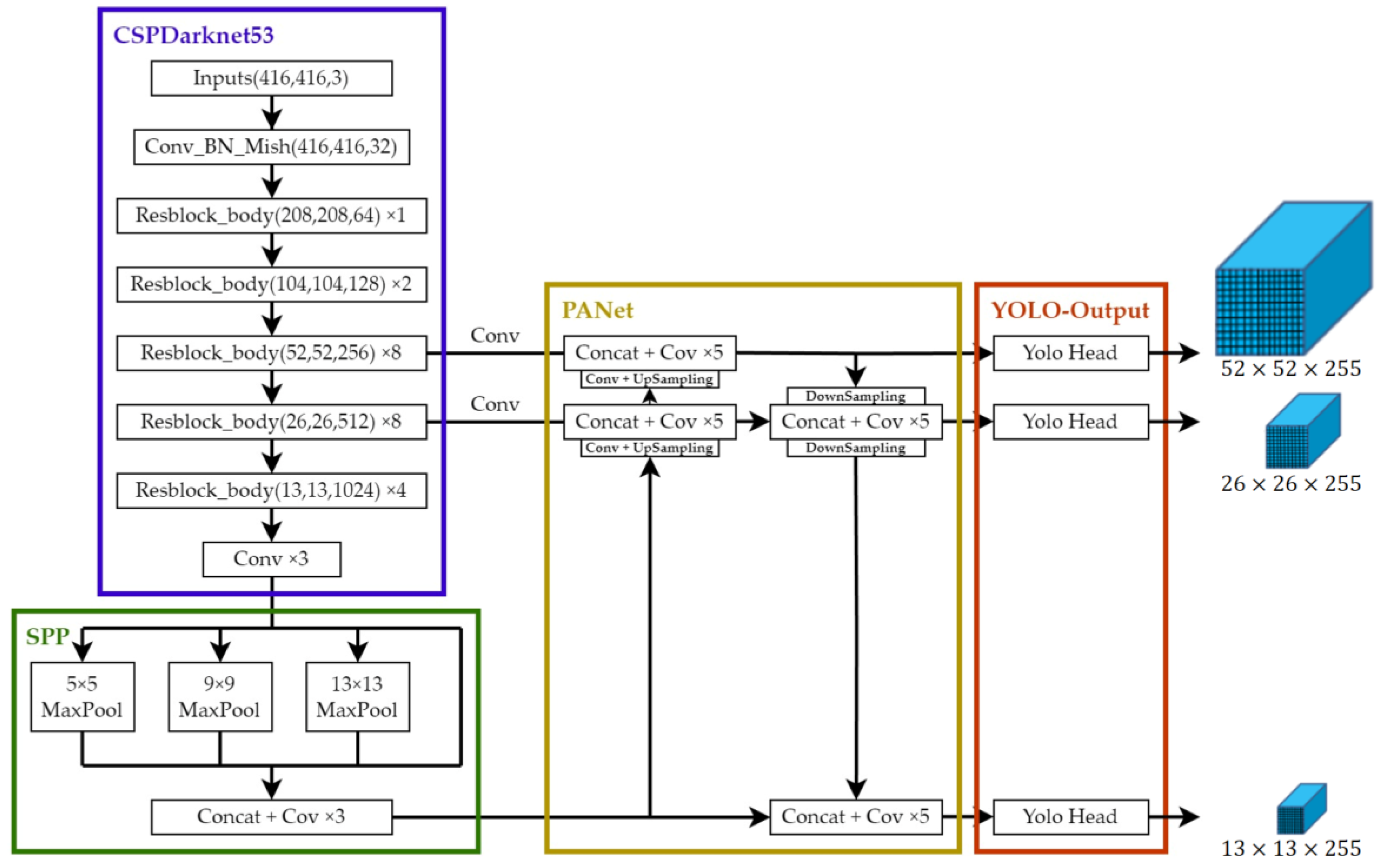
2.3. YOLO-v4 Machine Learning Model
- CSPDarknet53: The CSPDarknet53 layer is the entrance of the whole network, as part of the Backbone. (the blue frame part)
- SPP: Feature maps given before the last layer Concate of CSPDarknet53, as part of the Neck. (green frame part)
- PANet: The actions of sitting down and sampling and upsampling in PANet are also used here as part of the Neck.
- YOLO-Output: Finally, YOLO-Output outputs the final results, including the target position of the prediction frame and the reliability of the detection target. (Yellow frame part)
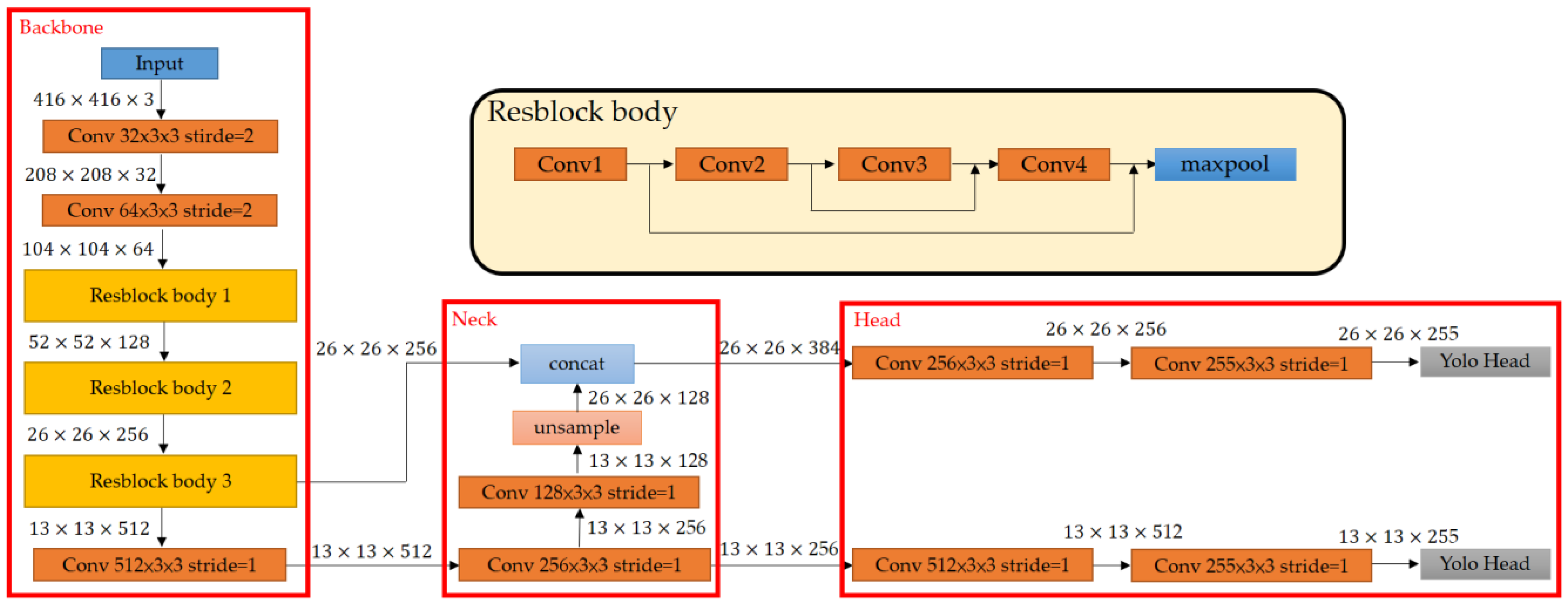
2.4. YOLO v4-Tiny Machine Learning Model
- Backbone
- Neck
- YOLO head
3. Materials and Methods
- It can effectively reduce the dimensionality of pictures with large amounts of data into small amounts of data.
- It can effectively retain image features and conform to the principles of image processing.
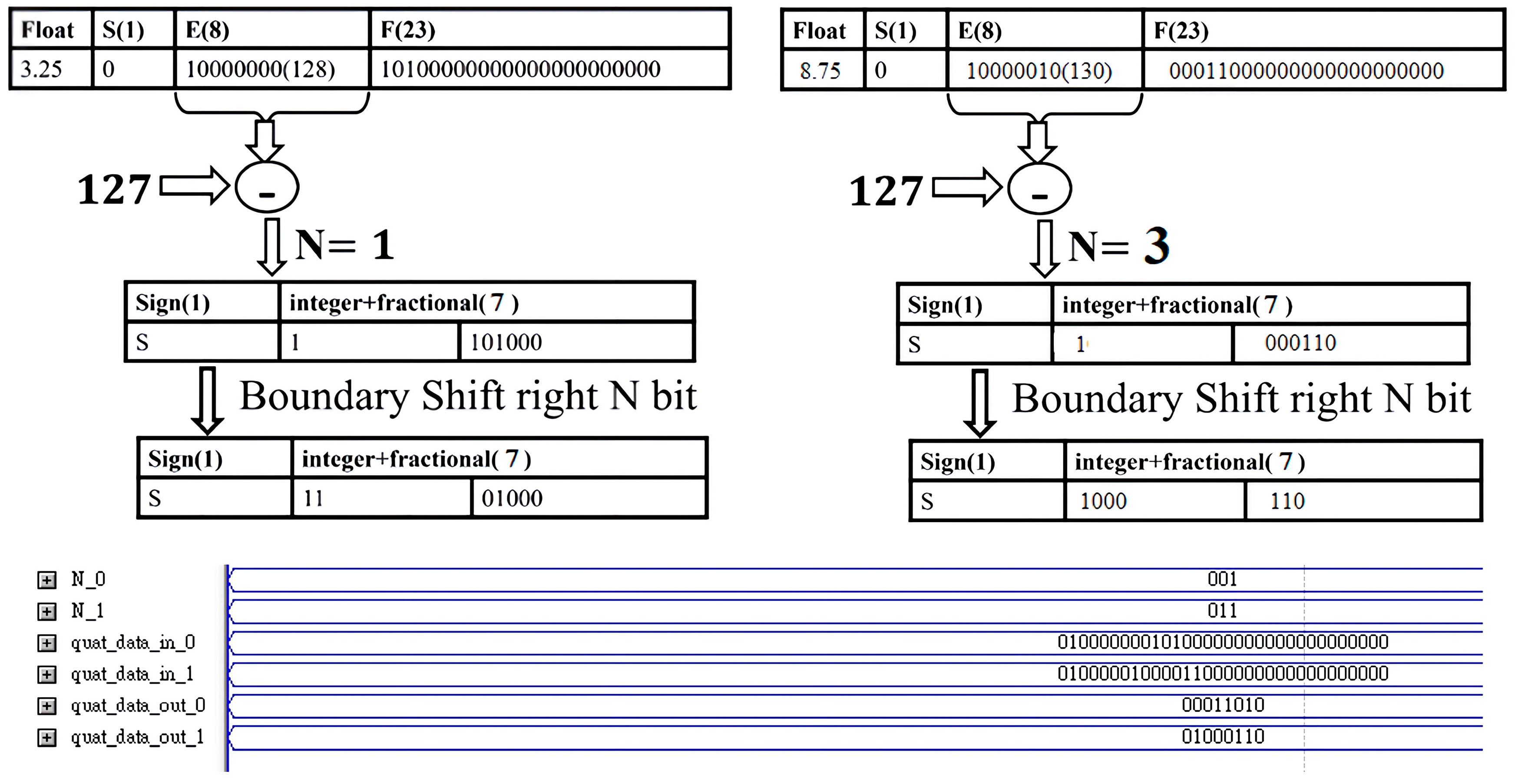
- Domain Quantization for saving storage and improving computing performance.
- CNN layers to be reduced, based on the YOLO v4-tiny model as the specific light CNN model to speed up object recognition computing.
- Data Parallelism programming method to be used for coding the CNN model to approach power-efficient computing in embedded systems.
4. Results
4.1. The Proposed Quantization Mechanism
4.2. Results of Quantization
4.3. Results of the Optimization of YOLO v4-Tiny Architecture
5. Discussion
6. Conclusions
Author Contributions
Funding
Data Availability Statement
Conflicts of Interest
References
- Meng, H.; Freeman, M.; Pears, N.; Bailey, C. Real-time human action recognition on an embedded, reconfigurable video processing architecture. J. Real-Time Image Process. 2008, 3, 163–176. [Google Scholar] [CrossRef] [Scilit]
- Molchanov, P.; Gupta, S.; Kim, K.; Pulli, K. Multi-sensor system for driver’s hand-gesture recognition. In Proceedings of the 11th IEEE Int. Conf. Workshops Autom. Face Gesture Recognit. (FG), Ljubljana, Slovenia, 4–8 May 2015; Volume 1, pp. 1–8. [Google Scholar]
- Qian, C.; Wu, Z.; Yang, Z.; Liu, Y.; Jamieson, K. Widar: Decimeterlevel passive tracking via velocity monitoring with commodity Wi-Fi. In Proceedings of the 18th ACM International Symposium on Mobile Ad Hoc Networking and Computing, New York, NY, USA, 10–14 July 2017. [Google Scholar]
- Li, C.; Liu, M.; Cao, Z. WiHF: Gesture and user recognition with WiFi. IEEE Trans. Mobile Comput. 2022, 21, 757–768. [Google Scholar] [CrossRef] [Scilit]
- Zhang, R.; Jiang, C.; Wu, S.; Zhou, Q.; Jing, X. Wi-Fi Sensing for Joint Gesture Recognition and Human Identification from Few Samples in Human-Computer Interaction. IEEE J. Sel. Areas Commun. 2022, 40, 2193–2205. [Google Scholar] [CrossRef] [Scilit]
- Shahzadm, M.; Zhang, S. Augmenting user identification with WiFi based gesture recognition. Proc. ACM Interact. Mob. Wearable Ubiquitous Technol. 2018, 2, 1–27. [Google Scholar] [CrossRef] [Scilit]
- Zhang, X.; Tao, M.; Tang, T.; Yang, J. Automatic Classification and Recognition Method based on Partially-Connected Differentiable Architecture Search for ISAC Systems. In Proceedings of the 2021 13th International Symposium on Antennas, Propagation and EM Theory (ISAPE), Zhuhai, China, 1–4 December 2021; pp. 1–3. [Google Scholar] [CrossRef] [Scilit]
- Ahmed, T.H.; Tiang, J.J.; Mahmud, A.; Do, D.-T. Proposed CtCNet-HDRNN: A Cornerstone in the Integration of 5G mmWave and DSRC for High-Speed Vehicular Networks. IEEE Access 2023, 11, 126482–126506. [Google Scholar] [CrossRef] [Scilit]
- De Lima, C.; Belot, D.; Berkvens, R.; Bourdoux, A.; Dardari, D.; Guillaud, M.; Isomursu, M.; Lohan, E.-S.; Miao, Y.; Barreto, A.N.; et al. Convergent Communication, Sensing and Localization in 6G Systems: An Overview of Technologies, Opportunities and Challenges. IEEE Access 2021, 9, 26902–26925. [Google Scholar] [CrossRef] [Scilit]
- Andy, S.; Rahardjo, B.; Hanindhito, B. Attack scenarios and security analysis of MQTT communication protocol in IoT system. In Proceedings of the 2017 4th International Conference on Electrical Engineering, Computer Science and Informatics (EECSI), Yogyakarta, Indonesia, 19–21 September 2017; pp. 19–21. [Google Scholar]
- Zhang, Q.; Wang, X.; Li, Z.; Wei, Z. Design and Performance Evaluation of Joint Sensing and Communication Integrated System for 5G mmWave Enabled CAVs. IEEE J. Sel. Top. Signal Process. 2021, 15, 1500–1514. [Google Scholar] [CrossRef] [Scilit]
- Pestana, D.; Miranda, P.R.; Lopes, J.D.; Duarte, R.P.; Vestias, M.P.; Neto, H.C.; De Sousa, J.T. A full featured configurable accelerator for object detection with YOLO. IEEE Access 2021, 9, 75864–75877. [Google Scholar] [CrossRef] [Scilit]
- Darknet Deep Learn Framework. Available online: https://github.com/AlexeyAB/darknet (accessed on 25 March 2022).
- Herrmann, V.; Knapheide, J.; Steinert, F.; Stabernack, B. A YOLO v3-tiny FPGA Architecture using a Reconfigurable Hardware Accelerator for Real-time Region of Interest Detection. In Proceedings of the 2022 25th Euromicro Conference on Digital System Design (DSD), Maspalomas, Spain, 31 August–2 September 2022; IEEE: Piscataway, NJ, USA, 2022; pp. 84–92. [Google Scholar]
- Lian, X.; Liu, Z.; Song, Z.; Dai, J.; Zhou, W.; Ji, X. High-Performance FPGA-Based CNN Accelerator with Block-Floating-Point Arithmetic. IEEE Trans. Very Large Scale Integr. (VLSI) Syst. 2019, 27, 1874–1885. [Google Scholar] [CrossRef] [Scilit]
- Koster, U.; Webb, T.; Wang, X.; Nassar, M.; Bansal, A.K.; Constable, W.; Elibol, O.; Hall, S.; Hornof, L.; Khosrowshahi, A.; et al. Flexpoint: An adaptive numerical format for efficient training of deep neural networks. arXiv 2017, arXiv:1711.02213. Available online: http://arxiv.org/abs/1711.02213 (accessed on 2 December 2017).
- Zhou, A.; Yao, A.; Guo, Y.; Xu, L.; Chen, Y. Incremental Network Quantization: Towards Lossless CNNs with Low-precision Weights. arXiv 2017, arXiv:1702.03044. [Google Scholar]
- Jiang, Z.; Zhao, L.; Li, S.; Jia, Y. Real-time object detection method based on improved YOLOv4-tiny. J. Netw. Intell. 2022, 7, 1–11. Available online: https://arxiv.org/abs/2011.04244 (accessed on 16 January 2023).
- Wang, H.; Sun, L. Design of static human posture recognition algorithm based on CNN. In Proceedings of the 2022 IEEE International Conference on Advances in Electrical Engineering and Computer Applications (AEECA), Dalian, China, 20–21 August 2022; pp. 890–894. [Google Scholar] [CrossRef] [Scilit]
- Paul, H.; Ferrari, V. End-to-end training of object class detectors for mean average precision. In Proceedings of the Computer Vision–ACCV 2016: 13th Asian Conference on Computer Vision, Taipei, Taiwan, 20–24 November 2016; pp. 198–213. [Google Scholar]



| Name | Type of Sensor | Application | Recognition Technology | Disadvantages | Advantages | Recognition Rate |
|---|---|---|---|---|---|---|
| Traditional hand/face recognition [19] | Optical camera | hand/face recognition | Various types of CNN models | only suitable for static objects, incapable of posture movement or changes, dependent on light sources | actual images are obtained, the highest recognition rate | about 90~100% |
| Multi-sensor [2] | Optical/depth camera Radar | hand recognition | DNN combining of Con3D | higher interdependence among sensors affected by environmental conditions | enhance a certain level of recognition accuracy without environmental influence | about 75–93% |
| Widar3.0 [5] | Wi-Fi | hand recognition, Person localization | CNN-LSTM combining of Con3D | Environmental noise reduces recognition rates, especially for subtle gestures. | Capable of using existing devices without the need for retraining gestures. | about 92.7% |
| This paper | mmWave | pose/gesture recognition, Person localization, heartbeat detection | YOLO-v4 YOLO-tiny | need to involve moving objects, overlapping objects are harder to distinguish | unaffected by environmental conditions, can expedite computations through quantization methods | about 92–95% |
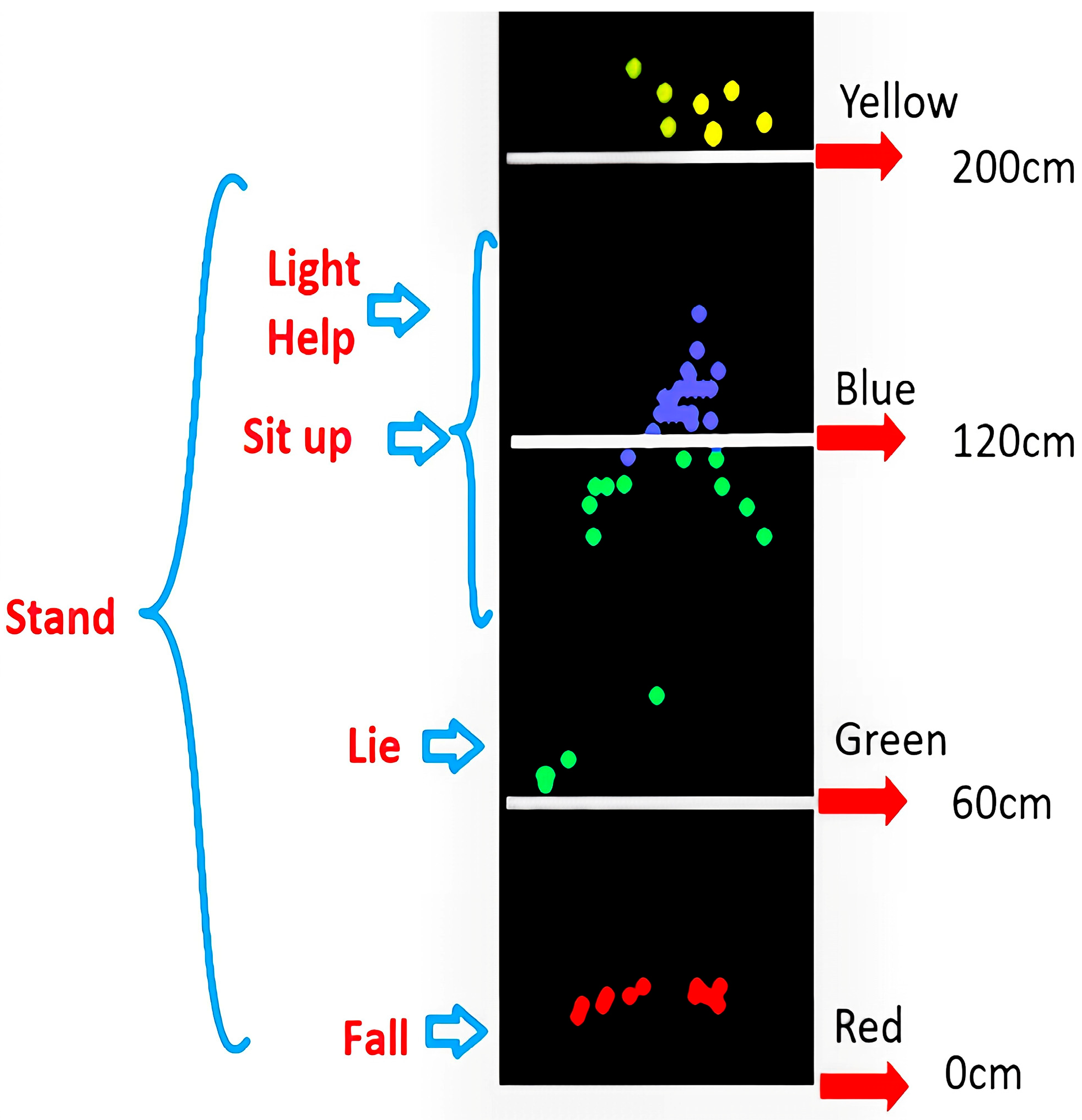
| Coloring Mapped Table | ||||
|---|---|---|---|---|
| Height | 0~60 cm | 60~110 cm | 110~220 cm | Over 220 cm |
| color | Red | Green | Blue | Yellow |
| Stand | Sit | Lie | Help | Light | Fall | |
|---|---|---|---|---|---|---|
| Stand | 60% | 30% | 0% | 10% | 0% | 0% |
| Sit | 30% | 60% | 0% | 8% | 2% | 0% |
| Lie | 0% | 0% | 40% | 0% | 20% | 40% |
| Help | 10% | 8% | 0% | 82% | 0% | 0% |
| Light | 0% | 2% | 20% | 0% | 50% | 28% |
| Fall | 0% | 0% | 40% | 0% | 28% | 32% |
| Stand | Sit | Lie | Help | Light | Fall | |
|---|---|---|---|---|---|---|
| Stand | 99% | 1% | 0% | 0% | 0% | 0% |
| Sit | 1% | 98% | 0% | 0% | 1% | 0% |
| Lie | 0% | 0% | 97% | 0% | 1% | 2% |
| Help | 0% | 0% | 0% | 97% | 3% | 0% |
| Light | 0% | 1% | 1% | 3% | 94% | 1% |
| Fall | 0% | 0% | 2% | 0% | 1% | 97% |
| Model | Computer Type | Data Type | Time (per Picture) | Accuracy | Improvement |
|---|---|---|---|---|---|
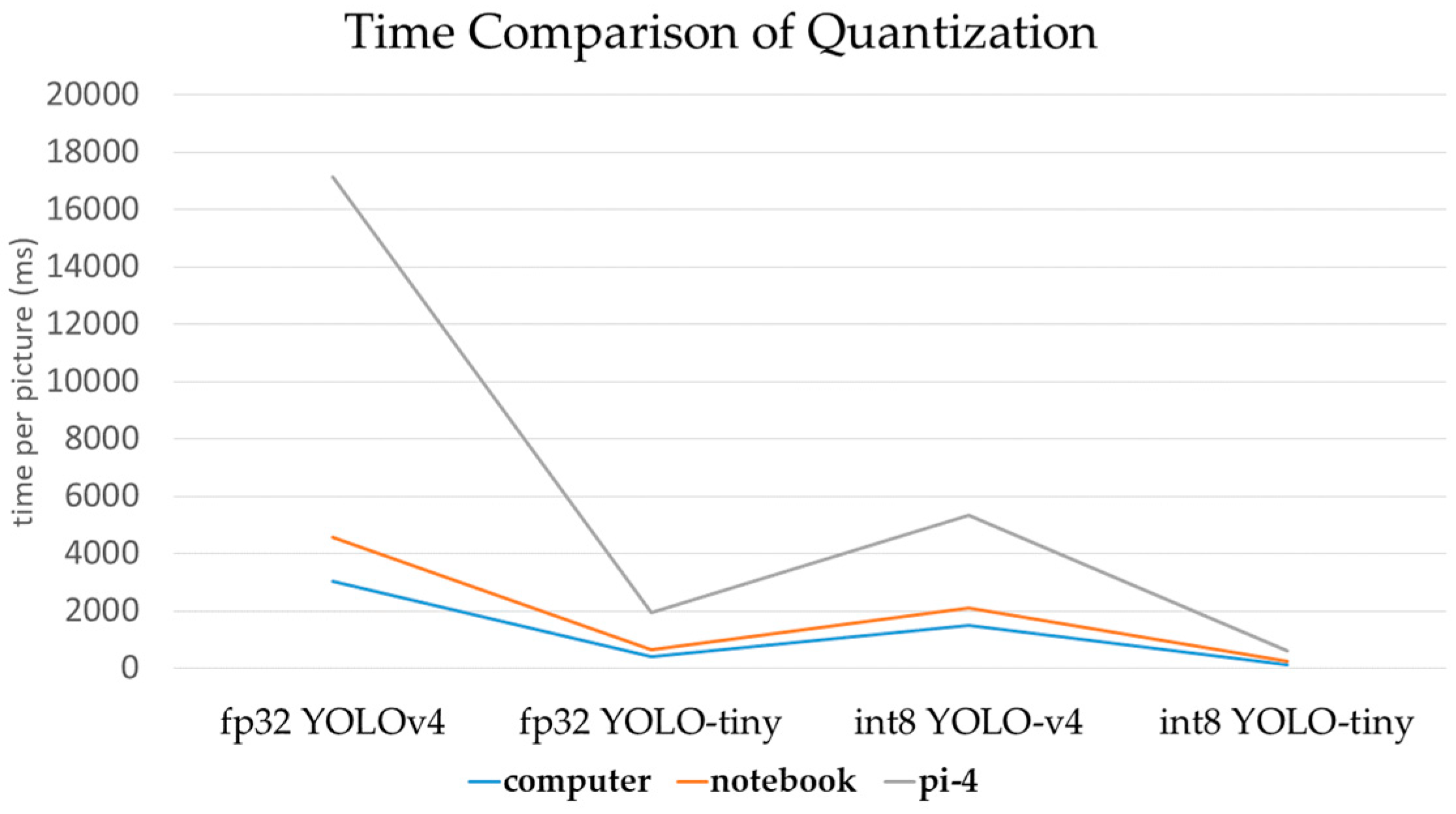
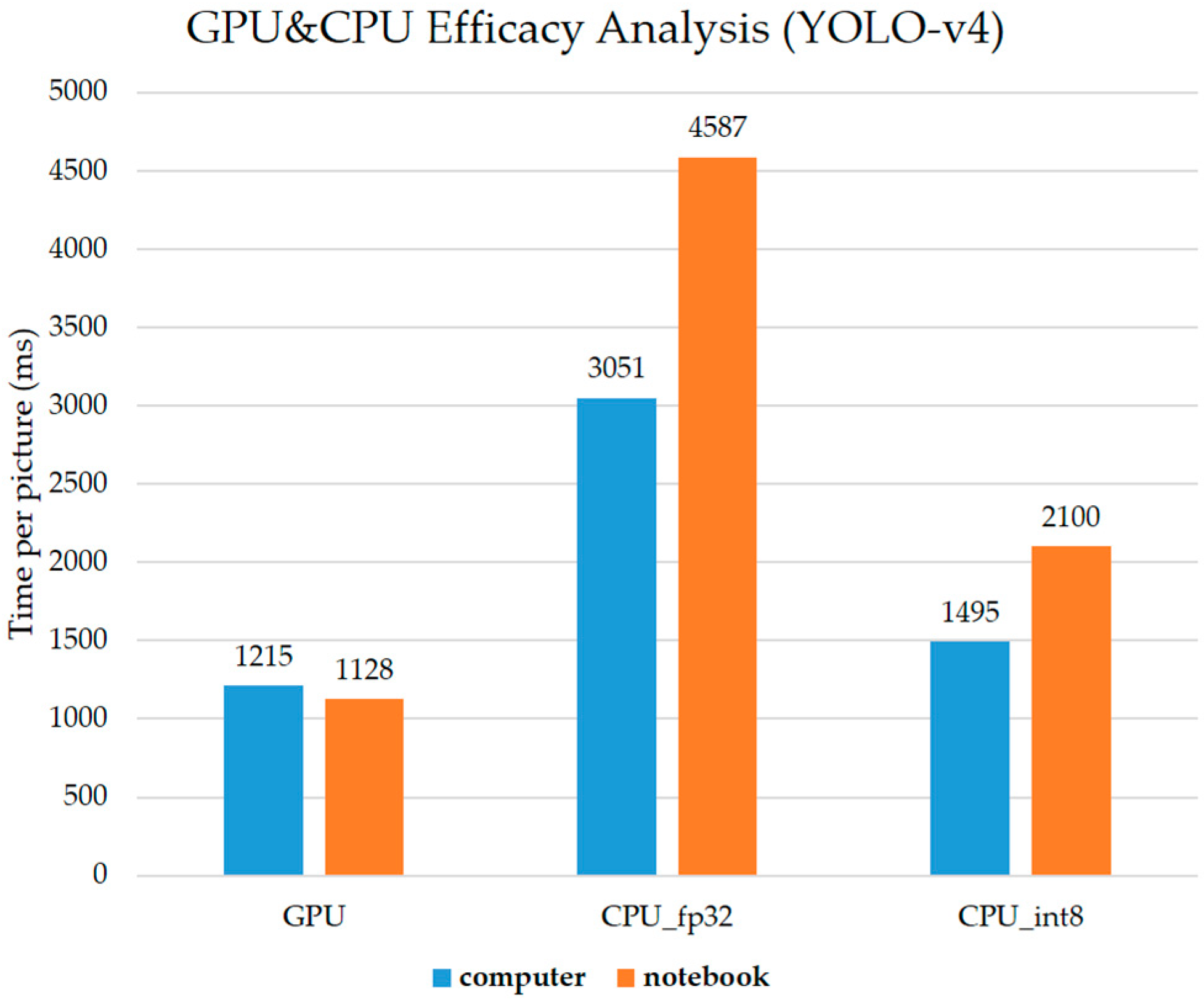
| YOLO-v4 (161 layers) | Computer Intel i7-6700 | float32 | 3051 ms | 98.7% | 1556 ms Up to 2.04 times |
| int8 | 1495 ms | 98% | |||
| Notebook Intel i5-5200 | float32 | 4587 ms | 99.2% | 2487 ms Up to 2.18 times | |
| int8 | 2100 ms | 99.1% | |||
| pi-4 ARM Cortex-A72 | float32 | 17,144 ms | 99.2% | 11,793 ms Up to 3.2 times | |
| int8 | 5351 ms | 99.1% | |||
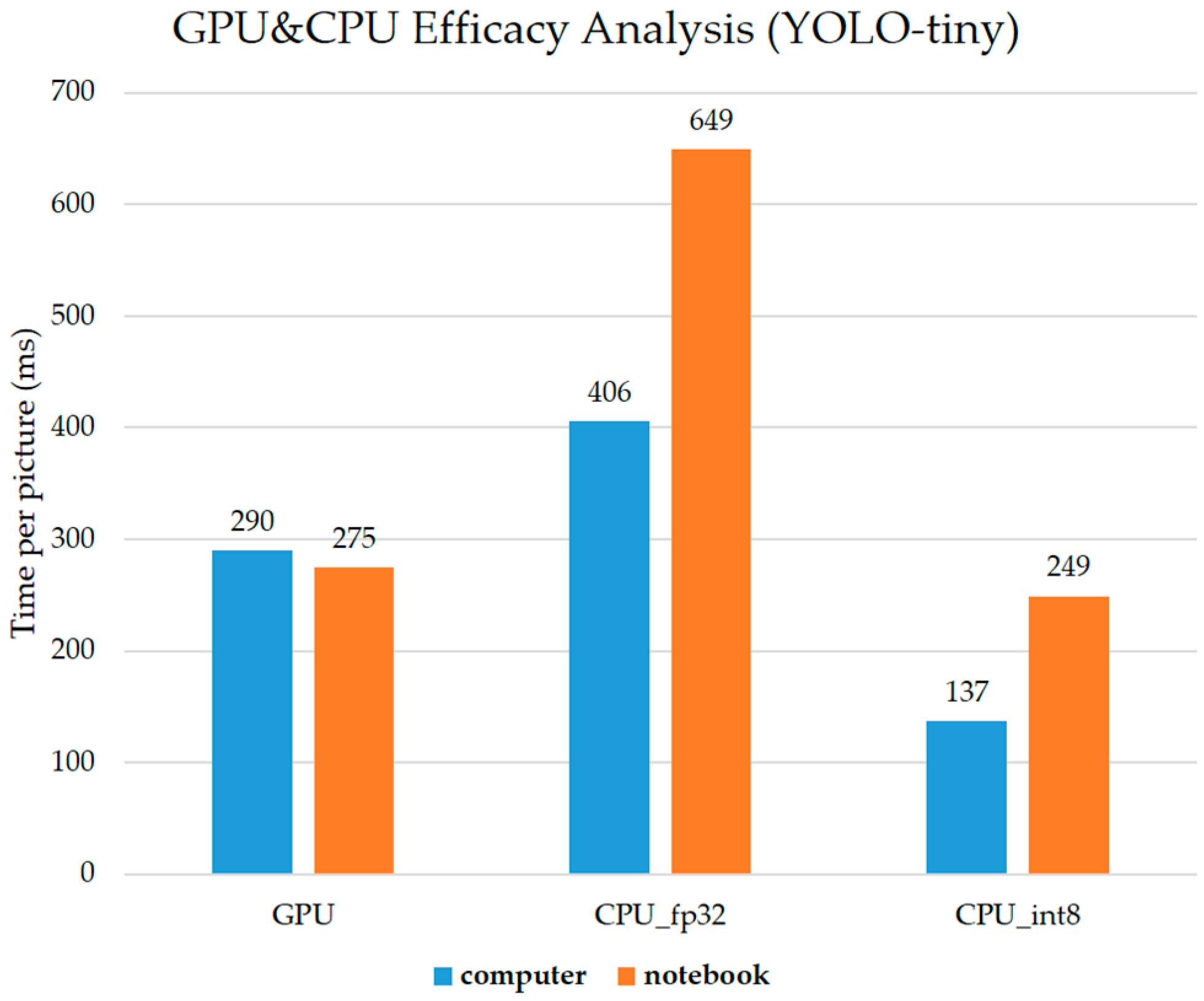
| YOLO-v4 tiny (38 layers) | Computer Intel i7-6700 | float32 | 406 ms | 95.2% | 269 ms Up to 2.96 times |
| int8 | 137 ms | 94.1% | |||
| Notebook Intel i5-5200 | float32 | 649 ms | 95.3% | 400 ms Up to 2.6 times | |
| int8 | 249 ms | 92.8% | |||
| pi-4 ARM Cortex-A72 | float32 | 1944 ms | 95.4% | 1338 ms Up to 3.2 times | |
| int8 | 606 ms | 92.8% |
| YOLO-v4 Tiny Architecture | mAP(@0.50) |
|---|---|
| Original | 0.562309 |
| Reduce the Resblock body 1 to 1 convolution operation | 0.170274 |
| Reduce the Resblock body 2 to 1 convolution operation | 0.477842 |
| Reduce the Resblock body 3 to 2 convolution operation | 0.548834 |
| Reduce the Resblock body 2 and 3 to 3 convolution operation | 0.421765 |
Disclaimer/Publisher’s Note: The statements, opinions and data contained in all publications are solely those of the individual author(s) and contributor(s) and not of MDPI and/or the editor(s). MDPI and/or the editor(s) disclaim responsibility for any injury to people or property resulting from any ideas, methods, instructions or products referred to in the content. |
© 2024 by the authors. Licensee MDPI, Basel, Switzerland. This article is an open access article distributed under the terms and conditions of the Creative Commons Attribution (CC BY) license (https://creativecommons.org/licenses/by/4.0/).
Share and Cite
Chiu, J.-C.; Lee, G.-Y.; Hsieh, C.-Y.; Lin, Q.-Y. Design and Implementation of Nursing-Secure-Care System with mmWave Radar by YOLO-v4 Computing Methods. Appl. Syst. Innov. 2024, 7, 10. https://doi.org/10.3390/asi7010010
Chiu J-C, Lee G-Y, Hsieh C-Y, Lin Q-Y. Design and Implementation of Nursing-Secure-Care System with mmWave Radar by YOLO-v4 Computing Methods. Applied System Innovation. 2024; 7(1):10. https://doi.org/10.3390/asi7010010
Chicago/Turabian StyleChiu, Jih-Ching, Guan-Yi Lee, Chih-Yang Hsieh, and Qing-You Lin. 2024. "Design and Implementation of Nursing-Secure-Care System with mmWave Radar by YOLO-v4 Computing Methods" Applied System Innovation 7, no. 1: 10. https://doi.org/10.3390/asi7010010
APA StyleChiu, J.-C., Lee, G.-Y., Hsieh, C.-Y., & Lin, Q.-Y. (2024). Design and Implementation of Nursing-Secure-Care System with mmWave Radar by YOLO-v4 Computing Methods. Applied System Innovation, 7(1), 10. https://doi.org/10.3390/asi7010010