Skip to Content

Dynamics

Dynamics is an international, peer-reviewed, open access journal on physical process.
Dynamics is published quarterly online by MDPI.

Get Alerted

Add your email address to receive forthcoming issues of this journal.

All Articles (196)

Simulated spiking neural networks have been explored for over a hundred years. Many of these networks are driven by biological considerations and an attempt to simulate brains, but others are used with little biological consideration. This paper gives some history of the development of spiking neural models, their use for modelling biological and cognitive phenomena, and for machine learning. It introduces the current state of the art in computational biological neuron and synapse modelling and plasticity. It introduces and reviews balanced spiking networks and their engineering applications. Spiking networks are also used for machine learning, with the hope that their implementation on neuromorphic hardware will bring energy and time savings. Similarly, neuromorphic hardware can enable massive parallelism, supporting larger spiking networks. The use of spiking nets for machine learning, both with biologically plausible models and without, is discussed, showing that effective models already exist. The paper concludes with some notes about implementing spiking nets and a discussion including open questions and future work.

17 March 2026
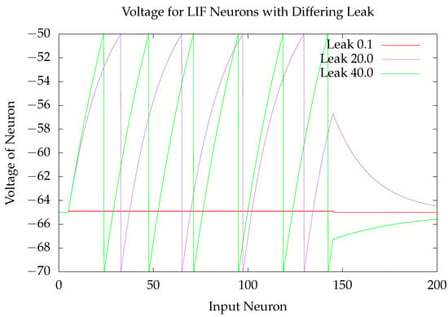
Voltage of three LIF neurons with uniform input and varying leak (retention). The 0.1 line is, in essence, an IF neuron with almost no energy retained from step to step. The input to all three neurons is the same, direct current. As the voltage increases, neurons reach the threshold (−50.0) and reset to (−70.0).

The growing need to safeguard sensitive data in various fields, including in relation to education, banking over the phone, private voice conferences, and the military, has grown as dependence on technology in daily life has increased. Encryption schemes based on chaotic systems are among the most commonly utilized approaches in the security field due to their high levels of safety and reliability. This study proposes a secure audio encryption framework based on the Chameleon chaotic algorithm implemented on a Xilinx ZedBoard Zynq-7000 FPGA. The system was designed using a fixed-point arithmetic format with 32-bit precision (eight integers; 24 fractional bits) with the Xilinx System Generator in MATLAB Simulink R2021b and verified using Vivado. The Chameleon Chaotic System, characterized by its transition from self-excited to hidden attractors through parameter variation, adds complexity to the system dynamics and strengthens the encryption algorithm. The Adaptive Feedback Control technique was applied to synchronize the signals. These methods enhance the security of audio data by ensuring robust and fast synchronization during transmission. The performance of the proposed system was assessed using correlation analysis, the mean squared error, histogram analysis, and audio spectrogram analysis. The system demonstrated strong encryption capabilities with low correlation values (−0.0033). In decryption, they achieved high fidelity with a correlation exceeding 0.999 in noise-free conditions and above 0.9933 under 20 dB AWGN. Adaptive Feedback Control showed superior decryption precision with lower MSEU and higher PSNR, confirming its effectiveness under noisy environments.

7 March 2026

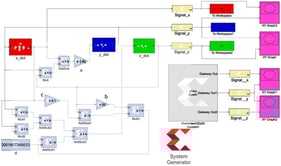
The chaotic Chameleon system (1) is designed under MATLAB-Simulink environment.

Stability Analysis and Chaos Control of Permanent-Magnet Synchronous Motor

  • Ahmed Sadeq Hunaish,
  • Fatma Noori Ayoob and
  • Viet-Thanh Pham
  • + 1 author

This paper investigates the dynamics of a permanent magnet synchronous motor (PMSM) and controls its chaotic speed behavior using the synergetic control technique (SCT). The model includes electrical dynamics in the dq frame and mechanical speed dynamics, with a scalar parameter γ capturing cross-coupling effects. The equilibrium structure and local stability properties of the PMSM are analyzed. For zero input voltages and zero load torque, the system exhibits a pitchfork-type bifurcation in the electrical–mechanical equilibrium as γ crosses a critical value. Explicit expressions are derived for all equilibria, and their stability is characterized using eigenvalue analysis and the Routh–Hurwitz criterion, and a secondary loss of stability via a Hopf-type mechanism is identified. The case of nonzero input voltages with zero load torque is also discussed. Numerical simulations confirm the analytical results and highlight the parameter regions that admit stable operation. Bifurcation diagrams show the different PMSM behaviors as the parameter γ varies. For a certain interval of γ, the PMSM speed undergoes chaotic oscillations. The SCT is introduced to control the chaos. Macro variables are chosen to design the SCT. The derived SCT is implemented to eliminate the chaotic speed. The controller provides good performance in suppressing the chaos. The controller is tested under sudden reference speed change where the controller gets the new reference speed accurately. It is also evaluated under sudden and sinusoidal load torque variations.

5 March 2026

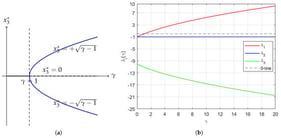
(a) Equilibrium bifurcation diagram of 
  
    x
    3
    ★
  
 versus 
  γ
 for the PMSM model (9). A pitchfork-type branching occurs at 
  
    γ
    =
    1
  
, generating two nonzero equilibria. (b) Eigenvalue trajectories of the linearization 
  
    
      J
      0
    
    
      (
      γ
      )
    
  
 at the origin as 
  γ
 varies. Stability is lost at 
  
    γ
    =
    1
  
 when one eigenvalue crosses zero.

We study the Cauchy problem for a loaded fractional integro-differential equation with a time-dependent diffusion coefficient. By reducing the problem to an equivalent Volterra integral equation of the second kind, we derive explicit analytical representations of solutions under appropriate regularity assumptions. The construction of the associated resolvent kernel allows us to establish existence and uniqueness results and to investigate the role of the fractional order and the loading term in the solution structure. Two illustrative examples are presented to demonstrate the applicability of the proposed approach.

14 February 2026

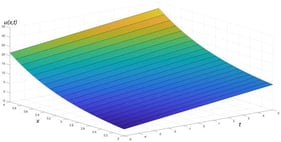
Three-dimensional surface plot of the solution 
  
    u
    (
    x
    ,
    t
    )
  
 of problem (5) and (6). The x-axis represents the spatial variable x, the t-axis represents time t, and the vertical axis corresponds to the solution values 
  
    u
    (
    x
    ,
    t
    )
  
.

News & Conferences

Volumes

Latest Issues

Open for Submission

Editor's Choice

Reprints of Collections

Nonlinear Phenomena, Chaos, Control and Applications to Engineering and Science and Experimental Aspects of Complex Systems
Reprint

Nonlinear Phenomena, Chaos, Control and Applications to Engineering and Science and Experimental Aspects of Complex Systems

Editors: José Manoel Balthazar, Angelo Marcelo Tusset, Átila Madureira Bueno, Diego Colón, Marcus Varanis
XFacebookLinkedIn
Dynamics - ISSN 2673-8716