

- Entry

Training Doctoral Researchers for Applied Computing Research: Design Science and Action Research in International Contexts
- Maurice Dawson and
- Samson Quaye
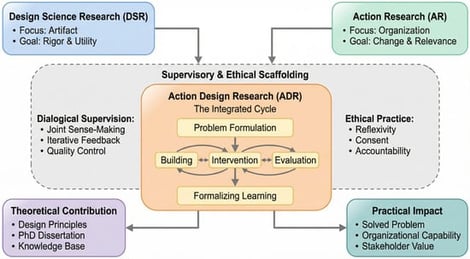
Doctoral training in applied computing and information systems is the structured development of a researcher’s capacity to produce original, rigorous, and scholarship that is relevant to practice, supported through doctoral supervision, which provides academic guidance for research design decisions, progress management, scholarly quality, and researcher development. In this setting, Design Science Research (DSR) is a methodology that generates knowledge through the purposeful design and evaluation of an artifact intended to address a defined problem. In parallel, Action Research (AR) generates knowledge through collaborative, iterative cycles of planned action and critical reflection conducted with stakeholders in real settings. Bringing both traditions together, Action Design Research (ADR) integrates DSR and AR by developing and evaluating artifacts through participatory cycles focused on intervention while maintaining explicit expectations of rigor and contribution. These approaches are often used in international or study abroad research contexts, which are research environments spanning national, cultural, institutional, or governance boundaries and therefore require adaptive methods, careful ethical attention, and sustained stakeholder engagement. This synthesis results in an integrated methodological framework that positions Action Design Research as a supervisory scaffold for doctoral training in applied computing and information systems. The framework integrates Design Science Research and Action Research within an iterative cycle embedded in dialogical supervision and ethical reflexivity. It contributes a structured model for aligning methodological rigor, doctoral learning, and practical impact in complex and international research environments.
20 March 2026