Skip to Content

Engineering Proceedings

Engineering Proceedings is an open access journal dedicated to publishing findings resulting from conferences, workshops, and similar events, in all areas of engineering.
The conference organizers and proceedings editors are responsible for managing the peer-review process and selecting papers for conference proceedings.

Get Alerted

Add your email address to receive forthcoming issues of this journal.

All Articles (6,876)

  • Proceeding Paper
  • Open Access

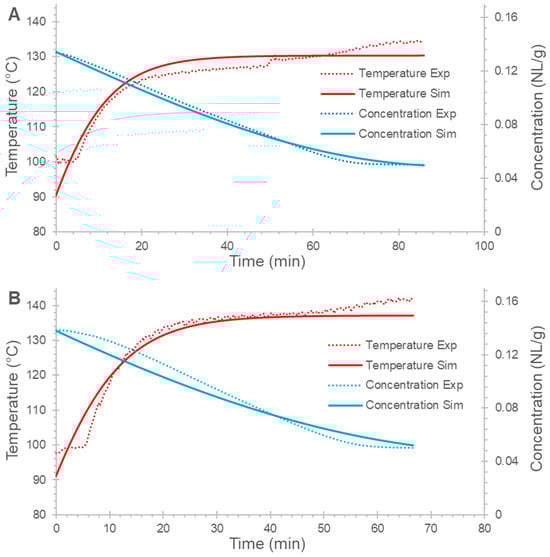
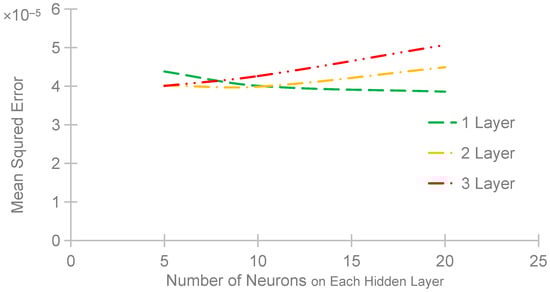
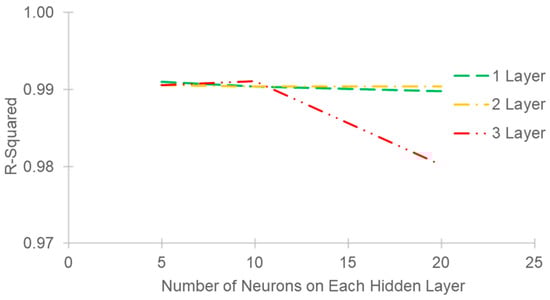
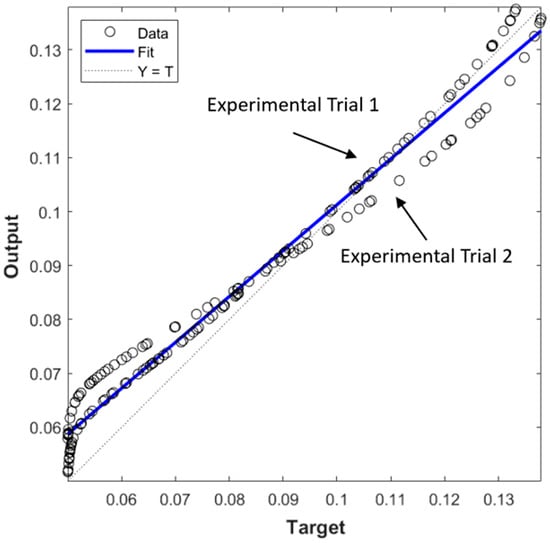
With hydrogen as a clean but hazardous energy carrier, solid-state hydrogen storage in the form of a metal hydride has come forth as a safe and low-pressure storage solution with competitive volumetric energy density. This paper reports the modelling of a metal hydride reactor during its discharge state using neural network regression. This was done by generating a validated finite element model of the reactor, which was then used to generate dynamic operational data based on the desired pressure outlet and heating fluid temperature as independent variables. The best-performing neural network model validation using the experimentally observed data achieved a regression coefficient of 0.99 and a mean squared error of less than 10−4. This predictive model, with further refinement, can be implemented to allow for predictive control, which has always been a challenge through conventional means due to the batch nature of the system. Moreover, the hydrogen concentration as stored in a solid-state measurement would be too expensive for industrial applications.

20 March 2026

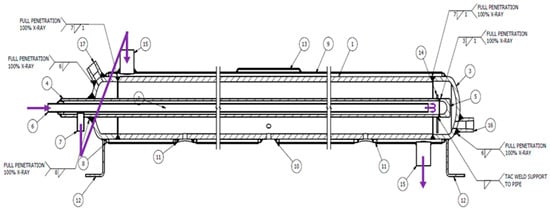
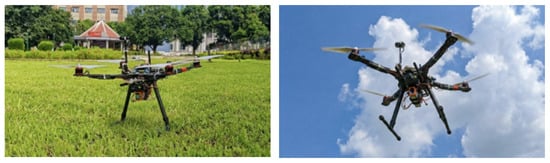
Schematic diagram of a hydride-based hydrogen compressor.
  • Proceeding Paper
  • Open Access

The escalating accumulation of pharmaceutical micropollutants in global water systems represents a significant challenge to current circular economy frameworks, highlighting a critical gap in the management of environmental persistence. Although advanced remediation technologies are often proposed to mitigate this crisis, their engineering optimization is frequently compromised by a reliance on empirical approximations rather than precise physicochemical constants. Addressing this fundamental deficit, this study executes a rigorous determination of mass transfer properties for two ubiquitous contaminants: Butylparaben and Triclosan. Utilizing a high-precision electrolytic conductance method under infinite dilution, we investigated transport dynamics across varying temperature gradients (305.15–319.15 K). Experimental data were subjected to advanced mathematical modeling, where the Modified Robinson–Stokes (MRS) quadratic model significantly outperformed classical linear approaches (R2>0.98), accurately capturing non-ideal solute–solvent interactions. The derived limiting molar conductivities facilitated the calculation of infinite dilution diffusion coefficients via the Nernst–Haskell equation, yielding values of 0.99×10⁸ m2/s for Butylparaben and 0.98×10⁸ m2/s for Triclosan. Furthermore, Stokes–Einstein analysis quantified the hydrodynamic radii, elucidating the steric mechanisms governing the sluggish migration of bulky chlorinated ethers compared to single-ring esters. These precise transport parameters are not merely theoretical values; they are essential inputs for developing accurate computational fate models and designing regenerable separation processes, thereby providing the hard physics required to engineer solutions for the perpetual pollution era.

19 March 2026

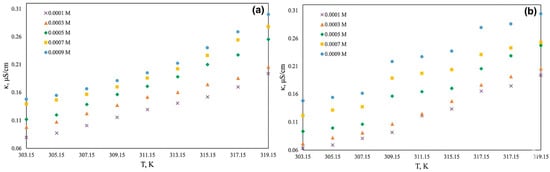
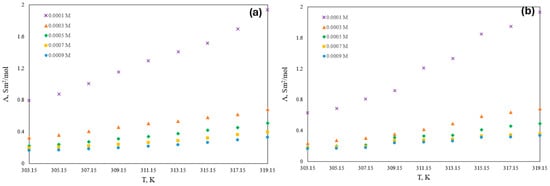
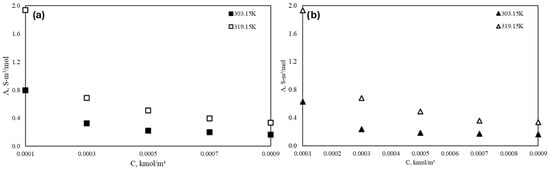
Measured electrolytic conductivities of (a) Butylparaben and (b) Triclosan.
  • Proceeding Paper
  • Open Access

Biometrics and Cybersecurity: Beyond Passwords for Digital Protection

  • José Portillo-Portillo,
  • Aldo Hernández Suárez and
  • Jesús Olivares Mercado
  • + 2 authors

During the early years of interaction between humans and computer systems, user authentication and identification was carried out with the support of knowledge-based factors (something the user knows: passwords, PINs, etc.) and tokens (something the user possesses: credentials, RFID cards, etc.) or a combination of both. In other words, the user presents a token and a password to the system in order to gain access. These solutions pose major challenges: Knowledge-based systems, which rely on secrets like passwords, are vulnerable to those secrets being guessed, shared, or forgotten. On the other hand, tokens are also vulnerable; some, despite implementing encryption, attract cyber attackers who can forge them, and users can share or lose them. In the search for more robust methods, the use of biometrics has been considered.

20 March 2026

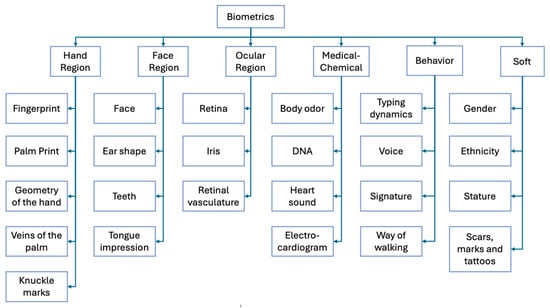
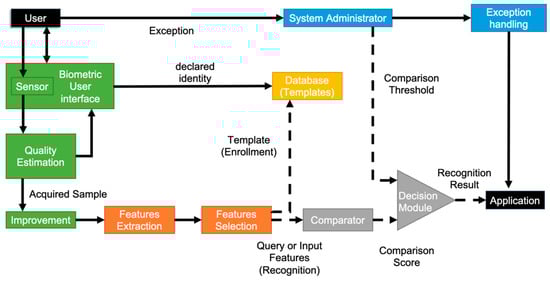
Separation of biometric features by body region and/or related groups.
  • Proceeding Paper
  • Open Access

Emerging Environmental Pollutants and Diabetes: A Pilot Study on PFASs in a South African Mixed-Ancestry Population

  • John Baptist Nzukizi Mudumbi,
  • Seteno Karabo Obed Ntwampe and
  • Tandi Edith Matsha
  • + 4 authors

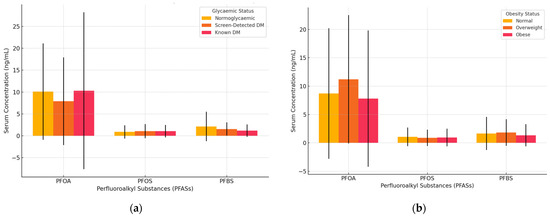
Per- and polyfluoroalkyl substances (PFASs) are synthetic chemicals widely used in industrial applications and consumer products due to their thermal stability and resistance to degradation. These properties also contribute to their environmental persistence and potential adverse health effects. Despite increasing global concern regarding PFAS exposure, biomonitoring data from African populations remain limited. This study investigated the serum concentrations of perfluorooctanoic acid (PFOA), perfluorooctanesulfonate (PFOS), and perfluorobutane sulfonate (PFBS), and their association with diabetes mellitus (DM) in a mixed-ancestry population from Bellville South, Cape Town, South Africa. Serum samples (n = 179) were analysed using liquid chromatography–tandem mass spectrometry (LC–MS-8030), and statistical analyses were performed using STATISTICA 13.5 software. All three PFASs were detected in 100% of samples, with PFOA exhibiting the highest mean concentration (9.43 ± 13.16 ng/mL), followed by PFBS and PFOS. PFAS concentrations were generally higher in females than in males, with significantly elevated PFOA levels observed among women (p = 0.0116). No statistically significant associations were identified between PFAS concentrations and glycemic status, obesity, or related metabolic indicators (p > 0.05). However, PFOS showed a modest positive correlation with HbA1c in females, suggesting potential gender-specific interactions. These findings confirm measurable PFAS exposure in the South African population and highlight the need for larger longitudinal studies implications.

17 March 2026

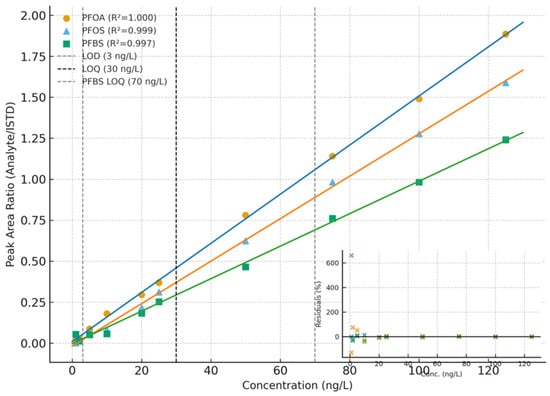
Procedural blank matrix-matched calibration curves for PFOA, PFOS, and PFBS (ng/L). The residuals inset displays the percentage deviation of each calibration point from the fitted linear regression model for PFOA (blue), PFOS (orange), and PFBS (green). Random distribution of residuals around zero confirms the suitability of the linear calibration model.

News & Conferences

Latest Issues

Open for Submission

Editor's Choice

Reprints of Collections

2nd International Conference on Green Aviation (ICGA 2024)
Reprint

2nd International Conference on Green Aviation (ICGA 2024)

Editors: Weihong Zhang, Shichun Yang, Leiting Dong, Xungang Diao, Shijun Yin, Lixin Guan, Zuxi Xia, Xue Zhang
2024 IEEE 7th International Conference on Knowledge Innovation and Invention
Reprint

2024 IEEE 7th International Conference on Knowledge Innovation and Invention

Editors: Teen-Hang Meen, Chun-Yen Chang, Cheng-Fu Yang
XFacebookLinkedIn
Eng. Proc. - ISSN 2673-4591