
Fluids 2026, 11(4), 92; https://doi.org/10.3390/fluids11040092 - 30 Mar 2026
Abstract
This paper investigates the combustion dynamics of interacting lazy multi-component gas plumes (i.e., buoyancy-dominated gas releases with a low initial momentum flux), a configuration relevant to coal mining waste emissions. By coupling a three-dimensional large eddy simulation (mesh size of 10−2 m;
[...] Read more.
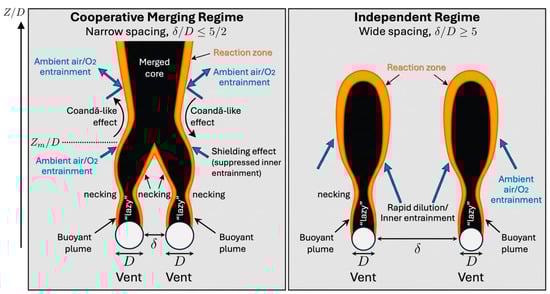
This paper investigates the combustion dynamics of interacting lazy multi-component gas plumes (i.e., buoyancy-dominated gas releases with a low initial momentum flux), a configuration relevant to coal mining waste emissions. By coupling a three-dimensional large eddy simulation (mesh size of 10−2 m; paralleling with 2048 processors) with detailed chemical kinetics (GRI-Mech 3.0), we analyzed the sensitivity of the flow structure and plume stabilization to the vent spacing of twin hydrogen-rich multi-component gas plumes (H2-CO-CH4-air). The results identified a distinct topological transition. While gas plumes from vents spaced at
(This article belongs to the Special Issue 10th Anniversary of Fluids—Recent Advances in Fluid Mechanics)
►
Show Figures
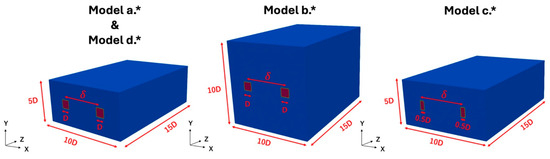
Figure 1