


Skip to Content

Future Internet

Future Internet is an international, peer-reviewed, open access journal on internet technologies and the information society, published monthly online by MDPI.

Quartile Ranking JCR - Q2 (Computer Science, Information Systems)

Get Alerted

Add your email address to receive forthcoming issues of this journal.

All Articles (3,320)

Differentially Private Federated Learning with Adaptive Clipping Thresholds

  • Jianhua Liu,
  • Yanglin Zeng and
  • Yao Tong
  • + 2 authors

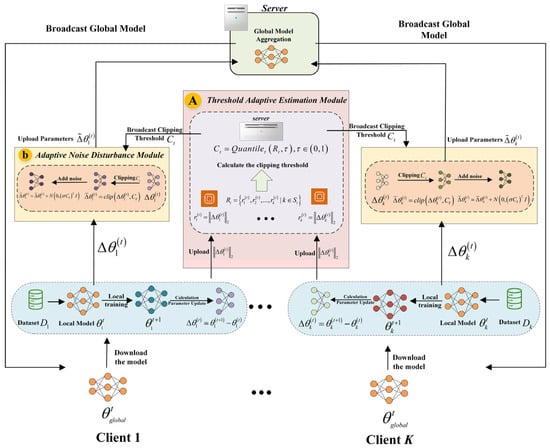
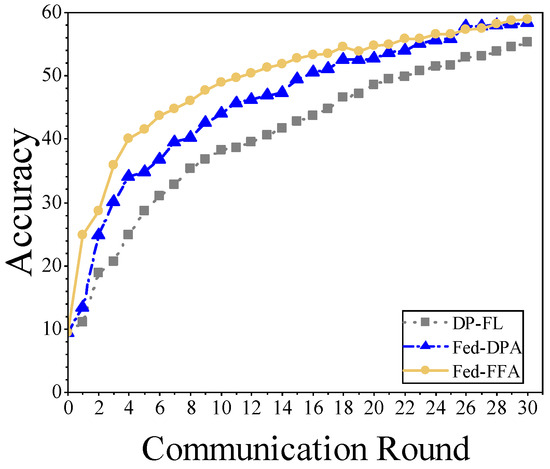
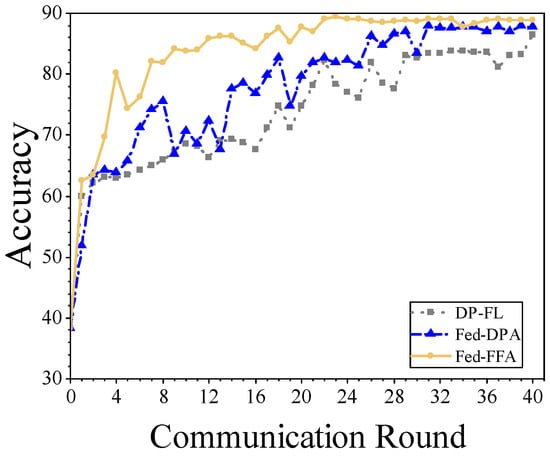
Under non-independent and identically distributed (Non-IID) conditions, significant variations exist in local model updates across clients and training phases during the collaborative modeling process of differential privacy federated learning (DP-FL). Fixed clipping thresholds and noise scales struggle to accommodate these diverse update differences, leading to mismatches between local update intensity and noise perturbations. This imbalance results in data privacy leaks and suboptimal model accuracy. To address this, we propose a differential privacy federated learning method based on adaptive clipping thresholds. During each communication round, the server adaptively estimates the global clipping threshold for that round using a quantile strategy based on the statistical distribution of client update norms. Simultaneously, clients adaptively adjust their noise scales according to the clipping threshold magnitude, enabling dynamic matching of clipping intensity and noise perturbation across training phases and clients. The novelty of this work lies in a quantile-driven, round-wise global clipping adaptation that synchronizes sensitivity bounding and noise calibration across heterogeneous clients, enabling improved privacy–utility behavior under a fixed privacy accountant. Using experimental results on the rail damage datasets, our proposed method slightly reduces the attacker’s MIA ROC-AUC by 0.0033 and 0.0080 compared with Fed-DPA and DP-FedAvg, respectively, indicating stronger privacy protection, while improving average accuracy by 1.55% and 3.35% and achieving faster, more stable convergence. We further validate its effectiveness on CIFAR-10 under non-IID partitions.

14 March 2026

Schematic of the adaptive clipping differentially private federated learning framework.

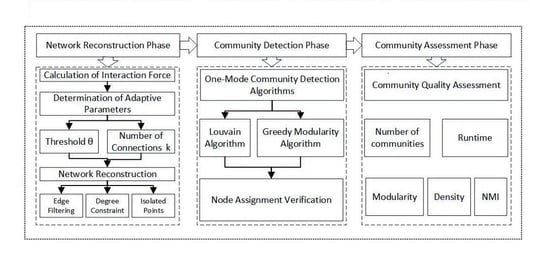
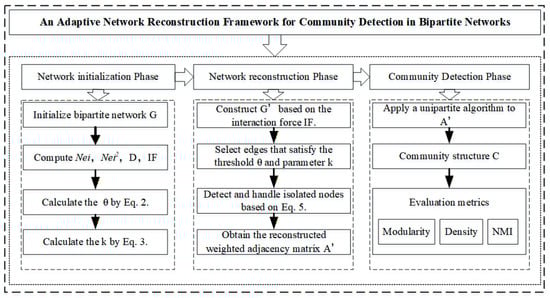
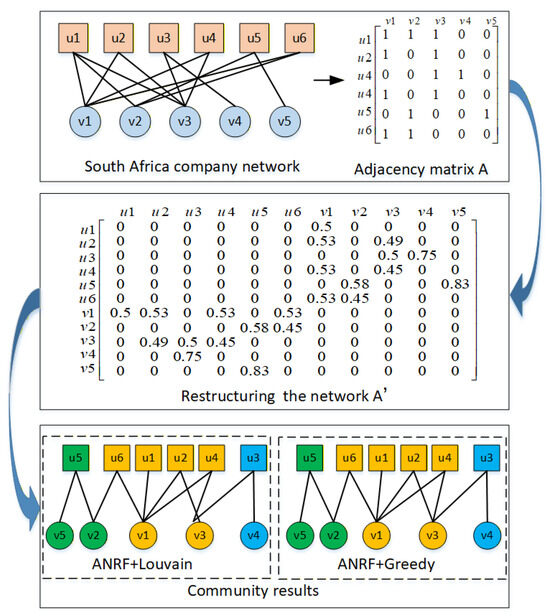
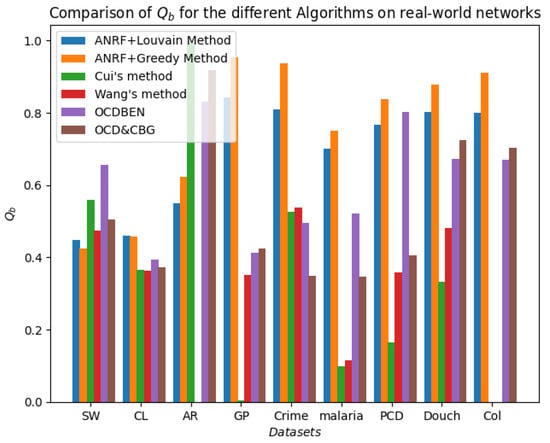
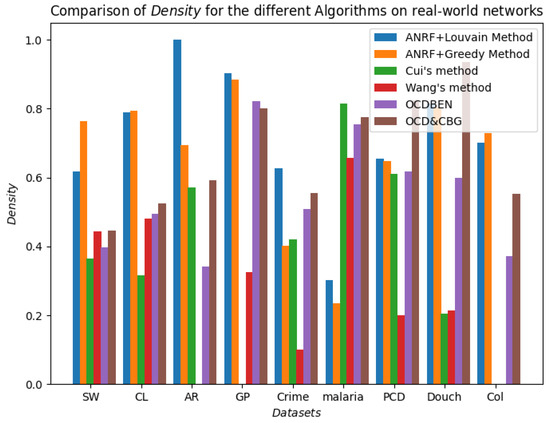
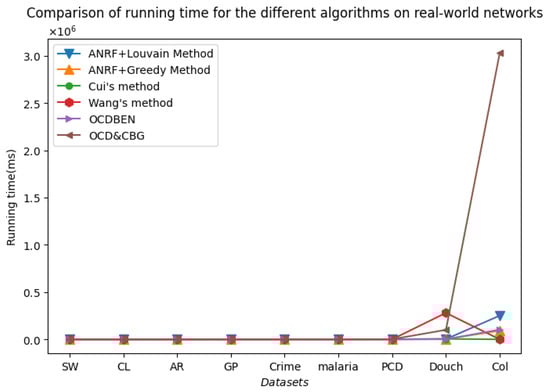
Bipartite network community detection is of significant importance for understanding the underlying structure and functional organization of real-world complex systems. Although many mature community detection algorithms exist for unipartite networks, they cannot be directly applied to bipartite networks due to their unique topological structure, characterized by heterogeneous node types and cross-layer connections. Furthermore, some existing bipartite network community detection methods still rely heavily on manual experience to set key parameters, which limits their applicability and scalability in practical scenarios. To address these issues, this paper proposes an enhanced framework—the Adaptive Network Reconstruction Framework (ANRF)—by introducing an adaptive parameter optimization mechanism based on the existing Network Reconstruction Framework (NRF). This framework can be effectively integrated with traditional unipartite network community detection algorithms to achieve automatic community detection with reduced dependence on manual parameter tuning. The core procedure of the method consists of four main steps. First, we calculate the interaction forces between node pairs. Second, through comprehensive analysis of the network topological features, we adaptively determine the threshold parameter θ and related parameters for the interaction forces. Third, based on these thresholds and parameters, we perform edge filtering on the bipartite network to construct a reconstructed network. Finally, we apply unipartite community detection algorithms directly to the reconstructed network to obtain the community structure. To validate the effectiveness of ANRF, we combined it with the Louvain method and the Greedy modularity method, and conducted experimental evaluations on multiple synthetic and real-world network datasets. A systematic comparison with current state-of-the-art algorithms was made. The experimental results on multiple synthetic and real-world datasets within our evaluated scope demonstrate that ANRF achieves competitive performance in terms of community modularity and community density compared to state-of-the-art algorithms, while significantly reducing reliance on manual parameter tuning and enhancing robustness under the tested conditions.

13 March 2026

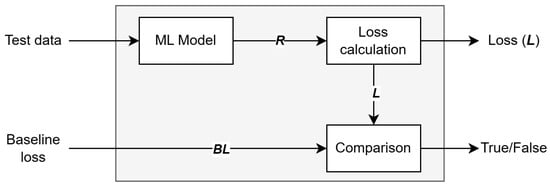
Overall Framework of the Algorithm.

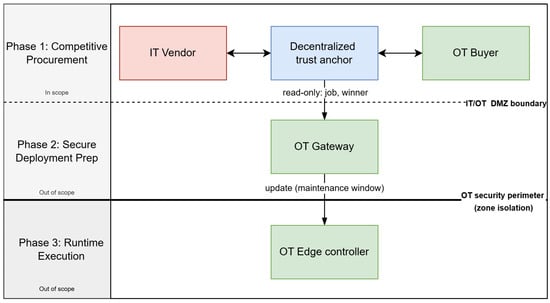
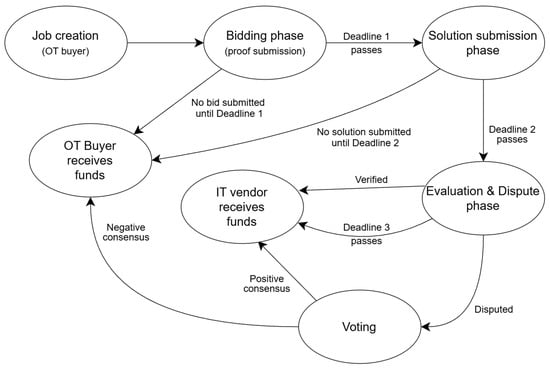
Integrating third-party Machine Learning (ML) models into industrial Operational Technology (OT) creates a procurement deadlock: operators cannot verify vendor performance claims without sharing representative evaluation data with vendors, while vendors refuse to reveal proprietary model weights before purchase, rendering traditional safeguards such as Non-Disclosure Agreements technically unenforceable. This paper introduces a framework combining Zero-Knowledge Proofs (ZKPs) with smart contracts to enable trust-minimized, cryptographically verifiable competitive model procurement in Industrial Cyber-Physical Systems (ICPS). Vendors cryptographically prove that their model outperforms a legacy baseline without disclosing proprietary weights, a process we term cryptographic performance attestation, while the on-chain workflow automates escrow, proof verification, and best-vendor selection with arbiter-based dispute resolution. ZKP privacy is scoped to vendor model weights; operator-side evaluation-data confidentiality is managed separately via synthetic, de-identified, or public benchmark data. We analyze three ZKP workflow variations and evaluate them on consumer-grade hardware, achieving proving times of approximately three seconds and sub-dollar on-chain verification costs under Layer-2 fee assumptions for the recommended single-proof variation, while identifying computational trade-offs of recursive proof aggregation. The entire verification phase operates offline with no impact on real-time OT control paths, bridging the IT/OT pre-transaction trust gap while deferring artifact deployment to existing OT tooling.

13 March 2026

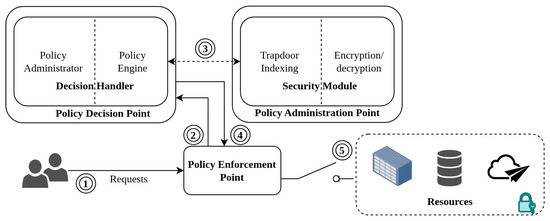
Phase-oriented integration view of procurement verification and OT deployment; colors denote the IT Vendor domain (red), the blockchain-based trust anchor and smart-contract layer (blue), and the OT domain (green).

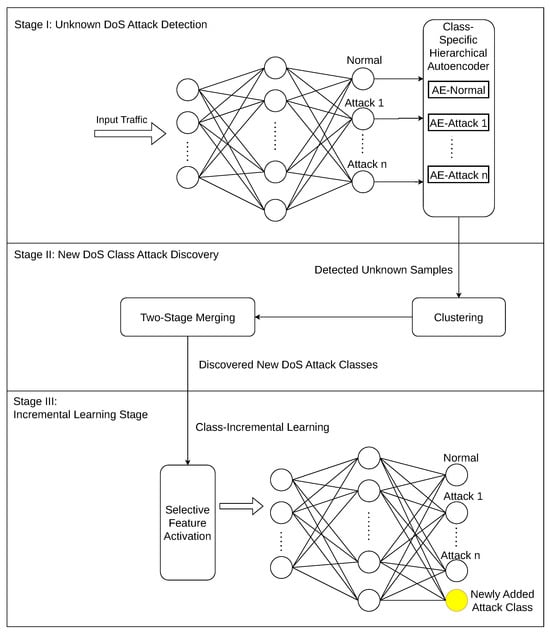
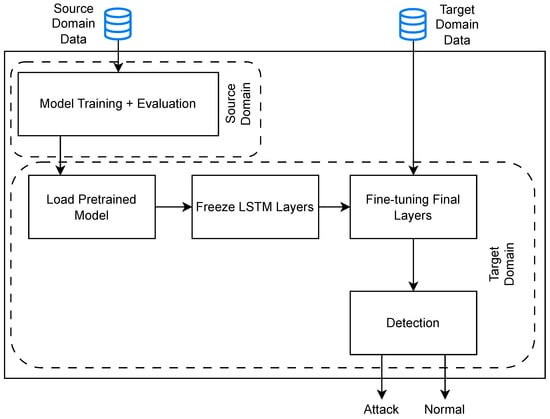
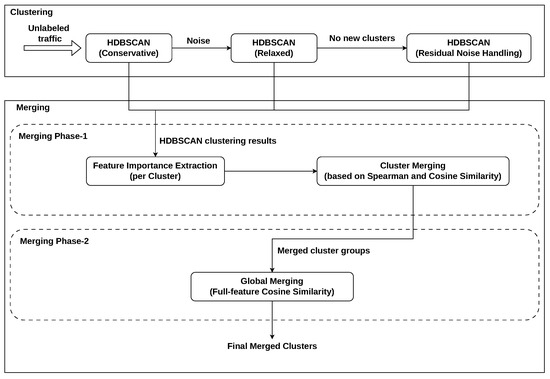
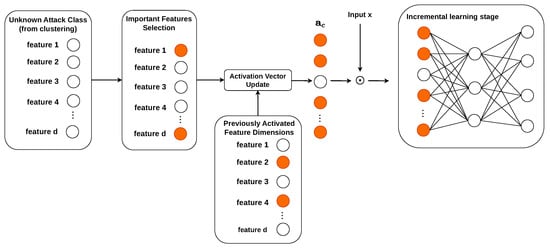
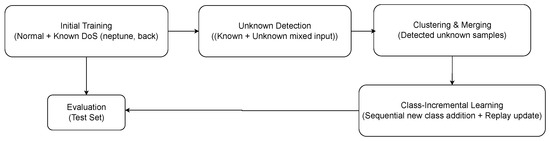
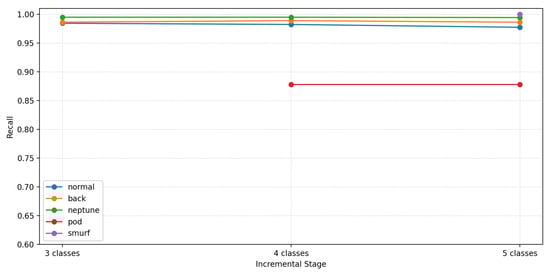
Denial-of-Service (DoS) attacks remain one of the most dangerous threats in modern Internet environments. They aim to overwhelm networks, servers, or online services with massive volumes of traffic, and maintaining service availability is a core pillar of cybersecurity. More importantly, DoS attack techniques continue to evolve. However, traditional intrusion detection systems (IDS) trained on fixed attack categories struggle to identify previously unknown DoS attack types and cannot dynamically incorporate newly emerging classes. To address this challenge, this study proposes a stage-wise network intrusion detection framework that integrates unknown attack detection, attack discovery, and class-incremental learning into a unified pipeline. The framework consists of three stages. First, an autoencoder-based anomaly detection approach is used to separate potential unknown DoS attack samples from known classes. Second, a clustering-and-merging strategy is applied to the detected unknown DoS samples to discover emerging attack clusters with similar structural characteristics. Third, the classifier architecture is expanded for each newly discovered cluster through a class-incremental learning mechanism, enabling the continual incorporation of new attack classes while maintaining stable detection performance on previously learned classes. Experimental results on the DoS category of the NSL-KDD dataset demonstrate that the proposed stage-wise framework can effectively isolate samples of unknown DoS attacks, accurately aggregate emerging attack clusters, and incrementally integrate newly discovered attack classes without significantly degrading recognition performance on previously learned classes. These results confirm the capability of the proposed framework to handle progressively emerging unknown DoS attacks.

12 March 2026

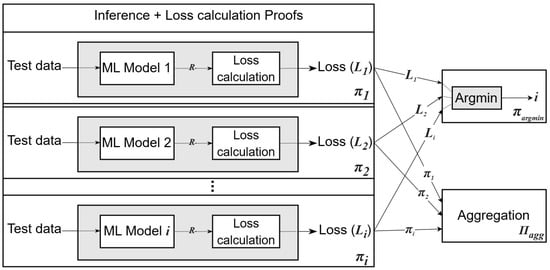
Overall framework of the proposed system.

News & Conferences

Volumes

Issues

Open for Submission

Editor's Choice

Reprints of Collections

IoT Security
Reprint

IoT Security

Threat Detection, Analysis and Defense
Editors: Olivier Markowitch, Jean-Michel Dricot
Virtual Reality and Metaverse
Reprint

Virtual Reality and Metaverse

Impact on the Digital Transformation of Society II
Editors: Diego Vergara
XFacebookLinkedIn
Future Internet - ISSN 1999-5903