
Geomatics 2026, 6(3), 56; https://doi.org/10.3390/geomatics6030056 (registering DOI) - 24 May 2026
Abstract
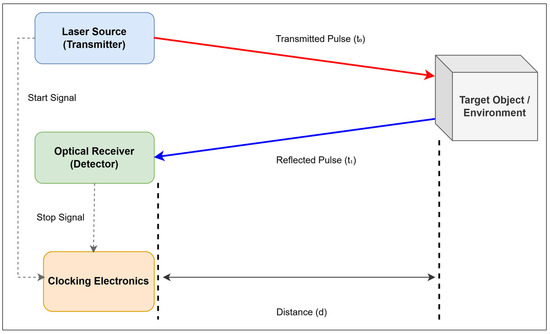
Terrestrial laser scanning (TLS) represents an efficient method for acquiring spatial data in urban environments, while the quality of resulting geometric outputs is significantly influenced by subsequent point cloud processing. This article focuses on analyzing the accuracy of automatic building footprint extraction from
[...] Read more.
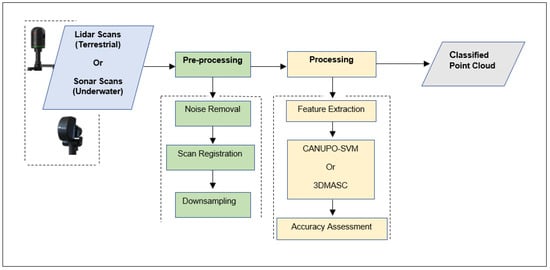
Terrestrial laser scanning (TLS) represents an efficient method for acquiring spatial data in urban environments, while the quality of resulting geometric outputs is significantly influenced by subsequent point cloud processing. This article focuses on analyzing the accuracy of automatic building footprint extraction from classified TLS point clouds, with an emphasis on the role of data cleaning methods. The study area is located in the city center of Žiar nad Hronom, where urban structures were monitored using TLS. For detailed analysis, three objects were selected—an apartment building, a garage, and an industrial building—representing different levels of geometric complexity. To simulate realistic processing conditions, classification results obtained from different software (Leica Cyclone 3DR, Trimble RealWorks, and LiDAR360) were used. Their quality was evaluated using standard metrics such as Precision, Recall, and F1-score. These classifications also served as input scenarios containing typical errors, such as point clusters, vegetation near buildings, or misclassified terrain elements. Subsequently, selected point cloud cleaning methods were applied to these datasets, specifically statistical outlier removal, noise filter, and label connected components. The accuracy of the extracted building footprints was evaluated by comparison with reference data obtained from geodetic measurements. The results show that automatic classification alone is not sufficient to achieve accurate building footprints, and that data cleaning plays a decisive role. For example, in the case of the apartment building, statistical filtering reduced the area from 1052 m2 to approximately 854 m2 (reference value: 706 m2) and significantly improved positional accuracy (centroid shift reduced from 0.455 m to 0.077 m). Similarly, for the industrial building, the area was reduced from 215 m2 to approximately 165 m2 (reference: 148 m2) while maintaining the correct number of corner points. In contrast, noise filter method proved to be less reliable, as removing up to 25–30% of points often did not lead to improvements in footprint geometry. The results highlight the importance of systematic point cloud cleaning as a key step in automated building footprint extraction and demonstrate that a properly selected combination of methods can significantly improve accuracy even in noisy datasets. The article also provides practical guidance for efficient TLS data processing in geoinformatics applications.
Full article
(This article belongs to the Special Issue Advances and Innovations in Geomatics: Celebrating a New Chapter—First Impact Factor and CiteScore Received)