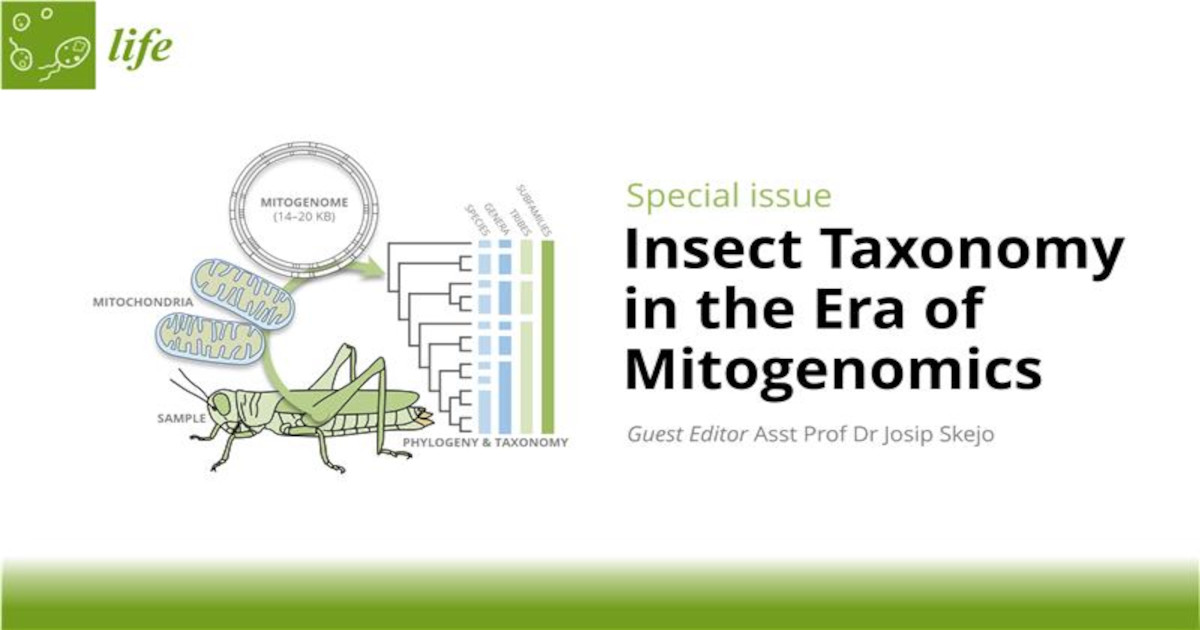
Insect Taxonomy in the Era of Mitogenomics

A Special Issue of Life (ISSN 2075-1729) belonging to the section "Biodiversity, Ecology and Evolution".

Deadline for manuscript submissions: 31 October 2026 | Viewed by 3148

Editor


E-Mail Website
Guest Editor
Division of Zoology, Evolution Lab, Department of Biology, Faculty of Science, University of Zagreb, Rooseveltov trg 6, 10000 Zagreb, Croatia
Interests: fieldwork; nomenclature; Orthoptera evolution, taxonomy, and conservation with special emphasis on Tetrigidae; faunistics; early evolution of eukaryotes
Special Issues, Collections and Topics in MDPI journals

Special Issue Information

Dear Colleagues,

Recent advances in sequencing technologies have rapidly transformed zoological research, strongly linking classical taxonomy and evolutionary biology. Among the genomic resources currently available, mitochondrial genomes (mitogenomes) have become particularly popular in entomology. Compared with nuclear genomes, mitogenomes are relatively short and structurally conserved, and therefore they are easier to assemble and analyse. These characteristics make mitochondrial genomes both accessible and fast to obtain, while also providing an efficient molecular data source for reconstructing phylogenetic relationships.

This Special Issue, “Insect Taxonomy in the Era of Mitogenomics”, provides a platform for scientists studying mitochondrial genomes to share their findings, reviews, and datasets. We invite contributions from researchers working on mitogenomic sequencing, comparative mitogenomics, and phylogenetic analyses that address taxonomic or systematic questions. Manuscripts presenting the first mitogenome sequences of particular species or lineages are welcome, as such data represent valuable resources for future research. However, authors are encouraged to place newly generated mitogenomes within a broader phylogenetic and comparative framework whenever possible.

Through integrating new mitochondrial genomes with existing datasets, this Special Issue aims to advance our understanding of insect phylogeny and taxonomy in the genomic era.

Dr. Josip Skejo
Guest Editor

Manuscript Submission Information

Manuscripts should be submitted online at www.mdpi.com by registering and logging in to this website. Once you are registered, click here to go to the submission form. Manuscripts can be submitted until the deadline. All submissions that pass pre-check are peer-reviewed. Accepted papers will be published continuously in the journal (as soon as accepted) and will be listed together on the special issue website. Research articles, review articles as well as short communications are invited. For planned papers, a title and short abstract (about 250 words) can be sent to the Editorial Office for assessment.

Submitted manuscripts should not have been published previously, nor be under consideration for publication elsewhere (except conference proceedings papers). All manuscripts are thoroughly refereed through a single-anonymized peer-review process. A guide for authors and other relevant information for submission of manuscripts is available on the Instructions for Authors page. Life is an international peer-reviewed open access monthly journal published by MDPI.

Please visit the Instructions for Authors page before submitting a manuscript. The Article Processing Charge (APC) for publication in this open access journal is 2600 CHF (Swiss Francs). Submitted papers should be well formatted and use good English. Authors may use MDPI's English editing service prior to publication or during author revisions.

Keywords

  • mitochondrial genomes
  • mitogenomes
  • entomology
  • phylogenetic
  • taxonomy
  • mitogenomic sequencing

Benefits of Publishing in a Special Issue

  • Ease of navigation: Grouping papers by topic helps scholars navigate broad scope journals more efficiently.
  • Greater discoverability: Special Issues support the reach and impact of scientific research. Articles in Special Issues are more discoverable and cited more frequently.
  • Expansion of research network: Special Issues facilitate connections among authors, fostering scientific collaborations.
  • External promotion: Articles in Special Issues are often promoted through the journal's social media, increasing their visibility.
  • Reprint: MDPI Books provides the opportunity to republish successful Special Issues in book format, both online and in print.

Further information on MDPI's Special Issue policies can be found here.

Published Papers (3 papers)

Order results
Result details
Select all
Export citation of selected articles as:

Research

13 pages, 2639 KB  
Article
Comparative Mitogenomic and Phylogenetic Insights of Three Aulacophora Species (Coleoptera: Chrysomelidae) Associated with Cucurbit Crops
by Liancheng Liu, Huanhuan Li, Gonghua Lin, Tianjuan Su, Fang Zhao, Bo He and Zuhao Huang
Life 2026, 16(8), 1231; https://doi.org/10.3390/life16081231 - 25 Jul 2026
Viewed by 319
Abstract
This study sequenced and comparatively analyzed the mitochondrial genomes of three agriculturally important Aulacophora pests: the polyphagous A. indica, the oligophagous A. lewisii, and the early-diverging A. nigripennis. All three mitogenomes contained the typical 37 genes with conserved gene order. [...] Read more.
This study sequenced and comparatively analyzed the mitochondrial genomes of three agriculturally important Aulacophora pests: the polyphagous A. indica, the oligophagous A. lewisii, and the early-diverging A. nigripennis. All three mitogenomes contained the typical 37 genes with conserved gene order. However, total length varied substantially (15,258–18,766 bp), driven primarily by control region length variation. All species exhibited pronounced AT bias, and relative synonymous codon usage analysis revealed marked interspecific divergence. Phylogenetic analysis based on 13 protein-coding genes resolved A. nigripennis as the basal lineage and A. lewisii and A. indica as closely related sister species. Both widespread species displayed maximum haplotype diversity (Hd = 1.000); however, A. indica exhibited approximately 2.4-fold higher nucleotide diversity (Pi = 0.00478) than A. lewisii (Pi = 0.00198), indicating differential population genetic architectures between the two species. These findings established a comparative mitogenomic framework for Aulacophora and provide baseline data for future phylogenomic and phylogeographic investigations. Full article
(This article belongs to the Special Issue Insect Taxonomy in the Era of Mitogenomics)
Show Figures

Figure 1

19 pages, 4966 KB  
Article
HiFi-Assembled Mitogenomes of Four Pygmy Grasshoppers Reveal Mito–Nuclear Discordance in Zhengitettix transpicula and Lineage-Specific Mitochondrial Intergenic Length Variation
by Rongjiao Zhang, Taihang Xu, Delong Guan and Weian Deng
Life 2026, 16(6), 1015; https://doi.org/10.3390/life16061015 - 17 Jun 2026
Viewed by 402
Abstract
Mitochondrial genomes are widely used in insect taxonomy and phylogenetics, but their signals may conflict with morphology and nuclear genomic evidence because the mitochondrial genome represents a single maternally inherited locus. Here, we assembled complete mitochondrial genomes of four pygmy grasshoppers, Zhengitettix transpicula [...] Read more.
Mitochondrial genomes are widely used in insect taxonomy and phylogenetics, but their signals may conflict with morphology and nuclear genomic evidence because the mitochondrial genome represents a single maternally inherited locus. Here, we assembled complete mitochondrial genomes of four pygmy grasshoppers, Zhengitettix transpicula, Formosatettix sp., Gibbotettix parvipulvillus, and Bolivaritettix sp., using PacBio HiFi reads. The four mitogenomes ranged from 15,152 to 17,976 bp and contained the typical 37 mitochondrial genes. Mitochondrial phylogenies inferred by maximum likelihood and Bayesian methods were topologically identical and recovered several well-supported tetrigid relationships, including a close relationship between Formosatettix sp. and Bolivaritettix sp. However, Z. transpicula was unexpectedly placed near Macromotettixoides rather than close to other Zhengitettix representatives. In contrast, a morphology-based tree recovered Z. transpicula with Z. triangularis, and comparison with a published nuclear single-copy ortholog tree based on 1962 loci supported a non-mitochondrial placement of Zhengitettix inconsistent with the anomalous mitochondrial position of Z. transpicula. Independent assembly from the original HiFi reads, read-depth inspection, protein-coding gene checks, and nuclear-genome screening for NUMT-like sequences supported the authenticity of the assembled Z. transpicula mitogenome. These results document mito–nuclear and cyto-morphological discordance in Tetrigidae and highlight the need for integrative interpretation of mitochondrial phylogenies in taxonomically complex insect groups. Full article
(This article belongs to the Special Issue Insect Taxonomy in the Era of Mitogenomics)
Show Figures

Figure 1

28 pages, 6975 KB  
Article
Establishing Ingrischana gen. nov. as a First Step in Reviewing Asian Tetriginae (Orthoptera: Tetrigidae)
by Madan Subedi and Josip Skejo
Life 2026, 16(5), 797; https://doi.org/10.3390/life16050797 - 10 May 2026
Viewed by 1187
Abstract
A new genus, Ingrischana gen. nov. (Tetrigidae: Tetriginae) is established for winged Tetriginae from Asia with extremely setose mid femur, and toothed dorsal margin of the hind femur. Till now, many species of this genus have been erroneously assigned to the genera Bannatettix [...] Read more.
A new genus, Ingrischana gen. nov. (Tetrigidae: Tetriginae) is established for winged Tetriginae from Asia with extremely setose mid femur, and toothed dorsal margin of the hind femur. Till now, many species of this genus have been erroneously assigned to the genera Bannatettix Zheng, 1993; Formosatettixoides Zheng, 1994; Ergatettix Kirby, 1914; Euparatettix Hancock, 1904; Paratettix Bolívar, 1887, and Tetrix Latreille, 1802. Altogether 2 new species, 11 new combinations, 1 new name, and 2 new synonyms are proposed, and 1 species is reinstated. Two new species are I. motbotawa gen. et sp. nov. (Brija Furry Groundhopper) and I. aspinosa gen. et sp. nov. (Toothless Furry Groundhopper), both from Nepal. New combinations are I. aptera (Zheng et Ou, 2009) comb. nov., I. barbifemura (Zheng, 1998) comb. nov., I. curvimargina (Zheng et Deng, 2004) comb. nov., I. dentifemura (Zheng, Shi et Luo, 2003) comb. nov., I. grossifemura (Zheng et Jiang, 1997) comb. nov., I. longzhouensis (Zheng et Jiang, 2000) comb. nov., I. obesa (Bolívar, 1887) comb. nov., I. serrifemora (Deng, Zheng et Wei, 2008) comb. nov., I. serrifemoralis (Zheng, 1998) comb. nov., I. serrifemoroides (Zheng et Jiang, 2002) comb. nov., and I. torulosinota (Zheng, 1998) comb. nov. The new name is I. parlungana nom. nov., proposed for Bannatettix serrifemoralis Zheng et Shi, 2009a, because of the homonymy with I. serrifemoralis (Zheng, 1998) comb. nov. Ingrischana jhapana (Ingrisch, 2001a) stat. rev. et comb. nov. is reinstated as a valid species. Two new synonyms are Formosatettixoides guangxiensis Zheng & Jiang, 2000 syn. nov. (of I. longzhouensis comb. nov.), and Ergatettix serifemoroides Zheng et Shi, 2009b syn. nov. (of I. parlungana nom. nov.). The new genus is defined not only by morphological apomorphies, but is also confirmed by mitogenome phylogeny. Full article
(This article belongs to the Special Issue Insect Taxonomy in the Era of Mitogenomics)
Show Figures

Graphical abstract

Back to TopTop