- Article

A Queuing-Network-Based Optimization Model for EV Charging Station Configuration in Highway Service Areas
- Hongwu Li,
- Bin Zhao and
- Yangsheng Jiang
- + 1 author
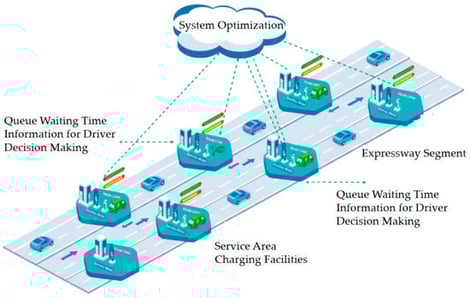
This paper addresses the optimization of electric vehicle (EV) charging facility configuration on highways by proposing a collaborative planning method that integrates driver anxiety psychology, mixed traffic flow dynamics, and service area queuing characteristics. By abstracting the road travel and service area replenishment processes into an integrated queuing network, a system analysis framework is constructed to characterize the coupling relationship of “facility supply, traffic assignment, and state feedback.” On this basis, a bi-level optimization model is established with the objective of minimizing the generalized total social cost. The upper level makes decisions on the coordinated quantities of fixed charging piles and mobile charging vehicles, while the lower level describes the stochastic user equilibrium behavior of drivers under the influence of real-time congestion and anxiety. To tackle the high-dimensional nonlinear nature of the model, an efficient solution algorithm based on simultaneous perturbation stochastic approximation (SPSA) is designed. A case study of the Nei-Yi Expressway demonstrates that compared with the traditional peak demand proportional allocation method, the proposed approach can better balance construction costs, operation and dispatching costs, and user travel experience under limited investment, significantly reducing waiting times and psychological anxiety costs. It provides theoretical methods and decision support for planning a resilient energy replenishment network that achieves “fixed facilities ensuring base load and mobile resources responding to peak demands.”
27 February 2026