Skip to Content

Network

Network is an international, peer-reviewed, open access journal on science and technology of networks, published quarterly online by MDPI.

Quartile Ranking JCR - Q2 (Computer Science, Information Systems | Telecommunications)

All Articles (179)

Limited terrestrial network coverage in rural and remote areas constitutes a significant barrier to the digital transformation of the agricultural sector. Smart and precision farming applications, ranging from conventional environmental monitoring systems to advanced Digital Twin solutions, rely on the reliable transmission of sensor data, images, and video streams from geographically isolated farms. Such data-intensive services cannot be effectively supported without a robust communication infrastructure. Non-Terrestrial Networks (NTNs), particularly satellite systems, offer both narrowband and broadband connectivity, enabling the transmission of low-rate sensor measurements, as well as high-throughput multimedia data from the field. This paper presents an experimental performance evaluation of two satellite backhauling solutions: a Geostationary Earth Orbit (GEO) system provided by SES and a Low Earth Orbit (LEO) system from Starlink. The networks were first deployed and tested in a laboratory environment and subsequently validated in an operational agricultural field setting. Their performance is benchmarked against a terrestrial cellular network to assess their suitability for supporting advanced agricultural applications. The performance assessment results indicate that both satellite backhauling solutions are reliable and capable of meeting the bandwidth and latency requirements of delay-tolerant agricultural applications. In addition to the technical evaluation, this work presents a cost–benefit analysis that further underscores the advantages of NTN-based solutions. Despite higher initial expenditures, they provide extended coverage in remote areas and enable cost sharing across multiple users, improving overall economic viability.

24 February 2026
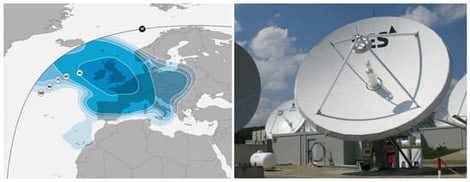
ASTRA 2F Europe Ku-band beam (left). RF Uplink and Downlink ground Station: ATF #33 Antenna, Diameter: 9m, Vertex, Tx/Rx, Ku-band (right).

Round-Trip Time Estimation Using Enhanced Regularized Extreme Learning Machine

  • Hassan Rizky Putra Sailellah,
  • Hilal Hudan Nuha and
  • Aji Gautama Putrada

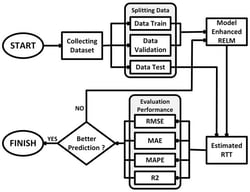
Reliable Internet connectivity is essential for latency-sensitive services such as video conferencing, media streaming, and online gaming. Round-trip time (RTT) is a key indicator of network performance and is central to setting retransmission timeout (RTO); inaccurate RTT estimates may trigger unnecessary retransmissions or slow loss recovery. This paper proposes an Enhanced Regularized Extreme Learning Machine (RELM) for RTT estimation that improves generalization and efficiency by interleaving a bidirectional log-step heuristic to select the regularization constant C. Unlike manual tuning or fixed-range grid search, the proposed heuristic explores C on a logarithmic scale in both directions (×10 and /10) within a single loop and terminates using a tolerance–patience criterion, reducing redundant evaluations without requiring predefined bounds. A custom RTT dataset is generated using Mininet with a dumbbell topology under controlled delay injections (1–1000 ms), yielding 1000 supervised samples derived from 100,000 raw RTT measurements. Experiments follow a strict train/validation/test split (6:1:3) with training-only standardization/normalization and validation-only hyperparameter selection. On the controlled Mininet dataset, the best configuration (ReLU, 150 hidden neurons, C=102) achieves R2=0.9999, , , and on the test set, while maintaining millisecond-level runtime. Under the same evaluation pipeline, the proposed method demonstrates competitive performance compared to common regression baselines (SVR, GAM, Decision Tree, KNN, Random Forest, GBDT, and ELM), while maintaining lower computational overhead within the controlled simulation setting. To assess practical robustness, an additional evaluation on a public real-world WiFi RSS–RTT dataset shows near-meter accuracy in LOS and mixed LOS/NLOS scenarios, while performance degrades markedly under dominant NLOS conditions, reflecting physical-channel limitations rather than model instability. These results demonstrate the feasibility of the Enhanced RELM and motivate further validation on operational networks with packet loss, jitter, and path variability.

29 January 2026

Flowchart diagram of the system.

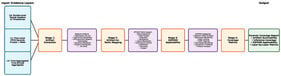
Network operators increasingly rely on abstracted telemetry (e.g., flow records and time-aggregated statistics) to achieve scalable monitoring of high-speed networks, but this abstraction fundamentally constrains the forensic and security inferences that can be supported from network data. We present a design-time audit framework that evaluates which threat hypotheses become non-supportable as network evidence is transformed from packet-level traces to flow records and time-aggregated statistics. Our methodology examines three evidence layers (L0: packet headers, L1: IP Flow Information Export (IPFIX) flow records, L2: time-aggregated flows), computes a catalog of 13 network-forensic artifacts (e.g., destination fan-out, inter-arrival time burstiness, SYN-dominant connection patterns) at each layer, and maps artifact availability to tactic support using literature-grounded associations with MITRE Adversarial Tactics, Techniques, and Common Knowledge (ATT&CK). Applied to backbone traffic from the MAWI Day-In-The-Life (DITL) archive, the audit reveals selectiveinference loss: Execution becomes non-supportable at L1 (due to loss of packet-level timing artifacts), while Lateral Movement and Persistence become non-supportable at L2 (due to loss of entity-linked structural artifacts). Inference coverage decreases from 9 to 7 out of 9 evaluated ATT&CK tactics, while coverage of defensive countermeasures (MITRE D3FEND) increases at L1 (7 → 8 technique categories) then decreases at L2 (8 → 7), reflecting a shift from behavioral monitoring to flow-based controls. The framework provides network architects with a practical tool for configuring telemetry systems (e.g., IPFIX exporters, P4 pipelines) to reason about and provision the minimum forensic coverage.

29 January 2026

Architecture and flow process of the audit framework. The framework processes three evidence layers (L0: packet headers, L1: IPFIX flow records, L2: time-aggregated flows) through four main stages: (1) Artifact Extraction computes observable network characteristics from each layer; (2) Artifact-to-Tactic Mapping uses literature-grounded associations to link artifacts to ATT&CK tactic-level hypotheses; (3) D3FEND Applicability Analysis evaluates which defensive technique categories remain actionable given available evidence; (4) Coverage Metrics Computation produces quantitative measures (artifact survivability, inference coverage, D3FEND applicability) that form the forensic coverage report. The diagram highlights how evidence abstraction at each stage progressively constrains the set of supportable threat hypotheses and actionable defensive techniques.

Devices equipped with the Global Positioning System (GPS) generate massive volumes of trajectory data on a daily basis, imposing substantial computational, network, and storage burdens. Online trajectory simplification reduces redundant points in a streaming manner while preserving essential spatial and temporal characteristics. A representative method in this line of research is Directed acyclic graph-based Online Trajectory Simplification (DOTS). However, DOTS does not preserve stay-related information and can incur high computational cost. To address these limitations, we propose Directed acyclic graph-based Online Trajectory Simplification with Stay Areas (DOTSSA), a fast online simplification method that integrates DOTS with an online stay area detection algorithm (SA). In DOTSSA, SA continuously monitors movement patterns to detect stay areas and segments the incoming trajectory accordingly, after which DOTS is applied to the extracted segments. This approach ensures the preservation of stay areas while reducing computational overhead through localized DAG construction. Experimental evaluations on a real-world dataset show that, compared with DOTS, DOTSSA can reduce compression time, while achieving comparable compression ratios and preserving key trajectory features.

29 January 2026

Stay points and stay areas in trajectory data.

News & Conferences

Issues

Open for Submission

Editor's Choice

Get Alerted

Add your email address to receive forthcoming issues of this journal.

XFacebookLinkedIn
Network - ISSN 2673-8732