Skip to Content
  • 5.8
    Impact Factor
  • 10.2
    CiteScore
  • 16 days
    Submission to First Decision
  • 3 days
    Acceptance to Publication

Nutrients

Nutrients is an international, peer-reviewed, open access journal of human nutrition published semimonthly online by MDPI. The Asia Pacific Nutrigenomics Nutrigenetics Organisation (APNNO), Italian Society for Pediatric Gastroenterology, Hepatology and Nutrition (SIGENP), Nutrition Society of New Zealand (NSNZ), Ocular Wellness & Nutrition Society (OWNS) and others are affiliated with Nutrients and their members receive discounts on article processing charges.

Get Alerted

Add your email address to receive forthcoming issues of this journal.

All Articles (40,302)

  • Article
  • Open Access

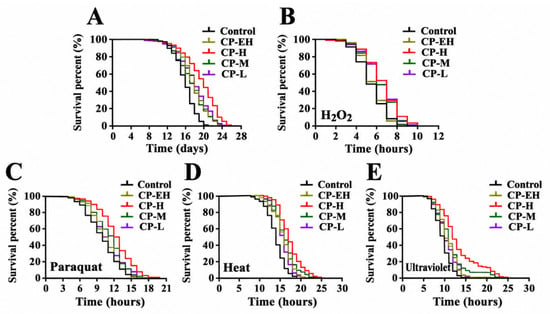
Background/Objectives: Propolis has been demonstrated to exhibit anti-aging and antioxidant properties, yet the molecular mechanisms underlying these effects remain incompletely understood. Methods: This study investigated the effects of propolis on aging and oxidative stress responses in Caenorhabditis elegans through proteomic and metabolomic analyses, with molecular docking used to explore potential molecular interactions. Results: We observed that propolis treatment significantly prolonged lifespan, enhanced resistance to various stressors, and reduced the accumulation of oxidative damage biomarkers in C. elegans—including reactive oxygen species, malondialdehyde, and lipofuscin. Furthermore, propolis treatment significantly enhanced the activities of key antioxidant enzymes—catalase, superoxide dismutase, and glutathione peroxidase. Integrated multi-omics analyses suggested that propolis may influence NAD+ metabolism through potential modulation of NAD+ salvage pathway-related proteins, including nicotinamidase-1, nicotinic acid phosphoribosyltransferase-1, NMN/NaMN adenylyltransferase-2, and NAD+ synthetase-1, as well as changes in the relative abundances of related metabolites, such as nicotinic acid mononucleotide, nicotinamide, and nicotinic acid. Furthermore, molecular docking analysis predicted favorable interactions between flavonoid constituents of propolis, such as chrysin and galangin, and the active sites of these NAD+ salvage pathway-related enzymes, suggesting their potential involvement in the modulation of NAD+ metabolism. Conclusions: Collectively, these findings suggest that propolis alleviates age-related phenotypes and enhances antioxidant defenses in C. elegans. The observed changes in NAD+ metabolism further point to a possible involvement of NAD+ homeostasis in these biological effects, providing insights into the metabolic processes potentially associated with the beneficial effects of propolis.

Nutrients

28 November 2026

Propolis enhances resistance to various environmental stressors. (A) Survival curves following treatment with varying concentrations of propolis. (B–E) Survival curves of worms exposed to H2O2 (B), paraquat (C), heat stress (D), or UV irradiation (E). At least 100 age-synchronized worms per group; n = 3.
  • Article
  • Open Access

Sources of Exposure to Parabens and Their Association with Overweight/Obesity in a Spanish Population of School-Aged Children

  • Patricia González-Palacios,
  • Cristina Samaniego-Sánchez and
  • Alberto Zafra-Gómez
  • + 4 authors

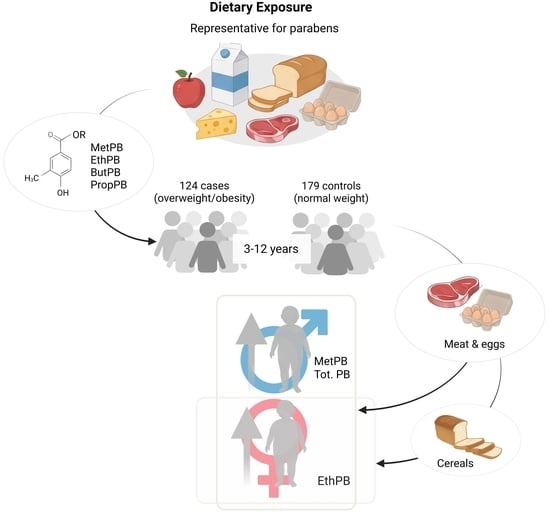
Objective: Parabens are widely used as preservatives in cosmetics, pharmaceuticals, food products and beverages for their antimicrobial properties. They may act as endocrine disruptors and obesogens, but evidence on their obesogenic activity remains limited. This study assessed the association between dietary exposure to parabens and overweight/obesity in Spanish children. Methods: Dietary and anthropometric data were collected from 124 cases and 179 controls aged 3–12 years in this case–control study. Dietary exposure to the four study parabens, methylparaben (MetPB), ethylparaben (EthPB), butylparaben (ButPB) and propylparaben (PropPB), was assessed using a food frequency questionnaire (FFQ) combined with previously measured paraben concentrations in food items. Diet quality was evaluated using the Mediterranean Diet Quality Index for children and adolescents (KIDMED). Associations were analyzed with sex-stratified logistic regression models. Results: High exposure to MetPB and total parabens from meat and eggs was associated with higher odds of overweight/obesity in boys (odds ratio (OR) = 3.26; 95% confidence interval (CI): 1.17–9.12 for both), as was high exposure to EthPB from meat and eggs (OR = 3.30; 95% CI: 1.25–8.68) and cereals (OR = 2.82; 95% CI: 1.13–7.04) in girls. Conclusions: This study suggests an association between dietary exposure to certain parabens and overweight/obesity in Spanish children, although these exploratory associations did not remain significant after correction for multiple comparisons and causal interpretation could not be established.

Nutrients

28 November 2026

Conceptual diagram illustrating the study workflow. Dietary exposure to parabens was estimated through the analysis of commonly consumed foods combined with data from a validated Food Frequency Questionnaire (FFQ). Paraben concentrations were quantified using UHPLC techniques, and associations were evaluated in relation to body mass index (BMI) in the pediatric population. The green and red areas represent the control (n = 179) and overweight/obesity (n = 124) groups, respectively.
  • Article
  • Open Access

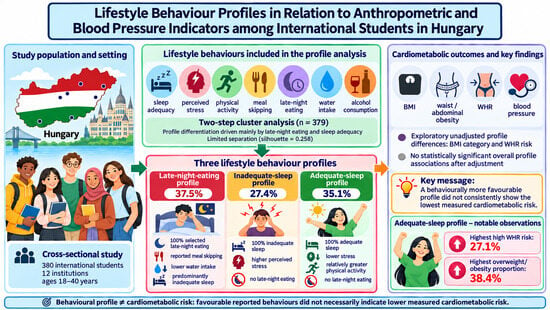
Background/Objectives: International students may experience changes in sleep, physical activity and eating behaviours. This study identified lifestyle behaviour profiles among international students in Hungary and examined associations with anthropometric and blood pressure (BP) indicators. Methods: This cross-sectional study included 380 students aged 18–40 years from 12 Hungarian higher education institutions. Two-step cluster analysis identified profiles based on seven behavioural and psychosocial variables among 379 participants. Waist circumference (WC) and BP were measured directly. Body mass index (BMI) and waist-to-hip ratio (WHR) were calculated from anthropometric measurements. Profile associations were assessed before and after adjustment for age, gender and scholarship status. Separate multivariable analyses examined associated factors. Results: Three profiles emerged: late-night eating (37.5%), inadequate sleep (27.4%) and adequate sleep (35.1%). Profile differentiation was driven primarily by the selection of late-night eating as an eating-plan issue and sleep adequacy, with limited cluster separation (silhouette coefficient = 0.258). The exploratory unadjusted p-values were 0.041 for BMI category (Pearson χ2) and 0.027 for WHR risk. The Fisher–Freeman–Halton exact test for BMI category yielded p = 0.067. Adjusted p-values for BMI category and WHR risk were 0.083 and 0.185, respectively. The adequate-sleep profile had the highest observed proportion classified as having high WHR risk (27.1%). In the separate BP model, the adjusted odds of hypertensive-range BP relative to normal BP were lower among participants aged 18–25 years and female participants and higher among students without a scholarship and those reporting no physical activity. Conclusions: No overall association between profile membership and any of the six anthropometric or BP outcomes reached statistical significance after adjustment. Direct anthropometric and BP measurements can complement behavioural assessment.

Nutrients

28 November 2026

Distribution of anthropometric and blood pressure categories among international students (n = 380). Values are presented as percentages, with corresponding participant counts (n) reported within the figure.
  • Article
  • Open Access

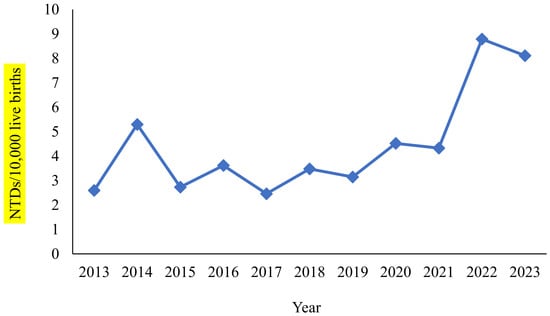
Background/Objectives: Neural tube defects (NTDs) are preventable congenital malformations that significantly contribute to morbidity and mortality in infants. The present study analyzed the epidemiological trends of NTDs in Jordan from 2013 to 2023., in addition to examining the awareness of folic acid (FA) supplementation among Jordanian women of childbearing age. Methods: A retrospective analysis of 1,162,932 recorded hospital-based live births in governmental hospitals, Royal Medical Services health institutions, and university-affiliated teaching hospitals revealed 514 cases of NTDs during the whole period (2013–2023). Results: This figure revealed an ongoing increasing trend through the study time frame, beginning at 2.60/10,000 hospital-based live births in 2013, peaking at 8.79/10,000 in 2022, and slightly declining to 8.11/10,000 in 2023, and spina bifida was the most prevalent form of NTD. Simultaneously, 1106 women of reproductive age who responded to a cross-sectional questionnaire indicated a reasonable level of awareness about the significance of FA in preventing NTDs; 33.7% had good FA-intake practices, 42.9% had positive attitudes, and 57.2% had good knowledge. Conclusions: Because of the increasing trend in the prevalence of NTDs from 2013 to 2023, there is a dire need for improved public health intervention programs intended to reduce the prevalence of NTDs in Jordan by promoting FA supplementation, preconception education and exploring the reasons behind the increasing trend for the prevalence of NTDs recently.

Nutrients

28 November 2026

Annual prevalence rates of NTDs/10,000 hospital-based live births among neonates in Jordan between 2013 and 2023.

Highly Accessed Articles

News & Conferences

Latest Issues

Open for Submission

Journal Sections

XFacebookLinkedIn
Nutrients - ISSN 2072-6643