Skip to Content

Separations

Separations - formerly Chromatography - is an international, peer-reviewed, open access journal on separation and purification science and technology in all areas of chemical, biological, physical science, and separation performance, published monthly online by MDPI.
The Central European Group of Separation Sciences (CEGSS) is affiliated with Separations and its members receive discounts on the article processing charges.

Get Alerted

Add your email address to receive forthcoming issues of this journal.

All Articles (2,413)

Platinum group metals (PGMs) are strategic metals, and recycling PGMs in spent automobile exhaust catalysts (SACs) is a key path to alleviate the contradiction between resource supply and demand. This paper proposes a new Cu-Ni capture process and conducts research on the recovery of PGMs from SACs. Through the binary phase diagram analysis of Cu, Ni and PGMs and the thermodynamic calculation of the system reduction reaction, the feasibility of this technology was theoretically confirmed. Experimental results show that under the conditions of a temperature of 1450 °C, a holding time of 90 min, a Cu-Ni ratio of 1:1, and a basicity of 0.58, the recovery rates of Pt, Pd, and Rh reached 99.2%, 99.34%, and 98.48% respectively. Combined with orthogonal experiments, it was verified that temperature is the most influential factor on the recovery rate, and the four-stage capture mechanism of “initial diffusion—droplet aggregation—sedimentation and wetting—slag–metal separation” was clarified. This process reduces the melting temperature and provides new technology for green and efficient recycling of PGMs.

6 March 2026
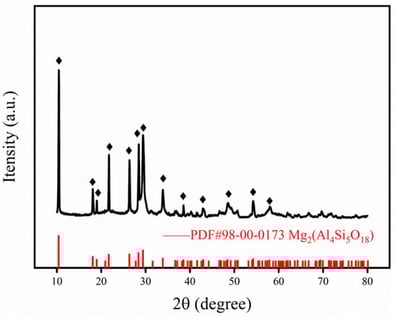
XRD analysis of SAC.

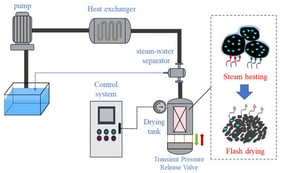
Coal slime, typically with particle sizes below 1 mm, is difficult to utilize directly and is frequently associated with energy loss and environmental burden. This study comparatively investigates hot–air drying and transient steam flash drying for the dehydration and upgrading of filter–pressed coal slime. In hot–air drying, elevated temperature and reduced particle size markedly accelerate the drying rate, and the apparent activation energy ranges from 18.39 to 20.96 kJ·mol−1 for different particle sizes. For steam flash drying, the influences of steam pressure, particle size, and holding time on moisture–removal efficiency and physicochemical structure are evaluated. The dehydration performance is enhanced by higher steam pressure and larger particle size, reducing the moisture content of the coal slime from 38% to 20%, with approximately 80% of the total water removed during the transient depressurization stage. Structural analyses reveal partial decomposition of oxygen–containing functional groups and mesopore contraction after flash treatment. Compared with hot–air drying, steam flash drying achieves shorter processing time and lower specific energy consumption. These findings indicate that steam flash drying is governed by a pressure–induced phase transition and enhanced thermodynamic driving force, providing an intensified pathway for the efficient upgrading of high–moisture coal slime.

6 March 2026

Steam flash drying test system diagram.

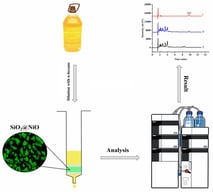
A simple, rapid, and cost-effective method for the determination of benzo[a]pyrene (BaP) in edible oil was developed and validated. Nickel oxide-deposited silica (SiO2@NiO) was employed as a solid-phase extraction (SPE) adsorbent for the extraction of BaP from edible oil, followed by high-performance liquid chromatography–diode array detector (HPLC-DAD) analysis of BaP. The edible oil was diluted with n-hexane and directly loaded to SiO2@NiO for SPE. The n-hexane was also used to clean the fat-soluble interference substance in the edible oil, and BaP was selectively captured using SiO2@NiO through the electron donor–acceptor interaction. The SPE conditions, including the amount of adsorbent, volume of washing solvent, and type and volume of desorption solvent, were optimized. This SiO2@NiO-based SPE coupled with the HPLC-DAD method demonstrated good linearity within a BaP concentration range of 6–1875 ng/g in edible oils, with a limit of detection of 1.3 ng/g, spiked recovery of 97.4–105.1%, and relative standard deviation (RSD) of <3.0%. The method was applied to the analysis of BaP in 11 real oil samples (soybean oil, olive oil, corn germ oil, flaxseed oil, walnut oil, sunflower kernel oil, peanut oil, unrefined oil, and high-temperature frying oil), and the results show that the unrefined oil and high-temperature frying oil were at risk of BaP exceeding acceptable level.

5 March 2026

FE-SEM and EDS mapping images of SiO2@NiO (A) and blank silica (SiO2) (B).

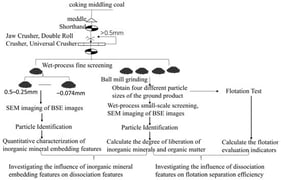
China’s coking coal resources are scarce, and maximizing the recycling of these resources is the primary objective of coal processing and utilization. The embedding features of inorganic minerals within coking middling coal resources are an inherent factor influencing their liberation and separation efficiency. However, current research lacks a systematic investigation into how the embedding features of inorganic minerals in coking middling coal affect their liberation characteristics and flotation separation performance. This study examines three Chinese coking middling coal samples with distinct embedding features. Based on quantitative characterization of inorganic mineral embedding, grinding tests with varying durations and flotation separation tests on post-grinding products were conducted. Liberation and separation efficiencies were evaluated to explore the influence of inorganic mineral embedding on liberation degree and the subsequent impact of the liberation degree on flotation performance. The results indicate that the three coking middling coal samples with different embedding features exhibit significant differences in the dissociation behavior between inorganic minerals and organic matter. The particle size (D) of inorganic mineral phases is the primary factor influencing the liberation degree of inorganic minerals, while the complexity of intergrowth between inorganic minerals and organic matter (CIG) is a secondary factor. The CIG is the primary factor affecting the liberation of organic matter. As the liberation of inorganic minerals and organic matter increases, the separation efficiency improves for the Liuwan middling coal samples, whereas it deteriorates for the Shaqu and Changzhi samples.

4 March 2026

Experimental flowchart.

News & Conferences

Issues

Open for Submission

Editor's Choice

XFacebookLinkedIn
Separations - ISSN 2297-8739