Skip to Content
  • 34 days
    Time to First Decision

Sinusitis

Sinusitis (Volume 3, Issue 3 - 2018 was published with Sinusitis and Asthma) is a peer-reviewed, open access journal which focuses on medical research about sinusitis, and is published semiannually online by MDPI.

Get Alerted

Add your email address to receive forthcoming issues of this journal.

All Articles (94)

Chronic rhinosinusitis (CRS) is a persistent inflammatory disorder of the nasal and paranasal mucosa, typically attributed to local infection or anatomical obstruction. However, recent evidence suggests that CRS may also reflect systemic inflammatory dysregulation influenced by the gut microbiome, establishing a potential ‘gut–sinus axis’. This systematic review aims to synthesise current evidence linking gut microbiome alterations to the pathogenesis and clinical course of CRS and to explore emerging therapeutic strategies targeting this axis. Five databases were comprehensively searched for studies published between January 2000 and October 2025. Data were extracted and evaluated for quality using the JBI and SYRCLE tools. A total of 441 records were retrieved, of which 20 studies met the inclusion criteria. Human studies consistently showed gut dysbiosis in CRS, characterised by reductions in Roseburia, Bifidobacterium, Faecalibacterium and Akkermansia species. These microbial shifts correlated with increased levels of systemic cytokines, such as interleukin-6, interleukin-17 and tumour necrosis factor-α, and disease severity. Animal and interventional studies confirmed that high-fibre diets and short-chain fatty acid (SCFA) supplementation modified airway inflammation, whereas antibiotic-induced dysbiosis exacerbated it. Current evidence substantiates a gut–sinus axis mediated by immune, metabolic and neuroendocrine pathways. Dysbiosis-driven reductions in SCFA-producing bacteria appear central to systemic pro-inflammatory signalling implicated in CRS.

12 March 2026
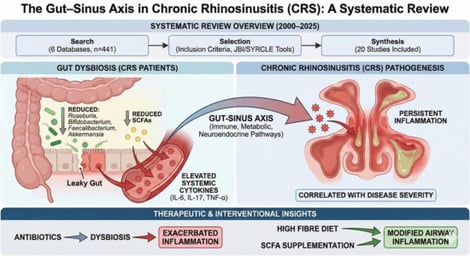
The schematic illustrates proposed immune, metabolic, and neuroimmune mechanisms linking gut microbiome dysbiosis to sinonasal inflammation. GPCR: G-protein-coupled receptors, GPR: G-protein receptors, SCFA: short-chain fatty acids, Th: T helper cells, Treg: T regulatory cells, IL: interleukin, TNF: tumour necrosis factor, TLRs: Toll-like receptors, GABA: Gamma Aminobutyric Acid, CRS: chronic rhinosinusitis, CRSwNP: chronic rhinosinusitis with nasal polyposis, CRSsNP: chronic rhinosinusitis without nasal polyposis, eCRS: eosinophilic chronic rhinosinusitis.
  • Case Report
  • Open Access

Previous cases of trigeminal neuralgia (TN) caused by fungal sinusitis have been reported, but mainly in immunocompromised patients. We present a case of fungal sinusitis masquerading as trigeminal neuralgia in an immunocompetent patient and discuss the potential implications of these two diseases. The patient is a 59-year-old male who presented with a four-year duration of left facial pain. He had been diagnosed and treated for trigeminal neuralgia by a pain specialist but was subsequently referred to ENT after a MRI of the brain showed left maxillary sinusitis. Nasoendoscopy findings and a CT scan of the paranasal sinuses were concordant with left maxillary sinusitis. The patient underwent left functional endoscopic sinus surgery and recovered uneventfully. Our study shows that even in immunocompetent patients who present with non-resolving or worsening facial pain resembling the original diagnosis of TN, clinicians should remain vigilant for the possibility of alternative underlying pathologies including fungal sinusitis.

23 February 2026

Primary ciliary dyskinesia (PCD) is a rare, genetically heterogeneous disorder of motile cilia that leads to impaired mucociliary clearance and recurrent airway infections. Children with PCD often present with ear and sinus disease resembling common pediatric conditions, yet the true burden and management remain incompletely defined. To address this gap, a systematic search for pediatric cohort studies published between 2020 and 2025 reporting otologic and sinonasal features of PCD was performed. Searches of PubMed, Embase, Scopus, and Web of Science identified 12 eligible studies, encompassing 524 children with confirmed PCD. Data extracted focused on demographics, otologic and sinonasal manifestations, vestibular findings, radiographic imaging, and interventions. Across studies, 60.3% had a history of otitis media and 39.1% had hearing loss, predominantly conductive. Tympanostomy tubes were utilized in more than half of patients, with many requiring multiple sets over time due to recurrent effusions or tube occlusion. Sinonasal disease was nearly universal, with 78.5% demonstrating chronic rhinosinusitis and most reporting nasal congestion and rhinorrhea; nasal polyps were uncommonly noted. Vestibular symptoms were also infrequently assessed but present in some patient cohorts. In conclusion, otologic and sinonasal disease are highly co-prevalent in pediatric PCD, highlighting the need for early recognition, regular surveillance, and standardized outcome reporting to guide long-term management of this complex chronic disease.

28 January 2026

Asthma is a multifactorial respiratory condition affected by demographic, clinical, and lifestyle factors. Recognizing sex-related differences in risk factors may help develop personalized preventive strategies and ultimately enhance clinical outcomes. This study aims to compare the characteristics of male and female patients with asthma and to identify the primary risk factors linked to the condition in each group as well. A comparative analysis was conducted using regression models to evaluate the association between asthma and potential risk factors. Odds ratios (ORs) with 95% confidence intervals (CIs) were calculated to estimate the strength of associations for men and women separately. In females, obesity (OR, 1.85; 95% CI, 1.24–2.75), chronic obstructive pulmonary disease (COPD) (OR, 3.37; 95% CI, 1.77–6.43), chronic sinusitis (OR, 4.37; 95% CI, 1.02–18.64), and hypothyroidism (OR, 1.79; 95% CI, 1.09–2.94) were significantly associated with asthma. In males, COPD was the strongest predictor (OR, 4.35; 95% CI, 1.18–15.97), while other factors showed weaker or non-significant associations. Age was not a significant predictor in either sex. The findings highlight important sex differences in the risk profile for asthma. These results underscore the need for sex-specific approaches in the prevention, diagnosis, and management of asthma.

9 January 2026

News & Conferences

Volumes

Latest Issues

Open for Submission

Editor's Choice

XFacebookLinkedIn
Sinusitis - ISSN 2673-351X