Skip to Content

Technologies

Technologies is an international, peer-reviewed, open access journal singularly focusing on emerging scientific and technological trends, published monthly online by MDPI.

Quartile Ranking JCR - Q1 (Engineering, Multidisciplinary)

Get Alerted

Add your email address to receive forthcoming issues of this journal.

All Articles (1,905)

Open vs. Commercial 5G SA Deployments: Performance Assessment

  • Teodora-Cristina Stoian,
  • Razvan-Marius Mihai and
  • Cristian Patachia-Sultanoiu
  • + 2 authors

Open-source and commercial fifth-generation (5G) deployments are difficult to compare because they are built for different goals and reported under different conditions, which slows down validation and technology transfer from research to practice. This study explores the deployment and evaluation of two 5G Standalone (SA) disaggregated Radio Access Network (RAN) systems, using open-source research RAN, commercial RAN, and Software-Defined Radio (SDR) hardware. The first testbed is a SDR-based prototype, containing a Universal Software Radio Peripheral (USRP) B210 device, using Software Radio System RAN (srsRAN) as the RAN. The commercial-based testbed contains a Benetel RAN550 Radio Unit (RU), connected via an optical fiber to a Commercial Off-the-Shelf (COTS) server acting as the Distributed Unit (DU) and Centralized Unit (CU) using the Accelleran virtualized Baseband Unit (vBBU) platform. The Core Network (CN) is implemented using the open-source Open5GS in both testbeds. To evaluate the network’s functionality, throughput and latency are tracked using a Motorola Edge 50 Pro mobile terminal. The experimental results are analyzed and compared with representative performance metrics reported in the literature to place the measurements in a broader research context. This study further assesses trade-offs related to cost, portability, and scalability by comparing SDR-based research prototypes with commercial deployments.

13 March 2026
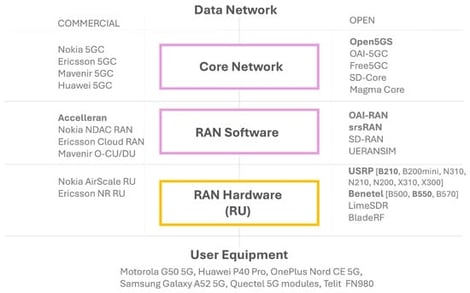
Comparative 5G architecture components. Structural differences between commercial and open deployments.

Sand production in an offshore hydrocarbon wells poses significant operational and integrity challenges, particularly in deviated wells, where complex flow geometries intensify particle transport and erosion risks. The traditional sand-monitoring method utilizes stationary acoustic sensors attached to the production flowline at the surface. However, these sensors provide limited spatial coverage and intermittent measurements, restricting their ability to detect early sanding onset or precisely localize sanding intervals. By combining with vertical seismic profiling (VSP), Distributed Acoustic Sensing (DAS) delivers continuous, high-density data along the entire length of the wellbore and is increasingly recognized as a powerful diagnostic tool for real-time downhole monitoring. This study presents a field application of DAS-VSP for detecting and characterizing sand transport in a deviated offshore production well equipped with 350 distributed fiber-optic channels spanning 0–1983 m true vertical depth (TVD) at 8 m spacing. A multistage workflow was developed, including SEGY ingestion and shot merging, channel and time window selection, trace normalization, and low-pass filtering below 20 Hz. Multi-domain signal analysis, such as RMS energy, spike-based time-domain attributes, FFT, PSD spectral characterization, and time–frequency decomposition, were used to isolate the characteristic im-pulsive low-frequency (<20 Hz) signatures associated with sand impact. An adaptive thresholding and event-clustering scheme was then applied to discriminate sanding bursts from background noise and integrate their acoustic energy over depth. The processed DAS section revealed distinct, depth-localized sand ingress zones within the production interval (1136–1909 m TVD). The derived sand log provided a quantitative measure of sand intensity variations along the deviated wellbore, with normalized RMS amplitudes ranging from 0.039 to 1.000 a.u., a mean value of 0.235 a.u., and 137 analyzed channels within the production interval. These results indicate that sand production is highly clustered within discrete depth intervals, offering new insights into sand–fluid interactions during steady-state flow. Overall, the findings confirm that DAS-VSP enables continuous real-time monitoring of the sanding behavior with a far greater depth resolution than conventional tools. This approach supports proactive sand management strategies, enhances well-integrity decision-making, and underscores the potential of DAS to evolve into a standard surveillance technology for hydrocarbon production wells.

13 March 2026

Schematic diagram of a DAS system highlighting the internal architecture of the Interrogator Unit. The system comprises a coherent laser source, an acousto-optic modulator for pulse generation, an optical circulator for signal routing, a photodetector for signal reception, and a data acquisition and processing unit. The external sensing fiber illustrates the interaction between the propagating laser pulse and environmental acoustic fields, leading to the return of modulated backscattered light [19,20].

The Impact of Geometric Continuities (C1, C2, and C3) on the Trajectories of Industrial Robots

  • Cozmin Adrian Cristoiu,
  • Marius-Valentin Drăgoi and
  • Gabriel Petrea
  • + 4 authors

This article presents a mathematical analysis of the geometric continuity of industrial robot trajectories, highlighting the influence of continuity conditions on velocity, acceleration, and vibration profiles. This study proposes an original approach: isolating geometric continuity as an independent parameter and the comparative evaluation of the continuity levels C1, C2, and C3 using a series of pre-computed kinematic metrics: vibration energy, acceleration variability, and trajectory curvature stability. The methodology is validated by numerical simulations performed with RoboDK for trajectory generation and by post-processing in Python for metric evaluation. The results indicate that C1 trajectories exhibit discontinuities in the higher-order derivatives, which lead to undesirable kinematic behaviors, while C2 continuity represents the minimum requirement for an acceptable, stable motion in industrial applications. Higher-order continuity, C3, brings greater regularity to the trajectories, but the practical advantages are limited and relatively insignificant for standard industrial applications.

13 March 2026

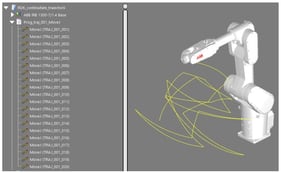
Robot trajectory generated for the first set of points.

In smart logistics and intelligent manufacturing scenarios, the deployment of Autonomous Guided Vehicles (AGVs) necessitates vision systems that balance stringent real-time constraints with high detection accuracy. However, contemporary lightweight models often struggle with multi-scale feature representation and precision degradation. To address these challenges, this study presents LSOD-YOLO, a tailored evolution of YOLO11n designed for embedded AGV systems. Our methodology focuses on three architectural innovations: (1) we propose a Lightweight Shared Convolution Detection (LSCD) head integrated with Group Normalization (GN) and a scale-adaptive mechanism to harmonize multi-scale feature responses; (2) we re-engineer the backbone using a Star-Net architecture enhanced by Gated MLPs and Depthwise Attention to refine local spatial modeling; and (3) we integrate multi-branch residuals and Channel Attention (CAA) into the C3k2-Star-CAA module to enhance robustness against occlusions and complex backgrounds. The experimental validation on a self-built AGV industrial dataset and COCO128 reveals a compelling performance leap: a 30 FPS increase in throughput and a 1.5% gain in precision, all achieved with 32.8% fewer parameters. These findings confirm that LSOD-YOLO achieves a superior trade-off between computational efficiency and reliability, showing great potential for seamless deployment in resource-constrained AGV visual tasks.

12 March 2026

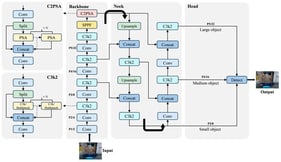
Structural layout of YOLO11n.

News & Conferences

Volumes

Issues

Open for Submission

Editor's Choice

Reprints of Collections

The Future of Healthcare
Reprint

The Future of Healthcare

Biomedical Technology and Integrated Artificial Intelligence 2nd Edition
Editors: Juvenal Rodriguez-Resendiz, Gerardo I. Pérez-Soto, Karla Anhel Camarillo-Gómez, Saul Tovar-Arriaga
Assistive Technologies in Care and Rehabilitation
Reprint

Assistive Technologies in Care and Rehabilitation

Research, Developments, and International Initiatives
Editors: Daniele Giansanti
XFacebookLinkedIn
Technologies - ISSN 2227-7080