


Abstract
In this work, the study of the fractional behavior of the Bateman–Feshbach–Tikochinsky and Caldirola–Kanai oscillators by using different fractional derivatives is presented. We obtained the Euler–Lagrange and the Hamiltonian formalisms in order to represent the dynamic models based on the Liouville–Caputo, Caputo–Fabrizio–Caputo and the new fractional derivative based on the Mittag–Leffler kernel with arbitrary order α. Simulation results are presented in order to show the fractional behavior of the oscillators, and the classical behavior is recovered when α is equal to 1.
1. Introduction
Several phenomenological models of dissipative systems have been proposed, such as the Bateman–Feshbach–Tikochinsky (BFT) or Caldirola–Kanai (CK) oscillators, the first model consists of a damped and an amplified oscillator, and this one-dimensional system exhibits an exponentially increasing mass with a Lagrangian given by Bateman [1,2,3,4,5]. Both quantum damped oscillators have been studied as a model to understand dissipation in quantum theory [6]. Bateman suggested the time-dependent Hamiltonian [2] and Caldirola the time dependent Hamiltonian to describe damped oscillations [4]. The Caldirola–Kanai oscillator is an open system whose parameters such as mass and frequency are all time dependent, while the Bateman–Feshbach–Tikochinsky oscillator is a closed system whose total energy is conserved and the dissipated energy from the damped oscillator is transferred to amplified one [7,8]. The fractional Hamiltonians are non-local and they are associated with dissipative systems [8]. There are few definitions of operators with fractional order, the Liouville–Caputo fractional derivative involving a kernel with singularity, and this definition is based on the power law and present singularity at the origin [9]. Recently, in order to solve the problem of singularity at the origin, Caputo and Fabrizio used the exponential decay law to construct a derivative with no singularity; however, the used kernel was local [10,11,12,13,14,15,16,17,18]. Thus, Atangana and Baleanu used the generalized Mittag–Leffler function to construct a derivative with no-singular and non-local kernel [19,20,21,22]. In this paper, we obtain alternative representations of the BFT and CK oscillators by using the Liouville–Caputo, Caputo–Fabrizio–Caputo and the new fractional derivative based in Mittag–Leffler kernel with arbitrary order α. Numerical solutions are based in a Crank–Nicholson scheme.
2. Fractional Operators
The Adams method is a multi-step method, and this method uses the information of all the previous values, , , , in order to calculate . This is the difference between the Adams method and the single-step methods, such as the Heun, Taylor and Runge–Kutta numerical schemes, which use only the last value to calculate the next one. There are two types of Adams methods, the Adams–Bashforth and the Adams–Moulton. The combination of these methods results in the predictor–corrector Adams–Bashforth–Moulton Method [23,24,25,26].
The generalization of this method for any order of derivative is called the fractional Adams–Bashforth Method [23]
where and is the Liouville–Caputo operator
Equation (1) satisfies the following Volterra integral equation
The fractional Adams method to solve (1) has been studied firstly by Diethelm, Ford and Freed [24], and this solution scheme is derived as follows:
The fractional operator proposed by Caputo and Fabrizio in Liouville–Caputo sense (CFC) is expressed as follows [10]:
where (is a normalization function). In this sense, the Laplace transform is given by
The fractional derivative based in Mittag–Leffler kernel (Atangana–Baleanu fractional operator in Liouville–Caputo sense, ABC) is given as
where is a Mittag–Leffler function [19]. The fractional integral is defined as
The Laplace transform of (7) produces
3. Applications
3.1. Bateman–Feshbach–Tikochinsky Oscillator
The classical Lagrangian of the BFT oscillator is given by
where is the damped harmonic oscillator coordinate and corresponds to the time-reversed counterpart, and the parameters m, ρ, K are time independent.
Now, we can get the generalized momentum as follows:
where is the Lagrangian of fractional order and .
The two generalized momentums are given by
Applying the Legendre transformation, we obtain the Hamiltonian of fractional order
Using the Equation (15), we have
We define and the Hamiltonian takes the form
The fractional Hamilton model of the BFT oscillator is given by
Now, we consider the fractional operators of Liouville–Caputo, Caputo–Fabrizio–Caputo and the fractional derivative based in the Mittag–Leffler kernel.
• First case. In the Liouville–Caputo sense, we have
• Second case. In the Caputo–Fabrizio–Caputo sense,
where
• Third case. For the fractional derivative based on the Mittag–Leffler kernel, we used the numerical approximation scheme developed in [20]
where
and the system (18) is represented by
Numerical Simulations
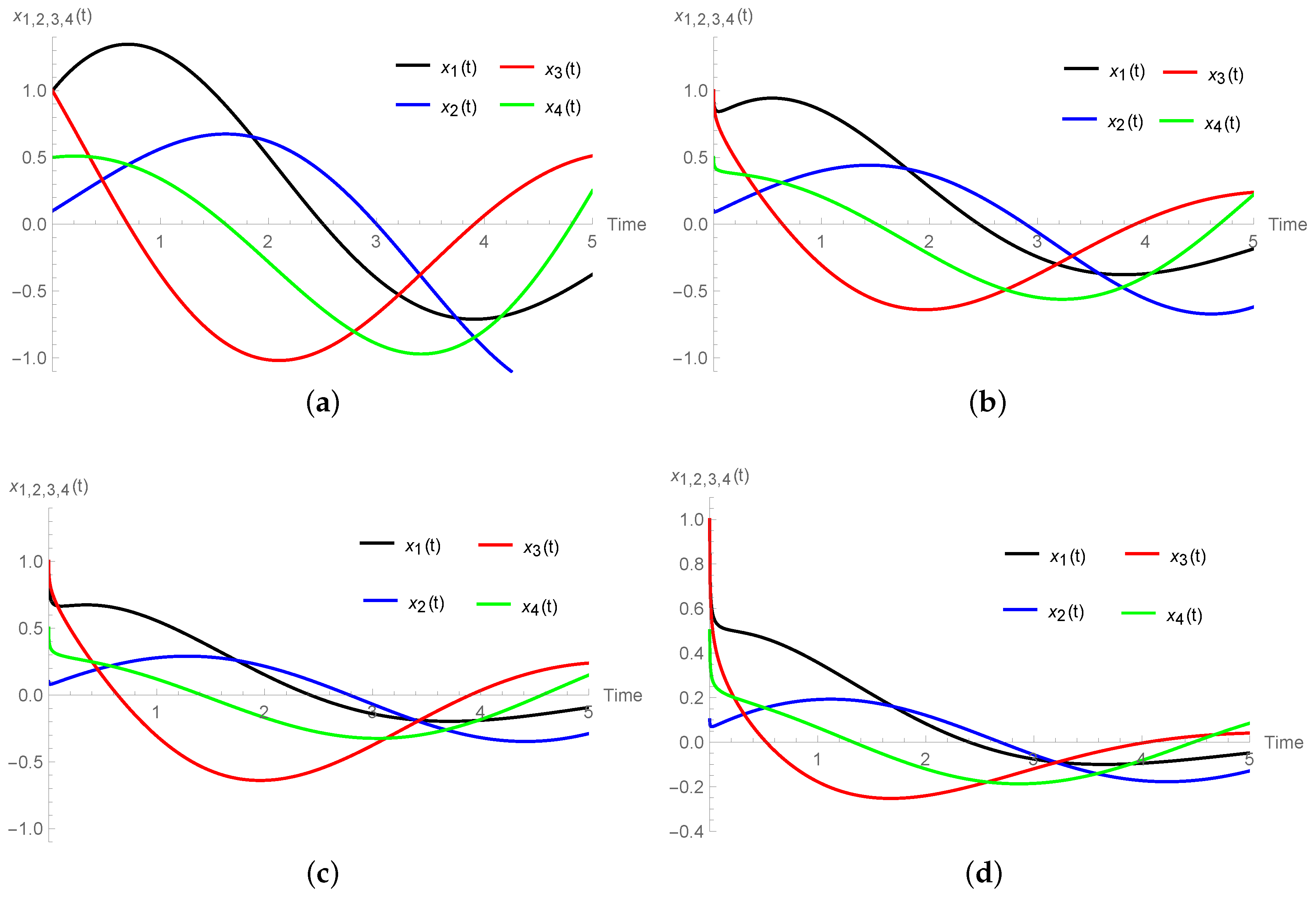
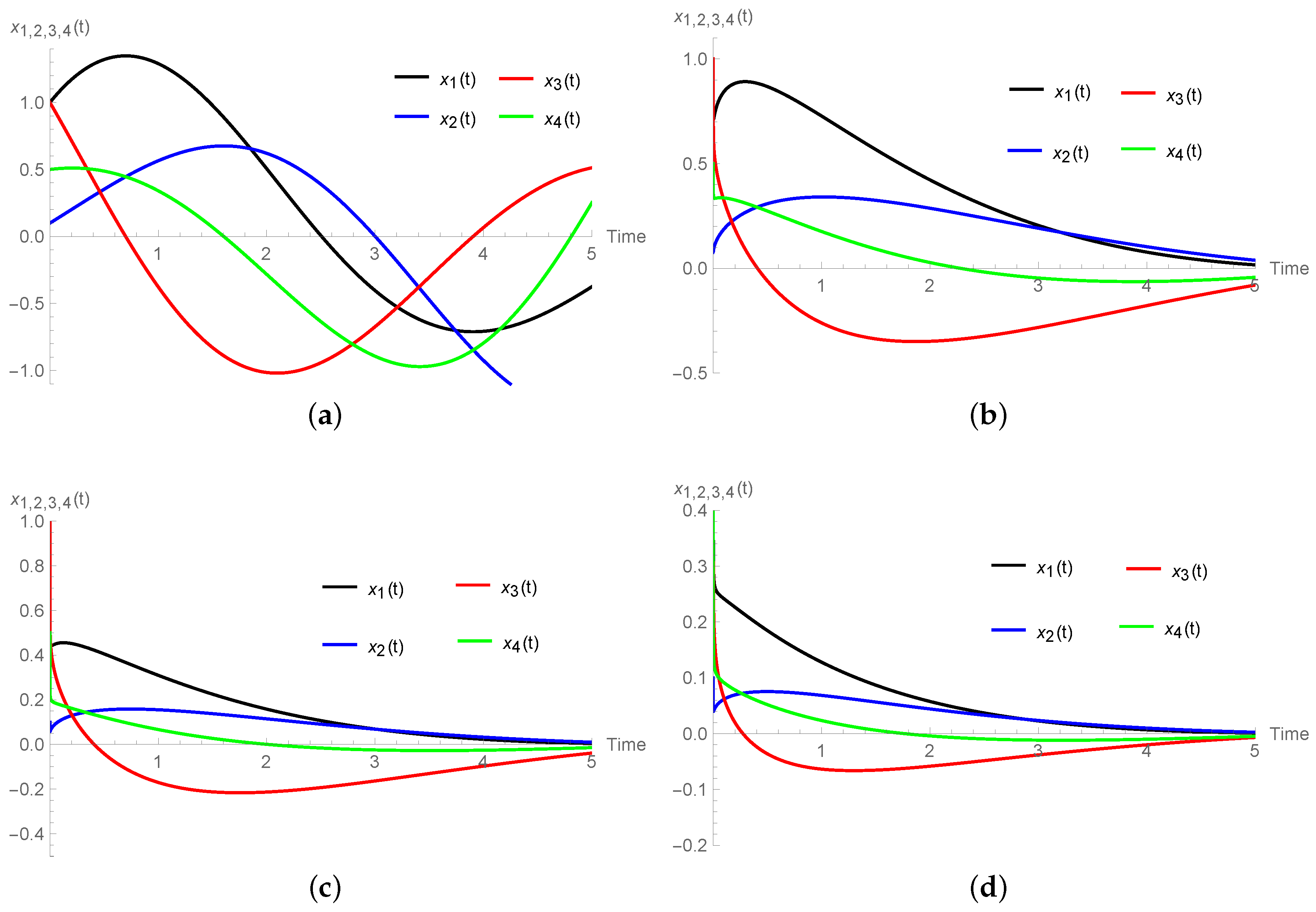
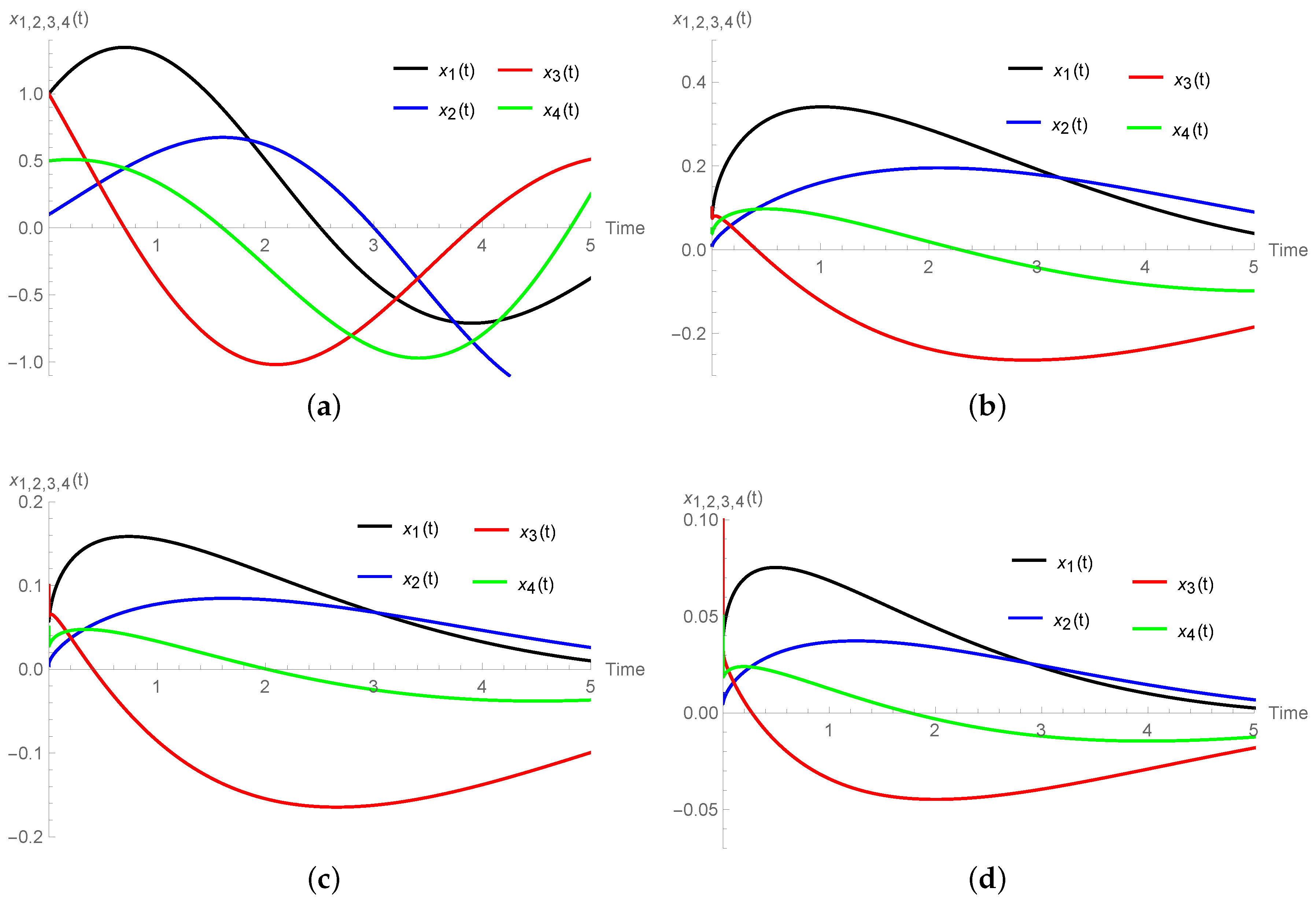
Figure 1, Figure 2 and Figure 3 shows the position , , and for systems (19), (20) and (23), respectively. For the simulation, the following values were considered: , , and different values of α, the total simulation time considered is 5 s, and the computational step . The initial conditions , , and were considered. The results show that by keeping the parameters constant and by varying α, we obtain different results. The reported results illustrate that the fractional approach is more suitable to describe the complex dynamics of the investigated model.
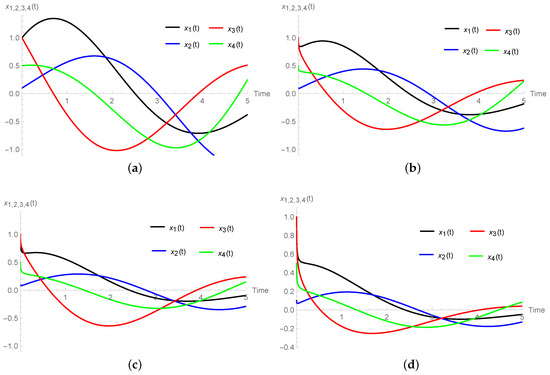
Figure 1.
Numerical evaluation of (19), in (a) ; in (b) ; in (c) ; and (d) .
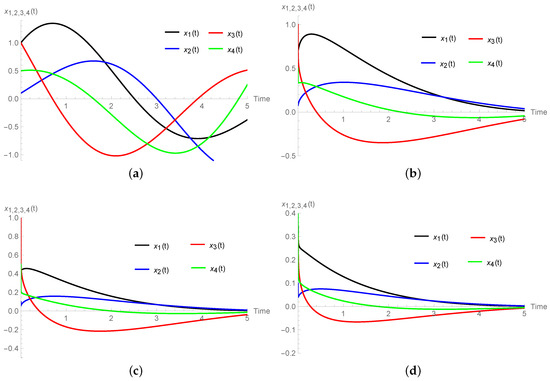
Figure 2.
Numerical evaluation of (20), in (a) ; in (b) ; in (c) ; and (d) .
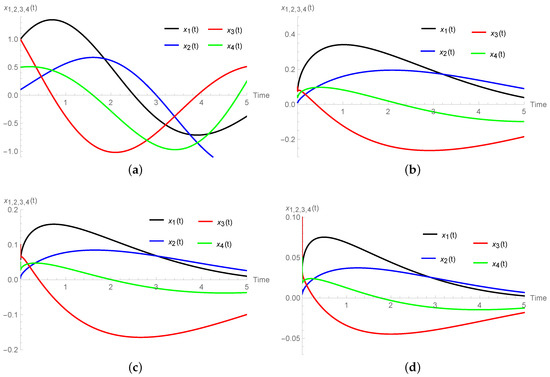
Figure 3.
Numerical evaluation of (23), in (a) ; in (b) ; in (c) ; and (d) .
3.2. Caldirola–Kanai Oscillator
We consider a harmonic CK oscillator whose mass depends on time such that , in this case, the Lagrangian is given by
where m depends explicitly on time, and β and γ are variable parameter and damping factors.
The Hamiltonian of fractional order is obtained using the Legendre transformation
where
The fractional Hamilton model of the CK oscillator is given by
Now, we consider the fractional operators of Liouville–Caputo, Caputo–Fabrizio–Caputo and the fractional derivative based on the Mittag–Leffler kernel.
• First case. In the Liouville–Caputo sense, we have
• Second case. In the Caputo–Fabrizio–Caputo sense, the Adams–Moulton rule for system (31) is given by
where
• Third case. For the fractional derivative based on the Mittag–Leffler kernel, we have
Numerical Simulations
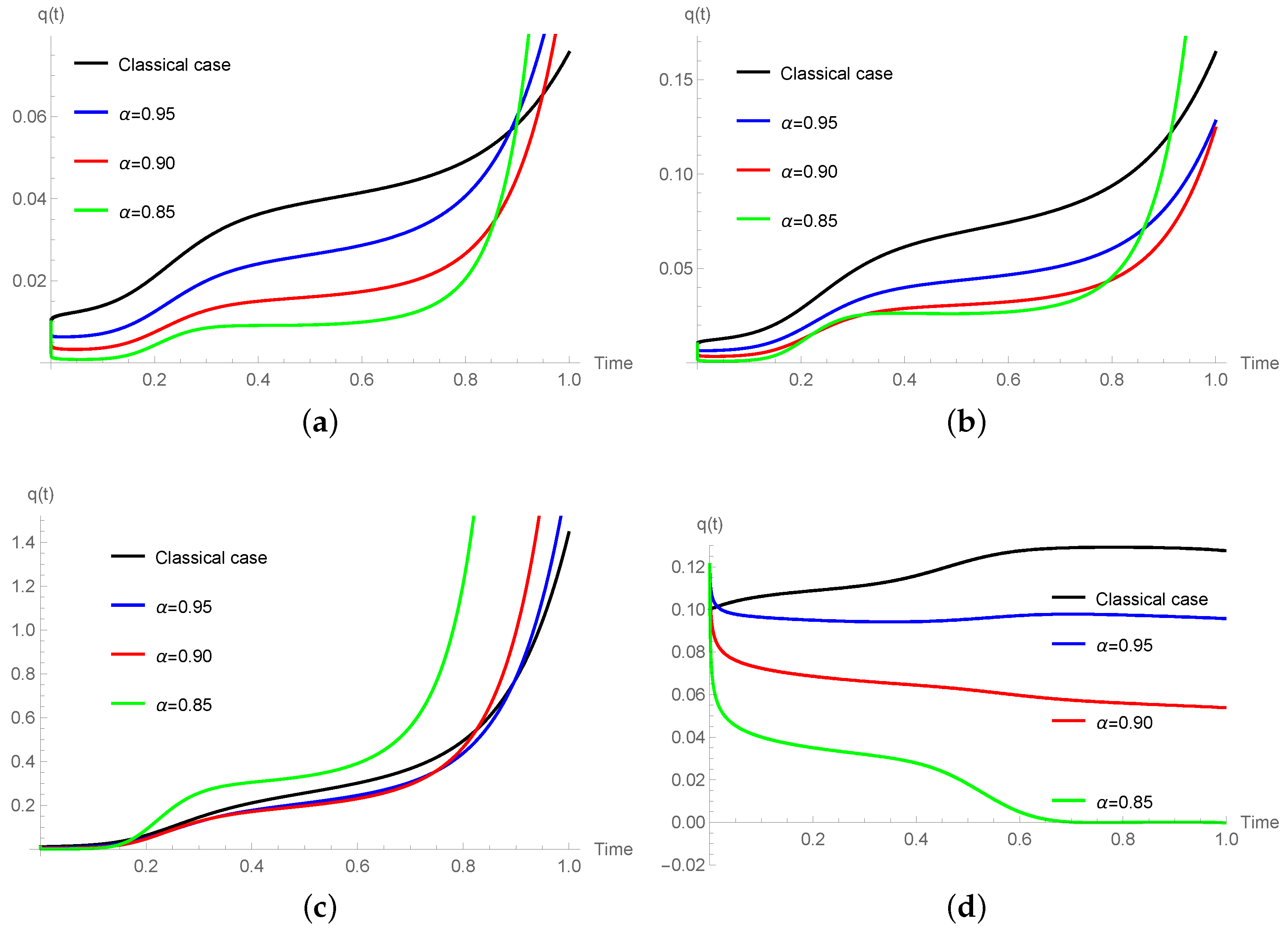
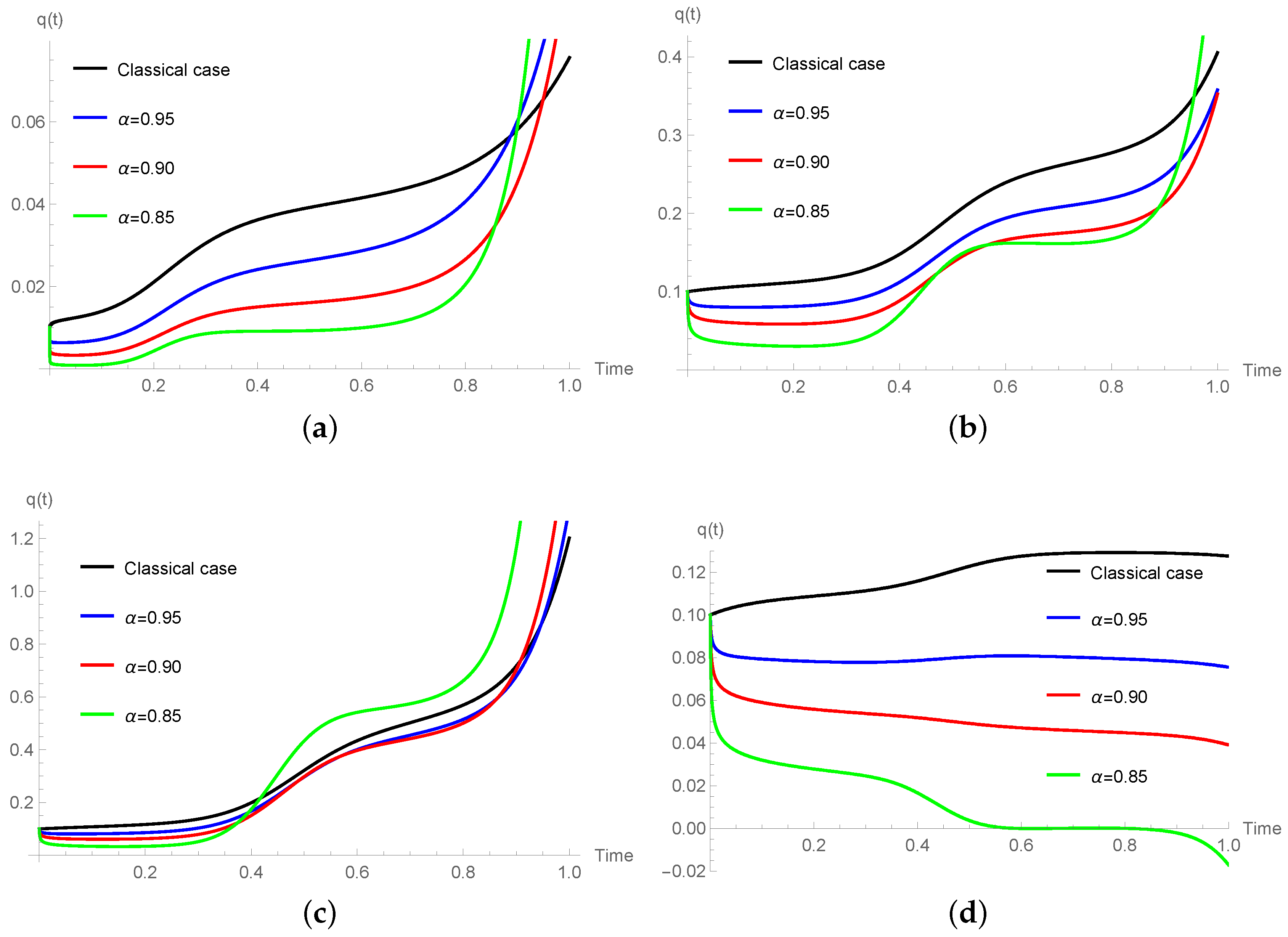
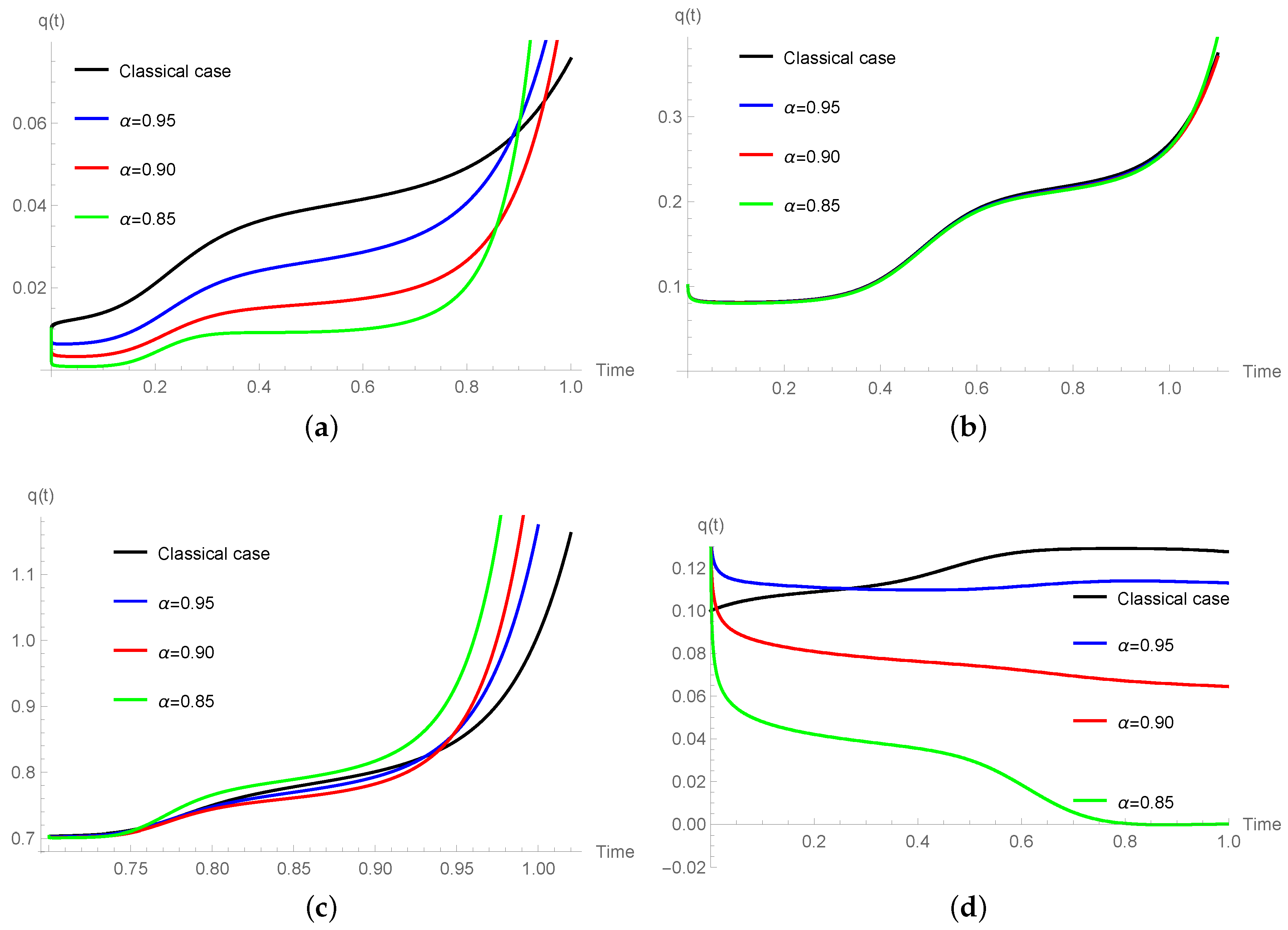
Figure 4, Figure 5 and Figure 6 depicted the numerical evaluation of (32)–(34) in Liouville–Caputo, Caputo–Fabrizio–Caputo and the fractional derivative based on the Mittag–Leffler kernel, respectively, considering different values of and fractional order γ, for all cases and , and the total simulation time considered is one second and computational step . It is clear from the figures that the behaviors of the fractional equations strongly depend on the order α of the fractional derivatives, in addition to the form of the function .
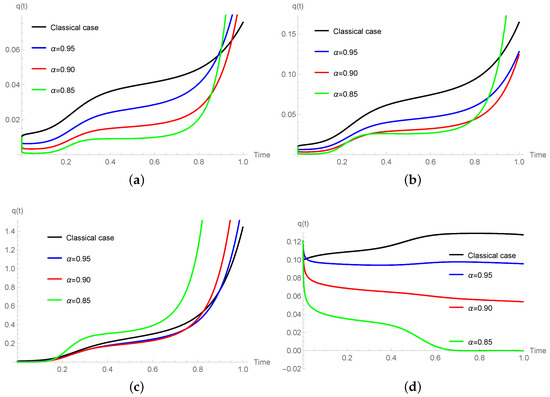
Figure 4.
Numerical evaluation of (32), in (a) ; in (b) ; in (c) ; and (d) .
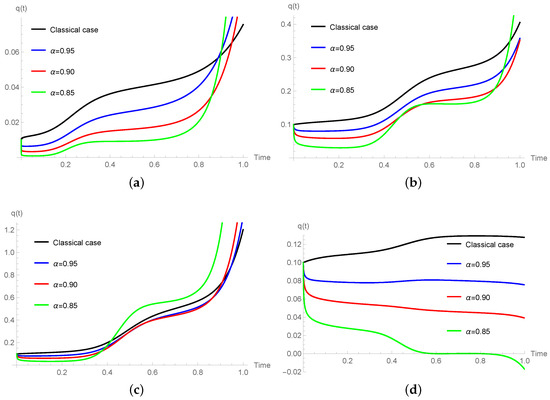
Figure 5.
Numerical evaluation of (33), in (a) ; in (b) ; in (c) ; and (d) .
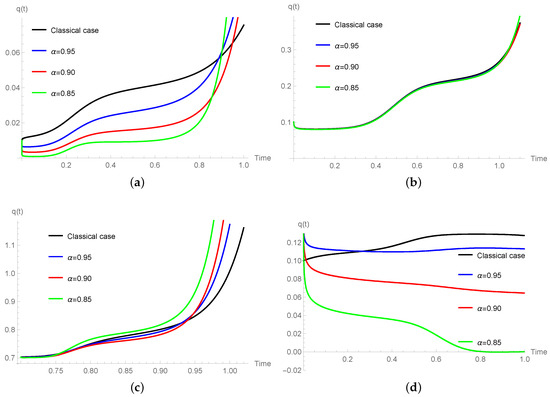
Figure 6.
Numerical evaluation of (34), in (a) ; in (b) ; in (c) ; and (d) .
4. Conclusions
Alternative representations of the Bateman–Feshbach–Tikochinsky and Caldirola–Kanai oscillators were studied using fractional operators of Liouville–Caputo type. We derive new solutions of these models using an iterative scheme and via a Crank–Nicholson scheme. The Liouville–Caputo fractional derivative involves a kernel with singularity, and this definition is based on the power law and present singularity at the origin. Recently, Caputo and Fabrizio solved the problem of singularity at the origin and used the exponential decay law to construct a derivative with no singularity; however, the used kernel is local. This derivative therefore has an advantage over the Liouville–Caputo derivative because the full effect of the memory can be portrayed. Atangana and Baleanu suggested two fractional derivatives based on the generalized Mittag–Leffler function. These derivatives with fractional order in Liouville–Caputo and Riemann–Liouville sense have non-singular and non-local kernel and preserve the benefits of the Riemann–Liouville, Liouville–Caputo and Caputo–Fabrizio operators.
Using these fractional operators, the results show that, by keeping the parameters constant and by varying α, we obtain different behaviors. The reported results illustrate that the fractional approach is more suitable to describe the complex dynamics of the investigated models. Finally, we observe novel behaviors that cannot be obtained with standard models and using local derivatives.
Acknowledgments
The authors appreciate the constructive remarks and suggestions of the anonymous referees that helped to improve the paper. We would like to thank Mayra Martínez for the interesting discussions. The authors extend their appreciation to the International Scientific Partnership Program (ISPP) at King Saud University for funding this research work through ISPP 63. Antonio Coronel Escamilla acknowledges the support provided by Consejo Nacional de Ciencia y Tecnología (CONACyT) through the assignment doctoral fellowship. José Francisco Gómez Aguilar acknowledges the support provided by CONACyT: Cátedras CONACyT para jóvenes investigadores 2014.
Author Contributions
The analytical results were worked out by Antonio Coronel-Escamilla, José Francisco Gómez-Aguilar, Dumitru Baleanu, Teodoro Córdova Fraga, Ricardo Fabricio Escobar Jiménez, Victor H. Olivares-Peregrino and Maysaa Mohamed Al Qurashi; José Francisco Gómez-Aguilar, Ricardo Fabricio Escobar Jiménez and Antonio Coronel-Escamilla polished the language and were in charge of technical checking. José Francisco Gómez-Aguilar, Antonio Coronel-Escamilla, Teodoro Córdova-Fraga, Dumitru Baleanu, Ricardo Fabricio Escobar-Jiménez, Victor H. Olivares-Peregrino and Maysaa Mohamed Al Qurashi wrote the paper. All authors have read and approved the final manuscript.
Conflicts of Interest
The authors declare no conflict of interest.
References
- Kim, S.P.; Santana, A.E.; Khanna, F.C.; Kor, J. Decoherence of quantum damped oscillators. Phys. Soc. 2003, 43, 452–460. [Google Scholar]
- Bateman, H. On dissipative systems and related variational principles. Phys. Rev. 1931, 38. [Google Scholar] [CrossRef]
- Feshbach, H.; Tikochinsky, Y. Quantization of the damped harmonic oscillator. Trans. N. Y. Acad. Sci. 1977, 38, 44–53. [Google Scholar] [CrossRef]
- Caldirola, P. Forze non conservative nella meccanica quantistica. Il Nuovo Cimento 1942, 18, 393–400. (In Italian) [Google Scholar] [CrossRef]
- Kanai, E. On the quantization of the dissipative systems. Prog. Theor. Phys. 1948, 3, 440–442. [Google Scholar] [CrossRef]
- Dekker, H. Classical and quantum mechanics of the damped harmonic oscillator. Phys. Rep. 1981, 80. [Google Scholar] [CrossRef]
- Baleanu, D.; Asad, J.H.; Petras, I. Fractional Bateman–Feshbach Tikochinsky Oscillator. Commun. Theor. Phys. 2014, 61, 221–225. [Google Scholar] [CrossRef]
- Baleanu, D.; Asad, J.H.; Petras, I.; Elagan, S.; Bilgen, A. Fractional Euler-Lagrange equation of Caldirola–Kanai oscillator. Rom. Rep. Phys. 2012, 64, 1171–1177. [Google Scholar]
- Atangana, A.; Alkahtani, B.S.T. Analysis of the Keller-Segel model with a fractional derivative without singular kernel. Entropy 2015, 17, 4439–4453. [Google Scholar] [CrossRef]
- Caputo, M.; Fabricio, M. A New Definition of Fractional Derivative without Singular Kernel. Prog. Fract. Differ. Appl. 2015, 1, 73–85. [Google Scholar]
- Caputo, M.; Fabrizio, M. Applications of new time and spatial fractional derivatives with exponential kernels. Prog. Fract. Differ. Appl. 2016, 2. [Google Scholar] [CrossRef]
- Batarfi, H.; Losada, J.; Nieto, J.J.; Shammakh, W. Three-point boundary value problems for conformable fractional differential equations. J. Funct. Spaces 2015, 2015. [Google Scholar] [CrossRef]
- Sitho, S.; Ntouyas, S.K.; Tariboon, J. Existence results for hybrid fractional integro-differential equations. Bound. Value Probl. 2015, 2015. [Google Scholar] [CrossRef]
- Gao, F.; Yang, X.J. Fractional Maxwell fluid with fractional derivative without singular kernel. Therm. Sci. 2016, 20, 871–877. [Google Scholar] [CrossRef]
- Shah, N.A.; Khan, I. Heat transfer analysis in a second grade fluid over and oscillating vertical plate using fractional Caputo Fabrizio derivatives. Eur. Phys. J. C 2016, 76. [Google Scholar] [CrossRef]
- Caputo, M.; Cametti, C. Fractional derivatives in the transport of drugs across biological materials and human skin. Phys. A Stat. Mech. Its Appl. 2016, 462, 705–713. [Google Scholar] [CrossRef]
- Gómez-Aguilar, J.F. Modeling diffusive transport with a fractional derivative without singular kernel. Phys. A Stat. Mech. Its Appl. 2016, 447, 467–481. [Google Scholar] [CrossRef]
- Zafar, A.A.; Fetecau, C. Flow over an infinite plate of a viscous fluid with non-integer order derivative without singular kernel. Alex. Eng. J. 2016, 55, 2789–2796. [Google Scholar] [CrossRef]
- Atangana, A.; Baleanu, D. New fractional derivatives with nonlocal and non-singular kernel: Theory and application to heat transfer model. Therm. Sci. 2016, 20, 763–769. [Google Scholar] [CrossRef]
- Gómez-Aguilar, J.F. Space-time fractional diffusion equation using a derivative with nonsingular and regular kernel. Phys. A Stat. Mech. Its Appl. 2017, 465, 562–572. [Google Scholar] [CrossRef]
- Gómez-Aguilar, J.F. Irving Mullineux oscillator via fractional derivatives with Mittag–Leffler kernel. Chaos Solitons Fractals 2017, 95, 179–186. [Google Scholar] [CrossRef]
- Atangana, A.; Koca, I. Chaos in a simple nonlinear system with Atangana-Baleanu derivatives with fractional order. Chaos Solitons Fractals 2016, 89, 447–454. [Google Scholar] [CrossRef]
- Changpin, L.; Chunxing, T. On the fractional Adams method. Comput. Math. Appl. 2009, 58, 1573–1588. [Google Scholar]
- Diethelm, K.; Ford, N.J.; Freed, A.D. Detailed error analysis for a fractional Adams method. Numer. Algorithms 2004, 36, 31–52. [Google Scholar] [CrossRef]
- Baskonus, H.M.; Bulut, H. On the numerical solutions of some fractional ordinary differential equations by fractional Adams-Bashforth-Moulton method. Open Math. 2015, 13, 547–556. [Google Scholar] [CrossRef]
- Changpin, L.; Guojun, P. Chaos in Chen’s system with a fractional order. Chaos Solitons Fractals 2004, 22, 443–450. [Google Scholar]
© 2017 by the authors. Licensee MDPI, Basel, Switzerland. This article is an open access article distributed under the terms and conditions of the Creative Commons Attribution (CC BY) license ( http://creativecommons.org/licenses/by/4.0/).