Abstract
Quantum computation by the adiabatic theorem requires a slowly-varying Hamiltonian with respect to the spectral gap. We show that the Landau–Zener–Stückelberg oscillation phenomenon, which naturally occurs in quantum two-level systems under non-adiabatic periodic drive, can be exploited to find the ground state of an N-dimensional Grover Hamiltonian. The total runtime of this method is , which is equal to the computational time of the Grover algorithm in the quantum circuit model. An additional periodic drive can suppress a large subset of Hamiltonian control errors by using coherent destruction of tunneling, thus outperforming previous algorithms.
1. Introduction
Adiabatic Quantum Computation (AQC) [1,2] is a computational model motivated by the adiabatic theorem. The theorem states that, if a system is prepared in the ground state of an initial Hamiltonian, and the Hamiltonian slowly varies over time, then the system will remain close to the instantaneous ground state [3,4]. By encoding a solution for a computational problem in the ground state of the final Hamiltonian, one can exploit this phenomenon to produce the aforementioned ground state, and thus produce a solution to the problem. The maximal rate of change allowed for such evolution usually scales with the square of the energy gap between the ground state and the first excited state [1].
The Grover problem [5], also known as The Unstructured Search Problem, is one of the few problems solvable by a native adiabatic algorithm, which achieves the same performance as the best possible algorithm in the circuit model [6] (see also [7,8,9]). The input to the problem is an n qubit Hamiltonian , which can only be used as a black box, meaning it can be switched on or off:
wherein is the identity matrix with , and we use dimensionless units (see Appendix A). The problem is to find the unknown string y. Grover’s algorithm solves the problem in time , which is a quadratic improvement to any classical algorithm. The problem is comparable to finding the ground state of a known Hamiltonian, whose ground state is computationally hard to find and, therefore, can be considered computationally unknown [10].
An adiabatic algorithm for the search problem was first suggested by Farhi et al. [1]. The system is initialized to a symmetric superposition of the computational basis states, denoted , and then evolves by the time-dependent Hamiltonian:
wherein the control function is initialized to 0 and increases monotonically in time to 1. The minimal gap for n qubit systems is . Evolving with a linear requires time, while a specially tailored control function, whose rate matches the instantaneous spectral gap, generates the ground state of in the optimal time, [11,12].
In this work, we introduce a diabatic algorithm for the Grover problem, denoted algorithm , whose performance matches the optimal adiabatic and circuit model algorithms [5,6,12], by setting when . The system passes the minimal gap multiple times diabatically and is effectively evolving by a Landau–Zener–Stükelberg (LZS) Hamiltonian [13,14,15,16,17] (which is sometimes referred to as the Landau–Zener–Stükelberg–Majorana Hamiltonian [18]). In algorithm , we add an oscillating term that yields improved robustness to Hamiltonian control errors relative to previous algorithms [5,12].
2. Background
2.1. LZS Hamiltonians
We start by analyzing the LZS Hamiltonian for a generic two-level system with the bare states , closely following the treatment of [19]:
The sinusoidal drive causes the Hamiltonian to exhibit avoided level crossings at for with a minimal energy gap of (see Figure 1).
Figure 1.
(top) The instantaneous eigenvalues of ; and (bottom) the drive . Avoided crossings occur at for integer k, when . Each period of the drive (gray or green background) contains a double crossing. Note that the ground state and the excited state alternate at every avoided crossing.
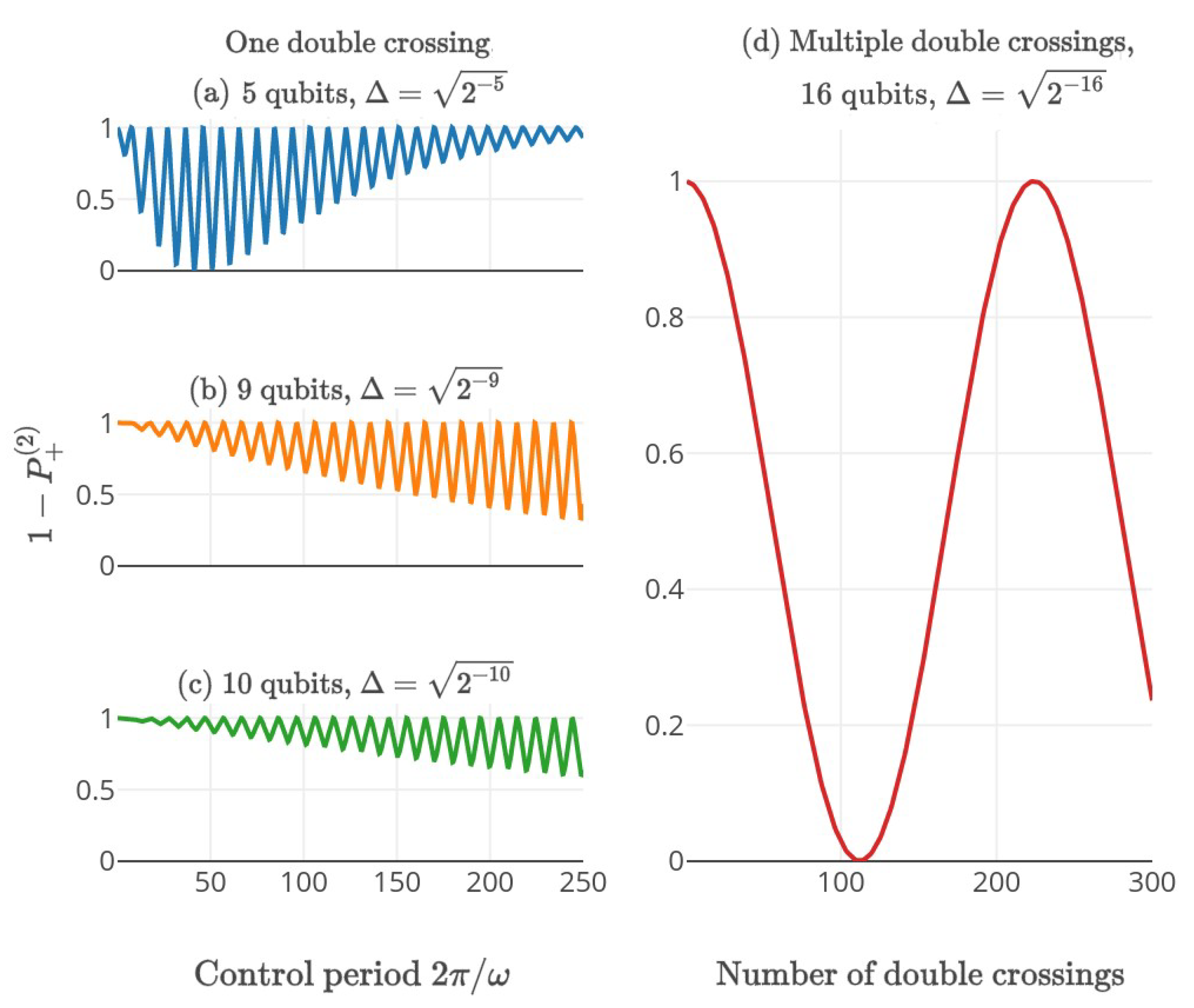
To gain some intuition, consider a system initialized to the state and driven through the avoided crossing twice (meaning, one period of ). After the double crossing, the population of the state , denoted , approaches 0 for both and for : if , the adiabatic condition holds; the system always remains in the instantaneous ground state and, thus, returns to . Furthermore, in the limit , the propagator approaches unity and the state remains unperturbed. In intermediate cases, an interesting phenomenon occurs: in the first passage of the avoided crossing, the system transfers almost perfectly from the initial ground state to the final excited state. However, a tiny amplitude leaks to the orthogonal state. The populations of the excited state and the ground state gain different phases between the two crossings, and, finally, interfere again in the second crossing. is affected by this interference and oscillates with the periodicity of the control in what is known as Landau–Zener–Stückelberg oscillations [13,14,15] (See Figure 2).
Figure 2.
Numerical simulation of LZS oscillations solving the Grover problem where the system is initialized to the ground state at . (a–c) The ground state population after a double crossing with different and gaps. This probability reaches 1 both for and for (only visible in (a)). For the first limit, the system is almost unperturbed. However, in second limit, the process is adiabatic and the system follows the instantaneous ground state and returns to its initial state. While the rotating wave approximation holds (), the ground state population after a double crossing is . The zeros of the Bessel function correspond to coherent destruction of tunneling, wherein in the graph. The approximation fails as in (a); (d) Numerical simulation of the ground state population following multiple double crossings in a 16-qubit system.
In the regime, one can use the rotating wave approximation (see [19], and Appendix B) to show that, with periodic drive, the system oscillates around the x axis in the Bloch sphere with frequency
The algorithm will fail when equals a root of the Bessel function , where a coherent destruction of tunneling (CDT) occurs, and ([20], see also [17,19]). CDT was previously suggested as a method to control interactions in quantum systems [21,22,23] and we use these ideas in algorithm .
2.2. Grover as a Two-Level System
Interestingly, the Grover Hamiltonian with a periodic control function is closely related to . The key to the mapping is the subspace , which is invariant to for all s, as originally noted by Farhi and Gutmann [24] (see proof in Appendix C). Although V is isomorphic to the Hilbert space of a two-level system, one cannot map to trivially in , because the first pair is only approximately orthogonal. To overcome this problem, we define a new basis , exponentially close to and , as stated in the following claim:
Claim 1.
The projection of on V satisfies:
wherein . The operators act on the states
wherein is the vector orthogonal to in V.
See Appendix D for the proof.
3. Results
3.1. Algorithm
Algorithm is an immediate corollary of Claim 1. The Hamiltonian with the control function acts on V as an LZS Hamiltonian on the states . Since and are exponentially close to and , respectively, evolving by will cause the system to oscillate between the states close to and with frequency . Hence, such a driven Hamiltonian can solve the Grover problem in time , i.e., the same complexity as the optimal circuit and adiabatic models.
A careful analysis of LZS interferometry shows that the algorithm finds y for a wide range of . We require only for the rotating wave approximation to hold. is a factor of the algorithm’s runtime, hence should not be large (for , ), and not too close to the roots of as it will cause to diminish by CDT. Note that none of these constraints requires prior knowledge of the gap , other than an upper bound. Hence, the algorithm is robust to a multiplicative error of the Hamiltonian due to calibration errors, similar to previous approaches [25]. A different choice of parameters may improve the algorithm’s robustness to the variations in the total evolution time, as demonstrated in [26].
The limit yields maximal , and corresponds to evolving by the time-independent Hamiltonian , which we denote . This is exactly the “analog” algorithm for the search problem by Farhi and Gutmann [24], and, more generally, a search by a quantum walk [25,27,28,29,30,31,32,33]. The Hamiltonian is the core of algorithms for the search problem: in the adiabatic algorithm [12], the Hamiltonian spends most of the time close to , where the gap is minimal [25], while the original gate-model algorithm by Grover [5] can be seen as a simulation (or an approximation by Trotter formula [34]) of [24].
3.2. Algorithm
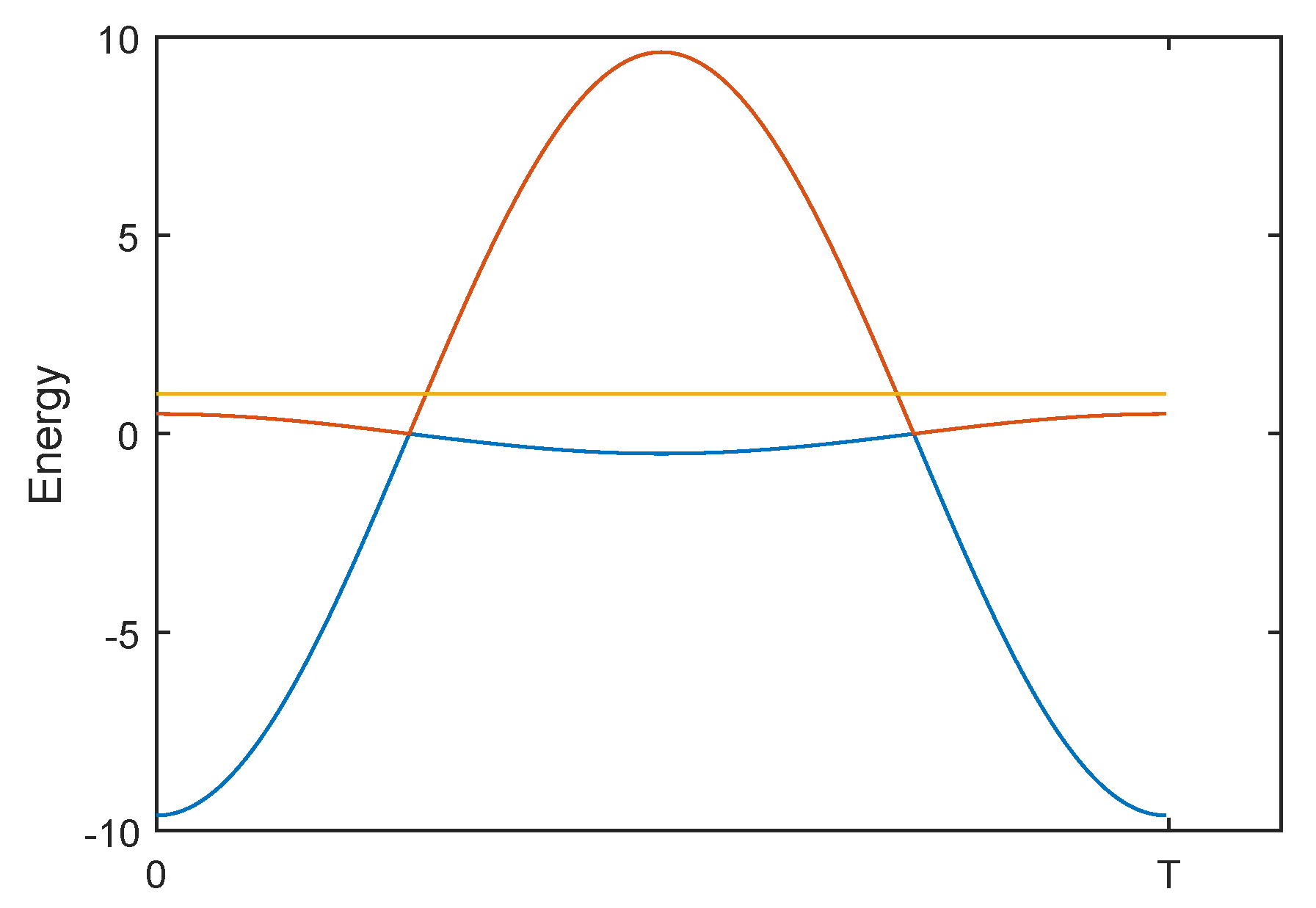
We now discuss adding an additional modulation to Algorithm to improve its robustness without significantly increasing the runtime. Equation (7) defines the Hamiltonian for algorithm , and the spectrum is illustrated in Figure 3.
Figure 3.
The spectrum of the noiseless over one period. The parameters are . Note that the yellow energy level is outside the invariant subspace V.
A natural question is whether Algorithm is “cheating” by artificially increasing the gap or by manipulating resources. Here, a small detour discussing resources is in order. First, note that implementing the term requires no prior knowledge of y. Namely the algorithm is the same for all y (or y is “unknown”). This means that the total time wherein is active would have to be at least . Otherwise, this would contradict the optimality of Grover’s algorithm [35]. To understand the role of B, one can partition by the Trotter approximation to slices of time independent Hamiltonians, where evolution by and by terms that are not alternate. In this picture, increasing corresponds to using a stronger quantum computer between calls to the black box, but has no effect on the query complexity of the problem (the total time is active).
3.3. Robustness Comparison
In what follows, we compare the robustness to control errors of algorithm versus applying the time-independent Hamiltonian , which also represents the standard gate model and adiabatic algorithms (for an analysis of the Hamiltonian-based search algorithm under different noise models, cf. [25,36,37]).
Hamiltonian control errors are uncontrolled terms causing the system to deviate unitarily from the intended evolution. The first error we focus on is in the form that preserves the subspace V and represents an error in (see Equation (5)).
Consider with a harmonic control error in :
This is exactly the LZS Hamiltonian. Therefore, for high frequency errors (), the Rabi frequency is , and the evolution is generally unaffected. On the other hand, for , even may cause the system to freeze in the initial state because the rotation may become more dominant than the desired rotation. Hence, algorithms based on are not robust to low frequency control errors.
Algorithm generally shows similar robustness (see Figure 4). It fails to find y when and for the same reasons fails. For high frequency errors, we write the Hamiltonian in the appropriate rotating frame (around ) while neglecting terms:
Figure 4.
Sixteen-qubit numerical simulation comparing the robustness of Algorithm versus an evolution by : (a) Algorithm with parameters ; and (b) an evolution by . The error with is equivalent to an error in . Each row in both panels is a simulation with different that is displayed on the y-axis. The brightness of the row changes from left to right as the value of varies in time under the noise of the specified . Both algorithms are influenced by errors with , and fail as diminishes. However, both are generally robust to high frequency errors.
See Appendix E for details.
The algorithm is generally unaffected by high frequency errors () where all terms except average out, and the Rabi oscillation is . Note that, if for some values of , then these terms would not average out, and may, in principle, cause the algorithm to fail because of CDT.
The second error we consider in our comparison are errors that do not preserve V. For their analysis, we use a three-level system toy model, composed of the previously defined states and an additional state , which represents a state outside of V. The error term we choose to focus on is the term . The Hamiltonians take the form:
Interestingly, already has some inherent robustness to errors diverting the system to : the diagonal elements of can be considered as “potential energies” of three sites. Therefore, a particle in needs to overcome a potential difference to reach , while it does not need to face a barrier when transitioning to .
Algorithm improves the natural error suppression by adding CDT between the states and , while allowing transitions between and . We hereby present a simplified analysis, using the rotating wave approximation. However, we stress that finer tools, such as Floquet theory [38], better describe the dynamics of the system and should be used when one attempts to find optimal values for (see Figure 5). After changing to a rotating frame where , and using the rotating wave approximation, we have:
Figure 5.
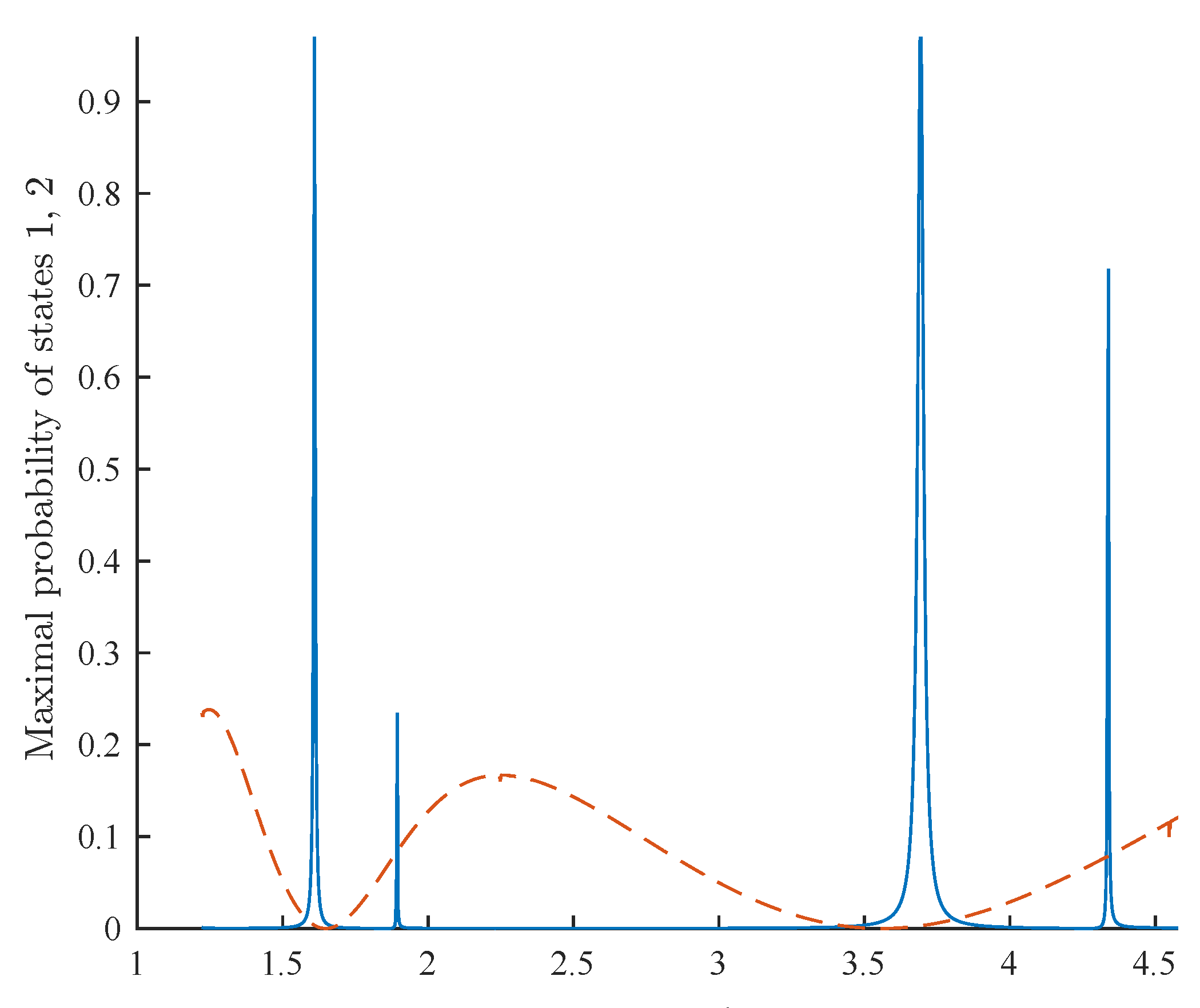
A simulation of Algorithm with the control errors which do not preserve V, as expressed in Equation (9). We set , and simulated the three-level system with different values of (x axis). For every simulation, two data points were plotted for the maximal probability reached by the states (blue, solid) and (orange, dashed) in the time interval . The ratio between the desired transition and the control error is 1:600; evolving by yields with probability . The graph shows that for some , the peak probability of is close to one. Hence, Algorithm is more robust to such errors. Note that Equation (10) predicts that the transition peaks for , which corresponds for the first two roots of , where the transition is strongly suppressed. The simulation shows that the desired transition peaks at two frequencies around each root—this implies that the rotating wave approximation is insufficient to describe the dynamics of the system.
Note that, in Equation (10), the argument for the Bessel function in is different from the one in . By choosing to be a root of , the transition from to is suppressed. On the other hand, the term , which dominates and the computation time, is multiplied by a factor of . Namely, the runtime is increased by a factor of , while the error term is suppressed. Our numerical simulations (see Figure 5) confirm that, for a given scenario, the probability of an evolution to find y is , while, with tuned parameters, Algorithm finds y with near certainty.
Thermal noise: Implementing error correction for quantum algorithms based on continuous Hamiltonians instead of discrete gates is an open problem [39]. One can suppress thermal noise (as well as control errors) by encoding the Hamiltonian by a stabilizer code [40], combined with dynamical decoupling [41], energy gap protection [42], or Zeno effect suppression [43]. All of them function very similarly [39,44], providing enhanced performance for finite size systems, which were recently described as noisy intermediate scale quantum (NISQ) [45]. For an exponential time algorithm, such as the unstructured search problem, error suppression methods ultimately fail, and an active error correction is required.
4. Discussion
In this work, we propose a new diabatic algorithm for solving the Grover problem using LZS interferometry. Diabatic scheduling for computation was researched recently [46,47] and, in some cases, even showed superior performances to adiabatic scheduling. Variational Quantum Algorithms (VQA) [48,49,50,51] and Quantum Approximate Optimization Algorithms (QAOA) [52,53], in which the path is optimized by a classical computer, can also be considered diabatic. However, our work shows a new application of diabaticity: suppression of control errors. We conjecture the need for hybrid algorithms (diabatic/adiabatic), tailored to the noise parameters of a system.
One possible near term implementation of such model is the unstructured search problem on the hypercube [30,54], which exhibits an avoided crossing between the two lowest eigenvalues, while the rest of the spectrum is separated. Driving the system with oscillations that are slow with respect to the gap between the first and second excited states will cause the two lowest energy states to act as a two-level system.
While the Grover problem is important on its own, it is interesting to examine the applicability of our paradigm to additional problems. It remains an open question whether one can translate any adiabatic algorithm to a diabatic algorithm.
Finally, it is interesting to find an expression for the optimal driving frequencies in Algorithm , including their spectral width, and effectiveness (based on a full numerical analysis of the Floquet problem).
Author Contributions
Conceptualization, Y.A. and N.K.; Formal analysis, Y.A. and N.K.; Investigation, Y.O.; Software, Y.O.; Supervision, N.K.; Writing—original draft, Y.A. and Y.O.; and Writing—review and editing, N.K.
Funding
Y.A.’s work is supported by ERC grant number 280157, and Simons foundation grant number 385590 & 385586. Y.O.’s work is supported by ERC grant number 280157, and by ISF grant 1721/17. N.K. is supported by the ERC Project No. 335933.
Acknowledgments
The authors thank Michael Ben-Or, Dorit Aharonov, Tuvia Gefen, Alex Retzker and Zuzana Gavorova for useful discussions. The authors thank an anonymous referee for suggesting the search on the hypercube as a diabatic/adiabatic hybrid algorithm.
Conflicts of Interest
The authors declare that there are no conflicting interests.
Appendix A. Dimensionless Units
In the main text we have worked in dimensionless units, specially because computational/query complexity is invariant to multiplicative factors. Here, we rewrite the main results while keeping the units consistent. The problem Hamiltonian is normally given with an energy scale ():
The Hamiltonian corresponding to Algorithm is the following:
where is the dimensionless amplitude of the control function . Note that the minimal energy gap is . Claim A1 takes the following form:
Claim A1.
The projection of on V satisfies:
wherein is dimensionless. The operators act on the states
wherein is the vector orthogonal to in V.
The rotating frame approximation holds when . The run time of the algorithm in this case is inversely proportional to the Rabi frequency . On the other hand, when , the process is adiabatic.
Algorithm is defined using an additional dimensionless variable b:
and by adding a unitary error from V to it takes the form:
Finally, the optimal values for are in proximity to the roots of .
Appendix B. Analysis of LZS Oscillations Using the Rotating Wave Approximation
In this section, we analyze the LZS oscillations and the robustness to errors by generalizing the rotating wave approximation analysis by [19,55].
Claim A2.
The Rabi frequency of a system driven by is
Proof.
We start with a two-level system and a general control function:
Changing to the rotating frame yields
wherein
Note that the populations of the ground state and the excited state are invariant to this transformation. The effective Hamiltonian , which satisfies the Shrödinger equation in the rotating frame, is the following [56]:
By assigning , integrating and using the Bessel–Anger identity
we get
A general pulse shape was analyzed in [57]. Since , we can use the rotating wave approximation, which yields
and the proof follows. □
Appendix C. Invariant Subspace in HG(s)
Claim A3
(Following Farhi and Gutmann [24]). The subspace is invariant to
Proof.
A general vector in V takes the form . When acts on and , we have
Therefore, for any choice of . □
This invariance allows us to reduce the -dimensional problem to a 2-dimensional problem as required for the similarity relation in Claim 1. Additionally, this enables numerical simulations for high values of n.
Appendix D. Proof of Claim 1
Here, we show the similarity of in the subspace V to the LZS Hamiltonian. It is clear that are not orthogonal and therefore they cannot be trivially mapped to in . To overcome the problem, we find a basis that is exponentially close to , which allows stating the similarity relation (clearly these corrections are relevant only for small and intermediate size systems). Note that the rate is also slightly adjusted.
Claim A4.
The projection of on V satisfies:
wherein . The operators act on the states
wherein is the vector orthogonal to in V.
Proof.
By definition,
We wish to prove that the matrix form of projected on V, in the basis is:
wherein . In other words, we should prove that
It is helpful to use the following three equations:
Calculating the matrix elements:
The proof of Claim 1 follows. □
Appendix E. Analysis of Algorithm Using the Rotating Wave Approximation
We add detailed derivation of (following Ashhab et al. [19]). In the case of error,
Claim A5.
Let
Using a rotation around the effective Hamiltonian takes the form:
Proof.
We subtract the global (time dependent) energy offset . Terms of order can be neglected because the Hamiltonian is applied for duration . We get
Next, we choose a rotating frame, in which the diagonal is zero, in a similar way to Equation (A11), but with :
wherein . The proof follows. □
Similarly, we derive the transformation of the three-level system in Equation (10).
Claim A6.
Let
By a changing to a frame, which preserves , the Hamiltonian can be approximated by Equation (10):
Proof.
First, we change the reference frame by the first equality of Equation (A11), with
We get
The diagonal can be adjusted by subtracting . By using the Bessel–Anger identity in Equation (A12), and by neglecting all but the zero frequency terms (rotating wave approximation), we get
Finally, for all z and the proof follows. □
References
- Farhi, E.; Goldstone, J.; Gutmann, S.; Sipser, M. Quantum computation by adiabatic evolution. arXiv 2000, arXiv:quant-ph/0001106. [Google Scholar]
- Albash, T.; Lidar, D.A. Adiabatic quantum computation. Rev. Mod. Phys. 2018, 90, 015002. [Google Scholar] [CrossRef]
- Kato, T. On the adiabatic theorem of quantum mechanics. J. Phys. Soc. Jpn. 1950, 5, 435–439. [Google Scholar] [CrossRef]
- Messiah, A. Quantum Mechanics [Vol 1–2]; North-Holland Publishing Company: Amsterdam, The Netherlands, 1964. [Google Scholar]
- Grover, L.K. A Fast Quantum Mechanical Algorithm for Database Search. In Proceedings of the 28th Annual ACM Symposium on Theory of Computing, Philadelphia, PA, USA, 22–24 May 1996; pp. 212–219. [Google Scholar]
- Bennett, C.H.; Bernstein, E.; Brassard, G.; Vazirani, U. Strengths and Weaknesses of Quantum Computing. SIAM J. Comp. 1997, 26, 1510–1523. [Google Scholar] [CrossRef]
- Somma, R.D.; Nagaj, D.; Kieferová, M. Quantum Speedup by Quantum Annealing. Phys. Rev. Lett. 2012, 109, 050501. [Google Scholar] [CrossRef] [PubMed]
- Hen, I. Period finding with adiabatic quantum computation. EPL (Europhys. Lett.) 2014, 105, 50005. [Google Scholar] [CrossRef]
- Subasi, Y.; Somma, R.D.; Orsucci, D. Quantum algorithms for linear systems of equations inspired by adiabatic quantum computing. arXiv 2018, arXiv:1805.10549. [Google Scholar]
- Atia, Y.; Aharonov, D. Fast-forwarding of Hamiltonians and exponentially precise measurements. Nat. Commun. 2017, 8, 1572. [Google Scholar] [CrossRef] [PubMed]
- Van Dam, W.; Mosca, M.; Vazirani, U. How powerful is adiabatic quantum computation? In Proceedings of the 42nd IEEE Symposium on Foundations of Computer Science, Newport Beach, CA, USA, 8–11 October 2001; pp. 279–287. [Google Scholar]
- Roland, J.; Cerf, N.J. Quantum search by local adiabatic evolution. Phys. Rev. A 2002, 65, 042308. [Google Scholar] [CrossRef]
- Landau, L.D. Zur theorie der energieubertragung. II. Phys. Sov. Union 1932, 2, 1–13. [Google Scholar]
- Zener, C. Non-adiabatic crossing of energy levels. Proc. R. Soc. Lond. A 1932, 137, 696–702. [Google Scholar] [CrossRef]
- Stückelberg, E. Theory of Inelastic Collisions between Atoms. Helv. Phys. Acta 1932, 5, 369–432. [Google Scholar]
- Oliver, W.D.; Valenzuela, S.O. Large-amplitude driving of a superconducting artificial atom. Quantum Inf. Process. 2009, 8, 261–281. [Google Scholar] [CrossRef]
- Shevchenko, S.; Ashhab, S.; Nori, F. Landau–zener–stückelberg interferometry. Phys. Rep. 2010, 492, 1–30. [Google Scholar] [CrossRef]
- Di Giacomo, F.; Nikitin, E.E. The Majorana formula and the Landau–Zener–Stückelberg treatment of the avoided crossing problem. Phys.-Uspekhi 2005, 48, 515. [Google Scholar] [CrossRef]
- Ashhab, S.; Johansson, J.; Zagoskin, A.; Nori, F. Two-level systems driven by large-amplitude fields. Phys. Rev. A 2007, 75, 063414. [Google Scholar] [CrossRef]
- Grossmann, F.; Dittrich, T.; Jung, P.; Hänggi, P. Coherent destruction of tunneling. Phys. Rev. Lett. 1991, 67, 516. [Google Scholar] [CrossRef]
- Villas-Bôas, J.; Ulloa, S.E.; Studart, N. Selective coherent destruction of tunneling in a quantum-dot array. Phys. Rev. B 2004, 70, 041302. [Google Scholar] [CrossRef]
- Lignier, H.; Sias, C.; Ciampini, D.; Singh, Y.; Zenesini, A.; Morsch, O.; Arimondo, E. Dynamical control of matter-wave tunneling in periodic potentials. Phys. Rev. Lett. 2007, 99, 220403. [Google Scholar] [CrossRef]
- Zueco, D.; Galve, F.; Kohler, S.; Hänggi, P. Quantum router based on ac control of qubit chains. Phys. Rev. A 2009, 80, 042303. [Google Scholar] [CrossRef]
- Farhi, E.; Gutmann, S. Analog analogue of a digital quantum computation. Phys. Rev. A 1998, 57, 2403. [Google Scholar] [CrossRef]
- Morley, J.G.; Chancellor, N.; Bose, S.; Kendon, V. Quantum search with hybrid adiabatic–quantum-walk algorithms and realistic noise. Phys. Rev. A 2019, 99, 022339. [Google Scholar] [CrossRef]
- Huang, X.R.; Ding, Z.X.; Hu, C.S.; Shen, L.T.; Li, W.; Wu, H.; Zheng, S.B. Robust Rydberg gate via Landau-Zener control of Förster resonance. Phys. Rev. A 2018, 98, 052324. [Google Scholar] [CrossRef]
- Meyer, D.A. From quantum cellular automata to quantum lattice gases. J. Stat. Phys. 1996, 85, 551–574. [Google Scholar] [CrossRef]
- Farhi, E.; Gutmann, S. Quantum computation and decision trees. Phys. Rev. A 1998, 58, 915. [Google Scholar] [CrossRef]
- Shenvi, N.; Kempe, J.; Whaley, K.B. Quantum random-walk search algorithm. Phys. Rev. A 2003, 67, 052307. [Google Scholar] [CrossRef]
- Childs, A.M.; Goldstone, J. Spatial search by quantum walk. Phys. Rev. A 2004, 70, 022314. [Google Scholar] [CrossRef]
- Hein, B.; Tanner, G. Quantum search algorithms on the hypercube. J. Phys. A: Math. Theor. 2009, 42, 085303. [Google Scholar] [CrossRef]
- Wong, T.G.; Meyer, D.A. Irreconcilable difference between quantum walks and adiabatic quantum computing. Phys. Rev. A 2016, 93, 062313. [Google Scholar] [CrossRef]
- Chakraborty, S.; Novo, L.; Di Giorgio, S.; Omar, Y. Optimal quantum spatial search on random temporal networks. Phys. Rev. Lett. 2017, 119, 220503. [Google Scholar] [CrossRef]
- Nielsen, M.A.; Chuang, I.L. Quantum Computation and Quantum Information; Cambridge University Press: Cambridge, UK, 2000. [Google Scholar]
- Bernstein, E.; Vazirani, U. Quantum Complexity Theory†. SIAM J. Comp. 1997, 26, 1411–1473. [Google Scholar] [CrossRef]
- Roland, J.; Cerf, N.J. Noise resistance of adiabatic quantum computation using random matrix theory. Phys. Rev. A 2005, 71, 032330. [Google Scholar] [CrossRef]
- Ashhab, S.; Johansson, J.; Nori, F. Decoherence in a scalable adiabatic quantum computer. Phys. Rev. A 2006, 74, 052330. [Google Scholar] [CrossRef]
- Shirley, J.H. Solution of the Schrödinger equation with a Hamiltonian periodic in time. Phys. Rev. 1965, 138, B979. [Google Scholar] [CrossRef]
- Young, K.C.; Sarovar, M.; Blume-Kohout, R. Error suppression and error correction in adiabatic quantum computation: Techniques and challenges. Phys. Rev. X 2013, 3, 041013. [Google Scholar] [CrossRef]
- Gottesman, D. Stabilizer codes and quantum error correction. arXiv 1997, arXiv:quant-ph/9705052. [Google Scholar]
- Lidar, D.A. Towards fault tolerant adiabatic quantum computation. Phys. Rev. Lett. 2008, 100, 160506. [Google Scholar] [CrossRef]
- Jordan, S.P.; Farhi, E.; Shor, P.W. Error-correcting codes for adiabatic quantum computation. Phys. Rev. A 2006, 74, 052322. [Google Scholar] [CrossRef]
- Paz-Silva, G.A.; Rezakhani, A.; Dominy, J.M.; Lidar, D. Zeno effect for quantum computation and control. Phys. Rev. Lett. 2012, 108, 080501. [Google Scholar] [CrossRef]
- Facchi, P.; Lidar, D.; Pascazio, S. Unification of dynamical decoupling and the quantum Zeno effect. Phys. Rev. A 2004, 69, 032314. [Google Scholar] [CrossRef]
- Preskill, J. Quantum Computing in the NISQ era and beyond. arXiv 2018, arXiv:1801.00862. [Google Scholar] [CrossRef]
- Muthukrishnan, S.; Albash, T.; Lidar, D.A. Tunneling and speedup in quantum optimization for permutation-symmetric problems. Phys. Rev. X 2016, 6, 031010. [Google Scholar] [CrossRef]
- Brady, L.; van Dam, W. Evolution-Time Dependence in Near-Adiabatic Quantum Evolutions. arXiv 2018, arXiv:1801.04349. [Google Scholar]
- Peruzzo, A.; McClean, J.; Shadbolt, P.; Yung, M.H.; Zhou, X.Q.; Love, P.J.; Aspuru-Guzik, A.; O’brien, J.L. A variational eigenvalue solver on a photonic quantum processor. Nat. Commun. 2014, 5, 4213. [Google Scholar] [CrossRef] [PubMed]
- Wecker, D.; Hastings, M.B.; Troyer, M. Progress towards practical quantum variational algorithms. Phys. Rev. A 2015, 92, 042303. [Google Scholar] [CrossRef]
- McClean, J.R.; Romero, J.; Babbush, R.; Aspuru-Guzik, A. The theory of variational hybrid quantum-classical algorithms. New J. Phys. 2016, 18, 023023. [Google Scholar] [CrossRef]
- Yang, Z.C.; Rahmani, A.; Shabani, A.; Neven, H.; Chamon, C. Optimizing variational quantum algorithms using pontryagin’s minimum principle. Phys. Rev. X 2017, 7, 021027. [Google Scholar] [CrossRef]
- Farhi, E.; Goldstone, J.; Gutmann, S. A quantum approximate optimization algorithm. arXiv 2014, arXiv:1411.4028. [Google Scholar]
- Farhi, E.; Goldstone, J.; Gutmann, S. A Quantum Approximate Optimization Algorithm Applied to a Bounded Occurrence Constraint Problem. arXiv 2014, arXiv:1412.6062. [Google Scholar]
- Dodds, B.; Kendon, V.; Adams, C.S.; Chancellor, N. Practical designs for permutation symmetric problem Hamiltonians on hypercubes. arXiv 2018, arXiv:1812.07885. [Google Scholar] [CrossRef]
- Pegg, D.; Series, G.W. On the reduction of a problem in magnetic resonance. Proc. R. Soc. Lond. A 1973, 332, 281–289. [Google Scholar] [CrossRef]
- Joachain, C.J. Quantum Collision Theory; Elsevier: Amsterdam, The Netherlands, 1975. [Google Scholar]
- Ono, K.; Shevchenko, S.; Mori, T.; Moriyama, S.; Nori, F. Quantum interferometry with a high-temperature single-spin qubit. arXiv 2018, arXiv:1809.02326. [Google Scholar]
© 2019 by the authors. Licensee MDPI, Basel, Switzerland. This article is an open access article distributed under the terms and conditions of the Creative Commons Attribution (CC BY) license (http://creativecommons.org/licenses/by/4.0/).