

You are currently viewing a new version of our website. To view the old version click .

Entropy

Entropy is an international and interdisciplinary peer-reviewed open access journal of entropy and information studies, published monthly online by MDPI.
The International Society for the Study of Information (IS4SI) and Spanish Society of Biomedical Engineering (SEIB) are affiliated with Entropy and their members receive a discount on the article processing charge.
Indexed in PubMed | Quartile Ranking JCR - Q2 (Physics, Multidisciplinary)

All Articles (14,139)

  • Feature Paper
  • Article
  • Open Access

On Best Erasure Wiretap Codes: Equivocation Matrices and Design Principles

  • Willie K. Harrison,
  • Truman Welling and
  • Andrew Swain
  • + 1 author

Physical-layer security can aid in establishing secure telecommunication networks including cellular, Internet of Things, and telemetry networks, among others. Channel sounding techniques and/or telemetry systems for reporting channel conditions, coupled with superior wiretap code design are necessary to implement such secure systems. In this paper, we present recent results in best wiretap coset code design for the binary erasure wiretap channel. We define equivocation matrices, and showcase their properties and utility in constructing good, and even the best, wiretap codes. We outline the notion of equivalence for wiretap coset codes, and use it to reduce the search space in exhaustive searches for best small codes. Through example, we show that the best codes do not exist for some code sizes. We also prove that simplex codes are better than codes repeating one column multiple times in their generator matrix.

9 December 2025
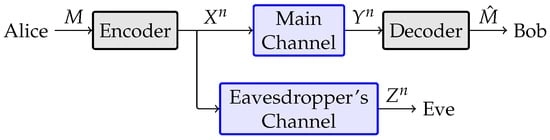
Wiretap channel model.
  • Correction
  • Open Access

Addition of an Author [...]

9 December 2025

  • Feature Paper
  • Article
  • Open Access

Mirror Descent and Exponentiated Gradient Algorithms Using Trace-Form Entropies

  • Andrzej Cichocki,
  • Toshihisa Tanaka and
  • Frank Nielsen
  • + 1 author

This paper introduces a broad class of Mirror Descent (MD) and Generalized Exponentiated Gradient (GEG) algorithms derived from trace-form entropies defined via deformed logarithms. Leveraging these generalized entropies yields MD and GEG algorithms with improved convergence behavior, robustness against vanishing and exploding gradients, and inherent adaptability to non-Euclidean geometries through mirror maps. We establish deep connections between these methods and Amari’s natural gradient, revealing a unified geometric foundation for additive, multiplicative, and natural gradient updates. Focusing on the Tsallis, Kaniadakis, Sharma–Taneja–Mittal, and Kaniadakis–Lissia–Scarfone entropy families, we show that each entropy induces a distinct Riemannian metric on the parameter space, leading to GEG algorithms that preserve the natural statistical geometry. The tunable parameters of deformed logarithms enable adaptive geometric selection, providing enhanced robustness and convergence over classical Euclidean optimization. Overall, our framework unifies key first-order MD optimization methods under a single information-geometric perspective based on generalized Bregman divergences, where the choice of entropy determines the underlying metric and dual geometric structure.

8 December 2025

TLS 1.3 is a crucial protocol for securing modern internet communications. To facilitate a smooth transition to post-quantum security, hybrid key exchange, which combines classical key exchange algorithms with post-quantum key encapsulation mechanisms (KEMs), is proposed to enhance the security of the current TLS 1.3 handshake. However, existing drafts and implementations of hybrid key exchange for TLS 1.3 primarily rely on CCA-secure KEMs (i.e., secure against chosen-ciphertext attacks) based on the Fujisaki-Okamoto (FO) transform. The re-encryption step in their decapsulation algorithms not only introduces additional performance overhead but also raises the risk of side-channel attacks. Although Huguenin-Dumittan and Vaudenay (Eurocrypt 2022) and Zhou et al. (Asiacrypt 2024) demonstrated that the weaker CPA-secure KEMs (i.e., secure against chosen-plaintext attacks) suffice for constructing a secure TLS 1.3 handshake, their analyses were limited to single-KEM settings and did not consider the hybrid key exchange scenario. This work challenges the necessity of CCA security by proving that CPA-secure KEMs are sufficient for the TLS 1.3 handshake even in the hybrid key exchange setting. We provide the first formal security proofs for this claim, covering both the classical random oracle model (ROM) and the quantum random oracle model (QROM), thereby ensuring security against quantum adversaries. To validate the practical benefits, we conduct an extensive performance evaluation based on the latest OpenSSL implementation. Our results show that using CPA-secure KEMs yields up to 44.8% performance improvement at the key exchange layer and up to approximately 9% acceleration for the full TLS 1.3 handshake. Beyond performance gains, this approach reduces the codebase’s attack surface by eliminating the re-encryption step, thereby mitigating a class of side-channel vulnerabilities. Our work positions CPA-secure KEMs as a secure, efficient, and practical alternative for standardizing and deploying post-quantum TLS 1.3 even with hybrid key exchange.

8 December 2025

News & Conferences

Issues

Open for Submission

Editor's Choice

Reprints of Collections

Semantic Information Theory
Reprint

Semantic Information Theory

Editors: Meixia Tao, Kai Niu, Youlong Wu
The Entropy Production—as Cornerstone in Applied Nonequilibrium Thermodynamics
Reprint

The Entropy Production—as Cornerstone in Applied Nonequilibrium Thermodynamics

Dedicated to Professor Signe Kjelstrup on the Occasion of Her 75th Birthday
Editors: Dick Bedeaux, Fernando Bresme, Alex Hansen

Get Alerted

Add your email address to receive forthcoming issues of this journal.

XFacebookLinkedIn
Entropy - ISSN 1099-4300