


Abstract
A map without equilibrium has been proposed and studied in this paper. The proposed map has no fixed point and exhibits chaos. We have investigated its dynamics and shown its chaotic behavior using tools such as return map, bifurcation diagram and Lyapunov exponents’ diagram. Entropy of this new map has been calculated. Using an open micro-controller platform, the map is implemented, and experimental observation is presented. In addition, two control schemes have been proposed to stabilize and synchronize the chaotic map.
1. Introduction
Discrete maps have attracted significant attention in the study of dynamical systems [1,2,3,4]. Discrete maps appear in various disciplines including physiology, chemistry, physics, ecology, social sciences and engineering [3,5,6,7]. It has previously been observed that simple first-order nonlinear maps can generate complex dynamical behavior including chaos [8]. Chaotic maps such as Hénon map [9], Logistic map [8], Lozi map [10], and zigzag map [11] are found. When investigating chaotic maps, the stability of fixed point plays a vital role. The authors tried to find fixed points and studied the behavior of orbits near fixed points. Relation of fixed points and critical transitions is illustrated in [12]. Previous studies have established that conventional chaotic maps often have unstable fixed points.
More recent studies have focused on chaotic maps related to the hidden attractor category [13,14,15]. Hidden attractors in chaotic maps are reported in [16], where a 1D map with no fixed point is extended from Logistic map. Jiang et al. introduced a list of two-dimensional maps with no fixed point [17]. These maps are inspired by Hénon map. By applying a Jerk-like structure, a gallery of 3D maps having hidden dynamics is investigated [17]. Ouannas proposed a fractional map having no fixed point [18]. Xu et al. found hidden dynamics of a two-dimensional map based on Arnold’s cat map [19]. The authors built a hardware implementation of the map using Field-programmable gate array (FPGA). However, detailed investigation of chaotic maps without fixed point should be examined further.
2. Chaotic Map
By using nonlinear functions, we construct a map described by:
where a, b, c, and d are positive parameters.
The fixed points of the map can be found by solving
By rewriting Equation (2), we have
Therefore, there is no any fixed point in the map in Equation (1) for such positive parameters b and d.
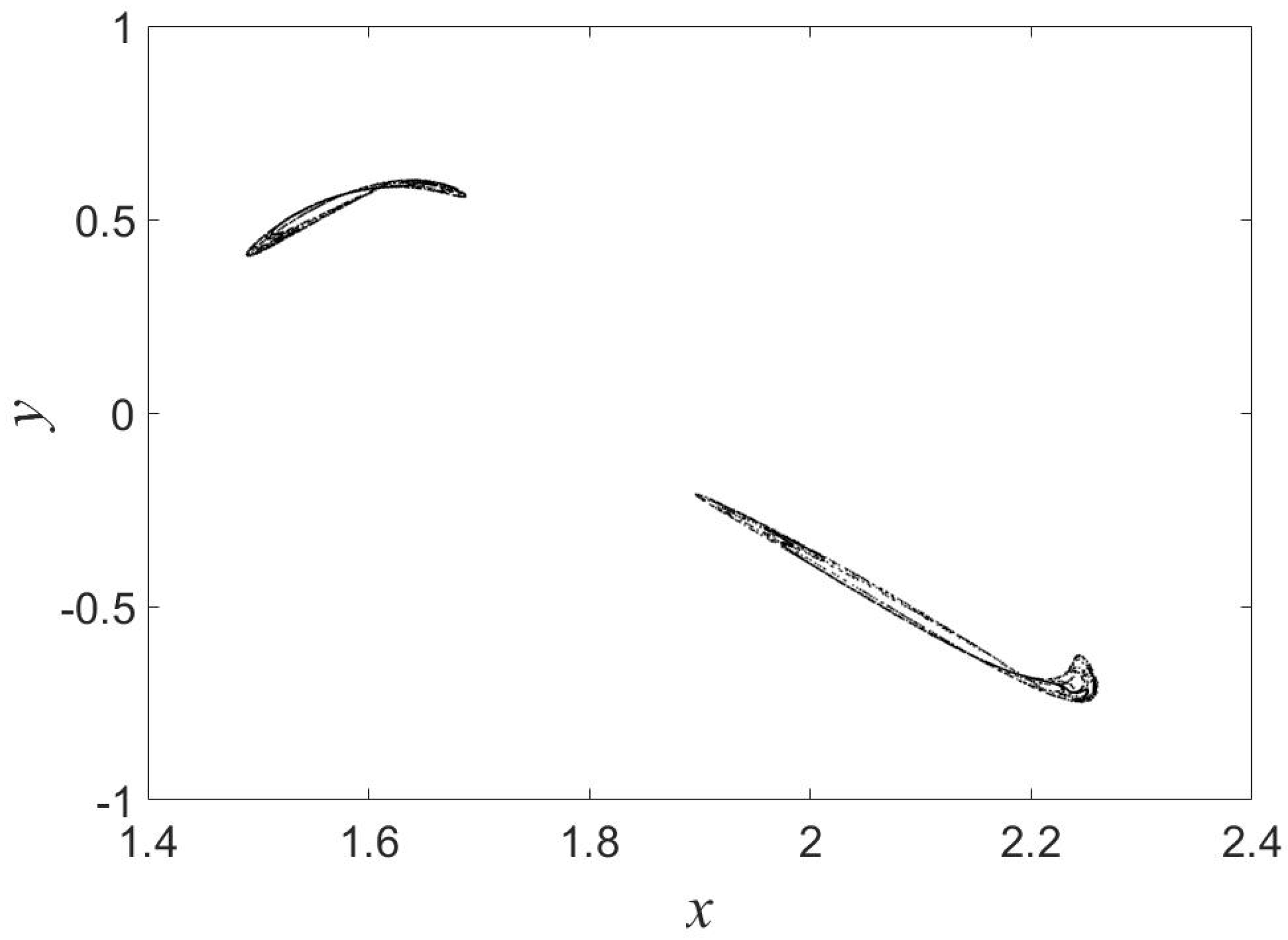
We observe chaos in the map for , , , and the initial conditions (see Figure 1). Similar to the reported map in [18], the map in Equation (1) belongs to a class of maps without fixed point. Compared with the map reported in [18], the map in Equation (1) is not a fractional one.
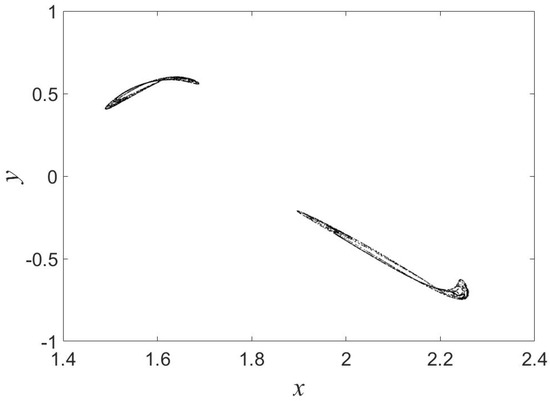
Figure 1.
Strange attractor of the map for , , , and .
2.1. Dynamics of the Map
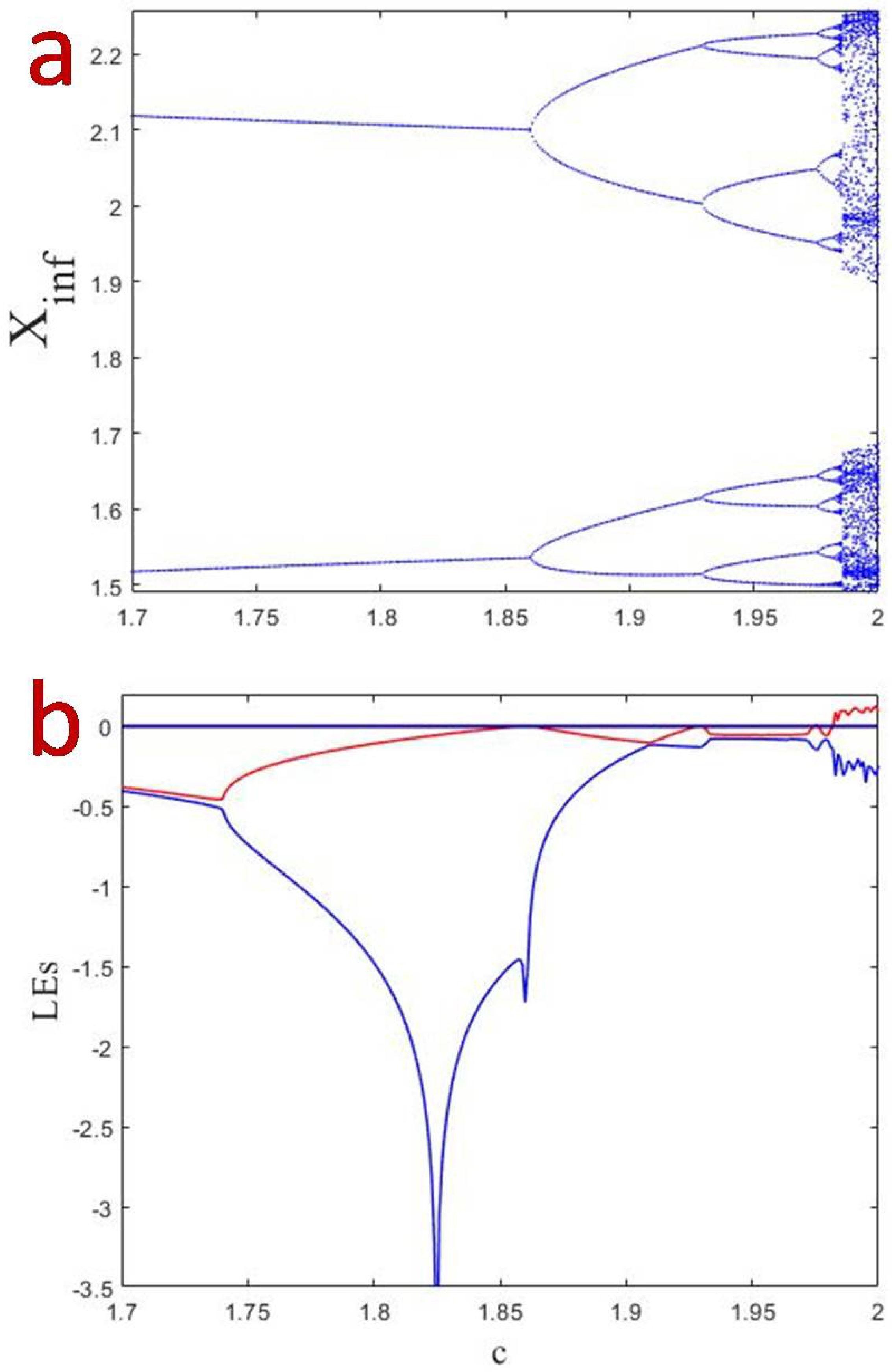
Dynamics of the proposed map were studied. It was found that the map displays interesting dynamics when varying the parameter c and keeping , , and . Note that, since we wanted to keep the system NE (no equilibrium), we have frizzed the parameters b and d. Changing parameter a as bifurcation parameter did not show a proper route to chaos and in some values resulted in unbounded solutions. Thus, we chose c as the bifurcation parameter. In addition, note that the initial condition used in our simulations was not dominant and affected only the initial transient regime. As seen in the bifurcation diagram (Figure 2a) and the finite-time local Lyapunov exponents (Figure 2b), the map in Equation (1) displays a period doubling route to chaos. The time interval for calculating finite-time local Lyapunov exponents [20] is 10,000. Since it has no equilibrium, it has no period-1 cycle. The bifurcation starts from a period-2 cycle. Then, it continues with period-doubling until chaos is born a little before .
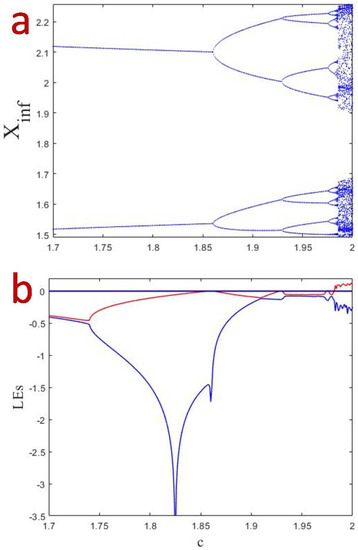
Figure 2.
Bifurcation diagram (a); and Lyapunov exponents (b) when varying c for , , and .
2.2. Entropy of the New Map
Previous research has established that entropy is an effective index for estimating information in a particular system [21,22,23]. The authors applied entropy measurement to consider the complexity/chaos of dynamical systems [24,25,26,27]. In particular, approximate entropy (ApEn) [28,29] is useful to study chaotic systems [19,30]. It is noted that there is no reported threshold to be achieve in the ApEn in order to exhibit chaos [28,29]. Xu et al. reported the ApEn of a new system with chaos [19]. Their values of ApEn ranged from 0 to 0.12. Wang and Ding presented a table of AnEn test for four chaotic maps [30]. Here, calculated approximate entropy (ApEn) for the proposed the map in Equation (1) is reported in Table 1. Obtained entropy in Table 1 illustrates the complexity of the map when it exhibits chaos.

Table 1.
Calculated approximate entropy of the map in Equation (1) for , , and .
3. Implementation of the Map Using Microcontroller
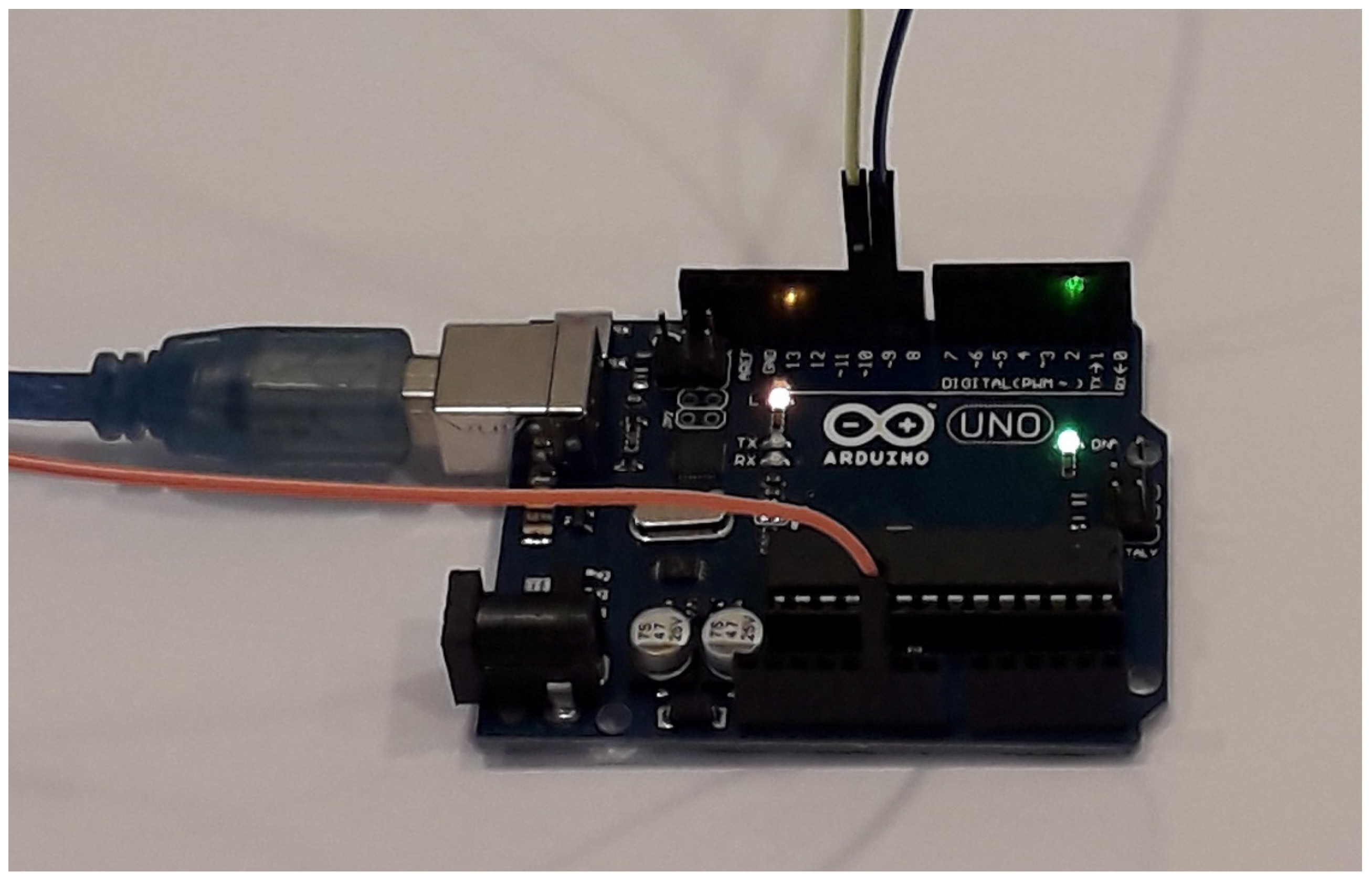
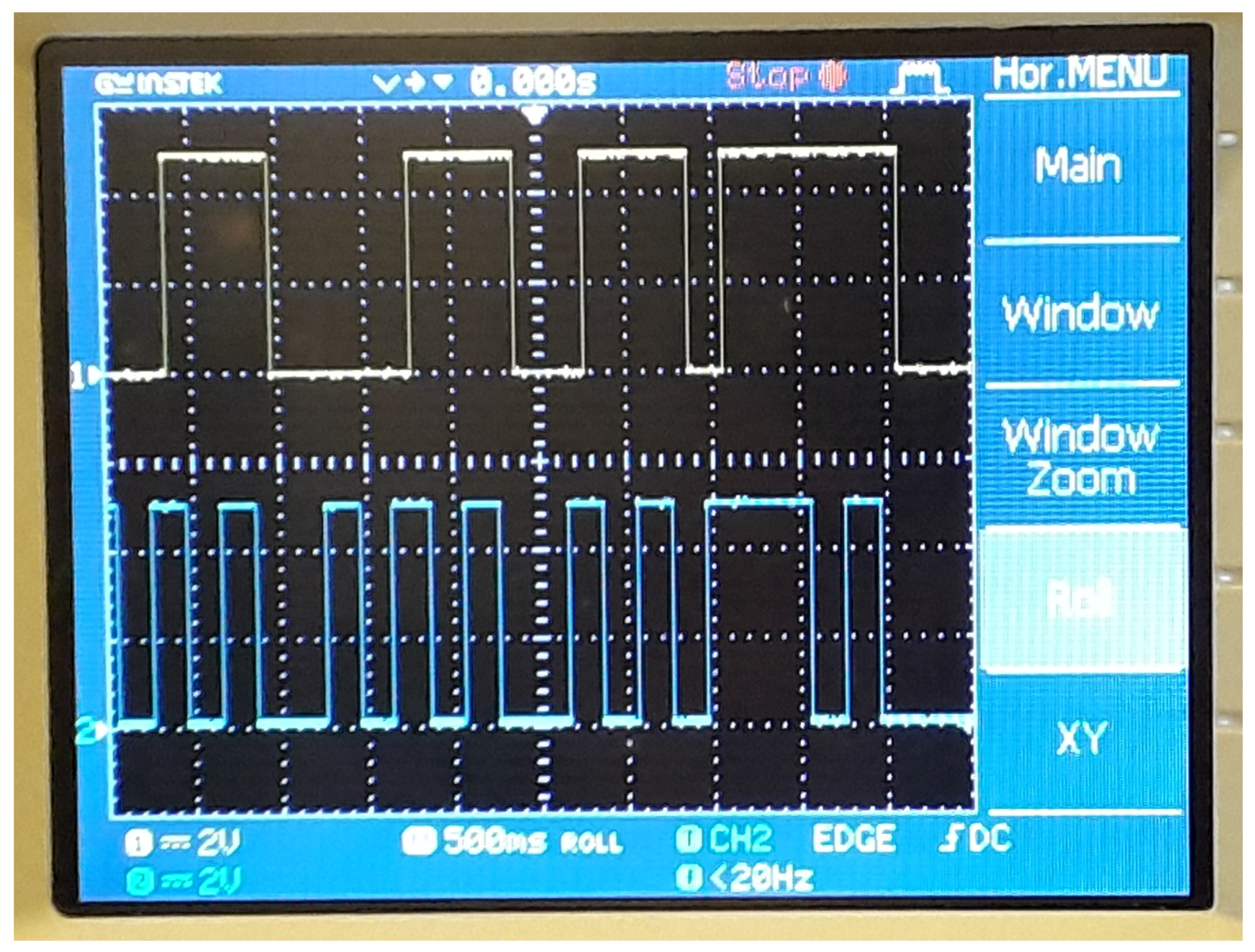
Chaotic maps are useful for designing pseudorandom number generators [31,32,33,34], building S-Box [35], proposing color image encryption [36] or constructing secure communication [37]. Therefore, implementation of chaotic maps is a practical topic in the literature. Some approaches have been used to realize theoretical models of chaotic maps. Valtierra et al employed a skew-tent map in switched-capacitor circuits [6]. Bernoulli shift map, Borujeni maps, zigzag, and tent are done with a field-programmable gate array architecture [7]. Wang and Ding introduced FPGA hardware implementation of a map with hidden attractors [30]. It is worth noting that using microcontroller is an effective approach to implement chaotic maps [37,38]. The open-source platform named Arduino provides a reasonable development tool because of its free development software [39,40,41]. In our work, we used an Arduino Uno board based on microcontroller to realize the proposed map in Equation (1), as shown in Figure 3. Pins 9 and 10 of the Arduino Uno board are configured as two digital outputs. However, we could choose different pins for digital outputs because Arduino Uno board has 14 digital pins. We wrote a program for the map in the Arduino development environment. It is noted that the algorithm steps and program structure used in our implementation are similar to those reported in [38]. The output pin 9 was activated when while the output pin 10 was activated when . Figure 4 displays the experimental waveforms at pins 9 and 10.
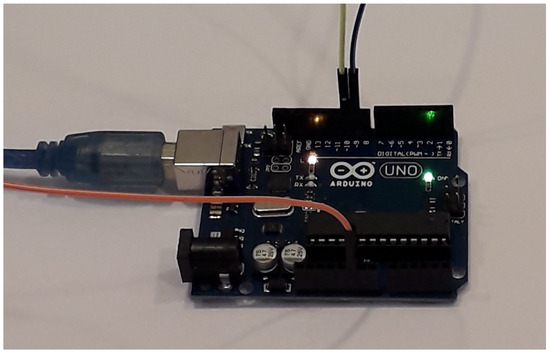
Figure 3.
Arduino Uno board for implementing chaotic the map in Equation (1).
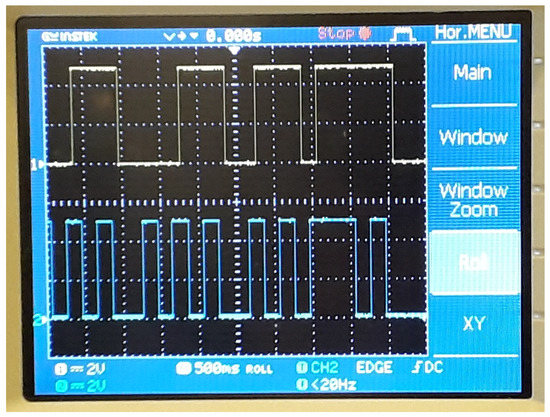
Figure 4.
Captured waveforms at pins 9 and 10 of the Arduino Uno board.
4. Control Schemes for the Proposed Map
When investigating chaotic maps, stabilization and synchronization are vital aspects. Two control laws for stabilizing and synchronizing the proposed non-fixed-point map are introduced in this section.
4.1. Stabilization
The aim of stabilizing the proposed map is to devise an adaptive control law such that all system states are stabilized to The controlled map is
where and are controllers to be determined.
Therefore, the map in Equation (1) is stabilized.
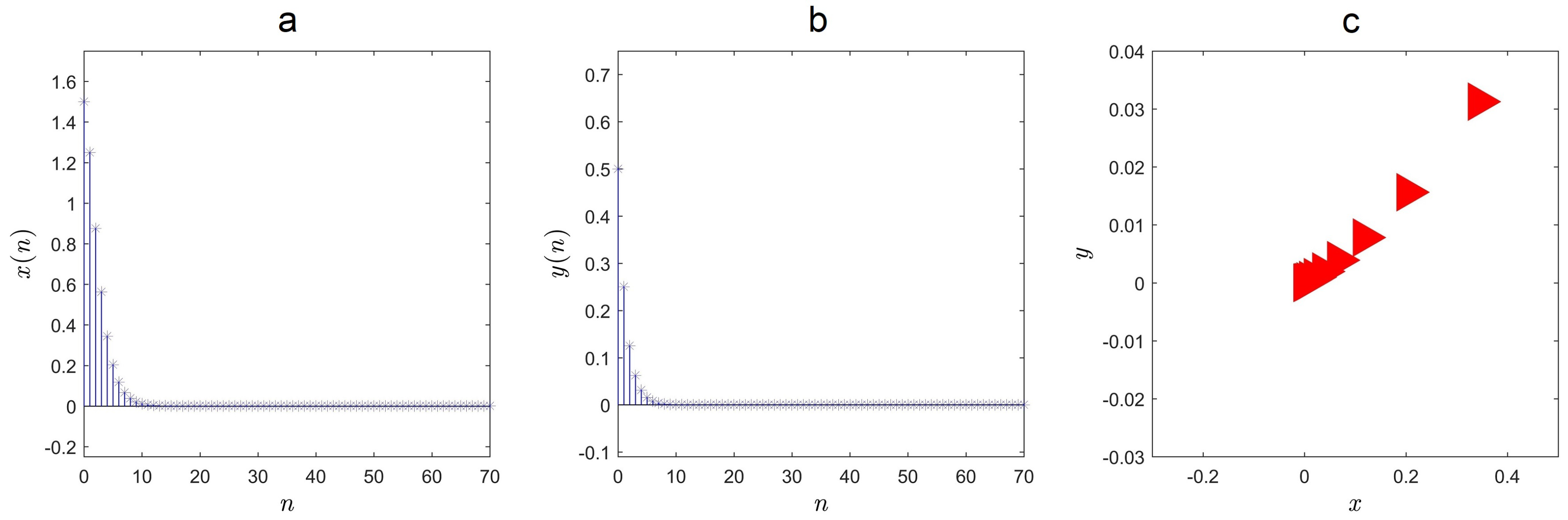
We illustrated the result by selecting parameters and . In Figure 5, the evolution of states verifies the control law.
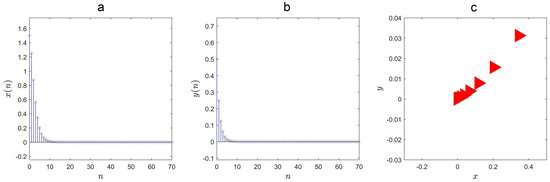
Figure 5.
Stabilization when applying the proposed control law: (a) , (b) , and (c) plane.
4.2. Synchronization
Researchers have discovered synchronization of discrete systems [42,43,44]. We consider the drive system in Equation (9)
It has been shown in [17] that the map in Equation (9) exhibits chaotic behaviors with no fixed points. The map in Equation (9) is one of the first example of discrete-time systems without fixed points, i.e, the map in Equation (9) has hidden attractors. The map in Equation (9) is inspired by the well-known Hénon map.
The subscript s denotes the response system’s states. The response is given by
where are synchronization controllers.
The error system is
We find the controllers and based on Theorem 1.
Theorem 1.
Proof.
The error system in Equation (11) is rewritten as
The Lyapunov function is ,
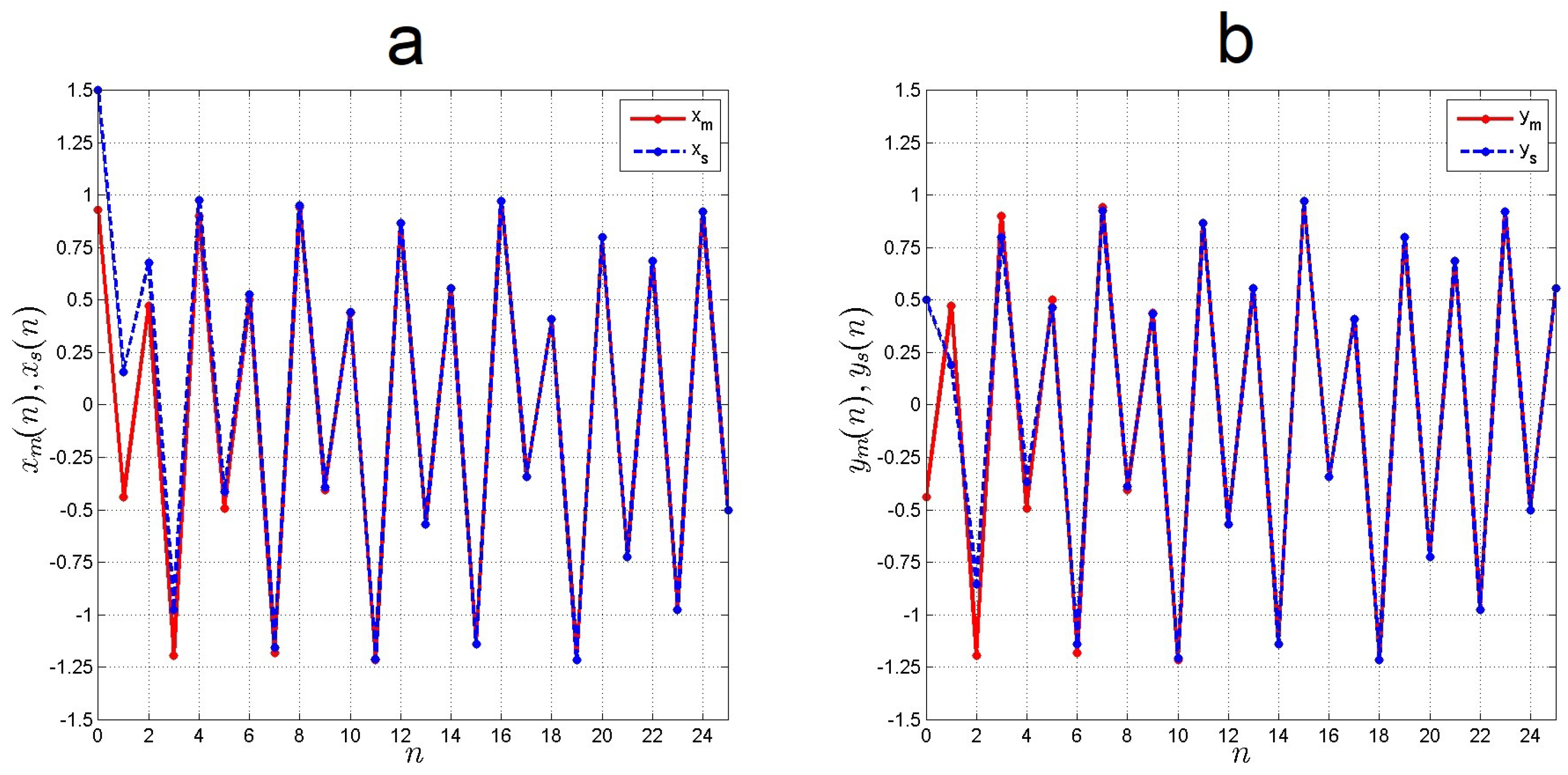
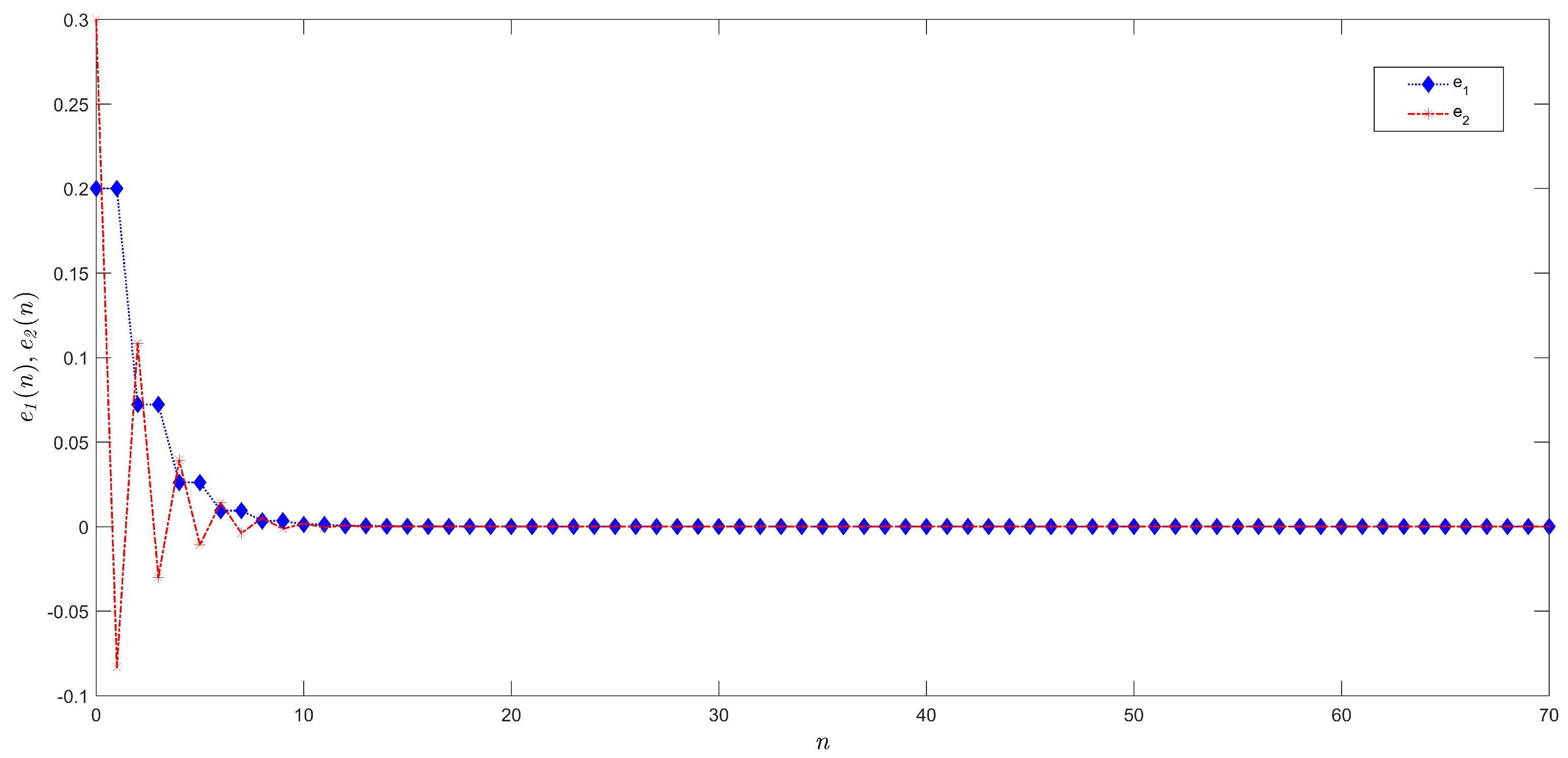
Figure 6 depicts the time evolution of states of systems in Equations (9) and (10) after control. As reported in Figure 7, synchronization is obtained.
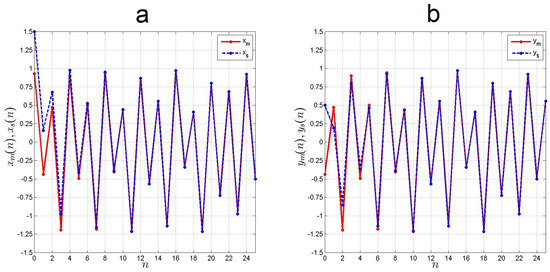
Figure 6.
Evolution of states when applying the control: (a) , and (b) , .
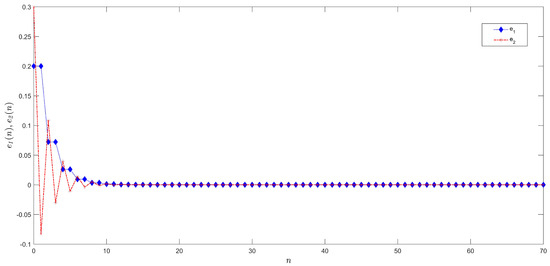
Figure 7.
Synchronization errors.
5. Conclusions
This work has introduced a new chaotic map, which can be considered as a system with hidden attractor. Having no fixed point is a notable feature of the proposed map. Chaos in the map is observed and confirmed by positive Lyapunov exponent. Realization of the map using an open-source electronic platform is given to illustrate its feasibility. Experimental results are recorded and displayed by oscilloscope. Approximate entropy is calculated to determine the complexity of the map. We have also presented stabilization and synchronization for the map. In future research, this map will be embedded into practical applications such as data encryption, signal transmission or motion planning.
Author Contributions
Conceptualization, V.V.H.; Formal analysis, A.O.; Investigation, V.V.H. and X.Q.N.; Methodology, A.O. and V.-T.P.; Project administration, V.-T.P.; Resources, X.W.; Software, X.W. and F.E.A.; Supervision, V.-T.P. and F.E.A.; Validation, V.V.H.; Visualization, A.O. and X.Q.N.; Writing—original draft, X.W. and X.Q.N.; and Writing—review and editing, F.E.A.
Funding
Xiong Wang was supported by the National Natural Science Foundation of China (No. 61601306) and Shenzhen Overseas High Level Talent Peacock Project Fund (No. 20150215145C).
Conflicts of Interest
The authors declare no conflict of interest.
References
- Pierre, C.; Jean-Pierre, E. Iterated Map on the Interval as Dynamical Systems; Springer: Berlin, Germany, 1980. [Google Scholar]
- Bahi, J.M.; Guyeux, C. Iterated Map on the Interval as Dynamical Systems; CRC Press: Boca Raton, FL, USA, 2013. [Google Scholar]
- Elaydi, S.N. Discrete Chaos: With Applications in Science and Engineering, 2nd ed.; Chapman and Hall/CRC: Boca Raton, FL, USA, 2007. [Google Scholar]
- Gibson, W.T.; Wilson, W.C. Individual-based chaos: Extensions of the discrete logistic model. J. Theor. Biol. 2013, 339, 84–92. [Google Scholar] [CrossRef] [PubMed]
- Borujeni, S.; Ehsani, M. Modified logistic maps for cryptographic application. Appl. Math. 2015, 6, 773–782. [Google Scholar] [CrossRef]
- Valtierra, J.L.; Tlelo-Cuautle, E.; Rodriguez-Vazquez, A. A switched-capacitor skew-tent map implementation for random number generation. Int. J. Circuit Theor. Appl. 2017, 45, 305–315. [Google Scholar] [CrossRef]
- De la Fraga, L.G.; Torres-Perez, E.; Tlelo-Cuautle, E.; Mancillas-Lopez, C. Hardware implementation of pseudo-random number generators based on chaotic maps. Nonlinear Dyn. 2017, 90, 1661–1670. [Google Scholar] [CrossRef]
- May, R.M. Simple mathematical models with very complicated dynamics. Nature 1976, 261, 459–467. [Google Scholar] [CrossRef]
- Hénon, M.A. A two-dimensional mapping with a strange attractor. Commun. Math. Phys. 1976, 50, 69–77. [Google Scholar] [CrossRef]
- Lozi, R. Un atracteur étrange du type attracteur de Hénon. J. Phys. 1978, 39, 9–10. [Google Scholar]
- Nejati, H.; Beirami, A.; Ali, W. Discrete-time chaotic-map truly random number generators: Design, implementation, and variability analysis of the zigzag map. Analog Integr. Circuits Signal Process. 2012, 73, 363–374. [Google Scholar] [CrossRef]
- Scheffer, M.; Bascompte, J.; Brock, W.A.; Brovkin, V.; Carpenter, S.R.; Dakos, V.; Held, H.; van Nes, E.H.; Rietkerk, M.; Sugihara, G. Early-warning singals for critical transitions. Nature 2009, 461, 53–59. [Google Scholar] [CrossRef]
- Leonov, G.A.; Kuznetsov, N.V.; Kuznetsova, O.A.; Seldedzhi, S.M.; Vagaitsev, V.I. Hidden oscillations in dynamical systems. Trans. Syst. Control 2011, 6, 54–67. [Google Scholar]
- Leonov, G.A.; Kuznetsov, N.V. Hidden attractors in dynamical systems: From hidden oscillation in Hilbert-Kolmogorov, Aizerman and Kalman problems to hidden chaotic attractor in Chua circuits. Int. J. Bifurc. Chaos 2013, 23, 1330002. [Google Scholar] [CrossRef]
- Dudkowski, D.; Jafari, S.; Kapitaniak, T.; Kuznetsov, N.; Leonov, G.; Prasad, A. Hidden attractors in dynamical systems. Phys. Rep. 2016, 637, 1–50. [Google Scholar] [CrossRef]
- Jafari, S.; Pham, V.T.; Moghtadaei, M.; Kingni, S.T. The relationship between chaotic maps and some chaotic systems with hidden attractors. Int. J. Bifurc. Chaos 2016, 26, 1650211. [Google Scholar] [CrossRef]
- Jiang, H.; Liu, Y.; Wei, Z.; Zhang, L. Hidden chaotic attractors in a class of two-dimensional maps. Nonlinear Dyn. 2016, 85, 2719–2727. [Google Scholar] [CrossRef]
- Ouannas, A.; Wang, X.; Khennaoui, A.A.; Bendoukha, S.; Pham, V.T.; Alsaadi, F. Fractional form of a chaotic map without fixed points: Chaos, entropy and control. Entropy 2018, 20, 720. [Google Scholar] [CrossRef]
- Xu, G.; Shekofteh, Y.; Akgul, A.; Li, C.; Panahi, S. New chaotic system with a self-excited attractor: Entropy measurement, signal encryption, and parameter estimation. Entropy 2018, 20, 86. [Google Scholar] [CrossRef]
- Kuznetsov, N.V.; Leonov, G.A.; Mokaev, T.N.; Prasad, A.; Shrimali, M.D. Finite–time Lyapunov dimension and hidden attractor of the Rabinovich system. Nonlinear Dyn. 2018, 92, 267–285. [Google Scholar] [CrossRef]
- Borda, M. Fundamentals in Information Theory and Coding; Springer: Berlin, Germany, 2011. [Google Scholar]
- Gray, R.M. Entropy and Information Theory; Springer: Berlin, Germany, 2011. [Google Scholar]
- Bossomaier, T.; Barnett, L. An Introduction to Transfer Entropy: Information Flow in Complex Systems; Springer: Berlin, Germany, 2016. [Google Scholar]
- Eckmann, J.; Ruelle, D. Ergodic theory of chaos and strange attractors. Rev. Mod. Phys. 1985, 57, 617. [Google Scholar] [CrossRef]
- He, S.; Sun, K.; Wang, H. Complexity analysis and DSP implementation of the fractional-order Lorenz hyperchaotic system. Entropy 2015, 17, 8299–8311. [Google Scholar] [CrossRef]
- He, S.; Li, C.; Sun, K.; Jafari, S. Multivariate multiscale complexity analysis of self-reproducing chaotic systems. Entropy 2018, 20, 556. [Google Scholar] [CrossRef]
- Munoz-Pacheco, J.M.; Zambrano-Serrano, E.; Volos, C.; Jafari, S.; Kengne, J.; Rajagopal, K. A New Fractional-Order Chaotic System with Different Families of Hidden and Self-Excited Attractors. Entropy 2018, 20, 564. [Google Scholar] [CrossRef]
- Pincus, S. Approximate entropy as a measure of system complexity. Proc. Natl. Acad. Sci. USA 1991, 88, 2297–2301. [Google Scholar] [CrossRef]
- Pincus, S. Approximate entropy (ApEn) as a complexity measure. Chaos Interdiscipl. J. Nonlinear Sci. 1995, 5, 110–117. [Google Scholar] [CrossRef]
- Wang, C.; Ding, Q. A new two-dimensional map with hidden attractors. Entropy 2018, 20, 322. [Google Scholar] [CrossRef]
- Garcia-Martinez, M.; Campos-Canton, E. Pseudo-random bit generator based on multi-modal maps. Nonlinear Dyn. 2015, 82, 2119–2131. [Google Scholar] [CrossRef]
- Francois, M.; Grosges, T.; Barchiesi, D.; Erra, R. Pseudo-random number generator based on mixing of three chaotic maps. Commun. Nonlinear Sci. Numer. Simul. 2014, 19, 887–895. [Google Scholar] [CrossRef]
- Murillo-Escobar, M.A.; Cruz-Hernandez, C.; Cardoza-Avendano, L.; Mendez-Ramirez, R. A novel pseudorandom number generator based on pseudorandomly enhanced logistic map. Nonlinear Dyn. 2017, 87, 407–425. [Google Scholar] [CrossRef]
- Wang, Y.; Liu, Z.; Ma, J.; He, H. A pseudorandom number generator based on piecewise logistic map. Nonlinear Dyn. 2016, 83, 2373–2391. [Google Scholar] [CrossRef]
- Lambic, D. A novel method of S-box design based on chaotic map and composition method. Chaos Solitons Fractals 2014, 58, 16–21. [Google Scholar] [CrossRef]
- Mazloom, S.; Eftekhari-Moghadam, A.M. Color image encryption based on Coupled Nonlinear Chaotic Map. Chaos Solitons Fractals 2009, 42, 1745–1754. [Google Scholar] [CrossRef]
- La Hoz, M.Z.D.; Acho, L.; Vidal, Y. An experimental realization of a chaos-based secure communication using Arduino microcontrollers. Sci. World J. 2015, 2015, 123080. [Google Scholar]
- Acho, L. A discrete-time chaotic oscillator based on the logistic map: A secure communication scheme and a simple experiment using Arduino. J. Frankl. Inst. 2015, 352, 3113–3121. [Google Scholar] [CrossRef]
- Teikari, P.; Najjar, R.P.; Malkki, H.; Knoblauch, K.; Dumortier, D.; Gronfer, C.; Cooper, H.M. An inexpensive Arduino-based LED stimulator system for vision research. J. Neurosci. Methods 2012, 211, 227–236. [Google Scholar] [CrossRef] [PubMed]
- Faugel, H.; Bobkov, V. Open source hard- and software: Using Arduino boards to keep old hardware running. Fusion Eng. Des. 2013, 88, 1276–1279. [Google Scholar] [CrossRef]
- Castaneda, C.E.; Lopez-Mancilla, D.; Chiu, R.; Villafana-Rauda, E.; Orozco-Lopez, O.; Casillas-Rodriguez, F.; Sevilla-Escoboza, R. Discrete-time neural synchronization between an Arduino microcontroller and a Compact Development System using multiscroll chaotic signals. Chaos Solitons Fractals 2019, 119, 269–275. [Google Scholar] [CrossRef]
- Ouannas, A.; Odibat, Z. Generalized synchronization of different dimensional chaotic dynamical systems in discrete-time. Nonlinear Dyn. 2015, 81, 765–771. [Google Scholar] [CrossRef]
- Ouannas, A.; Grassi, G. GA new approach to study co–existence of some synchronization types between chaotic maps with different dimensions. Nonlinear Dyn. 2016, 86, 1319–1328. [Google Scholar] [CrossRef]
- Ouannas, A.; Odibat, Z.; Shawagfeh, N.; Alsaedi, A.; Ahmad, B. Universal chaos synchronization control laws for general quadratic discrete systems. Appl. Math. Model. 2017, 45, 636–641. [Google Scholar] [CrossRef]
© 2019 by the authors. Licensee MDPI, Basel, Switzerland. This article is an open access article distributed under the terms and conditions of the Creative Commons Attribution (CC BY) license (http://creativecommons.org/licenses/by/4.0/).