


The MDPI journal Molecules is organized into 25 sections that cover many different areas of the broad field of chemistry. Among them, the Medicinal Chemistry section is one of the most classical. The overarching aim of this section is the publication of original re-search and review articles that increase our knowledge on how the chemical structure of molecules can be advantageously modulated to enhance their physicochemical and pharmacokinetic properties and/or their interaction with particular biological targets of therapeutic or diagnostic interest. With Medicinal Chemistry being multidisciplinary in essence, the contents of the articles published in this section partly overlap with those of other sections—namely, organic, natural products, bioorganic, and computational theo-retical chemistry or chemical biology, which contributes to the integration and coherence among the different areas of the journal.
Driven by a very active board of Academic Editors and imaginative section Managing Editors, new actions are continuously undertaken to attract, visualize, and promote high quality articles and reviews, with the final goal of disseminating in open access medicinal chemistry of excellence. On this line, we are initiating a series of Editorials to highlight the most influential articles, overall or considering specific topics, published in the Medicinal Chemistry section of Molecules in a particular year. We will start with the articles published in 2019, now that all of them have had an exposure to readers of at least one year.
To contextualize this action in the situation of Molecules in that year, in 2019:
- Molecules started to be published semi-monthly online.
- The scope of the journal was expanded by establishing the new sections of Fragances and Flavours and Colorants.
- The important milestone of reaching 20,000 articles published in the journal was achieved.
- The 2nd Molecules Medicinal Chemistry Symposium (MMCS2019—Facing Novel Challenges in Drug Discovery), organized by the Medicinal Chemistry Section of Molecules, was successfully held in Barcelona, with a 3-day program full of top-class speakers and about 200 attendees from all continents.
- For 2019, Molecules reached its highest ever impact factor of 3.267.
- With regard to the status of the Medicinal Chemistry section of Molecules, in 2019:
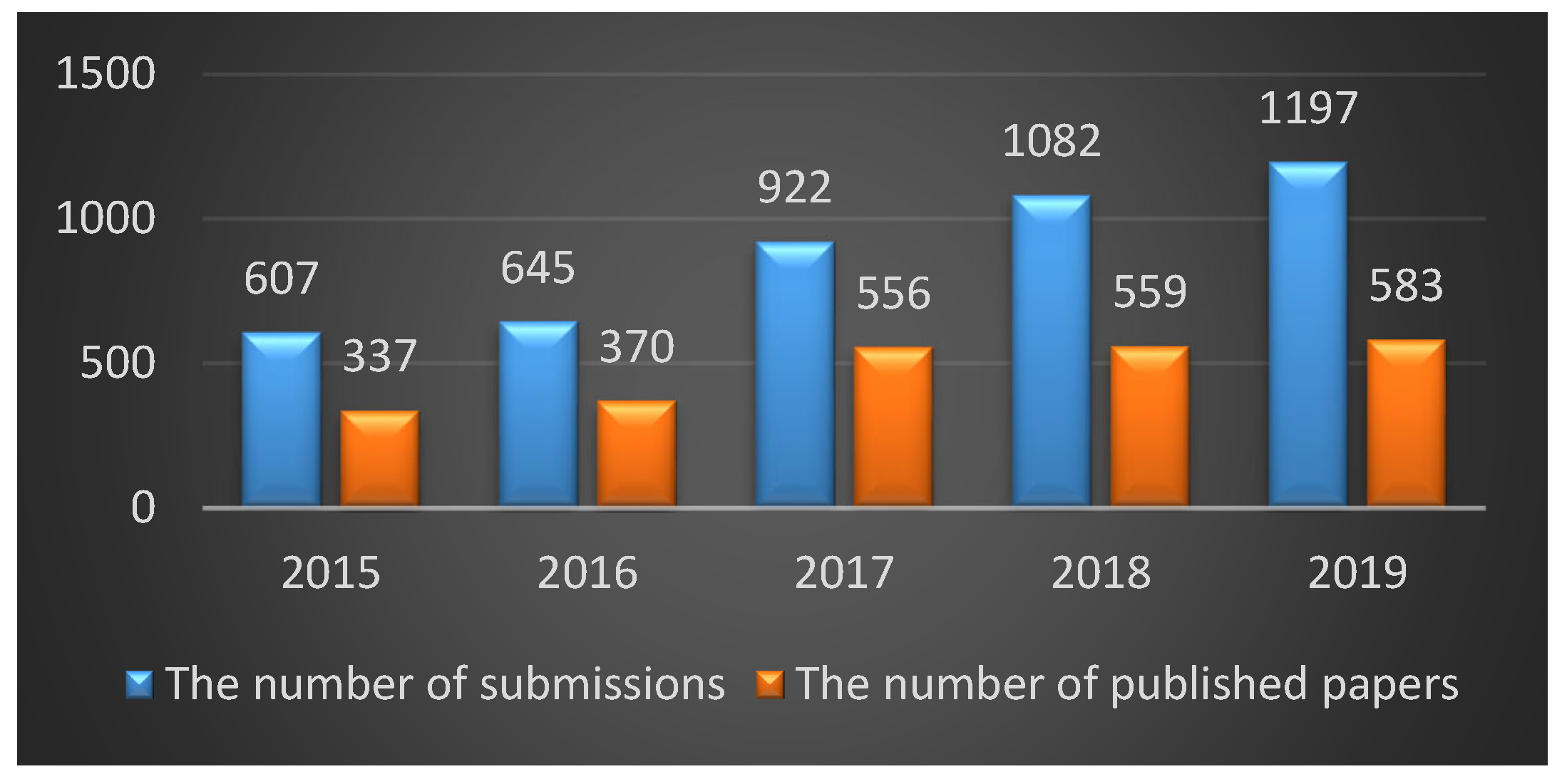
- A record of submissions (1197) and published articles (583) was achieved, consolidating a steady increase over previous years (Figure 1). Out of the 583 published papers, 482 were original research articles, but a significant number of review articles were also published (81), as well as a lower number of communications (10), editorials (7), and other types of contributions (commentaries, corrections) to complete the aforementioned figure.
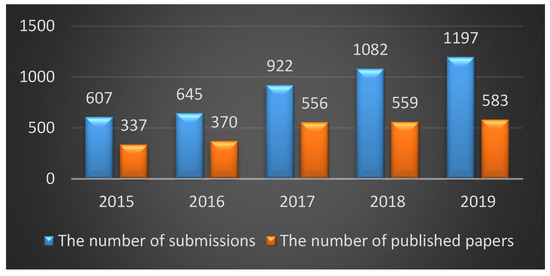 Figure 1. Number of submitted manuscripts (blue bars) and published papers (orange bars) in the Medicinal Chemistry section of Molecules in the period 2015–2019.
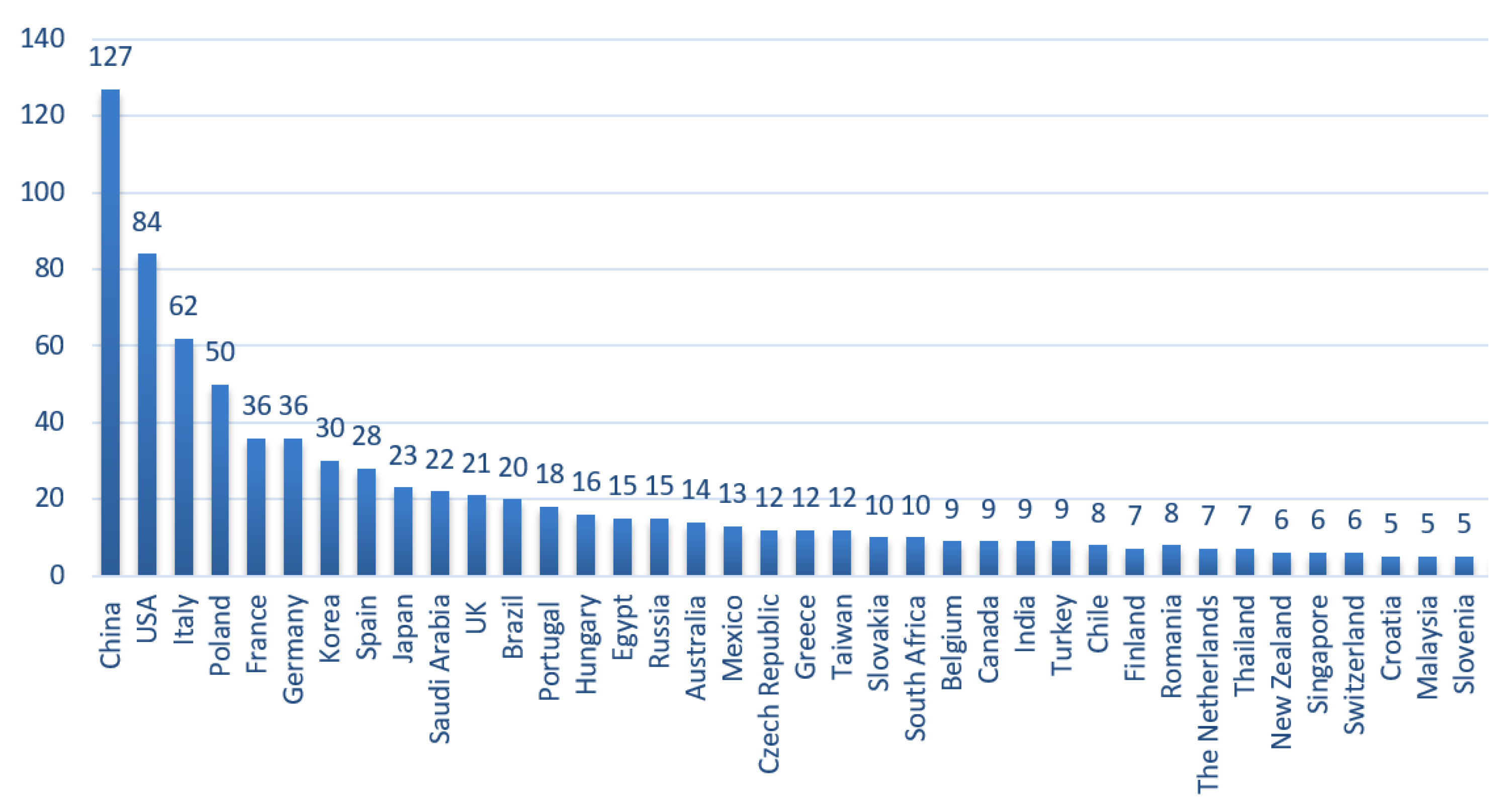
- The top 10 contributing countries, considering the affiliation of the corresponding authors of all articles published in the section in 2019, were China, USA, Italy, Poland, France, Germany, Korea, Spain, Japan, and Saudi Arabia (Figure 2).
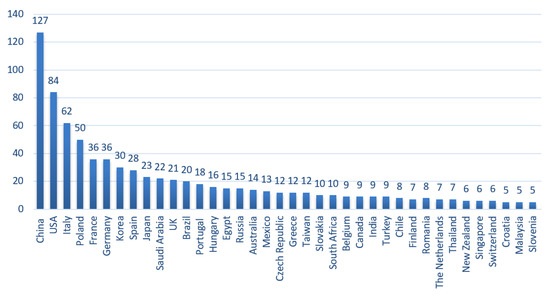 Figure 2. Geographical distribution of the corresponding authors of the papers published in the Medicinal Chemistry section of Molecules in 2019. The number of published articles is indicated on top of the bars. Only countries with five or more contributions are shown.
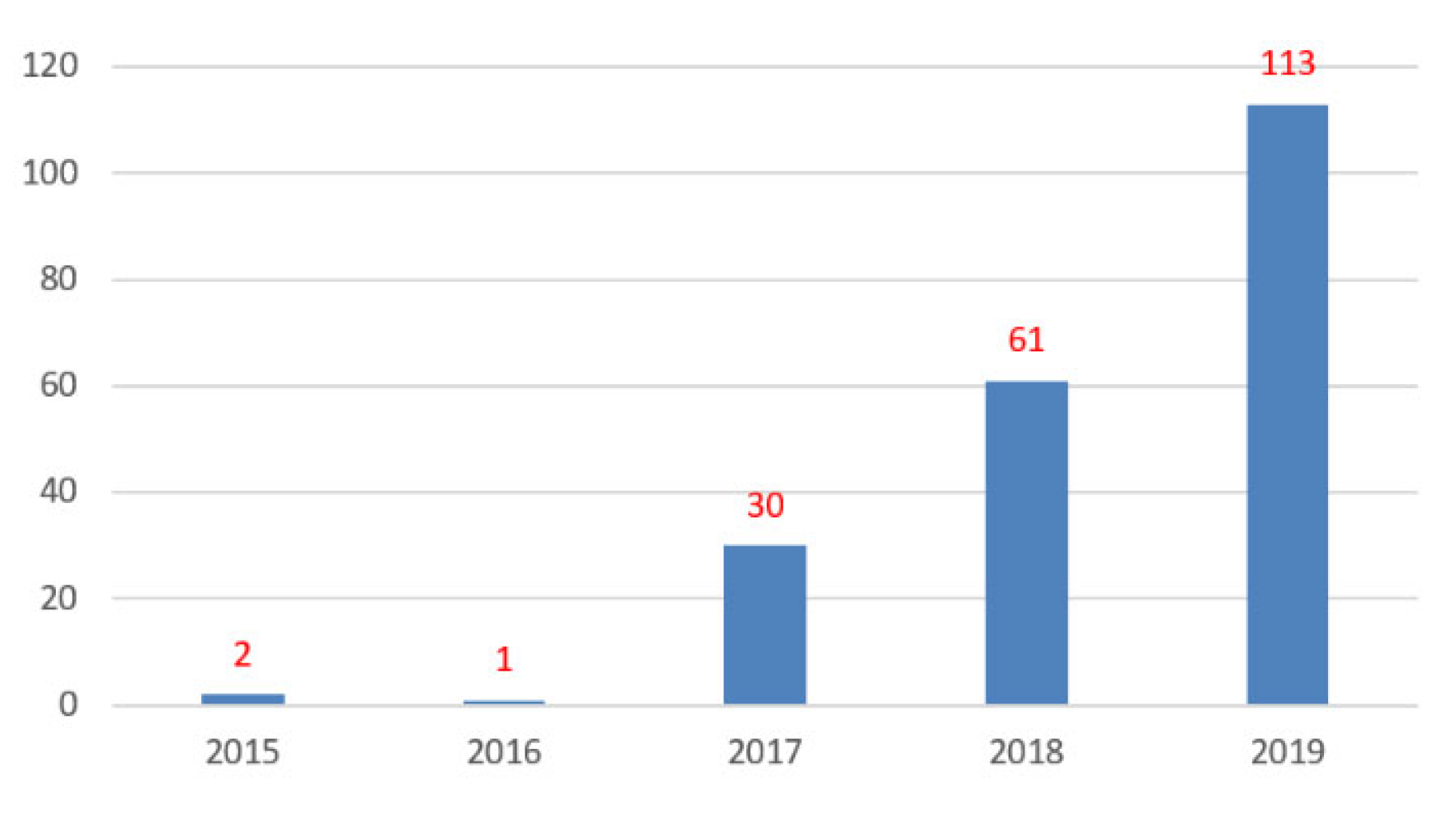
- The section experienced a large increase in the number of special issues launched in 2019, relative to the previous four years, almost doubling those launched in 2018 (Figure 3).
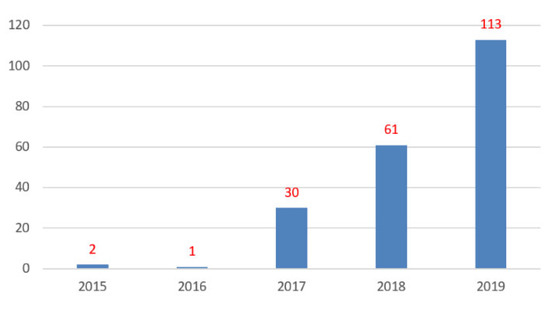 Figure 3. Total number of special issues launched in the Medicinal Chemistry section of Molecules in 2019.
A total of 644 articles have been published in the 113 Special Issues launched in 2019, with some of them having been published in 2020 in the case of Special Issues with submission deadlines beyond 2019. Overall, an average of 5.7 articles have been published per Special Issue launched in 2019. Out of the 113 Special Issues launched in 2019, 24 gathered 10 or more articles. Without considering the period of time for submission of manuscripts, which can vary significantly among Special Issues, the top 10 Special Issues of 2019 in which more articles have been published were:
Anticancer Agents: Design, Synthesis and Evaluation, Qiao-Hong Chen (Ed.), 32 papers.
Recent Advances in Anticancer Drugs II, Simona Collina and Mariarosaria Miloso (Eds.), 27 papers.
Advances in Nucleoside/Nucleotides and Nucleic Acid Chemistry: A Theme Issue in Honor of Prof. Dr. Piet Herdewijn, Katherine Seley-Radtke (Ed.), 24 papers.
Recent Trends on Enzymes Inhibitors and Activators in Drug Research II, Athina Geronikaki (Ed.), 22 papers.
Anticancer Drug Discovery and Development, Bartosz Tylkowski, Anna Bajek, and Krzysztof Roszkowski (Eds.), 20 papers.
Opioids and Their Receptors: Present and Emerging Concepts in Opioid Drug Discovery, Mariana Spetea and Helmut Schmidhammer (Eds.), 19 papers.
Biological Activity of Natural Substances and Their Derivatives, Olga Pecháňová and Martina Cebova (Eds.), 18 papers.
Bioconjugation Strategies in Drug Delivery and Molecular Imaging, Andrea Trabocchi and Elena Lenci (Eds.), 16 papers.
Advances in Anticancer Drug Discovery, Jóhannes Reynisson (Ed.), 15 papers.
Translational Approach to Antitumor Drugs, Krešimir Pavelić and Sandra Kraljevic Pavelic (Eds.), 14 papers.
- As a final remark, I would like to highlight the impressive number of views (752,853) and downloads (680,386) that the 583 articles published in the section in 2019 have received so far, which leads to an average of 1291 views and 1167 downloads per article. The evident interest that all these articles have generated in the scientific community is backed the high number of citations (2939) they have received thus far.
Not without first recognizing the high quality of all the articles published in the Medicinal Chemistry section of Molecules in 2019 and thanking all the authors for their trust in the section, a limited number of original research articles and review articles have been selected on the basis of the number of citations and downloads and are listed below in Table 1 and Table 2.

Table 1.
The top 10 articles of 2019 in the Medicinal Chemistry section of Molecules.
Table 2.
The top 10 review articles of 2019 in the Medicinal Chemistry section of Molecules.
Funding
This research received no external funding.
Conflicts of Interest
The author declares no conflict of interest.
References
- Musielak, B.; Kocik, J.; Skalniak, L.; Magiera-Mularz, K.; Sala, D.; Czub, M.; Stec, M.; Siedlar, M.; Holak, T.A.; Plewka, J. CA-170—A potent small-molecule PD-L1 inhibitor or not? Molecules 2019, 24, 2804. [Google Scholar] [CrossRef] [PubMed]
- Schaduangrat, N.; Nantasenamat, C.; Prachayasittikul, V.; Shoombuatong, W. ACPred: A computational tool for the prediction and analysis of anticancer peptides. Molecules 2019, 24, 1973. [Google Scholar] [CrossRef] [PubMed]
- Ravichandiran, P.; Sheet, S.; Premnath, D.; Kim, A.R.; Yoo, D.J. 1,4-Naphthoquinone analogues: Potent antibacterial agents and mode of action evaluation. Molecules 2019, 24, 1437. [Google Scholar] [CrossRef] [PubMed]
- Hasan, M.; Elkhoury, K.; Kahn, C.J.F.; Arab-Tehrany, E.; Linder, M. Preparation, characterization, and release kinetics of chitosan-coated nanoliposomes encapsulating curcumin in simulated environments. Molecules 2019, 24, 2023. [Google Scholar] [CrossRef] [PubMed]
- Mohammad, T.; Batra, S.; Dahiya, R.; Baig, M.H.; Rather, I.A.; Dong, J.-J.; Hassan, I. Identification of high-affinity inhibitors of cyclin-dependent kinase 2 towards anticancer therapy. Molecules 2019, 24, 4589. [Google Scholar] [CrossRef] [PubMed]
- Fu, H.-G.; Li, Z.-W.; Hu, X.-X.; Si, S.-Y.; You, X.-F.; Tang, S.; Wang, Y.-X.; Song, D.-Q. Synthesis and biological evaluation of quinoline derivatives as a novel class of broad-spectrum antibacterial agents. Molecules 2019, 24, 548. [Google Scholar] [CrossRef] [PubMed]
- Montanari, F.; Kuhnke, L.; Ter Laak, A.; Clevert, D.-A. Modeling physico-chemical ADMET endpoints with multitask graph convolutional networks. Molecules 2019, 25, 44. [Google Scholar] [CrossRef] [PubMed]
- Plante, A.; Shore, D.M.; Morra, G.; Khelashvili, G.; Weinstein, H. A machine learning approach for the discovery of ligand-specific functional mechanisms of GPCRs. Molecules 2019, 24, 2097. [Google Scholar] [CrossRef] [PubMed]
- Partridge, A.W.; Kaan, H.Y.K.; Juang, Y.-C.; Sadruddin, A.; Lim, S.; Brown, C.J.; Ng, S.; Thean, D.; Ferrer, F.; Johannes, C.; et al. Incorporation of putative helix-breaking amino acids in the design of novel stapled peptides: Exploring biophysical and cellular permeability properties. Molecules 2019, 24, 2292. [Google Scholar] [CrossRef] [PubMed]
- Battah, B.; Chemi, G.; Butini, S.; Campiani, G.; Brogi, S.; Delogu, G.; Gemma, S. A repurposing approach for uncovering the anti-tubercular activity of FDA-approved drugs with potential multi-targeting profiles. Molecules 2019, 24, 4373. [Google Scholar] [CrossRef] [PubMed]
- Singh, A.; Kukreti, R.; Saso, L.; Kukreti, S. Oxidative stress: A key modulator in neurodegenerative diseases. Molecules 2019, 24, 1583. [Google Scholar] [CrossRef] [PubMed]
- Asamitsu, S.; Obata, S.; Yu, Z.; Bando, T.; Sugiyama, H. Recent progress of targeted G-quadruplex-preferred ligands toward cancer therapy. Molecules 2019, 24, 429. [Google Scholar] [CrossRef] [PubMed]
- de la Torre, B.G.; Albericio, F. The pharmaceutical industry in 2018. An analysis of FDA drug approvals from the perspective of Molecules. Molecules 2019, 24, 809. [Google Scholar] [CrossRef] [PubMed]
- Kravanja, G.; Primožič, M.; Knez, Ž.; Leitgeb, M. Chitosan-based (nano)materials for novel biomedical applications. Molecules 2019, 24, 1960. [Google Scholar] [CrossRef] [PubMed]
- Tóth, K.; Ádám, D.; Bíró, T.; Oláh, A. Cannabinoid signaling in the skin: Therapeutic potential of the “c(ut)annabinoid” system. Molecules 2019, 24, 918. [Google Scholar] [CrossRef] [PubMed]
- Wehbe, R.; Frangieh, J.; Rima, M.; El Obeid, D.; Sabatier, J.-M.; Fajloun, Z. Bee venom: Overview of main compounds and bioactivities for therapeutic interests. Molecules 2019, 24, 2997. [Google Scholar] [CrossRef] [PubMed]
- He, R.; Finan, B.; Mayer, J.P.; Di Marchi, R.D. Peptide conjugates with small molecules designed to enhance efficacy and safety. Molecules 2019, 24, 1855. [Google Scholar] [CrossRef] [PubMed]
- Raimondi, M.; Randazzo, O.; La Franca, M.; Barone, G.; Vignoni, E.; Rossi, D.; Collina, S. DHFR inhibitors: Reading the past for discovering novel anticancer agents. Molecules 2019, 24, 1140. [Google Scholar] [CrossRef] [PubMed]
- Mputhia, Z.; Hone, E.; Tripathi, T.; Sargeant, T.; Martins, R.; Bharadwaj, P. Autophagy modulation as a treatment of amyloid diseases. Molecules 2019, 24, 3372. [Google Scholar] [CrossRef] [PubMed]
- Negash, K.H.; Norris, J.K.S.; Hodgkinson, J.T. Siderophore–antibiotic conjugate design: New drugs for bad bugs? Molecules 2019, 24, 3314. [Google Scholar] [CrossRef] [PubMed]
Publisher’s Note: MDPI stays neutral with regard to jurisdictional claims in published maps and institutional affiliations. |
© 2021 by the author. Licensee MDPI, Basel, Switzerland. This article is an open access article distributed under the terms and conditions of the Creative Commons Attribution (CC BY) license (http://creativecommons.org/licenses/by/4.0/).