


Abstract
From the aerial parts of Salpichroa origanifolia a new withanolide in which the C-13 angular methyl has migrated to C-17, was isolated and characterized by spectroscopic methods.
Introduction
In previous studies of Salpichroa origanifolia (Lam.) Thell collected in the provinces of Cordoba [1,2], Buenos Aires [3,4] and Salta [5], we have isolated thirteen withanolides (salpichrolides), eleven of which contain an aromatic D ring. The main withanolides salpichrolide A (1), salpichrolide G (2) and salpichrolide C (3), are feedant deterrants for Tribolium castaneum and Musca domestica [6].
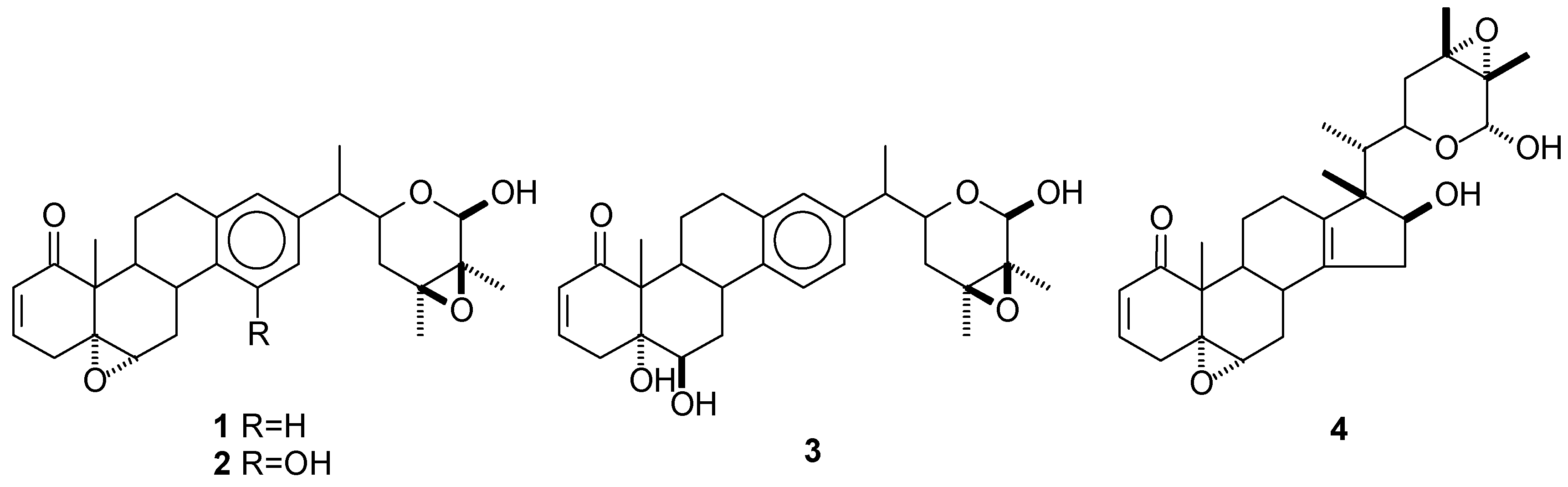
Continuing the isolation and characterization studies of the less abundant withanolides in S. ori-ganifolia collected in Salta, we have isolated a new withanolide, salpichrolide N (4) which would de- rive via C-13/C-18 cleavage, from the postulated fused cyclopropane intermediate (17,18- cycloergostane) in the biosynthetic pathway leading to expansion and aromatization of the D ring.
Experimental
Plant material and isolation procedure: Whole plants of S. origanifolia were collected in Salta, and extracted immediately with ether and ethanol at room temperature. Both extracts were evaporated and the pooled residues fractionated by flash chromatography and prep. TLC to yield compounds 1 and 3 and five minor withanolides, four of which have been described previously by us [5]; the seventh withanolide, salpichrolide N (4), was characterized by spectroscopic methods.
Results and Discussion
The 1H and 13C NMR resonances of rings A, B and the side chain of salpichrolide N were closely related to those of salpichrolide A (1) [1], However there were no aromatic H signals. The 13C NMR spectra showed two nonprotonated carbon resonances at δ 134.6 y 138.1 which were indicative of a tetrasubstituted double bond in rings C/D and five methyl groups. Analysis of the HMQC, HMBC and COSY-45 spectra (400 MHz), indicated that the double bond was placed at the C/D ring junction (13,14) and that the angular CH3-18 had been shifted to position 17. Diagnostic correlations in the HMBC spectrum were observed for the methyl H-18 with C-13, C-16, C-17 and C-20. The stereo-chemistry of the proposed structure (4) was confirmed by the strong H-18/H-15β correlation in the NOESY spectrum, H-16 couplings and molecular modelling calculations.
Acknowledgements
We thank Universidad de Buenos Aires and CONICET (Argentina) for financial support and Dr E. Manta and G. Hernandez (Universidad de la República, Uruguay) for the NMR spectra at 400 MHz.
References and Notes
- Veleiro, A. S.; Oberti, J. C.; Burton, G. Phytochemistry 1992, 31, 935.
- Veleiro, A. S.; Burton, G.; Bonetto, G.; Gil, R. R.; Oberti, J. C. J. Nat. Prod. 1994, 57, 1741. [CrossRef]
- Tettamanzi, M. C.; Veleiro, A. S.; Oberti, J. C.; Burton, G. Phytochemistry 1996, 43, 461.
- Tettamanzi, M. C.; Veleiro, A. S.; Oberti, J.C.; Burton, G. J Nat. Prod. 1998, 61, 338.
- Tettamanzi, M. C.; Veleiro, A. S.; de la Fuente, J. R.; Burton, G. XI Simposio Nacional de Química Orgánica, Córdoba. November 1997. [Google Scholar]
- Mareggiani, G.; Picollo, M. I.; Veleiro, A. S.; Tettamanzi, M. C.; Benedetti, V.; Burton, G.; Zerba, E. 21st IUPAC International Symposium on the Chemistry of Natural Products, Beijing, China. October 1998. [Google Scholar]