


Abstract
Copyright protection of medical images is a vital goal in the era of smart healthcare systems. In recent telemedicine applications, medical images are sensed using medical imaging devices and transmitted to remote places for screening by physicians and specialists. During their transmission, the medical images could be tampered with by intruders. Traditional watermarking methods embed the information in the host images to protect the copyright of medical images. The embedding destroys the original image and cannot be applied efficiently to images used in medicine that require high integrity. Robust zero-watermarking methods are preferable over other watermarking algorithms in medical image security due to their outstanding performance. Most existing methods are presented based on moments and moment invariants, which have become a prominent method for zero-watermarking due to their favorable image description capabilities and geometric invariance. Although moment-based zero-watermarking can be an effective approach to image copyright protection, several present approaches cannot effectively resist geometric attacks, and others have a low resistance to large-scale attacks. Besides these issues, most of these algorithms rely on traditional moment computation, which suffers from numerical error accumulation, leading to numerical instabilities, and time consumption and affecting the performance of these moment-based zero-watermarking techniques. In this paper, we derived multi-channel Gaussian–Hermite moments of fractional-order (MFrGHMs) to solve the problems. Then we used a kernel-based method for the highly accurate computation of MFrGHMs to solve the computation issue. Then, we constructed image features that are accurate and robust. Finally, we presented a new zero-watermarking scheme for color medical images using accurate MFrGHMs and 1D Chebyshev chaotic features to achieve lossless copyright protection of the color medical images. We performed experiments where their outcomes ensure the robustness of the proposed zero-watermarking algorithms against various attacks. The proposed zero-watermarking algorithm achieves a good balance between robustness and imperceptibility. Compared with similar existing algorithms, the proposed algorithm has superior robustness, security, and time computation.
1. Introduction
Multimedia tools, imaging technology, and digital image processing are widely used in modern smart healthcare systems. As a result, many medical images and data are transmitted between locations via healthcare networks and the internet. Medical images are used to help clinicians in diagnosis. Most of these medical images contain personal privacy details, which may be maliciously intercepted and tampered with by illegal elements during transmission, leading to patient privacy leakage [1,2]. Digital watermarking technology represents a reliable tool to overcome this challenge [3]. Digital watermarking technology addresses the essential requirements of copyright protection, authentication, integrity verification, and unique identification of medical images during transmission over insecure networks and storage in very large distributed databases. In the medical field, digital watermarking algorithms were applied to protect patients’ privacy, prevent tampering with medical data, and ensure the copyright of medical images [4,5,6,7]. Traditional embedding watermarking algorithms [8,9,10,11] embed digital information that identifies the ownership into the host image/carrier and then ensures the copyright or protects the copyright through extracting the embedded information. Extraction of the embedded information could destroy the information integrity of the host image, especially the fine data, which can lead to an inaccurate diagnosis.
Moreover, for transparency, the amount of embedded information is limited. The host images are distorted in those abovementioned traditional watermarking algorithms. In specific applications such as medical computer-aided diagnosis systems, scanning of artwork, and the military, distortion of images is unacceptable. Therefore, these traditional algorithms are less efficient and not suitable for copyright protection of medical images [12].
For medical image watermarking algorithms, imperceptibility and robustness are particularly important. Consequently, lossless copyright protection is imperative. Wen et al. [13] presented a zero-watermarking (lossless watermarking) concept to overcome the integrity challenge in conventional watermarking algorithms. In this approach, the original image features are extracted without any modifications even after attacks, which shows its reliability for the authentication of medical images. The zero-watermarks are invisible. In addition, it can address the noticeable conflict between imperceptibility and robustness in the traditional watermarking methods [13,14,15]. The zero-watermarking algorithms for digital images could be applied either in the spatial domain [16] or the frequency domain [17,18,19].
Based on the remarkable characteristics of orthogonal moments and their invariants in extracting the features of a medical digital image, moment-based zero-watermarking algorithms have received much attention from researchers. Here, we review the existing moments-based zero-watermarking algorithms, focusing on techniques. We discuss their effectiveness, limitations, and drawbacks. Wang et al. [20] extended the GOFMMs, defined the QGOFMMs, and then extracted the 4D features of the carrier medical image. The extracted images were applied to the zero-watermarking of medical images.
The authors [21] used invariant QPHTs of the color medical images and presented a robust zero-watermarking algorithm. In [22], they utilized QPHFTs in zero-watermarking of three medical CT images. Again, in [23], they applied a geometrically invariant QPHFMs-based null-watermarking to medical images for copyright protection.
Ma et al. [24] protected two similar medical images using a zero-watermarking algorithm based on TPCET and chaotic mapping. Xia et al. [25] applied multiple zero-watermarking of color medical images using QPHFMs. In [26], Niu et al. designed a fast QLPRHFMs-based zero-watermarking for color medical/non-medical images.
Recently [27,28,29], scientists have demonstrated that orthogonal moments with fractional orders outperform their corresponding ones with integer orders. The authors in [30] designed multiple zero-watermarking using the MFrGMs. In [31], the authors designed FoRHFMs-based lossless copyright protection for medical grayscale images. In [32], Wang and his co-authors derived QFPJFMs for color images and then applied these moments in a zero-watermarking algorithm.
Despite the considerable progress in the moment-based zero-watermarking approaches, the moment-based image zero-watermarking systems have several major drawbacks that limit the system’s performance. Through analysis of each zero-watermarking technique, we can easily summarize the limitations and drawbacks as follows:
- (1)
- Most of the abovementioned moment-based zero-watermarking techniques fail to achieve an acceptable trade-off between imperceptibility and robustness performance.
- (2)
- Most of them utilized the inaccurate zeroth-approximation method to compute the continuous orthogonal moments of integer orders, which results in a group of inaccurate features.
- (3)
- Most of them show low robustness against geometric and noise attacks.
- (4)
- Most of them are limited to the standard gray and color images and are not used in the medical field.
- (5)
- Due to the inaccurate direct computation method used in these algorithms, zero-watermarking algorithms are time-consuming and unsuitable for telemedicine applications.
These drawbacks have a major influence on the moments-based watermarking system.
Three relevant and interesting research questions that have been designed are given below:
RQ1. What is the influence of using a new accurate image descriptor, MFrGHMs, on the robustness of zero-watermarking?
RQ2. What is the influence of MFrGHMs on the imperceptibility of zero-watermarking?
RQ3. What is the influence of MFrGHMs on the computation time of zero-watermarking?
Motivated by considering the above limitations, this paper aims to develop a new color medical image zero-watermarking algorithm by integrating a new multi-channel fractional-order orthogonal moment with a chaotic map.
Firstly, we derived a new set of MFrGHMs for color medical images. We then used these new moments in designing a new zero-watermarking algorithm. We utilized a kernel-based for highly accurate computation of the MFrGHMs for the carrier medical image. Then, the carrier image was represented by extracting the robust and accurate features of MFrGHMs. Next, the features were transformed into a robust binary feature matrix.
Meanwhile, a 1D Chebyshev map was used in scrambling the watermark to provide a high level of security. Finally, we applied a bitwise exclusive-or operation to generate the zero-watermark for ownership verification. Based on the performed experiments, the proposed algorithm outperformed the existing zero-watermarking algorithms in terms of robustness against various attacks and execution times.
The overall contributions of this paper can be summarized as follows:
- We present a new image descriptor called multi-channel Gaussian–Hermite moments of fractional orders (MFrGHMs).
- We utilize a fast and highly accurate kernel-based method to compute (MFrGHMs).
- We propose a zero-watermarking scheme via accurate features of MFrGHMs, then apply it to protect the color medical image.
- We apply a new 1D Chebyshev chaotic map to enhance the security levels of the proposed algorithm.
- The utilization of multi-channel moments significantly reduces the computational complexity.
- Results from numerous experiments indicate that the proposed algorithm has superiority in robustness, security, and time computation.
This paper is organized into five sections. We describe the MFrGHMs in the second section. A detailed description of the proposed zero-watermarking algorithms is presented in the third section. Experiments and results are discussed in the fourth section. The conclusion is drawn in the fifth section.
2. Gaussian–Hermite Moments
This section briefly describes the conventional Gaussian–Hermite moments of integer and fractional orders for gray images. Then, we present the new multi-channel Gaussian–Hermite moments of fractional order for color images. Finally, we describe a highly accurate method to calculate the MFrGHMs coefficients for color medical images.
2.1. Traditional Gaussian-Hermite Moments of Gray Images
Hermite polynomials with integer order are defined over the domain ; the Hermite polynomial of the p-th degree is [33]:
In explicit form,
The recurrence relation of Hermite polynomials is:
where the first two polynomials are and . With a Gaussian weight function, , Hermite polynomials are orthogonal as follows:
where is the Kronecker symbol. With the help of Equation (4), the Gaussian–Hermite Polynomials are:
where
Replacing by , yields:
Hence, the Gaussian–Hermite moment (GHM) of image intensity function, is defined as follows [34]:
The approximated Gaussian–Hermite moments, , a digital image of size is calculated using the formula below.
2.2. Fractional-Order Gaussian–Hermite Moments of Gray Images
According to the remarkable work [35], the FrGHPs of degree p are obtained by replacing in Equation (7):
As proved in [35], FrGHPs are orthogonal in [0,1]:
where the fractional parameter, and The functions, , defined as in explicit form:
The recurrence formula of is:
For .
With:
Based on FrGHPs, the Fractional-order Gaussian–Hermite moment (FrGHM) of image intensity function, is defined as:
where is defined in .
2.3. Accurate Computation of New Multi-Channel Gaussian-Hermite Moments of Color Images
Representing the input color images, by using the approaches of multi-channel [36,37], where and . We generalized FrGHM of image intensity function, , in Equation (15) to be suitable for the RGB color image, and produced the MFrGHMs for , which are defined as:
where , , refer to non-negative integers’ indices.
Accurate computation of the MFrGHMs is the most effective process in a robust zero-watermarking algorithm. An accurate method [38] is used to compute MFrGHMs to achieve this goal. For the original color image, , we defined a discrete image in a domain , where . Therefore, the points defined as:
With and .
Equation (16) can be reformulated:
where:
Because the double integral in Equation (20) is separable; Equation (19) can be written as follows:
where:
The definite integrals’ limits are:
By substitutions of the Equations (24) and (25) in (22) and (23), we get:
Due to the impossibility of solving the integration in Equations (26) and (27) analytically, we use the accurate Gaussian quadrature method to compute the kernels, and . The definite integral, , could be computed as:
Substituting Equations (28) into (26) yields:
Similarly:
As we can see from Equations (29) and (30), the calculation of & is mainly based on and , respectively. Therefore, we use the recurrence form of fractional-order Gaussian-Hermit polynomials to effectively, accurately, and quickly compute & . Through overcoming the limitations of the explicit form of fractional-order Gaussian-Hermit polynomials, containing many factorial terms that produce numerical errors and instability.
3. Proposed Zero-Watermarking Algorithm
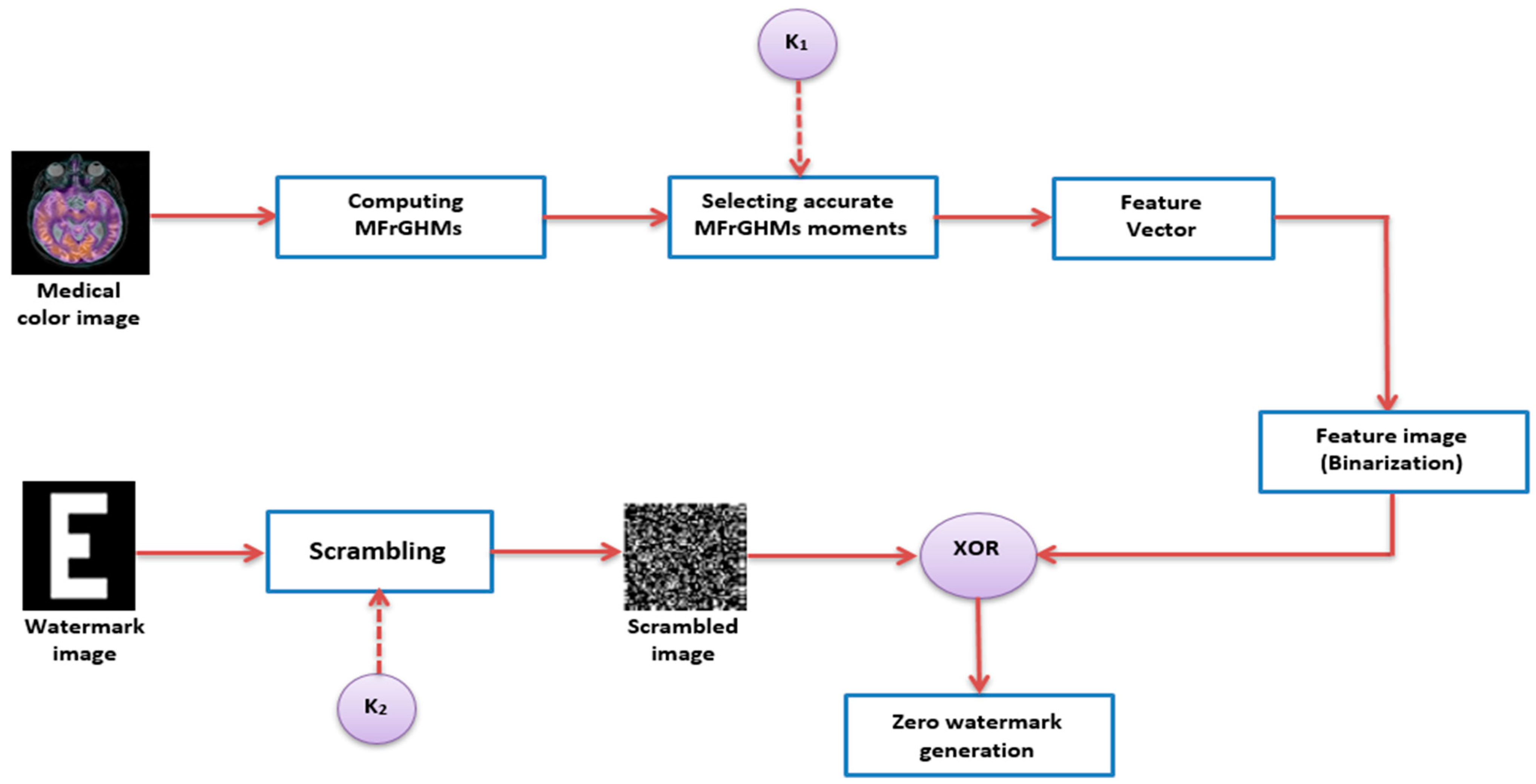
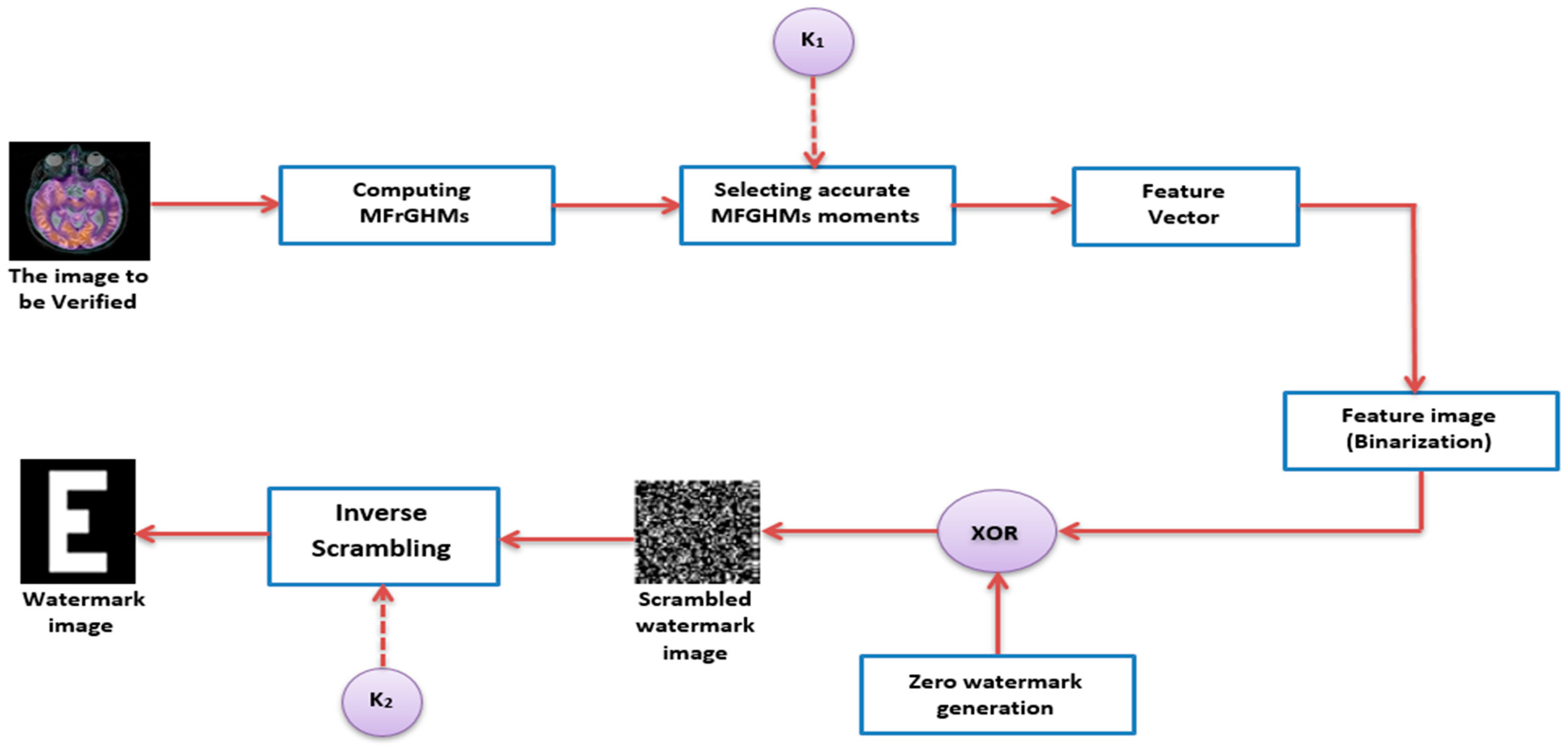
The proposed MFrGHMs-based zero-watermarking algorithm aimed to protect the copyright of color medical images. The proposed algorithm is divided into zero-watermarking generation and verification phases, as illustrated in Figure 1 and Figure 2, respectively.
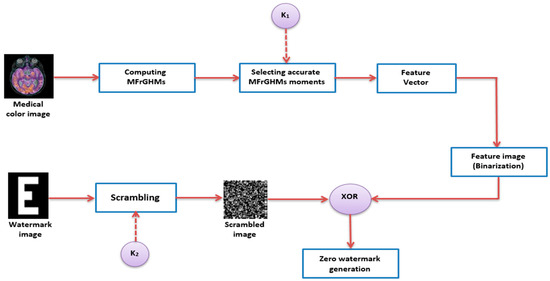
Figure 1.
Generation of zero-watermark.
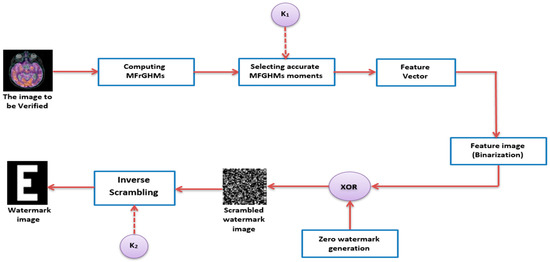
Figure 2.
Zero-watermarking verification framework.
3.1. Watermark Generation
Supposing the carrier’s medical image is , the size is , and the binary watermark image is W, , and the size is . The specific steps of the zero-watermark generation phase are:
- Step 1: Computing the coefficients of MFrGHMs.
We compute the maximum order MFrGHMs of the host image using Equation (19). We have a totally features, where a L- length vector of the amplitudes is created.
- Step2: Selected Features
Based on the standard selection criteria in [39] and by employing a secret key, , coefficient, which is the watermark image size, the precise and accurate MFrGHMs coefficient set, should be .
- Step 3: Construction of feature vector
The of MFrGHMs coefficients generated in Step 2 is used for the feature image construction. A number MFrGHMs moments is randomly selected from the calculated MFrGHMs moments (set S), where we calculate the amplitudes and produce the vector .
- Step 4: Binary Feature Vector
The binary feature sequence is obtained from the feature vector/sequence , where:
where T is the threshold based on the mean value of A.
The binarized vector/sequence is rearranged into a two-dimensional binary feature image, , with the size of .
- Step 5: Watermark Scrambling
We scrambled the watermark image using a 1D Chebyshev map to increase the security and broke the pixels-spatial relationship in the watermark image. The outstanding wide range of control parameters and pseudo-randomness has made the Chebyshev map suitable for image scrambling.
Therefore, the scrambling parameters of the 1D Chebyshev map are used to create the security key.
We transformed the watermark image, , into a one-dimensional sequence, . Next, a 1D Chebyshev map with controlling parameter and initial value (key ) used in generating the chaotic sequence, . The chaotic Chebyshev map is defined as:
where the control parameter ≥ 2.
A chaotic sequence, is binarized to obtain a chaotic binary sequence, as follows:
where is the threshold.
Then, we performed an XOR operation between and to get the chaotic scrambled watermark sequence, . Finally, is converted to the 2D matrix to generate the scrambled watermark
- Step 6: Generation of the Watermark Image
The performed XOR operation is used in scrambling the watermark image, and the image’s feature, to generate the zero-watermark, :
3.2. Detection of the Watermark
We mainly detect the image’s watermark information in the detection phase, independent of the original images.
- Step 1: Computation of the coefficients of MFrGHMs
We compute the maximum order , of MFrGHMs for the verified original image, using Equation (19).
- Step 2: Selection of the precise coefficients
Similar to Step 2 in the Zero-watermark generation, the precise and accurate MFrGHMs coefficient set, are obtained.
- Step 3: Construction of feature vector
A number MFrGHMs coefficients are randomly selected from accurate MFrGHMs coefficients set and their amplitudes are calculated, producing feature sequences .
- Step 4: Binary Feature Vector
We binarized the feature vector/sequence using Equation (31) to produce . Then, the binarized feature vector/sequence is transformed into the 2D binary feature image, of the size .
- Step 5: Generation of the scrambled watermark image
An XOR operation is utilized on the zero-watermark, , and the image’s features, to generate the scrambled version of the retrieved watermark,: .
- Step 6: Extraction of watermark image.
The reverse process of scrambling can extract and visually check out the watermark. is reversely scrambled using the key, of 1D-Chebyshev map to obtain the retrieved watermark, denoted as .
4. Experimental Results
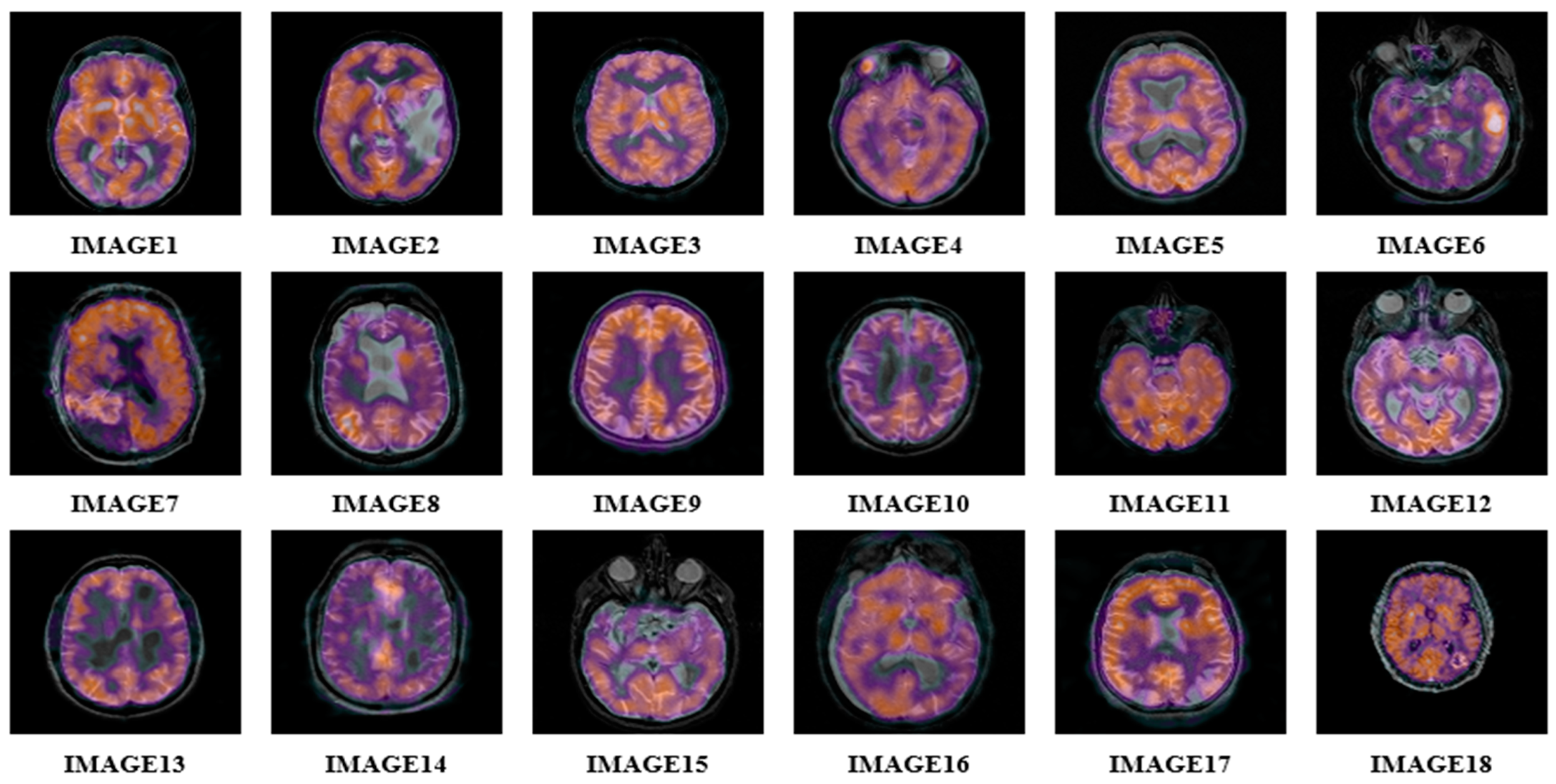
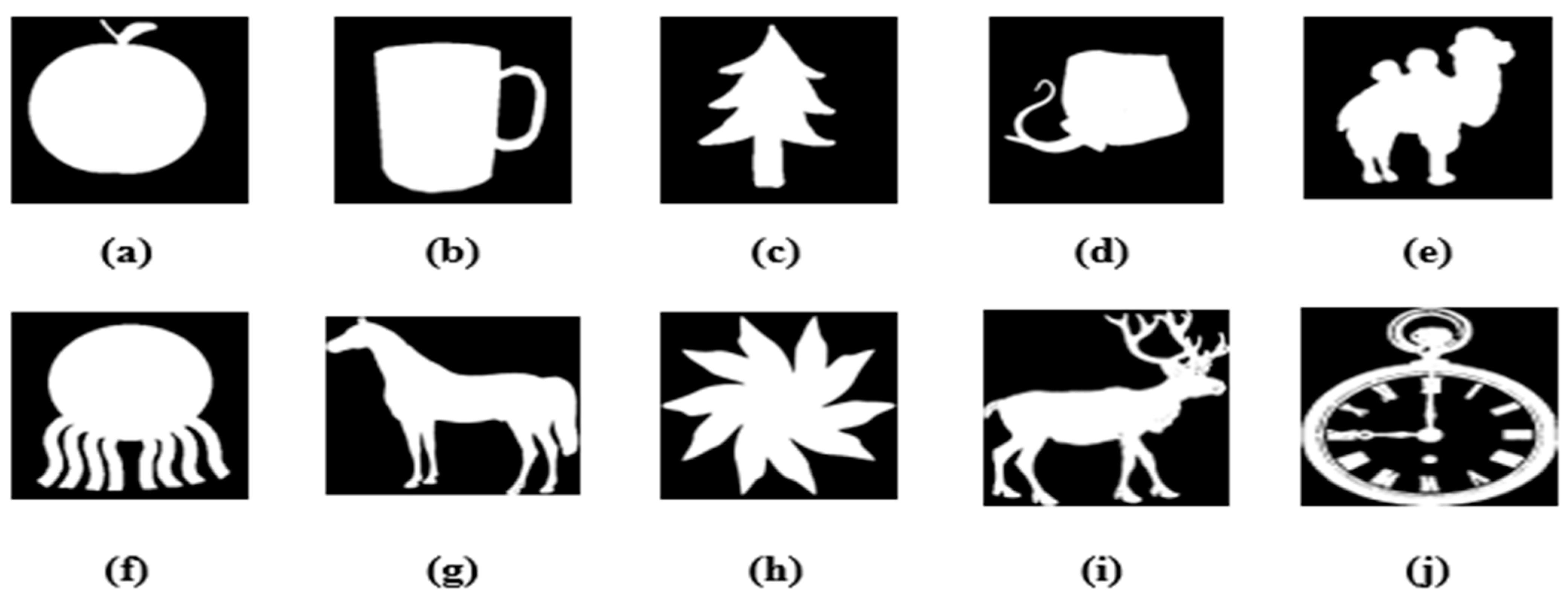
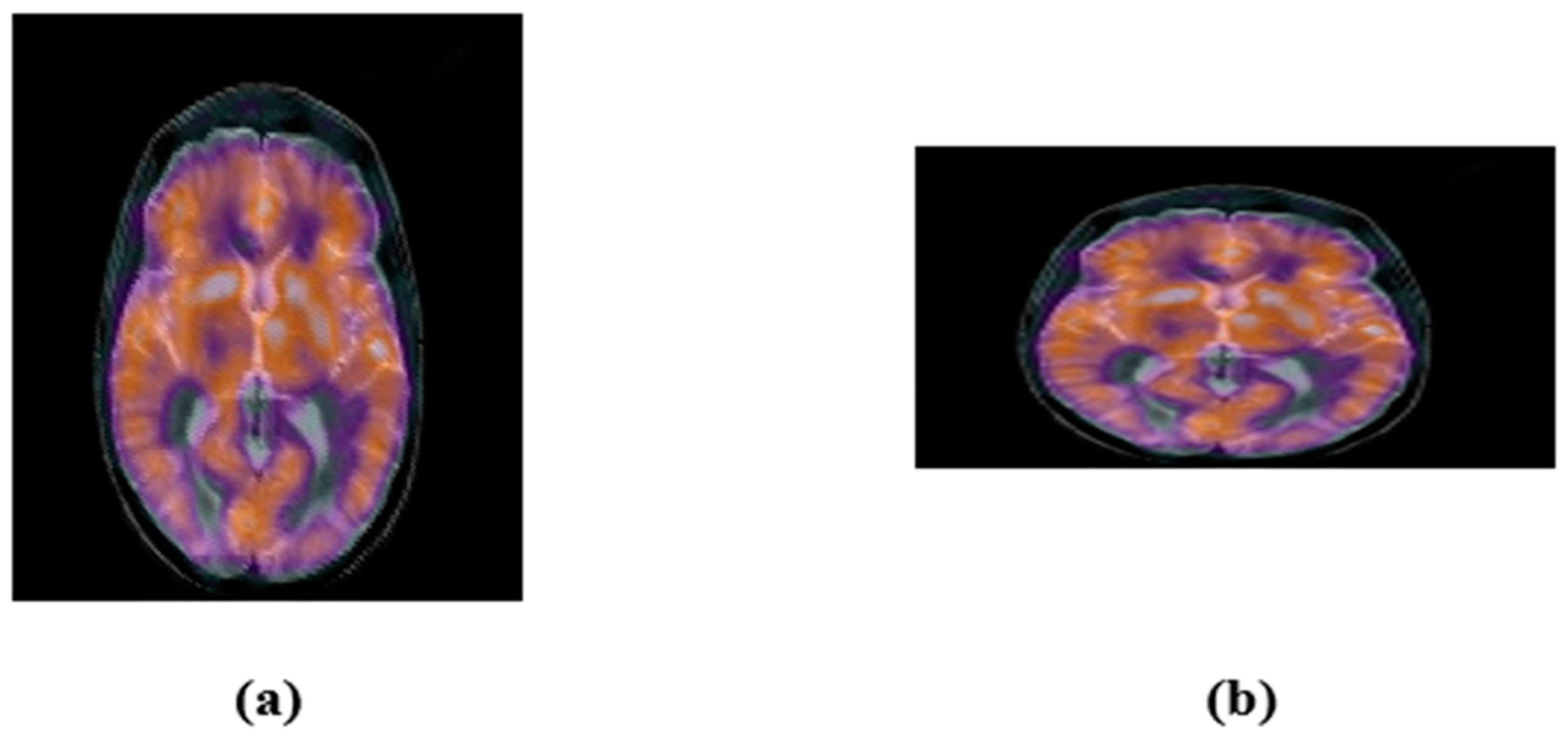
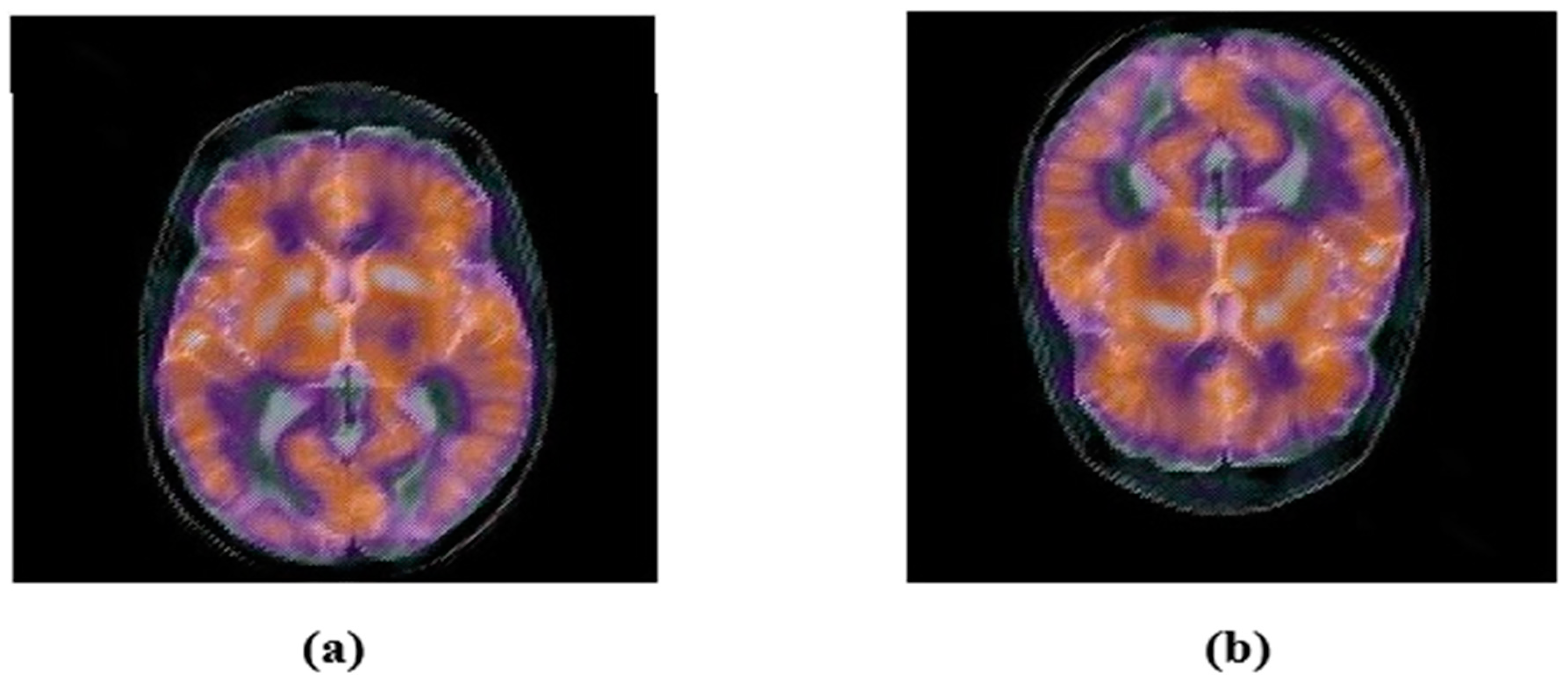
Experiments were conducted to evaluate the proposed algorithm. We selected 18 color MRI medical images (256 × 256) from the ‘The Whole-Brain Atlas’ [40], as displayed in Figure 3. Watermarks are binary images (32 × 32), shown in Figure 4, where the fractional parameter is set to t = 1.9.
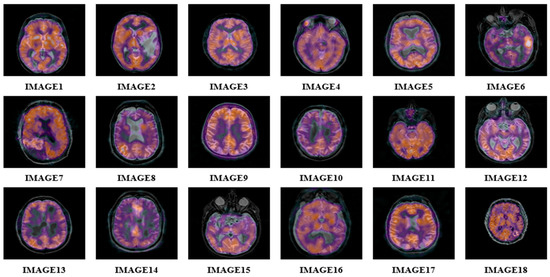
Figure 3.
Original MRI color medical images.
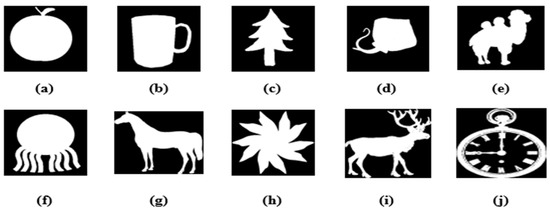
Figure 4.
Binary watermarks images.
4.1. Evaluation Metrics
The PSNR is used to evaluate the distortion of attacked images, where lower PSNR values reflect a high degree of distortion and vice versa. The PSNR is defined as [41]:
where:
where and refer to attacked and original images, respectively.
The robustness of the algorithm can be determined by comparing the BER and the NC of the extracted watermark image , with that of the original image . BER and NC are defined as:
The optimum values of BER and NC values are 0 and 1, respectively.
4.2. Robustness
Three experiments were conducted to test the robustness of the proposed scheme. In the two experiments, we used the color medical image, “ IMAGE1”, of size 256 × 256, as a carrier image and the binary image, “TREE”, of size 32 × 32, as a watermark. For the third experiment, we selected 18 color medical images of size 256 × 256 as carrier images and the binary image, “horse”, of size 32 × 32 as a watermark. In this experiment, we tested the robustness of the proposed zero-watermarking algorithms against various attacks.
4.2.1. Common Signal Processing Attacks
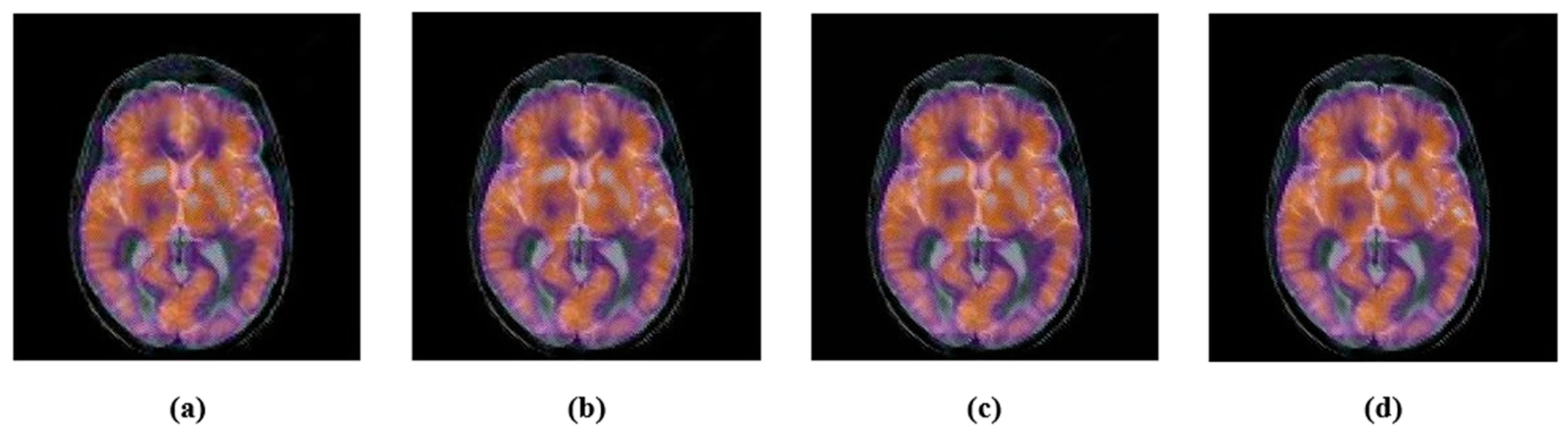
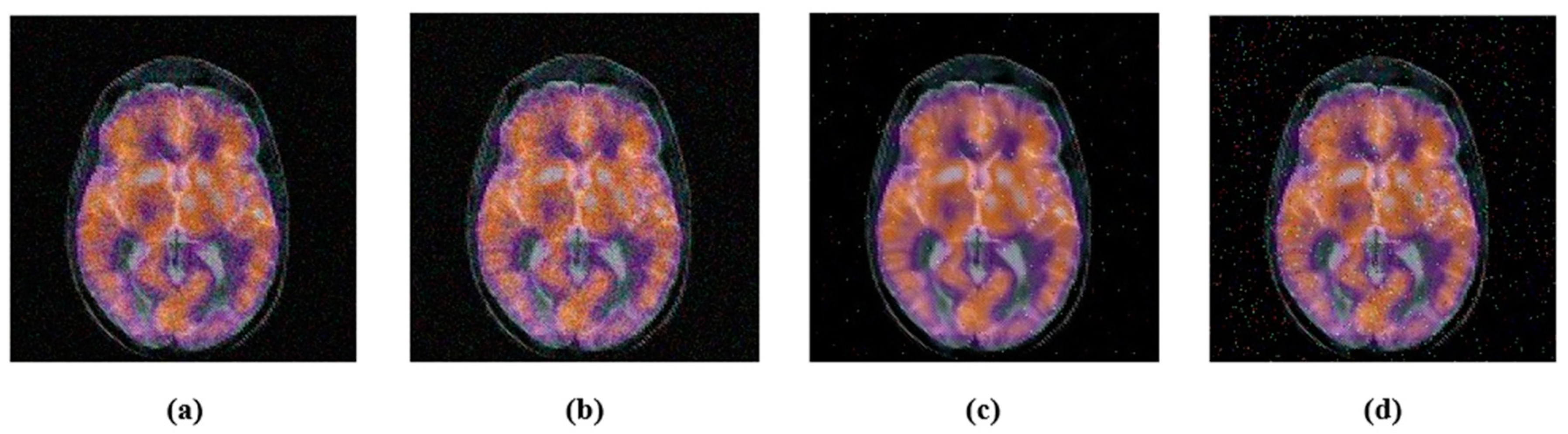
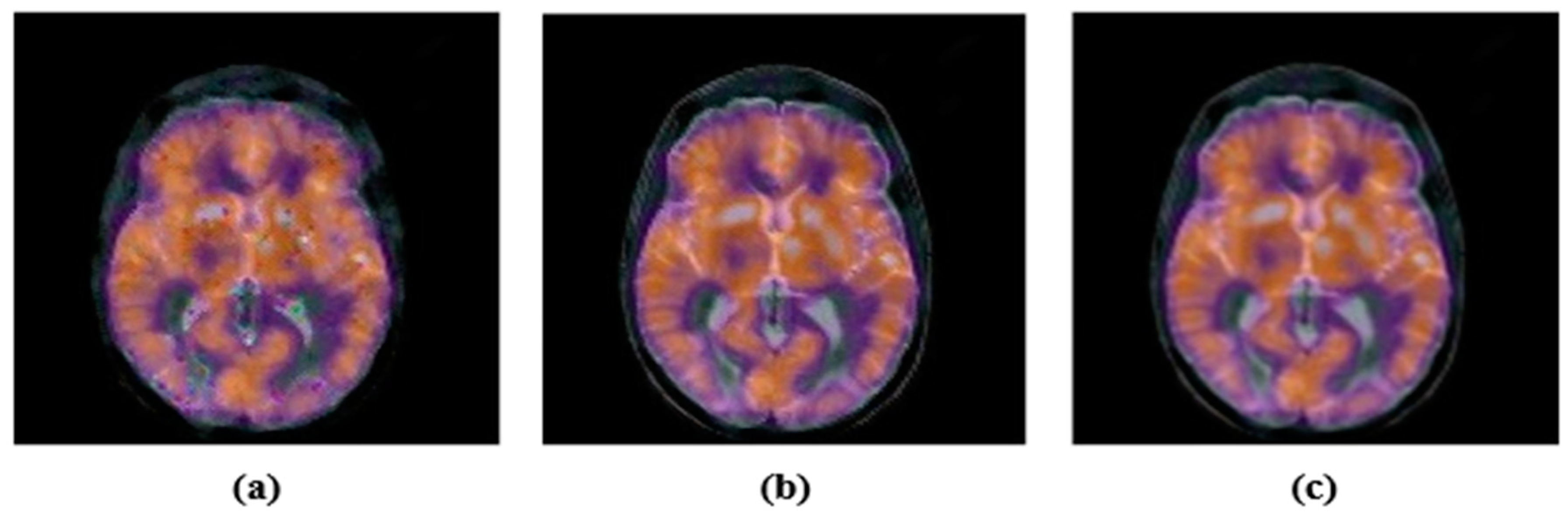
Noise, filtering, JPEG compression, etc., are common signal processing attacks. These attacks change the energy of the image pixels. We performed a few experiments. First, we applied the JPEG compression with various compression ratios, 10, 30, 50, 70 and 90. After the JPEG-compression attack, the attacked images and their corresponding PSNR are shown in Figure 5. Second, we contaminated color medical images with Gaussian noise with variances of 0.005 and 0.02, and also, the “salt and pepper” noise with density 0.005 and 0.02. The noisy images with their PSNR are shown in Figure 6. Finally, the selected color medical images were subjected to different filtering using a small window (3 × 3); median-filtering, Gaussian-filtering, and average-filtering. The filtered images with their PSNR are shown in Figure 7. For simplicity, we summarize these attacks in Table 1.
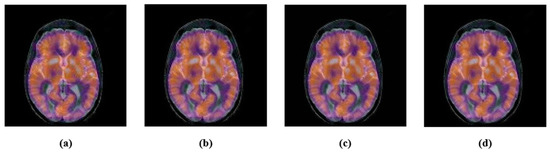
Figure 5.
Image after JPEG compression attack: (a) JPEG 30, PSNR = 32.1397; (b) JPEG 50; PSNR = 34.1217; (c) JPEG 70; PSNR = 36.4392; (d) JPEG 90; PSNR = 46.7826.
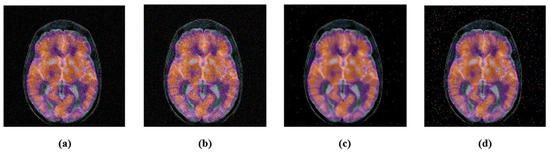
Figure 6.
Image after adding noise attack: (a) Gaussian-noise 0.005, PSNR = 21.4300; (b) Gaussian-noise 0.02, PSNR = 20.8392; (c) salt and pepper noise 0.005, PSNR = 27.0980; (d) salt and pepper noise 0.02, PSNR = 22.9251.
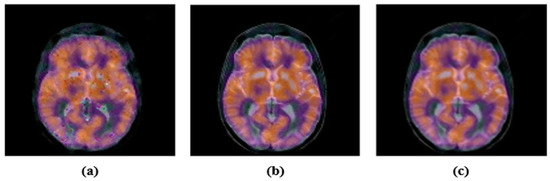
Figure 7.
Images after filtering attack: (a) median-filtering 3 × 3; PSNR = 24.2301; (b) Gaussian-filtering 3 × 3; PSNR = 18.7036; (c) average-filtering 3 × 3 PSNR = 19.2364.

Table 1.
Common image processing attacks and their parameterization.
The proposed algorithm shows a high degree of robustness to various attacks. The retrieved binary watermarks and the calculated values of BER and NC are summarized in Table 2. Table 2 shows that almost all values of BER and NC approach the optimum values, and the rest of the values of BER and NC are equal to 0 and 1, respectively. The retrieved watermarks using the proposed algorithm are very close to the original due to the high accuracy and stability of the MFrGHMs amplitude against various attacks. Therefore, this algorithm resists the different image processing attacks.
Table 2.
The extracted watermarks and the corresponding BER and NC values under common image processing attacks.
4.2.2. Geometric Attacks
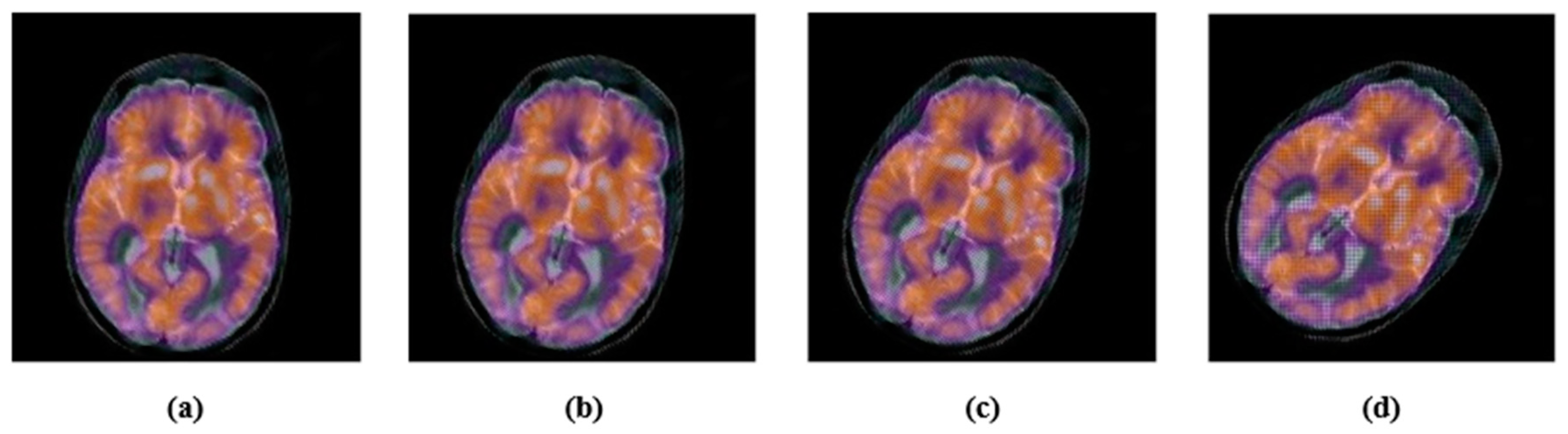
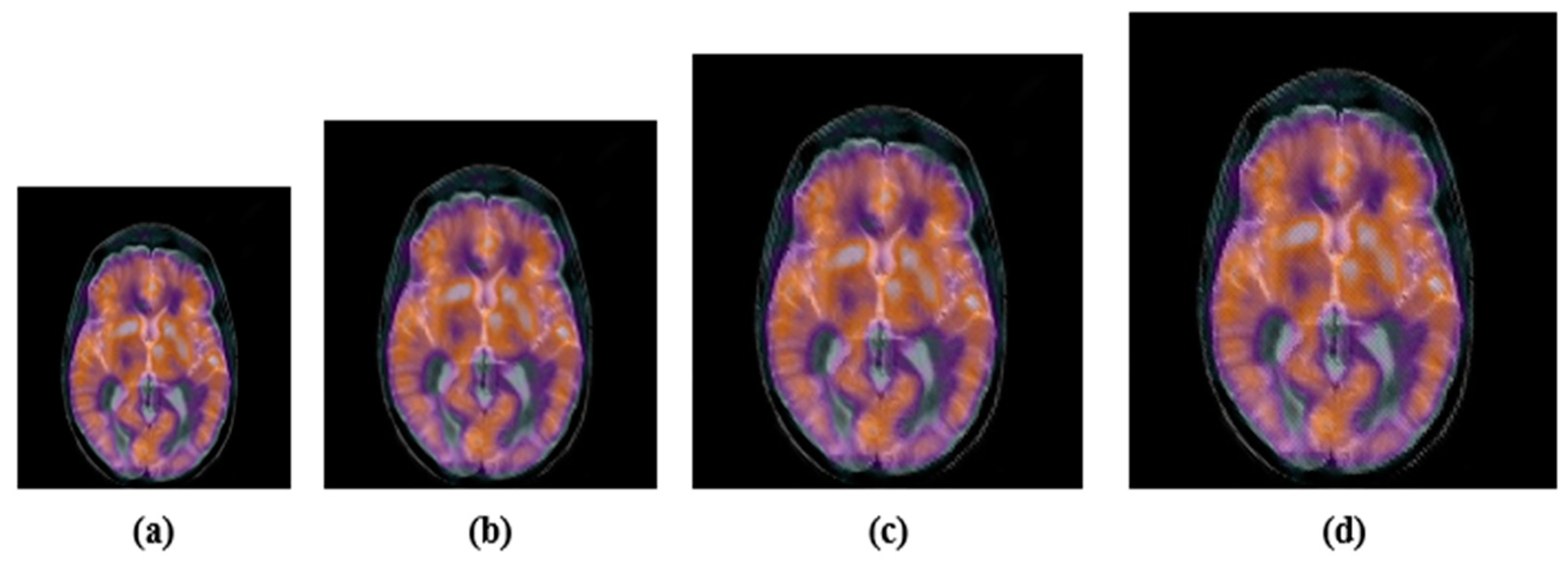
Here, the robustness of the proposed zero-watermarking algorithm is evaluated against common geometric attacks. First, we rotated the medical test image by 5°, 15°, 25°, and 45° (Figure 8). Next, we scaled the color medical image with a scaling factor of 0.5, 0.75, 1.5, and 2 (Figure 9). Then, we applied length–width ratio (LWR) changes to the tested images with factors of (1.0, 0.75) and (0.5, 1.0) (Figure 10). Finally, the medical test image was flipped vertically and horizontally (Figure 11). We summarize the common geometric attacks and their parameters in Table 3 for simplicity.
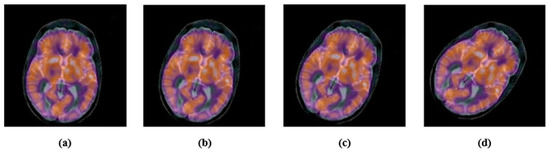
Figure 8.
Rotated Images: (a) 5°; PSNR = 16.5233; (b) 15°; PSNR = 15.1828; (c) 25°; PSNR = 14.3906; (d) 45°; PSNR = 13.6059.
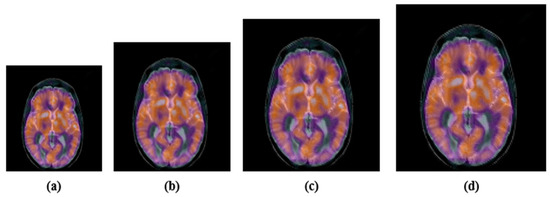
Figure 9.
Scaled images: (a) 0.5, (b) 0.75, (c) 1. 5, (d) 2.0.
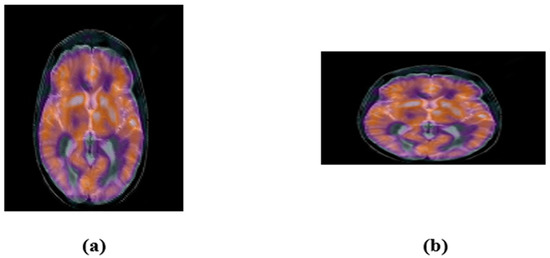
Figure 10.
Image after under LWR changing: (a) (1.0, 0.75), (b) (0.5, 1.0).
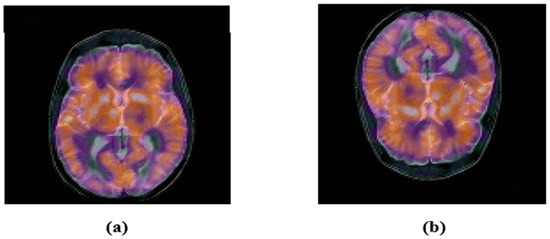
Figure 11.
Image after flipping attacks: (a) Horizontal-flipping, PSNR = 8.9862, (b) Vertical-flipping, PSNR = 12.5725.
Table 3.
Geometric attacks and their parameterization.
The results concerning the images subjected to geometric attacks are shown in Table 4. Table 4 shows that the retrieved watermarks from the attacked images are almost identical to the original watermarks. The values of BER and NC have approached or are equal to the optimum values of BER and NC, “0 and 1”, respectively. These results ensure the robustness of the proposed algorithm to the geometric attacks.
Table 4.
The watermarks and corresponding BER and NC values were extracted under common geometric attacks.
4.3. Robustness Comparison with Similar Algorithms
We computed the average values of BER of 18 images shown in Figure 3. Then compared the obtained results with the latest zero-watermarking algorithms [20,22,23,26,30,32], where the comparison results are reported in Table 5. We notice that the proposed algorithm achieved the lowest BER and exhibits higher-robustness than the existing zero-watermarking algorithms [20,22,23,26,30,32].
Table 5.
Average BER comparison with [20,22,23,26,30,32].
4.4. Computational Time
The proposed scheme mainly consists of two phases. The first is the generation, while the second is the verification. We calculate the execution time for the 18 carrier images (512 × 512) and the watermarks (32 × 32) using the proposed and the existing methods [20,22,23,26,30,32]. The average computation times are reported in Table 6.
Table 6.
Computation time for the proposed and the existing algorithms [20,22,23,26,30,32].
The proposed zero watermark algorithm requires much less time than the existing algorithms [20,22,23,26,30,32].
From all the numerical experiments, the proposed algorithm achieved the best values for the BER, the NC, and the computation time compared with the existing algorithms. The proposed algorithm has advantages over the existing algorithms due to the new descriptor with intrinsic features, the fast and accurate computation method of MFrGHMs, and the effective 1D Chebyshev chaotic map combined in the proposed algorithm.
5. Conclusions
In this paper, we have proposed a robust medical color image zero-watermarking algorithm using a new descriptor of medical images and a chaotic map to answer the research questions, RQ1, RQ2, and RQ3, through different numerical experiments. We derived a new set of multi-channel Gaussian–Hermite moments of fractional orders. These new descriptors are used to design an MFrGHMs-based watermarking algorithm for color medical images. The fractional-order orthogonal descriptors enable the extraction of coarse and fine features from the medical images. We used a highly accurate and numerically stable method to compute the MFrGHMs, minimizing common numerical errors. A 1D Chebyshev chaotic map is used to scramble the watermark and break the correlation between the adjacent pixels, improving the watermark’s security. Using multi-channel moments significantly reduces the computational complexity and speeds up the proposed algorithm. Experimental results ensure the robustness and resistance to various kinds of attacks. Furthermore, compared to several existing algorithms, the proposed algorithm achieves a good trade-off between imperceptibility and robustness and has certain superiority in terms of robustness, time complexity, security, and capacity.
For future works, there are some research studies planned. Firstly, the proposed method will be extended to deal with stereoscopic medical images. Secondly, we will utilize a computational method using a fast Fourier transform to improve the computation time and the accuracy of the feature extraction method of medical images. Then, we will improve the security levels by using a new chaotic map. Finally, we will extend the proposed to other real-life applications such as IoT medical systems.
Author Contributions
All authors contributed to different sections of the work equally. Conceptualization, D.S.K., F.K.K., K.M.H. and M.M.D.; methodology, D.S.K., F.K.K., K.M.H. and M.M.D.; validation, D.S.K., F.K.K., K.M.H. and M.M.D.; analysis, D.S.K., F.K.K., K.M.H. and M.M.D.; writing—original draft preparation, D.S.K., F.K.K., K.M.H. and M.M.D.; writing—review and editing, D.S.K., F.K.K., K.M.H. and M.M.D.; visualization, D.S.K., F.K.K., K.M.H. and M.M.D.; supervision, D.S.K., F.K.K., K.M.H. and M.M.D. All authors have read and agreed to the published version of the manuscript.
Funding
This project is funded by Princess Nourah bint Abdulrahman University Researchers Supporting Project number (PNURSP2022R300), Princess Nourah bint Abdulrahman University, Riyadh, Saudi Arabia.
Institutional Review Board Statement
Not applicable.
Informed Consent Statement
Not applicable.
Data Availability Statement
Not applicable.
Acknowledgments
Princess Nourah bint Abdulrahman University Researchers Supporting Project number (PNURSP2022R300), Princess Nourah bint Abdulrahman University, Riyadh, Saudi Arabia.
Conflicts of Interest
The authors declare no conflict of interest.
Abbreviations
| GOFMMs | Generalized Orthogonal Fourier–Mellin Moments |
| QGOFMMs | Quaternion Generalized Orthogonal Fourier–Mellin Moments |
| QPHTs | Quaternion Polar Harmonic Transforms |
| QPHFTs | Quaternion Polar Harmonic Fourier Transforms |
| QPHFMs | Quaternion Polar Harmonic Fourier Moments |
| TPCET | Ternary Polar Cosine Exponent Transform |
| MFrGMs | Fractional Genenbauer Moments of Fractional Orders |
| FoRHFMs | Radial Harmonic Fourier Moment of Fractional Orders |
| QFPJFMs | Quaternion Orthogonal Pseudo-Jacobi–Fourier Moments of Fractional Order |
| MFrGHMs | Multi-channel Gaussian–Hermite Moments of Fractional Orders |
| QLPRHFMs | Quaternion Log-polar Radial Harmonic Fourier Moments |
| FrGHPs | Fractional-order Gaussian–Hermite Polynomials |
| 2D | Two Dimensional |
| 1D | One Dimensional |
| PSNR | Peak Signal-to-noise Ratio |
References
- Aparna, P.; Kishore, P.V.V. A blind medical image watermarking for secure E-healthcare application using crypto-watermarking system. J. Intell. Syst. 2020, 29, 1558–1575. [Google Scholar] [CrossRef]
- Magdy, M.; Ghali, N.I.; Ghoniemy, S.; Hosny, K.M. Multiple Zero-Watermarking of Medical Images for Internet of Medical Things. IEEE Access 2022, 10, 38821–38831. [Google Scholar] [CrossRef]
- Castiglione, A.; Pizzolante, R.; Palmieri, F.; Masucci, B.; Carpentieri, B.; Santis, A.D.; Castiglione, A. On-board format-independent security of functional magnetic resonance images. ACM Trans. Embedded Comput. Syst. 2017, 16, 1–15. [Google Scholar] [CrossRef]
- Hosny, K.M.; Darwish, M.M.; Li, K.; Salah, A. Parallel Multi-core CPU and GPU for Fast and Robust Medical Image Watermarking. IEEE Access 2018, 6, 77212–77225. [Google Scholar] [CrossRef]
- Haddad, S.; Coatrieux, G.; Moreau-Gaudry, A.; Cozic, M. Joint Watermarking-Encryption-JPEG-LS for Medical Image Reliability Control in Encrypted and Compressed Domains. IEEE Trans. Inf. Forensic Secur. 2020, 15, 2556–2569. [Google Scholar] [CrossRef]
- Abdel-Aziz, M.M.; Hosny, K.M.; Lashin, N.A.; Fouda, M.M. Blind Watermarking of Color Medical Images Using Hadamard Transform and Fractional-Order Moments. Sensors 2021, 21, 7845. [Google Scholar] [CrossRef]
- Zhou, X.; Ma, Y.; Zhang, Q.; Mohammed, M.A.; Damaševičius, R. A Reversible Watermarking System for Medical Color Images: Balancing Capacity, Imperceptibility, and Robustness. Electronics 2021, 10, 1024. [Google Scholar] [CrossRef]
- Hosny, K.M.; Darwish, M.M. Invariant image watermarking using accurate polar harmonic transforms. Comput. Electr. Eng. 2017, 62, 429–447. [Google Scholar] [CrossRef]
- Cedillo-Hernandez, M.; Cedillo-Hernandez, A.; Nakano-Miyatake, M.; Perez-Meana, H. Improving the management of medical imaging by using robust and secure dual watermarking. Biomed. Signal Process. Control 2020, 56, 101695. [Google Scholar] [CrossRef]
- Kumar, M.; Aggarwal, J.; Rani, A.; Stephan, T.; Shankar, A.; Mirjalili, S. Secure video communication using firefly optimization and visual cryptography. Artif. Intell. Rev. 2021, 55, 2997–3017. [Google Scholar] [CrossRef]
- Juarez-Sandoval, O.U.; Garcia-Ugalde, F.J.; Cedillo-Hernandez, M.; Ramirez-Hernandez, J.; Hernandez-Gonzalez, L. Imperceptible–Visible Watermarking to Information Security Tasks in Color Imaging. Mathematics 2021, 9, 2374. [Google Scholar] [CrossRef]
- Magdy, M.; Hosny, K.M.; Ghali, N.I.; Ghoniemy, S. Security of medical images for telemedicine: A systematic review. Multimed. Tools Appl. 2022, 81, 25101–25145. [Google Scholar] [CrossRef]
- Wen, Q.T.; Sun, F.; Wang, S.X. Concept and application of zero-watermark. Acta Electron. Sin. 2003, 31, 214–216. [Google Scholar]
- Ren, N.; Zhao, Y.; Zhu, C.; Zhou, Q.; Xu, D. Copyright Protection Based on Zero Watermarking and Blockchain for Vector Maps. ISPRS Int. J. Geo-Inf. 2021, 10, 294. [Google Scholar] [CrossRef]
- Zhou, Q.; Zhu, C.; Ren, N.; Chen, W.; Gong, W. Zero Watermarking Algorithm for Vector Geographic Data Based on the Number of Neighboring Features. Symmetry 2021, 13, 208. [Google Scholar] [CrossRef]
- Chang, C.C.; Lin, P.Y. Adaptive watermark mechanism for rightful ownership protection. J. Syst. Softw. 2008, 81, 1118–1129. [Google Scholar] [CrossRef]
- Zou, B.; Du, J.; Liu, X.; Wang, Y. Distinguishable zero-watermarking scheme with similarity-based retrieval for digital rights Management of Fundus Image. Multimed. Tools Appl. 2018, 77, 28685–28708. [Google Scholar] [CrossRef]
- Liu, J.; Li, J.; Zhang, K.; Bhatti, U.A.; Ai, Y. Zero-watermarking algorithm for medical images based on dual-tree complex wavelet transform and discrete cosine transform. J. Med. Imaging Health Inform. 2019, 9, 188–194. [Google Scholar] [CrossRef]
- Wu, X.; Li, J.; Tu, R.; Cheng, J.; Bhatti, U.A.; Ma, J. Contourlet-DCT based multiple robust watermarking for medical images. Multimed. Tools Appl. 2019, 78, 8463–8480. [Google Scholar] [CrossRef]
- Wang, X.Y.; Wang, L.; Tian, J.L.; Niu, P.P.; Yang, H.Y. Color image zero-watermarking using accurate quaternion generalized orthogonal Fourier–Mellin moments. J. Math. Imaging Vis. 2021, 63, 708–734. [Google Scholar] [CrossRef]
- Xia, Z.; Wang, X.; Zhou, W.; Li, R.; Wang, C.; Zhang, C. Color medical image lossless watermarking using chaotic system and accurate quaternion polar harmonic transforms. Signal Process. 2019, 157, 108–118. [Google Scholar] [CrossRef]
- Xia, Z.; Wang, X.; Li, X.; Wang, C.; Unar, S.; Wang, M.; Zhao, T. Efficient copyright protection for three CT images based on quaternion polar harmonic Fourier moments. Signal Process. 2019, 164, 368–379. [Google Scholar] [CrossRef]
- Xia, Z.; Wang, X.; Wang, M.; Unar, S.; Wang, C.; Liu, Y.; Li, X. Geometrically invariant color medical image null-watermarking based on precise quaternion polar harmonic Fourier moments. IEEE Access 2019, 7, 122544–122560. [Google Scholar] [CrossRef]
- Ma, B.; Chang, L.; Wang, C.; Li, J.; Li, G.; Xia, Z.; Wang, X. Double medical images zero-watermarking algorithm based on the chaotic system and ternary accurate polar complex exponential transform. J. Math. Imaging Vis. 2021, 63, 1160–1178. [Google Scholar] [CrossRef]
- Xia, Z.; Wang, X.; Wang, C.; Ma, B.; Wang, M.; Shi, Y.Q. Local quaternion polar harmonic Fourier moments-based multiple zero-watermarking scheme for color medical images. Knowl.-Based Syst. 2021, 216, 106568. [Google Scholar] [CrossRef]
- Niu, P.P.; Wang, L.; Wang, F.; Yang, H.Y.; Wang, X.Y. Fast Quaternion Log-Polar Radial Harmonic Fourier Moments for Color Image Zero-Watermarking. J. Math. Imaging Vis. 2022, 64, 537–568. [Google Scholar] [CrossRef]
- Hosny, K.M.; Darwish, M.M.; Aboelenen, T. New Fractional-order Legendre-Fourier Moments for Pattern Recognition Applications. Pattern Recognit. 2020, 103, 107324. [Google Scholar] [CrossRef]
- Hosny, K.M.; Darwish, M.M.; Aboelenen, T. Novel Fractional-Order Generic Jacobi-Fourier Moments for Image Analysis. Signal Process. 2020, 172, 107545. [Google Scholar] [CrossRef]
- Hosny, K.M.; Darwish, M.M.; Aboelenen, T. Novel Fractional-Order Polar Harmonic Transforms for Gray-scale and Color Image Analysis. J. Frankl. Inst. 2020, 357, 2533–2560. [Google Scholar] [CrossRef]
- Hosny, K.M.; Darwish, M.M. New geometrically invariant multiple zero-watermarking algorithm for color medical images. Biomed. Signal Process. Control 2021, 70, 103007. [Google Scholar] [CrossRef]
- Xia, Z.; Wang, X.; Wang, C.; Wang, C.; Ma, B.; Li, Q.; Wang, M.; Zhao, T. A robust zero-watermarking algorithm for lossless copyright protection of medical images. Appl. Intell. 2021, 52, 607–621. [Google Scholar] [CrossRef]
- Wang, X.; Zhang, Y.; Tian, J.; Niu, P.; Yang, H. Accurate quaternion fractional-order pseudo-Jacobi–Fourier moments. Pattern Anal. Appl. 2022, 1–25. [Google Scholar] [CrossRef]
- Abramowitz, M.; Stegun, I.A. (Eds.) Handbook of Mathematical Functions with Formulas, Graphs, and Mathematical Tables; Applied Mathematics Series; National Bureau of Standards: Washington, DC, USA, 1964; Reprinted by Dover Publications: New York, NY, USA, 1965.
- Yang, B.; Dai, M. Image analysis by Gaussian–Hermite moments. Signal Process. 2011, 91, 2290–2303. [Google Scholar] [CrossRef]
- Yang, B.; Shi, X.; Chen, X. Image Analysis by Fractional-Order Gaussian-Hermite Moments. IEEE Trans. Image Process. 2022, 31, 2488–2502. [Google Scholar] [CrossRef]
- Chandan, S.; Jaspreet, S. Multi-channel versus quaternion orthogonal rotation invariant moments for color image representation. Digit. Signal Prog. 2018, 78, 376–392. [Google Scholar]
- Hosny, K.M.; Darwish, M.M. New set of multi-channel orthogonal moments for color image representation and recognition. Pattern Recognit. 2019, 88, 153–173. [Google Scholar] [CrossRef]
- Faires, J.D.; Burden, R.L. Numerical Methods, 3rd ed.; Brooks Cole Publication: Boston, MA, USA, 2002. [Google Scholar]
- Xin, Y.; Liao, S.; Pawlak, M. Circularly orthogonal moments for geometrically robust image watermarking. Pattern Recognit. 2007, 40, 3740–3752. [Google Scholar] [CrossRef]
- Johnson, K.A.; Becker, J.A. The Whole Brain Atlas. Available online: http://www.med.harvard.edu/AANLIB/home.html (accessed on 19 April 2022).
- Erkan, U.; Toktas, A.; Toktas, F.; Alenezi, F. 2D eπ-map for image encryption. Inf. Sci. 2022, 589, 770–789. [Google Scholar] [CrossRef]


Publisher’s Note: MDPI stays neutral with regard to jurisdictional claims in published maps and institutional affiliations. |
© 2022 by the authors. Licensee MDPI, Basel, Switzerland. This article is an open access article distributed under the terms and conditions of the Creative Commons Attribution (CC BY) license (https://creativecommons.org/licenses/by/4.0/).