


Abstract
Resveratrol (RVT) is a well known phyto-chemical and is widely used in dietary supplements and botanical products. It shows a wide range of pharmacological/beneficial effects. Therefore, it can be a potential candidate to be developed as phyto-pharmaceutical. Multiple diseases are reported to be treated by the therapeutic effect of RVT since it has antioxidant, anti-cancer activity and anti-inflammatory activities. It also has a major role in diabetes, arthritis, cardiac disorder and platelet aggregation etc. The major requirements are establishments regarding safety, efficacy profile and physicochemical characterization. As it is already being consumed in variable maximum daily dose, there should not be a major safety concern but the dose needs to be established for different indications. Clinical trials are also being reported in different parts of the world. Physicochemical properties of the moiety are also well reported. Moreover, due to its beneficial effect on health it leads to the development of some intellectual property in the form of patents.
1. Introduction
Resveratrol (3, 4′, 5-trihydroxystilbene) is a stilbenoid class of compound and works as phytoalexin (i.e., a substance that is produced by plant tissues in response to contact with a parasite and specifically inhibits the growth of that parasite) [1]. Because of its intriguing pharmacological potential, it has recently gained a lot of study attention. Early studies have illustrated the presence of substantial amounts of Resveratrol (RVT) in wounded, infected, and UV-treated leaves [2]. It is primarily found in grapes, peanuts, and berries. In the 1940s, RVT was discovered in the white hellebore plant. It is also found in processed plant products; its presence in red wine (concentrations of 0.1–14.3 mg/L) has been proposed as a possible explanation for the “French paradox,” the observation of an unusually low rate of heart disease among Southern French people who drink a lot of red wine, despite a high saturated fat diet [3,4]. SIRT1, one of the mammalian versions of the sirtuin family of proteins, is activated by RVT [5], deacetylates histones and non-histone proteins, such as transcription factors [6]. Metabolism, stress resistance, cell survival, cellular senescence, inflammation-immune function, endothelial functions, and circadian rhythms are all affected by the SIRT1-regulated pathway [5]. Since RVT has been demonstrated to activate SIRT1, it is expected to help people with disorders such as improper metabolic regulation, inflammation, and cell cycle abnormalities. RVT’s usage as a nutraceutical and a therapeutic agent for a variety of disorders has been extensively investigated in preclinical trials as a natural molecule. Moreover, clinical trials are been conducted globally so as to establish its therapeutic efficacy for treatment of different diseases. A detailed description of it is mentioned in subsequent subtopics.
Because of the substantial dangers associated with standard cancer therapies, such as surgery and chemotherapy, its usage is of particular interest to cancer patients [7]. The intricacies of cancer cell signalling networks make it difficult for targeted inhibitors that target only one network to be effective. RVT, on the other hand, has been found to have chemo-preventive and chemotherapeutic effects on tumours in vitro and in vivo by targeting various pathways, making it a promising anticancer drug [8]. RVT has an effect on carcinogenesis at all three stages: initiation, promotion, and progression. Additionally, RVT has been demonstrated to directly trigger the apoptotic pathway via a variety of methods [9,10]. For example it has an effect on the nuclear factor κB (NF-B) signalling system, which governs inflammation, immunological response to infection, and cellular response to stimuli [11]. Furthermore, it has also been demonstrated that it blocks the IGF-1R/Akt/Wnt pathways and activates p53, influencing cell development and carcinogenesis [12]. Moreover, it can also block the PI3K/Akt pathway, which regulates cell differentiation, development, and proliferation, and other factors [13]. Several studies have been conducted to investigate the various methods by which RVT operates the PI3K/Akt pathway.
Considering its diverse potentials, an attempt has been made to advocate the development of RVT as a drug molecule. Although there are several dietary supplement products available in the global market, a thorough investigation in terms of clinical safety and efficacy may pave the way for a new therapeutic molecule.
Since resveratrol is a well-known antioxidant and has been utilised as a nutraceutical for many years, it possesses a range of therapeutic properties. As some of its clinical trials are completed, it could therefore be regarded as a promising drug candidate to be used in the treatment of certain diseases.
2. Occurrence/Sources
Dark grape extracts (Vitis vinifera) and giant knot weed (Polygonnum cuspidatum, a perennial shrub) are the richest natural sources of RVT (Table 1). It is also abundant in labrusca and muscadine grapes. Additionally, it is also found in plants such as eucalyptus, spruce, and lily, as well as in foods such as mulberries, peanuts, blueberries, strawberries, hops, and their derivatives [14,15]. It may also be found in the vines, roots, seeds, and stalks, but the skin has the highest concentration, with 50–100 g per gm [16]. RVT is a phytoalexin, which is a kind of antibiotic molecule generated by plants as part of their defense against diseases. For example, in reaction to an invading fungus, RVT is produced from p-coumaroyl CoA and malonyl CoA [1,17]. As fungal infections are more prevalent in cooler areas, grapes produced in cooler climates have a higher quantity of RVT [18]. Table 2 shows the total RVT concentration of several wines and foods. Similarly, Figure 1 shows the occurrence of RVT in different sources.

Table 1.
List of biological sources of resveratrol and their concentration.
Table 2.
List of Resveratrol sources with its concentration.
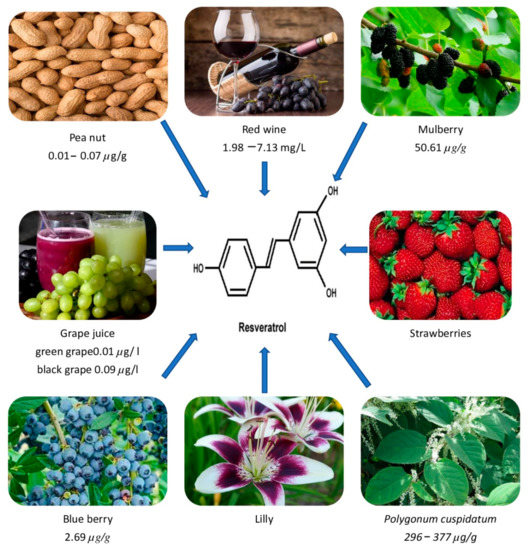
Figure 1.
shows the occurrence of RVT in different sources.
3. Physiological Effects of RVT
RVT has different physiological effects. It has been demonstrated to have neuroprotective benefits at low doses which is usually present in food [36] as well as positive effects on the cardiovascular system [37]. These benefits are mostly due to its anti-oxidant effect. Recently, it has been studied for its potential health advantages in various medical fields, such as anticancer activities when provided at larger, non-physiological concentrations. In the previous research, 500 mg of RVT per day is the bare minimum quantity required to protect against cancer [38]. Red wine is a rich source of RVT having approximately 1.98–7.13 mg/L of RVT. In red wine grapes, the terminal enzyme that is involved in biosynthesis of resveratrol is the stilbene synthase, which is activated by exogenous stress factors, UV light, and defined chemical signals from pathogenic fungi [39]. Therefore, the content of resveratrol and its isomers in the final wine products may significantly differ between countries and cultivation areas. Resveratrol can modulate the activity of SIRT1, a critical deacetylase that impacts the acetylation status of p53, forkhead proteins, and DNA repair enzymes [40]. On the other hand, activation of SIRT1 by resveratrol treatment reduced tumorigenesis in a mouse model. As a consequence, the binding of resveratrol to SIRT1 is associated with a signal that mimics calorie restriction and increases DNA stability [41]. It is reported to inhibit proliferation and induces apoptotic cell death in multiple cancer cell types in vitro [42]. Additionally, it has been shown to inhibit angiogenesis and delay tumour growth, impede carcinogenesis and reduce experimental carcinogenesis [43] in animal models of cancer. It affects the carcinogenesis process by influencing the three phases: tumor initiation, promotion, and progression, as well as suppressing the decisive stages of carcinogenesis, namely angiogenesis and metastasis [9]. It can also induce apoptosis, stop the cell cycle, and inhibit kinase pathways (Figure 2). Other remarkable activities are anti-thrombogenic, anti-inflammatory, cardioprotective, neuroprotective and anti-aging. Role of RVT in the human body is given below and its detailed mechanism of action for different condition is mentioned in Table 3.
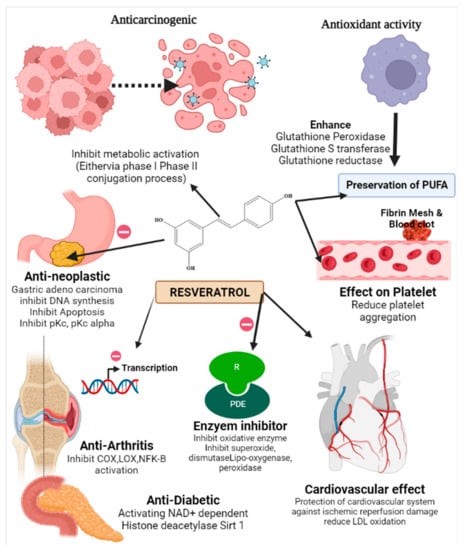
Figure 2.
shows the mechanism of action of resveratrol.
Table 3.
Mechanism of action of Resveratrol for different conditions.
3.1. Antioxidants
One of the most useful findings has been the antioxidant action of RVT. Because of its capacity to stimulate the activity of a range of antioxidant enzymes, RVT is both a free radical scavenger and a powerful antioxidant. The capacity of polyphenolic compounds to behave as antioxidants is dependent on the redox characteristics of their phenolic hydroxy groups and the possibility for electron delocalization across the chemical structure (Alarco et al., 2006), highlighting the significance of RVT as a natural antioxidant, proposing three possible antioxidant mechanisms: (i) competing with coenzyme Q and decreasing the oxidative chain complex, which is the location of ROS formation, (ii) scavenging O2 free radicals generated in the mitochondria, and (iii) suppression of LP (lipid peroxidation) induced by Fenton reaction products. Several investigations have showed that RVT may scavenge both O2 and OH free radicals [53,55]. In contrast, [56] found that RVT had no effect on XO (Xanthine Oxidase) activity or scavenged O2 free radicals in rat macrophage extracts utilising the enzymatic hypoxanthine oxidase–XO (xanthine oxidase) system. RVT can keep the concentration of intracellular antioxidants in biological systems stable. Stilbene, for example, protects the glutathione concentration in peripheral blood mononuclear cells against oxidative damage produced by 2-deoxy-D-ribose [57]. RVT significantly reduced the oxidation of protein thiol groups in human blood platelets [58]. Likewise, RVT increased glutathione levels in human lymphocytes stimulated with H2O2 in a concentration-dependent way. In another research it was found that RVT raised the levels of many antioxidant enzymes, including glutathione peroxidase, glutathione S-transferase, and glutathione reductase [53]. RVT’s antioxidant capability for the protection of polyunsaturated fatty acids (PUFA) has been described by [54].
3.2. Platelet Aggregation
RVT has been shown to have anti-platelet action [59]; however, the exact mechanisms are yet unknown. In a recent study, protein kinase C inhibitor (PKCI) and RVT (RSVL) exhibited an additive impact in decreasing platelet aggregation content, as did platelet membrane bound fibrinogen (PFig) [60,61]. Moreover, RSVL (at a concentration around 50 M) significantly reduced PKC activity in platelet membranes and the proportion of membrane PKC activity in total PKC activity [52]. In another investigation, RVT (0.05–0.25 μmol/L) inhibited platelet aggregation triggered by collagen (1 microg/mL) more effectively than other agonists [62]. In another study, RVT, at 10–1000 μmol/L concentrations, was found to be effective in preventing platelet aggregation in vitro produced by collagen, thrombin, and ADP in healthy people [63].
3.3. Enzyme Inhibitors
Trans-RVT inhibits oxidative enzymes in an animal cell system [64]. It inhibits superoxide dismutase, lipoxygenase, catalase, peroxidase, polyphenol oxidase, and 1-aminocyclopropane-1- carboxylic acid oxidase. Trans-RVT also inhibits lipoxygenase activity more efficiently than other lipoxygenase inhibitors such as propyl gallate, ibuprofen, ursolic acid, acetylsalicylic acid, and salicyl-hydroxamic acid [48]. The rate of inhibition rises as trans-RVT concentration increases. RVT, which has antioxidant action, suppresses matrix metalloproteinase via SIRT1 regulation in human fibrosarcoma cells, indicating that RVT might be a possible option for cancer chemoprevention [65]. According to a recent study, RVT (RSV) particularly inhibits inducible nitric oxide formation (iNOS) formation in muscle via a mechanism involving AMP-activated protein kinase (AMPK) but not deacetylase enzyme (SIRT1) activation [66]. RSV’s anti-inflammatory activity most likely adds to the plant polyphenol’s medicinal impact [67]. In another study, RVT was shown to suppress neuronal apoptosis and increase Ca2+/calmodulin-dependent protein kinase II activity in the diabetic mouse retina [68]. It was inferred that RVT obstructs diabetes-induced RGC mortality through down regulating calmodulin-dependent protein kinase II (CaMKII), suggesting that RVT may have potential therapeutic implications for the prevention of diabetes-induced visual impairment (Kim et al., 2010). RVT, a polyphenol found in red wine, prevents pancreatic cancer by blocking leukotriene A4 hydrolase [69]. It has a greater inhibitory impact than bestatin, a well-known inhibitor of LTA(4).
3.4. Anti-Carcinogenic Agents
RVT has been found to suppress carcinogenesis by influencing several molecular processes during the initiation, promotion, and progression phases [70]. RVT’s anti-initiation effect has been connected to the inhibition of metabolic activation and/or promotion of carcinogen detoxification via modulation of enzymes implicated in either phase I (i.e., cytochrome P450 enzymes (CYP)) or phase II conjugation processes. Several in vitro investigations have revealed that RVT suppresses the activity of the CYP1A1 and CYP1A2 enzymes [49]. The molecular processes responsible for RVT’s cancer-preventive impact might be the modulation of enzyme systems involved in carcinogen activation and detoxification. As these enzymes are also involved in drug metabolism, they may have an impact on therapeutic effectiveness and toxicity. A large number of in vitro investigations demonstrated that RVT affects cell proliferation, inflammation, apoptosis, angiogenesis, invasion, and metastasis through various intracellular targets. These include tumour suppressors p53 and Rb; cell cycle regulators cyclins [71], CDKs, p21WAF1, p27KIP, and INK, as well as the checkpoint kinases ATM/ATR; transcription factors NF-kappa B, AP-1, c-Jun, and c-Fos; angiogenic and metastatic factors VEGF and matrix metalloprotease 2/9; cyclooxygenases (L). In addition to its efficient antioxidant effects, there is mounting evidence that RVT has pro-oxidant activity under specific experimental settings, inducing oxidative DNA damage that may result in cell cycle arrest or apoptosis [72]. A recent study demonstrated for the first time that RVT has anti-proliferative, DNA damaging, and apoptotic effects in HNSCC cells independent of Smad4 status, both in vitro and in vivo, implying that more research is needed to establish its potential utility against head and neck squamous cell carcinoma (HNSCC) [73].
3.5. Anti-Neoplastic and Phytogenic Agent
RVT possess anti-cancer properties in tests that mimicked the three important phases of carcinogenesis. It has manifested to suppress cancer development and progression [74]. It functions as a selective oestrogen receptor modulator (SERM) and controls proteins involved in DNA synthesis and cell cycle regulation. RVT also has an effect on the activity of transcription factors involved in proliferation and stress responses, including NF-kB, AP1, and Egr1 [75].
3.6. Anti-Arthritic Agent
Arthritis is a chronic disease caused by the dysregulation of pro-inflammatory cytokines (e.g., tumour necrosis factor and interleukin-1beta) and proinflammatory enzymes that mediate the production of prostaglandins (e.g., cyclooxygenase-2) and leukotrienes (e.g., lipoxygenase), along with the expression of adhesion molecules, matrix metalloprotein and hyper-proliferation of synovial fibroblast [76]. The activation of the transcription factor nuclear factor-kappa B regulates all of these factors. Thus, any drug that may inhibit the production of tumour necrosis factor-alpha, interleukin-1beta, cycloxygenase-2, lipoxygenase, matrix metalloproteinases, or adhesion molecules, or inhibit the activation of NF-kappa B, has the potential to treat arthritis [50]. It was found that RVT acts as an inhibitor or mediator for several of these substances in our bodies.
3.7. Cardiotonic
RVT is a phytoestrogen, a powerful antioxidant, a scavenger of reactive oxygen species, and a metal chelator [77]. Thus, RVT may benefit the cardiovascular system by protecting it from ischemic-reperfusion injury [51]; it may also preserve and maintain the intact endothelium, it has anti-atherosclerotic effects, reduces LDL oxidation, suppresses platelet aggregation, and has estrogen-like activity [78]. As a result, RVT is potentially effective for cardiovascular disease.
3.8. Anti-Diabetic Potential
It has been established that RVT prolongs the life span of lower creatures by activating the NAD (+)-dependent histone deacetylase Sirt1 [79]. It was also discovered that RVT also boost lifespan and glucose homeostasis in mice via activating Sirt1-mediated deacetylation of the transcriptional coactivator PGC-1alpha [54]. In 2001, RVT (5–35 micromole/L) has been shown to elicit concentration-dependent relaxation of mesenteric arteries precontracted with nor-adrenaline (8 micromole/L) or KCl (125 mmol/L) in both lean and dietary obese rats [80]. Hyperglycemia, a characteristic of diabetes mellitus, causes hyper-osmotic response in vascular endothelial cells and leukocytes. Apoptotic cell death is frequently caused by hyper-osmotic shock. Because of its antioxidant properties, RVT has been shown to reduce high glucose-induced apoptotic alterations. Diabetes-related nephropathy is a severe vascular consequence and one of the leading causes of end-stage renal failure. Increased oxidative stress is a foremost contributor to the pathogenesis of diabetic nephropathy. In diabetic mice, RVT treatment dramatically reduced renal impairment and oxidative stress [81]. When insulin production by the islets of Langerhans is depleted, the majority of type 2 diabetes mellitus patients become insulin-dependent. In streptozotocin-induced diabetic rats, RVT was discovered to have hypoglycemic and hypolipidemic effects. When RVT was administered to diabetic rats on day 14 it was observed that the plasma glucose concentration was lowered by 25.3 percent, and the triglyceride concentration was reduced by 50.2 percent when compared to the placebo-treated rats, whereas in nicotinamide-treated diabetic rats on day 14, the plasma glucose concentration was lowered by only 20.3 percent, but the triglyceride concentration was reduced by 33 percent. RVT treatment significantly reduced insulin secretion and delayed the emergence of insulin resistance in STZ-nicotinamide DM rats [82].
3.9. Dermal Health
When administered topically, RVT cream decreased the production of HSV-1 lesions in the skin of mice. In addition to it, RVT cream also reduced herpes simplex virus (HSV) replication in the vagina of mice and restricts extravaginal diseases. As a result, RVT cream may possess some potential advantages for skin health, but additional research is needed to back up this health benefit claim.
3.10. Weight Management
RVT increases metabolism, allowing users to burn more calories throughout the day. As a result, RVT has weight loss advantages. When RVT was combined with genistein and quercetin adipogenesis was reduced in mouse and human adipocytes [42]. In contrast, one in vivo study illustrated that phytochemicals such as RVT, when combined with vitamin D, reduced weight gain and bone loss in a postmenopausal rat model [71]. A high-dose therapy (dosage: vitamin D + 400 mg/kg RVT + 2000 mg/kg quercetin + 1040 mg/kg genistein) decreased the body weight and fat pad weights in another investigation performed on elderly ovariectomized female rats. This medication significantly enhanced the serum levels of insulin-like growth factor-1 as well as of femoral bone mineral content. As a result, the synergistic effects of RVT and vitamin D may be useful in preventing bone loss and weight gain after menopause [71]. According to some studies, RVT may help prevent “weight gain” under specific situations. However, there is no conclusive proof that RVT aids in weight loss.
3.11. Anti-Inflammatory Activity
RVT manifests anti-inflammatory effects by modulating enzymes and pathways that produce inflammatory mediators, as well as inducing programmed cell death in activated immune cells. Even at high dosages, RVT has been demonstrated to have no negative side effects. As a result, RVT could be used either as complementary to or an alternative treatment for cancer and inflammatory illnesses [83].
3.12. Other Pathological/Physiological Conditions
Since microcirculation blockage and cytokine overproduction are implicated in many disorders, including acute pancreatitis, RVT as a platelet and cytokine inhibitor may aid acute pancreatitis patients [59]. In a Wistar rat investigation, RVT exhibits immunosuppressive properties as well as a protective impact on hepatocytes during allograft rejection [59]. RVT has been found to prevent ischemia perfusion (I/R) damage in the rat kidney through both antioxidant and anti-inflammatory pathways [84]. In one trial, researchers gave trans-RVT at a dose of 20 mg/kg/day for 90 days. Compared with a control group, the diameter of the seminiferous tubules was dramatically reduced from 437.5 ± 0.1 mum to 310.9 ± 0.1 mum. A considerable rise in tubular density accompanied this drop. The RVT-treated rats had considerably higher sperm counts than the control group, but sperm quality did not vary [85].
4. Pharmacokinetic Properties of RVT
4.1. Absorption and Bioavailability
RVT bioavailability in both rodents and humans reveals that this polyphenol possesses high oral absorption but rapid and widespread metabolism with no deleterious effects, resulting in only trace levels of unaltered RVT in the systemic circulation [86,87]. About 70% of orally administered RVT (25 mg) is rapidly (<30 min) absorbed and metabolized in humans, with a peak plasma level of 2 M of RVT metabolites and a half-life of 9–10 h [88]. Furthermore, drug absorption and metabolism processes differ significantly from person to person. The ability of the human colon to absorb and metabolize RVT is determined by hepatic function and local intestinal microflora metabolic activity [89].
4.2. Distribution
4.2.1. Blood Transport
The affinity of a therapeutic agent to bind to protein transporters is typically linked to its efficacy [64]. Because RVT is poorly soluble in water, it must be linked to plasma proteins in order to be distributed throughout the body and bioavailable [90]. Indeed, RVT can attach to serum proteins such as lipoproteins, hemoglobin, and albumin during its transport, facilitating carrier-mediated cellular absorption and then passively diffusing through the plasma membrane [91]. Researchers examined RVT’s binding capabilities to plasma proteins such as human serum albumin (HSA) and hemoglobin (Hb) and found that both complexes formed are spontaneous and exothermic. The RVT–HSA complex has a greater binding constant than RVT–Hb, indicating that HSA has a stronger affinity for RVT [92]. Hydrophobic interactions appear to be important in RVT’s binding to the hydrophobic cavity of HSA, whereas hydrogen bonding is the main force that works in RVT’s binding to the core cavity of Hb where certain residues engage directly with the compound’s hydroxyl groups. Electrostatic interactions can also be involved in the formation of both complexes since residues with positive charge are in the proximity of the binding compound.
4.2.2. Liver Uptake
The liver is known to play an important role in RVT bioavailability. After oral dosing, rats and mice accumulate the most RVT in their livers [93,94]. Despite this, no toxicity or hepatocyte lyses were found after high-dose RVT administration, which is significant because certain anti-neoplastic drugs produce hepatotoxicity, which limits their efficacy in anticancer therapy [95]. Furthermore, RVT’s high absorption by liver cells, combined with its low toxicity, shows that it plays a significant role in the prevention of liver disorders. In addition to passive diffusion, it was discovered that RVT reaches the liver cells through an active transporter-mediated pathway, accounting for more than half of total hepatic absorption [96]. Members of the organic anion-transporting polypeptides (OATPs) family, which are multi-specific transporters or albumin-binding proteins that bind RVT–albumin complexes and then deliver RVT in a manner similar to fatty acid absorption, are involved in this active process [42].
4.3. Metabolism
RVT undergoes substantial phase I (oxidation, reduction, and hydrolysis) and phase II (glucuronic acid, sulfate, and methyl conjugations) biochemical changes in the liver and intestinal epithelial cells shortly after administration, and the resulting metabolites are glucuronic acid and sulfate conjugation [76,97]. The aliphatic double bond is also hydrogenated [98]. While presystemic and systemic conversion to major metabolites (glucuronic and sulfate conjugations) occurs very quickly and efficiently in the intestine and liver in the so-called enterohepatic recirculation, other metabolites such as dihydro-RVT and piceatannol are likely mediated by microbial fermentation of trans-RVT in the gastrointestinal tract. Sulfotransferases (SULTs) sulphation of RVT by sulfotransferases (SULTs) in the human liver yield three metabolites: trans-RVT-3-O-4′-O-disulfate (S1), trans-RVT-4′-O-sulfate (S2), and trans-RVT-3-O-sulfate (S3) [99]. The effects of glucuronidation by uridine 5′-diphospho-glucoronosyl-transferases (UGTs) on RVT intestinal absorption were also examined, and two metabolites, trans-RVT-4′-O-glucuronide (G1) and trans-RVT-3-O-glucuronide (G2), were identified [100].
4.4. Excretion
All of RVT’s metabolites are removed from the body pharmacokinetically and excretion is nearly evenly distributed between urine and faeces. RVT and its metabolites are virtually completely eliminated from tissues in 72 h after a single intake. The mono-glucuronides of trans-RVT and dihydro-RVT were the two principal metabolites found in rodent urine [25]. The glucuronide- and sulfate-conjugates of RVT, as well as dihydro-RVT, were the predominant metabolites in humans. The overall recovery of glucuronic and sulphate conjugations in human urine and faeces was approximately 71–98% after oral dosages and 54–91% after intravenous doses, but the aglycone form of RVT had a near-zero recovery [101]. These findings show that the modified metabolite, not the original aglycone, is the most common form of RVT in circulation.
5. Safety Profile of RVT
To access its adverse effects, RVT was orally administered at its maximum tolerated levels in multiple toxicity trials. The findings suggest that RVT is not carcinogenic [102]. Furthermore, investigations demonstrated that the compound does not induce acute skin and eye irritation or other allergenicity symptoms [25]. Despite the fact that it is an estrogen-like substance, investigations show that trans-RVT has a low estrogenic potency in vivo. In fact, massive doses of RVT given orally had no effect on reproductive capacity and no substantial changes in bone density. Trans-RVT is found in commercial dietary supplements in amounts ranging from 50 to 500 mg, and human clinical investigations have been conducted up to single dosages of 5 g of the RVT with no adverse effects [103]. These findings indicate that trans-RVT is well tolerated in humans, and that 450 mg of RVT per day is a safe dose for a 70 kg person. A recent epidemiological study found that RVT consumption is inversely connected to breast cancer risk, with 50% or larger decreases in breast cancer risk in women who consumed the most RVT [104]. Given its low toxicity, RVT has been suggested as a possible candidate for chemoprevention in humans. Furthermore, this chemical can cross the blood–brain barrier, implying that it could be used to treat brain illnesses [105]. The summary of clinical trails according to various disorders is shown in Table 4.
Table 4.
Summary of Resveratrol’s clinical effects.
6. Commercial Products of RVT
Data pertaining to marketed products have been collected from the National Institute of Health, dietary supplement label database and other websites. These items include either RVT or a combination of RVT. These items have a great variation of doses, such as 20 mg per serving to 1400 mg. It indicates a better safety profile of the molecule. An exhaustive list of globally available products has been given in Supplementary Material (Table S2).
7. Clinical Trials on RVT Based Products
RVT has also been studied clinically, such as assessment of the effect of RVT on cognitive and cerebral blood flow in the United Kingdom. In Canada, an analysis on the effect of antioxidants on cardio vascular risk was assessed. Furthermore, in Brazil the RVT was examined for its effectiveness in the management of pain due to endometriosis. Moreover, in Taiwan the effect of RVT on complications in patients with haemodialysis was investigated. Additionally, RVT with or without Piperine to enhance the plasma level of RVT was also assessed (USA). Meanwhile, in Singapore, a phase-1 trial is being conducted to analyse the effect of RVT in patients with Type-2 Diabetes (RED). The impact of RVT on brain function and structure was also studied. Moreover, in Italy, RVT’s anti-inflammatory and antioxidants effects on healthy adults were examined. In Tamil Nadu (India), RVT was evaluated as a potent supplement for patient with Type-2 Diabetes Mellitus. Likewise, a similar study was conducted in Maharashtra (India) to confirm whether the addition of RVT is beneficial and safe for patient with diabetes, dyslipidemia and hypertension (who are already on standard therapy). In Karnataka (India), the effect of nutritional supplementation of RVT on patients with advanced cancers and undergoing chemotherapy was evaluated. A similar trial was conducted in Maharashtra (India), to study the effects of nutritional supplementation of extremely active RVT (XAR) in healthy human individuals. In Maharashtra, effect of RVT and copper in reducing toxic side-effects of chemotherapy in patients with advanced mouth cancer was analysed. A similar trial was held in Maharashtra (India), to study the effect of RVT-copper in reducing oral mucositis in patients receiving concurrent chemo radiotherapy for locally advanced oropharyngeal cancer. Additionally, a similar trial was performed in Maharashtra (India) to assess the effect of the addition of RVT with chemotherapeutic agents in patients with gastric cancer. Likewise, the effect of RVT-copper on treating COVID-19 pneumonia was analysed in Maharashtra (India). Additionally, a study to assess the effect of oral RVT and copper combination on life span of glioblastoma patients undergoing surgery was conducted in Maharashtra (India). In Australia, RVT as an option for the treatment of Friedreich ataxia was assessed. A study of dietary RVT on glucose and lipid metabolism disorder is being conducted in China. In Australia, the effect of RVT on circulatory function of obese people with elevated blood pressure was examined. Another trial on similar lines was conducted in Australia where the sustained effect of RVT on circulatory functions in obese adults were assessed. Additionally, the role of RVT in the prevention of colorectal polyps was also investigated in Australia. Moreover, the effect of RVT’s supplementation on gut hormone secretion, gastric emptying and blood glucose responses to meals in patients with type-2 diabetes was assessed in Australia. Meanwhile, another study on RVT supplementation on cerebrovascular function, mood and cognitive performance in type-2 diabetes mellitus (T2DM) was completed in Australia. Another clinical trial was executed in Australia to establish whether RVT can enhance mood, physical function and cerebrovascular function and counteract cognitive decline in post-menopausal women. In Germany, the bioavailability of three different RVT products was evaluated in healthy individuals. Likewise, a similar study was also conducted in Germany, to examine the bioavailability and metabolism of RVT as a constituent of berries in humans. Furthermore, a biokinetic study on the impact of formulation on RVT bioavailability was also performed in Germany. More details about clinical trials are mentioned in Table 5.
Table 5.
List of global clinical trials on Resveratrol.
8. Recent Patent on RVT
The medicinal advantages and other beneficial features of RVT have drawn the attention of numerous researchers to investigate and develop some intellectual property in the form of patents; some of them are included in Table 6.
Table 6.
List of Patent on Resveratrol Globally.
9. Conclusions
This review is an attempt to collectively enlighten readers about the sources, physiological effect, role in human body, pharmacokinetic property, toxicity, commercial products, patents, and clinical trials of RVT. Due to its wide significance as a cancer preventative, cardioprotective, antioxidant, anti-inflammatory, and neuroprotective dietary ingredient, RVT has emerged as one of the most promising naturally occurring compounds with a tremendous therapeutic potential. The preventative and therapeutic efficacy of dietary or supplemental RVT on tumor growth and progression, as well as the prevention of cardiovascular disease and neurological diseases, is being investigated. In fact, RVT and its analogues are pharmacologically safe and can be used with other drugs to improve therapeutic efficacy and reduce toxicity.
Unfortunately, RVT’s pharmacokinetic aspects do not match its positive pharmacological activity. Several investigations have found that trans-RVT is rapidly absorbed, digested, and eliminated in people and animals, implying that RVT has a low bioavailability that undermines its biological effects. The question that arises as to whether RVT can accumulate in target organs to bioactive amounts has yet to be answered. Several research have attempted to answer this topic, but the findings have been mixed. RVT carriers and site-specific delivery methods have been created to protect and stabilise RVT while also increasing its bioavailability and maintaining its biological and pharmacological properties. Despite the advances made in this field, size-tuned carrier systems with optimal lipophilicity are still needed for RVT delivery to more challenging sites such as the brain. Moreover, combination of RVT and conventional chemotherapeutic preparation for the treatment of tumor could be a new option for drug formulation. Due to its wide application, a lot study is required to established its mechanism of action for its pharmacological activities and develop certain delivery methods by which its bioavailability can be improvised without affecting its other properties.
Supplementary Materials
The following supporting information can be downloaded at: https://www.mdpi.com/article/10.3390/ph15080957/s1.
Author Contributions
S.K., S.A.K. and S.A.A.Z. has wrote manuscript. M.D. has worked on reeferences. U.F. has prepared figures. P.P.N., M.S.K., M.Z.K., A.S. and M.M.U.K. has prepared tables. Corresponding authors Z.I. and M.A.M. has checked and edited the whole manuscript. All authors have read and agreed to the published version of the manuscript.
Funding
The authors extend their appreciation to the Deanship of Scientific Research at King Khalid Uni-versity, Saudi Arabia for funding this work through the Research Group Program under Grant No: RGP 2/218/43.
Informed Consent Statement
Not applicable.
Data Availability Statement
Data sharing not applicable.
Acknowledgments
All the authors are thankful to King Khalid University, Saudi Arabia for financial support.
Conflicts of Interest
The authors declare no conflict of interest.
References
- Pecyna, P.; Wargula, J.; Murias, M.; Kucinska, M. More than resveratrol: New insights into stilbene-based compounds. Biomolecules 2020, 10, 1111. [Google Scholar] [CrossRef] [PubMed]
- Hasan, M.M.; Bae, H. An overview of stress-induced resveratrol synthesis in grapes: Perspectives for resveratrol-enriched grape products. Molecules 2017, 22, 294. [Google Scholar] [CrossRef] [Green Version]
- Moretón-Lamas, E.; Lago-Crespo, M.; Lage-Yusty, M.A.; López-Hernández, J. Comparison of methods for analysis of resveratrol in dietary vegetable supplements. Food Chem. 2017, 224, 219–223. [Google Scholar] [CrossRef] [PubMed]
- Balanov, P.E.; Smotraeva, I.V.; Abdullaeva, M.S.; Volkova, D.A.; Ivanchenko, O.B. Study on resveratrol content in grapes and wine products. In Proceedings of the International Conference on Efficient Production and Processing (ICEPP-2021), Kazan, Russia, 25–26 February 2021; Volume 247. [Google Scholar]
- Kuno, A.; Tanno, M.; Horio, Y. The effects of resveratrol and SIRT1 activation on dystrophic cardiomyopathy. Ann. N. Y. Acad. Sci. 2015, 1348, 46–54. [Google Scholar] [CrossRef]
- Bagul, P.K.; Deepthi, N.; Sultana, R.; Banerjee, S.K. Resveratrol ameliorates cardiac oxidative stress in diabetes through deacetylation of NFkB-p65 and histone 3. J. Nutr. Biochem. 2015, 26, 1298–1307. [Google Scholar] [CrossRef]
- Ko, J.H.; Sethi, G.; Um, J.Y.; Shanmugam, M.K.; Arfuso, F.; Kumar, A.P.; Bishayee, A.; Ahn, K.S. The role of resveratrol in cancer therapy. Int. J. Mol. Sci. 2017, 18, 2589. [Google Scholar] [CrossRef] [PubMed] [Green Version]
- Ren, B.; Kwah, M.X.Y.; Liu, C.; Ma, Z.; Shanmugam, M.K.; Ding, L.; Xiang, X.; Ho, P.C.L.; Wang, L.; Ong, P.S.; et al. Resveratrol for cancer therapy: Challenges and future perspectives. Cancer Lett. 2021, 515, 63–72. [Google Scholar] [CrossRef] [PubMed]
- Singh, C.K.; Chhabra, G.; Ahmad, N. Resveratrol and Cancer Cell Biology. In Resveratrol: State-of-the-Art Science and Health Applications; World Scientific: Singapore, 2018; pp. 183–207. [Google Scholar]
- Ashrafizadeh, M.; Taeb, S.; Haghi-Aminjan, H.; Afrashi, S.; Moloudi, K.; Musa, A.E.; Najafi, M.; Farhood, B. Resveratrol as an Enhancer of Apoptosis in Cancer: A Mechanistic Review. Anticancer Agents Med. Chem. 2020, 21, 2327–2336. [Google Scholar] [CrossRef] [PubMed]
- Gal, R.; Deres, L.; Toth, K.; Halmosi, R.; Habon, T. The effect of resveratrol on the cardiovascular system from molecular mechanisms to clinical results. Int. J. Mol. Sci. 2021, 22, 10152. [Google Scholar] [CrossRef] [PubMed]
- Zhang, L.X.; Li, C.X.; Kakar, M.U.; Khan, M.S.; Wu, P.F.; Amir, R.M.; Dai, D.F.; Naveed, M.; Li, Q.Y.; Saeed, M.; et al. Resveratrol (RV): A pharmacological review and call for further research. Biomed. Pharmacother. 2021, 143, 112164. [Google Scholar] [CrossRef]
- Han, N.R.; Park, H.J.; Moon, P.D. Resveratrol Downregulates Granulocyte-Macrophage Colony-Stimulating Factor-Induced Oncostatin M Production through Blocking of PI3K/Akt/NF-κB Signal Cascade in Neutrophil-like Differentiated HL-60 Cells. Curr. Issues Mol. Biol. 2022, 44, 541–549. [Google Scholar] [CrossRef] [PubMed]
- Galiniak, S.; Aebisher, D.; Bartusik-Aebisher, D. Health benefits of resveratrol administration. Acta Biochim. Pol. 2019, 66, 13–21. [Google Scholar] [CrossRef] [PubMed] [Green Version]
- Chan, E.W.C.; Wong, C.W.; Tan, Y.H.; Foo, J.P.Y.; Wong, S.K.; Chan, H.T. Resveratrol and pterostilbene: A comparative overview of their chemistry, biosynthesis, plant sources and pharmacological properties. J. Appl. Pharm. Sci. 2019, 9, 124–129. [Google Scholar] [CrossRef] [Green Version]
- Kuo, H.P.; Wang, R.; Lin, Y.S.; Lai, J.T.; Lo, Y.C.; Huang, S.T. Pilot scale repeated fed-batch fermentation processes of the wine yeast Dekkera bruxellensis for mass production of resveratrol from Polygonum cuspidatum. Bioresour. Technol. 2017, 243, 986–993. [Google Scholar] [CrossRef]
- Wang, J.; Yang, Y.; Yan, Y. Bioproduction of resveratrol. In Biotechnology of Natural Products; Springer International Publishing: Berlin/Heidelberg, Germany, 2017; pp. 61–79. ISBN 9783319679037. [Google Scholar]
- Cioch, M.; Semik-Szczurak, D.; Skoneczny, S. Botrytis and Wine Production. In Winemaking; CRC Press: Boca Raton, FL, USA, 2020; pp. 166–190. [Google Scholar]
- Burns, J.; Yokota, T.; Ashihara, H.; Lean, M.E.J.; Crozier, A. Plant foods and herbal sources of resveratrol. J. Agric. Food Chem. 2002, 50, 3337–3340. [Google Scholar] [CrossRef] [PubMed]
- Sales, J.M.; Resurreccion, A.V.A. Resveratrol in Peanuts. Crit. Rev. Food Sci. Nutr. 2014, 54, 734–770. [Google Scholar] [CrossRef] [PubMed]
- Tian, B.; Liu, J. Resveratrol: A review of plant sources, synthesis, stability, modification and food application. J. Sci. Food Agric. 2020, 100, 1392–1404. [Google Scholar] [CrossRef]
- Yadav, M.; Jain, S.; Bhardwaj, A.; Nagpal, R.; Puniya, M.; Tomar, R.; Singh, V.; Parkash, O.; Prasad, G.B.K.S.; Marotta, F.; et al. Biological and medicinal properties of grapes and their bioactive constituents: An update. J. Med. Food 2009, 12, 473–484. [Google Scholar] [CrossRef]
- Aggarwal, B.B.; Bhardwaj, A.; Aggarwal, R.S.; Seeram, N.P.; Shishodia, S.; Takada, Y. Role of resveratrol in prevention and therapy of cancer: Preclinical and clinical studies. Anticancer Res. 2004, 24, 2783–2840. [Google Scholar] [PubMed]
- Rauf, A.; Imran, M.; Butt, M.S.; Nadeem, M.; Peters, D.G.; Mubarak, M.S. Resveratrol as an anti-cancer agent: A review. Crit. Rev. Food Sci. Nutr. 2018, 58, 1428–1447. [Google Scholar] [CrossRef]
- Williams, L.D.; Burdock, G.A.; Edwards, J.A.; Beck, M.; Bausch, J. Safety studies conducted on high-purity trans-resveratrol in experimental animals. Food Chem. Toxicol. 2009, 47, 2170–2182. [Google Scholar] [CrossRef] [PubMed]
- Limmongkon, A.; Nopprang, P.; Chaikeandee, P.; Somboon, T.; Wongshaya, P.; Pilaisangsuree, V. LC-MS/MS profiles and interrelationships between the anti-inflammatory activity, total phenolic content and antioxidant potential of Kalasin 2 cultivar peanut sprout crude extract. Food Chem. 2018, 239, 569–578. [Google Scholar] [CrossRef] [PubMed]
- Gómez-Mejía, E.; Rosales-Conrado, N.; León-González, M.E.; Madrid, Y. Determination of phenolic compounds in residual brewing yeast using matrix solid-phase dispersion extraction assisted by titanium dioxide nanoparticles. J. Chromatogr. A 2019, 1601, 255–265. [Google Scholar] [CrossRef] [PubMed]
- Xiong, Q.; Zhang, Q.; Zhang, D.; Shi, Y.; Jiang, C.; Shi, X. Preliminary separation and purification of resveratrol from extract of peanut (Arachis hypogaea) sprouts by macroporous adsorption resins. Food Chem. 2014, 145, 1–7. [Google Scholar] [CrossRef]
- Wang, Y.; Catana, F.; Yang, Y.; Roderick, R.; Van Breemen, R.B. An LC-MS method for analyzing total resveratrol in grape juice, cranberry juice, and in wine. J. Agric. Food Chem. 2002, 50, 431–435. [Google Scholar] [CrossRef]
- Lima, M.d.S.; Da Conceição Prudêncio Dutra, M.; Toaldo, I.M.; Corrêa, L.C.; Pereira, G.E.; De Oliveira, D.; Bordignon-Luiz, M.T.; Ninow, J.L. Phenolic compounds, organic acids and antioxidant activity of grape juices produced in industrial scale by different processes of maceration. Food Chem. 2015, 188, 384–392. [Google Scholar] [CrossRef] [Green Version]
- Somkuwar, R.G.; Bhange, M.A.; Oulkar, D.P.; Sharma, A.K.; Ahammed Shabeer, T.P. Estimation of polyphenols by using HPLC–DAD in red and white wine grape varieties grown under tropical conditions of India. J. Food Sci. Technol. 2018, 55, 4994–5002. [Google Scholar] [CrossRef]
- Chudzińska, M.; Rogowicz, D.; Wołowiec, Ł.; Banach, J.; Sielski, S.; Bujak, R.; Sinkiewicz, A.; Grześk, G. Resveratrol and cardiovascular system—the unfulfilled hopes. Ir. J. Med. Sci. 2021, 190, 981–986. [Google Scholar] [CrossRef]
- Li, C.P.; Tan, S.; Ye, H.; Cao, J.; Zhao, H. A novel fluorescence assay for resveratrol determination in red wine based on competitive host-guest recognition. Food Chem. 2019, 283, 191–198. [Google Scholar] [CrossRef]
- Ardid-ruiz, A.; Ibars, M.; Mena, P.; Del Rio, D.; Muguerza, B.; Arola, L.; Aragonès, G.; Suárez, M. Resveratrol treatment enhances the cellular response to leptin by increasing OBRB content in palmitate-induced steatotic hepg2 cells. Int. J. Mol. Sci. 2019, 20, 6282. [Google Scholar] [CrossRef] [Green Version]
- Duessel, S.; Heuertz, R.M.; Ezekiel, U.R. Growth inhibition of human colon cancer cells by plant compounds. Clin. Lab. Sci. 2008, 21, 151–157. [Google Scholar] [PubMed]
- Salehi, B.; Mishra, A.P.; Nigam, M.; Sener, B.; Kilic, M.; Sharifi-Rad, M.; Fokou, P.V.T.; Martins, N.; Sharifi-Rad, J. Resveratrol: A double-edged sword in health benefits. Biomedicines 2018, 6, 91. [Google Scholar] [CrossRef] [PubMed] [Green Version]
- Meng, X.; Zhou, J.; Zhao, C.N.; Gan, R.Y.; Li, H. Bin Health benefits and molecular mechanisms of resveratrol: A narrative review. Foods 2020, 9, 340. [Google Scholar] [CrossRef] [PubMed] [Green Version]
- Sergides, C.; Chirilă, M.; Silvestro, L.; Pitta, D.; Pittas, A. Bioavailability and safety study of resveratrol 500 mg tablets in healthy male and female volunteers. Exp. Ther. Med. 2016, 11, 164–170. [Google Scholar] [CrossRef] [Green Version]
- Stervbo, U.; Vang, O.; Bonnesen, C. A review of the content of the putative chemopreventive phytoalexin resveratrol in red wine. Food Chem. 2007, 101, 449–457. [Google Scholar] [CrossRef]
- Howitz, K.T.; Bitterman, K.J.; Cohen, H.Y.; Lamming, D.W.; Lavu, S.; Wood, J.G.; Zipkin, R.E.; Chung, P.; Kisielewski, A.; Zhang, L.L.; et al. Small molecule activators of sirtuins extend Saccharomyces cerevisiae lifespan. Nature 2003, 425, 191–196. [Google Scholar] [CrossRef] [PubMed]
- Granchi, C.; Minutolo, F. Activators of Sirtuin-1 and their Involvement in Cardioprotection. Curr. Med. Chem. 2018, 25, 4432–4456. [Google Scholar] [CrossRef] [PubMed]
- Jiang, H.; Shang, X.; Wu, H.; Huang, G.; Wang, Y.; Al-Holou, S.; Gautam, S.C.; Chopp, M. Combination treatment with resveratrol and sulforaphane induces apoptosis in human U251 Glioma cells. Neurochem. Res. 2010, 35, 152–161. [Google Scholar] [CrossRef] [PubMed] [Green Version]
- Siddiqui, I.A.; Sanna, V.; Ahmad, N.; Sechi, M.; Mukhtar, H. Resveratrol nanoformulation for cancer prevention and therapy. Ann. N. Y. Acad. Sci. 2015, 1348, 20–31. [Google Scholar] [CrossRef]
- Tung, B.T.; Rodriguez-Bies, E.; Thanh, H.N.; Le-Thi-Thu, H.; Navas, P.; Sanchez, V.M.; López-Lluch, G. Organ and tissue-dependent effect of resveratrol and exercise on antioxidant defenses of old mice. Aging Clin. Exp. Res. 2015, 27, 775–783. [Google Scholar] [CrossRef]
- Shehzad, Q.; Rehman, A.; Jafari, S.M.; Zuo, M.; Khan, M.A.; Ali, A.; Khan, S.; Karim, A.; Usman, M.; Hussain, A.; et al. Improving the oxidative stability of fish oil nanoemulsions by co-encapsulation with curcumin and resveratrol. Colloids Surf. B Biointerfaces 2021, 199, 111481. [Google Scholar] [CrossRef] [PubMed]
- Sonego, G.; Abonnenc, M.; Tissot, J.D.; Prudent, M.; Lion, N. Redox proteomics and platelet activation: Understanding the redox proteome to improve platelet quality for transfusion. Int. J. Mol. Sci. 2017, 18, 387. [Google Scholar] [CrossRef] [PubMed]
- Cataldo, E.; Fucile, M.; Mattii, G.B. Biostimulants in Viticulture: A Sustainable Approach against Biotic and Abiotic Stresses. Plants 2022, 11, 162. [Google Scholar] [CrossRef] [PubMed]
- Nguyen, T.N.; Dubreucq, E.; Perrier, V.; Tran, Q.H.; Charpentier, C.; Charnay, C.; Terki, F.; Jay-Allemand, C.; Bidel, L.P.R. Interactions between trans-resveratrol and CpLIP2 lipase/acyltransferase: Evidenced by fluorescence and in silico. Food Chem. 2020, 318, 126482. [Google Scholar] [CrossRef] [PubMed]
- Guthrie, A.R.; Chow, H.H.S.; Martinez, J.A. Effects of resveratrol on drug- and carcinogen-metabolizing enzymes, implications for cancer prevention. Pharmacol. Res. Perspect. 2017, 5, 294. [Google Scholar] [CrossRef] [PubMed]
- Ghosh, N.; Ali, A.; Ghosh, R.; Das, S.; Mandal, S.C.; Pal, M. Chronic Inflammatory Diseases: Progress and Prospect with Herbal Medicine. Curr. Pharm. Des. 2015, 22, 247–264. [Google Scholar] [CrossRef]
- Liu, Y.; Yang, H.N.; Jia, G.Y.; Li, L.; Chen, H.; Bi, J.Z.; Wang, C.L. The Synergistic Neuroprotective Effects of Combined Rosuvastatin and Resveratrol Pretreatment against Cerebral Ischemia/Reperfusion Injury. J. Stroke Cerebrovasc. Dis. 2018, 27, 1697–1704. [Google Scholar] [CrossRef]
- Malaguarnera, L. Influence of resveratrol on the immune response. Nutrients 2019, 11, 946. [Google Scholar] [CrossRef] [PubMed] [Green Version]
- Truong, V.L.; Jun, M.; Jeong, W.S. Role of resveratrol in regulation of cellular defense systems against oxidative stress. BioFactors 2018, 44, 36–49. [Google Scholar] [CrossRef]
- Wang, C.; Sun, C.; Lu, W.; Gul, K.; Mata, A.; Fang, Y. Emulsion structure design for improving the oxidative stability of polyunsaturated fatty acids. Compr. Rev. Food Sci. Food Saf. 2020, 19, 2955–2971. [Google Scholar] [CrossRef]
- Li, C.; Xu, X.; Tao, Z.; Wang, X.J.; Pan, Y. Resveratrol dimers, nutritional components in grape wine, are selective ROS scavengers and weak Nrf2 activators. Food Chem. 2015, 173, 218–223. [Google Scholar] [CrossRef]
- Gu, T.; Wang, N.; Wu, T.; Ge, Q.; Chen, L. Antioxidative Stress Mechanisms behind Resveratrol: A Multidimensional Analysis. J. Food Qual. 2021, 2021. [Google Scholar] [CrossRef]
- Losa, G.A. Resveratrol modulates apoptosis and oxidation in human blood mononuclear cells. Eur. J. Clin. Investig. 2003, 33, 818–823. [Google Scholar] [CrossRef] [PubMed]
- Kuršvietienė, L.; Stanevičienė, I.; Mongirdienė, A.; Bernatonienė, J. Multiplicity of effects and health benefits of resveratrol. Medicina 2016, 52, 148–155. [Google Scholar] [CrossRef] [PubMed]
- Agah, S.; Akbari, A.; Sadeghi, E.; Morvaridzadeh, M.; Basharat, Z.; Palmowski, A.; Heshmati, J. Resveratrol supplementation and acute pancreatitis: A comprehensive review. Biomed. Pharmacother. 2021, 137, 111268. [Google Scholar] [CrossRef] [PubMed]
- Huang, W.C.; Liu, J.C.; Hsia, C.W.; Fong, T.H.; Hsia, C.H.; Tran, O.T.; Velusamy, M.; Yang, C.H.; Sheu, J.R. Pterostilbene, a Dimethylether Analogue of Resveratrol, Possesses High Potency in the Prevention of Platelet Activation in Humans and the Reduction of Vascular Thrombosis in Mice. J. Agric. Food Chem. 2021, 69, 4697–4707. [Google Scholar] [CrossRef]
- Ravishankar, D.; Albadawi, D.A.I.; Chaggar, V.; Patra, P.H.; Williams, H.F.; Salamah, M.; Vaiyapuri, R.; Dash, P.R.; Patel, K.; Watson, K.A.; et al. Isorhapontigenin, a resveratrol analogue selectively inhibits ADP-stimulated platelet activation. Eur. J. Pharmacol. 2019, 862, 172627. [Google Scholar] [CrossRef]
- Méndez, D.; Urra, F.A.; Millas-Vargas, J.P.; Alarcón, M.; Rodríguez-Lavado, J.; Palomo, I.; Trostchansky, A.; Araya-Maturana, R.; Fuentes, E. Synthesis of antiplatelet ortho-carbonyl hydroquinones with differential action on platelet aggregation stimulated by collagen or TRAP-6. Eur. J. Med. Chem. 2020, 192, 112187. [Google Scholar] [CrossRef]
- Bonechi, C.; Lamponi, S.; Donati, A.; Tamasi, G.; Consumi, M.; Leone, G.; Rossi, C.; Magnani, A. Effect of resveratrol on platelet aggregation by fibrinogen protection. Biophys. Chem. 2017, 222, 41–48. [Google Scholar] [CrossRef]
- Khan, M.A.; Muzammil, S.; Musarrat, J. Differential binding of tetracyclines with serum albumin and induced structural alterations in drug-bound protein. Int. J. Biol. Macromol. 2002, 30, 243–249. [Google Scholar] [CrossRef]
- Da Costa, D.C.F.; Fialho, E.; Silva, J.L. Cancer chemoprevention by resveratrol: The P53 tumor suppressor protein as a promising molecular target. Molecules 2017, 22, 1014. [Google Scholar] [CrossRef] [PubMed] [Green Version]
- Wei, Y.; Jia, J.; Jin, X.; Tong, W.; Tian, H. Resveratrol ameliorates inflammatory damage and protects against osteoarthritis in a rat model of osteoarthritis. Mol. Med. Rep. 2018, 17, 1493–1498. [Google Scholar] [CrossRef] [PubMed] [Green Version]
- Csiszar, A. Anti-inflammatory effects of resveratrol: Possible role in prevention of age-related cardiovascular disease. Ann. N. Y. Acad. Sci. 2011, 1215, 117–122. [Google Scholar] [CrossRef] [PubMed] [Green Version]
- Saleh, A.; Sabbir, M.G.; Aghanoori, M.R.; Smith, D.R.; Roy Chowdhury, S.K.; Tessler, L.; Brown, J.; Gedarevich, E.; Kassahun, M.Z.; Frizzi, K.; et al. Muscarinic Toxin 7 Signals Via Ca2+/Calmodulin-Dependent Protein Kinase Kinase β to Augment Mitochondrial Function and Prevent Neurodegeneration. Mol. Neurobiol. 2020, 57, 2521–2538. [Google Scholar] [CrossRef] [PubMed] [Green Version]
- Yang, X.; Li, X.; Ren, J. From French Paradox to Cancer Treatment: Anti-cancer Activities and Mechanisms of Resveratrol. Anticancer. Agents Med. Chem. 2014, 14, 806–825. [Google Scholar] [CrossRef]
- Maru, G.B. Understanding the molecular mechanisms of cancer prevention by dietary phytochemicals: From experimental models to clinical trials. World J. Biol. Chem. 2016, 7, 88. [Google Scholar] [CrossRef]
- Charu Gupta, C.G.; Girish Sharma, G.S.; Chan, D. Resveratrol: A chemo-preventative agent with diverse applications. In Phytochemicals of nutraceutical importance; CABI: Wallingford, UK, 2014; pp. 47–60. [Google Scholar]
- Lu, J.; Zheng, Y.; Yang, J.; Zhang, J.; Cao, W.; Chen, X.; Fang, S. Resveratrol alleviates inflammatory injury and enhances the apoptosis of fibroblast-like synoviocytes via mitochondrial dysfunction and ER stress in rats with adjuvant arthritis. Mol. Med. Rep. 2019, 20, 463–472. [Google Scholar] [CrossRef] [Green Version]
- Baek, S.H.; Ko, J.H.; Lee, H.; Jung, J.; Kong, M.; Lee, J.W.; Lee, J.; Chinnathambi, A.; Zayed, M.; Alharbi, S.A.; et al. Resveratrol inhibits STAT3 signaling pathway through the induction of SOCS-1: Role in apoptosis induction and radiosensitization in head and neck tumor cells. Phytomedicine 2016, 23, 566–577. [Google Scholar] [CrossRef]
- Chun, K.S.; Kim, D.H.; Raut, P.K.; Surh, Y.J. Anticancer natural products targeting immune checkpoint protein network. Semin. Cancer Biol. 2021; in press. [Google Scholar] [CrossRef]
- Yilancioğlu, K. i PRAMANICIN-A INDUCES APOPTOSIS IN HCT116 COLON CARCINOMA CELLS: ACTIVATION OF JNK, P38, ERK1/2 AND INDUCTION OF OXIDATIVE STRESS. 2008. Available online: http://research.sabanciuniv.edu/14274 (accessed on 27 July 2022).
- Chen, H.; Zheng, S.; Wang, Y.; Zhu, H.; Liu, Q.; Xue, Y.; Qiu, J.; Zou, H.; Zhu, X. The effect of resveratrol on the recurrent attacks of gouty arthritis. Clin. Rheumatol. 2016, 35, 1189–1195. [Google Scholar] [CrossRef]
- Batirel, S. Resveratrol, reactive oxygen species, and mesothelioma. In Cancer: Oxidative Stress and Dietary Antioxidants; Academic Press: Cambridge, MA, USA, 2021; pp. 465–474. ISBN 9780128195475. [Google Scholar]
- Ansari, N.N.; Spilioti, E.; Kalotychou, V.; Dalman-Wright, K.; Moutsatsou, P.; Papavassiliou, A.; Kassi, E. Effects of estrogens on endothelial-derived factors implicated in the atheromatic plaque vulnerability-clarification of the molecular mechanisms. Endocr. Abstr. 2015, 37, GP09.06. [Google Scholar] [CrossRef]
- Pallauf, K.; Rimbach, G.; Maria Rupp, P.; Chin, D.; Wolf, I.M.A. Resveratrol and Lifespan in Model Organisms. Curr. Med. Chem. 2016, 23, 4639–4680. [Google Scholar] [CrossRef] [PubMed]
- Konja, D.; Luo, C.; Sun, W.Y.; Yang, K.; Man, A.W.C.; Xu, A.; Vanhoutte, P.M.; Wang, Y. Assessment of vascular tone responsiveness using isolated mesenteric arteries with a focus on modulation by perivascular adipose tissues. J. Vis. Exp. 2019, 2019, e59688. [Google Scholar] [CrossRef] [PubMed]
- Wang, F.; Li, R.; Zhao, L.; Ma, S.; Qin, G. Resveratrol ameliorates renal damage by inhibiting oxidative stress-mediated apoptosis of podocytes in diabetic nephropathy. Eur. J. Pharmacol. 2020, 885, 173387. [Google Scholar] [CrossRef] [PubMed]
- Su, H.C.; Hung, L.M.; Chen, J.K. Resveratrol, a red wine antioxidant, possesses an insulin-like effect in streptozotocin-induced diabetic rats. Am. J. Physiol.-Endocrinol. Metab. 2006, 290, E1339–E1346. [Google Scholar] [CrossRef] [Green Version]
- Amiri, A.; Mahjoubin-Tehran, M.; Asemi, Z.; Shafiee, A.; Hajighadimi, S.; Moradizarmehri, S.; Mirzaei, H.R.; Mirzaei, H. Role of Resveratrol in Modulating microRNAs in Human Diseases: From Cancer to Inflammatory Disorder. Curr. Med. Chem. 2019, 28, 360–376. [Google Scholar] [CrossRef]
- Banez, M.J.; Geluz, M.I.; Chandra, A.; Hamdan, T.; Biswas, O.S.; Bryan, N.S.; Von Schwarz, E.R. A systemic review on the antioxidant and anti-inflammatory effects of resveratrol, curcumin, and dietary nitric oxide supplementation on human cardiovascular health. Nutr. Res. 2020, 78, 11–26. [Google Scholar] [CrossRef]
- Aslankoc, R.; Gumral, N.; Saygin, M.; Senol, N.; Asci, H.; Cankara, F.N.; Comlekci, S. The impact of electric fields on testis physiopathology, sperm parameters and DNA integrity—The role of resveratrol. Andrologia 2018, 50, e12971. [Google Scholar] [CrossRef]
- Meng, X.; Maliakal, P.; Lu, H.; Lee, M.J.; Yang, C.S. Urinary and Plasma Levels of Resveratrol and Quercetin in Humans, Mice, and Rats after Ingestion of Pure Compounds and Grape Juice. J. Agric. Food Chem. 2004, 52, 935–942. [Google Scholar] [CrossRef]
- Boocock, D.J.; Patel, K.R.; Faust, G.E.S.; Normolle, D.P.; Marczylo, T.H.; Crowell, J.A.; Brenner, D.E.; Booth, T.D.; Gescher, A.; Steward, W.P. Quantitation of trans-resveratrol and detection of its metabolites in human plasma and urine by high performance liquid chromatography. J. Chromatogr. B Anal. Technol. Biomed. Life Sci. 2007, 848, 182–187. [Google Scholar] [CrossRef] [Green Version]
- Gadag, S.; Narayan, R.; Nayak, Y.; Nayak, U.Y. Bioanalytical RP-HPLC method validation for resveratrol and its application to pharmacokinetic and drug distribution studies. J. Appl. Pharm. Sci. 2022, 12, 158–164. [Google Scholar] [CrossRef]
- Walle, T.; Hsieh, F.; DeLegge, M.H.; Oatis, J.E.; Walle, U.K. High absorption but very low bioavailability of oral resveratrol in humans. Drug Metab. Dispos. 2004, 32, 1377–1382. [Google Scholar] [CrossRef] [PubMed] [Green Version]
- Belguendouz, L.; Fremont, L.; Linard, A. Resveratrol inhibits metal ion-dependent and independent peroxidation of porcine low-density lipoproteins. Biochem. Pharmacol. 1997, 53, 1347–1355. [Google Scholar] [CrossRef]
- Jannin, B.; Menzel, M.; Berlot, J.P.; Delmas, D.; Lançon, A.; Latruffe, N. Transport of resveratrol, a cancer chemopreventive agent, to cellular targets: Plasmatic protein binding and cell uptake. Biochem. Pharmacol. 2004, 68, 1113–1118. [Google Scholar] [CrossRef] [PubMed]
- Lu, Z.; Zhang, Y.; Liu, H.; Yuan, J.; Zheng, Z.; Zou, G. Transport of a cancer chemopreventive polyphenol, resveratrol: Interaction with serum albumin and hemoglobin. J. Fluoresc. 2007, 17, 580–587. [Google Scholar] [CrossRef]
- Bertelli, A.; Bertelli, A.A.E.; Gozzini, A.; Giovannini, L. Plasma and tissue resveratrol concentrations and pharmacological activity. Drugs Exp. Clin. Res. 1998, 24, 133–138. [Google Scholar]
- Moga, M.A.; Dimienescu, O.G.; Arvatescu, C.A.; Mironescu, A.; Dracea, L.; Ples, L. The role of natural polyphenols in the prevention and treatment of cervical cancer—An overview. Molecules 2016, 21, 1055. [Google Scholar] [CrossRef] [Green Version]
- Jang, M.; Cai, L.; Udeani, G.O.; Slowing, K.V.; Thomas, C.F.; Beecher, C.W.W.; Fong, H.H.S.; Farnsworth, N.R.; Kinghorn, A.D.; Mehta, R.G.; et al. Cancer chemopreventive activity of resveratrol, a natural product derived from grapes. Science 1997, 275, 218–220. [Google Scholar] [CrossRef] [Green Version]
- Wu, X.; Li, M.; Xiao, Z.; Daglia, M.; Dragan, S.; Delmas, D.; Vong, C.T.; Wang, Y.; Zhao, Y.; Shen, J.; et al. Dietary polyphenols for managing cancers: What have we ignored? Trends Food Sci. Technol. 2020, 101, 150–164. [Google Scholar] [CrossRef]
- Wenzel, E.; Somoza, V. Metabolism and bioavailability of trans-resveratrol. Mol. Nutr. Food Res. 2005, 49, 472–481. [Google Scholar] [CrossRef]
- Kaldas, M.I.; Walle, U.K.; Walle, T. Resveratrol transport and metabolism by human intestinal Caco-2 cells. J. Pharm. Pharmacol. 2010, 55, 307–312. [Google Scholar] [CrossRef] [PubMed]
- Miksits, M.; Maier-Salamon, A.; Aust, S.; Thalhammer, T.; Reznicek, G.; Kunert, O.; Haslinger, E.; Szekeres, T.; Jaeger, W. Sulfation of resveratrol in human liver: Evidence of a major role for the sulfotransferases SULT1A1 and SULT1E1. Xenobiotica 2005, 35, 1101–1119. [Google Scholar] [CrossRef] [PubMed]
- Maier-Salamon, A.; Hagenauer, B.; Wirth, M.; Gabor, F.; Szekeres, T.; Jäger, W. Increased transport of resveratrol across monolayers of the human intestinal Caco-2 cells is mediated by inhibition and saturation of metabolites. Pharm. Res. 2006, 23, 2107–2115. [Google Scholar] [CrossRef]
- Vitaglione, P.; Sforza, S.; Galaverna, G.; Ghidini, C.; Caporaso, N.; Vescovi, P.P.; Fogliano, V.; Marchelli, R. Bioavailability of trans-resveratrol from red wine in humans. Mol. Nutr. Food Res. 2005, 49, 495–504. [Google Scholar] [CrossRef] [PubMed]
- Schmitt, E.; Lehmann, L.; Metzler, M.; Stopper, H. Hormonal and genotoxic activity of resveratrol. Toxicol. Lett. 2002, 136, 133–142. [Google Scholar] [CrossRef]
- Boocock, D.J.; Faust, G.E.S.; Patel, K.R.; Schinas, A.M.; Brown, V.A.; Ducharme, M.P.; Booth, T.D.; Crowell, J.A.; Perloff, M.; Gescher, A.J.; et al. Phase I dose escalation pharmacokinetic study in healthy volunteers of resveratrol, a potential cancer chemopreventive agent. Cancer Epidemiol. Biomarkers Prev. 2007, 16, 1246–1252. [Google Scholar] [CrossRef] [Green Version]
- Levi, F.; Pasche, C.; Lucchini, F.; Ghidoni, R.; Ferraroni, M.; La Vecchia, C. Resveratrol and breast cancer risk. Eur. J. Cancer Prev. 2005, 14, 139–142. [Google Scholar] [CrossRef] [PubMed]
- Wang, Q.; Xu, J.; Rottinghaus, G.E.; Simonyi, A.; Lubahn, D.; Sun, G.Y.; Sun, A.Y. Resveratrol protects against global cerebral ischemic injury in gerbils. Brain Res. 2002, 958, 439–447. [Google Scholar] [CrossRef]
- Honari, M.; Shafabakhsh, R.; Reiter, R.J.; Mirzaei, H.; Asemi, Z. Resveratrol is a promising agent for colorectal cancer prevention and treatment: Focus on molecular mechanisms. Cancer Cell Int. 2019, 19, 180. [Google Scholar] [CrossRef] [Green Version]
- Wang, M.; Jiang, S.; Yu, F.; Zhou, L.; Wang, K. Noncoding RNAs as Molecular Targets of Resveratrol Underlying Its Anticancer Effects. J. Agric. Food Chem. 2019, 67, 4709–4719. [Google Scholar] [CrossRef]
- Singh, C.K.; Ndiaye, M.A.; Ahmad, N. Resveratrol and cancer: Challenges for clinical translation. Biochim. Biophys. Acta - Mol. Basis Dis. 2015, 1852, 1178–1185. [Google Scholar] [CrossRef] [PubMed] [Green Version]
- Li, Y.H.; Niu, Y.B.; Sun, Y.; Zhang, F.; Liu, C.X.; Fan, L.; Mei, Q.B. Role of phytochemicals in colorectal cancer prevention. World J. Gastroenterol. 2015, 21, 9262–9272. [Google Scholar] [CrossRef] [PubMed]
- Pojero, F.; Poma, P.; Spanò, V.; Montalbano, A.; Barraja, P.; Notarbartolo, M. Targeting multiple myeloma with natural polyphenols. Eur. J. Med. Chem. 2019, 180, 465–485. [Google Scholar] [CrossRef] [PubMed]
- Singh, A.P.; Singh, R.; Verma, S.S.; Rai, V.; Kaschula, C.H.; Maiti, P.; Gupta, S.C. Health benefits of resveratrol: Evidence from clinical studies. Med. Res. Rev. 2019, 39, 1851–1891. [Google Scholar] [CrossRef] [PubMed]
- Moussa, C.; Hebron, M.; Huang, X.; Ahn, J.; Rissman, R.A.; Aisen, P.S.; Turner, R.S. Resveratrol regulates neuro-inflammation and induces adaptive immunity in Alzheimer’s disease. J. Neuroinflammation 2017, 14, 1. [Google Scholar] [CrossRef] [PubMed] [Green Version]
- Carrizzo, A.; Izzo, C.; Vecchione, C. Protective Activity of Resveratrol in Cardio- and Cerebrovascular Diseases. In Resveratrol—Adding Life to Years, Not Adding Years to Life; IntechOpen: London, UK, 2019. [Google Scholar]
- Magyar, K.; Halmosi, R.; Palfi, A.; Feher, G.; Czopf, L.; Fulop, A.; Battyany, I.; Sumegi, B.; Toth, K.; Szabados, E. Cardioprotection by resveratrol: A human clinical trial in patients with stable coronary artery disease. Clin. Hemorheol. Microcirc. 2012, 50, 179–187. [Google Scholar] [CrossRef]
- Agarwal, B.; Campen, M.J.; Channell, M.M.; Wherry, S.J.; Varamini, B.; Davis, J.G.; Baur, J.A.; Smoliga, J.M. Resveratrol for primary prevention of atherosclerosis: Clinical trial evidence for improved gene expression in vascular endothelium. Int. J. Cardiol. 2013, 166, 246–248. [Google Scholar] [CrossRef] [Green Version]
- Asghari, S.; Rafraf, M.; Farzin, L.; Asghari-Jafarabadi, M.; Ghavami, S.M.; Somi, M.H. Effects of pharmacologic dose of resveratrol supplementation on oxidative/antioxidative status biomarkers in nonalcoholic fatty liver disease patients: A randomized, double-blind, placebo- controlled trial. Adv. Pharm. Bull. 2018, 8, 307–317. [Google Scholar] [CrossRef] [Green Version]
- Yousefi Rad, E.; Falahi, E.; Saboori, S.; Asbaghi, O.; Birjandi, M.; Hesami, S.; Aghayan, M. Effect of selenium supplementation on lipid profile levels: An updated systematic review and meta-analysis of randomized controlled clinical trials. Obes. Med. 2019, 15, 100113. [Google Scholar] [CrossRef]
- Rasines-Perea, Z.; Teissedre, P.L. Grape Polyphenols’ effects in human cardiovascular diseases and diabetes. Molecules 2017, 22, 68. [Google Scholar] [CrossRef]
- Nyambuya, T.M.; Nkambule, B.B.; Mazibuko-Mbeje, S.E.; Mxinwa, V.; Mokgalaboni, K.; Orlando, P.; Silvestri, S.; Louw, J.; Tiano, L.; Dludla, P.V. A meta-analysis of the impact of resveratrol supplementation on markers of renal function and blood pressure in type 2 diabetic patients on hypoglycemic therapy. Molecules 2020, 25, 5645. [Google Scholar] [CrossRef]
- Liu, K.; Zhou, R.; Wang, B.; Mi, M.T. Effect of resveratrol on glucose control and insulin sensitivity: A meta-analysis of 11 randomized controlled trials. Am. J. Clin. Nutr. 2014, 99, 1510–1519. [Google Scholar] [CrossRef] [PubMed] [Green Version]
- Asghari, S.; Asghari-Jafarabadi, M.; Somi, M.H.; Ghavami, S.M.; Rafraf, M. Comparison of Calorie-Restricted Diet and Resveratrol Supplementation on Anthropometric Indices, Metabolic Parameters, and Serum Sirtuin-1 Levels in Patients With Nonalcoholic Fatty Liver Disease: A Randomized Controlled Clinical Trial. J. Am. Coll. Nutr. 2018, 37, 223–233. [Google Scholar] [CrossRef] [PubMed]
- Bagherniya, M.; Nobili, V.; Blesso, C.N.; Sahebkar, A. Medicinal plants and bioactive natural compounds in the treatment of non-alcoholic fatty liver disease: A clinical review. Pharmacol. Res. 2018, 130, 213–240. [Google Scholar] [CrossRef] [PubMed]
- Faghihzadeh, F.; Adibi, P.; Rafiei, R.; Hekmatdoost, A. Resveratrol supplementation improves inflammatory biomarkers in patients with nonalcoholic fatty liver disease. Nutr. Res. 2014, 34, 837–843. [Google Scholar] [CrossRef]
Publisher’s Note: MDPI stays neutral with regard to jurisdictional claims in published maps and institutional affiliations. |
© 2022 by the authors. Licensee MDPI, Basel, Switzerland. This article is an open access article distributed under the terms and conditions of the Creative Commons Attribution (CC BY) license (https://creativecommons.org/licenses/by/4.0/).