Case Report

An Unexpected Complication Resulting from Radiofrequency Ablation for Treating Facet Joint Syndrome: A Case Report


1
Department of Anatomy, Wonkwang University School of Medicine, Iksan 54538, Republic of Korea
2
Jesaeng-Euise Clinical Anatomy Center, Wonkwang University School of Medicine, Iksan 54538, Republic of Korea
3
Department of Anesthesiology and Pain Medicine, Wonkwang University Hospital, Wonkwang University School of Medicine, Iksan 54538, Republic of Korea
4
Sarcopenia Total Solution Center, Wonkwang University School of Medicine, Iksan 54538, Republic of Korea
5
Wonkwang Institute of Science, Wonkwang University School of Medicine, Iksan 54538, Republic of Korea
*
Authors to whom correspondence should be addressed.
Medicina 2023, 59(11), 1996; https://doi.org/10.3390/medicina59111996

Submission received: 16 October 2023 / Revised: 11 November 2023 / Accepted: 13 November 2023 / Published: 14 November 2023
(This article belongs to the Section Surgery)

Abstract

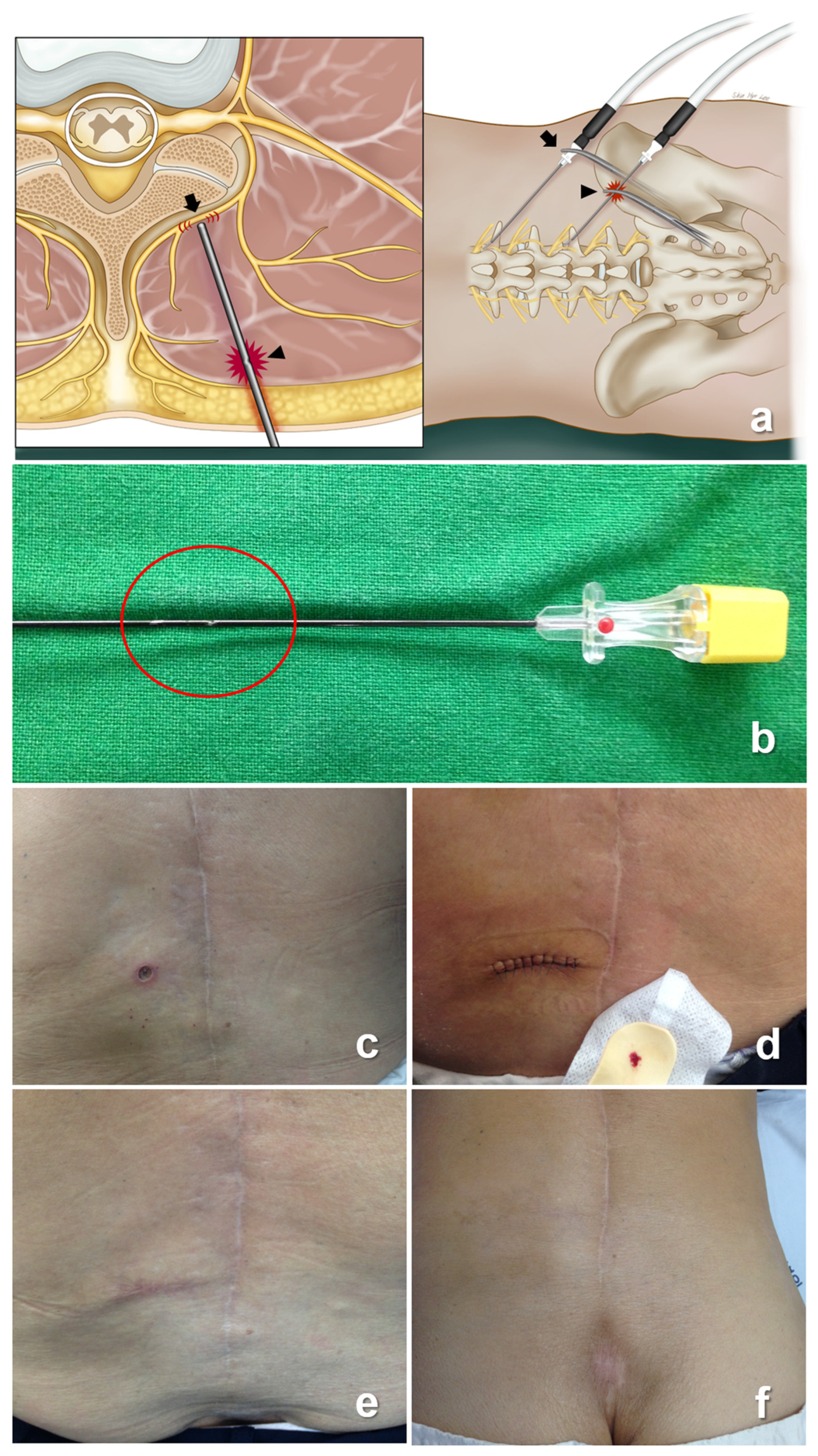
Lumbar facet joints have been identified as a potential source of chronic low back pain (LBP) in 15% to 45% of patients, with the prevalence of such pain varying based on specific populations and settings examined. Lumbar facet joint interventions are useful in the diagnosis as well as the therapeutic management of chronic LBP. Radiofrequency ablation (RFA) of medial branch nerves is recognized as a safe and effective therapy for chronic facet joint pain in the lumbosacral spine, and its efficacy has already been established. The use of RFA is currently widespread in the management of spinal pain, but it is noteworthy that there have been works in the literature reporting complications, albeit at a very low frequency. We present a case of third-degree skin burns following radiofrequency ablation (RFA) for the management of facet joint syndrome. Postoperatively, the patient’s skin encircling the needle displayed a pallor and exhibited deterioration in conjunction with the anatomical anomaly. The affected area required approximately 5 months to heal completely. During RFA, heat can induce burns not only at the point of contact with the RF electrode but also along the length of the needle. Vigilant attention is necessary to ensure patient safety and to address any potential complications that may arise during the procedure, including the possibility of minor technical errors.
Keywords: burn; chronic pain; complication; facet joint; lumbosacral region; needle; nerve block; radiofrequency ablation; spinal pain; surgery burn; chronic pain; complication; facet joint; lumbosacral region; needle; nerve block; radiofrequency ablation; spinal pain; surgery