


Abstract
The current 2019–2021 marine pharmacology literature review provides a continuation of previous reviews covering the period 1998 to 2018. Preclinical marine pharmacology research during 2019–2021 was published by researchers in 42 countries and contributed novel mechanism-of-action pharmacology for 171 structurally characterized marine compounds. The peer-reviewed marine natural product pharmacology literature reported antibacterial, antifungal, antiprotozoal, antituberculosis, and antiviral mechanism-of-action studies for 49 compounds, 87 compounds with antidiabetic and anti-inflammatory activities that also affected the immune and nervous system, while another group of 51 compounds demonstrated novel miscellaneous mechanisms of action, which upon further investigation, may contribute to several pharmacological classes. Thus, in 2019–2021, a very active preclinical marine natural product pharmacology pipeline provided novel mechanisms of action as well as new lead chemistry for the clinical marine pharmaceutical pipeline targeting the therapy of several disease categories.
Keywords:
drug; marine; sea; pharmacology; pharmaceutical; review; toxicology; pipeline; preclinical; mechanism 1. Introduction
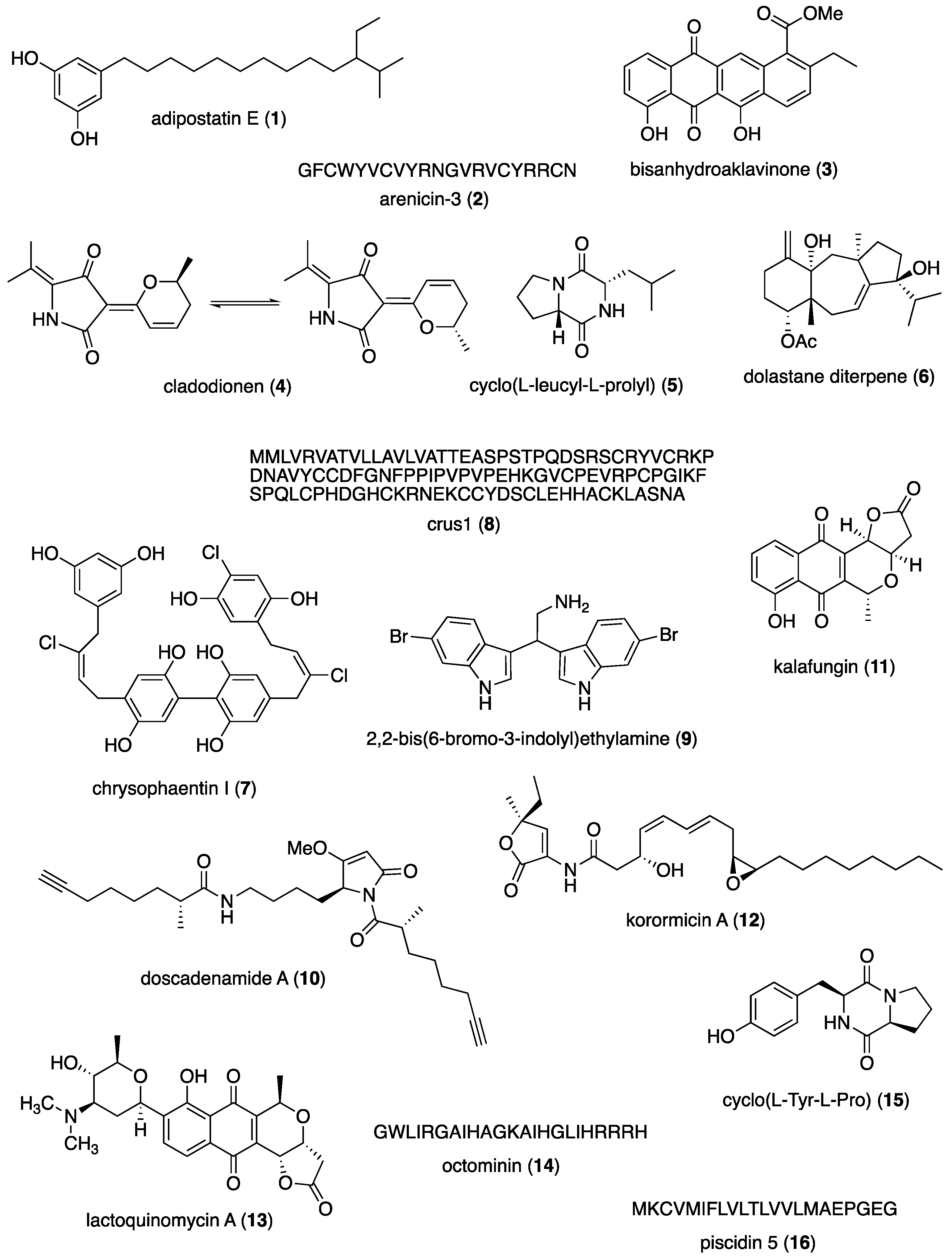
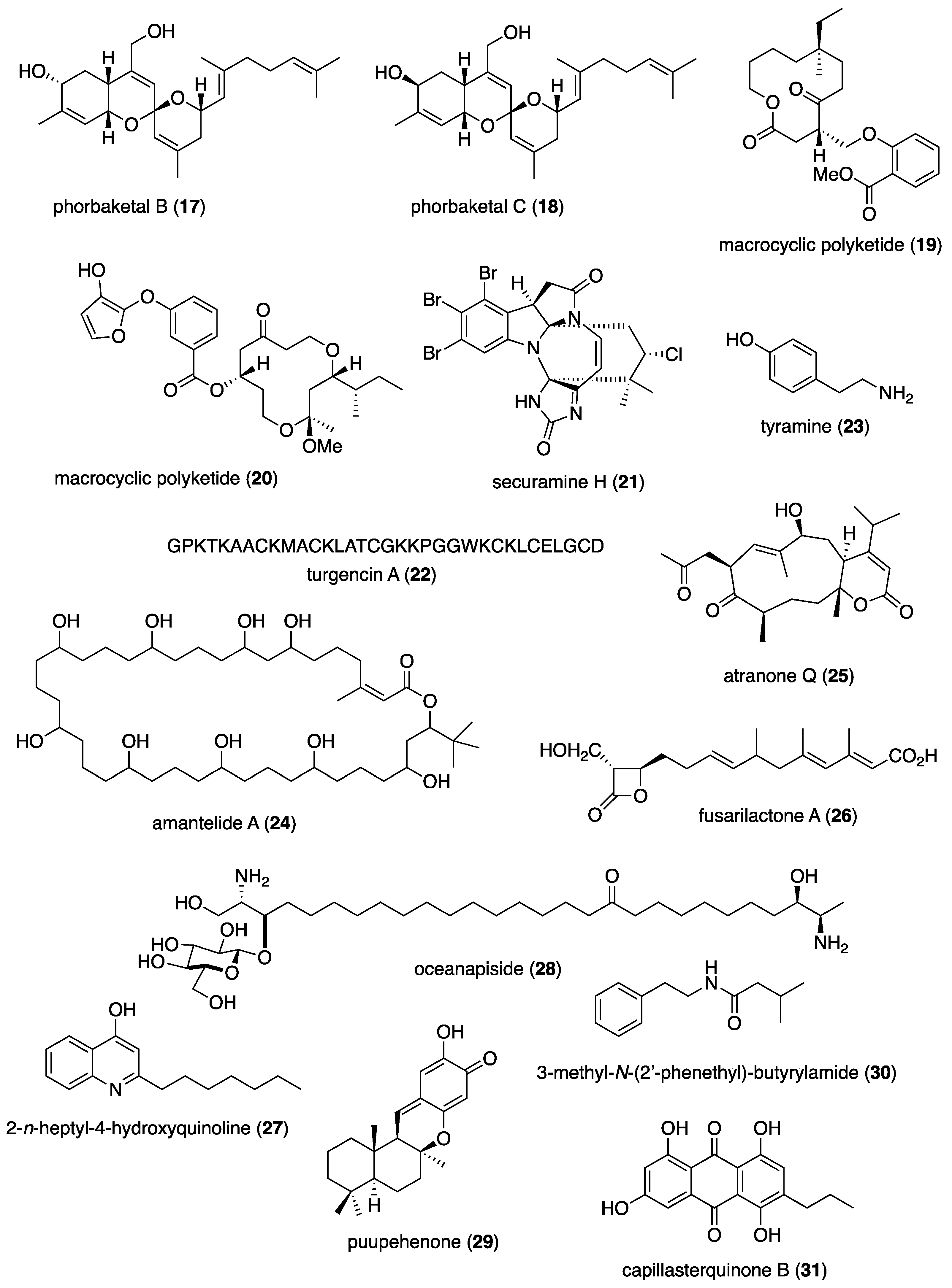
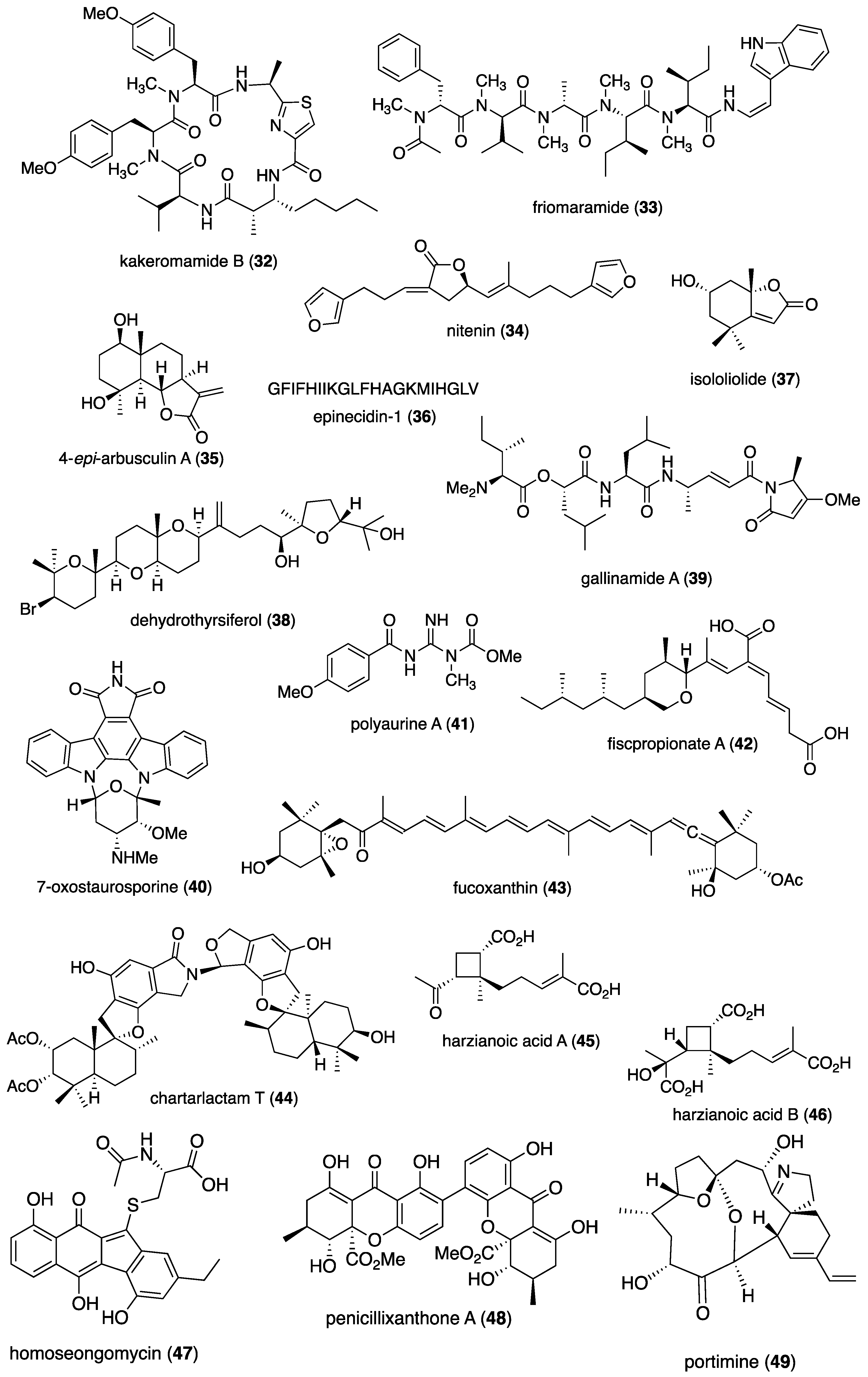
The aim of the present review is to consolidate the 2019–2021 preclinical marine pharmacology literature, with a similar format to our previous 12 reviews of this series, which cover the period 1998–2018 [1,2,3,4,5,6,7,8,9,10,11,12]. The scientific electronic databases MarinLit, PubMed, PubChem, ScienceDirect, and Google Scholar were used to search and retrieve the peer-reviewed published literature. In contrast with our previous reviews, we have focused the current review only on structurally characterized marine chemicals, classified into six major chemical classes, namely, polyketides, terpenes, peptides, alkaloids, shikimates, and sugars, including compounds with mixed biogenetic origin, using a modification of Schmitz’s chemical classification [13]. Mechanism-of-action studies of marine chemicals demonstrating antibacterial, antifungal, antiprotozoal, antituberculosis, and antiviral pharmacological activities are summarized in Table 1, and the corresponding structures are presented in Figure 1. Similarly, mechanism-of-action studies with marine compounds with immune and nervous system activities, as well as antidiabetic and anti-inflammatory bioactivities, are listed in Table 2, with their respective structures consolidated in Figure 2. Finally, marine compounds with miscellaneous mechanisms of action shown to affect multiple cellular and molecular targets, but with no currently assigned pharmacological category, are presented in Table 3, with their structures depicted in Figure 3.

Table 1.
Marine pharmacology in 2019–2021: mechanism-of-action studies with marine compounds demonstrating antibacterial, antifungal, antituberculosis, antiprotozoal and antiviral activities.
Table 1.
Marine pharmacology in 2019–2021: mechanism-of-action studies with marine compounds demonstrating antibacterial, antifungal, antituberculosis, antiprotozoal and antiviral activities.
| Drug Class | Compound/ Organism a | Chemistry | Pharmacologic Activity | IC50 b | MMOA c | Country/ Territory d | References |
|---|---|---|---|---|---|---|---|
| Antibacterial | adipostatin E (1)/ bacterium | Polyketide h | B. subtilis and L. monocytogenes inhibition | 3.4, 5.9 µM | PPCS inhibition | CRI, USA | [14] |
| Antibacterial | arenicin-3 (2)/worm | Peptide f | E. coli and K. pneumoniae inhibition | 0.38–0.76 μM + | Cell membrane disruption and ATP release | AUS, CHE, CHN, DNK, DEU, GBR, IRL | [15] |
| Antibacterial | bisanhydroaklavinone (3)/bacterium | Polyketide h | S. aureus inhibition | 16.6 μM + | Cell membrane damage and DNA leakage | PHL, SGP | [16] |
| Antibacterial | cladodionen (4)/ fungus | Polyketide h | P. aeruginosa quorum sensing inhibition | <400 µM | Downregulation of quorum sensing genes | CHN | [17] |
| Antibacterial | cyclo(l-leucyl-l-prolyl) (5)/bacterium | Peptide f | S. marcescens inhibition | 952 μM + | Biofilm formation inhibition | IND | [18] |
| Antibacterial | C. cervicornis diterpene (6)/alga | Terpenoid e | MR S. aureus inhibition | 22 μM + | Inhibition of efflux pump | BRA | [19] |
| Antibacterial | chrysophaentin I (7)/alga | Polyketide h | S. aureus inhibition | 15.5 μM + | Cytoskeletal protein FtsZ inhibition | USA | [20] |
| Antibacterial | crustin (8)/shrimp | Peptide f | M. luteus inhibition | 2.5 μM + | Membrane disruption and depolarization | CHN | [21] |
| Antibacterial | D. candidum alkaloid (9)/ascidian | Alkaloid f | S. aureus, E. coli, K. pneumoniae inhibition | 18.5 μM + | Biofilm formation inhibition | ITA | [22] |
| Antibacterial | doscadenamide A (10)/cyanobacterium | Peptide f/ Polyketide h | P. aeruginosa quorum sensing activation | <10 µM | AHL-binding site | USA | [23] |
| Antibacterial | kalafungin (11)/ bacterium | Polyketide h | S. aureus inhibition | 27, 53 μM + | Non-competitive β-lactamase inhibition | IND | [24] |
| Antibacterial | korormicin A (12)/bacterium | Polyketide h | V. cholerae and P. aeruginosa inhibition | 10–30 μM + | Reactive oxygen species production | BRA, JPN, USA | [25] |
| Antibacterial | lactoquinomycin A (13)/bacterium | Polyketide h | MR S. aureus and S. enterica inhibition | 0.06–0.55 μM + | Induction of DNA damage | S. KOR | [26] |
| Antibacterial | octominin (14)/ octopus | Peptide f | S. parauberis inhibition | 18.8 μM + | Membrane disruption and chromosomal DNA binding | S. KOR | [27] |
| Antibacterial | P. chrysogenum dipeptide (15)/ fungus | Peptide f | C. violaceum and P. aeruginosa inhibition | 91.4 mM + | Anti-quorum sensing activity | CHN | [28] |
| Antibacterial | piscidin 5 (16)/fish | Peptide f | V. parahaemolyticus and P. damselae inhibition | 1.5–6.2 µM | Membrane disruption and DNA binding | CHN | [29] |
| Antibacterial | phorbaketal B and C (17, 18)/sponge | Terpenoid e | S. aureus biofilm inhibition | <125 μM | Downregulation of hemolysin-related genes | S. KOR | [30] |
| Antibacterial | S. algae polyketide (19)/bacterium | Polyketide h | E. coli and MR S. aureus inhibition | 9.3 μM + | MRSA penicillin-binding protein active site docking | IND | [31] |
| Antibacterial | S. algae polyketide (20)/bacterium | Polyketide h | VR E. faecalis and MR S. aureus inhibition | 2–6 μM + | Siderophore mechanism of action | IND | [32] |
| Antibacterial | securamine H (21)/bryozoan | Alkaloid f | S. aureus inhibition | 3.13 μM + | Reduction in metabolic activity | NOR | [33] |
| Antibacterial | turgencin A (22)/ ascidian | Peptide f | C. glutamicum and B. subtilis inhibition | 0.4 μM + | Cell membrane disruption | AUS, NOR | [34] |
| Antibacterial | tyramine (23)/ bacterium | Alkaloid f | P. aeruginosa quorum sensing inhibition | 7.3 mM + | Pyoverdine production inhibition | ESP | [35] |
| Antifungal | amantelide A (24)/ cyanobacterium | Polyketide h | S. cervisiae inhibition | 12.5, 50 μM | Ergosterol binding and actin polymerization promotion | JPN, PHL, USA | [36] |
| Antifungal | atranone Q (25)/ fungus | Terpenoid e | C. albicans growth inhibition | 20.5 μM | Cytoplasm agglutination and cell membrane alterations | CHN | [37] |
| Antifungal | fusarilactone A (26)/fungus | Polyketide h | P. theae growth inhibition | 118.2 μM | HMG-CoA inhibition | CHN | [38] |
| Antifungal | 2-n-heptyl-4- hydroxyquinoline (27)/bacterium | Alkaloid f | C. albicans hyphal growth inhibition | 46.9 μM | cAMP-Efg1 pathway inhibition | S. KOR | [39] |
| Antifungal | oceanapiside (28)/sponge | Polyketide h | C. glabrata inhibition | 15.4 μM | Sphingolipid synthesis inhibition | PHL, USA | [40] |
| Antifungal | puupehenone (29)/sponge | Terpenoid e | CAS-insensitive C. neoformans inhibition | 7.6–15.2 μM + | CWI integrity pathway disruption | USA | [41] |
| Antifungal | S. olivaceus butyrylamide (30)/bacterium | Shikimate g | C. albicans hyphal growth inhibition and adhesion | 487.4 μM + | Downregulation of hyphal formation genes | CHN | [42] |
| Antimalarial | capillasterquinone B (31)/bacterium | Polyketide h | P. falciparum 3D7 inhibition | 29.3 µM | Lysyl-tRNA synthetase binding | DEU, EGY, GBR, SAU | [43] |
| Antimalarial | kakeromamide B (32)/cyanobacterium | Peptide f | Blood-stage P. falciparum inhibition | 8.9 μM | Binding to Plasmodium actin and sortilin | USA | [44] |
| Antimalarial | friomaramide (33)/sponge | Peptide f | P. falciparum sporozoites liver infection inhibition | <6.1 μM * | Hepatocyte nuclei viability confirmed | AUS, USA | [45] |
| Antimalarial | nitenin (34)/sponge | Terpenoid e | P. falciparum inhibition | 0.29 μM | Ring to trophozoite transition | USA | [46] |
| Antiprotozoal | 4-epi-arbusculin A (35)/zoanthid | Terpenoid e | A. castellanii inhibition | 26 μM | Programmed cell death induction | ESP | [47] |
| Antiprotozoal | epinecidin-1 (36)/fish | Peptide f | Trichomonas vaginalis inhibition | <26.7 µM | Membrane disruption | TWN | [48] |
| Antiprotozoal | isololiolide (37)/ hydroid | Terpenoid e | T. cruzi trypomastigotes and amastigotes inhibition | 32, 40 μM | Disruption of membrane integrity | BRA, USA | [49] |
| Antiprotozoal | dehydrothyrsiferol (38)/alga | Terpenoid e | A. castellanii growth inhibition | 5.3 μM | Mitochondrial malfunction | MEX, ESP | [50] |
| Antiprotozoal | gallinamide A (39)/cyanobacterium | Peptide f | T. cruzi amastigote inhibition | 14.7 nM | Recombinant cruzain inhibition | USA | [51] |
| Antiprotozoal | 7-oxostaurosporine (40)/bacterium | Alkaloid f | A. castellanii growth inhibition | 0.8, 0.9, 5.5 μM | Mitochondrial malfunction | ECU, ESP | [52] |
| Antiprotozoal | polyaurine A (41)/ ascidian | Alkaloid f | S. mansoni inhibition | >100 μM | Egg-production impairment in vitro | IDN, ITA | [53] |
| Antituberculosis | fiscpropionate A (42)/fungus | Polyketide h | M. tuberculosis MptpB inhibition | 5.1 μM | Noncompetitive inhibition | CHN | [54] |
| Antituberculosis | fucoxanthin (43)/alga | Terpenoid e | M. tuberculosis strains inhibition | 2.8–4.1 μM + | TBNAT inhibition | CHL, CZE, IRN, ROU | [55] |
| Antiviral | chartarlactam T (44)/fungus | Alkaloid f | Zika virus inhibition | 10 μM * | Protein E inhibition | CHN | [56] |
| Antiviral | harzianoic acids A and B (45, 46)/fungus | Terpenoid e | HCV inhibition | 35,43 μM | Virus replication and entry inhibition | CHN, DEU | [57] |
| Antiviral | homoseongomycin (47)/bacterium | Polyketide h | VEEV and EEEV inhibition | 8.6 μM | Viral replication inhibition | TWN, USA | [58] |
| Antiviral | penicillixanthone A (48)/fungus | Polyketide h | HIV-1 replication inhibition | 0.36 μM | CCR5/CXCR4 receptor antagonist | CHN | [59] |
| Antiviral | portimine (49)/ dinoflagellate | Polyketide h | HIV-1 replication inhibition | 4.1 nM | Reverse-transcriptase inhibition | JPN | [60] |
a Organism: Kingdom Animalia: worm (Phylum Annelida); shrimp (Phylum Arthropoda); bryozoa (Phylum Bryozoa); ascidian, fish (Phylum Chordata); hydroid, zoanthid (Phylum Cnidaria), dinoflagellate (Phylum Dinoflagellata); octopus (Phylum Mollusca); sponge (Phylum Porifera); Kingdom Monera: bacterium, cyanobacterium (Phylum Cyanobacteria); Kingdom Fungi: fungus; Kingdom Plantae: alga; b IC50: concentration of a compound required for 50% inhibition in vitro, *: estimated IC50; + MIC: minimum inhibitory concentration, c MMOA: molecular mechanism of action; d Country/Territory: AUS: Australia; BRA: Brazil; CHE: Switzerland; CHL: Chile; CHN: China; CRI: Costa Rica; CZE: Czech Republic; DNK: Denmark; DEU: Germany; ECU: Ecuador; EGY: Egypt; ESP: Spain; GBR: United Kingdom; IDN: Indonesia; IND: India; IRL: Ireland; IRN: Iran; ITA: Italy; JPN: Japan; MEX: Mexico; NOR: Norway; PHL: Philippines (the); ROU: Romania; SAU: Saudi Arabia; SGP: Singapore; S. KOR: South Korea; TWN: Taiwan; Chemistry: e terpene; f nitrogen-containing compound; g shikimate; h polyketide; Abbreviations: AHL: acylated homoserine lactone; cAMP: cyclic AMP; CAS: caspofungin; CCR5: C-C chemokine receptor type 5; CWI: cell-wall integrity; CXCR4: C-X-C chemokine receptor type 4; EEEV: Eastern equine encephalitis virus; Efg1: elongation factor 1 transcription factor; HCV: hepatitis C virus; HIV-1: human immunodeficiency virus type-1; HMG-CoA: 3-hydroxy-3-methylglutaryl-CoA; M: Mycobacterium; MptpB: protein tyrosine phosphatase B; MR: methicillin-resistant; MRSA: methicillin-resistant Staphylococcus aureus; PPCS: phosphopantothenoylcysteine synthetase; S: Staphylococcus; TBNAT: arylamine-N-acetyltransferase; VEEV: Venezuelan equine encephalitis virus; T: Trypanosoma; VR: vancomycin-resistant.
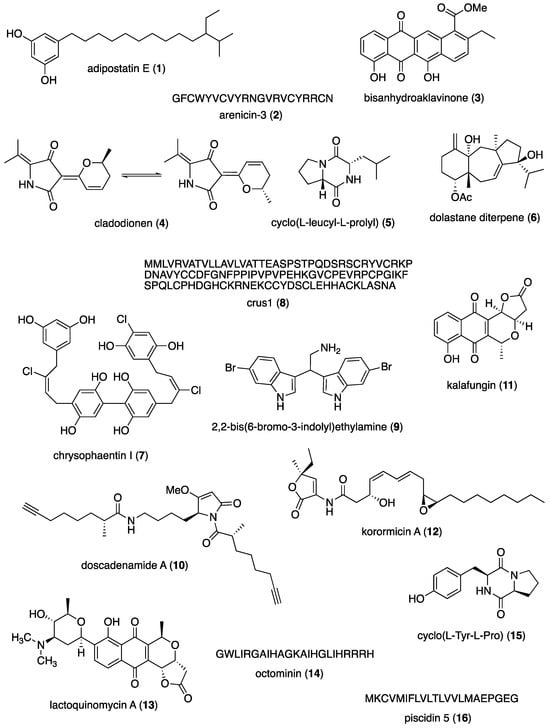
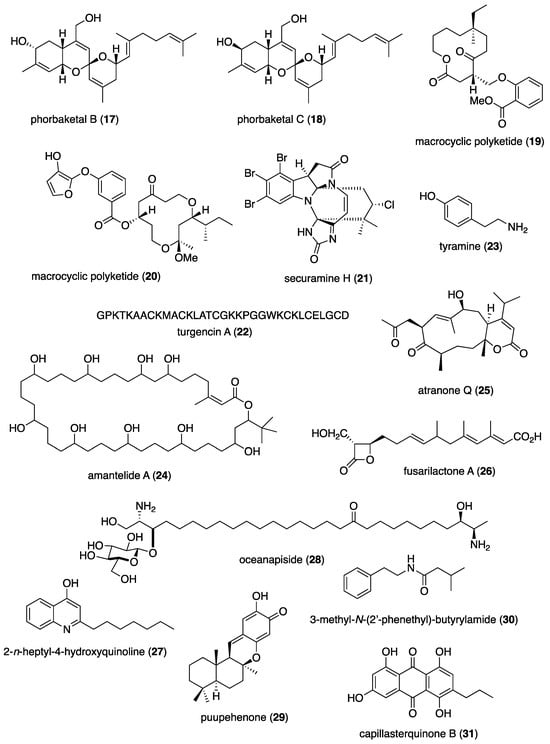
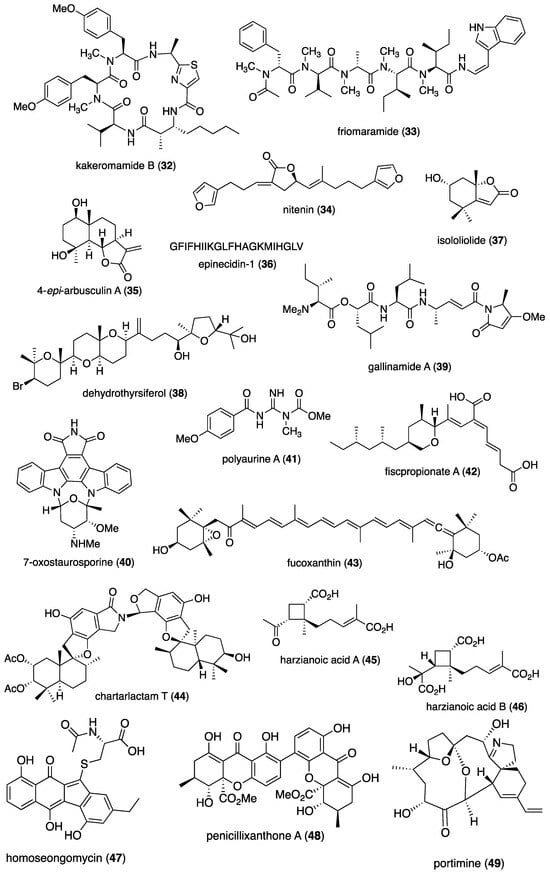
Figure 1.
Marine pharmacology in 2019–2021: marine compounds with antibacterial, antifungal, antiprotozoal, antituberculosis and antiviral activities.
Figure 1.
Marine pharmacology in 2019–2021: marine compounds with antibacterial, antifungal, antiprotozoal, antituberculosis and antiviral activities.
3. Marine Compounds with Antidiabetic and Anti-Inflammatory Activity, and Affecting the Immune and Nervous System
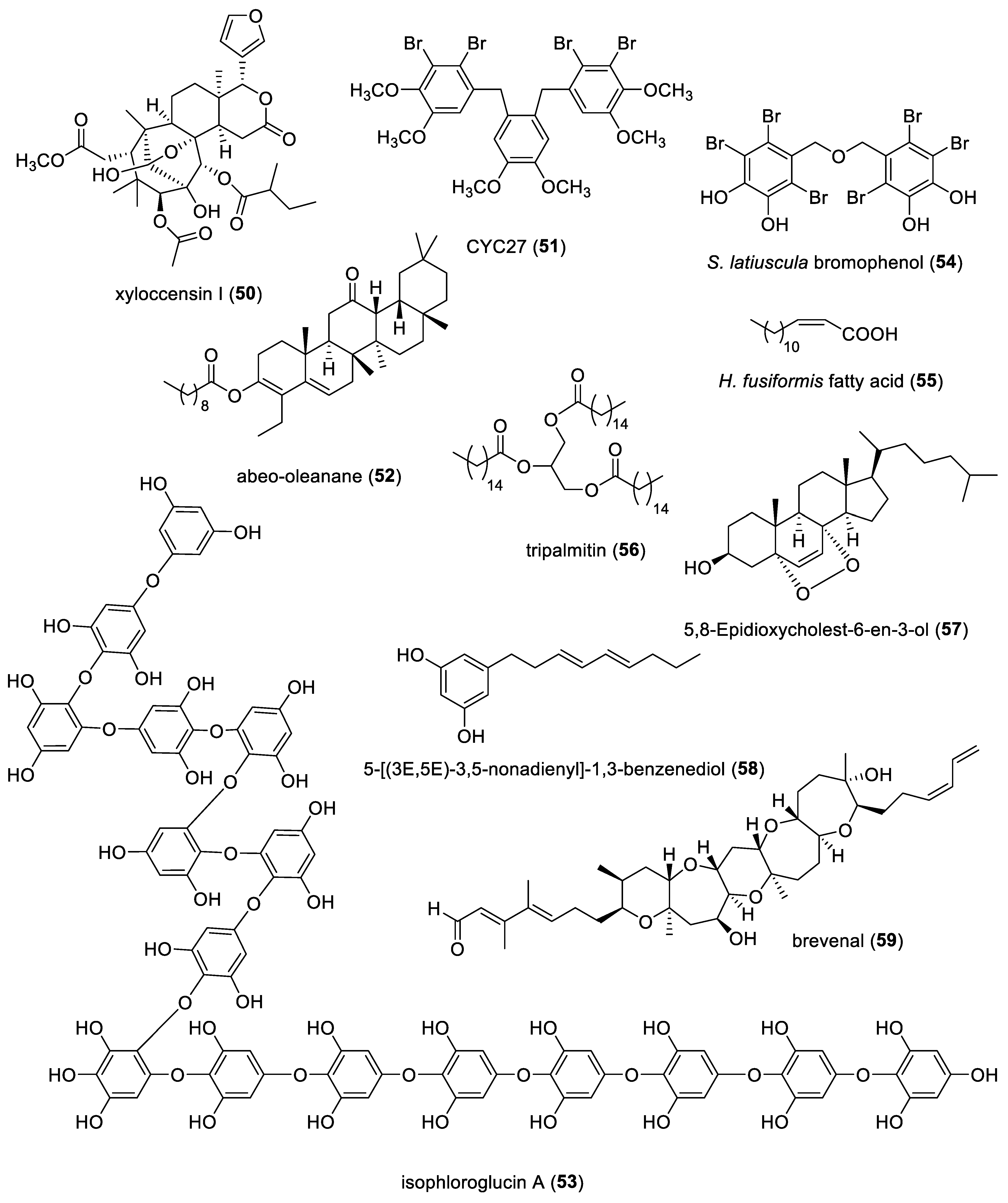
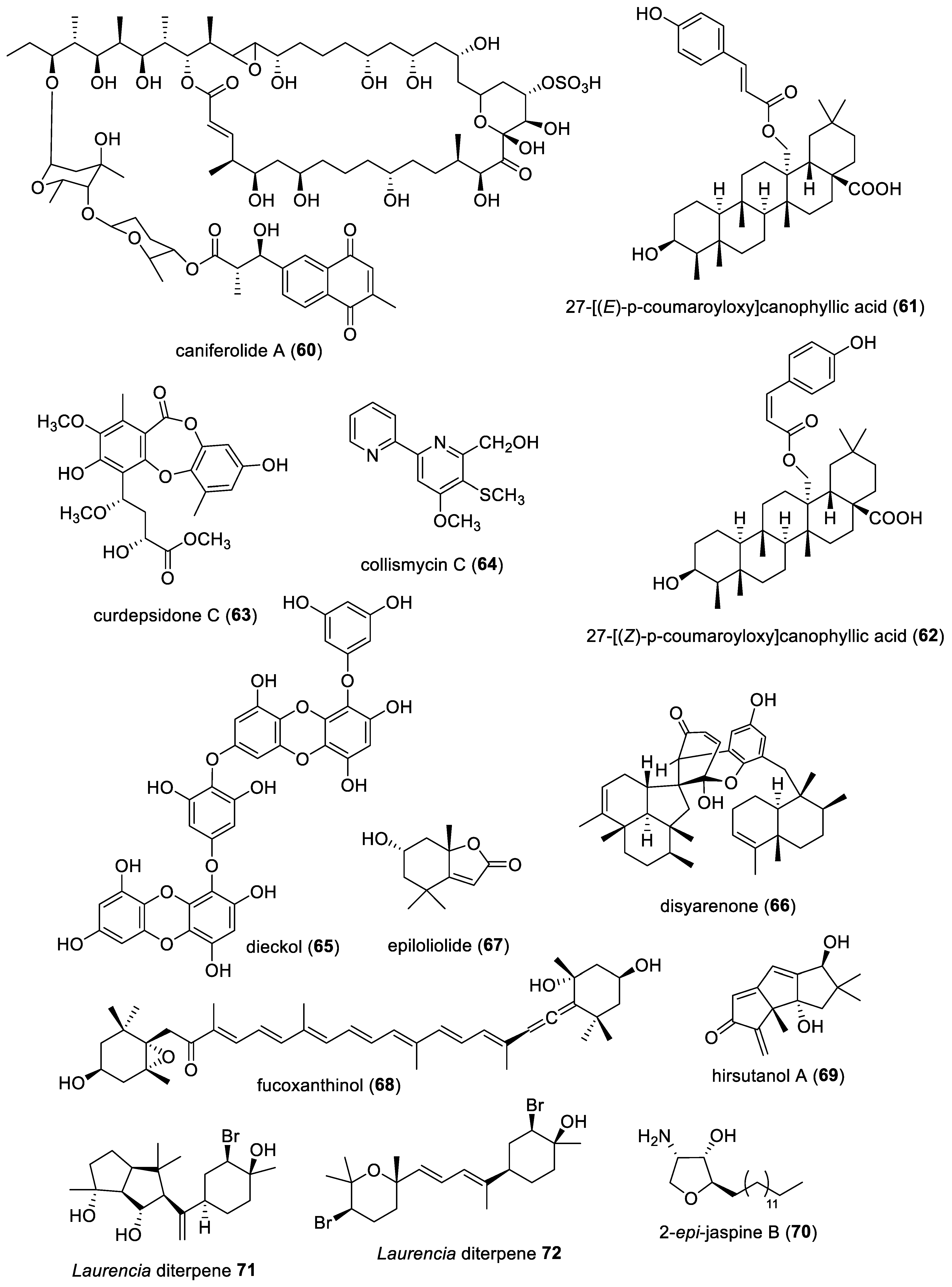
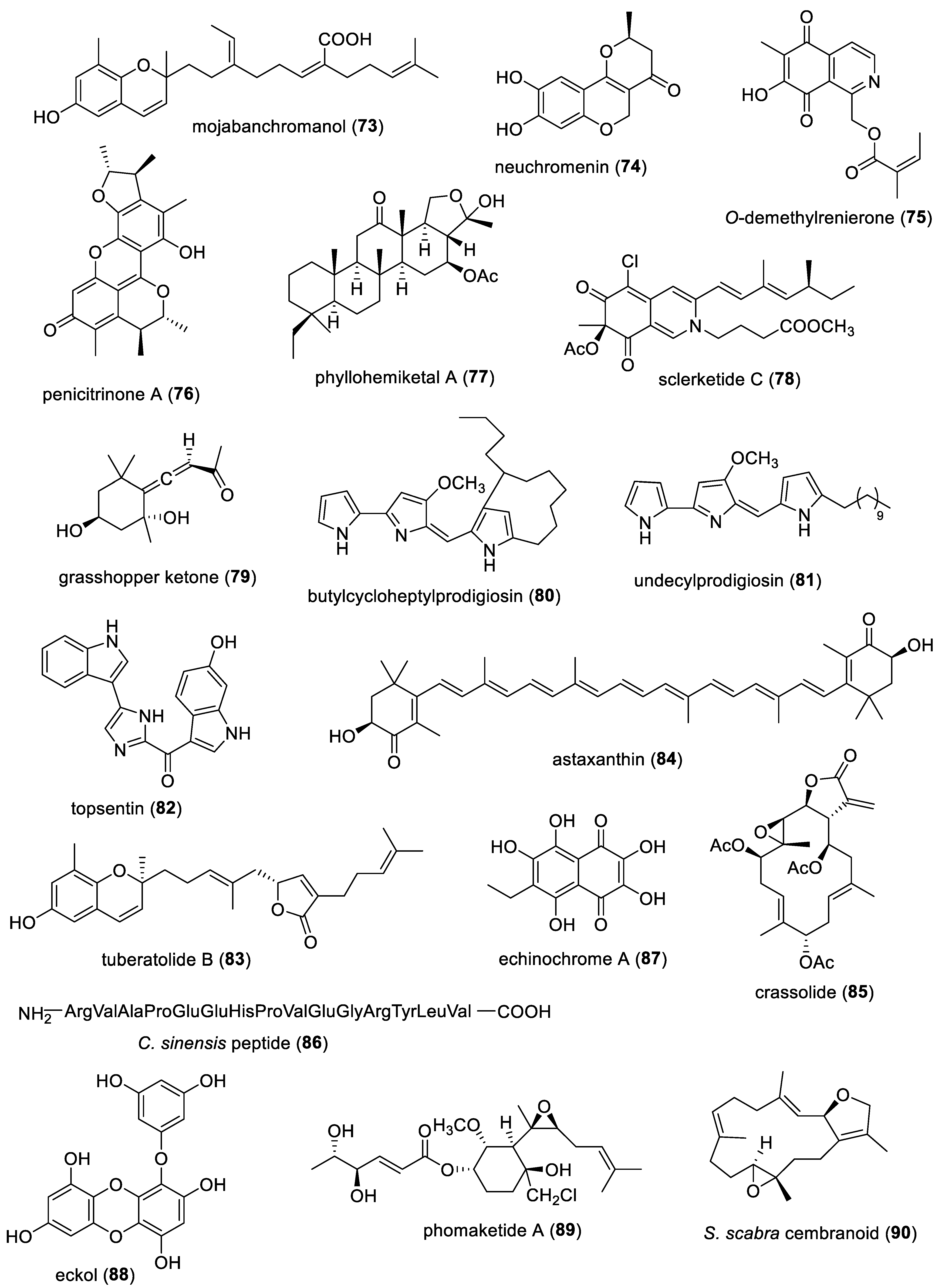
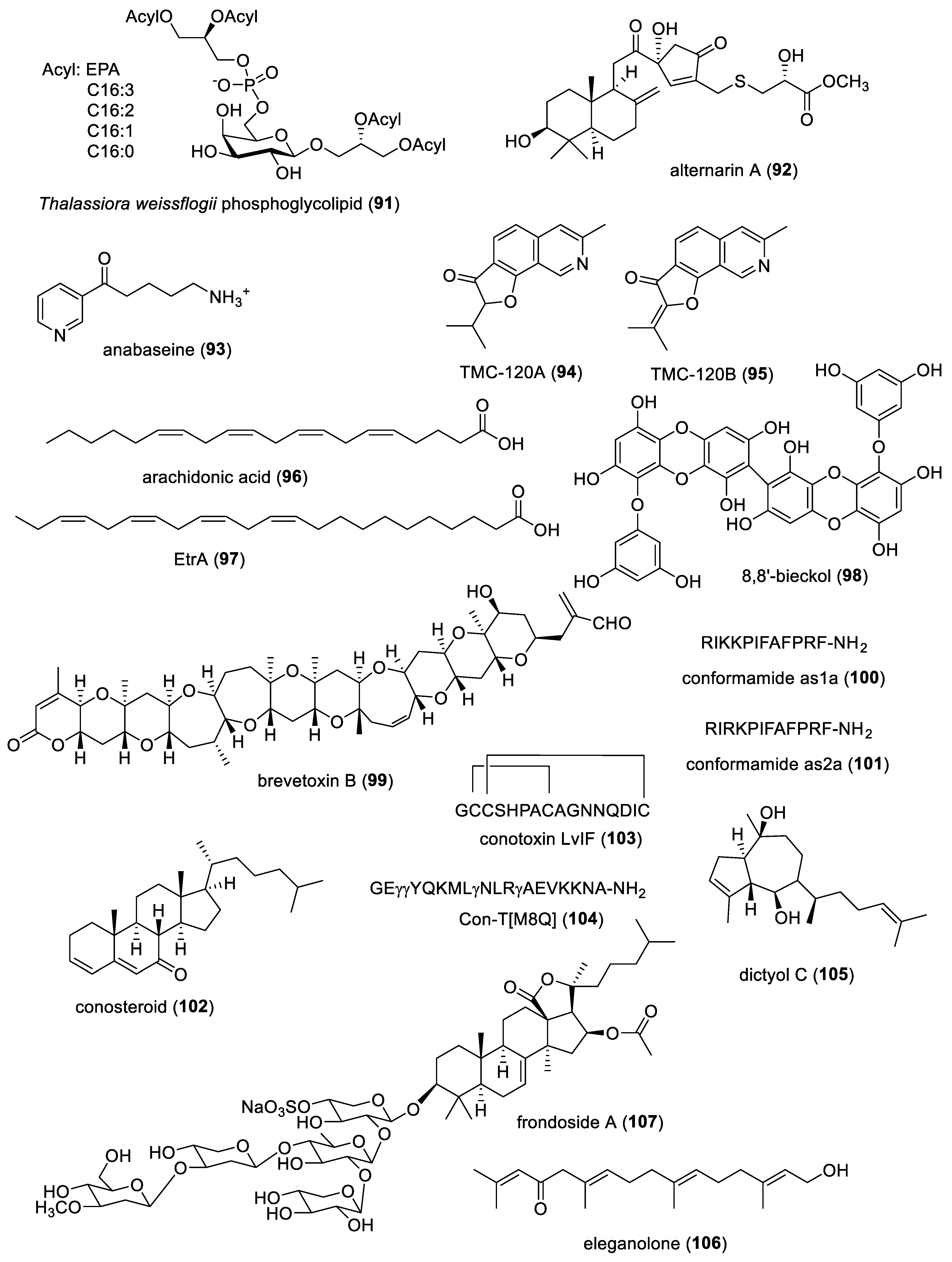
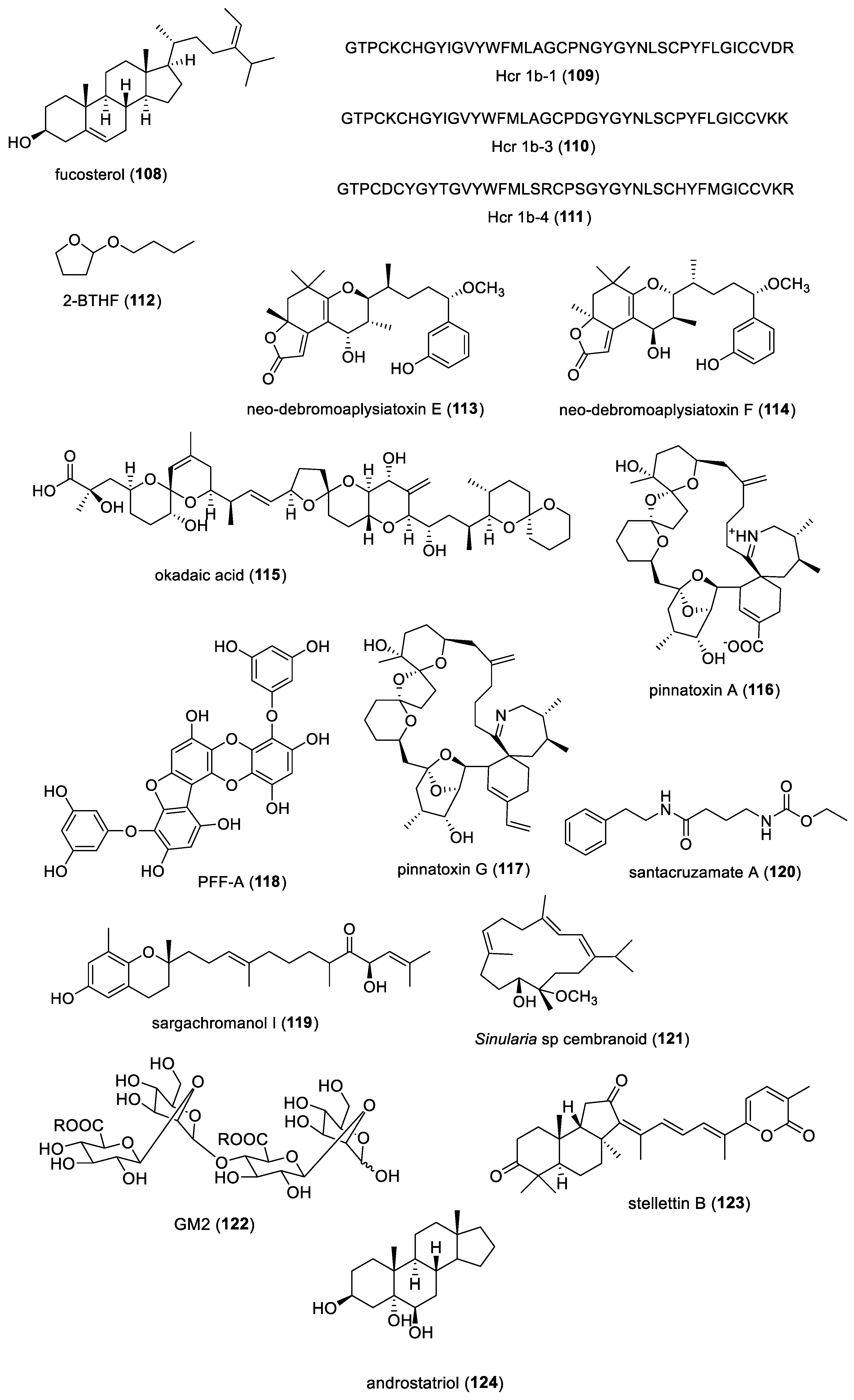
Table 2 presents 2019–2021 mechanism-of-action studies with structurally characterized marine compounds (50–124), as shown in Figure 2, that demonstrated antidiabetic or anti-inflammatory activity and affected the immune or nervous system.
Table 2.
Marine pharmacology in 2019–2021: mechanism-of-action studies with marine compounds with antidiabetic and anti-inflammatory activity that affected the immune and nervous systems.
Table 2.
Marine pharmacology in 2019–2021: mechanism-of-action studies with marine compounds with antidiabetic and anti-inflammatory activity that affected the immune and nervous systems.
| Drug Class | Compound/ Organism a | Chemistry | Pharmacological Activity | IC50 b | MMOA c | Country/ Territory d | References |
|---|---|---|---|---|---|---|---|
| Antidiabetic | xyloccensin-1 (50)/ mangrove | Terpenoid f | α-glucosidase inhibition | 0.25 mM | Docking studies completed | IND | [61] |
| Antidiabetic | CYC27 (51)/alga | Shikimate h | Reduction in blood glucose | 50 mg/kg/day ** | Insulin signaling pathways enhanced | CHN | [62] |
| Antidiabetic | fucoxanthin (43)/alga | Terpenoid f | α-amylase and α-glucosidase inhibition | 121 µM | Mixed-type inhibition kinetics | DNK, MYS, S. KOR, THA | [63,64] |
| Antidiabetic | fucoxanthin (43)/alga | Terpenoid f | Decrease ROS production in kidney mensangial cell line | 0.5 µM * | Epigenomic and transcriptomic effects | USA | [65] |
| Antidiabetic | abeo-oleanene (52)/alga | Terpenoid f | α-amylase and α-glucosidase inhibition | 0.29 mM | Docking studies completed | IND | [66] |
| Antidiabetic | isophloroglucin A (53)/alga | Polyketide e | Glucose homeostasis improvement | 1.35 mg/kg/day ** | GLUT4 levels increased | S. KOR | [67] |
| Antidiabetic | S. latiuscula bromophenol (54)/alga | Shikimate h | α-glucosidase inhibition | 1.92 µM | PTP1B competitive inhibition | S. KOR | [68] |
| Antidiabetic | H. fusiformis fatty acid (55)/alga | Fatty Acids | α-glucosidase inhibition | 48 µM | PTP1B inhibition | S. KOR | [69] |
| Antidiabetic | tripalmitin (56)/fungus | Fatty Acids | α-glucosidase inhibition | 3.75 µM | Mixed-type inhibition kinetics | PAN | [70] |
| Anti-inflammatory | A. depilans EnP(5,8) (57)/sea hare | Terpenoid f | Macrophage NO, COX-2, IL-6 and TNF-α | 18.4 μM | Nos2 and COX-2 expression decrease | ESP, PRT | [71] |
| Anti-inflammatory | Aspergillus sp. aglycone (58)/fungus | Polyketide e | Macrophage NO release inhibition | 6 μM | NF-κB inhibition | CHN | [72] |
| Anti-inflammatory | brevenal (59)/ dinoflagellate | Polyketide e | Macrophage TNF-α inhibition | 0.1 nM | Macrophage activation inhibition | USA | [73] |
| Anti-inflammatory | caniferolide A (60)/ bacterium | Polyketide e | Microglia NO, IL-1β, IL-6 release inhibition | 0.01 μM * | iNOS, ERK, JNK expression inhibition | ESP | [74] |
| Anti-inflammatory | C. inophyllum terpenoids (61, 62)/mangrove | Terpenoid f/ Shikimate h | Macrophage NO and IL-1β release inhibition | 2.4, 7 μM | iNOS induction and NF-κB inhibition | VNM, S. KOR | [75] |
| Anti-inflammatory | curdepsidone C (63)/fungus | Polyketide e/ Shikimate h | Human macrophage IL-1β release inhibition | 7.5 μM | JNK and ERK inhibition | CHN | [76] |
| Anti-inflammatory | collismycin C (64)/ bacterium | Alkaloid g | Murine sepsis inhibition and survival | 4 mg/kg ** | NF-κB and p38 inhibition | S. KOR | [77] |
| Anti-inflammatory | dieckol (65)/alga | Polyketide e | Decreased murine liver NLRP3 synthesis | 2.5 mg/kg/day ** | NF-κB and NLRP3 inhibition | S. KOR | [78] |
| Anti-inflammatory | dysiarenone (66)/sponge | Terpenoid f | Macrophage IL-6, TNF-α and LTB4 release inhibition | 2–8 μM * | NF-κB, p38, ERK, Akt inhibition | CHN | [79] |
| Anti-inflammatory | epiloliolide (67)/alga | Terpenoid f | Human periodontal ligament cell iNOS, IL-1, IL-6, and TNF-α inhibition | >10 μM * | NLRP3 decrease and PKA/CREB increase | S. KOR | [80] |
| Anti-inflammatory | fucoxanthin (43)/ diatom | Terpenoid f | Murine sepsis inhibition and survival | 1 mg/kg ** | NF-κB inhibition | CHN, TWN, USA | [81] |
| Anti-inflammatory | fucoxanthin (43)/ diatom | Terpenoid f | Murine liver inflammation inhibition | 10–40 mg/kg ** | NF-κB inhibition and NRF2 increase | CHN | [82] |
| Anti-inflammatory | fucoxanthin (43)/alga | Terpenoid f | Macrophage osteoclastogenesis inhibition | <5 μM * | ERK, p38 inhibition and NRF2 increase | S. KOR | [83] |
| Anti-inflammatory | fucoxanthin (43)/alga | Terpenoid f | Macrophage iNOS and COX-2 expression inhibition | 5, 10 μM * | NF-κB inhibition | CHN, USA | [84] |
| Anti-inflammatory | fucoxanthinol (68)/ diatom | Terpenoid f | Microglia NO and PGE2 expression inhibition | 20 μM * | NF-κB, Akt, MAPK inhibition and NRF2 increase | CHN | [85] |
| Anti-inflammatory | hirsutanol A (69)/ fungus | Terpenoid f | LPS-induced MMP-9 release and lung injury attenuation | 30 mg/kg ** | NF-κB, STAT3, ERK inhibition | RUS, TWN | [86] |
| Anti-inflammatory | 2-epi-jaspine B (70)/sponge | Alkaloid g | Rat arthritis inhibition | 30 mg/kg ** | SphK1 inhibition | CHN | [87] |
| Anti-inflammatory | L. glandulifera diterpenes (71, 72)/alga | Terpenoid f | Macrophage NO release inhibition | 2.3, 2.9 μM | iNOS induction inhibition | GRC | [88] |
| Anti-inflammatory | mojabanchromanol (73)/alga | Terpenoid f | Murine alveolar epithelial cell line lipid peroxidation inhibition | 147.4 µM * | ERK, JNK inhibition | S. KOR | [89] |
| Anti-inflammatory | neuchromenin (74)/ fungus | Polyketide e | Microglia NO and PGE2 inhibition | 2.7, 3.2 μM | NF-κB and p38 inhibition | S. KOR | [90] |
| Anti-inflammatory | O-demethylrenierone (75)/sponge | Alkaloid g | Human macrophage NO and PGE2, inhibition | 10 µM * | NF-κB inhibition and increase | S. KOR, VNM | [91] |
| Anti-inflammatory | penicitrinone A (76)/fungus | Polyketide e | Human neutrophil superoxide anion inhibition | 2.7 µM | caspase-3- dependent apoptosis induction | TWN | [92] |
| Anti-inflammatory | phyllohemiketal A (77)/sponge | Terpenoid f | Human macrophage NO and PGE2 inhibition | 5 µM * | NF-κB, p38, ERK and JNK inhibition and NRF2 increase | S. KOR | [93] |
| Anti-inflammatory | sclerketide C (78)/ fungus | Alkaloid g | Macrophage NO release inhibition | 2.7 µM | iNOS and COX-2 mRNA expression decrease | CHN | [94] |
| Anti-inflammatory | grasshopper ketone (79)/alga | Terpenoid f | Macrophage NO, IL-1β, IL-6 release inhibition | 4.5–45 µM * | NF-κB, p38, ERK, JNK inhibition | S. KOR | [95] |
| Anti-inflammatory | S. mastoidea prodigiosins (80, 81)/bacterium | Alkaloid g | Rat gastric inflammation inhibition | >100 mg/kg ** | NF-κB inhibition and HO-1 increase | EGY | [96] |
| Anti-inflammatory | topsentin (82)/sponge | Alkaloid g | Human keratinocyte COX-2 expression inhibition | 1.2 µM | AP-1, p38, JNK, and Erk inhibition | S. KOR | [97] |
| Anti-inflammatory | tuberatolide B (83)/alga | Polyketide e/ Terpenoid f | Macrophage NO, IL-1β, IL-6 release inhibition | 29.6 µM * | NF-κB, p38, ERK, JNK inhibition | S. KOR | [98] |
| Immune system | astaxanthin (84)/alga | Terpenoid f | Inhibition of LPS-induced dendritic cell dysfunction | 5–20 µM * | HO-1 and NRF-2 increase | CHN | [99] |
| Immune system | crassolide (85)/soft coral | Terpenoid f | Suppression of dendritic cell maturation and T cell responses | 2.5 µM * | DC maturation and pro-inflammatory cytokines inhibition | TWN | [100] |
| Immune system | C. sinensis peptide (86)/mollusk | Peptide g | Increased murine macrophage phagocytosis | 25 µM * | NF-κB and NLRP3 increase | CHN | [101] |
| Immune system | dieckol (65)/alga | Polyketide e | Decreased intestinal Th17 cells and increased Treg cells | 2.5 mg/kg/day ** | NF-κB and IL-6 decrease | S. KOR | [102] |
| Immune system | echinochrome A (87)/sea urchin | Polyketide e | Expansion of PBMC-derived CD34+ cells | 10 µM * | ROS and p38MAPK/JNK phosphorylation decrease | S. KOR, RUS | [103] |
| Immune system | echinochrome A (87)/sea urchin | Polyketide e | Protection against murine inflammatory bowel disease | 10 mg/kg ** | Regulatory T cell production increase | S. KOR, RUS | [104] |
| Immune system | echinochrome A (87)/sea urchin | Polyketide e | Inhibition of murine bleomycin-induced scleroderma | 1 µM * | STAT3 phosphorylation decrease | S. KOR, RUS | [105] |
| Immune system | eckol (88)/alga | Polyketide e | Inhibition murine IgE-mediated PCA reaction | 50 µg/mouse ** | FCεR and NF-κB activation decrease | S. KOR | [106] |
| Immune system | phomaketide A (89)/fungus | Polyketide e/ Terpenoid f | Lymphangiogenesis inhibition | 3.7 µM | VEGFR-3 phosphorylation and PKCδ activation decrease | TWN | [107] |
| Immune system | S. scabra cembranoid (90)/soft coral | Terpenoid f | LPS-induced B lymphocyte proliferation | 4.4 µM | B cell proliferation decrease and IL-10 increase | CHN | [108] |
| Immune system | sticholysins I and II (proteins of about 20KD)/sea anemone | Peptide g | Maturation of dendritic cells | 0.05 µM * | TLR4 and MYD88 activation decrease | BRA, CUB, USA | [109] |
| Immune system | T. weissflogii phosphoglycolipid (91)/diatom | Polyketide e | Immune stimulation of human monocyte-derived dendritic cells | 6.8 µM * | TLR4 and NF-κB activation decrease | ITA | [110] |
| Nervous system | alternarin A (92)/fungus | Terpenoid f | Neuronal spontaneous Ca2+ oscillations (SCO) inhibition | 3.2 µM | SCO frequency and amplitude decreased | CHN, HU | [111] |
| Nervous system | anabaseine (93)/worm | Alkaloid g | α7 nAChR inhibition | 1.85–3.85 µM | Membrane depolarization | USA | [112] |
| Nervous system | A. insuetus TMC-120Ac and TMC-120B (94, 95)/fungus | Alkaloid g | Mouse focal seizure duration reduction | 10 mg/kg ** | Undetermined | BEL, DNK, NOR | [113] |
| Nervous system | Ara and ETrA (96, 97)/alga | Fatty Acids | AChE inhibition | 1.6–2.4 mM | Non-competitive inhibition | CHN | [114] |
| Nervous system | astaxanthin (84)/shrimp | Terpenoid f | Reduction in LPS-induced memory impairment | 30 or 50 mg/kg ** | Inhibits STAT3 phosphorylation | S. KOR, USA | [115] |
| Nervous system | astaxanthin (84)/shrimp | Terpenoid f | Cognitive dysfunction protection | 10 mg/kg ** | ROS reduction and decreased Ab | THA | [116] |
| Nervous system | 8,8′-bieckol (98)/alga | Polyketide e | BACE1 and AChE inhibition | 1.6–4.6 µM | Non-competitive or competitive inhibition | S. KOR | [117] |
| Nervous system | brevetoxin (99)/ dinoflagellate | Polyketide e | VGSC activator | 2.4 nM | Shifts voltage dependence, slows inactivation | JPN, USA | [118] |
| Nervous system | C. austini conorfamides (100, 101)/cone snail | Peptide g | α7 nAChR inhibition | 0.68–0.76 µM | Inhibition of Ca2+ ion flow | AUS, MEX | [119] |
| Nervous system | C. geographus conosteroid (102)/ cone snail | Terpenoid f | Hot plate murine pain model inhibition | 2–10 mg/kg ** | GABAAR negative allosteric modulator | USA | [120] |
| Nervous system | C. lividus conotoxin Lv1F (103)/cone snail | Peptide g | α3β2 nAChR inhibition; hotplate and formalin murine pain inhibition | 0.0089 µM; 25–100 µg/kg ** | Competitive binding; unknown | CHN | [121,122] |
| Nervous system | Con-T[M8Q] (104)/cone snail | Peptide g | Inhibition of murine morphine dependence | 15 nmol/kg ** | NMDAR GluN2B antagonist | CHN, USA | [123] |
| Nervous system | dictyol C (105)/alga | Terpenoid f | Neuroprotection of rat CIRI | 80 µg/kg ** | Increased Nrf2/ARE signaling pathway | CHN | [124] |
| Nervous system | echinochrome A (87)/sea urchin | Polyketide e | Mitigation of cerebral ischemic injury | 10 µM ** | Decreases pro-apoptotic factors; increased survival factors | S. KOR, RUS | [125] |
| Nervous system | eckol (88)/alga | Polyketide e | Dopamine D3/D4 agonist | 42, 43 µM | GPCR signaling | S. KOR | [126] |
| Nervous system | eleganolone (106)/alga | Terpenoid f | Human neuroblastoma cells neurotoxicity inhibition | 0.1–1 µM * | Decreases ROS levels and apoptotic factors | BRA, ESP, PRT | [127] |
| Nervous system | frondoside A (107)/sea cucumber | Terpenoid f | Dopaminergic degeneration inhibition | 0.1, 0.5 µM * | Increase in protein degradation pathway, decrease apoptotic factors | THA | [128] |
| Nervous system | fucosterol (108)/alga | Terpenoid f | Aβ-induced neuronal apoptosis | 10 µM * | Decreased pro-apoptotic factors; decreased APP mRNA | MYS | [129] |
| Nervous system | fucosterol (108)/alga | Terpenoid f | Neurodegenerative disorders system pharmacology | NA | Neuronal survival pathways | S.KOR, | [130] |
| Nervous system | fucoxanthin (43)/alga | Terpenoid f | Reduced corneal denervation | 10 mg/kg ** | Increased Nrf2 expression | TWN | [131] |
| Nervous system | fucoxanthin (43)/alga | Terpenoid f | Reduction in PC12 neurons intracellular ROS | 1 µM * | Binds to Keap1 | CHN | [132] |
| Nervous system | H. crispa peptides (109–111)/sea anemone | Peptide g | Inhibition of ASIC ion channels | 1.25–4.95 µM | rASIC1a ion channel inhibition | RUS | [133] |
| Nervous system | H. scabra 2-BTHF (112)/sea cucumber | Polyketide e | Aβ-induced C. elegans paralysis inhibition | 6.9 µM * | Decreased the formation of Ab oligomers and fibrils | THA | [134] |
| Nervous system | neo-debromoaplysiatoxins E and F (113, 114)/cyanobacterium | Terpenoid f/ Shikimate h | Kv1.5 inhibition | 1.22–2.85 µM | Binding to Kv1.5 S6 domain | CHN | [135] |
| Nervous system | okadaic acid (115)/ dinoflagellate | Polyketide e | Chick embryo neural tube defects | 0.5 µM * | Increased ROS, decreased Nrf2-signaling pathway | CHN | [136] |
| Nervous system | pinnatoxins A and G (116, 117)/dinoflagellate | Polyketide e | Synaptic transmission block at neuromuscular junction | 2.8–3.1 nmol/kg ** | AChE inhibition | FRA, USA | [137] |
| Nervous system | PFF-A (118)/alga | Polyketide e | hMAO-A inhibition | 9.2 µM | Noncompetitive inhibition | S. KOR | [138] |
| Nervous system | sargachromanol (119)/alga | Terpenoid f | AChE inhibition | 0.79 µM | Mixed reversible inhibition | S. KOR | [139] |
| Nervous system | santacruzamate A (120)/cyanobacterium | Alkaloid g | Amelioration of AD-like pathology | 10 mg/kg ** | Increased KDELR, decreased ER stress | CHN | [140] |
| Nervous system | Sinularia sp. cembranoid (121)/soft coral | Terpenoid f | Aβ42 inhibition | >10 µM | Binds to c-terminal of Ab monomer | CHN | [141] |
| Nervous system | S. latiuscula bromophenol (54)/alga | Shikimate h | HD3R inhibition | 18.7 µM | Binding to HD3R orthosteric site | S. KOR | [142] |
| Nervous system | S. japonica GM2 (122)/alga | Sugar | PC12 neurons increased viability | 270–540 µM | Increased autophagy factors; decreased pro-apoptotic factors | CHN | [143] |
| Nervous system | S. latiuscula bromophenol (54)/alga | Shikimate h | BACE1, AChE and BChe inhibition | 2.3–4.03 µM | Non-competitive or competitive inhibition | S. KOR | [144] |
| Nervous system | stelletin B (123)/sponge | Terpenoid f | Reversal of zebrafish locomotor deficiency | 1 nM * | Increased Nrf2/ARE signaling; decreased pro-apoptotic factors | TWN | [145] |
| Nervous system | androstatriol (124)/ soft coral | Terpenoid f | Retinal ganglion cells protection | 80 µg/eye ** | Negative regulation of Keap1 | CHN | [146] |
a Organism: Kingdom Animalia: worm (Phylum Annelida); shrimp (Phylum Arthropoda); coral, sea anemone (Phylum Cnidaria); sea cucumber, sea urchin (Phylum Echinodermata); cone snail, mollusk, sea hare (Phylum Mollusca); sponge (Phylum Porifera); Kingdom Chromista: dinoflagellate; Kingdom Fungi: fungus; Kingdom Plantae: alga; diatoms, mangrove; Kingdom Monera: bacterium; cyanobacterium (Phylum Cyanobacteria); b IC50: concentration of a compound required for 50% inhibition, *: apparent IC50, ** in vivo study; c MMOA: molecular mechanism of action; d Country/Territory: AUS: Australia; BEL: Belgium; BRA: Brazil; CHN: China; CUB: Cuba; DNK: Denmark; EGY: Egypt; ESP: Spain; FRA: France; GRC: Greece; HU: Hungary; IND, India; ITA: Italy; JPN: Japan; MEX: Mexico; MYS: Malaysia; NLD: Netherlands; NOR: Norway; PAN: Panama; PRT: Portugal; RUS: Russia; S. KOR: South Korea; THA: Thailand; TWN: Taiwan; VNM: Vietnam; Chemistry: e polyketide; f terpene; g nitrogen-containing compound; h shikimate. Abbreviations: Aβ: amyloid-β peptide; Ach: acetylcholine; AChE: acetylcholinesterase; AD: Alzheimer’s disease: AP-1: dimeric transcription factor; BChe: butyrylcholinesterase; Akt: also known as protein kinase B is a serine/threonine protein kinase; APP: amyloid precursor protein; ASIC: acid-sensing ion channel; BACE1: β-Secretase; 2-BTHF: 2-butoxytetrahydrofuran; CIRI: cerebral ischemia-reperfusion injury; COX: cyclooxygenase; CREB: cAMP-response element binding protein; ER: endoplasmic reticulum; ERK: extracellular signal-regulated kinase; EnP(5,8): 5α,8α-epidioxycholest-6-en-3β-ol; FCεR: high-affinity IgE receptor; GLUT4: glucose transporter 4; GM2: Saccharina japonica fucoidan-derived glucuronomannan oligosaccharide; GPCR: G-protein-coupled receptor; HD3R: human dopamine receptor 3; hMAO: human monoamine oxidase; HO-1: heme oxygenase-1 protein; IgE: immunoglobulin E; IL: interleukin; iNOS: inducible nitric oxide synthase; JNK: c-jun N-terminal kinase; KDELR: endoplasmic reticulum retention signal receptor; Keap1: Kelch-like ECH-associated protein 1; Kv: voltage-gated potassium channel; LPS: lipopolysaccharide; LTB4: leukotriene B4; MAPK: mitogen-activated protein kinase; MMP-9: matrix metalloproteinase 9; MAO: monoamine oxidase; nAChR: nicotinic acetylcholine receptor; NF-κB: nuclear factor kappa-light-chain-enhancer of activated B cells; NLRP3: NLR family pyrin domain containing 3; NMDAR: N-methyl-D-aspartate receptor; NO: nitric oxide; Nos2: nitric oxide synthase 2; Nrf2-ARE: nuclear transcription factor E2-related factor antioxidant response element; PBMC: PB mononuclear cells; PCA: passive cutaneous anaphylaxis; PFF-A: phlorofucofuroeckol-A; PGE2: prostaglandin E2; PK: protein kinase; PTP1B: tyrosine phosphatase 1B; rASIC: rat acid-sensing ion channel; ROS: reactive oxygen species; SPHK1: sphingosine kinase 1; STAT3: signal transducer and activator of transcription 3; Th17: T helper 17 cells, a subset of CD4+ T helper cells; TNF-α: tumor necrosis factor-α; Tregs: regulatory T cells; TRIOL: 5α-androst-3β, 5α, 6β-triol; VEGFR-3: vascular endothelial growth factor receptor-3; VGSC: voltage-gated sodium channel.
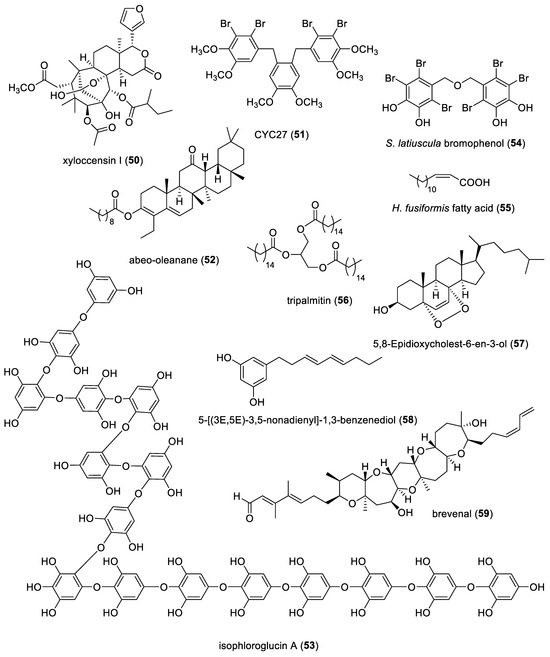
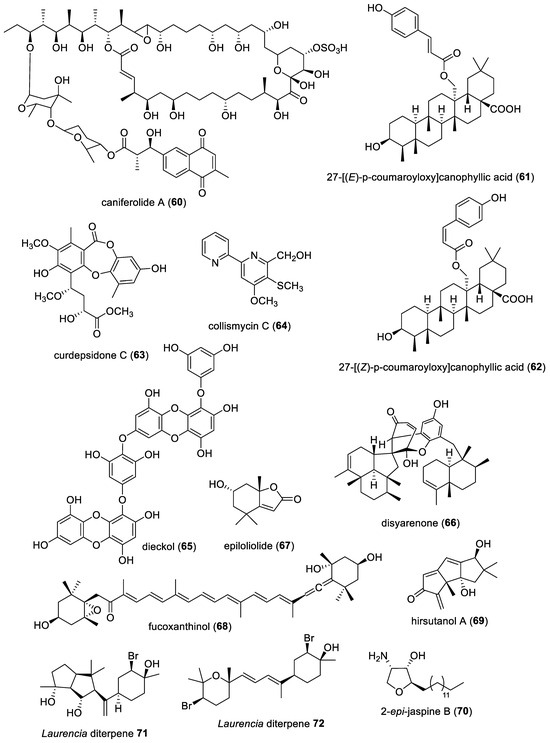
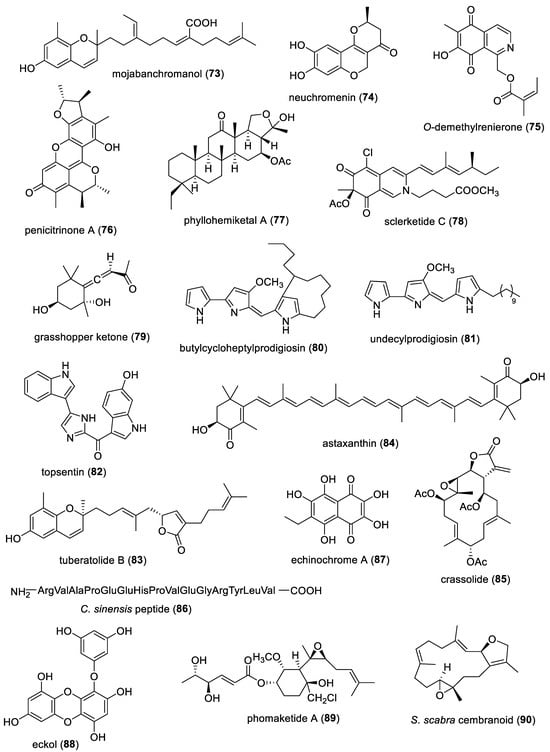
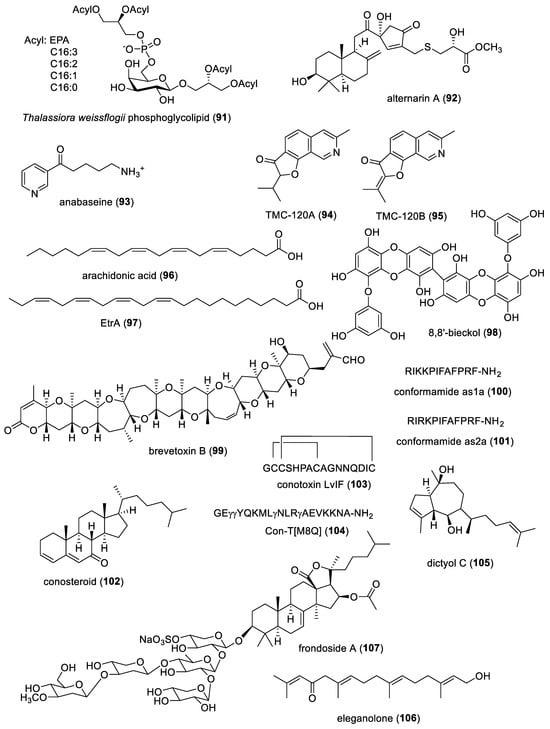
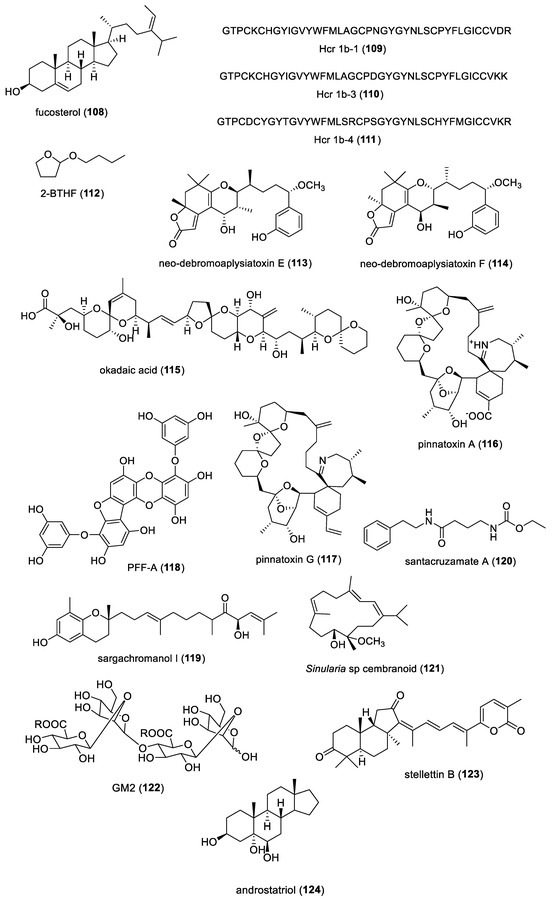
Figure 2.
Marine pharmacology in 2019–2021: marine compounds with antidiabetic and anti-inflammatory activity that affect the immune and nervous system.
Figure 2.
Marine pharmacology in 2019–2021: marine compounds with antidiabetic and anti-inflammatory activity that affect the immune and nervous system.
3.1. Antidiabetic Activity
Diabetes is a disease that is characterized by high glucose blood levels that may lead to cardiovascular disease, as well as kidney and nerve damage (https://www.niddk.nih.gov/health-information/diabetes (accessed on 20 May 2024). As shown in Table 2 and Figure 2, during 2019–2021, studies with eight structurally characterized marine natural products (43, 50–56) isolated from fungi, algae and mangrove reported novel antidiabetic mechanisms of pharmacological action targeting α-amylase and α-glucosidase, insulin signaling pathways, oxidative stress, glucose transporter 4, and tyrosine phosphatase 1B.
Das and colleagues contributed the limonoid terpenoid xyloccensin-1 (50), discovered in the mangrove Xylocarpus granatum, that demonstrated significant antidiabetic activity resulting from potent in vitro inhibition of α-amylase and α-glucosidase, observations confirmed with α-glucosidase enzyme molecular docking binding studies [61]. Luo and colleagues described a synthetic derivative of shikimate bromophenol CYC27 (51), derived from the marine red alga Rhodomela confervoides, which induced hypoglycemia in diabetic mice by increased phosphorylation of insulin receptors and the enhancement of insulin signaling pathways; in addition, “most regulated phosphoproteins (were) related to RNA splicing, mRNA processing and RNA processing” [62]. Zaharudin and colleagues determined that the terpene fucoxanthin (43), found in the marine brown edible alga Undaria pinnatifida, strongly inhibited yeast α-glucosidase enzyme with mixed-type inhibition kinetics, commenting that “a compound that inhibits yeast α-glucosidase activity will not necessary inhibit mammalian α-glucosidase activity” [63]. Interestingly, Arthiya and colleages demonstrated that fucoxanthin (43), isolated from the marine microalga P. tricornutum, inhibited rat intestinal α-glucosidase enzyme by noncompetitive inhibition [64]. Hudlikar and colleagues evaluated the protective effect of fucoxanthin (43) on high glucose-induced oxidative stress in mouse kidney mesangial cells in vitro, observing that fucoxanthin modified epigenomic and transcriptomic biomarkers, thus protecting mesangial cells “from high glucose-induced oxidative stress and damage” [65]. Chakraborty and Antony identified the terpenoid abeo-oleanene (52), purified from the intertidal marine red alga Gracilaria salicornia, and assessed potent in vitro antioxidant and antidiabetic potential with dual inhibition of starch digestive enzymes α-amylase and α-glucosidase, further confirmed by in silico molecular modeling studies, thus proposing that this compound might “constitute prospective anti-hyperglycemic pharmaceutical candidate” [66]. Yang and colleagues investigated the polyketide ishophloroglucin A (53), uncovered in the marine brown edible seaweed Ishige okamurae, demonstrating it affected glucose homeostasis in the pancreas and muscle of high-fat diet-fed (HFD) mice by targeting the glucose transporter 4 in the muscles, thus considering the compound “a functional food for the prevention of diabetes” [67]. Paudel and colleagues reported the anti-diabetic potential of a shikimate bis-(2,3,6-tribromo-4,5-dihydroxybenzylmethyl ether) (54), discovered in the marine alga Symphyocladia latiuscula, and determined by both enzyme kinetics and in silico molecular modeling potent tyrosine phosphatase 1B and α-glucosidase inhibition, as well as the enhancement of both insulin sensitivity and glucose uptake; thus, (54) “may represent a novel class of anti-diabetic drugs” [68]. Seong and colleagues showed that the fatty acid (Z)-hexadec-12-enoic acid (55), derived from the edible marine brown seaweed Hizikia fusiformis, by detailed enzyme kinetics and molecular docking studies, was a potent tyrosine phosphatase 1B and α-glucosidase inhibitor [69]. Lopez and colleagues characterized the fatty acid tripalmitin (56), found in a mangrove-associated fungus Zasmidium sp. strain EM5-10, as a mixed inhibitor of α-glucosidase as determined by enzyme kinetic studies, with potential to bind the human intestinal α-glucosidase, and this was “the first report on α-glucosidase inhibitory activity of triglycerides” [70].
3.2. Anti-Inflammatory Activity
As shown in Table 2 and Figure 2, during 2019–2021, studies with 28 structurally characterized marine natural products (43, 57–83) isolated from bacteria, fungi, sponges, sea hare, dinoflagellates, diatoms, algae and mangrove reported novel anti-inflammatory pharmacological mechanisms of action that targeted NF-κB activation, pro-inflammatory cytokine production, and reactive oxygen species generation.
Several marine-derived natural products investigated mechanistically during 2019–2021 demonstrated significant anti-inflammatory functions by targeting signal transduction pathways, leading to NF-κB activation and pro-inflammatory cytokine production. The anti-inflammatory activity of the terpenoid xanthophyll fucoxanthin (43) was reported in several papers: Su and colleagues reported that the terpenoid fucoxanthin (43), discovered in the marine diatom Conticribra weissflogii ND-8, prophylactically attenuated LPS-induced sepsis in a whole animal mouse model by blocking NF-κB activation and the production of pro-inflammatory cytokines [81]. Zheng and colleagues showed that edible brown seaweed-derived terpenoid fucoxanthin (43) demonstrated protective effects in an in vivo model of alcohol-induced liver damage by activation of the Nrf2-sginaling pathway and decreasing NF-κB activation [82]. Ha and colleagues further characterized the terpenoid fucoxanthin (43), and observed that in osteoclast-like RAW264.7 cells in vitro, fucoxanthin increased Nrf2 activation and decreased the expression of osteoclast-specific markers, as well as “osteoclast differentiation and bone resorption ability” [83]. Li and colleagues determined that the terpenoid fucoxanthin (43), protected against LPS-induced murine lung inflammation in vivo, by decreasing cellular infiltration and both lung tissue COX-2 and iNOS expression. Interestingly, molecular docking simulations demonstrated that fucoxanthin (43) blocked LPS-induced signaling by binding to the TLR4 pocket that is required for LPS stimulation [84]. Together, these findings indicate that fucoxanthin (43) from both marine diatoms and seaweed has the potential to attenuate inflammation in vitro and in vivo.
Wen and colleagues identified the polyketide phenolic aglycone (58), derived from the marine fungus Aspergillus sp., and showed that it decreased LPS-induced NO production and NF-κB-regulated cytokines such as IL-1β and IL-6 [72]. Keeler and colleagues investigated the polyketide brevenal (59), isolated from the marine dinoflagellate Karenia brevis, showing that in the context of lung inflammation, it blocked NF-κB activation and the development of fully activated macrophages in vitro, which are critical players that promote lung inflammation [73]. Alvariño and colleagues reported the polyketide caniferolide A (60), found in the marine actinomycete Streptomyces caniferus, which blocked NF-κB, p38, JNK, and MAPK activation with a concomitant increase in NRf2 that promoted the survival of BV2 microglial cells, suggesting that (60) may target “many pathological markers of Alzheimer’s disease” [74]. Ding and colleagues showed that the polyketide/shikimate curdepsidone C (63), obtained from the marine fungus Curvularia sp. IFB-Z10, blocked bacterial-induced THP-1 cell IL-1β production as well as the activation of MAPK signaling pathways, presumably through direct interactions with the TLR1/2 receptor [76].
Ku and colleagues characterized the alkaloid collismycin C (64), isolated from the marine red alga-associated Streptomyces sp. strain MC025, and determined that in vitro, it decreased NF-κB phosphorylation of p38 and TNF-α production, and it was protective in a PolyP model of murine sepsis in mice [77]. Oh and colleagues contributed the polyketide dieckol (65), purified from brown seaweed Ecklonia cava, and showed that it attenuated the development of nonalcoholic fatty liver disease by decreasing NLRP3 inflammasome formation and pyroptosis in a mouse high-fat diet model [78]. Kim and colleagues evaluated the terpenoid epiloliolide (67), uncovered in the marine brown alga Sargassum horneri, on human periodontal ligament cells in vitro in the presence of P. gingivalis lipopolysaccharide (LPS), and observed a decreased production of inflammatory mediators TNF-α, IL-6, and IL-1β, and the promotion of cell growth and proliferation via the “regulation of PKA/CREB signaling” [80]. Li and colleagues determined that the terpenoid fucoxanthinol (68), discovered in the marine diatom Nitschia laevis, was able to block the LPS-induced inflammatory response by microglia in vitro by increasing Nrf2 with a subsequent loss of the expression iNOS, COX-2, and pro-inflammatory cytokines TNF-α and IL-6, and PGE-2 [85]. Jan and colleagues identified the terpenoid hirsutanol A (69), derived from the marine red alga-derived fungus Chondrostereum sp. NTOU4196, that attenuated LPS-induced lung inflammation in vivo and behavioral changes in a mouse endotoxemia model by blocking LPS-induction of STAT3 and MMP-9 [86]. Chen and colleagues explored the polyketide 2-epi-jaspine B (70) analog, isolated from the marine sponges Pachastrissa sp. and Jaspis. sp., and in an in vivo rat model of complete Freund’s adjuvant rheumatoid arthritis (RA), showed it acted as a SphK1 inhibitor in vitro and significantly improved RA symptoms measured by decreased pro-inflammatory cytokines TNF-α, IL-6, and IL-1β, swelling volume, and arthritis score [87]. Daskalaki and colleagues investigated the diterpenes (71, 72), obtained from the red seaweed Laurencia glandulifera, which demonstrated the ability to decrease the production of pro-inflammatory mediators in vitro and suppress the development of dextran sulfate sodium-induced murine colitis in vivo [88].
Kim and colleagues reported that the alkaloid O-demethylrenierone (75), purified from the marine sponge Haliclona sp., suppressed NF-κB nuclear translocation and subsequent expression of NO synthase, cyclooxygenase-2, with a subsequent increase in Nrf2 using human epithelial cell and monocyte cell lines [91]. Lee and colleagues showed that the terpenoid deacetylphylloketal (77), a novel derivative uncovered in the marine sponge Phyllospongia sp., inhibited LPS-induced NO, PGE2, and pro-inflammatory cytokines TNF-α, IL-6, and IL-1β production in human epithelial cells and PMA-differentiated macrophages by blocking NF-κB nuclear translocation and increasing HO-1 levels [93]. Kim and colleagues characterized the grasshopper terpenoid ketone (79), discovered in the marine brown alga Sargassum fulvellum, that attenuated LPS-induced nitric oxide production and pro-inflammatory cytokines IL-6, TNF-α and IL-1β by blocking multiple signaling pathways, including NF-κB [95]. Abdelfattah and colleagues contributed the alkaloids butylcycloprodigiosin and undecylprodigiosin (80, 81), derived from the red sea sponge Spheciospongia mastoidea, which attenuated gastric inflammation and gastric mucosal apoptosis in vivo by decreasing both NF-κB and iNOS expression and while increasing HO-1 expression, suggesting that prodigiosins “exerted gastroprotective effects” [96]. Hwang and colleagues described the bis(indole) alkaloid topsentin (82), found in the marine sponge Spongosorites genitrix, observing that it protected a human epidermal keratinocyte cell line in vitro from ultraviolet-induced inflammation by suppressing AP-1 and MAPK signaling pathways [97].
Other marine-derived natural products investigated mechanistically during 2019–2021 demonstrated significant anti-inflammatory functions by targeting signaling pathways involved in reactive oxygen radicals, i.e., superoxide and nitric oxide generation: Pereira and colleagues determined that the steroidal endoperoxide terpenoid 5α,8α-epidioxycholest-6-en-3β-ol (57), isolated from the sea hare Aplysia depilans, blocked the induction of nitric oxide (NO) levels by decreasing the expression of iNOS and other pro-inflammatory markers [71]. Van Thanh and colleagues evaluated two novel terpenoids (61, 62), purified from the leaves of the Vietnamese mangrove Calophyllum inophyllum, and observed that they blocked LPS-induced NO production and the production of pro-inflammatory cytokines by blocking the induction of iNOS and NF-κB activation, respectively [75]. Hu and colleagues identified the meroterpenoid dysiarenone (66), isolated from the marine sponge Dysidea arenaria, which blocked LPS-induction of inflammatory cytokines and other mediators, such as ROS by increasing the production of HO-1 via an Nrf2-dependent mechanism [79]. Herath and colleagues investigated the terpenoid mojabanchromanol (73), a chromanol uncovered in the marine brown alga Sargassum horneri, which decreased ROS-mediated responses and TLR2/4/7 activation in a type II alveolar epithelial cell line, suggesting that mojobanchromanol may become a potential treatment against airway inflammation induced by particulate matter [89]. Ha and colleagues reported the polyketide neuchromenin (74), discovered in the Antarctic marine-derived fungal strain Penicillium glabrum SF-7123, that, in an in vitro model of microglial and macrophage activation, demonstrated the suppression of LPS-induced NO-synthase (iNOS) and cyclooxygenase-2 (COX-2) expression and downregulation of NF-κB and p38 pathways [90]. Chu and colleagues showed that the polyketide penicitrinone A (76), derived from the marine fungus Penicillium citrinum, decreased neutrophil activation and agonist-induced superoxide generation putatively “through Bcl-2, Bax and caspase 3 signaling cascades” [92]. Liu and colleagues contributed the polyketide sclerketide C (78), found in the marine coral-derived fungus Penicillium sclerotiorin, which inhibited NO production in LPS-induced macrophages, by binding to the active site of the iNOS enzyme and blocking its activity [94]. Kim and colleagues described the polyketide/terpenoid tuberatolide B (83), isolated from the marine brown alga Sargassum macrocarpum, which had both in vitro anti-inflammatory properties by attenuating LPS-induced NF-κB and MAPK phosphorylation, while in vivo, using a zebrafish model, (83) blocked the induction iNOS and subsequent NO production [98]. Taken together, these studies demonstrate the importance and potential of marine-derived compounds as therapeutic options in the treatment of inflammatory diseases.
3.3. Marine Compounds with Activity on the Immune System
As shown in Table 2 and Figure 2, during 2019–2021, studies with nine structurally characterized marine natural products (65, 84–91) isolated from fungi, sea anemones, soft corals, mollusks, sea urchins, diatoms, and algae reported novel immune system pharmacological mechanisms of action that indicate that marine-derived compounds have the ability to influence the immune system both in vitro and in vivo and provide evidence that these compounds could have significant therapeutic impact upon further investigation.
As shown in Table 2 and Figure 2, the ability of marine-derived compounds to modulate dendritic cell function varied depending on the source of the compound. Two compounds had anti-inflammatory effects both in vitro and in vivo. Firstly, Yin and colleagues extended the pharmacology of the carotenoid pigment terpenoid astaxanthin (84), found in “microalgae and seafood”, and demonstrated it altered murine dendritic cell activation and reduced the production of pro-inflammatory cytokines TNF-α, IL-6, and IL-10 in vitro by increasing HO-1 and Nrf2 levels [99]. Secondly, Lin and colleagues reported that the cembranoid terpenoid crassolide (85), isolated from the soft coral Sarcophyton crassocaule, also negatively impacted LPS-induced activation of dendritic cells and downstream T cell responses in vitro, and these effects therapeutically attenuated the development of autoantibodies and associated thrombosis in vivo [100]. In contrast, Laborde and colleagues showed that the large pore-forming proteins sticholysins I and II, purified from the marine anemone Stichodactyla helianthus, enhanced bone marrow-derived dendritic cell maturation in a TLR4-specific manner that resulted in enhanced activation of CD8+ cytotoxic T cells [109]. Finally, Manzo and colleagues characterized an “unprecedented” polyketide phosphatidylmonogalactosyldiacylglycerol pool (91), uncovered in the marine diatom Thalassiosira weissflogii, which was also immunostimulatory to dendritic cells by acting directly as a TLR4 agonist that increased the ability of these cells to activate CD8+ T cells [110]. Taken together, the immunomodulatory effects of these molecules deserve further insight and investigation.
During this time period, three studies investigated the effect on immune function of the dark polyketide echinochrome A (87), isolated from sea urchins: Park and colleagues determined that echinochrome A (87) promoted the expansion of CD34+ hematopoietic precursors from the blood by decreasing p38-MAPK/JNK phosphorylation and ROS generation and subsequently enhancing activation of the p110δ/PI3K/Akt pathway in vitro [103]. Oh and colleagues reported that echinochrome A (87) attenuated experimental colitis in a mouse model of inflammatory bowel disease through the generation of regulatory T cells in vivo “that modulate the inflammatory response and immune homeostasis” [104]. Finally, Park and colleagues described, in another inflammatory autoimmune disease, that echinochrome A (87) alleviated bleomycin-induced scleroderma in vivo by decreasing the number of activated myofibroblasts and the number of pro-inflammatory macrophages and cytokine levels [105].
Additional studies during 2019–2021 demonstrated a significant impact of marine natural products on immune cell function both in vitro and in vivo. Li and colleagues contributed a novel pentadecapeptide (86), isolated from a marine cultured bivalve mollusk Cyclina sinensis, which showed enhanced activation of murine macrophage RAW 246.7 cells in vitro by increasing NF-κB and NLRP3, resulting in elevated release of pro-inflammatory cytokines TNF-α, IL-6, and IL-1β [101]. Yang and colleagues identified a terpenoid cembranoid (90), purified from the South China sea soft coral Sinularia scabra, which attenuated the mitogenic responses of both T cells and B cells in vitro, suggesting that upon further study, this could become a “new class of potential immunosuppressive agents” [108]. Oh and colleagues investigated purified polyketide dieckol (65), obtained from marine brown alga Ecklonia cava in an in vivo rat model of spontaneous hypertension and observed that it attenuated endothelial dysfunction in both the gut and aorta by modulating the Treg/Th17 axis towards Tregs that are immunoprotective [102]. Han and colleagues studied the polyketide eckol (88), discovered in the marine brown alga Ecklonia cava, noting that it attenuated IgE-mediated mast cell activation and cytokine production in vitro and IgE-mediated allergic murine ear swelling in vivo [106]. Tai and colleagues reported for the first time that the polyketide/terpenoid phomaketide A (89), derived from the marine fungus Phoma sp. NTOU4195, decreased lymphatic endothelial cell lymphangiogenesis in vitro by decreasing VEGFR-3 phosphorylation and eNOS. Additional studies demonstrated the in vivo significance of these effects in that (89) blocked the development of lymphatic vessels and tumor growth in a mouse tumor model, suggesting “this natural product could potentially treat cancer metastasis” [107].
3.4. Marine Compounds Affecting the Nervous System
As shown in Table 2 and Figure 2, in 2019–2021, studies with 38 structurally characterized marine natural compounds (43, 54, 84, 87, 88, 92–124) isolated from bacteria, fungi, sponges, soft corals, sea anemones, worms, cone snails, shrimp, sea urchins, sea cucumbers, dinoflagellates and algae reported novel nervous system pharmacological mechanisms of action that affected ion channels and membrane potential, increasing the antioxidant response pathway reducing reactive oxygen species (ROS), increasing survival factors and decreasing apoptotic factors.
Four compounds (92–95) were shown to reduce seizurogenic activity. Wang and colleagues reported that the terpenoid alternarin A (92), discovered in the South China Sea soft coral Lobophytum crissum-derived fungus Alternaria sp., suppressed seizurogenic 4-aminopyridine (4-AP)-induced hyperactive spontaneous calcium oscillations in murine neocortical cultures [111]. Andrud and colleagues showed that the alkaloid anabaseine (93), derived from the Pacific Ocean marine worm Paranemertes peregina, demonstrated in vitro binding to a4b2 and a7 nicotinic acetylcholine receptors (nAChRs) that are commonly expressed in the brain, and caused depolarization in tsA201 cells expressing the human a4b2 nAChR [112]. The synthetic derivative 3-(2,4-Dimethoxybenzylidene)-Anabaseine (DMXBA; also called GTS-21) selectively targets a7 nAChRs and is the first anabaseine derivative tested in clinical trials as a therapeutic agent for neurodegenerative and neuropsychiatric conditions as well as modulating pain through anti-inflammatory mechanisms [147]. Copmans and colleagues studied the alkaloids TMC-120A (94) and TMC-120B (95), found in the marine fungus Aspergillus insuetus, ameliorated epileptiform discharges in a pentylenetetrazole (PTZ)-induced seizure model in zebrafish and reduced seizure duration in a mouse psychomotor seizure model induced by corneal electrical stimulation [113].
Four compounds (84, 96–98) were observed to be neuroprotective and inform the development of novel Alzheimer’s Disease (AD) therapeutics. Yang and colleagues extended the pharmacology of the fatty acids arachidonic acid (Ara, 96) and eicosatrienoic acid (EtRA, 97), purified from the Pacific Ocean edible seaweed Hizika fusiforme, by showing them to be noncompetitive inhibitors of acetylcholine esterase (AChE) with a modified Ellman’s method, and also displayed antioxidant properties and anti-neuroinflammatory properties. Thus, these compounds indicate putative anti-AD properties by reducing acetylcholine breakdown, which is diminished in AD, as well as antioxidant properties potentially reducing amyloid b (Ab) and tau tangles, which are caused by oxidative damage [114]. Han and colleagues contributed findings with the terpenoid astaxanthin (84), present in the red-orange pigment Asteroidea, salmon, trout, and the shells of crustaceans, that protected against memory impairment in a murine model of AD via binding to signal transducer and activator of transcription 3 (STAT3) and inhibiting phosphorylation and activation, resulting in reduced Ab levels and b-secretase (BACE1) activity [115]. Taksima and colleagues determined that the terpenoid astaxanthin (84) decreased reactive oxygen species (ROS) that may contribute to oxidative damage and protein aggregation and decreased Ab levels, thus improving cognitive dysfunction in a rat model of AD assessed using the Morris water maze, novel object recognition, and novel object location tests [116]. Lee and Jun described the polyketide 8,8′-bieckol (98), discovered in the edible brown seaweed Ecklonia cava, which was a competitive inhibitor of AChE and a noncompetitive inhibitor BACE1, and thus should enhance cholinergic activity as well as decrease Ab protein aggregation [117].
Three compounds (99–101) were shown to affect ion channel flux. Konoki and colleagues investigated the polyketide brevetoxin (99), a voltage-gated sodium channel (VGSC) activator produced by the marine dinoflagellate Karenia brevis, showing that it binds to the VGSC at neurotoxin receptor 5 in Nav1.2 (brain isoform) and Nav1.4 (skeletal muscle isoform), shifting the voltage dependence to a more negative level and slowing inactivation in vitro using TsA-201 cells [118]. Jin and colleagues identified the novel peptides conorfamides As1a (100) and As2a (101), derived from the Mexican cone snail Conus austini, that inhibited neuronal a7 nAChR, resulting in an inhibition of calcium ion flow into the intracellular space in SH-SY5Y human neuroblastoma cell line [119].
Four compounds (102–104) demonstrated effects on pain perception. Niu and colleagues reported that a novel terpenoid conosteroid (102), found in the cone snail Conus geographus, was a negative allosteric modulator (NAM) of type-a g-aminobutyric acid receptor (GABAAR), resulting in murine pain inhibition using the hot plate model, but did not display anesthetic properties via the von Frey test or effects on inflammatory pain with the formalin test [120]. Guo and colleagues showed that the peptide a-conotoxin Lv1F (103), isolated from the sea snail Conus lividus, competitively bound and inhibited a3b2 nAChR, resulting in a voltage-dependent blockade in Xenopus oocytes expressing rat a3b2 nAChR, which are normally expressed in the dorsal-root ganglion (DRG) of the spinal cord and are involved in pain and sensory perception [121,122]. Similarly, Qiang and colleagues studied the a-conotoxin Lv1d, from the same species, observing that it showed analgesic effects in both the murine hotplate test and the formalin test, suggesting it was also effective for inflammatory pain [121,122]. Liu and colleagues communicated that a helical conantokin peptide Con-T[M8Q] (104), purified from the genus Conus, was an antagonist of the GluN2B subunit of the N-methyl-D-aspartate receptor (NMDAR), which showed inhibition of physiological and psychological morphine dependence and attenuated withdrawal symptoms, as examined by naloxone-induced jumping and conditioned place preference tests in a murine model of morphine addiction [123].
Two compounds (105, 87) showed neuroprotective effects post-stroke. Wu and colleagues described that the terpenoid dictyol C (105), uncovered in the marine brown alga Dictyota sp., demonstrated the neuroprotection of cerebral ischemia-reperfusion injury (CIRI) when given to rats two hours prior to middle cerebral artery occlusion (MCAO). Moreover, analysis in PC12 cells suggested that cytoprotection resulted from an increase in nuclear factor erythroid 2–related factor 2 (Nrf2)/antioxidant response element (ARE) signaling pathway, as examined with H2O2-induced oxidative damage [124]. Kim and colleagues determined that polyketide echinochrome A (87), discovered in sea urchins, mitigated cerebral ischemic injury in rat MCAO when given after reperfusion, as demonstrated in improved performance in the forced swim test as well as in histological preparations showing reduced brain infarct volume and reduced edema. Further analyses demonstrated increased cell growth and survival factors brain-derived neurotrophic factor (BDNF), B-cell leukemia/lymphoma 2 protein (Bcl-2), phospho-extracellular signal-regulated kinase (pERK), and phospho-protein kinase B (pAKT) expression and decreased pro-apoptotic factors caspase-3 and Bcl2-associated X (BAX) [125].
Twelve compounds (43, 54, 88, 106–114) showed promising effects for various neurodegenerative disorders. Paudel and colleagues evaluated the polyketide eckol (88), derived from the brown alga Ecklonia stolonifera, as an agonist of dopamine receptor 3 (D3) and dopamine receptor 4 (D4), which reduced Gai/o-mediated G-protein coupled receptor (GPCR) signaling, resulting in a reduction in adenylyl cyclase in Chinese hamster ovary (CHO) cells stably transfected and expressing human dopamine receptors [126]. Silva and colleagues identified the terpenoid eleganolone (106), found in the brown seaweed Bifurcaria bifurcata, as an inhibitor of 6-hydroxydopamine (6-OHDA) toxicity in SH-SY5Y cells by increasing catalase activity, which protects from ROS damage, decreasing ROS levels, and reducing the depolarization of mitochondrial membrane potential. Additionally, it decreased pro-apoptotic factor caspase 3 and increased the cytoplasmic localization of nuclear factor kappa-light-chain-enhancer of activated B cells (NF-κB), a key regulator of apoptotic/inflammatory events [127]. Chalorak and colleagues reported that the terpenoid frondoside A (107), isolated from the sea cucumber Cucumaria frondosa, inhibited dopaminergic neuronal degeneration via an increase in the free-radical scavenging gene superoxide dismutase (SOD-3), an increase in genes associated with the protein degradation pathway, a reduction in a-synuclein accumulation, and a decrease in apoptotic genes in a Caenorhabditis elegans model of PD [128]. Gan and colleagues showed that the terpenoid fucosterol (108), purified from brown alga, reduced intracellular levels of Ab via a decrease in amyloid precursor protein mRNA and increased the mRNA levels of anti-apoptotic factor neuroglobin (Ngb) [129]. Additionally, Hannan and colleagues studied fucosterol (108) with in silico analysis to identify binding affinity to tropomyosin receptor kinase B (TrkB), which is involved in neuronal growth and survival, and BACE1, the enzyme involved in the production of Ab in the brain [130]. Chen and colleagues contributed observations that the terpenoid fucoxanthin (43), extracted from a brown seaweed, reduced corneal denervation in a rat UVB-induced photokeratitis model by increasing Nrf2 expression and reduced intracellular ROS, as well as decreased symptoms of inflammatory pain (eye wipe behavior) and decreased transient receptor potential cation channel subfamily V member 1 (TRVP1) signaling, which contributes to hyperalgesia [131]. Moreover, Wu and colleagues showed that fucoxanthin (43) binds to Kelch-like ECH-associated protein 1 (Keap1), a Nrf2 inhibitor and sensor of oxidative stress at the same binding site as Nrf2, thus enhancing Nrf2/ARE signaling in PC12 cells [132]. Kalina and colleagues described the APETx-like peptides Hcr 1b-2, Hcr 1b-3, and Hcr 1b-4 (109–111), discovered in the sea anemone Heteractis crispa, which inhibited rat acid-sensing ion channel (rASIC) 1a, which is highly expressed in the central nervous system. Rat ASIC1a was expressed in Xenopus laevis oocytes, and Hcr 1b-3 and -4 (109–110) reversibly inhibited the channel in a dose-dependent manner, indicating therapeutic potential for pathological conditions associated with prolonged acidosis including PD, multiple sclerosis, epilepsy, and ischemic stroke [133]. Tangrodchanapong and colleagues determined that the polyketide 2-butoxytetrahydrofuran (112), derived from the sea cucumber Holothuria scabra, inhibited Ab-induced paralysis in C. elegans by the suppression of Ab oligomer formation and deposition via the upregulation of autophagy genes important for clearing misfolded and abnormally aggregated proteins and a decrease in ROS levels that contribute to oxidative damage and protein degradation [134]. Fan and colleagues explored a novel terpenoid/shikimate neo-debromoaplysiatoxins E (113) and F (114), found in the marine cyanobacterium Lyngbya sp., that exhibited potent blocking activity against potassium channel 1.5 (Kv1.5), an ion channel expressed in neurons and smooth muscle cells that is important for cellular repolarization [135].
Three compounds (115–117) were reported to show neurotoxic effects. Jiao and colleagues reported that exposure to the polyketide okadaic acid (115), a marine shellfish toxin, resulted in neural tube defects in chicken (Gallus gallus) embryos via inhibition of the Nrf2 signaling pathway and increased ROS levels, as well as increasing cellular proliferation, decreasing neuronal differentiation, and decreasing pro-apoptotic factor caspase-3 [136]. Benoit and colleagues showed that the polyketide pinnatoxins (PnTXs) A (116) and G (117), isolated from the marine dinoflagellate Vulcanodinium rugosum, blocked synaptic transmission at the neuromuscular junction by the competitive antagonism of muscle-type nAChR in mice, consistent with death via muscle paralysis and respiratory depression in vivo [137].
Two compounds (118–119) were shown to modulate neurotransmitter signaling. Seong and colleagues studied the polyketide phlorofucofuroeckol-A (PFF-A, 118), obtained from the brown alga Ecklonia stolonifera, noting that it was a noncompetitive inhibitor of human monoamine oxidase (MAO)-A and -B that prevented the breakdown of dopamine and other neurotransmitters. Additionally, PFF-A (118) was a D3 and D4 receptor agonist that stimulated Gai/o-mediated-GPCR signaling, resulting in inhibition of adenylyl cyclase, as well as an antagonist to D1, serotonin 1a receptor (5HT1A), and neurokinin-1 (NK1), indicating multifactorial effects on the dopaminergic and serotonergic systems, which may be important for treating depression and/or PD [138]. Lee and colleagues characterized the terpenoid sargachromanol (119) compound, purified from the brown alga Sargassum siliquastrum, finding that it potently inhibited AChE via a mixed reversible inhibition, suggesting that it binds to both an active site and a non-catalytic site of AChE, in turn suggesting potential therapeutic development for the treatment of AD [139].
Two compounds (120–121) demonstrated important effects on reducing misfolded proteins. Chen and colleagues contributed the alkaloid santacruzamate A (120), discovered in a marine cyanobacterium, that increased KDEL, a receptor known for regulating the endoplasmic reticulum retrieval system, which is important for regulating misfolded proteins both in vitro in PC12 and SH-SY5Y cells and in vivo in mouse brain tissue. It also increased mitochondrial space assembly protein 40 (Mia40), an augmenter of liver regeneration (ALR), potentially suppressing mitochondrial fission and apoptosis pathways. Notably, it improved behavioral results in a mouse model of AD, indicating that the KDEL receptor played a role in improved memory impairment [140]. Jiang and colleagues described the novel terpenoid cembranoid (121), derived from the soft coral Sinularia sp., which bound to the c-terminal of Ab monomers and inhibited Ab aggregation, indicating a new source for novel therapeutics for AD [141].
Four compounds (54, 122–124) demonstrated neuroprotective effects. Paudel and colleagues determined that the shikimate bromophenol (54), found in the red alga Symphyocladia latiuscula, was a human dopamine D4 receptor agonist, which may provide a novel therapeutic for treating cognitive deficits associated with schizophrenia. It also demonstrated lesser human dopamine D3 receptor agonist activity, potentially as a novel therapeutic for PD management [142,143]. Paudel and colleagues additionally evaluated the bromophenol (54) as a mixed-type inhibitor of AChE, a competitive inhibitor of butyrylcholinesterase (BChE), as well as noncompetitive inhibition of BACE1 in vitro, indicating therapeutic potential for AD management [144]. Liu and colleagues identified the sugar glucuronomannan GM2 (122), isolated from the brown seaweed Saccharina japonica, which improved cell viability by inhibiting lactate dehydrogenase (LDH) release, reduced ROS levels in PC12 cells, improved the ratio of anti-apoptotic Bcl-2 and pro-apoptotic Bax, and reduced caspases 3 and 9, attenuating apoptosis. Feng and colleagues investigated the terpenoid stellettin B (123), purified from the marine sponge Jaspis stellifera, that increased Nrf2/ARE signaling, decreased ROS-positive cells, and decreased caspase-3 signaling in SH-SY5Y cells. Additionally, it reversed zebrafish locomotion deficits in a 6-OHDA-induced model of PD, suggesting therapeutic potential [145]. Sheng and colleagues demonstrated that the terpenoid 5a-androst-3b, 5a, 6b-triol (124), discovered in the soft coral Nepthea brassica, demonstrated protection of retinal ganglion cells in a mouse model of retinal ischemic injury via negative regulation of Keap1, resulting in an upregulation of Nrf-2/ARE signaling [146].
4. Marine Compounds with Miscellaneous Mechanisms of Action
As reported in the 2019–2021 peer-reviewed literature, Table 3 presents 51 marine compounds (43, 54, 65, 88, 118, 125–170) with miscellaneous mechanisms of action shown to affect multiple cellular and molecular targets, but with no currently assigned pharmacological category, and that have been isolated from marine bacteria, cyanobacteria, seahorses, sharks, crinoids, octopuses, mussels, oysters, sponges, fungi, and algae, with their corresponding structures shown in Figure 3: marine cyanobacterium Okeania sp.-derived linear peptide amantamide (125) that selectively stimulated C-X-C chemokine receptor type 7 and increased extracellular signal-regulated kinase 1 phosphorylation [148]; marine octopus Amphioctopus neglectus-derived macrocyclic lactone (126) with radical-scavenging capacity and anti-hypertensive activity against angiotensin converting enzyme [149]; marine edible shellfish Arca subcrenata-derived peptides D2-G1S-1 and G2-G1S-2 (127, 128) that demonstrated potent radical scavenging activities and extended worm Caenorhabditis elegans lifespan, thus suggesting “applications in functional cosmetics additives” [150]; marine fugal strain Aspergillus sp. F452-derived polyketide aspermytin A (129) that inhibited Staphylococcus aureus-derived sortase A by a reversible mixed inhibitor mechanism that affected “bacterial adherence to fibronectin-coated surfaces” [151]; marine sponge-derived terpenoid avarol (130) that reduced synthesis of cholesteryl ester by potent inhibition of sterol O-acyltransferase and concomitant reduction in lipid droplet accumulation in CHO-K1 cells [152]; marine brown alga Ecklonia cava-derived polyketide pyrogallol-phloroglucinol-6,6-bieckol (131) that decreased murine hypertension resulting from a high-fat diet by affecting aortic endothelial to mesenchymal transition as well as LOX-1 and MMP-9 gene expression [153]; marine red algae-derived shikimate 3-bromo-4,5-dihydroxybenzaldehyde (132) that enhanced antioxidant enzyme HO-1 expression and increased Nrf2 expression, phosphorylation and nuclear translocation [154]; marine oyster Crassostrea gigas-derived novel peptide (133) that promoted MC3T3-E1 osteoblast-like cells proliferation by binding to the α5β1 integrin [155]; an additional marine oyster Crassostrea gigas-derived peptide (134) that inhibited thrombin by a competitive inhibition mechanism [156]; marine sponge Dysidea herbacea-derived polyketide diphenyl ether (135) that inhibited bacterial α-d-galactosidase by irreversibly inactivating the active-site of the enzyme [157]; marine brown alga Ecklonia cava-derived shikimate dieckol (65) that reduced oxidative stress-exposed porcine oocytes by increasing the level of glutathione and antioxidant enzymes [158] and suppressed ultraviolet radiation-induced skin damage in human dermal fibroblasts by increasing collagen synthesis and reducing proinflammatory cytokines and metalloproteinases [159]; marine brown alga Ishige okamurae-derived polyketide diphlorethohydroxycarmalol (DPHC) (136) that dose-dependently reduced high-fat diet-induced obesity in mice by reducing critical adipogenic-specific, lipogenic enzyme expression, and exerted vasodilatory effects via calcium signaling [160,161,162]; marine brown alga Ecklonia stolonifera-derived phlorotannin (137) with potential antioxidant and tyrosinase inhibitory activity [163]; marine alga Ecklonia cava-derived polyketide eckol (88) that reduced ROS generation in particulate matter 2.5-induced skin damage to keratinocytes by inhibiting MAPK signaling [164]; marine fungus Streptomyces nitrosporeus YBH10-5-derived polyketide farnesylquinone (138) observed to have fat-reducing effects by enhancing mitochondrial β-oxidation rate and modifying energy metabolism genes’ transcription [165]; marine brown alga Eisenia bicyclis polyketide fucofuroeckol-A (139) that suppressed melanogenesis in murine B16 melanoma cells by down-regulation of tyrosinase-related protein-2 activity, suggesting it might be beneficial as a “melanin control drug for hyperpigmentation disorders” [166]; marine brown alga Sargassum wightii-derived terpenoid fucoxanthin (43) that inhibited angiotensin 1-converting enzyme by a non-competitive mechanism and binding to the active site of the enzyme [167], and alleviated oxidative stress in glomerular mesangial cells by stimulating Akt/Sirt1/FoxO3 α signaling [168]; marine fungal strain Aspergillus sp. SF-5929-derived polyketide funalenone (140) that dose-dependently inhibited PTP1B enzyme by a non-competitive mechanism targeting “a site that is distinct from the catalytic site of PTP1B” [169]; deep-sea-derived actinomycete Streptomyces lusitanus SCSIOLR32 polyketide grincamycin B (142) that targeted isocitrate dehydrogenase 1 and might become a “potential target for hematological malignancies intervention in the future” [170]; mangrove endophytic fungus Tilachlidium sp.-derived novel thiodiketopiperazine alkaloid GQQ-792 (141), shown to be a non-ATP competitive inhibitor of phosphoglycerate kinase 1 [171]; marine edible seahorse Hippocampus abdominalis-derived peptides HGSH and KGPSW (143,144) that protected against H2O2-induced oxidative damage in human umbilical vein endothelial cells by activating the nuclear transcription factor-erythroid 2-related factor signaling pathway, suggesting these peptides as a “promising agent for oxidative stress-related cardiovascular diseases” [172]; marine brown alga Sargassum horneri-derived monoterpene (−)-loliolide (145) that suppressed both lipid accumulation in 3T3-L11 adipocytes and expression of adipogenic and lipogenic proteins, thus possibly being a “lipid-lowering agent in the management of patients who suffer from obesity” [173]; marine sponge Monanchora pulchra-derived alkaloid monanchomycalin B (146) observed to be a “slow-binding irreversible” inhibitor of α-galactosidase from marine γ-proteobacterium Pseudoalteromonas sp. KMM 701, targeting two alkaloid binding sites on the molecule [174]; marine sponge Clathria frondifera associated fungus Monascus sp. NMK7-derived polyketide monacolin X (147) that suppressed angiogenesis by downregulation of the VEGFR2 signaling pathway [175]; marine sponge Diacarnus erythraeanus-derived norterpene peroxide (−)-muqubilin A (148), found to be a retinoic acid receptor α positive allosteric modulator and retinoic acid signaling enhancer [176]; marine sponge Mycale aff. nullarosette-derived polyketide mycalolide A (149) that inhibited cytokinesis by the disruption of F-actin and binucleation induction [177]; marine blue mussel Mytilus edulis-derived dodecapeptide (150) that promoted growth of osteoblasts, promoted bone loss reduction in ovariectomized mice and interacted with integrins 1L5G and 3V14 [178]; tilapia Oreochromis niloticus-derived oligopeptide (151), shown to be protective of angiotensin II-induced hypertensive endothelial injury by affecting Nrf2 and NF-κB signaling pathways [179]; marine fungus Penicillium sp. KFD28-derived indole-terpenoid penerpene A (152) that potently inhibited protein tyrosine phosphatase B by binding to the active site pocket [180]; mangrove endophytic fungus Penicillium janthinellum-derived alkaloid penicisulfuranol A (153), discovered as a novel Hsp90 C-terminus inhibitor at “cysteine residues near amino acid region responsible for dimerization of Hsp90” [181]; marine endophytic fungal strain Pestalotiopsis neglecta SCSIO41403 polyketide pestalotioquinoside C (154) that acted as a putative liver X receptor alpha agonist, as demonstrated by the upregulation of downstream gene ABCA1 [182]; marine sponge-derived fungal strain Aspergillus sp. 151304 cyclohexapeptide petrosamide C (155) that dose-dependently inhibited pancreatic lipase by a non-competitive mechanism [183]; marine sponge Phakellia fusca-derived cycloheptapeptide phakefustantin A (156) that inhibited the PI3K/Akt signaling pathway by regulating the transcriptional function of retinoic X receptor-α [184]; marine brown alga Ecklonia cava-derived phlorotannin 2-phloroeckol (157) that inhibited tyrosinase by a slow-binding competitive inhibition of the active site of the enzyme [185]; marine brown alga Ecklonia cava-derived functional polyphenol polyketide phlorofucofuroeckol A (118), shown to modulate human tracheal fibroblast collagen type 1 protein expression by downregulation of MAPKs and SMAD 2/3 signaling pathways [186], and enhance bone marrow osteoblastogenesis [187]; marine fungus Penicillium polonicum-derived diketopiperazine alkaloid polonimide analog (158) with inhibitory activity against agricultural insect pest Ostrinia furnacalis GH18 chitinase OfChi-h, supported by docking studies with the enzyme [188]; marine red alga Polysiphonia morrowii shikimate 5-bromo-3,4-dihydroxybenzaldehyde (132) that inhibited adipogenesis in 3T3-L1 adipocytes by the regulation of adipogenic transcription factors as well as activation of the AMP-activated protein kinase pathway [189]; marine fungus Penicillium sp. SF-5497-derived meroterpenoid preaustinoid A6 (159), which inhibited protein tyrosine phosphatase B in a noncompetitive manner [190]; marine red alga Pyropia yezoensis-derived peptide (160), assessed as protective against synthetic glucocorticoid dexamethasone-induced myotube atrophy [191]; crinoid Himerometra magnipinna-derived anthraquinone polyketide rhodoptilometrin (161) that significantly increased wound healing and cell migration as well as increased FAK, fibronectin and type 1 collagen protein and gene expression in human hGF-1 gingival fibroblasts [192]; marine alga Sargassum serratifolium-derived terpenoid sargahydroquinoic acid (162) that stimulated beige-like adipocytes by lipid catabolic pathway activation [193]; shark-derived marine bile terpenoid 5β-scymnol (163), demonstrated to be a novel agonist of the TGR5 receptor by causing sustained intracellular Ca2+ release, thus “showing therapeutic potential for treating atherosclerosis [194]; fungus Aspergillus quadrilineatus FJJ093-derived epipolythiodioxopiperazine alkaloid secoemestrin C (164), determined to be an uncompetitive inhibitor of isocitrate lyase (ICL) in the glyoxylate cycle of Candida albicans and also to inhibit ICL mRNA expression [195]; marine ascidian Didemnum proliferum-derived alkaloid shishijimicin A (165), noted to bind to double-stranded DNA’s minor groove with its β-carboline moiety playing a role “in the binding through intercalation” [196]; marine green alga Codium cylindricum Holmes-derived terpenoid siphonaxanthin (166) that induced transcription factor Nrf2 protein expression and signaling in HepG2 cells [197]; marine alga Symphyocladia latiuscula-derived bromophenol polyketide (54) that competitively inhibited both melanin and tyrosinase in melanoma cells [198]; marine bacterium Saccharothrix sp. 10-10-derived polyketide tetracenomycin X (167) that induced cell cycle arrest by downregulating cyclin D1 as a result of proteasomal degradation [199]; cyanobacterium Schizothrix sp.-derived cyclodepsipeptide tutuilamide A (168) that demonstrated as a potent and reversible inhibitor of the pancreatic serine protease elastase [200]; marine brown edible alga Undaria pinnatifida peptide KNFL (169) that inhibited angiotensin-1 converting enzyme via a non-competitive inhibition mechanism and binding to the ACE non-active site via hydrogen bonds, suggesting it could become a “functional food ingredient(s) against hypertension” [201]; and marine Dunaliella salina microalga-derived terpenoid zeaxanthin heneicosylate (170) that ameliorated age-associated rat cardiac dysfunction by the stimulation of retinoid receptors [202].
Table 3.
Marine pharmacology in 2019–2021: marine compounds with miscellaneous mechanisms of action.
Table 3.
Marine pharmacology in 2019–2021: marine compounds with miscellaneous mechanisms of action.
| Compound/Organism a | Chemistry | Pharmacological Activity | IC50 b | MMOA c | Country/ Territory d | References |
|---|---|---|---|---|---|---|
| amantamide (125)/ cyanobacterium | Peptide g | CXCR7 stimulation | 2.5 µM | Erk1/2 phosphorylation increase | CHN, PHL, USA | [148] |
| A.neglectus macrocyclic lactone (126)/octopus | Polyketide e | DPPH radical scavenging | 0.9 mM | ACE-1 non-competitive inhibition | IND | [149] |
| A. subcrenata peptides (127, 128)/shellfish | Peptide g | DPPH radical scavenging | 1 mM | Insulin/IGF-1 signaling modulation | CHN | [150] |
| aspermytin A (129)/fungus | Polyketide e | S. aureus-derived SrtA inhibition | 0.146 mM | Reversible mixed inhibition | S. KOR | [151] |
| avarol (130)/sponge | Terpenoid f | Cholesteryl ester synthesis inhibition | 5.7 µM | SOAT inhibition | JPN | [152] |
| bieckol (131)/alga | Polyketide e | Murine cholesterol, LDL and triglyceride decrease | 2.5 mg/kg/day ** | Aortic LOX-1 and PKC-α expression decreased | S. KOR | [153] |
| 3-BDB (132)/alga | Shikimate h | HO-1 antioxidant enzyme upregulation | 10 µM * | Nrf2/HO-1 pathway activation | S. KOR | [154] |
| C. gigas peptide (133)/oyster | Peptide g | Osteogenesis induction | 0.1 µM * | Integrin α5β1 binding | CHN | [155] |
| C. gigas peptide (134)/oyster | Peptide g | Thrombin inhibition | 3.6 mM * | Competitive inhibition | CHN | [156] |
| D. herbacea diphenyl ether (135)/sponge | Polyketide e | Bacterial α-d-galactosidase inhibition | 4.26 µM | Irreversible active-site inactivation | RUS | [157] |
| dieckol (65)/alga | Shikimate h | ROS inhibition | 0.5 µM * | Enhanced NFE2L and SOD1 gene expression | S. KOR | [158] |
| dieckol (65)/alga | Shikimate h | UVB-induced skin damage reduction | 25 µM * | Enhanced collagen synthesis and pro-inflammatory cytokines reduction | S. KOR | [159] |
| DPHC (136)/alga | Polyketide e | High-fat diet-induced adiposity inhibition | 25, 50 mg/kg/day ** | Lipogenesis enzymes inhibition | S. KOR | [160,161] |
| DHPC (136)/alga | Polyketide e | NO stimulation | 20 µM * | AchR and VEGFR2 expression activation | S. KOR | [162] |
| eckol (88)/alga | Polyketide e | ROS inhibition | 30 µM * | MAPK signaling inhibition | S. KOR | [164] |
| E. stolonifera phlorotannin (137)/alga | Polyketide e | Tyrosinase inhibition | 1.6 µM | Competitive inhibition | S. KOR | [163] |
| farnesylquinone (138)/fungus | Polyketide e | Lipid-lowering activity | 0.5 mM | Mitochondrial β-oxidation enhancement | CHN, DEU | [165] |
| fucofuroeckol-A (139)/alga | Polyketide e | Melanogenesis inhibition | 25 µM * | Tyrosinase-related protein-activity inhibition | JPN | [166] |
| fucoxanthin (43)/alga | Terpenoid f | ACE inhibition | 0.8 mM | Non-competitive inhibition | IND | [167] |
| fucoxanthin (43)/alga | Terpenoid f | Reduction in GMC’s collagen IV and fibronectin | 2 μM * | Akt/Sirt1/FoxO3α signaling regulation | CHN | [168] |
| funalenone (140)/fungus | Polyketide e | PTP1B inhibition | 6.1 μM | Non-competitive inhibition | S. KOR | [169] |
| GQQ-792 (141)/fungus | Alkaloid g | PGK1 inhibition | 1.2 μM | Non-competitive inhibition | CHN | [171] |
| grincamycin B (142)/fungus | Polyketide e | IDH1 inhibition | 1.25 μM * | Increased CHOP and GADD34 gene expression | CHN, USA | [170] |
| H. abdominalis peptides (143, 144)/seahorse | Peptide g | ROS inhibition in HUVEC | 0.23 and 0.17 mM * | Nrf2 signaling activation | S. KOR | [172] |
| (−)-loliolide (145)/alga | Terpenoid g | Lipid accumulation suppresion | 62 μM * | Decreased adipogenic protein expression | S. KOR | [173] |
| monanchomycalin B (146)/sponge | Alkaloid g | α-PsGal inhibition | Not shown | Slow-biding irreversible inhibition | RUS | [174] |
| monacolin X (147)/fungus | Polyketide e | HUVEC tube formation inhibition | 30 μM * | VEGFR2 signaling modulation | IND, SGP | [175] |
| (−)-muqubilin A (148)/sponge | Terpenoid f | RXRα and PPARα agonist | 10 μM * | Positive RARα allosteric modulation | CAN, ITA, USA | [176] |
| mycalolide A (149)/sponge | Polyketide e | Cytokinesis inhibition | 11 µM | F actin inhibition and binucleation induction | JPN | [177] |
| M. edulis dodecapeptide (150)/mussel | Peptide g | Osteoblast growth stimulation | 67.2 µM | Binding to cellular 1L5G and 3V14 integrins | CHN | [178] |
| O. niloticus oligopeptide (151)/fish | Peptide g | NO and ROS inhibition | 10 μM * | NF-κB pathway suppression | CHN | [179] |
| penerpene A (152))/fungus | Terpenoid f | PTP inhibition | 1.7 μM | Docking studies completed | CHN | [180] |
| penicisulfuranol A (153)/fungus | Alkaloid g | Hsp90 inhibition | 0.5 μM | Binding to Hsp90α C-terminus | CHN | [181] |
| pestalotioquinoside C (154)/ fungus | Polyketide e | ABCA1 mRNA upregulation | 50 μM | LXRα receptor binding | CHN | [182] |
| petrosamide C (155)/fungus | Peptide g | Pancreatic lipase inhibition | 0.5 μM | Competitive inhibition | CHN | [183] |
| phakefustantin A (156) sponge | Peptide g | Akt expression inhibition | 10 µM * | RXR-α binding | CHN | [184] |
| 2-phloroeckol (157)/alga | Polyketide e | Tyrosinase inhibition | 7 µM | Slow-binding competitive inhibition | S. KOR | [185] |
| phlorofucofuroeckol A (118)/alga | Polyketide e | Collagen type 1 expression inhibition | 25 µM * | MAPK and SMAD 2/3 pathway downregulation | S. KOR | [186] |
| phlorofucofuroeckol A (118)/alga | Polyketide e | Osteoblastogenesis stimulation | 5 µM * | BMP and Wnt/β catenin- signaling activation | S. KOR | [187] |
| polonimide analogue (158)/ fungus | Alkaloid g | Insect GH18 chitinase OfChi-h inhibition | <1 µM * | Docking studies completed | CHN | [188] |
| P. morrowii bromophenol (132)/alga | Shikimate h | Adipogenesis inhibition | 25 µM * | PPAR-γ, C/EBPα, leptin inhibition and AMPK enhancement | S. KOR | [189] |
| preaustinoid A6 (159)/fungus | Terpenoid f | PTP inhibition | 17.6 µM | Non-competitive inhibition | S. KOR, VNM | [190] |
| P. yezoensis peptide (160)/alga | Peptide g | Dexamethasone-induced atrophy protection | 0.31 µM | IFG-1 signaling activation | S. KOR | [191] |
| rhodoptilometrin (161)/crinoid | Polyketide e | Wound healing and cell migration stimulation | 1 µM * | FAK, fibronectin and type 1 collagen increased | TWN | [192] |
| sargahydroquinoic acid (162)/alga | Terpenoid f | Activation of lipid catabolism | 2.5 µM * | PPAR-γ and AMPKα activation | S. KOR | [193] |
| scymnol (163)/shark | Terpenoid f | Activation of TGR5 receptor | 0.5 mM * | Sustained intracellular Ca2+ release | AUS | [194] |
| secoemestrin C (164)/fungus | Alkaloid g | ICL inhibition | 4.77 µM | ICL mRNA expression inhibition | S. KOR | [195] |
| shishijimicin A (165)/ascidian | Alkaloid g | DNA cleavage | 0.014 µM | Binding to double-stranded DNA minor groove | GRC, SGP, USA, | [196] |
| siphonaxanthin (166)/alga | Terpenoid f | Cellular Nrf2 protein expression activation | 1 μM * | Nrf2 signaling activation | JPN | [197] |
| S. latiuscula bromophenol (54)/alga | Polyketide e | Tyrosinase inhibition | 2.9 µM | Competitive inhibition | S. KOR | [198] |
| tetracenomycin X (167)/bacterium | Polyketide e | Cyclin D1 downregulation | 2.5 µM * | Cyclin D1 proteosomal degradation | CHN | [199] |
| tutuilamide A (168)/ cyanobacterium | Peptide g | Elastase inhibition | 0.001 µM | Docking studies completed | BRA, CHN, DEU, USA | [200] |
| U. pinnatifida peptide (169)/alga | Peptide g | ACE inhibition | 225 µM | Mixed-type inhibition | CHN | [201] |
| zeaxanthin heneicosylate (170)/alga | Terpenoid f | In vivo inhibition of age-associated cardiac dysfunction | 250 µg/kg ** | RXR-α activation | EGY | [202] |
a Organism: Kingdom Animalia: ascidian, seahorse, shark (Phylum Chordata), crinoid (Phylum Echinodermata), octopus, mussel, oyster, (Phylum Mollusca), sponge (Phylum Porifera); Kingdom Fungi: fungus; Kingdom Plantae: alga; Kingdom Monera: bacterium; cyanobacterium (Phylum Cyanobacteria); b IC50: concentration of a compound required for 50% inhibition in vitro; *: estimated IC50; ** in vivo study; c MMOA: molecular mechanism of action; d Country/Territory: AUS: Australia; BRA: Brazil; CAN: Canada; CHN: China; DEU: Germany; EGY: Egypt; GRC: Greece; IND, India; ITA: Italy; JPN: Japan; PHL: Philippines; RUS: Russian Federation; SGP: Singapore; S. KOR: South Korea; TWN: Taiwan; VNM: Vietnam; Chemistry: e polyketide; f terpene; g nitrogen-containing compound; h shikimate; Abbreviations: ABCA1: a well-known LXR target gene; ACE: angiotensin 1-converting enzyme; AchR: acetylcholine receptor; Akt: protein kinase B; α-PsGal: α-galactosidase from marine γ-proteobacterium Pseudoalteromonas sp. KMM 701; AMPK: AMP-activated protein kinase; 3-BDB: 3-bromo-4,5-dihydroxybenzaldehyde; BMP: bone morphogenic protein; C/EBPα: CCAAT/enhancer-binding protein α; CHOP: C/EBP homologous protein; CXCR7: C-X-C chemokine receptor type 7; DPHC: diphlorethohydroxycarmalol; DPPH: 1,1-diphenyl-2-picryl-hydrazil; ERK: extracellular signal-regulated kinase; FAK: focal adhesion kinase; GADD34: an apoptosis- and DNA damage-inducible gene; GMC: glomerular mesangial cells; HO-1: heme oxygenase-1; HUVEC: human umbilical vein endothelial cells; ICL: isocitrate lyase; IDH1: isocitrate dehydrogenase 1; IGF-1: insulin-like growth factor; IL5g: integrin IL5; LDL: low-density lipoproteins; LOX-1: lectin-type oxidized LDL receptor-1; LXRα: liver X receptor α; MAPK: mitogen-activated protein kinase; NFE2L: nuclear factor erythroid 2-like 2; NF-κB: nuclear factor kappa-light-chain-enhancer of activated B cells; NO: nitric oxide; Nrf2: nuclear factor-erythroid 2-related factor 2; PGK1: phosphoglycerate kinase 1; PKC: protein kinase C; PPAR-γ: peroxisome proliferator-activated receptor-γ; α-PsGal: α-D-galactosidase; PTP: protein tyrosine phosphatase; RAR: retinoic acid receptor; ROS: reactive oxygen species; RXRα: retinoic X receptor-α; SMAD: an acronym from the fusion of Caenorhabditis elegans Sma genes and the Drosophila Mad, mothers against decapentaplegic proteins; SOAT: sterol O-acyltransferase; SOD: superoxide dismutase; SrtA: sortase A;TGR5: G protein-coupled bile acid receptor 1; UV: ultraviolet; VEGFR: vascular endothelial growth factor receptor; Wnt/β-catenin signaling pathway: proteins in the wingless/integrated signaling pathway are involved in embryonic development and adult tissue homeostasis.
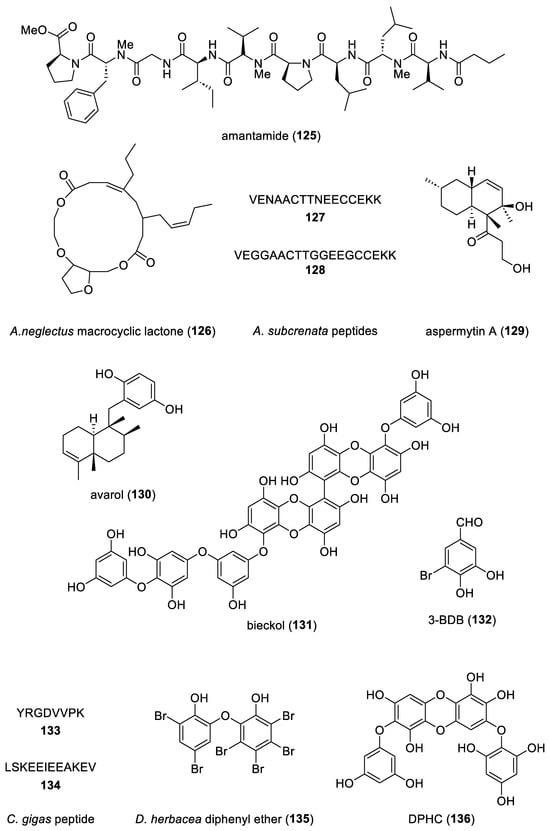
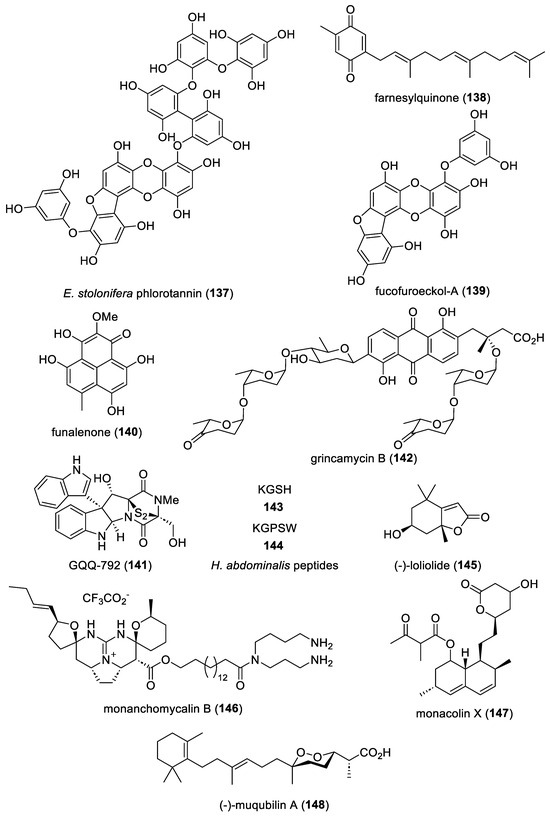
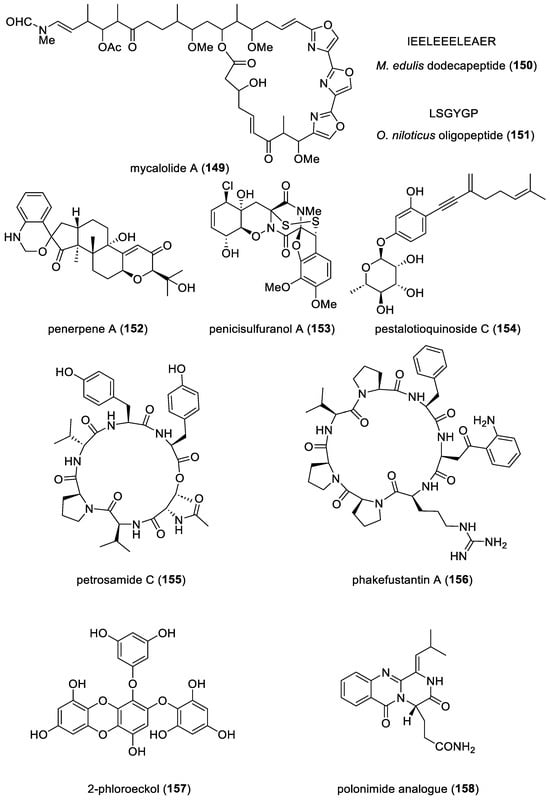
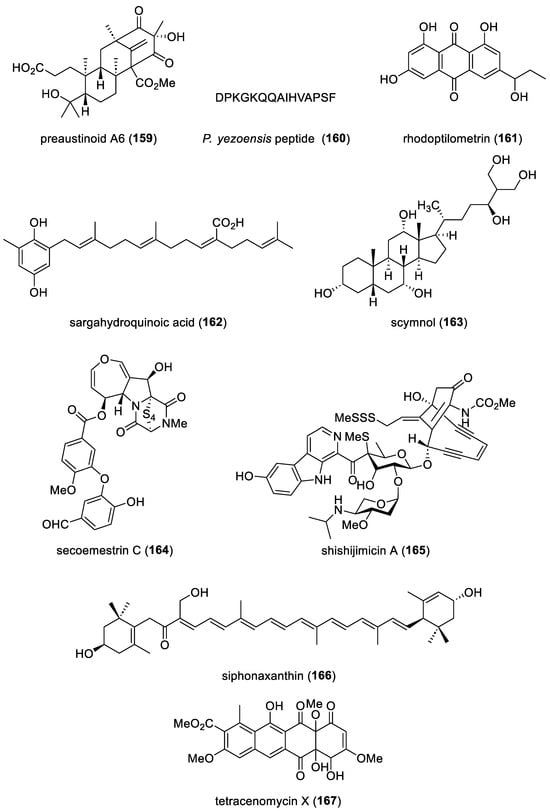
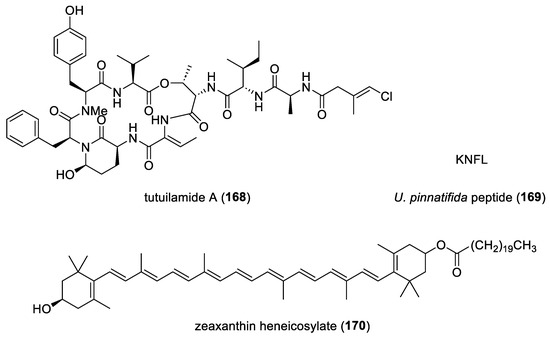
Figure 3.
Marine pharmacology in 2019–2021: marine compounds with miscellaneous mechanisms of action.
Figure 3.
Marine pharmacology in 2019–2021: marine compounds with miscellaneous mechanisms of action.
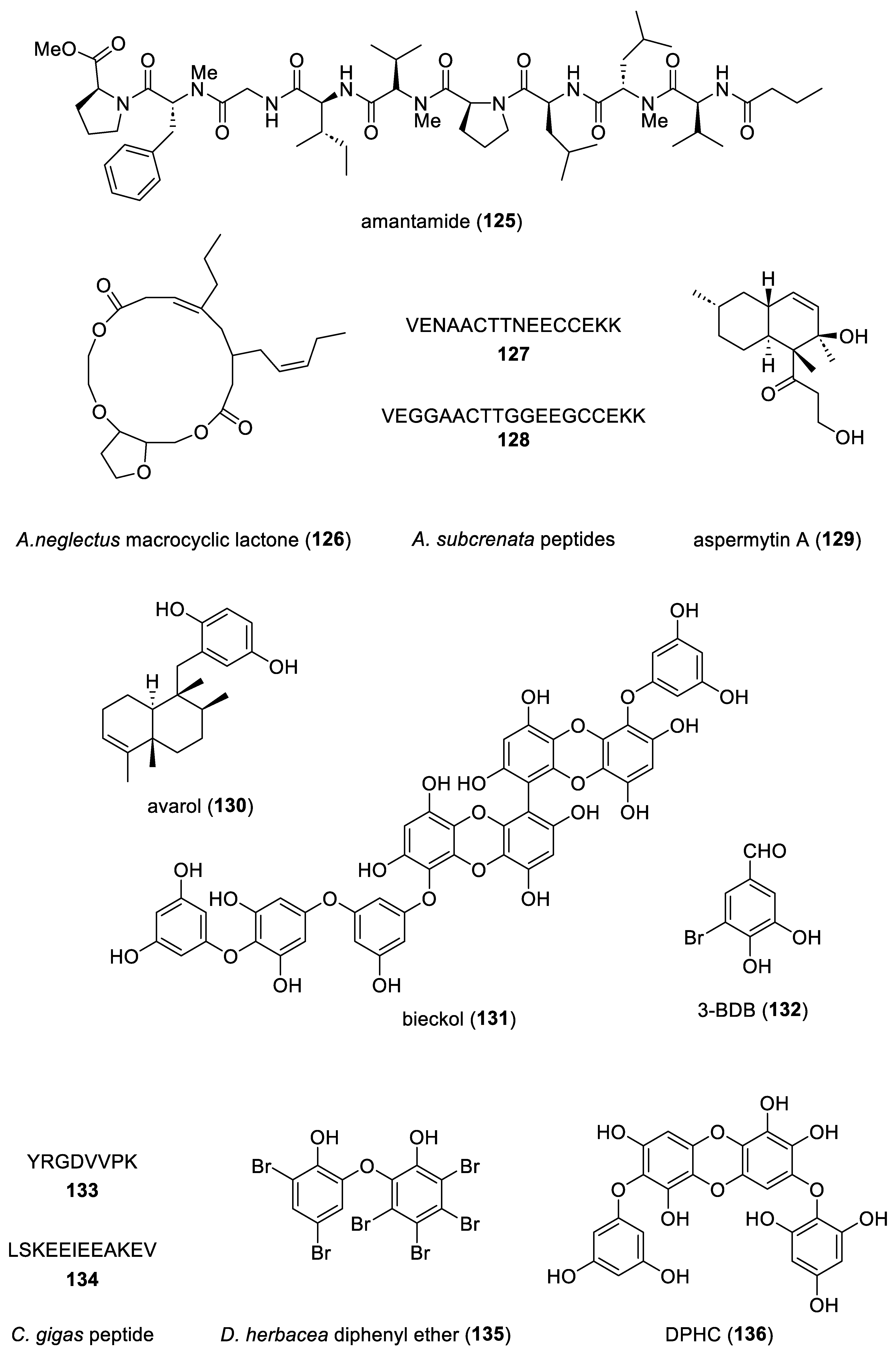
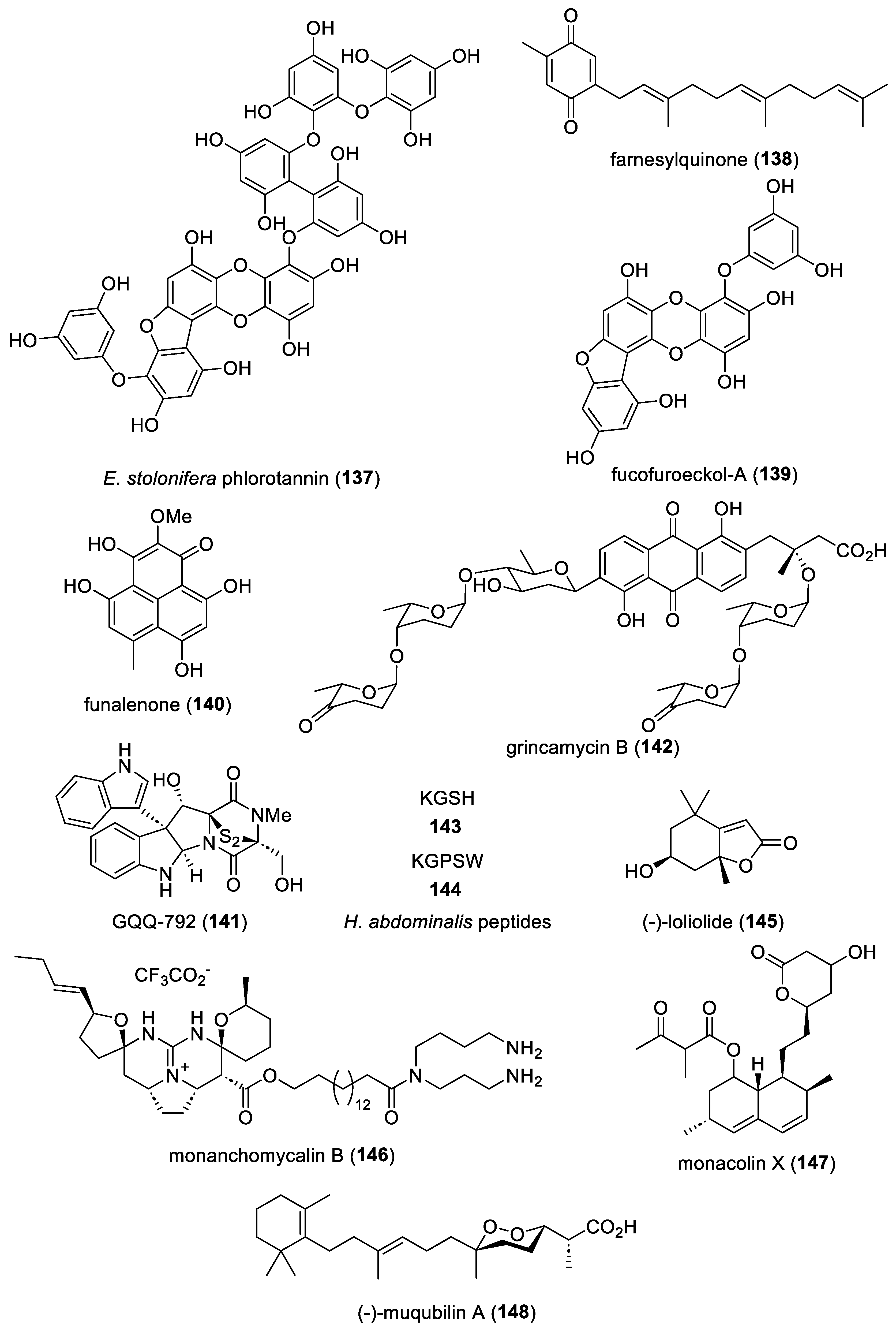
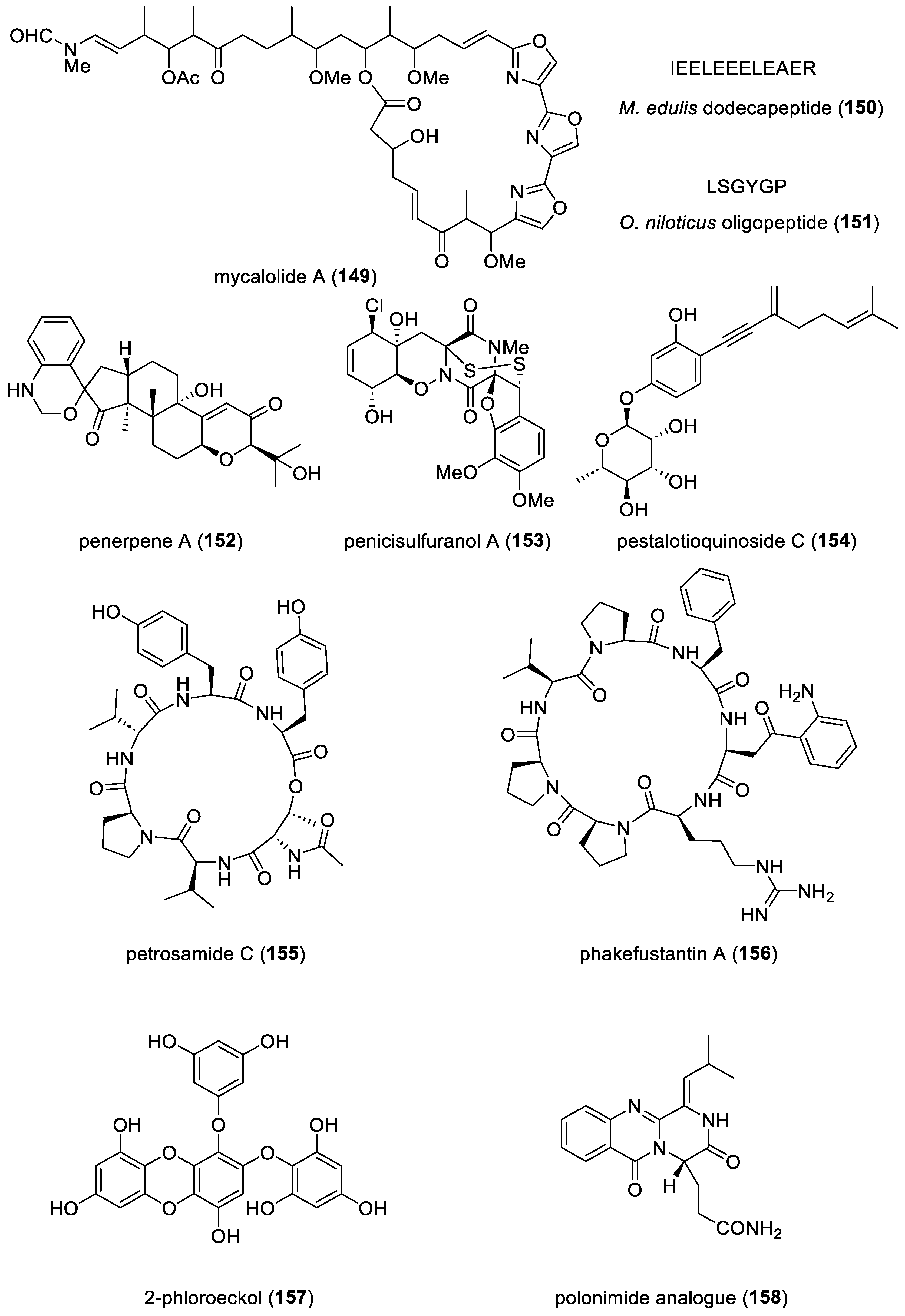
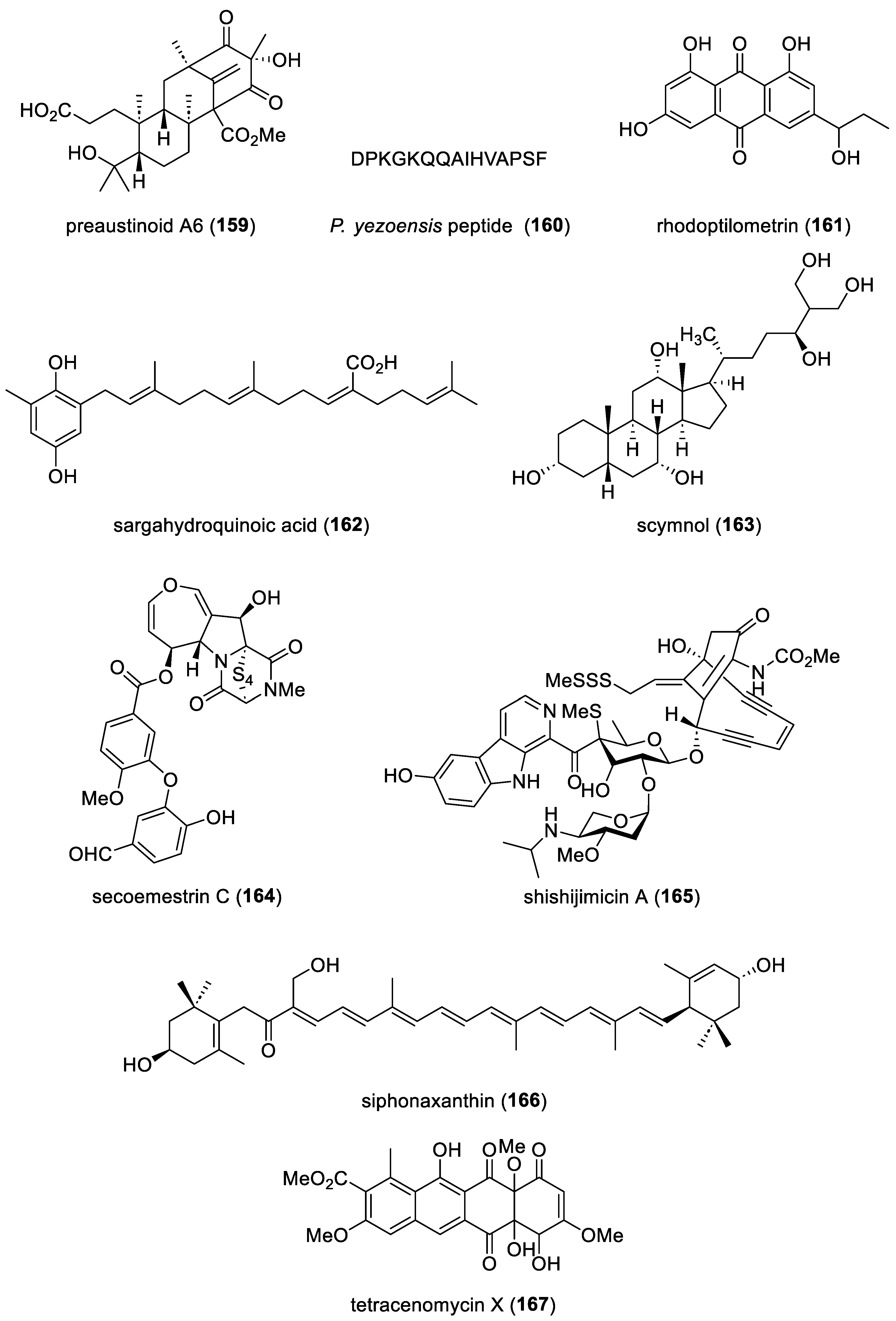
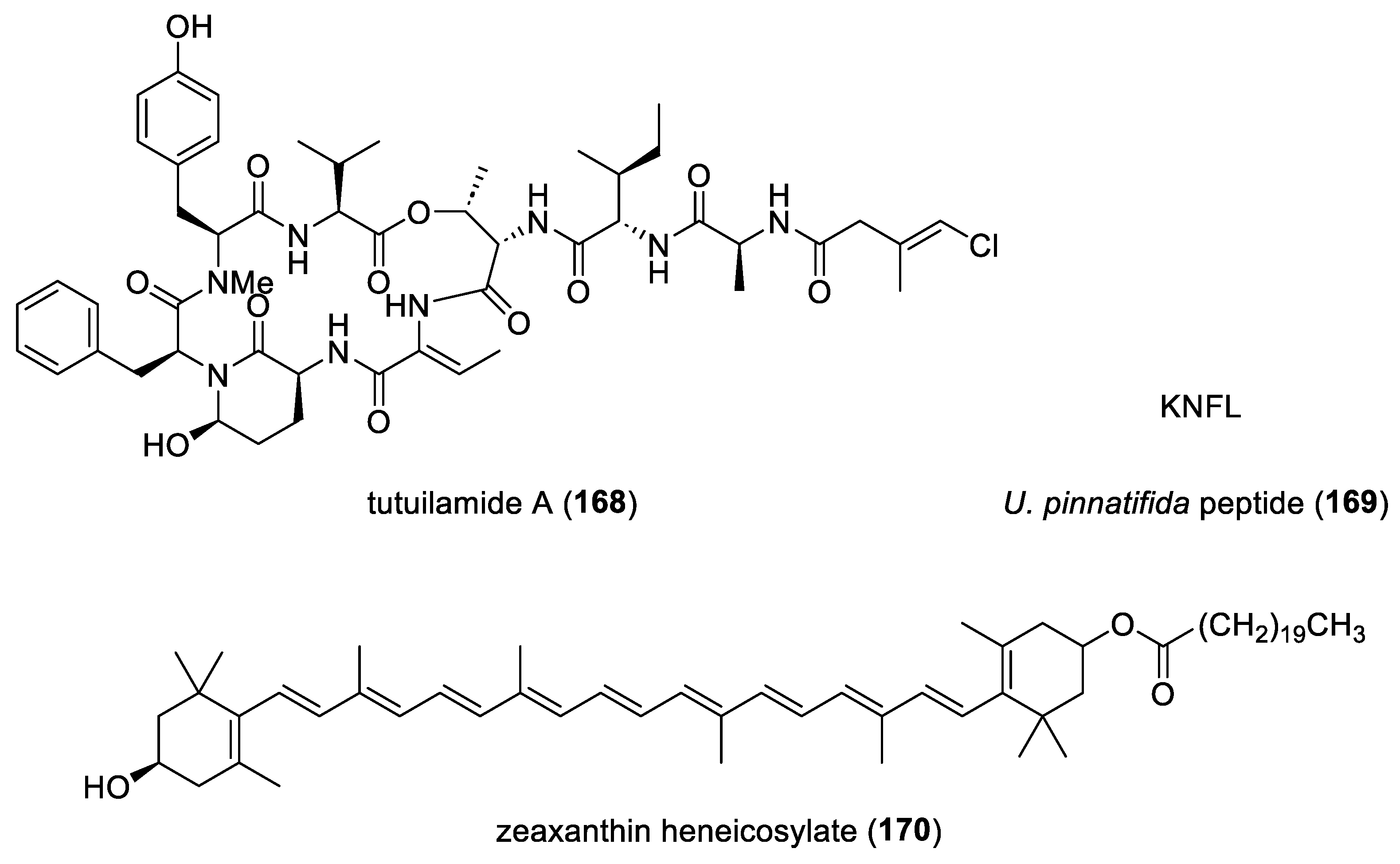
5. Reviews on Marine Pharmacology and Pharmaceuticals
In 2019–2021, a large number of reviews were published that covered general and/or specific areas of marine preclinical pharmacology: (a) marine pharmacology and marine pharmaceuticals: marine natural products and their relevant biological activities published in 2019, 2020 and 2021 [203,204,205]; advances in marine natural products therapeutic potential [206]; polar marine terpenoids and their potential for drug discovery [207]; bioactive properties of marine phenolics [208]; chemistry and biological activities of marine flavonoids [209]; marine-derived spirotetronates and potential pharmaceutical applications [210]; bioactivities of marine-derived hydroperoxides [211]; marine-derived macrocyclic alkaloids as a potential source of drugs [212]; pharmacology of thiazole-based marine-derived peptides [213]; marine meroterpenoids’ and cembranoids’ biological activities [214,215]; marine-derived macrolides chemical and biological diversity [216]; the pharmacology of cyanobacterial-derived natural products [217,218,219,220,221,222]; marine natural products from microalgae: an -omics overview [223,224]; pharmacological potential of macroalgae natural products [225,226,227,228,229,230,231,232]; bioactive compounds from Bryozoa and Cnidaria [233,234,235,236]; genus Didemnum secondary metabolites’ pharmacological properties [237]; marine fungi-derived bioactive compounds [238,239,240]; the pharmacological significance of marine microbial natural compounds [241,242,243,244,245]; marine sponge-derived pharmacological activity [246,247]; the pharmacological activity of mangrove-derived natural products [248,249,250]; bioactive marine natural products from Indonesia (1970–2017) and the Red Sea [251,252]; marine-derived bioactive compounds in China (2009–2018) [253]; marine bioactive natural products from the Yucatan Peninsula [254]; marine natural products as a source of new drugs: a patent review and productivity (2015–2018) [255,256]; natural product-based antibody drug conjugates: clinical status as of 9 November 2020 [257]; the global marine pharmaceutical pipeline: approved marine-derived compounds and in Phase I, II and III of clinical development https://www.marinepharmacology.org/ (accessed on 20 May 2024); (b) antimicrobial, antifungal and antiviral marine pharmacology: marine bacteria-derived antimicrobial natural products [258,259,260,261]; marine bacteria as source of quorum-sensing inhibitors [262,263,264,265]; marine natural products targeting multidrug-resistant bacteria [266,267,268]; ascidian-derived marine antimicrobial natural products [269]; epinecidin-1 and other marine antimicrobial peptides [270,271]; marine fungi-derived antimicrobial natural products [272,273]; marine macrolides with antibacterial and/or antifungal activity [274]; antimicrobial lipids from marine organisms [275]; marine tryptophan-derived antimicrobial alkaloids [276]; recent advances on marine-based antifungals [277]; marine natural products for RNA virus infections including SARS-CoV-2 [278,279,280]; natural products targeting hepatitis C and respiratory viruses [281,282]; marine algae-derived compounds as antivirals [283,284,285]; (c) antiprotozoal and antimalarial marine pharmacology: antiprotozoal activities of marine polyether triterpenoids [286]; recent advances in novel antiprotozoal agents [287,288]; marine drugs as a new drug lead for trypanosomatids and malaria [289,290]; marine-sponge-derived antimalarial metabolites [291]; antituberculosis marine natural products [292]; marine natural products and latent tuberculosis drug resistance [293]; (d) immuno- and anti-inflammatory marine pharmacology: anti-inflammatory marine natural products [294]; marine-derived compounds for rheumatoid arthritis treatment [295]; marine anti-inflammatory alkaloids [296]; anti-inflammatory compounds from marine fungi [297]; anti-inflammatory prostaglandins and peptides in marine organisms [298,299]; marine polypeptides as inhibitors of neutrophil elastase [300]; anti-inflammatory marine n-3 polyunsaturated fatty acids [301,302,303]; anti-inflammatory pharmacology of fucoxanthin [304]; antioxidant properties of marine algae [305]; Sargassum seaweed as a source of anti-inflammatory natural products [306]; microalgae with immunomodulatory activities [307]; immunomodulation by marine invertebrate-derived natural products [308,309]; marine-derived vaccine adjuvants [310]; (e) cardiovascular and antidiabetic marine pharmacology: marine-derived anti-atherosclerotic and lipid-lowering compounds [311,312]; marine-derived anti-thrombotics and patents [313,314]; marine-derived sulfated polysaccharides as antithrombotics [315]; microalgae-derived bioactive compounds for cardiovascular pharmacology and inflammation [316]; anti-obesity and anti-diabetic effects of marine algae [317,318,319,320]; antidiabetic properties of Indian mangroves [321]; anti-obesity and anti-diabetic benefits of the carotenoids astaxanthin and fucoxanthin [322,323]; brown seaweeds for the management of metabolic syndrome [324,325]; (f) nervous system marine pharmacology: the neuroprotective potential of marine natural products [326,327]; marine omega-3 phospholipids and brain health [328]; the pharmacological diversity of conotoxins [329,330]; biological activities and pharmacological applications of conopeptides [330]; marine toxins and gastrointestinal visceral pain therapeutics [331]; marine algae anti-inflammatory and neuroprotective pharmacology [332,333,334]; marine compounds for Alzheimer’s therapeutics [335,336,337,338,339]; cyanobacterial bioactive compounds for Alzheimer’s disease [340]; marine natural products for Parkinson’s disease [341]; neuroprotective pharmacology of astaxanthin [342,343,344]; cnidarian peptide neurotoxins as modulators in central nervous system diseases [345]; marine toxins targeting mammalian voltage-gated potassium channels [346]; marine excitatory amino acids [347]; marine natural products with monoamine oxidase inhibitory activity [348]; (g) miscellaneous molecular targets, methodologies and uses: marine natural product databases [349,350]; metabolomic tools used in marine natural product drug discovery [351]; a chemical genetics approach for biologically active marine natural product discovery [352]; marine-derived cellular signal transduction inhibitors [353]; seaweed-derived signal transduction pathway modulators [354]; astaxanthin modulation of autophagy signal transduction pathways and ocular diseases [355,356]; marine natural product protein kinase inhibitors [357]; marine natural products as ATP-competitive mTOR kinase inhibitors [358]; drug potential of the marine-derived protein kinase C modulators bryostatins [359,360]; natural products as eukaryotic protein secretion modulators [361]; marine natural products targeting eukaryotic cell membranes and cytoskeleton [362,363]; marine natural products as pregnane X receptor ligands [364]; ubiquitin–proteasome system modulation by marine natural products [365]; intracellular calcium signal modulation by marine natural products [366]; cyanobacterial natural products for skin protection and cosmetic applications [367,368,369]; and seaweed bioactive compounds as nutraceuticals and cosmeceuticals [370,371,372].
6. Conclusions
This review, covering the peer-reviewed marine pharmacology literature published in 2019–2021, is the 12th contribution to the marine preclinical pharmacology pipeline review series that was initiated by AMSM in 1998 [1,2,3,4,5,6,7,8,9,10,11], with the purpose of presenting a consolidated and systematic overview of selected peer-reviewed preclinical marine pharmacological literature published during 2019–2021. Global preclinical marine pharmacology mechanism-of-action research involved chemists and pharmacologists from 41 countries, namely, Australia, Belgium, Brazil, Canada, Chile, China, Costa Rica, Cuba, Czech Republic, Denmark, Egypt, Ecuador, France, Germany, Greece, Hungary, India, Indonesia, Iran, Ireland, Italy, Japan, Jordan, Malaysia, Mexico, the Netherlands, Norway, Panama, Portugal, Romania, Russian Federation, Saudi Arabia, Singapore, South Korea, Spain, Switzerland, Thailand, Taiwan, the Philippines; United Kingdom, Vietnam, and the United States. Thus, during 2019–2021, the marine preclinical pharmaceutical pipeline continued to generate novel marine chemical leads for the active marine clinical pharmaceutical pipeline. As currently shown on the marine pharmaceutical pipeline website, https://www.marinepharmacology.org/ (accessed on 20 May 2024), there are 15 marine-derived pharmaceuticals approved by either the U.S. Food and Drug Administration, Australia, Japan and/or China, and 33 compounds in either Phase I, II or III of clinical pharmaceutical development.
Author Contributions
Conceptualization: A.M.S.M., M.S.-M., M.L.P., A.D.R., F.N. and O.T.-S.; methodology: A.M.S.M., V.A.M., M.S.-M., M.L.P., A.D.R., F.N. and O.T.-S.; 2019–2021 literature analysis: A.M.S.M., V.A.M., M.S.-M. and M.L.P.; Figure 1, Figure 2 and Figure 3: A.D.R., F.N. and O.T.-S.; writing—original draft preparation: A.M.S.M., V.A.M., M.S.-M. and M.L.P.; writing—review and editing: A.M.S.M., V.A.M., M.S.-M., M.L.P., A.D.R., F.N. and O.T.-S.; funding: A.M.S.M., A.D.R. and O.T.-S. All authors have read and agreed to the published version of the manuscript.
Funding
We gratefully acknowledge support from Midwestern University to A.M.S.M. NIH-SC1 Award (Grant 1SC1GM086271-01A1) of the University of Puerto Rico to ADR. The content of this review is solely the responsibility of the authors and does not necessarily represent the official views of the NIH. EU grant within the MUR PNRR Extended Partnership initiative on Emerging Infectious Diseases (Project no. PE00000007, INF-ACT) to O.T.-S.
Acknowledgments
We thank the contributions of students Linda Huang, Neal Patel, Patrick Patel, Katelyn Howe, and Asmaa Alawsi from the Chicago College of Pharmacy, Midwestern University for the retrieval of the 2019, 2020 and 2021 marine pharmacology literature reviewed in this article, and Colleen Bannon, Midwestern University Library for Endnote database assistance. We also thank the secretarial assistance of Victoria Sears from the Pharmacology Department, College of Graduate Studies.
Conflicts of Interest
The authors declare no conflicts of interest.
References
- Mayer, A.M.S.; Lehmann, V.K.B. Marine pharmacology in 1998: Marine compounds with antibacterial, anticoagulant, antifungal, anti-inflammatory, anthelmintic, antiplatelet, antiprotozoal, and antiviral activities; with actions on the cardiovascular, endocrine, immune, and nervous systems; and other miscellaneous mechanisms of action. Pharmacologist 2000, 42, 62–69. [Google Scholar]
- Mayer, A.M.S.; Hamann, M.T. Marine pharmacology in 1999: Compounds with antibacterial, anticoagulant, antifungal, anthelmintic, anti-inflammatory, antiplatelet, antiprotozoal and antiviral activities affecting the cardiovascular, endocrine, immune and nervous systems, and other miscellaneous mechanisms of action. Comp. Biochem. Physiol. C Toxicol. Pharmacol. 2002, 132, 315–339. [Google Scholar] [PubMed]
- Mayer, A.M.S.; Hamann, M.T. Marine pharmacology in 2000: Marine compounds with antibacterial, anticoagulant, antifungal, anti-inflammatory, antimalarial, antiplatelet, antituberculosis, and antiviral activities; affecting the cardiovascular, immune, and nervous systems and other miscellaneous mechanisms of action. Mar. Biotechnol. 2004, 6, 37–52. [Google Scholar]
- Mayer, A.M.S.; Hamann, M.T. Marine pharmacology in 2001–2002: Marine compounds with anthelmintic, antibacterial, anticoagulant, antidiabetic, antifungal, anti-inflammatory, antimalarial, antiplatelet, antiprotozoal, antituberculosis, and antiviral activities; affecting the cardiovascular, immune and nervous systems and other miscellaneous mechanisms of action. Comp. Biochem. Physiol. C Toxicol. Pharmacol. 2005, 140, 265–286. [Google Scholar] [PubMed]
- Mayer, A.M.S.; Rodriguez, A.D.; Berlinck, R.G.; Hamann, M.T. Marine pharmacology in 2003–2004: Marine compounds with anthelmintic antibacterial, anticoagulant, antifungal, anti-inflammatory, antimalarial, antiplatelet, antiprotozoal, antituberculosis, and antiviral activities; affecting the cardiovascular, immune and nervous systems, and other miscellaneous mechanisms of action. Comp. Biochem. Physiol. C Toxicol. Pharmacol. 2007, 145, 553–581. [Google Scholar] [PubMed]
- Mayer, A.M.S.; Rodriguez, A.D.; Berlinck, R.G.; Hamann, M.T. Marine pharmacology in 2005–2006: Marine compounds with anthelmintic, antibacterial, anticoagulant, antifungal, anti-inflammatory, antimalarial, antiprotozoal, antituberculosis, and antiviral activities; affecting the cardiovascular, immune and nervous systems, and other miscellaneous mechanisms of action. Biochim. Biophys. Acta 2009, 1790, 283–308. [Google Scholar] [CrossRef]
- Mayer, A.M.S.; Rodriguez, A.D.; Berlinck, R.G.; Fusetani, N. Marine pharmacology in 2007–2008: Marine compounds with antibacterial, anticoagulant, antifungal, anti-inflammatory, antimalarial, antiprotozoal, antituberculosis, and antiviral activities; affecting the immune and nervous system, and other miscellaneous mechanisms of action. Comp. Biochem. Physiol. C Toxicol. Pharmacol. 2011, 153, 191–222. [Google Scholar] [CrossRef] [PubMed]
- Mayer, A.M.S.; Rodriguez, A.D.; Taglialatela-Scafati, O.; Fusetani, N. Marine Pharmacology in 2009–2011: Marine Compounds with Antibacterial, Antidiabetic, Antifungal, Anti-Inflammatory, Antiprotozoal, Antituberculosis, and Antiviral Activities; Affecting the Immune and Nervous Systems, and other Miscellaneous Mechanisms of Action. Mar. Drugs 2013, 11, 2510–2573. [Google Scholar] [CrossRef]
- Mayer, A.M.S.; Rodriguez, A.D.; Taglialatela-Scafati, O.; Fusetani, N. Marine Pharmacology in 2012–2013: Marine Compounds with Antibacterial, Antidiabetic, Antifungal, Anti-Inflammatory, Antiprotozoal, Antituberculosis, and Antiviral Activities; Affecting the Immune and Nervous Systems, and Other Miscellaneous Mechanisms of Action. Mar. Drugs 2017, 15, 273. [Google Scholar] [CrossRef]
- Mayer, A.M.S.; Guerrero, A.J.; Rodriguez, A.D.; Taglialatela-Scafati, O.; Nakamura, F.; Fusetani, N. Marine Pharmacology in 2014–2015: Marine Compounds with Antibacterial, Antidiabetic, Antifungal, Anti-Inflammatory, Antiprotozoal, Antituberculosis, Antiviral, and Anthelmintic Activities; Affecting the Immune and Nervous Systems, and Other Miscellaneous Mechanisms of Action. Mar. Drugs 2019, 18, 5. [Google Scholar] [CrossRef]
- Mayer, A.M.S.; Guerrero, A.J.; Rodriguez, A.D.; Taglialatela-Scafati, O.; Nakamura, F.; Fusetani, N. Marine Pharmacology in 2016–2017: Marine Compounds with Antibacterial, Antidiabetic, Antifungal, Anti-Inflammatory, Antiprotozoal, Antituberculosis and Antiviral Activities; Affecting the Immune and Nervous Systems, and Other Miscellaneous Mechanisms of Action. Mar. Drugs 2021, 19, 49. [Google Scholar] [CrossRef] [PubMed]
- Mayer, A.M.S.; Pierce, M.L.; Howe, K.; Rodríguez, A.D.; Taglialatela-Scafati, O.; Nakamura, F.; Fusetani, N. Marine pharmacology in 2018: Marine compounds with antibacterial, antidiabetic, antifungal, anti-inflammatory, antiprotozoal, antituberculosis and antiviral activities; affecting the immune and nervous systems, and other miscellaneous mechanisms of action. Pharmacol. Res. 2022, 183, 106391. [Google Scholar] [CrossRef] [PubMed]
- Schmitz, F.J.; Bowden, B.F.; Toth, S.I. Antitumor and Cytotoxic Compounds from Marine Organisms. Pharm. Bioact. Nat. Prod. 1993, 1, 197–308. [Google Scholar]
- Gomez-Rodriguez, L.; Schultz, P.J.; Tamayo-Castillo, G.; Dotson, G.D.; Sherman, D.H.; Tripathi, A. Adipostatins E-J, New Potent Antimicrobials Identified as Inhibitors of Coenzyme—A Biosynthesis. Tetrahedron Lett. 2020, 61, 151469. [Google Scholar] [CrossRef] [PubMed]
- Elliott, A.G.; Huang, J.X.; Neve, S.; Zuegg, J.; Edwards, I.A.; Cain, A.K.; Boinett, C.J.; Barquist, L.; Lundberg, C.V.; Steen, J.; et al. An amphipathic peptide with antibiotic activity against multidrug-resistant Gram-negative bacteria. Nat. Commun. 2020, 11, 3184. [Google Scholar] [CrossRef] [PubMed]
- Paderog, M.J.V.; Suarez, A.F.L.; Sabido, E.M.; Low, Z.J.; Saludes, J.P.; Dalisay, D.S. Anthracycline Shunt Metabolites from Philippine Marine Sediment-Derived Streptomyces Destroy Cell Membrane Integrity of Multidrug-Resistant Staphylococcus aureus. Front. Microbiol. 2020, 11, 743. [Google Scholar] [CrossRef] [PubMed]
- Wang, M.; Zhao, L.; Wu, H.; Zhao, C.; Gong, Q.; Yu, W. Cladodionen Is a Potential Quorum Sensing Inhibitor against Pseudomonas aeruginosa. Mar. Drugs 2020, 18, 205. [Google Scholar] [CrossRef] [PubMed]
- Gowrishankar, S.; Pandian, S.K.; Balasubramaniam, B.; Balamurugan, K. Quorum quelling efficacy of marine cyclic dipeptide -cyclo(l-leucyl-l-prolyl) against the uropathogen Serratia marcescens. Food Chem. Toxicol. 2019, 123, 326–336. [Google Scholar] [CrossRef] [PubMed]
- de Figueiredo, C.S.; Menezes Silva, S.M.P.; Abreu, L.S.; da Silva, E.F.; da Silva, M.S.; Cavalcanti de Miranda, G.E.; Costa, V.C.O.; Le Hyaric, M.; Siqueira Junior, J.P.; Barbosa Filho, J.M.; et al. Dolastane diterpenes from Canistrocarpus cervicornis and their effects in modulation of drug resistance in Staphylococcus aureus. Nat. Prod. Res. 2019, 33, 3231–3239. [Google Scholar] [CrossRef]
- Davison, J.R.; Bewley, C.A. Antimicrobial Chrysophaentin Analogs Identified from Laboratory Cultures of the Marine Microalga Chrysophaeum taylorii. J. Nat. Prod. 2019, 82, 148–153. [Google Scholar] [CrossRef]
- Wang, Y.; Zhang, J.; Sun, Y.; Sun, L. A Crustin from Hydrothermal Vent Shrimp: Antimicrobial Activity and Mechanism. Mar. Drugs 2021, 19, 176. [Google Scholar] [CrossRef]
- Campana, R.; Favi, G.; Baffone, W.; Lucarini, S. Marine Alkaloid 2,2-Bis(6-bromo-3-indolyl) Ethylamine and Its Synthetic Derivatives Inhibit Microbial Biofilms Formation and Disaggregate Developed Biofilms. Microorganisms 2019, 7, 28. [Google Scholar] [CrossRef] [PubMed]
- Liang, X.; Matthew, S.; Chen, Q.Y.; Kwan, J.C.; Paul, V.J.; Luesch, H. Discovery and Total Synthesis of Doscadenamide A: A Quorum Sensing Signaling Molecule from a Marine Cyanobacterium. Org. Lett. 2019, 21, 7274–7278. [Google Scholar] [CrossRef] [PubMed]
- Jabila Mary, T.R.; Kannan, R.R.; Muthamil Iniyan, A.; Carlton Ranjith, W.A.; Nandhagopal, S.; Vishwakarma, V.; Prakash Vincent, S.G. β-lactamase inhibitory potential of kalafungin from marine Streptomyces in Staphylococcus aureus infected zebrafish. Microbiol. Res. 2021, 244, 126666. [Google Scholar] [CrossRef] [PubMed]
- Maynard, A.; Butler, N.L.; Ito, T.; da Silva, A.J.; Murai, M.; Chen, T.; Koffas, M.A.G.; Miyoshi, H.; Barquera, B. Antibiotic Korormicin A Kills Bacteria by Producing Reactive Oxygen Species. J. Bacteriol. 2019, 201, 10-1128. [Google Scholar] [CrossRef] [PubMed]
- Chung, B.; Kwon, O.S.; Shin, J.; Oh, K.B. Antibacterial Activity and Mode of Action of Lactoquinomycin A from Streptomyces bacillaris. Mar. Drugs 2020, 19, 7. [Google Scholar] [CrossRef] [PubMed]
- Thulshan Jayathilaka, E.H.T.; Liyanage, T.D.; Rajapaksha, D.C.; Dananjaya, S.H.S.; Nikapitiya, C.; Whang, I.; De Zoysa, M. Octominin: An antibacterial and anti-biofilm peptide for controlling the multidrug resistance and pathogenic Streptococcus parauberis. Fish Shellfish Immunol. 2021, 110, 23–34. [Google Scholar] [CrossRef]
- Yu, X.; Li, L.; Sun, S.; Chang, A.; Dai, X.; Li, H.; Wang, Y.; Zhu, H. A Cyclic Dipeptide from Marine Fungus Penicillium chrysogenum DXY-1 Exhibits Anti-quorum Sensing Activity. ACS Omega 2021, 6, 7693–7700. [Google Scholar] [CrossRef] [PubMed]
- Pan, Y.; Zheng, L.B.; Mao, Y.; Wang, J.; Lin, L.S.; Su, Y.Q.; Li, Y. The antibacterial activity and mechanism analysis of piscidin 5 like from Larimichthys crocea. Dev. Comp. Immunol. 2019, 92, 43–49. [Google Scholar] [CrossRef]
- Kim, Y.G.; Lee, J.H.; Lee, S.; Lee, Y.K.; Hwang, B.S.; Lee, J. Antibiofilm Activity of Phorbaketals from the Marine Sponge Phorbas sp. against Staphylococcus aureus. Mar. Drugs 2021, 19, 301. [Google Scholar] [CrossRef]
- Kizhakkekalam, V.K.; Chakraborty, K.; Joy, M. Antibacterial and antioxidant aryl-enclosed macrocyclic polyketide from intertidal macroalgae associated heterotrophic bacterium Shewanella algae. Med. Chem. Res. 2020, 29, 145–155. [Google Scholar] [CrossRef]
- Chakraborty, K.; Kizhakkekalam, V.K.; Joy, M. Macrocyclic polyketides with siderophore mode of action from marine heterotrophic Shewanella algae: Prospective anti-infective leads attenuate drug-resistant pathogens. J. Appl. Microbiol. 2021, 130, 1552–1570. [Google Scholar] [CrossRef] [PubMed]
- Hansen, K.Ø.; Hansen, I.K.Ø.; Richard, C.S.; Jenssen, M.; Andersen, J.H.; Hansen, E.H. Antimicrobial activity of securamines from the bryozoan Securiflustra securifrons. Nat. Prod. Commun. 2021, 16, 1934578X21996180. [Google Scholar] [CrossRef]
- Hansen, I.K.O.; Isaksson, J.; Poth, A.G.; Hansen, K.O.; Andersen, A.J.C.; Richard, C.S.M.; Blencke, H.M.; Stensvåg, K.; Craik, D.J.; Haug, T. Isolation and Characterization of Antimicrobial Peptides with Unusual Disulfide Connectivity from the Colonial Ascidian Synoicum turgens. Mar. Drugs 2020, 18, 51. [Google Scholar] [CrossRef] [PubMed]
- Reina, J.C.; Perez-Victoria, I.; Martin, J.; Llamas, I. A Quorum-Sensing Inhibitor Strain of Vibrio alginolyticus Blocks Qs-Controlled Phenotypes in Chromobacterium violaceum and Pseudomonas aeruginosa. Mar. Drugs 2019, 17, 494. [Google Scholar] [CrossRef]
- Elsadek, L.A.; Matthews, J.H.; Nishimura, S.; Nakatani, T.; Ito, A.; Gu, T.; Luo, D.; Salvador-Reyes, L.A.; Paul, V.J.; Kakeya, H.; et al. Genomic and Targeted Approaches Unveil the Cell Membrane as a Major Target of the Antifungal Cytotoxin Amantelide A. Chembiochem 2021, 22, 1790–1799. [Google Scholar] [CrossRef]
- Yang, B.; He, Y.; Lin, S.; Zhang, J.; Li, H.; Wang, J.; Hu, Z.; Zhang, Y. Antimicrobial Dolabellanes and Atranones from a Marine-Derived Strain of the Toxigenic Fungus Stachybotrys chartarum. J. Nat. Prod. 2019, 82, 1923–1929. [Google Scholar] [CrossRef]
- Tang, X.X.; Yan, X.; Fu, W.H.; Yi, L.Q.; Tang, B.W.; Yu, L.B.; Fang, M.J.; Wu, Z.; Qiu, Y.K. New β-Lactone with Tea Pathogenic Fungus Inhibitory Effect from Marine-Derived Fungus MCCC3A00957. J. Agric. Food Chem. 2019, 67, 2877–2885. [Google Scholar] [CrossRef]
- Kim, H.; Hwang, J.Y.; Chung, B.; Cho, E.; Bae, S.; Shin, J.; Oh, K.B. 2-Alkyl-4-hydroxyquinolines from a Marine-Derived Streptomyces sp. Inhibit Hyphal Growth Induction in Candida albicans. Mar. Drugs 2019, 17, 133. [Google Scholar] [CrossRef]
- Dalisay, D.S.; Rogers, E.W.; Molinski, T.F. Oceanapiside, a Marine Natural Product, Targets the Sphingolipid Pathway of Fluconazole-Resistant Candida glabrata. Mar. Drugs 2021, 19, 126. [Google Scholar] [CrossRef]
- Tripathi, S.K.; Feng, Q.; Liu, L.; Levin, D.E.; Roy, K.K.; Doerksen, R.J.; Baerson, S.R.; Shi, X.; Pan, X.; Xu, W.H.; et al. Puupehenone, a Marine-Sponge-Derived Sesquiterpene Quinone, Potentiates the Antifungal Drug Caspofungin by Disrupting Hsp90 Activity and the Cell Wall Integrity Pathway. mSphere 2020, 5, 10-1128. [Google Scholar] [CrossRef] [PubMed]
- Meng, L.; Sun, C.; Zhang, C.; Song, S.; Sun, X.; Ju, J.; Deng, Y. Efficacy of Compounds Isolated from Streptomyces olivaceus against the Morphogenesis and Virulence of Candida albicans. Mar. Drugs 2019, 17, 442. [Google Scholar] [CrossRef] [PubMed]
- Alhadrami, H.A.; Thissera, B.; Hassan, M.H.A.; Behery, F.A.; Ngwa, C.J.; Hassan, H.M.; Pradel, G.; Abdelmohsen, U.R.; Rateb, M.E. Bio-Guided Isolation of Antimalarial Metabolites from the Coculture of Two Red Sea Sponge-Derived Actinokineospora and Rhodococcus spp. Mar. Drugs 2021, 19, 109. [Google Scholar] [CrossRef] [PubMed]
- Sweeney-Jones, A.M.; Gagaring, K.; Antonova-Koch, J.; Zhou, H.; Mojib, N.; Soapi, K.; Skolnick, J.; McNamara, C.W.; Kubanek, J. Antimalarial Peptide and Polyketide Natural Products from the Fijian Marine Cyanobacterium Moorea producens. Mar. Drugs 2020, 18, 167. [Google Scholar] [CrossRef] [PubMed]
- Knestrick, M.A.; Wilson, N.G.; Roth, A.; Adams, J.H.; Baker, B.J. Friomaramide, a Highly Modified Linear Hexapeptide from an Antarctic Sponge, Inhibits Plasmodium falciparum Liver-Stage Development. J. Nat. Prod. 2019, 82, 2354–2358. [Google Scholar] [CrossRef] [PubMed]
- Wright, A.E.; Collins, J.E.; Roberts, B.; Roberts, J.C.; Winder, P.L.; Reed, J.K.; Diaz, M.C.; Pomponi, S.A.; Chakrabarti, D. Antiplasmodial Compounds from Deep-Water Marine Invertebrates. Mar. Drugs 2021, 19, 179. [Google Scholar] [CrossRef] [PubMed]
- Rodríguez-Expósito, R.L.; Nocchi, N.; Reyes-Batlle, M.; Sifaoui, I.; Suárez-Gómez, B.; Díaz-Marrero, A.R.; Souto, M.L.; Piñero, J.E.; Fernández, J.J.; Lorenzo-Morales, J. Antiamoebic effects of sesquiterpene lactones isolated from the zoanthid Palythoa aff. clavata. Bioorg. Chem. 2021, 108, 104682. [Google Scholar] [CrossRef] [PubMed]
- Huang, H.N.; Chuang, C.M.; Chen, J.Y.; Chieh-Yu, P. Epinecidin-1: A marine fish antimicrobial peptide with therapeutic potential against Trichomonas vaginalis infection in mice. Peptides 2019, 112, 139–148. [Google Scholar] [CrossRef] [PubMed]
- Lima, M.L.; Romanelli, M.M.; Borborema, S.E.T.; Johns, D.M.; Migotto, A.E.; Lago, J.H.G.; Tempone, A.G. Antitrypanosomal activity of isololiolide isolated from the marine hydroid Macrorhynchia philippina (Cnidaria, Hydrozoa). Bioorg. Chem. 2019, 89, 103002. [Google Scholar] [CrossRef]
- Lorenzo-Morales, J.; Diaz-Marrero, A.R.; Cen-Pacheco, F.; Sifaoui, I.; Reyes-Batlle, M.; Souto, M.L.; Hernandez Daranas, A.; Pinero, J.E.; Fernandez, J.J. Evaluation of Oxasqualenoids from the Red Alga Laurencia viridis against Acanthamoeba. Mar. Drugs 2019, 17, 420. [Google Scholar] [CrossRef]
- Boudreau, P.D.; Miller, B.W.; McCall, L.I.; Almaliti, J.; Reher, R.; Hirata, K.; Le, T.; Siqueira-Neto, J.L.; Hook, V.; Gerwick, W.H. Design of Gallinamide A Analogs as Potent Inhibitors of the Cysteine Proteases Human Cathepsin L and Trypanosoma cruzi Cruzain. J. Med. Chem. 2019, 62, 9026–9044. [Google Scholar] [CrossRef] [PubMed]
- Cartuche, L.; Reyes-Batlle, M.; Sifaoui, I.; Arberas-Jimenez, I.; Pinero, J.E.; Fernandez, J.J.; Lorenzo-Morales, J.; Diaz-Marrero, A.R. Antiamoebic Activities of Indolocarbazole Metabolites Isolated from Streptomyces sanyensis Cultures. Mar. Drugs 2019, 17, 588. [Google Scholar] [CrossRef] [PubMed]
- Casertano, M.; Imperatore, C.; Luciano, P.; Aiello, A.; Putra, M.Y.; Gimmelli, R.; Ruberti, G.; Menna, M. Chemical Investigation of the Indonesian Tunicate Polycarpa aurata and Evaluation of the Effects against Schistosoma mansoni of the Novel Alkaloids Polyaurines A and B. Mar. Drugs 2019, 17, 278. [Google Scholar] [CrossRef] [PubMed]
- Liu, Z.; Wang, Q.; Li, S.; Cui, H.; Sun, Z.; Chen, D.; Lu, Y.; Liu, H.; Zhang, W. Polypropionate Derivatives with Mycobacterium tuberculosis Protein Tyrosine Phosphatase B Inhibitory Activities from the Deep-Sea-Derived Fungus Aspergillus fischeri FS452. J. Nat. Prod. 2019, 82, 3440–3449. [Google Scholar] [CrossRef] [PubMed]
- Sudomova, M.; Shariati, M.A.; Echeverria, J.; Berindan-Neagoe, I.; Nabavi, S.M.; Hassan, S.T.S. A Microbiological, Toxicological, and Biochemical Study of the Effects of Fucoxanthin, a Marine Carotenoid, on Mycobacterium tuberculosis and the Enzymes Implicated in Its Cell Wall: A Link between Mycobacterial Infection and Autoimmune Diseases. Mar. Drugs 2019, 17, 641. [Google Scholar] [CrossRef] [PubMed]
- Liu, D.; Li, Y.; Guo, X.; Ji, W.; Lin, W. Chartarlactams Q-T, Dimeric Phenylspirodrimanes with Antibacterial and Antiviral Activities. Chem. Biodivers. 2020, 17, e2000170. [Google Scholar] [CrossRef] [PubMed]
- Li, B.; Li, L.; Peng, Z.; Liu, D.; Si, L.; Wang, J.; Yuan, B.; Huang, J.; Proksch, P.; Lin, W. Harzianoic acids A and B, new natural scaffolds with inhibitory effects against hepatitis C virus. Bioorg. Med. Chem. 2019, 27, 560–567. [Google Scholar] [CrossRef] [PubMed]
- Lin, S.C.; Lehman, C.W.; Stewart, A.K.; Panny, L.; Bracci, N.; Wright, J.L.C.; Paige, M.; Strangman, W.K.; Kehn-Hall, K. Homoseongomycin, a compound isolated from marine actinomycete bacteria K3-1, is a potent inhibitor of encephalitic alphaviruses. Antivir. Res. 2021, 191, 105087. [Google Scholar] [CrossRef] [PubMed]
- Tan, S.; Yang, B.; Liu, J.; Xun, T.; Liu, Y.; Zhou, X. Penicillixanthone A, a marine-derived dual-coreceptor antagonist as anti-HIV-1 agent. Nat. Prod. Res. 2019, 33, 1467–1471. [Google Scholar] [CrossRef]
- Izumida, M.; Suga, K.; Ishibashi, F.; Kubo, Y. The Spirocyclic Imine from a Marine Benthic Dinoflagellate, Portimine, Is a Potent Anti-Human Immunodeficiency Virus Type 1 Therapeutic Lead Compound. Mar. Drugs 2019, 17, 495. [Google Scholar] [CrossRef]
- Das, S.K.; Samantaray, D.; Sahoo, S.K.; Pradhan, S.K.; Samanta, L.; Thatoi, H. Bioactivity guided isolation of antidiabetic and antioxidant compound from Xylocarpus granatum J. Koenig bark. 3 Biotech 2019, 9, 198. [Google Scholar] [CrossRef]
- Luo, J.; Jiang, B.; Li, C.; Jia, X.; Shi, D. CYC27 Synthetic Derivative of Bromophenol from Red Alga Rhodomela confervoides: Anti-Diabetic Effects of Sensitizing Insulin Signaling Pathways and Modulating RNA Splicing-Associated RBPs. Mar. Drugs 2019, 17, 49. [Google Scholar] [CrossRef] [PubMed]
- Zaharudin, N.; Staerk, D.; Dragsted, L.O. Inhibition of α-glucosidase activity by selected edible seaweeds and fucoxanthin. Food Chem. 2019, 270, 481–486. [Google Scholar] [CrossRef] [PubMed]
- Kawee-Ai, A.; Kim, A.; Kim, S. Inhibitory activities of microalgal fucoxanthin against α-amylase, α-glucosidase, and glucose oxidase in 3T3-L1 cells linked to type 2 diabetes. J. Oceanol. Limnol. 2019, 37, 928–937. [Google Scholar] [CrossRef]
- Hudlikar, R.R.; Sargsyan, D.; Li, W.; Wu, R.; Zheng, M.; Kong, A.N. Epigenomic, Transcriptomic, and Protective Effect of Carotenoid Fucoxanthin in High Glucose-Induced Oxidative Stress in Mes13 Kidney Mesangial Cells. Chem. Res. Toxicol. 2021, 34, 713–722. [Google Scholar] [CrossRef]
- Chakraborty, K.; Antony, T. First report of antioxidative abeo-oleanenes from red seaweed Gracilaria salicornia as dual inhibitors of starch digestive enzymes. Med. Chem. Res. 2019, 28, 696–710. [Google Scholar] [CrossRef]
- Yang, H.W.; Son, M.; Choi, J.; Oh, S.; Jeon, Y.J.; Byun, K.; Ryu, B. Effect of Ishophloroglucin A, A Component of Ishige okamurae, on Glucose Homeostasis in the Pancreas and Muscle of High Fat Diet-Fed Mice. Mar. Drugs 2019, 17, 608. [Google Scholar] [CrossRef] [PubMed]
- Paudel, P.; Seong, S.H.; Park, H.J.; Jung, H.A.; Choi, J.S. Anti-Diabetic Activity of 2,3,6-Tribromo-4,5-Dihydroxybenzyl Derivatives from Symphyocladia latiuscula through PTP1B Downregulation and α-Glucosidase Inhibition. Mar. Drugs 2019, 17, 166. [Google Scholar] [CrossRef]
- Seong, S.H.; Nguyen, D.H.; Wagle, A.; Woo, M.H.; Jung, H.A.; Choi, J.S. Experimental and Computational Study to Reveal the Potential of Non-Polar Constituents from Hizikia fusiformis as Dual Protein Tyrosine Phosphatase 1B and α-Glucosidase Inhibitors. Mar. Drugs 2019, 17, 302. [Google Scholar] [CrossRef]
- Lopez, D.; Cherigo, L.; Mejia, L.C.; Loza-Mejia, M.A.; Martinez-Luis, S. α-Glucosidase inhibitors from a mangrove associated fungus, Zasmidium sp. strain EM5-10. BMC Chem. 2019, 13, 22. [Google Scholar] [CrossRef]
- Pereira, R.B.; Pereira, D.M.; Jimenez, C.; Rodriguez, J.; Nieto, R.M.; Videira, R.A.; Silva, O.; Andrade, P.B.; Valentao, P. Anti-Inflammatory Effects of 5α,8α-Epidioxycholest-6-en-3β-ol, a Steroidal Endoperoxide Isolated from Aplysia depilans, Based on Bioguided Fractionation and NMR Analysis. Mar. Drugs 2019, 17, 330. [Google Scholar] [CrossRef] [PubMed]
- Wen, H.; Chen, C.; Sun, W.; Zang, Y.; Li, Q.; Wang, W.; Zeng, F.; Liu, J.; Zhou, Y.; Zhou, Q.; et al. Phenolic C-Glycosides and Aglycones from Marine-Derived Aspergillus sp. and Their Anti-Inflammatory Activities. J. Nat. Prod. 2019, 82, 1098–1106. [Google Scholar] [CrossRef] [PubMed]
- Keeler, D.M.; Grandal, M.K.; McCall, J.R. Brevenal, a Marine Natural Product, is Anti-Inflammatory and an Immunomodulator of Macrophage and Lung Epithelial Cells. Mar. Drugs 2019, 17, 184. [Google Scholar] [CrossRef] [PubMed]
- Alvarino, R.; Alonso, E.; Lacret, R.; Oves-Costales, D.; Genilloud, O.; Reyes, F.; Alfonso, A.; Botana, L.M. Caniferolide A, a Macrolide from Streptomyces caniferus, Attenuates Neuroinflammation, Oxidative Stress, Amyloid-Beta, and Tau Pathology In Vitro. Mol. Pharm. 2019, 16, 1456–1466. [Google Scholar] [CrossRef] [PubMed]
- Van Thanh, N.; Jang, H.J.; Vinh, L.B.; Linh, K.T.P.; Huong, P.T.T.; Cuong, N.X.; Nam, N.H.; Van Minh, C.; Kim, Y.H.; Yang, S.Y. Chemical constituents from Vietnamese mangrove Calophyllum inophyllum and their anti-inflammatory effects. Bioorg. Chem. 2019, 88, 102921. [Google Scholar] [CrossRef]
- Ding, Y.; An, F.; Zhu, X.; Yu, H.; Hao, L.; Lu, Y. Curdepsidones B–G, Six Depsidones with Anti-Inflammatory Activities from the Marine-Derived Fungus Curvularia sp. IFB-Z10. Mar. Drugs 2019, 17, 266. [Google Scholar] [CrossRef] [PubMed]
- Ku, S.K.; Jeong, S.Y.; Yang, S.; Kim, K.M.; Choi, H.; Bae, J.S. Suppressive effects of collismycin C on polyphosphate-mediated vascular inflammatory responses. Fitoterapia 2019, 134, 447–453. [Google Scholar] [CrossRef]
- Oh, S.; Son, M.; Byun, K.A.; Jang, J.T.; Choi, C.H.; Son, K.H.; Byun, K. Attenuating Effects of Dieckol on High-Fat Diet-Induced Nonalcoholic Fatty Liver Disease by Decreasing the NLRP3 Inflammasome and Pyroptosis. Mar. Drugs 2021, 19, 318. [Google Scholar] [CrossRef] [PubMed]
- Hu, T.Y.; Zhang, H.; Chen, Y.Y.; Jiao, W.H.; Fan, J.T.; Liu, Z.Q.; Lin, H.W.; Cheng, B.H. Dysiarenone from Marine Sponge Dysidea arenaria Attenuates ROS and Inflammation via Inhibition of 5-LOX/NF-κB/MAPKs and Upregulation of Nrf-2/OH-1 in RAW 264.7 Macrophages. J. Inflamm. Res. 2021, 14, 587–597. [Google Scholar] [CrossRef]
- Kim, E.N.; Nabende, W.Y.; Jeong, H.; Hahn, D.; Jeong, G.S. The marine-derived natural product epiloliolide isolated from Sargassum horneri regulates NLRP3 via PKA/CREB, promoting proliferation and anti-inflammatory effects of human periodontal ligament cells. Mar. Drugs 2021, 19, 388. [Google Scholar] [CrossRef]
- Su, J.; Guo, K.; Huang, M.; Liu, Y.; Zhang, J.; Sun, L.; Li, D.; Pang, K.L.; Wang, G.; Chen, L.; et al. Fucoxanthin, a Marine Xanthophyll Isolated from Conticribra weissflogii ND-8: Preventive Anti-Inflammatory Effect in a Mouse Model of Sepsis. Front. Pharmacol. 2019, 10, 906. [Google Scholar] [CrossRef] [PubMed]
- Zheng, J.; Tian, X.; Zhang, W.; Zheng, P.; Huang, F.; Ding, G.; Yang, Z. Protective Effects of Fucoxanthin against Alcoholic Liver Injury by Activation of Nrf2-Mediated Antioxidant Defense and Inhibition of TLR4-Mediated Inflammation. Mar. Drugs 2019, 17, 552. [Google Scholar] [CrossRef] [PubMed]
- Ha, Y.J.; Choi, Y.S.; Oh, Y.R.; Kang, E.H.; Khang, G.; Park, Y.B.; Lee, Y.J. Fucoxanthin Suppresses Osteoclastogenesis via Modulation of MAP Kinase and Nrf2 Signaling. Mar. Drugs 2021, 19, 132. [Google Scholar] [CrossRef] [PubMed]
- Li, X.; Huang, R.; Liu, K.; Li, M.; Luo, H.; Cui, L.; Huang, L.; Luo, L. Fucoxanthin attenuates LPS-induced acute lung injury via inhibition of the TLR4/MyD88 signaling axis. Aging 2020, 13, 2655–2667. [Google Scholar] [CrossRef] [PubMed]
- Li, Y.; Liu, L.; Sun, P.; Zhang, Y.; Wu, T.; Sun, H.; Cheng, K.W.; Chen, F. Fucoxanthinol from the Diatom Nitzschia Laevis Ameliorates Neuroinflammatory Responses in Lipopolysaccharide-Stimulated BV-2 Microglia. Mar. Drugs 2020, 18, 116. [Google Scholar] [CrossRef] [PubMed]
- Jan, J.S.; Yang, C.H.; Wang, M.H.; Lin, F.L.; Yen, J.L.; Hsieh, I.; Khotimchenko, M.; Lee, T.H.; Hsiao, G. Hirsutanol A Attenuates Lipopolysaccharide-Mediated Matrix Metalloproteinase 9 Expression and Cytokines Production and Improves Endotoxemia-Induced Acute Sickness Behavior and Acute Lung Injury. Mar. Drugs 2019, 17, 360. [Google Scholar] [CrossRef] [PubMed]
- Chen, H.; Yang, H.; Zhi, Y.; Yao, Q.; Liu, B. Evaluation of pyrrolidine-based analog of jaspine B as potential SphK1 inhibitors against rheumatoid arthritis. Bioorg. Med. Chem. Lett. 2021, 34, 127754. [Google Scholar] [CrossRef]
- Daskalaki, M.G.; Vyrla, D.; Harizani, M.; Doxaki, C.; Eliopoulos, A.G.; Roussis, V.; Ioannou, E.; Tsatsanis, C.; Kampranis, S.C. Neorogioltriol and Related Diterpenes from the Red Alga Laurencia Inhibit Inflammatory Bowel Disease in Mice by Suppressing M1 and Promoting M2-Like Macrophage Responses. Mar. Drugs 2019, 17, 97. [Google Scholar] [CrossRef] [PubMed]
- Herath, K.; Kim, H.J.; Jang, J.H.; Kim, H.S.; Kim, H.J.; Jeon, Y.J.; Jee, Y. Mojabanchromanol Isolated from Sargassum horneri Attenuates Particulate Matter Induced Inflammatory Responses via Suppressing TLR2/4/7-MAPK Signaling in MLE-12 Cells. Mar. Drugs 2020, 18, 355. [Google Scholar] [CrossRef]
- Ha, T.M.; Kim, D.C.; Sohn, J.H.; Yim, J.H.; Oh, H. Anti-Inflammatory and Protein Tyrosine Phosphatase 1B Inhibitory Metabolites from the Antarctic Marine-Derived Fungal Strain Penicillium glabrum SF-7123. Mar. Drugs 2020, 18, 247. [Google Scholar] [CrossRef]
- Kim, Y.N.; Ji, Y.K.; Kim, N.H.; Van Tu, N.; Rho, J.R.; Jeong, E.J. Isoquinolinequinone Derivatives from a Marine Sponge (Haliclona sp.) Regulate Inflammation in In Vitro System of Intestine. Mar. Drugs 2021, 19, 90. [Google Scholar] [CrossRef] [PubMed]
- Chu, Y.C.; Chang, C.H.; Liao, H.R.; Cheng, M.J.; Wu, M.D.; Fu, S.L.; Chen, J.J. Rare Chromone Derivatives from the Marine-Derived Penicillium citrinum with Anti-Cancer and Anti-Inflammatory Activities. Mar. Drugs 2021, 19, 25. [Google Scholar] [CrossRef] [PubMed]
- Lee, S.M.; Kim, N.H.; Lee, S.; Kim, Y.N.; Heo, J.D.; Jeong, E.J.; Rho, J.R. Deacetylphylloketal, a New Phylloketal Derivative from a Marine Sponge, Genus Phyllospongia, with Potent Anti-Inflammatory Activity in In Vitro Co-Culture Model of Intestine. Mar. Drugs 2019, 17, 634. [Google Scholar] [CrossRef]
- Liu, Z.; Qiu, P.; Liu, H.; Li, J.; Shao, C.; Yan, T.; Cao, W.; She, Z. Identification of anti-inflammatory polyketides from the coral-derived fungus Penicillium sclerotiorin: In vitro approaches and molecular-modeling. Bioorg. Chem. 2019, 88, 102973. [Google Scholar] [CrossRef]
- Kim, M.J.; Jeong, S.M.; Kang, B.K.; Kim, K.B.; Ahn, D.H. Anti-Inflammatory Effects of Grasshopper Ketone from Sargassum fulvellum Ethanol Extract on Lipopolysaccharide-Induced Inflammatory Responses in RAW 264.7 Cells. J. Microbiol. Biotechnol. 2019, 29, 820–826. [Google Scholar] [CrossRef]
- Abdelfattah, M.S.; Elmallah, M.I.Y.; Ebrahim, H.Y.; Almeer, R.S.; Eltanany, R.M.A.; Abdel Moneim, A.E. Prodigiosins from a marine sponge-associated actinomycete attenuate HCl/ethanol-induced gastric lesion via antioxidant and anti-inflammatory mechanisms. PLoS ONE 2019, 14, e0216737. [Google Scholar] [CrossRef]
- Hwang, J.; Kim, D.; Park, J.S.; Park, H.J.; Shin, J.; Lee, S.K. Photoprotective Activity of Topsentin, A Bis(Indole) Alkaloid from the Marine Sponge Spongosorites genitrix, by Regulation of COX-2 and Mir-4485 Expression in UVB-Irradiated Human Keratinocyte Cells. Mar. Drugs 2020, 18, 87. [Google Scholar] [CrossRef]
- Kim, E.A.; Kim, S.Y.; Kim, J.; Oh, J.Y.; Kim, H.S.; Yoon, W.J.; Kang, D.H.; Heo, S.J. Tuberatolide B isolated from Sargassum macrocarpum inhibited LPS-stimulated inflammatory response via MAPKs and NF-κB signaling pathway in RAW264.7 cells and zebrafish model. J. Funct. Foods 2019, 52, 109–115. [Google Scholar] [CrossRef]
- Yin, Y.; Xu, N.; Shi, Y.; Zhou, B.; Sun, D.; Ma, B.; Xu, Z.; Yang, J.; Li, C. Astaxanthin Protects Dendritic Cells from Lipopolysaccharide-Induced Immune Dysfunction. Mar. Drugs 2021, 19, 346. [Google Scholar] [CrossRef]
- Lin, C.C.; Chang, Y.K.; Lin, S.C.; Su, J.H.; Chao, Y.H.; Tang, K.T. Crassolide Suppresses Dendritic Cell Maturation and Attenuates Experimental Antiphospholipid Syndrome. Molecules 2021, 26, 2492. [Google Scholar] [CrossRef]
- Li, W.; Ye, S.; Zhang, Z.; Tang, J.; Jin, H.; Huang, F.; Yang, Z.; Tang, Y.; Chen, Y.; Ding, G.; et al. Purification and Characterization of a Novel Pentadecapeptide from Protein Hydrolysates of Cyclina sinensis and Its Immunomodulatory Effects on RAW264.7 Cells. Mar. Drugs 2019, 17, 30. [Google Scholar] [CrossRef] [PubMed]
- Oh, S.; Shim, M.; Son, M.; Jang, J.T.; Son, K.H.; Byun, K. Attenuating Effects of Dieckol on Endothelial Cell Dysfunction via Modulation of Th17/Treg Balance in the Intestine and Aorta of Spontaneously Hypertensive Rats. Antioxidants 2021, 10, 298. [Google Scholar] [CrossRef]
- Park, G.B.; Kim, M.J.; Vasileva, E.A.; Mishchenko, N.P.; Fedoreyev, S.A.; Stonik, V.A.; Han, J.; Lee, H.S.; Kim, D.; Jeong, J.Y. Echinochrome A Promotes Ex Vivo Expansion of Peripheral Blood-Derived CD34+ Cells, Potentially through Downregulation of ROS Production and Activation of the Src-Lyn-p110δ Pathway. Mar. Drugs 2019, 17, 526. [Google Scholar] [CrossRef]
- Oh, S.J.; Seo, Y.; Ahn, J.S.; Shin, Y.Y.; Yang, J.W.; Kim, H.K.; Han, J.; Mishchenko, N.P.; Fedoreyev, S.A.; Stonik, V.A.; et al. Echinochrome A Reduces Colitis in Mice and Induces In Vitro Generation of Regulatory Immune Cells. Mar. Drugs 2019, 17, 622. [Google Scholar] [CrossRef]
- Park, G.T.; Yoon, J.W.; Yoo, S.B.; Song, Y.C.; Song, P.; Kim, H.K.; Han, J.; Bae, S.J.; Ha, K.T.; Mishchenko, N.P.; et al. Echinochrome A Treatment Alleviates Fibrosis and Inflammation in Bleomycin-Induced Scleroderma. Mar. Drugs 2021, 19, 237. [Google Scholar] [CrossRef]
- Han, E.J.; Kim, H.S.; Sanjeewa, K.K.A.; Herath, K.; Jeon, Y.J.; Jee, Y.; Lee, J.; Kim, T.; Shim, S.Y.; Ahn, G. Eckol from Ecklonia cava Suppresses Immunoglobulin E-mediated Mast Cell Activation and Passive Cutaneous Anaphylaxis in Mice. Nutrients 2020, 12, 1361. [Google Scholar] [CrossRef]
- Tai, H.C.; Lee, T.H.; Tang, C.H.; Chen, L.P.; Chen, W.C.; Lee, M.S.; Chen, P.C.; Lin, C.Y.; Chi, C.W.; Chen, Y.J.; et al. Phomaketide A Inhibits Lymphangiogenesis in Human Lymphatic Endothelial Cells. Mar. Drugs 2019, 17, 215. [Google Scholar] [CrossRef]
- Yang, M.; Li, H.; Zhang, Q.; Wu, Q.H.; Li, G.; Chen, K.X.; Guo, Y.W.; Tang, W.; Li, X.W. Highly diverse cembranoids from the South China Sea soft coral Sinularia scabra as a new class of potential immunosuppressive agents. Bioorg. Med. Chem. 2019, 27, 3469–3476. [Google Scholar] [CrossRef]
- Laborde, R.J.; Ishimura, M.E.; Abreu-Butin, L.; Nogueira, C.V.; Grubaugh, D.; Cruz-Leal, Y.; Luzardo, M.C.; Fernández, A.; Mesa, C.; Pazos, F.; et al. Sticholysins, pore-forming proteins from a marine anemone can induce maturation of dendritic cells through a TLR4 dependent-pathway. Mol. Immunol. 2021, 131, 144–154. [Google Scholar] [CrossRef]
- Manzo, E.; Gallo, C.; Sartorius, R.; Nuzzo, G.; Sardo, A.; De Berardinis, P.; Fontana, A.; Cutignano, A. Immunostimulatory Phosphatidylmonogalactosyldiacylglycerols (PGDG) from the Marine Diatom Thalassiosira weissflogii: Inspiration for a Novel Synthetic Toll-Like Receptor 4 Agonist. Mar. Drugs 2019, 17, 103. [Google Scholar] [CrossRef]
- Wang, H.L.; Li, R.; Li, J.; He, J.; Cao, Z.Y.; Kurtan, T.; Mandi, A.; Zheng, G.L.; Zhang, W. Alternarin A, a Drimane Meroterpenoid, Suppresses Neuronal Excitability from the Coral-Associated Fungi Alternaria sp. ZH-15. Org. Lett. 2020, 22, 2995–2998. [Google Scholar] [CrossRef] [PubMed]
- Andrud, K.; Xing, H.; Gabrielsen, B.; Bloom, L.; Mahnir, V.; Lee, S.; Green, B.T.; Lindstrom, J.; Kem, W. Investigation of the Possible Pharmacologically Active Forms of the Nicotinic Acetylcholine Receptor Agonist Anabaseine. Mar. Drugs 2019, 17, 614. [Google Scholar] [CrossRef]
- Copmans, D.; Kildgaard, S.; Rasmussen, S.A.; Slezak, M.; Dirkx, N.; Partoens, M.; Esguerra, C.V.; Crawford, A.D.; Larsen, T.O.; de Witte, P.A.M. Zebrafish-Based Discovery of Antiseizure Compounds from the North Sea: Isoquinoline Alkaloids TMC-120A and TMC-120B. Mar. Drugs 2019, 17, 607. [Google Scholar] [CrossRef]
- Yang, W.C.; Zhang, Y.Y.; Li, Y.J.; Nie, Y.Y.; Liang, J.Y.; Liu, Y.Y.; Liu, J.S.; Zhang, Y.P.; Song, C.; Qian, Z.J.; et al. Chemical Composition and Anti-Alzheimer’s Disease-Related Activities of a Functional Oil from the Edible Seaweed Hizikia fusiforme. Chem. Biodivers. 2020, 17, e2000055. [Google Scholar] [CrossRef]
- Han, J.H.; Lee, Y.S.; Im, J.H.; Ham, Y.W.; Lee, H.P.; Han, S.B.; Hong, J.T. Astaxanthin Ameliorates Lipopolysaccharide-Induced Neuroinflammation, Oxidative Stress and Memory Dysfunction through Inactivation of the Signal Transducer and Activator of Transcription 3 Pathway. Mar. Drugs 2019, 17, 123. [Google Scholar] [CrossRef]
- Taksima, T.; Chonpathompikunlert, P.; Sroyraya, M.; Hutamekalin, P.; Limpawattana, M.; Klaypradit, W. Effects of Astaxanthin from Shrimp Shell on Oxidative Stress and Behavior in Animal Model of Alzheimer’s Disease. Mar. Drugs 2019, 17, 628. [Google Scholar] [CrossRef]
- Lee, J.; Jun, M. Dual BACE1 and Cholinesterase Inhibitory Effects of Phlorotannins from Ecklonia cava—An In Vitro and in Silico Study. Mar. Drugs 2019, 17, 91. [Google Scholar] [CrossRef]
- Konoki, K.; Baden, D.G.; Scheuer, T.; Catterall, W.A. Molecular Determinants of Brevetoxin Binding to Voltage-Gated Sodium Channels. Toxins 2019, 11, 513. [Google Scholar] [CrossRef]
- Jin, A.H.; Cristofori-Armstrong, B.; Rash, L.D.; Roman-Gonzalez, S.A.; Espinosa, R.A.; Lewis, R.J.; Alewood, P.F.; Vetter, I. Novel conorfamides from Conus austini venom modulate both nicotinic acetylcholine receptors and acid-sensing ion channels. Biochem. Pharmacol. 2019, 164, 342–348. [Google Scholar] [CrossRef]
- Niu, C.; Leavitt, L.S.; Lin, Z.; Paguigan, N.D.; Sun, L.; Zhang, J.; Torres, J.P.; Raghuraman, S.; Chase, K.; Cadeddu, R.; et al. Neuroactive Type-A γ-Aminobutyric Acid Receptor Allosteric Modulator Steroids from the Hypobranchial Gland of Marine Mollusk, Conus geographus. J. Med. Chem. 2021, 64, 7033–7043. [Google Scholar] [CrossRef]
- Guo, M.; Yu, J.; Zhu, X.; Zhangsun, D.; Luo, S. Characterization of an α 4/7-Conotoxin LvIF from Conus lividus That Selectively Blocks α3β2 Nicotinic Acetylcholine Receptor. Mar. Drugs 2021, 19, 398. [Google Scholar] [CrossRef]
- Qiang, Y.; Wu, Y.; Zhao, D.; Zhao, B.; Wang, F.; Ren, S.; Wen, Y.; Gu, J.; Zhang, L.; Liu, K.; et al. Discovery and characterization of the novel conotoxin Lv1d from Conus lividus that presents analgesic activity. Toxicon 2021, 194, 70–78. [Google Scholar] [CrossRef] [PubMed]
- Liu, Z.; Yu, Z.; Yu, S.; Zhu, C.; Dong, M.; Mao, W.; Hu, J.; Prorok, M.; Su, R.; Dai, Q. A Conantokin Peptide Con-T[M8Q] Inhibits Morphine Dependence with High Potency and Low Side Effects. Mar. Drugs 2021, 19, 44. [Google Scholar] [CrossRef]
- Wu, J.; Xi, Y.; Li, G.; Zheng, Y.; Wang, Z.; Wang, J.; Fang, C.; Sun, Z.; Hu, L.; Jiang, W.; et al. Hydroazulene Diterpenes from a Dictyota Brown Alga and Their Antioxidant and Neuroprotective Effects against Cerebral Ischemia-Reperfusion Injury. J. Nat. Prod. 2021, 84, 1306–1315. [Google Scholar] [CrossRef]
- Kim, R.; Hur, D.; Kim, H.K.; Han, J.; Mishchenko, N.P.; Fedoreyev, S.A.; Stonik, V.A.; Chang, W. Echinochrome A Attenuates Cerebral Ischemic Injury through Regulation of Cell Survival after Middle Cerebral Artery Occlusion in Rat. Mar. Drugs 2019, 17, 501. [Google Scholar] [CrossRef]
- Paudel, P.; Seong, S.H.; Wu, S.; Park, S.; Jung, H.A.; Choi, J.S. Eckol as a Potential Therapeutic against Neurodegenerative Diseases Targeting Dopamine D3/D4 Receptors. Mar. Drugs 2019, 17, 108. [Google Scholar] [CrossRef] [PubMed]
- Silva, J.; Alves, C.; Pinteus, S.; Susano, P.; Simoes, M.; Guedes, M.; Martins, A.; Rehfeldt, S.; Gaspar, H.; Goettert, M.; et al. Disclosing the potential of eleganolone for Parkinson’s disease therapeutics: Neuroprotective and anti-inflammatory activities. Pharmacol. Res. 2021, 168, 105589. [Google Scholar] [CrossRef] [PubMed]
- Chalorak, P.; Sanguanphun, T.; Limboonreung, T.; Meemon, K. Neurorescue Effects of Frondoside A and Ginsenoside Rg3 in C. elegans Model of Parkinson’s Disease. Molecules 2021, 26, 4843. [Google Scholar] [CrossRef] [PubMed]
- Gan, S.Y.; Wong, L.Z.; Wong, J.W.; Tan, E.L. Fucosterol exerts protection against amyloid β-induced neurotoxicity, reduces intracellular levels of amyloid beta and enhances the mRNA expression of neuroglobin in amyloid β-induced SH-SY5Y cells. Int. J. Biol. Macromol. 2019, 121, 207–213. [Google Scholar] [CrossRef]
- Hannan, M.A.; Dash, R.; Sohag, A.A.M.; Moon, I.S. Deciphering Molecular Mechanism of the Neuropharmacological Action of Fucosterol through Integrated System Pharmacology and In Silico Analysis. Mar. Drugs 2019, 17, 639. [Google Scholar] [CrossRef]
- Chen, S.J.; Lee, C.J.; Lin, T.B.; Peng, H.Y.; Liu, H.J.; Chen, Y.S.; Tseng, K.W. Protective Effects of Fucoxanthin on Ultraviolet B-Induced Corneal Denervation and Inflammatory Pain in a Rat Model. Mar. Drugs 2019, 17, 152. [Google Scholar] [CrossRef] [PubMed]
- Wu, W.; Han, H.; Liu, J.; Tang, M.; Wu, X.; Cao, X.; Zhao, T.; Lu, Y.; Niu, T.; Chen, J.; et al. Fucoxanthin Prevents 6-OHDA-Induced Neurotoxicity by Targeting Keap1. Oxid. Med. Cell. Longev. 2021, 2021, 6688708. [Google Scholar] [CrossRef] [PubMed]
- Kalina, R.S.; Koshelev, S.G.; Zelepuga, E.A.; Kim, N.Y.; Kozlov, S.A.; Kozlovskaya, E.P.; Monastyrnaya, M.M.; Gladkikh, I.N. APETx-Like Peptides from the Sea Anemone Heteractis crispa, Diverse in Their Effect on ASIC1a and ASIC3 Ion Channels. Toxins 2020, 12, 266. [Google Scholar] [CrossRef] [PubMed]
- Tangrodchanapong, T.; Sornkaew, N.; Yurasakpong, L.; Niamnont, N.; Nantasenamat, C.; Sobhon, P.; Meemon, K. Beneficial Effects of Cyclic Ether 2-Butoxytetrahydrofuran from Sea Cucumber Holothuria scabra against Aβ Aggregate Toxicity in Transgenic Caenorhabditis elegans and Potential Chemical Interaction. Molecules 2021, 26, 2195. [Google Scholar] [CrossRef] [PubMed]
- Fan, T.T.; Zhang, H.H.; Tang, Y.H.; Zhang, F.Z.; Han, B.N. Two New Neo-debromoaplysiatoxins—A Pair of Stereoisomers Exhibiting Potent Kv1.5 Ion Channel Inhibition Activities. Mar. Drugs 2019, 17, 652. [Google Scholar] [CrossRef] [PubMed]
- Jiao, Y.; Wang, G.; Li, D.; Li, H.; Liu, J.; Yang, X.; Yang, W. Okadaic Acid Exposure Induced Neural Tube Defects in Chicken (Gallus gallus) Embryos. Mar. Drugs 2021, 19, 322. [Google Scholar] [CrossRef] [PubMed]
- Benoit, E.; Couesnon, A.; Lindovsky, J.; Iorga, B.I.; Araoz, R.; Servent, D.; Zakarian, A.; Molgo, J. Synthetic Pinnatoxins A and G Reversibly Block Mouse Skeletal Neuromuscular Transmission In Vivo and In Vitro. Mar. Drugs 2019, 17, 306. [Google Scholar] [CrossRef] [PubMed]
- Seong, S.H.; Paudel, P.; Choi, J.W.; Ahn, D.H.; Nam, T.J.; Jung, H.A.; Choi, J.S. Probing Multi-Target Action of Phlorotannins as New Monoamine Oxidase Inhibitors and Dopaminergic Receptor Modulators with the Potential for Treatment of Neuronal Disorders. Mar. Drugs 2019, 17, 377. [Google Scholar] [CrossRef] [PubMed]
- Lee, J.P.; Kang, M.G.; Lee, J.Y.; Oh, J.M.; Baek, S.C.; Leem, H.H.; Park, D.; Cho, M.L.; Kim, H. Potent inhibition of acetylcholinesterase by sargachromanol I from Sargassum siliquastrum and by selected natural compounds. Bioorg. Chem. 2019, 89, 103043. [Google Scholar] [CrossRef]
- Chen, L.; Liu, Y.C.; Tan, H.; Zhang, Y.; Xu, J.; Liu, W.L.; Li, Z.Y.; Li, W.P. Santacruzamate A Ameliorates AD-Like Pathology by Enhancing ER Stress Tolerance through Regulating the Functions of KDELR and Mia40-ALR in vivo and in vitro. Front. Cell. Neurosci. 2019, 13, 61. [Google Scholar] [CrossRef]
- Jiang, C.S.; Ru, T.; Yao, L.G.; Miao, Z.H.; Guo, Y.W. Four new cembranoids from the Chinese soft coral Sinularia sp. and their anti-Aβ aggregation activities. Fitoterapia 2019, 136, 104176. [Google Scholar] [CrossRef]
- Paudel, P.; Park, S.E.; Seong, S.H.; Jung, H.A.; Choi, J.S. Bromophenols from Symphyocladia latiuscula Target Human Monoamine Oxidase and Dopaminergic Receptors for the Management of Neurodegenerative Diseases. J. Agric. Food Chem. 2020, 68, 2426–2436. [Google Scholar] [CrossRef]
- Liu, Y.; Jin, W.; Deng, Z.; Zhang, Q.; Wang, J. Glucuronomannan GM2 from Saccharina japonica Enhanced Mitochondrial Function and Autophagy in a Parkinson’s Model. Mar. Drugs 2021, 19, 58. [Google Scholar] [CrossRef]
- Paudel, P.; Seong, S.H.; Zhou, Y.; Park, H.J.; Jung, H.A.; Choi, J.S. Anti-Alzheimer’s Disease Activity of Bromophenols from a Red Alga, Symphyocladia latiuscula (Harvey) Yamada. ACS Omega 2019, 4, 12259–12270. [Google Scholar] [CrossRef]
- Feng, C.W.; Chen, N.F.; Wen, Z.H.; Yang, W.Y.; Kuo, H.M.; Sung, P.J.; Su, J.H.; Cheng, S.Y.; Chen, W.F. In Vitro and In Vivo Neuroprotective Effects of Stellettin B through Anti-Apoptosis and the Nrf2/HO-1 Pathway. Mar. Drugs 2019, 17, 315. [Google Scholar] [CrossRef]
- Sheng, L.; Lu, B.; Chen, H.; Du, Y.; Chen, C.; Cai, W.; Yang, Y.; Tian, X.; Huang, Z.; Chi, W.; et al. Marine-Steroid Derivative 5α-Androst-3β, 5α, 6β-triol Protects Retinal Ganglion Cells from Ischemia–Reperfusion Injury by Activating Nrf2 Pathway. Mar. Drugs 2019, 17, 267. [Google Scholar] [CrossRef]
- Nakamura, Y.; Matsumoto, H.; Wu, C.H.; Fukaya, D.; Uni, R.; Hirakawa, Y.; Katagiri, M.; Yamada, S.; Ko, T.; Nomura, S.; et al. Alpha 7 nicotinic acetylcholine receptors signaling boosts cell-cell interactions in macrophages effecting anti-inflammatory and organ protection. Commun. Biol. 2023, 6, 666. [Google Scholar] [CrossRef]
- Liang, X.; Luo, D.; Yan, J.L.; Rezaei, M.A.; Salvador-Reyes, L.A.; Gunasekera, S.P.; Li, C.; Ye, T.; Paul, V.J.; Luesch, H. Discovery of Amantamide, a Selective CXCR7 Agonist from Marine Cyanobacteria. Org. Lett. 2019, 21, 1622–1626. [Google Scholar] [CrossRef]
- Chakraborty, K.; Krishnan, S.; Joy, M. Macrocyclic lactones from seafood Amphioctopus neglectus: Newly described natural leads to attenuate angiotensin-II induced cardiac hypertrophy. Biomed. Pharmacother. 2019, 110, 155–167. [Google Scholar] [CrossRef]
- Shi, H.; Hu, X.; Zheng, H.; Li, C.; Sun, L.; Guo, Z.; Huang, W.; Yu, R.; Song, L.; Zhu, J. Two novel antioxidant peptides derived from Arca subcrenata against oxidative stress and extend lifespan in Caenorhabditis elegans. J. Funct. Foods 2021, 81, 104462. [Google Scholar] [CrossRef]
- Park, S.C.; Chung, B.; Lee, J.; Cho, E.; Hwang, J.Y.; Oh, D.C.; Shin, J.; Oh, K.B. Sortase A-Inhibitory Metabolites from a Marine-Derived Fungus Aspergillus sp. Mar. Drugs 2020, 18, 359. [Google Scholar] [CrossRef] [PubMed]
- Ohshiro, T.; Kobayashi, K.; Suzuki, A.; Yamazaki, H.; Uchida, R.; Namikoshi, M.; Tomoda, H. Inhibition of neutral lipid synthesis by avarols from a marine sponge. Bioorg. Med. Chem. Lett. 2019, 29, 2283–2285. [Google Scholar] [CrossRef] [PubMed]
- Son, M.; Oh, S.; Jang, J.T.; Son, K.H.; Byun, K. Pyrogallol-Phloroglucinol-6 6-Bieckol on Attenuates High-Fat Diet-Induced Hypertension by Modulating Endothelial-to-Mesenchymal Transition in the Aorta of Mice. Oxid. Med. Cell. Longev. 2021, 2021, 8869085. [Google Scholar] [CrossRef] [PubMed]
- Ryu, Y.S.; Fernando, P.; Kang, K.A.; Piao, M.J.; Zhen, A.X.; Kang, H.K.; Koh, Y.S.; Hyun, J.W. Marine Compound 3-bromo-4,5-dihydroxybenzaldehyde Protects Skin Cells against Oxidative Damage via the Nrf2/HO-1 Pathway. Mar. Drugs 2019, 17, 234. [Google Scholar] [CrossRef] [PubMed]
- Chen, H.; Xu, Z.; Fan, F.; Shi, P.; Tu, M.; Wang, Z.; Du, M. Identification and mechanism evaluation of a novel osteogenesis promoting peptide from Tubulin Alpha-1C chain in Crassostrea gigas. Food Chem. 2019, 272, 751–757. [Google Scholar] [CrossRef] [PubMed]
- Chen, H.; Cheng, S.; Fan, F.; Tu, M.; Xu, Z.; Du, M. Identification and molecular mechanism of antithrombotic peptides from oyster proteins released in simulated gastro-intestinal digestion. Food Funct. 2019, 10, 5426–5435. [Google Scholar] [CrossRef] [PubMed]
- Utkina, N.K.; Likhatskaya, G.N.; Balabanova, L.A.; Bakunina, I.Y. Sponge-derived polybrominated diphenyl ethers and dibenzo-p-dioxins, irreversible inhibitors of the bacterial alpha-d-galactosidase. Environ. Sci. Process. Impacts 2019, 21, 1754–1763. [Google Scholar] [CrossRef] [PubMed]
- Pyeon, D.B.; Lee, S.E.; Yoon, J.W.; Park, H.J.; Park, C.O.; Kim, S.H.; Oh, S.H.; Lee, D.G.; Kim, E.Y.; Park, S.P. The antioxidant dieckol reduces damage of oxidative stress-exposed porcine oocytes and enhances subsequent parthenotes embryo development. Mol. Reprod. Dev. 2021, 88, 349–361. [Google Scholar] [CrossRef] [PubMed]
- Wang, L.; Je, J.G.; Yang, H.W.; Jeon, Y.J.; Lee, S. Dieckol, an Algae-Derived Phenolic Compound, Suppresses UVB-Induced Skin Damage in Human Dermal Fibroblasts and Its Underlying Mechanisms. Antioxidants 2021, 10, 352. [Google Scholar] [CrossRef]
- Ding, Y.; Wang, L.; Im, S.; Hwang, O.; Kim, H.S.; Kang, M.C.; Lee, S.H. Anti-Obesity Effect of Diphlorethohydroxycarmalol Isolated from Brown Alga Ishige okamurae in High-Fat Diet-Induced Obese Mice. Mar. Drugs 2019, 17, 637. [Google Scholar] [CrossRef]
- Kang, M.C.; Ding, Y.; Kim, H.S.; Jeon, Y.J.; Lee, S.H. Inhibition of Adipogenesis by Diphlorethohydroxycarmalol (DPHC) through AMPK Activation in Adipocytes. Mar. Drugs 2019, 17, 44. [Google Scholar] [CrossRef]
- Lu, Y.A.; Jiang, Y.; Yang, H.W.; Hwang, J.; Jeon, Y.J.; Ryu, B. Diphlorethohydroxycarmalol Isolated from Ishige okamurae Exerts Vasodilatory Effects via Calcium Signaling and PI3K/Akt/eNOS Pathway. Int. J. Mol. Sci. 2021, 22, 1610. [Google Scholar] [CrossRef] [PubMed]
- Manandhar, B.; Wagle, A.; Seong, S.H.; Paudel, P.; Kim, H.R.; Jung, H.A.; Choi, J.S. Phlorotannins with Potential Anti-tyrosinase and Antioxidant Activity Isolated from the Marine Seaweed Ecklonia stolonifera. Antioxidants 2019, 8, 240. [Google Scholar] [CrossRef]
- Zhen, A.X.; Hyun, Y.J.; Piao, M.J.; Fernando, P.; Kang, K.A.; Ahn, M.J.; Yi, J.M.; Kang, H.K.; Koh, Y.S.; Lee, N.H.; et al. Eckol Inhibits Particulate Matter 2.5-Induced Skin Keratinocyte Damage via MAPK Signaling Pathway. Mar. Drugs 2019, 17, 444. [Google Scholar] [CrossRef] [PubMed]
- Jia, X.; Xu, M.; Yang, A.; Zhao, Y.; Liu, D.; Huang, J.; Proksch, P.; Lin, W. Reducing Effect of Farnesylquinone on Lipid Mass in C. elegans by Modulating Lipid Metabolism. Mar. Drugs 2019, 17, 336. [Google Scholar] [CrossRef] [PubMed]
- Ohno, Y.; Kondo, S.; Tajima, K.; Shibata, T.; Itoh, T. Effect of phlorotannins isolated from Eisenia bicyclis on melanogenesis in mouse B16 melanoma cells. Nat. Prod. Commun. 2021, 16, 1934578X211019264. [Google Scholar] [CrossRef]
- Raji, V.; Loganathan, C.; Sadhasivam, G.; Kandasamy, S.; Poomani, K.; Thayumanavan, P. Purification of fucoxanthin from Sargassum wightii Greville and understanding the inhibition of angiotensin 1-converting enzyme: An in vitro and in silico studies. Int. J. Biol. Macromol. 2020, 148, 696–703. [Google Scholar] [CrossRef]
- Yang, G.; Jin, L.; Zheng, D.; Tang, X.; Yang, J.; Fan, L.; Xie, X. Fucoxanthin Alleviates Oxidative Stress through Akt/Sirt1/FoxO3α Signaling to Inhibit HG-Induced Renal Fibrosis in GMCs. Mar. Drugs 2019, 17, 702. [Google Scholar] [CrossRef]
- Kim, D.C.; Minh Ha, T.; Sohn, J.H.; Yim, J.H.; Oh, H. Protein tyrosine phosphatase 1B inhibitors from a marine-derived fungal strain Aspergillus sp. SF-5929. Nat. Prod. Res. 2020, 34, 675–682. [Google Scholar] [CrossRef]
- Wang, Z.; Li, Z.X.; Zhao, W.C.; Huang, H.B.; Wang, J.Q.; Zhang, H.; Lu, J.Y.; Wang, R.N.; Li, W.; Cheng, Z.; et al. Identification and characterization of isocitrate dehydrogenase 1 (IDH1) as a functional target of marine natural product grincamycin B. Acta Pharmacol. Sin. 2021, 42, 801–813. [Google Scholar] [CrossRef]
- Wang, Y.; Sun, L.; Yu, G.; Qi, X.; Zhang, A.; Lu, Z.; Li, D.; Li, J. Identification of a novel non-ATP-competitive protein kinase inhibitor of PGK1 from marine nature products. Biochem. Pharmacol. 2021, 183, 114343. [Google Scholar] [CrossRef]
- Oh, Y.; Ahn, C.B.; Je, J.Y. Cytoprotective Role of Edible Seahorse (Hippocampus abdominalis)-Derived Peptides in H2O2-Induced Oxidative Stress in Human Umbilical Vein Endothelial Cells. Mar. Drugs 2021, 19, 86. [Google Scholar] [CrossRef] [PubMed]
- Lee, H.G.; Kim, H.S.; Je, J.G.; Hwang, J.; Sanjeewa, K.K.A.; Lee, D.S.; Song, K.M.; Choi, Y.S.; Kang, M.C.; Jeon, Y.J. Lipid Inhibitory Effect of (−)-loliolide Isolated from Sargassum horneri in 3T3-L1 Adipocytes: Inhibitory Mechanism of Adipose-Specific Proteins. Mar. Drugs 2021, 19, 96. [Google Scholar] [CrossRef]
- Bakunina, I.; Likhatskaya, G.; Slepchenko, L.; Balabanova, L.; Tekutyeva, L.; Son, O.; Shubina, L.; Makarieva, T. Effect of Pentacyclic Guanidine Alkaloids from the Sponge Monanchora pulchra on Activity of α-Glycosidases from Marine Bacteria. Mar. Drugs 2018, 17, 22. [Google Scholar] [CrossRef]
- Nagabhishek, S.N.K.; Kumar, A.M.; Sambhavi, B.; Balakrishnan, A.; Katakia, Y.T.; Chatterjee, S.; Nagasundaram, N. A marine sponge associated fungal metabolite monacolin X suppresses angiogenesis by down regulating VEGFR2 signaling. RSC Adv. 2019, 9, 26646–26667. [Google Scholar] [CrossRef] [PubMed]
- D’Aniello, E.; Iannotti, F.A.; Falkenberg, L.G.; Martella, A.; Gentile, A.; De Maio, F.; Ciavatta, M.L.; Gavagnin, M.; Waxman, J.S.; Di Marzo, V.; et al. In Silico Identification and Experimental Validation of (−)-Muqubilin A, a Marine Norterpene Peroxide, as PPARα/γ-RXRα Agonist and RARα Positive Allosteric Modulator. Mar. Drugs 2019, 17, 110. [Google Scholar] [CrossRef] [PubMed]
- Hayashi-Takanaka, Y.; Kina, Y.; Nakamura, F.; Yamazaki, S.; Harata, M.; Soest, R.; Kimura, H.; Nakao, Y. Effect of mycalolides isolated from a marine sponge Mycale aff. nullarosette on actin in living cells. Sci. Rep. 2019, 9, 7540. [Google Scholar] [CrossRef] [PubMed]
- Xu, Z.; Chen, H.; Fan, F.; Shi, P.; Tu, M.; Cheng, S.; Wang, Z.; Du, M. Bone formation activity of an osteogenic dodecapeptide from blue mussels (Mytilus edulis). Food Funct. 2019, 10, 5616–5625. [Google Scholar] [CrossRef] [PubMed]
- Chen, J.; Gong, F.; Chen, M.F.; Li, C.; Hong, P.; Sun, S.; Zhou, C.; Qian, Z.J. In Vitro Vascular-Protective Effects of a Tilapia By-Product Oligopeptide on Angiotensin II-Induced Hypertensive Endothelial Injury in HUVEC by Nrf2/NF-κB Pathways. Mar. Drugs 2019, 17, 431. [Google Scholar] [CrossRef]
- Kong, F.D.; Fan, P.; Zhou, L.M.; Ma, Q.Y.; Xie, Q.Y.; Zheng, H.Z.; Zheng, Z.H.; Zhang, R.S.; Yuan, J.Z.; Dai, H.F.; et al. Penerpenes A–D, Four Indole Terpenoids with Potent Protein Tyrosine Phosphatase Inhibitory Activity from the Marine-Derived Fungus Penicillium sp. KFD28. Org. Lett. 2019, 21, 4864–4867. [Google Scholar] [CrossRef]
- Dai, J.; Chen, A.; Zhu, M.; Qi, X.; Tang, W.; Liu, M.; Li, D.; Gu, Q.; Li, J. Penicisulfuranol A, a novel C-terminal inhibitor disrupting molecular chaperone function of Hsp90 independent of ATP binding domain. Biochem. Pharmacol. 2019, 163, 404–415. [Google Scholar] [CrossRef] [PubMed]
- Wang, J.; Liang, Z.; Li, K.; Yang, B.; Liu, Y.; Fang, W.; Tang, L.; Zhou, X. Ene-yne Hydroquinones from a Marine-derived Strain of the Fungus Pestalotiopsis neglecta with Effects on Liver X Receptor Alpha. J. Nat. Prod. 2020, 83, 1258–1264. [Google Scholar] [CrossRef] [PubMed]
- Tang, W.Z.; Liu, J.T.; Hu, Q.; He, R.J.; Guan, X.Q.; Ge, G.B.; Han, H.; Yang, F.; Lin, H.W. Pancreatic Lipase Inhibitory Cyclohexapeptides from the Marine Sponge-Derived Fungus Aspergillus sp. 151304. J. Nat. Prod. 2020, 83, 2287–2293. [Google Scholar] [CrossRef] [PubMed]
- Wu, Y.; Liao, H.; Liu, L.Y.; Sun, F.; Chen, H.F.; Jiao, W.H.; Zhu, H.R.; Yang, F.; Huang, G.; Zeng, D.Q.; et al. Phakefustatins A-C: Kynurenine-Bearing Cycloheptapeptides as RXRα Modulators from the Marine Sponge Phakellia fusca. Org. Lett. 2020, 22, 6703–6708. [Google Scholar] [CrossRef] [PubMed]
- Kim, J.H.; Lee, S.; Park, S.; Park, J.S.; Kim, Y.H.; Yang, S.Y. Slow-Binding Inhibition of Tyrosinase by Ecklonia cava Phlorotannins. Mar. Drugs 2019, 17, 359. [Google Scholar] [CrossRef] [PubMed]
- Heo, S.Y.; Jeong, M.S.; Lee, H.S.; Kim, Y.J.; Park, S.H.; Jung, W.K. Phlorofucofuroeckol A from Ecklonia cava ameliorates TGF-β1-induced fibrotic response of human tracheal fibroblasts via the downregulation of MAPKs and SMAD 2/3 pathways inactivated TGF-β receptor. Biochem. Biophys. Res. Commun. 2020, 522, 626–632. [Google Scholar] [CrossRef] [PubMed]
- Oh, J.H.; Ahn, B.N.; Karadeniz, F.; Kim, J.A.; Lee, J.I.; Seo, Y.; Kong, C.S. Phlorofucofuroeckol A from Edible Brown Alga Ecklonia Cava Enhances Osteoblastogenesis in Bone Marrow-Derived Human Mesenchymal Stem Cells. Mar. Drugs 2019, 17, 543. [Google Scholar] [CrossRef] [PubMed]
- Guo, X.C.; Zhang, Y.H.; Gao, W.B.; Pan, L.; Zhu, H.J.; Cao, F. Absolute Configurations and Chitinase Inhibitions of Quinazoline-Containing Diketopiperazines from the Marine-Derived Fungus Penicillium polonicum. Mar. Drugs 2020, 18, 479. [Google Scholar] [CrossRef]
- Ko, S.C.; Ding, Y.; Kim, J.; Ye, B.R.; Kim, E.A.; Jung, W.K.; Heo, S.J.; Lee, S.H. Bromophenol (5-bromo-3,4-dihydroxybenzaldehyde) isolated from red alga Polysiphonia morrowii inhibits adipogenesis by regulating expression of adipogenic transcription factors and AMP-activated protein kinase activation in 3T3-L1 adipocytes. Phytother. Res. 2019, 33, 737–744. [Google Scholar] [CrossRef]
- Park, J.S.; Quang, T.H.; Thi Thanh Ngan, N.; Sohn, J.H.; Oh, H. New preaustinoids from a marine-derived fungal strain Penicillium sp. SF-5497 and their inhibitory effects against PTP1B activity. J. Antibiot. 2019, 72, 629–633. [Google Scholar] [CrossRef]
- Lee, M.K.; Choi, J.W.; Choi, Y.H.; Nam, T.J. Protective Effect of Pyropia yezoensis Peptide on Dexamethasone-Induced Myotube Atrophy in C2C12 Myotubes. Mar. Drugs 2019, 17, 284. [Google Scholar] [CrossRef] [PubMed]
- Tseng, C.C.; Lai, Y.C.; Kuo, T.J.; Su, J.H.; Sung, P.J.; Feng, C.W.; Lin, Y.Y.; Chen, P.C.; Tai, M.H.; Cheng, S.Y.; et al. Rhodoptilometrin, a Crinoid-Derived Anthraquinone, Induces Cell Regeneration by Promoting Wound Healing and Oxidative Phosphorylation in Human Gingival Fibroblast Cells. Mar. Drugs 2019, 17, 138. [Google Scholar] [CrossRef] [PubMed]
- Kwon, M.; Lee, B.; Lim, S.-J.; Choi, J.S.; Kim, H.-R. Sargahydroquinoic acid, a major compound in Sargassum serratifolium (C. Agardh) C. Agardh, widely activates lipid catabolic pathways, contributing to the formation of beige-like adipocytes. J. Funct. Foods 2019, 58, 355–366. [Google Scholar] [CrossRef]
- Halkias, C.; Darby, W.G.; Feltis, B.N.; McIntyre, P.; Macrides, T.A.; Wright, P.F.A. Marine Bile Natural Products as Agonists of the TGR5 Receptor. J. Nat. Prod. 2021, 84, 1507–1514. [Google Scholar] [CrossRef] [PubMed]
- Hwang, J.-Y.; Chung, B.; Kwon, O.-S.; Park, S.C.; Cho, E.; Oh, D.-C.; Shin, J.; Oh, K.-B. Inhibitory effects of epipolythiodioxopiperazine fungal metabolites on isocitrate lyase in the glyoxylate cycle of Candida albicans. Mar. Drugs 2021, 19, 295. [Google Scholar] [CrossRef] [PubMed]
- Zhang, H.; Li, R.; Ba, S.; Lu, Z.; Pitsinos, E.N.; Li, T.; Nicolaou, K.C. DNA Binding and Cleavage Modes of Shishijimicin A. J. Am. Chem. Soc. 2019, 141, 7842–7852. [Google Scholar] [CrossRef]
- Zheng, J.; Manabe, Y.; Sugawara, T. Siphonaxanthin, a carotenoid from green algae Codium cylindricum, protects Ob/Ob mice fed on a high-fat diet against lipotoxicity by ameliorating somatic stresses and restoring anti-oxidative capacity. Nutr. Res. 2020, 77, 29–42. [Google Scholar] [CrossRef] [PubMed]
- Paudel, P.; Wagle, A.; Seong, S.H.; Park, H.J.; Jung, H.A.; Choi, J.S. A New Tyrosinase Inhibitor from the Red Alga Symphyocladia latiuscula (Harvey) Yamada (Rhodomelaceae). Mar. Drugs 2019, 17, 295. [Google Scholar] [CrossRef]
- Qiao, X.; Gan, M.; Wang, C.; Liu, B.; Shang, Y.; Li, Y.; Chen, S. Tetracenomycin X Exerts Antitumour Activity in Lung Cancer Cells through the Downregulation of Cyclin D1. Mar. Drugs 2019, 17, 63. [Google Scholar] [CrossRef]
- Keller, L.; Canuto, K.M.; Liu, C.; Suzuki, B.M.; Almaliti, J.; Sikandar, A.; Naman, C.B.; Glukhov, E.; Luo, D.; Duggan, B.M.; et al. Tutuilamides A–C: Vinyl-Chloride-Containing Cyclodepsipeptides from Marine Cyanobacteria with Potent Elastase Inhibitory Properties. ACS Chem. Biol. 2020, 15, 751–757. [Google Scholar] [CrossRef]
- Feng, X.; Liao, D.; Sun, L.; Wu, S.; Lan, P.; Wang, Z.; Li, C.; Zhou, Q.; Lu, Y.; Lan, X. Affinity Purification of Angiotensin Converting Enzyme Inhibitory Peptides from Wakame (Undaria pinnatifida) Using Immobilized ACE on Magnetic Metal Organic Frameworks. Mar. Drugs 2021, 19, 177. [Google Scholar] [CrossRef] [PubMed]
- El-Baz, F.K.; Hussein, R.A.; Saleh, D.O.; Abdel Jaleel, G.A.R. Zeaxanthin Isolated from Dunaliella salina Microalgae Ameliorates Age Associated Cardiac Dysfunction in Rats through Stimulation of Retinoid Receptors. Mar. Drugs 2019, 17, 290. [Google Scholar] [CrossRef] [PubMed]
- Carroll, A.R.; Copp, B.R.; Davis, R.A.; Keyzers, R.A.; Prinsep, M.R. Marine natural products. Nat. Prod. Rep. 2021, 38, 362–413. [Google Scholar] [CrossRef] [PubMed]
- Carroll, A.R.; Copp, B.R.; Davis, R.A.; Keyzers, R.A.; Prinsep, M.R. Marine natural products. Nat. Prod. Rep. 2022, 39, 1122–1171. [Google Scholar] [CrossRef] [PubMed]
- Carroll, A.R.; Copp, B.R.; Davis, R.A.; Keyzers, R.A.; Prinsep, M.R. Marine natural products. Nat. Prod. Rep. 2023, 40, 275–325. [Google Scholar] [CrossRef] [PubMed]
- Liang, X.; Luo, D.; Luesch, H. Advances in exploring the therapeutic potential of marine natural products. Pharmacol. Res. 2019, 147, 104373. [Google Scholar] [CrossRef]
- Nunez-Pons, L.; Shilling, A.; Verde, C.; Baker, B.J.; Giordano, D. Marine Terpenoids from Polar Latitudes and Their Potential Applications in Biotechnology. Mar. Drugs 2020, 18, 401. [Google Scholar] [CrossRef]
- Mateos, R.; Perez-Correa, J.R.; Dominguez, H. Bioactive Properties of Marine Phenolics. Mar. Drugs 2020, 18, 501. [Google Scholar] [CrossRef] [PubMed]
- Martins, B.T.; Correia da Silva, M.; Pinto, M.; Cidade, H.; Kijjoa, A. Marine natural flavonoids: Chemistry and biological activities. Nat. Prod. Res. 2019, 33, 3260–3272. [Google Scholar] [CrossRef]
- Braddock, A.A.; Theodorakis, E.A. Marine Spirotetronates: Biosynthetic Edifices That Inspire Drug Discovery. Mar. Drugs 2019, 17, 232. [Google Scholar] [CrossRef]
- Vil, V.A.; Gloriozova, T.A.; Terent’ev, A.O.; Savidov, N.; Dembitsky, V.M. Hydroperoxides derived from marine sources: Origin and biological activities. Appl. Microbiol. Biotechnol. 2019, 103, 1627–1642. [Google Scholar] [CrossRef] [PubMed]
- Althagbi, H.I.; Alarif, W.M.; Al-Footy, K.O.; Abdel-Lateff, A. Marine-Derived Macrocyclic Alkaloids (MDMAs): Chemical and Biological Diversity. Mar. Drugs 2020, 18, 368. [Google Scholar] [CrossRef]
- Dahiya, R.; Dahiya, S.; Fuloria, N.K.; Kumar, S.; Mourya, R.; Chennupati, S.V.; Jankie, S.; Gautam, H.; Singh, S.; Karan, S.K.; et al. Natural Bioactive Thiazole-Based Peptides from Marine Resources: Structural and Pharmacological Aspects. Mar. Drugs 2020, 18, 329. [Google Scholar] [CrossRef]
- El-Demerdash, A.; Kumla, D.; Kijjoa, A. Chemical Diversity and Biological Activities of Meroterpenoids from Marine Derived-Fungi: A Comprehensive Update. Mar. Drugs 2020, 18, 317. [Google Scholar] [CrossRef]
- Li, G.; Dickschat, J.S.; Guo, Y.W. Diving into the world of marine 2,11-cyclized cembranoids: A summary of new compounds and their biological activities. Nat. Prod. Rep. 2020, 37, 1367–1383. [Google Scholar] [CrossRef] [PubMed]
- Zhang, H.; Zou, J.; Yan, X.; Chen, J.; Cao, X.; Wu, J.; Liu, Y.; Wang, T. Marine-Derived Macrolides 1990–2020: An Overview of Chemical and Biological Diversity. Mar. Drugs 2021, 19, 180. [Google Scholar] [CrossRef] [PubMed]
- Demay, J.; Bernard, C.; Reinhardt, A.; Marie, B. Natural Products from Cyanobacteria: Focus on Beneficial Activities. Mar. Drugs 2019, 17, 320. [Google Scholar] [CrossRef]
- Fidor, A.; Konkel, R.; Mazur-Marzec, H. Bioactive Peptides Produced by Cyanobacteria of the Genus Nostoc: A Review. Mar. Drugs 2019, 17, 561. [Google Scholar] [CrossRef]
- Huang, I.S.; Zimba, P.V. Cyanobacterial bioactive metabolites—A review of their chemistry and biology. Harmful Algae 2019, 86, 139–209. [Google Scholar] [CrossRef]
- Li, Y.; Naman, C.B.; Alexander, K.L.; Guan, H.; Gerwick, W.H. The Chemistry, Biochemistry and Pharmacology of Marine Natural Products from Leptolyngbya, a Chemically Endowed Genus of Cyanobacteria. Mar. Drugs 2020, 18, 508. [Google Scholar] [CrossRef]
- Tan, L.T.; Phyo, M.Y. Marine Cyanobacteria: A Source of Lead Compounds and their Clinically-Relevant Molecular Targets. Molecules 2020, 25, 2197. [Google Scholar] [CrossRef] [PubMed]
- Qamar, H.; Hussain, K.; Soni, A.; Khan, A.; Hussain, T.; Chénais, B. Cyanobacteria as Natural Therapeutics and Pharmaceutical Potential: Role in Antitumor Activity and as Nanovectors. Molecules 2021, 26, 247. [Google Scholar] [CrossRef] [PubMed]
- Lauritano, C.; Ferrante, M.I.; Rogato, A. Marine Natural Products from Microalgae: An Omics Overview. Mar. Drugs 2019, 17, 269. [Google Scholar] [CrossRef] [PubMed]
- Sathasivam, R.; Radhakrishnan, R.; Hashem, A.; Abd Allah, E.F. Microalgae metabolites: A rich source for food and medicine. Saudi J. Biol. Sci. 2019, 26, 709–722. [Google Scholar] [CrossRef] [PubMed]
- Salehi, B.; Sharifi-Rad, J.; Seca, A.M.L.; Pinto, D.; Michalak, I.; Trincone, A.; Mishra, A.P.; Nigam, M.; Zam, W.; Martins, N. Current Trends on Seaweeds: Looking at Chemical Composition, Phytopharmacology, and Cosmetic Applications. Molecules 2019, 24, 4182. [Google Scholar] [CrossRef] [PubMed]
- Cikos, A.M.; Jurin, M.; Coz-Rakovac, R.; Jokic, S.; Jerkovic, I. Update on Monoterpenes from Red Macroalgae: Isolation, Analysis, and Bioactivity. Mar. Drugs 2019, 17, 537. [Google Scholar] [CrossRef] [PubMed]
- Freile-Pelegrín, Y.; Tasdemir, D. Seaweeds to the rescue of forgotten diseases: A review. Bot. Mar. 2019, 62, 211–226. [Google Scholar] [CrossRef]
- Hannan, M.A.; Sohag, A.A.M.; Dash, R.; Haque, M.N.; Mohibbullah, M.; Oktaviani, D.F.; Hossain, M.T.; Choi, H.J.; Moon, I.S. Phytosterols of marine algae: Insights into the potential health benefits and molecular pharmacology. Phytomedicine 2020, 69, 153201. [Google Scholar] [CrossRef]
- Rosa, G.P.; Tavares, W.R.; Sousa, P.M.C.; Pages, A.K.; Seca, A.M.L.; Pinto, D. Seaweed Secondary Metabolites with Beneficial Health Effects: An Overview of Successes in In Vivo Studies and Clinical Trials. Mar. Drugs 2019, 18, 8. [Google Scholar] [CrossRef]
- Rushdi, I.; Abdel-Rahman, I.; Saber, H.; Attia, E.; Abdelraheem, W.; Madkour, H.; Hassan, H.; Elmaidomv, A.; Abdelmohsen, U. Pharmacological and natural products diversity of the brown algae genus Sargassum. RSC Adv. 2020, 10, 24951–24972. [Google Scholar] [CrossRef]
- Purcell-Meyerink, D.; Packer, M.A.; Wheeler, T.T.; Hayes, M. Aquaculture Production of the Brown Seaweeds Laminaria digitata and Macrocystis pyrifera: Applications in Food and Pharmaceuticals. Molecules 2021, 26, 1306. [Google Scholar] [CrossRef] [PubMed]
- Shannon, E.; Conlon, M.; Hayes, M. Seaweed Components as Potential Modulators of the Gut Microbiota. Mar. Drugs 2021, 19, 358. [Google Scholar] [CrossRef] [PubMed]
- Thangaraj, S.; Bragadeeswaran, S.; Gokula, V. Bioactive compounds of sea anemones: A review. Int. J. Pept. Res. Ther. 2019, 25, 1405–1416. [Google Scholar] [CrossRef]
- Tinta, T.; Kogovsek, T.; Klun, K.; Malej, A.; Herndl, G.J.; Turk, V. Jellyfish-Associated Microbiome in the Marine Environment: Exploring Its Biotechnological Potential. Mar. Drugs 2019, 17, 94. [Google Scholar] [CrossRef] [PubMed]
- Ciavatta, M.L.; Lefranc, F.; Vieira, L.M.; Kiss, R.; Carbone, M.; van Otterlo, W.A.L.; Lopanik, N.B.; Waeschenbach, A. The Phylum Bryozoa: From Biology to Biomedical Potential. Mar. Drugs 2020, 18, 200. [Google Scholar] [CrossRef] [PubMed]
- Guillen, P.O.; Jaramillo, K.B.; Genta-Jouve, G.; Thomas, O.P. Marine natural products from zoantharians: Bioactivity, biosynthesis, systematics, and ecological roles. Nat. Prod. Rep. 2020, 37, 515–540. [Google Scholar] [CrossRef]
- Youssef, D.T.A.; Almagthali, H.; Shaala, L.A.; Schmidt, E.W. Secondary Metabolites of the Genus Didemnum: A Comprehensive Review of Chemical Diversity and Pharmacological Properties. Mar. Drugs 2020, 18, 307. [Google Scholar] [CrossRef] [PubMed]
- Barone, G.; Varrella, S.; Tangherlini, M.; Rastelli, E.; Dell’Anno, A.; Danovaro, R.; Corinaldesi, C. Marine fungi: Biotechnological perspectives from deep-hypersaline anoxic basins. Diversity 2019, 11, 113. [Google Scholar] [CrossRef]
- Youssef, F.S.; Ashour, M.L.; Singab, A.N.B.; Wink, M. A Comprehensive Review of Bioactive Peptides from Marine Fungi and Their Biological Significance. Mar. Drugs 2019, 17, 559. [Google Scholar] [CrossRef]
- Youssef, F.S.; Simal-Gandara, J. Comprehensive Overview on the Chemistry and Biological Activities of Selected Alkaloid Producing Marine-Derived Fungi as a Valuable Reservoir of Drug Entities. Biomedicines 2021, 9, 485. [Google Scholar] [CrossRef]
- Pandey, A. Pharmacological significance of marine microbial bioactive compounds. Environ. Chem. Lett. 2019, 17, 1741–1751. [Google Scholar] [CrossRef]
- Sang, V.T.; Dat, T.T.H.; Vinh, L.B.; Cuong, L.C.V.; Oanh, P.T.T.; Ha, H.; Kim, Y.H.; Anh, H.L.T.; Yang, S.Y. Coral and Coral-Associated Microorganisms: A Prolific Source of Potential Bioactive Natural Products. Mar. Drugs 2019, 17, 468. [Google Scholar] [CrossRef] [PubMed]
- Santos, J.D.; Vitorino, I.; Reyes, F.; Vicente, F.; Lage, O.M. From Ocean to Medicine: Pharmaceutical Applications of Metabolites from Marine Bacteria. Antibiotics 2020, 9, 455. [Google Scholar] [CrossRef] [PubMed]
- Sayed, A.M.; Abdel-Wahab, N.M.; Hassan, H.M.; Abdelmohsen, U.R. Saccharopolyspora: An underexplored source for bioactive natural products. J. Appl. Microbiol. 2020, 128, 314–329. [Google Scholar] [CrossRef]
- Xu, J.L.; Liu, Z.F.; Zhang, X.W.; Liu, H.L.; Wang, Y. Microbial Oligosaccharides with Biomedical Applications. Mar. Drugs 2021, 19, 350. [Google Scholar] [CrossRef] [PubMed]
- Shady, N.H.; Fouad, M.A.; Salah Kamel, M.; Schirmeister, T.; Abdelmohsen, U.R. Natural Product Repertoire of the Genus Amphimedon. Mar. Drugs 2018, 17, 19. [Google Scholar] [CrossRef] [PubMed]
- Varijakzhan, D.; Loh, J.Y.; Yap, W.S.; Yusoff, K.; Seboussi, R.; Lim, S.E.; Lai, K.S.; Chong, C.M. Bioactive Compounds from Marine Sponges: Fundamentals and Applications. Mar. Drugs 2021, 19, 246. [Google Scholar] [CrossRef]
- Nabeelah Bibi, S.; Fawzi, M.M.; Gokhan, Z.; Rajesh, J.; Nadeem, N.; Rengasamy Kannan, R.R.; Albuquerque, R.D.D.G.; Pandian, S.K. Ethnopharmacology, Phytochemistry, and Global Distribution of Mangroves—A Comprehensive Review. Mar Drugs 2019, 17, 231. [Google Scholar] [CrossRef] [PubMed]
- Islam, M.T.; Sharifi-Rad, J.; Martorell, M.; Ali, E.S.; Asghar, M.N.; Deeba, F.; Firoz, C.K.; Mubarak, M.S. Chemical profile and therapeutic potentials of Xylocarpus moluccensis (Lam.) M. Roem.: A literature-based review. J. Ethnopharmacol. 2020, 259, 112958. [Google Scholar] [CrossRef]
- Jia, S.L.; Chi, Z.; Liu, G.L.; Hu, Z.; Chi, Z.M. Fungi in mangrove ecosystems and their potential applications. Crit. Rev. Biotechnol. 2020, 40, 852–864. [Google Scholar] [CrossRef]
- Hanif, N.; Murni, A.; Tanaka, C.; Tanaka, J. Marine Natural Products from Indonesian Waters. Mar. Drugs 2019, 17, 364. [Google Scholar] [CrossRef]
- El-Hossary, E.M.; Abdel-Halim, M.; Ibrahim, E.S.; Pimentel-Elardo, S.M.; Nodwell, J.R.; Handoussa, H.; Abdelwahab, M.F.; Holzgrabe, U.; Abdelmohsen, U.R. Natural Products Repertoire of the Red Sea. Mar. Drugs 2020, 18, 457. [Google Scholar] [CrossRef] [PubMed]
- Sun, W.; Wu, W.; Liu, X.; Zaleta-Pinet, D.A.; Clark, B.R. Bioactive Compounds Isolated from Marine-Derived Microbes in China: 2009–2018. Mar. Drugs 2019, 17, 339. [Google Scholar] [CrossRef] [PubMed]
- Pech-Puch, D.; Perez-Povedano, M.; Gomez, P.; Martinez-Guitian, M.; Lasarte-Monterrubio, C.; Vazquez-Ucha, J.C.; Novoa-Olmedo, M.L.; Guillen-Hernandez, S.; Villegas-Hernandez, H.; Bou, G.; et al. Marine Organisms from the Yucatan Peninsula (Mexico) as a Potential Natural Source of Antibacterial Compounds. Mar. Drugs 2020, 18, 369. [Google Scholar] [CrossRef] [PubMed]
- Shinde, P.; Banerjee, P.; Mandhare, A. Marine natural products as source of new drugs: A patent review (2015–2018). Expert Opin. Ther. Pat. 2019, 29, 283–309. [Google Scholar] [CrossRef] [PubMed]
- Pereira, F. Have marine natural product drug discovery efforts been productive and how can we improve their efficiency? Expert Opin. Drug Discov. 2019, 14, 717–722. [Google Scholar] [CrossRef] [PubMed]
- Newman, D.J. Natural Product Based Antibody Drug Conjugates: Clinical Status as of November 9, 2020. J. Nat. Prod. 2021, 84, 917–931. [Google Scholar] [CrossRef] [PubMed]
- Andryukov, B.; Mikhailov, V.; Besednova, N. The biotechnological potential of secondary metabolites from marine bacteria. J. Mar. Sci. Eng 2019, 7, 176. [Google Scholar] [CrossRef]
- Stincone, P.; Brandelli, A. Marine bacteria as source of antimicrobial compounds. Crit. Rev. Biotechnol. 2020, 40, 306–319. [Google Scholar] [CrossRef]
- Datta, S.R.; Roy, A. Antimicrobial peptides as potential therapeutic agents: A review. Int. J. Pept. Res. Ther. 2021, 27, 555–577. [Google Scholar] [CrossRef]
- Zhang, S.; Liang, X.; Gadd, G.M.; Zhao, Q. Marine Microbial-Derived Antibiotics and Biosurfactants as Potential New Agents against Catheter-Associated Urinary Tract Infections. Mar. Drugs 2021, 19, 255. [Google Scholar] [CrossRef]
- Borges, A.; Simoes, M. Quorum Sensing Inhibition by Marine Bacteria. Mar. Drugs 2019, 17, 427. [Google Scholar] [CrossRef]
- Chen, J.; Wang, B.; Lu, Y.; Guo, Y.; Sun, J.; Wei, B.; Zhang, H.; Wang, H. Quorum Sensing Inhibitors from Marine Microorganisms and Their Synthetic Derivatives. Mar. Drugs 2019, 17, 80. [Google Scholar] [CrossRef]
- Torres, M.; Dessaux, Y.; Llamas, I. Saline Environments as a Source of Potential Quorum Sensing Disruptors to Control Bacterial Infections: A Review. Mar. Drugs 2019, 17, 191. [Google Scholar] [CrossRef]
- Zhao, J.; Li, X.; Hou, X.; Quan, C.; Chen, M. Widespread Existence of Quorum Sensing Inhibitors in Marine Bacteria: Potential Drugs to Combat Pathogens with Novel Strategies. Mar. Drugs 2019, 17, 275. [Google Scholar] [CrossRef]
- Liu, Y.; Ding, S.; Shen, J.; Zhu, K. Nonribosomal antibacterial peptides that target multidrug-resistant bacteria. Nat. Prod. Rep. 2019, 36, 573–592. [Google Scholar] [CrossRef]
- Barbosa, F.; Pinto, E.; Kijjoa, A.; Pinto, M.; Sousa, E. Targeting antimicrobial drug resistance with marine natural products. Int. J. Antimicrob. Agents 2020, 56, 106005. [Google Scholar] [CrossRef]
- Liu, M.; El-Hossary, E.M.; Oelschlaeger, T.A.; Donia, M.S.; Quinn, R.J.; Abdelmohsen, U.R. Potential of marine natural products against drug-resistant bacterial infections. Lancet Infect. Dis. 2019, 19, e237–e245. [Google Scholar] [CrossRef]
- Casertano, M.; Menna, M.; Imperatore, C. The Ascidian-Derived Metabolites with Antimicrobial Properties. Antibiotics 2020, 9, 510. [Google Scholar] [CrossRef]
- Neshani, A.; Zare, H.; Akbari Eidgahi, M.R.; Khaledi, A.; Ghazvini, K. Epinecidin-1, a highly potent marine antimicrobial peptide with anticancer and immunomodulatory activities. BMC Pharmacol. Toxicol. 2019, 20, 33. [Google Scholar] [CrossRef]
- Portelinha, J.; Duay, S.S.; Yu, S.I.; Heilemann, K.; Libardo, M.D.J.; Juliano, S.A.; Klassen, J.L.; Angeles-Boza, A.M. Antimicrobial Peptides and Copper(II) Ions: Novel Therapeutic Opportunities. Chem. Rev. 2021, 121, 2648–2712. [Google Scholar] [CrossRef] [PubMed]
- Willems, T.; De Mol, M.L.; De Bruycker, A.; De Maeseneire, S.L.; Soetaert, W.K. Alkaloids from Marine Fungi: Promising Antimicrobials. Antibiotics 2020, 9, 340. [Google Scholar] [CrossRef] [PubMed]
- Wang, C.; Tang, S.; Cao, S. Antimicrobial compounds from marine fungi. Phytochem. Rev. 2021, 20, 85–117. [Google Scholar] [CrossRef]
- Karpinski, T.M. Marine Macrolides with Antibacterial and/or Antifungal Activity. Mar. Drugs 2019, 17, 241. [Google Scholar] [CrossRef] [PubMed]
- Alves, E.; Dias, M.; Lopes, D.; Almeida, A.; Domingues, M.D.R.; Rey, F. Antimicrobial Lipids from Plants and Marine Organisms: An Overview of the Current State-of-the-Art and Future Prospects. Antibiotics 2020, 9, 441. [Google Scholar] [CrossRef] [PubMed]
- Almeida, M.C.; Resende, D.; da Costa, P.M.; Pinto, M.M.M.; Sousa, E. Tryptophan derived natural marine alkaloids and synthetic derivatives as promising antimicrobial agents. Eur. J. Med. Chem. 2021, 209, 112945. [Google Scholar] [CrossRef] [PubMed]
- Arockianathan, P.M.; Mishra, M.; Niranjan, R. Recent Status and Advancements in the Development of Antifungal Agents: Highlights on Plant and Marine Based Antifungals. Curr. Top. Med. Chem. 2019, 19, 812–830. [Google Scholar] [CrossRef] [PubMed]
- Christy, M.P.; Uekusa, Y.; Gerwick, L.; Gerwick, W.H. Natural Products with Potential to Treat RNA Virus Pathogens Including SARS-CoV-2. J. Nat. Prod. 2021, 84, 161–182. [Google Scholar] [CrossRef] [PubMed]
- Hamoda, A.M.; Fayed, B.; Ashmawy, N.S.; El-Shorbagi, A.A.; Hamdy, R.; Soliman, S.S.M. Marine Sponge is a Promising Natural Source of Anti-SARS-CoV-2 Scaffold. Front. Pharmacol. 2021, 12, 666664. [Google Scholar] [CrossRef] [PubMed]
- Khan, M.T.; Ali, A.; Wang, Q.; Irfan, M.; Khan, A.; Zeb, M.T.; Zhang, Y.J.; Chinnasamy, S.; Wei, D.Q. Marine natural compounds as potents inhibitors against the main protease of SARS-CoV-2—A molecular dynamic study. J. Biomol. Struct. Dyn. 2021, 39, 3627–3637. [Google Scholar] [CrossRef]
- El-Tantawy, W.H.; Temraz, A. Natural products for the management of the hepatitis C virus: A biochemical review. Arch. Physiol. Biochem. 2020, 126, 116–128. [Google Scholar] [CrossRef] [PubMed]
- Sun, T.T.; Zhu, H.J.; Cao, F. Marine Natural Products as a Source of Drug Leads against Respiratory Viruses: Structural and Bioactive Diversity. Curr. Med. Chem. 2021, 28, 3568–3594. [Google Scholar] [CrossRef] [PubMed]
- Sansone, C.; Brunet, C.; Noonan, D.M.; Albini, A. Marine Algal Antioxidants as Potential Vectors for Controlling Viral Diseases. Antioxidants 2020, 9, 392. [Google Scholar] [CrossRef] [PubMed]
- Pagarete, A.; Ramos, A.S.; Puntervoll, P.; Allen, M.J.; Verdelho, V. Antiviral Potential of Algal Metabolites—A Comprehensive Review. Mar. Drugs 2021, 19, 94. [Google Scholar] [CrossRef] [PubMed]
- Besednova, N.N.; Andryukov, B.G.; Zaporozhets, T.S.; Kryzhanovsky, S.P.; Fedyanina, L.N.; Kuznetsova, T.A.; Zvyagintseva, T.N.; Shchelkanov, M.Y. Antiviral Effects of Polyphenols from Marine Algae. Biomedicines 2021, 9, 200. [Google Scholar] [CrossRef]
- Diaz-Marrero, A.R.; Lopez-Arencibia, A.; Bethencout-Estrella, C.J.; Cen-Pacheco, F.; Sifaoui, I.; Hernandez Creus, A.; Duque-Ramirez, M.C.; Souto, M.L.; Hernandez Daranas, A.; Lorenzo-Morales, J.; et al. Antiprotozoal activities of marine polyether triterpenoids. Bioorg. Chem. 2019, 92, 103276. [Google Scholar] [CrossRef]
- Lee, S.M.; Kim, M.S.; Hayat, F.; Shin, D. Recent Advances in the Discovery of Novel Antiprotozoal Agents. Molecules 2019, 24, 3886. [Google Scholar] [CrossRef]
- Zhang, S.; Kavianinia, I.; Brimble, M. Naturally occurring antitubercular cyclic peptides. Tetrahedron Lett. 2019, 60, 151339. [Google Scholar] [CrossRef]
- Alvarez-Bardon, M.; Perez-Pertejo, Y.; Ordonez, C.; Sepulveda-Crespo, D.; Carballeira, N.M.; Tekwani, B.L.; Murugesan, S.; Martinez-Valladares, M.; Garcia-Estrada, C.; Reguera, R.M.; et al. Screening Marine Natural Products for New Drug Leads against Trypanosomatids and Malaria. Mar. Drugs 2020, 18, 187. [Google Scholar] [CrossRef]
- Nweze, J.A.; Mbaoji, F.N.; Li, Y.M.; Yang, L.Y.; Huang, S.S.; Chigor, V.N.; Eze, E.A.; Pan, L.X.; Zhang, T.; Yang, D.F. Potentials of marine natural products against malaria, leishmaniasis, and trypanosomiasis parasites: A review of recent articles. Infect. Dis. Poverty 2021, 10, 9. [Google Scholar] [CrossRef]
- Aguiar, A.C.C.; Parisi, J.R.; Granito, R.N.; de Sousa, L.R.F.; Renno, A.C.M.; Gazarini, M.L. Metabolites from Marine Sponges and Their Potential to Treat Malarial Protozoan Parasites Infection: A Systematic Review. Mar. Drugs 2021, 19, 134. [Google Scholar] [CrossRef] [PubMed]
- Hou, X.M.; Wang, C.Y.; Gerwick, W.H.; Shao, C.L. Marine natural products as potential anti-tubercular agents. Eur. J. Med. Chem. 2019, 165, 273–292. [Google Scholar] [CrossRef] [PubMed]
- Khan, M.T.; Kaushik, A.C.; Bhatti, A.I.; Zhang, Y.J.; Zhang, S.; Wei, A.J.; Malik, S.I.; Wei, D.Q. Marine Natural Products and Drug Resistance in Latent Tuberculosis. Mar. Drugs 2019, 17, 549. [Google Scholar] [CrossRef] [PubMed]
- Zhao, M.M.; Zheng, K.W. Marine natural products with anti-inflammation effects. Tradit. Med. Res. 2020, 5, 252–260. [Google Scholar] [CrossRef]
- Bilal, M.; Qindeel, M.; Nunes, L.V.; Duarte, M.T.S.; Ferreira, L.F.R.; Soriano, R.N.; Iqbal, H.M.N. Marine-Derived Biologically Active Compounds for the Potential Treatment of Rheumatoid Arthritis. Mar. Drugs 2020, 19, 10. [Google Scholar] [CrossRef]
- Souza, C.R.M.; Bezerra, W.P.; Souto, J.T. Marine Alkaloids with Anti-Inflammatory Activity: Current Knowledge and Future Perspectives. Mar. Drugs 2020, 18, 147. [Google Scholar] [CrossRef]
- Xu, J.; Yi, M.; Ding, L.; He, S. A Review of Anti-Inflammatory Compounds from Marine Fungi, 2000–2018. Mar. Drugs 2019, 17, 636. [Google Scholar] [CrossRef]
- Di Costanzo, F.; Di Dato, V.; Ianora, A.; Romano, G. Prostaglandins in Marine Organisms: A Review. Mar. Drugs 2019, 17, 428. [Google Scholar] [CrossRef]
- Kemp, D.C.; Kwon, J.Y. Fish and Shellfish-Derived Anti-Inflammatory Protein Products: Properties and Mechanisms. Molecules 2021, 26, 3225. [Google Scholar] [CrossRef]
- Ahmad, S.; Saleem, M.; Riaz, N.; Lee, Y.S.; Diri, R.; Noor, A.; Almasri, D.; Bagalagel, A.; Elsebai, M.F. The Natural Polypeptides as Significant Elastase Inhibitors. Front. Pharmacol. 2020, 11, 688. [Google Scholar] [CrossRef]
- Zhang, Y.; Min, J.; Zhang, L. Anti-inflammatory and immunomodulatory effects of marine n-3 polyunsaturated fatty acids on human health and diseases. J. Ocean Univ. China 2019, 18, 481–492. [Google Scholar] [CrossRef]
- Rausch, J.; Gillespie, S.; Orchard, T.; Tan, A.; McDaniel, J.C. Systematic review of marine-derived omega-3 fatty acid supplementation effects on leptin, adiponectin, and the leptin-to-adiponectin ratio. Nutr. Res. 2021, 85, 135–152. [Google Scholar] [CrossRef] [PubMed]
- Wei, Y.; Meng, Y.; Li, N.; Wang, Q.; Chen, L. The effects of low-ratio n-6/n-3 PUFA on biomarkers of inflammation: A systematic review and meta-analysis. Food Funct. 2021, 12, 30–40. [Google Scholar] [CrossRef] [PubMed]
- Liu, M.; Li, W.; Chen, Y.; Wan, X.; Wang, J. Fucoxanthin: A promising compound for human inflammation-related diseases. Life Sci. 2020, 255, 117850. [Google Scholar] [CrossRef] [PubMed]
- Alharbi, R. Antioxidant properties of marine algae: An overview. Biosci. Res. 2019, 16, 986–996. [Google Scholar]
- Saraswati; Giriwono, P.E.; Iskandriati, D.; Tan, C.P.; Andarwulan, N. Sargassum Seaweed as a Source of Anti-Inflammatory Substances and the Potential Insight of the Tropical Species: A Review. Mar. Drugs 2019, 17, 590. [Google Scholar] [CrossRef]
- Riccio, G.; Lauritano, C. Microalgae with Immunomodulatory Activities. Mar. Drugs 2019, 18, 2. [Google Scholar] [CrossRef]
- Dolmatova, L.S.; Dolmatov, I.Y. Different Macrophage Type Triggering as Target of the Action of Biologically Active Substances from Marine Invertebrates. Mar. Drugs 2020, 18, 37. [Google Scholar] [CrossRef]
- Rubilar, T.; Barbieri, E.S.; Gazquez, A.; Avaro, M. Sea Urchin Pigments: Echinochrome A and Its Potential Implication in the Cytokine Storm Syndrome. Mar. Drugs 2021, 19, 267. [Google Scholar] [CrossRef]
- Sanina, N. Vaccine Adjuvants Derived from Marine Organisms. Biomolecules 2019, 9, 340. [Google Scholar] [CrossRef] [PubMed]
- Cao, Q.; Zhao, J.; Xing, M.; Xiao, H.; Zhang, Q.; Liang, H.; Ji, A.; Song, S. Current Research Landscape of Marine-Derived Anti-Atherosclerotic Substances. Mar. Drugs 2020, 18, 440. [Google Scholar] [CrossRef]
- Zhao, J.; Cao, Q.; Xing, M.; Xiao, H.; Cheng, Z.; Song, S.; Ji, A. Advances in the Study of Marine Products with Lipid-Lowering Properties. Mar. Drugs 2020, 18, 390. [Google Scholar] [CrossRef]
- Dwivedi, R.; Pomin, V.H. Marine Antithrombotics. Mar. Drugs 2020, 18, 514. [Google Scholar] [CrossRef] [PubMed]
- Doshi, G.; Nailwal, N. A Review on Molecular Mechanisms and Patents of Marine-derived Anti-thrombotic Agents. Curr. Drug Targets 2021, 22, 318–335. [Google Scholar] [CrossRef]
- Carvalhal, F.; Cristelo, R.R.; Resende, D.; Pinto, M.M.M.; Sousa, E.; Correia-da-Silva, M. Antithrombotics from the Sea: Polysaccharides and Beyond. Mar. Drugs 2019, 17, 170. [Google Scholar] [CrossRef] [PubMed]
- Barkia, I.; Saari, N.; Manning, S.R. Microalgae for High-Value Products Towards Human Health and Nutrition. Mar. Drugs 2019, 17, 304. [Google Scholar] [CrossRef] [PubMed]
- Yang, H.W.; Fernando, K.H.N.; Oh, J.Y.; Li, X.; Jeon, Y.J.; Ryu, B. Anti-Obesity and Anti-Diabetic Effects of Ishige okamurae. Mar. Drugs 2019, 17, 202. [Google Scholar] [CrossRef]
- Chen, L.; Liu, R.; He, X.; Pei, S.; Li, D. Effects of brown seaweed polyphenols, a class of phlorotannins, on metabolic disorders via regulation of fat function. Food Funct. 2021, 12, 2378–2388. [Google Scholar] [CrossRef]
- Pradhan, B.; Nayak, R.; Patra, S.; Jit, B.P.; Ragusa, A.; Jena, M. Bioactive Metabolites from Marine Algae as Potent Pharmacophores against Oxidative Stress-Associated Human Diseases: A Comprehensive Review. Molecules 2020, 26, 37. [Google Scholar] [CrossRef]
- Rayapu, L.; Chakraborty, K.; Valluru, L. Marine Algae as a Potential Source for Anti-diabetic Compounds—A Brief Review. Curr. Pharm. Des. 2021, 27, 789–801. [Google Scholar] [CrossRef]
- Sachithanandam, V.; Lalitha, P.; Parthiban, A.; Mageswaran, T.; Manmadhan, K.; Sridhar, R. A Review on Antidiabetic Properties of Indian Mangrove Plants with Reference to Island Ecosystem. Evid. Based Complement. Altern. Med. 2019, 2019, 4305148. [Google Scholar] [CrossRef] [PubMed]
- Bae, M.; Kim, M.B.; Park, Y.K.; Lee, J.Y. Health benefits of fucoxanthin in the prevention of chronic diseases. Biochim. Biophys. Acta Mol. Cell Biol. Lipids 2020, 1865, 158618. [Google Scholar] [CrossRef] [PubMed]
- Landon, R.; Gueguen, V.; Petite, H.; Letourneur, D.; Pavon-Djavid, G.; Anagnostou, F. Impact of Astaxanthin on Diabetes Pathogenesis and Chronic Complications. Mar. Drugs 2020, 18, 357. [Google Scholar] [CrossRef] [PubMed]
- Gabbia, D.; De Martin, S. Brown Seaweeds for the Management of Metabolic Syndrome and Associated Diseases. Molecules 2020, 25, 4182. [Google Scholar] [CrossRef] [PubMed]
- Gunathilaka, T.L.; Samarakoon, K.; Ranasinghe, P.; Peiris, L.D.C. Antidiabetic Potential of Marine Brown Algae-a Mini Review. J. Diabetes Res. 2020, 2020, 1230218. [Google Scholar] [CrossRef] [PubMed]
- Balasa, A.F.; Chircov, C.; Grumezescu, A.M. Marine Biocompounds for Neuroprotection—A Review. Mar. Drugs 2020, 18, 290. [Google Scholar] [CrossRef] [PubMed]
- Catanesi, M.; Caioni, G.; Castelli, V.; Benedetti, E.; d’Angelo, M.; Cimini, A. Benefits under the Sea: The Role of Marine Compounds in Neurodegenerative Disorders. Mar. Drugs 2021, 19, 24. [Google Scholar] [CrossRef] [PubMed]
- Ahmmed, M.K.; Ahmmed, F.; Tian, H.; Carne, A.; Bekhit, A.E. Marine omega-3 (n-3) phospholipids: A comprehensive review of their properties, sources, bioavailability, and relation to brain health. Compr. Rev. Food Sci. Food Saf. 2019, 19, 64–123. [Google Scholar] [CrossRef] [PubMed]
- Jin, A.H.; Muttenthaler, M.; Dutertre, S.; Himaya, S.W.A.; Kaas, Q.; Craik, D.J.; Lewis, R.J.; Alewood, P.F. Conotoxins: Chemistry and Biology. Chem. Rev. 2019, 119, 11510–11549. [Google Scholar] [CrossRef]
- Jimenez, E.C. Post-translationally modified conopeptides: Biological activities and pharmacological applications. Peptides 2021, 139, 170525. [Google Scholar] [CrossRef]
- Baj, A.; Bistoletti, M.; Bosi, A.; Moro, E.; Giaroni, C.; Crema, F. Marine Toxins and Nociception: Potential Therapeutic Use in the Treatment of Visceral Pain Associated with Gastrointestinal Disorders. Toxins 2019, 11, 449. [Google Scholar] [CrossRef]
- Barbalace, M.C.; Malaguti, M.; Giusti, L.; Lucacchini, A.; Hrelia, S.; Angeloni, C. Anti-Inflammatory Activities of Marine Algae in Neurodegenerative Diseases. Int. J. Mol. Sci. 2019, 20, 3061. [Google Scholar] [CrossRef]
- Olasehinde, T.A.; Olaniran, A.O.; Okoh, A.I. Macroalgae as a Valuable Source of Naturally Occurring Bioactive Compounds for the Treatment of Alzheimer’s Disease. Mar. Drugs 2019, 17, 609. [Google Scholar] [CrossRef]
- Hannan, M.A.; Dash, R.; Haque, M.N.; Mohibbullah, M.; Sohag, A.A.M.; Rahman, M.A.; Uddin, M.J.; Alam, M.; Moon, I.S. Neuroprotective Potentials of Marine Algae and Their Bioactive Metabolites: Pharmacological Insights and Therapeutic Advances. Mar. Drugs 2020, 18, 347. [Google Scholar] [CrossRef]
- Rathnayake, A.U.; Abuine, R.; Kim, Y.J.; Byun, H.G. Anti-Alzheimer’s Materials Isolated from Marine Bio-resources: A Review. Curr. Alzheimer. Res. 2019, 16, 895–906. [Google Scholar] [CrossRef]
- Ciccone, L.; Vandooren, J.; Nencetti, S.; Orlandini, E. Natural Marine and Terrestrial Compounds as Modulators of Matrix Metalloproteinases-2 (MMP-2) and MMP-9 in Alzheimer’s Disease. Pharmaceuticals 2021, 14, 86. [Google Scholar] [CrossRef]
- Kabir, M.T.; Uddin, M.S.; Jeandet, P.; Emran, T.B.; Mitra, S.; Albadrani, G.M.; Sayed, A.A.; Abdel-Daim, M.M.; Simal-Gandara, J. Anti-Alzheimer’s Molecules Derived from Marine Life: Understanding Molecular Mechanisms and Therapeutic Potential. Mar. Drugs 2021, 19, 251. [Google Scholar] [CrossRef]
- Rahman, M.A.; Dash, R.; Sohag, A.A.M.; Alam, M.; Rhim, H.; Ha, H.; Moon, I.S.; Uddin, M.J.; Hannan, M.A. Prospects of Marine Sterols against Pathobiology of Alzheimer’s Disease: Pharmacological Insights and Technological Advances. Mar. Drugs 2021, 19, 167. [Google Scholar] [CrossRef]
- Silva, M.; Seijas, P.; Otero, P. Exploitation of Marine Molecules to Manage Alzheimer’s Disease. Mar. Drugs 2021, 19, 373. [Google Scholar] [CrossRef]
- Castaneda, A.; Ferraz, R.; Vieira, M.; Cardoso, I.; Vasconcelos, V.; Martins, R. Bridging Cyanobacteria to Neurodegenerative Diseases: A New Potential Source of Bioactive Compounds against Alzheimer’s Disease. Mar. Drugs 2021, 19, 343. [Google Scholar] [CrossRef]
- Huang, C.; Zhang, Z.; Cui, W. Marine-Derived Natural Compounds for the Treatment of Parkinson’s Disease. Mar. Drugs 2019, 17, 221. [Google Scholar] [CrossRef]
- Fakhri, S.; Aneva, I.Y.; Farzaei, M.H.; Sobarzo-Sanchez, E. The Neuroprotective Effects of Astaxanthin: Therapeutic Targets and Clinical Perspective. Molecules 2019, 24, 2640. [Google Scholar] [CrossRef]
- Sorrenti, V.; Davinelli, S.; Scapagnini, G.; Willcox, B.J.; Allsopp, R.C.; Willcox, D.C. Astaxanthin as a Putative Geroprotector: Molecular Basis and Focus on Brain Aging. Mar. Drugs 2020, 18, 351. [Google Scholar] [CrossRef]
- Bahbah, E.I.; Ghozy, S.; Attia, M.S.; Negida, A.; Emran, T.B.; Mitra, S.; Albadrani, G.M.; Abdel-Daim, M.M.; Uddin, M.S.; Simal-Gandara, J. Molecular Mechanisms of Astaxanthin as a Potential Neurotherapeutic Agent. Mar Drugs 2021, 19, 201. [Google Scholar] [CrossRef]
- Liao, Q.; Feng, Y.; Yang, B.; Lee, S.M. Cnidarian peptide neurotoxins: A new source of various ion channel modulators or blockers against central nervous systems disease. Drug Discov. Today 2019, 24, 189–197. [Google Scholar] [CrossRef]
- Finol-Urdaneta, R.K.; Belovanovic, A.; Micic-Vicovac, M.; Kinsella, G.K.; McArthur, J.R.; Al-Sabi, A. Marine Toxins Targeting Kv1 Channels: Pharmacological Tools and Therapeutic Scaffolds. Mar. Drugs 2020, 18, 173. [Google Scholar] [CrossRef]
- Stonik, V.A.; Stonik, I.V. Marine Excitatory Amino Acids: Structure, Properties, Biosynthesis and Recent Approaches to Their Syntheses. Molecules 2020, 25, 3049. [Google Scholar] [CrossRef]
- Hong, A.; Tu, L.C.; Yang, I.; Lim, K.M.; Nam, S.J. Marine natural products with monoamine oxidase (MAO) inhibitory activity. Pharm. Biol. 2020, 58, 716–720. [Google Scholar] [CrossRef]
- Barbosa, A.J.M.; Roque, A.C.A. Free Marine Natural Products Databases for Biotechnology and Bioengineering. Biotechnol. J. 2019, 14, e1800607. [Google Scholar] [CrossRef]
- van Santen, J.A.; Kautsar, S.A.; Medema, M.H.; Linington, R.G. Microbial natural product databases: Moving forward in the multi-omics era. Nat. Prod. Rep. 2021, 38, 264–278. [Google Scholar] [CrossRef]
- Stuart, K.A.; Welsh, K.; Walker, M.C.; Edrada-Ebel, R. Metabolomic tools used in marine natural product drug discovery. Expert Opin. Drug Discov. 2020, 15, 499–522. [Google Scholar] [CrossRef] [PubMed]
- Williams, D.E.; Andersen, R.J. Biologically active marine natural products and their molecular targets discovered using a chemical genetics approach. Nat. Prod. Rep. 2020, 37, 617–633. [Google Scholar] [CrossRef] [PubMed]
- Wang, L.; Umezawa, K. Cellular Signal Transductions and Their Inhibitors Derived from Deep-Sea Organisms. Mar. Drugs 2021, 19, 205. [Google Scholar] [CrossRef] [PubMed]
- Juarez-Portilla, C.; Olivares-Banuelos, T.; Molina-Jimenez, T.; Sanchez-Salcedo, J.A.; Moral, D.I.D.; Meza-Menchaca, T.; Flores-Munoz, M.; Lopez-Franco, O.; Roldan-Roldan, G.; Ortega, A.; et al. Seaweeds-derived compounds modulating effects on signal transduction pathways: A systematic review. Phytomedicine 2019, 63, 153016. [Google Scholar] [CrossRef] [PubMed]
- Kim, S.H.; Kim, H. Astaxanthin Modulation of Signaling Pathways That Regulate Autophagy. Mar. Drugs 2019, 17, 546. [Google Scholar] [CrossRef] [PubMed]
- Giannaccare, G.; Pellegrini, M.; Senni, C.; Bernabei, F.; Scorcia, V.; Cicero, A.F.G. Clinical Applications of Astaxanthin in the Treatment of Ocular Diseases: Emerging Insights. Mar. Drugs 2020, 18, 239. [Google Scholar] [CrossRef] [PubMed]
- Li, T.; Wang, N.; Zhang, T.; Zhang, B.; Sajeevan, T.P.; Joseph, V.; Armstrong, L.; He, S.; Yan, X.; Naman, C.B. A Systematic Review of Recently Reported Marine Derived Natural Product Kinase Inhibitors. Mar. Drugs 2019, 17, 493. [Google Scholar] [CrossRef] [PubMed]
- Parate, S.; Kumar, V.; Lee, G.; Rampogu, S.; Hong, J.C.; Lee, K.W. Marine-Derived Natural Products as ATP-Competitive mTOR Kinase Inhibitors for Cancer Therapeutics. Pharmaceuticals 2021, 14, 282. [Google Scholar] [CrossRef] [PubMed]
- Raghuvanshi, R.; Bharate, S.B. Preclinical and Clinical Studies on Bryostatins, A Class of Marine-Derived Protein Kinase C Modulators: A Mini-Review. Curr. Top. Med. Chem. 2020, 20, 1124–1135. [Google Scholar] [CrossRef]
- Wu, R.; Chen, H.; Chang, N.; Xu, Y.; Jiao, J.; Zhang, H. Unlocking the Drug Potential of the Bryostatin Family: Recent Advances in Product Synthesis and Biomedical Applications. Chemistry 2020, 26, 1166–1195. [Google Scholar] [CrossRef]
- Luesch, H.; Paavilainen, V.O. Natural products as modulators of eukaryotic protein secretion. Nat. Prod. Rep. 2020, 37, 717–736. [Google Scholar] [CrossRef] [PubMed]
- Nishimura, S.; Matsumori, N. Chemical diversity and mode of action of natural products targeting lipids in the eukaryotic cell membrane. Nat. Prod. Rep. 2020, 37, 677–702. [Google Scholar] [CrossRef] [PubMed]
- Risinger, A.L.; Du, L. Targeting and extending the eukaryotic druggable genome with natural products: Cytoskeletal targets of natural products. Nat. Prod. Rep. 2020, 37, 634–652. [Google Scholar] [CrossRef]
- Carazo, A.; Mladenka, P.; Pavek, P. Marine Ligands of the Pregnane X Receptor (PXR): An Overview. Mar. Drugs 2019, 17, 554. [Google Scholar] [CrossRef] [PubMed]
- Vasilopoulou, M.; Ioannou, E.; Roussis, V.; Chondrogianni, N. Modulation of the ubiquitin-proteasome system by marine natural products. Redox Biol. 2021, 41, 101897. [Google Scholar] [CrossRef] [PubMed]
- González-Andrés, P.; Fernández-Peña, L.; Díez-Poza, C.; Villalobos, C.; Nuñez, L.; Barbero, A. Marine Heterocyclic Compounds That Modulate Intracellular Calcium Signals: Chemistry and Synthesis Approaches. Mar. Drugs 2021, 19, 78. [Google Scholar] [CrossRef] [PubMed]
- Kageyama, H.; Waditee-Sirisattha, R. Antioxidative, Anti-Inflammatory, and Anti-Aging Properties of Mycosporine-Like Amino Acids: Molecular and Cellular Mechanisms in the Protection of Skin-Aging. Mar. Drugs 2019, 17, 222. [Google Scholar] [CrossRef]
- Rosic, N.N. Mycosporine-Like Amino Acids: Making the Foundation for Organic Personalised Sunscreens. Mar. Drugs 2019, 17, 638. [Google Scholar] [CrossRef]
- Nowruzi, B.; Sarvari, G.; Blanco, S. The cosmetic application of cyanobacterial secondary metabolites. Algal Res. 2020, 49, 101959. [Google Scholar] [CrossRef]
- Jesumani, V.; Du, H.; Aslam, M.; Pei, P.; Huang, N. Potential Use of Seaweed Bioactive Compounds in Skincare—A Review. Mar. Drugs 2019, 17, 688. [Google Scholar] [CrossRef]
- Shannon, E.; Abu-Ghannam, N. Seaweeds as nutraceuticals for health and nutrition. Phycologia 2019, 58, 563–577. [Google Scholar] [CrossRef]
- Thiyagarasaiyar, K.; Goh, B.H.; Jeon, Y.J.; Yow, Y.Y. Algae Metabolites in Cosmeceutical: An Overview of Current Applications and Challenges. Mar. Drugs 2020, 18, 323. [Google Scholar] [CrossRef] [PubMed]
Disclaimer/Publisher’s Note: The statements, opinions and data contained in all publications are solely those of the individual author(s) and contributor(s) and not of MDPI and/or the editor(s). MDPI and/or the editor(s) disclaim responsibility for any injury to people or property resulting from any ideas, methods, instructions or products referred to in the content. |
© 2024 by the authors. Licensee MDPI, Basel, Switzerland. This article is an open access article distributed under the terms and conditions of the Creative Commons Attribution (CC BY) license (https://creativecommons.org/licenses/by/4.0/).