


Abstract
Objective: The goal of this study was to systematically review risk factors for workplace bullying. Methods: The search was carried out in two databases. Studies with estimates of risk factors for workplace bullying were included in the review. We assessed the quality of the selected studies using an adapted version of the Downs and Black checklist. Preferred Reporting Items for Systematic Reviews and Meta-Analyses (PRISMA) and Meta-analyses of Observational Studies in Epidemiology (MOOSE) guidelines were used for reporting papers. Results: Fifty-one papers were included, and 70.6% were from European countries. Women were reported to be at higher risk of being bullied in most studies (odds ratio (OR) from 1.17 to 2.77). Authoritarian and laissez-faire leadership styles were positively associated with bullying. Several psychosocial factors, such as stress (OR from 1.37 to 4.96), and occupational risks related to work organization, such as flexible work methods, role conflict, role ambiguity, monotonous or rotating tasks, high demands, pressure of work, and unclarity of duties were strongly associated with bullying. Discussion: The findings highlight the central role of organizational factors in bullying. Policies to prevent bullying must address the culture of organizations, facing the challenge of developing a new management and leadership framework.
1. Introduction
Workplace bullying is a still relatively recent issue in occupational health research, with most studies having occurred in the last 30 years. It is defined as situations where a person repeatedly and over a period of time is exposed to harassment, abuse, offenses, or social exclusion, placing the individual in an asymmetrical position where he/she is not able to defend himself/herself from unethical behaviour [1,2,3,4]. Its occurrence in workplaces is high, as demonstrated by a systematic review of 102 estimates, which identified an overall prevalence of 14.6% [1]. Also, bullying can be considered one of the greatest threats for workers’ well-being [5,6], reinforcing the importance of better understanding its causes and mechanisms.
In the 1990s, Leymann claimed that four main factors were related to the occurrence of bullying in organizations: deficiencies in work design, deficiencies in leadership behaviour, socially exposed position of the victim, and low moral standards in the organization [2,3,4], describing the ‘work environment hypothesis’. Since then, several studies have been conducted in order to elucidate its impact and causes. Recent systematic reviews and longitudinal studies of the consequences of workplace bullying demonstrate that bullying is associated with mental health problems—such as depression [7], anxiety [8,9], suicidal ideation [10,11]—sleep problems [12,13], neck and back pain [14], cardiovascular disease [15], diabetes [16], and absenteeism [17]. However, as a multicausal and complex phenomenon [4], effectively reducing bullying in workplaces is still a challenge. A recent Cochrane review established that there is very low-quality evidence regarding interventions to prevent bullying at work [18].
Since the 1990s, a few studies have attempted to summarize the risk factors for workplace bullying. Two reviews published in 2006 assessed antecedents of workplace bullying in the general working population [19,20]. These reviews included very few studies [19] or focused on specific risk factors such as role conflict and role ambiguity [20], and only reported correlation coefficients. Since then, many new articles regarding risk factors for bullying have been published. Another two recent reviews assessed exclusively the relationship between personality traits and bullying [21], and reviewed risk factors for bullying in nurses [22]. Nevertheless, no reviews have focused on epidemiological studies or estimates of risk factors for bullying.
Therefore, there is still a need to identify the most important risk factors for workplace bullying to estimate their effects, to develop occupational health policies, and to guide theoretical models and research hypotheses on this subject. Thus, the aim of this study was to systematically review epidemiological findings on risk factors for workplace bullying and contribute to its theoretical framework.
2. Materials and Methods
We carried out an electronic search on the Medline (PubMed) and the Latin American Centre for Health Sciences Information (BIREME) (which includes the Literatura Latino-Americana e do Caribe em Ciências da Saúde (LILACS), Índice Bibliográfico Espanhol de Ciências de Saúde (IBECS), Bibliografía Nacional em Ciencias de La Salud (BINACIS), Base de Dados Enfermagem (BDENF), Index Psicologia, Publicações da Organização Mundial da Saúde (WHOLIS), Literatura em Ciências da Saúde dos países do Caribe (MedCarib) and Coleciona SUS) databases. The search was done in September 2018. The review focused on workplace bullying studies using the following keywords: ((((“bullying”[MeSH Terms] OR “bullying”[All Fields]) OR mobbing[All Fields]) OR harassment[All Fields]) OR “negative acts”[All Fields]) AND (((“workplace”[MeSH Terms] OR “workplace”[All Fields]) OR (“work”[MeSH Terms] OR “work”[All Fields])) OR job[All Fields]).
The identified articles investigated definitions, models, risk factors, and outcomes for workplace bullying. The inclusion criteria included descriptive and analytical studies that evaluated risk factors for workplace bullying from any country worldwide, published in English, Spanish, or Portuguese, from January 1958 to September 2018.
The search and selection of papers were carried out by two researchers. Both researchers were PhD students in a public university and were supported by a governmental scholarship. The first researcher had already worked in the private and public sector, as well as a consultant for private companies and trade unions, and the second researcher did not have any previous occupational experiences. The quality of papers was blindly assessed using an adaptation of the Downs and Black [23] checklist for observational studies, building an index based on 15 items (from 27 items in the original tool). Evaluated points included reporting (5 items), external validity (3 items), bias (5 items), confounding (1 item), and power (1 item). Answers were scored 0 or 1 and the maximum score was 15. We excluded 12 items from the original version as they were focused on clinical trials. For the same reason, the score of item 27 was also modified to zero or one.
The Preferred Reporting Items for Systematic Reviews and Meta-Analyses (PRISMA) [24] and the Meta-analyses of Observational Studies in Epidemiology (MOOSE) [25] were used as guidelines for reporting the selected articles.
3. Results
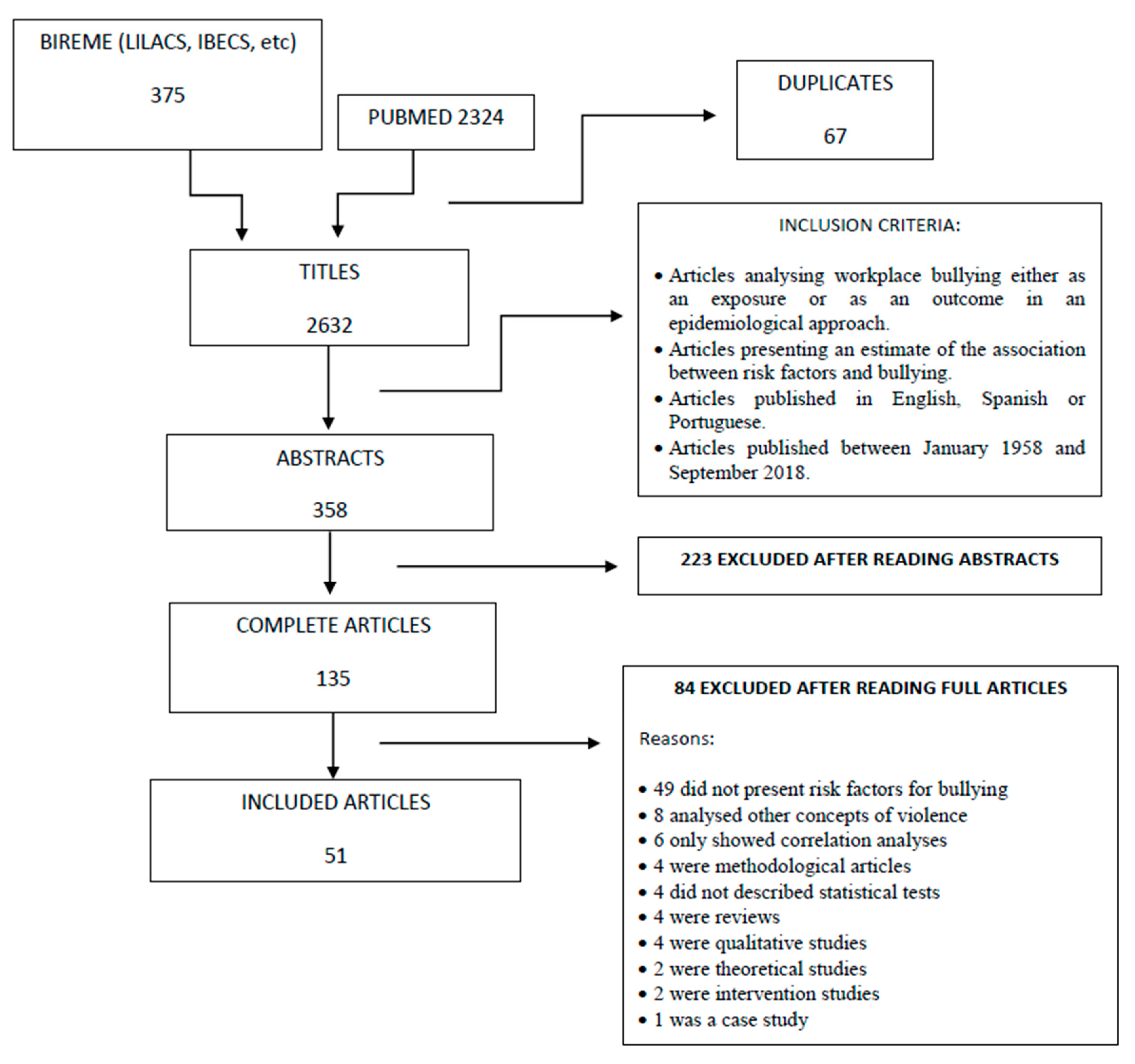
The search identified, after exclusion of duplicates, a total of 2632 articles. After reading the titles and abstracts, 135 articles were selected for full reading (Figure 1). A total of fifty-one papers were included in this review (Table 1). The main reasons for exclusion were not presenting risk factors for bullying, analysing other concepts of violence, not describing statistical tests or showing only correlation coefficients, and being methodological articles or reviews. A total of 70.6% (n = 36) of the included studies were from Europe, 11.8% (n = 6) from North America, 9.8% (n = 5) from Australia and New Zealand, and 7.8% from other countries—Japan (n = 2), Mexico (n = 1), and Ghana (n = 1). Regarding methodological issues, most of the studies were cross-sectional, with data either from national surveys or specific groups of workers. Response rates varied from 12.5% to 95.0%, but only two studies reached a response rate higher than 80%. The approaches, methods, objectives, and quality of these studies were very heterogeneous. Papers scored between 6 and 15 points in the Downs and Black assessment tool [23]. A total of 15 articles (29.4%) scored less than 10 points and 18 (35.3%) scored above 13. Missed points in the Downs and Black index were mostly due to lack of losses description, p-value reporting, and confounding evaluation.
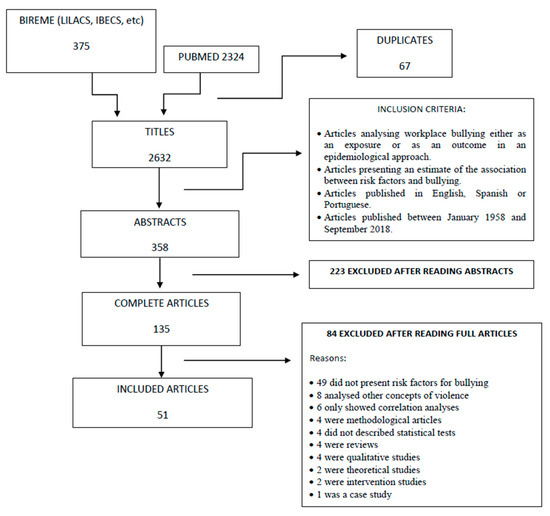
Figure 1.
Preferred Reporting Items for Systematic Reviews and Meta-Analyses (PRISMA) flow diagram: studies selection about risk factors for workplace bullying.

Table 1.
Epidemiological studies about risk factors for workplace bullying.
Most of the studies reported that women are more likely to be bullied than men [26,27,28,29,30,31,32,33,34,35,36,37,38]. Statistically significant odds ratios and prevalence ratios ranged from 1.17 to 2.77. Also, 11 studies showed no association between gender and bullying [39,40,41,42,43,44,45,46,47,48,49]. Only two studies suggested a higher risk among men [50,51]. The results on the association between age and workplace bullying were also inconsistent. Although eight studies found that workers younger than 44 years of age are more likely to be bullied [30,32,37,41,45,50,52,53], nine studies showed no association between age and workplace bullying [29,36,39,42,43,44,47,48,49]. Only one study suggested a higher prevalence of bullying in older workers [54].
Only five studies presented relevant data on the association between ethnicity and bullying. Three studies suggested a higher prevalence of bullying between ‘non-white’, ‘multiracial individuals’, and ‘Asian and black’, compared to white workers. The risk was increased in a range from 1.30 to 2.30 times [29,34,50]. One study showed no differences in the Negative Acts Questionnaire (NAQ) mean score when comparing white workers and black or ethnic minorities [51], while one study showed 28% less prevalence of bullying in non-white workers [52]. The NAQ is a tool with several questions about negative acts that suggest workplace bullying during the previous six months [4].
The association between family structure and bullying also varied between studies. Four studies reported no association between workplace bullying and marital status [37,43,49,55]. On the other hand, three studies reported that single, separated, divorced, and widowed workers were more likely to suffer from bullying at work [34,46,56], while one study found a higher risk of bullying among married workers (odds ratio (OR) = 3.06 (1.41–12.94)) [42]. Two studies also found a strong risk of being bullied among workers who have small children at home (OR from 1.92 to 2.87) [35,36].
Most of the studies reported no association between education and bullying. However, data from the 5th European Working Conditions Survey suggested a strong association between lower educational level and bullying (OR = 5.51 (1.79–16.95)) [36]. At the same time, two Turkish studies with forest engineers reported a higher prevalence of bullying among those with a doctoral degree [37,55].
The relationship between personality traits and being a victim of bullying was also evaluated by a few studies. Five studies described statistically significant associations between some specific personality traits and bullying. Neuroticism was identified as a risk factor for bullying in three studies, with odds ratios from 1.23 to 1.28 [26,40,76]. Most of the personality traits evaluated by these studies were not associated with bullying. In a cluster of participants of one study, people with Type A personality [48], less extroverted, less agreeable, less conscientious, less open to experience and more emotionally unstable were also more likely to be bullied [76]. Nevertheless, another study showed that personality characteristics explained only 2% of the variance (adjusted R2 = 0.02) of bullying [58].
A wide range of important occupational factors regarding work organization, management issues, type of job, and earnings were also evaluated across the studies. The occurrence of bullying varied across professions, and it was not possible to identify a pattern in this aspect. The results were also controversial concerning the type of work (if permanent or temporary). Civil servants were more likely to be bullied than other workers [34,38,45]. Workers with lower income [63], paid hourly [34], and less satisfied with their payment [35] were also more likely to be bullied. Regarding the association between years of work in the organization and the occurrence of bullying, studies showed either a positive association [43] or no difference [49]. Shift work was strongly and positively associated with workplace bullying. Odds ratios (OR) of this association ranged from 1.74 (US workers) [34] to 2.68 (Spanish workers) [36]. The magnitude of the association was stronger in the public (OR = 2.46) than in the private sector (OR = 1.94) [35].
Organizational change, lack of procedural justice [53], and poor psychosocial safety climate were strongly and positively associated with bullying [71]. Leadership style was reported as an important risk factor by nine studies. Passive laissez-faire leadership, evaluated by three articles, increased up to 4.3 times the risk of workplace bullying [64,66,69]. Destructive [61], dictatorial [53], and autocratic leadership [74] were also related to a higher occurrence of bullying. On the other hand, supportive leadership style [57], consideration of individual by leaders [64], transformational and transactional leadership [66], authentic leadership [69], and fair leadership [73] reduced up to 70% the risk of bullying.
Flexible work methods [33], role conflict, role ambiguity [68,72,75], personal conflicts [70,72], less satisfaction with working conditions [35,36], either monotonous or rotating tasks [36], high demands at work, pressure of work, and unclarity of duties [74] were also positively associated with workplace bullying.
Work stress was one of the most important occupational factors reported in empirical studies, and was always strongly and positively related to bullying [33,35,36,49,62]. The odds ratios varied from 1.38 [49] to 4.96 [36]. Lack of social support [30,53,70,72], low social capital [59], and effort–reward imbalance [60] were also strongly associated with a higher risk of bullying.
Lastly, worse physical and mental health increased the risk of being bullied both in cross-sectional and longitudinal analyses. Sick leave and being on sickness treatment were also positively associated with bullying [38,57,61,65,67].
4. Discussion
A total of 49 out of 51 studies on risk factors for workplace bullying came from high-income countries, particularly Europe. Thus, either epidemiological studies on workplace bullying have not been developed in low- and middle-income countries, or their findings have not been published internationally. In a globalized scenario, it is not plausible that this phenomenon is not happening in other countries, mainly in countries where working conditions are poor. Only two studies [42,74] had response rates higher than 80%. As Nielsen (2010) advised, representative and convenience samples provide significantly different estimates of the prevalence of bullying [1], which could distort effect measures. On the other hand, most of the studies measured bullying with validated instruments, which tend to provide a ‘more objective’ measure. Although a few adaptations of Leymann’s inventory were described, the NAQ (77) has been used and validated in several working populations [77,78], thus it is an option that improves the comparability of results. Some studies also measured bullying ‘subjectively’ (self-labelled approach), providing its definition and asking whether the worker was bullied or not in a single question. A combination of both objective and subjective measures can also be a satisfactory method to improve specificity [74,79].
The identified studies evaluated workers in several professions and activities, with a great variability of sociodemographic profiles and occupational characteristics, which makes it difficult to summarize and compare the results. While some studies focused on sociodemographic determinants and personality traits as antecedents of bullying, others focused on managerial and organizational factors. The ‘work environment hypothesis’ proposed by Leymann in the early 1990s targeted the work organization as the main cause of bullying, while more recent studies tested new hypotheses regarding the relationship between individual factors, such as personality and bullying [21]. This demonstrates the complexity of the phenomenon and indicates that simple explanations focusing on one or a few aspects of bullying are not enough to study this theme [80].
Regarding demographic factors, the role played by women in a globalized labour market, the work organization of institutions, and also the sexist culture in work environments could explain the consistency of results showing a higher risk of workplace bullying among women. Regarding age and marital status, results largely vary according to the type of job. Possibly in certain types of jobs with a demand for rapid response or physical effort, such as in blue-collar jobs, older workers could be more likely to be bullied. Also, in a job requiring a flexible schedule, people with children could be the main targets. Despite the fact that studies usually show a higher vulnerability of black people and ethnic minorities for several exposures and health outcomes—such as racial discrimination [81]—very few studies evaluated the association between ethnicity and bullying and results on this matter are controversial.
Findings from four papers [26,40,48,76] are consistent with a systematic review [21], indicating a positive association between bullying and neuroticism. However, other personality traits were not associated with bullying. Effect sizes of the association between neuroticism and bullying were small, so residual confounding should be considered. The explanatory power of personality as a predictor of bullying was also very small [58]. One of the premises of occupational health actions is that the work environment and the work organization should be adequate to individual characteristics, not the opposite. Thus, interventions to prevent bullying focused on individual aspects tend to be limited. Notwithstanding, studies investigating the effect of work organization on bullying should evaluate these factors as confounders or effect modifiers.
The effect of sociodemographic, personality and some occupational factors on bullying varied across studies, while a poor work organization and poor working processes always increased the risk of bullying. This risk varies across professions because it depends much more on the work environment than the profession itself or the years of work. For example, since workers’ resignation is not common among civil servants, they can be easy targets of bullying, mainly when organizations are not prepared to support employees not well adapted to employers’ demands. Workers with lower income, paid hourly, and less satisfied with their payment, as well as those in shift work, are usually exposed to more precarious working conditions, making these individuals more vulnerable to bullying.
In a context of ‘flexible restructuring’ of capitalism [82], the fundamental role of the capital and labour conflict on the existence of workplace bullying is unveiled by the human resources management (HRM) ideology [80,83]. Workplace bullying plays an important role in the intensification of work processes, being a tool to deepen mechanisms to control workers [84]. As a ‘functional discipline’, HRM lies at the core of organizational design and practice, shaping the way organizations operate [83,85]. The importance of HRM as a main determinant of bullying is evidenced by the positive association between low moral standard, lack of procedural justice, organizational change, and low psychosocial safety climate with bullying.
HRM ideology determines leadership styles in organizations and, agreeing with a systematic review about bullying in nurses [22], authoritarian and laissez-faire leadership patterns were strongly related to workplace bullying in this review [53,64,66,69,74] while ‘democratic’ leadership styles—such as supportive [57], authentic [69], transformational [66,69] and fair leadership [73]—protected the organization against bullying. Leaders are selected to put in practice the organizations’ ‘values’ and ‘missions’ and an authoritarian leadership pattern is still highly valued in several companies [86]. A poor work organization, where workers are under a lot of pressure and/or ethical values are secondary, is more likely to request authoritarian leadership. In some organizations, once its existence can improve productivity and accomplishments, bullying is institutionalized and works as an essential part of leadership and managerial practice [3,87]. This can also be one of the reasons why interventions against bullying are often ineffective [18].
Leadership patterns are strongly related to the work organization and might determine role conflicts, role ambiguity, flexibility in work methods, and unclarity of duties. All these problems in work methods and in management increase the risks of bullying, results that agree with former reviews [19,20]. These hazards are related to the post-Fordist models; with the restructuring of production, workers need to be ‘super-qualified’, polyvalent, and able to perform several tasks and activities [82,88]. These organizational aspects, while they intensify working processes, generate workloads such as work pressure, monotonous tasks, rotating tasks, high demands and stress, which also increase the risk of workplace bullying. On these aspects, a bidirectional association is also plausible, as the existence of bullying in an organization degrades the work environment [80,89] increasing workloads and intensifying working processes.
The findings from this review reinforce Leymann’s theoretical model, highlighting the central role of organizational factors on bullying determination. HRM, leadership patterns, and organizational factors are key distal determinants, having an impact on the physical and psychosocial workloads which determine bullying.
5. Conclusions
We have a large amount of valuable data concerning workplace bullying in high-income countries, particularly in Europe. However, a major effort is still necessary to encourage research on workplace bullying in low- and middle-income countries. Discrimination and harassment are more often described in non-dominant or disadvantaged groups [90], so a social context with poorer working conditions could lead to a higher risk of workplace bullying.
The main limitations of our review were the low response rates in most of the selected papers, as well as the variability of measures to assess risk factors and outcome, reducing the comparability of findings. Also, most of the studies were cross-sectional and were not able to estimate the effect of all occupational factors on bullying, precluding strong inferences regarding the direction of associations. Therefore, future studies with a longitudinal design and representative samples (or at least a better description of losses) are important to clarify associations subjected to reverse causation and improve the interpretation of the results. It is necessary to deepen the understanding of the role of organizational factors and emphasize the role of human resource management on bullying causation. The effect of work schedules, breaks, and extra hours on bullying also need to be studied. Validated instruments, such as the Psychosocial Safety Climate-12, which addresses aspects of the management in work environments, can be fundamental to evaluate distal contextual factors. Considering the scarcity of information about the association between race and sexual orientation with bullying, future studies should also investigate this subject.
Bullying should be understood as a completely unacceptable and unethical behaviour in workplaces. Policies to prevent bullying must address the culture of organizations and face the challenge of developing psychosocial safety at work environments. Interventions promoting a new management and leadership framework, increasing democratic values, and promoting employee participation in work decisions, should be implemented and evaluated in order to provide better parameters for practice in occupational health.
Author Contributions
Conceptualization, F.R.F., D.D.G., and A.G.F.; methodology, F.R.F., D.D.G., A.G.F., and N.P.; validation, F.R.F., D.D.G., A.G.F., and N.P.; formal analysis, F.R.F., D.D.G., A.G.F., and N.P.; investigation, F.R.F., D.D.G., and A.G.F.; data curation, F.R.F., D.D.G., and A.G.F.; writing—original draft preparation, F.R.F., D.D.G., A.G.F., and N.P.; writing—review and editing, F.R.F., D.D.G., A.G.F., and N.P.; visualization, F.R.F., D.D.G., A.G.F., and N.P.; supervision, A.G.F. and N.P.; project administration, F.R.F. and A.G.F.
Funding
This article was funded by the Coordination for the Improvement of Higher Level/Education- Personnel (CAPES-Brazil).
Acknowledgments
The authors express thanks to the Coordination for the Improvement of Higher Level/Education-Personnel (CAPES-Brazil).
Conflicts of Interest
The authors declare no conflicts of interest.
References
- Nielsen, M.B.; Matthiesen, S.B.; Einarsen, S. The impact of methodological moderators on prevalence rates of workplace bullying. A meta-analysis. J. Occup. Organ. Psychol. 2010, 83, 955–979. [Google Scholar] [CrossRef]
- Leymann, H. The content and development of mobbing at work. Eur. J. Work Organ. Psychol. 1996, 5, 165–184. [Google Scholar] [CrossRef]
- Einarsen, S. The nature, causes and consequences of bullying at work: The Norwegian experience. Pistes: Perspectives Interdisciplin¬aire sur le Travail et la Sante 2005, 7, 1–14. [Google Scholar] [CrossRef]
- Einersen, S.; Hoel, H.; Diater Zapt, C.L.C. The concept of bullying and harassment at work: The European tradition. In Bullying and Harassment in the Workplace Developments in Theory, Research, and Practice, 2nd ed.; Einarsen, S., Hoel, H., Zapf, D., Cooper, C.L., Eds.; CRC Press: Boca Raton, FL, USA, 2011; pp. 3–40. [Google Scholar]
- Hoel, H.; Cooper, C.L.; Faragher, B. The experience of bullying in Great Britain: The impact of organizational status. Eur. J. Work Organ. Psy. 2001, 10, 443–465. [Google Scholar] [CrossRef]
- Pheko MM, Monteiro NM, Segopolo MT. When work hurts: A conceptual framework explaining how organizational culture may perpetuate workplace bullying. J. Hum. Behav. Soc. Environ. 2017, 27, 571–588. [Google Scholar] [CrossRef]
- Theorell, T.; Hammarström, A.; Aronsson, G.; Träskman Bendz, L.; Grape, T.; Hogstedt, C.; Marteinsdottir, I.; Skoog, I.; Hall, C. A systematic review including meta-analysis of work environment and depressive symptoms. BMC Public Health 2015, 15, 738. [Google Scholar] [CrossRef]
- Verkuil, B.; Atasayi, S.; Molendijk, M.L. Workplace Bullying and Mental Health: A Meta-Analysis on Cross-Sectional and Longitudinal Data. Courvoisier DS, editor. PLoS ONE 2015, 10, e0135225. [Google Scholar] [CrossRef]
- Nielsen, M.B.; Gjerstad, J.; Jacobsen, D.P.; Einarsen, S.V. Does ability to defend moderate the association between exposure to bullying and symptoms of anxiety? Front. Psychol. 2017, 8, 1953. [Google Scholar] [CrossRef]
- Butterworth, P.; Leach, L.S.; Kiely, K.M. Why it’s important for it to stop: Examining the mental health correlates of bullying and ill-treatment at work in a cohort study. Aust. N. Z. J. Psychiatry 2016, 50, 1085–1095. [Google Scholar] [CrossRef]
- Nielsen, M.B.; Einarsen, S.; Notelaers, G.; Nielsen, G.H. Does exposure to bullying behaviors at the workplace contribute to later suicidal ideation? A three-wave longitudinal study. Scand. J. Work Environ. Health 2016, 42, 246–250. [Google Scholar] [CrossRef] [PubMed]
- Lallukka, T.; Rahkonen, O.; Lahelma, E. Workplace bullying and subsequent sleep problems—The Helsinki health study. Scand. J. Work Environ. Health 2011, 37, 204–212. [Google Scholar] [CrossRef] [PubMed]
- Takaki, J.; Taniguchi, T.; Fukuoka, E.; Fujii, Y.; Tsutsumi, A.; Nakajima, K.; Hirokawa, K. Workplace bullying could play important roles in the relationships between job strain and symptoms of depression and sleep disturbance. J. Occup. Health 2010, 52, 367–374. [Google Scholar] [CrossRef]
- Glambek, M.; Nielsen, M.B.; Gjerstad, J.; Einarsen, S. Gender differences in the relationship between workplace bullying and subjective back and neck pain: A two-wave study in a Norwegian probability sample. J. Psychosom. Res. 2018, 106, 73–75. [Google Scholar] [CrossRef] [PubMed]
- Kivimäki, M.; Virtanen, M.; Vartia, M.; Elovainio, M.; Vahtera, J.; Keltikangas-Järvinen, L. Workplace bullying and the risk of cardiovascular disease and depression. Occup. Environ. Med. 2003, 60, 779–783. [Google Scholar] [CrossRef]
- Xu, T.; Magnusson Hanson, L.L.; Lange, T.; Starkopf, L.; Westerlund, H.; Madsen, I.E.H.; Rugulies, R.; Pentti, J.; Stenholm, S.; Vahtera, J.; et al. Workplace bullying and violence as risk factors for type 2 diabetes: A multicohort study and meta-analysis. Diabetologia 2018, 61, 75–83. [Google Scholar] [CrossRef]
- Janssens, H.; Braeckman, L.; De Clercq, B.; Casini, A.; De Bacquer, D.; Kittel, F.; Clays, E. The indirect association of job strain with long-term sickness absence through bullying: A mediation analysis using structural equation modeling. BMC Public Health 2016, 16, 851. [Google Scholar] [CrossRef]
- Gillen, P.A.; Sinclair, M.; Kernohan, W.G.; Begley, C.M.; Luyben, A.G. Interventions for prevention of bullying in the workplace. Cochrane Database Syst. Rev. 2017, 1, CD009778. [Google Scholar] [CrossRef] [PubMed]
- Moayed, F.A.; Daraiseh, N.; Shell, R. Theoretical Issues in Ergonomics Science Workplace bullying: A systematic review of risk factors and outcomes. Theor. Issues Ergon. Sci. 2006, 7, 37–41. [Google Scholar] [CrossRef]
- Bowling, N.A.; Beehr, T.A. Workplace harassment from the victim’s perspective: A theoretical model and meta-analysis. J. Appl. Psychol. 2006, 91, 998–1012. [Google Scholar] [CrossRef]
- Nielsen, M.B.; Glasø, L.; Einarsen, S. Exposure to workplace harassment and the Five Factor Model of personality: A meta-analysis. Personal. Individ. Differ. 2017, 104, 195–206. [Google Scholar] [CrossRef]
- Trépanier, S.-G.; Fernet, C.; Austin, S.; Boudrias, V. Work environment antecedents of bullying: A review and integrative model applied to registered nurses. Int. J. Nurs. Stud. 2016, 55, 85–97. [Google Scholar] [CrossRef] [PubMed]
- Downs, S.H.; Black, N. The feasibility of creating a checklist for the assessment of the methodological quality both of randomized and non-randomized studies of health care interventions. J. Epidemiol. Community Health 1998, 52, 377–384. [Google Scholar] [CrossRef] [PubMed]
- Moher, D.; Liberati, A.; Tetzlaff, J.; Altman, D.G.; PRISMA Group. Preferred reporting items for systematic reviews and meta-analyses: The PRISMA statement. PLoS Med. 2009, 6, e1000097. [Google Scholar] [CrossRef] [PubMed]
- Stroup, D.F.; Berlin, J.A.; Morton, S.C.; Olkin, I.; Williamson, G.D.; Rennie, D.; Moher, D.; Becker, B.J.; Sipe, T.A.; Thacker, S.B. Meta-analysis of Observational Studies in Epidemiology: A Proposal for Reporting. JAMA 2000, 283, 2008–2012. [Google Scholar] [CrossRef] [PubMed]
- Rosta, J.; Aasland, O.G. Perceived bullying among Norwegian doctors in 1993, 2004 and 2014–2015: A study based on cross-sectional and repeated surveys. BMJ Open 2018, 8, e018161. [Google Scholar] [CrossRef]
- Forsell, K.; Eriksson, H.; Järvholm, B.; Lundh, M.; Andersson, E.; Nilsson, R. Work environment and safety climate in the Swedish merchant fleet. Int. Arch. Occup. Environ. Health 2017, 90, 161–168. [Google Scholar]
- Niedhammer, I.; David, S.; Degioanni, S. Economic activities and occupations at high risk for workplace bullying: Results from a large-scale cross-sectional survey in the general working population in France. Int. Arch. Occup. Environ. Health 2007, 80, 346–353. [Google Scholar] [CrossRef]
- Quine, L. Workplace bullying in junior doctors: Questionnaire survey. BMJ 2002, 324, 878–879. [Google Scholar] [CrossRef]
- Cole, L.L.; Grubb, P.L.; Sauter, S.L.; Swanson, N.G.; Lawless, P. Psychosocial correlates of harassment, threats and fear of violence in the workplace. Scand. J. Work Environ. Health 1997, 23, 450–457. [Google Scholar] [CrossRef]
- Rouse, L.P.; Gallagher-Garza, S.; Gebhard, R.E.; Harrison, S.L.; Wallace, L.S. Workplace Bullying Among Family Physicians: A Gender Focused Study. J. Women’s Health 2016, 25, 882–888. [Google Scholar] [CrossRef]
- Salin, D. Risk factors of workplace bullying for men and women: The role of the psychosocial and physical work environment. Scand. J. Psychol. 2015, 56, 69–77. [Google Scholar] [CrossRef] [PubMed]
- Ariza-Montes, A.; Leal-Rodríguez, A.L.; Leal-Millán, A.G. A Comparative Study of Workplace Bullying Among Public and Private Employees in Europe. J. Occup. Environ. Med. 2015, 57, 695–700. [Google Scholar] [CrossRef] [PubMed]
- Khubchandani, J.; Price, J.H. Workplace Harassment and Morbidity Among US Adults: Results from the National Health Interview Survey. J. Community Health 2015, 40, 555–563. [Google Scholar] [CrossRef] [PubMed]
- Ariza-Montes, J.A.; Muniz, R.N.M.; Leal-Rodríguez, A.L.; Leal-Millán, A.G. Workplace bullying among managers: A multifactorial perspective and understanding. Int. J. Environ. Res. Public Health 2014, 11, 2657–2682. [Google Scholar] [CrossRef]
- Ariza-Montes, A.; Muniz, N.M.; Montero-Simó, M.J.; Araque-Padilla, R.A. Workplace bullying among healthcare workers. Int. J. Environ. Res. Public Health 2013, 10, 3121–3139. [Google Scholar] [CrossRef] [PubMed]
- Toksoy, D.; Bayramoǧlu, M.M. Bullying within the forestry organizations of Turkey. Sci. World J. 2013, 2013, 851839. [Google Scholar] [CrossRef] [PubMed]
- González Trijueque, D.; Graña Gómez, J.L. Workplace bullying: Prevalence and descriptive analysis in a multi-occupational sample. Psicothema 2009, 21, 288–293. [Google Scholar]
- Norton, P.; Costa, V.; Teixeira, J.; Azevedo, A.; Roma-Torres, A.; Amaro, J.; Cunha, L. Prevalence and Determinants of Bullying Among Health Care Workers in Portugal. Workplace Health Saf. 2017, 65, 188–196. [Google Scholar] [CrossRef]
- Medina-Gómez, O. Prevalencia de mobbing en trabajadores y factores de riesgo asociados. Gac Med. Mex. 2016, 152, 452–456. [Google Scholar]
- Quine, L. Workplace bullying in NHS community trust: Staff questionnaire survey. BMJ 1999, 318, 228–232. [Google Scholar] [CrossRef]
- Picakciefe, M.; Acar, G.; Colak, Z.; Kilic, I. The Relationship Between Sociodemographic Characteristics, Work Conditions, and Level of “Mobbing” of Health Workers in Primary Health Care. J. Interpers. Violence 2017, 32, 373–398. [Google Scholar] [CrossRef]
- Carretero, N.; Luciano, J.V. Prevalence and incidence of workplace bullying among Spanish employees working with people with intellectual disability. Disabil. Health J. 2013, 6, 405–409. [Google Scholar] [CrossRef] [PubMed]
- Askew, D.A.; Schluter, P.J.; Dick, M.-L.; Régo, P.M.; Turner, C.; Wilkinson, D. Bullying in the Australian medical workforce: Cross-sectional data from an Australian e-Cohort study. Aust. Health Rev. 2012, 36, 197–204. [Google Scholar] [CrossRef] [PubMed]
- Notelaers, G.; Vermunt, J.K.; Baillien, E.; Einarsen, S.; De Witte, H. Exploring risk groups workplace bullying with categorical data. Ind. Health 2011, 49, 73–88. [Google Scholar] [CrossRef] [PubMed]
- Keuskamp, D.; Ziersch, A.M.; Baum, F.E.; Lamontagne, A.D. Workplace bullying a risk for permanent employees. Aust. N. Z. J. Public Health 2012, 36, 116–119. [Google Scholar] [CrossRef] [PubMed]
- Ortega, A.; Høgh, A.; Pejtersen, J.H.; Olsen, O.; Olsen, O. Prevalence of workplace bullying and risk groups: A representative population study. Int. Arch. Occup. Environ. Health 2009, 82, 417–426. [Google Scholar] [CrossRef]
- Pranjić, N.; Males-Bilić, L.; Beganlić, A.; Mustajbegović, J. Mobbing, stress, and work ability index among physicians in Bosnia and Herzegovina: Survey study. Croat. Med. J. 2006, 47, 750–758. [Google Scholar]
- Bilgel, N.; Aytac, S.; Bayram, N. Bullying in Turkish white-collar workers. Occup. Med. (Lond.) 2006, 56, 226–231. [Google Scholar] [CrossRef][Green Version]
- Lipscomb, J.; London, M.; McPhaul, K.M.; Ghaziri MEl Lydecker, A.; Geiger-Brown, J.; Johnson, J.V. The Prevalence of Coworker Conflict Including Bullying in a Unionized U.S. Public Sector Workforce. Violence Vict. 2015, 30, 813–829. [Google Scholar] [CrossRef] [PubMed]
- Carter, M.; Thompson, N.; Crampton, P.; Morrow, G.; Burford, B.; Gray, C.; Illing, J. Workplace bullying in the UK NHS: A questionnaire and interview study on prevalence, impact and barriers to reporting. BMJ Open 2013, 3, e002628. [Google Scholar] [CrossRef]
- Fernandez, C.A.; Moore, K.; McClure, L.A.; Caban-Martinez, A.J.; LeBlanc, W.G.; Fleming, L.E.; Cifuentes, M.; Lee, D.J. Occupational psychosocial hazards among the emerging U.S. green collar workforce. J. Occup. Environ. Med. 2017, 59, 1–5. [Google Scholar] [CrossRef] [PubMed]
- Oxenstierna, G.; Elofsson, S.; Gjerde, M.; Magnusson Hanson, L.; Theorell, T. Workplace bullying, working environment and health. Ind. Health 2012, 50, 180–188. [Google Scholar] [CrossRef] [PubMed]
- Varhama, L.M.; Björkqvist, K. Conflicts, workplace bullying and burnout problems among municipal employees. Psychol. Rep. 2004, 94, 1116–1124. [Google Scholar] [CrossRef] [PubMed]
- Bayramoǧlu, M.M.; Toksoy, D. Leadership and Bullying in the Forestry Organization of Turkey. BioMed Res. Int. 2017, 2017, 9454682. [Google Scholar] [CrossRef]
- Sahin, B.; Cetin, M.; Cimen, M.; Yildiran, N. Assessment of Turkish junior male physicians’ exposure to mobbing behavior. Croat. Med. J. 2012, 53, 357–366. [Google Scholar] [CrossRef]
- Tong, M.; Schwendimann, R.; Zúñiga, F. Mobbing among care workers in nursing homes: A cross-sectional secondary analysis of the Swiss Nursing Homes Human Resources Project. Int. J. Nurs. Stud. 2017, 66, 72–81. [Google Scholar] [CrossRef]
- Amponsah-Tawiah, K.; Annor, F. Do Personality and Organizational Politics Predict Workplace Victimization? A Study among Ghanaian Employees. Saf. Health Work 2017, 8, 72–76. [Google Scholar] [CrossRef]
- Pihl, P.; Albertsen, K.; Hogh, A.; Andersen, L.P.S. Social capital and workplace bullying. Work 2017, 57, 535–545. [Google Scholar] [CrossRef]
- Guglielmi, D.; Mazzetti, G.; Villano, P.; Cantisano, G.T. The impact of perceived effort—Reward imbalance on workplace bullying: Also a matter of organizational identification. Psychol. Health Med. 2018, 23, 511–516. [Google Scholar] [CrossRef]
- Gardner, D.; O’Driscoll, M.; Cooper-Thomas, H.; Roche, M.; Bentley, T.; Catley, B.; Teo, S.; Trenberth, L. Predictors of Workplace Bullying and Cyber-Bullying in New Zealand. Int. J. Environ. Res. Public Health 2016, 13, 448. [Google Scholar] [CrossRef]
- Ariza-Montes, A.; Muniz, R.N.M.; Leal-Rodríguez, A.L.; Leal-Millán, A.G. Workplace Bullying Among Teachers: An Analysis from the Job Demands-Resources (JD-R) Model Perspective. J. Occup. Environ. Med. 2016, 58, 818–827. [Google Scholar] [CrossRef] [PubMed]
- Tsuno, K.; Kawakami, N.; Tsutsumi, A.; Shimazu, A.; Inoue, A.; Odagiri, Y.; Yoshikawa, T.; Haratani, T.; Shimomitsu, T.; Kawachi, I. Socioeconomic determinants of bullying in the workplace: A national representative sample in Japan. PLoS ONE 2015, 10, e0119435. [Google Scholar] [CrossRef] [PubMed]
- Tsuno, K.; Kawakami, N. Multifactor leadership styles and new exposure to workplace bullying: A six-month prospective study. Ind. Health 2015, 53, 139–151. [Google Scholar] [CrossRef] [PubMed]
- Rodríguez-Muñoz, A.; Moreno-Jiménez, B.; Sanz-Vergel, A.I. Reciprocal relations between workplace bullying, anxiety, and vigor: A two-wave longitudinal study. Anxiety Stress Coping 2015, 28, 514–530. [Google Scholar] [CrossRef] [PubMed]
- Dussault, M.; Frenette, É. Supervisors’ Transformational Leadership and Bullying in the Workplace. Psychol. Rep. 2015, 117, 724–733. [Google Scholar] [CrossRef]
- Tuckey, M.R.; Neall, A.M. Workplace bullying erodes job and personal resources: Between- and within-person perspectives. J. Occup. Health Psychol. 2014, 19, 413–424. [Google Scholar] [CrossRef] [PubMed]
- Reknes, I.; Pallesen, S.; Magerøy, N.; Moen, B.E.; Bjorvatn, B.; Einarsen, S. Exposure to bullying behaviors as a predictor of mental health problems among Norwegian nurses: Results from the prospective SUSSH-survey. Int. J. Nurs. Stud. 2014, 51, 479–487. [Google Scholar] [CrossRef] [PubMed]
- Nielsen, M.B. Bullying in work groups: The impact of leadership. Scand. J. Psychol. 2013, 54, 127–136. [Google Scholar] [CrossRef]
- Figueiredo-Ferraz, H.; Gil-Monte, P.R.; Grau-Alberola, E.; Llorca-Pellicer, M.; García-Juesas, J.A. Influence of some psychosocial factors on mobbing andits consequences among employeesworking with people with intellectual disabilities. J. Appl. Res. Intell. Disabil. 2012, 25, 455–463. [Google Scholar] [CrossRef]
- Law, R.; Dollard, M.F.; Tuckey, M.R.; Dormann, C. Psychosocial safety climate as a lead indicator of workplace bullying and harassment, job resources, psychological health and employee engagement. Accid. Anal. Prev. 2011, 43, 1782–1793. [Google Scholar] [CrossRef]
- Carretero Domínguez, N.; Gil-Monte, P.R.; Devis, J.V.L. Antecedentes y consecuencias del acoso psicológico en el trabajo. Psicothema 2011, 23, 617–623. [Google Scholar] [PubMed]
- Mageroy, N.; Lau, B.; Riise, T.; Moen, B.E. Association of psychosocial factors and bullying at individual and department levels among naval military personnel. J. Psychosom. Res. 2009, 66, 343–351. [Google Scholar] [CrossRef] [PubMed]
- Agervold, M. The significance of organizational factors for the incidence of bullying. Scand. J. Psychol. 2009, 50, 267–276. [Google Scholar] [CrossRef]
- Matthiesen, S.B.; Einarsen, S. Perpetrators and Targets of Bullying at Work: Role Stress and Individual Differences. Violence Vict. 2007, 22, 735. [Google Scholar] [CrossRef] [PubMed]
- Glasø, L.; Matthiesen, S.B.; Nielsen, M.B.; Einarsen, S. Do targets of workplace bullying portray a general victim personality profile?: Personality and Social Sciences. Scand. J. Psychol. 2007, 48, 313–319. [Google Scholar] [CrossRef] [PubMed]
- Einarsen, S.; Hoel, H.; Notelaers, G. Measuring exposure to bullying and harassment at work: Validity, factor structure and psychometric properties of the negative acts questionnaire-revised. Work Stress 2009, 23, 24–44. [Google Scholar] [CrossRef]
- Silva, I.V.; de Aquino, E.M.L.; Pinto, I.C. Características psicométricas do Negative Acts Questionnaire para detecção do assédio moral no trabalho: Estudo avaliativo do instrumento com uma amostra de servidores estaduais da saúde. Rev. Bras. Saúde Ocup. 2017, 42. [Google Scholar] [CrossRef]
- Nielsen, M.B.; Notelaers, G.; Einersen, S. Measuring Exposure to Workplace Bullying. In Bullying and Harassment in the Workplace Developments in Theory, Research, and Practice, 2nd ed.; Einarsen, S., Hoel, H., Zapf, D., Cooper, C.L., Eds.; CRC Press: Boca Raton, FL, USA, 2011; pp. 149–174. [Google Scholar]
- Barreto, M.; Heloani, R. Violência, saúde e trabalho: A intolerância e o assédio moral nas relações laborais. Serviço Soc. Soc. 2015, 123, 544–561. [Google Scholar] [CrossRef]
- Krieger, N.; Chen, J.T.; Waterman, P.D.; Hartman, C.; Stoddard, A.M.; Quinn, M.M.; Sorensen, G.; Barbeau, E.M. The inverse hazard law: Blood pressure, sexual harassment, racial discrimination, workplace abuse and occupational exposures in US low-income black, white and Latino workers. Soc. Sci. Med. 2008, 67, 1970–1981. [Google Scholar] [CrossRef]
- Harvey, D. Condição Pós-Moderna: Uma Pesquisa Sobre as Origens da Mudança Cultural; Edições Loyola: São Paulo, Brazil, 1992. [Google Scholar]
- Gaulejac, V. La société Malade de la Gestion. Idéologie Gestionnaire, Pouvoir Managérial et Harcèlement Social; Seuil: Paris, France, 2005. [Google Scholar]
- Beale, D.; Hoel, H. Workplace bullying and the employment relationship: Exploring questions of prevention, control and context. Work Employ Soc. 2011, 25, 5–18. [Google Scholar] [CrossRef]
- Lewis, D.; Rayner, C. Bullying and human resource management: A wolf in sheep’s clothing? In Bullying and Emotional Abuse in the Workplace; Taylor & Francis: London, UK, 2003. [Google Scholar]
- Hoel, H.; Salin, D. Organisational antecedents of workplace bullying. In Bullying and Emotional Abuse in the Workplace; Taylor & Francis: London, UK, 2003; pp. 203–218. [Google Scholar]
- Hoel, H.; Beale, D. Workplace bullying, psychological perspectives and industrial relations: Towards a contextualized and interdisciplinary approach. Br. J. Ind. Relat. 2006, 44, 239–262. [Google Scholar] [CrossRef]
- Antunes, R. Os Sentidos do Trabalho: Ensaio Sobre a Afirmação e a Negação do Trabalho; Boitempo: São Paulo, Brazil, 2000. [Google Scholar]
- Keashly, L.; Nowell, B.L. Conflict, conflict resolution and bullying. In Bullying and Emotional Abuse in the Workplace; Taylor & Francis: London, UK, 2003. [Google Scholar]
- Okechukwu, C.A.; Souza, K.; Davis, K.D.; de Castro, A.B. Discrimination, harassment, abuse, and bullying in the workplace: Contribution of workplace injustice to occupational health disparities. Am. J. Ind. Med. 2014, 57, 573–586. [Google Scholar] [CrossRef] [PubMed]
© 2019 by the authors. Licensee MDPI, Basel, Switzerland. This article is an open access article distributed under the terms and conditions of the Creative Commons Attribution (CC BY) license (http://creativecommons.org/licenses/by/4.0/).