1. Introduction
Nano/microactuators, as an indispensable portion of nano/microelectromechanical systems, are always subject to different inherent nonlinear forces. Many studies show that an integro-differential equation is generated in the modeling process of the nano/microactuator governing equation owing to axial forces ([
1,
2,
3]). In [
4,
5], the following nanoactuator beam equation augmented to boundary conditions and containing an integro-differential expression, was discussed
where
f and
t denote the deflection and length of the beam, respectively.
and
r denote some inherent nonlinear forces. Actually, in practical engineering applications, actuators are constructed by the billions for chipsets, therefore, developing more effective and accurate strategies for the study of nano/microactuator structures is of great significance.
Furthermore, it is often not appropriate to establish models with delayed behaviors by ordinary differential equations or partial differential equations, while integral equations are ideal tools. Moreover, fractional calculus operators are convolution operators (For details, please refer to the definitions of fractional integral and differential operators in [
6], in which the definitions involving convolution integrals.), because they are nonlocal and have full-memory function, and those characteristics can be well used to describe various phenomena and complex processes involving delay and global correlations. For this reason, fractional calculus has been extensively applied in interdisciplinary fields such as fluid and viscoelastic mechanics, control theory, signal and image processing, electricity, physical, etc., (see [
7,
8,
9]). Therefore, matching fractional calculus operators and integro-differential equations is ideal to complete the mathematical modeling of practical problems. Taking into account the effect of a full-memory system, the integer derivatives in Equation (
1) can be substituted for fractional ones. Inspired by this fact in Equation (
1), Shivanian [
10] introduced the following overdetermined Fredholm fractional integro-differential equations
where
,
,
. The existence of at least three weak solutions was obtained through the three critical points theorem.
Committed to fully considering more general systems, this paper studies a class of nonlinear Fredholm fractional integro-differential equations with
p-Laplacian operator and Sturm–Liouville boundary conditions as below
where
and
are positive constants,
is a parameter,
with
and
,
. For
,
,
,
satisfies
and
,
.
and
denote the left Caputo fractional derivative and right Riemann–Liouville fractional derivative of order
, respectively, which are defined by Kilbas et al. in [
6]
for
,
,
.
We emphasize that this paper extends previous results in several directions, which are listed as follows: (i) In recent years, a large number of existence results for fractional differential equations have been acquired by variational methods and critical point theory ([
11,
12,
13,
14]). However, not many research works are available in related references to handle fractional integro-differential equations, let alone involving the
p-Laplacian operator and Sturm–Liouville boundary conditions. (ii) It is not hard to see that Equation (
3) can turn into the Dirichlet boundary value problem Equation (
2) under
,
, which means that Equation (
2) is a special case of Equation (
3). Furthermore, since the
p-Laplacian operator is considered with
in the paper, the linear differential operator
is extended to the nonlinear differential operator
. In short, the form of Equation (
3) is more generalized, as well as the boundary value conditions. (iii) Infinitely many solutions are obtained in this paper with some simpler and more easily verified assumptions. Hence, our work improves and replenishes some existing results form the literature.
2. Preliminaries
Assume H is a Banach space and . Functional satisfies the Palais–Smale condition if each sequence such that is bounded and possesses strongly convergent subsequence in H.
Theorem 1 ([
15]).
Let H be an infinite-dimensional Banach space, is an even functional and satisfies the Palais–Smale condition. Assume that:- (i)
. There exist and such that and for all , where ;
- (ii)
For any finite dimensional subspace , the set is bounded.
Then, has infinitely many critical points.
Definition 1. Let , , . Define the fractional derivative space with the weighted normwhereas the closure of endowed with the norm is a reflexive and separable Banach space [
16].
Therefore, H also is a reflexive and separable Banach space. Lemma 1 ([
13]).
For any , with , there exists a constant such that , . Taking into account Lemma 1, one has
. In order to describe it more easily for the further analysis, denote
Obviously, the norm defined by (
7) is equivalent to
We work with the norm (
10) hereinafter.
Lemma 2 ([
17]).
Let , , . Suppose that any sequence converges to in weakly. Then, in as . Lemma 3 ([
18]).
Let be any finite-dimensional subspace of , . There exists a constant such that meas, . Lemma 4 ([
6]).
Let , , and ( in the case when ). If and , then, . Lemma 5. It is said is a weak solution of Equations (3), if the following equation holds Proof. Consider (
4) and (
5), the boundary conditions in Equation (
3) and Lemma 4 yield:
Substituting
into Equation (
3) and integrating on both sides from 0 to
T, then summing from
to
and combining with (
12), we can obtain Equation (
11). The proof is completed. □
Remark 1. For any , , from Equation (3) we havebecause , andone gets Hence, the terms and exist in this paper.
Consider the functional
with
where
,
,
. Owing to
,
, the G
teaux derivative of
is
Then, combining the continuity of
f and (
14), we can see that
and
Notice that, the critical point of
is the weak solution of Equation (
3).
3. Main Results
First, some hypotheses related to nonlinearity f are given, which play important roles in the remaining discussion.
uniformly for , ;
as uniformly for ;
For any
,
with
, and
where
,
,
is a constant and
is introduced thereinafter,
.
Lemma 6. satisfies the Palais–Smale condition under .
Proof. Suppose that sequence
is bounded and
,
. We claim that
is bounded in
H. Indeed, assume
. From
, for any
, there exists
such that
For any fixed
with
, from the integral mean value theorem, there exists
such that
Combining (
16) and (
17) yields
In view of (
8), (
9), (
13) and (
18) we have
Choose
L large enough such that
, then combining (
19) yields that
, which means that
as
,
. It contradicts that
is bounded. Hence,
is bounded in
H. Because of the reflexivity of
H, we get that
in
H (up to subsequences). From Lemma 2, we have
uniformly in
and
. Then,
From (
15), we obtain that
moreover,
Denote
combining (
20), (
21) and (
22), we obtain
as
. As in the discussion of
in [
19], we can get
where
are constants,
. Based on the above discussion, we can obtain
,
, for all
. Hence, the Palais–Smale condition holds. □
Theorem 2. Assume that and hold and . Then, Equation (3) has infinitely many solutions with and . Proof. Due to
, it is easy to verify that
is even. Obviously,
. Taking into account
that, for any
, there exists
such that
Further,
means that the kernel
is bounded by, say
, i.e.,
, and
Let
. For any
, one has
. Then,
which means that
. At this point, from (
13), (
23) and (
24) we can see
where
. Choose
, from (
26), we get
Hence, and . Therefore, the condition in Theorem 1 holds.
For any finite-dimensional space
, we claim that
is bounded. Assume that there exists at least a sequence
such that
as
. From
and (
19), we obtain
Since
L is arbitrary, we draw a contradiction. Therefore,
is bounded. Based on Theorem 1, functional
has infinitely many critical points, which means that Equation (
3) has infinitely many solutions in
H. □
Theorem 3. Assume that holds and . Then, Equation (3) has infinitely many solutions with . Proof. Suppose that the sequence
is bounded and
,
. In what follows, we prove that
satisfies the Palais–Smale condition. Indeed, assume
, from (
13), (
24),
and (
8), we have
namely
Recall that , and is bounded, we get a contradiction. Hence, is bounded on H. The rest of the proof for the Palais–Smale condition is similar to that of Lemma 6, so we do not repeat it.
Let
. For any
, one has
. A similar analysis with (
25) yields
. From (
28), we get
Clearly, and .
For any finite-dimensional space
, we claim that
is bounded. Assume that there exists at least a sequence
such that
as
. Then, according to (
19),
and Lemma 3 we obtain
where
and
. Since
, then
based on
and
as
, we get
Combining (
31) and (
32), we obtain that
as
, which draws a contradiction. Hence,
is bounded. Based on Theorem 1, functional
has infinitely many critical points, which means that Equation (
3) has infinitely many solutions in
H. □
Example 1. Focus on the following Fredholm fractional partial integro-differential equations with and :where , , It is easy to verify that
f is continuous with respect to
t and continuously differentiable with respect to
and
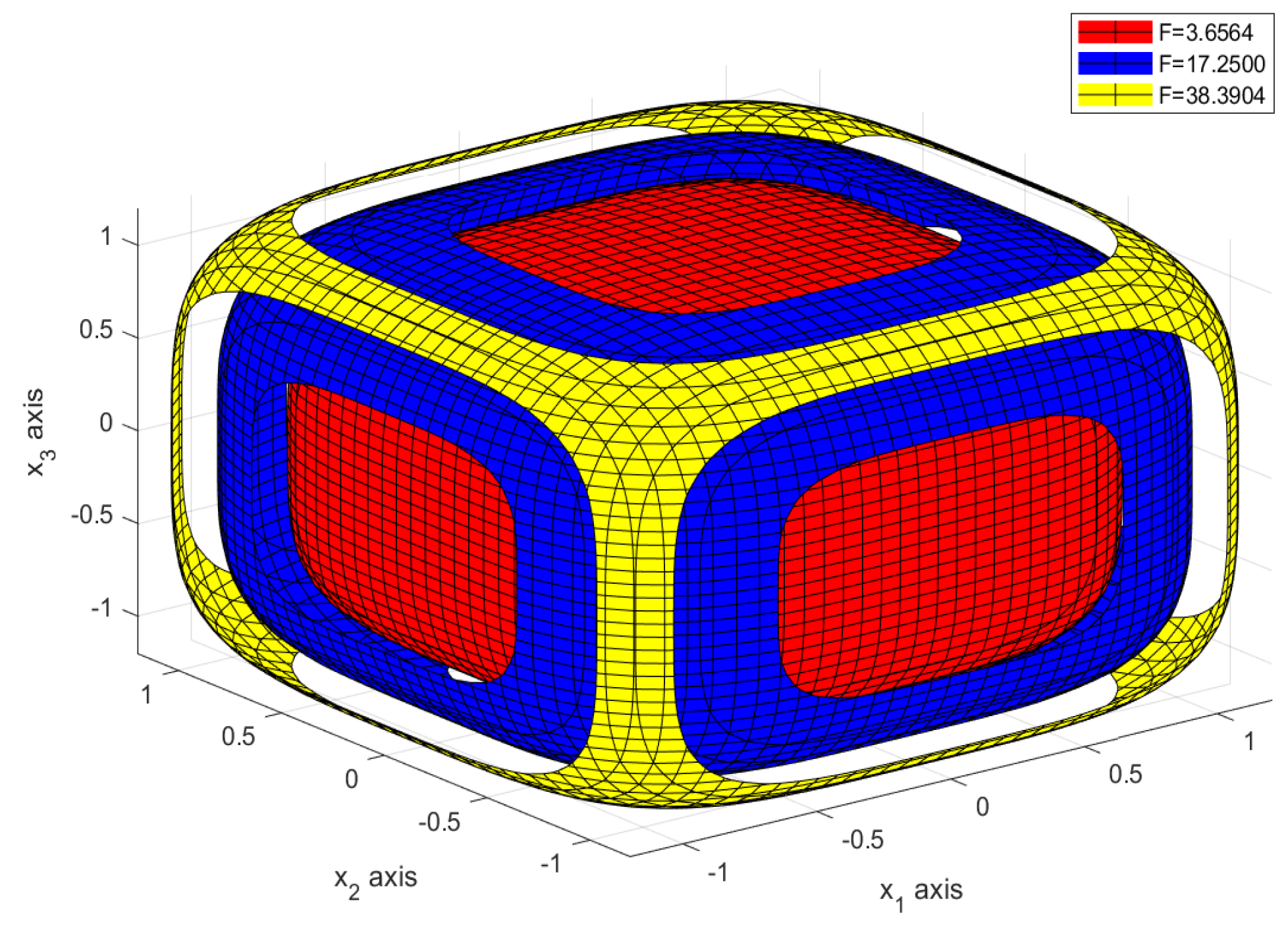
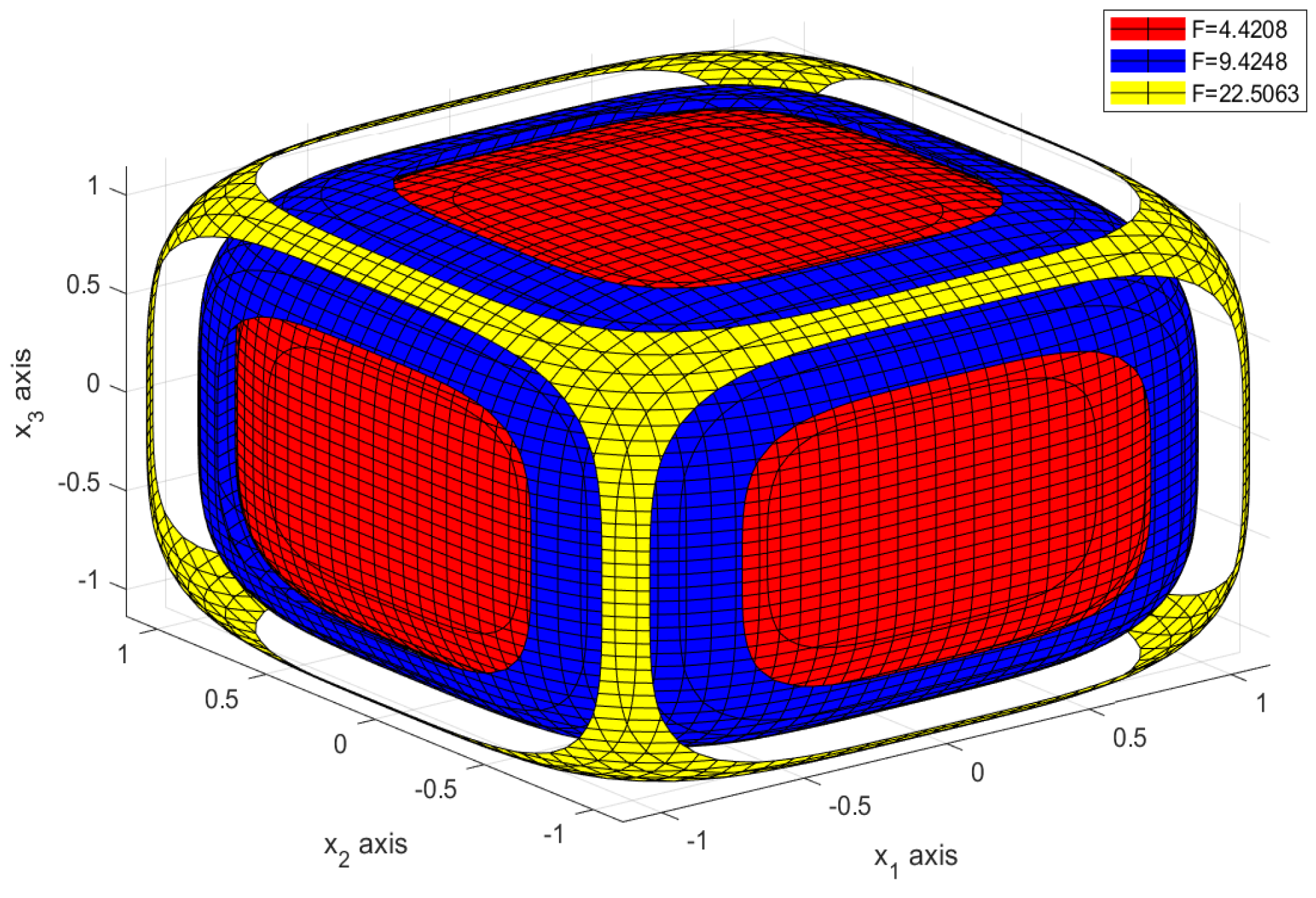
(see
Figure 1 and
Figure 2) and satisfies
and
. Obviously,
,
. By direct calculation we have
,
, and
then
namely,
,
, then
. Hence, from Theorem 2 we can see that Equation (
33) has infinitely many solutions.