


Abstract
The paper will examine, in detail, (a) the norms that can be featured under the category “Green Deal” connected to the European Commission, (b) their application to Spain, and (c) the different patterns of action and development models that have been shaped by this framework over the last 20 years. These patterns are particularly relevant currently, as the COVID-19 crisis has highlighted the importance of advancing towards new patterns of local sustainability endowed with higher resilience. The notion of cognitive sustainability will be one of the added values to the current reflections on sustainability in general, and energetic sustainability in particular.
1. Introduction
In regards to European law on energy, before COVID-19 was in crisis, there was a great need to move from a fossil paradigm of energy production to a renewal paradigm. However, this transition was not easy, as energy production and distribution systems are embedded into a complex technological and economic industry. In addition, lobbies of energy have been strong, and replacing one paradigm by another will bring an important reduction in benefits to some economic actors. However, the limits of the environment, together with the unsustainable subsidies of fuel energies—estimated by the IMF in 2019 as 6.5% of the world GDP—made this situation critical [1]. By looking at the European policy to recover from COVID-19, it can be said that this pandemic, although tough, has served as a stimulus to complete the transition towards green energies already in motion in Europe.
Transforming the energetic system and its associated development pattern is not only a matter of law reform and policy. It requires finding new models of local self-sufficient forms of economic organization. In other words, it requires, in addition to exploring the macro dynamics of specialized companies and government behaviors, generation through the action of local development models informed by the principles of prosperity, peace, social justice, sustainability and cognitive independence.
Thus, this paper focuses on this needed dialogue among law reform, policy and local practices, through the lens of one national actor within the European Union, which is Spain. In order to do so, first, the evolution of the European law of energy will be reviewed; second, the variations in the diverse last governments of Spain on this particular issue will be explored; third, the relevance of cognitive sustainability for development will be studied; and, finally, before the conclusions, some local cases that try to generate new energetic and development local models will be analyzed.
2. The Evolution of the Legal Framework of the European Union and Spain in the Field of Energy. A Perspective of European and International Law
This section explores the legal framework for European energetic transition. Legal perspectives are normative, and include revisions and interpretations of existing laws; that is, what will be done, to some extent, in order to better capture the context within which grassroots initiatives work to transform energy systems of production, distribution and commercialization.
From a geopolitical point of view, this contribution and reflection should be located in a European and international context, presided over the evidence that the rules that have governed international relations are under question and have become obsolete. Today’s world is no longer made up only of state actors. These are no longer the sole protagonists and, in fact, many of the big international strategic decisions are no longer adopted within the state framework, but at other regional levels and also often within the private dimensions, where the trade and global politics actors cease to be states and become the companies, the large multinational corporations.
All of this opens the way to the growing European and international prominence of non-state, non-governmental actors, and the result is the emergence of a new diplomacy or paradiplomacy, appreciable, for example, in the international security agenda, which cannot rest solely and exclusively on the states; in effect, the factors of poverty, social exclusion, financial instability, organized crime, migration, pandemic diseases (COVID-19) [2], or climate change and environmental degradation, among others, are a clear example of the impossibility of facing such global challenges only from the perspective, and with the leading role, of the states and governmental organizations.
Interdependence and reciprocal interaction of that sum of factors means that they cannot be focused, much less solved, in terms of state territoriality; these areas in which a new form of action is based on multilevel cooperation must find its way. What good is it, for example, for Spain to reduce its carbon dioxide emissions into the atmosphere if France or Europe does not do the same?
At a time of change, with Europe at the crossroads, regional reality is not on the European reforms agenda. Nevertheless, the regional factor is a referential element in the European construction. In fact, the “multilevel governance” concept emerges as a guiding principle in the development of policies, all this at a key moment of the European Project of the European Union, when it must solve the dilemma in which it finds itself and define its future model as a society.
It remains to develop and materialize the reality of the binomial “Regions and the principles of proportionality and subsidiarity in the EU’’. All this, in turn, is framed in a globalization process, regions and multilevel governance in the UE, which forces the need to redefine the role they currently occupy within Europe and determine how it should be in the future.
The note of internationality of this energy discipline and its consequences have a tendency towards international uniformity regulation [3], currently characterized and/or delimited by the phenomenon of the Europeanization of private law [4], with its origin in the Amsterdam Treaty [5], and reinforced and consolidated nowadays after twelve years of the Treaty of Lisbon [6], as well as the projection or external dimension [7] of the said attack [8]. This clearly reflects a range of different problems inside a European project [9], which seems at times to be staggering or getting disoriented after the exit processes experienced [10], and this has a direct reflection on the predictability of the outcomes and on the legal security [11], requiring a new time in which the old project of the United States of Europe [12] is strengthened [13].
2.1. The Effective Materialization of the Common Energy Policy in the European Union
The common energy policy should undoubtedly be the backbone of the economic, environmental and social development of the EU [14] in a society of nations such as ours in the 21st century [15]. An open sector to the technical changes, to the clean, renewable, green energy sources that allow the drastic displacement of an energy system based on the promotion of a decadent and unsustainable energy. In fact, the old energy policy, with a predominance of fossil waste-based fuels, shows the impact that has allowed, along with other variables, a global warming that is projected on the factual evidence on the European continent of abrupt changes and alterations in the climate, which have caused an exponential increase in the frequency, intensity, and also in the quantity of episodes of intense rainfall on a global scale, as well as an increase in the risk of drought in our Mediterranean region. All of this is aware that the aforementioned common policy energy in the European Union seems to be currently one of the least common of all policies, and this undoubtedly has an impact on the development and establishment of a harmonized legal framework to level 27 [16].
As we note, renewable energies, also known as green energies, are at this moment the best alternative to substitute fossil fuels and decarbonize the economy without much impact on employment and wellbeing in general.
From the beginning, the member states of the current European Union demonstrated the need to articulate a homogeneous legal normative framework and the realization of certain strategic measures of energetic character.
The Paris Treaty 1951–1952 came to form the European Coal and Steel Community in order to integrate the markets of these goods, which were vitals for the economic reconstruction of Europe and strategies, in the same way, for a common European defense. Later came the Euratom Treaty in 1957 and with it the creation of the European Atomic Energy Community, which pretended to build on the momentum of development cooperation of this type of energy with peaceful purposes. Already with the Maastricht Treaty of 1992, the competence to apply specific measures in the energy sector or field was recognized in order to achieve the objectives and general purposes of the European Community [17].
Nevertheless, given the above, the legal qualification of the common energy policy does not materialize until the enactment of the Lisbon Treaty in 2007, which introduces it by Article 176 A. This common policy is framed and has as general scope of operation in the internal market to address the need of preserving and improving the environment (TFEU internal energy market: Article 114). This way, and with a spirit of solidarity between the member states, the energy policy of the Union has the following main goals: (a) guaranteeing the functioning of the energy market; (b) guaranteeing energy supply security and energy saving of the Union; (c) promoting energy efficiency and energy saving, as well as the development of new and renewable energies; and (d) promoting the interconnection of energy networks. To achieve all this, the European Parliament and the Council, in accordance with the ordinary legislative procedure, shall establish the necessary measures to achieve the objectives after consulting the Economic and Social Committee and the Committee of the Regions. However, the Lisbon Treaty also warns in this precept of the law of each state to determine the conditions of the exploitation of their energy resources, to choose among the different sources and the general structure of supply. However, the Council may take measures affecting the said right of the states, specifically when they are of a fiscal nature, provided that it is unanimous and after consulting Parliament.
Certainly this last nuance above-mentioned is exactly one that does not allow talking about a consolidated, harmonized, effective and efficient common energy policy, and therefore we advocate again for the consolidation of the United States of Europe. It should be noted that, according to Article 194 of the Treaty of the Functioning of the European Union (TFEU), some areas of the energy policy become a shared competence, which is a step towards a common energy policy, but does not exactly consolidate for the fact that each member state maintains their right to determine the conditions of the exploitation of their energy resources, their possibilities of choosing among different energy sources, and their general structure of energy supply. It is therefore a greater legal, political, economic and energetic integration of the European Union.
Having said this, it should not be overlooked that great strides have been made in the energy policy within the Union. Indeed, it cannot be ignored that the EU is aware of the need to ensure, on the one hand, the energy supply (security of supply, Article 122 of the TFEU), and on the other, exponentially reduce the energy dependence of third states, for example, Russia. This also comes hand-in-hand with the emergence of another series of energy concerns that must be addressed with dynamism and seriousness, among others, the protection of consumers, the creation of a consolidated internal energy market, and the reduction in environmental pollution caused by greenhouse gases that can alter the planetary climate as a regional and also global challenge.
In fact, the challenges that the EU faces in the energy area include its increasing dependence on imports, limited diversification, high and volatile energy prices, growing global energy demand, security risks that affect the producer and transit countries, escalating threats resulting from climate change, the slow progress being made on energy efficiency, or the challenges posed by the increase in the share of renewable energies, as well as the need for greater transparency and better integration and networking of the energy markets. The centerpiece of the European energy policy is formed by a number of measures aimed at achieving an integrated energy market, the security of energy supply, and the sustainability of the energy sector.
We should point out or note that, despite what has been said above about the necessity of definitively consolidating an efficient, effective and harmonized common energy policy to respond to the challenges of the 21st century in the EU, it must be recognized that the attitude of the institutions of the Union in the last years have not been of inaction. Moreover, the Union’s performance in the energy field has been reflected in different sectors and areas, including analyses, studies, and policy designs reflected on white and green papers, specific programs approved by the Commission’s decisions, the enactment of Directives and directly applicable European Regulations about some concrete points related to supply security, internal market, trans-European networks, efficiency and environmental sustainability.
2.2. A Brief Reference to the Standards That Compose the European Legal Regulatory Framework Applicable to the Energy
It goes beyond this academic reflection to carry out a thorough review of the various standards, analyses, decisions and policies that have materialized; however, some of them and their scope of action should be noted.
Thus, in the first block of actions we must mention those of a general nature, as follows:
On 25 February 2015, the Commission published the Energy Union’s strategy COM-2015-080, with the goal of building an Energy Union that provides EU households and businesses with a secure, sustainable, competitive and affordable energy supply [18]. On the other hand, on 30 November 2016, the Commission suggested the package of measures called clean energy for all Europeans COM-2016-860 [19]. This is a package of measures consisting of eight legislative proposals that cover the governance (Regulation 2018/1999 on the Governance of the Energy Union) [20], the electricity market design (Electricity Directive (EU) 2019/944 [21]; electricity regulation (EU) 2019/943 [22]; and the risk-preparedness Regulation [23]), the energy efficiency (Directive on energy efficiency (EU) 2018/2002 [24]; Directive on the energy performance of buildings (EU) 2018/844 [25]), renewable energy (Directive on renewable energies (EU) 2018/2001 [26]), and the European Union Agency for the Cooperation of Energy Regulators (Regulation (EU) 2019/942 [27] establishing ACER). The last element of the package of measures, the Regulation on the Governance of the Energy Union, was finally adopted on 4 December 2019. In accordance with the Regulation, the member states of the EU shall establish integrated national energy and climate plans (ENCP), covering the ten years period of 2021–2030, report the situation every two years thereafter, and develop consistent and long-term strategies to achieve the Paris agreement objectives. On the other hand, it should be indicated that the Decision (EU) 2019/504 [28] introduced changes in the Union’s energy efficiency policy and in the governance of the Energy Union as a consequence of the Union’s retreat of the United Kingdom.
The second block of regulatory actions is related to the ultimate materialization of the internal energy market and its correct functioning to guarantee affordable energy prices, the green energy investment, guarantee the energy supply and redirect to the so-called climate neutrality. Among the most remarkable legal advances promoted and adopted in the two last energy packages should be the Regulation (EU) 1227/2011 about the integrity and transparency of the energy wholesale market [29], and the Regulation (EU) 347/2013 relating to the orientations of the trans-European energy infrastructures [30].
The third block of actions is the one determined by energy efficiency. It should be advertised, in this way, that the cornerstone on which the efficiency energy policy of the EU pivots is the Directive 2012/27/EU relating to energy efficiency [31], which establishes a bundle of binding measures to help the EU to achieve the goal of 20% on energy efficiency in 2020. The Directive also introduced the energy-saving objectives and diverse energy efficiency measures, including the relative ones to the renovation to achieve it and the energy obligatory certifications for the buildings, the minimum energy efficiency standards for different products, the energy efficiency labels and the intelligent energy meters, as well as the establishment of the consumers’ rights. In December 2018, the revised Directive relating to energy efficiency raised the EU general goal for 2030 until 32.5% (in regards to the 2007 modelling projections for 2030). As a part of the European Green New Deal, the Commission proposed a revision of the Directive relating to energy efficiency and published an evaluation roadmap on 3 August 2020.
In addition to the foregoing, it should be noted that the modified Directive relating to the energy performance of buildings, the Directive (EU) 2018/844 [32] establishes road maps with indicative milestones for 2030, 2040 and 2050, as well as long-term strategies for member states to support the renovation of the national building stock of residential and non-residential buildings, both public and private, in order to achieve a decarbonised building stock and be highly efficient from the point of view of energy by 2050.
The fourth regulatory block for the energy in the European law to consider is the one related to renewable energies. In effect, the renewable energies situation in Europe was specifically addressed for the first time in the “Green Paper on Renewable Energy Sources” presented by the Commission in 1996. Then, in 1997, would come the white paper laying down a European strategy and action plan. One of its tangible fruits will be the programs named Altener and, from the legal point of view, the Directive 2001/77/EC, of 27th September, which establishes a common framework for the promotion of energy generated from renewable energies. Qualified green electricity, due to its environmentally friendly origin, can be obtained with primary energy from wind, solar, oceanic and hydroelectric onshore and offshore, biomass and biofuels. This Directive was later replaced by Directive 2009/28/EC, of 23 April [33], which also incorporates provisions on biofuels for transport. Moreover, this in turn was replaced by Directive 2018/2001, of 11 December [34]. These Directives seek to comply with the commitments derived from the United Nations Framework Convention on Climate Change of 1992 and the Kyoto Protocol of 1997, of which the Union is a signatory by virtue of Decision 2002/358/EC of the Council, of 25 April 2002.
Certainly, this legal line introduced such a type of electricity in the EU concretizing some specific goals to distribute among the member states according to their natural characteristics, their economic development and according to their technological potentials. Regulations that in turn promote the creation of public systems that guarantee a source of the green electricity, encourage transparency in the consumer’s choice.
The Directive 2018/2001, currently in force, updates and replaces the two previous ones, intends to fulfil specially the Paris Agreement of 2015 on climate change, and, as an innovation, includes a commitment to self-consumption and the renewable energy communities, as well as the integration of the renewable sources in heating, cooling and transportation. This legal framework has been reinforced in legal terms by the Regulation 2018/1999, of 11 December [35], on the Governance of the Energy Union and Climate Action that, among other issues, comes to force states to elaborate national integrated energy and climate plans, submitted to approval and a compliance evaluation by the European Commission.
The fifth section of European measures is intended to intensify the external relations in the energy sector. It should be underlined that in 2012 the EU structured a mechanism for information exchange and coordination, in order to guarantee compliance with the European law. In addition, the Decision 994/2012/EU [36], which was modified by the Decision (EU) 2017/684 of the European Parliament and the Council, of 5 April 2017 [37], required all member states to make European institutions available for its evaluation in all the international conventions, treaties and agreements in force about energy.
Finally, the last block of energy measures developed by the institutions of the EU through European law has to do with the improvement of the energy supply security. The Regulation (EU) 2019/941 arose as a part of the package named the clean energy for all Europeans package, with the purpose of preparing the industry for any potential future hazards that would not allow the guarantee of a supply of electricity.
In addition to the above, and due to the nuclear importance of gas and oil for the security of energy supply in the EU, the European institutions adopted various regulatory measures, such as Regulation (EU) 2017/1938 [38] on the security of gas supply that came to introduce security safeguards with regard to gas, and reinforced the mechanisms of prevention, solidarity and response to the crisis. Furthermore, it should be noted that under Directive 2009/119/EC [39] to EU oil reserves, all 27 member states are required to maintain the minimum stocks of petroleum corresponding to 90 days of average daily net imports or 61 days of average daily inland consumption, whichever of the two quantities is greater. The Commission has suggested extending the field of application of the Directive (EU) 2019/692 [40], concerning gas to all those gas pipelines to and from third countries. There are also special provisions in place as the Directive 2013/30/UE [41] on the safety of offshore oil and gas operations, and the Regulation 2017/1938 [42] in response to the crisis in Ukraine with Russia.
Finally, it should be necessarily noted that European institutions strongly support those regions that base their energy capacity on coal, so they materialize a transition to low-emission energy sources. Among others can be seen the European Green Deal and the Just Transition Fund proposed by European institutions [43]. Certainly, EU institutions have been empowering throughout the COVID-19 pandemic, and the green and digital strategies, with the intention of achieving an Energy EU, are much more integrated. This clear positioning can be seen, among others, in the European Parliament resolutions of 28th November 2019 [44] and 15th January 2020 [45].
On the other hand, it should be also considered that the European Union, which is part of the United Nations Framework Convention on Climate Change (UNFCCC) [46] and the Kyoto Protocol [47], in both the first commitments period (2008–2012) and the second one (2013–2020), has been working on a climate policy that promotes sustainable development areas and specifically the reduction in greenhouse gas emissions (GHG), renewable energies, and energy efficiency through the elaboration of an EU energy and climate package until 2020 and 2030 [48].
This way the Paris Agreement was aroused [49], which was the result of the international community to give a more effective response to climate alterations during the 21st Conference of the Parties (COP21) of the United Nations Framework Convention, celebrated in Paris in November 2015. An agreement that has the goal of establishing a legal international framework of climate change fighting, applicable to all contracting parties. In this way, the Paris Agreement joins the battle that their predecessors began (the UNFCCC and the Kyoto Protocol). The Paris Agreement is characterized by the flexibility of their arrangements, which appeal to the voluntarism of the parties, so it can be described as a soft law instrument [50].
We can advertise that the EU, after the ratification of the Agreement, has established itself as the international leader in the elaboration and adoption of a sustainable climate policy, becoming the great reference within the international community, working on sustainable development measures and betting on energy efficiency that invites raising awareness not only of the rest of the nations, but also appeals to corporate responsibility and to the population itself.
3. The Historical Turmoil around the Spanish Energy Law
Given that laws both restrain and enable social action, after reviewing the European law on energy, and before exploring some two collective initiatives running in Spain, the Spanish legislation on energy must be examined too.
The legal tangle of state regulations applicable in Spain to energy is certainly complex for determining the material law applicable to a specific issue. As we advertised, the United States of Europe or European Union consolidation would reduce, exponentially, both the legal insecurity and the lack of normative coherence projected by the current conglomerate of the regulations applicable by sectors to energy in the Spanish legal system. The feeling that comes out from the sum of the more than 140 coexisting rules applicable in blocks or areas (general legislation; norms about general aspects of the activities, payments by capacity and access tolls; rules on the regulation of the internal electricity market in the non-peninsular system; rules relating to renewable energies, cogeneration and waste; rules on electricity transportation and the system operation; rules of electricity distribution; rules on commercialization and supply; legal regulatory framework for electricity activities, installations licensing and supply contracting; rules on international exchanges; and rules on energy efficiency) to this field makes it overly complicated to consistently describe the legal policy promoted by the legislator, since this atomized beam of legislative solutions only complicates the daily activity of operators and the daily domestic life of citizens [51].
Of course, the policy to promote energy, with special emphasis on renewables, must be implemented by the European institutions once the United States of Europe has finally materialized. As we warn, today, global challenges cannot be faced regionally. The legal development of the Common Energy Policy is insufficient, since it does not reach the necessary degree of harmonization of national legislation, which, similarly to the Spanish legislation, is invaded by a tangle of regulations and an over-atomization of rules that distracts the legal operator, business and citizens, to guarantee legal certainty and predictability of the result, and an efficient and effective energy policy. For the consolidation of harmonized standards at the EU level, the diversity of countries in terms of their aptitudes for one or the other technologies cannot be a problem, it is necessary to join forces and create synergies.
It would be worthwhile to evaluate, in a reflective study different from the current one, the innumerable litigation cases generated by the energy policy and on which the Court of Justice of the European Union, as the highest court in the EU, has decided. Among other issues, remember the questioning of state support systems that violated the prohibition of state aid. There is much greater legal harmonization on the aforementioned matter, a greater possibility of avoiding inconsistent and super-atomized legislative and non-legislative policies of some countries, which, similarly to Spain, have generated tremendous legal uncertainty in the energy sector, reducing investor confidence, with cuts exponential and retroactive, as well as through the imposition of new taxes on renewables that delayed the Spanish leadership in the matter.
It seems necessary to reiterate that EU institutions must assume a greater role if what they pretend is to consolidate the old project of the United States of Europe [52] and implement an innovative common energy policy responsive to the challenges of a complex 21st century.
Finally, it should be noted that European institutions and the CJEU must set themselves as the highest guarantors on the subject, providing legal regulatory responses and strong hermeneutic criteria at the interpretative conflict and the European law infringement that any member states files. Not offering an early response to those hazards, and offering concessions to a group of member states against others in common matters, entails the encystation of legal regulatory positions and policies that weaken the common project in a time when unredeemed nationalisms should make way for a Europe of the nations, the regions and the peoples in which clean and sustainable energy has a place.
4. Cognitive Sustainability for Local Development and Energetic Sufficiency
After examining the legal framework for energy action in Europe, it must be said that achieving new energetic models cannot be dissociated from the wider search for new patterns of development. As it will be underlined in the next lines, despite the fact that green energy production has dramatically increased in Spain, it only represents half of the total production. According to Red Eléctrica de España (Spanish Network for Electricity), the production of green energy in Spain attained its apex since the data are gathered. In 2007, there was 43.6% of the total production of electricity. https://www.ree.es/es/sala-de-prensa/actualidad/nota-de-prensa/2020/12/las-renovables-alcanzan-el-43-6-por-ciento-de-la-generacion-de-2020-su-mayor-cuota-desde-existen-registros (accessed on 12 June 2021). In addition, the system may be considered fragile as it depends on big companies that generate great amounts of electricity and massively distribute it. This pattern for energy production is part of the prevalent development pattern that will be called into question in the following paragraphs.
Since the rebuilding of Europe after the second world war, a specific model of development has been prevalent. This pattern is basically grounded on the aim to foster economic growth through the following set of interrelated strategies: promoting infrastructures—buildings, roads, bridges, water and energy industries—, transfers of capital and financial investment, movements of populations from the rural to the urban areas, industrialization, promotions of consumption, expanding the educational system in the hope to train people for growing industries, and technological innovation. This whole process of development, understood in terms of modernization, required a lot of energy, and the main sources for that energy were fossil energies found in big pools [53].
This description needs to be more nuanced, as the discourse on development has been meaningfully enriched over seven decades of intense practice and reflection all over the world [54]. Some of the approaches that emerged from the development theory and practice are the Green Revolution, whose purpose was to enhance agriculture productivity in the rural areas through the introduction of proper technology; Max Neef’s perspective on the poorest needs [55]; the focus on the development on institutional capacity; Sen’s notion of development as the exercise of freedom and the cultivation of human capabilities [56]; sustainable development, women empowerment, education or natality control, to name a few [57]. However, the initial trend indicated in the previous paragraph is still valid and the mainstream of development practices follow that same pattern.
4.1. Obstacles for New Patterns of Development
The model of development enunciated previously is facing, at least, four kinds of limits related to (a) the environment, (b) inequalities, (c) fragility and dependency, and (d) conflicts. To begin with, the planet, as a result of the sort of activities associated with economic growth and global consumption, is on the verge of collapse [58]. In addition, China and India, two countries with over one billion inhabitants, are expecting to keep growing and to significantly expand their middle class consumption.
The second limit has to do with the inequalities that the model engenders. Despite the fact that, according to the World Bank, over the last 25 years, more than one billion people overcame extreme poverty [59]—currently, 10% of the world’s population is below that line of extreme poverty—, inequalities have increased further and further. Since 2005, the United Nations eight reports on the world social situation warn against the inexorable trend that threatens other achievements of the development goals, which is inequality [60].
The third problem generated by the current model is linked to its fragility and dependence. The model is fragile because it is dependent from petrol—for transport, fertilizing, etc.—, from goods, service, and food produced far from the place where these are consumed and, finally, from expertise and ever fewer and fewer people that work in the fields [61]. This dependence and fragility will be explored deeper later on in this section.
The fourth issue affected by the prevalent pattern of development is the conflicts it awakes. As a result of inequalities, raw material exploitation, competitive approaches and groups empowerment to promote partisan interests, conflict is a structural dimension of current societies. Countries such as Venezuela, Bolivia, or Brazil, who tried to grow economically and eradicate historical inequalities amongst groups of peoples, ended up with violent dynamics that jeopardized their progress on two spheres—economic growth and inequalities reduction [62].
Because of these previous dynamics, the path forward is inexorably linked to the need to find, out of experience, new patterns of local development emerging from the grassroots. Without these needed models, regulation and policy will not be able to respond effectively to this challenging juncture. In addition, many countries are influenced by certain forces that make it even harder to undertake collective endeavors to generate local and sustainable models of development. Four of those forces need to be examined before delving into the concept of cognitive sustainability.
Individualism is probably at the heart of the difficulties to promote social collective action. The upsurge of a strong individuality—as it was posed by Ulrich Beck—, aware of the powers and agency of the individual, is probably one of the most welcome outcomes of modernity [63]. However, this healthy trend has been replaced by an excessive emphasis on the individual who has put in risk social bonds and, therefore, social cohesion. Within that context, any collective project that requires cooperation, reciprocity, and joint action is extremely difficult. Seeking new patterns of development demands a long-term collective project where individuals place their energies into the common good.
Another force that blocks the sort of collective action that is being described here is the naturalization of competition and conflict. Modern liberal democracies are built upon the assumption that individual interest is the engine for progress and, consequently, competition is considered the main strategy to attain excellence [64]. Even movements and organizations committed to social change adopt conflictive approaches that, on the one hand, contribute to this individualistic and competitive culture and, on the other, reduce their effectiveness as the logics of conflicts explode internally and fragment their groups [65].
The delocalization of production systems, under the rationale that, in a globalized world, space is not important anymore, also blocks the efforts towards energetic and economic sustainability. The assumption underpinning that arrangement is that the only factors to be considered in the decisions to allocate production centers are human capital and costs, as any product generated in any part of the world will achieve every corner of the planet within 24 h. Although authors, such as Nobel Prize Stiglitz, had been warning about the malice of globalization since a long time ago [66], it has not been until the current pandemic that the general awareness on its fragility crystallized. Therefore, the current delocalization of production needs to be addressed in order to generate local sustainable patterns of development and energetic systems.
Another trend affecting this search for new models entails the paradox of, at the same time, trusting too much and being constantly disillusioned by the state. From a wider perspective, though, it might be said that those who are constantly criticizing the incapacity of the state to regulate the economy hold very high expectations.
The last force that will be posed here is directly linked to fossil energies. According to a working paper of the International Monetary Fund, released just before the outbreak of COVID-19 [67], the equivalent of 6.5% of the world’s gross domestic product is being used to subsidize fuel energies. These sorts of subsidies have at least the following three effects: (a) keep polluting the atmosphere, (b) enlarging the inequality gap, and (c) creating a competitive advantage over green energies.
Hence, it is clear that the challenge to move from a fossil economy to a green economy, from dependence to local self-sufficiency, is enormous. The pandemic seems to be a further burden. However, recent historical research shows that pandemics were the prelude of different sorts of civilization renewals, such as the following: Islamic splendor, Italian Renaissance, enlightenmen [68]. If these findings are solid, we could expect that COVID-19 will engender the kind of collective will and desire to innovate that, on the one hand, will shake the foundations of the current fragile, dependent and extractive order and, on the other, will replace it by another grounded into the notions of interdependence, cooperation, local resilience, fairness, and sustainability.
4.2. Cognitive Sustainability for Development
One promising and heuristic notion, proposed here to inform the development efforts and attempts to transform the energetic system, is cognitive sustainability. Sustainability is related to self-sufficiency; in the case of development, individual and collective sustainability, global, but mainly local, sustainability. Sustainability is also linked to resources that are easily available. These resources are both material and ecological resources, and human and intellectual resources. The idea of “cognitive” precisely refers to the following intellectual aspect of sustainability: you are self-sufficient if you know how to do things by yourself.
Following that line of thought, it is clear that cognitive sustainability is connected with different types of knowledge and with the need of local structures to generate that knowledge. First, the knowledge and the learnings need to be local. Second, it is not just a matter of people acquiring knowledge. Given that the kind of knowledge to establish new local patterns of social organization that are peaceful, prosperous and fair has not been generated yet, local structures to facilitate the production of practical knowledge about local progress is of paramount importance. These structures, in turn, need to systematize the learnings generated through collective action and to introduce it into materials to build further capacity for development in local individuals, groups, and institutions. Third, the knowledge required will emerge through cooperation, so those new local structures will also serve to raise the capacity of groups to collaborate in a joint project. Finally, the fourth point is associated with the fact that the knowledge required for development requires deliberation among groups, stakeholders, and among wisdoms. Therefore, scientific knowledge, traditional knowledge, practical knowledge, generated through practice, and even the spiritual inheritance of the locality need to interact through these structures to elaborate new patterns of economic, political and social organization [69].
Before exploring particular cases where these notions are being applied to find new energetic patterns, the following two last concepts have to be briefly examined: development and resilience.
Defining development is not an easy task. Indeed, short definitions cannot capture the meaning of complex phenomena, ever. However, a few words must be said to indicate the way development is conceived here. Development has to do with advancing towards a prosperous, peaceful, sustainable and fair model of social organization. This model needs to be underpinned locally, as it was described above, but has a global dimension. In other words, it has to be “glocal” (sic). Thus, local developments include education, economic activity, health, agriculture, trade, technology, and even political organization, which defies fragmentation. In order to transform all those subsystems of social, economic and political life, a progressive and methodical approach is needed, as well as a participatory perspective. Many people are needed, so growing groups of people need to generate a common vision and engage in a common project to change their local reality.
The last concept connected to the previous ones is resilience. Self-sufficiency and sustainability increase collective resilience. The development thus conceived, requires and produces resilience. Resilience is a concept that comes from psychology and environmental sciences, and that has been progressively used in other social sciences. It is related to a particular capability that human beings and nature possess, namely, the power to not only resist a crisis, but to overcome it and get stronger. In other words, resilience is a capacity to respond to environmental or life impacts in such a way that the person or the environment end up being better equipped for future similar strikes. Radicalization prevention studies have also turned to the notion of individual and community resilience to overcome radicalizing forces [70].
Just to illustrate both the fragility of the current development pattern and why adopting resilience approaches is of vital importance, some passages from the classical book of Richard Heinberg, American agriculture: Peak Everything: Waking Up to the Century of Declines [71], will be displayed. When that book was first published, highly industrialized agriculture was producing more food in less fields than ever. In addition, in the 1960s, 20% of the American salary was used to buy food, whereas at the beginning of the XXI century, only 10% was used to buy food. In isolation, these two data show that the efficiency of agriculture was (is) extremely high.
However, if other dimensions are introduced into the equation, the picture dramatically changes. For instance, agriculture is totally dependent on energy, particularly on petrol and gas. Further, 17% of the total amount of energy used in the USA goes towards agriculture. In order to reduce energy dependence, more people and workers are necessary. Nonetheless, fewer and fewer people work in fields and are professional peasants. In addition, the average age of peasants is 57. Whereas in 1982, 15.9% were under 35, and in 2002 only 5.8% were of that age. Furthermore, 80% of the total water used in the states is used for agriculture. In sum, productivity is high, but given that (a) the land has been reduced, (b) energy and water dependence is high, and (c) very few people work in the fields, the fragility of the system is extreme. Finally, climate change is affecting diverse territories, so if the little region where agriculture is mainly produced in the states was affected by climate upheavals, the consequences for the world consumption of food would be tragic, as the USA still is the most important world exporter of food [72].
What is needed, thus, is replacing the economy as the center of collective existence by the generation, application and diffusion of practical knowledge about social progress and local organization. This transformation is not an easy task, given that most forms of political organization, including liberal democracies and communist countries, have placed economic activity at the center of social life. However, the problems humanity is currently facing demand such an amount of knowledge—that has not been generated—that needs to emerge from practice, so this adjustment seems vital. The COVID-19 pandemic is just an example of the collective cognitive deficit of society. The tensions to prioritize health over economy, or vice versa, are better addressed if learning is placed at the center of social and political life, and both health and economy are approached from that angle [73].
In order to reshape the structure of society—overall at the local level—under the light of cognitive sustainability, and to replace the economy by the generation, application and diffusion of practical knowledge on social progress, some adjustments are needed. To begin with, new spaces for collective action and learning are due. As it was posed before, individualism has been a byproduct of modernization in many countries, and so the power of collective action has almost disappeared. However, undertaking a collective project entails recovering this special dynamic of collective agency. Connected to that, building simple structures to facilitate this process should be a central concern. Successful experiences of local development show that new local structures for growing numbers of peoples and groups to participate in the acquisition, application, generation and diffusion of practical knowledge on local development and organization are crucial [74].
An important role of these structures is to put in contact different forms of wisdom in a deliberative spirit. At least the following four kinds of wisdom need to interact: scientific knowledge or expertise, practical knowledge coming from the grassroots experiences, traditional knowledge on how things have been done in that particular setting, and cultural–spiritual knowledge coming from the worldviews and religious texts of the people involved in the development processes.
Another function of these structures related to cognitive sustainability is the introduction of collaborative decision-making methodologies into the collective dynamics. Teamwork is as beautiful as challenging. Therefore, a collective decision-making process and coordination deserve careful attention. Furthermore, these structures have to systematize the insights and learning coming from practice and, besides organizing them, translate them into educational training materials to empower individuals, groups and institutions to move forward the whole process of transformation [75]. This last point differs with other proposals for social transformation. Whereas most notions of social transformation underline either the importance of transforming individuals or the priority to transform the structures of power, this proposal poses the need to work simultaneously at the following three different levels: the level of the individual, the level of the community, and the level of the institutions [76].
Finally, two last points need to be stressed. It was pointed out that competition has become the articulating principle for most societies, but that addressing complex and interdependent problems, such as attaining sustainable local development, requires advancing towards collaborative systems. Hence, the creation of those new systems for different social spheres—politics, education, media, economy or law—is a pressing learning concern that over time, as capacity is raised for more complex collective action, will have to be addressed. The last point is linked to the previous. Creative collaborative systems and replacing the economy by learning as the heart of society to achieve cognitive sustainability involves an overarching local initiative to enhance certain capabilities and to infuse new values associated with the project—cooperation, deliberation, working for the common good, a sense of mission...—into the social body [77]. This will be only possible if an intersectoral socialization strategy is set in motion. The media, schools, academia, and civil organizations, to name a few actors, need to foster that strategy to succeed.
5. Study Cases
The previous sections presented, first, the legal context that enables and constrains the search for new patterns of development that include energetic systems; and, second, what might be considered the guidelines of a conceptual framework that informs and permits the organization of learning about efforts to attain energetic, economic, social and cognitive sustainability. Regarding the latter, some notions, principles and approaches, together with the role assigned to knowledge generation for development, conform the evolving matrix of that framework. This section, though, is aimed to briefly describe some efforts to advance towards energetic sustainability. Thus, some cases will be posed in the first case and, in the second, a critical analysis in light of the framework for cognitive sustainability will be made in order to assess the impact of those cases.
When practices in the field of energy are examined, the notion of energetic transition is used. According to their governance institutions, the European Union in general, and Spain in particular, are using COVID-19 as a catalyzer to complete the energetic transition already in motion [78]. However, these expressions are often called into question, as there are also proposals to renounce the Green Deal and to temporarily replace it by a gas deal to overcome the crisis [79]. In any case, policies to move towards a total or partial transition towards green energy often focus on the following three interrelated strategies: increasing efficiency, establishing a green energetic system, and technological innovation. However, reducing energetic consumption and exploring alternative local sustainable forms for energy production and distribution are seldom involved.
The 2020 report of the International Energy, titled “European Union 2020: Energy Policy Review”, is a good example [80]. On the one hand, it highlights the progress made in Europe to reduce emissions, explores the main strategies followed, and examines both those sectors that advanced further and those that need to be strengthened; on the other, it stresses the importance of energetic security during the transition. Nevertheless, despite its final framing in light of resilience and energy security, there is no connection between the energetic policies and the local development efforts.
This disconnect is of deeper concern when the main actors of energy activity are brought into the discussion. The main actors to affect the energetic transition are the big companies that have contributed to the damage to the environment. This is not a moral dilemma, it is also a practical challenge, as National and International Energy actors, although turning towards green energy, generate cognitive and technological dependence. The pattern is still fragile. In the following paragraphs the experiences of Torrelodones’ economic governance Lab and of Gipuzkoa’s “Etorkizuna Eraikiz” model will be studied. These two cases have not received academic attention. There are a couple of papers written by one of authors on Torre Lab, but in the context of the organization that created the program, as follows: ICGD (Instituto para el Conocimiento, la Gobernanza y el Desarrollo globales/Institute for Knowledge, Governance and Global Development). Sergio García-Magariño and José Soto, “Organic organisations oriented towards learning about social transformation”, Science and processes of education, 30 (1), pp. 23–35; Sergio García-Magariño and Antonio Sánchez Bayón, ”Gestión del cambio y del conocimiento en organizaciones cooperativas y de transformación social”, Revista Internacional de Organizaciones (an accepted paper that will be published on Volume 27, October 2021). These two experiences could be interpreted as comprehensive development initiatives, the first at local scale, and the second at the regional—province or state—with implications for cognitive and energetic sustainability.
5.1. Torrelodones Lab for Economic Governance
Torrelodones is a small town located in the province of Madrid, Spain. Over the last two and a half years, one of the authors of this paper has assisted the government team of Torrelodones to apply the notion of “starting small, learning and growing progressively as capacity is built” to foster local development. In order to do so, a participatory process for business people, civil organizations, and the government was set in motion to allow local business people and civil organizations to take part in the formation of local development policies. This initiative was approached from an experimentation and learning perspective. This way, all the entities involved, assisted by an organization—ICGD (Institute for Knowledge, Governance and Global Development)— could systematize the experience and define a program named the “Collective learning Lab on governance and economy”, which has had a great impact on the political, economic and social life of the locality and is being used by the local government of Torrelodones as the hallmark of their village. Currently, efforts are being made to assist the local government to maintain the program by itself. Reports of the effects of the program on local development, on economic, social and cultural initiatives and, more importantly, on the collective capability to collaborate and learn—crucial for cognitive sustainability—are encouraging. The reports can be downloaded from the web page of the local government (https://www.torrelodones.es/etiquetas/lab-laboratorio-de-aprendizaje-colectivo accessed on 4 June 2021), or watched in Amaranta.tv (https://amaranta.tv/noticias/ accessed on 4 June 2021).
Although energetic sustainability has not been an explicit aim of the lab, since it aspires to advance towards local self-sufficiency, it has been part of the deliberations, both with the local government discussions and the reflections of the stakeholders. Indeed, some of the local companies engaged in the project, some from the energetic, finance and technological sectors. However, their contribution is not isolated; they are part of a network of socially committed actors that want to transform their locality, and to inform that transformation with the principles of ecological and cognitive sustainability, fairness, material, social and cultural prosperity, cooperation and reciprocity, and social peace.
Reducing plastics and transport for the production and exchange of goods and services—including food—for instance, is a collective goal set by the community of practice and learning comprising the Lab and led by the local government. Here, the seed of a special and singular collective capability to foster local progress can be identified.
The importance of the Lab to attain energetic and cognitive sustainability is better understood within the wider context of the government’s efforts to move towards green energies. This is despite the fact that Torrelodones has had policies for energetic transition since 2008. The full plan can be downloaded from the following link: https://www.torrelodones.es/medio-ambiente/planes-y-estudios/plan-de-accion-de-energia-sostenible (accessed on 6 June 2021). When it joined the national agreements of mayors for energetic transition—Pacto de Alcaldes—the efforts did not involve the local population. However, the Lab has generated the conditions for many actors to collaborate with the local government in a search for a new energy system. The town still offers macro incentives for companies to adjust and transform their behavior to the “green” requirements. However, because of the overarching process of the Lab to create capacity for collective action, for development and for material and cognitive self-sufficiency, it can be said that the citizens have taken charge of their own energetic and development path.
The next logo of the Lab (Figure 1), which is full of “green” references, symbolizes the commitment of the locality to energetic sustainability.
Figure 1.
Source: webpage of the local government of Torrelodones.
5.2. Collaborative Governance in Gipuzkoa: “Etorkizuna Eraikiz”
Another initiative that might be of particular interest is Etorkizuna Eraikiz. Gipuzkoa is one of the three provinces of the Basque Country region in Spain. Its government is known as Diputación Foral de Gipuzkoa (DFG). In an attempt to adjust the government culture and mode of functioning to the needs of the current society—distinguished by the acceleration of pace, complexity, interdependence, problems that require long-term vision...—, they have tried over the years to implement a system for public policies in which anticipation is the articulating vector. Informed by this expectation, they have elaborated a model grounded on the following two dimensions: experimentation and learning, and intersectoral collaboration [81]
In practical terms, they have defined a cycle for policy design, in which listening to society and understanding their needs, the introduction of expert knowledge, deliberation amongst actors, experimentation, interinstitutional and intersectoral collaboration, participation, and the systematization of proofed learning to inform public policies have been institutionalized. Its over 12 high-impact projects, together with more than eight reference centers for research, innovation and project implementation, are a good indication of the potentiality of this system. It also has some think tank topics. The think tank is part of the model and aspires to institutionalize the introduction of expert knowledge into the system, as well as some experimentation projects and reference centers, which explicitly addressed the energetic issue. However, as in the previous case, the value of this initiative does not come from the energetic innovation per se, but from the wider context the energetic initiatives are embedded in and from the collective capability that is being built for further action in the path of energetic, economic and cognitive sustainability.
Here, there is a chart (Figure 2) that illustrates the model of Etorkizuna Eraikiz to inform public policy:
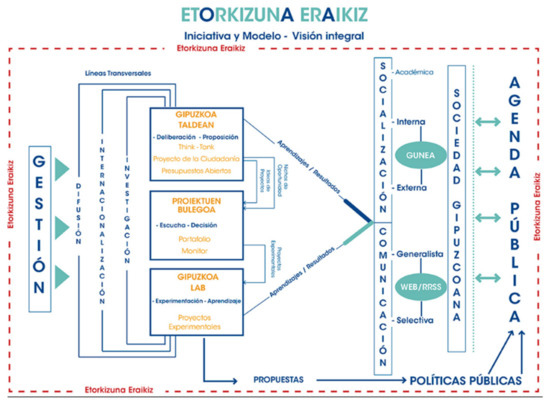
Figure 2.
Source: official site of Etorkizuna Eraikiz.
Recently, the government of Gipuzkoa came to a decision with further implications for the cultivation of these capabilities at the grassroots. They decided to launch a research and action project, through Globernance—an independent research center of the Basque Country with which both authors collaborate with—to (a) try to replicate the model of Etorkizuna Eraikiz in 18 localities, and (b) to create a learning ecosystem or a learning community on good governance. Within two and a half years, that community is expected to be established and to have generated a sufficiently solid experience so as to be conceptualized and published. Undoubtedly, learning about energetic governance will be something that will be explored along that period and later on.
5.3. Common Features
The two cases shortly examined above tried to show, in practical terms, some of the notions related to cognitive sustainability. However, none of the cases have succeeded to establish a new pattern of social organizations that includes an alternative energy system. Achieving that higher aim and attaining more local resilience—including energetic self-sufficiency and energy security—demand other requirements.
First, it requires a lot of collective experimentation at the grassroots. In addition, it requires a long-term commitment. Some comments on that are needed. Although both cases try to escape current political dynamics, liberal democracies and contemporary political activity are short term. “Etorkizuna Eraikiz” and Torre Lab aspire to become systems independent from the political parties in the government. Once that can be achieved, people also need to commit to the following long-term project: A long-term project to transform their collective life. That will entail reestablishing priorities in life, and overcoming consumption and leisure forces that engender lethargy.
Another requirement is to establish a pattern of action that allows for growing numbers of people to be constantly and progressively incorporated into the process. The bigger the group is, though, the higher the challenges to manage diversity. Thus, fostering unity of thought and action, while preserving and taking advantage of diversity, will be of vital importance. Moreover, collective capacity needs to grow. Whereas, the process has to begin simple, with one or two lines of action, and as more capacity is raised, more resources are obtained and more people are involved, complexity needs to grow.
Finally, multisectoral collaboration has to be harmonized with the need to coordinate the whole process. Initially, an organization or a couple of people can convene a simple experimentation and learning process; however, as the circle is expanded—and it has to be expanded to embrace most of the population— a clear overarching coordination scheme needs to materialize. In those places where the government is very committed with both action and the philosophy underlying the whole process, it can be the convening platform. In other cases, actors need to define this coordination and, along that path, involve the government and other local institutions and people. Ultimately, creating spaces where the government, private companies, civil organizations, and committed individuals and groups learn to collaborate as equals, lies at the heart of the project.
6. Discussion, Limitations and Conclusions
Setting a collective European goal to advance towards a resilient, green and sustainable system of energy production, distribution and consumption needs to be accompanied by a comprehensive strategy that takes into consideration European and national regulation, technological innovation and grass root cases grounded into new patterns of local development.
The European Union has paid attention to the issue of energetic supply and security from its inception, as the first international organisms and treaties that represented the seed of the current Union included energetic arrangements, such as the European Coal and Steel Community (ECSC, 1951) and the European Atomic Energy Community (EURATOM, 1957).
However, the nature of the challenges facing Europe nowadays, in connection to energy, seem to require a deep transformation in its configuration that goes beyond regulation. Global warming—which can be considered the result of human action and, in particular, the consequence of a fossil fuel system of dependence—, the energetic insecurity and lack of sovereignty, democratic erosion, economic crisis, and fragile and conflicted patterns of development, all call for a sort of historical political innovation to realize some of the ideals that inspired the European project: the creation of the United States of Europe. However, the United States of Europe will need, in turn, to be aware and to contribute to advancing towards an international federated order.
Spain, as one of the European countries dealing with European regulation and trying to apply it to a national context, has tried, over the decades, to transform its energetic system into a green, sustainable and resilient one. In order to attain that goal, Spain has followed the following three interrelated strategical lines of action: constant regulation, investments on and financing technological innovation, and fiscal stimulus for new green energetic industries. The coronavirus crisis has intensified this existing trend; this is shown in the hallmark of the economic plan, as follows: recovery, transformation and resilience. However, unless some of the former problems are recognized, little will probably be achieved.
First, Spain has overregulated the energetic sector. There are so many laws that their applicability is too difficult. Second, constant changes in the different governments’ policies on energy has not allowed a long-term strategy to bear its fruits. Indeed, companies of the “new” green sector, depending on the political color of the government, have experienced both times of excessive growth and times of excessive homelessness. Third, and finally, little attention has been paid to the need of embedding energetic strategies into development strategies.
The prevailing development models have brought relative prosperity to a percentage of the world’s population. Nonetheless, the following costs associated with them are not possible anymore: environmental degradation, fragility, conflicts, inequalities and material, and human and cognitive dependence.
Attaining new patterns of development informed by the notions of sustainability, fairness and peace is a very hard task. The project calls for a massive grassroots mobilization, coordinated nationally and internationally to generate practice knowledge on many areas related to social progress. At the heart of this initiative, an effort to build structures for participatory and deliberative practical knowledge generation, systematization and diffusion needs to be laid.
One of the tasks of this kind of learning community and ecosystem is to identify and systematize successful cases. Along that path, this paper highlighted two promising experiences that are inspired by some of the principles required to advance towards that new pattern of development, and that include energetic sustainability, as follows: the efforts of ICGD to assist the local government of Torrelodones (Madrid, Spain) to set in motion an economic governance Lab; and the Governance initiative to help the Government of Gipuzkoa (a province or state of the Basque Country in Spain) to replicate its “Etorkizuna Eraikiz” public policy definition model to a network of about 15 local governments and to establish a learning ecosystem on collaborative governance among them. More specifically, the experiences are informed by one of the following key concepts that was examined in this work: the notion of cognitive sustainability. A word of caution, though, is necessary. The cases studied here are by no means neither the end of the road nor definitive successful cases to be replicated. They just point out, in practical terms, some of the principles and approaches that seem to be essential to undertake the historical and vital collective project that the international community has in its front.
On another note, it must be recognized that the results of this paper are preliminary for a variety of reasons. To begin with, the methodological approach tried to combine legal analysis with sociological scrutiny. The purpose to examine the European and Spanish law on energy was not an end in itself, but a means to illustrate the following two main points: legal frameworks both constrain and enable action, and regulation is not sufficient to transform energetic systems.
Another limitation has to do with the fact that finding successful cases to shed light upon the relevance of the notion of cognitive sustainability in the context of energetic production, distribution and commercialization is not an easy task. Thus, the cases presented here, although interesting and innovative, cannot be interpreted as successful cases of energetic cognitive sustainability. At best, they represent the seed of nascent new patterns. The very notion of “cognitive sustainability” proposed by the authors is new and, although in the field of development, some organizations could have been examined, they did not have much experience in the sphere of energy.
To end this paper, some thoughts need to be shared in relation to policy. The focus of this paper has been the local constructive action aimed to create an alternative, sustainable energetic system. However, this does not mean that policy is not important. Indeed, the fact that the legal framework of Europe and Spain for green energy has been included at the beginning of the paper is an implicit recognition of the fact that policy matters. Furthermore, legal regulation is one of the forms that policy manifests. European and Spanish laws on energy, to continue with this line of reflection, need be stable, simple, and to reward green and local energetic systems. The accent is also posed on a local level because resilience is a property that has to be incorporated into our social systems. The COVID-19 pandemic, among other things, might be considered the last reminder of the fact that our economic and social systems are fragile.
Economic incentives are another area that policy has to promote. In particular, credit packages and fiscal exceptions need to stimulate local and green initiatives. In addition, the global fossil fuel subsidies that represent 6.5% of world GDP, mentioned at the outset of the paper, have to disappear.
Finally, public institutions should create learning spaces at the local, national and international level, for stakeholders, practitioners, business people and NGO working on the field of energy to make joint diagnosis, to exchange insights, to devise plans, and to assess initiatives. The nature of the task is so complex that including different types of actors and intelligence, and moving towards collaborative forms of action, is vital. This sphere of policy action is as crucial as complex, because it entails the exercise of the art of government and authority in another mode. The trend that better describes this innovative approach for public policy is the discourse on collaborative governance. Without a profound change in the way politics is practiced, promoting effective policies to transform energy systems and to make them more ecological and resilient is probably a task condemned to failure.
Author Contributions
S.G.-M. conceived the whole paper, examined the cases and elaborated the analysis and the conclusions. U.B. contributed to the conception of the paper, made the legal analysis of the Europan Union and Spain and assisted with the conclusions. All authors have read and agreed to the published version of the manuscript.
Funding
This research was funded by Fundación la Caixa and Fundación Caja Navarra, LCF/PR/PR13/51080004.
Institutional Review Board Statement
Not applicable.
Informed Consent Statement
Not applicable.
Data Availability Statement
Not applicable.
Conflicts of Interest
The authors declare no conflict of interest.
References
- Coady, D.; Parry, I.; Le, N.-P.; Shang, B. Global Fossil Fuel Subsidies Remain Large: An Update Based on Country-Level Estimates. International Monetary Fund. 2019. Available online: https://www.imf.org/en/Publications/WP/Issues/2019/05/02/Global-Fossil-Fuel-Subsidies-Remain-Large-An-Update-Based-on-Country-Level-Estimates-46509 (accessed on 22 June 2021).
- García-Magariño, S. Cronología de una Pandemia. Podría Tornarse la Crisis en Oportunidad; Sindéresis: Madrid, Spain, 2020; pp. 15–26. Available online: https://editorialsinderesis.com/producto/cronologia-de-una-pandemia-podria-tornarse-la-crisis-en-oportunidad (accessed on 22 June 2021).
- Berlingieri, F. Uniformité du Droit Maritime. Quelques problèmes. In IL Diritto Marittimo; 1992; Volume 3, p. 796. Available online: http://www.dirmar.com/index.php/en/ (accessed on 22 June 2021).
- Iriarte Ángel, J.L. La armonización del Derecho internacional privado por la Unión Europea. Jado Boletín Acad. Vasca Derecho 2006, 9, 47–93. [Google Scholar]
- Álvarez Rubio, J.J. La incidencia del Tratado de Ámsterdam en el sistema español de Derecho interregional. An. Fac. Derecho 2001, 18, 65–78. [Google Scholar]
- Calvo Caravaca, A.L. El Derecho internacional privado de la Comunidad Europea. An. Fac. Derecho 2003, 21, 49–69. [Google Scholar]
- Borrás Rodríguez, A. La proyección externa de la comunitarización del Derecho internacional privado: Los datos del problema. La Ley Rev. Española Jurisprud. Legis. 2002, 5611, 1–8. [Google Scholar]
- Guzmán Zapater, M. Cooperación civil y Tratado de Lisboa: ¿Cuánto hay de nuevo? La Ley Rev. Española Jurisprud. Legis. 2010, 7479, 713. [Google Scholar]
- Fernández Rozas, J.C. La comunitarización del Derecho internacional privado y Derecho aplicable a las obligaciones contractuales. Rev. Española Seguros 2009, 140, 595–616. [Google Scholar]
- Moya, S.; García, C.; Troncos, M. El posible impacto del Brexit en los contratos internacionales de ámbito europeo. Rev. Aranzadi Unión Eur. 2016, 12, 81–91. [Google Scholar]
- De Miguel Asensio, P.A. Integración Europea y Derecho Internacional Privado. Rev. Derecho Comunitario Eur. 1997, 2, 413–445. [Google Scholar]
- Álvarez Rubio, J.J. Transporte Marítimo Internacional de Mercancías: Alcance material y conflictual de la Autonomía Contractual. In III Seminario Internacional de Derecho Internacional Privado: Autorregulación y Unificación del Derecho de los Contratos Internacionales; Universidad Complutense de Madrid: Madrid, Spain, 2009; pp. 558–559. [Google Scholar]
- Gondra Romero, J.M. Integración económica e integración jurídica en el marco de la Comunidad Económica Europea. In Tratado de Derecho Comunitario Europeo; García, E., González, J.D., Muñoz, S., Eds.; Editorial Cívitas: Madrid, Spain, 1986; Volume I, pp. 275–312. [Google Scholar]
- Belintxon Martín, U. La política común de transportes de la UE: ¿la menos común de todas las políticas? Una primera reflexión sobre el Reglamento (UE) 2020/1055 de 15 julio de 2020. Rev. La Ley Unión Eur. 2020, 87. Available online: https://dialnet.unirioja.es/servlet/articulo?codigo=7705514 (accessed on 22 June 2021).
- Belintxon Martín, U. La política común de transportes de la UE: ¿la menos común de todas las políticas? Una primera reflexión sobre el Reglamento (UE) 2020/1055 de 15 julio 2020. Available online: https://dialnet.unirioja.es/servlet/articulo?codigo=7705514 (accessed on 22 June 2021).
- Fernández Rozas, J.C. El Espacio de libertad, seguridad y justicia consolidado por la Constitución Europea. La Ley Rev. Española Jurisprud. Legis. 2004, 195. Available online: https://core.ac.uk/download/pdf/19710667.pdf (accessed on 22 June 2021).
- Delgado Piquera, F. Las energías renovables (electricidad verde) en la jurisprudencia de la Unión Europea. Actual. Jurídica Ambient. 2020, 102, 138–174. [Google Scholar]
- Communication from the Commission to the European Parliament, the Council, the European Economic and Social, the Committee of the Regions and the European Investment Bank. A Framework Strategy for a Resilient Energy Union with a Forward-Looking Climate. 25 February 2015. Available online: https://eur-lex.europa.eu/resource.html?uri=cellar:1bd46c90-bdd4-11e4-bbe1-01aa75ed71a1.0001.03/DOC_1&format=PDF (accessed on 22 June 2021).
- Communication from the European Commission about Clean Energy For All Europeans. Brussels. 30 November 2016. Available online: https://ec.europa.eu/energy/sites/ener/files/documents/com_860_final.pdf (accessed on 22 June 2021).
- Regulation (EU) 2018/1999 of the European Parliament and of the Council of 11 December 2018 on the Governance of the Energy Union and Climate Action, amending Regulations (EC) No 663/2009 and (EC) No 715/2009 of the European Parliament and of the Council, Directives 94/22/EC, 98/70/EC, 2009/31/EC, 2009/73/EC, 2010/31/EU, 2012/27/EU and 2013/30/EU of the European Parliament and of the Council, Council Directives 2009/119/EC and (EU) 2015/652 and repealing Regulation (EU) No 525/2013 of the European Parliament and of the Council. OJEU L.328/1, 21 December 2018. Available online: https://eur-lex.europa.eu/legal-content/EN/TXT/?uri=uriserv%3AOJ.L_.2018.328.01.0001.01.ENG (accessed on 22 June 2021).
- Directive (EU) 2019/944 of the European Parliament and of the Council of 5 June 2019 on Common Rules for the Internal Market for Electricity and Amending Directive 2012/27/EU. OJEU L.158/125, 14 June 2019. Available online: https://eur-lex.europa.eu/legal-content/EN/TXT/?uri=CELEX%3A32019L0944 (accessed on 22 June 2021).
- Regulation (EU) 2019/943 of the European Parliament and the Council of 5th June 2019 on the Internal Market for Electricity. OJEU L.158/54, 14 June 2019. Available online: https://eur-lex.europa.eu/legal-content/en/ALL/?uri=CELEX:32019R0943 (accessed on 22 June 2021).
- Regulation (EU) 2019/941 of the European Parliament and of the Council of 5th June 2019 on Risk-Preparedness in the Electricity Sector and Repealing Directive 2005/89/EC. OJEU L.158/1, 14 June 2019. Available online: https://eur-lex.europa.eu/legal-content/EN/TXT/?uri=uriserv:OJ.L_.2019.158.01.0001.01.ENG (accessed on 22 June 2021).
- Directive (EU) 2018/2002 of the European Parliament and of the Council of 11 December 2018 Amending Directive 2012/27/EU on Energy Efficiency. OJEU L 328/210, 21 December 2008. Available online: https://eur-lex.europa.eu/legal-content/EN/ALL/?uri=CELEX%3A32018L2002 (accessed on 22 June 2021).
- Directive (EU) 2018/844 of the European Parliament and of the Council of 30 May 2018 amending Directive 2010/31/EU on the Energy Performance of Buildings and Directive 2012/27/EU on Energy Efficiency. OJEU L 156/75, 19 June 2018. Available online: https://eur-lex.europa.eu/legal-content/EN/ALL/?uri=CELEX%3A32018L0844 (accessed on 22 June 2021).
- Directive (EU) 2018/2001 of the European Parliament and of the Council of 11 December 2018 on the Promotion of the Use of Energy from Renewable Sources. OJEU L.328/82, 21 December 2018. Available online: https://eur-lex.europa.eu/legal-content/EN/TXT/?uri=uriserv:OJ.L_.2018.328.01.0082.01.ENG (accessed on 22 June 2021).
- Regulation (EU) 2019/942 of the European Parliament and of the Council of 5 June 2019 establishing a European Union Agency for the Cooperation of Energy Regulators OJEU L.158/22, 14 June 2019. Available online: https://eur-lex.europa.eu/legal-content/en/ALL/?uri=CELEX:32019R0942 (accessed on 22 June 2021).
- Decision (EU) 2019/504 of the European Parliament and of the Council of 19 March 2019 on Amending Directive 2012/27/EU on Energy Efficiency and Regulation (EU) 2018/1999 on the Governance of the Energy Union and Climate Action, by Reason of the Withdrawal of the United Kingdom of Great Britain and Northern Ireland from the Union. OJEU L.85/66, 27 March 2019. Available online: https://eur-lex.europa.eu/eli/dec/2019/504/oj (accessed on 22 June 2021).
- Regulation (EU) No 1227/2011 of the European Parliament and of the Council of 25 October 2011 on Wholesale Energy Market Integrity and Transparency Text. OJEU L.326/1, 8 December 2011. Available online: https://eur-lex.europa.eu/legal-content/EN/TXT/?uri=CELEX%3A32011R1227 (accessed on 22 June 2021).
- Regulation (EU) No 347/2013 of the European Parliament and of the Council of 17 April 2013 on Guidelines for Trans-European Energy Infrastructure and Repealing Decision No 1364/2006/EC and Amending Regulations (EC) No 713/2009, (EC) No 714/2009 and (EC) No 715/2009. OJEU L.115/39, 25 April 2013. Available online: https://eur-lex.europa.eu/legal-content/EN/TXT/?uri=CELEX:02013R0347-20140110 (accessed on 22 June 2021).
- Directive 2012/27/EU of the European Parliament and of the Council of 25 October 2012 on Energy Efficiency, Amending Directives 2009/125/EC and 2010/30/EU and Repealing Directives 2004/8/EC and 2006/32/EC. OJEU L.315/1, 14 November 2012. Available online: https://eur-lex.europa.eu/legal-content/en/TXT/?uri=CELEX:32012L0027 (accessed on 22 June 2021).
- Directive (EU) 2018/844, op. cit., note 25. Available online: https://eur-lex.europa.eu/legal-content/en/TXT/?uri=CELEX:32012L0027 (accessed on 22 June 2021).
- Directive 2009/28/EC of the European Parliament and of the Council of 23 April 2009 on the Promotion of the Use of Energy from Renewable Sources and Amending and Subsequently Repealing Directives 2001/77/EC and 2003/30/EC. OJEU L.140, 5 June 2009. Available online: https://eur-lex.europa.eu/LexUriServ/LexUriServ.do?uri=OJ:L:2009:140:0016:0062:en:PDF (accessed on 22 June 2021).
- Directive (EU) 2018/2001op. Available online: https://eur-lex.europa.eu/legal-content/EN/TXT/?uri=uriserv:OJ.L_.2018.328.01.0082.01.ENG (accessed on 22 June 2021).
- Regulation (EU) 2018/1999, op. cit., note 20. Available online: https://eur-lex.europa.eu/legal-content/EN/TXT/?uri=uriserv%3AOJ.L_.2018.328.01.0001.01.ENG (accessed on 22 June 2021).
- Decision No 994/2012/EU of the European Parliament and of the Council of 25 October 2012 Establishing an Information Exchange Mechanism with Regard to Intergovernmental Agreements between Member States and Third Countries in the Field of Energy. OJEU L.299/13, 27 October 2012. Available online: https://eur-lex.europa.eu/legal-content/EN/TXT/PDF/?uri=CELEX:32012D0994&from=EN (accessed on 22 June 2021).
- Decision (EU) 2017/684 of the European Parliament and of the Council of 5 April 2017 on Establishing an Information Exchange Mechanism with Regard to Intergovernmental Agreements and Non-Binding Instruments between Member States and Third Countries in the Field of Energy, and Repealing Decision No 994/2012/EU. OJEU L.99/1, 12 April 2017. Available online: https://eur-lex.europa.eu/legal-content/EN/ALL/?uri=celex:32017D0684 (accessed on 22 June 2021).
- Regulation (EU) 2017/1938 of the European Parliament and of the Council of 25 October 2017 Concerning Measures to Safeguard the Security of Gas Supply and Repealing Regulation (EU) No 994/2010. OJEU L.280/1, 28 October 2017. Available online: https://eur-lex.europa.eu/legal-content/EN/TXT/?uri=celex:32017R1938 (accessed on 22 June 2021).
- Council Directive 2009/119/EC of 14 September 2009 Imposing an Obligation on Member States to Maintain Minimum Stocks of Crude Oil and/or Petroleum Products. OJEU L.265/9 of 9 October 2009. Available online: https://eur-lex.europa.eu/legal-content/EN/ALL/?uri=celex:32009L0119 (accessed on 22 June 2021).
- Directive (EU) 2019/692 of the European Parliament and of The Council of Amending Directive 2009/73/EC Concerning Common Rules for the Internal Market in Natural Gas. OJEU L.117/1, 3 May 2019. Available online: https://eur-lex.europa.eu/legal-content/EN/ALL/?uri=celex:32009L0119 (accessed on 22 June 2021).
- Directive 2013/30/EU of the European Parliament and of the Council of on Safety of Offshore Oil and Gas Operations and Amending Directive 2004/35/EC. OJEU L.178/66, 28 June 2013. Available online: https://eur-lex.europa.eu/legal-content/EN/TXT/?uri=CELEX:32013L0030 (accessed on 22 June 2021).
- Regulation (EU) 2017/1938, op. cit, note 38. Available online: https://eur-lex.europa.eu/eli/reg/2017/1938/oj (accessed on 22 June 2021).
- Regulation of the European Parliament and of the Council establishing the Just Transition Fund COM/2020/22 final. Brussels, 14 January 2020. Available online: https://eur-lex.europa.eu/legal-content/EN/TXT/?uri=CELEX:52020PC0022 (accessed on 22 June 2021).
- European Parliament Resolutions of 28 November 2019. Available online: https://www.europarl.europa.eu/doceo/document/TA-9-2019-0078_EN.html (accessed on 16 May 2021).
- European Parliament Resolutions of 15 January 2020. Available online: https://www.europarl.europa.eu/doceo/document/TA-9-2020-0005_EN.html (accessed on 16 May 2021).
- United Nations Framework Convention on Climate Change (UNFCCC). Available online: https://unfccc.int/resource/docs/convkp/convsp.pdf (accessed on 16 May 2021).
- Kyoto Protocol. Available online: https://unfccc.int/resource/docs/convkp/kpspan.pdf (accessed on 16 May 2021).
- Zambrano González, K. La Unión Europea ante la emergencia climática. Anu. Español Derecho Int. 2020, 36, 429–447. [Google Scholar] [CrossRef]
- Paris Agreement. Available online: https://unfccc.int/sites/default/files/spanish_paris_agreement.pdf (accessed on 16 May 2021).
- On 5 October 2016, Representatives of the Presidency of the Council and the European Commission Deposited the Instruments of Ratification of the Paris Agreement, with the Secretary-General of the United Nations, Entering into Force on 4 November 2016. Available online: https://treaties.un.org/pages/ViewDetails.aspx?src=TREATY&mtdsg_no=XXVII-7-d&chapter=27&clang=_en (accessed on 22 June 2021).
- The Full Set of Standards Can Be Viewed at the Following Link with Its Reference to the BOE (Official State Gazette). Available online: https://www.boe.es/biblioteca_juridica/codigos/codigo.php?id=14&modo=2¬a=0&tab=2 (accessed on 16 May 2021).
- Belintxon Martín, U. Derechos humanos y responsabilidad social corporativa en las empresas de transporte. Un apunte de Derecho europeo. Cuad. Eur. Deusto 2020, 63, 269–294. [Google Scholar] [CrossRef]
- García-Magariño, S. El desarrollo Social y Económico: Un Enfoque Holístico; Delta: Madrid, Spain, 2018. [Google Scholar]
- Arbab, F. Evolución de los Conceptos de Desarrollo; Centro Universitario de Bienestar Rural: Puerto Tejada, Colombia, 2006. [Google Scholar]
- Max-Neef, M. Desarrollo a Escala Humana; Icaria: Barcelona, Spain, 1998. [Google Scholar]
- Sen, A. Rationality and Freedom; Harvard University Press: Cambridge, MA, USA, 2004. [Google Scholar]
- García-Magariño, S. Criterios, propuestas y experiencias de la Carta contra el Hambre: II: Distribución de alimentos en un contexto más amplio. Éxodo 2017, 139, 37–41. [Google Scholar]
- Wallace-Wells, D. El Planeta Inhóspito: La Vida Después Del Calentamiento; DEBATE: Barcelona, Spain, 2019. [Google Scholar]
- World Bank Web Page. Available online: https://www.bancomundial.org/es/news/press-release/2018/09/19/decline-of-global-extreme-poverty-continues-but-has-slowed-world-bank (accessed on 10 May 2021).
- United Nations Page for Social and Economic Affairs and Social Inclusion. Available online: https://www.un.org/development/desa/dspd/world-social-report/2005-4.html (accessed on 10 May 2021).
- Heinberg, R. Peak Everything: Waking Up to the Century of Declines; New Society Publishers: Gabriola Island, BC, Canada, 2007. [Google Scholar]
- Barkin, D. Violence, Inequality and Development. J. Aust. Political Econ. 2016, 78, 115–131. [Google Scholar]
- Beck, U. La Individualización: El Individualismo Institucionalizado y Sus Consecuencias Sociales y Políticas; Paidós: Barcelona, Spain, 2000. [Google Scholar]
- García-Magariño, S. Un cuestionamiento de las bases conflictuales del debate contemporáneo. J. Sociol. Theory Relig. 2016, 5, 171–190. [Google Scholar]
- Kalberg, M. Beyond the Culture of Contest; George Ronald: London, UK, 2014. [Google Scholar]
- Stiglitz, J.E. Globalization and Its Discontents; Norton: New York, NY, USA, 2002. [Google Scholar]
- Coady, D.; Parry, I.; Le Nghia, P.; Baoping Shang, B. Global Fossil Fuel Subsidies Remain Large: An Update Based on Country-Level Estimates. Available online: file:///C:/Users/Camelia%20Baluta/Downloads/WPIEA2019089.pdf (accessed on 10 May 2021).
- Ruiz Domenec, J. El día Después de las Grandes Epidemias; Taurus: Barcelona, Spain, 2020. [Google Scholar]
- García-Magariño, S. Desafíos del Sistema de Seguridad Colectiva de la ONU: Análisis Sociológico de las Amenazas Globales; Centro de Investigaciones Sociológicas: Madrid, Spain, 2016. [Google Scholar]
- Stephens, W.; Sieckelinck, S. Being resilient to radicalisation in PVE policy: A critical examination. Crit. Stud. Terror. 2020, 13, 142–165. [Google Scholar] [CrossRef] [Green Version]
- Heinberg, R. Peak Everything. Available online: https://newsociety.com/books/p/peak-everything (accessed on 22 June 2021).
- GlobalSTD. Available online: https://www.globalstd.com/blog/10-paises-lideres-en-exportacion-mundial-de-alimentos/ (accessed on 18 May 2021).
- García-Magariño, S. Cronología de una pandemia ¿Podría tornarse la crisis en oportunidad? Available online: https://editorialsinderesis.com/producto/cronologia-de-una-pandemia-podria-tornarse-la-crisis-en-oportunidad (accessed on 22 June 2021).
- Karlberg, M.; Correa, B. Development as Systematic Learning and Capacity Building. In Education, Learning and the Transformation of Development; Skinner, A., Smith, M., Brown, E., Troll, T., Eds.; Routledge: London, UK, 2016; pp. 19–35. [Google Scholar]
- Arbab, F. La Senda del Aprendizaje en Latinoamérica; Editorial Nur: Cali, Colombia, 1993. [Google Scholar]
- Arbab, F. Rural University: Learning About Education and Development; IDRC: Ottawa, ON, Canada, 1985. [Google Scholar]
- García-Magariño, S. El orden mundial de Bahá’u’lláh: Una aproximación a su propuesta de transformación social desde las ciencias eclesiásticas. Cauriensia 2015, 10, 289–309. [Google Scholar]
- European Union Commission Web Page. Keynote Speech of President von der Leyen at the Berlin Energy Transition Dialogue of 2021. Available online: https://ec.europa.eu/commission/presscorner/detail/en/SPEECH_21_1182 (accessed on 19 May 2021).
- Mazzucchi, N. European energy transition after Covid-19: From Green Deal to ‘Gas Deal’? Frstrategie 2020, 18. Available online: https://www.frstrategie.org/sites/default/files/documents/publications/notes/2020/202018.pdf (accessed on 22 June 2021).
- International Energy Agency. European Union 2020: Energy Policy Review; IEA: Paris, France, 2020. [Google Scholar]
- Etorkizuna Eraikiz Web Page. Available online: https://www.gipuzkoa.eus/es/web/etorkizunaeraikiz/modelo (accessed on 19 May 2021).
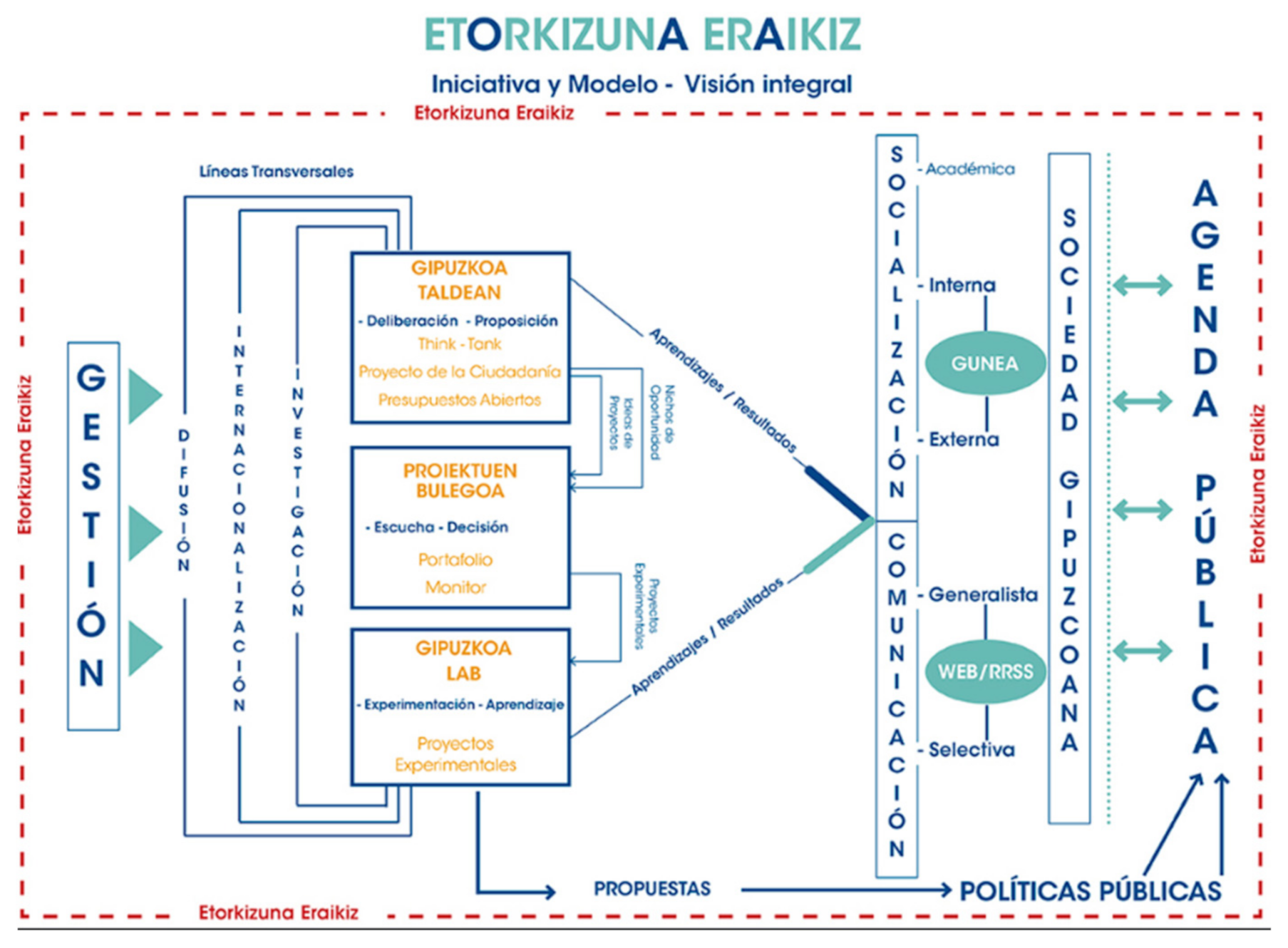
Publisher’s Note: MDPI stays neutral with regard to jurisdictional claims in published maps and institutional affiliations. |
© 2021 by the authors. Licensee MDPI, Basel, Switzerland. This article is an open access article distributed under the terms and conditions of the Creative Commons Attribution (CC BY) license (https://creativecommons.org/licenses/by/4.0/).