


Abstract
The regional energy system (RES) is a system that consumes multiple forms of energy in the region and achieves coordinated and efficient utilization of energy resources. The RES is composed of multiple micro energy systems (MESs); however, due to the mismatch of energy resources and different energy consumption within each MES, a large amount of clean energy is wasted, and each MES has to acquire extra energy. This significantly increases operation costs and contributes to environmental pollution. One of the promising ways to solve this problem is to deploy an energy storage system in the RES, which can make use of its advantages to transfer energy in space-time and fulfill the demand for loads in different periods, and conduct unified energy management for each MES in the RES. Nevertheless, a large number of users are deterred by the high investment in energy storage devices. A shared energy storage system (SESS) can allow multi-MESs to share one energy storage system, and meet the energy storage needs of different systems, to reduce the capital investment of energy storage systems and realize efficient consumption of clean energy. Taking multiple MESs as the object, this paper proposes a model and collaborative optimal strategy of energy management for the RES to accomplish high utilization of clean energy, environmental friendliness, and economy. First, the paper analyzes the internal energy supply characteristics of the RES and develops a model of the RES with an SESS. Then, the paper poses the management concept of load integration and unified energy distribution by using the operational information of each subsystem. An optimal operation strategy is established to minimize daily operation costs and achieve economic, environmentally friendly, and efficient operation of the RES. Third, by setting up scenarios such as no energy storage system and an independent energy storage system (IESS) of each MES and SESS, a case of a science and education park in Guangzhou, China, is illustrated for experiments. Numerical experiment results show that with an SESS built by the investor in the RES and applying the mentioned energy management strategy, the utilization of clean energy can be 100%, the operation costs can be reduced by up to 9.78%, the pollutant emission can be reduced by 3.92%, and the peak-to-valley difference can be decreased by 20.03%. Finally, the influence of energy storage service fees and electricity tariffs on daily operation costs is discussed, and the operation suggestions of the SESS are proposed. It validates the effectiveness of the proposed strategy.
1. Introduction
Rapid economic and social development has gradually increased the demand for energy [1]. However, the consumption of large amounts of fossil fuels not only emits large amounts of greenhouse gases but also leads to a huge waste of energy and a deterioration of the ecological environment [2]. With the increasing depletion of traditional fossil energy resources and the rapid development of energy internet technology, the regional energy system (RES) with multiple energy resources coupled and complemented has gradually become one of the hot research issues [3,4,5]. An RES refers to the integrated system of energy production, supply, and distribution that promotes the sustainable development of various types of energy resources in a specific region by bringing into play their multi-energy complementary characteristics, which can provide people with a variety of energy resources, including electricity, thermal, and cold energy [6,7]. Under the serious threat of global fossil energy depletion and environmental pollution problems, the RES can greatly improve the efficiency of multi-energy utilization; provide clean, low-carbon energy; and realize the sustainable development of human society [8].
An RES is usually composed of several relatively independent micro energy systems, and each MES may have a mismatch between renewable energy and electrical load [9]. On the other hand, thermal energy and cold energy can also be generated from renewable energy [10]; therefore, a comprehensive analysis of the whole system from the perspective of the RES is extremely necessary to achieve efficient energy utilization and improve environmental friendliness [11]. Several issues need to be addressed in this regard. The first is the energy management for the RES, which allows multiple energy resources to be collaboratively consumed and meet people’s energy needs. In Ref. [12], current research on the energy management of integrated energy systems (IESs) is reviewed. The energy management of IESs includes unit commitment, economic dispatch, and optimal multi-energy flow. Based on this, in Ref. [13], an optimal method of an IES is constructed considering the economy and environmental protection. In Ref. [14], an optimal scheduling method for the IES of an island based on bioenergy is posed, which further expands the scope of clean energy and improves energy utilization. Zhang et al. [15] propose a co-integration theory-based source-load interaction model for regional integrated energy systems, which achieves lean control of regional loads and helps to achieve efficient and stable utilization of regional energy. The authors in Ref. [16] propose a coordinated control strategy for multi-micro energy systems. The proposed approach is presented from the MES side and distribution grid side with consideration of different control objectives under day-ahead dispatch, intra-day dispatch, and emergency control circumstances. A case study verifies the effectiveness of the proposed method. Parvin et al. [17] propose a smart grid demand-side management service based on the energy internet, stating that EI-based SGs can be used for sustainable operation and management in the future. This approach can effectively enhance the energy utilization for MES. In Ref. [18], an optimal power flow approach is proposed to improve the static voltage stability under the impact of penetration of renewable energy. By studying the coupling relationship between different types of energy resources, these references establish energy systems that can satisfy multiple energy resources and improve energy utilization. However, there is no research on energy management for RES containing multiple MESs.
Secondly, for clean energy that cannot be consumed in time, how to avoid abandonment of wind and solar energy is another key factor to improve the efficiency of energy utilization. Ref. [19] builds control frameworks for transactive energy storage services aimed at energy communities, and this achieves energy transfer in space-time. Liao et al. [20] construct a shared energy storage system based on a cyber-physical system to enable the operation of zero-energy buildings (ZEBs) in a community. Ref. [21] finds that the peak load of the system could be reduced by 4.64% by studying the application of separate energy storage devices in systems containing renewable energy, indicating that energy storage systems can effectively achieve system peak shaving and valley filling. Cao et al. [22] put forward an efficient and economic energy sharing and storage model for micro energy networks, which effectively improves the utilization of clean energy. Walker et al. [23] study the impact of stand-alone and shared energy storage systems in residential communities, and conclude that shared energy storage systems can significantly increase the level of system energy terracing. Ref. [24] analyzes the pricing of shared energy storage services, then concludes that shared energy storage can reduce the operating costs of a community, and that operation costs decrease as the storage capacity increases from 0 to 3.9 MWh using 2009 price and demand data of Ireland. Ref. [25] model capacity and energy-sharing platform with a hybrid energy storage system for the hospitality industry. Chang et al. [26] analyze the allocation and optimization of shared community energy storage. Zhang et al. [27] construct a thermal storage device with an equivalent round-trip efficiency of up to 85.17% for the thermal energy storage system, achieving a proper match between the heat resource and the thermal storage medium. Li et al. [28] rationalize the planning and sharing of energy storage systems after considering the interests of investors and professional users, providing a realistic reference for the government to effectively implement shared energy storage. Mao et al. [29] construct a cooperative operation framework for a wind-solar-CCHP multi-energy system with electrical storage and thermal storage, and maximize the benefits of both parties through Nash game theory.
In terms of system economy and environmental protection, Dai et al. [30] analyze the relationship between shared energy storage and environmental friendliness. Wang et al. [31] integrate biomass as a fuel for the RES to achieve near-zero carbon emissions from the system. Liu et al. [32] evaluate the environmental indexes of IESs and conclude that IESs can be effective in enhancing environmental friendliness. Ref. [33] analyzes the impact of the indexes in the IES on the integrated operation of the system in three dimensions—energy, environment, and economy—and concludes that the IES consisting of a grid, gas turbine, ground source heat pump unit, and flue gas unit can be considered to satisfy the optimal operation of energy, environment, and economy.
In this paper, a model of the RES considering clean energy and SESS is propounded, which contains wind power, solar energy, natural gas, and energy conversion devices. The contributions of this paper can be divided into the following four parts.
- A regional energy system with a shared energy storage system is proposed for the coordinated operation of multiple MESs and multi-energy complementarities.
- To minimize the system’s daily operation costs, the strategy of energy management of the RES is proposed through the interaction of information. The method includes load integration and unified energy distribution to achieve efficient utilization of clean energy.
- The objective function for economic optimization is introduced, and the constraints of the system are analyzed. The problem is transformed into the capacity and economic optimum of the SESS, which is a mixed integer nonlinear programming (MINLP) problem. The Big-M method is used to solve the MINLP problem and good results are obtained.
- A case of the RES with an SESS is analyzed, and results indicate that the RES with an SESS can effectively improve the economy and environmental protection. Moreover, by comparing scenarios of no energy storage system, IESS, and SESS, the results also demonstrate that an SESS is the key way to reduce the daily operation costs.
- The indexes such as clean energy utilization, carbon emission, and grid peak shaving are proposed to evaluate the RES with an SESS. The simulation results demonstrate that the proposed method can effectively achieve environmental friendliness and reduce the system peak-to-valley difference.
In Section 2, the RES is described, and the coupling of energy and equipment between its internals is illustrated. Based on this, the concept of the RES with an SESS is proposed. Section 3 analyzes the objective function and constraints for the economic operation of the RES with an SESS. A case study and analysis are given in Section 4. Finally, the conclusions of this paper and future work are put forward in Section 5.
2. Regional Energy System with a Shared Energy Storage System
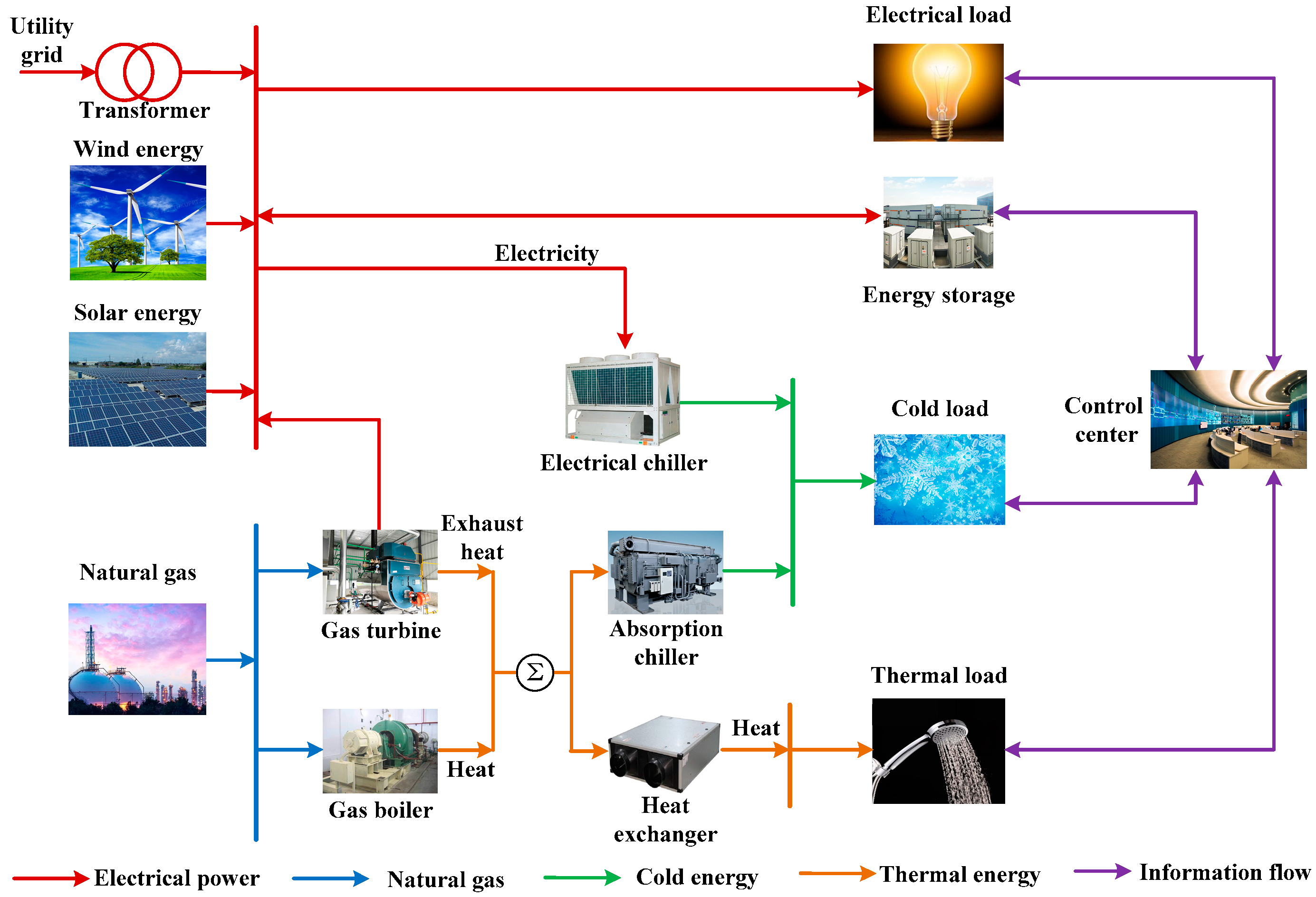
The MES is an energy system in a small region, which can utilize various energy resources. The multiple energy conversion devices in the system realize the efficient use of different energy resources. A typical MES topology diagram is shown in Figure 1.
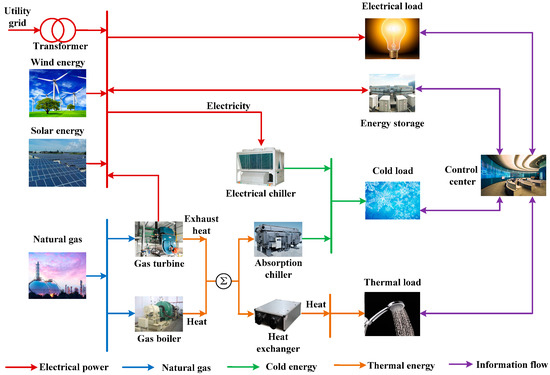
Figure 1.
Typical MES topology diagram.
In Figure 1, the MES is supplied with solar energy, wind power, natural gas, etc., and is also connected to the external utility grid. In each MES, the load may consist of residential users, businesses, industry, schools, and so forth, and people need electrical, thermal, and cold energy for daily life. The system also includes gas turbines, boilers, absorption chillers, heat exchangers, and electrical chillers equipment. In addition, the MES is connected to an energy storage system that can store or release electrical energy.
The energy management of the MES is performed by the control center, which can interact with the information of the equipment in the system, control the operation status of the equipment in real time, and finally realize the coordination and optimization of multiple energy resources.
The MES generates electricity in three ways, photovoltaic power generation, wind power plants, and gas turbines. The self-generated electricity of the MES can meet the electrical load and electrical chillers. When the self-generated electricity of the MES is more abundant or the grid electricity tariff is cheaper, the energy storage system will work. When the self-generated electricity of the MES cannot meet the load demand, electricity will be purchased from the grid, or energy from the storage system is released.
Exhausted heat generated from gas turbines and heat generated from gas boilers can be mixed. When people need thermal energy, part of the mixed heat will pass through the heat exchangers, and the heat is converted into thermal energy to meet people’s needs.
The rest of the mixed heat can be used as the heat resource of the absorption chillers to meet the cold load, and when there is a shortage of cold energy, it can be provided by the electrical chillers.
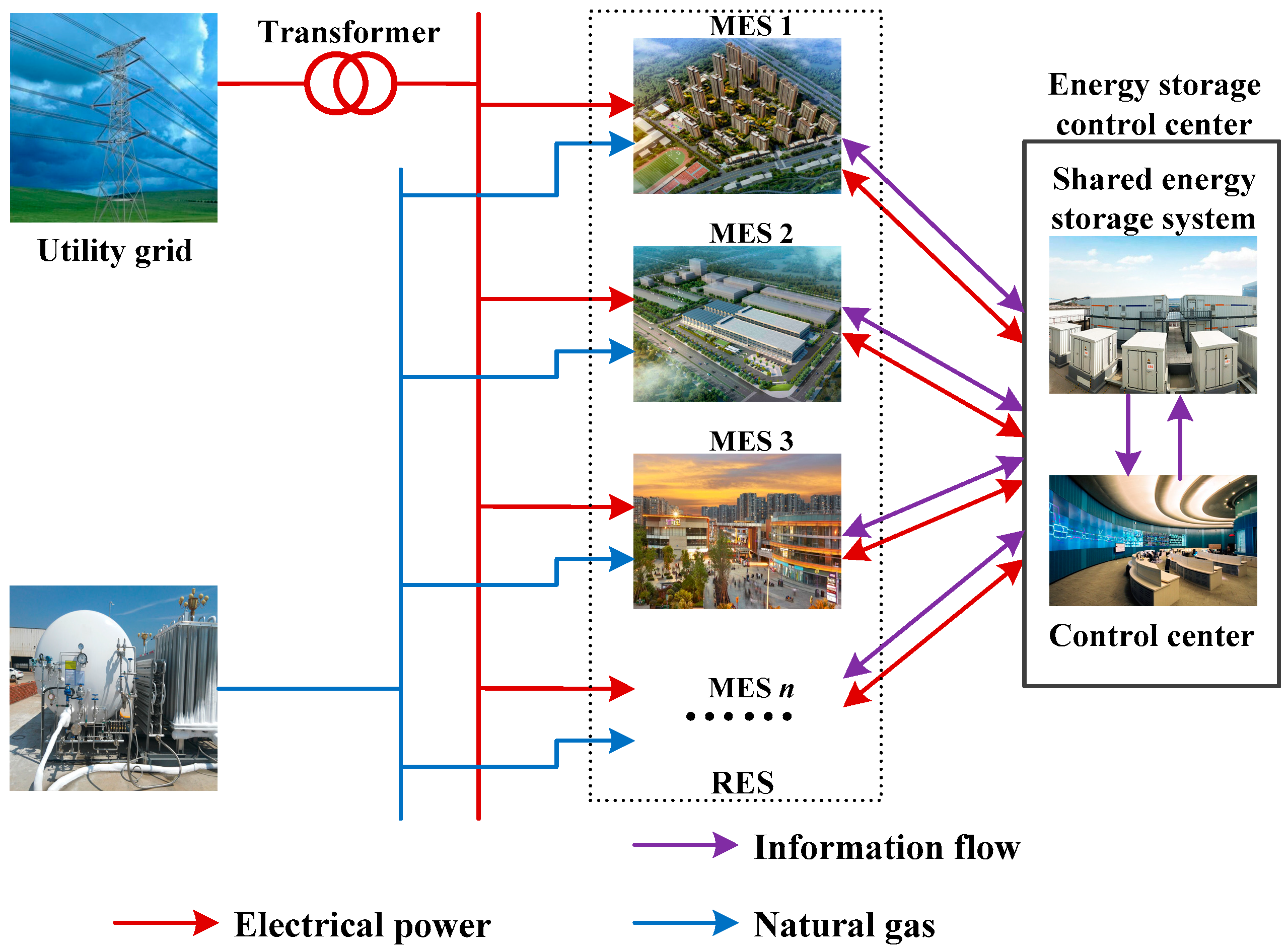
Multiple MESs constitute the RES. As is shown in Figure 2, each subsystem (i.e., MES1, MES2, MES3) operates according to the micro energy system model. The difference is that each MES no longer has a separate energy storage system and control center. An SESS and a control center are deployed in the RES, which realizes the unified management and distribution of energy through the interaction of information with different MESs.
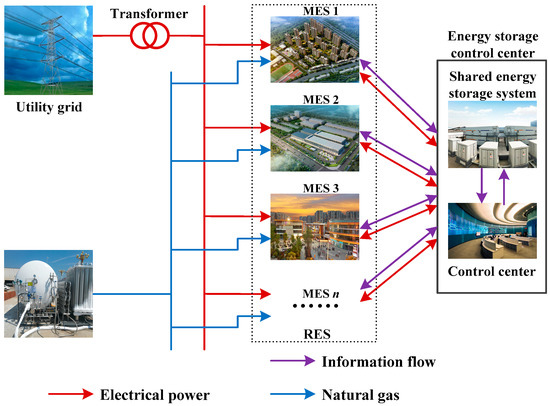
Figure 2.
Multi-RES with SESS.
The SESS can effectively reduce investment costs. Each MES is also connected by wires to allow for the interconnection of electrical energy. The energy storage control center (ESCC) realizes energy charging and discharging of energy storage devices by analyzing the energy situation inside each MES. The ESCC first aggregates the load of the RES, and when the self-generated electricity of the RES can meet the total load demand, there is no need to purchase power from the utility grid, and the excess power can be stored in SESS. Each MES only needs to realize internal energy transfer under the command of the control center. When the self-generated electricity of the RES cannot meet the aggregated electrical load, the ESCC controls the system to purchase power from the utility grid, natural gas, or discharge from the SESS.
The SESS is built by users themselves or by investors. If the SESS is built by users, users are responsible for the construction and operation and maintenance costs. If the SESS is built by investors, such as administration, users only need to pay the service fee for the SESS when storing or releasing electricity. What we need to discuss is how to achieve the economic and environmentally friendly operation of the RES with an SESS.
3. Optimal Operation Strategy and Solution
3.1. Objective Function
The first advantage of the SESS is cost-saving. Thus, the lowest operation costs is the optimization goal for the RES with an SESS. The objective function expression of the optimal dispatching model is below:
where is the total cost of system operation, ~ is the cost of natural gas, the cost of electricity purchased from the utility grid, and the service fee for the RES containing an SESS, respectively.
The expressions of the equations ~ are shown as follows:
where N is the number of MESs, T is the dispatching period, is the price per unit volume of natural gas of equivalent value, is the gas consumption of MES i at time t, is the price per unit electricity of MES i at time t, is the purchasing power from the utility grid of MES i at time t, is the service price for SESS, is the discharging power of MES i using SESS at time t, and is the charging power of MES i using SESS at time t.
3.2. System Model and Constraints
Considering that the system is in a small region and the power wire is not long, the power wire loss can be ignored. The model considering the RES with an SESS should include electrical, thermal, cold power balance, and the physical characteristics constraints of each device. Each constraint is shown as follows.
3.2.1. Power Balance
Electrical Power Balance
The system has to satisfy the electrical power balance with the following constraints, which are shown below:
where is the photovoltaic power of MES i, is the wind power of MES i, is the gas turbine power of MES i, is the electrical chiller power, and is the electrical load power of MES i.
Thermal Power Balance
The system has to satisfy the thermal power balance with the following constraints:
where is the exhaust heat of the gas turbine of MES i, is the output of gas boiler of MES i, is the input of absorption chiller of MES i, is the input of heat exchanger of MES i, is the output of heat exchanger of MES i, and is the thermal load of MES i.
Cold Power Balance
The system has also to satisfy cold power balance with the following constraint:
where is the power of electrical chillers of MES i, is the power of absorption chillers of MES i, and is the power of cold load of MES i.
3.2.2. Constraints of System Physical Characteristics
Constraint of Gas Turbine and Gas Boiler
The output power and climbing power of the gas turbine and gas boiler should satisfy the following equation:
where and are the minimum and maximum values of gas turbine power, and are the upper and lower limits of gas turbine climbing power, and are the power of the equipment at moment t and moment t – 1, and are the minimum and maximum values of gas boiler power, and are the upper and lower limits of gas boiler climbing power, and and are the power of the equipment at moment t and moment t – 1.
Constraints of Energy Conversion
The electricity generated by the gas turbine and the exhausted heat obtained by the absorption chiller can be calculated according to the following formula:
where is the amount of natural gas consumed by the gas turbine of MES i, is the power generation efficiency of the gas turbine of MES i, and is the energy loss rate when the gas turbine is operating.
The equation of absorption chillers is shown as follows:
where is the amount of cold produced by the chillers of MES i, is the conversion coefficient between cold and heat of absorption chillers of MES i, and is the efficiency of energy conversion of the chiller unit of MES i.
The thermal power output of the heat exchanger meets the daily thermal load demand, whose mathematical model is
where is the conversion efficiency of the energy of the heat exchanger.
When the absorption chillers cannot meet the demand of the cold load in the system, electrical chillers will work, and its mathematical model is
where is the cold and thermal conversion coefficient of the electric refrigeration machine of MES i, is the power of the electrical chiller of MES i, and is the conversion efficiency of the energy of the electric refrigeration machine.
3.3. Solving Method
It can be seen from the analysis above that the decision variables are integer variables and real variables. The integer variables are the charging and discharging state, the capacity state of the shared energy storage, and the state of each MES. The real variables are the charging and discharging power of the RES with an SESS, the power purchased from the utility grid by each MES, the maximum charging and discharging power, and the maximum capacity and the charging and discharging power. Moreover, the model also includes 11 equality constraints, 10 inequality constraints, and 5 bounding constraints.
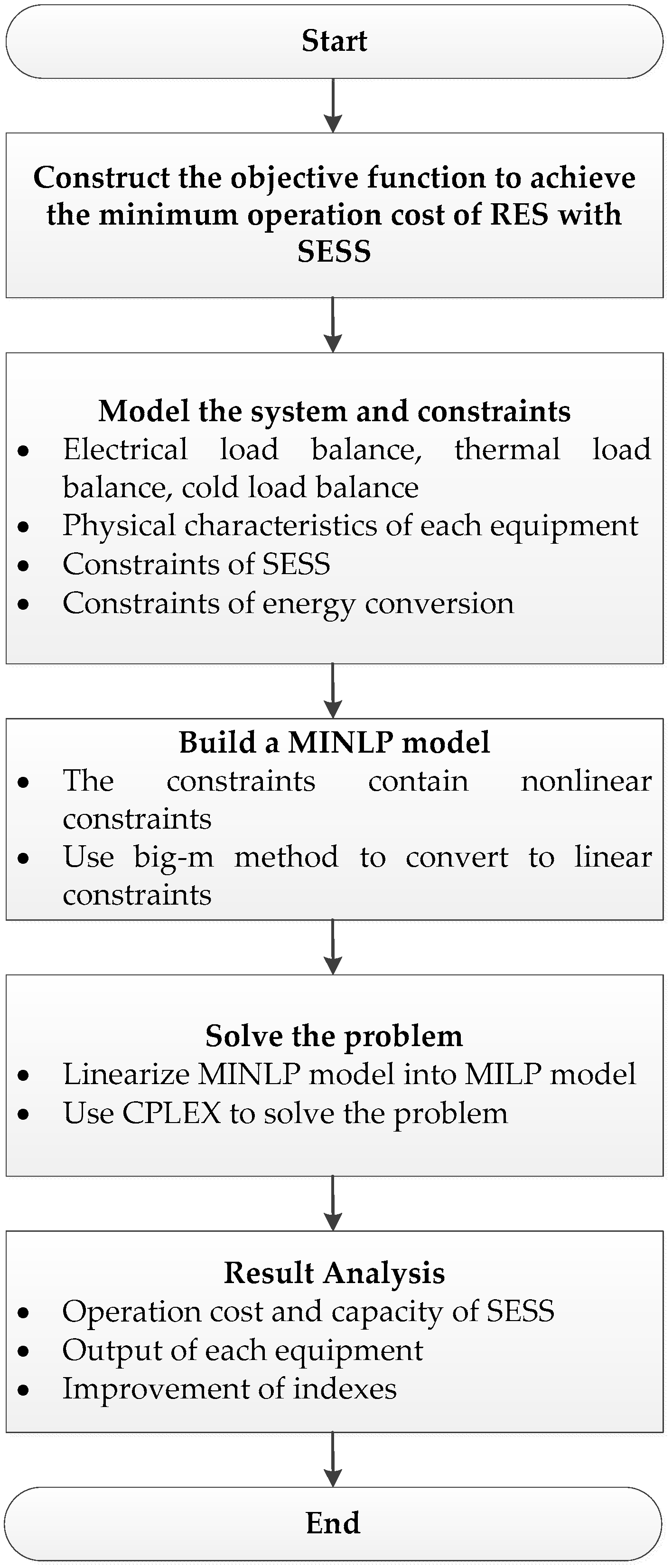
The above model, such as Equation (7), contains nonlinear constraints. Therefore, the problem is a mixed integer nonlinear programming problem, which is difficult to solve by conventional methods. To solve the model containing nonlinear constraints, this paper uses the Big-M method to linearize the nonlinear constraints.
The constraint after linearizing Equation (15) using the Big-M method is:
where M is an extremely large constant.
The model described in the previous section shows that this collaborative dispatching model is transferred to a mixed integer linear programming problem, so the CPLEX solver in MATLAB is used to solve the problem efficiently and accurately. The model-solving process is shown in Figure 3.
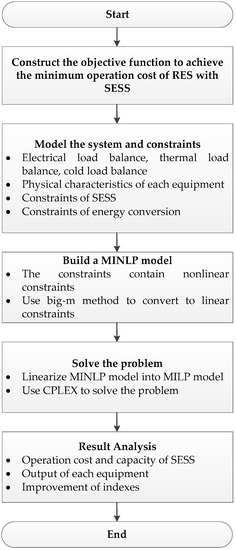
Figure 3.
Model-solving process.
4. Case Study
This paper selects a science and education park in Guangzhou, China, as the subject of the study. The park is composed of three relatively scattered and independent campuses and is connected to the utility grid and gas network. There are also some commercial complexes in this area. Each community can be seen as an MES and realize the efficient utilization of energy.
Each community contains clean energy such as wind energy and solar energy according to its environmental characteristics. Local administration constructs the SESS for the park, and the user only needs to pay the fees to the investor, without bearing the construction cost of the SESS.
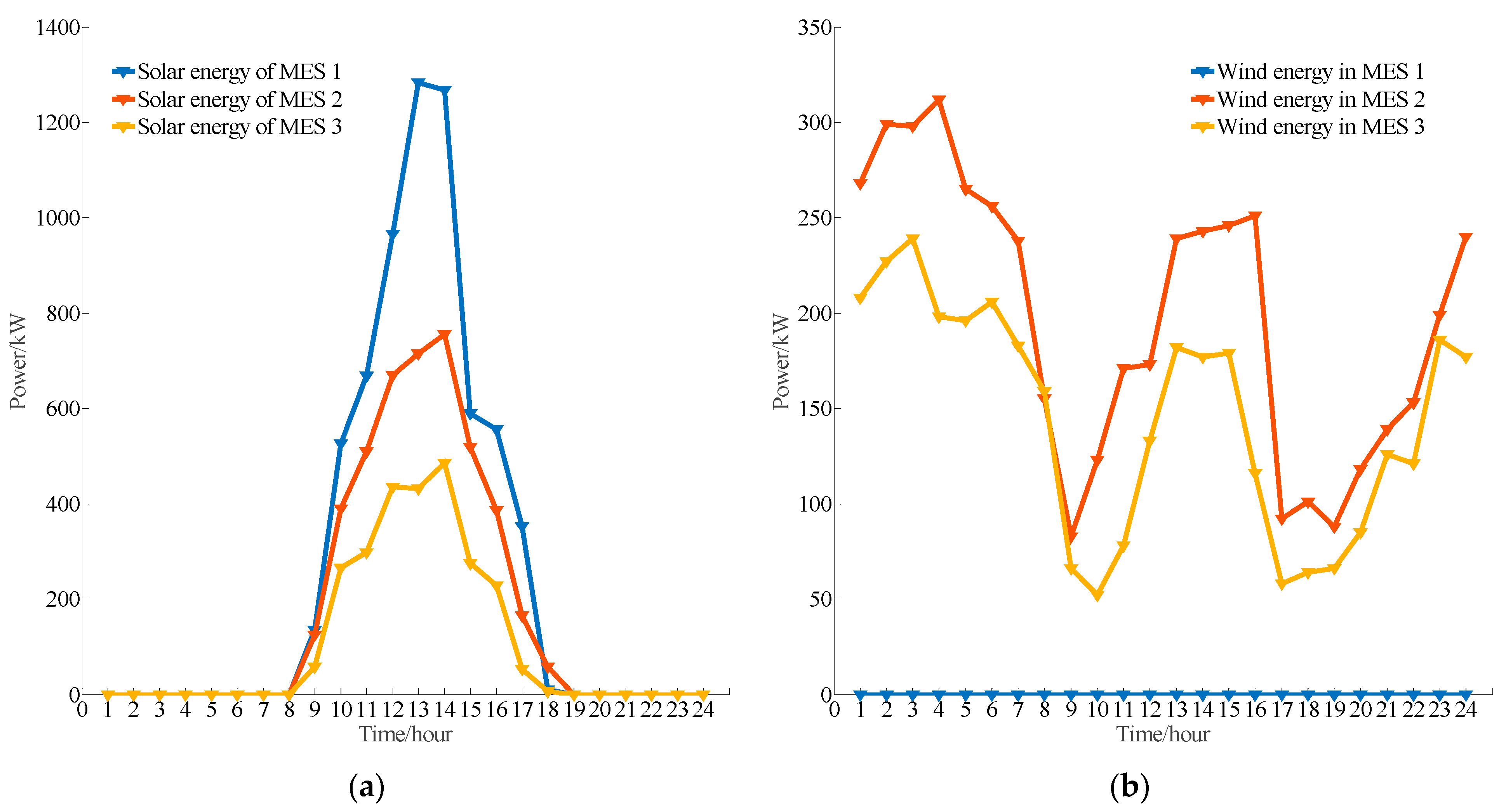
As it is located in a tropical area, the daily load including electrical load, thermal load, and cold load are the same. This paper selects the typical daily loads as the research data. Every kind of load of the MES is given in Appendix A. Similarly, the paper selects the typical PV and wind power as the research data. The PV and wind power output of each MES is also shown in Appendix A.
Moreover, the paper takes = 0.9 and RMB 3.5 per unit of natural gas as an example. The service fee of the SESS is 0.23 RMB/kW·h. The dispatching cycle of the system is 24 h, and the operation parameters of the equipment in each MES are shown in Appendix B. The electricity tariff is also shown in Appendix B.
4.1. Optimization Results
4.1.1. Load Integration
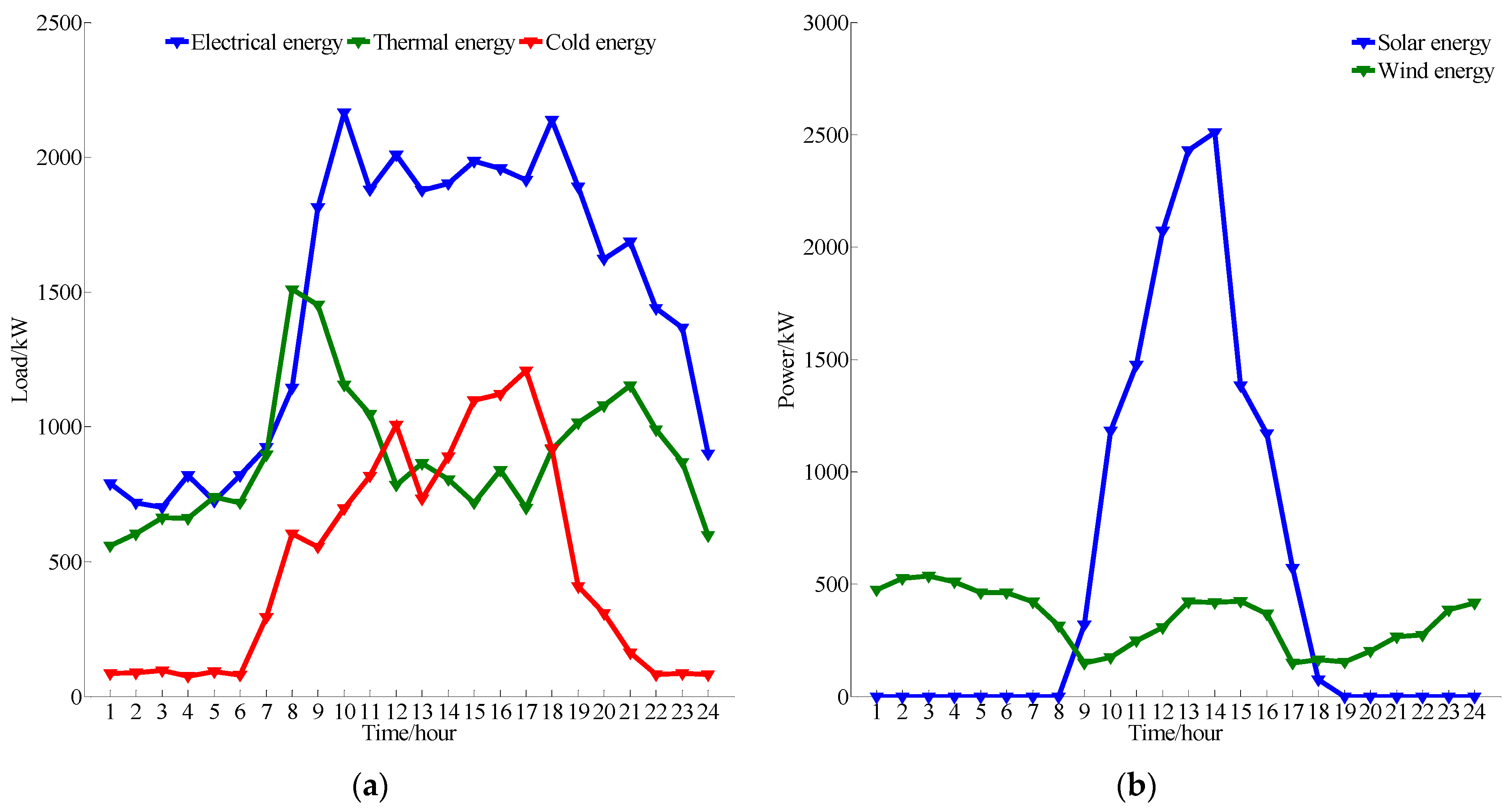
When the three MESs are connected to the ESCC as a whole, the electricity of renewable energy and loads of the three MESs will be integrated respectively, and the SESS will be dispatched according to the overall situation. Loads and electricity of renewable energy of the whole RES are shown in Figure 4.
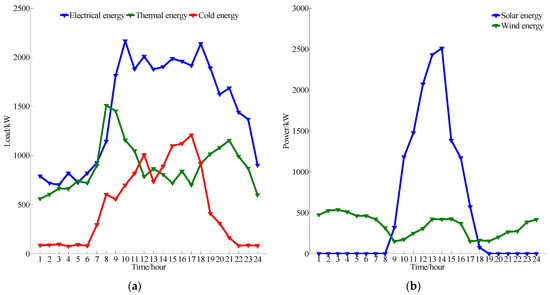
Figure 4.
Loads and electricity of renewable energy of the whole MESs: (a) total electrical load, heat load, and cold load; (b) total PV and wind energy power output in each MES.
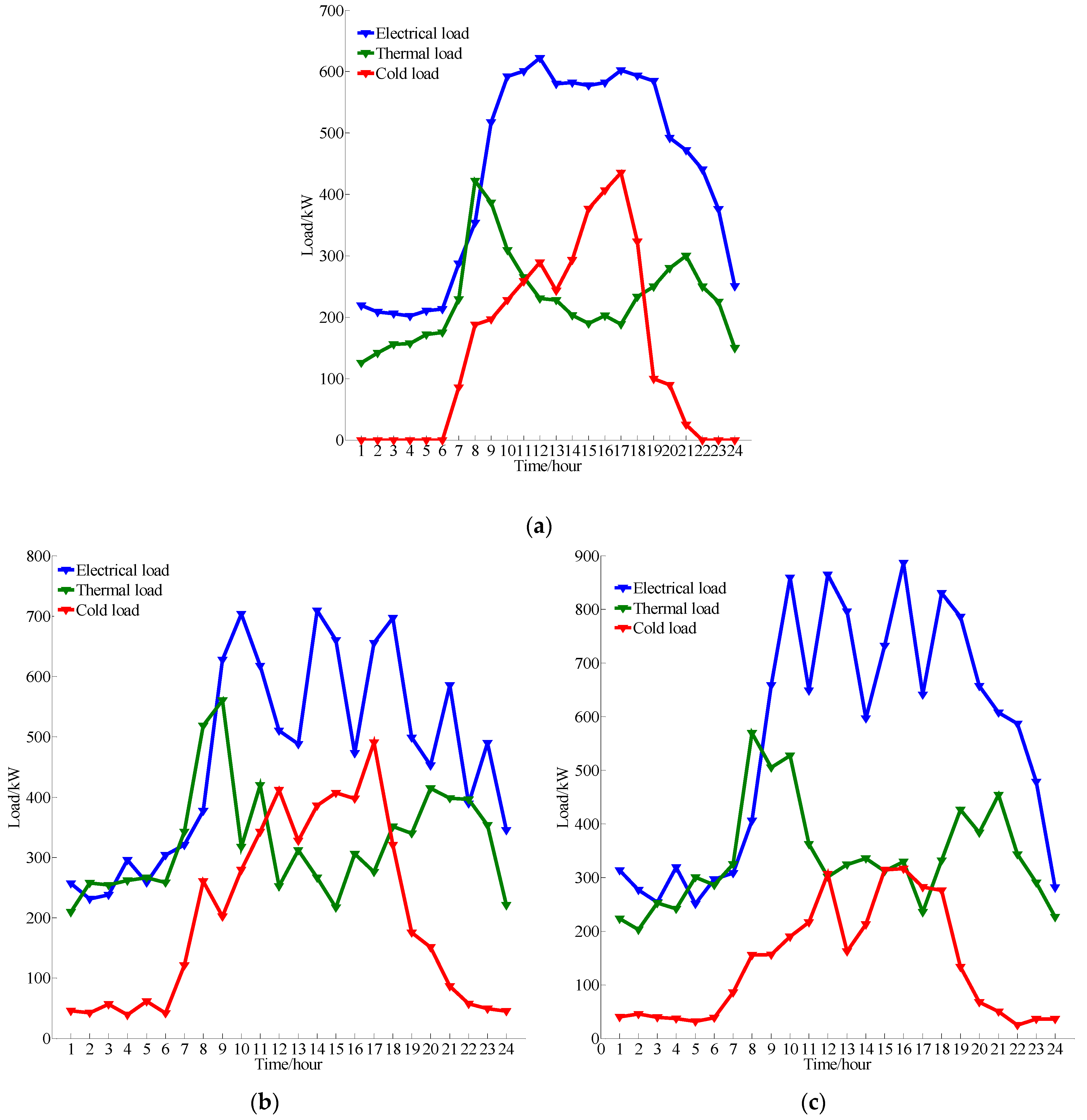
As seen in Figure 4, after integrating electrical load, thermal load, and cold load, the load curves are much smoother compared with Figure A1. This is because different loads are different at different moments. With the consideration of the temporal complementary between loads, the peak-to-valley difference of loads can be effectively reduced. Similarly, after integrating solar energy and wind power as a whole, generation curves also become smoother.
Under the control of the ESCC, renewable energy generation in the region meets the energy demand among MESs through mutual transfer. When the total amount of clean energy generation exceeds the total load demand (i.e., 12:00–14:59), the SESS will store the excess energy to avoid the abandonment of wind and solar energy. When the total amount of renewable energy generation does not meet the total load demand (i.e., 00:00–11:59, 15:00–23:59), the RES will purchase power from outside or use the power from the SESS.
4.1.2. Optimization Results
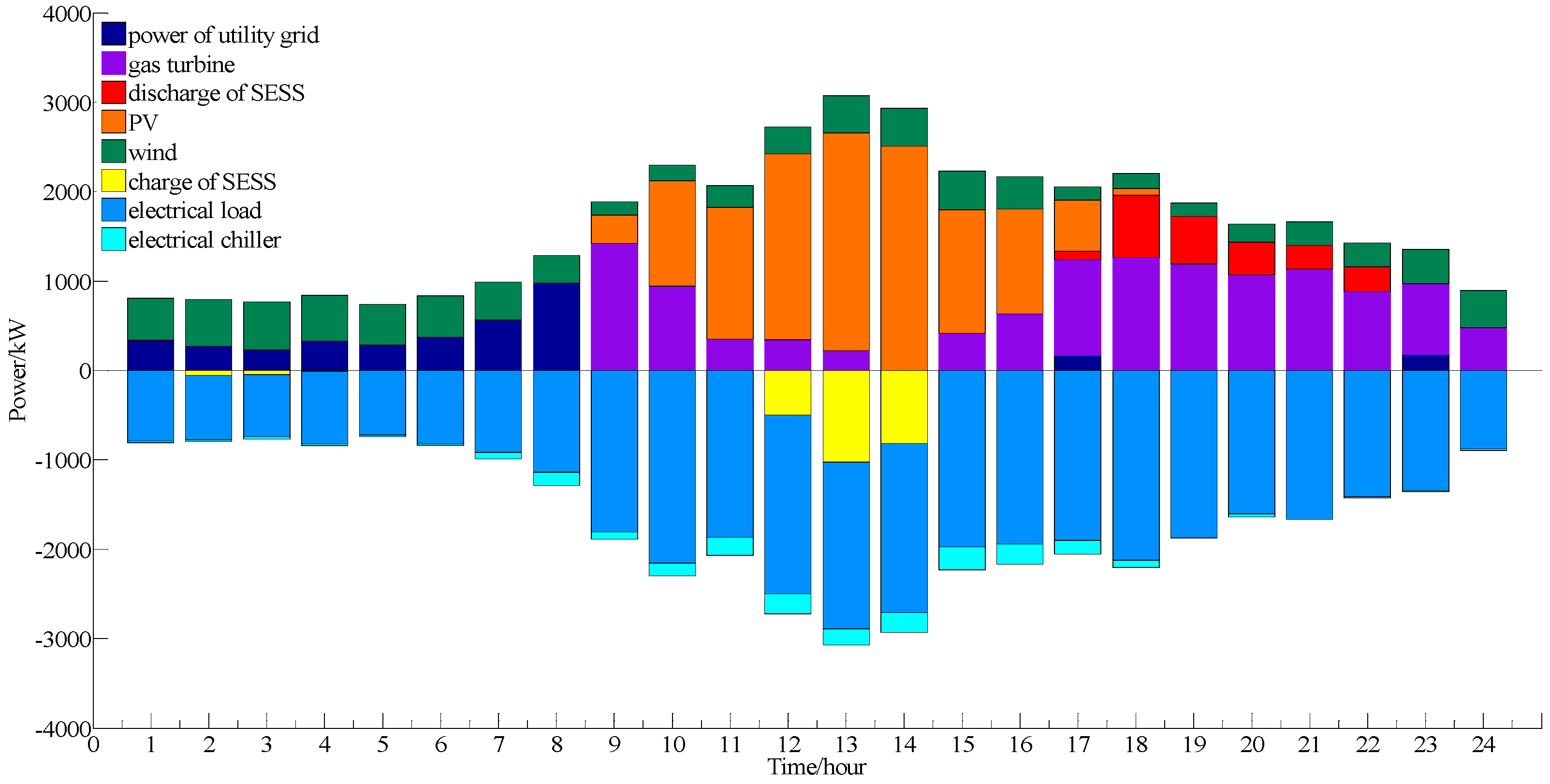
Optimization results show that the capacity of the SESS is 3338 kW·hm and the total cost is RMB 20,451. The electrical power of each device for each period time is shown in Figure 5. In the figure, a positive power indicates that the equipment emits electrical energy, and a negative power number shows that the equipment consumes electrical energy.
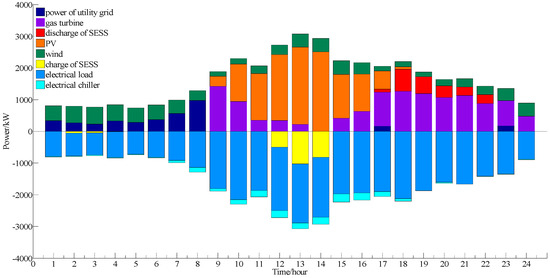
Figure 5.
Electrical power of each device in RES.
As we can see from the figure, during the period from 00:00 to 8:59, the system mainly uses wind power and power purchased from the grid to meet the electrical load and the operation of the electrical chiller. This is because clean energy generation power cannot meet the electrical load during this period and gas turbine power generation is not economical (the electricity tariff is 0.45 RMB/kW·h and the price of electrical power generation from gas turbines is about 1.02 RMB/kW·h).
From 9:00 to 11:59, electricity is mainly composed of wind power, photovoltaic power, and gas turbine power to meet the electricity demand of electrical loads and electrical chillers. Compared to 00:00 to 08:59, the system does not purchase power from the grid at this time because the electricity tariff is at a high level (1.62 RMB/kW·h) during this period. Since the clean energy output cannot meet the demand of the load, the cheaper gas turbine generation is started at this time, and the exhausted heat is used as other types of load.
As time goes on, the clean energy output gradually increases and gradually exceeds the load. From 12:00 to 14:59, the power of the gas turbine gradually decreases (stops at 14:00), while the SESS starts to store energy. Using excess clean energy to store energy for SESS can effectively consume clean energy and reduce storage charging costs and the total system operating costs.
From 15:00 to 17:59, the clean energy output gradually decreases and gradually cannot meet the load. To maintain the system power balance, the gas turbine is started gradually. At 17:00, the system purchases power from the grid due to the relatively low price of electricity (0.98 RMB/kW·h).
From 18:00 to 23:59, the output of clean energy decreases further, and the electricity tariff is at a high level (1.62 RMB/kW·h) during this period. Since the service cost of the SESS (0.23 RMB/kW·h) is much less than the price of electricity, the system stops purchasing electricity from the grid at this time and meets the system load with gas turbine generation, clean energy output, and SESS release storage.
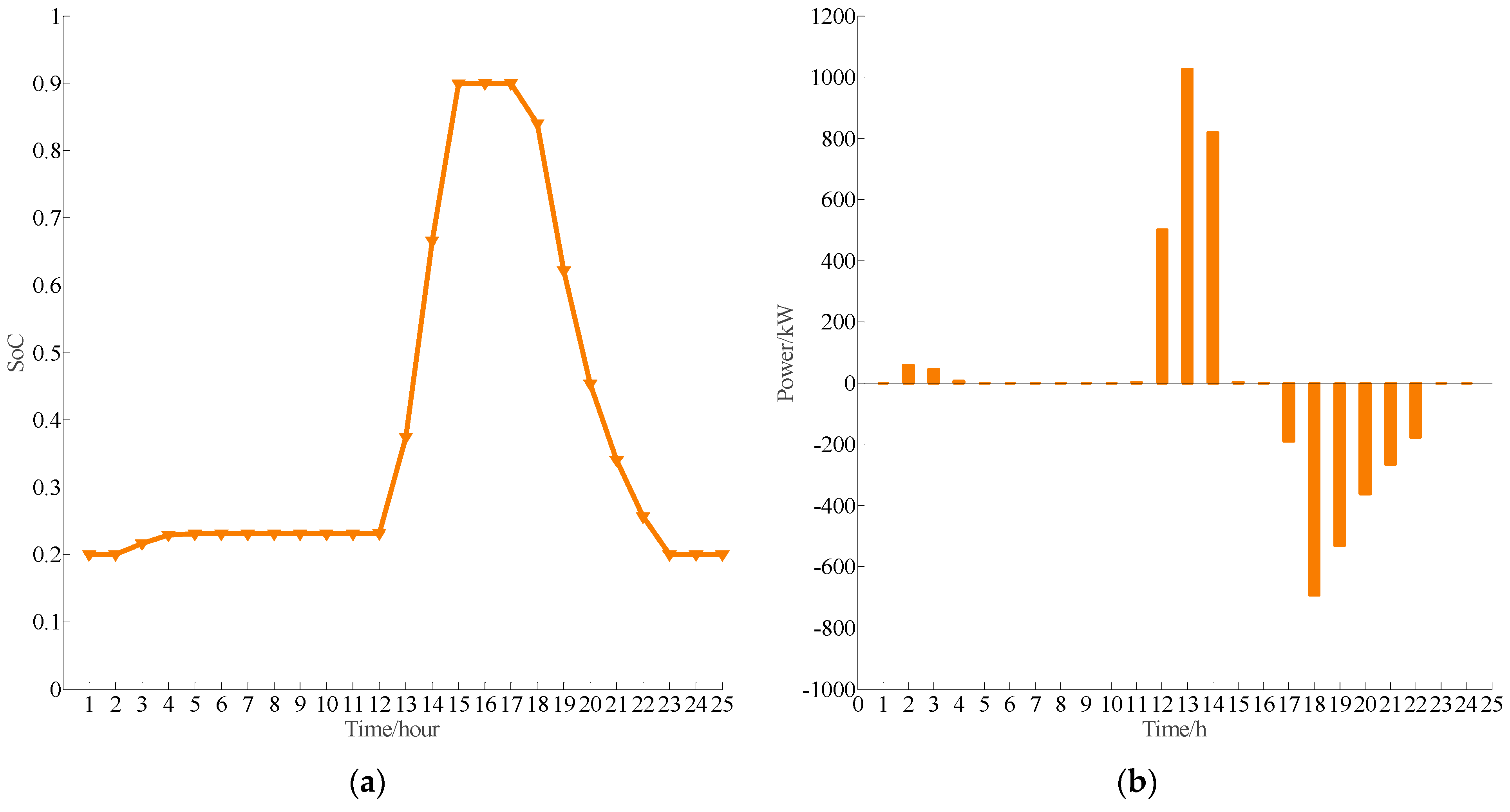
The state of the SESS and charging and discharging power are shown in Figure 6.
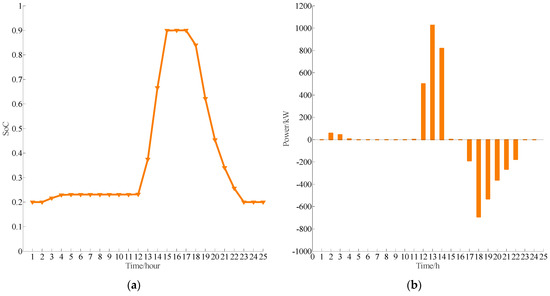
Figure 6.
State of SESS and charging and discharging power: (a) state of charge; (b) charging and discharging power.
As seen in Figure 6, during 23:00–11:59, there is little power exchange in the SESS, and the SoC of the storage equipment remains at about 0.23.
During 12:00–14:59, the SESS is charging, and the maximum charging power is 1027 kW, while the SoC of the storage equipment gradually rises to 0.9.
During 15:00–16:59, there is also little power exchange in the SESS, and the SoC of the storage equipment remains at 0.9.
During the period of 17:00–22:59, the SESS is discharging, the maximum discharging power is 693kW, and the SoC of the storage equipment decreases from 0.9 to 0.2.
From the overall operation results of the system, it can be seen that the SESS mainly stores energy during the hours of 2:00~4:59 and 12:00~14:59. This is mainly because the electricity price (0.45 RMB/kW·h) is relatively cheap from 2:00 to 4:59, while from 12:00 to 14:59, the SESS mainly uses the excess clean energy for energy storage. The SESS is mainly discharged during 17:00~22:59 h. This is mainly because the electricity price is more expensive from 17:00 to 22:59, and the system uses the energy storage of the SESS to reduce the system operation costs.
4.2. Comparison of Different Scenarios
4.2.1. Different Scenarios
To further analyze the operation of the system in different scenarios, four scenarios are designed in this paper to compare the operation of the system in different scenarios.
Scenario 1 does not contain any energy storage devices, and excess solar and wind energy will be abandoned during operation.
Scenario 2 is in the form of an independent energy storage system (IESS), i.e., each MES has its own energy storage devices inside, and there is no energy exchange between the subsystems. In addition, each user needs to afford the construction and operation costs of each subsystem’s energy storage equipment.
Scenario 3 is in the form of shared energy storage. The construction and operation costs of the shared energy storage devices are borne by users. When the equipment is in the state of use, users do not need to pay the service fees of shared energy storage.
Scenario 4 is the case analysis, also in the form of shared energy storage, but the SESS is built by the investor, and the users need to pay for the service fees.
The types of four scenarios are shown in Table 1.

Table 1.
Different scenarios.
The service cost, capacity cost, power cost, and annual O&M cost of the shared energy storage system are shown in Table 2.
Table 2.
Cost.
The results of total cost and electrical energy storage capacity in different scenarios are shown in Table 3.
Table 3.
Results of total cost and electrical energy storage capacity in different scenarios.
For Scenario 1, the daily cost is RMB 22,788. For Scenario 2, the daily cost is RMB 21,824, and the storage capacity is 3796kW·h. That is, for daily cost, Scenario 2 is 4.23% lower than Scenario 1. For Scenario 3, the daily cost is RMB 20,822, and the storage capacity is 2216kW·h. That is, for daily cost, Scenario 3 is 8.63% lower than Scenario 1 and 4.59% lower than Scenario 2. For Scenario 4, the daily cost is RMB 20,558, and the storage capacity is 3338kW·h. That is, for daily cost, Scenario 4 is 9.78% lower than Scenario 1, 5.81% lower than Scenario 2, and 1.27% lower than Scenario 3.
Comparing Scenario 3 and Scenario 4, Scenario 4 requires 50% more energy storage system capacity than Scenario 3. This is because Scenario 3 is invested by the user, while Scenario 4 is built by the investor, which reduces the O&M cost. Therefore, the cost of Scenario 4 is lower than that of Scenario 3.
Compared with the SESS, the IESS requires a larger energy storage capacity than the SESS, which also shows that shared energy storage has economic advantages over individual energy storage.
4.2.2. Index Improvement
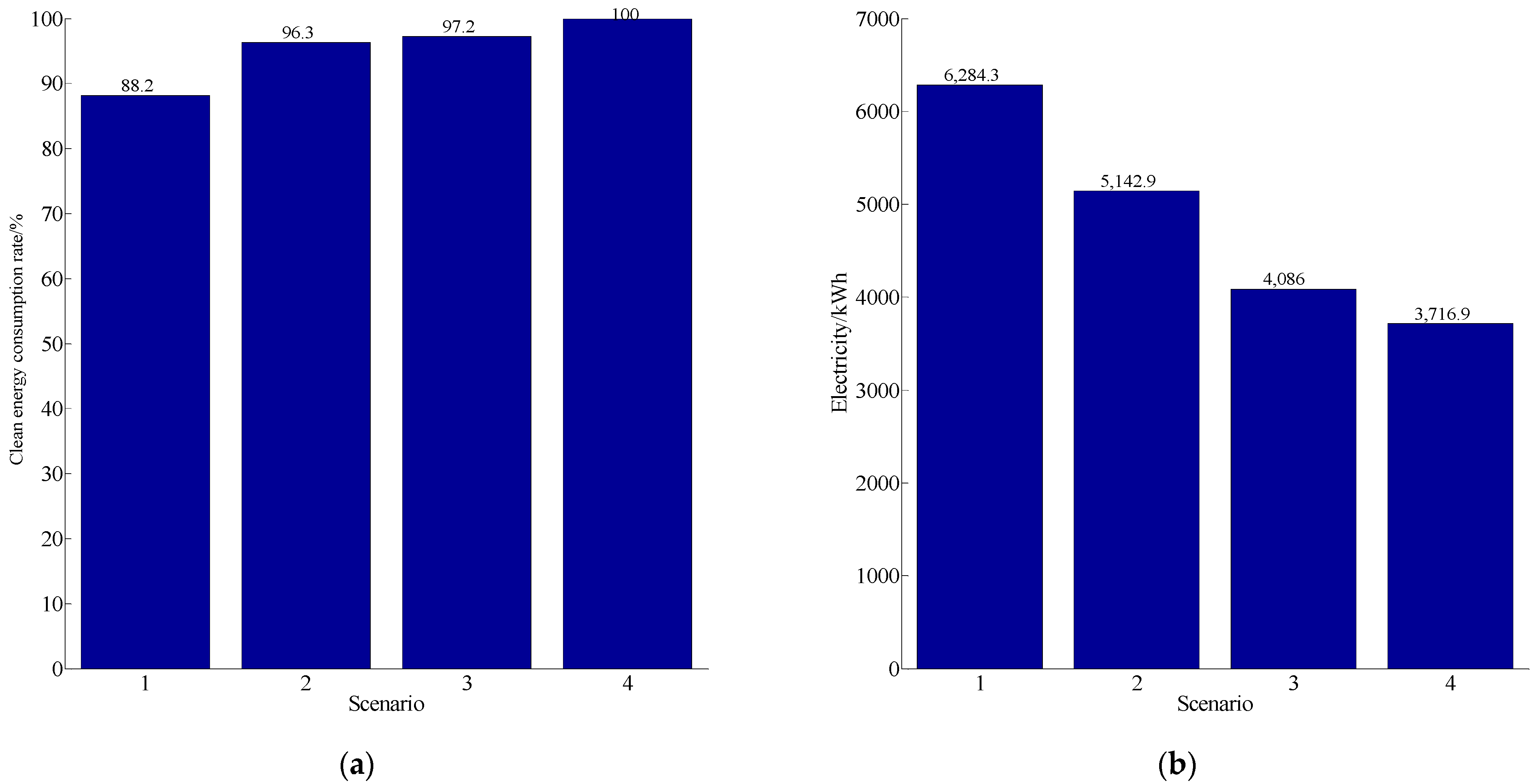
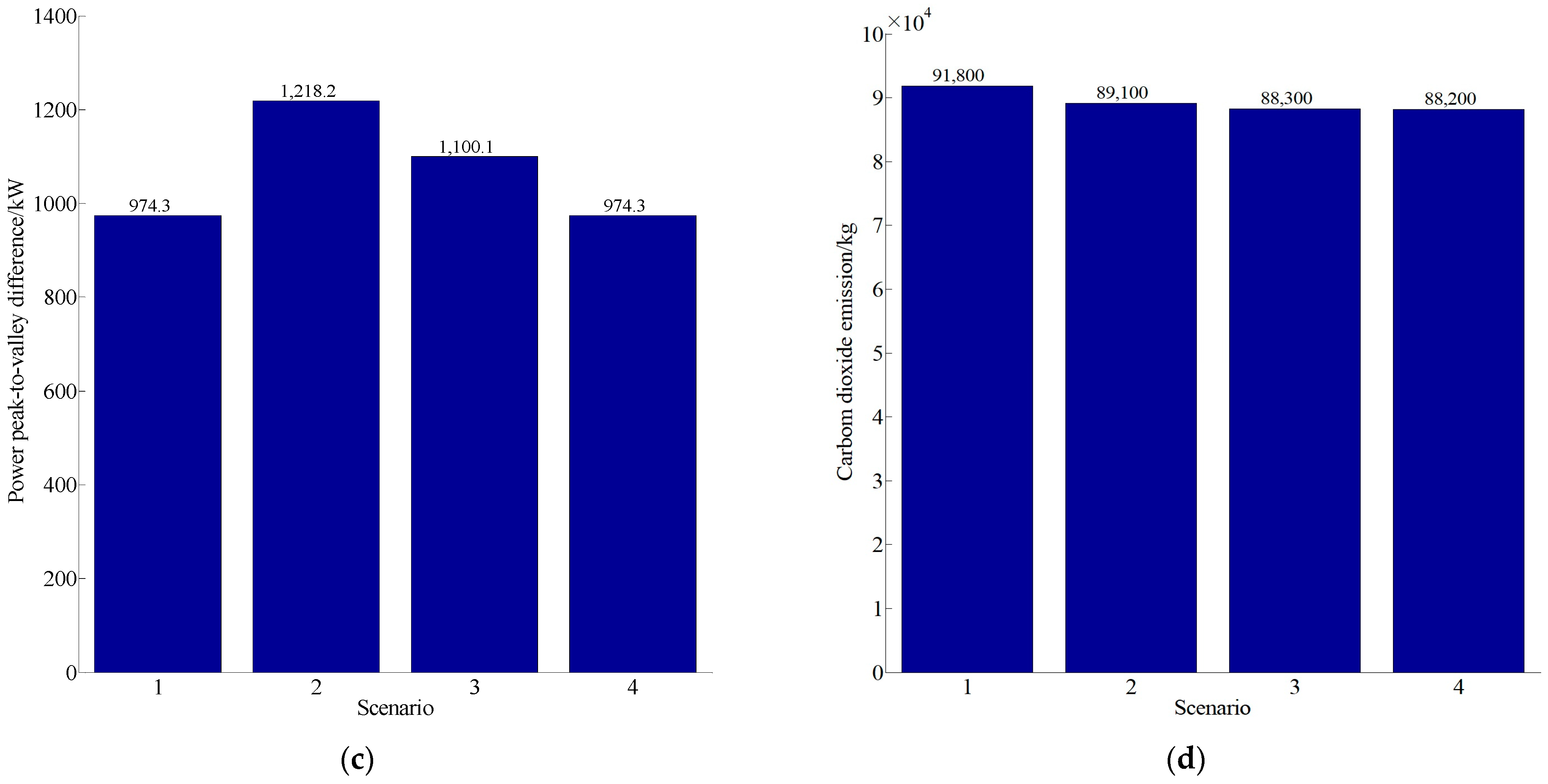
In this section, we select four indexes for a comprehensive evaluation of each scenario. The four indexes are clean energy consumption rate, external power purchase, grid power peak-to-valley difference, and pollutant emissions, respectively.
- Clean energy consumption rate. The clean energy consumption rate is the proportion of wind power and solar energy that is converted into electricity. The higher the rate of clean energy consumption, the higher the level of utilization of renewable energy.
- External power purchase. External power purchases reflect the level of energy self-sufficiency within the system. The fewer external power purchases, the higher the level of self-sufficiency.
- Grid power peak-to-valley difference. The smaller the peak-to-valley difference is, the smaller the power fluctuation of the grid is, and the easier the system control and regulation.
- Pollutant emissions. The higher the pollutant emissions, the lower the environmental protection level of the system. Pollutant emissions are calculated by the formula below.
A comparison of each index for the four scenarios can be seen in Figure 7.
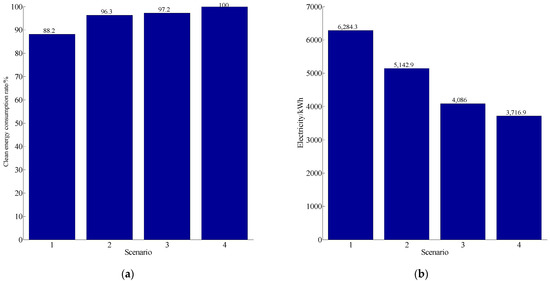
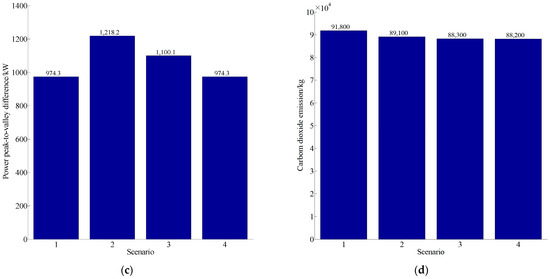
Figure 7.
Comparison of each index for the four scenarios: (a) clean energy consumption rate; (b) external power purchase; (c) grid power peak-to-valley difference; (d) pollutant emissions.
Obliviously, Scenario 4 with the investor-built SESS has the best overall performance. The investor-built SESS solution allows for full consumption of clean energy, fewer external power purchases, and minimal pollutant emissions. This maximizes environmental friendliness. Moreover, the peak-to-valley difference in the grid is also minimal compared to other energy storage scenarios, which reduces the investment in grid equipment and further improves the economics. Therefore, the solution for investor-built SESS has the most marketing value.
4.3. Sensitivity Analysis
4.3.1. Impact of the Service Fee of SESS on Daily Operating Costs
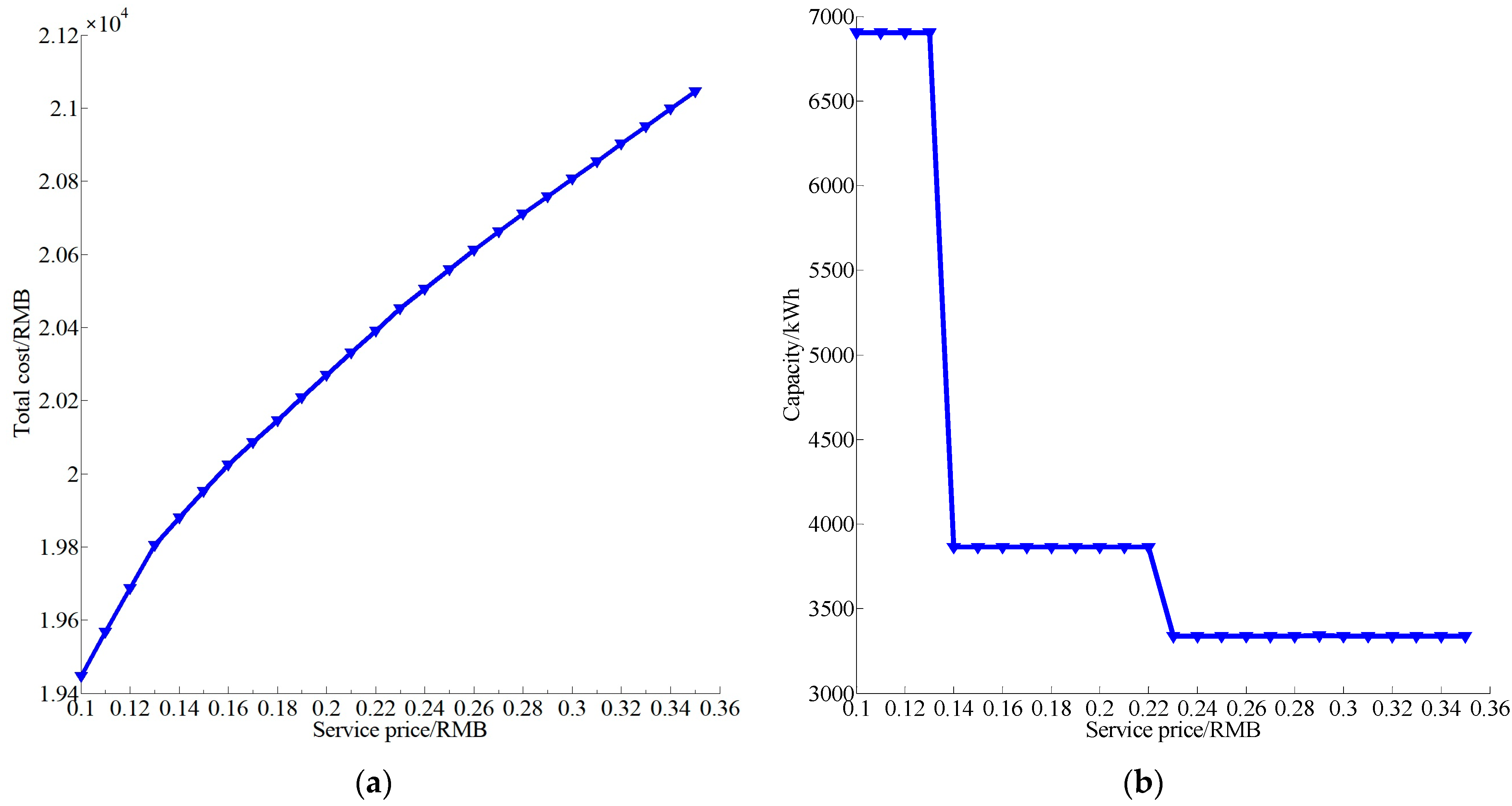
Taking Scenario 4 as an example, the daily operating cost of the system and the capacity of the storage can be obtained by analyzing the different service fees of energy storage. Figure 8 shows the results of the analysis of the total operating cost and the capacity of the energy storage for different service fees.
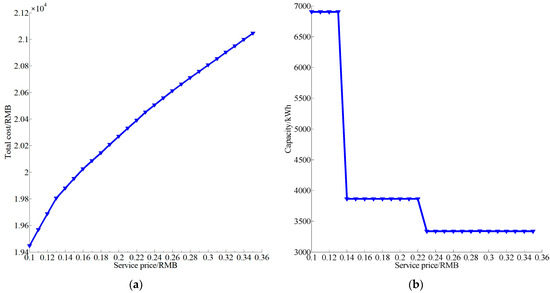
Figure 8.
Total cost and capacity: (a) total cost; (b) capacity.
It can be seen that with the gradual reduction of the service charge, the total daily running cost also shows a decreasing trend. When the service charge is 0.1 RMB/kW·h, the total daily operation costs are USD 19,431, which is 14.75% cheaper than Scenario 1. At the same time, the capacity of energy storage equipment is on the rise with the decreasing service fee. When the service fee is 0.1 RMB/kW·h, the configured capacity of energy storage is 6902 kW·h; when the service fee is 0.35 RMB/kW·h, the capacity is 3338 kW·h.
From the perspective of investors, the capacity of shared energy storage equipment should not be too large, and the service fee should not be too low; otherwise, it will be difficult to recover from costs or even be in a long-term loss, which will seriously affect investors’ enthusiasm. From the perspective of consumers, people think that lower service fees will encourage consumers to use shared energy plants and save more money.
In summary how much the service fee is should depend on the game between consumers and investors.
4.3.2. Impact of Electricity Tariff of SESS on Daily Operating Costs
In this section, we will analyze the impact of the unit price of natural gas and the electricity tariff on the total cost.
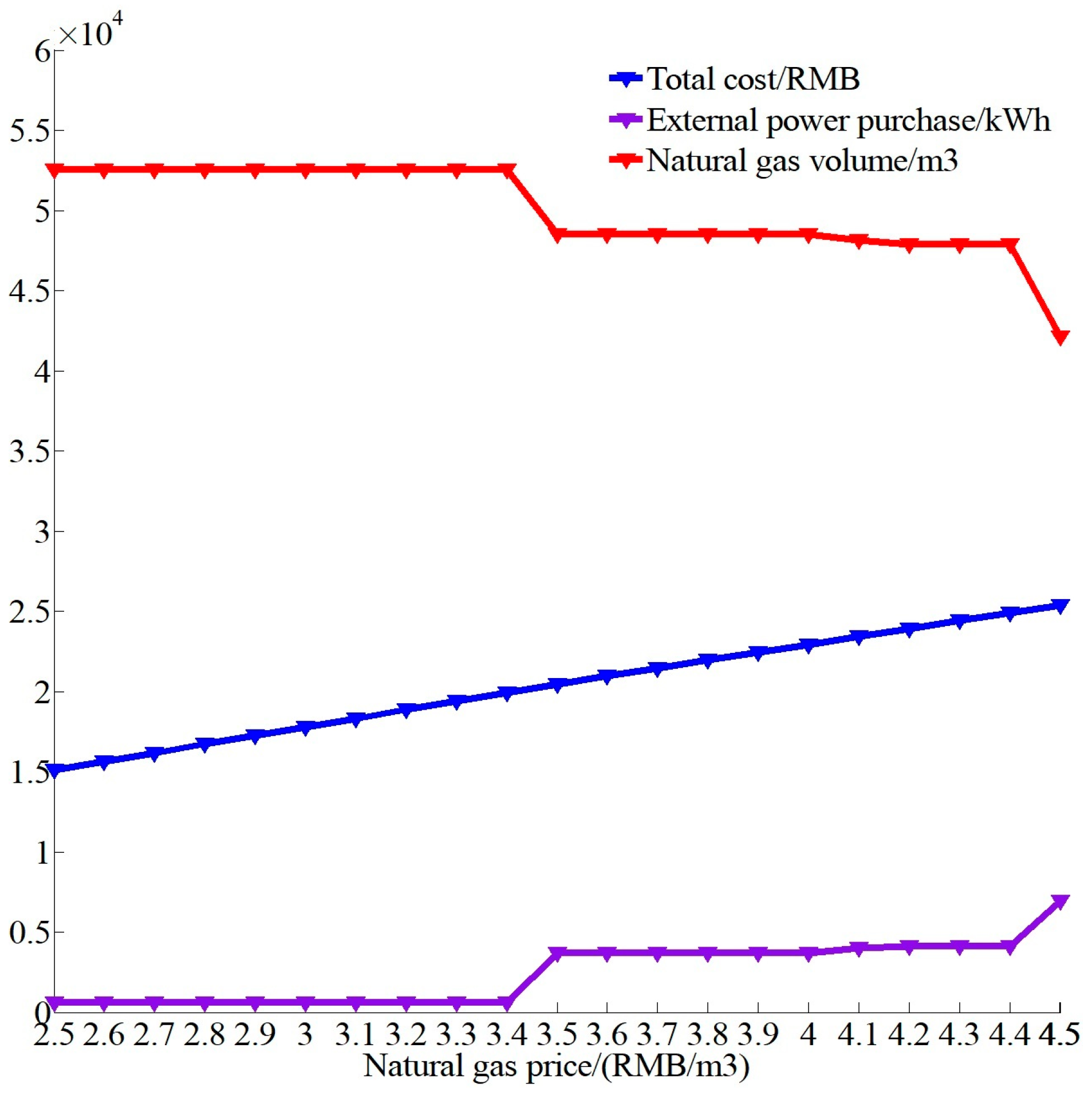
When the unit price of natural gas changes from 2.5 RMB/m3 to 4.5 RMB/m3, the total cost, external power purchase, and natural gas volume are shown in Figure 9. It can be found that the total cost varies approximately linearly when the unit price of natural gas changes. When the unit price of natural gas changes from 2.5 RMB/m3 to 3.4 RMB/m3, the amount of natural gas used in the system and the amount of external electricity purchased remain unchanged at 52,500 m3 and 588.5 kW·h, respectively.
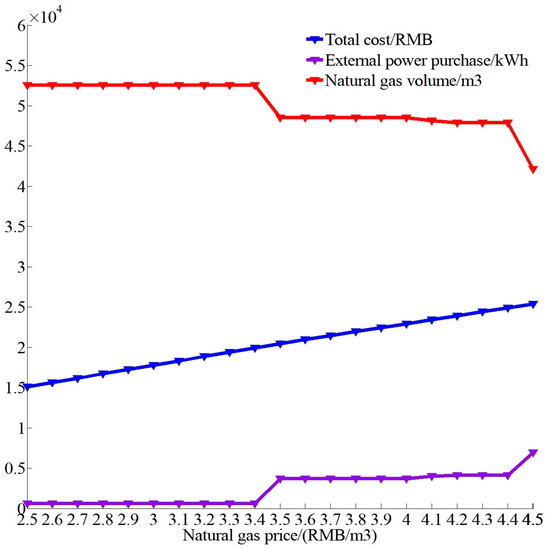
Figure 9.
Total cost, external power purchase, and natural gas volume (natural gas price changes).
When the unit price of natural gas changes from 3.5 RMB/m3 to 4.4 RMB/m3, the amount of natural gas used in the system decreases, while the amount of external electricity purchased rises to 48,500 m3 and 3716.9 kW·h, respectively. This is because as the unit price of natural gas increases, the cost of using gas for electrical power generation, cooling, and heat rises, and to keep the total cost at a minimum, the system will increase the demand for externally purchased electricity at this time. Similarly, when the unit price of natural gas changes to 4.5, the cost of using gas for electrical power, cooling, and heat increases further, and then cheap purchased electricity becomes the main form of energy supply for the system.
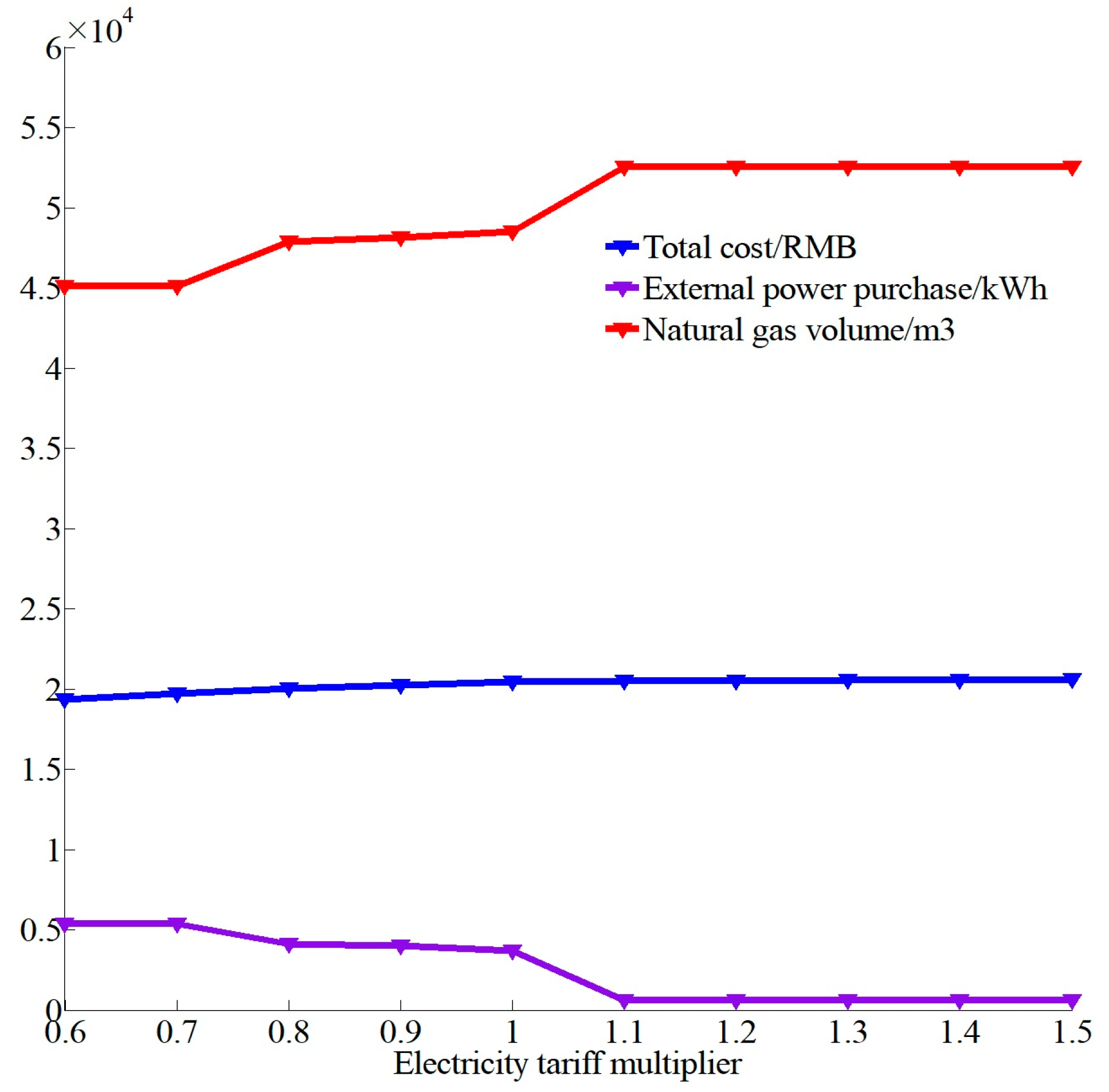
The results for when the electricity tariff changes from 0.5 times the original price to 1.5 times are shown in Figure 10.
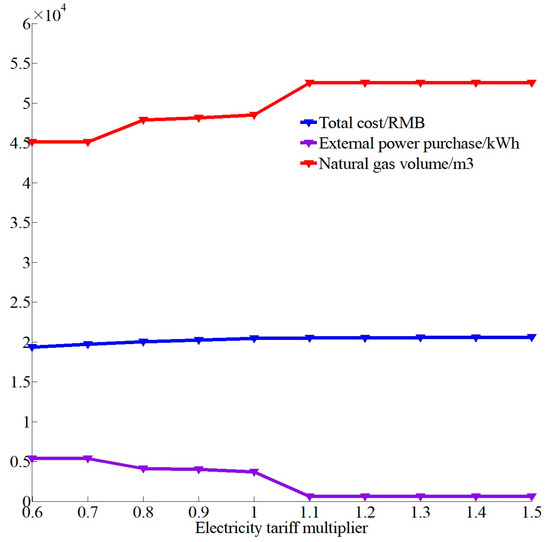
Figure 10.
Total cost, external power purchase, and natural gas volume (electricity tariff changes).
It can be seen that as the electricity price rises, the volume of natural gas rises, and the external power purchase gradually decreases, while the total cost remains the same. When the electricity tariff changes to 1.1 times the original tariff, the amount of external electricity purchased decreases rapidly, i.e., 588 kW·h, while the amount of natural gas increases to 52,500 m3. This is because as the electricity tariff increases, the system switches to using cheaper natural gas to produce electricity, heat, and cooling.
In summary, when the price of natural gas and electricity changes, the system will use natural gas and externally purchased electricity according to the economic cost minimum, which leads to the total cost and the change of natural gas volume and externally purchased electricity.
5. Conclusions
In this paper, the regional energy system with a shared energy storage system is detailed and illustrated. The system includes gas turbines, gas boilers, electric chillers, absorption chillers, and heat exchangers, and is connected with the utility grid and natural gas network, which can efficiently and fully use clean energy. The efficient energy management method of the RES is propounded. By setting four scenarios and analyzing the operation of each scenario, the proposed strategy can achieve efficient use of clean energy, reduce pollutant emissions and achieve economic operation of the system. Conclusions can be summarized below.
- (1)
- The RES of electricity, heat, and cooling can significantly improve the capacity of clean energy consumption and meet the supply–demand of many different forms of energy, which can minimize the total cost while ensuring an environment-friendly premise.
- (2)
- The mentioned energy management method can realize the load integration of different MESs, which in turn can realize the unified dispatch of multi-energy and finally make the clean energy to be efficiently consumed.
- (3)
- It is concluded that users can effectively reduce operation costs and improve the utilization of clean energy by paying for shared energy storage services. Numerical results show that with an SESS built by the investor in the RES, the utilization of clean energy can be 100%, the operation costs can be reduced by up to 9.78%, the pollutant emission can be reduced by 3.92% and the peak-to-valley difference can be decreased by 20.03%. This can reduce the replacement of equipment.
- (4)
- This paper only considered the physical constraints of each electrical device within each system and did not consider the impact of voltage and frequency fluctuations within the system on the power supply. Current research has been conducted mainly on AC power flow constraints in distributed energy systems (e.g., [34]). The next study can focus on analyzing the impact of power fluctuations within the RES.
Author Contributions
All the authors made contributions to the concept and design of the article. Conceptualization, X.J. and J.W.; Methodology, X.J.; Software, X.J. and W.L.; Validation, X.J. and M.Y.; Formal Analysis, X.J.; Investigation, J.W.; Resources, J.W.; Data Curation, X.J.; Writing—Original Draft Preparation, X.J.; Writing—Review & Editing, X.J.; Visualization, X.J. and W.L.; Supervision, M.Y. All authors have read and agreed to the published version of the manuscript.
Funding
This research received no external funding.
Conflicts of Interest
The authors declare no conflict of interest.
Appendix A
The electrical load, thermal load, and cold load of each MES are shown in Figure A1.
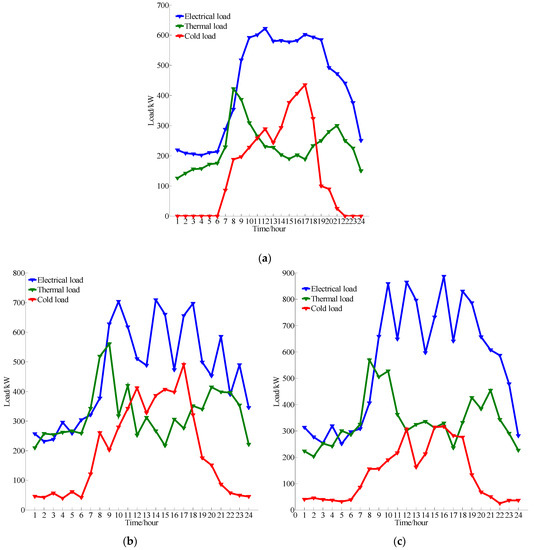
Figure A1.
Electrical load, heat load, and cold load: (a) MES 1; (b) MES 2; (c) MES 3.
Figure A1.
Electrical load, heat load, and cold load: (a) MES 1; (b) MES 2; (c) MES 3.
The PV and wind power output of each subsystem is shown in Figure A2.
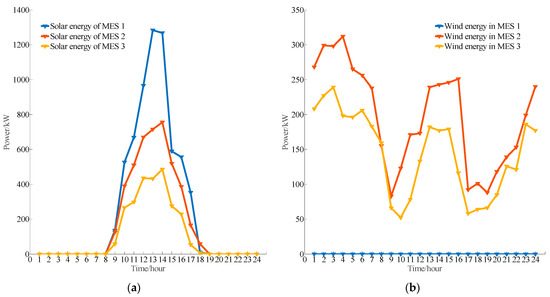
Figure A2.
PV and wind energy power output in each subsystem: (a) solar energy in each MES; (b) wind energy in each sub-MES.
Figure A2.
PV and wind energy power output in each subsystem: (a) solar energy in each MES; (b) wind energy in each sub-MES.
Appendix B
The operation parameters of the equipment in each MES is shown in Table A1.
Table A1.
Equipment parameters.
Table A1.
Equipment parameters.
| Equipment | Maximum Power/kW | Climbing Power/(kW/h) |
|---|---|---|
| Gas Turbine | 1000 | 200 |
| Absorption Chillers | 200 | / |
| Gas Boiler | 1000 | 200 |
| Heat Exchanger | / | / |
| Electric Refrigeration Equipment | 1000 | / |
The operation parameters of the energy storage equipment are shown in Table A2.
Table A2.
Parameters of energy storage devices.
Table A2.
Parameters of energy storage devices.
| Attrition Rate | Energy Storage Efficiency | Energy Discharge Efficiency | Maximum Energy Storage State | Minimum Energy Storage State |
|---|---|---|---|---|
| 0.001 | 0.95 | 0.95 | 90% | 20% |
The relationship between electricity tariff and time is shown in Table A3.
Table A3.
Electricity tariff.
Table A3.
Electricity tariff.
| Category | Time | Unit Price of Electricity (RMB/(kW·h)) |
|---|---|---|
| Peak | 8:00–12:00, 17:00–21:00 | 1.62 |
| Flat | 12:00–17:00, 21:00–24:00 | 0.98 |
| Valley | 0:00–8:00 | 0.45 |
References
- Raffaele, C.; Mariagrazia, D.; Jan, J.; Michael, K.; Sarah, B.O. Energy scheduling of a smart microgrid with shared photovoltaic panels and storage: The case of the Ballen marina in Samsø. Energy 2020, 198, 117188. [Google Scholar]
- Shenbo, Y.; Zhongfu, T.; Rui, Z.; Gejirifu, D.; Hongyu, L.; Liwei, J.; Feng’ao, Z. Operation optimization and income distribution model of park integrated energy system with power-to-gas technology and energy storage. J. Clean. Prod. 2020, 247, 119090. [Google Scholar]
- Yunshou, M.; Jiekang, W.; Wenjie, Z. An Effective Operation Strategy for CCHP System Integrated with Photovoltaic/Thermal Panels and Thermal Energy Storage. Energies 2020, 23, 6418. [Google Scholar]
- Xu, S.; Liuchen, L.; Tong, Z.; Shang, C.; Zhenjun, C. Study of economic feasibility of a compound cool thermal storage system combining chilled water storage and ice storage. Appl. Therm. Eng. 2018, 133, 613–621. [Google Scholar]
- Karunakaran, V.; Uma, G. Optimal power flow control of hybrid renewable energy system with energy storage: A WOANN strategy. J. Renew. Sustain. Energy 2019, 11, 015501. [Google Scholar]
- Mao, Y.; Wu, J.; Wang, R.; Cai, Z.; Zhang, R.; Chen, L.; Zhang, W. A Collaborative Demand-Controlled Operation Strategy for a Multi-Energy System. IEEE Access 2021, 9, 80571–80581. [Google Scholar]
- Xudong, H.; Shengnan, W.; Xueliang, Z. Clean energy powers energy poverty alleviation: Evidence from Chinese micro-survey data. Technol. Forecast. Soc. Chang. 2022, 182, 121737. [Google Scholar]
- Xu, Z.; Jun, Y.; Yuan, L.; Chang, L.; Bo, M.; Lei, C. Optimal Scheduling Method for a Regional Integrated Energy System Considering Joint Virtual Energy Storage. IEEE Access 2019, 7, 138260–138272. [Google Scholar]
- Xin, M.; Chenghui, Z.; Ke, L.; Fan, L.; Haiyang, W.; Jianfei, C. Optimal dispatching strategy of regional micro energy system with compressed air energy storage. Energy 2020, 212, 118557. [Google Scholar]
- Nian, L.; Lu, T.; Haonan, S.; Zhenyu, Z.; Bin, G. Bilevel Heat–Electricity Energy Sharing for Integrated Energy Systems With Energy Hubs and Prosumers. IEEE Trans. Ind. Informat 2022, 18, 3754–3765. [Google Scholar]
- Bo, M.; Jingyi, L.; Hao, L.; Chang, L.; Bin, L.; Xu, Z.; Yang, J. Day-Ahead Energy Trading Strategy of Regional Integrated Energy System Considering Energy Cascade Utilization. IEEE Access 2020, 8, 138021–138035. [Google Scholar]
- Valery, S.; Evgeny, B.; Dmitry, S.; Bin, Z. Current state of research on the energy management and expansion planning of integrated energy systems. Energy Rep. 2022, 8, 10025–10036. [Google Scholar]
- Yongli, W.; Yudong, W.; Yujing, H.; Haiyang, Y.; Ruiting, D.; Fuli, Z.; Fuwei, Z.; Jinrong, Z. Optimal Scheduling of the Regional Integrated Energy System Considering Economy and Environment. IEEE Trans. Sustain. Energy 2019, 10, 1939–1949. [Google Scholar]
- Canbing, L.; Hanyu, Y.; Mohammad, S.; Xu, Z.; Bin, Z.; Yijia, C.; Long, Z. Optimal Planning of Islanded Integrated Energy System With Solar-Biogas Energy Supply. IEEE Trans. Sustain. Energy 2020, 11, 2437–2448. [Google Scholar]
- Anan, Z.; Yadi, Z.; Huang, H.; Ning, D.; Chengqian, Z. Co-integration theory-based cluster time-varying load optimization control model of regional integrated energy system. Energy 2022, 260, 125086. [Google Scholar]
- Qi, W.; Sumeng, T.; Xianbo, D.; Chunlin, Z.; Yi, T. Coordinated Control Strategy for Multi Micro Energy Systems Within Distribution Grid Considering Dynamic Characteristics and Contradictory Interests. IEEE Access 2019, 7, 139548–139559. [Google Scholar]
- Parvin, K.; Hannan, M.A.; Looe, H.M.; Hossain Lipu, M.S.; Maher, G.M.A.; Pin, J.K.; Kashem, M.M.; Dong, Z.Y. The future energy internet for utility energy service and demand-side management in smart grid: Current practices, challenges and future directions. Sustain. Energy Technol. Assess. 2022, 53, 102648. [Google Scholar] [CrossRef]
- Mengqi, Y.; Daniel, K.M.; Johanna, L.M. An Optimal Power-Flow Approach to Improve Power System Voltage Stability Using Demand Response. IEEE Trans. Control Netw. Syst. 2019, 6, 1015–1025. [Google Scholar]
- Nicola, M.; Paolo, S.; Raffaele, C.; Mariagrazia, D. Control frameworks for transactive energy storage services in energy communities. Control. Eng. Pract. 2023, 130, 105364. [Google Scholar]
- Hongtao, L.; Jun, P.; Heng, L.; Chengzhang, L.; Zhiwu, H. Energy Sharing of Zero-Energy Buildings: A Consensus-Based Approach. IEEE Access 2019, 7, 62172–62183. [Google Scholar]
- Xiaohua, S.; Peng, W.; Bingjia, Z.; Tong, X. A low-carbon peak-load regulation trading strategy for large-scale wind power integration using information gap decision theory. Energy Rep. 2022, 8, 9642–9661. [Google Scholar]
- Wenzhi, C.; Jiang-Wen, X.; Shi-Chang, C.; Xiao-Kang, L. An efficient and economical storage and energy sharing model for multiple multi-energy microgrids. Energy 2022, 244, 123124. [Google Scholar]
- Awnalisa, W.; Soongeol, K. Analysis on impact of shared energy storage in residential community: Individual versus shared energy storage. Appl. Energy 2021, 282, 116172. [Google Scholar]
- Wenyi, Z.; Wei, W.; Laijun, C.; Boshen, Z.; Shengwei, M. Service pricing and load dispatch of residential shared energy storage unit. Energy 2020, 202, 117543. [Google Scholar]
- Lingling, S.; Jing, Q.; Xiao, H.; Xia, Y.; Zhaoyang, D. Capacity and energy sharing platform with hybrid energy storage system: An example of hospitality industry. Appl. Energy 2020, 280, 115897. [Google Scholar]
- Hsiu-Chuan, C.; Bissan, G.; Jatin, N. Shared community energy storage allocation and optimization. Appl. Energy 2022, 318, 119160. [Google Scholar]
- Kezhen, Z.; Ming, L.; Yongliang, Z.; Hui, Y.; Junjie, Y. Design and performance evaluation of a new thermal energy storage system integrated within a coal-fired power plant. J. Energy Storage 2022, 50, 104335. [Google Scholar]
- Longxi, L.; Xilin, C.; Sen, Z. Shared energy storage system for prosumers in a community: Investment decision, economic operation, and benefits allocation under a cost-effective way. J. Energy Storage 2022, 50, 104710. [Google Scholar]
- Mao, Y.; Wu, J.; Cai, Z.; Wang, R.; Zhang, R.; Chen, L. Cooperative operation framework for a wind-solar-CCHP multi-energy system based on Nash bargaining solution. IEEE Access 2021, 9, 119987–120000. [Google Scholar]
- Rui, D.; Rasul, E.; Hadi, C. The Utilization of Shared Energy Storage in Energy Systems: A Comprehensive Review. IEEE Trans. Smart Grid. 2021, 12, 3163–3174. [Google Scholar]
- Pengya, W.; Jianxiao, W.; Ruiyang, J.; Gengyin, L.; Ming, Z.; Qing, X. Integrating biogas in regional energy systems to achieve near-zero carbon emissions. Appl. Energy 2022, 322, 119515. [Google Scholar]
- Hechuan, L.; Xiaoxin, Z.; Xiaoyu, Y.; Yalou, L.; Xiong, L. Influence Evaluation of Integrated Energy System on the Unit Commitment in Power System. IEEE Access 2020, 8, 163344–163356. [Google Scholar]
- Jiaojiao, D.; Lin, Z.; Qihuan, D.; Paychuda, K.; Yunting, L.; Yilu, L.; Leon, M.T.; Joshua, C.H.; Yaosuo, S.X.; Ben Ollis, T.; et al. Integrating Transactive Energy Into Reliability Evaluation for a Self-Healing Distribution System With Microgrid. IEEE Trans. Sustain. Energy 2022, 13, 122–134. [Google Scholar]
- Paolo, S.; Raffaele, C.; Mariagrazia, D. Noncooperative Equilibrium-Seeking in Distributed Energy Systems Under AC Power Flow Nonlinear Constraints. IEEE Trans. Control Netw. Syst. 2022, 9, 1731–1742. [Google Scholar]
Disclaimer/Publisher’s Note: The statements, opinions and data contained in all publications are solely those of the individual author(s) and contributor(s) and not of MDPI and/or the editor(s). MDPI and/or the editor(s) disclaim responsibility for any injury to people or property resulting from any ideas, methods, instructions or products referred to in the content. |
© 2023 by the authors. Licensee MDPI, Basel, Switzerland. This article is an open access article distributed under the terms and conditions of the Creative Commons Attribution (CC BY) license (https://creativecommons.org/licenses/by/4.0/).