


Abstract
The phenomenon of oxygen incorporation-induced superconductivity in iron telluride (Fe1+yTe, with antiferromagnetic (AFM) orders) is intriguing and quite different from the case of FeSe. Until now, the microscopic origin of the induced superconductivity and the role of oxygen are far from clear. Here, by combining in situ scanning tunneling microscopy/spectroscopy (STM/STS) and X-ray photoemission spectroscopy (XPS) on oxygenated FeTe, we found physically adsorbed O2 molecules crystallized into c (2/3 × 2) structure as an oxygen overlayer at low temperature, which was vital for superconductivity. The O2 overlayer were not epitaxial on the FeTe lattice, which implied weak O2 –FeTe interaction but strong molecular interactions. The energy shift observed in the STS and XPS measurements indicated a hole doping effect from the O2 overlayer to the FeTe layer, leading to a superconducting gap of 4.5 meV opened across the Fermi level. Our direct microscopic probe clarified the role of oxygen on FeTe and emphasized the importance of charge transfer effect to induce superconductivity in iron-chalcogenide thin films.
1. Introduction
Iron-chalcogenide Fe (Se,Te) superconductors are an important family of (Tc) iron-based high transition temperature (Tc) superconductors. The monolayer grown on SrTiO3 (STO) still holds the record in Tc with much-enhanced superconducting pairing [1,2,3]; the strong spin-orbit coupling in Te-alloyed compounds leads to a topological band structure [4,5,6,7], the family also exhibits rich magnetic phases strongly dependent on the chemical composition [8,9]. Non-superconducting FeTe with antiferromagnetic (AFM) orders was considered as the parent compound of Iron-chalcogenide superconductors [10]. Superconductivity could be induced in FeTe through Se or S substitution [10] and oxygen incorporation by low-temperature annealing or long-time exposure in an O2 atmosphere [11,12,13,14,15,16,17,18,19,20,21]. Despite lots of efforts towards understanding oxygenated FeTe bulk crystals [15,16,17,18,19,20,21,22] and thin films [11,12,13,14,21], the microscopic role played by oxygen is still unknown.
Zheng et al. [12] found that interstitial oxygen, rather than oxygen substitution [23], was responsible for the emergence of superconductivity. The interstitial oxygen [13,16] would dope holes into FeTe [17], suppress the AFM ordering and then induce superconductivity. Yamazaki et al. [19] and Sun et al. [18] have studied the dynamics of oxygen annealing and concluded that the superconductivity first emerged on the surface and the superconducting regions moved inside with non-superconducting materials left on the surface, such as Fe2O3, TeOx, FeTe2. The controversial results from different experimental probes call for a unified study of the crystal, chemical and electronic structures on thin films with controlled oxygen incorporation. However, this is generally challenging to achieve for ex situ measurements because samples exposed to the atmosphere inevitably change surface morphology and chemistry. In this study, we overcame this challenge by integrating one ultra-high vacuum environment for the sample growth and oxygenation process along with spectroscopic tools with elemental and spatial resolution.
First, we grew nearly stoichiometric 10 Unit-Cell (UC) FeTe epitaxy ultrathin films by molecular beam epitaxy (MBE) and then studied the adsorption of O2 incorporation by combined in situ STM and X-ray photoelectron spectroscopy (XPS). We found that O2 molecules physically adsorbed on FeTe surface under low O2 partial pressure at room temperature and crystallized into c (2/3 × 2) structure, which gradually disappeared after heating up to 100 °C in vacuum. No surface oxidation can be found. The band shift observed in STS and XPS suggests hole doping from the O2 overlayer to FeTe, which induced a superconducting gap in FeTe. It agrees with the ex situ transport measurement that long-time exposure to air can induce superconducting transition in 10UC FeTe on STO.
2. Materials and Methods
High-quality 10UC FeTe thin films were grown on SrTiO3(001) by using a Unisoku ultrahigh vacuum (UHV) low-temperature STM system (Unisoku 1300 9T-2T-2T, 2016, Hirakata, Osaka, Japan), equipped with an MBE chamber for film preparation. The base pressure of our MBE chamber is 1 × 10⁻¹⁰ mbar and does not exceed 5 × 10⁻¹⁰ mbar during FeTe epitaxial growth. The Nb doped-STO substrate (Nb: 0.7% wt, KMT comp.) was firstly annealed at 1000 °C for 1 h and then kept at 280 °C during FeTe growth. High purity Fe (99.9999%) and Te (99.9999%) sources were co-evaporated onto SrTiO3(001) substrates from two standard Knudsen cells. To improve the quality of crystallization, FeTe films were annealed at 280 °C for 1 h after growth. The O2 gas (99.999%) was introduced to a small preparation chamber with a base pressure of 2 × 10⁻⁹ mbar. Then the oxygen absorption was carried out at room temperature under O2 partial pressure of 1.6 × 10⁻⁴ mbar (if not specified otherwise). After O2 absorption, the samples were in situ transferred to the STM chamber or XPS equipment for further characterizations. For electronic transport measurement, 10UC FeTe films were grown on high-resistance STO and covered with the Te protection layer.
All STM/STS measurements were performed at a temperature of 4.7 K with a bias voltage applied to the sample. Polycrystalline Pt/Ir tips were cleaned by electron bombardment and then carefully calibrated on Ag films grown on Si (111). All STM topographic images were obtained under a constant current mode. The differential conductance dI/dV spectra were acquired by using a standard lock-in technique at a frequency of 983 Hz. The STM topographic images were processed with WSXM software (WSxM 5.0 Develop 10.0, 2020, Julio Gómez Herrero & José María Gómez Rodríguez, Madrid, Spain) [24].
After STM/STS measurements, the samples were transferred via a UHV interconnection pipeline in Nano-X for XPS/UPS characterization without exposure to air. XPS/UPS experiments were carried out by using a commercial analyzer (PHI 5000, VersaProbe, ULVAC-PHI, ~ 5 × 10⁻¹⁰ mbar, 2016, Chigasaki, Kanagawa, Japan), equipped with a monochromatic Al Kα X-ray source of 1486.7 eV. The binding energy (BE) of core-level peaks were calibrated with respect to the C-C 1s bond (BE = 284.8 eV). A monochromatized He I with an energy of 21.22 eV were used for UPS measurement. During the UPS measurement, a voltage of −5 V was applied between the sample and the spectrometer.
3. Results
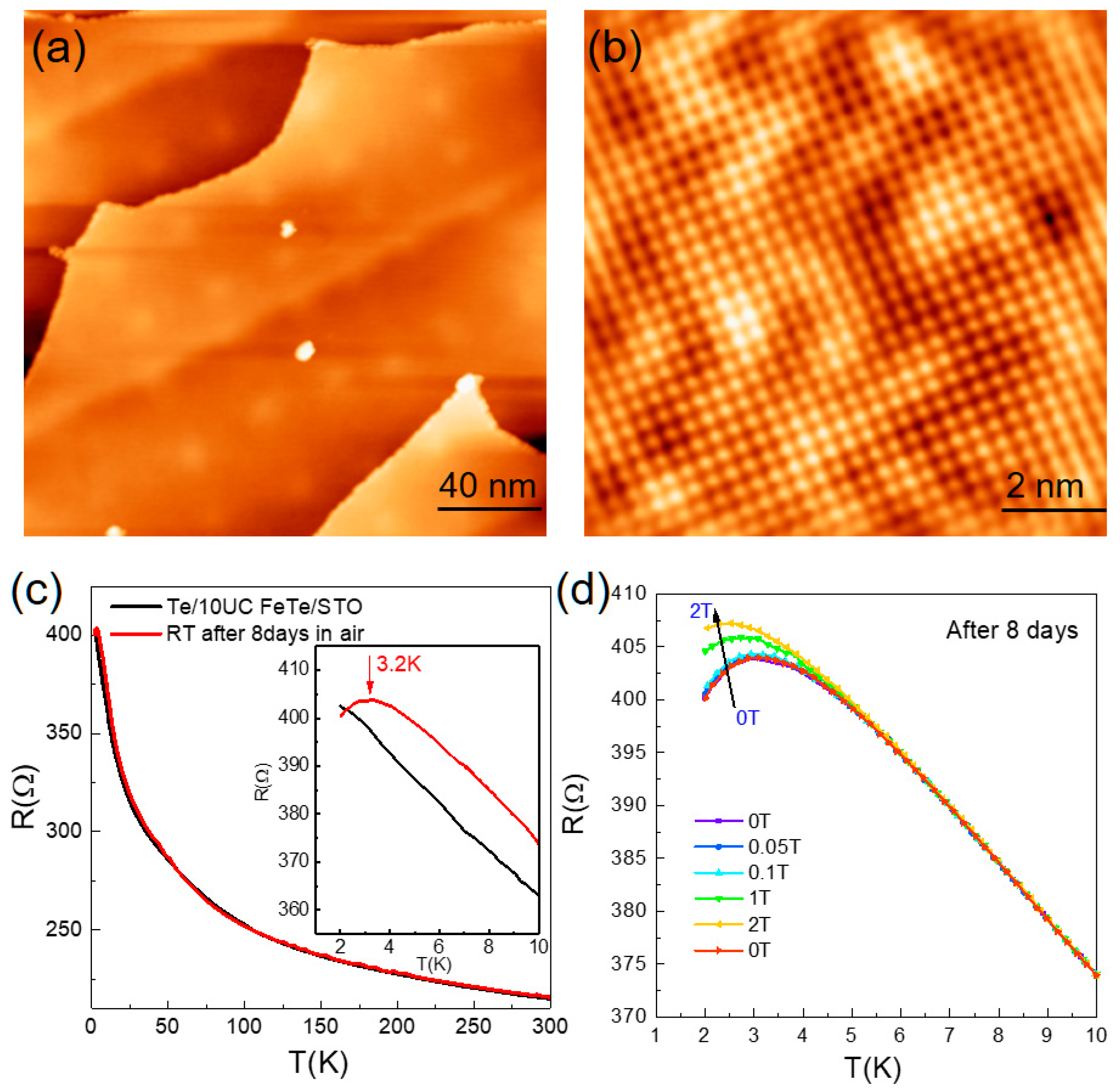
High-quality FeTe films are epitaxially grown on STO substrates via step flow growth mode. Figure 1a shows the typical surface morphology of 10UC FeTe film, and Figure 1b shows the atomically resolved image with Te termination. Fast Fourier transform image yields enlarged lattice constant of ~ 0.384 nm, similar to the case of FeSe on STO [1]. No Fe adatoms (or interstitial Fe atoms) and Te vacancies can be observed on the surface, which indicates nearly stoichiometric FeTe epitaxy films. To carry out electronic transport measurement, the protection Te layer was deposited on the 10UC FeTe surface, and the results were shown in Figure 1c. No superconducting transition but semiconducting behavior was observed in initially grown 10UC FeTe film down to 1.8 K, consistent with previous experiments [25,26]. Compared with bulk or thick FeTe films [11,13,23,27,28,29], we have not found an anomaly in the R-T curve between 40 K and 80 K, which further demonstrates free of Fe interstitial atoms [26]. AFM state may be suppressed here. After exposing the sample to air for 8 days, the resistance turned downward at ~3.2 K, as shown in the inset of Figure 1c. Considering the fact of long-time exposure-induced superconductivity in FeTe compounds, such downward should be attributed to superconducting transition. It is further verified by the suppression of transition under external magnetic fields in Figure 1d, characteristic of superconductivity. Non-zero resistance here suggests the developed superconductivity is not uniform. We found that exposure to air for a longer time would increase the superconducting transition temperature further.
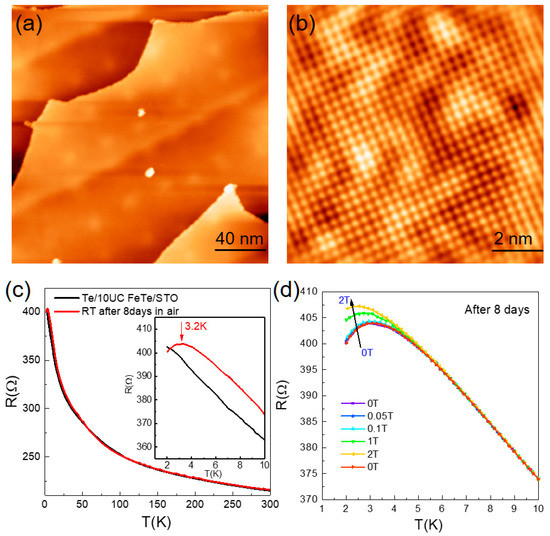
Figure 1.
(Color online) (a) Surface topography (200 nm × 200 nm) of the 10UC FeTe films on the Nb:STO. Scanning condition: sample bias 𝑉s = 3 V, tunneling current 𝐼𝑡 = 100 pA. (b) Typical atomically resolved STM image (10 nm ×10 nm) of 10UC FeTe. Scanning condition: sample bias 𝑉s = 0.7 V, tunneling current 𝐼𝑡 = 200 pA. (c) Temperature-dependent resistance (R-T) curve of 10UC FeTe thin film on HR-STO before and after exposure to air for 8 days. Inset: R-T curve under low temperature, showing turn-down behavior after exposure to air. (d) Temperature-dependent resistance of 10UC FeTe after exposure to air for 8 days under an out-of-plane magnetic field up to 2 T. The turn-down behavior was suppressed under magnetic fields and recovered after magnetic field withdrawal.
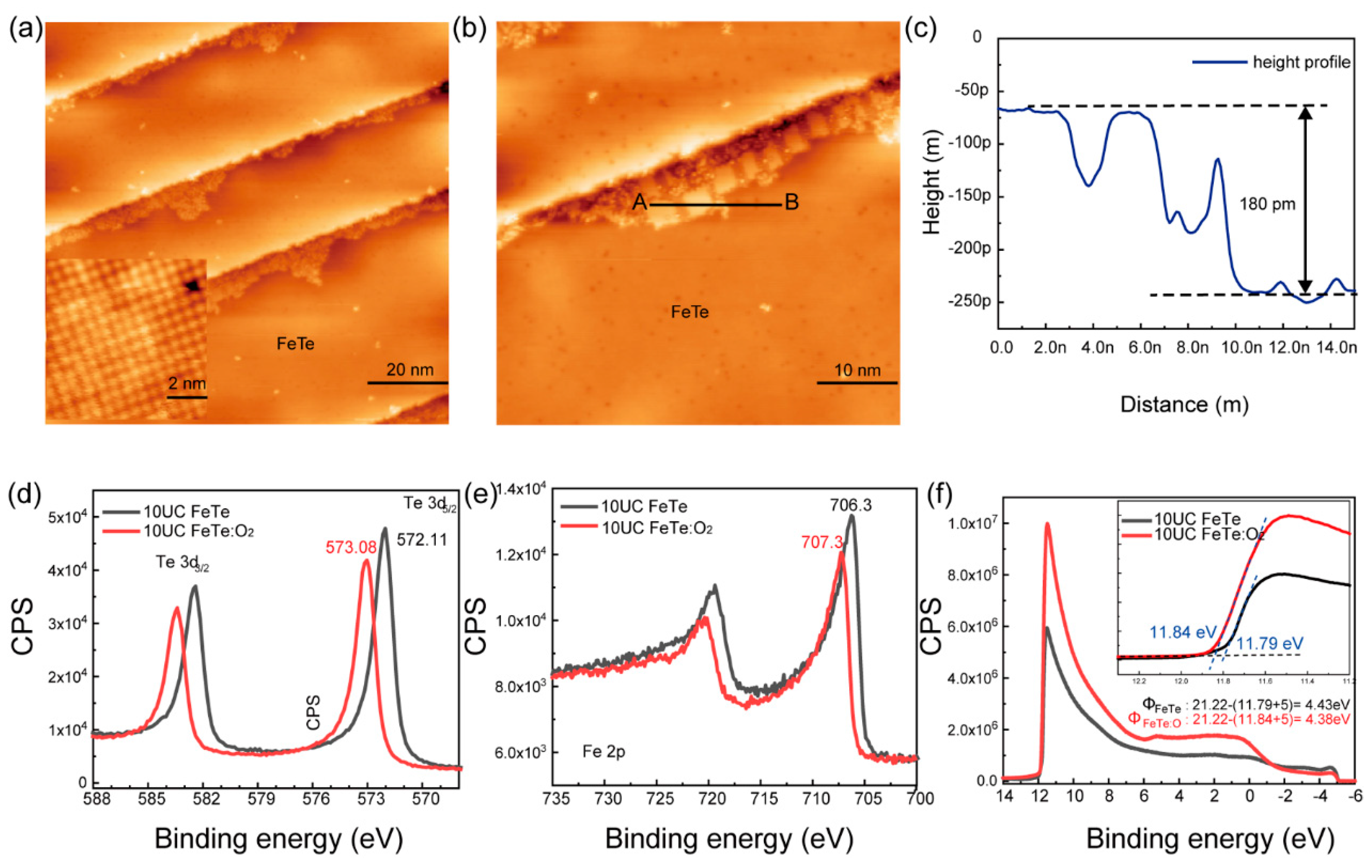
To figure out the superconducting mechanism in FeTe after exposure to O2, we carried out the oxygenated process under a well-control condition and probed the atomic and electronic structures microscopically. Figure 2a shows the surface morphology of the initial adsorption stage after exposure 10UC FeTe to O2 under a partial pressure of 1.6 × 10⁻⁴ mbar for 15 min. We can observe extra layers along the step edge, while other uncovered clean FeTe areas still remain unchanged, as illustrated by the atomically resolved STM image in the inset. No OTe substitution or interstitial O atoms can be observed. The enlarged image in Figure 2b shows there are small compacted islands with a height of ~0.18 nm in the overlayer, as shown in Figure 2c. Some dispersed clusters can be also found at the domain boundaries, which should be the ones that have not coarsened into the islands. If further increasing the amount of inlet O2, nearly the whole surface can be covered by the adsorbed overlayers, as shown in Figure S1a. The uncovered areas are still very clean in Figure S1b.
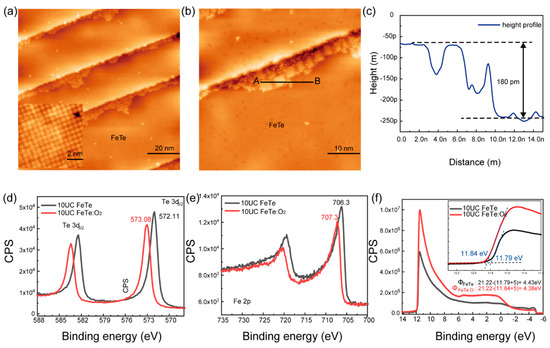
Figure 2.
(Color online) (a) Surface topography (100 nm × 100 nm) of the 10UC FeTe films after exposure to oxygen partial pressure of 1.6 × 10⁻⁴ mbar for 15 min at RT. Scanning condition: sample bias 𝑉s = 1 V, tunneling current 𝐼𝑡 = 100 pA. O2 overlayers were initially formed along the step edge. Inset is the atomically resolved STM image of the uncovered clean FeTe surface. (b) Enlarged STM image (50 nm × 50 nm) of O2 overlayers (FeTe : O2) on FeTe surface. Scanning condition: sample bias 𝑉s = 0.50 V, tunneling current 𝐼𝑡 = 100 pA. (c) The height profile of FeTe : O2 along line AB in panel b. (d,e) XPS core-level spectra of Te 3d (d) and Fe 2p (e) on as-prepared 10 UC FeTe and FeTe : O2 covered surface, respectively. No trance of Te-O and Fe-O signals can be observed. The spectra show apparent peak shifts after oxygen adsorption. (f) UPS spectra of 10UC FeTe covered w/o FeTe : O2, and the added voltage here is −5 V. Inset is the large view.
To unravel the nature of adsorbed overlayer (O2 molecules, FeOx, TeOx, Fe-Te-O or others?), Figure 2d,e present the core-level XPS spectra of Te 3d and Fe 2p before and after inlet O2, respectively. After inlet O2 under a partial pressure of 1.6 × 10⁻⁴ mbar, we do not observe Te-O and Fe-O spectra signals. If exposure to O2 partial pressure of 1.5 × 10⁻¹ mbar for 20 min, as shown in Figure S3c clear Te-O core level peak can be identified, which suggests surface oxidation under high O2 partial pressure. The XPS spectra of Te 3d and Fe 2p show an obvious peak shift toward higher binding energy, which hints hole doping effect in FeTe. The overlayer would gradually desorb when heating up to 100 °C and disappeared after annealing at 200 °C for 2 h. Only a clean FeTe surface was left. The overlayer will re-adsorb after inlet O2 again. Thus, we can rule out the possibility of Fe- or Te-related compounds because there was negligible residual Fe or Te atoms after growth. In addition, we notice there are some dispersed clusters higher than the compacted islands in Figure 2b and Figure 3a, which helps us to conclude that the overlayer should be O2 molecules rather than stacked O atoms. The shape of O 1s core level almost remains unchanged after O2 adsorption under a partial pressure of 1.6 × 10⁻⁴ mbar, as illustrated in Figure S3, but changes a lot after surface oxidation due to the signal from O-Te and O-Fe. It implies the signal of O 1s at 529.5 eV ~ 531 eV are mainly from the STO substrate, which, as expected, exhibits a similar core level shift as Te 3d, as shown in Figure S3a. It also consists of the nature of physically adsorbed O2 molecules, where characteristic core-level XPS peak always cannot be found. Thus, we name the overlayer heterostructure as FeTe : O2. UPS measurements in Figure 2f show that the work function just slightly changed from ϕFeTe ~ 4.43 eV to ϕFeTe:O2 ~ 4.38 eV after O2 adsorption. The small difference in work function is also consistent with the nature of O2 molecules in the overlayer.
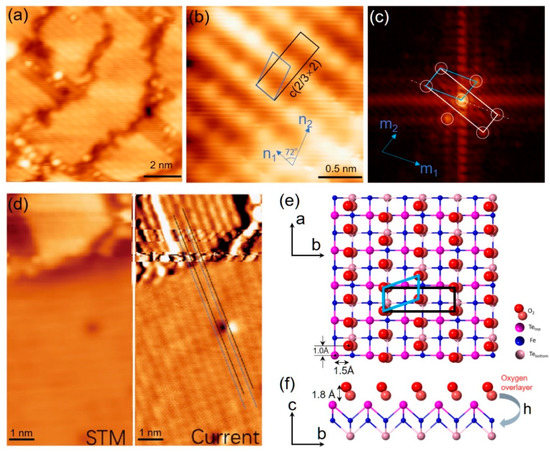
Figure 3.
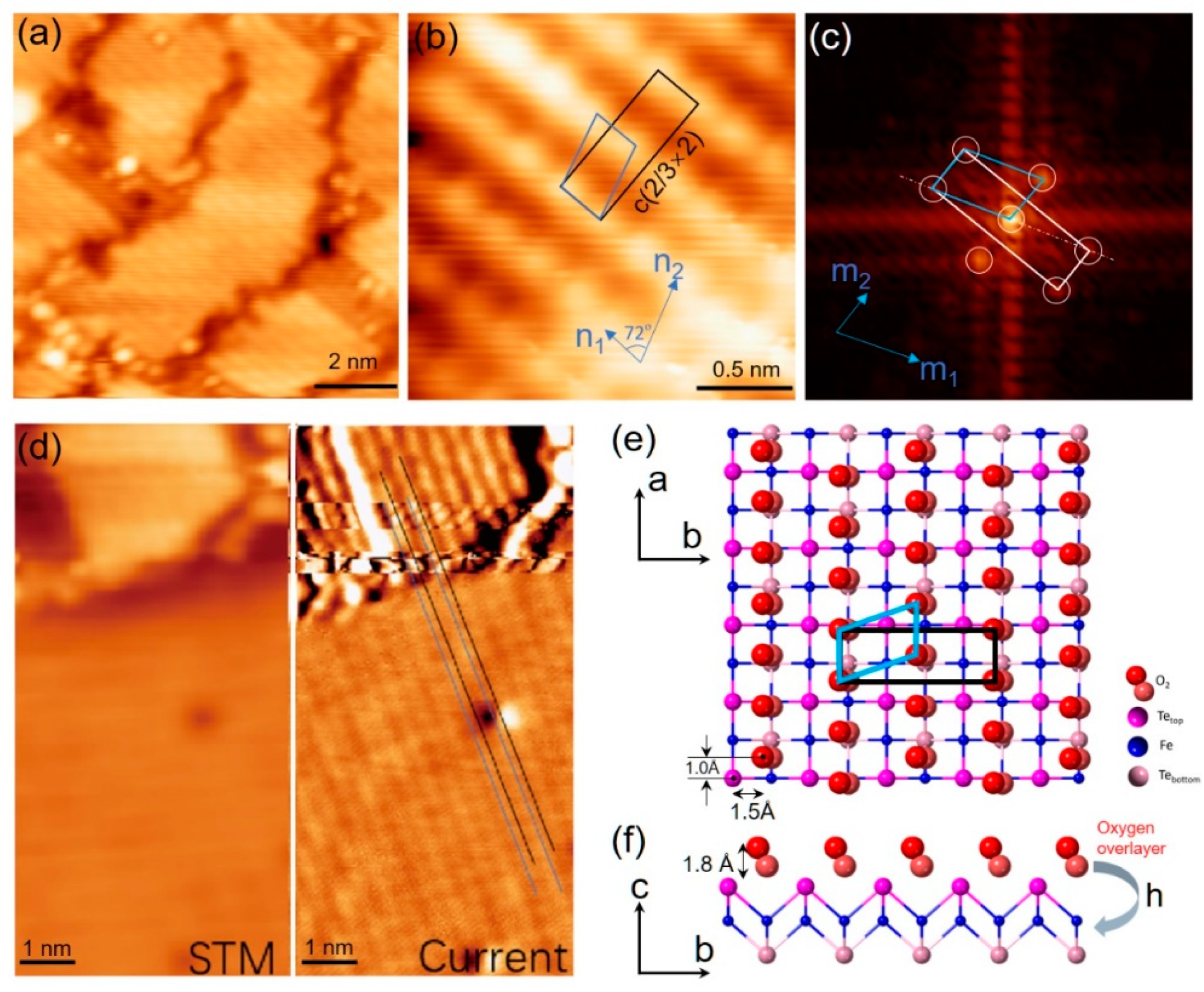
(Color online) (a) Small compacted FeTe : O2 islands on 10UC FeTe. Dispersed clusters can be observed at domain boundaries. Scanning condition: sample bias 𝑉s = 1 V, tunneling current 𝐼𝑡 = 200 pA. (b) Atomically resolved STM images (2 nm × 2 nm) on FeTe : O2 islands. Scanning condition: sample bias 𝑉s = 0.1 V, tunneling current 𝐼𝑡 = 200 pA. (c) The fast Fourier transform image of (b). White circles mark the reciprocal lattice. (d) STM topographic (left panel) and constant current (right panel) images (5 nm × 10 nm) of the 10UC FeTe films with one FeTe : O2 island. The current image helps us to measure the adsorption geometrical configuration. Scanning condition: sample bias 𝑉s = 0.3 V, tunneling current 𝐼𝑡 = 300 pA. (e,f) Schematic diagrams of geometrical configuration of O2 adsorption overlayer on FeTe: (e) top side and (f) side views.
Figure 3a shows some small compacted FeTe : O2 islands, where striped structures can be clearly observed. Only two perpendicular orientations were distinguished, which consist of the tetragonal symmetry of the underlying FeTe lattice. The atomically resolved structure of adsorbed FeTe : O2 islands is shown in Figure 3b. The distance between neighboring bright rows is ~ 0.386 nm, nearly equal to the lattice constant aFeTe of FeTe. The corresponding fast Fourier transform image in Figure 3c yields an in-plane lattice of n1 with a value of 0.25±0.02 nm and n2 with a value of 0.41±0.02 nm. The angle between n1 and n2 is measured to be ~ 72°. We notice that the spot distance of 0.25 nm along n1 is nearly equal to 2/3aFeTe. Thus, the lattice can be notated as c (2/3×2), as shown in Figure 3b,c. Such lattice arrangement demonstrates a close relationship between the O2 adsorption overlayer (FeTe : O2) and the FeTe surface. To locate the precise adsorption sites of O2 on FeTe, we achieved an atomically resolved image on both the FeTe : O2 island and FeTe surface in Figure 3d. The results are shown in the structural model in Figure 3e. As illustrated, along the n1 direction, the adsorption sites of O2 molecules are not well-defined relative to FeTe lattice and not at high-symmetry points. It not only signifies that the van der Waals interaction between O2 molecules plays a vital role in the overlayer but also verifies the absence of chemical bonding between the O2 interlayer and the FeTe surface.
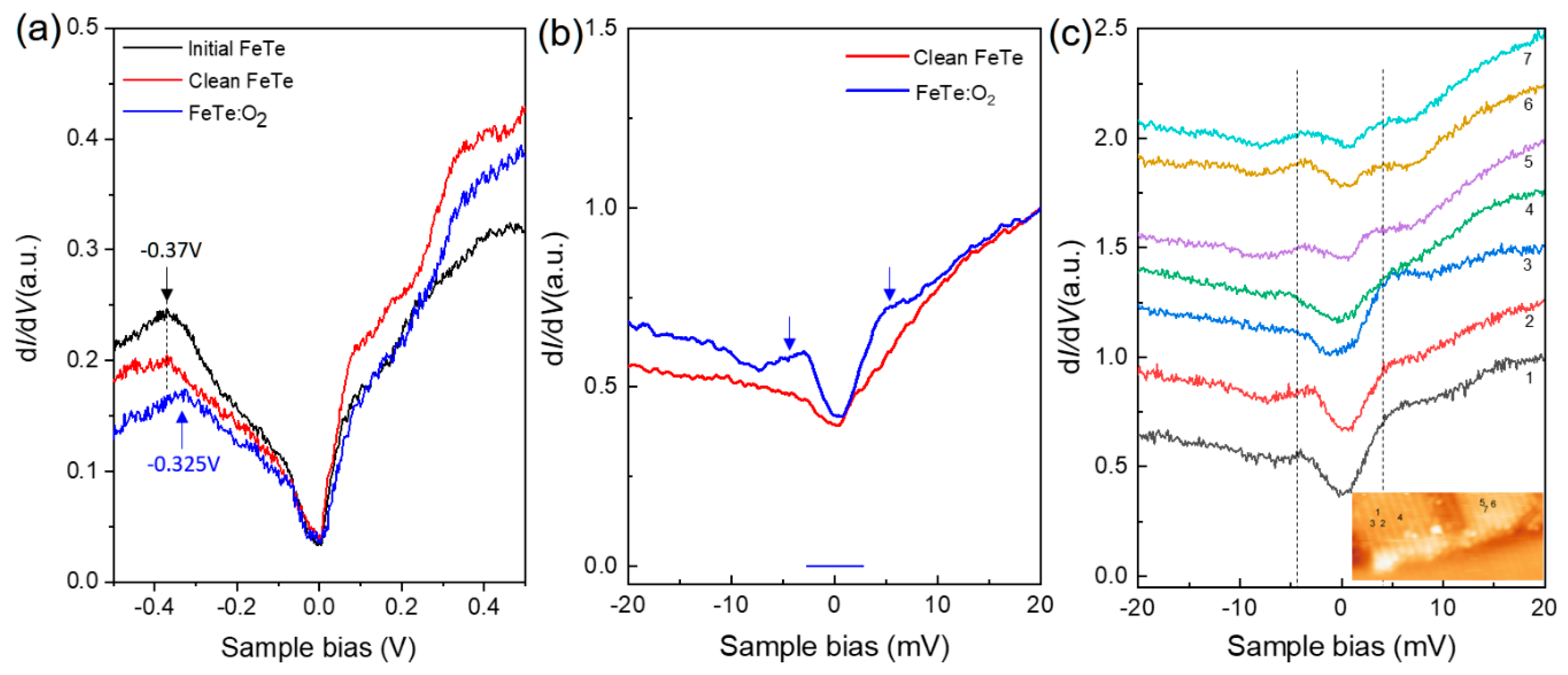
To explore how the electronic structure changes due to O2 absorption, we conducted detailed differential conductance dI/dV measurements, which are known to be proportional to the local density of state (LDOS). On as-prepared and uncovered clean 10UC FeTe surfaces, the STS remain nearly unchanged with a “V” shape across the Fermi level in Figure 4a, consistent with previous studies [2,30]. A hump at the negative bias voltage shift from −0.37 V to −0.325 V on FeTe : O2 after O2 adsorption, which indicates hole doping effect to FeTe, agreeing well with the observation of peak shift in XPS experiments in Figure 2. Such oxygen-induced hole doping effect [31] was recently observed on the CsV3Sb5 with an increased superconducting transition temperature. Additionally, hole doping effects were observed in Bi2Te3/FeTe [32,33] and Sb2Te3/FeTe [26] heterostructures and thought to be the origin of two-dimensional superconductivity in the heterostructures. Figure 4b shows the dI/dV spectra in a small energy range. A clear V-shape was observed on a clean FeTe surface, similar to the one on the monolayer FeTe [2] and thick FeTe film [30]. Strikingly, on FeTe : O2 islands two pronounced peaks with an energy gap of ~9 meV were clearly identified across the Fermi level. Considering the facts of previous observation of hole-doping-induced superconductivity in the Bi2Te3/FeTe heterostructure and the superconductivity observed in 10UC FeTe/STO sample after long-time exposure to air, we conclude that the gap on FeTe : O2 is just a superconducting gap with Δ ~4.5 meV, larger than the one on Bi2Te3/FeTe heterostructure (~2.5 meV) [32,34]. It should be due to the interfacial effect on STO substrate because similar enhanced superconductivities have been observed on the Pb islands [35] and monolayer FeTexSe1-x [1,2,25]. We have studied the spatial distribution of the superconducting gap on the FeTe : O2 islands in Figure 4c. Pronounced coherent peaks can be observed in all the dI/dV curves.
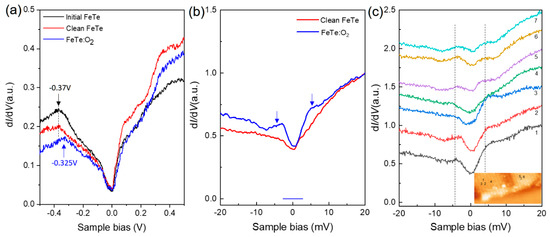
Figure 4.
(Color online) (a) Typical dI/dV spectra on 10UC FeTe before and after O2 adsorption. A hump at negative energy shows a clear shift on FeTe : O2 overlayer. Starting condition: 𝑉s = 0.5 V, tunneling current 𝐼𝑡 = 100 pA. (b) The zoomed-in dI/dV spectra on clean FeTe area and FeTe : O2 overlayer. An energy gap with two pronounced peaks was observed across the Fermi level, which is a superconducting gap. Starting condition: 𝑉s = 20 mV, tunneling current 𝐼𝑡 = 200 pA. (c) A series of dI/dV spectra on FeTe : O2, showing the energy gap can be observed on the whole FeTe : O2 islands. Starting condition: 𝑉s = 20 mV, tunneling current 𝐼𝑡 = 200 pA.
The observation of enhanced superconducting gap on FeTe : O2 islands is intriguing and distinct from all the previously proposed mechanisms. Physically adsorbed O2 molecules rather than interstitial oxygen or oxygen substitution are responsible for superconductivity in oxygenated FeTe. Previously, annealing under an elevated temperature or quite a long-time aging may be aimed at the formation of a uniform O2 overlayer into the FeTe layer. Our study here also emphasizes the importance of the hole doping effect and interfacial effect to induce superconductivity on FeTe. We have not observed a superconducting gap on FeTe:O2 overlayer on monolayer FeTe, which may be due to the extra electron doping from the STO substrate.
4. Conclusions
In summary, we have systematically investigated the changes of morphology and electronic structure of 10UC FeTe films after O2 adsorption. Ex-situ transport measurements demonstrate long-term exposure to air could induce superconducting transition in 10UC FeTe ultrathin film, which verifies the effect of oxygen incorporation. Initially, O2 molecules physically adsorbed on the FeTe surface and formed compacted FeTe : O2 islands with c(2/3×2) structure at low temperatures. No oxygen-related defects can be detected on the uncovered clean FeTe surface. Energy shifts in STS and XPS measurements point out obvious hole doping into FeTe from the oxygen overlayer. Such hole doping results in a superconducting gap of ~ 4.5 meV opened with apparent coherent peaks. Our study here directly provides microscopical insights about the role of oxygen on FeTe thin film.
Supplementary Materials
The following are available online at https://www.mdpi.com/article/10.3390/ma14164584/s1, Figure S1: (color online) (a) Surface topography (100 nm × 100 nm) of the 10UC FeTe films after exposure to O2 under 1.6 × 10⁻⁴ mbar for 4 h at room temperature. Scanning condition: Vs = 3 V, It = 100 pA. (b) Enlarged view (50 nm × 50 nm) of surface topography, showing clean FeTe surface with O2 overlayer. Scanning condition: Vs = 1 V, It = 100 pA, Figure S2: (color online) The XPS survey scan on 10 UC FeTe after O2 adsorption, showing no other impurities can be observed after O2 inlet, Figure S3: (color online) (a) The XPS core level spectra of O1s before and after O2 inlet, showing similar shift as Te 3d and Fe 2p. (b,c) The normalized and shifted XPS core level spectra of O 1s (b) and Te 3d (c) on 10 UC FeTe before and after O2 adsorption, showing the shapes of O 1s or Te 3d are nearly overlapped. We also added the XPS spectra on the oxidized FeTe/STO when exposure to O2 partial pressure of 1.5 × 10⁻¹ mbar for 20 min.
Author Contributions
Conceptualization, F.L. and Y.W.; methodology, F.L. and W.R.; software, W.R.; validation, W.R., H.R. and K.P., H.L., S.L., A.C., P.W., X.F., Z.L., R.H. and L.W.; formal analysis, F.L., W.R., H.R. and Y.W.; investigation, F.L. and W.R.; resources, F.L. and Y.W.; data curation, F.L. and W.R.; writing—original draft preparation, F.L. and W.R.; writing—review and editing, F.L. and W.R.; visualization, F.L. and W.R.; supervision, F.L. and Y.W.; project administration, F.L. and Y.W.; funding acquisition, F.L. and Y.W. All authors have read and agreed to the published version of the manuscript.
Funding
This work is supported by the National Natural Science Foundation of China (Grants No. 11604366, No. 11634007). F. Li acknowledges support from the Youth Innovation Promotion Association of the Chinese Academy of Sciences (2017370). Y. Wang would like to acknowledge partial support by the Ministry of Science and Technology of China under Grant numbers 2017YFA0303000 and 2016YFA0301002, NSFC Grant No. 11827805, and Shanghai Municipal Science and Technology Major Project Grant No.2019SHZDZX01.
Institutional Review Board Statement
Not applicable.
Informed Consent Statement
Not applicable.
Data Availability Statement
The data presented in this study are available on request from the corresponding authors.
Acknowledgments
We thank Xu-cun Ma, Li-li Wang and Haiping Lin for helpful discussion.
Conflicts of Interest
The authors declare that they have no conflict of interest.
Abbreviations
| AFM | Antiferromagnetic |
| UC | Unit-Cell |
| UHV | Ultrahigh Vacuum |
| BE | Binding Energy |
| LDOS | Local Density of State |
| STO | SrTiO3 |
| STM | Scanning Tunneling Microscopy |
| STS | Scanning Tunneling Spectroscopy |
| XPS | X-ray Photoelectron Spectroscopy |
| UPS | Ultraviolet Photoelectron Spectrometer |
| MBE | Molecular Beam Epitaxy |
References
- Wang, Q.-Y.; Li, Z.; Zhang, W.-H.; Zhang, Z.-C.; Zhang, J.-S.; Li, W.; Ding, H.; Ou, Y.-B.; Deng, P.; Chang, K.; et al. Interface-induced high-temperature superconductivity in single unit-cell FeSe films on SrTiO3. Chin. Phys. Lett. 2012, 29, 037402. [Google Scholar] [CrossRef] [Green Version]
- Li, F.; Ding, H.; Tang, C.; Peng, J.; Zhang, Q.; Zhang, W.; Zhou, G.; Zhang, D.; Song, C.-L.; He, K.; et al. Interface-enhanced high-temperature superconductivity in single-unit-cell FeTe1−xSex films onSrTiO3. Phys. Rev. B 2015, 91, 220503(R). [Google Scholar] [CrossRef]
- Lee, J.J.; Schmitt, F.T.; Moore, R.G.; Johnston, S.; Cui, Y.T.; Li, W.; Yi, M.; Liu, Z.K.; Hashimoto, M.; Zhang, Y.; et al. Interfacial mode coupling as the origin of the enhancement of T(c) in FeSe films on SrTiO3. Nature 2014, 515, 245–248. [Google Scholar] [CrossRef]
- Wang, D.; Kong, L.; Fan, P.; Chen, H.; Zhu, S.; Liu, W.; Cao, L.; Sun, Y.; Du, S.; Schneeloch, J.; et al. Evidence for Majorana bound states in an iron-based superconductor. Science 2018, 362, 333–335. [Google Scholar] [CrossRef] [PubMed] [Green Version]
- Zhang, P.; Yaji, K.; Hashimoto, T.; Ota, Y.; Kondo, T.; Okazaki, K.; Wang, Z.J.; Wen, J.S.; Gu, G.D.; Ding, H.; et al. Observation of topological superconductivity on the surface of an iron-based superconductor. Science 2018, 360, 182. [Google Scholar] [CrossRef] [Green Version]
- Xu, G.; Lian, B.; Tang, P.; Qi, X.L.; Zhang, S.C. Topological superconductivity on the surface of Fe-based superconductors. Phys. Rev. Lett. 2016, 117, 047001. [Google Scholar] [CrossRef] [Green Version]
- Jiang, D.; Pan, Y.; Wang, S.; Lin, Y.; Holland, C.M.; Kirtley, J.R.; Chen, X.; Zhao, J.; Chen, L.; Yin, S.; et al. Observation of robust edge superconductivity in Fe(Se,Te) under strong magnetic perturbation. Sci. Bull. 2021, 66, 425–432. [Google Scholar] [CrossRef]
- Enayat, M.; Sun, Z.X.; Singh, U.R.; Aluru, R.; Schmaus, S.; Yaresko, A.; Liu, Y.; Lin, C.T.; Tsurkan, V.; Loidl, A.; et al. Real-space imaging of the atomic-scale magnetic structure of Fe1+yTe. Science 2014, 345, 653–656. [Google Scholar] [CrossRef] [PubMed] [Green Version]
- Trainer, C.; Yim, C.M.; Heil, C.; Giustino, F.; Croitori, D.; Tsurkan, V.; Loidl, A.; Rodriguez, E.E.; Stock, C.; Wahl, P. Manipulating surface magnetic order in iron telluride. Sci. Adv. 2019, 5, eaav3478. [Google Scholar] [CrossRef] [PubMed] [Green Version]
- Dagotto, E. Colloquium: The unexpected properties of alkali metal iron selenide superconductors. Rev. Mod. Phys. 2013, 85, 849–867. [Google Scholar] [CrossRef] [Green Version]
- Nie, Y.F.; Telesca, D.; Budnick, J.I.; Sinkovic, B.; Wells, B.O. Superconductivity induced in iron telluride films by low-temperature oxygen incorporation. Phys. Rev. B 2010, 82, 020508(R). [Google Scholar] [CrossRef] [Green Version]
- Zheng, M. Growth and Oxygen Doping of Thin Film FeTe by Molecular Beam Epitaxy. Available online: http://hdl.handle.net/2142/46712 (accessed on 15 August 2021).
- Hu, H.; Kwon, J.-H.; Zheng, M.; Zhang, C.; Greene, L.H.; Eckstein, J.N.; Zuo, J.-M. Impact of interstitial oxygen on the electronic and magnetic structure in superconducting Fe1+yTeOx thin films. Phys. Rev. B 2014, 90, 180504(R). [Google Scholar] [CrossRef] [Green Version]
- Zhao, P.H.; Zhu, H.F.; Tian, Y.J.; Li, D.L.; Ma, L.; Suo, H.L.; Nie, J.C. O2 Annealing Induced Superconductivity in FeTe1−xSex: On the Origin of Superconductivity in FeTe Films. J. Super. Nov. Magn. 2016, 30, 871–876. [Google Scholar] [CrossRef]
- Mizuguchi, Y.; Deguchi, K.; Tsuda, S.; Yamaguchi, T.; Takano, Y. Evolution of superconductivity by oxygen annealing in FeTe0.8S0.2. Europhys. Lett. 2010, 90. [Google Scholar] [CrossRef] [Green Version]
- Hu, H.; Zuo, J.-M.; Zheng, M.; Eckstein, J.N.; Park, W.K.; Greene, L.H.; Wen, J.; Xu, Z.; Lin, Z.; Li, Q.; et al. Structure of the oxygen-annealed chalcogenide superconductor Fe1.08Te0.55Se0.45Ox. Phys. Rev. B 2012, 85, 064504. [Google Scholar] [CrossRef] [Green Version]
- Su, T.S.; Yin, Y.W.; Teng, M.L.; Gong, Z.Z.; Zhang, M.J.; Li, X.G. Effect of carrier density and valence states on superconductivity of oxygen annealed Fe1.06Te0.6Se0.4 single crystals. J. Appl. Phys. 2013, 114. [Google Scholar] [CrossRef]
- Sun, Y.; Tsuchiya, Y.; Taen, T.; Yamada, T.; Pyon, S.; Sugimoto, A.; Ekino, T.; Shi, Z.; Tamegai, T. Dynamics and mechanism of oxygen annealing in Fe1+yTe0.6Se0.4 single crystal. Sci. Rep. 2014, 4, 4585. [Google Scholar] [CrossRef] [Green Version]
- Yamazaki, T.; Sakurai, T.; Yaguchi, H. Size Dependence of oxygen-annealing effects on superconductivity of Fe1+yTe1-xSx. J. Phys. Soc. Jpn. 2016, 85, 114712. [Google Scholar] [CrossRef] [Green Version]
- Dong, L.; Zhao, H.; Zeljkovic, I.; Wilson, S.D.; Harter, J.W. Bulk superconductivity in FeTe1-xSex via physicochemical pumping of excess iron. Phys. Rev. Mater. 2019, 3, 114801. [Google Scholar] [CrossRef]
- Ru, H.; Lin, Y.-S.; Chen, Y.-C.; Feng, Y.; Wang, Y.-H. Observation of two-level critical state in the superconducting FeTe thin films. Chin. Phys. Lett. 2019, 36, 077402. [Google Scholar] [CrossRef] [Green Version]
- Kawasaki, Y.; Deguchi, K.; Demura, S.; Watanabe, T.; Okazaki, H.; Ozaki, T.; Yamaguchi, T.; Takeya, H.; Takano, Y. Phase diagram and oxygen annealing effect of FeTe1-xSex iron-based superconductor. Solid State Commun. 2012, 152, 1135–1138. [Google Scholar] [CrossRef] [Green Version]
- Si, W.; Jie, Q.; Wu, L.; Zhou, J.; Gu, G.; Johnson, P.D.; Li, Q. Superconductivity in epitaxial thin films of Fe1.08Te:Ox. Phys. Rev. B 2010, 81, 092506. [Google Scholar] [CrossRef]
- Horcas, I.; Fernandez, R.; Gomez-Rodriguez, J.M.; Colchero, J.; Gomez-Herrero, J.; Baro, A.M. WSXM: A software for scanning probe microscopy and a tool for nanotechnology. Rev. Sci. Instrum. 2007, 78, 013705. [Google Scholar] [CrossRef] [PubMed]
- Zhang, W.-H.; Sun, Y.; Zhang, J.-S.; Li, F.-S.; Guo, M.-H.; Zhao, Y.-F.; Zhang, H.-M.; Peng, J.-P.; Xing, Y.; Wang, H.-C.; et al. Direct Observation of high-temperature superconductivity in one-unit-cell FeSe films. Chin. Phys. Lett. 2014, 31, 017401. [Google Scholar] [CrossRef] [Green Version]
- Liang, J.; Zhang, Y.J.; Yao, X.; Li, H.; Li, Z.-X.; Wang, J.; Chen, Y.; Sou, I.K. Studies on the origin of the interfacial superconductivity of Sb2Te3/Fe1+yTe heterostructures. Proc. Natl. Acad. Sci. USA 2020, 117, 221–227. [Google Scholar] [CrossRef] [PubMed] [Green Version]
- Telesca, D.; Nie, Y.; Budnick, J.I.; Wells, B.O.; Sinkovic, B. Impact of valence states on the superconductivity of iron telluride and iron selenide films with incorporated oxygen. Phys. Rev. B 2012, 85, 214517. [Google Scholar] [CrossRef] [Green Version]
- Zhang, Z.T.; Yang, Z.R.; Lu, W.J.; Chen, X.L.; Li, L.; Sun, Y.P.; Xi, C.Y.; Ling, L.S.; Zhang, C.J.; Pi, L.; et al. Superconductivity in Fe1.05Te:Ox single crystals. Phys. Rev. B 2013, 88, 214511. [Google Scholar] [CrossRef]
- Smith, N.; Gelting, D.; Basaran, A.C.; Schofield, M.; Schuller, I.K.; Gajdardziska-Josifovska, M.; Guptasarma, P. Effects of oxygen annealing on single crystal iron telluride. Phys. C Supercond. 2019, 567, 1253400. [Google Scholar] [CrossRef]
- Zhang, Z.; Cai, M.; Li, R.; Meng, F.; Zhang, Q.; Gu, L.; Ye, Z.; Xu, G.; Fu, Y.-S.; Zhang, W. Controllable synthesis and electronic structure characterization of multiple phases of iron telluride thin films. Phys. Rev. Mater. 2020, 4, 125003. [Google Scholar] [CrossRef]
- Song, Y.; Ying, T.; Chen, X.; Han, X.; Huang, Y.; Wu, X.; Schnyder, A.-P.; Guo, J.; Chen, X. Enhancement of superconductivity in hole-doped CsV3Sb5 thin films. arXiv 2021, arXiv:2105.09898v1. [Google Scholar]
- Qn, H.; Guo, B.; Wang, L.; Zhang, M.; Xu, B.; Shi, K.; Pan, T.; Zhou, L.; Chen, J.; Qu, Y.; et al. Superconductivity in single-quintuple-layer Bi2Te3 grown on epitaxial FeTe. Nano Lett. 2020, 20, 3160–3168. [Google Scholar] [CrossRef] [PubMed]
- Owada, K.; Nakayama, K.; Tsubono, R.; Shigekawa, K.; Sugawara, K.; Takahashi, T.; Sato, T. Electronic structure of a Bi2Te3/FeTe heterostructure: Implications for unconventional superconductivity. Phys. Rev. B 2019, 100, 064518. [Google Scholar] [CrossRef] [Green Version]
- Guo, B.; Shi, K.-G.; Qin, H.-L.; Zhou, L.; Chen, W.-Q.; Ye, F.; Mei, J.-W.; He, H.-T.; Pan, T.-L.; Wang, G. Evidence for topological superconductivity: Topological edge states in Bi2Te3/FeTe heterostructure. Chin. Phys. B 2020, 29, 097403. [Google Scholar] [CrossRef]
- Yuan, Y.; Wang, X.; Song, C.; Wang, L.; He, K.; Ma, X.; Yao, H.; Li, W.; Xue, Q.-K. Observation of coulomb gap and enhanced superconducting gap in nano-sized Pb islands grown on SrTiO3. Chin. Phys. Lett. 2020, 37, 017402. [Google Scholar] [CrossRef]
Publisher’s Note: MDPI stays neutral with regard to jurisdictional claims in published maps and institutional affiliations. |
© 2021 by the authors. Licensee MDPI, Basel, Switzerland. This article is an open access article distributed under the terms and conditions of the Creative Commons Attribution (CC BY) license (https://creativecommons.org/licenses/by/4.0/).