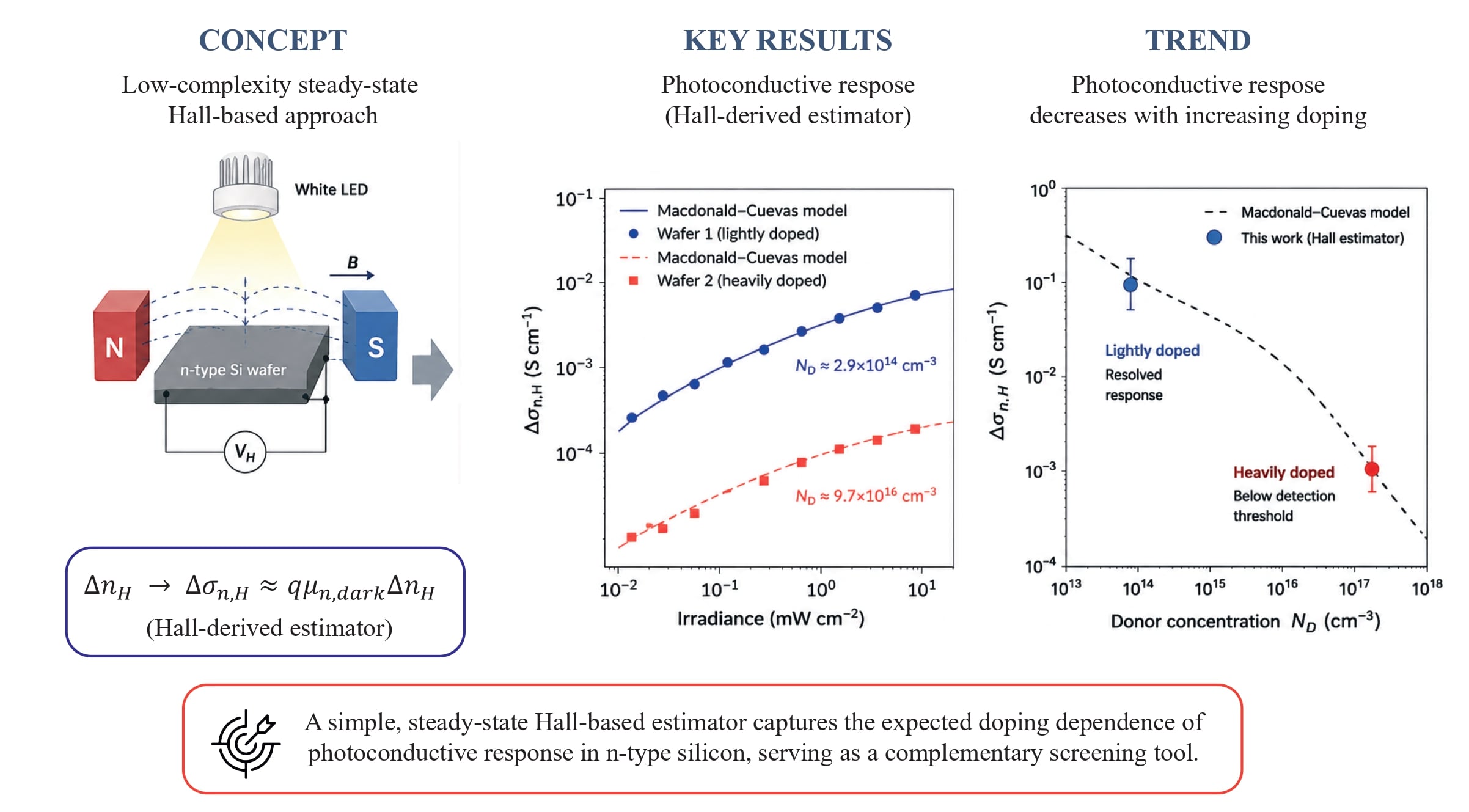
A low-complexity Hall-based measurement system implementing a dark/illuminated differential estimator of the majority-carrier photoconductive response is assessed on
n-type crystalline silicon wafers with contrasting doping concentrations. The setup combines a Van der Pauw configuration, permanent neodymium magnets, a characterized white LED source,
[...] Read more.
A low-complexity Hall-based measurement system implementing a dark/illuminated differential estimator of the majority-carrier photoconductive response is assessed on
n-type crystalline silicon wafers with contrasting doping concentrations. The setup combines a Van der Pauw configuration, permanent neodymium magnets, a characterized white LED source, and a source–measure unit to extract an apparent Hall-derived differential indicator—not a calibrated majority-carrier density—under dark and illuminated steady-state conditions. At
, the lightly doped wafer (
) shows a resolved response (
), reported as mean ± sample standard deviation from 15 dark/light cycles. The heavily doped wafer (
) gives a nominal below-threshold response (
) from the same cycling protocol; it should be interpreted only as an unresolved trend-level indication because it lies below the instrumental detection threshold. The contrast is qualitatively consistent with the expected doping dependence, but no quantitative performance ratio is claimed for the heavily doped wafer. A Macdonald–Cuevas comparison is used only as a qualitative physical-consistency benchmark. No independent QSSPC, SSPC,
-PCD, or carrier-resolved photo-Hall measurement was available for the same wafers; therefore, the
system serves as a complementary low-cost screening tool for comparative trend analysis, not a replacement for calibrated photoconductance or photo-Hall techniques, and it does not constitute a new measurement principle.
Full article