


Abstract
MgO-doped LiNbO3 (LN:Mg) is famous for its high resistance to optical damage, but this phenomenon only occurs in visible and infrared regions, and its photorefraction is not decreased but enhanced in ultraviolet region. Here we investigated a series of ZrO2 co-doped LN:Mg (LN:Mg,Zr) regarding their ultraviolet photorefractive properties. The optical damage resistance experiment indicated that the resistance against ultraviolet damage of LN:Mg was significantly enhanced with increased ZrO2 doping concentration. Moreover, first-principles calculations manifested that the enhancement of ultraviolet damage resistance for LN:Mg,Zr was mainly determined by both the increased band gap and the reduced ultraviolet photorefractive center O2−/−. So, LN:Mg,Zr crystals would become an excellent candidate for ultraviolet nonlinear optical material.
1. Introduction
Lithium niobate (LiNbO3, LN), also known as the silicon of nonlinear optics, is famous for its excellent physical properties such as acousto-optic, electro-optic, pyro-electric, piezoelectric, and nonlinear properties [1,2]. Although it has been grown for more than half a century, LiNbO3 has remained one of the hot issues for researchers up to now [3]. In LiNbO3, the optically-induced damage, also called the photorefraction, can be produced easily with a laser beam of several milliwatts, which seriously hinders its applications such as optical waveguides, frequency convertors, and Q-switches at high light intensities [4]. The good news is that doping MgO into LiNbO3 solves this problem well, and the optical damage resistance for LiNbO3 can be increased by two orders of magnitude, substantially promoting its practical use in nonlinear optics [5,6]. Nowadays, MgO doped LN (LN:Mg) still garners extensive research interest in optical waveguide, domain engineering, and quasi-phase-matching, however, it should be noted that most of these researches have only been carried out in visible and infrared regions, but not in ultraviolet (UV) [7,8]. In fact, LN:Mg exposes the visible enhancement of UV photorefraction [9], and this is a serious problem that has become a noteworthy impediment to its extension of applications into UV region.
As we know, the chemical element Zr is considered as a unique and promising dopant in LiNbO3 since it has a lower doping threshold (~ 2.0 mol.%) and a optimal distribution coefficient close to one, especially the strong optical damage resistance from UV to visible [10,11,12,13]. It should be pointed out that it has been the only doped LN crystal possessing superior resistance against UV damage so far [14]. Generally, this property is thought to be related to the replacement of Zr4+ ions against Nb5+ on Li sites because the element Zr is adjacent to Nb in the periodic table. It has been reported that Zr4+ ions co-dope with some transition metal elements in LN crystals [15,16], such as Fe, Mn, Cu, and Ce, which can considerably reduce the light-induced scattering as well as improve the response speed. Besides, Zr doping also improves the near infrared emission efficiency in LN:Er, LN:Yb,Er crystals [17]; meanwhile, it can also stabilize the signal output of the Ti-diffused LN waveguides under the high-power pumping without optical damage observed [18]. Furthermore, we have reported that some additional ZrO2 doping into LN:Mg not only can finely adjust the phase-matching temperature but also realize the room temperature noncritical phase-matching [19]. The above research results suggest that Zr doping have such a strong impact on the properties of LN, so further research on its influence on the UV photorefraction of LN:Mg is very necessary and meaningful to promote the laser frequency conversion to UV wavelength region. Therefore, in this work we mainly investigated the resistance against UV damage of ZrO2 co-doped LN:Mg crystals. Moreover, the first-principles calculations were employed to explore the effect of the crystal defect on the UV photorefractive properties in the doubly-doped LiNbO3.
2. Materials and Methods
A series of fixed 5.0 mol.% MgO and various ZrO2 (0, 0.5, 1.0 and 1.5 mol.%) co-doped LiNbO3 crystals were investigated and labelled as LN:Mg5.0,Zr0.5, LN:Mg5.0,Zr1.0, and LN:Mg5.0,Zr1.5, respectively. For comparison, the 2.0 mol.% ZrO2-doped congruent LN crystal was also prepared, labeled as LN:Zr2.0. Here, the crystal growth and treatment had been described in our previous report [19].
The transmitted beam spot distortion method [20] was performed directly and evaluated the optical damage resistance of crystals in the UV region. An e-polarized beam operating at 355 nm from a continuous wave frequency-tripled solid-state laser with a maximum output power of 100 mW was focused into the 3.0-mm-thick y-plates. The laser beam was polarized parallel to the c-axis of the plates, and the highest intensity at the focal point was 2.2 × 10⁵ W/cm2. When a crystal suffers from the optical damage, the transmitted beam spot is smeared and elongated along the c-axis with decreased intensities at the central part. Moreover, in order to further characterize the optical damage resistance at 355 nm quantitatively, we also used the two-wave coupling holographic recording method [21], namely, two coherent e-polarized beams with irradiation intensities of 400 mW/cm2 were focused into the y-oriented plates at the intersecting angle of 28° (2θ) to measure the light-induced refractive index changes (Δn) of these crystals.
In addition, to explore the linking mechanism between defect structure and optical damage resistance properties, the theoretical calculation for the defects and electronic structure of the crystals was performed by the Vienna Ab-initio Simulation Package (VASP) and general gradient approximation (GGA) [22,23]. The cutoff energy of the projector augmentation wave (PAW) pseudo-potentials was 400 eV with an allowed error in energy from relaxation of 10−5 eV. Moreover, the calculations of the bulk defects in perfect LN were carried out in the super-cell containing 2 × 2 × 1 conventional unit cells with 120 atoms, meanwhile the employed 2 × 2 × 1 K-points mesh over the Brillouin-zone was generated by the Monkhost–Pack scheme [24].
3. Results and Discussion
3.1. Resistance Against Ultraviolet Damage
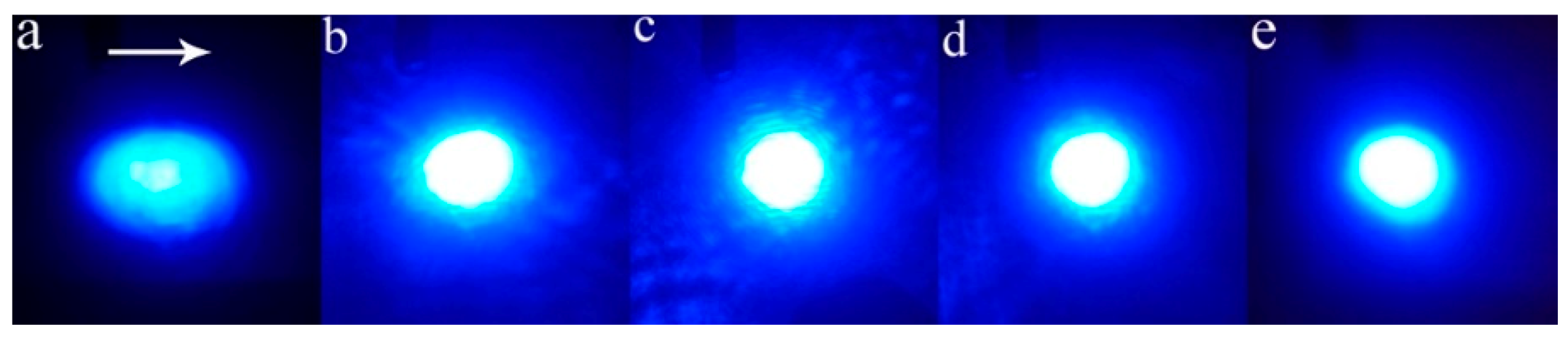
Figure 1 depicts the images of the transmitted beam spots for different samples after 5 min radiation. With the ZrO2 doping concentration increasing from 0.5 to 1.5 mol.%, no beam spot distortion is observed in LN:Mg,Zr crystals with a maximum light intensity of 2.2 × 10⁵ W/cm2, as in the case of LN:Zr2.0. For comparison, the transmitted light beam spot of LN:Mg5.0 obviously diffuses along the c-axis under the low light intensity of 2.8 × 10³ W/cm2. Based on the results above, we found out that the resistance against UV optical damage of LN:Mg5.0 is nearly improved by two orders of magnitude by only 0.5 mol.% ZrO2 doping.
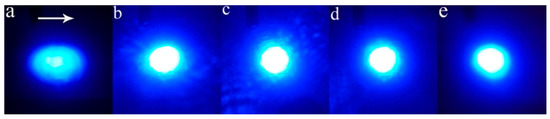
Figure 1.
Distortion of transmitted laser beam spots after 5 min of irradiation. The white arrow represents the c-axis of the crystal. (a) LN:Mg5.0; (b) LN:Mg5.0,Zr0.5; (c) LN:Mg5.0,Zr1.0; (d) LN:Mg5.0,Zr1.5; (e) LN:Zr2.0. The light intensities are (a) 2.8 × 10³ W/cm2 and (b–e) 2.2 × 10⁵ W/cm2.
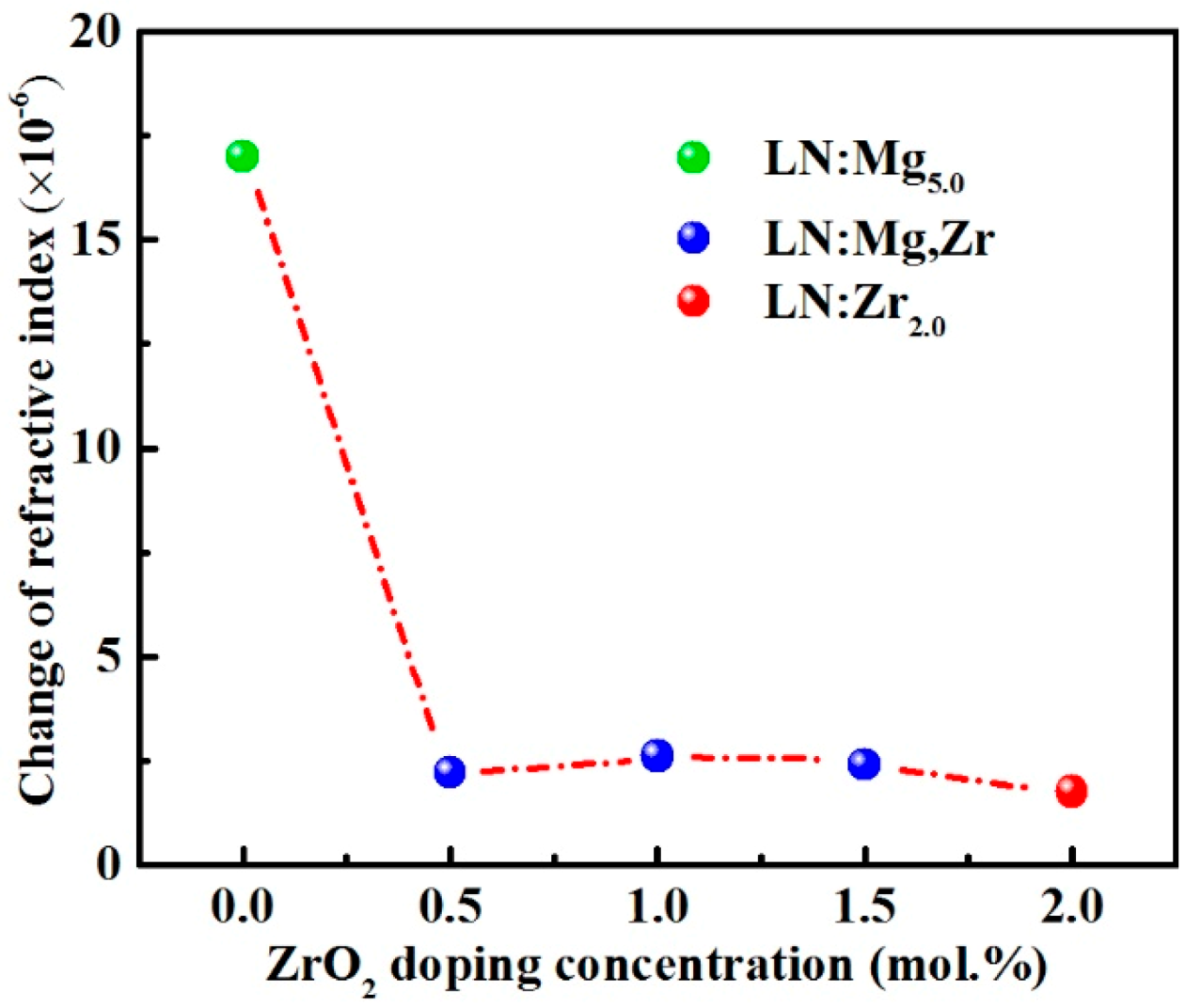
We also calculated the refractive index changes by two-wave coupling holographic recording method, and the relevant results are shown in Figure 2. From this figure, it reveals that the changes of the refractive index of LN:Mg5.0 have lowered about an order of magnitude by co-doping with ZrO2, which can even be compared with that of LN:Zr2.0. Considering the inverse correlation in the change of refractive index with the optical damage resistance of the crystals, we conclude that the additional ZrO2 dopants greatly reduce the UV optical damage of LN:Mg5.0. However, it does not show a linear pattern between the refractive index changes and ZrO2 co-doping with increasing ZrO2 doping concentration in doubly crystals, and this particularity probably signifies that ZrO2 doping has had a profound effect on the crystal structure of LN:Mg. So, we utilized the first-principles calculations to find out more about the inherent mechanism of enhanced UV optical damage resistance of LN:Mg by ZrO2 co-doping.
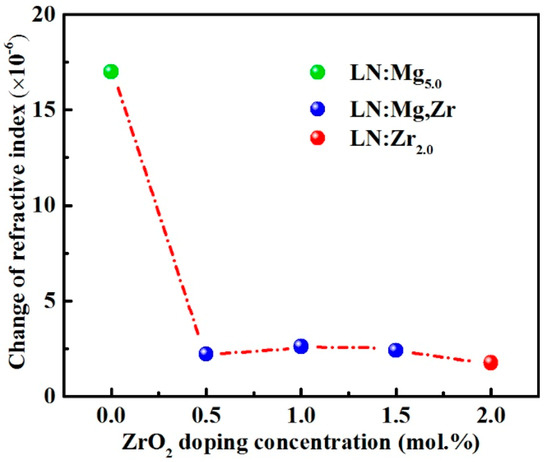
Figure 2.
Refractive index changes of LN:Mg,Zr crystals as a function of ZrO2 doping concentration. That of LN:Zr2.0 is labelled for comparison.
3.2. Defects Structure in the LN:Mg,Zr
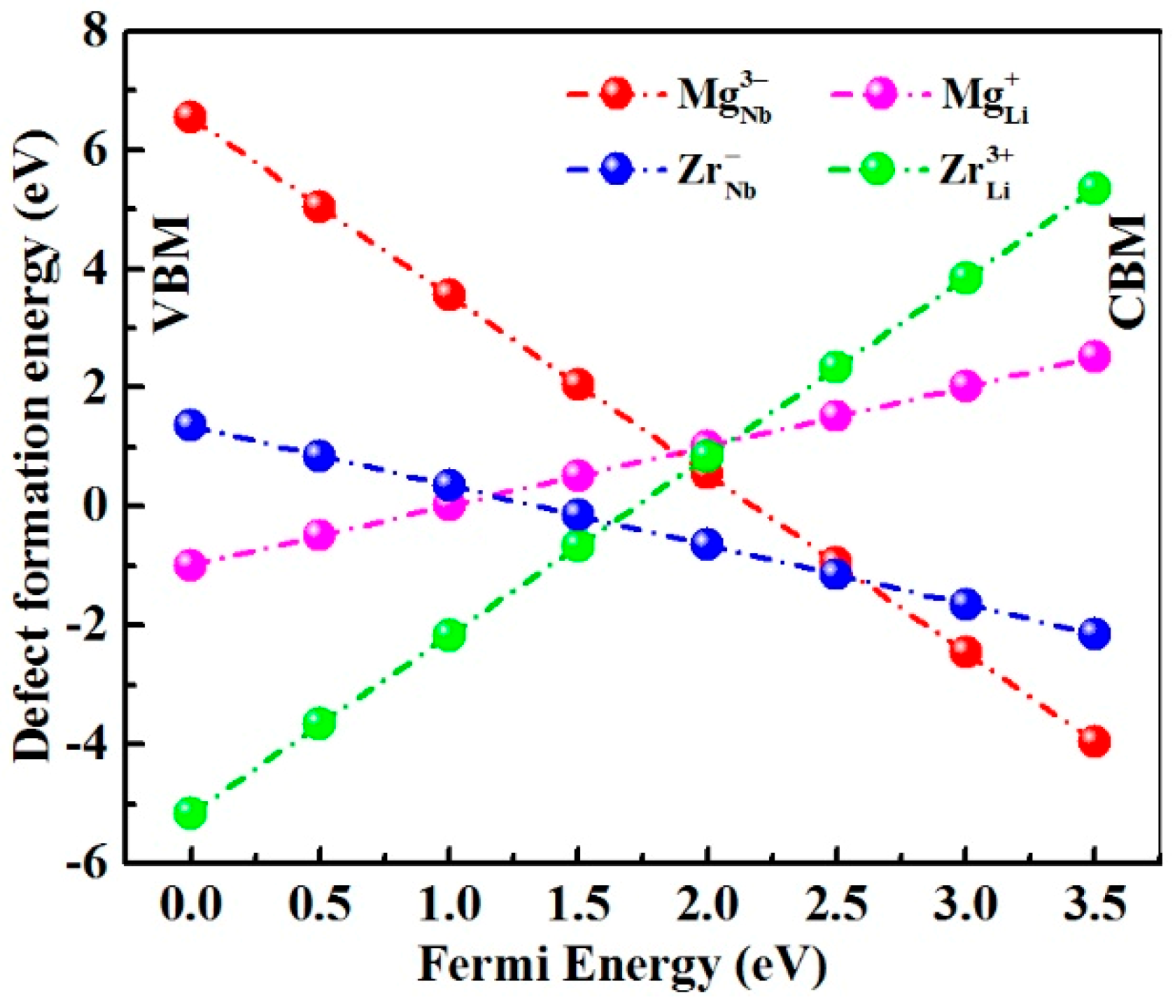
Generally, the formation energy is treated as the stability criterion of defects in materials [25]. According to the optimization model of prefect LN [26], we firstly calculated the formation energies of point defects , ,, in LN:Mg,Zr to investigate the substitution sequence of doping ions, and the results are shown in Figure 3. It should be noted that the concentration increase of doping ions will cause the raise of Fermi level [27], so it can be observed from the figure that and transform into and at the points when EF = 1.9 eV and EF = 1.6 eV, respectively, which illustrates that Mg2+ and Zr4+ ions give priority to form and rather than and . It is widely accepted [14] that doping ions in LN are assumed preferably to occupy Li sites and replace anti-site up to the threshold value, and further above the threshold value, all defects are replaced, then doping ions separately enter Nb sites and Li sites. Clearly, Zr4+ ions occupy Nb sites ahead of Mg2+ ions.
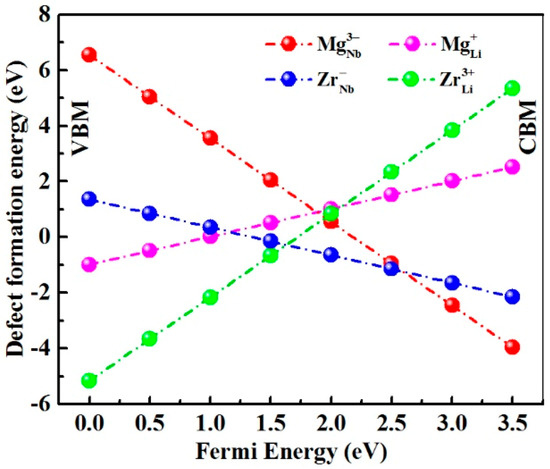
Figure 3.
Formation energies of point defects , ,, in LN:Mg,Zr crystals. The valance-band maximum and the conduction-band minimum are labelled as VBM and CBM, respectively. Fermi energy (EF) range corresponds to the fundamental band gap of LN.
In our previous report [19] we employed the OH– absorption spectra and UV-visible absorption spectra to analyze the defects of these doubly co-doped crystals, and the results indicated that the + defect clusters exist in crystals. Hence, according to the experimental results and the above calculated results of point defects, three kinds of defect clusters were constructed to find the energetically preferable configuration in LN:Mg,Zr crystals:
- Zr4+ and Mg2+ ions only occupy Li-sites, labelled as + + ;
- Zr4+ and Mg2+ ions replace Nb- and Li-sites, respectively, labelled as + ;
- Zr4+ ions only substitute Nb-sites while Mg2+ ions occupy both Li- and Nb-sites, labelled as + + .
Table 1 shows the calculated defect formation energies, and the + defect cluster had the lowest defect formation energy, reflecting that the existence of + defect cluster in LN:Mg,Zr was reasonable, which is in agreement with that of our previous experimental results.

Table 1.
Formation energies of defect clusters in LN:Mg,Zr.
3.3. Charge States of LN:Mg,Zr
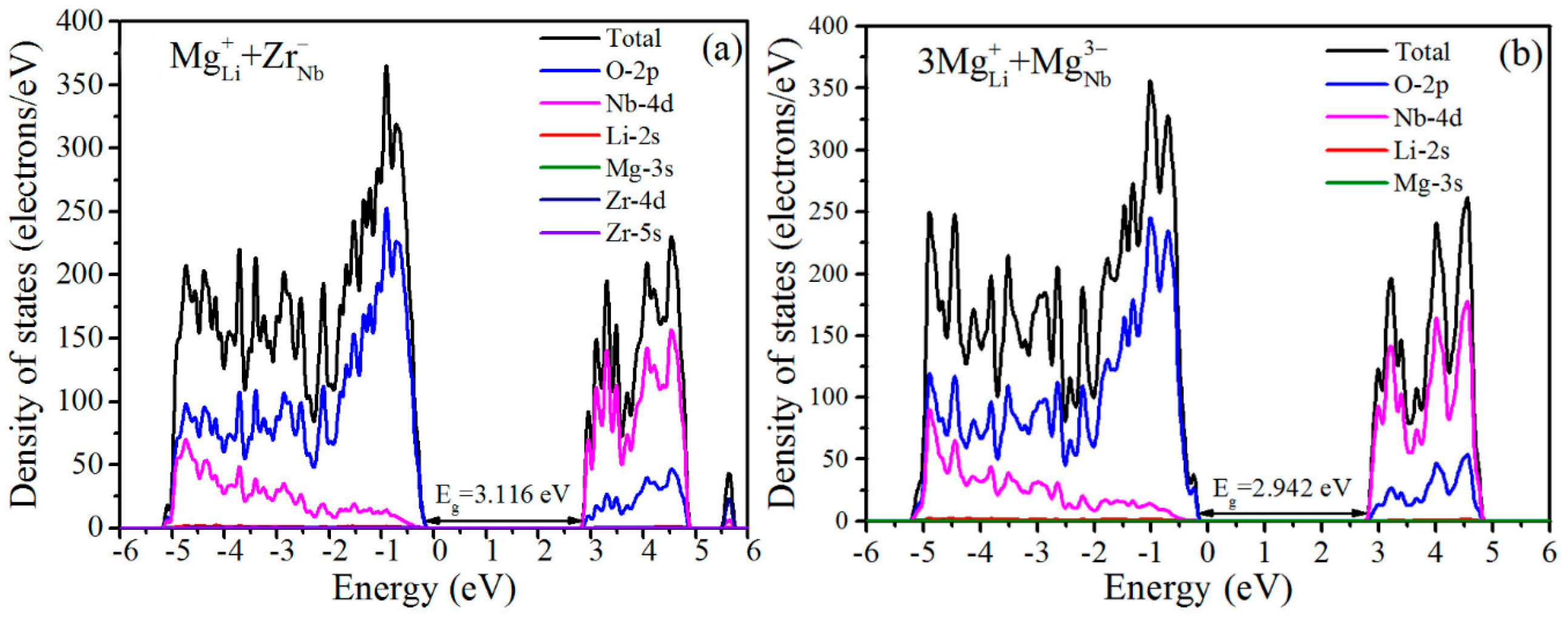
The partial density of states (PDOS) of LN:Mg,Zr was calculated with the aforementioned optimal + model, as shown in Figure 4a. Moreover, according to the 3 + defect model [26], the calculated PDOS of LN:Mg is described in Figure 4b for comparison. The PDOS clearly showed the DOS of each atom in the LN:Mg,Zr crystals, and the highest occupied valence band exhibits mainly O-2p features, whereas the lowest unoccupied conduction band mainly consists of Nb-4d electrons, meaning that the band gap of LN is determined by the transition energy of an electron transition from O2− 2p-state to Nb5+ 4d-state, consistent with the widely accepted results [28].
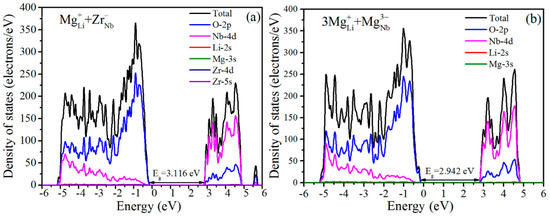
Figure 4.
Density of states for (a) LN:Mg,Zr based on the + defect model. For comparison, that of (b) LN:Mg based on the 3 + cluster is also presented.
Moreover, it can also be seen that the density of states of O-2p and Nd-4d in LN:Mg,Zr exhibit a distinctly decreased DOS at valence band maximum (VBM) and conduction band minimum (CBM), respectively, which elucidates the reduction of charge carriers in crystals [29]. The enhancement of resistance against UV optical damage of LN:Zr is considered as the reduction of UV photorefractive centers such as O2−/− near [11,30]. It knows by the calculated DOS that the charge density of O-2p of LN:Mg is reduced dramatically by ZrO2 co-doping, which signifies that the UV photorefractive center O2−/− of LN:Mg,Zr is sharply decreased. Moreover, the band gap of LN:Mg,Zr is calculated to be about 3.116 eV, which is significantly greater than that of LN:Mg (2.942 eV), and the increase in band gap of LN:Mg,Zr makes charge carriers excitation from O2−/− more difficult, which powerfully proves the above analysis and further confirms the theoretical calculation corresponding to the experiment results. Based on the analyses above, we state that the reduction in the number of UV photorefractive canters O2−/− and the increased band gap together result in the high resistance against UV optical damage of LN:Mg,Zr.
4. Conclusions
In summary, we have investigated the resistance against ultraviolet damage and electronic structures of LN:Mg co-doping with ZrO2 by experiment and first-principles calculations. It is found that ZrO2 co-doping greatly improves the ultraviolet damage resistance of LN:Mg. Meantime, first-principles calculations elucidate that the enhancement of resistance against UV damage of LN:Mg by co-doping ZrO2 is caused by both the increased band gap and the reduced ultraviolet photorefractive center O2−/−. This knowledge may open avenues to expand the nonlinear optical applications of LN:Mg to the UV region, and it can be an important candidate material for UV frequency conversion.
Author Contributions
Conceptualization, H.L. and Z.F.; methodology, T.K. and W.W.; investigation, T.K. and W.W.; data curation, Y.L. and H.K.; writing—original draft preparation, T.K. and H.L.; writing—review and editing, W.W., Y.L. and H.K.; All authors have read and agreed to the published version of the manuscript.
Funding
This research was funded by the Science Foundation of Henan University of Technology (2018BS058) and the Natural Science Project in Henan Province Department of Education (21B140004).
Institutional Review Board Statement
Not applicable.
Informed Consent Statement
Not applicable.
Data Availability Statement
The data presented in this study are available from the corresponding author on reasonable request.
Conflicts of Interest
The authors declare no conflict of interest.
References
- Carrascosa, M.; García-Cabañes, A.; Jubera, M.; Ramiro, J.B.; Agulló-López, F. LiNbO3: A photovoltaic substrate for massive parallel manipulation and patterning of nano-objects. Appl. Phys. Rev. 2015, 2, 040605. [Google Scholar] [CrossRef]
- Kong, Y.; Bo, F.; Wang, W.; Zheng, D.; Liu, H.; Zhang, G.; Rupp, R.; Xu, J. Recent progress in lithium niobate: Optical damage, defect simulation, and on-chip devices. Adv. Mater. 2019, 32, e1806452. [Google Scholar] [CrossRef] [PubMed]
- Krogen, P.; Suchowski, H.; Liang, H.; Flemens, N.; Hong, K.H.; Kärtner, F.X.; Moses, J. Generation and multi-octave shaping of mid-infrared intense single-cycle pulses. Nat. Photonics 2017, 11, 222–227. [Google Scholar] [CrossRef]
- Ashkin, A.; Boyd, G.D.; Dziedzic, J.M.; Smith, R.G.; Ballman, A.A.; Levinstein, J.J.; Nassau, K. Optically-induced refractive index inhomogeneities in LiNbO3 and LiTaO3. Appl. Phys. Lett. 1966, 9, 72–74. [Google Scholar] [CrossRef]
- Zhong, G.; Jin, J.; Wu, Z. Measurement of optically induced refractive index damage of lithium niobate doped with different concentrations of MgO. J. Opt. Soc. Am. 1980, 70, 631–635. [Google Scholar]
- Bryan, D.A.; Gerson, R.; Tomaschke, H.E. Increased optical damage resistance in lithium niobate. Appl. Phys. Lett. 1984, 44, 847–849. [Google Scholar] [CrossRef]
- Escalé, M.R.; Sergeyev, A.; Geiss, R.; Grange, R. Nonlinear mode switching in lithium niobate nanowaveguides to control light directionality. Opt. Express 2017, 25, 3013–3023. [Google Scholar] [CrossRef]
- Li, G.; Chen, Y.; Jiang, H.; Chen, X. Broadband sum-frequency generation using D33 in periodically poled LiNbO3 thin film in the telecommunications band. Opt. Lett. 2017, 42, 939–942. [Google Scholar] [CrossRef] [PubMed]
- Xu, J.; Zhang, G.; Li, F.; Zhang, X.; Sun, Q.; Liu, S.; Song, F.; Kong, Y.; Chen, X.; Qiao, H.; et al. Enhancement of ultraviolet photorefraction in highly magnesium-doped lithium niobate crystals. Opt. Lett. 2000, 25, 129–131. [Google Scholar] [CrossRef] [PubMed]
- Kong, Y.; Liu, S.; Zhao, Y.; Liu, H.; Chen, S.; Xu, J. Highly optical damage resistant crystal: Zirconium-oxide-doped lithium niobate. Appl. Phys. Lett. 2007, 91, 081908. [Google Scholar] [CrossRef]
- Liu, F.C.; Kong, Y.F.; Li, W.; Liu, H.D.; Liu, S.G.; Chen, S.L.; Zhang, X.Z.; Rupp, R.; Xu, J.J. High resistance against ultraviolet photorefraction in zirconium-doped lithium niobate crystals. Opt. Lett. 2010, 35, 10–12. [Google Scholar] [CrossRef]
- Kovács, L.; Szaller, Z.; Lengyel, K.; Péter, A.; Hajdara, I.; Mandula, G.; Pálfalvi, L.; Hebling, J. Photorefractive damage resistance threshold in stoichiometric LiNbO3:Zr crystals. Opt. Lett. 2013, 38, 2861–2864. [Google Scholar] [CrossRef]
- Nava, G.; Minzioni, P.; Yan, W.B.; Parravicini, J.; Grando, D.; Musso, E.; Cristiani, I.; Argiolas, N.; Bazzan, M.; Ciampolillo, M.V.; et al. Zirconium-doped lithium niobate: Photorefractive and electro-optical properties as a function of dopant concentration. Opt. Mater. Express 2011, 1, 270–277. [Google Scholar] [CrossRef]
- Bhatt, R.; Bhaumik, I.; Ganesamoorthy, S.; Bright, R.; Soharab, M.; Karnal, A.; Gupta, P. Control of intrinsic defects in lithium niobate single crystal for optoelectronic applications. Crystals 2017, 7, 23. [Google Scholar] [CrossRef]
- Kong, Y.; Liu, F.; Tian, T.; Liu, S.; Chen, S.; Rupp, R.; Xu, J. Fast responsive nonvolatile holographic storage in LiNbO3 triply doped with Zr, Fe, and Mn. Opt. Lett. 2009, 34, 3896–3898. [Google Scholar] [CrossRef] [PubMed]
- Riscob, B.; Bhatt, R.; Vijayan, N.; Bhaumik, I.; Ganesamoorthy, S.; Wahab, M.A.; Rashmi; Bhagavannarayana, G. Structural, optical and thermal properties of Zr-Fe co-doped congruent LiNbO3 single crystals. J. Appl. Crystallogr. 2013, 46, 601–609. [Google Scholar] [CrossRef]
- Qian, Y.; Wang, R.; Wang, B.; Xu, C.; Xing, L.; Xu, Y. Highly efficient 1.54 mu m emission in Zr/Yb/Er-codoped LiNbO3 crystal. Opt. Lett. 2012, 37, 4176–4178. [Google Scholar] [CrossRef]
- Zhang, D.L.; Yang, X.F.; Zhang, Q.; Wong, W.H.; Yu, D.Y.; Pun, E.Y.B. Near-stoichiometric Ti-diffused LiNbO3 strip waveguide doped with Zr4+. Opt. Lett. 2015, 40, 5307–5310. [Google Scholar] [CrossRef] [PubMed]
- Kong, T.; Liu, H.; Ge, X.; Qu, D.; Liu, S.; Chen, S.; Zhang, L.; Kong, Y.; Rupp, R.; Xu, J. Room temperature 90° phase-matching in zirconium and magnesium co-doped lithium niobate crystals. Sci. Rep. 2018, 8, 3865. [Google Scholar] [CrossRef] [PubMed]
- Yamamoto, J.K.; Kitamura, K.; Iyi, N.; Kimura, S.; Furukawa, Y.; Sato, M. Increased optical damage resistance in Sc2O3-doped LiNbO3. Appl. Phys. Lett. 1992, 61, 2156. [Google Scholar] [CrossRef]
- Kogelnik, H. Coupled wave theory for thick hologram gratings. Bell Syst. Tech. J. 1969, 48, 2909–2947. [Google Scholar] [CrossRef]
- Perdew, J.P.; Burke, K.; Ernzerhof, M. Generalized gradient approximation made simple. Phys. Rev. Lett. 1996, 77, 3865. [Google Scholar] [CrossRef]
- Xu, H.; Lee, D.; He, J.; Sinnott, S.B.; Gopalan, V.; Dierolf, V.; Phillpot, S.R. Stability of intrinsic defects and defect clusters in LiNbO3 from density functional theory calculations. Phys. Rev. B 2008, 78, 174103. [Google Scholar] [CrossRef]
- Monkhorst, H.J.; Pack, J.D. Special points for Brillouin-zone integrations. Phys. Rev. B 1976, 13, 5188–5192. [Google Scholar] [CrossRef]
- Li, Q.; Wang, B.; Woo, C.H.; Wang, H.; Wang, R. First-principles study on the formation energies of intrinsic defects in LiNbO3. J. Phys. Chem. Solids 2007, 68, 1336–1340. [Google Scholar] [CrossRef]
- Li, Y.; Li, L.; Cheng, X.; Zhao, X. Microscopic properties of Mg in Li and Nb Sites of LiNbO3 by First-Principle Hybrid Functional: Formation and related optical properties. J. Phys. Chem. C 2017, 121, 8968–8975. [Google Scholar] [CrossRef]
- Li, L.; Li, Y.; Zhao, X. Hybrid density functional theory insight into the stability and microscopic properties of Bi-doped LiNbO3: Lone electron pair effect. Phys. Rev. B 2017, 96, 115118. [Google Scholar] [CrossRef]
- Földvári, I.; Polgár, K.; Voszka, R.; Balasanyan, R.N. A simple method to determine the real composition of LiNbO3 crystals. Cryst. Res. Technol. 1984, 19, 1659–1661. [Google Scholar] [CrossRef]
- Liang, L.; Lei, F.; Gao, S.; Sun, Y.; Jiao, X.; Wu, J.; Qamar, S.; Xie, Y. Single unit cell Bismuth Tungstate layers realizing robust solar CO2 reduction to methanol. Angew. Chem. Int. Ed. 2015, 54, 13971–13974. [Google Scholar] [CrossRef]
- Herth, P.; Granzow, T.; Schaniel, D.; Woike, T.; Imlau, M.; Krätzig, E. Evidence for light-induced hole polarons in LiNbO3. Phys. Rev. Lett. 2005, 95, 067404. [Google Scholar] [CrossRef] [PubMed]
Publisher’s Note: MDPI stays neutral with regard to jurisdictional claims in published maps and institutional affiliations. |
© 2021 by the authors. Licensee MDPI, Basel, Switzerland. This article is an open access article distributed under the terms and conditions of the Creative Commons Attribution (CC BY) license (http://creativecommons.org/licenses/by/4.0/).