


Abstract
Considering food security and climate change mitigation as the main sustainability challenges for agriculture, the main goal is to achieve agricultural production at an acceptable level of greenhouse gas (GHG) emissions. In this paper, the effects of GHGs are described. Panel data models are built to assess the impact of greenhouse gases on harvested production of cereals in EU countries. The study is focused on the climate change cause by GHG emissions that have a direct impact on agriculture in what concerns cereal production. Therefore, the impact of GHGs on cereal production in the European Union, except Malta, in the period 2000–2016 was assessed. Moreover, the effects of GHGs on agricultural irrigated land in Denmark and Hungary, two EU countries with the large agricultural surface, were computed. The results indicated a positive impact of GHGs from agriculture and fertilizer consumption in the previous year on cereal production in the EU. Moreover, only in Hungary did the increase in GHG emissions determined a slow increase in the volume of agricultural irrigated lands in the period of 2000–2016.
1. Introduction
Human activity, including agriculture, contributes to the creation of greenhouse gases (GHG) that have been growing fast since the start of the industrial age [1]. The major challenges for agriculture in developing countries are represented by food security and climate change mitigation [2]. Since 1970, the global agricultural production has increased, on average, by more than two2 times with a contribution of almost a quarter of the total GHG burden in 2010. Food production has to grow to satisfy our growing demands, but climate change should be addressed and GHG emissions have to decrease. Bennetzen et al. [3] showed that except for the energy use in farming, the GHG emissions from all sources grew less than agricultural production. The authors stated there is decoupling between GHG emissions and agricultural production in recent decades.
By measuring GHG emissions from the production of various food commodities, researchers, farmers, and policymakers can better manage these emissions and identify suitable mitigation strategies to ensure higher food security and sustainable development [4,5].
At the world level, agriculture is the main source of climate change, contributing around 14% of anthropogenic greenhouse gas (GHG) emissions, and another 17% through land use change. Most of the next increases in agricultural emissions will be, most probably, registered in low- to middle-income countries [6].
The latest data from the European Union indicate a slow increase in GHG as of 2017, this growth by 0.6% in 2017 as compared to 2016 being mostly attributed to the transportation sector. Chances to achieve the 2020 targets are getting smaller with every new day, thus, constant efforts should be made to achieve the newer targets established for 2030 already. In this context, the EU countries should deliver measures and policies to meet the Paris agreement commitments and the new targets for 2030. Changes in the EU climate legislation were made in 2018 stipulating a decrease in GHG by minimum 40% until 2030 as compared to the 1990 level. In case of full implementation of the EU policies, the emissions are expected to decrease by 45% until 2030, which would be a better performance than that established by the Paris Agreement [7]. There is still a significant decoupling between emissions and economic growth, even if the CO2 per unit of GDP decreased as compared to 1990. The emission of GHG from agriculture, transportation and international aviation has grown in the last five years. The efforts made in the direction to low carbon transition were supported by the integration of climate issues into the EU budget. Climate aspects required 20% of this budget in 2017. For the next budget, this share will be increased to 25% in order to achieve the climate objectives for the period of 2021–2027 [7].
Industrialized countries made efforts to reduce their actual levels of GHG emissions, while developing countries are still struggling to find an alternative to low-carbon development pathways. One of these alternatives is climate-smart agriculture (CSA) that transforms agricultural systems to achieve three goals: increased food security, climate change adaptation, and mitigation. In developing countries, mitigation is a co-benefit, the main propriety being food security and adaptation [8,9]. CSA is complementary with sustainable intensification (SI) that focuses on the growing agricultural productivity using actual agricultural land when environmental impact is reduced. Increased resource use efficiency contributes to SI like CSA through productivity growth and lowers GHG emissions per unit of output [8]. CSA and SI both focus on the potential trade-offs between agricultural production and environmental integrity. The trade-off’s potential helps in achieving a more productive and sustainable agricultural sector [10,11,12,13].
Agriculture releases to the air significant quantities of carbon dioxide, methane, and nitrous oxide [14]. The major challenge of GHG is the climate change that consists in extreme phenomena like storms, cyclones or very high temperatures. These climate conditions have a direct impact on production.
Agriculture land occupies around 40–50% of the land surface generating almost 12% of the total GHG emissions at the world level [10]. Greenhouse gas emissions are influenced by land utilisation, especially by the types of crops. The emission might vary with a crop type. In general, long-run effects of land use are smaller than short-term ones. Land use effects on the emission of CO2 are dominated by tillage. In case of N2O, the highest emissions are usually caused by fertilized grasslands [12]. The ploughing-in of residues can generate CO2 and N2O emissions. Industrialization cannot be directly responsible for changes in the concentration of water vapour, the main cause of these changes being attributed to climate warming [13].
There are just few studies dealing with assessment of impacts of GHG emissions from agriculture and their impacts [3,12,13,14]. These studies do not provide assessment of GHG emissions on cereal production or irrigated land. The main input of this study is assessment of GHG emissions impact on cereal production by taking into account mineral consumption. Therefore, our study attempts to assess the impact of GHG emissions from agriculture on the cereal production in the states of the European Union, excluding Malta, which does not produce cereals as such. On the other hand, during drought periods GHG emissions cause the necessity for extra irrigation. Therefore, the effects from GHG emissions might also be assessed taking the share of agricultural irrigated lands into account. In this paper, we will evaluate the relation between irrigated surfaces and GHG emissions from agriculture for Denmark and Hungary, the countries with large irrigated areas in EU agriculture. After a short review of literature regarding the necessity to reduce GHG emissions due to their negative consequences, the paper presents the assessment of the GHG emissions’ impact on cereals’ production and irrigated lands in EU countries. The last part of this paper draws some final conclusions.
2. The Greenhouse Gas Emissions from Agriculture and the Necessity to Mitigate Them
2.1. The Impact of GHG Emissions on Agriculture
The greenhouse gas (GHG) emission has significant effects on the environment:
- -
- Temperature increases determine increases in the water levels through dilatation and melting of the glaciers which could bring the disappearance of some territories (the Maldives islands and coral islands are the most vulnerable ones in this regard) [14];
- -
- Climate conditions are becoming more extreme with the fluctuations in the directions of storms and droughts;
- -
- Significant changes in climate might lead to the sinking of low-altitude coastal areas, now exploitable in agriculture, because of the rise in sea level;
- -
- Human health can be affected by climate transformations too: the waves of extreme heat cause deaths, encourage bacteria and mould, increase the quantity of insects (mosquitoes) and the infections (malaria and yellow fever in particular) [15].
Among the extreme meteorological events we should pay special attention to cyclones. These extreme climatic phenomena are usually named hurricanes when they are produced in the Atlantic Ocean, or typhoons when they are formed in the Pacific Ocean. They are also called tropical cyclones when they take place in the Indian Ocean [14]. For example, Irma was the most intense cyclone in the history with its 50 days of meteorological registrations by the satellite. It was also the strongest hurricane ever in the Atlantic Ocean. The previous record was registered by the super-typhoon Haiyan that affected the Philippines archipelago back in 2013 [4].
Glaciers in Switzerland melt at a high speed, losing almost one cubic kilometre of ice in the last year which means 900 billion litres of water. Zwally et al. [15] showed that glaciers melt intensified in the last 10 years and this tendency will continue even if the global warming will stop. Each year, the glaciers lose between 0.5–1 m from their bulk which is by 2–3 times more than the average loss in the previous century [15].
The currents’ change might also have disastrous effects. The actual climatic zones might migrate towards the Poles which would provoke the movement of temperate climate with 200–300 km for each additional degree Celsius. The consequences for the ecosystem can be critical because the move of these favourable areas might turn out to be too fast and the natural regeneration might not take place as such [11].
In Northern Europe, abundant rains could be favourable for the agriculture on the one hand, however, the floods might be dangerous. In the south, the waves of heat are more frequent and threat the sources of drinking water. In Siberia, the thaw of permafrost moves the areas of vegetation 150–500 km closer to the North Pole [15]. In the Middle East, very strong droughts increase the areas under the desert, which leads to decrease in the sources of water, thus, agriculture is affected [11]. In South America, tropical cyclones, storms and floods are becoming more and more frequent.
2.2. GHG Mitigation Policies in Agriculture
According to experts, human activity is responsible for intensification of the Earth warming processes. Brunetière et al. [16] pointed out that the greenhouse gas emissions into the atmosphere in France are caused by transport (26% of them), industry (22%), animal husbandry (19%) and agriculture (19%). At the world level, the carbon dioxide (CO2) from human activity comes from the following domains: 43% from agriculture, 24% from transportation, 19% from industries and 14% from the cities. The methane gas comes from animal husbandry (30%), rice plantation (22%), exploitation of oils deposits (17%), fires (11%) and waste decomposition (11%) [16]. There are no natural halocarbons in the atmosphere. Human activity is always responsible for their existence and, consequently, for the Earth’s warming.
The GHG emissions’ variation, especially those of CO2, is tracked down by an international network collecting atmospheric samples. Today this method of data collection is additionally strengthened by the air collection techniques practiced over the continents. As humans are responsible for GHG emissions’ excess, it is our duty to reduce the level of these emissions as soon as possible. In this regard, the experts propose, inter alia, the following measures:
- -
- The production of energy coming from fossil fuel combustion should be limited using instead the renewable energy like solar, wind, biomass, tide, nuclear etc. [15];
- -
- The reduction of GHG emissions from the main producing sectors: industry, agriculture, energy sector, construction etc. [16];
- -
- Protection of natural carbon sinks (the ecosystems that might absorb CO2 from the atmosphere, like oceans and forests) and intensification of the creation of complex carbon sinks [14].
However, these proposed measures are not enough. Some countries have already reacted to the negative consequences from the excess in GHG emissions, France being among them. Since 1990, the GHG emissions in this country decreased by 22% in industry, by 10% in agriculture, by 9% in the energy sector and by 8% in the sector of waste treatment [16].
Various international meetings have been taking place proposing policies to reduce GHG emissions. The most famous of them took place in June 1992, at Rio de Janeiro. The main objective of this conference was to ensure the level of gases that does not affect the climate. The Kyoto Protocol as of 1997 forced 38 industrialized countries to reduce their GHG emissions by 5% until 2012 as compared to the level in 1990. The Protocol constrained the US, the European Union and Japan to reduce the level of GHG emissions by 7%, 8% and, respectively, by 6%, even though later the US refused and asked for simple rules [1]. The conference held in Hague in 2000 proposed the application of this US offer which led, together with several other issues, to the suspension of talks as such without any compromise being achieved
The 2015 Paris Agreement of the United Nations Framework Convention on Climate Change established that GHG emissions from agriculture should be reduced as to respond to climate change and also that they have to decrease by 2 °C by 2100 [17].
Relatively recently, in June 2017, almost 300 delegates from the IMO Member States, intergovernmental organizations and NGOs participated in the first meeting of a working group concerned with the reduction of GHG emissions from ships.
2.3. Major Challenges of GHG Mitigation in Agriculture
Agricultural production brings off-farm emissions because of the accompanying manufacturing and transportation of herbicides, fertilizers, and pesticides. Almost 1.6 bln ha of land are used these days for crop production. In developing countries, around 1 bln ha are used for crop production. At the world level, almost 25% of the CO2, 50% of the CH4 and 70% of the N2O from agriculture are produced by cultivated lands [18]. The GHG emissions together with ozone-depleting chlorofluorocarbons generate almost 96% of increase in radiative forcing since 1750.
Lands for agriculture that should meet the global food demand come from grasslands, forests, and other natural habitats [19]. Agriculture plays an important role in the global fluxes of carbon dioxide, methane, and nitrous oxide [20,21]. Carbon dioxide is mainly released from soil organic matter, burning of plant litter and microbial decay [22]. Methane appears when organic materials decompose due to lack of oxygen, mainly from fermentative digestion by stored manures, ruminant livestock, and rice grown in floods [23]. Nitrous oxide comes from the microbial transformation of nitrogen in manures and soils [24]. Agricultural GHG emissions are heterogeneous and complex, but they could be decreased [25]. Many mitigation opportunities stem from the currently available technologies. Burney et al. [26] considered that investment in agriculture is a good strategy to mitigate GHG emissions.
Table 1 presents the most frequent mitigation practices for GHG emissions.

Table 1.
Measures aimed at reducing the GHG emissions from agricultural ecosystems.
Searchinger et al. [41] built a worldwide agricultural model to compute the GHG emissions from land-use change. Their results indicated that corn-based ethanol almost doubled the greenhouse emissions in the last 30 years and contributed to the increase in greenhouse gas emissions. Biofuels from switchgrass in the U.S. corn lands grew the GHG emissions by 50%. The utilization of good cropland to expand production of biofuels might intensify the global warming in a similar way like the conversion of grasslands and forests [41].
Various practices from agriculture (spraying, fertilizing, sowing, harvesting, soil tillage, transportation) require the use of tractors and, consequently, massive consumption of diesel fuel. For Turkey, Beran et al. [42] showed that agricultural diesel consumption produces up to 6606.7 thousand tonnes of CO2. Therefore, the CO2 emissions might be decreased by using more energy efficient tractors and also by means of applying innovative technologies and practices so that to improve the agricultural energy budget at the same time.
3. The Impact of Greenhouse Gas Emissions on Cereal Production and Agricultural Irrigated Lands in the European Union
3.1. Data and Methods
Given the fact that the main effect of greenhouse gases is related to climate change, our empirical study will assess the impact of greenhouse gas emissions on agriculture in terms of cereal production and use of agricultural irrigated lands in the European Union. The data availability preconditioned us to consider only two countries when studying the impact of greenhouse gas emissions on irrigated lands.
There are other factors that affect cereal production, actually. CO2 is generated along with the utilization of fertilizer and the production of fertilizer. The use of fertilizer increases the cereal production, but after a period of fertilizer consumption. However, the fact that fertilizer is used gives us important information about the fact that the previous and the actual production is not large enough and more fertilizer is needed.
Our empirical analysis will be focused on newer directions of research in the related field:
- -
- The evaluation of the effect from greenhouse gas emissions from agriculture and fertilizer consumption on the production of cereals in the states of the European Union (except Malta which does not have cereal production as such);
- -
- The evaluation of the effect of greenhouse gas emissions from agriculture on the agricultural irrigated lands (% of the total agricultural lands) in Denmark and Hungary, the countries with large agricultural surfaces, as compared to the rest of the European Union.
Greenhouse gas emissions expressed in thousand tonnes include: CO2, CH4 in CO2 equivalent, N2O in CO2 equivalent, PFC in CO2 equivalent, HFC in CO2 equivalent, SF6 in CO2 equivalent and NF3 in CO2 equivalent. The GHG emission indicator is measured only for agriculture. The sources of CO2 in agriculture are: fossil fuels, land use changes and oil organic matter of the croplands. CO2 emissions are predetermined in the first place by the use of agriculture machines and by production of fertilizers.
Fertilizers’ consumption expressed in kilograms per hectare of arable land indicates the quantity of plant nutrients utilized per unit of arable land. Fertilizer products include potash, nitrogenous and phosphate fertilizers.
Harvested production here refers only to cereals, including seeds.
Agricultural irrigated land includes the agricultural areas purposely provided with water. The lands irrigated by means of controlled flooding are included into this category.
The data on greenhouse gas emissions and harvest production are obtained from the Eurostat database. The data on agricultural irrigated lands in Denmark and Hungary and fertilizer consumption in the EU countries are obtained from the World Bank database. All the data covers the period of 2000–2016, more details are presented in Appendix A where the set of data for all the EU countries is presented. The data we need has been available since 2002 for fertilizers’ consumption and since 2000 only for the rest of the variables. Therefore, suitable techniques that could be applied on small sets of data were employed: panel data models and Bayesian models. In Table 2 we summarize the variables and the corresponding models.
Table 2.
Variables and the corresponding models.
The volume of agricultural irrigated lands had a significant tendency to increase in the period of 2000–2012 in Denmark, but in 2013 it abruptly decreased. In Hungary, this parameter was demonstrating fluctuations that can be explained by varying temperatures during summers. In the EU-28, due to different environmental policies, the greenhouse gas emissions from agriculture alone decreased by almost 6%. However, these GHG emissions still remain a challenge, particularly for agriculture.
Since the data are organized by countries and for a specific time period, we have used panel data regression models to estimate the impact of greenhouse gas emissions on cereal production. This method was also previously used in several similar environmental sociological studies [42,43]. A fixed-effect model controls for any unobserved, time-constant characteristics between the countries, as well as the events that occurred in each year effecting the countries at the same time. Therefore, the models indirectly control for any variables linked to GHG emissions from cereal production that are not observed within the model. The panel data model is presented below:
where:
- —dependent variable in country i and year t;
- —explanatory variables in country i and year t;
- —individual effects;
- —the error;
- c—constant value;
- b, d—parameters.
In our particular case, we get the following models estimated in Stata 15 (StataCorp LLC, Texas, USA):
Model 1:
Then we conduct individual time series analysis for Denmark and Hungary to assess the impact of GHG emissions on irrigated lands. Due to the small time series (2000–2016), Bayesian linear models will be built using Gibbs sampling method of estimation in R.
Model 2:
Model 2 is necessary in this analysis because irrigated land is also influenced by GHG emissions. Global warming, due to GHG emissions, also contributes to the expansion of irrigated lands.
Bayesian linear models and panel data models have the main advantage of solving the issue of small sets of data. However, Bayesian models have also limits due to the method of estimation (Gibbs sampling). This method might marginalize out the closed form of parameters. Moreover, the samples are not independent as it is the case of rejection sampling. Gibbs sampling may fail if there is no path between islands of high-probability states and when all the states have positive probability and one island with high probability states. In this case, we considered a normal conjugate prior distribution for the model and an inverse-gamma distribution for error variance:
3.2. Results
Panel data models are built to assess the impact of greenhouse gas emissions on harvested production of cereals in all of the EU countries, except Malta. The panel data for each variable were stationary at 5% level of significance according to Levin–Lin–Chu and Fisher-type test (Appendix B). Some random-effects models and a fixed-effects model were estimated to explain the production of cereals based on the quantity of greenhouse gas emissions from agriculture.
We checked the correlation between GHG emissions from agriculture and mineral fertilizer consumption and there is no significant contemporaneous correlation between these variables (according to a cross-sectional time series FGLS regression, the coefficient of fertilizers’ consumption is 4.23 (p-value = 0.6320)) which means that it is possible to consider the two variables as explanatory ones in the same model (see Table 3).
Table 3.
Random-effects GLS regression model explaining the cereal production based on greenhouse gas emissions from agriculture (2000–2016).
A total of 87.63% of the variation in production can be explained by the differences between the countries in terms of greenhouse gas emission quantities. According to Table 3, greenhouse gas emissions from agriculture had a positive and significant impact on cereal production in the European Union. As expected, the increase in cereal production is explained by the higher level of greenhouse gas emissions from agriculture which might be due to extensive cultivation of cereals, but also due to more mineral fertilizers that were previously used, thus producing more GHG emissions. Fertilizers’ consumption in the same period had a negative impact on cereal production, because fertilizer needs time to action. Indeed, the model suggests that the lands with low cereal production needed more fertilizers’ consumption. In this context, a generalized estimating equation (GEE) population averaged model with autoregression of order one is considered to measure the positive impact of fertilizers’ consumption (see Table 4).
Table 4.
GEE population averaged model explaining cereal production in the EU countries (2000–2016).
As expected, after considering an autoregressive structure of order one in the population averaged model, we detected a strong positive impact of fertilizers’ consumption on cereal production and lower impact of GHG emissions from agriculture on it. This econometric technique made a necessary separation between current GHG emission level and the current consumption of fertilizers that will later generate GHG emissions.
Knowing that there are significant differences between the countries in the panel set, a better methodological solution is to employ a cross-sectional time series FGLS regression under the hypothesis of heteroskedastic panels and no autocorrelation (see Table 5).
Table 5.
Cross-sectional time series FGLS regression model explaining cereal production based on greenhouse gas emissions from agriculture and fertilizers’ consumption (2000–2016).
According to Table 5, the greenhouse gas emissions from agriculture had a more significant positive impact on the cereal production in the European Union. This result reflects the positive effect of greenhouse gas emissions on agricultural production due to higher temperature ensured by these GHG emissions. As expected, fertilizers’ consumption had no immediate impact on cereal production growth. Low production level, in turn, stimulated the use of more fertilizer.
We also built a dynamic panel data model with Arellano–Bover–Blundell–Bond estimation (see Table 6) to explain cereal production, considering the production in the previous year and fertilizers’ consumption in the previous year.
Table 6.
Dynamic panel data model (Arellano–Bover–Blundell–Bond estimation) to explain cereal production.
According to the dynamic panel data model in Table 6, cereal production in the previous year, GHG emissions and fertilizers’ consumption in the previous year had, on average, a positive impact on cereal production. The strongest influence belongs to fertilizers’ consumption. An increase in the fertilizers; consumption in the previous year by 1000 tonnes determines, on average, an increase in the actual cereal production by 189 tonnes. If fertilizers’ consumption in the previous year grew, on average, by 1000 tonnes, the cereal production increased by 7168 tonnes. Actually, the increase in cereal production due to fertilizers’ consumption in the previous year is by around 10 times more than the increase due to GHG emissions in agriculture. According to dynamic panel data model, an increase in the annual GHG emissions from agriculture by 1000 tonnes determines, on average, an increase in the actual cereal production by 703 tonnes in the period 2000–2016.
Denmark and Hungary have quite large agriculture surfaces. Now we will check whether greenhouse emissions have affected the agricultural irrigated land (as % of the total agricultural lands) in Denmark and Hungary as both these countries use irrigation quite extensively. Due to relatively small dataset (time series from 2000–2016), some Bayesian linear regression models will be constructed for each country.
According to Table 7, when the quantity of greenhouse gases from agriculture in Denmark increased by one thousand tonnes, the share of irrigated lands in total agricultural areas decreased, on average, by almost 0.33 percentage points.
Table 7.
Bayesian model explaining the impact of greenhouse emissions in agriculture on agricultural irrigated lands in Denmark (2000–2016).
According to Table 8, if the quantity of greenhouse gas emissions from Hungarian agriculture increased by one thousand tonnes, the share of irrigated lands in total agricultural areas increased, on average, by almost 0.04 percentage points. This confirms the fact that mitigation of GHG emissions from agriculture should be top priority for less irrigated areas.
Table 8.
Bayesian model explaining the impact of greenhouse gas emissions from agriculture on irrigated lands in Hungary (2000–2016).
The obtained results can be explained by the economic development of the countries that has helped them reduce the costs of irrigation and achieve higher rates of production at the same time. There are few methods for reducing costs of irrigation. For example, if drip systems are used, these systems reduce the water utilization up to 20% compared to sprinkler system. Actually, drip system provides a steadier water flow which goes directly into the soil. The use of landscaping strategies and the proper plants, correct irrigation scheduling and control, overhead systems for large areas, oversight and proper maintenance are usual practices for reducing costs of irrigation. In Denmark, further efforts should be made to reduce GHG emissions from agriculture: better management of manure to reduce nitrous oxide, extension of rotational grazing, energy conservation, etc.
4. Discussion
GHG emissions have been increasing during the whole last century because of fossil fuel burning and associated human activities [44]. Agriculture remains a major global source of GHG emissions. The growing world population puts pressure on agricultural production that aims to guarantee food security under GHG emissions’ minimizing.
Our results are in line with the conclusions of Bennetzen et al. [3] who showed the decoupling between agricultural production and GHG emissions in the last decades. Several previous studies also showed that many techniques were applied to mitigate the GHG emissions from agriculture [27,45,46,47]. The positive effects of GHG emissions from agriculture on cereal production are revealed in this study. This might be explained by the increase in temperature which is favourable for cereal vegetation in some regions of Europe [25].
The obtained results are in line with [48] indicating that increase in GHG emissions have positive impact on crop yields in Northern and Eastern Europe. A study [48] also revealed a negative impact of increase in GHG emissions and climate change on crop yields just in the Mediterranean region. The impact of climate change on crop yields in other regions of EU was neutral [48]. The important limitation of current study is that EU regions were not singled out in the course of analysis. The impact of GHG emissions on cereal production needs to be addressed separately for North and Eastern Europe as well as for the Mediterranean Region, etc. Comparisons between these European regions will be made in order to assess the degree of achieving sustainable development which allows us to make recommendations for reducing the development gaps between regions. This issue will be analysed in a future research where the impact of GHG emissions on cereal production will be analysed in the context of achieving the objective of sustainable development.
Our results are in line with Venkat [49], Williams [50], Galnaitytė et al. [51] and Reif [52], all explaining that organic farming practices produce more greenhouse gas emissions as compared to conventional farming because of lower yields and extra reliance on machinery. We also obtained the result of higher cereal production under higher GHG emissions, which might be also explained by organic farming practices. Moreover, our econometric approach suggests higher impact of fertilizers’ consumption on cereal production as compared to GHG emissions. This result is in line with Ladha et al. who proved the efficiency of fertilizers in cereal production [53]. However, the effects of fertilizers’ consumption are not immediate, a lag of one year being necessary in this case to stimulate cereal production. The results of dynamic panel data model suggest that the increase in fertilizers’ consumption in the previous year with one unit generates an increase in cereal production by 10 times more than GHG emissions growth. The suitable fertilizer contributes to biomass production growth that restores and maintains soil organic carbon levels. An efficient strategy to manage GHG emissions is necessary in order to apply ecologically intensive management practices for crops. Snyder et al. suggested that this type of strategy ensures nutrient use efficiency maintaining cereal production growth [54,55]. On the other hand, high-yielding crops might mitigate GHG emissions due to extra storage of carbon in the soil. The results for both countries that we have chosen to analyse separately indicate that when greenhouse gas emissions increased, the share of irrigated areas in Denmark decreased, while in Hungary we observe an increase in the share of irrigated lands. This might be explained by the fact that Denmark, as a developed country, unlike Hungary, made more investments in agriculture as to reduce the quantity of irrigations. Water retention in the soil could be enhanced using farming methods like conservation tillage, residue management, bunds, field levelling. Moreover, Denmark has implemented various technologies that decrease the nitrogen losses without affecting the crops.
Moreover, Denmark is the single country from the Baltic region that registered net export for agricultural products. This country has a significant percentage of arable lands and a moderate climate which is favourable for agriculture production. Also, high productivity of Danish agriculture can be explained by well-developed infrastructure and the use of most advanced technologies in this field.
At the same time, these results might be cautiously retained since the decreased share of irrigated areas might be also explained by the environmental legislation that requires more parks and forests instead of farmers’ lands.
5. Conclusions
The increase of GHG emissions into the atmosphere has already led to global warming and accompanying climate change. Food production imposes high costs on the environment because of large GHG emissions from plants, soil, and livestock.
In this paper, we assess the impact of GHG emissions on cereal production in the EU countries, except Malta, and on agricultural irrigated lands in Denmark and Hungary, the EU countries with large agricultural areas. GHG emissions might affect cereal production and the volume of water needed for agricultural irrigation systems. Therefore, we employed the selected econometric techniques to evaluate the impact of GHG emissions on cereal production in the period of 2000–2016.
The main results show that the increase in GHG emissions from agriculture had a positive impact on cereal production in the EU. This means that the increase in GHG emissions brought the cereal production growth. This result suggests that efforts were made for a sustainable agriculture that produces more cereals in the conditions of ascending GHG. However, the impact of GHG emissions on cereal production needs to be addressed separately for Northern and Eastern Europe as well as for the Mediterranean region, etc. This could become one of the directions for future research in the same direction. The increased GHG emissions induced higher temperatures in Hungary and, consequently, more irrigated lands as compared to Denmark where control over GHG emissions is higher and a part of agricultural lands have been recently transformed into parks and forests.
Our study is limited by the fact that GHG emissions were not measured for the entirety of agriculture, but only for the lands covered by cereals, while GHG emissions arrive in the atmosphere from different various agricultural sources at the same time which is difficult to measure. However, most of the agricultural lands in Europe are designated to cereals. The relationship between GHG emissions and agricultural irrigated lands is checked for two countries only due to the lack of long data series for other EU countries. In a future study, we may consider the effects of GHG emissions on other indicators (productions of other plants, for example vegetables and some fruits). Moreover, it is useful to compare the impact of GHG emissions on the production of cereals, fruits and vegetables and to propose some measures to have an optimal effect of GHG emissions on each type of agricultural culture.
GHG emissions and utilization of global lands might develop in different directions depending on the trends in energy systems’ and agriculture development [51]. An efficient use of land is required as to preserve energy and ensure a maximum production without negatively affect the environment. Sustainable Development Goals focus on poverty reduction and on promotion of a sustainable economic growth path by protecting the planet from degradation [52,53,54,55,56]. While these goals build on earlier commitments, their incorporation indicates the interest of countries worldwide to cooperate more on sustainable development issues. While some improvements have been already observed in what concerns fighting against global poverty, the environmental goals were not achieved as such and the reduction of GHG emissions should be an important objective for future debates on sustainable agriculture development.
Author Contributions
All authors contributed equally to this work.
Funding
This research received no external funding.
Conflicts of Interest
The authors declare no conflict of interest.
Appendix A
Table A1.
Data for calculations.
Table A1.
Data for calculations.
| Country | Country Index | Year | Cereal Production in Million Tones | GHG from Agriculture in Tones of CO2 Equivalent | Total GHG in Tones of CO2 Equivalent | Fertilizers Consumption in Kilograms Per Hectare of Arable Land |
|---|---|---|---|---|---|---|
| Belgium | 1 | 2000 | 2512.9 | 11,350.62 | 147,323.6 | |
| Bulgaria | 2 | 2000 | 5242.5 | 4987.47 | 49,756.29 | |
| Czech Republic | 3 | 2000 | 6454.2 | 8975.75 | 139,419.5 | |
| Denmark | 4 | 2000 | 9412.7 | 11,227.9 | 74,119.51 | |
| Germany | 5 | 2000 | 45,271.2 | 67,562.78 | 1,004,997 | |
| Estonia | 6 | 2000 | 696.1 | 1078.02 | 13,916.58 | |
| Ireland | 7 | 2000 | 2173.9 | 20,295.16 | 75,014.25 | |
| Greece | 8 | 2000 | 4233.75 | 9124.74 | 124,216.5 | |
| Spain | 9 | 2000 | 24,566.9 | 39,998.8 | 348,018.2 | |
| France | 10 | 2000 | 65,698.4 | 83,696.04 | 528,762.3 | |
| Croatia | 11 | 2000 | 2311.9 | 2887.95 | 17,750.01 | |
| Italy | 12 | 2000 | 20,622.2 | 34,914.39 | 536,621.4 | |
| Cyprus | 13 | 2000 | 48 | 632.31 | 8251.89 | |
| Latvia | 14 | 2000 | 923.6 | 2081.38 | 3641.24 | |
| Lithuania | 15 | 2000 | 2657.7 | 4156.97 | 9779.82 | |
| Luxembourg | 16 | 2000 | 152.8 | 695.38 | 8914.96 | |
| Hungary | 17 | 2000 | 10,036.4 | 6100.63 | 72,693.58 | |
| Netherlands | 18 | 2000 | 1818.8 | 21,243.78 | 225,422.9 | |
| Austria | 19 | 2000 | 4490.2 | 7506.43 | 64,306.92 | |
| Poland | 20 | 2000 | 22,340.6 | 31,005.77 | 359,134.4 | |
| Portugal | 21 | 2000 | 1623.46 | 7343.64 | 77,204.08 | |
| Romania | 22 | 2000 | 10,477.51 | 18,456.03 | 117,344.8 | |
| Slovenia | 23 | 2000 | 493.8 | 1873.69 | 12,976.94 | |
| Slovakia | 24 | 2000 | 2201.3 | 3378.74 | 40,144.17 | |
| Finland | 25 | 2000 | 4089.3 | 6466.33 | 48,188.59 | |
| Sweden | 26 | 2000 | 5670.3 | 7804.74 | 30,775.23 | |
| United Kingdom | 27 | 2000 | 23,985 | 49,551.63 | 710,020.2 | |
| Belgium | 1 | 2001 | 2358.5 | 11,132.17 | 145,635 | |
| Bulgaria | 2 | 2001 | 6055.8 | 4786.46 | 55,807.35 | |
| Czech Republic | 3 | 2001 | 7337.6 | 9082.41 | 138,744.5 | |
| Denmark | 4 | 2001 | 9423.1 | 11,224.88 | 76,481.69 | |
| Germany | 5 | 2001 | 49,709.3 | 67,125.01 | 1,019,402 | |
| Estonia | 6 | 2001 | 558.4 | 1090.55 | 16,204.51 | |
| Ireland | 7 | 2001 | 2165.1 | 19,996.11 | 77,843.59 | |
| Greece | 8 | 2001 | 4236.78 | 9109.03 | 124,785.4 | |
| Spain | 9 | 2001 | 18,055.4 | 39,306.84 | 344,860.3 | |
| France | 10 | 2001 | 60,246 | 83,127.12 | 518,344.5 | |
| Croatia | 11 | 2001 | 2829 | 3015.1 | 18,484.98 | |
| Italy | 12 | 2001 | 19,933.2 | 34,366.38 | 536,627 | |
| Cyprus | 13 | 2001 | 127.4 | 690.97 | 8146.61 | |
| Latvia | 14 | 2001 | 928 | 2201.84 | 3535.03 | |
| Lithuania | 15 | 2001 | 2345.3 | 4054.6 | 12,433.75 | |
| Luxembourg | 16 | 2001 | 144.3 | 681.24 | 9389.21 | |
| Hungary | 17 | 2001 | 15,046.9 | 6283.97 | 73,202.92 | |
| Netherlands | 18 | 2001 | 1862.6 | 20,762.88 | 225,785 | |
| Austria | 19 | 2001 | 4833.8 | 7448.97 | 65,428.22 | |
| Poland | 20 | 2001 | 26,960.3 | 30,614.99 | 367,460.5 | |
| Portugal | 21 | 2001 | 1307.16 | 7113.47 | 73,303.89 | |
| Romania | 22 | 2001 | 18,870.93 | 18,580.83 | 123,581.6 | |
| Slovenia | 23 | 2001 | 495.97 | 1851.17 | 12,660.12 | |
| Slovakia | 24 | 2001 | 3212 | 3398.24 | 43,410.81 | |
| Finland | 25 | 2001 | 3661 | 6511.77 | 51,845.23 | |
| Sweden | 26 | 2001 | 5390.7 | 7260.3 | 25,963.33 | |
| United Kingdom | 27 | 2001 | 18,959.4 | 46,979.11 | 712,637.6 | |
| Belgium | 1 | 2002 | 2639.3 | 10,999.97 | 143,580 | 327.8918 |
| Bulgaria | 2 | 2002 | 6754 | 4931.69 | 51,524.56 | 113.7684 |
| Czech Republic | 3 | 2002 | 6770.8 | 8855.49 | 135,603.1 | 81.67916 |
| Denmark | 4 | 2002 | 8803.7 | 11,302.85 | 77,219.48 | 97.55844 |
| Germany | 5 | 2002 | 43,391.3 | 65,025.57 | 1,032,688 | 220.074 |
| Estonia | 6 | 2002 | 524.7 | 1029.38 | 15,148.9 | 44.01402 |
| Ireland | 7 | 2002 | 1963.6 | 19,660.94 | 76,168.23 | 597.0178 |
| Greece | 8 | 2002 | 4249.66 | 9132.75 | 124,485 | 156.3769 |
| Spain | 9 | 2002 | 21,682.7 | 38,860.27 | 362,965.4 | 164.4518 |
| France | 10 | 2002 | 69,660.9 | 81,849.54 | 504,843.6 | 211.2838 |
| Croatia | 11 | 2002 | 3080.2 | 2926.78 | 19,283.78 | 256.9883 |
| Italy | 12 | 2002 | 21,256.1 | 33,729.47 | 531,928.8 | 171.1219 |
| Cyprus | 13 | 2002 | 141.8 | 717.35 | 8350.11 | 159.65 |
| Latvia | 14 | 2002 | 1028.5 | 2183.59 | 4998.72 | 50.59507 |
| Lithuania | 15 | 2002 | 2539.1 | 4226.85 | 13,578.96 | 110.155 |
| Luxembourg | 16 | 2002 | 168.8 | 667.34 | 10,166.68 | 581.1452 |
| Hungary | 17 | 2002 | 11,705.7 | 6317.11 | 72,059.87 | 94.87625 |
| Netherlands | 18 | 2002 | 1823.9 | 19,576.38 | 223,663.6 | 428.8231 |
| Austria | 19 | 2002 | 4757.3 | 7336.49 | 71,950.76 | 234.0238 |
| Poland | 20 | 2002 | 26,877.3 | 29,929.56 | 347,981.8 | 116.1952 |
| Portugal | 21 | 2002 | 1508.44 | 7007.25 | 77,973.94 | 191.054 |
| Romania | 22 | 2002 | 14,356.5 | 18,892.92 | 125,370.6 | 34.78274 |
| Slovenia | 23 | 2002 | 610.73 | 1911.72 | 12,529.35 | 83.10638 |
| Slovakia | 24 | 2002 | 3193.6 | 3417.03 | 40,830.68 | 403.4762 |
| Finland | 25 | 2002 | 3939.4 | 6615.73 | 53,737.97 | 136.1426 |
| Sweden | 26 | 2002 | 5461.9 | 7393.26 | 29,274.46 | 99.88793 |
| United Kingdom | 27 | 2002 | 22,965.4 | 46,717.91 | 691,496.2 | 309.0218 |
| Belgium | 1 | 2003 | 2613.6 | 10,626.75 | 143,905.3 | 313.8371 |
| Bulgaria | 2 | 2003 | 3814.1 | 4827.31 | 55,298.22 | 147.3274 |
| Czech Republic | 3 | 2003 | 5762.4 | 8388.58 | 140,425 | 91.57431 |
| Denmark | 4 | 2003 | 9050.9 | 11,046.16 | 81,829.39 | 136.4003 |
| Germany | 5 | 2003 | 39,426 | 64,080.43 | 1,027,593 | 219.6981 |
| Estonia | 6 | 2003 | 505.7 | 1081.34 | 16,691.48 | 71.64954 |
| Ireland | 7 | 2003 | 2146.9 | 19,843.15 | 76,389.18 | 533.7733 |
| Greece | 8 | 2003 | 4290.68 | 9099.06 | 128,493.2 | 162.0903 |
| Spain | 9 | 2003 | 21,170.2 | 40,519.29 | 371,292.8 | 175.271 |
| France | 10 | 2003 | 54,982 | 79,336.78 | 505,548.6 | 223.3639 |
| Croatia | 11 | 2003 | 2013.84 | 2849.91 | 21,337.54 | 292.8021 |
| Italy | 12 | 2003 | 17,864.1 | 33,640.31 | 554,343 | 177.7025 |
| Cyprus | 13 | 2003 | 164.69 | 703.55 | 8740.66 | 158.2321 |
| Latvia | 14 | 2003 | 932.4 | 2234.8 | 5669.04 | 49.49425 |
| Lithuania | 15 | 2003 | 2631.8 | 4339.91 | 13,864.82 | 147.3843 |
| Luxembourg | 16 | 2003 | 164.1 | 633.59 | 10,646.59 | 267.4677 |
| Hungary | 17 | 2003 | 8769.6 | 6143.84 | 72,646.19 | 95.49706 |
| Netherlands | 18 | 2003 | 1917.1 | 19,175.87 | 224,073.2 | 438.2914 |
| Austria | 19 | 2003 | 4263.8 | 7188.72 | 87,005.24 | 297.1385 |
| Poland | 20 | 2003 | 23,390.8 | 29,364.19 | 358,489.6 | 128.8711 |
| Portugal | 21 | 2003 | 1194.71 | 6552.93 | 83,602.27 | 174.404 |
| Romania | 22 | 2003 | 12,964.4 | 19,451.89 | 130,665.2 | 38.63282 |
| Slovenia | 23 | 2003 | 398.75 | 1815.94 | 12,476.73 | 78.94834 |
| Slovakia | 24 | 2003 | 2490.3 | 3273.44 | 41,514.29 | 400.289 |
| Finland | 25 | 2003 | 3782.8 | 6476.98 | 60,660.28 | 118.386 |
| Sweden | 26 | 2003 | 5352.1 | 7399.75 | 32,698.22 | 98.23706 |
| United Kingdom | 27 | 2003 | 21,644.8 | 46,909.71 | 698,586.2 | 314.1898 |
| Belgium | 1 | 2004 | 2951 | 10,534.33 | 145,477.1 | 339.856 |
| Bulgaria | 2 | 2004 | 7462.8 | 5277.21 | 53,706.39 | 80.8518 |
| Czech Republic | 3 | 2004 | 8783.8 | 8583.03 | 140,765.8 | 87.00808 |
| Denmark | 4 | 2004 | 8963.2 | 10,983.24 | 75,393.19 | 144.7845 |
| Germany | 5 | 2004 | 51,097 | 64,012.91 | 1,007,915 | 215.1258 |
| Estonia | 6 | 2004 | 607.8 | 1121.78 | 16,853.04 | 84.30965 |
| Ireland | 7 | 2004 | 2501 | 19,572.03 | 73,921.37 | 466.4315 |
| Greece | 8 | 2004 | 4540.02 | 9139.04 | 129,205.1 | 176.4176 |
| Spain | 9 | 2004 | 24,848.6 | 39,629.37 | 387,324.6 | 165.4026 |
| France | 10 | 2004 | 70,496.6 | 79,460.75 | 503,629.5 | 212.108 |
| Croatia | 11 | 2004 | 3067.48 | 3054.24 | 21,319.49 | 312.5844 |
| Italy | 12 | 2004 | 23,294.2 | 33,376.68 | 552,996.7 | 181.4181 |
| Cyprus | 13 | 2004 | 111.41 | 681.98 | 8971.67 | 131.4071 |
| Latvia | 14 | 2004 | 1059.5 | 2168.01 | 7072.58 | 64.12884 |
| Lithuania | 15 | 2004 | 2859.4 | 4387.73 | 14,879.37 | 173.7602 |
| Luxembourg | 16 | 2004 | 179 | 647.2 | 12,035.66 | 333.6129 |
| Hungary | 17 | 2004 | 16,779.3 | 6409.91 | 72,519.4 | 98.5211 |
| Netherlands | 18 | 2004 | 1923.3 | 19,019.46 | 224,972.6 | 357.3135 |
| Austria | 19 | 2004 | 5315.3 | 7170.01 | 82,409.48 | 131.3427 |
| Poland | 20 | 2004 | 29,635.1 | 29,354.21 | 352,015.8 | 129.1356 |
| Portugal | 21 | 2004 | 1378.83 | 6663.75 | 77,024.28 | 215.9395 |
| Romania | 22 | 2004 | 24,403.01 | 20,302.75 | 130,171.2 | 42.62524 |
| Slovenia | 23 | 2004 | 583.17 | 1753.99 | 12,681.63 | 83.66691 |
| Slovakia | 24 | 2004 | 3793.2 | 3036.22 | 42,473.47 | 358.6989 |
| Finland | 25 | 2004 | 3618.7 | 6434.47 | 55,410.34 | 132.7455 |
| Sweden | 26 | 2004 | 5507.8 | 7091.16 | 32,788.17 | 97.85392 |
| United Kingdom | 27 | 2004 | 22,074.5 | 46,894.88 | 694,623 | 287.3346 |
| Belgium | 1 | 2005 | 2817.5 | 10,312.48 | 141,556.3 | 329.1435 |
| Bulgaria | 2 | 2005 | 5839.1 | 4963.06 | 54,429.75 | 74.23196 |
| Czech Republic | 3 | 2005 | 7659.85 | 8257.49 | 138,395.1 | 89.555 |
| Denmark | 4 | 2005 | 9283.1 | 10,787.98 | 70,876.07 | 137.1171 |
| Germany | 5 | 2005 | 45,980.2 | 63,446.45 | 979,873.1 | 208.7571 |
| Estonia | 6 | 2005 | 759.7 | 1129.09 | 16,465.84 | 60.95134 |
| Ireland | 7 | 2005 | 1939.9 | 19,248.76 | 75,184.82 | 458.0372 |
| Greece | 8 | 2005 | 4416.61 | 8936.41 | 132,888.9 | 143.0409 |
| Spain | 9 | 2005 | 14,325 | 37,359.67 | 400,812 | 142.1395 |
| France | 10 | 2005 | 64,080.1 | 78,601.81 | 504,018.1 | 192.4626 |
| Croatia | 11 | 2005 | 3038.84 | 3029.67 | 21,504.31 | 294.5086 |
| Italy | 12 | 2005 | 21,505.1 | 32,711.68 | 551,063.7 | 171.7531 |
| Cyprus | 13 | 2005 | 70.19 | 624.16 | 9127.27 | 108.9756 |
| Latvia | 14 | 2005 | 1314.3 | 2245.76 | 7818.58 | 68.04029 |
| Lithuania | 15 | 2005 | 2811.1 | 4420.46 | 16,739.58 | 97.56412 |
| Luxembourg | 16 | 2005 | 160.6 | 635.84 | 12,325.27 | 313.15 |
| Hungary | 17 | 2005 | 16,212.5 | 6071.82 | 69,916.72 | 85.19887 |
| Netherlands | 18 | 2005 | 1857.3 | 18,822.76 | 220,081.6 | 337.8065 |
| Austria | 19 | 2005 | 4898.3 | 7103.85 | 81,908.82 | 135.7159 |
| Poland | 20 | 2005 | 26,927.8 | 29,511.99 | 353,281.6 | 161.9389 |
| Portugal | 21 | 2005 | 802.54 | 6613 | 87,654.33 | 202.7615 |
| Romania | 22 | 2005 | 19,345.46 | 20,505.81 | 126,331.7 | 51.35136 |
| Slovenia | 23 | 2005 | 576.29 | 1774.29 | 13,007.21 | 80.50395 |
| Slovakia | 24 | 2005 | 3585.3 | 3021.66 | 45,790.67 | 329.5511 |
| Finland | 25 | 2005 | 4058.3 | 6457.3 | 42,425.22 | 134.2173 |
| Sweden | 26 | 2005 | 5050.6 | 7096.57 | 32,095.52 | 87.76872 |
| United Kingdom | 27 | 2005 | 21,024.9 | 46,084.36 | 686,115.4 | 272.8225 |
| Belgium | 1 | 2006 | 2741.8 | 10,097.34 | 138,976.7 | 316.4525 |
| Bulgaria | 2 | 2006 | 5531.8 | 4845.77 | 54,212.51 | 73.93997 |
| Czech Republic | 3 | 2006 | 6386.1 | 8111.66 | 142,242.6 | 94.27358 |
| Denmark | 4 | 2006 | 8632.3 | 10,525.38 | 79,011.52 | 138.5812 |
| Germany | 5 | 2006 | 43,474.8 | 62,559.62 | 986,776 | 194.419 |
| Estonia | 6 | 2006 | 619 | 1123.75 | 15,895.8 | 75.65373 |
| Ireland | 7 | 2006 | 2083.07 | 18,932.99 | 75,386.18 | 431.8768 |
| Greece | 8 | 2006 | 3811.31 | 8839.92 | 128,908 | 124.6293 |
| Spain | 9 | 2006 | 19,091.8 | 36,669.01 | 387,950.2 | 142.3295 |
| France | 10 | 2006 | 61,707.9 | 78,626.58 | 489,253.1 | 190.3826 |
| Croatia | 11 | 2006 | 3034.64 | 2976.48 | 22,009.37 | 380.7877 |
| Italy | 12 | 2006 | 20,206.6 | 32,336.12 | 540,314.7 | 177.0316 |
| Cyprus | 13 | 2006 | 66.83 | 647.41 | 9391.46 | 109.0261 |
| Latvia | 14 | 2006 | 1158.7 | 2253.68 | 7199.35 | 62.6556 |
| Lithuania | 15 | 2006 | 1857.8 | 4396.09 | 17,967.8 | 102.1679 |
| Luxembourg | 16 | 2006 | 161.5 | 627.26 | 12,244.2 | 293.6333 |
| Hungary | 17 | 2006 | 14,467.4 | 6055.67 | 71,022.17 | 99.19513 |
| Netherlands | 18 | 2006 | 1749.9 | 18,806.84 | 215,118.6 | 353.1464 |
| Austria | 19 | 2006 | 4460 | 7077.16 | 84,416.76 | 130.6992 |
| Poland | 20 | 2006 | 21,775.9 | 30,221.1 | 373,160.7 | 159.3386 |
| Portugal | 21 | 2006 | 1200.18 | 6551.88 | 73,155.79 | 137.0609 |
| Romania | 22 | 2006 | 15,759.32 | 20,522.75 | 127,335.6 | 40.59559 |
| Slovenia | 23 | 2006 | 493.56 | 1768.61 | 13,240.94 | 91.78157 |
| Slovakia | 24 | 2006 | 2928.8 | 2951.14 | 42,934.74 | 322.0056 |
| Finland | 25 | 2006 | 3790 | 6414.82 | 47,266.57 | 134.4955 |
| Sweden | 26 | 2006 | 4128.4 | 7252.1 | 27,477.61 | 86.29002 |
| United Kingdom | 27 | 2006 | 20,805.4 | 45,637.32 | 680,174.3 | 254.1844 |
| Belgium | 1 | 2007 | 2786.8 | 10,277.61 | 135,555 | 355.1847 |
| Bulgaria | 2 | 2007 | 3201.9 | 4701.61 | 59,387.79 | 102.0094 |
| Czech Republic | 3 | 2007 | 7152.9 | 8265.07 | 145,923 | 100.1696 |
| Denmark | 4 | 2007 | 8220.2 | 10,750.22 | 71,688.29 | 142.412 |
| Germany | 5 | 2007 | 40,632.1 | 61,972.9 | 960,477.9 | 221.8718 |
| Estonia | 6 | 2007 | 879.1 | 1179.45 | 19,198.73 | 75.87185 |
| Ireland | 7 | 2007 | 1997.04 | 18,629.4 | 73,345.53 | 427.5217 |
| Greece | 8 | 2007 | 3974.37 | 8971.78 | 133,216.3 | 96.90339 |
| Spain | 9 | 2007 | 24,543.7 | 37,842.12 | 401,775.3 | 157.7222 |
| France | 10 | 2007 | 59,469.9 | 79,534.12 | 480,286.4 | 209.3382 |
| Croatia | 11 | 2007 | 2534.23 | 2920.35 | 24,049.87 | 410.0634 |
| Italy | 12 | 2007 | 20,303.7 | 32,979.21 | 555,783.1 | 190.23 |
| Cyprus | 13 | 2007 | 63.53 | 643.89 | 9797.57 | 109.8361 |
| Latvia | 14 | 2007 | 1535.2 | 2347.46 | 8250.38 | 67.72475 |
| Lithuania | 15 | 2007 | 3017 | 4488.55 | 18,462.24 | 90.06537 |
| Luxembourg | 16 | 2007 | 148.4 | 641.42 | 11,751.41 | 276.4098 |
| Hungary | 17 | 2007 | 9652.9 | 6051.96 | 68,833.14 | 110.4094 |
| Netherlands | 18 | 2007 | 1622.6 | 18,556.54 | 214,239.8 | 302.1391 |
| Austria | 19 | 2007 | 4757.9 | 7118.3 | 81,349.05 | 110.2667 |
| Poland | 20 | 2007 | 27,142.8 | 30,854.09 | 379,013.5 | 181.1723 |
| Portugal | 21 | 2007 | 1066.84 | 6681.1 | 66,999.73 | 199.9086 |
| Romania | 22 | 2007 | 7814.83 | 20,613.75 | 132,581.1 | 44.63585 |
| Slovenia | 23 | 2007 | 531.89 | 1823.95 | 13,016.35 | 89.95062 |
| Slovakia | 24 | 2007 | 2793.2 | 3014.18 | 41,409.46 | 324.5257 |
| Finland | 25 | 2007 | 4137.3 | 6390.74 | 53,337.44 | 123.5029 |
| Sweden | 26 | 2007 | 5066.8 | 6869.15 | 23,524.66 | 89.33031 |
| United Kingdom | 27 | 2007 | 19,045 | 44,934.51 | 667,957.7 | 253.2457 |
| Belgium | 1 | 2008 | 3307.2 | 10,129.36 | 135,870.5 | 242.891 |
| Bulgaria | 2 | 2008 | 7015.6 | 4952.1 | 56,882.38 | 111.2429 |
| Czech Republic | 3 | 2008 | 8369.5 | 8382.73 | 138,224.6 | 87.26412 |
| Denmark | 4 | 2008 | 9073.5 | 10,693.69 | 63,232.79 | 147.6761 |
| Germany | 5 | 2008 | 50,104.9 | 64,327.79 | 955,916.3 | 159.5827 |
| Estonia | 6 | 2008 | 863.8 | 1236.16 | 17,235.75 | 100.363 |
| Ireland | 7 | 2008 | 2461.29 | 18,464.63 | 71,557.34 | 378.109 |
| Greece | 8 | 2008 | 5058.75 | 8715.16 | 128,418.6 | 119.0477 |
| Spain | 9 | 2008 | 24,179.7 | 34,787.88 | 369,970 | 106.5446 |
| France | 10 | 2008 | 70,246 | 79,988.68 | 473,840.5 | 152.4465 |
| Croatia | 11 | 2008 | 3725.5 | 2909.42 | 22,543.17 | 495.2283 |
| Italy | 12 | 2008 | 21,847.93 | 31,991.35 | 523,176.8 | 143.4763 |
| Cyprus | 13 | 2008 | 6.34 | 616.78 | 9931.03 | 112.0146 |
| Latvia | 14 | 2008 | 1689.4 | 2325.77 | 7378.31 | 66.94701 |
| Lithuania | 15 | 2008 | 3421.9 | 4340.16 | 17,378.31 | 86.68117 |
| Luxembourg | 16 | 2008 | 189.7 | 655.35 | 11,621.2 | 250.5161 |
| Hungary | 17 | 2008 | 16,840.6 | 6073.5 | 65,424.06 | 96.70076 |
| Netherlands | 18 | 2008 | 2062.6 | 18,619.91 | 213,569.5 | 267.7086 |
| Austria | 19 | 2008 | 5747.8 | 7225.72 | 82,401.8 | 110.0453 |
| Poland | 20 | 2008 | 27,664.3 | 30,928.18 | 372,487 | 157.7182 |
| Portugal | 21 | 2008 | 1313.19 | 6630.12 | 62,875.41 | 155.4888 |
| Romania | 22 | 2008 | 16,826.44 | 20,261.46 | 127,631.7 | 45.63525 |
| Slovenia | 23 | 2008 | 579.64 | 1739.62 | 14,554.47 | 75.08394 |
| Slovakia | 24 | 2008 | 4137 | 2904.63 | 43,233.55 | 279.843 |
| Finland | 25 | 2008 | 4229.1 | 6469.37 | 46,385 | 130.5808 |
| Sweden | 26 | 2008 | 5201.2 | 6968.36 | 21,437.18 | 99.01141 |
| United Kingdom | 27 | 2008 | 24,282 | 44,024.15 | 647,517.9 | 213.9883 |
| Belgium | 1 | 2009 | 3324.3 | 10,288.06 | 122,880.3 | 300 |
| Bulgaria | 2 | 2009 | 6427.2 | 4772.11 | 48,621.55 | 104.6004 |
| Czech Republic | 3 | 2009 | 7832 | 7929.92 | 128,903.6 | 88.51698 |
| Denmark | 4 | 2009 | 10,116.8 | 10,406.89 | 64,572.13 | 102.9181 |
| Germany | 5 | 2009 | 49,748.2 | 63,664.35 | 888,919.9 | 181.4144 |
| Estonia | 6 | 2009 | 873.1 | 1173.28 | 13,902.32 | 69.41314 |
| Ireland | 7 | 2009 | 2063.03 | 18,278.6 | 65,347.07 | 477.3737 |
| Greece | 8 | 2009 | 5269.54 | 8497.16 | 121,095.6 | 63.09619 |
| Spain | 9 | 2009 | 17,827.3 | 35,403.55 | 332,777.4 | 96.92694 |
| France | 10 | 2009 | 69,999.9 | 79,150.97 | 458,784.6 | 120.5634 |
| Croatia | 11 | 2009 | 3441.8 | 2796.26 | 20,563.14 | 164.6793 |
| Italy | 12 | 2009 | 17,562.91 | 31,330.52 | 469,849.8 | 120.1116 |
| Cyprus | 13 | 2009 | 56.82 | 611.74 | 9694.45 | 181.4499 |
| Latvia | 14 | 2009 | 1663.1 | 2353.79 | 10,738.45 | 64.88356 |
| Lithuania | 15 | 2009 | 3806.6 | 4381.11 | 12,502.46 | 44.25573 |
| Luxembourg | 16 | 2009 | 188.6 | 658.86 | 11,105.47 | 244.5847 |
| Hungary | 17 | 2009 | 13,590.4 | 5722.63 | 60,802.64 | 77.48222 |
| Netherlands | 18 | 2009 | 2088.8 | 18,474.1 | 208,220.4 | 238.1711 |
| Austria | 19 | 2009 | 5144.2 | 7244.78 | 75,853 | 83.40627 |
| Poland | 20 | 2009 | 29,826.6 | 30,232.31 | 356,617.3 | 147.265 |
| Portugal | 21 | 2009 | 1119.83 | 6541.58 | 59,852.01 | 118.5657 |
| Romania | 22 | 2009 | 14,872.95 | 19,605.96 | 108,192 | 48.49323 |
| Slovenia | 23 | 2009 | 532.84 | 1753.24 | 12,701.26 | 78.3097 |
| Slovakia | 24 | 2009 | 3330 | 2798.28 | 38,824.93 | 233.8345 |
| Finland | 25 | 2009 | 4260.9 | 6487.93 | 29,373.94 | 107.9839 |
| Sweden | 26 | 2009 | 5250.2 | 6715.78 | 15,180.76 | 63.91205 |
| United Kingdom | 27 | 2009 | 21,618 | 43,830.67 | 590,443.1 | 239.8744 |
| Belgium | 1 | 2010 | 3105.2 | 10,235.8 | 130,524.1 | 344.1247 |
| Bulgaria | 2 | 2010 | 7136.41 | 5245.13 | 50,693.57 | 97.05336 |
| Czech Republic | 3 | 2010 | 6877.62 | 7761.98 | 131,425.8 | 95.84579 |
| Denmark | 4 | 2010 | 8747.7 | 10,326.04 | 61,863.82 | 113.7121 |
| Germany | 5 | 2010 | 44,069.94 | 62,853.35 | 925,381.6 | 211.5968 |
| Estonia | 6 | 2010 | 678 | 1192.37 | 19,219.06 | 68.38915 |
| Ireland | 7 | 2010 | 2040.32 | 18,349.23 | 65,861.86 | 462.4411 |
| Greece | 8 | 2010 | 4592.12 | 8815.94 | 114,983.9 | 122.4959 |
| Spain | 9 | 2010 | 19,869.15 | 34,712.01 | 318,328 | 130.6753 |
| France | 10 | 2010 | 65,505.66 | 77,780.83 | 472,139.2 | 150.538 |
| Croatia | 11 | 2010 | 3007.18 | 2717.5 | 20,065.22 | 297.3098 |
| Italy | 12 | 2010 | 20,960.33 | 30,526.61 | 473,438.3 | 122.746 |
| Cyprus | 13 | 2010 | 65.73 | 637.48 | 9408.37 | 202.7724 |
| Latvia | 14 | 2010 | 1435.5 | 2376 | 14,221.31 | 77.64791 |
| Lithuania | 15 | 2010 | 2796.7 | 4329.22 | 10,881.33 | 103.5348 |
| Luxembourg | 16 | 2010 | 166.19 | 668.17 | 11,997.12 | 258.1921 |
| Hungary | 17 | 2010 | 12,262 | 5642.44 | 60,853.54 | 84.33424 |
| Netherlands | 18 | 2010 | 1887 | 18,495.31 | 220,056.8 | 293.3258 |
| Austria | 19 | 2010 | 4817.87 | 7094.42 | 79,171.92 | 108.4873 |
| Poland | 20 | 2010 | 27,228.1 | 29,717.72 | 376,248.8 | 180.4783 |
| Portugal | 21 | 2010 | 1020.52 | 6472.12 | 58,381.3 | 148.9574 |
| Romania | 22 | 2010 | 16,712.88 | 17,505.79 | 102,402.8 | 52.54625 |
| Slovenia | 23 | 2010 | 568.83 | 1720.16 | 12,803.12 | 85.06394 |
| Slovakia | 24 | 2010 | 2571.24 | 2813.38 | 40,547.07 | 266.5692 |
| Finland | 25 | 2010 | 2989.3 | 6576.22 | 48,287.81 | 124.0797 |
| Sweden | 26 | 2010 | 4286.8 | 6799.98 | 16,513.4 | 81.73032 |
| United Kingdom | 27 | 2010 | 20,946 | 44,114.86 | 606,250.8 | 250.7538 |
| Belgium | 1 | 2011 | 2944.2 | 10,140.34 | 120,117.1 | 338.1818 |
| Bulgaria | 2 | 2011 | 7520.4 | 4897.07 | 60,030.54 | 133.0825 |
| Czech Republic | 3 | 2011 | 8284.81 | 7904.13 | 128,528.6 | 100.5765 |
| Denmark | 4 | 2011 | 8793.5 | 10,328.39 | 55,056.89 | 112.8487 |
| Germany | 5 | 2011 | 41,960.4 | 64,537.51 | 906,630.1 | 191.487 |
| Estonia | 6 | 2011 | 771.2 | 1218.35 | 19,104.08 | 71.51802 |
| Ireland | 7 | 2011 | 2509.42 | 17,748.11 | 61,715.79 | 430.4802 |
| Greece | 8 | 2011 | 4785.69 | 8574.71 | 111,918.6 | 159.7077 |
| Spain | 9 | 2011 | 22,094.52 | 34,236.16 | 320,069.2 | 122.6165 |
| France | 10 | 2011 | 63,825.48 | 77,362.01 | 448,477.2 | 141.2993 |
| Croatia | 11 | 2011 | 2827.5 | 2785.56 | 20,677.9 | 311.0115 |
| Italy | 12 | 2011 | 17,923.47 | 30,861.56 | 465,141.3 | 134.3225 |
| Cyprus | 13 | 2011 | 70.2 | 619.21 | 9106.4 | 151.2024 |
| Latvia | 14 | 2011 | 1412 | 2395.87 | 13,214.96 | 83.2323 |
| Lithuania | 15 | 2011 | 3225.9 | 4345.41 | 11,116.61 | 77.6328 |
| Luxembourg | 16 | 2011 | 149.59 | 662 | 11,767.56 | 270.6053 |
| Hungary | 17 | 2011 | 13,678.21 | 5881.38 | 59,700.1 | 93.28828 |
| Netherlands | 18 | 2011 | 1685 | 18,173.86 | 206,237.6 | 246.8111 |
| Austria | 19 | 2011 | 5704.27 | 7146.13 | 76,509.92 | 103.3892 |
| Poland | 20 | 2011 | 26,767.4 | 30,088.15 | 368,514.2 | 169.7423 |
| Portugal | 21 | 2011 | 1158.46 | 6436.58 | 57,097.91 | 132.5053 |
| Romania | 22 | 2011 | 20,842.16 | 17,774.04 | 108,187.6 | 54.13496 |
| Slovenia | 23 | 2011 | 607.96 | 1696.47 | 12,959.41 | 95.93732 |
| Slovakia | 24 | 2011 | 3714.1 | 2806.24 | 39,046.5 | 256.5066 |
| Finland | 25 | 2011 | 3667.8 | 6410.69 | 38,898.46 | 80.23195 |
| Sweden | 26 | 2011 | 4646.4 | 7171.39 | 19,459.69 | 85.08148 |
| United Kingdom | 27 | 2011 | 21,485 | 44,013.6 | 557,965.8 | 238.7001 |
| Belgium | 1 | 2012 | 3011.5 | 9911.06 | 117,176.6 | 348.6924 |
| Bulgaria | 2 | 2012 | 6988 | 5017.11 | 54,872.99 | 95.86976 |
| Czech Republic | 3 | 2012 | 6595.49 | 7895.79 | 125,008.7 | 127.6652 |
| Denmark | 4 | 2012 | 9460.4 | 10,274.3 | 52,410.93 | 107.1133 |
| Germany | 5 | 2012 | 45,441 | 64,076.53 | 912,374.2 | 198.9216 |
| Estonia | 6 | 2012 | 991.2 | 1307.4 | 18,034.42 | 81.0701 |
| Ireland | 7 | 2012 | 2125.18 | 18,094.93 | 62,699.1 | 469.7325 |
| Greece | 8 | 2012 | 4282.21 | 8446.56 | 108,648.5 | 109.4488 |
| Spain | 9 | 2012 | 17,543.12 | 33,113.7 | 317,673.5 | 122.5808 |
| France | 10 | 2012 | 68,457.75 | 77,059.12 | 438,671.9 | 160.7863 |
| Croatia | 11 | 2012 | 2686.55 | 2704.64 | 19,144.4 | 191.3879 |
| Italy | 12 | 2012 | 18,958.76 | 31,455.39 | 451,413.9 | 122.5063 |
| Cyprus | 13 | 2012 | 90.75 | 593.81 | 8605.24 | 196.5268 |
| Latvia | 14 | 2012 | 2124.5 | 2506.49 | 11,971.32 | 91.56537 |
| Lithuania | 15 | 2012 | 4656.6 | 4379.52 | 12,010.84 | 107.056 |
| Luxembourg | 16 | 2012 | 153.43 | 642.5 | 11,389.24 | 258.5198 |
| Hungary | 17 | 2012 | 10,372.74 | 5945.19 | 55,277.76 | 99.61542 |
| Netherlands | 18 | 2012 | 1826 | 17,970.34 | 201,475.1 | 289.8121 |
| Austria | 19 | 2012 | 4875.88 | 7077.38 | 74,404.87 | 125.452 |
| Poland | 20 | 2012 | 28,543.8 | 29,956.2 | 361,368.6 | 177.8856 |
| Portugal | 21 | 2012 | 1178.9 | 6481.31 | 57,667.59 | 150.8605 |
| Romania | 22 | 2012 | 12,824.14 | 17,623.42 | 106,481.1 | 49.78086 |
| Slovenia | 23 | 2012 | 576.41 | 1679.31 | 12,517.31 | 106.9195 |
| Slovakia | 24 | 2012 | 3035.81 | 2890.52 | 35,629.74 | 250.3811 |
| Finland | 25 | 2012 | 3658.7 | 6373.21 | 30,057.66 | 80.28189 |
| Sweden | 26 | 2012 | 5070.6 | 6679.75 | 10,350.98 | 75.96158 |
| United Kingdom | 27 | 2012 | 19,515 | 43,534.5 | 575,575.3 | 235.029 |
| Belgium | 1 | 2013 | 3155.9 | 9904.48 | 117,438.4 | 340.31 |
| Bulgaria | 2 | 2013 | 9153.93 | 5497.68 | 48,946.29 | 109.1383 |
| Czech Republic | 3 | 2013 | 7512.61 | 8128.87 | 121,829.6 | 161.483 |
| Denmark | 4 | 2013 | 9050.7 | 10,277.98 | 55,618.9 | 116.6228 |
| Germany | 5 | 2013 | 47,793.2 | 65,242.18 | 930,850.9 | 203.4706 |
| Estonia | 6 | 2013 | 975.5 | 1303.52 | 20,368.99 | 82.3558 |
| Ireland | 7 | 2013 | 2400.6 | 18,923.95 | 62,263.3 | 472.9048 |
| Greece | 8 | 2013 | 4620.24 | 8380.53 | 100,571.8 | 117.2323 |
| Spain | 9 | 2013 | 25,373.44 | 33,373.32 | 286,432.1 | 143.5965 |
| France | 10 | 2013 | 67,323.34 | 75,832.11 | 436,461.4 | 169.4174 |
| Croatia | 11 | 2013 | 3187.88 | 2536.99 | 17,400.73 | 160.8101 |
| Italy | 12 | 2013 | 18,212.33 | 30,252.61 | 406,621.6 | 129.3035 |
| Cyprus | 13 | 2013 | 51.92 | 550.18 | 7876.57 | 183.8706 |
| Latvia | 14 | 2013 | 1948.7 | 2570.33 | 12,342.1 | 100.6565 |
| Lithuania | 15 | 2013 | 4474.8 | 4357.33 | 11,443.61 | 109.6359 |
| Luxembourg | 16 | 2013 | 173.3 | 658.25 | 10,677.71 | 247.5901 |
| Hungary | 17 | 2013 | 13,609.91 | 6340.13 | 53,526.08 | 113.5586 |
| Netherlands | 18 | 2013 | 1823 | 18,447.22 | 202,059.4 | 231.1277 |
| Austria | 19 | 2013 | 4590.15 | 7059.12 | 75,636.8 | 135.6105 |
| Poland | 20 | 2013 | 28,455.1 | 30,497.88 | 355,081.6 | 179.3273 |
| Portugal | 21 | 2013 | 1363.56 | 6468.34 | 56,260.18 | 168.4289 |
| Romania | 22 | 2013 | 20,897.08 | 18,193.88 | 97,156.71 | 56.23496 |
| Slovenia | 23 | 2013 | 457.34 | 1662.5 | 12,631.87 | 109.3302 |
| Slovakia | 24 | 2013 | 3411.96 | 2970.82 | 34,814.36 | 254.1252 |
| Finland | 25 | 2013 | 4062.8 | 6483.94 | 36,859.69 | 80.85607 |
| Sweden | 26 | 2013 | 4992.6 | 6900.33 | 10,829.38 | 84.30115 |
| United Kingdom | 27 | 2013 | 20,022 | 43,798.3 | 558,701.5 | 246.5924 |
| Belgium | 1 | 2014 | 3172.99 | 10,107.03 | 112,149 | 322.481 |
| Bulgaria | 2 | 2014 | 9530.42 | 5084.9 | 50,369.88 | 108.8032 |
| Czech Republic | 3 | 2014 | 8779.3 | 8280.62 | 118,037.5 | 162.6573 |
| Denmark | 4 | 2014 | 9764.4 | 10,399.55 | 50,523.64 | 120.5029 |
| Germany | 5 | 2014 | 52,048.2 | 66,590.89 | 889,384.9 | 217.659 |
| Estonia | 6 | 2014 | 1221.6 | 1341.93 | 19,326.18 | 85.34098 |
| Ireland | 7 | 2014 | 2597.81 | 18,882.49 | 62,398.47 | 499.294 |
| Greece | 8 | 2014 | 4297.44 | 8294.91 | 98,909.79 | 123.0625 |
| Spain | 9 | 2014 | 20,564.24 | 34,899.25 | 284,839.5 | 151.3561 |
| France | 10 | 2014 | 72,714.92 | 78,860.91 | 413,626.7 | 168.4267 |
| Croatia | 11 | 2014 | 2994.8 | 2427.05 | 16,457.73 | 192.077 |
| Italy | 12 | 2014 | 19,412.82 | 29,757.88 | 388,986.8 | 126.5641 |
| Cyprus | 13 | 2014 | 7.36 | 537.75 | 8250.3 | 158.2065 |
| Latvia | 14 | 2014 | 2227.2 | 2663.32 | 15,533.33 | 101.1241 |
| Lithuania | 15 | 2014 | 5123.2 | 4529.73 | 12,537.14 | 111.7522 |
| Luxembourg | 16 | 2014 | 168.56 | 666.53 | 10,299.72 | 240.7603 |
| Hungary | 17 | 2014 | 16,613.38 | 6493.9 | 52,518.22 | 112.7082 |
| Netherlands | 18 | 2014 | 1767 | 18,616.7 | 194,047.7 | 247.8533 |
| Austria | 19 | 2014 | 5710.27 | 7183.51 | 71,495.84 | 144.5557 |
| Poland | 20 | 2014 | 31,945.43 | 30,472.43 | 350,800.6 | 164.0007 |
| Portugal | 21 | 2014 | 1334.49 | 6566.04 | 54,497.6 | 179.8445 |
| Romania | 22 | 2014 | 22,070.74 | 18,190.23 | 97,155.02 | 51.51959 |
| Slovenia | 23 | 2014 | 649.06 | 1707.55 | 10,903.26 | 116.4788 |
| Slovakia | 24 | 2014 | 4708.34 | 3047.13 | 34,556.04 | 263.0787 |
| Finland | 25 | 2014 | 4127.8 | 6510.8 | 30,735.96 | 85.88443 |
| Sweden | 26 | 2014 | 5782.5 | 6975.81 | 8659.96 | 92.65934 |
| United Kingdom | 27 | 2014 | 24,525 | 44,698.03 | 515,491.6 | 243.3625 |
| Belgium | 1 | 2015 | 3282.54 | 10,002.78 | 115,537.4 | 323.8505 |
| Bulgaria | 2 | 2015 | 8728.97 | 5937.8 | 54,608.01 | 112.0156 |
| Czech Republic | 3 | 2015 | 8183.51 | 8482.99 | 120,486.1 | 192.0822 |
| Denmark | 4 | 2015 | 10,024.4 | 10,298.62 | 52,071.86 | 132.374 |
| Germany | 5 | 2015 | 48,917.7 | 66,955.17 | 887,351.7 | 202.2227 |
| Estonia | 6 | 2015 | 1535.3 | 1337.62 | 15,681.26 | 116.1867 |
| Ireland | 7 | 2015 | 2633.55 | 19,227.11 | 64,191.82 | 1273.853 |
| Greece | 8 | 2015 | 3437.14 | 8309.97 | 92,574.66 | 118.2727 |
| Spain | 9 | 2015 | 20,140.95 | 35,978.59 | 296,889.7 | 151.5015 |
| France | 10 | 2015 | 72,633.16 | 78,372.94 | 421,318.8 | 170.401 |
| Croatia | 11 | 2015 | 2796.8 | 2555.32 | 18,510.43 | 181.7 |
| Italy | 12 | 2015 | 16,118.99 | 29,953.42 | 396,806.1 | 134.127 |
| Cyprus | 13 | 2015 | 88.13 | 559.3 | 8262.48 | 156.6778 |
| Latvia | 14 | 2015 | 3021.5 | 2739.64 | 12,679.81 | 104.7593 |
| Lithuania | 15 | 2015 | 6066.71 | 4600.3 | 13,391.18 | 122.5821 |
| Luxembourg | 16 | 2015 | 176.52 | 680.83 | 9863.99 | 242.6752 |
| Hungary | 17 | 2015 | 14,145.17 | 6676.35 | 54,579.64 | 120.2579 |
| Netherlands | 18 | 2015 | 1706.47 | 19,210.26 | 201,749.5 | 269.1291 |
| Austria | 19 | 2015 | 4843.8 | 7167.99 | 74,027.14 | 144.7092 |
| Poland | 20 | 2015 | 28,002.7 | 29,649.89 | 356,997.9 | 174.0975 |
| Portugal | 21 | 2015 | 1241.32 | 6623.53 | 60,275.48 | 173.3919 |
| Romania | 22 | 2015 | 19,286.24 | 18,613.03 | 98,168.54 | 60.68603 |
| Slovenia | 23 | 2015 | 624.05 | 1743.51 | 11,202.48 | 112.9911 |
| Slovakia | 24 | 2015 | 3805.71 | 3014.46 | 34,840.7 | 267.9463 |
| Finland | 25 | 2015 | 3682.8 | 6480.97 | 29,516.44 | 82.87651 |
| Sweden | 26 | 2015 | 6168.8 | 6894.67 | 3177.33 | 96.5354 |
| United Kingdom | 27 | 2015 | 24,735 | 44,615.35 | 496,123.1 | 248.378 |
| Belgium | 1 | 2016 | 2333.53 | 10,029.5 | 2300.4 | 327.8918 |
| Bulgaria | 2 | 2016 | 8938.66 | 5999.2 | 8956.2 | 113.7684 |
| Czech Republic | 3 | 2016 | 8596.41 | 8503.5 | 8694.3 | 81.67916 |
| Denmark | 4 | 2016 | 9130.2 | 10,199.7 | 9033.7 | 97.55844 |
| Germany | 5 | 2016 | 45,401 | 64,200 | 42,300 | 220.074 |
| Estonia | 6 | 2016 | 934.1 | 1378.62 | 946.3 | 44.01402 |
| Ireland | 7 | 2016 | 2310.94 | 19,108.11 | 2258.9 | 597.0178 |
| Greece | 8 | 2016 | 3473.83 | 8322 | 3479.6 | 156.3769 |
| Spain | 9 | 2016 | 24,227.2 | 33,298.6 | 23,996 | 164.4518 |
| France | 10 | 2016 | 54,209.47 | 75,004 | 53,668.3 | 211.2838 |
| Croatia | 11 | 2016 | 3457.6 | 2587 | 3469.1 | 256.9883 |
| Italy | 12 | 2016 | 18,218.72 | 27,883 | 17,889 | 171.1219 |
| Cyprus | 13 | 2016 | 27.89 | 569 | 27.89 | 159.65 |
| Latvia | 14 | 2016 | 2703.2 | 2767 | 2758.4 | 50.59507 |
| Lithuania | 15 | 2016 | 5069.66 | 4505 | 5112.9 | 110.155 |
| Luxembourg | 16 | 2016 | 139.26 | 672 | 137.8 | 581.1452 |
| Hungary | 17 | 2016 | 16,726.07 | 6636 | 16,884 | 94.87625 |
| Netherlands | 18 | 2016 | 1369.69 | 19,023 | 1302.7 | 428.8231 |
| Austria | 19 | 2016 | 5691.32 | 7189 | 5684.7 | 234.0238 |
| Poland | 20 | 2016 | 29,849.22 | 29,833.5 | 30,003 | 116.1952 |
| Portugal | 21 | 2016 | 1149.65 | 6633.9 | 1167.2 | 191.054 |
| Romania | 22 | 2016 | 19,928.26 | 18,657.9 | 20,003 | 34.78274 |
| Slovenia | 23 | 2016 | 643.88 | 1779.4 | 645.7 | 83.10638 |
| Slovakia | 24 | 2016 | 4745.52 | 3000.96 | 4883.1 | 403.4762 |
| Finland | 25 | 2016 | 3520.4 | 6480.97 | 3528.1 | 136.1426 |
| Sweden | 26 | 2016 | 5458.3 | 6778.1 | 5332.8 | 99.88793 |
| United Kingdom | 27 | 2016 | 21,965 | 44,045.35 | 19,726 | 309.0218 |
Table A2.
Irrigated land in Denmark and Hungary (percent of total agricultural land).
Table A2.
Irrigated land in Denmark and Hungary (percent of total agricultural land).
| Irrigated Land in Denmark, % | Irrigated land in Hungary, % |
|---|---|
| 7.623318 | 2.48 |
| 7.654784 | 2.5 |
| 7.580888 | 2.540494 |
| 7.709751 | 2.04502 |
| 9.678611 | 1.280914 |
| 9.667897 | 1.341367 |
| 9.538115 | 2.081798 |
| 9.52024 | 1.382383 |
| 9.643128 | 1.846101 |
| 12.14775 | 0.840352 |
| 11.384 | 1.894323 |
| 10.7783 | 2.337954 |
| 9.275585 | 2.224719 |
| 8.9364 | 1.857838 |
| 8.9936 | 1.9 |
| 9.0364 | 2.1 |
Appendix B
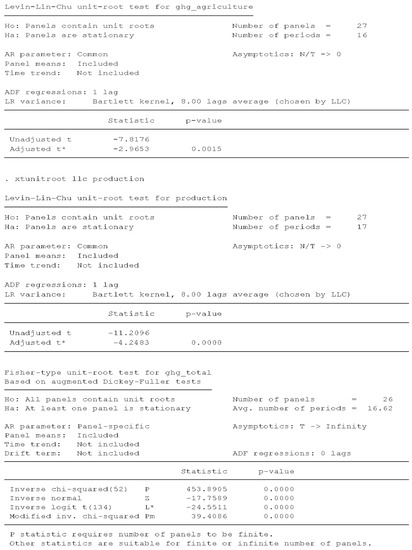
Figure A1.
Panel unit root tests.
Figure A1.
Panel unit root tests.
References
- Johnson, D.E.; Johnson, K.A. Greenhouse Gas Emissions. In Encyclopedia of Animal Science-(Two-Volume Set); CRC Press: Boca Raton, FL, USA, 2018; pp. 578–581. [Google Scholar]
- Yue, Q.; Xu, X.; Hillier, J.; Cheng, K.; Pan, G. Mitigating greenhouse gas emissions in agriculture: From farm production to food consumption. J. Clean. Prod. 2017, 149, 1011–1019. [Google Scholar] [CrossRef]
- Bennetzen, E.H.; Smith, P.; Porter, J.R. Decoupling of greenhouse gas emissions from global agricultural production: 1970–2050. Glob. Chang. Biol. 2016, 22, 763–781. [Google Scholar] [CrossRef] [PubMed]
- Vetter, S.H.; Sapkota, T.B.; Hillier, J.; Stirling, C.M.; Macdiarmid, J.I.; Aleksandrowicz, L.; Green, R.; Joy, E.J.M.; Dangour, A.D.; Smith, P. Greenhouse gas emissions from agricultural food production to supply Indian diets: Implications for climate change mitigation. Agric. Ecosyst. Environ. 2017, 237, 234–241. [Google Scholar] [CrossRef] [PubMed]
- Hnatyshyn, M. Decomposition analysis of the impact of economic growth on ammonia and nitrogen oxides emissions in the European Union. J. Int. Stud. 2018, 11, 201–209. [Google Scholar] [CrossRef]
- Palut, M.P.J.; Canziani, O.F. Contribution of Working Group II to the Fourth Assessment Report of the Intergovernmental Panel on Climate Change; Cambridge University Press: Cambridge, UK, 2007. [Google Scholar]
- European Environment Agency. Approximated EU GHG Inventory: Proxy GHG Estimates for 2017; EEA Report; European Environment Agency: Copenhagen, Denmark, 2018; Volume 17, pp. 2–107. [Google Scholar]
- Campbell, B.M.; Thornton, P.; Zougmoré, R.; Van Asten, P.; Lipper, L. Sustainable intensification: What is its role in climate smart agriculture? Curr. Opin. Environ. Sustain. 2014, 8, 39–43. [Google Scholar] [CrossRef]
- Lipper, L.; Thornton, P.; Campbell, B.M.; Baedeker, T.; Braimoh, A.; Bwalya, M.; Caron, P.; Cattaneo, A.; Garrity, D.; Henry, K.; et al. Climate-smart agriculture for food security. Nat. Clim. Chang. 2014, 4, 1068. [Google Scholar] [CrossRef]
- Klapwijk, C.J.; van Wijk, M.T.; Rosenstock, T.S.; Van Asten, P.J.A.; Thornton, P.K.; Giller, K.E. Analysis of trade-offs in agricultural systems: Current status and way forward. Curr. Opin. Environ. Sustain. 2014, 6, 110–115. [Google Scholar] [CrossRef]
- Steenwerth, K.L.; Hodson, A.K.; Bloom, A.J.; Carter, M.R.; Cattaneo, A.; Chartres, C.J.; Hatfield, J.L.; Henry, K.; Hopmans, J.W.; Horwáth, W.R.; et al. Climate-smart agriculture global research agenda: Scientific basis for action. Agric. Food Secur. 2014, 3, 11. [Google Scholar] [CrossRef]
- Kanter, D.R.; Musumba, M.; Wood, S.L.; Palm, C.; Antle, J.; Balvanera, P.; Dale, V.H.; Havlik, P.; Kline, K.L.; Scholes, R.J.; et al. Evaluating agricultural trade-offs in the age of sustainable development. Agric. Syst. 2018, 163, 73–88. [Google Scholar] [CrossRef]
- Morkūnas, M.; Volkov, A.; Pazienza, P. How Resistant Is the Agricultural Sector? Economic Resilience Exploited. Econ. Sociol. 2018, 11, 321–332. [Google Scholar] [CrossRef]
- Paustian, K.; Cole, C.V.; Sauerbeck, D.; Sampson, N. CO2 mitigation by agriculture: An overview. Clim. Chang. 1998, 40, 135–162. [Google Scholar] [CrossRef]
- Zwally, H.J.; Li, J.; Robbins, J.W.; Saba, J.L.; Yi, D.; Brenner, A.C. Mass gains of the Antarctic ice sheet exceed losses. J. Glaciol. 2015, 61, 1019–1036. [Google Scholar] [CrossRef]
- Brunetière, J.R.; Alexandre, S.; d’Aubreby, M.; Debiesse, G.; Guérin, A.J.; Perret, B.; Schwartz, D. Le Facteur 4 en France: La Division Par 4 des Émissions de Gaz à Effet de Serre à L’horizon 2050; Rapport Final; Technical Report; Conseil général de l’Environment et du Développement durable: Tour Séquoïa, Puteaux, France, 2009. [Google Scholar]
- Wollenberg, E.; Richards, M.; Smith, P.; Havlík, P.; Obersteiner, M.; Tubiello, F.N.; Herold, M.; Gerber, P.; Carter, S.; Reisinger, A.; et al. Reducing emissions from agriculture to meet the 2 C target. Glob. Chang. Biol. 2016, 22, 3859–3864. [Google Scholar] [CrossRef] [PubMed]
- Stavi, I.; Lal, R. Agriculture and greenhouse gases, a common tragedy. A review. Agron. Sustain. Dev. 2013, 33, 275–289. [Google Scholar] [CrossRef]
- Zona, D.; Janssens, I.A.; Aubinet, M.; Gioli, B.; Vicca, S.; Fichot, R.; Ceulemans, R. Fluxes of the greenhouse gases (CO2, CH4 and N2O) above a short-rotation poplar plantation after conversion from agricultural land. Agric. For. Meteorol. 2013, 169, 100–110. [Google Scholar] [CrossRef]
- Robertson, G.P.; Paul, E.A.; Harwood, R.R. Greenhouse gases in intensive agriculture: Contributions of individual gases to the radiative forcing of the atmosphere. Science 2000, 289, 1922–1925. [Google Scholar] [CrossRef] [PubMed]
- Havrysh, V.; Nitsenko, V.; Bilan, Y.; Streimikiene, D. Assessment of optimal location for a centralized biogas upgrading facility. Energy Environ. 2018. [Google Scholar] [CrossRef]
- Janzen, H.H. Carbon cycling in earth systems—A soil science perspective. Agric. Ecosyst. Environ. 2004, 104, 399–417. [Google Scholar] [CrossRef]
- Mosier, A.R.; Duxbury, J.M.; Freney, J.R.; Heinemeyer, O.; Minami, K.; Johnson, D.E. Mitigating agricultural emissions of methane. Clim. Chang. 1998, 40, 39–80. [Google Scholar] [CrossRef]
- Oenema, O.; Wrage, N.; Velthof, G.L.; van Groenigen, J.W.; Dolfing, J.; Kuikman, P.J. Trends in global nitrous oxide emissions from animal production systems. Nutr. Cycl. Agroecosyst. 2005, 72, 51–65. [Google Scholar] [CrossRef]
- Meisterling, K.; Samaras, C.; Schweizer, V. Decisions to reduce greenhouse gases from agriculture and product transport: LCA case study of organic and conventional wheat. J. Clean. Prod. 2009, 17, 222–230. [Google Scholar] [CrossRef]
- Burney, J.A.; Davis, S.J.; Lobell, D.B. Greenhouse gas mitigation by agricultural intensification. Proc. Natl. Acad. Sci. USA 2010, 107, 12052–12057. [Google Scholar] [CrossRef] [PubMed]
- Schils, R.L.M.; Verhagen, A.; Aarts, H.F.M.; Šebek, L.B.J. A farm level approach to define successful mitigation strategies for GHG emissions from ruminant livestock systems. Nutr. Cycl. Agroecosyst. 2005, 71, 163–175. [Google Scholar] [CrossRef]
- Pradhan, B.B.; Shrestha, R.M.; Hoa, N.T.; Matsuoka, Y. Carbon prices and greenhouse gases abatement from agriculture, forestry and land use in Nepal. Glob. Environ. Chang. 2017, 43, 26–36. [Google Scholar] [CrossRef]
- Kasimir-Klemedtsson, Å.; Klemedtsson, L.; Berglund, K.; Martikainen, P.; Silvola, J.; Oenema, O. Greenhouse gas emissions from farmed organic soils: A review. Soil Use Manag. 1997, 13, 245–250. [Google Scholar] [CrossRef]
- Merino, A.; Pérez-Batallón, P.; Macías, F. Responses of soil organic matter and greenhouse gas fluxes to soil management and land use changes in a humid temperate region of southern Europe. Soil Biol. Biochem. 2004, 36, 917–925. [Google Scholar] [CrossRef]
- Harris, Z.M.; Spake, R.; Taylor, G. Land use change to bioenergy: A meta-analysis of soil carbon and GHG emissions. Biomass Bioenergy 2015, 82, 27–39. [Google Scholar] [CrossRef]
- Giuntoli, J.; Agostini, A.; Edwards, R.; Marelli, L. Solid and Gaseous Bioenergy Pathways: Input Values and GHG Emissions; Report EUR; Joint Research Centre: Luxembourg, 2015; p. 26696. [Google Scholar]
- Buchholz, T.; Prisley, S.; Marland, G.; Canham, C.; Sampson, N. Uncertainty in projecting GHG emissions from bioenergy. Nat. Clim. Chang. 2014, 4, 1045. [Google Scholar] [CrossRef]
- Smith, P.; Martino, D.; Cai, Z.; Gwary, D.; Janzen, H.; Kumar, P.; McCarl, B.; Ogle, S.; O’Mara, F.; Rice, C.; et al. Greenhouse gas mitigation in agriculture. Philos. Trans. R. Soc. B Biol. Sci. 2008, 363, 789–813. [Google Scholar] [CrossRef] [PubMed]
- Chadwick, D.; Sommer, S.; Thorman, R.; Fangueiro, D.; Cardenas, L.; Amon, B.; Misselbrook, T. Manure management: Implications for greenhouse gas emissions. Anim. Feed Sci. Technol. 2011, 166, 514–531. [Google Scholar] [CrossRef]
- Van Vuuren, D.P.; Stehfest, E.; Gernaat, D.E.; Doelman, J.C.; Van den Berg, M.; Harmsen, M.; De Boer, H.S.; Bouwman, L.F.; Daioglou, V.; Edelenbosch, O.Y.; et al. Energy, land-use and greenhouse gas emissions trajectories under a green growth paradigm. Glob. Environ. Chang. 2017, 42, 237–250. [Google Scholar] [CrossRef]
- Bellarby, J.; Tirado, R.; Leip, A.; Weiss, F.; Lesschen, J.P.; Smith, P. Livestock greenhouse gas emissions and mitigation potential in Europe. Glob. Chang. Biol. 2013, 19, 3–18. [Google Scholar] [CrossRef] [PubMed]
- Wang, W.; Dalal, R.C.; Reeves, S.H.; Butterbach-Bahl, K.L.A.U.S.; Kiese, R. Greenhouse gas fluxes from an Australian subtropical cropland under long-term contrasting management regimes. Glob. Chang. Biol. 2011, 17, 3089–3101. [Google Scholar] [CrossRef]
- Henderson, B.B.; Gerber, P.J.; Hilinski, T.E.; Falcucci, A.; Ojima, D.S.; Salvatore, M.; Conant, R.T. Greenhouse gas mitigation potential of the world’s grazing lands: Modeling soil carbon and nitrogen fluxes of mitigation practices. Agric. Ecosyst. Environ. 2015, 207, 91–100. [Google Scholar] [CrossRef]
- Allard, V.; Soussana, J.F.; Falcimagne, R.; Berbigier, P.; Bonnefond, J.M.; Ceschia, E.; D’Hour, P.; Hénault, C.; Laville, P.; Martin, C.; et al. The role of grazing management for the net biome productivity and greenhouse gas budget (CO2, N2O and CH4) of semi-natural grassland. Agric. Ecosyst. Environ. 2007, 121, 47–58. [Google Scholar] [CrossRef]
- Searchinger, T.; Heimlich, R.; Houghton, R.A.; Dong, F.; Elobeid, A.; Fabiosa, J.; Tokgoz, S.; Hayes, D.; Yu, T.H. Use of US croplands for biofuels increases greenhouse gases through emissions from land-use change. Science 2008, 319, 1238–1240. [Google Scholar] [CrossRef]
- Beran, A.D.A.Y.; Ertekin, C.; Evrendilek, F. Emissions of Greenhouse Gases from Diesel Consumption in Agricultural Production of Turkey. Eur. J. Sustain. Dev. 2016, 5, 279–288. [Google Scholar]
- Jorgenson, A.K.; Austin, K.; Dick, C. Ecologically unequal exchange and the resource consumption/environmental degradation paradox: A panel study of less-developed countries, 1970–2000. Int. J. Comp. Sociol. 2009, 50, 263–284. [Google Scholar] [CrossRef]
- York, R. Do alternative energy sources displace fossil fuels? Nat. Clim. Chang. 2012, 2, 441. [Google Scholar] [CrossRef]
- Johnson, J.M.F.; Franzluebbers, A.J.; Weyers, S.L.; Reicosky, D.C. Agricultural opportunities to mitigate greenhouse gas emissions. Environ. Pollut. 2007, 150, 107–124. [Google Scholar] [CrossRef]
- Cole, C.V.; Duxbury, J.; Freney, J.; Heinemeyer, O.; Minami, K.; Mosier, A.; Paustian, K.; Rosenberg, N.; Sampson, N.; Sauerbeck, D.; et al. Global estimates of potential mitigation of greenhouse gas emissions by agriculture. Nutr. Cycl. Agroecosyst. 1997, 49, 221–228. [Google Scholar] [CrossRef]
- Chico, J.R.; Sánchez, A.R.P.; García, M.J. Influence of agricultural factors of production on the emission of greenhouse gases worldwide. ‘Oikos Polis’ Rev. Latinoam. Cienc. Econ. Soc. 2017, 2, 31–63. [Google Scholar]
- European Environment Agency. Climate Change, Impacts and Vulnerability in Europe 2012, An Indicator-Based Report; European Environment Agency: Copenhagen, Denmark, 2012. [Google Scholar]
- Venkat, K. Comparison of twelve organic and conventional farming systems: A life cycle greenhouse gas emissions perspective. J. Sustain. Agric. 2012, 36, 620–649. [Google Scholar] [CrossRef]
- Williams, A.; Audsley, E.; Sandars, D. Determining the Environmental Burdens and Resource Use in the Production of Agricultural and Horticultural Commodities: Defra Project Report IS0205. Available online: http://randd.defra.gov.uk/Default.Aspx (accessed on 5 March 2019).
- Reiff, M.; Surmanová, K.; Balcerzak, A.P.; Pietrzak, M.B. Multiple Criteria Analysis of European Union Agriculture. J. Int. Stud. 2016, 9, 62–74. [Google Scholar] [CrossRef] [PubMed]
- Ladha, J.K.; Pathak, H.; Krupnik, T.J.; Six, J.; van Kessel, C. Efficiency of fertilizer nitrogen in cereal production: Retrospects and prospects. Adv. Agron. 2005, 87, 85–156. [Google Scholar]
- Snyder, C.S.; Bruulsema, T.W.; Jensen, T.L.; Fixen, P.E. Review of greenhouse gas emissions from crop production systems and fertilizer management effects. Agric. Ecosyst. Environ. 2009, 133, 247–266. [Google Scholar] [CrossRef]
- Galnaitytė, A.; Kriščiukaitienė, I.; Baležentis, T.; Namiotko, V. Evaluation of Technological, Economic and Social Indicators for Different Farming Practices in Lithuania. Econ. Sociol. 2017, 10, 189–202. [Google Scholar] [CrossRef] [PubMed]
- Balezentis, T.; Novickyte, L. Are Lithuanian Family Farms Profitable and Financially Sustainable? Evidence Using DuPont Model, Sustainable Growth Paradigm and Index Decomposition Analysis. Transform. Bus. Econ. 2018, 17, 237–255. [Google Scholar]
- Simionescu, M.; Albu, L.L.; Raileanu Szeles, M.; Bilan, Y. The impact of biofuels utilisation in transport on the sustainable development in the European Union. Technol. Econ. Dev. Econ. 2017, 23, 667–686. [Google Scholar] [CrossRef]
© 2019 by the authors. Licensee MDPI, Basel, Switzerland. This article is an open access article distributed under the terms and conditions of the Creative Commons Attribution (CC BY) license (http://creativecommons.org/licenses/by/4.0/).