Challenges to Internationalisation of University Programmes: A Systematic Thematic Synthesis of Qualitative Research on Learner-Centred English Medium Instruction (EMI) Pedagogy

 ,
, 
Abstract
:1. Introduction
2. Conceptual Framework and Literature Review
2.1. Learner-Centred Pedagogy in HE
2.2. Learner-Centred Pedagogy in HE and EMI
“For EMI courses, the delivery of content, whole-class interaction, the learning materials, and the demonstration and assessment of learning outcomes (such as oral presentation, assignments, or tests) should be in English. Other languages may be used in a principled and limited way in specific circumstances, for example, student-to-student and teacher-to-student interaction during pair work and group work may sometimes take place in languages other than English to aid mutual comprehension and idea generation. However, students should be asked to present their discussion outcomes in English and lecturers should ensure that at least 70% of class communication takes place in English”.
3. Materials and Methods
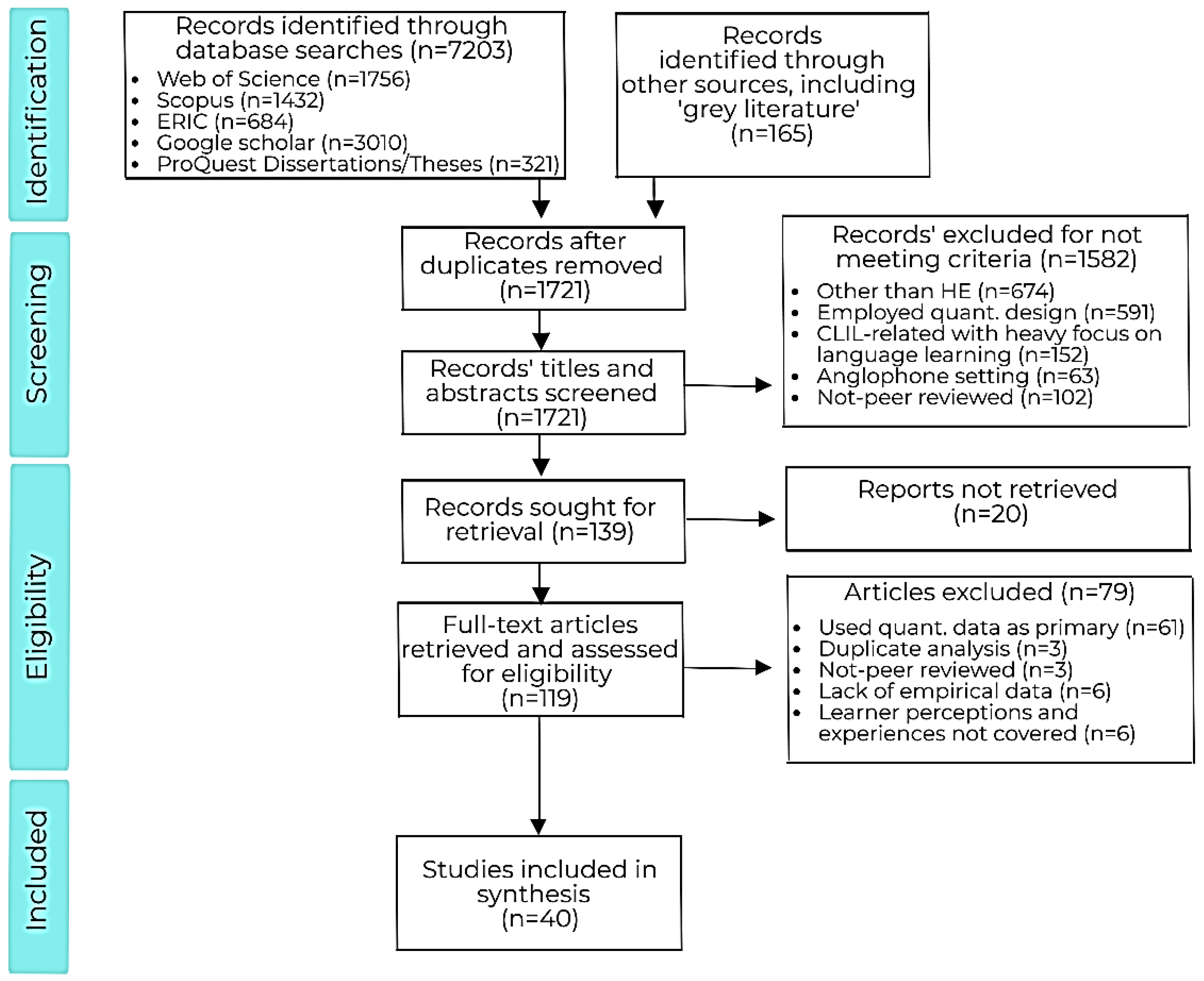
3.1. Literature Search and Selection
- TOPIC: (English medium instruction) AND TOPIC: (teaching) AND TOPIC: (students) AND TOPIC: (perceptions) AND TOPIC: (university).
- TOPIC: (EMI) AND TOPIC: (pedagogy) AND TOPIC: (students) AND TOPIC: (views) AND TOPIC: (higher education).
3.2. Quality Appraisal
3.3. Data Synthesis
- All included papers were read thoroughly by three authors.
- The first author then extracted and summarised the documents regarding their definition and context of EMI, country of research, sample size, characteristics of academic subjects, study design, methods of analysis, and key research questions (see Table 4).
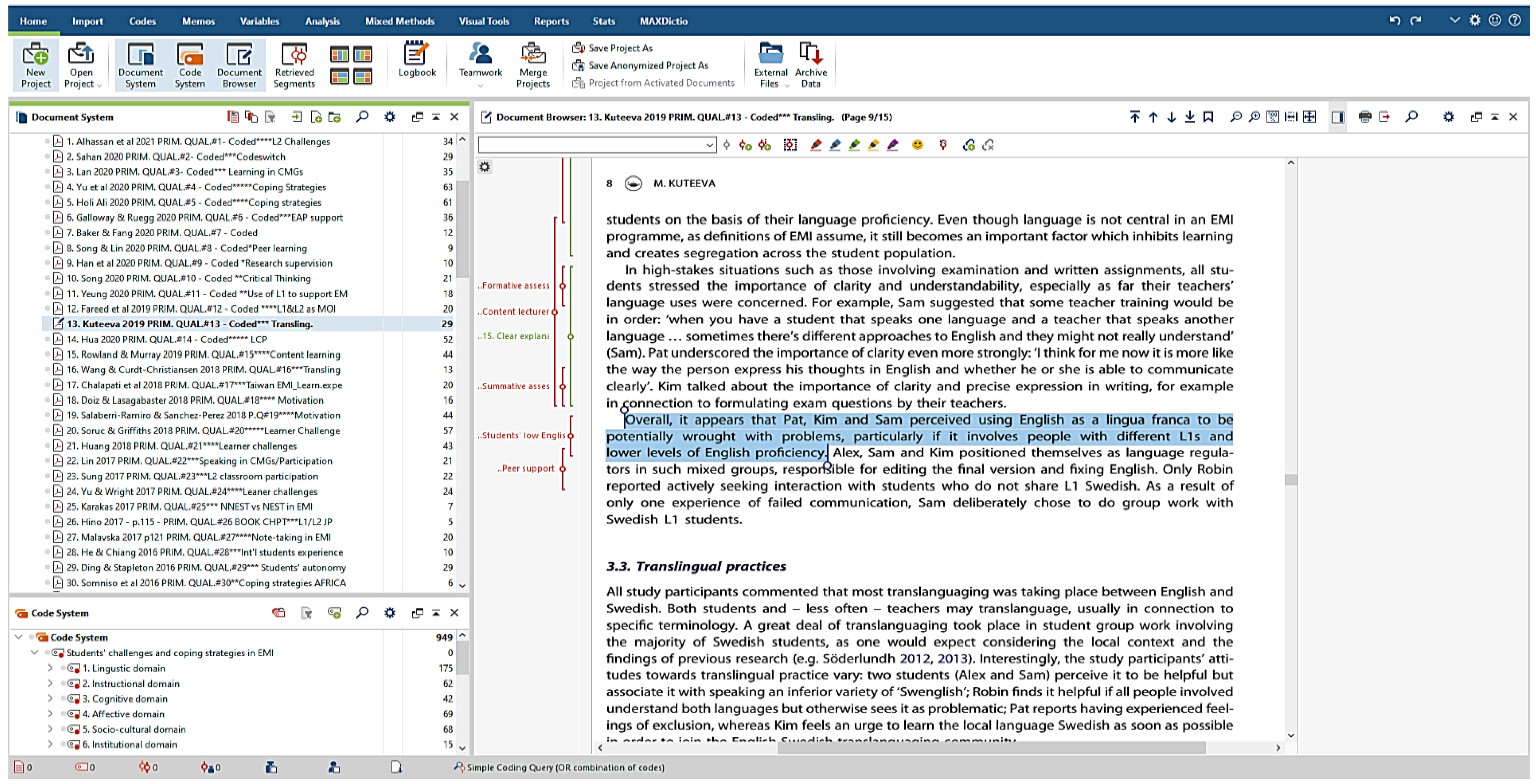
- Data from the results sections of the articles were independently and inductively coded by two authors (M.I., Y.Y, N.D.) line-by-line using MAXQDA Ver. 2020TM, a software programme designed for computer-assisted qualitative and mixed-method data, text, and multimedia analysis (see Figure 3).
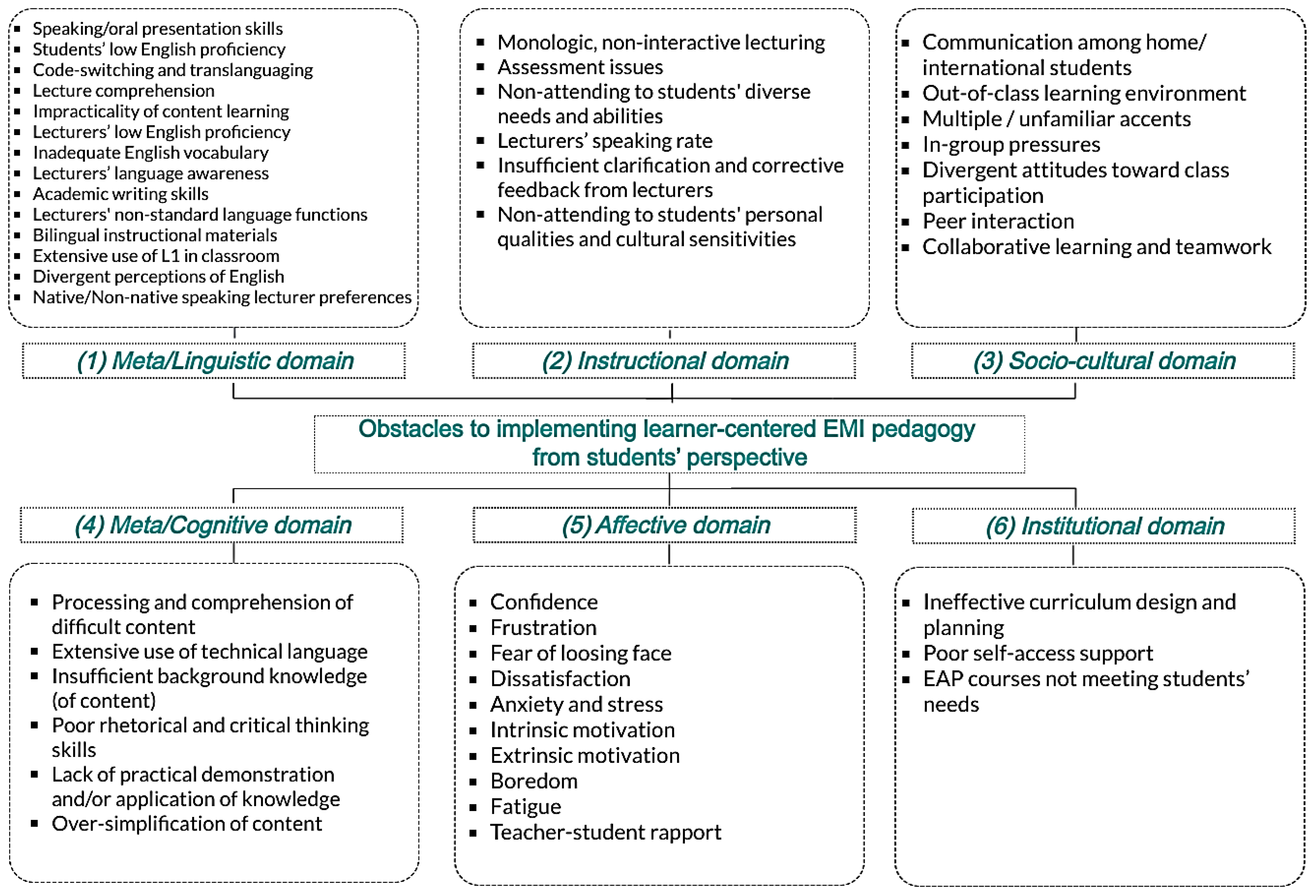
- The results of open coding were organised into descriptive themes. Researchers (M.I. and T.K.F.C.) then compared the developed themes inductively and established the primary analytical domains [63].
4. Results
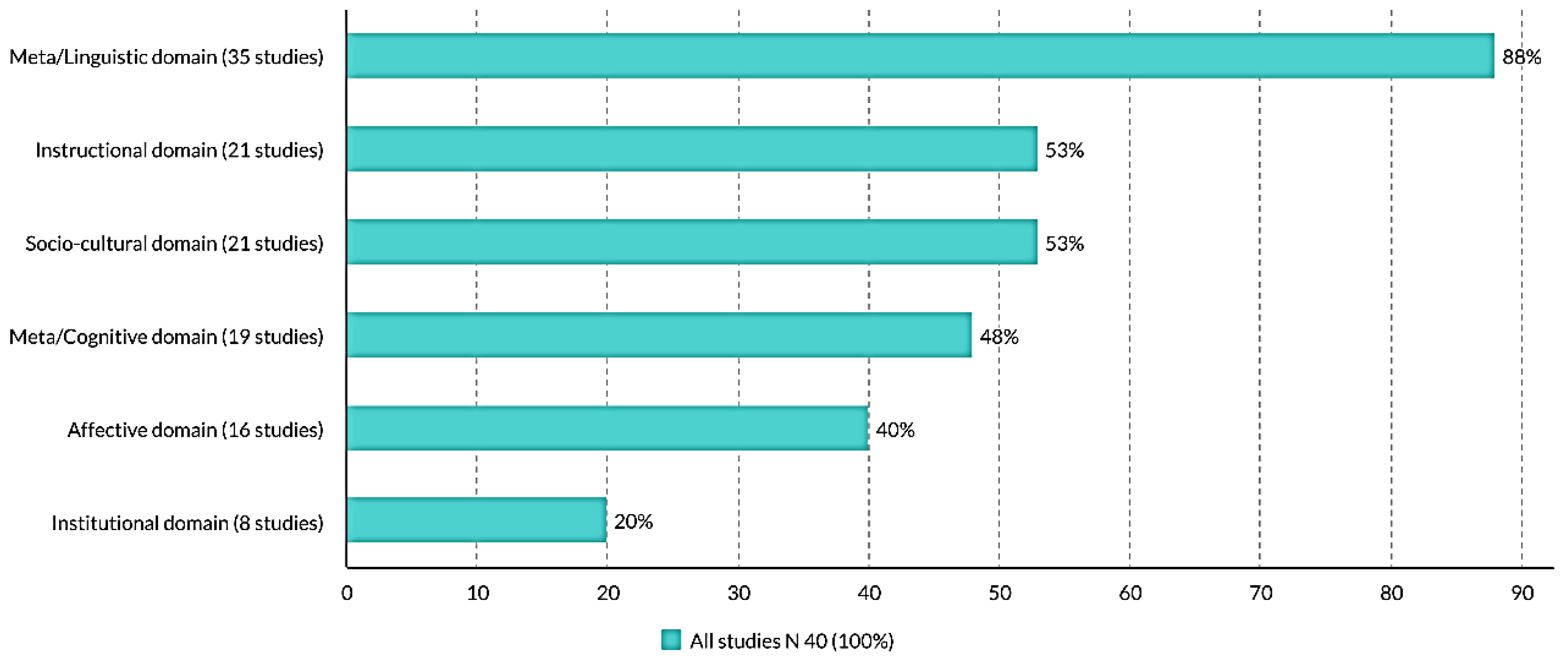
4.1. Meta/Linguistic Domain
4.2. Instructional Domain
4.3. Socio-Cultural Domain
4.4. Meta/Cognitive Domain
4.5. Affective Domain
4.6. Institutional Domain
5. Discussion: Empirical and Pedagogical Implications
5.1. Context-Dependency
5.2. Multi-Dimensionality
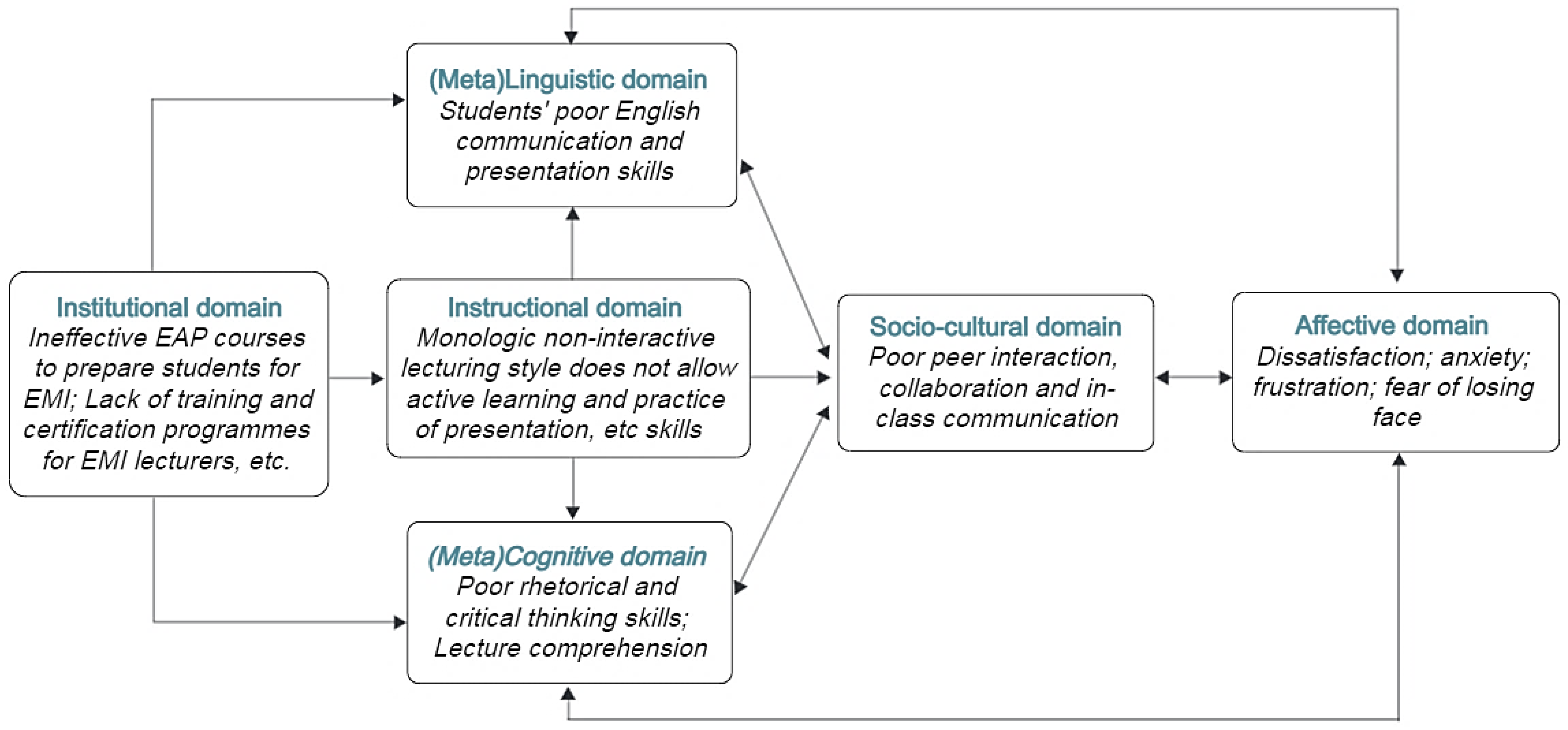
5.3. Domain Interdependence
5.4. Teacher-Centredness by Default
5.5. Sustaining the Effectiveness of EMI on All Levels
- On a micro-level, the success of both HE internationalisation and EMI pedagogy depends on how effectively such programmes can create inclusive environments to sustain students’ learning, motivation, and classroom engagement. As we observed from numerous studies, even ‘small’ issues such as ‘fear of losing face’ or ‘multiple accents in multicultural EMI classrooms’ can impair student learning and satisfaction in the long run when not addressed [13,68,77,95].
- On a meso-level, implementing an effective and learner-centred EMI pedagogy requires a sustainable institutional strategy to train and possibly certify content lecturers. Crucially, such measures could also focus on facilitating collaboration and coordination between content lecturers and language instructors in a systematic manner [3,4,5,6].
- On a macro-level, the success of EMI ultimately depends on how faculty and university administrators perform on the previous two fronts, as they are critical for sustaining international student mobility and inter-university partnerships as strategic objectives of the internationalisation of HE [2].
6. Conclusions
6.1. Overview of Findings
6.2. Strengths and Limitations
Author Contributions
Funding
Institutional Review Board Statement
Informed Consent Statement
Data Availability Statement
Acknowledgments
Conflicts of Interest
Appendix A

| # | Author Year [Ref] Document Type | Location | Sample Size, EMI Subject | Design (Data Collection; Data Analysis) | Key Research Question(s) | Quality Appraisal | |
|---|---|---|---|---|---|---|---|
| CASP 10-Item Check List [60] | COREQ 32-Item Check List [61] | ||||||
| 1. | Alhassan et al. 2021 [91] Journal article | Sudan | N = 21 Business | Ethnographic research (Semi-structured Interviews, observations, and collection of documents; Content analysis). | What challenges do Sudanese EMI business students experience in EMI courses? To what extent do these problems impact students’ academic performance? | Passed | Passed |
| 2. | Baker & Fang 2020 [98] Journal article | Mainland China (and UK) | N = 45 Various EMI courses | A qualitative interpretive design (Open-ended questionnaire responses, interviews and focus groups; Thematic framework approach). | To what extent do students develop an awareness of and/or identity as an intercultural citizen because of undertaking EMI programmes in a university abroad? | Passed | Passed |
| 3. | Chalapati et al. 2018 [79] Journal article | Taiwan | N = 64 International tourism and hospitality | A qualitative design (Semi-structured, focus group interviews; Thematic framework approach). | What are the learning experiences of local and international students, and what barriers do they face in an EMI degree programme at a private university? | Passed | Passed |
| 4. | Ding & Stapleton 2016 [81] Journal article | Hong Kong SAR | N = 9 Various EMI courses | A qualitative multiple case study design (semi-structured interviews, classroom observation; Thematic framework approach). | What major problems do students encounter while adapting to the EMI education? | Passed | Passed |
| 5. | Doiz & Lasagabaster 2018 [68] Journal article | Spain | N = 28 Various EMI courses | A qualitative interpretive design (Focus group interviews and discussions; Thematic framework approach). | How are teachers’ and students’ ideal L2 self-manifested in EMI? What are the teachers’ and students’ reflections on the EMI experience? | Passed | Passed |
| 6. | Doiz et al. 2013 [70] Journal article | Spain | N = 27 Various EMI courses | A qualitative interpretive design (Focus group discussions; Thematic framework approach). | What does internationalisation mean to the university community? How much does the community value EMI? | Passed | Passed |
| 7. | Fareed et al. 2019 [66] Journal article | Pakistan | N = 104 Various EMI courses | A qualitative interpretive design (In-depth interviews; Thematic framework approach). | What are the perceptions of school, college and university teachers and students about the medium of instruction? | Passed | Passed |
| 8. | Galloway & Ruegg 2020 [89] Journal article | Japan and Mainland China | N = 29 Various EMI courses | A qualitative interpretive design (Open-ended questionnaire responses, interviews and focus groups; Thematic framework approach). | What are the core principles of EMI? How can students studying through the medium of English be supported? What are the needs of the international student body? | Passed | Passed |
| 9. | Hamid et al. 2013 [76] Journal article | Bangladesh | N = 54 Various EMI courses | A qualitative interpretive design (semi-structured interviews, classroom observations; Inductive content analysis). | How do teachers and students develop language practices, ideologies and institutional othering in a private university in Bangladesh? | Passed | Passed |
| 10. | Han et al. 2020 [95] Journal article | Mainland China | N = 25 Various EMI courses | A qualitative interpretive design (In-depth interviews; Thematic framework approach). | What challenges do local students experience when working with international students? | Passed | Passed |
| 11. | He & Chiang 2016 [86] Journal article | Mainland China | N = 60 Various EMI courses | A qualitative interpretive design (Open ended reports; Thematic framework approach). | English-medium education aims in accommodating international students in Mainland Chinese universities, and how well are they working? | Passed | N/A (No interviews/focus groups used) |
| 12. | Henry & Goddard 2015 [69] Journal article | Sweden | N = 32 Various EMI courses | A qualitative discourse analysis (Semi-structured interviews; Discursive analysis). | Does identity play a role in explaining Swedish students’ enrolment in an EMI programme? | Passed | Passed |
| 13. | Hino 2017 [85] Book chapter | Japan | N = 4 Various EMI courses | A qualitative interpretive design (Case studies, class observation, class video recording, open-ended questionnaire; Content analysis). | How could EMI help students acquire communicative abilities in EIL, including linguistic, sociolinguistic, and interactive? | Passed | N/A (No interviews/focus groups used) |
| 14. | Holi Ali 2020 [65] Journal article | Oman | N = 12 Engineering | A qualitative interpretive design (Semi-structured interviews; Inductive content analysis). | How did Omani engineering students respond to EMI challenges? | Passed | Passed |
| 15. | Hua 2020 [52] Journal article | Taiwan | N = 30 Psychology | A qualitative interpretive design (Qualitative open-ended questionnaire and focus group discussions; Content analysis). | What are the factors facilitating or hindering local students’ EMI learning? What are their suggestions to facilitate EMI experiences? | Passed | Passed |
| 16. | Huang & Jhuang 2015 [88] Journal article | Taiwan | N = 11 Various EMI courses | A grounded theory (Classroom observations and semi-structured interviews; Thematic framework approach). | What types of affordances do students in these two types of EMI contexts perceive and accept? What factors might inform these affordances? | Passed | Passed |
| 17. | Huang 2018 [84] Journal article | Taiwan | N = 4 International Business, Accounting | A qualitative multiple-case study design (semi-structured interviews, learning stories and class observations; Reconstructive thematic analysis). | What constitutes learner resistance during studying at an EMI course? Why do learners construct their resistance, and in what ways? | Passed | Passed |
| 18. | Karakaş 2017 [80] Journal article | Turkey | N = 20 Various EMI courses | Mixed methods with qualitative data as a primary instrument (Semi-structured interviews; Thematic framework approach). | Do students prefer NESTs, NNESTs, or both for content and language-focused courses? What factors influence students’ preferences towards NNESTs and NESTs? | Passed | Passed |
| 19. | Kuteeva 2019 [78] Journal article | Sweden | N = 5 Various EMI courses | A qualitative interpretive design (In-depth interviews; Content analysis). | What are local and international students’ conceptualisations of English and positioning in the context of an English-medium university? | Passed | Passed |
| 20. | Lan 2020 [77] Journal article | Taiwan | N = 42 Various EMI courses | Narrative approach (Semi-structured interviews and reflective journals; Thematic framework approach). | How did the participants invest in non-native speaker intercultural interaction? What were the participants’ imagined communities? | Passed | Passed |
| 21. | Lin 2017 [73] Journal article | Taiwan | N = 82 Various EMI courses | Ethnographic research (semi-structured interviews; Thematic framework approach). | How do local and international students perceive, interpret, and adapt their in-class behaviours in multicultural EMI classrooms? | Passed | Passed |
| 22. | Malavska 2017 [75] Journal article | Latvia and Russia | N = 24 Various EMI courses | A qualitative interpretive design (Open ended questionnaire, Semi-structured interviews; Thematic framework approach). | To what extent does the note-taking process depend on students’ skills or lecturers’ competence in delivering coherent and cohesive EMI lectures? | Passed | Passed |
| 23. | Pitkänen et al. 2013 [71] Journal article | Finland | N = 60 Various EMI courses | A qualitative interpretive design (open-ended electronic questionnaire; Content analysis). | Why do Finnish students apply to study in graduate EMI programmes? What challenges, advantages and disadvantages do they perceive when doing so? Do they feel linguistically able to cope with their studies? | Passed | N/A (No interviews/focus groups used) |
| 24. | Rowland and Murray 2019 [53] Journal article | Italy | N = 18 Biomedical sciences | A qualitative interpretive design (Semi-structured interviews and focus group discussions; Content analysis). | What are lecturers’ and students’ perceptions concerning the adequacy of their own and each other’s English language proficiency? | Passed | Passed |
| 25. | Sahan 2020 [94] Journal article | Turkey | N = 120 Engineering | Classroom observation (Audio recording and observation; Thematic framework approach). | How do teachers and students use code-switching to support content learning in an ELF classroom setting? | Passed | N/A (No interviews/focus groups used) |
| 26. | Salaberri-Ramiro & Sánchez-Pérez 2018 [64] Journal article | Spain | N = 310 Various EMI courses | A qualitative interpretive design (Open ended questionnaire survey; Thematic framework approach). | What are the factors that motivated students to participate in a bilingual course? What changes would they introduce to feel more motivated to participate in bilingual courses in the future? | Passed | N/A (No interviews/focus groups used) |
| 27. | Sibomana 2016 [82] Journal article | South Africa | N = 21 Education | A grounded theory (semi-structured interviews; assignment tasks, lecturer feedback; Thematic framework approach). | What is the nature of challenges faced by the students? What are the students’ coping strategies? What are the effects of support offered by the university? | Passed | Passed |
| 28. | Somniso et al. 2016 [93] Journal article | South Africa | N = 9 Various EMI courses | A qualitative interpretive design (semi-structured interviews; Thematic framework approach). | What coping strategies do students from the DRC employ to overcome their learning challenges in English Medium Instruction? | Passed | Passed |
| 29. | Song & Lin 2020 [96] Journal article | Mainland China | N = 20 Various EMI courses | Ethnographic research (Observation and interviews; Content analysis). | How do students in EMI programmes engage in translingual practices in different social spaces? | Passed | Passed |
| 30. | Song 2020 [97] Journal article | Mainland China | N = 51 Political studies | Grounded theory (Classroom observations, Semi-structured interviews; Thematic framework approach). | How has being critical been understood and practiced in relation to students’ intercultural experiences in EMI Master’s degree programmes? | Passed | Passed |
| 31. | Soruç & Griffiths 2018 [12] Journal article | Turkey | N = 39 International Relations, Psychology | A qualitative interpretive design (videorecording, open-ended questionnaire, stimulated-recall interviews; Thematic framework approach). | What difficulties do students generally have in an EMI classroom? What strategies do they use to deal with difficulties? What are their views regarding the EMI phenomenon in Turkey? | Passed | Passed |
| 32. | Studer 2014 [87] Journal article | Switzer-land | N = 40 Natural Resource Sciences | A qualitative interpretive design (Focus group discussions, stimulated recall method; Thematic framework approach). | What are German-speaking students’ perceptions of their lecturers’ L2 (EMI) competence in the science classroom? | Passed | Passed |
| 33. | Sung 2017 [74] Journal article | Hong Kong SAR | N = 1 Various EMI courses | A narrative inquiry approach (in-depth interviews, elicited written self-reports, class observations; Content analysis). | How did the student negotiate her identities in the L2 university classroom when participating in various classroom oral activities? How did the student’s classroom participation change over time? | Passed | Passed |
| 34. | Tatzl 2012 [72] Journal article | Austria | N = 74 Business, Engineering | A qualitative interpretive design (open-ended questionnaire; semi-structured interviews; Content analysis). | What are Austrian lecturers’ and students’ attitudes towards EMI-based master’s programmes? What are the perceived best practices? How do they perceive the challenges of EMI implementation? | Passed | Passed |
| 35. | Trent 2008 [92] Journal article | Hong Kong SAR | N = 8 English for business and economics | Ethnographic study (semi-structured interviews, class observations and recordings of classroom interaction; Content analysis). | How can oral classroom participation by undergraduate students be promoted in English-medium universities? | Passed | Passed |
| 36. | Wang & Curdt-Christiansen 2018 [67] Journal article | Mainland China | N = 37 Business management | Ethnographic research (Semi-structured Interviews, classroom observations, and collection of documents; Content analysis). | What are the contexts and pedagogical realities that gave rise to translanguaging practices in EMI programmes? How are students as individual agents engaged in translanguaging practices? | Passed | Passed |
| 37. | Yeon 2018 [83] Doctoral thesis | South Korea | N = 15 Various EMI courses | A qualitative interpretive design (semi-structured in-depth interviews; class observation; Content analysis). | How do learners accept and act on the identities, practices and resources available to them in EMI courses at a large public university in South Korea? | Passed | Passed |
| 38. | Yeung 2020 [90] Journal article | Hong Kong SAR | N = 79 Various EMI courses | A qualitative interpretive design (Focus groups and in-depth interviews; Thematic framework approach). | Do teachers and students have difficulties using EMI? How do they cope with these difficulties? | Passed | Passed |
| 39. | Yu & Wright 2017 [6] Journal article | Hong Kong SAR | N = 124 Various EMI courses | A qualitative interpretive design (Focus group interviews; Content analysis). | How do local, Mainland Chinese and international students perceive the main challenges to academic adaptation? | Passed | Passed |
| 40. | Yu et al. 2020 [13] Journal article | Macao SAR | N = 14 Various EMI courses | A qualitative interpretive design (Semi-structured interviews and reflective journals; Thematic framework approach). | What are the perceived benefits and losses of Mainland Chinese students during EMI learning? | Passed | Passed |
References
- Marinoni, G.; de Wit, H. Internationalization of Higher Education in the New Political Climate. Inside High. Ed. Available online: https://www.insidehighered.com/blogs/world-view/internationalization-higher-education-new-political-climate (accessed on 3 March 2021).
- Dearden, J. English as a Medium of Instruction—A Growing Global Phenomenon; British Council: London, UK, 2015; Available online: https://ora.ox.ac.uk/objects/uuid:4f72cdf8-b2eb-4d41-a785-4a283bf6caaa (accessed on 13 January 2021).
- Mueller Iyobe, B.; Li, J. Factors for Success and Sustainability of an Elective English-Medium Instruction Program. In English-Medium Instruction in Japanese Higher Education; Bradford, A., Brown, H., Eds.; Multilingual Matters: Bristol, UK, 2017. [Google Scholar] [CrossRef]
- Kim, Y. The Value of Interactive Polling and Intrinsic Motivation When Using English as a Medium of Instruction. Sustainability 2020, 12, 1332. [Google Scholar] [CrossRef] [Green Version]
- Rakhshandehroo, M.; Ivanova, P. International student satisfaction at English-medium graduate programs in Japan. High. Educ. 2019, 79, 39–54. [Google Scholar] [CrossRef]
- Yu, B.; Wright, E. Academic adaptation amid internationalisation: The challenges for local, mainland Chinese, and international students at Hong Kong’s universities. Tert. Educ. Manag. 2017, 23, 347–360. [Google Scholar] [CrossRef]
- Macaro, E. English Medium Instruction. Content and Language in Policy and Practice; Oxford University Press: Oxford, UK, 2018. [Google Scholar]
- Chapple, J. Teaching in English Is Not Necessarily the Teaching of English. Int. Educ. Stud. 2015, 8, 1–13. [Google Scholar] [CrossRef] [Green Version]
- Macaro, E.; Curle, S.; Pun, J.; An, J.; Dearden, J. A systematic review of English medium instruction in higher education. Lang. Teach. 2017, 51, 36–76. [Google Scholar] [CrossRef] [Green Version]
- Curle, S.; Yuksel, D.; Soruç, A.; Altay, M. Predictors of English Medium Instruction academic success: English proficiency versus first language medium. System 2020, 95, 102378. [Google Scholar] [CrossRef]
- Rose, H.; Curle, S.; Aizawa, I.; Thompson, G. What drives success in English medium taught courses? The interplay between language proficiency, academic skills, and motivation. Stud. High. Educ. 2019, 45, 2149–2161. [Google Scholar] [CrossRef]
- Soruç, A.; Griffiths, C. English as a medium of instruction: Students’ strategies. ELT J. 2017, 72, 38–48. [Google Scholar] [CrossRef]
- Yu, S.; Wang, Y.; Jiang, L.; Wang, B. Coping with EMI (English as a medium of instruction): Mainland China students’ strategies at a university in Macau. Innov. Educ. Teach. Int. 2020, 58, 462–472. [Google Scholar] [CrossRef]
- Aizawa, I.; Rose, H.; Thompson, G.; Curle, S. Beyond the threshold: Exploring English language proficiency, linguistic challenges, and academic language skills of Japanese students in an English medium instruction programme. Lang. Teach. Res. 2020, 136216882096551. [Google Scholar] [CrossRef]
- Macaro, E. Exploring the role of language in English medium instruction. Int. J. Biling. Educ. Biling. 2019, 23, 263–276. [Google Scholar] [CrossRef]
- Galloway, N.; Numajiri, T.; Rees, N. The ‘internationalisation’, or ‘Englishisation’, of higher education in East Asia. High. Educ. 2020, 80, 395–414. [Google Scholar] [CrossRef] [Green Version]
- Wanphet, P.; Tantawy, N. Effectiveness of the policy of English as a medium of instruction: Perspectives and outcomes from the instructors and students of university science courses at a university in the UAE. Educ. Res. Policy Pract. 2017, 17, 145–172. [Google Scholar] [CrossRef]
- Chickering, A.W.; Gamson, Z.F. Seven Principles for Good Practice in Undergraduate Education. Wingspread J. 1987, 9, 1–10. [Google Scholar]
- Sharkey, S.; Weimer, M. Learner-Centered Teaching: Five Key Changes to Practice. Teach. Sociol. 2003, 31, 251. [Google Scholar] [CrossRef]
- Merrill, M.D. First principles of instruction. Educ. Technol. Res. Dev. 2002, 50, 43–59. [Google Scholar] [CrossRef]
- Ramsden, P. Learning to Teach in Higher Education, 2nd ed.; Routledge Falmer: New York, NY, USA, 2003. [Google Scholar]
- Biggs, J.; Tang, C. Using Constructive Alignment in Outcomes-Based Teaching and Learning Teaching for Quality Learning at University, 3rd ed.; Open University Press: Berkshire, UK, 2007. [Google Scholar]
- Schweisfurth, M. Learner-centred pedagogy: Towards a post-2015 agenda for teaching and learning. Int. J. Educ. Dev. 2015, 40, 259–266. [Google Scholar] [CrossRef]
- Li, L. Student perceptions of the teaching of principles of management using English-medium instruction. J. Educ. Bus. 2019, 95, 115–120. [Google Scholar] [CrossRef]
- Macaro, E.; Tian, L.; Chu, L. First and second language use in English medium instruction contexts. Lang. Teach. Res. 2018, 24, 382–402. [Google Scholar] [CrossRef]
- Kim, J.-Y.; Choi, J.; Tatar, B. English-Medium Instruction and Intercultural Sensitivity: A Korean Case Study. J. Stud. Int. Educ. 2017, 21, 467–482. [Google Scholar] [CrossRef]
- Kim, V.; Kim, J. Roles of Teacher Feedback in Promoting Effective English-Medium Instruction of a Business Subject. J. Asiat. 2020, 17, 889–905. [Google Scholar] [CrossRef]
- Richards, J.C.; Pun, J. A Typology of English-Medium Instruction. RELC J. 2021, 003368822096858. [Google Scholar] [CrossRef]
- Bradford, A. Toward a Typology of Implementation Challenges Facing English-Medium Instruction in Higher Education. J. Stud. Int. Educ. 2016, 20, 339–356. [Google Scholar] [CrossRef]
- Sahan, K.; Rose, H.; Macaro, E. Models of EMI pedagogies: At the interface of language use and interaction. System 2021, 101, 102616. [Google Scholar] [CrossRef]
- Thompson, G.; Aizawa, I.; Curle, S.; Rose, H. Exploring the role of self-efficacy beliefs and learner success in English medium instruction. Int. J. Biling. Educ. Biling. 2019, 1–14. [Google Scholar] [CrossRef]
- Williams, D.; A Systematic Review of EMI and Implications for the South Korean HE Context. ELT World Online 2015, 1–23. Available online: https://tinyurl.com/4xtmvnzp (accessed on 16 March 2021).
- Kremer, M.; Valcke, M. Teaching and learning in English in higher education: A literature review. In Proceedings of the 6th International Conference on Education and New Learning Technologies (EDULEARN), Barcelona, Spain, 7–9 July 2014; pp. 1430–1441. Available online: http://hdl.handle.net/1854/LU-5818549 (accessed on 3 March 2021).
- Rocha, Á.; Gonçalves, M.J.A.; da Silva, A.F.; Teixeira, S.; Silva, R. Leadership Challenges in the Context of University 4.0. A Thematic Synthesis Literature Review. Comput. Math. Organ. Theory 2021. [Google Scholar] [CrossRef]
- Baeten, M.; Dochy, F.; Struyven, K. Using students’ motivational and learning profiles in investigating their perceptions and achievement in case-based and lecture-based learning environments. Educ. Stud. 2012, 38, 491–506. [Google Scholar] [CrossRef]
- Wright, G. Student-Centred Learning in Higher Education. Int. J. Teach. Learn. High. Educ. 2011, 23, 92–97. [Google Scholar]
- Paris, C.; Combs, B. Lived meanings: What teachers mean when they say they are learner-centred. Teach. Teach. Theory Pract. 2006, 12, 571–592. [Google Scholar] [CrossRef]
- Jacobs, G.M.; Renandya, W.A.; Power, M. Simple, Powerful Strategies for Student Centered Learning; Springer International Publishin: Berlin/Heidelberg, Germany, 2016. [Google Scholar]
- Sahan, K. Implementing English-medium instruction. Aust. Rev. Appl. Linguist. 2021, 44, 129–153. [Google Scholar] [CrossRef]
- Bolton, K.; Botha, W.; Bacon-Shone, J. English-medium instruction in Singapore higher education: Policy, realities and challenges. J. Multiling. Multicult. Dev. 2017, 38, 913–930. [Google Scholar] [CrossRef]
- Wallace, A.; Spiliotopoulos, V.; Ilieva, R. CLIL Collaborations in Higher Education: A Critical Perspective. Engl. Teach. Learn. 2020, 44, 127–148. [Google Scholar] [CrossRef]
- Macaro, E.; Tian, L. Developing EMI teachers through a collaborative research model. J. Multiling. Multicult. Dev. 2020, 1–16. [Google Scholar] [CrossRef]
- Arnó-Macià, E.; Aguilar-Pérez, M.; Tatzl, D. Engineering students’ perceptions of the role of ESP courses in internationalized universities. Engl. Specif. Purp. 2020, 58, 58–74. [Google Scholar] [CrossRef]
- Muguruza, B.; Cenoz, J.; Gorter, D. Implementing translanguaging pedagogies in an English medium instruction course. Int. J. Multiling. 2020, 1–16. [Google Scholar] [CrossRef]
- Fang, F.; Liu, Y. ‘Using all English is not always meaningful’: Stakeholders’ perspectives on the use of and attitudes towards translanguaging at a Chinese university. Lingua 2020, 247, 102959. [Google Scholar] [CrossRef]
- Moore, E. Conceptualising multilingual higher education in policies, pedagogical designs and classroom practices. Lang. Cult. Curric. 2016, 29, 22–39. [Google Scholar] [CrossRef]
- Macaro, E.; Sahan, K.; Rose, H. The profiles of English medium instruction teachers in higher education. Int. J. Appl. Linguist. 2021, 31, 458–474. [Google Scholar] [CrossRef]
- Gustafsson, H. Capturing EMI teachers’ linguistic needs: A usage-based perspective. Int. J. Biling. Educ. Biling. 2018, 23, 1071–1082. [Google Scholar] [CrossRef]
- Wang, Y.; Yu, S.; Shao, Y. The experiences of Chinese mainland students with English-medium instruction in a Macau University. Educ. Stud. 2017, 44, 357–360. [Google Scholar] [CrossRef]
- Yu, B.; Zhang, K. ‘It’s more foreign than a foreign country’: Adaptation and experience of Mainland Chinese students in Hong Kong. Tert. Educ. Manag. 2016, 22, 300–315. [Google Scholar] [CrossRef]
- Qiu, X.; Fang, C. Creating an effective English-Medium Instruction (EMI) classroom: Chinese undergraduate students’ perceptions of native and non-native English-speaking content teachers and their experiences. Int. J. Biling. Educ. Biling. 2019, 1–15. [Google Scholar] [CrossRef]
- Hua, T.-L. Understanding the Learning Challenges of English-Medium Instruction Learners and Ways to Facilitate Their Learning: A Case Study of Taiwan Psychology Students’ Perspectives. Lat. Am. J. Content Lang. Integr. Learn. 2020, 12, 321–340. [Google Scholar] [CrossRef]
- Rowland, L.; Murray, N. Finding their feet: Lecturers’ and students’ perceptions of English as a medium of instruction in a recently-implemented Master’s programme at an Italian university. J. Multiling. Multicult. Dev. 2019, 41, 1–14. [Google Scholar] [CrossRef]
- Goodman, B.A.; Montgomery, D.P. “Now I always try to stick to the point”: Socialization to and from genre knowledge in an English-medium university in Kazakhstan. J. Engl. Acad. Purp. 2020, 48, 100913. [Google Scholar] [CrossRef]
- Chung, J.H.J. “We Participate, Silently”: Explicating Thai University Students’ Perceptions of Their Classroom Participation and Communication. Qual. Res. Educ. 2021, 10, 62–87. [Google Scholar] [CrossRef]
- Melnyk, V.; Mikhnenko, G. International Students’ Perception of Teaching Microbiology, Virology and Immunology at Medical Universities in Ukraine. Adv. Educ. 2020, 7, 56–65. [Google Scholar] [CrossRef]
- Dearden, J.; Spain, T. A Definition of an EMI Course. In EMI Enhancement Plan 2021–2026, the Program on Bilingual Education for Students in College (BEST); Ministry of Education Taiwan & British Council, Ed.; Ministry of Education Taiwan: Taipei, Taiwan, 2021; p. 5. Available online: https://www.researchgate.net/project/Taiwan-Ministry-of-Education-BEST-programme (accessed on 15 August 2021).
- Tong, A.; Flemming, K.; McInnes, E.; Oliver, S.; Craig, J. Enhancing transparency in reporting the synthesis of qualitative research: ENTREQ. BMC Med. Res. Methodol. 2012, 12, 181. [Google Scholar] [CrossRef] [Green Version]
- Ong, M.; Jaumot-Pascual, N.; Ko, L.T. Research literature on women of color in undergraduate engineering education: A systematic thematic synthesis. J. Eng. Educ. 2020, 109, 581–615. [Google Scholar] [CrossRef]
- Critical Appraisal Skills Programme. CASP Qualitative Studies Checklist. 2018. Available online: https://casp-uk.b-cdn.net/wp-content/uploads/2018/03/CASP-Qualitative-Checklist-2018_fillable_form.pdf (accessed on 12 January 2021).
- Tong, A.; Sainsbury, P.; Craig, J. Consolidated criteria for reporting qualitative research (COREQ): A 32-item checklist for interviews and focus groups. Int. J. Qual. Health Care 2007, 19, 349–357. [Google Scholar] [CrossRef] [Green Version]
- Page, M.J.; McKenzie, J.E.; Bossuyt, P.M.; Boutron, I.; Hoffmann, T.C.; Mulrow, C.D.; Shamseer, L.; Tetzlaff, J.M.; Akl, E.A.; Brennan, S.E.; et al. The PRISMA 2020 statement: An updated guideline for reporting systematic reviews. BMJ 2021, 372, n71. [Google Scholar] [CrossRef] [PubMed]
- Thomas, J.; Harden, A. Methods for the thematic synthesis of qualitative research in systematic reviews. BMC Med. Res. Methodol. 2008, 8, 45. [Google Scholar] [CrossRef] [PubMed] [Green Version]
- Ramiro, M.S.S. Motivations of Higher Education Students to Enrol in Bilingual Courses. Porta Ling. Int. J. Didact. For. Lang. 2018, 3, 61–74. [Google Scholar] [CrossRef]
- Ali, H.I.H. Omani Students’ Coping Strategies in an English Medium Engineering Programme. Arab. World Engl. J. 2020, 11, 361–382. [Google Scholar] [CrossRef]
- Fareed, M.; Ashraf, A.; Mushtaque, S. Medium of Instruction in Education: Perceptions of Teachers and Students from Pakistani School, College and University. FWU J. Soc. Sci. 2019, 13, 134–143. [Google Scholar]
- Wang, W.; Curdt-Christiansen, X.L. Translanguaging in a Chinese–English bilingual education programme: A university-classroom ethnography. Int. J. Biling. Educ. Biling. 2018, 22, 322–337. [Google Scholar] [CrossRef]
- Doiz, A.; Lasagabaster, D. Teachers’ and Students’ Second Language Motivational Self System in English-Medium Instruction: A Qualitative Approach. TESOL Q. 2018, 52, 657–679. [Google Scholar] [CrossRef]
- Henry, A.; Goddard, A. Bicultural or Hybrid? The Second Language Identities of Students on an English-Mediated University Program in Sweden. J. Lang. Identity Educ. 2015, 14, 255–274. [Google Scholar] [CrossRef]
- Doiz, A.; Lasagabaster, D.; Sierra, J. Globalisation, internationalisation, multilingualism and linguistic strains in higher education. Stud. High. Educ. 2013, 38, 1407–1421. [Google Scholar] [CrossRef]
- Pitkänen, K.K.; Siddall, R.; Lehtonen, T. The linguistic landscape of international students in English-medium Master’s programmes at the University of Helsinki: Student perceptions on the use of English and plurilingualism. Lang. Learn. High. Educ. 2013, 2. [Google Scholar] [CrossRef]
- Tatzl, D. English-medium masters’ programmes at an Austrian university of applied sciences: Attitudes, experiences and challenges. J. Engl. Acad. Purp. 2011, 10, 252–270. [Google Scholar] [CrossRef]
- Lin, S. To speak or not to speak in the new Taiwanese university: Class participation and identity construction in linguistically and culturally diverse graduate classrooms. Lang. Intercult. Commun. 2017, 18, 184–203. [Google Scholar] [CrossRef]
- Sung, C.C.M. Understanding classroom participation and identity negotiation: An undergraduate student’s L2 learning experiences in an English-medium university in Hong Kong. Appl. Linguist. Rev. 2017, 8, 375–399. [Google Scholar] [CrossRef]
- Malavska, V. Problems Students Encounter with Note-Taking in English-Medium Instruction. BJELLC 2017, 7, 121–138. [Google Scholar]
- Hamid, M.O.; Jahan, I.; Islam, M. Medium of instruction policies and language practices, ideologies and institutional divides: Voices of teachers and students in a private university in Bangladesh. Curr. Issues Lang. Plan. 2013, 14, 144–163. [Google Scholar] [CrossRef]
- Lan, S.-W. Intercultural Interaction in English: Taiwanese University Students’ Investment and Resistance in Culturally Mixed Groups. SAGE Open 2020, 10, 215824402094186. [Google Scholar] [CrossRef]
- Kuteeva, M. Revisiting the ‘E’ in EMI: Students’ perceptions of standard English, lingua franca and translingual practices. Int. J. Biling. Educ. Biling. 2019, 23, 287–300. [Google Scholar] [CrossRef] [Green Version]
- Chalapati, S.; Leung, R.; Chalapati, N. Exploring factors affecting first-year students’ learning experiences: A case study of a private university in Taiwan. Stud. Success 2018, 9, 25–39. [Google Scholar] [CrossRef]
- Karakaş, A. Teacher Preferences in Content and Language-focused Courses in Higher Education: The Case of Turkish EMI Students. J. Lang. Teach. Learn. 2017, 7, 127–145. [Google Scholar]
- Ding, F.; Stapleton, P. Walking like a toddler: Students’ autonomy development in English during cross-border transitions. System 2016, 59, 12–28. [Google Scholar] [CrossRef]
- Sibomana, E. ’We know what to say, we know what to write, but we don’t know how’: The challenges of becoming academically literate in a new linguistic and socio-cultural space. Educ. Chang. 2016, 20, 1–22. [Google Scholar] [CrossRef] [Green Version]
- Yeon, S. Globalization in the Classroom: A Qualitative Study on Teaching and Learning in English-Medium Courses at a University in South Korea. Ph.D. Dissertation, University of Washington, Seattle, WA, USA, 2018. Available online: https://digital.lib.washington.edu/researchworks/bitstream/handle/1773/42925/Yeon_washington_0250E_19015.pdf?sequence=1 (accessed on 26 January 2021).
- Huang, Y.-P. Learner Resistance to English-medium instruction practices: A qualitative case study. Teach. High. Educ. 2018, 23, 435–449. [Google Scholar] [CrossRef]
- Hino, N. The Significance of EMI for the Learning of EIL in Higher Education: Four Cases from Japan. In Successful Family Language Policy; Springer International Publishing: Berlin/Heidelberg, Germany, 2017; pp. 115–131. [Google Scholar]
- He, J.-J.; Chiang, S.-Y. Challenges to English-medium instruction (EMI) for international students in China: A learners’ perspective. Engl. Today 2016, 32, 63–67. [Google Scholar] [CrossRef]
- Studer, P. Coping with English: Students’ perceptions of their teachers’ linguistic competence in undergraduate science teaching. Int. J. Appl. Linguist. 2015, 25, 183–201. [Google Scholar] [CrossRef]
- Huang, Y.-P.; Jhuang, W.-T. Affordance of English-Medium Instruction Contexts in Taiwan. Taiwan J. TESOL 2015, 12, 1–35. [Google Scholar]
- Galloway, N.; Ruegg, R. The provision of student support on English Medium Instruction programmes in Japan and China. J. Engl. Acad. Purp. 2020, 45, 100846. [Google Scholar] [CrossRef]
- Yeung, M. The Use of English As a Medium of Instruction in Higher Education in Post-Colonial Hong Kong—Perceived Realities And Issues. Taiwan J. TESOL 2020, 17, 39–64. [Google Scholar] [CrossRef]
- Alhassan, A.; Ali, N.A.; Ali, H.I.H. EFL students’ challenges in English-medium business programmes: Perspectives from students and content teachers. Cogent Educ. 2021, 8, 1888671. [Google Scholar] [CrossRef]
- Trent, J. Towards a Pedagogical Framework for Participatory Learning in EAP. J. Asia TEFL 2008, 5, 1–25. [Google Scholar]
- Somniso, M.; Cekiso, M.; Tshotsho, B.; Lydy, M. Exploring the Coping Strategies Employed by Congolese Students in a South African University. Int. J. Educ. Sci. 2016, 12, 212–218. [Google Scholar] [CrossRef]
- Sahan, K. ELF interactions in English-medium engineering classrooms. ELT J. 2020, 74, 418–427. [Google Scholar] [CrossRef]
- Han, Y.; Li, W.; Bao, M.; Cao, X. An Investigation of the Experiences of Working with Multilingual International Students among Local Students and Faculty Members in Chinese Universities. Sustainability 2020, 12, 6419. [Google Scholar] [CrossRef]
- Song, Y.; Lin, A.M.Y. Translingual practices at a Shanghai university. World Engl. 2020, 39, 249–262. [Google Scholar] [CrossRef]
- Song, Y. Forming critical selves through lived experiences of interculturality in an internationalizing university in China. Asia Pac. J. Educ. 2020, 40, 299–314. [Google Scholar] [CrossRef]
- Baker, W.; Fang, F. (Gabriel) ‘So maybe I’m a global citizen’: Developing intercultural citizenship in English medium education. Lang. Cult. Curric. 2021, 34, 1–17. [Google Scholar] [CrossRef]
- Goodman, B.; Tastanbek, S. Making the Shift from a Codeswitching to a Translanguaging Lens in English Language Teacher Education. TESOL Q. 2021, 55, 29–53. [Google Scholar] [CrossRef]
- Wei, L. Moment Analysis and translanguaging space: Discursive construction of identities by multilingual Chinese youth in Britain. J. Pragmat. 2011, 43, 1222–1235. [Google Scholar] [CrossRef]
- Tran, T.T.T. Key components of teaching from students’ perspectives— Some positive shifts in Vietnamese higher education. J. Furth. High. Educ. 2021, 45, 943–957. [Google Scholar] [CrossRef]
- Corrales, K.A.; Rey, L.A.P.; Escamilla, N.S. Is EMI Enough? Perceptions from University Professors and Students. Lat. Am. J. Content Lang. Integr. Learn. 2016, 9, 318–344. [Google Scholar] [CrossRef] [Green Version]
- Wan, Z.; Gao, X. English or Chinese as medium of instruction? International students’ perceptions and practices in Chinese universities. Engl. Today 2019, 36, 37–44. [Google Scholar] [CrossRef]
- Ismailov, M.; Laurier, J. We are in the “breakout room.” Now what? An e-portfolio study of virtual team processes involving undergraduate online learners. E-Learn. Digit. Media 2021, 204275302110397. [Google Scholar] [CrossRef]
- Ismailov, M. Conceptualizing an inquiry-based lingua-cultural learning through telecollaborative exchanges. F1000Research 2021, 10, 677. [Google Scholar] [CrossRef]
- Ismailov, M. Virtual exchanges in an inquiry-based learning environment: Effects on intra-cultural awareness and intercultural communicative competence. Cogent Educ. 2021, 8, 8. [Google Scholar] [CrossRef]
- Chiu, T.K. Digital support for student engagement in blended learning based on self-determination theory. Comput. Hum. Behav. 2021, 124, 106909. [Google Scholar] [CrossRef]
- Chiu, T.K.F. Applying the self-determination theory (SDT) to explain student engagement in online learning during the COVID-19 pandemic. J. Res. Technol. Educ. 2021, 1–17. [Google Scholar] [CrossRef]
- Chiu, T.K.; Hew, T.K. Factors influencing peer learning and performance in MOOC asynchronous online discussion forum. Australas. J. Educ. Technol. 2018, 34, 16–28. [Google Scholar] [CrossRef]
- Ismailov, M. Designing motivating online assignments and telecollaborative tasks in the time of a pandemic: Evidence from a post-course survey study in Japan. In Culture in the Communication Age: Proceedings of Society for Information Technology and Teacher Education (SITE); Langran, E., Archambault, L., Eds.; SITE: Waynesville, NC, USA, 2021; pp. 600–609. [Google Scholar] [CrossRef]
- Chell, G.; Mikkilä-Erdmann, M.; Iiskala, T.; Dillon, A. A comparative study of academic literacy in English medium instruction programs in UAE and Finland. Issues Educ. Res. 2021, 31, 56–75. [Google Scholar]
- Denman, C.J.; Al-Mahrooqi, R. English Medium Instruction, Arabic and Identity in Oman’s Higher Education Institutions: Teacher and Student Attitudes. Engl. Teach. Learn. 2019, 43, 317–335. [Google Scholar] [CrossRef]
- Li, C.; Ruan, Z. Changes in beliefs about language learning among Chinese EAP learners in an EMI context in Mainland China: A socio-cultural perspective. System 2015, 55, 43–52. [Google Scholar] [CrossRef]
- Chiu, T.K.F. Student engagement in K-12 online learning amid COVID-19: A qualitative approach from a self-determination theory perspective. Interact. Learn. Environ. 2021, 1–14. [Google Scholar] [CrossRef]
- Jin, J. Students’ silence and identity in small group interactions. Educ. Stud. 2017, 43, 328–342. [Google Scholar] [CrossRef]
- Sabaté-Dalmau, M. The Englishisation of higher education in Catalonia: A critical sociolinguistic ethnographic approach to the students’ perspectives. Lang. Cult. Curric. 2016, 29, 263–285. [Google Scholar] [CrossRef] [Green Version]
- Brown, K.L. From teacher-centered to learner-centered curriculum: Improving learning in diverse classrooms. Education 2003, 124, 49–54. [Google Scholar]
- Moate, R.M.; Cox, J.A. Learner-Centered Pedagogy: Considerations for Application in a Didactic Course. Prof. Couns. 2015, 5, 379–389. [Google Scholar] [CrossRef]
- Bain, K. What the Best College Teachers Do; Harvard University Press: Cambridge, MA, USA, 2004. [Google Scholar]
- Diseth, Åge Students’ Evaluation of Teaching, Approaches to Learning, and Academic Achievement. Scand. J. Educ. Res. 2007, 51, 185–204. [CrossRef]
- Morell, T. Multimodal competence and effective interactive lecturing. System 2018, 77, 70–79. [Google Scholar] [CrossRef]
- Ismailov, M.; Ono, Y. Assignment Design and its Effects on Japanese College Freshmen’s Motivation in L2 Emergency Online Courses: A Qualitative Study. Asia Pac. Educ. Res. 2021, 30, 263–278. [Google Scholar] [CrossRef]
- Boudreau, P.; Mackenzie, S.H.; Hodge, K. Flow states in adventure recreation: A systematic review and thematic synthesis. Psychol. Sport Exerc. 2020, 46, 101611. [Google Scholar] [CrossRef]
- Naidoo, N.; Nguyen, V.T.; Ravaud, P.; Young, B.; Amiel, P.; Schanté, D.; Clarke, M.; Boutron, I. The research burden of randomized controlled trial participation: A systematic thematic synthesis of qualitative evidence. BMC Med. 2020, 18, 1–11. [Google Scholar] [CrossRef] [Green Version]
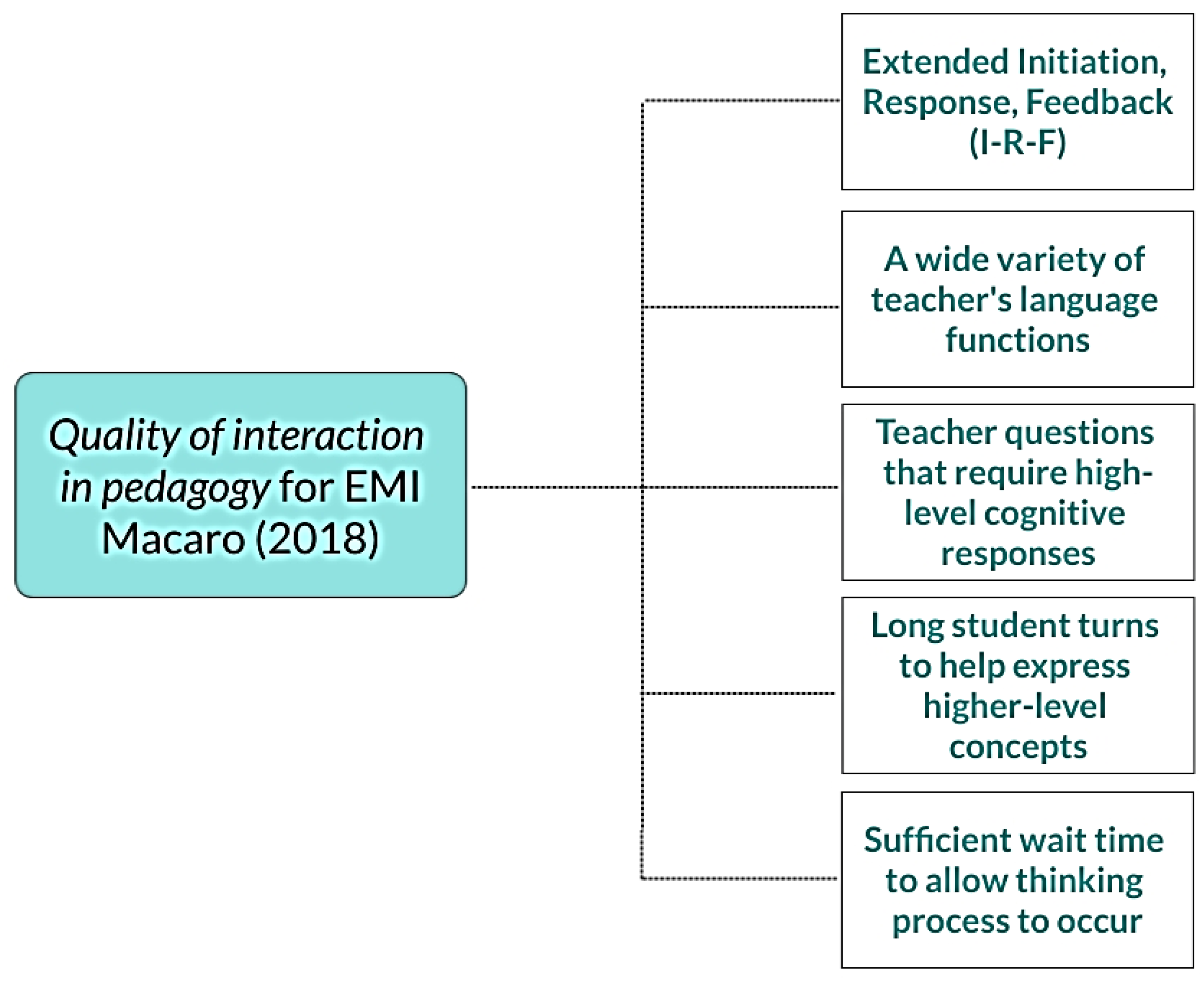



| Pedagogical Frameworks in HE | Key Attributes |
|---|---|
| Principles of good practice in higher education Chickering & Gamson (1987) [18] |
|
| Keys to change toward learner-centred practice Weimer (2002) [19] |
|
| First principles of instruction Merrill (2002) [20] |
|
| Principles of effective teaching in higher education Ramsden (2003) [21] |
|
| Framework of ‘Constructive Alignment’ Biggs & Tang (2007) [22] |
|
| Post-2015 standards of learner-centred education Schweisfurth (2015) [23] |
|
| Key elements of student-centred learning Jacobs, Renandya & Power (2016) [38] |
|
| Category | Possible Alternatives to be Used in Search Strings |
|---|---|
| Learning environment | (English medium instruction | EMI | English-medium instruction | English medium of instruction | English as the medium of instruction | English as a medium of instruction | English language as medium of instruction | English-medium education | English-medium higher education | English-medium teaching | English-medium university | English-medium courses | English-medium programmes | English-medium programs | English as the lingua franca medium of instruction | English medium content classes) (CLIL | Content and Language Integrated Learning | Content-Language Integrated Learning | Content-Based Instruction | Content-Based Language Teaching | Immersion Education | English for Specific Purposes | English for Academic Purposes) |
| Pedagogical approaches | (pedagogy | pedagogical | pedagogic | teaching | classroom-based | interactive | didactic | learner-centred | student-centered | student-centred | teacher-centered | teacher-centred) |
| Participants | (students | learners |needs | perceptions | views | challenges | experiences | obstacles | difficulties) |
| Educational level | (higher education | university | college | tertiary education) |
| Type | Category | Definition |
|---|---|---|
| Search and selection | Participants | Literature addressing student needs when studying academic subjects using English; learners’ perspectives on challenges and obstacles (as opposed to faculty or administrator views). |
| Search and selection | Learning environment | Literature entitled or described as Content and Language Integrated Learning (CLIL) or Immersion, but nonetheless following the ‘Country’ criterion below. |
| Search and selection | Publication date | Published or made accessible from database inception to February 2021. |
| Selection | Country | Literature presenting studies of which the whole research or significant parts were conducted in countries or jurisdictions in which the first language of the population was not English. (For example, the synthesis included studies from South Africa, which may fairly be considered an English-speaking country. However, according to official information (https://www.gov.za/, accessed on 21 April 2021), the country has 11 official languages, with over one quarter (25.3%) of population speaking isiZulu). |
| Selection | Education phase | Literature findings focus on students in higher education: undergraduate, graduate, and doctoral levels, excluding professional faculty and continuing education. |
| Selection | Document type | Published (e.g., journal articles, books, and book chapters which did not duplicate journal articles) and ‘grey literature’, that is, unpublished or published in non-commercial forms (e.g., conference proceedings, dissertations, and reports). |
| Selection | Language | No restrictions |
| Domain and Themes Names | Sample Quotations/Authors’ Comments from Selected Primary Qualitative Studies [Ref.] | N (%) of Total Articles (within Theme) | Articles Reporting the Themes [Ref.] | N (%) of Total Articles (within Domain) |
|---|---|---|---|---|
| META/LINGUISTIC DOMAIN | ||||
| Themes related to the use of medium of instruction (MOI) | ||||
| Impracticality of EMI for some content disciplines | “For those of us who study Law, English is not meaningful, and we would rather prefer other languages like Italian that provides a context closer to Spanish law” [64]. | 11 (28) | [12,53,64,65,66,67,68,69,70,71,72] | 35 articles (88%) |
| Divergent perceptions of English | “I told one of my [local] lab mates, ‘You are good in English, you have many vocabularies. So why you don’t speak with me?’ He said he is not confident from himself. And, this is why he feels shy to speak in front of me. And, I told to him, ‘Also I am Arabic. My native language is Arabic, not English, but I can speak English.’ So, he said ‘No, you are … something different” [73]. | 5 (13) | [70,73,74,75,76] | |
| Students’ low (general) English proficiency | “The major problem I am having now is about my language proficiency… so I found it difficult to study all the common courses in English by the time I began to study in university. I couldn’t even understand what my professor was talking about in the tutorial sessions” [6]. | 12 (30) | [6,12,64,66,74,76,77,78,79,80,81,82] | |
| Lecturers’ low English proficiency | “I sometimes even thought it would be better if she had just let the class be open to whole group discussions rather than giving lectures herself. I know she is a professional in the field but because of her language barrier, it is almost impossible to understand her lecture” [83]. | 10 (25) | [12,53,72,75,79,81,83,84,85,86] | |
| Lecturers’ non-standard language functions | “[The problem is] pronunciation of some specific words because the way they are pronounced by the lecturer differs from how I am used to pronouncing them” [75]. | 7 (18) | [53,67,75,81,86,87,88] | |
| Native vs. non-native English-speaking lecturer preferences | “I’d definitely go for a NEST [native English-speaking teacher]. It is because they have nothing to do with language issues while NNESTs experience troubles in delivering courses.” [80].“I think if it is an engineering course I would probably prefer a Turkish lecturer/…/because the other one is a “native speaker” he often speaks too fast without realizing it/…/especially he frequently uses unfamiliar terms” [80]. | 4 (10) | [53,71,80,88] | |
| Lecturers’ poor language awareness and support | “Because the professor is from Hong Kong, many students just spoke Cantonese to respond to questions. But the professor required us to speak in English. The students didn’t seem to like it and stuttered so much when they spoke” [74]. | 9 (23) | [53,68,69,74,78,83,88,89,90] | |
| Extensive code-switching and translanguaging | “Sometimes like even during the lectures when you’re like commenting on- on something, I usually do that in Swedish. It’s not necessarily English. It’s like switching back and forth. It really depends, so […]” [78]. “If we needed to say something and the subject was a bit more difficult, we spoke in Italian” [53] (code-switching).“They get caught up with their own language. That happened to me in my Civil Engineering practical work. We were a group of nine people and I was the only non-local and everyone just spoke Cantonese” [6] (translanguaging). | 12 (30) | [6,12,53,64,66,67,74,75,76,78,89,91] | |
| Extensive use of L1 in classroom | “Yes, our mother tongue was a great help for us in translation and interpreting technical terms and concepts. I use dictionaries to help me translate technical words into Arabic… The teacher was an Arabic speaker and I used to understand and comprehend 97% of the lectures” [65]. | 6 (15) | [13,65,66,67,78,90] | |
| Speaking and oral presentation skills | “It may already be difficult to talk about a graph in Spanish, so what do I say now in English? Yes, I’m twice as nervous” [68]. | 14 (35) | [6,12,52,53,64,66,68,73,74,81,82,89,91,92] | |
| Inadequate English vocabulary | “I used dictionaries to look up every word in the lesson when I did not understand what the professor was saying” [13]. | 10 (25) | [12,13,65,67,68,81,90,91,93,94] | |
| Academic writing skills | “I think people have got problems with writing. People can’t write. They know for instance, the word and they pronounce it but they can’t write it. This is a real problem. You find someone talks about the topic and understands the topic and when it comes to writing they make mistakes. You feel there are problems with structure, grammar, and clarity” [91]. | 9 (23) | [6,53,65,72,81,82,83,90,91] | |
| Lecture comprehension | “If the lecture is held in our first language, even when we are doing our own things, we can still get the content… However, it is totally different when the language changes to English… Thus, if I do not focus on the lecture, then the lecture becomes a background sound, like birding humming in the background. I wouldn’t care what the content is” [52]. | 11(28) | [12,52,53,66,75,81,82,86,88,90,91] | |
| Bilingual instructional materials | “We sometimes translate the whole handout [into Arabic] to understand it in a better way” [65].“Wordy and complex texts” [67]. | 6 (15) | [12,13,53,65,67,79] | |
| INSTRUCTIONAL DOMAIN | ||||
| Themes related to content lecturer competence and instructional strategies | ||||
| Monologic, non-interactive lecturing | “I think the lecturer’s teaching approach is very rigid, and inflexible, with the same pattern all the time. She just literally reads from the textbook and covers the material in the textbook. Nothing special for her teaching approach. This results in the class atmosphere being completely dead [literal translation “Dead Air”]” [52]. | 10 (25) | [6,12,52,53,64,67,79,84,86,87] | 21 articles (53%) |
| Assessment issues | “[Course Title] has multiple choice questions … So if you can do exercises, it’ll be okay. And for [Course Title], you need to do every exercise. The test questions are similar (to those in the textbook) … Just memorise the test questions, and input, output. I forgot after the exam” [84]. | 10 (25) | [6,53,64,65,66,67,72,78,84,88] | |
| Attending to students’ diverse needs/abilities | “So … in the first class we took SAT test, and it was not difficult for us [ local students]. Just a few words we don’t understand … I think it’s for talented junior high students …. So what the instructor taught is not difficult for us, but rather difficult for international students. The instructor needs to make a balance” [84]. | 6 (15) | [6,12,52,79,82,84] | |
| Non-attending to students’ personal qualities and cultural sensitivities | “The professor, like: ‘Come on, say something.’ ‘You have, you have something to say, right?’ And you’re like, really? Nothing (laughs). […] I think they are more soft with the local because the local don’t speak, they think that the international would do it, so they put you in the corner” [73]. | 4 (10) | [6,73,82,83] | |
| Lecturers’ speaking rate | “There was a problem in the accounting courses. For instance, we couldn’t understand from the teacher of Financial Accounting course in semester one. Even those who graduated from the school here and who have business backgrounds faced a problem with understanding the teacher… she was fast” [91]. | 5 (13) | [12,52,75,90,91] | |
| Lack of clarification and corrective feedback from lecturers | “I think EMI leaves too much pressure on Korean students, and I feel like I have to survive on my own. I am sure my assignments submitted in English are full of grammar errors, but I don’t get any feedback on my writing from the instructor. I sometimes feel frustrated that there is little support for Korean students whose mother tongue is Korean and who is not familiar at all with learning in English” [83]. | 5 (13) | [13,65,75,83,90] | |
| SOCIO-CULTURAL DOMAIN | ||||
| Themes related to students’ learning in CMGs and out-of-class environments | ||||
| Communication among home/international students | “… we have a [Mainland] Chinese girl in our class, and she has a bit of problems with English, so she doesn’t understand what I’m telling her so when we, we were in the same group and she didn’t understand what I wanted from her so we had a misunderstanding in the group work which resulted in a worse grade” [78]. | 9 (23) | [6,12,77,78,79,81,82,83,85] | 21 articles 53% |
| In-group pressures | “Similarly, following just one incident of working in a mixed group which included two students from [Mainland] China, Sam had avoided working in such groups in the EMI programme: ‘since then I have sort of tried to find at least people who speak Swedish or English” [78]. | 6 (15) | [73,74,77,78,84,95] | |
| Multiple and/or unfamiliar accents | “At first, I did have great difficulties in understanding international students from Pakistan or India. They had a very good grasp of knowledge and spoke quite fluently, but I did not understand what they said due to their accents” [95]. | 6 (15) | [6,12,71,77,85,95] | |
| Peer support | “Even in peer learning groups they preferred to work together as Rwandans. One reason for this… was that South African students looked down on them because they were not proficient in English” [82]. | 4 (10) | [78,82,88,95] | |
| Divergent attitudes toward class participation | “I mean my basic think is there is a question, the teacher is asking, and I’m, like, thinking, ‘Do I have anything to say, regardless of who is there and what they do and think?’ […] And if I feel like I have something to say, I say it.” [73]. | 5 (13) | [73,74,84,85,86] | |
| Collaborative learning and teamwork | “If a student in my secondary school refused to do anything when s/he was doing a project, they would be caught and punished. But in university, professors won’t care about which student is a free rider. They only care about how good their students’ group project is and give marks based on the quality of the project” [6]. | 5 (13) | [6,78,96,97,98] | |
| META/COGNITIVE DOMAIN | ||||
| Themes related to students’ content learning and comprehension | ||||
| Processing and comprehension of difficult content | “[When concepts were complex to explain] ‘even for the lecturers, it sometimes became a bit tricky” [53].“Like in the textbook a section requires us to reflect on the theory …. Provide examples …. But the instructor skipped it …. But with reading by myself, I can take time to think” [84]. | 11 (28) | [12,52,53,65,67,68,69,75,76,79,84] | 19 articles (48%) |
| Poor background knowledge | “…Students with weaker English, coupled with a weaker background in science, could sometimes struggle with the extensive reading required on the MSc” [53]. | 4 (10) | [52,53,88,91] | |
| Over-simplification of content | “What is taught [via EMI] will be relatively easy and the test is easier” [84]. “The emphasis on learners’ inadequate English proficiency compels the instructors to lower their expectations about student performance” [88]. | 3 (8) | [74,84,88] | |
| Extensive use of technical language | “It is common that we don’t know what is being taught in the lecture so we need to spend a lot of time on looking up the meaning of some technical words so we understand what will be taught before the lecture begins” [6]. | 7 (18) | [6,12,72,75,88,91,94] | |
| Lack of practical demonstration/application of knowledge | “Seriously, for the content of the course, I have no idea how it influences me … I feel like I am still a test-taking machine, studying those theories. I can barely see how it makes my life better; it’s kind of no use to my daily life” [84]. | 3 (8) | [67,74,84] | |
| Poor rhetorical and critical thinking skills | “When it comes to discussion, it’s usually just silence and until someone breaks it, it’s always really reluctant. From my experience in the UK, people are a lot more engaged and argumentative, so that’s one thing that really stands out [6]. “Everyone expected you to give a critical opinion, but nobody trained you how to do a critical assessment. The school system that I went through didn’t train you how to be critical, like outside the box” [97]. | 3 (8) | [6,83,97] | |
| AFFECTIVE DOMAIN | ||||
| Themes related to students’ socio-emotional responses toward EMI | ||||
| Lack of confidence | “I feel shy. Embarrassed. I can’t catch up with the teacher because my English is not good, and my memory is not so strong to keep all information” [12]. | 6 (15) | [12,13,52,64,79,82] | 16 articles (40%) |
| Fear of losing face | “My English is not so good, so I find myself suffering a lot when sitting in EMI classrooms. I did not ask questions in class because I was afraid that I cannot make myself understood. When the instructors asked “are you with me”? I would always say “yes”, even though I was not. If I said “no”, I was afraid that I could not understand the instructors’ further explanations.” [13]. | 5 (13) | [12,13,64,68,74] | |
| Teacher–student rapport | “Yet this is not the case with teachers who are native speakers of English. We dared not ask them for clarification after class because we cannot understand their English” [13]. | 2 (5) | [13,95] | |
| Frustration | “Some students do not understand what the teacher says and that interrupts the flow of the class that becomes really slow and some of us feel frustrated” [64]. | 6 (15) | [6,12,64,74,79,95] | |
| Dissatisfaction | “Though those who earn the first place in the department will attend classes, showing their passion, but in general … I see classmates are using smartphones. I don’t want to be like that [skip classes], but I feel it boring and cannot listen to anything” [84]. | 5 (13) | [68,74,79,84,87] | |
| Anxiety and stress | “I could understand only 10%–20% of the lectures in the first few weeks. The teacher for our core course speaks English with a strong Hong Kong accent. I was very nervous. But the more nervous I was, the harder it was for me to understand the teacher” [81]. | 5 (13) | [6,52,64,68,81] | |
| Boredom | “It’s just like senior high school, listening during the class, one-way delivering, and back to home study, finally aiming to score high on the test. I cannot figure out what’s the difference between college and senior high school. This kind of feeling continues in [Course Title]” [84]. | 3 (8) | [12,52,84] | |
| Fatigue | “What made the situation worse is that the lecturer would continue the lesson without any breaks” [52]. | 2 (5) | [12,52] | |
| Intrinsic motivation | “In addition to the academic reasons such as getting a “certificate” because it is essential for the future, I also like listening to “music” “in English,” and I watch TV “in English” more” [68]. | 5 (13) | [13,65,66,68,84] | |
| Extrinsic motivation | “They [parents] are always telling me that English is extremely important”. “They are a drag, a pest” [68]. | 4 (10) | [12,53,68,84] | |
| INSTITUTIONAL DOMAIN | ||||
| Themes related to university-wide EMI policies and conditions affecting students’ learning | ||||
| Ineffective curriculum designs and planning | “It [EMI course] was generally not effective; for some it was too short, for others the methodology was not suited to beginners and others considered the level of the course too low or ‘irrelevant’ to postgraduate students” [82]. | 4 (10) | [74,79,82,87] | 8 articles (20%) |
| Inadequate self-access support | Both staff and students criticised support with regard to its availability, effectiveness, or, in one case, price. “While “special TOEFL classes” are sometimes offered, Sandra (Domestic student, University C) doesn’t “go to these classes as they are expensive. They are not free. 30,000 Yen” [89]. | 4 (10) | [53,82,89,93] | |
| EAP courses not meeting students’ needs | “I took one such course offered by the university in order to improve my spoken English and grammar use. However, I found the instructor simply taught the course in English, pretty much like the way other marketing major-related classes were taught, rather than really targeting my spoken and grammar problems” [13]. | 3 (8) | [13,82,89] | |
Publisher’s Note: MDPI stays neutral with regard to jurisdictional claims in published maps and institutional affiliations. |
© 2021 by the authors. Licensee MDPI, Basel, Switzerland. This article is an open access article distributed under the terms and conditions of the Creative Commons Attribution (CC BY) license (https://creativecommons.org/licenses/by/4.0/).
Share and Cite
Ismailov, M.; Chiu, T.K.F.; Dearden, J.; Yamamoto, Y.; Djalilova, N. Challenges to Internationalisation of University Programmes: A Systematic Thematic Synthesis of Qualitative Research on Learner-Centred English Medium Instruction (EMI) Pedagogy. Sustainability 2021, 13, 12642. https://doi.org/10.3390/su132212642
Ismailov M, Chiu TKF, Dearden J, Yamamoto Y, Djalilova N. Challenges to Internationalisation of University Programmes: A Systematic Thematic Synthesis of Qualitative Research on Learner-Centred English Medium Instruction (EMI) Pedagogy. Sustainability. 2021; 13(22):12642. https://doi.org/10.3390/su132212642
Chicago/Turabian StyleIsmailov, Murod, Thomas K. F. Chiu, Julie Dearden, Yukiko Yamamoto, and Nigora Djalilova. 2021. "Challenges to Internationalisation of University Programmes: A Systematic Thematic Synthesis of Qualitative Research on Learner-Centred English Medium Instruction (EMI) Pedagogy" Sustainability 13, no. 22: 12642. https://doi.org/10.3390/su132212642
APA StyleIsmailov, M., Chiu, T. K. F., Dearden, J., Yamamoto, Y., & Djalilova, N. (2021). Challenges to Internationalisation of University Programmes: A Systematic Thematic Synthesis of Qualitative Research on Learner-Centred English Medium Instruction (EMI) Pedagogy. Sustainability, 13(22), 12642. https://doi.org/10.3390/su132212642