


Abstract
The proponents of the entrepreneurial motivation dichotomy have argued that opportunity-driven entrepreneurs are more likely to succeed and sustain in entrepreneurship, unlike people who start-up businesses out of necessity. However, disagreement still exists on why and under which conditions the former might outperform the latter. This research contributes to this debate by examining the mediation role of psychological capital in the relationship between entrepreneurial motivation and business success among youths. This study relied on a random sample of 295 young entrepreneurs surveyed from Bukavu in the Democratic Republic of the Congo (DRC). We applied partial least squares to analyze the hypothesized relationships. Evidence for the positive effect of opportunity-led motivation on psychological capital was found, but the findings did not support any direct effect of entrepreneurial motivation on business success. Instead, psychological capital positively and significantly mediated the relationship between entrepreneurial motivation and business success. This paper makes a distinctive new contribution to the understanding of the intriguing and controversial entrepreneurial motivation dichotomy—a business success relationship. To this end, we have found out that opportunity entrepreneurs have 3% more chance of succeeding in businesses compared to necessity entrepreneurs, because the former outperform the latter by 4% in the dimensions of psychological capital. This paper has new policy implications, as it reveals the great importance of psychological capital in promoting business success, thus reducing unemployment among youths, and offers tips from which psychological capital can be built or improved.
1. Introduction
Entrepreneurship is one of the solutions to the problem of unemployment among youths that plague many countries in the world [1]. In 2014, more than 73.3 million young people were unemployed, and youth overall unemployment rate was set at 13% in the world [2]. The problem is more acute across Africa, which is also the world’s youngest continent [2] where two-thirds of nearly 420 million youths aged 15–35 are either unemployed or underemployed [3].
The Democratic Republic of the Congo (DRC) is the second-largest country in Africa and one of the most natural resources-endowed countries on earth. Still battling to recover from civil strife and wars, the country has some of the most challenging institutional and entrepreneurial ecosystems on the continent that have kept investors’ concerns high [4]. The DRC offers many entrepreneurial opportunities in agricultural-related activities, in tourism, energy, mining, transport, and the information and communication technology sectors, with a population of more than 80 million [5]. However, in the “easiness of doing business” report for the year 2020, the DRC scored 36.2% and was ranked—in 183rd position out of 190 countries surveyed—among the least entrepreneurial countries in the world [6]. The youths are largely excluded from the mainstream economy, as the unemployment rate among them is high and only a few have benefited from the opportunities offered by their country [7]. The dilemma of a higher unemployment rate coupled with the under-participation of youths in entrepreneurship has been given little or no attention by researchers. Questions of whether a few of them who started up businesses are successful, and the drivers of their perceived success levels have been under-investigated. Yet, these questions are important as it is only when youth entrepreneurship is successful that it might be regarded as a credible solution to unemployment [1] particularly given that the DRC, like most African countries, has a youth bulge demographic profile.
This research argues that examining the drivers of business success among the youths has the potential for a compounding effect on motivation for more youths to participate in entrepreneurship within a dynamic and volatile business environment of developing and emerging African economies [8]. Subsequently, successful local youth ventures would provide role model entrepreneurs to whom youths will look up to, learn, and get inspiration from in the start-up stage [9].
This study draws from the cognitive view of the entrepreneurship [10,11,12,13,14,15] to examine the relationship between entrepreneurial motivation (EM), psychological capital (PsyCap) and business success (BS) among youths. The EM literature considers that the creation of a business can be chosen deliberately out of a passion for exploiting a perceived a viable business opportunity [16] or be forced upon an individual by circumstances of poverty or of unemployment [10,17]. These two exclusive dimensions are usually referred to as “push or necessity” and “pull or opportunity” factors, respectively [17]. There is a belief that, unlike necessity entrepreneurs, opportunity entrepreneurs have more chance to succeed [18] since they are driven by the need for achievement and excellence rather than money [19,20].
While it may seem conceivable that there is a relationship between EM and BS [21], this relationship, however, remains subject to intense debate among researchers. Disagreement and ambiguity still exist on why and under which conditions opportunity might outperform necessity entrepreneurs [10,17,22,23]. Some researchers have argued that necessity-driven entrepreneurs should equally succeed because they are likely to work hard to avoid failure for they are unlikely to have the option of going back [17]. Other scholars suggest that the EM dichotomy between opportunity and necessity entrepreneurs is misleading because the entrepreneurial process is so dynamic to the extent that push may become pull entrepreneurs along the business life course and vice versa [17,24].
This study posits that the ambiguity may lie in the fact that the mechanism and conditions through which EM relates to or influences BS are not yet examined. The direct effect of EM on BS is incomplete unless we account for why opportunity-driven entrepreneurs can create superior value compared to necessity-led entrepreneurs. This study is based on the theory of the resource-based view [21,25,26,27] to examine the PsyCap as the alternative mediating variable between the EM and BS relationship. Subsequently, this paper responds to the call for more research to use PsyCap as a mediator [28].
More studies with promising results are emerging linking employee and owner’s PsyCap to business performance [29,30,31]. PsyCap has its origin in the positive organizational behavior literature [32,33] and is a state of mindset made of four constructs: hope, optimism, self-confidence, and resilience [6,16,31,32,34,35]. We hope that opportunity-driven young entrepreneurs have higher PsyCap, which justifies why they are more likely to succeed in businesses compared to necessity-driven entrepreneurs. We base our argument on the fact that higher PsyCap individuals are happier, competitive, emotionally intelligent, assertive, leaders, empathetic, sociable, patient, open to criticisms [29], more committed, and less stressed [36,37]. In addition, they would be more confident in what they do, can survive any drawback, and set realistic goals that they pursue persistently with clear plans, while those with a lower PsyCap may experience less or the opposite of these values [7,38]. Thus, we draw from the theory of the resource-based view of the firm to acknowledge that PsyCap dimensions are valuable and non-substitutable strategic resources in the short and long term, but imitable and imperfectly rare resources in the long term because they are open to development [7,39]. Then, what makes the difference between necessity and opportunity entrepreneurs in the short run is the tacitness, the complexity, the non-observability, and scarcity of PsyCap dimensions that generate causal ambiguity in competence-based advantage, and thus raise barriers to imitation by necessity entrepreneurs.
This research seeks to (1) examine whether the level of BS differs between the necessity and opportunity-driven youth entrepreneurs; (2) to evaluate the level of perceived BS and PsyCap of youth entrepreneurs (3) explore the relationship between PsyCap and BS; (4) assess the correlation between EM and PsyCap; (5) and examine the mediating effect of PsyCap on the relationship between EM and BS. The findings of this study do not only highlight the importance of PsyCap in promoting BS but also, offer guidance on how PsyCap can be fostered or improved among youths. They also contribute to the understanding of an intriguing EM–BS relationship by showing that PsyCap is the missing link.
The remaining paper is organized as follows: the second section presents the review of the literature and hypotheses, the third section describes the methodology used to address the research questions; the fourth section presents the findings, while the fifth section presents the discussion. The sixth section offers the conclusion and recommendations for research and policy formulation.
2. Literature Review and Hypotheses Development
2.1. Business Success (BS) and the Theory of Resourced-Based View of the Firm
Despite the popularity and interest of the subject, there is no consensus definition of BS among academics and practitioners [40,41]. However, two views emerge from the literature and these include the subjective and the objective measures of BS.
The common objective measures of BS include the number of employees and customers; survival and continuation as opposed to closure; market share; performance which in turn is assessed based on profitability and income and the total value of assets [31,34,42,43,44,45,46,47]. Subjective measures of BS refer to the feeling the entrepreneur has towards his/her overall situation, such as the perception of personal fulfillment, social recognition and contribution, goals’ achievement, life satisfaction, and family business balance [48,49].
This study opted for the subjective measures, as most youths entering the entrepreneurship space in developing and emerging African economies predominantly start-up out of necessity [19,24]. As such, most of them would own informal and semi-formal small businesses that lack the appropriate management systems that could provide reliable financial statements and employment compliance records to assess objectively their success [50]. Interestingly, research has established a strong and positive correlation between subjective and objective measures of BS [51].
The review of the literature on the antecedents of BS shows that they can be categorized into three themes: factors related to the entrepreneur, those related to the business itself, and finally those related to the environment [30,52,53]. While we do acknowledge the relevance of the business and environmental-related factors in explaining BS, this research focus is put on the entrepreneur, who decides which business to pursue and finds the strategy to adapt to the environment.
We examine the effect of EM on perceived BS through an entrepreneur’s PsyCap. Our argument is drawn from the cognitive view of entrepreneurship that posits that the EM and the behaviors of individuals are important antecedents of BS [54].
The inclusion of PsyCap as an eventual driver of BS is further based on the theory of the resource-based view of the firm. According to this theory that is widely used in the strategic management literature, the sustainable competitive advantage is often achieved by businesses that have rare, inimitable, non-substitutable, and valuable resources or capabilities [25,55]. Despite the popularity of this theory in explaining the differences in competitive advantage across firms [21,25,27,55,56], it does not implicitly refer to the entrepreneur’s PsyCap as an intangible strategic resource. We expect that PsyCap dimensions are strategic resources or core competencies, such as human, physical, and other intangible (e.g., reputation) resources, heterogeneously distributed among opportunity and necessity entrepreneurs. The expectancy is that opportunity entrepreneurs enter into businesses because they already believe in their entrepreneurial competencies and have more means to overcome any drawback compared to necessity entrepreneurs who often startup businesses with limited funds, social capital, and poor entrepreneurial skill.
The following sections will operationalize and define the key dimensions of PsyCap within the organizational behavior literature. Next, we base on this literature to explain and justify the likely direct effect of PsyCap on BS and later, we turn to the direct effect of EM on PsyCap and BS. Finally, we provide support for the hypothesized indirect or mediating influence of PsyCap on BS.
Psychological Capital—PsyCap
PsyCap is a construct that was first adopted in the workplace to symbolize positive psychology [57]. It consists of mental capabilities: self-efficacy, optimism, hope, and resilience [16,35] that can be measured, developed, and managed for performance improvement [6,14,35].
Entrepreneurial self-efficacy is the positive belief or confidence in one’s entrepreneurial capabilities [11,58] or the degree to which a person feels capable of mobilizing the motivation, cognitive resources, and courses of action needed to successfully perform entrepreneurial activities [59,60,61,62,63]. The hope construct captures someone’s ability to aim at a goal that is slightly challenging and realistic [31,64]. Individuals who score highly in the hope dimension have both the will (agency) to reach a particular goal [65], as well as concrete ideas of how to attain it (pathways) [6,31,64,65]. Optimism captures the extent to which the individual is used to expecting that s/he will experience a good outcome from his/her behaviors [65,66]. Resilience is the extent to which individuals can bounce or rebound back from a negative experience, failure, and adapt to or even learn from life challenges [14] and stressful events [35].
2.2. Effect of Psychological Capital on Business Success
The studies examining the effect of PsyCap on BS are just emerging, although with promising results [31,32,34,67]. To this end, it has been reported that resilient people with higher levels of belief and optimism about their success have a high probability of succeeding in entrepreneurship [31,34,67,68]. The entrepreneurs who have high PsyCap set realistic, well-planned goals and find alternative routes to achieve them. They are more committed, self-confident, hard workers, and persistent than their counterparts [68]. In addition, higher PsyCap individuals exhibit some of the behaviors associated with successful entrepreneurs and these include creativity, innovation, flexibility, adaptability, emotional intelligence, and autonomy orientation [16,35,69]. Based on this background, we posit that:
Hypothesis 1 (H1).
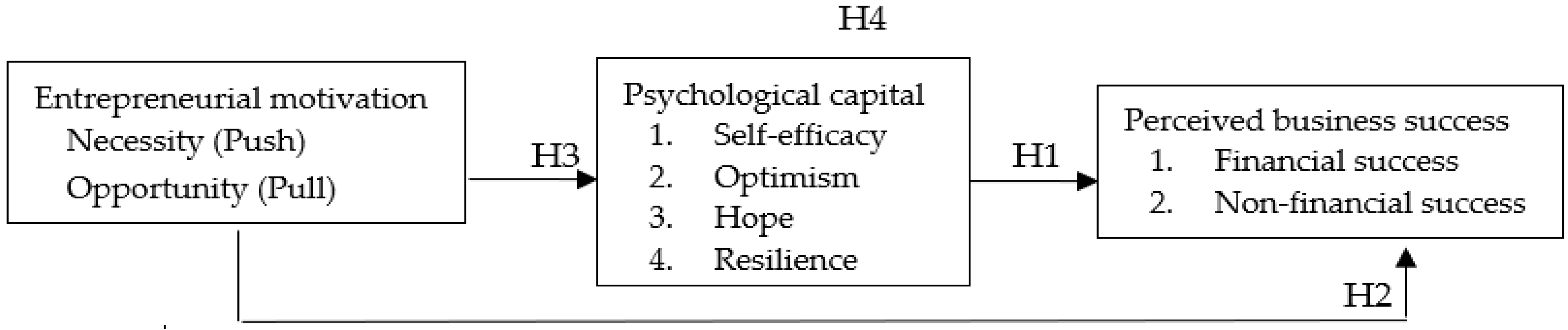
PsyCap has a positive effect on BS among the youths.
2.3. Effect of Entrepreneurial Motivation on Business Success
EM is about the goals that the entrepreneur seeks to achieve by setting up a business [18]. Two exclusive dimensions of EM are found in the literature and they include necessity and opportunity entrepreneurs [13]. This classification has gained popularity in the field of entrepreneurship with the Global Entrepreneurship Monitor (GEM) reports that show that majority of entrepreneurs in developing countries are necessary ones [70,71,72]. Unlike necessity entrepreneurs, opportunity-driven entrepreneurs neither enter into entrepreneurship to survive unemployment or poverty nor because they are frustrated in their jobs or living conditions [17,18,19,28,31,35]. Opportunity entrepreneurs are those who have deliberately chosen entrepreneurship as a career option out of a passion for exploiting a perceived viable business opportunity [73]. They are motivated by the need for achievement or excellence instead of earning money, which is incidental and part of the measures of success [18,20].
Entrepreneurs who were motivated by the opportunity to start their businesses have often been found to have higher success levels than necessity entrepreneurs [15,22,52,74,75,76]. The former often have entrepreneurial skills and enjoy what they do (passion). They are usually better prepared to embark on entrepreneurship, unlike necessity-driven or push entrepreneurs who randomly pursue entrepreneurial activities without any vision and necessary resources. Based on this background, the following hypothesis is posited:
Hypothesis 2 (H2).
Opportunity entrepreneurs would be more successful than necessity entrepreneurs.
2.4. The Mediating Role of PsyCap in the Relationship Between EM and BS
EM research is a mature topic in the field of entrepreneurship, however, the relationship between EM and BS is inconclusive and the findings are imbalanced. Some researchers consider the EM dichotomy to be simplistic and misleading [73]. They indicate that the EM does not matter for BS because it is a complex phenomenon that fluctuates over time, across the individual’s life course, from the necessity to opportunity and vice versa [10,17]. In addition, it has been reported that necessity-driven entrepreneurs should equally succeed because they are likely to work hard to avoid failure, for they are unlikely to have the option of going back [17]. What we learn from the review of the literature is that disagreements still exist as to why opportunity entrepreneurs might create superior value compared to necessity ones. We draw from the theory of the resource-based view of the firm to argue that opportunity entrepreneurs are more likely to succeed in businesses because they would have higher PsyCap compared to necessity entrepreneurs. We thus examine PsyCap as a mediating variable in the EM–BS relationship. Although some commentators would argue that necessity entrepreneurs could develop a higher level of PsyCap that is rooted in hard work and strengthened by the fact that they have limited career options, we posit the opposite. While we do not underestimate the impact of hard work on BS, we argue that entrepreneurship is about resources and competencies among which psychological capital would play a key role [7]. People who embark on an entrepreneurial career to exploit a perceived viable opportunity would be self-confident to take advantage of the occasion because they believe it will lead to a positive outcome (optimism) since they have already set realistic goals about the opportunity (hope) and are ready to overcome any drawback along the way (resilience). We acknowledge that PsyCap dimensions are valuable and non-substitutable strategic resources, in both the short and long run. However, they can be improved, imitated, or developed, thus become widely distributed among both necessity and opportunity entrepreneurs in the long run [7,39].
Then, what makes the difference between necessity and opportunity entrepreneurs in the short run is the tacitness, the complexity, the non-observability, and the scarcity of PsyCap dimensions that generate causal ambiguity in competence-based advantage, and thus raise barriers to imitation by necessity entrepreneurs. Two hypotheses derive from this background and are formulated as follows:
Hypothesis 3 (H3).
Opportunity entrepreneurs develop higher PsyCap compared to necessity entrepreneurs.
Hypothesis 4 (H4).
PsyCap positively mediates the relationship between EM and BS among youths.
The four hypotheses and their relationships are presented in Figure 1 below.
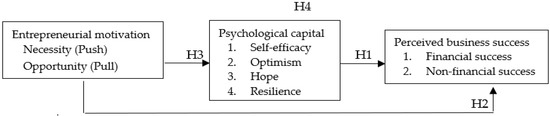
Figure 1.
Conceptual model and hypothesized relationships. Source: Literature Review.
3. Methodology
3.1. Population and Sampling
The targeted population for this study consists of young entrepreneurs between the ages of 15 and 35 years as per the African Union Youth Charter age limit [77]. A multistage sampling procedure was used to select the youths in the study. First, we focused on the major axes where the majority of the youths carry out their business activities in Bukavu city including the Patrice Emery Lumumba axis, the Kadutu axis passing through the main market, and Bagira communes, to identify youths that formed the basis of the selection. In total, 1400 youth entrepreneurs were identified, out of which, a random sample of 300 youths whose age was within the range for the study was selected for the interview regardless of the kind and size of their business. This selection was based on an existing study [78] sampling technique at a 95 percent confidence level and youths freely decided to participate. Although the response rate was 100 percent, only 295 questionnaires were, however, properly filled in and were thus used for analysis. Most of the youths surveyed were shop holders and a few were involved either in agribusiness activities or in information technology (IT) services.
3.2. Measurement of Variables
The variables used in this study are latent and categorical, measured by “multi-item scales” adapted from empirical studies. “Multi-item levels” have the advantage of allowing measurement errors to cancel out against each other while improving the validity and reliability of the instruments [14]. The variables are measured on a 5-point Likert scale ranging from “1: strongly disagree” to “5: strongly agree” [79].
BS was measured by perceived financial and non-financial success from 16 items [15,80,81] listed in Appendix A.
EM measurement was adapted from two studies [13,82]. We used 16 items classified into two dimensions: opportunity and necessity (Appendix B). The significant items from the exploratory factor analysis were averaged to obtain an index for each of the EM dimensions. If the average of opportunity dimension items was higher than that of necessity dimension items, then the entrepreneur was opportunity-driven and coded 1, and necessity-driven if otherwise and coded 0.
PsyCap was measured using 24 items classified into four dimensions that originated from the work of an existing study [35] and adapted to the entrepreneurial career context. These dimensions were self-efficacy, hope, optimism, and resilience [7,59,60,61,62,63]. The details of PsyCap items are provided in Appendix C.
3.3. Controlled Factors
In addition to EM, BS, and PsyCap, the study used controlled factors such as sex (coded 1 for males and 0 for females); business age which refers to the time since the creation of the business until 2019, which was the year of the survey implementation; and the level of education (coded as ‘‘0‘‘, if the respondent did not study at all, ‘‘1‘‘ if s/he completed the primary school, ‘’2‘‘ if s/he completed the high school and ‘‘3‘‘if s/he held any university degree. We used four Likert scale items ranging from “5 strongly agree” to “1 strongly disagree” to measure innovation. The innovations items were: “I keep introducing new methods to getting the work done”, “I always change the way I do my business”, “I keep introducing new products and/or services based on the needs of customers”, and “I always create value for the customer through creative ideas”.
3.4. Reliability and Validity of the Measurement Scales
We applied the exploratory factor analysis to reduce a large number of items to a smaller number by grouping the items into the dimension (factor) that measures the same thing [1]. Any item whose factor weight (structural coefficient) was higher than or equal to 0.41 on several factors or with a contribution lower than 0.50 or both, on at least one of the components loaded was deleted [83]. Additionally, we removed items with communality (quality of representation) lower than 0.4 while retaining the dimensions with an Eigenvalue higher than one. The dimensions satisfied the criterion of at least 60 percent of variance explained to ensure that the factors account for a significant amount of the variation [84].
We performed the reliability and validity test on the variables, and the results in Table 1 reveal that the three constructs exhibit significant Cronbach alpha coefficients and are higher than the standard threshold of 0.7 [85,86]. Such results show that the instruments are internally consistent. Therefore, they are reliable and likely to be replicable in similar conditions. The information in Table 1 also indicates that the values attached to the average variance extracted (AVE) were higher or equal to the recommended cut-off of 0.5 [86]. We performed Bartlett’s sphericity test and constructed the sampling adequacy (MSA) or Kaiser–Meyer–Olkin (KMO) index. The results indicate that the items retained are coherent and adequately measure the constructs of BS, EM, and PsyCap. The joint information from construct reliability, the AVE values, KMO, and Bartlett’s sphericity test show that all used measures exhibit convergent validity. Additionally, Table 1 shows that all the squares of correlation coefficients between variables are lower than the average variance extracted. Such results prove that each construct is different from the other; hence discriminant validity is satisfied [79].

Table 1.
The reliability and validity test on variables.
3.5. Model Specification, Data Processing, and Analysis
In this study, some control variables such as sex [15,87], business age [88], level of education of the entrepreneur [88], and innovation could explain both the dependent variable (BS), the independent variable (EM) and the mediating variable (PsyCap). These variables could hide the real effects of EM and PsyCap on BS. Hence, we neutralized the impact of the control variables to analyze only the effect of the exogenous and mediating factors on the endogenous variable.
To this end, we regressed PsyCap on the owner’s sex, level of education, and business age; EM was regressed on the owner’s sex and level of study; and BS on the owner’s sex, business age, level of education, and degree of innovation of the entrepreneur. By regressing each of the variables of interest on the control variables, the residuals of each of the three estimated models (we controlled the effects of the control variables) were generated. Finally, the residuals of BS, EM, and PsyCap were used as values of the variables for the different regressions of structural equations.
Structural equation modeling (SEM) was used for analysis. To reduce the model’s complexity, the items related to each dimension were averaged to get an index [63]. The advantage of SEM is that it takes into account the relationship between simultaneous, separate but interdependent equations of the model [79,86]. SEM makes it possible to examine different direct and indirect (e.g., mediation) effects and provides confirmatory factor analysis information on how well the conceptual model fits the data [7,89]. It minimizes the residual error in the endogenous latent variables [2] and reduces the bias in the estimators [89] regardless of the normality of the variables [63].
The partial least squares (PLS) method was used to estimate the parameters [90]. The inferential statistic was performed to assess the significance of the parameters estimated in the following simultaneous equations model:
The coefficient c2 in Equation (2) defines the effect of the independent variable—EM—on the outcome variable—BS—controlling for the mediating variable—PsyCap—and represents the direct effect. The m coefficient establishes the impact of the mediating variable on the outcome controlling for the independent variable. The coefficient “a“ in Equation (3) defines the effect of the independent variable on the mediating variable. The coefficient c1 represents the overall effect of the independent variable on the outcome variable, also known as the total effect. The product of “a” and “m” coefficients defines the indirect effect of EM on BS through the PsyCap.
4. Findings
4.1. Sample Characteristics
The findings in Table 2 indicate that the majority (72.9%) of the young entrepreneurs surveyed were male. So, the male to female entrepreneur ratio is 2.7. This is not surprising because previous studies indicate that women are less represented in the entrepreneurial career despite a level of desirability is often equal to that of men [72,87,91]. Additionally, the Global Entrepreneurship Monitor indicates that women are more afraid of failure than men, which explains their reluctance to embark on an entrepreneurial career [72]. Many of the young entrepreneurs in Bukavu hold either a secondary school qualification (31%) or a university degree (63%). About 61 percent of the young entrepreneurs from Bukavu consider themselves to be innovative. The average number of years of experience in business is 3.4. This implies that the founders still lack experience and are not yet well established.
Table 2.
Some characteristics of the respondents.
4.2. Exploratory Factor Analysis
The results in Table 3 present the principal component analysis (PCA) of the major factors that measure the BS. According to the findings, the items representing BS are grouped in three-dimensions. The first dimension includes young entrepreneurs that consider themselves to be successful when they achieve economic profit and self-fulfillment; the second dimension includes those that consider themselves being successful when they are recognized by their environment, contribute to the development of their society and find a balance between their business and private life. Finally, the third dimension includes those who feel successful when they are empowered and satisfied. The three dimensions extracted explain 62% of the variance of entrepreneurial success. Financial profitability and personal fulfillment (FSPF) are the main components of business success, with 22% of the total variance explained.
Table 3.
Exploratory factor analysis for business success. FSPF: financial success and personal fulfillment; SRCWLB: social contribution, recognition, and the work-life balance; AS: autonomy and satisfaction.
The second dimension, which is social recognition and participation, the balance between professional and private life (SRCWLB), explains 22% of the variance of the BS by young entrepreneurs. Finally, the third dimension, which is autonomy and satisfaction (AS) explains 18% of the variance of the BS by young entrepreneurs. All the items are of acceptable quality (communality >0.4; structural coefficient ≥0.5 on at least one factor and not more than 0.4 on more than one element at a time).
The EM exploratory factor analysis results presented in Table 4 reveal that EM is made of four components that contribute to explain about 60% of the variance. The first dimension includes the need to fight against poverty (FAP), which explains 18%; the second includes the frustration in employment and studies (FES), which explains 15%, the third includes the passion for entrepreneurship (EP), which explains 13% and finally, the need to make a social contribution (NSC), which explains 13%. The four components can be grouped into two broad dimensions regarding the Global Entrepreneurship Monitor conceptualization [72]. The first two components (FAP and FES) refer to necessity-driven entrepreneurs, while the last two (EP and NSC) refer to opportunity-driven motivation.
Table 4.
Exploratory factor analysis for entrepreneurial-driven motivation (EM). FAP: fight against poverty; FES: frustration in employment and studies; EP: passion for entrepreneurship; NSC: the need to make a social contribution.
The exploratory factor analysis results presented in Table 5 indicate that only 12 items out of 24 initially retained were enough to measure PsyCap because they were satisfied with the commonality and loading factor criteria. They were grouped into four dimensions and contribute to explaining about 59% of the variation in PsyCap. Hope appears as the main component (15%) of PsyCap, followed by self-efficacy (15%), optimism (15%), and resilience (13%).
Table 5.
Exploratory factor analysis for psychological capital (PsyCap).
Table 6 summarizes the mean scores information; the total variation explained, the standard deviations and z-values of the study variables, and their dimensions. Z-values allow us to test the hypothesis that the average scores are different from 3 (50%) for BS and PsyCap and the assumption that the young people are most motivated by necessity rather than an opportunity. The information in Table 6 reveals that young people consider themselves to have succeeded to the extent of 61%. Their level of success (3.42) is significantly higher (3.689 > 1.96) and different from the average of 3 (50%). Additionally, the information from Table 5 shows that the majority (55%) of the youths entered into businesses by necessity rather than by opportunity (45%) and that the difference between the proportion of the two groups is significant (2.589 > 1.96). We can thus argue that there are 55 necessity-driven entrepreneurs for every 100 young entrepreneurs. The PsyCap level of the young entrepreneurs in Bukavu is 67%. This PsyCap level is significantly (6.284 > 1.96) different from the average (3). Besides, the coefficient of variation indicates that PsyCap deviates from its average by 28%, implying that the youths’ levels of PsyCap are homogeneous at 72%.
Table 6.
Means, standard deviations, coefficient of variation (CV), and explained variance of study variables.
4.3. Effects of the Control Variables on the Variables of Interest
The results in Table 7 indicate that PsyCap is higher for men than for women, but the difference is not significant. The level of education of the youth and the age of the firm have a positive insignificant influence on PsyCap. Additionally, men are much more motivated by opportunity. In contrast, women are mostly motivated by necessity, but the difference in the prevailing EM is not significant across gender. The EM type depends significantly upon the level of education. The most educated youth are motivated by opportunity, and the less educated ones are more likely to be necessity-driven.
Table 7.
Effect of control variables on variables of interest.
This further indicates that women are more likely to succeed in an entrepreneurial career compared to the men, but the difference is not significant. The level of education has an insignificant negative effect on BS. Business age has a positive and significant effect on BS. Finally, innovation, defined as the creation of value from the implementation of new ideas, has a positive and significant effect on BS as expected.
4.4. Mediation Analysis’ Results
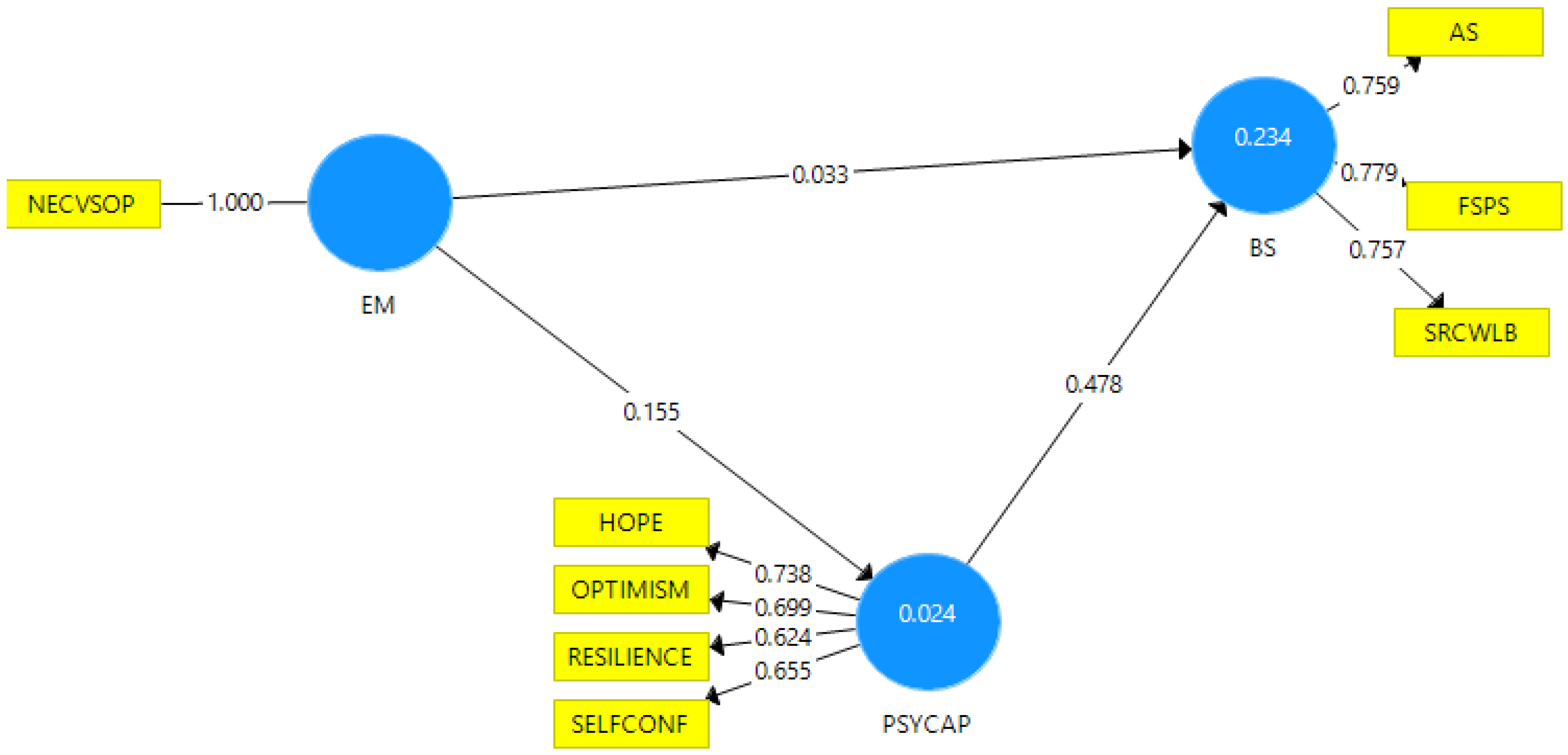
Figure 2 shows the estimators associated with each SEM path; the effects of the control variables are neutralized.
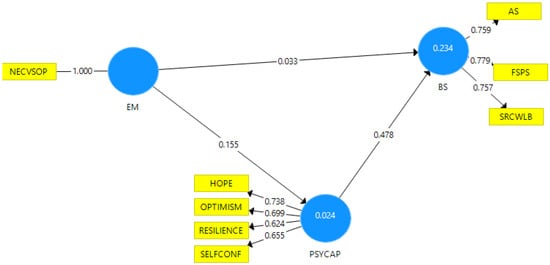
Figure 2.
The empirical model: confirmatory factor analysis. (NECVSOP: Necessity versus Opportunity motivation, SELFCONF: Self−Confidence, FSPF: fi-nancial success and personal fulfillment; SRCWLB: social contribution, recognition, and the work-life balance; AS: autonomy and satisfaction).
The figure shows that there is a positive relationship between PsyCap and BS. Besides, opportunity entrepreneurs outperform necessity entrepreneurs for both PsyCap and BS levels.
Table 8 presents the robustness test results of the exploratory factor analysis findings. It confirms that hope, self-confidence, optimism, and resilience are indeed significant measures (indicators) of PsyCap (p = 0.000 < 0.05 and z-value > 1.96). The financial profit and personal fulfillment (FSPF), social contribution, recognition, and the work-life balance (SRCWLB), autonomy, and satisfaction (AS) are the components that best define BS (p = 0.000 < 0.05 and z-value > 1.96). Based on the z statistics, the findings do not confirm financial gains as the most important indicator of BS for the youth surveyed. Instead, the findings indicate that youth are most concerned with their social contribution and recognition and the work-life balance.
Table 8.
Results of the relationships between the latent variables and their dimensions.
We ran three equations simultaneously to test for mediation [58,92]. In the first regression, BS was regressed on EM (1); in the second regression, BS was regressed on both EM and PsyCap (2), and in the last regression, PsyCap was regressed on EM (3). The results of these three regressions are shown in Table 9.
Table 9.
Important information for psychological capital mediation role test.
The mediation role of PsyCap (H4) is supported because EM is significant in regression (1) and (3), PsyCap is significant in regression (2) and the direct effect of EM on BS (c2 = 0.033; z = 0.577) is less in regression (2) than its total effect (c1 = 0.108; z = 1.628) in regression (1). Moreover, the effect of EM on BS is fully mediated by PsyCap because EM is not significant (z = 0.577 < 1.96) in regression (2). This implies that unlike the prediction in H2, EM does not have any significant direct effect on BS. However, it does have an indirect and significant (z = 2.32, p = 0.021) effect on BS which is equal to 0.074. Of the 11% EM effect on BS, about 7% channels through PsyCap. The direct positive and significant effect coefficient of EM on PsyCap (0.155) supports H3 and indicates that opportunity entrepreneurs have 4% more PsyCap compared to necessity-driven entrepreneurs. Because they have a higher PsyCap level and since PsyCap has a positive effect on BS (H1 is supported), opportunity entrepreneurs have a 3% more chance to succeed in entrepreneurship compared to necessity ones. The direct and total effect of PsyCap on BS in absolute terms is equal to 0.478. Since the data are provided on a 5-point Likert scale for which each point corresponds to 25%, this finding implies that an improvement of PsyCap by 25% corresponds to about 12% more chance of BS by the youth.
Table 9 reveals that EM and PsyCap explain about 23% of the variation in BS, whereas EM accounts for about 2% of the variation in Psycap. All the estimated fit indexes (standardized root mean square residual (SRMR) = 0.108, Chi-square = 180.344, goodness of fit (GFI) = 0.102 and normed fit index (NFI) = 0.516) were equal to the saturated model. This implies the fit is perfect and that the distance between the empirical and the theoretical model is short [7,93].
5. Discussion and Conclusions
Several major findings emerge from this research and contribute to the understanding of youth business success. Young entrepreneurs in Bukavu consider themselves to be successful in their business at 61%. Although youth have a high level of PsyCap (67%), more than half (55%) of them were constrained to start-up businesses by limited employment opportunities. The unexpected business success level implies that despite the unfavorable business environment prevailing in the DRC [94], entrepreneurship is a viable career option for youth. It can thus be argued that the lower youth business ownership rate cannot be explained by the youth underperformance thesis, but by other factors such as PsyCap. This study is unique as it shows that, among other things, youths consider themselves to be successful in entrepreneurship when they can give back to their society. Thus, increasing their participation in entrepreneurship is likely to benefit the people around them beyond addressing their unemployment.
The results of the study show that four main reasons motivate youth to embark on an entrepreneurial career: to fight against poverty, frustration in employment and education, passion for businesses, and concern for social contribution. According to the Global Entrepreneurship Monitor’s conceptual framework [72], the first two components are push-related motivations, whereas the last two are of the order of opportunity. Thus, the generalizability of the entrepreneurial motivation dichotomy is confirmed in the context we examined. The study revealed that more than half (55%) of the youths had started up a business out of necessity, thus implying that entrepreneurship is much more of a constraint than a deliberate choice. This study concurs with two studies [17,95], who noted that poverty, lack of job opportunities, and poor economic living conditions are the main reasons that drive people to choose entrepreneurship in developing countries.
Opportunity-driven youth entrepreneurs have a significantly higher level of PsyCap compared to necessity ones. The EM does not directly influence BS but significantly does so through PsyCap. The results of this study concur with existing studies [15,74], who found out that entrepreneurs who have been motivated by the opportunity to start their business have a higher degree of success than those driven by necessity. However, this research draws from the resource-based view of the firm to contribute to knowledge by showing that higher PsyCap is the reason why opportunity entrepreneurs outperform necessity-driven entrepreneurs. The finding is salient and reveals that young entrepreneurs who have perceived a viable business opportunity to start up a business or for whom entrepreneurship is a passion, develop more confidence in their abilities and keep expecting positive results even when things are uncertain. Such youths would have many ways to overcome difficulties, and thus adapt to stressful life events, unlike necessity entrepreneurs. Besides, some empirical studies have shown that opportunity entrepreneurs are those who, beforehand, are endowed with entrepreneurial ingredients that drive their choice of an entrepreneurial career [18,73,96]. We do acknowledge that PsyCap dimensions are valuable and non-substitutable long term strategic resources [25], open to development and improvement [7,39]. Then, what makes the difference between necessity and opportunity entrepreneurs in the short run is the tacitness, the complexity, and scarcity of PsyCap dimensions that generate causal ambiguity in competence-based advantage and thus, raise barriers to imitation by necessity entrepreneurs.
PsyCap was found to positively drive BS for which it explains about 23% of the variance. Thus, this research concurs with most of the previous studies [26,31,81,96] that reported a positive effect of PsyCap on business performance across countries and sectors. An improvement of PsyCap by 25% corresponds to about 12% more chance of BS by the youth. Because PsyCap is a state open to development and improvement [7,28,93], this research argues that it is possible to promote BS among the youth by enhancing their self-efficacy, optimism, hope, and resilience.
The results of this study concur with the positive behavior literature [29,65,73,97,98,99] by confirming that self-efficacy, hope, optimism, and resilience are the measures of PsyCap. However, whereas most of the previous research ranks self-confidence in the first place, this study shows that hope is the primary PsyCap ingredient. This finding may find an explanation in the fact that because the DRC is an unfriendly business environment [99], the success lies in youth’s ambition and the ability to challenge oneself by setting high goals and working hard to achieve them. The four ingredients measure 58.62% of the variance in the PsyCap. The PsyCap level (67.18%) of the youths is somehow higher, however, it does offer opportunities for improvement.
5.1. Theoretical and Methodological Implications
The results of this study contribute to the existing literature on BS in different ways. First, this study shows that the effect of EM on BS is best understood when we account for how opportunity entrepreneurs might outperform necessity entrepreneurs. In particular, this study draws from the resource-based view of the firm to show that PsyCap is the intermediate variable through which opportunity entrepreneurs succeed in business rather than necessity entrepreneurs. The research thus reinforces the thesis that PsyCap is contextual and influenced. We can thus argue that entrepreneurs by opportunity are those endowed beforehand with PsyCap ingredients, which, fortunately, can also be acquired by necessity-driven entrepreneurs across their life course. Second, from a methodological point of view, this research relies on the partial least squares’ structural equation model, which is a recommended methodology [7] to test the mediating role of a variable. This methodology provides a frame of reference for future research, given its primacy over hierarchical regressions and its ability to judge the fitness of and confirm the measurement scales of the latent variables. Third, this study has the merit of having neutralized the effects of the control variables on the variables of interest. These variables could mask the real effects of EM and PsyCap on BS.
5.2. Practical Implications
Policymakers and youths are now aware that BS largely depends on the youths’ PsyCap and not only on the material, social, human resources available to the entrepreneur. This paper, therefore, recommends that youths who have a higher PsyCap should be identified, and directly supported and encouraged to start−up businesses, whereas lower PsyCap performers should either be trained in the PsyCap dimensions or oriented to the waged employment otherwise. The constant fact is that the institutions supporting and promoting youth entrepreneurs should focus on their self-efficacy, optimism, hope, and resilience. The promotion of entrepreneurial success would involve the integration of PsyCap into the content of the entrepreneurship course. It would also be desirable that teachers are chosen among youth or business owners. Successful young entrepreneurs can also be invited to deliver entrepreneurship lectures or to share their experiences with the students to increase learners’ confidence and optimism in choosing an entrepreneurial career and persisting towards success. Parents and teachers should be less stern; instead, they should make fun with the youths so that they can build confidence in themselves. Teachers should empower students at school and give them time to express their ideas freely so that they can trust themselves later in life. One of the ways to increase self-confidence is to remember that no one is perfect; the most important thing for the youth would be to learn from their mistakes. This assumes that young entrepreneurs should be proud of themselves, self-confident, but not arrogant. It is essential to look at past experiences, appreciate them, and to remind oneself that you can still do it. To this end, seeing people in similar situations (and perceived as similar to oneself) overcoming obstacles increases the belief that one, too, can do it. Because self-efficacy is affected by external factors, it would be useful to entrepreneurship if the government keeps on enabling the business climate so that youths feel confident enough to engage in successful entrepreneurship.
In line with hope enhancement, youths should set SMART (specific, measurable, achievable, relevant, and time-limited) goals to improve their hope capacity. Lecturers and parents can support the youths by breaking down complex, challenging goals into bite-size portions. It is equally essential that the youths list and write down their dreams and repeat them continuously and loudly. Youth entrepreneurs can diversify their portfolios to improve their resilience capacity. In awkward moments, facing and accepting reality may be a better basis to endure hardship for the time it lasts. Being able to find meaning or purpose in life is a core for resilience improvement. Improvising and doing with whatever we have at hand is equally important to enhance resilience. Higher and quality education is said to have a positive effect on resilience, so it may help if more youths are given a chance to access to the highest level of learning.
6. Limitations and Future Research Directions
Although the model was globally significant, the predictive power was weak, suggesting that other variables should be mobilized in future studies to explain BS. In the context of Bukavu, given the broad unavailability of financial information from youth start-ups, this study successfully applied subjective indicators of business success. Although the measures were effective, objective measures could add a cumulative effect in reflecting the broad-based BS. Future research should rely on more objective indicators of BS, such as business continuity, market share, and profitability. This study used cross-sectional data, however, PsyCap [100], EM [17,70,101] and BS are dynamic variables that would accurately be measured through longitudinal studies. Thus, future studies could use longitudinal data to test the robustness and effect of EM and PsyCap on BS. The sample size and the specificity of one country may reduce the generalizability of the research findings. We then call upon future studies to re-examine the mediating role of PsyCap in the EM−BS link on a broader sample so that the external validity of this study can be tested.
Despite the efforts to neutralize the effects of the control variables on the variables of interest, the results of the models can still suffer from endogeneity. Thus, the results cannot represent strict causality and could open the door to future research using experimental or quasi-experimental methods such as propensity score matching, which have had more success in the area of entrepreneurship [102,103,104]. Finally, although we did control for innovation and some demographics, we acknowledge that future research could pay particular attention to innovation and other environmental-related independent variables. This would reduce the limitation of this research by using only two variables to explain the complexity of BS.
Author Contributions
All the authors have made substantial contributions to the research design, data collection, data analysis, and write-up of the manuscript. All authors have read and agreed to the published version of the manuscript.
Funding
This research is funded by the International Fund for Agricultural Development (IFAD) under the grant 2000001374 “Enhancing Capacity to Apply Research Evidence (CARE) in Policy for Youth Engagement in Agribusiness and Rural Economic Activities in Africa” Project in the International Institute of Tropical Agriculture (IITA).
Institutional Review Board Statement
Not applicable.
Informed Consent Statement
Informed consent was obtained from all subjects involved in the study.
Data Availability Statement
The data presented in this study are available on request from the corresponding author.
Acknowledgments
The first author is immensely grateful for the generous mentoring support from Förderverein Uni Kinshasa e.V, through the BEBUC Scholarship program. The usual disclaimers apply.
Conflicts of Interest
The authors declare no conflict of interest.
Appendix A
Table A1.
Dimensions and items used to represent BS.
Table A1.
Dimensions and items used to represent BS.
| Financial measures |
|
| Nonfinancial measures |
|
Appendix B.
Table A2.
Dimensions and items used to represent EM.
Table A2.
Dimensions and items used to represent EM.
| Necessity based entrepreneurial motivations |
|
| Opportunity based entrepreneurial motivations |
|
Appendix C.
Table A3.
Dimensions and items used to represent PsyCap.
Table A3.
Dimensions and items used to represent PsyCap.
| Hope |
|
| Self-efficacy |
|
| Optimism |
|
| Resilience |
|
References
- Bignotti, A.; le Roux, I. Discovering the entrepreneurial endowment of the youth. Afr. J. Econ. Manag. Stud. 2018, 9, 14–33. [Google Scholar] [CrossRef]
- ILO. Global Employment Trends for Youth 2015; International Labour Office: Geneva, Switzerland, 2015. [Google Scholar]
- Raikes, A.; Britto, P.R.; Hirokawu, Y.; Iruka, I. Children, Youth, and Developmental Science in the 2015–2030 Global Sustainable Development Goals. Soc. Res. Child Dev. 2017, 30, 1–23. [Google Scholar] [CrossRef]
- World Bank. World Bank Group, Country Highlights, Democratic Republic of Congo. Enterprise Survey; World Bank: Washington, DC, USA, 2014; p. 2. [Google Scholar]
- AfDB; OECD; UNDP. Economic Perspectives in Africa—DRC; African Development Bank: Abidjan, Ivory Coast, 2017. [Google Scholar]
- Wernsing, T. Psychological Capital: A test of measurement invariance across 12 national cultures. J. Leadersh. Organ. Stud. 2014, 21, 179–190. [Google Scholar] [CrossRef]
- Akilimali, N.; Namatovu, R.; Basalirwa, E.M. Perceived social norms, psychological capital, and entrepreneurial intention among undergraduate students in Bukavu. Educ. Train. 2019, 61, 963–983. [Google Scholar] [CrossRef]
- Smida, A.; Khelil, N. Repenserl’ Échec Entrepreneurial des Petites Entreprises Émergentes Proposition d’une Typologies’ Appuyant sur une Approche Intégrative. Revue Int. PME 2019, 23, 65–106. [Google Scholar]
- Rusu, V.D.; Angela, R. Entrepreneurial Activity in the EU: An Empirical Evaluation of Its determinants. Sustainability 2017, 9, 1679. [Google Scholar] [CrossRef]
- Adamon, K. Beyond the marginalization thesis: An examination of the motivations of informal entrepreneurs in Sub-Saharan African: Insights from Ghana. Int. J. Entrep. Innov. 2014, 15, 113–125. [Google Scholar] [CrossRef]
- Bandura, A. Cultivate self-efficacy for personal and organizational effectiveness. In Handbook of Principles of Organizational Behavior: Indispensable Knowledge for Evidence; Wiley: Hoboken, NJ, USA, 2000; pp. 120–136. [Google Scholar] [CrossRef]
- Chua, H.S.; Bedford, O. A qualitative exploration of fear of failure and entrepreneurial intent in Singapore. J. Career Dev. 2015, 43, 1–16. [Google Scholar] [CrossRef]
- Hung, C.; Orhan, K.; Xiaowei, Z.; Kubilay, G. Chinese entrepreneurs Motivations, success factors, problems, and business-related stress. J. Chin. Entrep. 2011, 3, 84–111. [Google Scholar] [CrossRef]
- Johnmark, D.; Munene, J.C.; Balunywa, W. Robustness of personal initiative in moderating entrepreneurial intentions and actions of disabled students. Cogent Bus. Manag. 2016, 3, 1–16. [Google Scholar] [CrossRef]
- Leszczyński, D. The investigation into motivations, success factors, and barriers among Women Small Business owners: An overview of existing literature. Int. J. Manag. Econ. 2014, 39, 108–125. [Google Scholar] [CrossRef]
- Baron, R.A.; Franklin, R.J.; Hmieleski, K.M. Why entrepreneurs often experience low, not high levels of stress: The joint effects of selection and psychological capital. J. Manag. 2016, 42, 742–768. [Google Scholar] [CrossRef]
- Langevang, T.; Namatovu, R.; Dawa, S. Beyond necessity and opportunity entrepreneurship: Motivations and aspirations of young entrepreneurs in Uganda. Int. Dev. Plan. Rev. 2012, 34, 440–459. [Google Scholar] [CrossRef]
- Eijdenberg, E.L.; Masurel, E. Entrepreneurial motivation in a least developed country: Push factors and pull factors among MSEs in Uganda. J. Enterprising Cult. 2013, 21, 19–43. [Google Scholar] [CrossRef]
- Larsson, J.P.; Thulin, P. Independent by necessity? The life satisfaction of necessity and opportunity entrepreneurs in 70 countries. Small Bus. Econ. 2019, 53, 921–934. [Google Scholar] [CrossRef]
- McClelland, D. Need for achievement and entrepreneurship: A longitudinal study. J. Personal. Soc. Psychol. 1965, 1, 389–392. [Google Scholar] [CrossRef]
- Reed, R.; Defillippi, R.J. Causal ambiguity, barriers to imitation, and sustainable competitive advantage. Acad. Manag. 1990, 15, 88–102. [Google Scholar]
- Zali, M.R.; Faghih, N.; Ghotbi, S.; Rajaie, S. The effect of necessity and opportunity-driven entrepreneurship on business growth. Int. Res. J. Appl. Basic Sci. 2013, 7, 100–108. [Google Scholar]
- Zoumba, N.B. Des motivations par nécessité et par opportunité aux comportements des entrepreneurs. In Proceedings of the XXVIe Conférence Internationale de Management Stratégique, Lyon, France, 7–9 June 2017. [Google Scholar]
- Jafari-sadeghi, V. The motivational factors of business venturing: Opportunity versus necessity? A gendered perspective on European countries. J. Bus. Res. 2020, 113, 279–289. [Google Scholar] [CrossRef]
- Barney, J. Firm resources and sustained competitive advantage. J. Manag. 1991, 17, 99–120. [Google Scholar] [CrossRef]
- Hossain, M.; Ibrahim, Y.; Uddin, M. Finance, financial literacy, and small firm financial growth in Bangladesh: The effectiveness of government support. J. Small Bus. Entrep. 2020. [Google Scholar] [CrossRef]
- Oliver, C. Sustainable competitive advantage: Combining institutional and resource-based views. Strateg. Manag. J. 1997, 18, 697–713. [Google Scholar] [CrossRef]
- Newman, A.; Ucbasaran, D.; Zhu, F.E.I.; Hirst, G. Psychological capital: A review and synthesis. J. Organ. Behav. 2014, 35, 120–138. [Google Scholar] [CrossRef]
- Baluku, M.M.; Kikooma, J.F.; Kibanja, G.M.; Mabunda, M. Psychological capital and the startup capital—entrepreneurial success relationship. J. Small Bus. Entrep. 2016, 28, 27–54. [Google Scholar] [CrossRef]
- Gupta, N.; Mirchandani, A. Investigating entrepreneurial success factors of women-owned SMEs in UAE. Manag. Decis. 2018, 56, 219–232. [Google Scholar] [CrossRef]
- Hsu, S.-H.; Wang, Y.-C.; Chen, Y.F.; Dahlgaard-Park, S.M. Building business excellence through psychological capital. Total Qual. Manag. Bus. Excell. 2014, 25, 1210–1223. [Google Scholar] [CrossRef]
- Abbas, M. Impact of psychological capital on innovative performance and job stress. Can. J. Adm. Sci. 2015, 138, 128–138. [Google Scholar] [CrossRef]
- Namatovu, R.; Balunywa, W.; Kyejjusa, S.; Dawa, S. Global Entrepreneurship Monitor (GEM) Uganda 2010, Executive Report; Babson College: Babson Park, MA, USA, 2010. [Google Scholar]
- Gulsun, A. De la résilience individuelle à la réussite entrepreneuriale: Le cas de Steve Jobs De la résilience individuelle à la réussite entrepreneuriale: Le cas de Steve Jobs. In Proceedings of the XXVIIe Conférence Internationale de Management Stratégique, Montpellier, France, 6–8 June 2018. [Google Scholar]
- Luthans, F. Organizational Behavior. An Evidence-Based Approach, 12th ed.; McGraw-Hill: New York, NY, USA, 2011. [Google Scholar]
- Coskun, K.; Oksuz, Y.; Yilmaz, H.B. Ten years Emotional Intelligence Scale (TYEIS): Its development, validity, and reliability. Int. J. Assess. Tools Educ. 2017, 4, 122–133. [Google Scholar]
- Li, X.; Ma, L. Chinese management research needs self-confidence but not over-confidence. Asia Pac. J. Manag. 2020, 37, 481–498. [Google Scholar] [CrossRef]
- Wang, X.; Zheng, Q.; Cao, X. Psychological capital: A new perspective for psychological Health Education Management of Public Schools. J. Public Pers. Manag. 2014, 43, 371–383. [Google Scholar] [CrossRef]
- Luthans, F.; Avey, J.B.; Avolio, B.J.; Norman, S.M.; Combs, G.M. Psychological capital development: Toward a micro-intervention. J. Organ. Behav. 2006, 27, 387–393. [Google Scholar] [CrossRef]
- Staniewski, M.W.; Awruk, K. Entrepreneurial success and achievement motivation—A preliminary report on a validation study of the questionnaire of entrepreneurial success. J. Bus. Res. 2019, 101, 433–440. [Google Scholar] [CrossRef]
- De Souza, G.H.S.; Dos Santos, P.D.C.F.; Lima, N.C.; Da Cruz, N.J.T.; Lezana, Á.G.R. Entrepreneurial Potential and Success in Business: A Study on Elements of Convergence and Explanation. Mackenzie Manag. Rev. 2016, 17, 188–215. [Google Scholar] [CrossRef]
- Hasan, M.; Musa, C.I.; Azis, M.; Tahir, T. Positive psychological capital, market orientation, and business performance of family business in the culinary sector: A research study. Econ. Sociol. 2020, 13, 97–112. [Google Scholar] [CrossRef] [PubMed]
- Fisher, R.; Maritz, A.; Lobo, A. Evaluating entrepreneurs perception of success Development of a measurement scale. Int. J. Entrep. Behav. Res. 2013, 20, 478–492. [Google Scholar] [CrossRef]
- Jabroui, S. «Les Facteurs Déterminants du Succès de L’entrepreneuriat au Maroc: Cas de la Région de Casablanca» Colloque International de la Prospective sous le Thème «Entrepreneuriat: Vers un Maroc Entrepreneurial» Casablanca, 24 et 25 Novembre 2016. In Proceedings of the International Conference on Foresight under the Theme “Entrepreneurship: Towards an Entrepreneurial Morocco”, Casablanca, Morocco, 24–25 November 2016; pp. 1–13. [Google Scholar]
- Owusu, F.B.; Alhassan, A.L. Asset-Liability Management and bank profitability: Statistical cost accounting analysis from an emerging market. Int. J. Financ. Econ. 2020, 26, 1488–1502. [Google Scholar] [CrossRef]
- Quan, L.; Huy, H. The effect of entrepreneurial human capital and entrepreneurial failure learning on the entrepreneurial restart Intention. Asian Soc. Sci. J. 2014, 10, 99–112. [Google Scholar] [CrossRef]
- Yves, R.; Egbert, M. Les motivations entrepreneuriales comme facteur explicatif de la taille des entreprises. J. Small Bus. Entrep. 2008, 21, 59–73. [Google Scholar] [CrossRef]
- Koch, M.; Park, S.; Zahra, S.A. Career patterns in self-employment and career success. J. Bus. Ventur. 2021, 36, 105998. [Google Scholar] [CrossRef]
- Manzano-García, G.; Ayala-Calvo, J.C. Entrepreneurial orientation: Its relationship with the entrepreneur’s subjective success in SMEs. Sustainability 2020, 12, 4547. [Google Scholar] [CrossRef]
- Karadag, H. Financial Management Challenges In Small and Medium-Sized Enterprises: A Strategic Management Approach. Emerg. Mark. J. 2015, 5, 25–40. [Google Scholar] [CrossRef]
- Sandeep, V.; Harpreet, B. Are subjective business performance measures justified? Int. J. Product. Perform. Manag. 2016, 65, 603–621. [Google Scholar] [CrossRef]
- Jensen, S.M. Psychological capital: Key to understanding entrepreneurial Stress? Econ. Bus. J. Inq. Perspect. 2012, 4, 44–55. [Google Scholar]
- Rowley, J. Competencies associated with growth of women-led SMEs. J. Small Bus. Enterp. Dev. 2014, 21, 588–601. [Google Scholar] [CrossRef]
- Mitchell, R.K.; Mcdougall, P.P.; Morse, E.A.; Smith, J.B. Toward a Theory of Entrepreneurial Cognition: Rethinking the people side of Entrepreneurship Research. Entrep. Theory Pract. 2002, 27, 93–104. [Google Scholar] [CrossRef]
- Yuen, K.F.; Wang, X.; Ma, F.; Lee, G.; Li, X. Critical success factors of supply chain integration in container shipping: An application of resource-based view theory. Marit. Policy Manag. 2018, 46, 653–668. [Google Scholar] [CrossRef]
- Paek, B.; Lee, H. Strategic entrepreneurship and competitive advantage of established firms: Evidence from the digital TV industry. Int. Entrep. Manag. J. 2018, 14, 883–925. [Google Scholar] [CrossRef]
- Udin, U.; Yuniawan, A. Psychological capital, personality traits of big-five, organizational citizenship behavior, and task performance: Testing their relationships. J. Asian Financ. Econ. Bus. 2020, 7, 781–790. [Google Scholar] [CrossRef]
- Solesvik, M. A study of personal initiative as a mediator between self-efficacy and entrepreneurial intentions. Acad. Manag. 2017, 2017, 15614. [Google Scholar] [CrossRef]
- Abaho, E.; Olomi, D.R.; Urassa, G.C. Antecedents of entrepreneurial values-a review of literature. Eur. J. Bus. Manag. 2013, 1, 56–69. [Google Scholar]
- Ajzen, I. Perceived behavioral control, Self-efficacy, Locus of control, and the Theory of Planned Behavior. J. Appl. Soc. Psychol. 2002, 32, 665–683. [Google Scholar] [CrossRef]
- Obschonka, M.; Silbereisen, R.K.; Schmitt-rodermund, E. Entrepreneurial intention as a developmental outcome. J. Vocat. Behav. 2010, 77, 63–72. [Google Scholar] [CrossRef]
- Akmaliah, Z.; Pihie, L. Entrepreneurship as a career choice: An analysis of entrepreneurial self-efficacy and intention of university students. Eur. J. Soc. Sci. 2009, 9, 338–349. [Google Scholar]
- Robledo, J.; Sanchez, V.; Arán, M.; Molina, M. The moderating role of gender on entrepreneurial intentions: A TPB perspective. Intang. Cap. J. 2015, 11, 92–117. [Google Scholar] [CrossRef]
- Kangarlouei, S.J.; Shadkami, N.; Motavassel, M. The Impact of Intellectual Capital, social capital, and psychological capital on Competitive advantage of Vehicle Industries in Tehran Stock Exchange (TSE). Int. J. Acad. Res. Bus. Soc. Sci. 2012, 2, 559–566. [Google Scholar]
- Sebora, T.C. Psychological Capital and the Entrepreneurial Intention of College Students. ResearchGate. University of Nebraska at Lincoln. 2017. Available online: http://www.researchgate.net/publication/257964362 (accessed on 12 April 2020).
- Selangor, B.Y.; Raja, J.; Abdul, M.; Baru, K.; Lumpur, K. The nexus between entrepreneur skills and successful business: A decompositional analysis Naziruddin Abdullah and Noor Ul Hadi * Léo-Paul Dana. Int. J. Entrep. Small Bus. 2018, 34, 249. [Google Scholar]
- Ouchallal, A.B.; Ouchallal, E.-K. La dimension psychosociologique dans la réussite entrepreneuriale. Les Cahiers Du CREAD 2009, 90, 131–156. [Google Scholar]
- Mabunda, M.B.; Kikooma, J.F.; Bantu, E.; Otto, K. Psychological capital and entrepreneurial outcomes: The moderating role of social competencies of owners of micro-enterprises in East Africa. J. Glob. Entrep. Res. 2018, 8, 26. [Google Scholar]
- Ayala, J.; Manzano, G. The resilience of the entrepreneur. Influence on the success of the business. A longitudinal analysis. J. Econ. Psychol. 2014, 42, 126–135. [Google Scholar] [CrossRef]
- Murnieks, C.Y.; Klotz, A.C.; Shepherd, D.A. Entrepreneurial motivation: A review of the literature and an agenda for future research. J. Organ. Behav. 2020, 41, 115–143. [Google Scholar] [CrossRef]
- Pilkov, A.; Jančovičová, Z.; Kovačičová, Z. Inclusive entrepreneurship in Visegrad4 countries. Procedia Soc. Behav. Sci. 2016, 220, 312–320. [Google Scholar] [CrossRef]
- Singer, S.; Moska, A.; Amorós, J. Global Entrepreneurship Monitor 2014 Global Report; Babson College: Babson Park, MA, USA, 2015. [Google Scholar]
- Andria, A.; Gabarret, I.; Vedel, B. Resilience and effectuation for a successful business takeover. Int. J. Entrep. Behav. Res. 2018, 24, 1200–1221. [Google Scholar] [CrossRef]
- Amit, R.; Muller, E. “Push” and “Pull” entrepreneurship. J. Small Bus. Entrep. 1995, 12, 64–80. [Google Scholar] [CrossRef]
- Buttner, E.H.; Moore, D.P. Women’s Organizational Exodus to Entrepreneurship: Self-Reported Motivations and Correlates with Success. J. Small Bus. Manag. 1997, 35, 34–46. [Google Scholar]
- Dawson, C.; Henley, A. “Push“ versus “pull“ entrepreneurship: An ambiguous distinction? Int. J. Entrep. Behav. Res. 2012, 18, 697–719. [Google Scholar] [CrossRef]
- Gyimah-brempong, K.; Kimenyi, M.S. Youth Policy and the Future of African Development; Brookings Institution: Washington, DC, USA, 2013. [Google Scholar]
- Krejcie, R.V.; Morgan, D.W. Determining sample size for research activities. Educ. Psychol. Meas. 1970, 30, 607–610. [Google Scholar] [CrossRef]
- Babin, B.J.; Svensson, G. Structural equation modeling in social science research: Issues of validity and reliability in the research process. Eur. Bus. Rev. 2012, 24, 320–330. [Google Scholar] [CrossRef]
- Chandler, G.N.; Hanks, S.H. Measuring the performance of emerging businesses: A validation study. J. Bus. Ventur. 1993, 8, 391–408. [Google Scholar] [CrossRef]
- Walker, E.; Brown, A. What success factors are important to small business owners? Int. Small Bus. J. 2004, 22, 577–594. [Google Scholar] [CrossRef]
- Gray, K.R.; Foster, H.; Howard, M. Motivations of Moroccans to be entrepreneurs. J. Dev. Entrep. 2006, 11, 297–318. [Google Scholar] [CrossRef]
- Calderon, C.; Ferrando, P.J.; Lorenzo-Seva, U.; Higuera, O.; Ramon y Cajal, T.; Rogado, J.; Mut-Lloret, M.; Rodriguez-Capote, A.; Jara, C.; Jimenez-Fonseca, P. Validity and Reliability of the Decision Regret Scale in Cancer Patients Receiving Adjuvant Chemotherapy. J. Pain Symptom Manag. 2019, 57, 828–834. [Google Scholar] [CrossRef]
- Ababneh, O.M.A.; LeFevre, M.; Bentley, T. Employee engagement: Development of a new measure. Int. J. Hum. Resour. Dev. Manag. 2019, 19, 105–134. [Google Scholar] [CrossRef]
- Esfandiar, K.; Sharifi, M.; Pratt, S.; Altinay, L. Understanding entrepreneurial intentions: A developed integrated structural model approach. J. Bus. Res. 2019, 94, 172–182. [Google Scholar] [CrossRef]
- Saeid, K.; Harm, B.; Thomas, L.; Zahra, A.; Mohammad, C.; Martin, M. Application of Structural Equation Modelling to assess the effect of entrepreneurial characteristics on students’ entrepreneurial intention. In Proceedings of the 6th European Conference on Entrepreneurship and Innovation, Robert Gordon University, Aberdeen, UK, 15–16 September 2011; pp. 954–967. [Google Scholar]
- Poggesi, S.; Mari, M.; De Vita, L. What’s new in female entrepreneurship research? Answers from the literature. Int. Entrep. Manag. J. 2016, 12, 735–764. [Google Scholar] [CrossRef]
- Ammar, S.; Nakaa, N. Impacts du profil de l ‘ entrepreneur sur la croissance des petites entreprises tunisiennes: Cas de la région de Gafsa. Int. J. Commer. Manag. Res. 2016, 2, 23–27. [Google Scholar]
- Iakovleva, T.; Kolvereid, L.; Stephan, U. Entrepreneurial intentions in developing and developed countries. Educ. Train. 2011, 53, 353–370. [Google Scholar] [CrossRef]
- Chumney, F.L. Structural Equation Models with Small Samples: A Comparative Study of Four Approaches. Ph.D. Thesis, University of Nebraska-Lincoln, Lincoln, NE, USA, 2013. [Google Scholar]
- Marlow, S. Exploring future research agendas in the field of gender and entrepreneurship. Int. J. Gend. Entrep. 2014, 6, 102–120. [Google Scholar] [CrossRef]
- Byabashaija, W.; Katono, I. The Impact of college entrepreneurial education on entrepreneurial attitudes and intention to start a business in Uganda. J. Dev. Entrep. 2011, 16, 127–144. [Google Scholar] [CrossRef]
- Contreras, F.; De Dreu, I.; Espinosa, J.C. Examining the relationship between psychological capital and entrepreneurial intention: An exploratory study. Asian Soc. Sci. J. 2017, 13, 80–88. [Google Scholar] [CrossRef]
- World Bank. Doing Business 2020: Comparing Business Regulation in 190 Economies; World Bank: Washington, DC, USA, 2019. [Google Scholar]
- Almobaireek, W.N.; Manolova, T.S. Entrepreneurial motivations among female university youth in Saudi Arabia. J. Bus. Econ. Manag. 2013, 14 (Suppl. 1), 56–75. [Google Scholar] [CrossRef]
- Rosa, P.; Kodithuwakku, S.; Balunywa, W. Entrepreneurial motivation in developing countries: What does “Necessity” and “Opportunity” entrepreneurship really mean? Front. Entrep. Res. 2006, 26. Available online: http://digitalknowledge.babson.edu/fer/vol26/iss20/4 (accessed on 22 June 2019). [CrossRef]
- Hall, R. A framework linking intangible resources and capabilities to sustainable competitive advantage. Strateg. Manag. J. 1993, 14, 607–618. [Google Scholar] [CrossRef]
- Sweetman, D.; Luthans, F.; Avey, J.; Luthans, B. Relationship between positive psychological capital and creative performance. Manag. Dep. Fac. Publ. 2010, 28, 4–13. [Google Scholar] [CrossRef]
- World Bank. Doing Business 2018, Reforming to Create Jobs; World Bank: Washington, DC, USA, 2018. [Google Scholar]
- Youssef, C.M.; Luthans, F. An integrated model of psychological capital in the workplace. In Oxford handbook of Positive Psychology and Work; Oxford University Press, Inc.: Oxford, UK, 2010. [Google Scholar]
- Reynolds, P.D.; Camp, S.M.; Bygrave, W.D.; Hay, M. Global Entrepreneurship Monitor 2001 Summary Report; Kauffman Center for Entrepreneurial Leadership at the Ewing Marion Kauffman Foundation: Kansas City, MO, USA, 2001. [Google Scholar]
- Hair, J.F.; Sarstedt, M.; Ringle, C.M.; Mena, J.A. An assessment of the use of partial least squares structural equation modeling in marketing research. J. Acad. Mark. Sci. 2012, 40, 414–433. [Google Scholar] [CrossRef]
- Lokshin, M.; Zurab, S. Maximum likelihood estimation of endogenous switching regression models. Stata J. 2004, 4, 282–289. [Google Scholar] [CrossRef]
- Lane, F.; Robin, H. An illustrative example of propensity score matching with education research. Career Tech. Educ. Res. 2012, 37, 187–212. [Google Scholar] [CrossRef]
Publisher’s Note: MDPI stays neutral with regard to jurisdictional claims in published maps and institutional affiliations. |
© 2021 by the authors. Licensee MDPI, Basel, Switzerland. This article is an open access article distributed under the terms and conditions of the Creative Commons Attribution (CC BY) license (http://creativecommons.org/licenses/by/4.0/).