


Abstract
This study investigated the impact of entrepreneurial attitude, perceived desirability, and perceived feasibility on sustainable entrepreneurship intentions under the moderating impact of entrepreneurial passion among undergraduate students of Malaysia. It was a quantitative study that compared two groups of students, i.e., Group A, comprised of students who have studied entrepreneurship modules and whose programmes did not offer any dual/triple award degrees and Group B, made up of students who have studied entrepreneurship modules and whose programmes offered dual/triple award degrees. Data were collected from 542 undergraduate students of universities located in Kuala Lumpur and Selangor through survey questionnaire. WarpPLS Software version 7.0 was used to analyse the data. The findings of this study revealed that Group B students’ entrepreneurial attitude, perceived desirability, and perceived feasibility positively and significantly impacted the sustainable entrepreneurship intentions under the moderating impact of entrepreneurial passion. However, the impact of entrepreneurial attitude was found positive and significant on sustainable entrepreneurship intentions among students of Group A and entrepreneurial passion was found to be significant moderator to improve the impact of only entrepreneurial attitude and perceived desirability on sustainable entrepreneurship intentions but not for the impact of perceived feasibility on sustainable entrepreneurship intentions among these students. Moreover, the direct impacts of perceived desirability and perceived feasibility were also found non-significant on sustainable entrepreneurship intentions among Group A students. The findings reveal that universities having partnership with other overseas’ universities may offer high quality entrepreneurship modules due to which their students have high entrepreneurial passion and develop more entrepreneurial attitudes, and are more willing and capable to start their own businesses as compared to students of other local universities who have no partnership with overseas’ universities.
1. Introduction
Universities are using several strategies to promote the sustainable entrepreneurship intentions among undergraduate students as well as to provide quality entrepreneurship education to equip the students with the essential skills needed to run sustainable entrepreneurial businesses [1]. Academic entrepreneurship is becoming increasingly popular among scientific institutions, businesses, and local governments [2]. There are several reasons for the interest of academic entrepreneurship. For instance, increasing importance of knowledge for the economic development based on human capital entrepreneurship theory [3], research funding and prestige universities, as well as positive influence of entrepreneurship academic research to build competitiveness and international innovation of the economy [4]. The integration of scientific techniques within commerce leads towards the sustainable businesses. These factors have changed the ways of doing businesses. Therefore, universities are contributing towards the practical implications of their research findings due to which the entrepreneurial firms are improving their performances and are becoming more sustainable and innovative businesses [4]. Schumpeter has considered the entrepreneurship as an economic resource that also determines the effective use of material resources [5]. The existing studies have mentioned the importance of universities in promoting entrepreneurship education in every field of study [2,3,4]. This is because the universities’ entrepreneurial cultures foster the entrepreneurial skills of students through their participation in entrepreneurship related research projects, new venture or start-ups projects, as well as through their participation in entrepreneurship classes conducted by business incubators [2]. An academic entrepreneur is an animator of scientific research, an organizer of the transfer of scientific research to the economy, an inspirer of the creation of innovative firms. Therefore, the entrepreneurship education can be enhanced due to the active cooperation between students and academic entrepreneurs.
Entrepreneurship has been considered as an attractive career option for students. Therefore, there is a real need to focus on developing an entrepreneurial mind-set among undergraduate students of universities [6]. Universities should focus more on producing graduates with entrepreneurial attitudes to create more jobs. Thus, universities play a key role in providing the ecosystem to foster entrepreneurship and encourage students to become entrepreneurs. Although universities are striving their best to implement diverse approaches to promote the entrepreneurship, however, not all entrepreneurship related programmes facilitate entrepreneurship as a potential career option for students [6,7]. Knowledge regarding the students’ entrepreneurial intentions assists in understanding the factors that could be considered to develop entrepreneurship intention among them.
The entrepreneurship intention among university students is evident regarding the career alternative. The universities play an important role in developing the entrepreneurial skills among students and the focus of the existing entrepreneurship intention of the students has been on education of entrepreneurship [8]. The empirical studies on students’ entrepreneurship have provided evidence regarding the positive influence of entrepreneurship courses on their decision to become entrepreneur but with a few studies of contrasting results [4,9,10]. Although the existing literature focused more on the importance of entrepreneurship courses in developing the entrepreneurship intention among students, however, very less or no attention has been paid on how the educational resources and outcomes provided in a university with its partnership university/ies at the overseas, can assist the students to choose entrepreneurship as a career choice. Even though some universities have partnership with other universities in other developed countries and are providing unique resources to support graduate entrepreneurship, however, the influence of these partnerships in promoting the entrepreneurial intention among the undergraduate students is not evident in the existing entrepreneurship literature.
Furthermore, the research on entrepreneurial intentions has tended to focus on one or two aspects of value creation in the context of sustainable entrepreneurship [11,12,13,14]. The term value creation differs the conventional entrepreneurship from sustainable entrepreneurship. Although entrepreneurs have earlier believed to pay attention on economic value creation. In these novel entrepreneurship schemes, economic value creation is perceived to an end or to blend different values [14,15,16]. Environmental entrepreneurship emphasises environmental value creation, while social entrepreneurship is about social value creation [14]. Sustainable entrepreneurship has been acknowledged to blend social, economic, and environmental value creation [12,17]. The sustainable entrepreneurship comprises both environmental and social entrepreneurship [12]. Thus, sustainable entrepreneurship intentions refer to the intentions of the individuals to create businesses by incorporating the elements of social, economic, and environmental factors. In other words, sustainable entrepreneurship intentions refer towards the intentions of individuals to engage themselves in the process of recognizing, assessing, and availing the entrepreneurial opportunities that could minimize a firm’s influence on the natural environment and create the benefits for the whole society as well as for local communities by improving their living standards.
Entrepreneurial attitude, perceived desirability, and perceived feasibility have been considered the critical factors that have been studied widely to explore the entrepreneurship intention among students under various contexts [1,18,19]. The attitude towards a certain behaviour indicates the favourable or unfavourable assessments of the individual regarding that behaviour [18]. The perceived desirability is the personal attractiveness of initiating a business with respect to both extra personal and intrapersonal impacts [18]. Perceived desirability indicates the thoughts, enthusiasm as well as attractiveness towards starting the new venture. It refers to the degree of intensity to which a person is attracted to become an entrepreneur for behavioral success. Moreover, previous research observed that desirability is influenced by cultural influences and social norms. If one believes that individuals from their surrounding society accept the activity, this will improve one’s attitude towards the behavior. Such social burdens are an obstacle to embarking on any business venture [19]. On the other hand, the perceived feasibility is the extent to which the individual feels capability to start business [1,18]. Perceived feasibility indicates the extent to which one feels personally more competent to start the new venture and refers to the extent to which one believes himself to be capable of carrying out a behaviour. Thus, the presence of mentors, guidance, and role models assist in developing one’s perception towards feasibility and gives more confidence to believe that there is some potential and implementation of business idea is very much possible [19].
However, the determinants of sustainable entrepreneurship intentions have not yet been explored among those universities’ students whose universities do offer dual or triple award degree programs e.g., [1,20,21,22,23]. Many internally-developed degrees level as well as diploma level programmes offered by Malaysian private HEIs are recognised and validated by various top foreign universities in the UK, USA, Canada and other developed countries. These partnerships bring a lot of opportunities for the students of Malaysian universities. For instance, superior quality of education is ensured through the process of external moderation of subject modules of local private universities by the professors of foreign universities and employers are also ensured about quality of degree due to dual/triple award degrees programmes. The students could perceive more value of their degrees due to validation of their local degree from prestige university/ies of abroad and thus strive hard to get success in their modules. The main purpose of any entrepreneurship module is to develop the entrepreneurial intentions among the students towards sustainable entrepreneurial businesses. This study argues that the students could feel more motivation towards sustainable entrepreneurship businesses in universities with dual/triple award degree programmes and are more passionate to start their own businesses due to the unique resources of entrepreneurship knowledge which the partner universities provide to local universities to teach the entrepreneurship modules.
Although the government of Malaysia has taken various incentive measures to attract entrepreneurial activities, however, it has not reached at desired level. The level of Malaysian’s entrepreneurial activity is still at a low level compared to several other developed nations. For instance, Global Entrepreneurship Monitor (GEM) stated that only 4.9% Malaysians have entrepreneurial intentions, which ranked Malaysia 64th out of 65 countries. One of the best ways to increase the future entrepreneurial activities is to create entrepreneurial intentions among universities’ students. Undergraduate students should develop sustainable entrepreneurship intentions to create social, economic, and environmental values. Unfortunately, not many studies have examined the sustainable entrepreneurship intentions among undergraduate students, e.g., [1,15,20,21,24,25]. Although many studies have explored the entrepreneurial intentions among universities’ students, however, these studies have not investigated the influence of partnerships of local universities with overseas’ universities on the sustainable entrepreneurship intentions among undergraduate students. Therefore, this study’s focus is to investigate the effect of local universities’ partnerships on sustainable entrepreneurship intentions among their students in the settings of an emerging country. A comparative study is planned to be conducted among Malaysian universities’ students whose programs are affiliated with any other overseas’ university/ies (with dual/triple award degree programs) and other students of Malaysian universities whose programs are not affiliated with any of other overseas’ university/ies (without dual/triple award degree programs).
While the concept of sustainable entrepreneurship intention is achieving a significant attention in the field of entrepreneurship, prior research focuses mainly on different determinants on entrepreneurial intentions among universities’ students in general in different countries [2,20,22,25]. However, the impact of different factors on sustainable entrepreneurial intentions of universities’ students is poorly known. More importantly, although a few studies have investigated the impact of entrepreneurial attitudes, perceived desirability and perceived feasibility on entrepreneurial intentions of universities’ students under different contexts [20,26]. These studies have found contradictory results regarding the impact of these predictors on developing the sustainable entrepreneurship intentions. For instance, some studies have found very strong influence of entrepreneurial attitude, perceived desirability, and perceived feasibility on entrepreneurial intentions among universities’ students [1,27], while other researchers have found weak impacts of these variables on entrepreneurial intentions among universities’ students [21]. Due to inconsistent findings regarding the impact of entrepreneurial attitude, perceived desirability, and perceived feasibility on entrepreneurship intentions among students in the existing studies under various contexts, this study argues that entrepreneurial passion could be the potential moderator that could improve the impact of entrepreneurial attitude, perceived desirability, and perceived feasibility on students’ intentions towards the sustainable entrepreneurship. This is because the entrepreneurial passion is regarded to be the most observed factor in the entrepreneurial process and has been considered as the number one characteristic for any successful entrepreneur [5]. As mentioned earlier, since the existing studies did not examine the impact of universities’ partnerships with overseas’ universities on the sustainable entrepreneurship intentions among undergraduate students, which is one of the strategies to enhance the academic entrepreneurship to promote sustainable entrepreneurship intentions among students. Thus, it would be interesting to examine the impact of understudy variables on sustainable entrepreneurship intentions among universities’ students with and without dual/triple award degree programs. Therefore, this study seeks to answer the following two questions:
- (1)
- How is the impact of entrepreneurial attitudes, perceived desirability, and perceived feasibility on sustainable entrepreneurship intentions among universities’ students with and without dual/triple award degree programs?
- (2)
- How does the entrepreneurial passion moderate the positive impact of entrepreneurial attitude, perceived desirability, and perceived feasibility on sustainable entrepreneurship intentions among universities’ students with and without dual/triple award degree programs?
This study provides useful insights for future development of sustainable entrepreneurship intentions among Malaysian universities’ students and will reveal the impact of universities’ brand image through their partnerships on students’ sustainable entrepreneurship intentions.
This paper has been divided into several sections. For instance, after the Introduction section, the proposed model is presented which is followed by development of hypotheses based on existing literature. Methodology, data analysis and results are then presented in the next sections followed by discussion, study limitations and future recommendations, and finally conclusions.
2. Proposed Model
The entrepreneurial intention literature has emphasised five main themes; entrepreneurship education, the core entrepreneurial intention models, social and sustainable entrepreneurship, the entrepreneurial intention-behavior link, and the factors influencing entrepreneurial intentions including regional, cultural as well as institutional and individual-level variables [28]. The social and sustainable entrepreneurship themes of entrepreneurial intention have emerged more lately [28]. Only one or two features of value creation were emphasized in the research on entrepreneurial intentions under sustainable entrepreneurship’s context [14,29]. This study’s model consists of sustainable entrepreneurship intentions as the dependent variable. Moreover, entrepreneurial attitude, perceived entrepreneurial feasibility and desirability are proposed as drivers of sustainable entrepreneurship intention. These drivers are the constructs that describe the perception of individuals regarding their abilities to perform the given tasks [29]. This study has also used entrepreneurial passion as a moderator for the impact of entrepreneurial attitude, perceived entrepreneurial feasibility and desirability on sustainable entrepreneurship intentions among universities’ students. Based on Upper Echelon Theory (UET), the essential characteristics like entrepreneurial passion impact on the success of any business [30]. Since it is based on UET, this study argues that the passion could facilitate the individual’s entrepreneurial attitude towards sustainability, as well as the perceived entrepreneurial feasibility and desirability of sustainable entrepreneurship intentions among students.
During their research on entrepreneurial intention, [31,32] suggested the Entrepreneurial Potential Model (EPM). In their study, [31] mentioned two significant constructs including perceived desirability and perceived feasibility. Krueger and Brazeal proposed the EPM model by integrating the Entrepreneurial Event Model (EEM) and the Theory of Planned Behaviour (TPB) in which few concepts were overlapping. Findings indicate that the credibility depends on the perception of desirability and on understanding of feasibility of the venture opportunity that leads towards the behaviour which also depends on the person’s potential who wants to start the venture [19]. The researchers such as [33] mentioned that EPM interacts with the two significant models, i.e., EEM and TPB. This study is based on the modified model of Entrepreneurial Potential Model [31] due to addition of two relevant constructs namely entrepreneurial attitude and entrepreneurial passion. EPM conceptualizes that the individuals can create entrepreneurial ventures based on their ability and potential to start a business which are explained by three main constructs namely perceived feasibility, perceived desirability, and propensity to act. However, in this study, the impacts of entrepreneurial attitude, perceived feasibility and perceived desirability have been analysed on sustainable entrepreneurship intention under the moderating influence of entrepreneurial passion. Based on modified EPM, we have proposed our hypothesized model as shown in Figure 1.
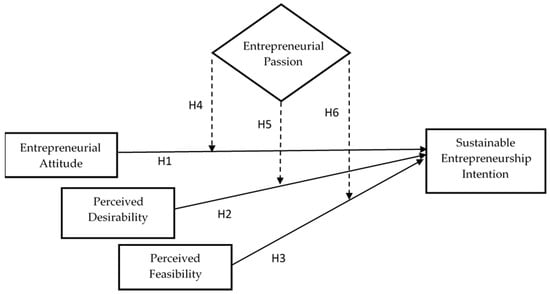
Figure 1.
Proposed Research Model.
3. Development of Hypotheses
3.1. The Impact of Entrepreneurial Attitude on Sustainable Entrepreneurship Intentions
Sustainable entrepreneurship is in contrast with commercial entrepreneurship in order to focus on merging different types of orientations including, social, economic and environmental [13]. There are two substitute ways to sustainability-oriented entrepreneurial practice, that are assisted by a supportive operational environment and are created as a reaction to an unsupportive environment. Studies revealed that the first way refers to sustainability-oriented including sustainability-oriented entrepreneurial ideas, emphasising on perceiving business and value formation and social support. On the other hand, the second way on a high level of entrepreneurial intention toward sustainability, excluding sustainability-oriented entrepreneurial concepts and not perceiving social and contextual support [34]. Reference [35] argued that attitudes are formed by value priorities, shape intentions and the following behaviour, therefore, studies regarding entrepreneurial intention in the context of sustainable entrepreneurship must include attitude toward sustainability [36]. According to [37], entrepreneurial attitudes assess the character to achieve the specific targets, therefore, they are different from traits. Additionally, entrepreneurial attitudes also impact the individual intentions and behaviour simultaneously [33]. The entrepreneurial attitudes have a significant role in developing intentions and has become the determinant factor in forming behaviour [38,39]. Many existing studies have found the positive and significant influence of entrepreneurial attitude on entrepreneurial intentions under various contexts [38,40]. Therefore, the following hypothesis is developed in this regard:
H1.
Entrepreneurial attitude positively impacts the sustainable entrepreneurship intentions among universities’ students with and without dual/triple award degree programs.
3.2. The Impact of Perceived Desirability on Sustainable Entrepreneurship Intention
Existing empirical studies have found positive and significant impact of perceived desirability towards entrepreneurial intentions [24,41]. This is because the individuals are more intended to become entrepreneurs if they believe that being an entrepreneur is more desirable to them than working for others [42]. The desire of individuals to become entrepreneur or to be self-employed provides a positive drive to become an entrepreneur [41]. Individuals would prefer to become an entrepreneur when they believe that the benefits and rewards of entrepreneurship outweigh the advantages of work because of the fact that the expected rewards depend on the individual’s evaluation of entrepreneurship and desirability to become an entrepreneur [41]. Thus, based on existing studies, this study develops the following hypothesis:
H2.
Perceived desirability positively impacts the sustainable entrepreneurship intentions among universities’ students with and without dual/triple award degree programs.
3.3. The Impact of Perceived Feasibility on Sustainable Entrepreneurship Intentions
Additionally, people who are more concerned with sustainable development and preserving nature also tend to act according to their values [43,44,45]. While, it has been identified that under more entrepreneurial self-efficacy and more industry resource-scarcity, people do not follow to their pro-environmental standards when assessing environmental destruction caused by grabbing opportunities [46]. Thus, partiality for environmental and social value creation composed with a positive opinion of entrepreneurship as a career choice could be positively referred to sustainability-oriented entrepreneurial intentions. Social problems are often considered to be much challenging, which suggests that the chances of effectively solving them are perceived to be low or even non-existent [47]. Consequently, perceived entrepreneurial feasibility has been anticipated to be positively associated with entrepreneurial intentions [48,49,50]. Based on the empirical evidences provided by the entrepreneurship literature, it is proposed that perceived feasibility influence the sustainable entrepreneurial intentions. Thus, the following hypothesis is developed.
H3.
Perceived feasibility positively impacts the sustainable entrepreneurship intentions among universities’ students with and without dual/triple award degree programs.
3.4. Moderating Impact of Entrepreneurial Passion
Numerous researches have shown that entrepreneurial passion contributes as one of essential factors in the creation processes of new venture [51,52,53]. Reference [54] referred passion with the ‘fire of desire’ that acts as a fuel for the entrepreneurs’ efforts and creativity and enables them to face all the difficulties they encounter [53]. Entrepreneurial passion is related to the positive attitudes and feelings for activities that are important for the individual’s self-identity [55,56]. Passion has been regarded as the “heart of entrepreneurship” that is also a key element of entrepreneurial behavior action towards the business creation [57]. Existing literature has widely proven that entrepreneurial passion has a significant role in entrepreneurial intention [23,55,58,59,60,61]. Furthermore, some researchers have also identified that entrepreneurial passion improves motivational factors and develops the positive feelings in high turbulent business environment with restraint resources [3,60].
Reference [61] concluded that entrepreneurial passion motivates individuals to identify opportunities for innovations and thus, develops intention to create a new business. Likewise, other researchers have also found the positive and significant impact of entrepreneurial passion on entrepreneurial intention under various contexts [51,52,58,62,63].
Reference [54] have described three types of entrepreneurial passion relevant to many characteristics of entrepreneurial activities. The first type of passion indicates the inventor identity [52,54] which is regarding the involvement of the entrepreneur in identifying, inventing, and then exploring new opportunities. This type of passion indicates the funder identity [52,54] which is regarding the involvement of the entrepreneur in entrepreneurial process of creating a business venture and related commercializing and exploiting activities [55]. The third type of passion indicates developer identity [52,54] which is regarding the entrepreneur’s involvement in the nurturing, forecasting, progress, and growth activities of the venture after its establishment [55]. These entrepreneurial passions relevant with three different types of role identities impact the entrepreneurial intention [44]. Thus, individuals with their higher level of entrepreneurial passion are most likely to create a business and execute their passion into action [55]. Thus, the study suggests the following hypotheses:
H4.
Entrepreneurial passion positively moderates the impact of entrepreneurial attitude on sustainable entrepreneurship intention among universities’ students, i.e., the positive impact of entrepreneurial attitude on sustainable entrepreneurship intentions will be more when the entrepreneurial passion is high.
H5.
Entrepreneurial passion positively moderates the impact of perceived desirability on sustainable entrepreneurship intention among universities’ students, i.e., the positive impact of perceived desirability on sustainable entrepreneurship intentions will be more when the entrepreneurial passion is high.
H6.
Entrepreneurial passion positively moderates the impact of perceived feasibility on sustainable entrepreneurship intention among universities’ students, i.e., the positive impact of perceived feasibility on sustainable entrepreneurship intentions will be more when the entrepreneurial passion is high.
4. Methodology
We searched the data bases from Google Scholar, Emerald, Springer, Sage, Elsevier, Taylor and Francis, Academy of Management (AOM) Journals, and Wiley Online Library by using the combinations of various keywords such as “Entrepreneurial Attitude and Entrepreneurship Intentions among Students”, “Perceived Desirability and Entrepreneurship Intentions among Students”, “Perceived Feasibility and Entrepreneurship Intentions among Students”, “Entrepreneurial Passion and Entrepreneurship Intentions among Students”, and “Sustainable Entrepreneurship Intentions among Students”. The observation period was last 11 years. We screened all the revenant studies and did review of only those studies that could qualify the two criteria. First, those studies that were mostly published in academic journals, excluding other sources such as trade publications, country reports or magazines. Second, we used empirical studies that mostly used the sample of undergraduate students.
Furthermore, the students were selected from management and business related programmes to collect data for this study. This study involves a quantitative study and data were collected using standard survey questionnaire from 600 undergraduate students of Kuala Lumpur and Selangor. Only 542 questionnaires were useable for data analysis which consisted 271 students in Group B with dual/triple award degree programmes who took entrepreneurship module and other 271 students in Group A who also took entrepreneurship module but their programmes did not offer dual/triple award degree programmes. Non-probability sampling techniques including snowball, convenience, and quota samplings were used to get target respondents. According to WarpPLS Software, the minimum sample size required for current model is 160 for the inverse square root with power level of 0.80 with significance level of 0.05 and 146 for the gamma exponential method [64]. Since researcher was able to collect data from 542 students (271 for Group A and 271 for Group B) which exceeded the minimum required sample size. All the constructs were measured using the items that were adapted from existing literature. For instance, Entrepreneurial Attitude (EA) and Perceived Desirability (PD) were measured with 3 items each adapted from [29], Perceived Feasibility (PF) was measured with 4 items adapted from [65], Sustainable Entrepreneurship Intention (SEI) and Entrepreneurial Passion (PASS) were measured with 5 and 4 items adapted from [36,55] respectively. All the constructs and their measures are presented in Table 1 as below:

Table 1.
Constructs with Items and Source.
Table 2 represents the demographic information about respondents. In both groups A and B, female respondents are more than male respondents. The majority respondents were Malays and Chinese having diploma and high school degree and belonged to the age group of 22–23. Group A students belonged to private as well as public universities located at Kuala Lumpur while Group B students belonged to only private universities located at Selangor.
Table 2.
Descriptive Statistics.
5. Data Analysis and Results
The current study used the WarpPLS software version 7.0 to test the proposed framework [66]. While performing analysis on WarpPLS, there are few requirements which are needed to be fulfilled to ensure that the instrument is reliable [66]. To evaluate the goodness of research model fit, several indicators were checked including: Average path coefficient (APC), Average R-squared (ARS), Average adjusted R-squared (AARS), Average block VIF (AVIF), Average full collinearity VIF (AFVIF), Tenenhaus GoF (GoF), Sympson’s paradox ratio (SPR), R-squared contribution ratio (RSCR), Statistical suppression ratio (SSR) and Nonlinear bivariate causality direction ratio (NLBCDR) [67].
Table 3 indicates the evaluation of goodness of fit of this research based on APC value 0.132 with p < 0.001, ARS value 0.375 with p < 0.001 and AARS value 0.368 with p < 0.001. The AVIF value of 2.089 is ideally ≤ 5 and AFVIF values of 1.999 ideally ≤ 5 which means neither vertical nor lateral multicollinearity occurs in the research model. The GoF value is found 0.540 which is greater than 0.36 which means that the fit of the model is very good. Also, the SPR, RSCR, SSR and NLBCDR values meet their threshold criteria as shown in Table 3. This means that the predictors are not found to be mutually correlated in the research model and there is no collinearity problem between the predictors and the criterion as well.
Table 3.
Model fit and quality indices.
6. Multiple Group Invariant Assessment
To conduct the multiple group analysis (MGA) test, the current study divided the respondents into two groups based on university affiliation (Group A: without dual/triple award degree programmes and Group B: with dual/triple award degree programmes) as suggested by [68]. It is critical to establish the measurement invariance before conducting MGA. After that, the researchers confirmed that any differences in model ratings parameters between subgroups are not caused by content differences or perceived differences in the description of the steps that make up the model for both groups. It should be noted that rating error may increase when measurement imbalances can be established; It should be noted that measurement error can be inflated when measurement invariance is not established; this can lead to biased results [69]. Table 4 shows absolute latent coefficients for loadings and their p values greater than 0.05, which means that no significant difference occurred between groups due to factor loadings. After, establishing the partial measurement invariance, the MGA was made to compare the coefficients of the two groups to predict the purpose of smartwatch adoption.
Table 4.
Measurement Model and Invariance Analysis.
The measurement model (outer model) is initially evaluated, which indicates the construct reliability and validity of Entrepreneurial Attitude (EA), Perceived Desirability (PD), Perceived Feasibility (PF), Entrepreneurial Passion (PASS) and Sustainable Entrepreneurship Intentions (SEI) variables that are measured as reflectively. To evaluate the outer model, the three criteria were used including the construct reliability, convergent validity, and discriminant validity (Fornell-Larcker criterion and Heterotrait-Monotrait (HTMT)) [70]. While evaluating the reliability and validity of the model, Cronbach alpha(α), composite reliability (CR), and average variance extracted (AVE) were checked. In general, value of outer loadings needs to be greater than 0.70 [71]. Those items whose outer loadings fall in the range of 0.40–0.70 should be removed only if deleting them increases α, CR or AVE values [72]. Hence, composite reliability is appropriate measure of reliability and varies from 0 to 1. Values above 0.70 are recommended as threshold [72]. The threshold level of AVE is 0.50 or above according to criteria [73]. Table 4 shows convergent validity and reliability of the model.
Discriminant validity is used to ensure that each concept of latent variable is different from other variables standards [73]. In Fornell-Larcker criteria, the comparison is done between square root value of AVE and the correlation coefficient of each construct. For a construct to have discriminant validity, square root value of AVE of a construct needs to be greater than the correlation coefficients of other constructs [74]. In Table 5, it can be seen that the root AVE value for each variable is higher than the AVE value for the other variables. This shows that the prerequisites for the discriminant validity test have been met. Thus, the instrument used in this study has met the requirements of the validity test.
Table 5.
Discriminant validity coefficients.
The Heterotrait-Monotrait (HTMT) ratio indicates the average of correlation of the indicators among different constructs and the average of the correlation of indicators of the related construct. According to [71], models with constructs that are conceptually similar have threshold level of 0.90 while those constructs that are unrelated to each other have threshold value of 0.85 or below. From Table 6, it can be observed that not a single value is greater than 0.85. Hence, discriminant validity is established.
Table 6.
Heterotrait-Monotrait (HTMT) ratio.
7. Results Structural Model
After examining the measurement model, the structural model is assessed for the values of R2, Q2, f2, and significance of relationships. R2 for endogenous latent variable is assessed in order to find the amount of variance explained by all constructs [75]. Though a satisfactory value of R2 depends upon the setting of study. According to [76], the value of 0.26, 0.13, and 0.09 express high, moderate and low amount of variance respectively. Table 7 shows the R2 value of sustainable entrepreneurship intention of both groups i.e., Group A and Group B. The EA, PF and PD represent only 19.3% variance in sustainable entrepreneurship intention in Group A (without dual/triple degree awards) and 44.7% in Group B (with dual/triple degree awards). Furthermore, a cross-validated redundancy measure (Q2) was applied to quantify the estimate significance of the research model [71]. There was support for sufficient estimates’ significance of the direct effect model because Table 7 shows that the value of Q2 is greater than zero in both Group A = 0.200 and Group B = 0.350. Therefore, it can be considered as a satisfactory predictive relevance of the model.
Table 7.
Coefficient of Determination in the PLS method.
Reference [71] describe (f2) estimations between 0.02, 0.15 and 0.35 as having small, medium, and large effects respectively. Thus, following [76] rule, the impacts’ sizes of these exogenous construct on endogenous construct can be reflected as small, medium and large, respectively as shown in Table 8. Moreover, we calculated the p-values for the one-tailed test to interpret the significance of the coefficients. The Figure 2 shows that the EA has significant effect on SEI in Group A (β = 0.322, p < 0.05) also Group B (β = 0.110, p < 0.05). Thus, the H1 is supported for Group A and Group B. But the result for group pairs analysis is non-significant (β = 0.065, p > 0.05). H2 is not supported for Group A because the direct effect of PD on SEI is non-significant (β = 0.055, p > 0.05) but H2 is supported for Group B where its impact is significant (β = 0.316, p < 0.05) and group pairs result is significant (β = 0.226, p < 0.05). Lastly, the direct impact of PF on SEI is non-significant in Group A (β = 0.043, p > 0.05) but is significant in Group B (β = 0.274, p < 0.05). Thus, H3 is supported for Group B but is not supported for Group A. The group pairs result is significant too for this relationship as well (β = 0.137, p < 0.05). The results of group pairs imply that there is a significant difference in the path coefficients of Group A and Group B for the relationships of PD and PF with SEI, whereas, no significant difference is found for the path coefficients of relationship of EA and SEI between these groups.
Table 8.
Path coefficients.
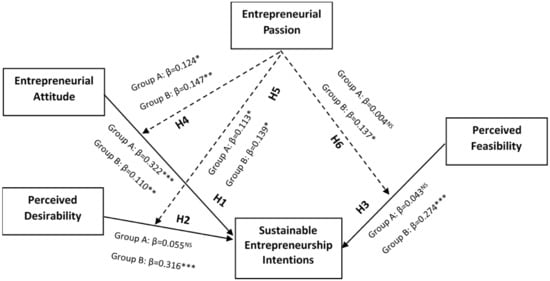
Figure 2.
Groups path results. Note: * p < 0.05, ** p < 0.01, *** p < 0.001, and Not Supported (NS).
Since this study has also hypothesized the positive moderating impact of Entrepreneurial Passion (PASS) for the impacts of EA, PD, and PF on SEI. As described in Table 8, the moderating effect of PASS between EA and SEI is positive and significant in both Group A (β = 0.124, p < 0.05) and Group B (β = 0.147, p < 0.01). Thus, H4 is supported for both groups. Likewise, the moderating effect of PASS between PD and SEI is significant in both Group A (β = 0.113, p < 0.05) and in Group B (β = 0.139, p < 0.05). Thus, H5 is also supported for both groups.
Finally, the moderating effect of PASS between PF and SEI is non-significant in Group A (β = 0.004, p > 0.05) but is significant in Group B (β = 0.137, p < 0.05). Thus, H6 is supported only for Group B but not for Group A. Furthermore, the results of group pair were non-significant for the moderating impact of PASS between EA and SEI (β = 0.053, p > 0.05). However, the result of group pair was significant for the moderating impact of PASS between PD and SEI (β = 0.076, p < 0.05) and moderating impact of PASS between PF and SEI (β = 0.116, p < 0.01). Thus, the group pair results reveal that there is significant difference in the path coefficients for the PASS*PD and SEI as well as and for PASS*PF and SEI between Group A and Group B. However, no significant difference was found for the path coefficients of PASS*EA and SEI between both groups. Figure 2 and Table 8 show the results regarding the significance of all direct and moderating relationships of the hypothesized research model.
8. Discussion
This study has used the EPM model of Krueger and Brazeal with some modifications to examine the sustainable entrepreneurship intentions among undergraduate students. Three constructs including entrepreneurial attitude, perceived desirability, and perceived feasibility have been taken as independent variables to examine the sustainable entrepreneurial intention among students under the moderating influence of entrepreneurial passion who have studied entrepreneurship subject at undergraduate level in Malaysian universities. This study consisted the comparison of two groups of students. Group A students were those students who took entrepreneurship module in local Malaysian universities without dual/triple award degree programmes. And Group B students were those students who took entrepreneurship module in local Malaysian universities with dual/triple award degree programmes.
The main aim of this study was to compare the impact of entrepreneurial attitude, perceived desirability, and perceived feasibility under the moderating impact of entrepreneurial passion on undergraduate students’ sustainable entrepreneurship intention with and without dual/triple award programmes. The findings of this study reveal a significant impact of entrepreneurial attitude, perceived desirability, and perceived feasibility on sustainable entrepreneurship intention among undergraduate students of Group B whose universities are offering dual/triple award degree programmes. The positive and significant impact of entrepreneurial attitude on sustainable entrepreneurship intention are consistent with findings of some other studies that have also found similar results under various contexts [38,40]. Likewise, the results regarding the positive and significant influence of perceived desirability and perceived feasibility on sustainable entrepreneurship intention are also congruent with similar type of existing studies’ results i.e., perceived desirability [24,41] and perceived feasibility [48,49,50] in different contexts.
Furthermore, the positive and significant moderating impact of entrepreneurial passion was also found for the influence of entrepreneurial attitude, perceived desirability, and perceived feasibility on sustainable entrepreneurship intention among undergraduate students of Group B. The results show that students of entrepreneurship module with dual/triple award degree programmes develop positive entrepreneurial attitudes, perceive more desirable and capable of starting an entrepreneurial business and their passion improves their entrepreneurial attitude, perceive desirability, and feasibility in starting sustainable entrepreneurial business as well. Therefore, all the six hypotheses were supported for Group B students. However, for Group A students, only H1 which regards the impact of entrepreneurial attitude on sustainable entrepreneurship intention was supported among the direct hypotheses. H5 and H6 were also supported regarding the positive moderating influence of entrepreneurial passion for the impact of perceived desirability and perceived feasibility respectively on sustainable entrepreneurship intention among Group A students, whereas, H2 and H3 regarding the direct positive impact of perceived desirability and perceived feasibility respectively, were not supported for Group A students. These findings reveal that students with entrepreneurship modules from universities without dual/triple award programmes perceived less desirability and capability to start sustainable entrepreneurship businesses and show less entrepreneurial passion as compared to students with entrepreneurship modules from universities with dual/triple award degree programmes. The multi group analysis also reveal significant differences among students of Group A and Group B regarding the impact of perceived desirability and perceived feasibility on sustainable entrepreneurship intentions. Likewise, significant differences were also found for the moderating impact of entrepreneurial passion on perceived desirability and perceived feasibility on sustainable entrepreneurship intention among students of Group A and Group B as well.
Additionally, the findings show that entrepreneurial attitude, perceived feasibility, and perceived desirability explain and influence most of the sustainable entrepreneurship intentions of Group B students (e.g, R2 value = 0.447) whose degree programmes are dual or triple awarded as compared to Group A students without dual or triple award degree programmes (e.g, R2 value = 0.193). Thus, the findings of this study clearly reveal that only entrepreneurship education is not very affective in promoting the sustainable entrepreneurship intention among undergraduate students but the partnership of local universities with other overseas’ universities is equally important in this regard. Thus, to improve the sustainable entrepreneurship intentions among students, the universities should develop partnerships with other universities of developed countries. Due to the partnership of local universities with other overseas’ universities, the quality of entrepreneurship education can be enhanced and more resources could be provided to assist students in their learning about entrepreneurship. Due to dual/triple award degree programmes, the students may feel more motivation and confidence in their abilities to start their own businesses and desire for sustainable entrepreneurial businesses. Their entrepreneurial attitude increases too and they feel more passionate in starting their own businesses. Whereas, based on the findings of this study, the students in local universities without dual/triple award degree programmes have entrepreneurial attitude towards sustainable entrepreneurship intentions, however, they don’t perceive desirability and feasibility for it. In other words, they are not willing to be self-employed in their own business and feel less abilities for starting their own businesses. The reason could be that the entrepreneurship modules taught in local universities could only develop their entrepreneurial attitudes but could not develop their confidence and passion to start their own business. The local universities should also develop more partnerships with other overseas universities to give more exposure to their students for the new idea generation process. The quality of existing entrepreneurship modules could be improved and more learning resources could be accessed for students to learn about entrepreneurship due to partnership with other universities of overseas. Likewise, university-industry partnership could be another important factor that could impact on sustainable entrepreneurship intention among students. Local universities can use their contacts as well as industry networks of their partnership universities to create more internship opportunities for university students to improve their knowledge and understanding regarding sustainable entrepreneurial businesses.
9. Study Limitations and Future Recommendations
Despite the practical implications of this study, there are some limitations as well. For instance, the data were collected from students of only two cities namely Kuala Lumpur and Selangor in Malaysia in a cross-sectional setting. The future studies can include sample of students from other universities of Malaysia and longitudinal approach could be used in carrying out the research. The future studies should investigate the impact of academic entrepreneurship in motivating students towards sustainable entrepreneurship businesses by using qualitative/quantitative or mix methodologies. The future researchers should also examine the cultural conditions of the region to propose a model for an academic entrepreneur for significant contribution in the literature related to sustainable entrepreneurship intentions among students. Future researchers are suggested to conduct similar type of studies in other countries to contribute in the international literature. The comparative studies on the topic of sustainable entrepreneurship intentions among students of developing and developed countries could make a significant contribution in the existing literature. Likewise, future researchers are also suggested to compare the academic entrepreneurship courses in Malaysia and those of overseas universities to see their impact on sustainable entrepreneurship intentions among undergraduate students. As mentioned in above discussion that university-industry partnership could be another potential contributing factor in developing the sustainable entrepreneurship intention among students. Thus, future research is recommended to investigate the influence of university-industry partnership on sustainable entrepreneurship intentions among university students. Moreover, the future researchers can conduct the interview of alumni of universities who took entrepreneurship module at their undergraduate level and are successfully operating their businesses. The effectiveness of entrepreneurship education and impact of universities’ dual/triple award degree programmes could be also explored through qualitative or mix-methodology research towards sustainable entrepreneurship intention.
10. Conclusions
It is essential for the students to grasp the depth understanding of entrepreneurship module and venture creation, equip the specific skills to implement new business ideas, and should develop propensity to act towards sustainable entrepreneurship intentions. The high-quality entrepreneurship modules can improve the entrepreneurial ability of students towards venture creation. The entrepreneurship curriculum in universities that have partnerships with overseas’ universities, is creating the significant influence on the mindset of the students in Malaysia and enhancing their implementation behaviour for new business idea. The presence of high risk-taking skill, practical experience in incubators, more awareness regarding the government policies, increased engagement with entrepreneurial network is promoting entrepreneurial behaviour among students with dual/triple award degree programmes. Hence, it is strongly recommended that the universities should develop partnerships with overseas universities to improve quality of entrepreneurship curriculum and should provide more practical experience in incubation centers, and access to entrepreneurial networks that will boost the entrepreneurship thinking process of the students. Universities should provide more knowledge regarding government policies to increase the perceive desirability of students towards sustainable entrepreneurship intentions. The entrepreneurship curriculum should be designed with partner universities’ experts to develop essential entrepreneurial skills among undergraduate students towards their sustainable entrepreneurial intention.
Author Contributions
Conceptualization, S.T.; methodology, S.T.; software, S.A.H.; validation, S.A.H. and S.T.; formal analysis, S.A.H.; investigation, S.T.; resources, S.T.; data curation, S.T.; writing—original draft preparation, S.T., writing—review and editing, S.T., and S.A.H.; visualization, S.T., and S.A.H.; supervision, S.T., and S.A.H.; project administration, S.T., and S.A.H.; funding acquisition, S.T. All authors have read and agreed to the published version of the manuscript.
Funding
This research was funded under the Research Funds; Project Codes #GRTIN-RRO-83-2020 and #GRTIN-IRG-65-2021 sponsored by Sunway University.
Institutional Review Board Statement
The study was approved by the Sunway University Research Ethics Committee of Sunway University (protocol code: SUREC 2020/009 and 27/02/2020).
Informed Consent Statement
Informed consent was obtained from all subjects involved in the study.
Data Availability Statement
The datasets used and/or analyzed during the current study are available from the corresponding author on reasonable request.
Acknowledgments
The authors thank all the students who participated in this study.
Conflicts of Interest
The authors declare no conflict of interest.
References
- Ahmad, R.; Mahli, F.; Tehseen, S.; Qureshi, Z.H.; Jannat, U.M.U. Entrepreneurial intentions among university’s students in Malaysia. In 2019 13th International Conference on Mathematics, Actuarial Science, Computer Science and Statistics (MACS); IEEE: New York, NY, USA, 2019; pp. 1–7. [Google Scholar] [CrossRef]
- Sun, H.; Lo, C.T.; Liang, B.; Wong, Y.L.B. The impact of entrepreneurial education on entrepreneurial intention of engineering students in Hong Kong. Manag. Decis. 2017, 56, 1371–1393. [Google Scholar] [CrossRef]
- Moses, C.; Olokundun, A.M.; Akinbode, M.; Agboola, M.G.; Inelo, F. Entrepreneurship education and entrepreneurial intentions: The moderating role of passion. Soc. Sci. 2016, 11, 645–653. [Google Scholar]
- Hahn, D.; Minola, T.; Bosio, G.; Cassia, L. The impact of entrepreneurship education on university students’ entrepreneurial skills: A family embeddedness perspective. Small Bus. Econ. 2020, 55, 257–282. [Google Scholar] [CrossRef]
- Barringer, B.R.; Ireland, R.D. Entrepreneurship: Successfully Launching New Ventures, 6th ed.; Pearson Prentice-Hall: Upper Saddle River, NJ, USA, 2019. [Google Scholar]
- Tomy, S.; Pardede, E. An entrepreneurial intention model focussing on higher education. Int. J. Entrep. Behav. Res. 2020. [Google Scholar] [CrossRef]
- Sardeshmukh, S.R.; Smith-Nelson, R.M. Educating for an entrepreneurial career: Developing opportunity-recognition ability. Aust. J. Career Dev. 2011, 20, 47–55. [Google Scholar] [CrossRef]
- Hofer, A.-R.; Potter, J.; Redford, D.; Stolt, J. Promoting Successful Graduate Entrepreneurship at the University of Applied Sciences Schmalkalden, Germany. In OECD Local Economic and Employment Development Programme; OECD: Paris, France, 2013. [Google Scholar] [CrossRef]
- Karlsson, T.; Moberg, K. Improving perceived entrepreneurial abilities through education: Exploratory testing of an entrepreneurial self-efficacy scale in a pre-post setting. Int. J. Manag. Educ. 2013, 11, 1–11. [Google Scholar] [CrossRef]
- Chang, J.; Rieple, A. Assessing students’ entrepreneurial skills development in live projects. J. Small Bus. Enterp. Dev. 2013, 20, 225–241. [Google Scholar] [CrossRef]
- Shepherd, D.A.; Patzelt, H. The new field of sustainable entrepreneurship: Studying entrepreneurial action linking “what is to be sustained” with “what is to be developed”. Entrep. Theory Pract. 2011, 35, 137–163. [Google Scholar] [CrossRef]
- Schaltegger, S.; Wagner, M. Sustainable entrepreneurship and sustainability innovation: Categories and interactions. Bus. Strategy Environ. 2011, 20, 222–237. [Google Scholar] [CrossRef]
- Hockerts, K.; Wüstenhagen, R. Greening Goliaths versus emerging Davids—Theorizing about the role of incumbents and new entrants in sustainable entrepreneurship. J. Bus. Ventur. 2010, 25, 481–492. [Google Scholar] [CrossRef]
- Zahra, S.A.; Gedajlovic, E.; Neubaum, D.O.; Shulman, J.M. A typology of social entrepreneurs: Motives, search processes and ethical challenges. J. Bus. Ventur. 2009, 24, 519–532. [Google Scholar] [CrossRef]
- Fayolle, A.; Liñán, F.; Moriano, J.A. Beyond entrepreneurial intentions: Values and motivations in entrepreneurship. Int. Entrep. Manag. J. 2014, 10, 679–689. [Google Scholar] [CrossRef]
- Cohen, B.; Winn, M.I. Market imperfections, opportunity and sustainable entrepreneurship. J. Bus. Ventur. 2017, 22, 29–49. [Google Scholar] [CrossRef]
- Vuorio, A. Opportunity-Specific Entrepreneurial Intentions in Sustainable Entrepreneurship. Ph.D. Thesis, Acta Universitatis Lappeenrantaensis, Lappeenranta, Finland, 2018. [Google Scholar]
- Iakovleva, T.; Kolvereid, L. An integrated model of entrepreneurial intentions. Int. J. Bus. Glob. 2009, 3, 66–80. [Google Scholar] [CrossRef]
- Tan, L.P.; Pham, L.X.; Bui, T.T. Personality Traits and Social Entrepreneurial Intention: The Mediating Effect of Perceived Desirability and Perceived Feasibility. J. Entrep. 2020. [Google Scholar] [CrossRef]
- Al-Jubari, I.; Hassan, A.; Liñán, F. Entrepreneurial intention among University students in Malaysia: Integrating self-determination theory and the theory of planned behavior. Int. Entrep. Manag. J. 2018, 1–20. [Google Scholar] [CrossRef]
- Ahmad, M.A. Entrepreneurial Intention Among Postgraduate Students of UUM. Master’s Thesis, Universiti Utara, Kuala Lumpur, Malaysia, 2015. [Google Scholar]
- Amanamah, R.B.; Acheampong, A.; Owusu, E.K. An exploratory study of entrepreneurial intention among university students in Ghana. Int. J. Sci. Technol. Res. 2018, 7, 140–148. [Google Scholar]
- Biraglia, A.; Kadile, V. The role of entrepreneurial passion and creativity in developing entrepreneurial intentions: Insights from American homebrewers. J. Small Bus. Manag. 2017, 55, 170–188. [Google Scholar] [CrossRef]
- Esfandiar, K.; Sharifi-Tehrani, M.; Pratt, S.; Altinay, L. Understanding entrepreneurial intentions: A developed integrated structural model approach. J. Bus. Res. 2019, 94, 172–182. [Google Scholar] [CrossRef]
- Israr, M.; Saleem, M. Entrepreneurial intentions among university students in Italy. J. Glob. Entrep. Res. 2018, 8, 1–14. [Google Scholar] [CrossRef]
- Lechuga Sancho, M.P.; Martín-Navarro, A.; Ramos-Rodríguez, A.R. Will they end up doing what they like? the moderating role of the attitude towards entrepreneurship in the formation of entrepreneurial intentions. Stud. High. Educ. 2020, 45, 416–433. [Google Scholar] [CrossRef]
- Ramayah, T.; Rahman, S.A.; Taghizadeh, S.K. Modelling green entrepreneurial intention among university students using the entrepreneurial event and cultural values theory. Int. J. Entrep. Ventur. 2019, 11, 394–412. [Google Scholar] [CrossRef]
- Liñán, F.; Fayolle, A. A systematic literature review on entrepreneurial intentions: Citation, thematic analyses, and research agenda. Int. Entrep. Manag. J. 2015, 11, 907–933. [Google Scholar] [CrossRef]
- Vuorio, A.M.; Puumalainen, K.; Fellnhofer, K. Drivers of entrepreneurial intentions in sustainable entrepreneurship. Int. J. Entrep. Behav. Res. 2018, 24, 359–381. [Google Scholar] [CrossRef]
- Hambrick, D.C.; Mason, P.A. Upper echelons: The organization as a reflection of its top managers. Acad. Manag. Rev. 1984, 9, 193–206. [Google Scholar] [CrossRef]
- Krueger, N.F., Jr.; Brazeal, D.V. Entrepreneurial potential and potential entrepreneurs. Entrep. Theory Pract. 1994, 18, 91–104. [Google Scholar] [CrossRef]
- Moghavvemi, S.; Salleh, N.A.M.; Abessi, M. Determinants of IT-related innovation acceptance and use behavior: Theoretical integration of unified theory of acceptance and use of technology and entrepreneurial potential model. Soc. Technol. 2013, 3, 243–260. [Google Scholar] [CrossRef]
- Ajzen, I. The theory of planned behavior. Organ. Behav. Hum. Decis. Process. 1991, 50, 179–211. [Google Scholar] [CrossRef]
- Muñoz, P.; Dimov, D. The call of the whole in understanding the development of sustainable ventures. J. Bus. Ventur. 2015, 30, 632–654. [Google Scholar] [CrossRef]
- Fischer, R.; Schwartz, S. Whence differences in value priorities? Individual, cultural, or artifactual sources. J. Cross Cult. Psychol. 2011, 42, 1127–1144. [Google Scholar] [CrossRef]
- Munir, H.; Jianfeng, C.; Ramzan, S. Personality traits and theory of planned behavior comparison of entrepreneurial intentions between an emerging economy and a developing country. Int. J. Entrep. Behav. Res. 2019, 25, 554–580. [Google Scholar] [CrossRef]
- Ajzen, I. Attitudes, Personality, and Behaviour; Open University Press: Milton Keynes, UK, 1988. [Google Scholar]
- Mahfud, T.; Triyono, M.B.; Sudira, P.; Mulyani, Y. The influence of social capital and entrepreneurial attitude orientation on entrepreneurial intentions: The mediating role of psychological capital. Eur. Res. Manag. Bus. Econ. 2020, 26, 33–39. [Google Scholar] [CrossRef]
- Nguyen, A.T.; Do, T.H.H.; Vu, T.B.T.; Dang, K.A.; Nguyen, H.L. Factors affecting entrepreneurial intentions among youths in Vietnam. Child. Youth Serv. Rev. 2019, 99, 186–193. [Google Scholar] [CrossRef]
- Jena, R.K. Measuring the impact of business management Student’s attitude towards entrepreneurship education on entrepreneurial intention: A case study. Comput. Hum. Behav. 2020, 107, 106275. [Google Scholar] [CrossRef]
- Yousaf, U.; Shamim, A.; Siddiqui, H.; Raina, M. Studying the influence of entrepreneurial attributes, subjective norms and perceived desirability on entrepreneurial intentions. J. Entrep. Emerg. Econ. 2015. [Google Scholar] [CrossRef]
- Levesque, M.; Shepherd, D.A.; Douglas, E.J. Employment or self-employment: A dynamic utility-maximizing model. J. Bus. Ventur. 2002, 17, 189–210. [Google Scholar] [CrossRef]
- Wagner, M. Ventures for the public good and entrepreneurial intentions: An empirical analysis of sustainability orientation as a determining factor. J. Small Bus. Entrep. 2012, 25, 519–531. [Google Scholar] [CrossRef]
- Criado-Gomis, A.; Cervera-Taulet, A.; Iniesta-Bonillo, M.A. Sustainable entrepreneurial orientation: A business strategic approach for sustainable development. Sustainability 2017, 9, 1667. [Google Scholar] [CrossRef]
- Bruyere, B.; Rappe, S. Identifying the motivations of environmental volunteers. J. Environ. Plan. Manag. 2007, 50, 503–516. [Google Scholar] [CrossRef]
- Shepherd, D.A.; Patzelt, H.; Baron, R.A. I care about nature, but…: Disengaging values in assessing opportunities that cause harm. Acad. Manag. J. 2013, 56, 1251–1273. [Google Scholar] [CrossRef]
- Seelos, C.; Mair, J. Social entrepreneurship: Creating new business models to serve the poor. Bus. Horiz. 2005, 48, 241–246. [Google Scholar] [CrossRef]
- Zhang, M.; Fang, Z. Research on the Influence Mechanism of Multi-level Information Ecological Environment on Entrepreneurial Intention. In Proceedings of the International Conference on Education and Cognition, Behavior, Neuroscience (ICECBN2018), Zhengzhou, China, 23–25 November 2018. [Google Scholar] [CrossRef]
- Smith, I.H.; Woodworth, W.P. Developing social entrepreneurs and social innovators: A social identity and self-efficacy approach. Acad. Manag. Learn. Educ. 2012, 11, 390–407. [Google Scholar] [CrossRef]
- Mair, J.; Noboa, E. Social Entrepreneurship: How intentions to create a social venture are formed. In Social Entrepreneurship; Palgrave Macmillan: London, UK, 2006; pp. 121–135. [Google Scholar] [CrossRef]
- Syed, I.; Butler, J.C.; Smith, R.M.; Cao, X. From entrepreneurial passion to entrepreneurial intentions: The role of entrepreneurial passion, innovativeness, and curiosity in driving entrepreneurial intentions. Personal. Individ. Differ. 2020, 157, 109758. [Google Scholar] [CrossRef]
- Neneh, B.N. Entrepreneurial passion and entrepreneurial intention: The role of social support and entrepreneurial self-efficacy. Stud. Higher Educ. 2020, 1–17. [Google Scholar] [CrossRef]
- Cardon, M.S.; Kirk, P.C. Entrepreneurial Passion as Mediator of the Self-Efficacy to Persistence Relationship. Entrep. Theory Pract. 2015, 39, 1027–1050. [Google Scholar] [CrossRef]
- Cardon, M.S.; Wincent, J.; Singh, J.; Drnovsek, M. The Nature and Experience of Entrepreneurial Passion. Acad. Manag. Rev. 2009, 34, 511–532. [Google Scholar] [CrossRef]
- Li, C.; Murad, M.; Shahzad, F.; Khan, M.A.S.; Ashraf, S.F.; Dogbe, C.S.K. Entrepreneurial passion to entrepreneurial behavior: Role of entrepreneurial alertness, entrepreneurial self-efficacy and proactive personality. Front. Psychol. 2020, 11, 1–19. [Google Scholar] [CrossRef] [PubMed]
- Huyghe, A.; Knockaert, M.; Obschonka, M. Unraveling the “passion orchestra” in academia. J. Bus. Ventur. 2016, 31, 344–364. [Google Scholar] [CrossRef]
- Santos, S.C.; Cardon, M.S. What’s love got to do with it? Team entrepreneurial passion and performance in new venture teams. Entrep. Theory Pract. 2019, 43, 475–504. [Google Scholar] [CrossRef]
- Karimi, S. The role of entrepreneurial passion in the formation of students’ entrepreneurial intentions. Appl. Econ. 2020, 52, 331–344. [Google Scholar] [CrossRef]
- Schenkel, M.T.; Farmer, S.; Maslyn, J.M. Process improvement in SMEs: The impact of harmonious passion for entrepreneurship, employee creative self-efficacy, and time spent innovating. J. Small Bus. Strategy 2019, 29, 71–84. [Google Scholar]
- Türk, S.; Zapkau, F.B.; Schwens, C. Prior entrepreneurial exposure and the emergence of entrepreneurial passion: The moderating role of learning orientation. J. Small Bus. Manag. 2020, 58, 225–258. [Google Scholar] [CrossRef]
- Cardon, M.S.; Glauser, M.; Murnieks, C.Y. Passion for what? Expanding the domains of entrepreneurial passion. J. Bus. Ventur. Insights 2017, 8, 24–32. [Google Scholar] [CrossRef]
- Hockerts, K. Determinants of social entrepreneurial intentions. Entrep. Theory Prac. 2017, 41, 105–130. [Google Scholar] [CrossRef]
- Campos, H.M. Impact of entrepreneurial passion on entrepreneurial orientation with the mediating role of entrepreneurial alertness for technology-based firms in Mexico. J. Small Bus. Enterp. Dev. 2017, 24, 353–374. [Google Scholar] [CrossRef]
- Kock, N.; Hadaya, P. Minimum sample size estimation in PLS-SEM: The inverse square root and gamma-exponential methods. Inf. Syst. J. 2018, 28, 227–261. [Google Scholar] [CrossRef]
- Masrury, M.J. The Impact of Perceived Feasibility and Perceived Desirability on Entrepreneurial Intention among Undergraduate Students in Universitas Muhammadiyah Surakarta; Universitas Muhammadiyah: Surakarta, Indonesia, 2016. [Google Scholar]
- Kock, N. Factor-based structural equation modeling with WarpPLS. Aust. Mark. J. 2019, 27, 57–63. [Google Scholar] [CrossRef]
- Sholihin, M.; Ratmono, D. Analisis SEM-PLS Dengan WarpPLS 7.0: Untuk Hubungan Nonlinier Dalam Penelitian Sosial dan Bisnis; Penerbit Andi: Surabaya, Indonesia, 2013. [Google Scholar]
- Kock, N. WarpPLS User Manual: Version 6.0; ScriptWarp Systems: Laredo, TX, USA, 2017. [Google Scholar]
- Hair, J.F.; Sarstedt, M.; Ringle, C.M.; Gudergan, S.P. Advanced Issues in Partial Least Squares Structural Equation Modeling, 3rd ed.; Sage: Thousand Oaks, CA, USA, 2018. [Google Scholar]
- Hair, J.F.; Risher, J.J.; Sarstedt, M.; Ringle, C.M. When to use and how to report the results of PLS-SEM. Eur. Bus. Rev. 2019, 31, 2–24. [Google Scholar] [CrossRef]
- Hair, J.F.; Hult, G.T.M.; Ringle, C.M.; Sarstedt, M. A Primer on Partial Least Squares Structural Equation Modeling (PLS-SEM), 2nd ed.; Sage: Thousand Oaks, CA, USA, 2017. [Google Scholar]
- Hair, J.F., Jr.; Sarstedt, M.; Matthews, L.M.; Ringle, C.M. Identifying and treating unobserved heterogeneity with FIMIX-PLS: Part I–method. Eur. Bus. Rev. 2016. [Google Scholar] [CrossRef]
- Fornell, C.; Larcker, D.F. Evaluating structural equation models with unobservable variables and measurement error. J. Mark. Res. 1981, 18, 39–50. [Google Scholar] [CrossRef]
- Ringle, C.M.; Wende, S.; Becker, J.M. SmartPLS 3; SmartPLS GmbH: Boenningstedt, Germany, 2015. [Google Scholar]
- Ramayah, T.; Cheah, J.; Chuah, F.; Ting, H.; Memon, M.A. Partial Least Squares Structural Equation Modeling (PLS-SEM) Using smartPLS 3.0; Pearson: Kuala Lumpur, Malaysia, 2018. [Google Scholar]
- Cohen, J. Statistical Power Analysis for the Behavioural Sciences; Lawrence Earlbaum Associates: Hillside, NJ, USA, 1988; pp. 19–74. [Google Scholar]
Publisher’s Note: MDPI stays neutral with regard to jurisdictional claims in published maps and institutional affiliations. |
© 2021 by the authors. Licensee MDPI, Basel, Switzerland. This article is an open access article distributed under the terms and conditions of the Creative Commons Attribution (CC BY) license (https://creativecommons.org/licenses/by/4.0/).