


Abstract
Sustainable development entails socio-economic wellbeing, which is often threatened by weather hazards. Indeed, the need to minimise the adverse impact of climate change and extreme weather events cannot be overstressed. Notably, damage to the built environment by extreme weather and its consequential effects is highly significant. This emphasises the need for a climate-resilient built environment. Thus, this study derived the strategic capability areas required by business organisations to achieve the flood resilience of their built environment. The research method involved rounds of review by a carefully selected team of experts, and the review of lessons from four case studies. Twenty-six capability areas were identified from literature but were consolidated to nineteen at the end of data collection and analysis. The capability areas covered how properties are used and managed as well as the actual fabric and design of business premises/properties. The capability areas included awareness and understanding of flood risk to property, review for a flood resilience scheme, product acquisition for flood risk management, dynamic stakeholder identification and strong network, maintenance and post-flood management scheme, physical characteristics of the property and business data management. Professionals and business organisations can use the outcome of this study as a guide for business premises flood resilience enhancement planning and decision making.
1. Introduction
Sustainable development targets and general societal wellbeing are often threatened by weather hazards. Commercial properties contribute significantly to the economy, with a 2.2 per cent average growth rate since 2008. The value of business properties is dispersed throughout a larger range, assuring both local and national economic development [1]. Floodlist [2] estimated the property market loss from the February 2020 floods in the United Kingdom (UK) as GBP 297 million. In 2012, a year that witnessed a wet summer in the UK, flooding affected about 8000 properties in the UK [3]; insurers paid out a sum of GBP 373 million in claims for flood damage to business properties and paid business interruption claims to the value of GBP 40 million, and GBP 690 million on properties [4]. The damage from the February 2020 flood alone significantly compares with the total damage in 2012. Records of climate impacts accentuate the need to adapt and fortify properties and businesses at large against climate events. Despite previous efforts, more effort is needed to enhance property resilience to floods through improved planning and recovery [5]. Pluvial and fluvial flooding are frequent occurrences in some locations [6] thereby making business premises and the environment unhabitable and business operations interrupted. In such instances, based on experiences in the UK, and others, the possession of some capabilities does limit business premises and asset damage thereby speeding up business recovery [7]. To this end, Saito [8] highlighted the need to adopt flood risk management systems that shield against climate change impacts, Terdpaopong and Rickards [9] highlighted the need for company resilience to flooding for greater sustainability, Asgary [10] and Skouloudis et al. [11] discussed SMEs flood resilience and asset protection challenges, while Ogie et al. [12] provided some information meant to help decision making on hydrological infrastructure assets. In relation to achieving organisational goals which include managing and surviving climate events such as flooding [13,14], Yen-Tsang, Csillag, and Siegler [15] described the need for capabilities. In the context of climate resilience, Bosher [16] identified some structural and operational issues that can be effectively addressed with relevant capabilities at the organisation level.
UNISDR [17] submitted that capacity can also be referred to as capability and Khan, Vasilescu and Khan [18] described capacity in the context of catastrophes, such as climate events, as resources, means, strengths, structural measures, flood knowledge, skills, networks, resources, facilities and other non-structural measures which enables a system to cope with, withstand, prepare for, prevent, mitigate or quickly recover from a disaster. Structural measures refer to physical measures aimed at ensuring the strength and resilient ability of the surrounding environment and building members [19]. Examples include the use of flood resilient paint and raising the position of sockets above the anticipated flood level [20]. Non-structural measures refer to non-physical measures such as awareness, training and administrative actions [20]. Capabilities define the coping response, absorptive ability, adaptive strength and in turn the overall resilience of a system in a disaster situation. According to UNISDR [17], resilience is the ability of a system, community or society exposed to hazards to resist, absorb, accommodate and recover from the effects of a hazard in a timely and efficient manner, including through the preservation and restoration of its essential basic structures and functions. In the context of the built environment, according to Bosher [21], a climate or disaster-resilient built environment is ‘designed, located, built, operated and maintained in a way that maximises the ability of built assets, associated support systems (physical and institutional) and the people that reside or work within the built assets, to withstand, recover, and mitigate for, the impacts of extreme natural and human-induced hazards’.
The aim of this study is to identify and verify the strategic capability areas needed at the organisation level to enhance the flood resilience of the business premises of micro, small and medium-sized enterprises (MSMEs). MSMEs are significant to the economy of a nation and the flood resilience of business premises to climate-induced catastrophes are important to ensure business continuity [22]. Indeed, MSMEs are large employers of labour and their activities feed into the broader market [23]. However, MSMEs are highly vulnerable to disruptions basically because of their inherent limited risk management capability [23,24,25]. Various economic analyses on floods [26] as well as submissions on the magnitudes of direct physical and indirect losses, and loss estimation procedures have been reported in the literature [27,28,29,30]. Despite this, many MSMEs are not prepared [31]. CSES [32] and Ward and Rhodes [33] defined micro-businesses as business organisations with 0–9 employees, small-sized enterprises are businesses with employees between 10 and 49 employees and medium-sized enterprises are businesses with 50–249 employees.
This study explored existing knowledge and consolidated it with new knowledge from experts alongside the first-hand recovery experience of case organisations. This was needed to identify organisation-based capabilities for flood resilience considering the dynamism of demands and the growing need for improved business resilience. Sustainable development entails the existence of resilient physical properties and the preservation of economic activities. This study examined existing knowledge by reviewing the literature, incorporating expert submissions and carefully consolidating the capability areas using the lessons learnt from the recovery experience of previously flooded MSMEs. It is believed that a rigorous expert review and the case study lessons from the recovery experience of previously flooded MSMEs represent a unique addition to previous business resilience-related studies. This study acknowledges the relevance of multiple stakeholders to the flood recovery process but focuses on the business organisation perspective. This is because flood recovery is psychologically and emotionally draining to business owners as they are largely left to manage their business premises recovery as individual organisations. The outcome of this study will guide business administrators, community flood groups and professionals on the strategic capabilities that are useful to enhance the resilience of business premises. The need to enhance the flood performance of commercial properties and be able to build back better after a flood cannot be overemphasised.
2. Literature Review
2.1. Dynamic Capabilities Theory
Neise and Diez [34] highlighted the principle of dynamic capability and the idea of routine as it applies to flood adaptation. Routines are standard operating procedures; they are predictable behavioural patterns existing in an organisation during normal operations while dynamic capabilities require novel conceptualisation based on what circumstance demands. Dynamic capabilities can be skills, knowledge and facilities that allow organisations to reconfigure procedures as circumstances change and they emerge from the modification of routine procedures. For an organisation to evolve to achieve resilience, steady progressive modification to operational routines is germane and this highlights the importance of understanding necessary strategic capabilities. This study acknowledges that the extent of damage from floods depends on the velocity of flow, depth and duration of inundation among other factors. The study believes that the deployment of appropriate capabilities in all instances will mitigate the extent of the damage. Even though location and firm size influence the strategy and adaptation capacity of organisations [34], organisation learning principles should be applied to both operating routines and dynamic capabilities [35], also in the context of a flood. Hence, strategic capabilities for enhancement are explored in the further sections of this study.
2.2. Strategic Capability Areas for Enhancing the Flood Resilience of a Business Premises
The capability areas identified from the literature relate to physical facilities, institutional relationships, societal coping mechanisms, human knowledge, skills, social relationships, as well as leadership and management. Some of the listed capability areas (Table 1) were not clearly described in the literature as capabilities related to built environment flood resilience. Thus, all the capabilities extracted were subjected to rounds of verification by experts and stakeholders in case study organisations.

Table 1.
Capability areas and brief descriptions.
An interesting development which requires the deployment of strategic capabilities is the discussion around Flood Performance Certificates (FPC), a certificate showing the flood risk profile of each property. This discussion emerged in the UK to encourage businesses and property owners to embrace flood resilience measures [46]. This is likely to have several consequences, including renters receiving a more thorough briefing on the flood resilience of assets and insurance firms making judgments based on FPC ratings. It is also a chance for firms to explore gradual resilience improvements. All of these would make it easier to disperse the financial burden of floods over time [46] and possibly to make it more equitable among stakeholders. In terms of overall policy, regulatory and implementation infrastructure for FPCs, testing and other considerations are necessary [47,48].
3. Research Method
A thorough literature search using keywords such as capabilities, structural measures, non-structural measures, business resilience, capability areas, flood adaptation, organisation resilience and built environment flooding was undertaken to identify a list of capabilities that are required for enhancing the flood resilience of business premises. The capabilities (Table 1) identified from the literature were taken through a multi-stage verification process which involved scoring and qualitative review rounds of modified Delphi by experts and four case studies. The expert forum review allows the acquisition of deep knowledge from a team of experts [49], while a case study permits a relatively detailed focused evaluation, analysis and reporting of a phenomenon [50]. The research process for this study is presented in Figure 1.

Figure 1.
Research process.
3.1. Expert Forum Review (Modified Delphi Approach)
Table 2 describes the width and depth of knowledge of the panel members. The choice was made to select experts with knowledge of the built environment and flood risk management, those that have experienced flooding, worked on the recovery of communities that have experienced flooding, those involved in disaster and flood-related policymaking or those with flood protection or flood damage response experience as well as expertise in the built environment. Scholars who have carried out extensive research in flooding, communities and household and business recovery were also engaged. The panel was briefed on the significance of the structural and non-structural areas of investment in flood risk management and how this relates to built environment resilience. The briefing was to ensure that panel members had adequate information about what was expected from them in this study.
Table 2.
Designation and brief on expert forum members.
A 10-member expert forum team was involved in the first round of capability area verification, and six experts were engaged in the third round of the review which was a qualitative review. The sizes of the expert review panels aligned with the proof provided by Boje and Murnighan [51] and the study observed no effect of group sizes on decision-making techniques when it engaged groups made up of 3, 7 and 11 members. Moreover, Adler and Ziglio [52] submitted that the composition and quality of a panel matter more than the size especially when the heterogeneity of the panel is not prominent. Similarly, Powell [53] acknowledged the variation in the number of participants in panel-based research techniques but submitted based on the comment of Murphy [54] that there is scant evidence of panel size on the credibility of outcomes and that an expert panel is not expected to be statistically representative but rather be made up of experts with appropriate qualities. Panel sizes ranging from 5 to 10 have also been engaged by previous researchers [49,55,56]. Based on the evidence available in previous studies, the panel size was adequate [49,52,53,54,55,56].
The first round of evaluation was achieved by using a 5-point Likert scale questionnaire administered to the consented experts. They indicated their agreement with the suitability and the importance of the capability areas separately. The questionnaire was used as a method of knowledge extraction from the team of experts due to its suitability for numerically evaluating adequacy and consensus [57]. The mean score was used to measure how the members of the expert panel indicated their levels of agreement with the identified capability areas after the first round. Only capability areas with mean scores of 2.5 or above were considered for the second review and verification. The third stage was a review achieved by providing the expert team with more information on each capability area, and rather than scoring, panel members undertook a qualitative review and consolidated the capability areas. Qualitative interviews and reviews offer the opportunity of receiving in-depth insights into a phenomenon of interest [58]. This stage was followed by case study interviews.
3.2. Case Studies
The case studies were conducted to scrutinise the applicability of the verified capability areas based on the recovery experiences of the case organisations. The three main criteria for selecting the case study businesses were: (a) Membership of a defined property use class, e.g., shops, retail warehouses, hairdressers, undertakers, travel and ticket agencies, post offices, pet shops, sandwich bars, showrooms, domestic hire shops, dry cleaners and internet cafes, restaurant and snacks bars, drinking establishments, hot food takes away, hot food take away and hotel and guest houses. (b) Being an MSME. (c) The property must have previously experienced flooding. Four case study organisations were selected for the study. Property owners, business owners and staff in the organisations that experienced the flood and the recovery process were engaged.
The case studies were undertaken by methodically reviewing the flooding and the recovery experience of their organisation and its premises with the respondents. This was aimed at establishing the capabilities utilised and their alignment with the capabilities earlier verified in the expert forum. In addition to the review of the flooding and recovery experience, the stakeholders in the organisations were interviewed on the specific capabilities required for enhancing the flood resilience of the built environment of their businesses. Lastly, respondents were asked to bare their minds on the appropriateness of the already identified capability areas for enhancing the flood resilience of the built environment of their premises. Data from the case studies were analysed using content analysis, i.e., identifying key points and topics in the case study interviews [59]. Selective coding, which involves matching points or ideas in a discussion to an existing or a formed theme [50] was mainly employed in this study. This was appropriate because the relevant themes (i.e., capability areas) had already been identified and documented. Consideration was also made for the possibility of adding a new set of capabilities. The unit of analysis in the case studies was ‘interview with individuals about their organisation’ [50]. A total of three interviews were conducted in each of the four case study organisations (i.e., a total of 12 interviews).
4. Data Analysis and Results
4.1. The Expert Review
The expert review stages 1 and 2 were to screen the strategic capability areas identified from the literature. The decision was taken to eliminate capability areas with a mean value of less than 2.50 out of 5.00, this was to ensure that only suitable capability areas were considered in the next phase of the research. This approach was utilised by Babatunde and Perera [55], though variables with mean scores of at least 3.00 were selected in the study. The result of the expert rating of agreement with the suitability of the capability areas (Table 3) showed that no variable scored less than 2.50, and no variable was eliminated. The top five in terms of the mean score were understanding of flood risk to property, review for a flood resilience scheme, acquisition of relevant products for flood risk management (materials and technologies), a survey of the property and the availability of flood-proof protection for stocks and contents. The top five key capability areas recorded mean scores above 4.00 on a scale of 5.00 (Table 3), this implies that experts largely agreed on the need for a business to possess and utilise all the listed capabilities for resistance and resilience. Out of 26 capability areas, only 1 scored below 3.00 on a scale of 5.00. SCA1–SCA26 are the code references for the capability areas 1 to 26. The lowest score in the first rating was 2.90, followed by 3.30 while the lowest score in the second rating was 3.40. The average mean score of the listed capabilities increased from 3.89 to 3.97. It should be noted that variables with mean scores of less than 2.5 were eliminated but all the capability areas were considered fit for the next stage of review since none scored below 2.5.
Table 3.
Result of the first and second rating-expert screening of the identified capability areas for enhancing the flood resilience of business premises.
Based on the results, all the capability areas were considered in the next phase of the research, that is, the second expert rating. In the second round of verification, experts indicated their agreement with the variables by scoring the variables on a Likert scale of 1–5. Table 3 shows that the experts rated the identified capabilities high in the second round (Round 2). The topmost five areas were understanding of flood risk to property, planning or review for a flood resilience scheme, insurance adequacy and management, general awareness and commitment to resilience and the acquisition of relevant products for flood risk management (building materials and technologies). The top five in terms of experts’ agreement in the first and second ratings were similar, in the sense that the same three of the top five factors appeared in both ratings. The new inclusions among the first five capabilities in the second rating were insurance, and general awareness and commitment to resilience; they replaced the acquisition of relevant products for flood risk management and flood survey of the property. However, all the capability areas scored above 2.50 (Table 3).
The quantitative screening stage was followed by a qualitative review where experts provided qualitative feedback. This stage involved a six-member expert panel, and the panel members were from the ten experts that participated in the earlier rounds of rating. The designation and a brief on the six-panel members are presented in Table 4. The criteria for selecting the experts is discussed in the research methods section. Table 5 is only meant to provide a brief on the six members that participated in the qualitative review.
Table 4.
Designation and area of practice of expert review panel members.
Table 5.
Summary of consolidated capability areas.
Presented in the succeeding paragraphs are the comments of the panel members on each of the capability areas during the qualitative review. TR suggested the merger of operation and maintenance (SCA6) with the installation and post-flood management scheme (SCA5). However, based on the submissions of other expert panel members, the installation and post-flood management scheme was revised to include maintenance, i.e., maintenance and post-flood management scheme relationships. Moreover, operation and maintenance (SCA6) were renamed as the operation of acquired facilities; the maintenance aspect is now part of the post-flood management scheme relationships (SCA5). With the development, the comments of TR, JR and RC were satisfied. Moreover, TR suggested the exclusion of safety precautions (SCA8) as a substantial capability area; this was because the required safety precautions are about the plan in place for floods by the organisation. A similar submission was made by RC, but LT and LJ were silent on it. Therefore, the suggestion was adopted, and safety precaution was merged with the definitions of roles and how they change in disaster situations (SCA23). Moreover, retaining the interest of customers was perceived not to be good enough to stand alone as a capability area; therefore, it was merged with turnover and cash flow management (SCA10).
Further, TR stated that businesses take advice from insurance brokers and that insurance (SCA11) will no longer be available to businesses through FloodRe in the UK; therefore, insurance can be taken off the list of capabilities. LT also felt it can be eliminated because of the FloodRe issue. RC also raised concerns about some businesses’ decision not to claim; the capability was retained because three other experts did not object to its relevance as a capability area, and insurance adequacy and management will still be relevant to businesses in other countries. All other submissions were carefully considered and are summarised in Table 6.
Table 6.
Brief on case studies.
Eventually, some of the panel suggestions were adopted while some were not. Some were not taken up because they were not objected to by a majority of the experts, or they were beyond the scope of this study. After careful consideration of the submissions of the panel, the initial 26 capability areas were consolidated into 20 capability areas (Table 5). The consolidated list of capability areas was ratified by the expert forum members; none of the members provided further comments when further review was requested.
After the qualitative expert review, case study interviews were conducted to capture the lessons from the capabilities deployed during the flood recovery process of the case organisations. The lessons were expected to validate the outcome of the expert review and expand the list of capability areas. A brief on the case studies is provided in Table 6.
4.2. Case Studies
A total of 12 interviews were conducted for the case studies (three per case study), and the interviewees were the business property owners, the business owners and the staff of the organisations. They are key stakeholders involved in the day-to-day administration of the businesses and they witnessed the floods that affected their organisations. The respondents were suitable to contribute to the achievement of the aim of this study. The participation of multiple stakeholders in each organisation improved robustness and provided an opportunity to compare submissions, as well as to identify the differences and similarities in the understanding of flood resilience and associated activities in the organisations. The key findings from the case studies are presented as follows.
4.2.1. Case Study 1 (CS1)—Guest House
Several submissions covering the recovery process were described by the respondents. Reference was made to the attempt by the organisation to achieve a complete seal of the business premises from water. The wiring and the staircase among other elements were taken out and the damp-proof membrane was inserted into the floors. Wooden skirtings were replaced with tiles and furniture was raised; non-return valves were introduced. These were the activities undertaken to ensure the physical flood resilience of the property. All the activities were undertaken in consultation with stakeholders such as loss assessors, loss adjusters, insurance companies and construction firms. The lessons from the above are the ‘deployment of physical adaptation features’, and ‘stakeholder identification and engagement’. Other lessons identified by the respondents in the recovery process included ‘collaboration with neighbours’ for the activation of facility-level flood defences, and a post ‘flood survey’ ‘funding’ by a community organisation and the ‘continuous identification of stakeholders’ as events unfolded. It was clear that ‘flood resistant facilities’ were also acquired. A good ‘understanding of flood risk’ was also evident as one of the respondents highlighted the need to keep in touch with flood developments within the community through agencies and community updates. The advantage of the ‘simulated deployment’ of ‘resistance measures’ was also highlighted alongside the adequate ‘maintenance of the facilities’. The need for funds to finance and coordinate the recovery ‘crises budget’ was highlighted. One of the key capabilities highlighted as a lesson was an ability for the staff to take ‘decisions in emergencies’ and ‘dynamically identify stakeholders’ relevant to necessary actions. After experiencing around a 12-month closure in 2012, and a 17-month closure in 2012, recovery only took four weeks after the 2015 flood. This is clear evidence of the impact of the lessons learnt from the previous flood subsequently deployed as capabilities.
4.2.2. Case Study 2 (CS2)—Restaurant
The restaurant experienced flooding around five times in 2015 but the lessons deployed as capabilities ensured the recovery and a return to business within 2 to 7 days. Reference was made to the efficacy of ‘flood resistance facilities and resilient materials’ which included flood gates, waterproof floor membrane, stone-cement floor and light brown tiles. A ‘flood survey’ was also conducted and constant ‘interaction with stakeholder groups and agencies’ was ensured. The business owner recalled the ‘constant monitoring of flood updates’ through community groups and agencies. It was stated that all employees were trained to trigger premises protection measures as soon as the water level reaches a height. ‘Rehearsals and occasional trigger’ of the measures aided the speed of deployment of the measures over time. A key resource deployed was the ‘funds’ obtained from the business savings to restore the premises that included cleaning, repair and building some aspects back better. Although content insurance existed, insurance interventions were delayed. Another lesson from the recovery experience was the importance of the organisation’s familiarity with ‘sourcing facilities and seeking assistance’ such as for cleaning and drying, the lessons from previous experiences aided the network and the organisation’s ability to mobilise. ‘Cashflow’ had to be preserved and the organisation already understood the need to ‘reach out to customers’ even when operations were suspended due to flood. Preserving income was described as the only way to secure the business and the premises for the present and the future. One of the key lessons highlighted and regarded by the organisation was the importance of ‘pre and post-flood survey’, it was also stated that the embrace of ‘decentralised’ decision making sounded good as employees felt comfortable with being trusted with decision making. The previous flood experiences strengthened the restaurant’s capabilities to deal with subsequent floods.
4.2.3. Case Study 3 (CS3)–Retail Outlet
Case study 3 experienced flooding several times and learnt through the process thereby deploying capabilities for quicker recovery at every succeeding flooding. Respondents emphasised the importance of the knowledge acquired from previous flood experiences and ‘understanding of flood risk’, an interviewee stated:
‘We knew what to do, we knew how to engage the insurance company, we knew how to arrange for premises clean up, so the flood did not have a lasting impact on us.’
The business returned to operation within 36 hours and rejected the clean-up offer by the insurance company. The business resorted to the self-sorting of items; it was believed that more items would have been disposed of if the activity was handled by an insurance firm. Another capability deployed was the ‘knowledge of insurance’ as one of the owners stated:
‘We knew what to expect; they came with a loss assessor, I engaged a loss adjuster, I knew what not to accept, I knew what I would not let them do for me (the business)’.
After one of the previous floods, some ‘resilience and resistance measures’ were also installed. A sump pump and flood barriers were installed. The business owner’s construction knowledge helped during the selection and interaction with contractors. Because companies cannot function in damaged buildings, it is considered that if damage to properties and business facilities can be reduced, the pace of return to business will be faster for all enterprises. Other capabilities deployed included ‘flood-proof area’, ‘cloud and offsite storage of business data and ‘crisis fund’.
4.2.4. Case Study 4 (CS4)—Coffee Shop
The experience of the business was not as robust as the other organisations. The stock room was flooded, and some items were damaged. Flood water was pumped out and backflow valves were installed in the drains. Premises clean-up was completed but the interview revealed that that were no real plans for resilience. The need to ‘understand flood risk’ was acknowledged alongside the importance of the ‘deployment of a clear scheme’.
The consolidated list of strategic capabilities was compared with the capability-enhancing lessons from the case studies (presented in quotes). Thereafter, a very similar list was generated but the case studies provided live narrations of how the lessons were learnt and subsequently became capability areas deployed to reduce flood damage reduction and enhance the flood recovery process of the organisations. The submissions in the case organisations resulted in the merger of a ‘flood-proof store’ with ‘physical resilience of the fabric and structure of the property’. The upper floor of the properties was regarded and used as a ‘flood-proof store’. As a result, the strategic capability areas (SCA) were reduced to 19. The SCAs aided the business premises recovery and the return to business of the case organisations.
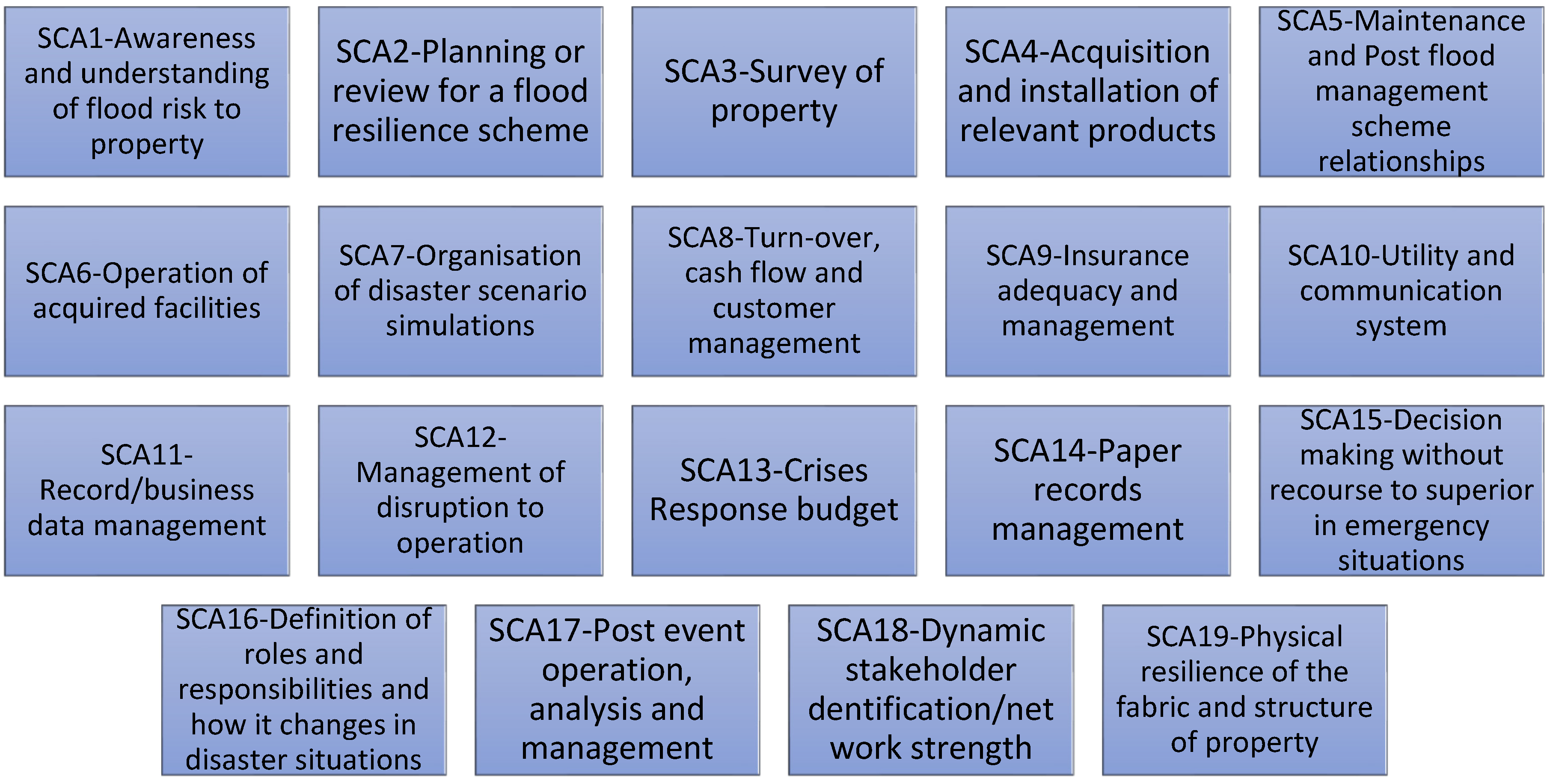
Based on the findings of this study, Figure 2 presents the summary of the nineteen (19) strategic capability areas useful for enhancing the flood resilience of a business premises.
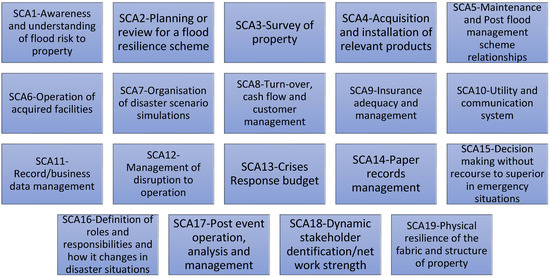
Figure 2.
Strategic Capability Areas.
5. Discussion of Findings
The initial two-round quantitative expert verification revealed that parts of all the attributes extracted from the literature were needed for the swift recovery of the premises of businesses. None of the capability areas scored below 2.50 on a 5-point scale. Understanding of flood risk scored 4.80 and 4.90 in rounds 1 and round 2 of the expert scoring, respectively, and it had the highest mean in both ratings. This indicates the huge importance attached to the need to understand flood risk; it is the foundation on which every other decision is made. This capability refers to a business’ awareness of the type and frequency of flood, knowledge of property vulnerability and water entry channels, and understanding of its consequences to organisation assets. Understanding of flood risk by an organisation will affect several other decisions. Among these is its disposition to the need for a mitigation survey [38] and how community-scale big data opportunities are utilised [60]. The level of understanding will influence flood risk perception and perception will influence the collective organisation and community decision making [61]. The importance evident in the mean rating of the variables in Table 1 justifies what has been referenced in the literature, that is, the resilience of business property and the built environment at large is not a function of the physical characteristics of the property alone but also the use, users, management of the property and the attributes of external stakeholders [21,43,62,63].
The qualitative expert judgement resulted in the merger of some of the capability areas but did not imply the non-relevance of any. Apart from the merger of needed capabilities, the thorough evaluation of each of the variables before recommendations for a merger was simply a form of expert validation. Authors have requested innovative solutions to flood risk management, but some strategic and effective actions do not have to look complex. Merging the ‘understanding of flood risk to property’ with ‘general awareness and commitment to resilience’ to produce ‘awareness and understanding of flood risk to property’ looks highly logical. It has been discussed that the ‘awareness and understanding of flood risk’ will surely influence a business organisation’s perspective and eventual commitment to resilience. The other variables merged, as presented in Table 5, were not eliminated but better interpreted under the emerged capability areas. Safety precautions are embedded in the fundamental roles of employees and how they change in disaster situations. Employees must stay protected and what could breach property safety during a flood must be avoided.
Concerning the final list of strategic capability areas, unarguably, ‘awareness and understanding of flood risk to property’ appears simple but has huge significance. A business’ depth in this area will influence the organisation’s decision on plans for a flood resilience scheme and overall commitment to flood resilience. Moreover, since there are a variety of resilience schemes and measures, the company’s decision will be influenced by how much it is aware of the available measures. Another decision that can be influenced by the awareness and understanding of flood risk is how to analyse the cost implication of options with the help of relevant data and professionals. Moreover, ‘planning and review for a flood resilience scheme’ is another capability area; it requires the deployment of some skills, and it is expected to lead to the workable layout of a resilience scheme. Effectively establishing a flood resilience scheme is a function of the ability of the organisation to effectively use in-house or external resources. The review of the plan will influence where and how to finance a scheme of choice and the sophistication of the method to adopt among others [37,38].
Another capability area is the ‘survey of property’, which relates to the appraisal of business property to understand areas of weakness or exposure to flood risk. The actual survey should be carried out by a certified professional but a business’ knowledge of this process and purpose will affect decisions on the urgency of the task, the selection of the surveyor and action on the survey result. Ensuring the use of a professionally accredited surveyor to inspect vulnerable points and measure apertures is germane [38]. This will guarantee a detailed and adequate specification for the business property [64]. ‘Acquisition and installation of relevant product’ is another capability area; it depends on the scheme the organisation decides to adopt. The respondents in the retail case study recalled how the organisation purchased a sump pump, generator, flood gates, non-return valves and others. These decisions reflect the organisation’s understanding of the range of available products. The business’ maturity in this regard [65] will determine how this area of intervention will be managed. Whether the organisation settles for a dry-proofing or wet-proofing option, appropriate technology and facilities need to be acquired. Clear specifications are necessary, and proper kite marks and other quality assurance criteria need to be considered. ‘Maintenance and post-flood management scheme relationships’ is another area of importance; acquired products will have to be maintained to guarantee optimal performance during the subsequent flood and other post-flood interactions with manufacturers, suppliers and installers [38] have to be effectively carried out.
SCA6, SCA7, SCA8 and SCA9 are hugely self-explanatory. Relevant background stories have been presented in the case studies. The case studies did not just confirm the importance of ‘operation of acquired facilities’, ‘organisation of disaster scenario simulation’, ‘cashflow preservation’ and ‘insurance adequacy and management’ to the speedy restoration of business premises and business, the case studies also provided relevant background stories. A favourable insurance policy and a quickly paid compensation will surely aid the recovery of the premises of a typical business. Although, currently, there are outstanding issues with the availability of affordable insurance to businesses (in the UK). There are arguments on the non-inclusion of businesses in the FloodRe scheme that is aimed at ensuring the availability of affordable insurance to property owners. FloodRe is a temporary measure that is expected to precede the opening of a free market for the insurance of flood risk [3]. The scheme is financed by premiums to reinsure flood risk and a statutory levy on UK property owners, FloodRe is not available to businesses because the government and the Association of British Insurers (ABI) believe that businesses source insurance at normal prices [3]. This leaves businesses to strive for flood protection via other possible ways. The prowess of the organisation in terms of ‘utility supply and communication system’ during response and recovery before eventual restoration is very important. The functionality of the premises depends on the availability of relevant utilities and the communication structure within and beyond the firm. Communication is better sustained with the employees, customers, stocks, and equipment providers among others. This will facilitate the complete restoration of the business area to its pre-flood condition. Among other strategic capability areas are the ‘dynamic stakeholder identification’, flood risk management is a multi-stakeholder exercise, and an organisation should be vast in identifying and interacting with individuals, agencies, and groups relevant to flood issues as it affects the organisation.
Since the resilience and recovery of MSMEs are largely handled by the respective businesses, only the possession of the right capabilities can help. It should be noted that physical damages, delayed restoration of business premises and overall poor resilience to floods are hindrances to business operation restoration; this is a significant impedance to the attainment of sustainable development goals. There is a huge need to preserve livelihoods [66] even as more floods has been projected for the future [67].
6. Conclusions
This study aimed to identify and verify the strategic capability areas needed at the organisation level to enhance the flood resilience of business premises and promote speedy post-flood business recovery. Since organisations cannot function in damaged premises, it is considered that if damage to properties and business facilities can be reduced, the pace of return to business will be faster for all enterprises. The study explored existing knowledge and sought relevant new knowledge from experts and case studies to establish a list of nineteen (19) capability areas. The research process commenced with the identification of 26 capability areas from the literature; the capability areas were reduced to 20 after a rigorous expert forum review and were consolidated to 19 at the end of multiple case study reviews focused on lessons and derivable capabilities. The richness of the experts engaged in terms of diversity and depth, and the rich case study accounts are fascinating. The key contributions of this study are as follows:
- This study expanded knowledge on capacity and capability in the context of disaster resilience in the built environment. It produced a detailed checklist of strategic considerations for business premises flood resilience and recovery planning. The capabilities identified span the entire disaster lifecycle, that is, pre-event, event and post-flood event phases;
- The identified strategic capability areas can be adopted by researchers for use in subsequent studies;
- It has been confirmed that the resilience and recovery of premises are a function of both structural and non-structural measures; therefore, this study believes that it might be necessary to measure the flood performance of a property beyond the physical characteristics of the property. Discussions on the Flood Performance Certificate [47] for properties will be much more comprehensive if perspectives beyond structural measures are introduced. Although an assessment can be based on structural measures to create a channel of compensation for associated expenditure, the non-physical capabilities needed for complete premises recovery and usability should always be acknowledged.
The findings of this study are fundamentally applicable. Both public and private sector stakeholders should embed the identified flood resilience capability areas as a planning guide for all flood resilience initiatives. Indeed, this study engaged experts from diverse backgrounds and experiences but engaged four case study MSMEs operating in standard buildings in the UK, the businesses were exposed to pluvial and fluvial flooding. Therefore, the experience of a bigger organisation faced with a different type of flood might be slightly different.
Author Contributions
Conceptualization, O.A.; Data curation, O.A.; Formal analysis, O.A.; Funding acquisition, O.T.O. and M.Q.R.; Investigation, O.A. and P.R.; Methodology, O.A.; Project administration, O.A., P.R. and O.T.O.; Supervision, O.T.O.; Validation, O.A., O.T.O. and M.Q.R.; Writing—original draft, O.A.; Writing—review & editing, O.A., P.R., O.T.O. and M.Q.R. All authors have read and agreed to the published version of the manuscript.
Funding
We thank the British Council for funding this publication.
Informed Consent Statement
Informed consent was obtained from all subjects involved in the study.
Conflicts of Interest
The authors declare no conflict of interest.
References
- Xiao, H.; Proverbs, D.; Joseph, R.; Adedeji, T. Improving the flood resilience of commercial buildings through property flood resilience measures. In WITS Transactions in the Built Environment: Urban Water Systems & Floods III; Mambretti, S., Proverbs, D., Eds.; WIT Press: Southampton, UK, 2020; Volume 194, pp. 13–22. [Google Scholar]
- Floodlist (2020) Perils Estimates Insured Losses for UK’s February Floods at US$367 Million. Available online: http://floodlist.com/insurance/uk/insured-loss-uk-february-2020-floods (accessed on 4 April 2020).
- RICS. Flooding: Issues of Concern to RICS Surveyors and Valuers (Residential Property); RICS: London, UK, 2015. [Google Scholar]
- ABI. Over 1300 Customers Helped Every Day by Insurers to Recover from Extreme Weather in 2012. 2013. Available online: https://www.abi.org.uk/News/News-releases/2013/02/Over-1300-Customers-Helped-Everyday-By-Insurers-To-Recover-From-Extreme-Weather-In-2012 (accessed on 20 November 2016).
- Lawther, P.M. Towards a natural disaster intervention and recovery framework. Disasters 2016, 40, 494–517. [Google Scholar] [CrossRef] [PubMed]
- Leinster, P. Flooding in England: A National Assessment of Flood Risk; Environment Agency: Almondsbury, UK, 2009. [Google Scholar]
- UNDP. Analysing the Vulnerability of Micro, Small, and Medium Enterprises to Natural Hazards and Their Capacity to Act as Drivers of Community Recovery. 2013. Available online: http://www.preventionweb.net/english/hyogo/gar/2013/en/bgdocs/UNDP,%202013.pdf (accessed on 20 February 2014).
- Saito, N. Challenges for adapting Bangkok’s flood management systems to climate change. Urban Clim. 2014, 9, 89–100. [Google Scholar] [CrossRef]
- Terdpaopong, K.; Rickards, R.C. Thai non-life insurance companies’ resilience and the historic 2011 floods: Some recommendations for greater sustainability. Sustainability 2021, 13, 8890. [Google Scholar] [CrossRef]
- Asgary, A.; Anjum, M.I.; Azimi, N. Disaster recovery and business continuity after the 2010 flood in Pakistan: Case of small businesses. Int. J. Disaster Risk Reduct. 2012, 2, 46–56. [Google Scholar] [CrossRef]
- Skouloudis, A.; Tsalis, T.; Nikolaou, I.; Evangelinos, K.; Leal Filho, W. Small & medium-sized enterprises, organizational resilience capacity and flash floods: Insights from a literature review. Sustainability 2020, 12, 7437. [Google Scholar]
- Ogie, R.I.; Perez, P.; Win, K.T.; Michael, K. Managing hydrological infrastructure assets for improved flood control in coastal mega-cities of developing nations. Urban Clim. 2018, 24, 763–777. [Google Scholar] [CrossRef]
- Grewal, R.; Tansuhaj, P. Building organizational capabilities for managing economic crisis: The role of market orientation and strategic flexibility. J. Mark. 2001, 65, 67–80. [Google Scholar] [CrossRef]
- O’Regan, N.; Ghobadian, A. The importance of capabilities for strategic direction and performance. Manag. Decis. 2004, 42, 292–313. [Google Scholar] [CrossRef]
- Yen-Tsang, C.; Csillag, J.M.; Siegler, J. Theory of reasoned action for continuous improvement capabilities: A behavioural approach. Rev. Adm. Empresas 2012, 52, 546–564. [Google Scholar] [CrossRef]
- Bosher, L. Built-in resilience through disaster risk reduction: Operational issues. Build. Res. Inf. 2014, 42, 240–254. [Google Scholar] [CrossRef]
- UNISDR. UNISDR Terminology on Disaster Risk Reduction; UNISDR: Geneva, Switzerland, 2009. [Google Scholar]
- Khan, H.; Vasilescu, L.G.; Khan, A. Disaster management cycle—A theoretical approach Manag. Mark. J. 2008, 6, 43–50. [Google Scholar]
- Rossetto, T. Construction Design, Building Standards and Site Selection. In Tools for Mainstreaming Disaster Risk Reduction: Guidance Notes for Development Organisations; Benson, C., Twigg, J., Eds.; ProVention Consortium Secretaria: Geneva, Switzerland, 2007; pp. 141–152. [Google Scholar]
- United Nations. Report of the open-ended intergovernmental expert working group on indicators and terminology relating to disaster risk reduction. 2016. Available online: https://www.preventionweb.net/publication/report-open-ended-intergovernmental-expert-working-group-indicators-and-terminology (accessed on 3 December 2020).
- Bosher, L. (Ed.) The need for built-in resilience. In Hazards and the Built Environment—Attaining Built-in Resilience; Routledge: Oxon, UK, 2008; pp. 3–19. [Google Scholar]
- Pitt, M. The Pitt Review—Learning Lessons from the 2007 Floods. 2008. Available online: http://www.coulthard.org.uk/hullfloods/Pitts_interim_flood_report_web.pdf (accessed on 2 March 2015).
- UNISDR. From Shared Risk to Shared Value—The Business Case for Disaster Risk Reduction. Global Assessment Report on Disaster Risk Reduction. 2013. Available online: http://www.preventionweb.net/english/hyogo/gar/2013/en/home/GAR_2013/GAR_2013_2.html (accessed on 17 July 2014).
- Bannock, G. The Economics and Management of Small Business: An International Perspective; Psychology Press: Hove, UK, 2005. [Google Scholar]
- Heliview Research. Climate Change Effects; Heliview Research: Breda, The Netherlands, 2008. [Google Scholar]
- Li, Y.; Li, H.X.; Huang, J.; Liu, C. An approximation method for evaluating flash flooding mitigation of sponge city strategies—A case study of Central Geelong. J. Clean. Prod. 2020, 257, 120525. [Google Scholar] [CrossRef]
- Büchele, B.; Kreibich, H.; Kron, A.; Thieken, A.; Ihringer, J.; Oberle, P.; Merz, B.; Nestmann, F. Flood-risk mapping: Contributions towards an enhanced assessment of extreme events and associated risks. Nat. Hazards Earth Syst. Sci. 2006, 6, 485–503. [Google Scholar] [CrossRef]
- Dutta, D.; Herath, S.; Musiake, K. A mathematical model for flood loss estimation. J. Hydrol. 2003, 277, 24–49. [Google Scholar] [CrossRef]
- Mendoza-Tinoco, D.; Guan, D.; Zeng, Z.; Xia, Y.; Serrano, A. Flood footprint of the 2007 floods in the UK: The case of the Yorkshire and The Humber Region. J. Clean. Prod. 2017, 168, 655–667. [Google Scholar] [CrossRef]
- Merz, B.; Kreibich, H.; Schwarze, R.; Thieken, A. Review article “Assessment of economic flood damage”. Nat. Hazards Earth Syst. Sci. 2010, 10, 1697–1724. [Google Scholar] [CrossRef]
- Woodman, P. Business Continuity Management; Chartered Management Institute: London, UK, 2008. [Google Scholar]
- CSES. Evaluation of the SME Definition—Final Report; CSES: London, UK, 2012. [Google Scholar]
- Ward, M.; Rhodes, C. Small Businesses and the UK Economy; House of Commons Library: London, UK, 2014. [Google Scholar]
- Neise, T.; Diez, J.R. Adapt, move or surrender? Manufacturing firms’ routines and dynamic capabilities on flood risk reduction in coastal cities of Indonesia. Int. J. Disaster Risk Reduct. 2019, 33, 332–342. [Google Scholar] [CrossRef]
- Berkhout, F.; Hertin, J.; Gann, D.M. Learning to adapt: Organisational adaptation to climate change impacts. Clim. Change 2006, 78, 135–156. [Google Scholar] [CrossRef]
- Busch, T. Organizational adaptation to disruptions in the natural environment: The case of climate change. Scand. J. Manag. 2011, 27, 389–404. [Google Scholar] [CrossRef]
- CIRIA. Flood Resilience and Resistance of Critical Infrastructure; CIRIA: London, UK, 2010. [Google Scholar]
- White, I.; O’Hare, P.; Lawson, N.; Garvin, S.; Connelly, A. Six Steps to Property Level Flood Resilience—Guidance for Property Owners; BRE: Manchester, UK, 2013. [Google Scholar]
- BS25999-1; British Standards Institution’s Code of Practice for Business Continuity Management. British Standard Institutions: London, UK, 2007.
- Stephenson, A. Benchmarking the Resilience of Organisations. Ph.D. Thesis, University of Canterbury, Canterbury, UK, 2010. [Google Scholar]
- Wedawatta, G. Resilience of Construction SMEs to Extreme Weather Events. Ph.D. Thesis, University of Salford, Salford, UK, 2013. [Google Scholar]
- UKCIP. Small and Medium Enterprises—Vulnerability and Resilience to Extreme Weather; UKCIP: Oxford, UK, 2009. [Google Scholar]
- Labaka, L.; Hernantes, J.; Sarriegi, J.M. A framework to improve the resilience of critical infrastructures. Int. J. Disaster Resil. Built Environ. 2015, 6, 409–423. [Google Scholar] [CrossRef]
- Jüpner, R. Coping with extremes—Experiences from event management during the recent Elbe flood disaster in 2013. J. Flood Risk Manag. 2018, 11, 15–21. [Google Scholar] [CrossRef]
- IBM Global Services. Resilient Infrastructure: Improving Your Business Resilience; IBM Corporation: New York, NY, USA, 2002. [Google Scholar]
- Akeson, J.; Salzenstein, L. Climate Change Adaptation and Urban Development: A Genealogy of Flood Risk Management in Glasgow. 2021. Available online: https://lup.lub.lu.se/luur/download?func=downloadFile&recordOId=9065032&fileOId=9065033 (accessed on 14 January 2022).
- FPC. Flood performance certificates. 2020. Available online: https://www.floodre.co.uk/wp-content/uploads/Flood-Performance-Certificates.pdf (accessed on 14 January 2022).
- RICS. Flood Risk Mitigation and Commercial Property Advice: An International Comparison. 2017. Available online: https://www.rics.org/uk/news-insight/research/research-reports/flood-risk-mitigation-and-commercial-property-advice-an-international-comparison/ (accessed on 15 March 2017).
- Eadie, R. Methodology for Developing a Model for the Analysis Of E-Procurement Capability Maturity of Construction Organisations. Ph.D. Thesis, Ulster University, Coleraine, UK, 2009. [Google Scholar]
- Yin, R.K. Case Study Research: Design and Methods; Sage Publications: London, UK, 2014. [Google Scholar]
- Boje, D.M.; Murnighan, J.K. Group confidence pressures in iterative decisions. Manag. Sci. 1982, 28, 1187–1196. [Google Scholar] [CrossRef]
- Adler, M.; Ziglio, E. Gazing into the Oracle: The Delphi Method and Its Application to Social Policy and Public Health; Jessica Kingsley Publishers: London, UK, 1996. [Google Scholar]
- Powell, C. The Delphi technique: Myths and realities. J. Adv. Nurs. 2003, 41, 376–382. [Google Scholar] [CrossRef]
- Murphy, M.; Black, N.; Lamping, D.; McKee, C.; Sanderson, C.; Askham, J.; Marteau, T. Consensus development methods, and their use in clinical guideline development. Health Technol. Assess. 1998, 2, i-88. [Google Scholar] [CrossRef]
- Babatunde, S.O.; Perera, S.; Zhou, L. Methodology for developing capability maturity levels for PPP stakeholder organisations using critical success factors. Constr. Innov. 2016, 16, 81–110. [Google Scholar] [CrossRef]
- Xia, B.; Chan, A.P.; Yeung, J.F. Identification of key competencies of design-builders in the construction market of the People’s Republic of China (PRC). Constr. Manag. Econ. 2009, 27, 1141–1152. [Google Scholar] [CrossRef][Green Version]
- Hsu, C.-C.; Sandford, B.A. The Delphi technique: Making sense of consensus. Pract. Assess. Res. Eval. 2007, 12, 1–8. [Google Scholar]
- Kendall, L. The conduct of qualitative interview: Research questions, methodological issues, and researching online. In Handbook of Research on New Literacies; Coiro, M.K.J., Lankshear, C., Leu, D., Eds.; Lawrence Erlbaum Associates: New York, NY, USA, 2008; pp. 133–149. [Google Scholar]
- Fellows, R.F.; Liu, A.M. Research Methods for Construction; John Wiley & Sons: New York, NY, USA, 2015. [Google Scholar]
- Yuan, F.; Fan, C.; Farahmand, H.; Coleman, N.; Esmalian, A.; Lee, C.C.; Patrascu, F.I.; Zhang, C.; Dong, S.; Mostafavi, A. Smart flood resilience: Harnessing community-scale big data for predictive flood risk monitoring, rapid impact assessment, and situational awareness. Environ. Res. Infrastruct. Sustain. 2022, 2, 025006. [Google Scholar] [CrossRef]
- Mehryar, S.; Surminski, S. Investigating flood resilience perceptions and supporting collective decision-making through fuzzy cognitive mapping. Sci. Total Environ. 2022, 837, 155854. [Google Scholar] [CrossRef] [PubMed]
- Gibberd, J. Measuring capability for sustainability: The Built Environment Sustainability Tool (BEST). Build. Res. Inf. 2015, 43, 49–61. [Google Scholar] [CrossRef]
- UN ESCAP; AIT. Integrating Environmental Sustainability and Disaster Resilience in Building Codes; UN ESCAP: Bangkok, Thailand, 2012. [Google Scholar]
- Perera, S.; Adeniyi, O.; Babatunde, S.O. Analysing community needs and skills for enhancing disaster resilience in the built environment. Int. J. Disaster Resil. Built Environ. 2017, 8, 292–305. [Google Scholar] [CrossRef]
- Adeniyi, O.; Perera, S.; Ginige, K.; Feng, Y. Developing maturity levels for flood resilience of businesses using built environment flood resilience capability areas. Sustain. Cities Soc. 2019, 51, 101778. [Google Scholar] [CrossRef]
- Liu, H.; Pan, W.; Su, F.; Huang, J.; Luo, J.; Tong, L.; Fang, X.; Hu, J. Livelihood Resilience of Rural Residents under Natural Disasters in China. Sustainability 2022, 14, 8540. [Google Scholar] [CrossRef]
- Kundzewicz, Z.W.; Lugeri, N.; Dankers, R.; Hirabayashi, Y.; Döll, P.; Pińskwar, I.; Dysarz, T.; Hochrainer, S.; Matczak, P. Assessing river flood risk and adaptation in Europe—Review of projections for the future. Mitig. Adapt. Strateg. Glob. Change 2010, 15, 641–656. [Google Scholar] [CrossRef]

Publisher’s Note: MDPI stays neutral with regard to jurisdictional claims in published maps and institutional affiliations. |
© 2022 by the authors. Licensee MDPI, Basel, Switzerland. This article is an open access article distributed under the terms and conditions of the Creative Commons Attribution (CC BY) license (https://creativecommons.org/licenses/by/4.0/).