


Abstract
This study explores tourists’ preferences and how Smart Cities (SC) can provide for them, using Tel Aviv-Yafo (TLV) as a case study. The theoretical model that we suggest measures gaps between the tourists’ perceived importance of the city’s characteristics, such as transportation, personal safety, recreation, etc., and their satisfaction with them. Then we evaluate the extent to which an SC can narrow those gaps and thereby enhance tourists’ satisfaction. The evaluation was performed by aligning each characteristic with a relevant indicator of the SC standard ISO 37122. Our model identified that SC measures can contribute the most to TLV tourists’ experience in the following aspects: information, transportation, personal safety, and disabled accessibility. Therefore, those aspects should be prioritized to improve tourists’ satisfaction and a promote longer stay in the city. We also recommend that cities will continuously challenge themselves with the most advanced technologies that will enable every single tourist to fully experience the city for all purposes of visits and for the different time frames of stay.
1. Introduction
Smart Cities (SC) use Information and Communication Technologies (ICT) to enhance the life quality of their citizens. Although SCs affect many aspects of life in the city, including direct and indirect impacts on tourism, not many research papers have addressed this issue. The following paper will bridge that gap by providing the critical link between SCs and tourism and by providing tourism managers and planners with an effective tool that will enable them to improve tourists’ satisfaction with their urban experience using SC measures and capabilities. Moreover, our current research provides a methodology that can guide policy makers to realize which tourism aspects need to be improved and the effectiveness of SCs in the improvement process. The ICT used by SCs affect many aspects of life in the city, including direct and indirect impacts on tourism. Today, ICT can improve tourists’ satisfaction in ways that were not available in the past. For example, it can provide tourists with relevant and dynamic information that can make their city experience more rewarding, fascinating, and convenient. Although the concept of the SC has been studied before, there is a lack of understanding of the linkage between the SC and tourism. Questions such as from what aspects and to what extent SC abilities can contribute to attracting more tourists to a city, to extend the time they stay, and the money they spend. This study is intended to bridge that gap by providing a model that can be used by SCs employing ICT. Our suggested model first identifies the gaps between the importance given by tourists to different factors concerning their visit, and their satisfaction with the services they are provided concerning these factors. Then, the model evaluates the probabilities that those gaps will be bridged by ICT, and finally, it suggests alternatives to improve tourists’ experience of a city.
SCs are making intensive use of ICT to foster communication with their residents, as well as to improve the services offered to them. Here, we evaluated the SC according to ISO 37122 (ISO is the International Organization for Standardization. ISO 37122 is the standard for sustainable cities and communities—Indicators for smart cities), ISO’s SC standard. Many of ISO 37122’s parameters are also relevant to tourists, especially the capability of supplying various real-time information about transportation, events, facilities, etc. The use of ICT brings local information closer to the tourists. Often, local residents learn something about their city from a tourist who found it on the web. The 2014 Best SC award from the SC Expo World Congress was reasoned as follows: “the city of Tel-Aviv-Yafo (TLV) won this award, thanks to embracing technology-driven improvements and public engagement strategies. The award recognized TLV’s firm commitment towards a new and more direct model of engaging citizens.” (SC Expo world congress report, 2014, p. 42).
TLV is the second largest city in Israel, with about 464,000 residents. However, the city is considered the most important in Israel, from economic and cultural points of view, and is the main city of the greater TLV area, the largest metropolitan area in Israel. Over the past two decades, the city of TLV has undergone significant changes concerning tourism. According to Mr. Ron Huldai—the mayor of TLV—significant investments were made in dozens of projects, including the upgrading of tourism sites, culture and sports events, and heritage sites. These investments position TLV as a touristic city on a par with the leading cities in the world.
The Tourism Vision Report for 2030 ((https://www.tel-aviv.gov.il/en/Pages/ArticlePage.aspx?WebID=9336473c-1537-4ab6-8a69-d299b5db8bcc&ListID=b4eda22c-a69a-4bef-9479-05d5a832ad16&ItemId=122 (accessed on 15 March 2022)) published by the TLV municipality notes that the city has three main pillars for tourism. The first one includes high-quality beaches. The second is a vibrant urbanity that offers a wide variety of culture, art, nightlife, restaurants, and cuisine; safe public spaces; technology and innovations; and, finally, the old city of Yafo –which combines history, heritage, religion, and multiculturalism. In addition, the city serves as an international business center and is home to over 1700 start-up companies.
TLV has 10,500 hotel rooms; 92% of the tourists arrive independently, and only 8% arrive on an organized trip. The city of offers a wide range of attractions and entertainment sites for tourists, for example, 14 km of beaches that provide extensive services including restaurants, cafes, and sports facilities. Cultural attractions include museums, theaters, and an opera house. There are also shopping centers and authentic markets. Additionally, the TLV municipality operates a tourist site in English (called visit Tel Aviv) that provides plenty of information about attractions in the city. According to Euromonitor International (https://www.euromonitor.com/tel-aviv-in-israel/report (accessed on 12 May 2022)), in 2018, about 2.8 million tourists visited TLV (a growth of 8% compared to 2017) and almost 3 million tourists in 2019 (a growth of 7% compared to 2018), which ranks TLV as the 80th most visited city in the world. The results of this research show that SC measures can contribute the most to TLV tourists’ experience in the following aspects: information, transportation, personal safety, and disabled accessibility. Therefore, in our view, the city should invest funds to promote those aspects using ICT in order to improve tourists’ satisfaction and promote a longer stay in the city.
2. Literature Review
The concept of SC has evolved over the last two decades [1]. The research literature provided varied definitions for SC. Ref. [2] (p. 139) defined it as “a high-tech intensive and an advanced city that connects people, information and city elements using new technologies in order to create a sustainable, greener city, competitive and innovative commerce and a recuperating life quality”. Refs. [3,4] conceptualized SC using six dimensions, namely: smart economy, smart mobility, smart living, smart environment, smart people, and smart governance. SCs employ an array of ICT for their political and administrative systems. ICT is used to gather, disperse, and use the information to control different facilities and to facilitate communication and cooperation between its citizens. The SC concept, however, lacks a coherent set of guidelines and criteria for the evaluation of its effectiveness and efficiency as an urban management system, as well as its contribution to a democratic urban regime [5].
SC projects are driven in many cases by ICT firms and infrastructure companies [6]. Municipal entrepreneurs together with firms such as IBM, Cisco, General Electric, Siemens, and Philips, among others, introduce their priorities into urban development considerations [7] cited in [6]. Their vision is mostly futuristic cities with a high quality of life for residents, as they perceive it and aspire for, but not necessarily as the residents prefer [8] (p. 3). Ref. [6] prefers the perspective that sees SCs as “territories with a high capacity for learning and innovation… smart[er] cities must seriously start with people and the human capital side of the equation, rather than blindly believing that IT itself can automatically transform and improve cities” [9] (p. 306).
Another classification describes three concepts of a SC. The first one, the technological approach, focuses on aspects of ICT systems as part of the basic urban infrastructure. The second, the managerial-economic approach sees the SC as business-friendly, especially so towards the high technology and the creative sectors. It also strives to connect residents to the ICT infrastructure since it enables it to provide better services and more revenue to its firms. The third approach is the governmental-political one, which interprets the “smartness” as opening avenues for effective communication between the residents and the municipality, enabling more participatory governance [10].
The concept of good-smart governance evolved into a set of tools that enables the SC to integrate different mechanisms of urban management in a complex and diverse society, addressing social, economic, and environmental challenges [11]. The components of that urban management include mobility, energy management, water and waste management, air quality, and land use, as well as personal security, employment, and social participation, all of which can benefit from incorporating ICT intensively [12], as well as employing tools such as big data and city dashboards in the process of decision making [13].
Ref. [14] introduced 18 indicators and 46 sub-indicators of SCs based on these six key elements: (1) Environment: Smart buildings, resource management, sustainable urban planning; (2) Mobility: Efficient transport, multimodal access, technology infrastructure; (3) Government: Online services, infrastructure, open government; (4) Economy: Entrepreneurship and innovation, productivity, local and global connection; (5) People: Inclusion, education, creativity; and (6) Living: Culture and wellbeing, safety, and health.
The International Telecommunication Union—ITU (2015)—defined the SC as follows: “A smart sustainable city is an innovative city that uses information and communication technologies (ICTs) and other means to improve quality of life, the efficiency of urban operation and services, and competitiveness, while ensuring that it meets the needs of present and future generations with respect to economic, social, environmental as well as cultural aspects”. The International Organization for Standardization (ISO) developed a family of standards for smart cities—ISO 37122 (https://www.iso.org/files/live/sites/isoorg/files/news/magazine/ISO%20Focus%2B%20(2010-2013)/en/2013/ISO%20Focus%2B%2C%20January%202013.pdf, accessed on 10 April 2022)—which will serve later in this research to evaluate TLV as a smart city. It may seem conspicuous that ISO 37122 does not specify ICT as an SC indicator. This is because it is not a category on its own but rather functions as a facilitator and enabler across all categories [15].
3. Smart Tourism and Smart Destinations
Smart tourism destinations are SCs that make intensive use of ICT to enhance the tourist’s experience [2], as well as mitigating the effects of over-tourism upon the city [16,17]. Therefore, smart destinations are first and foremost SCs which enable the sustainable development of tourism while maintaining the residents’ quality of life [18,19,20]. They serve tourists in a manner that resembles that which they serve their residents in the way that they support mobility, allocate resources, and enhance sustainability and quality of life for residents as well as visitors [21]. In an SC destination, tourists can communicate and interact better with residents, local businesses, local government, and city attractions. Consequently, SCs are better equipped to respond promptly, effectively, and at a lower cost to tourists’ needs, making them more competitive for tourism [2]. ICTs are also changing the business models of the tourism industry. The Internet of Things (IoT), big data, location-based services, and augmented reality, are some examples of ICTs that enable new ways of managing tourist flows, better tourist services, new advertising models, and new joint ventures [22]. ICT does not only serve as a tool within the traditional tourism industry, but it also acts as a disruptive agent that brings new players to the arena and changes the roles of some existing ones [23,24].
Although SC is mostly associated with ICT, it should be remembered that a city is a physical, spatial entity. Therefore, its spatial design is the basis for its character. It can create the feeling of a pleasant, comfortable, and safe urban environment. When the city’s spatial planning creates well-defined functions and clear boundaries, it provides the essential elements for a pleasant and safe environment [25]. It should be considered that space is perceived differently by different people, at different times. Tourists might find certain places threatening, while residents do not, or they may be interested in visiting places at different times than the resident [26]. ICT can be functional in mediating between the different perceptions, mostly by providing accessible information that is directed toward different groups and preferences, combining micro and macro perspectives and approaches from several disciplines [27].
Ref. [28] found that residents are interested in the city’s attractiveness for tourists, because it creates employment and accelerates the city’s economic growth. Yet they are also concerned with the city’s “livability”, which might contradict some aspects of the attractiveness for visitors. Smart cities are striving to maintain the uneasy balance between the two, employing ICT, amongst other measures.
Ref. [29] have also concluded that smart tourism destinations include governance, sustainability, technology, innovation, accessibility, connectivity, and smart sensor networks and information systems. Therefore, in their view, it can be considered that both the SC and the smart tourism destination are urban areas that would be constituted in “smart places” through the intensive use of ICTs, which would have as their main purpose the increase in the quality of life of people, whether residents or tourists. An example of the benefits for tourists stemming from SC infrastructure is the MAAS (Mobility as a Service) system, which enables the use of multiple transportation services, thus making the use of cars much less attractive, to the benefit of the residents and especially tourists [30].
There are many characteristics that a tourist considers when she has to choose her tourism destination. Refs. [31,32,33] specified several important factors that tourists may consider: events and entertainment, good safety and security, variety of cultural events and historical attractions, good accessibility and transports, accommodation facilities, the environment, the cleanliness of the city, wi-fi access, easy access to communications networks, good nightlife, shopping facilities, digital applications for tourists, online information about health and care, and digital information in general. A somewhat surprising consideration is the size of the city: tourists prefer to visit cities of a similar size as their own [34].
Ref. [35] ranked Smart Tourists Destinations (STD) according to a model comprising of 6 dimensions (SA(6)) and 57 indicators. The dimensions suggested were smart attractions (7 ind.), smart accessibility (20 ind.), smart amenities (7 ind.), smart ancillary services (12 ind.), smart activities (5 ind.), and smart packages (6 ind.). The authors intended to introduce a common framework for ranking STDs, since such an accepted coherent framework, which could enable comparing cities from that aspect, was missing from the literature, in their view.
Ref. [36] suggest a typology with five categories for smart tourism: transportation, accommodation, attraction, gastronomy, and ancillary services. All these factors and categories can benefit substantially from SC characteristics.
In addition to official municipal and governmental sites or other information sources, there are voluntary or commercial sources, such as travel blogs or Wikipedia. User-generated content and user recommendations are perceived as more trustworthy than commercial or even official sites [37].
However, the research linking tourism and SC is at an early stage, and the literature concerning this combination is scarce. Although smart tourism to smart cities destinations is becoming an important part of the tourism industry, as well as a driving force for innovation and competitiveness for the cities, it has not been thoroughly researched, discussed, conceptualized, and analyzed [3]. We will present an overview of the criteria for SCs, elaborating on the aspects that are relevant to tourists, according to a survey conducted amongst tourists to Israel. Based on these factors, we will present the gaps between tourists’ expectations and satisfaction. Then we will evaluate the possible ways for smart cities’ systems to minimize these gaps. Thus, the discussion of the contribution of SCs to narrow the gaps between tourist expectations and satisfaction is also a discussion concerning the missing link in research between SCs and smart tourism.
4. Data, Methodologies, and Model
This research examines smart tourism destinations as a part of a general concept of SC. For this purpose, we suggest a model that examines the gaps between the Degree of Importance (DI) that tourists assign to certain factors of tourism and the actual Degree of Satisfaction (DS) of tourists from those factors in Tel-Aviv Yafo. Then we estimated the probability that SC indicators, as presented by ISO 37122:2019, can bridge those gaps utilizing ISO aspects that are relevant to tourist’s DI and DS. By using ISO 37122 indicators, we established a clear benchmark to which the DI and DS parameters can relate. This is necessary to avoid the vagueness that is often attributed to the SC concept.
The result of the model will enable policymakers to better understand which gaps can be addressed using SC capabilities. Our primary data source is the Israeli Ministry of Tourism’s periodical survey among tourists in 2019. The sample size is 27,000 tourists, and it includes questions about tourists’ expectations and satisfaction. According to the survey (https://www.gov.il/BlobFolder/reports/inbound-tourism-survey-2/he/9259_ENG-web%20report%202019_v4.pdf (accessed on 20 July 2022)), 39.8% of the tourists arrived solo, 40.6% as part of a couple, and 19.6% as a traveling group of 3 persons and above. Moreover, 25.6% were Jewish, 53.9% Christian, 1.4% Muslim, 2.6% belonged to other religions, and 16.6% had no religious affiliation. A total of 24.8% of the tourists were 55 or older, 33.3% were between 35 and 54 years of age, 21.3% were between 25 and 34 years of age, and 20.6% of the tourists were 24 years old or younger. In total 18.8% of the tourists arrived for religious purposes (pilgrimage), 25.2% came for touring and sightseeing, 29.4% for visiting friends and relatives, 14.2% for leisure and pleasure, and 8.3% for business.
SCs, and indeed any city, have overlapping and interacting concerns, including tourism. The aspects shown in Figure 1 are only an example of the many different aspects that may be influenced by the SC’s measures. For example, big data, artificial intelligence (AI), or the IoT can be used to improve transportation efficiency, health services, sustainability, and tourist experience.
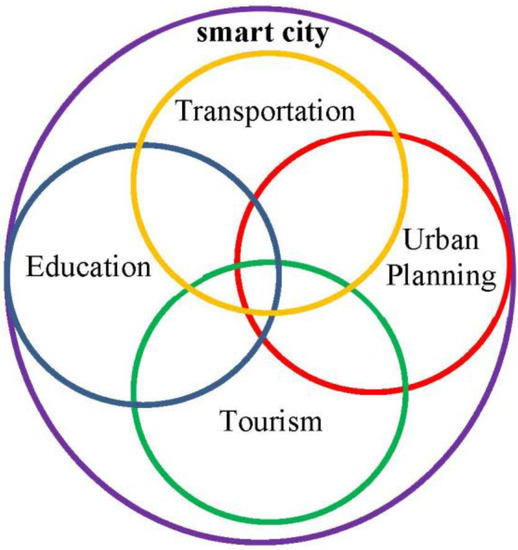
Figure 1.
Aspects of the smart city that are relevant to tourism.
Tel Aviv’s SC is composed of three main groups of activities. The first is the Digi-Tel initiative, which is a personalized information application for residents, based on their personal interests. It also gives discounts at the city’s institutions and facilities. The second is the deployment of smart infrastructure for security, public wireless communications (Wi-Fi), crisis management, and transportation. The third are the services that create an ecosystem for startups, private companies, and civil society [38]. The TLV municipality does not have a “smart city” department. The SC projects are developed and operated by the Computing and Information Systems (CIS) department, together with the relevant municipality administration [3]. The CIS department is part of the planning, organization, and information systems division, which reports directly to the municipality’s CEO. Thus, for example, online classes, online libraries, and online school registration are developed together with the education administration, while planning information and building licenses are accessible online through joint projects with the engineering administration. The cooperation between the department and the various administrations is facilitated by the CEO’s office.
Our aim is to estimate the extent to which SC characteristics, as indicated by the ISO 37122:2019 Indicators, can improve the tourist’s experience and extend their length of stay in a city. The conceptual model presented in Figure 2 identifies the Degree of Importance (DI) various aspects of the city have for tourists, as opposed to the Degree of Satisfaction (DS) of those aspects, and finally examines to what extent those gaps can be bridged by SC measures.
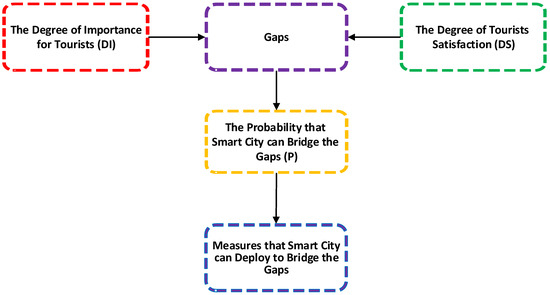
Figure 2.
The conceptual model.
The model identifies gaps that can be potentially narrowed by the SC capabilities and prioritize them according to two principles: 1. How big is the gap? 2. The estimated probability that SC measures can bridge a specific gap (Equation (1)):
where: Pi = the probability that SC measures can bridge a specific gap; DIi = the relative degree of importance for tourism of aspect i; and DSi = the degree of tourist’s satisfaction of aspect i.
We hypothesize that ICT will be identified as most beneficial to tourism enhancing information in different localities including local boards and on the web. The information can be static, such as main points of interest, or dynamic, such as restaurant seat availability or the density of visitors in museums at a specific hour. Information can also serve tourists in terms of available accommodation and efficient transportation.
5. Findings
5.1. Different Tourism Aspects of Tel-Aviv Yafo SC
There are various reasons why tourists choose to visit a specific city. Table 1 presents the distribution of visiting purposes of tourists to TLV and the relative degree of importance of different tourism aspects. TLV was chosen as a case study since it won first prize in the EXPO 2014 SC convention and other prestigious prizes (Smart City Expo, World Congress, Report 2014).

Table 1.
Visiting purposes of tourists to TLV.
Table 1 shows that TLV is indeed a significant tourist destination in Israel and therefore requires the municipal authorities to act accordingly in order to enable tourists to have a pleasant stay while visiting the city. Tourists mainly come to visit the city for sightseeing and to visit friends and relatives. Another major visiting goal is shopping, enjoying the nightlife the city has to offer, and its variety of restaurants. In order to better understand the degree of satisfaction tourists have from the different aspects of the tourism experience in TLV, the Truism Ministry of Israel conducted a periodical survey among tourists. The survey is scaled from 1 to 5, where 1 is “not satisfied at all” and 5 is “very satisfied”. Table 2 summarizes the main results of this tourist’s satisfaction (DS), the degree of importance (DI), and the probabilities that SC measures can bridge those gaps (P).
Table 2.
The DI and DS in different tourism aspects of TLV.
Table 2 demonstrates that the highest by far P*Gap is 1.30, indicating, as was hypothesized, that TLV should first invest in its SC resources to improve tourists’ information and communication deficiency. The next factor that the SC capabilities should try to solve is transportation and safety. Our analysis also indicates that the city does not need to address shops, restaurants, and nightlife aspects by SC means. We now discuss SC measures that enable us to bridge the major two gaps found in our analysis of tourist information needs, transportation, and safety.
5.2. Information and Communication
Tourists’ information and communication can be supplied in different locations and forms. ICT is an enabling technology that is a prerequisite for most components of the SC. A three-tier model for engaging residents via ICT was defined by the TLV municipality: physical infrastructure; software infrastructures for a wide variety of applications; applications that address specific tasks. TLV has a large Wi-Fi coverage in the public domain, which is free for all, which is an important advantage for tourists that enables them not to depend on expensive cellular data. The municipality allows direct access to its databases, which enables the public to use the information for community, culture, public health, budgets, security, and other uses important to residents and tourists alike. Although the municipality website is not one of the SC’s ISO Indicators, since we identified that addressing the tourists’ information needs is an important factor of tourists’ satisfaction, we examined Tel-Aviv Yafo official tourists’ website and summarized the results in Table 3.
Table 3.
TLV tourists’ official website analysis.
In addition to the municipality’s website, there is a plethora of information produced by businesses and NGOs (NGO = Non-Governmental Organization). For example, there are virtual tours, such as one day in Tel Aviv: 360° Virtual Tour (Sygic Travel, https://www.youtube.com/watch?v=bPDUHkS94Bg (accessed on 7 March 2022)), and information organized by themes, such as in Tourist Israel (https://www.touristisrael.com/ (accessed on 16 August 2021)). Commercial services, such as TripAdvisor (https://www.tripadvisor.com/Tourism-g293984-Tel_Aviv_Tel_Aviv_District-Vacations.html (accessed on 15 January 2022)), are an important source of information, especially when they are well-edited and have a user-ranking system. In the case of Google Maps, there is also the possibility of going on virtual tours and reading reviews before arriving at the destination. Other online services enable the tourist to verify the availability of restaurants, museums, and other attractions, as well as ordering tickets and paying for them: for example, the Tel Aviv Museum of Art (https://www.tamuseum.org.il/en/ (accessed on 28 February 2022)). This example also illustrates the kind of Public–Private Partnership (PPP) that is typical to the operation of a SC. While the museum is a public institute, affiliated with the municipality, it is supported by philanthropic foundations, and the tickets are sold by a business venture called SmartTicket. Other possibilities include self-guided tours: for example, GPSMYCITY (https://www.gpsmycity.com/ (accessed on 14 March 2022)), VoiceMap (https://voicemap.me/tour/tel-aviv (accessed on 17 March 2022)). Here, too, the municipality supplies the connectivity and the geographical data, while the application is created by the business. There are also live face-to-face information centers, operated by the municipality, offering information about tours, attractions, and events (https://www.tel-aviv.gov.il/Visitors/VisitorInfo/Pages/info.aspx (Hebrew) (accessed on 22 June 2022)), as well as brochures, printed or online (https://cybertechisrael.com/brochure/index.html (accessed on 14 April 2022)). COVID-19 has made tourists’ information needs more crucial and complex than usual since more accurate information was needed to plan successful sight visits. For example, the number of visitors in museums and theatres was limited, and visitors were asked to wear masks or wait in lines for a long time for their excursion. ICT can relieve some of the tourists’ concerns by providing accurate real-time information about the safety needs and requirements in various tourist attractions.
5.3. Transportation and Safety and Disables Accesability
Transportation within the city and from the city is crucial for a comfortable urban tourist experience. Transportation information can be supplied by various means such as dedicated web portals and dynamic boards scattered throughout the city. Smart transportation is intended mainly to reduce car usage and encourage the use of bicycles and public transportation. For that purpose, in TLV, 161 km of bicycle lanes were paved until 2021, and 250 km are planned for 2025. Their location is published on the internet (https://tel-aviv.kaplanopensource.co.il/bicycle/ (accessed on 17 May 2022)). Tel-O-fun is a municipal rent-a-bike venture with 1700 bicycles and 175 renting stations (https://www.tel-o-fun.co.il/#fsm-map-section (accessed on 21 June 2022)). The public transportation includes, in addition to regular buses, on-demand bus service (https://www.bubbledan.co.il/ (accessed on 21 June 2022)), and a light rail transit (LRT) system is being built and is planned to be operational in 2022. These measures enable tourists to have better access to recreation sites, entertainment centers, attractions, and business facilities without wasting valuable time in traffic jams, as well as experiencing the city in a more direct way.
Personal safety can be supplied by security cameras and easy access to an alarm system. Accessibility for people with disabilities can be served by indicating places and attractions that include accessibility and also by highlighting the directions to such access. TLV Municipality established a security and emergency command and control center. It installed hundreds of cameras in public spaces, public gardens, educational institutions, and municipal facilities around the city. AI is used to automatically identify irregular incidents. Incidents are managed by a Microsoft CRM (Customer Relationship Management) system. It also uses the municipal databases and the iView GIS system to map the resources in case of an emergency. The data include the location of emergency facilities and are conveniently located via iView (https://gisn.tel-aviv.gov.il/iview2js4/index.aspx?zoom=14000&extent=3834007,3755970,3923298,3790292&layers=592&back=0&year=2021&opacity=0.9&filters (accessed on 17 July 2022)) (a GIS system). Therefore, tourists and residents alike know that the public sphere is monitored at all times and that security and emergency forces are within reach.
6. Tourism and SC’s ISO Indicators
In order to evaluate the extent to which an SC can enhance tourists’ satisfaction, we aligned each indicator of the ISO 37122 SC standard with the importance that tourists attribute to that indicator and their satisfaction with its fulfillment in the case of TLV. Then we evaluated the probability that the SC’s capabilities can contribute to narrowing the gap between the two. The results are described in Table 4. The first column shows the ISO 37122 SC indicators (ISO 37122 is explained earlier); the second column presents the related parameters of importance to tourists and TLV’s scores and our estimate that SC characteristics can contribute to increasing tourists’ satisfaction.
Table 4.
SC indicators and their relevance to tourism.
7. Discussion
Tel Aviv-Yafo won the 2014 international Smart City Expo competition and has been often recognized for its SC characteristics. The TLV municipality also developed a strategic plan for sustainability. It presents a holistic approach, which combines different aspects of sustainability, such as energy, waste, transportation, building, education, community, etc. It has been developed based on the “One Planet Living” principles [39]. Our findings show that tourists often prefer destinations that have good air and water quality, offer high walkability, and other environmental amenities. This is directly evident by their concern with these indicators, as well as their interests in the result of the environmental amenities, such as ethical health tourism, one aspect of which is the preference for smart destinations [40].
We analyzed and modeled the potential benefits to tourism in SCs. We established that a SC’s contribution to the local population as well as to tourists is a holistic one that touches many different aspects of life in the city. The theoretical model we suggest measures gaps between tourists’ perceived degree of importance of different city experiences and their current satisfaction level. Moreover, an evaluation of the extent to which an SC can enhance tourists’ satisfaction was performed by aligning each indicator of ISO 37122 (smart city indicators) with the importance that tourists attribute to that indicator and their satisfaction with its fulfillment in the case of TLV. We concluded that SC could contribute the most by a significant improvement of real-time access to tourist information. We found that the city’s official tourist website has diverse information that is relevant for tourists; however, other online services can also be useful for tourists, enabling them to verify the availability of restaurants, museums, and other attractions, as well as ordering tickets and paying for them. An important aspect of more accessible information is the subjective perception of security by the visitors. Both because they have a better sense of the city and because they know they are being taken care of through ICT devices such as cameras and location-based services.
The variety of information sources is not limited to the municipality. It can also be sourced from Public–Private Partnership (PPP) ventures that are typical to the modus operandi of the SC.
City tourism in the global world is very competitive. Therefore, an SC can significantly contribute to improving the competitive position of a city compared to its rivals. Moreover, we recommend that a city will continuously challenge itself with the most advanced technologies that will enable every single tourist to fully experience the city for all visit purposes and for different time frames of stay.
8. The Research Limitations and Further Research
The main limitation of the current research is that the model has been tested in one city in Israel. In order to generalize the model conclusions, it should be tested in other cities in Israel and around the world. Moreover, the SC’s contribution to tourism should be tested over time by measuring the tourists’ real usage of ICT to enhance their tourism enjoyment and as a result their length of stay in the city. Future research may adopt this research model and examine it in other SC around the world.
Author Contributions
Investigation, A.H. and G.C.; Methodology, G.D. The contribution of this research paper is equal to the stated authors. The contribution includes methodologies, concept development, and research implementations. All authors have read and agreed to the published version of the manuscript.
Funding
This research was funded by Western Galilee Academic College.
Conflicts of Interest
The authors declare no conflict of interest.
References
- Anthopoulos, L.G. Understanding the smart city domain: A literature review. Transform. City Gov. Success. Smart Cities 2015, 9–21. [Google Scholar] [CrossRef]
- Bakıcı, T.; Almirall, E.; Wareham, J. A smart city initiative: The case of Barcelona. J. Knowl. Econ. 2013, 4, 135–148. [Google Scholar] [CrossRef]
- Jasrotia, A.; Gangotia, A. Smart cities to smart tourism destinations: A review paper. J. Tour. Intell. Smartness 2018, 1, 47–56. [Google Scholar]
- Neirotti, P.; De Marco, A.; Cagliano, A.C.; Mangano, G.; Scorrano, F. Current trends in smart city initiatives: Some stylised facts. Cities 2014, 38, 25–36. [Google Scholar] [CrossRef]
- Herscovici, A. New development: Lean thinking in smart cities. Public Money Manag. 2018, 38, 320–324. [Google Scholar] [CrossRef]
- Hollands, R.G. Critical interventions into the corporate smart city. Camb. J. Reg. Econ. Soc. 2015, 8, 61–77. [Google Scholar] [CrossRef]
- Harvey, D. From managerialism to entrepreneurialism: The transformation in urban governance in late capitalism. Geogr. Ann. Ser. B Hum. Geogr. 1989, 71, 3–17. [Google Scholar] [CrossRef]
- Anttiroiko, A.V. U-cities reshaping our future: Reflections on ubiquitous infrastructure as an enabler of smart urban development. AI Soc. 2013, 28, 491–507. [Google Scholar] [CrossRef]
- Hollands, R.G. Will the real smart city please stand up? Intelligent, progressive or entrepreneurial? City 2008, 12, 303–320. [Google Scholar] [CrossRef]
- Caragliu, A.; Del Bo, C.F. Do Smart Cities invest in smarter policies? learning from the past, planning for the future. Soc. Sci. Comput. Rev. 2016, 34, 657–672. [Google Scholar] [CrossRef]
- Azzari, M.; Garau, C.; Nesi, P.; Paolucci, M.; Zamperlin, P. Smart city governance strategies to better move towards a smart urbanism. In International Conference on Computational Science and Its Applications; Springer: Cham, Switzerland, 2018; pp. 639–653. [Google Scholar]
- Campisi, T.; Severino, A.; Al-Rashid, M.A.; Pau, G. The development of the smart cities in the connected and autonomous vehicles (CAVs) era: From mobility patterns to scaling in cities. Infrastructures 2021, 6, 100. [Google Scholar] [CrossRef]
- Garau, C.; Desogus, G.; Annunziata, A.; Coni, M.; Crobu, C.; Francesco, M.D. Smart governance models to optimise urban planning under uncertainty by decision trees. In International Conference on Computational Science and Its Applications; Springer: Cham, Switzerland, 2021; pp. 551–564. [Google Scholar] [CrossRef]
- Cohen, B.; Smart City Index Master Indicators Survey. Smart Cities Counc. 2014. Available online: https://www.smartcitiescouncil.com/resources/smart-city-index-master-indicators-survey (accessed on 19 July 2022).
- Pira, M. A novel taxonomy of smart sustainable city indicators. Humanit. Soc. Sci. Commun. 2021, 8, 197. [Google Scholar] [CrossRef]
- Milano, C.; Novelli, M.; Cheer, J.M. Over tourism and tourismphobia: A journey through four decades of tourism development, planning and local concerns. Tour. Plan. Dev. 2019, 16, 353–357. [Google Scholar] [CrossRef]
- Pasquinelli, C.; Trunfio, M. Reframing urban over tourism through the Smart-City Lens. Cities 2020, 102, 102729. [Google Scholar] [CrossRef]
- Gretzel, U.; Sigala, M.; Xiang, Z.; Koo, C. Smart tourism: Foundations and developments. Electron. Mark. 2015, 25, 179–188. [Google Scholar] [CrossRef]
- Koens, K.; Melissen, F.; Mayer, I.; Aall, C. The smart city hospitality framework: Creating a foundation for collaborative reflections on overtourism that support destination design. J. Destin. Mark. Manag. 2021, 19, 100376. [Google Scholar] [CrossRef]
- Trunfio, M.; Campana, S. Drivers and emerging innovations in knowledge-based destinations: Towards a research agenda. J. Destin. Mark. Manag. 2019, 14, 100370. [Google Scholar] [CrossRef]
- Buhalis, D.; Amaranggana, A. Smart tourism destinations. In Information and Communication Technologies in Tourism; Springer: Cham, Switzerland, 2013; pp. 553–564. [Google Scholar]
- Wang, D.; Park, S.; Fesenmaier, D. The role of smartphones in mediating the tourism experience. J. Travel Res. 2012, 51, 371–387. [Google Scholar] [CrossRef]
- Sigala, M.; Chen, T. CfP JTR: Sharing Economy in Tourism. 2017. Available online: https://www.servsig.org/wordpress/2017/03/cfp-jtr-sharing-economy-in-tourism/ (accessed on 19 July 2022).
- Sigala, M. New technologies in tourism: From multi-disciplinary to anti-disciplinary advances and trajectories. Tour. Manag. Perspect. 2018, 25, 151–155. [Google Scholar] [CrossRef]
- Matlovičová, K.; Mocák, P.; Kolesárová, J. Environment of estates and crime prevention through urban environment formation and modification. Geogr. Pannonica 2016, 20, 168–180. [Google Scholar] [CrossRef]
- Mocák, P.; Matlovičová., K.; Matlovič., R.; Pénzes., J.; Pachura, P.; Mishra, P.K.; Kostilnikova, K.; Demková., M. 15-minute city concept as a sustainable urban development alternative: A brief outline of conceptual frameworks and slovak cities as a case. Folia Geogr. 2022, 64, 69. [Google Scholar]
- Bagiran Ozseker, D. Towards a model of destination innovation process: An integrative review. Serv. Ind. J. 2019, 39, 206–228. [Google Scholar] [CrossRef]
- Romao, J.; Neuts, B. Territorial capital, smart tourism specialization and sustainable regional development: Experiences from Europe. Habitat Int. 2017, 68, 64–74. [Google Scholar] [CrossRef]
- Santos-Júnior, A.; Almeida-García, F.; Morgado, P.; Mendes-Filho, L. Residents’ quality of life in smart tourism destinations: A theoretical approach. Sustainability 2020, 12, 8445. [Google Scholar] [CrossRef]
- Canale, A.; Tesoriere, G.; Campisi, T. The MAAS development as a mobility solution based on the individual needs of transport users. In AIP Conference Proceedings; AIP Publishing LLC: Melville, NY, USA, 2019; Volume 2186, p. 160005. [Google Scholar]
- Guerra, I.; Borges, F.; Padrão, J.; Tavares, J.; Padrao, M.H. Smart cities, smart tourism? The case of the city of Porto. Rev. Galega Econ. 2017, 26, 129–142. [Google Scholar] [CrossRef]
- Tan, W.K.; Chen, T.H. The usage of online tourist information sources in tourist information search: An exploratory study. Serv. Ind. J. 2012, 32, 451–476. [Google Scholar] [CrossRef]
- Tripathy, A.K.; Tripathy, P.K.; Ray, N.K.; Mohanty, S.P. iTour: The future of smart tourism: An IoT framework for the independent mobility of tourists in smart Cities. IEEE Consum. Electron. Mag. 2018, 7, 32–37. [Google Scholar] [CrossRef]
- Cohen, G. The sister cities program and tourism. J. Hosp. Tour. Manag. 2020, 45, 182–191. [Google Scholar]
- Huertas, A.; Moreno, A.; My, T.H. Which destination is smarter? Application of the (SA) 6 framework to establish a ranking of smart tourist destinations. Int. J. Inf. Syst. Tour. 2019, 4, 19–28. [Google Scholar]
- Lee, P.; Hunter, W.C.; Chung, N. Smart tourism city: Developments and transformations. Sustainability 2020, 12, 39–58. [Google Scholar] [CrossRef]
- Amaral, F.; Tiago, T.; Tiago, F. User-generated content: Tourists’ profiles on TripAdvisor. Int. J. Strateg. Innov. Mark. 2014, 1, 137–145. [Google Scholar] [CrossRef]
- Toch, E.; Feder, E. International Case Studies of Smart Cities, Tel Aviv, Israel Institutions for Development Sector Fiscal and Municipal Management Division. 2016, Discussion Paper Nº Idb-Dp-444, June. Available online: https://publications.iadb.org/en/international-case-studies-smart-cities-tel-aviv-israel (accessed on 19 July 2022).
- Ronen, O. A Report on the Environment and Sustainability in the City of Tel Aviv-Yafo; Tel Aviv—Yafo Municipality: Tel Aviv, Israel, 2018. [Google Scholar]
- Ganglmair-Wooliscroft, A.; Wooliscroft, B. Diffusion of innovation: The case of ethical tourism behavior. J. Bus. Res. 2016, 69, 2711–2720. [Google Scholar] [CrossRef]
Publisher’s Note: MDPI stays neutral with regard to jurisdictional claims in published maps and institutional affiliations. |
© 2022 by the authors. Licensee MDPI, Basel, Switzerland. This article is an open access article distributed under the terms and conditions of the Creative Commons Attribution (CC BY) license (https://creativecommons.org/licenses/by/4.0/).