


Abstract
This study seeks to conduct a systematic literature review (SLR) of the present state of research on gender and international women entrepreneurship. This SLR critically assesses the existing frameworks offered by literature for measuring women entrepreneurship, including the theoretical frameworks on which they were built, their validation (if any) and their application beyond the original settings. Based on a total of 241 works using the keywords “Entrepreneurship” AND “Framework” AND “Gender”, this review reveals that although research on gender and women entrepreneurship has made considerable progress over the last few years, still there is a lack of an established gender-aware framework, which was urged by the scholars in this field for decade after decade. The findings of this review reveal that a few studies offer a framework for evaluating women entrepreneurship using gender perspective with no conceptual and operational definition of constructs and empirical validation. Additionally, the review unfolds that the suitability in assessing women entrepreneurship in cross-boarder entrepreneurship is insubstantial. Finally, the review points out that the uneven advancement of this prominent paradigm leaves important avenues to explore in future research.
1. Introduction
International women entrepreneurship, as a paradigm, is gaining the attention of academics, government bodies and policymakers in all economics around the globe. Women entrepreneurs in international trade are crucial for unlocking the full potential of an economy. Additionally, ensuring balanced economic growth requires women’s full participation everywhere in the economic mainstream, because the equal involvement of men and women is a prerequisite to achieving the Global Goals for Sustainable Development. With this view in mind, the ITC (International Trade Centre) aims to bring at least three million women entrepreneurs to international markets by 2021 [1]. Therefore, it is necessary to gain knowledge and better understanding of women entrepreneurs’ participation in the global economy so that more women entrepreneurs feel free and encouraged to be involved in international trade. Although there is a long line of literature positing that entrepreneurship is indispensable for economic and societal development [2,3], researchers have asserted that entrepreneurial activity is not open for everyone [1,2]. Existing research conducted from a gender perspective clearly portrays the ‘gender gap’ in entrepreneurial activities between the categories of men and women [2,4,5]. The gender gap in entrepreneurship is significant and systematic and varies both by the economic development of a country and by region [4]. The gap is more noticeable in high-income countries, but it exists throughout the world and in all regions, while European and Asian low/middle-income countries score a greater gap than the Latin American and Caribbean low/middle-income countries ([6], p. 16).
Gender gaps and income losses from the gender gap are wider in international trade [7]. This gap can be measured by differences in entrepreneurial activities between men and women [4]. ITC [7] finds that “only one in five exporting firms is led by women entrepreneurs.” Unequal legal rights, access to education, networks, technology, capital, social norms, values and expectations within a country, as well as non-tariff barriers mainly create roadblocks for women entrepreneurs in participation in international business [2,4,8]. In trade liberalization and export promotion policies, a gender gap is noticeable alongside class, race and ethnicity [9]. Practically, trade policies and practices have different effects on men and women, particularly in less favourable market economies, because of the differences in roles, responsibilities, rights and opportunities that society assigns to men and women. As a result of the gender gap, women encounter more challenges than men in taking advantage of trade opportunities [6]. The ITC found that in Asia, the number of women-owned exporting businesses is very small although women employment is the highest in this region [7].
Investigating international entrepreneurship from a gender perspective is attracting interest not only from academics, but also from policymakers as a topic of research across the world [4,10,11]. For example, development agencies are identifying factors to enable the flourishing of high-potential female entrepreneurs—‘women who own and operate businesses that are innovative, market expanding, and export oriented’ ([4], p. 4). Authors also claim that high-potential/export-oriented women entrepreneurs can improve their own economic welfare and contribute to the economic and social fabric of society through their entrepreneurial activities. The Global Entrepreneurship and Development Institute is identifying and analysing the conditions that foster high-potential (export-oriented) female entrepreneurship development by The Female Entrepreneurship Index (FEI). The FEI systematically compares cross-country regarding benchmarking of the gender-differentiated conditions that often affect high-potential export-oriented female entrepreneurship development [4]. Regarding the growing interest in the topic of gender and entrepreneurship among academics, publishers are taking initiatives for establishments of new journals focused on the intersection of gender and entrepreneurship as well as publishing special issues of existing journals on this topic in response to growing interest [12]. The persistent gender gap in entrepreneurship and high-level interest of exploring this gap makes the area of women entrepreneurship a new and emerging field of research.
The purpose of this study is to answer two questions: (a) Is there any gender-aware framework for evaluating international women entrepreneurship? (b) How far have those (if any) frameworks been developed? This paper contributes to the field by reviewing and assessing the suitability of measurement instruments used in women entrepreneurship literature in the context of international women entrepreneurship. To contribute to this prominent research area, this review aims to provide a descriptive overview and critical assessment of existing framework offered by literature for measuring women entrepreneurship, including the theoretical frameworks on which they were built, their validation (if any) and their application beyond the original settings. Based on this review, this paper identifies gaps and inconsistencies in the existing framework and proposes future research direction for developing international women entrepreneurship as a new research paradigm. This review pinpoints existing frameworks/instruments offered by women entrepreneurship literature, which provides meaningful and relevant information for further development of this field. The findings of this review enhance our knowledge of gender-aware measurement instruments and provide an opportunity to both researchers and practitioners for future work on this new research paradigm.
This paper is structured as follows. In the following sections, firstly, we present the significance of bringing a gender-perspective/gender-aware framework in women entrepreneurship based on evidence from prior research. Secondly, we elaborate on the methodology used to include the literature for this review. Thirdly, we describe the findings of this review, focusing on examining the theoretical underpinnings, assessing the methodological inclusion and empirical validation of the frameworks and identifying the suitability and adaptability of the existing gender-aware framework in the context of international women entrepreneurship. Finally, we provide an opportunity and directions for researchers to build on existing research more meaningfully by underlining inconsistencies in the current state of the field and identifying areas for future research.
2. Gender-Aware Framework—A Long-Standing Debate
Gender gap in entrepreneurship exists in almost all countries. Existing works argue that although female entrepreneurs are not significantly different from male entrepreneurs in terms of physique, the challenges that women entrepreneurs face significantly differ from those of their counterparts because the challenges are do not stem only from their physiological or psychological issues. Rather, most challenges emerge from the society they run their business in, the environment in which they operate their business and from the business partners and institutions they work with [13]. For instance, although it is true that women entrepreneurs face some challenges similar to the challenges that male entrepreneurs face, women entrepreneurs face some additional challenges, which are different in nature [14,15]. Some examples are the following: lack of social and family support [16,17]; lack of social acceptance/respect [14]; shackles of patriarchy [17]; work–family responsibility [16]; and perception of women’s ability [18]. Moreover, in case of internationalization/cross-border entrepreneurship, women face more additional challenges since internationalization (i.e., exporting) requires capabilities beyond those needed by businesses that produce only for domestic markets [19,20]. For example, many studies reveal that procedural complexities related to exporting discourage women entrepreneurs from being involved in cross-border entrepreneurship [21,22,23,24,25]. Therefore, treating international women entrepreneurs the same as women entrepreneurs who produce and sell only in the domestic market would be a fallacy.
Moreover, the gender gap in entrepreneurship is significant and systematic and varies both by country GDP and by region [4,6]. Still, female entrepreneurs usually tend to be judged based on a presumption of gender neutrality of the entrepreneurship theories and frameworks. According to Buttner and Moore [26], several studies have conceptual flaws because they try to evaluate the values, thought processes and experiences of women business leaders based upon and controlling against male counterparts. More specifically, women entrepreneurs are judged according to masculine values [27]. However, if we use a common yardstick to evaluate both male-owned and female-owned firms, it would be just like prescribing a single medicine for all types of diseases [28].
To address gender differences in entrepreneurship and to understand women’s entrepreneurial behaviour for both policymaking and academic interest, scholars urge the incorporation of a feminist approach in investigating women entrepreneurship [5,29,30]. Scholars criticise the framework designed mostly for understanding male entrepreneurs when applied in the context of female entrepreneurs [11,31]. The reason behind this is the entrepreneur’s gender, which influences their mindset and the way they explore and invest [8,13]. As such, many scholars in the women entrepreneurship field emphasise the need for the future analysis of women entrepreneurs from gender perspective by bringing a feminist approach in women entrepreneurship. During the course of exploring the gender gaps in entrepreneurship, this study carefully reviews the future research direction given by scholars to minimise the gender gap in entrepreneurship. Some future research directions from the existing literature are summarised and analysed to find the prevailing gaps and ideas about how to approach the gaps (see Table 1). This review provides few important findings. Firstly, all the studies indicate that female entrepreneurs usually tend to be judged based on a presumption of gender neutrality of the entrepreneurship theories and frameworks. However, existing studies clearly evidence that challenges, barriers and forces that stimulate or obstruct men and women entrepreneurship domestically and internationally are inherently different [21,32]. Although scholars argue that a gender gap is prevailing in entrepreneurship, both domestic and international, the gender of entrepreneurs has been less explored as variables in researching international entrepreneurship. From a systematic literature review of antecedents, outcomes and moderators of SME international involvement by Martineau and Pastoriza [33], it is evident that a manager’s socio-cognitive properties (e.g., fear to lose control or intolerance for ambiguity) are the most researched antecedent of international involvement. However, evaluation of a manager’s socio-cognitive properties from gender perspective is absent in the international entrepreneurship research [34,35].

Table 1.
Future research directions of previous research and gaps in literature.
The review of existing literature reveals that bringing gender perspective in measuring or evaluating women entrepreneurship is a long-standing theoretical and empirical debate. For example, Lindgren and Packendorff [8] propose to trace back the gender gap in entrepreneurship by focusing on general cultural gender differences in the society where entrepreneurship is assumed as a masculine activity. Ahl and Marlow [36] advise to analyse how local narratives can accommodate and repress entrepreneurial actions. The authors also advise future researchers to explore the process and practice of entrepreneurship from diverse feminist perspectives, which will “strengthen the critical evaluation of the bounded ontology informing the current entrepreneurial research agenda” (p. 558). Ratten [8] claims that gender is no longer being considered biological, but rather based on behaviour, and more research is needed to understand this changing notion. Siba [13] highlights that future research should focus on psychological, social and skills constraints for women entrepreneurs beyond a basic focus on the access to financial and human capital. As such, it is important to identify the extent of inclusion of gender perspective in entrepreneurship research. Therefore, this study is a timely response since it aims to provide a descriptive overview of existing frameworks offered by the literature for measuring women entrepreneurship. This review provides researchers with a transparent view of a state-of the-art gender perspective in offering a framework for women entrepreneurship and the suitability of using the existing framework in the context of international women entrepreneurship.
3. Conceptualisation of the Study
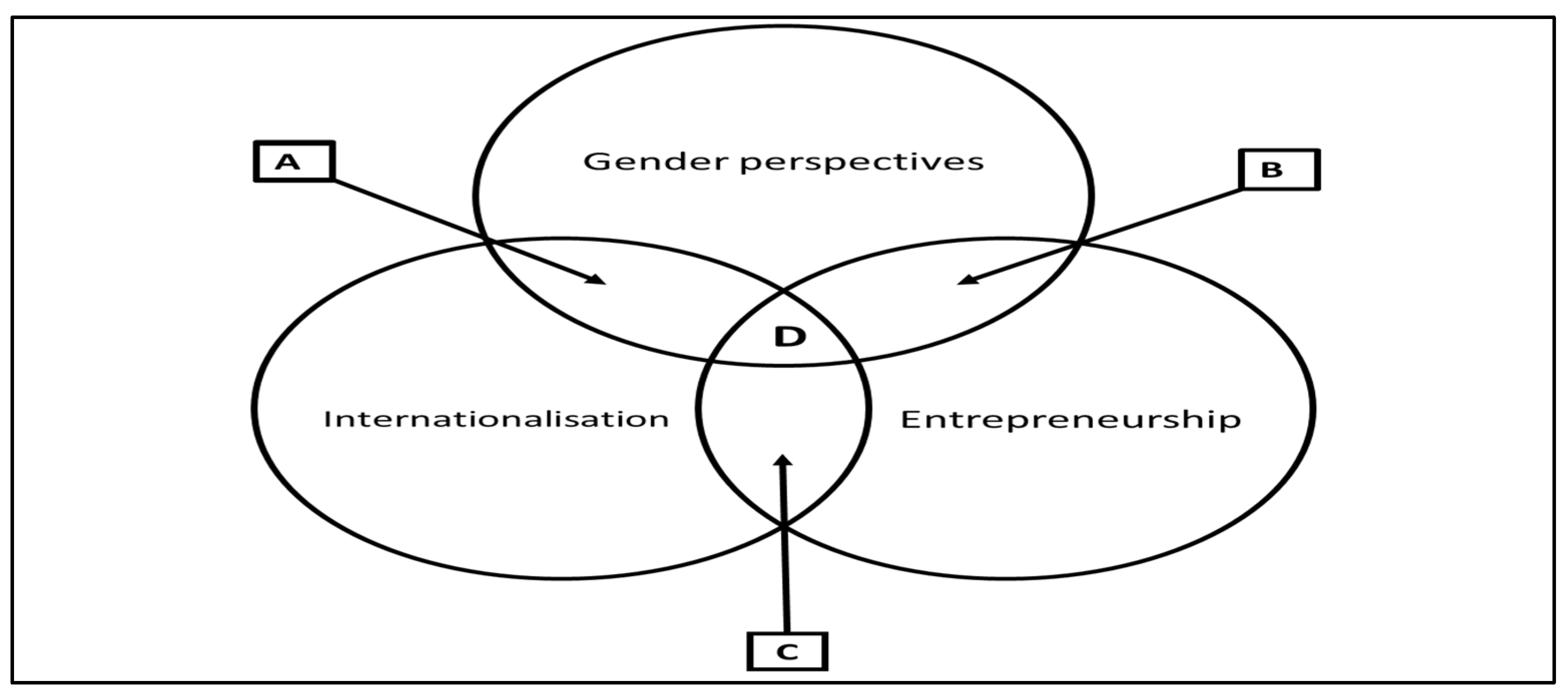
The concept of internationalisation and entrepreneurship is not new, however, women entrepreneurs’ participation in the process of internationalisation is a modish concept attracting more scholarly attention. A large number of studies have been conducted regarding an understanding of the role of women in business. For example, based on an overview of 50 years of empirical research findings, Joshi et al. [42] identify a path of evolution of women-led business. Through thematic issues, authors find that at the beginning, researchers started to recognize the inequality faced by women entrepreneurs (Sphere B in Figure 1); later on, they were devoted to identifying the barriers faced by women business owners (Sphere B in Figure 1). Following this, the research interest has shifted towards gender differences and team diversity. Another systematic literature review by Jones et al. [34] over a period of 1989–2009 shows the extensive research on international entrepreneurship (Sphere C in Figure 1). Although women entrepreneurship and international entrepreneurship are widely explored, the stream of research on women entrepreneurship in international business and trade is relatively new (Sphere A in Figure 1). The review of literature conducted in the previous section provides clear evidence of gender difference/gap in entrepreneurship. The gender gap in international entrepreneurship is wider. In a survey across 20 countries (in five regions of the world), the ITC finds that very few women-owned businesses participate in international trade relative to businesses owned by men, which creates a significant trade loss in terms of productivity [43]. However, the rate of men and women entrepreneurship roughly becomes equal in some countries [19]. Without adequate and accurate information about the influence of gender in international business, opportunities for international business and growth may be foregone, possibly leading to a significant trade loss. Therefore, it is necessary to gain knowledge and better understanding about the obstacles, drivers and impacts of women’s participation in the global economy (Sphere A in Figure 1).
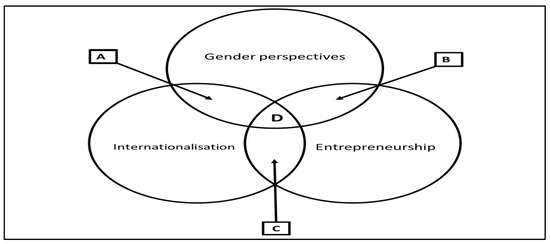
Figure 1.
Conceptualization of the study. Sphere A: International Gender Diversity. Sphere B: Women Entrepreneurship. Sphere C: International Entrepreneurship. Sphere D: International Women Entrepreneurship.
There is a paucity of research on gender diversity and internationalisation (Sphere A in Figure 1), which requires more exploration, particularly of understanding the differences in the number of women entrepreneurs’ participation in internationalisation from the context of developed, developing and emerging countries due to differences in cultural and societal restrictions [11,44]. Moreover, the implications of gender as a socially constructed factor in examining women entrepreneurship require in-depth exploration to create greater value in the foreseeable future; e.g., thinking about strengthening women-led business [45]. However, incorporation of gender perspectives in the context of international women entrepreneurship remains unexplored (Sphere A in Figure 1).
4. Methodology
According to Ratten and Tajeddini [11], review and analysis of the literature helps to make the research field more transparent. Due to an increased attention on incorporation of gender perspective in entrepreneurship, internationalization and women entrepreneurship among academics and policymakers, a systematic search of the literature was conducted on literatures focusing on gender, women entrepreneurship and internationalization. This literature review was conducted following a two-stage process. In the first stage, relevant literature focusing on gender and entrepreneurship, gender and trade, exporting and internationalization of women-owned firms, barriers to women entrepreneurship growth and expansion, gender and firm performance was reviewed. The reason behind including the literature focusing on these topics is that research concerning women entrepreneurship spreads over different research streams—i.e., business, economic, gender studies, trade, international development, and other fields [11]. Findings in the first stage of the literature review (see Table 1) point out that there is still a long-standing debate on incorporating gender perspectives in women entrepreneurship research. These findings lead to the second stage of the literature review which incorporates assessing the inclusion of gender perspectives in a framework for analysing women entrepreneurship.
To identify gender perspectives to be included in a framework for analysing women entrepreneurship, the second stage of the literature review includes a literature search to pinpoint existing framework/instruments offered by the women entrepreneurship literature and their suitability to being used in the context of international women entrepreneurship. Given that our goal is to point out existing frameworks and instruments offered by the women entrepreneurship literature, a detailed review of the literature focusing on women entrepreneurship would be too broad to present in a single study. Thus, our literature review is limited to studies that focus on offering a gender-aware framework for measuring women entrepreneurship. In particular, we review the literature focusing on entrepreneurship, trade and gender published between 1990 and 2020. At this step, we followed the approach suggested by Martineau and Pastoriza [33] for a systematic literature review. We explore the Scopus databases focused on women entrepreneurship, gender, trade and internationalization, specifying social sciences as a research domain.
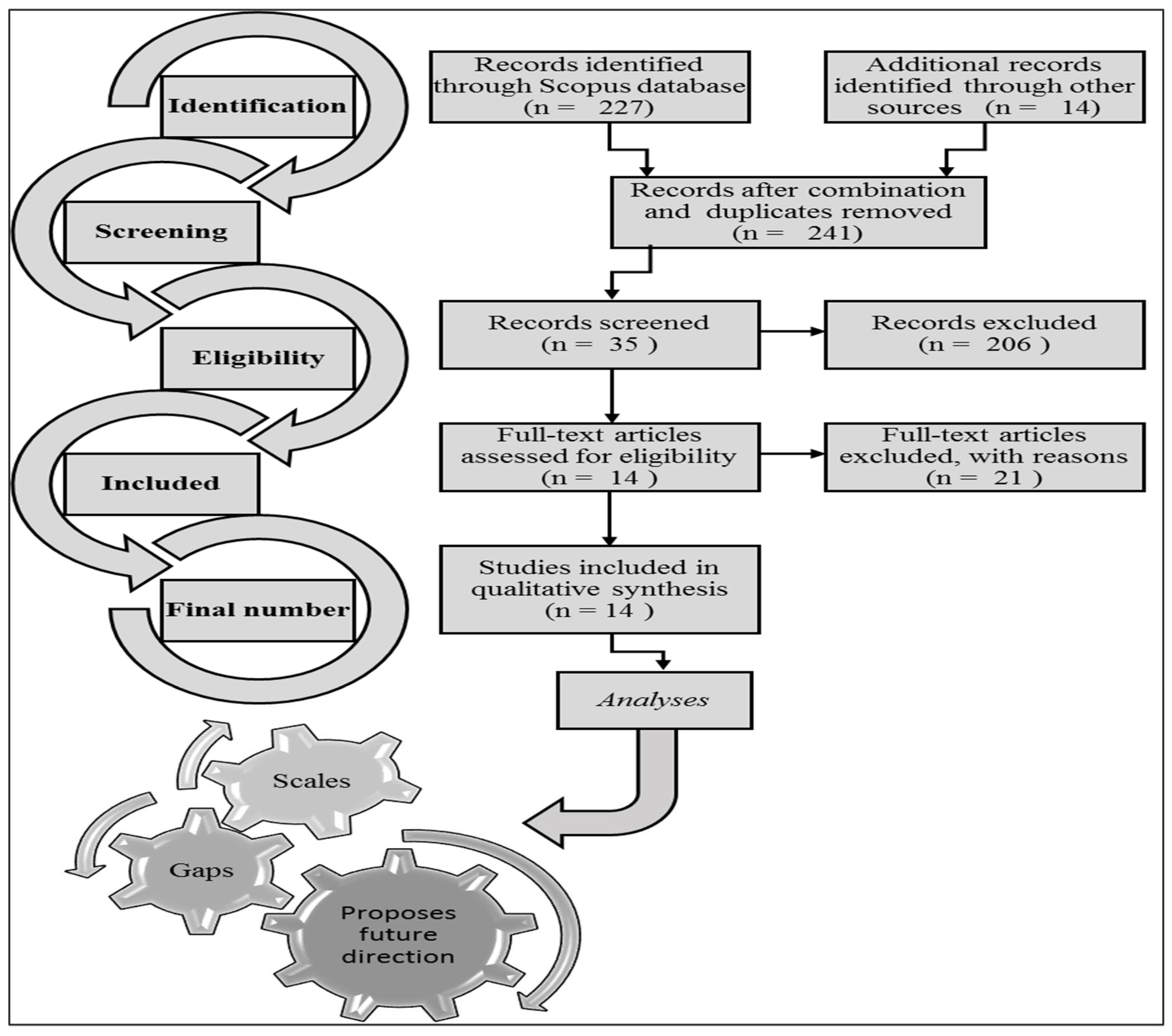
We conducted the literature search by exploring four options with four sets of keywords relevant to the research domain. In option 1, the keywords were “International women entrepreneurship” OR “Trade” AND “Gender-aware framework”. No document was found during this search attempt. In attempt 2 (option 2), the keywords were “Women entrepreneurship” OR “Female Entrepreneurship” AND “Gender-aware framework”. During this attempt, only three documents were found. Further (in option 3), we again searched using keywords “Women entrepreneurship” OR “Female Entrepreneurship” AND “Framework”. In this attempt, 87 documents were found. In the third attempt (option 4), the keywords were “Entrepreneurship” AND “Framework” AND “Gender”. During this attempt, 227 documents were found. This literature review was not only limited to the Scopus database, but also included journals that either focus on or are relevant to the study of gender and entrepreneurship. As such, we also conducted a word search on the Google and Google scholar using the keywords women entrepreneurship, internationalization and gender-aware framework to ensure a transparent and reliable research, as suggested by Martineau and Pastoriza [33] and Linán and Fayolle [46]. The search on Google Scholar resulted in some articles that are not indexed in Scopus. Finally, we used 241 documents for a review purpose.
An abstract of each of the articles was analysed to check whether a study offers a comprehensive framework with an useable measurement instrument relevant to women entrepreneurship and internationalization. Articles were removed if they had no link to offering a framework with a focus on a gender perspective in women entrepreneurship. A total of 35 articles were selected after reading the abstracts. Finally, 14 articles (see Table 2) offering a gender-aware framework were thoroughly analysed to check whether frameworks were appropriate for applying them in the international women entrepreneurship research stream. The steps involved in the literature process in this stage are summarised in Figure 2. For analysing the selected articles, we used a technique suggested by Ratten and Tajeddini [11]. This technique focuses on identifying research aims and findings from each article, which helps to describe the subject material and issues addressed. Linán and Fayolle [46] argue that this technique helps to understand the conceptual thinking and core arguments of a research topic. Each identified framework is critically assessed by way of an overview to identify the themes (see Table 2).
Table 2.
Review of existing framework.
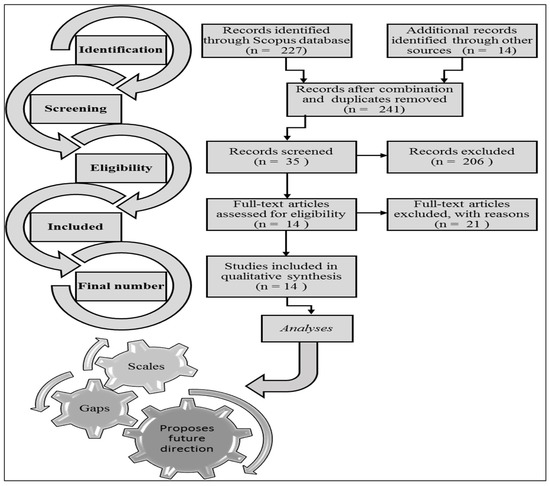
Figure 2.
Literature inclusion process.
5. Results and Discussion
Based on the content analysis of the identified frameworks, three main themes emerged: (a) theoretical underpinnings, (b) methodological inclusion and empirical validation and (c) the suitability or adaptability to the stream of research on international women entrepreneurship. Additionally, particular attention is paid to discussing the main findings of reviewed articles, and to providing suggestions for future research (see Table 2).
5.1. Theoretical Underpinnings
According to Buttner and Moore [26], several existing studies in women entrepreneurship research suffer from conceptual flaws because they try to evaluate the values, thought processes and experiences of women business leaders based upon and controlling against male counterparts. Hughes et al. [41] argue that “feminist perspectives, especially, are rarely invoked explicitly” (p. 431) and there are long-standing theoretical and empirical gaps in existing women entrepreneurship research, which need to be addressed for extending this stream of research. Ahl [36] asserts that studies should emerge in new stages by expanding objective research and by bringing change in the epistemological position. Why is bringing change in an epistemological position important? Considering a feminist perspective as an epistemological position is important because if we use one common yardstick to evaluate both male-owned and female-owned firms, it will be just like prescribing one medicine for all types of diseases. The literature still continues to judge women entrepreneurs according to masculine values [27]. For example, Meyerson and Kolb [57] argue that attributes associated with femininity, for example, nurturing, listening, emoting and relating, put women in a disadvantaged position. Moreover, there is a connection between emotion, cognition and entrepreneurial decision making [58,59]. Hence, it would be difficult to judge women’s journey as business owners solely on the basis of personal characteristics or institutional, economic or political perspectives.
In response to this, currently, researchers focus on evaluating women entrepreneurship from a gender perspective. In the selection of the articles, this study prioritizes those that have focused on a gender perspective in offering a framework for understanding women entrepreneurship. Hence, in terms of theoretical underpinnings, all the articles that bring a gender perspective in entrepreneurship research are relevant. Hurley [28] argues that feminist research methods allow a researcher to become involved with the subjects. Moreover, men and women are different in psychobiological, cultural and family aspects and a gender perspective should be included in analysing each of these aspects of entrepreneurs [58]. Although several authors regard feminism and gender perspectives as a philosophical standpoint, feminist perspectives are rarely included in frameworks with explicit constructs. Mirchandani [49] argues that it is necessary to include a feminism reflection to enhance our knowledge on women business owners. However, no concrete guidelines about parameters which should be used to evaluate women entrepreneurs’ participation in businesses, especially in international businesses, are offered and no measurement instruments are developed. Other articles [31,40,50,54] emphasise bringing a gender or feminism perspective by offering a gender-aware framework. However, these articles fall short in articulating parameters that should be used to evaluate women entrepreneurs’ participation in businesses, especially in international businesses. A summary of identified gaps and shortcomings of existing frameworks are presented in Table 2.
Among the 14 selected articles, only Brush, de Burin and Welter [29] articulate a framework with explicit constructs. The authors offer a gender-aware framework with “3Ms” (markets, money and management), which they later extended to the “5Ms” framework with two additional Ms (“motherhood” and “meso/macro environment”) [56]. The authors argue that motherhood and macro/meso environment are influential factors and should be included in the 3M (markets, money and management) framework for understanding women’s entrepreneurship. They also argue that each of the “Ms”, especially the motherhood and meso/macro, can be framed in a set of testable hypotheses in relation to the entrepreneurial process. However, cognitive/psychological factors (i.e., risk taking, opportunity identification), which can be affected by the socialisation process, are not considered in this framework. Siba [13] highlights that beyond emphasizing only general barriers, such as the access to financial and human capital, it is important to look at psychological, social and skills constraints on women entrepreneurs to be able to suggest optimal public policies to support women entrepreneurs.
Women entrepreneurs’ psychological characteristics (feelings, thoughts, beliefs, actions) associated with gender in relation to their society (family, society, wealth, religion) affect their entrepreneurial activities. From the society’s perspective, an individual inculcates values and the social norms, which helps her in shaping her personality and influences her behaviour according to the external situations. For example, in some countries, women are given opportunities, but they are reluctant to start or advance their business due to a fear of failure. Martinelli [60] argues that for a successful enterprise, both ‘seed’ and suitable soil (‘ground’) are important. The author also regards an entrepreneur as a ‘seed’ and argues that researchers who focus on the seed should include either psychological characteristics or social characteristics of an entrepreneurial conduct. Furthermore, the author regards a business environment as ‘soil’ and claims that researchers focusing on the soil should analyse an entrepreneurial conduct either through certain structural factors (i.e., a market type) or through cultural factors (i.e., social approval of entrepreneurial activities) [60]. Hence, entrepreneurs’ psychological characteristics should be included in a conceptual framework. However, it should be noted that the ‘5Ms’ framework is developed within a domestic boundary, and thus is limited in evaluating international women entrepreneurship. Following Ratten and Tajeddini [11], there are gender characteristics that influence internationalization rates and there are issues around women’s entrepreneurship and internationalisation to be explored. Particular areas which require exploration are: women’s attitude towards international trade, a gender divide in trade policy preferences, a structure of fair trade and women exclusion [37], barriers and drivers to women entrepreneurs in developing their international businesses and participating in exporting [13,61,62], and bringing gender consciousness to the development of an entrepreneurial leadership theory [31,55].
5.2. Methodological Inclusion and Empirical Validation of the Frameworks
This section discusses the methodological inclusion of the selected articles that propose a gender-aware framework for women entrepreneurship. This section also critically examines whether proposed frameworks are validated by empirical data. According to Henry et al. [55], there are a number of different methodological and theoretical perspectives on the role of gender and entrepreneurship. Hughes et al. [41] claim that it is important to use new methodological approaches to build and improve upon the rigour and creativity of empirical research in women entrepreneurship research. Although there is a shift in philosophical underpinnings (e.g., incorporating feminist critiques) in women entrepreneurship research, the literature continues to compare men and women, with little or no attention paid to the constructions of gender. Moreover, small sample size, the use of gender-biased measures and highlighting women entrepreneurs’ subordinate role while comparing male and female entrepreneurs are some notable methodological weaknesses in women entrepreneurship research [55,63]. As stated by Ahl [36], replication of such accepted methodological practices simply adds more evidence of women’s subordination in entrepreneurship, thereby restricting the development of this field of research. As such, this study explores the methodological inclusions in the proposed frameworks to examine whether the shift in the conceptualisation of gender and entrepreneurship considers the appropriate shift in methodological approaches.
There are few systematic literature reviews conducted regardinf methodological approaches taken in the literature on gender and entrepreneurship. As our objective is not to review methodological approaches taken in the existing entrepreneurship literature, we do not focus on this vast literature. Our discussion is focused on methodological approaches taken in the articles selected for this particular review. Our main objective is to explore the adequacy of methodological approaches in proposing frameworks for researching female entrepreneurship (see Table 3). However, the findings and directions of the existing review serve for a critical assessment of the articles reviewed in this study.
Table 3.
Review of Methodological inclusion and empirical validation of the frameworks.
The review results show that most of the articles (10 out of 14) aiming to propose a gender-aware framework are conceptual in nature. All of the articles focus on the discussion of the importance of incorporating a feminist perspective in researching women entrepreneurship. For instance, by applying a feminist critique to sociological theories of entrepreneurship, Hurley [48] explains how gender is related to political factors, state policies, culture, spatial location and professionalization and how these factors affect entrepreneurship. The author suggests including feminism theories in developing organisational theories and entrepreneurship theories. Similarly, Ahl and Marlow [31] demonstrate how a feminist analysis can inform entrepreneurship theories about the prevailing hetero-normative assumptions, which limit the epistemological scope of contemporary research and position women as failed or reluctant entrepreneurial subjects. Echoing [31,40,48,54] Hurley [48] and Ahl and Marlow [31], Muntean and Ozkazanc-Pan [54] and Vossenberg [40] claim that much research remains to be conducted with regards to theoretical and empirical works that not only would recognise gender as an organising principle of entrepreneurship, but also would heed the call toward gender equality in the enactment of entrepreneurship. However, no hypothesis is formulated and tested in any of those studies.
Only the article by Brush, de Burin and Welter [56], which involves the “5Ms” framework (money, markets, management, motherhood and meso/macro environment), suggests that each of the “Ms”, and especially the motherhood and meso/macro, can be framed in a set of testable hypotheses in relation to the entrepreneurial process, but no hypothesis is developed and tested using empirical data. Only in the study by Fischer, Reuber and Dyke [47], an empirical analysis is conducted in a commonly accepted manner (i.e., comparing male and female entrepreneurs’ performance). However, the authors find the lack of an integrative frameworks for understanding the nature and implications of issues related to sex, gender and entrepreneurship. The authors also argue that this has been a major obstacle in understanding whether differences between men and women entrepreneurs and their business performances are pervasive, and why they might exist.
In the review article on methodological approaches in gender and entrepreneurship research, Henry, Foss and Ahl [55] find that research on female entrepreneurship continues to be characterised by explaining differences between male and female entrepreneurs, because few entrepreneurship researchers are interested in a feminist epistemology. The authors suggest a radical shift (i.e., “a move away from traditional, broad-sweeping quantitative approaches towards more focused qualitative and innovative methodologies”) in methodological approaches in gender and entrepreneurship research by highlighting the importance of in-depth interviews, life histories, case studies, ethnography or discourse analysis to tackle down the complex issues and to draw a more comprehensive picture of women’s entrepreneurship. Our review reveals that the development of a gender-aware framework is still at the inception stage, especially in evaluating international entrepreneurship, which is consistent with conclusions from Ratten and Tajeddini [11].
5.3. Suitability and Applicability of Existing Frameworks in International Women Entrepreneurship
This section discusses the applicability of the frameworks identified in this study for researching international women entrepreneurship. In the literature on entrepreneurial activities, there is a long trace of ‘gender gap’ [2,4,5,44]. A gender gap and income losses from gender gap also persist in international trade as “only one in five exporting firms is led by women entrepreneurs” [7]. Non-tariff barriers are the main roadblocks behind the lesser participation of women entrepreneurs in international business [7]. Moreover, for achieving the UN Sustainable Development Goals (SDGs), the ITC aims to bring three million women to international market by 2021 [1]. Consequently, policymakers, development agencies and governments are trying to better understand factors contributing to the growth and success of female-owned firms at a national level [64], as well as at an international level [1,7]. Researchers are increasingly placing the emphasis on the entrepreneur, the venture, resources as well as the context in exploring women entrepreneurship to provide a more authentic framework to researchers, practitioners and policymakers [8,65].
Although women entrepreneurship and internationalisation are well-explored research areas, still “there is a lack of a coherent framework and inconsistent research about the internationalisation perspective on women entrepreneurship” [11], p. 780. Butler, Doktor and Lins [66] suggest that international entrepreneurship requires a high level of cognitive creativity and willingness to take more uncertainty, in addition to other types of entrepreneurships. As such, this study examines the applicability of the frameworks for measuring international women entrepreneurship. Presumably, all instruments intended to highlight the necessity of a feminist perspective in female entrepreneurship are included in the review. However, the majority of them fail to articulate the conceptual and operational definitions of the constructs needed to be included in the framework. Additionally, the review presented in this study reveals that no framework or instrument has been developed with a focus on the gender perspective in international women entrepreneurship. Discussions of all of the articles were limited to entrepreneurial activities within a domestic boundary. Only the article by Brush, de Burin and Welter [29] offers a gender-aware framework with 5 Ms (Money, Market, Management, Motherhood and Macro/meso). However, no instrument has been developed which can be used for measuring internationalisation of women-owned firms. Moreover, the cognitive/psychological characteristic of women entrepreneurs have been overlooked in this framework.
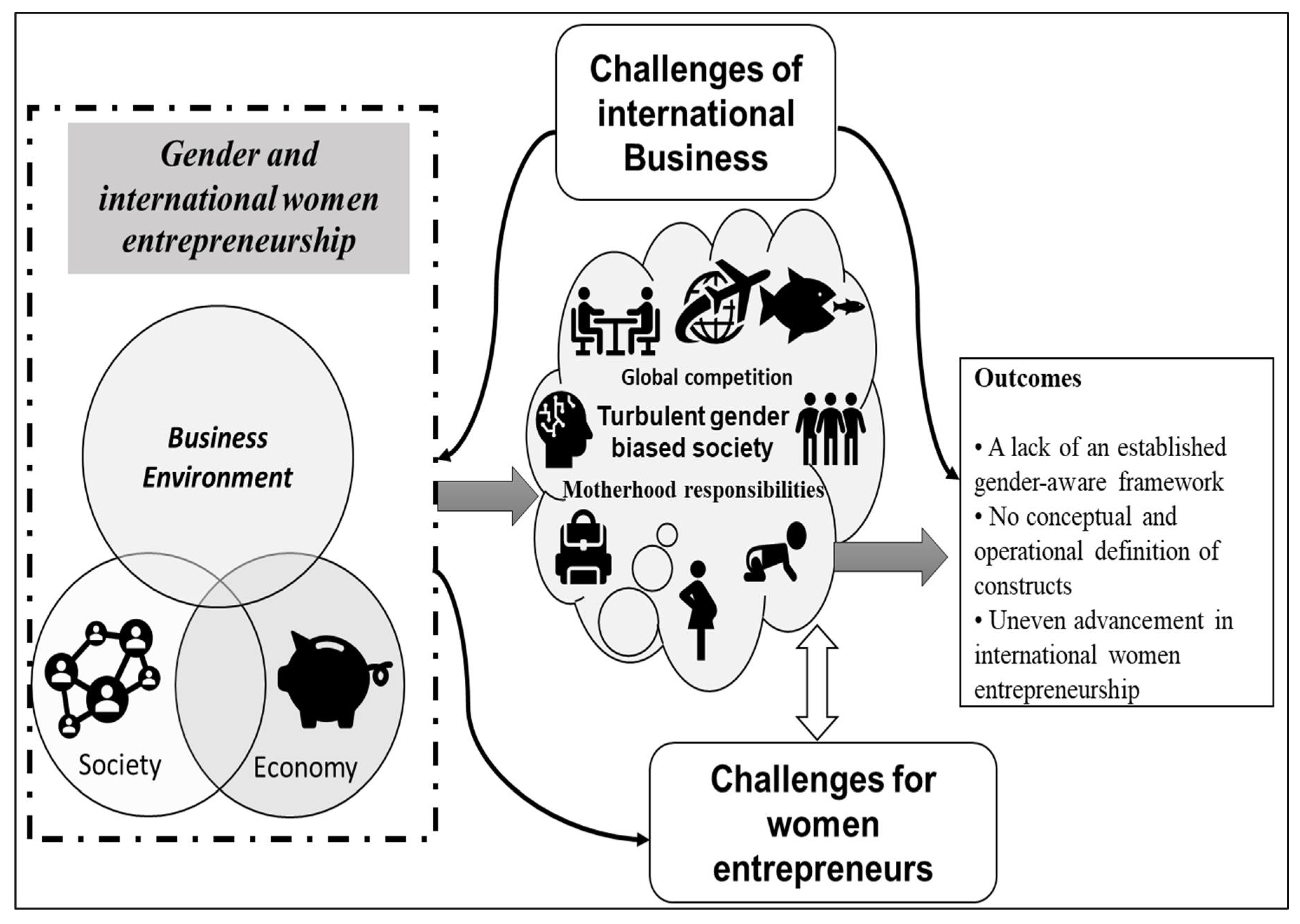
Overall, although women entrepreneurship and internationalisation are well-explored research areas, there is still a lack of a coherent framework in international women entrepreneurship. Moreover, there is no framework with a well-defined measurement instrument. Based on existing work on women’s entrepreneurship and internationalisation, Ratten and Tajeddini [11] claim that there are many topics around women’s entrepreneurship and internationalisation to be explored. For instance, gender equality within global capitalist structures is a theoretical matter that requires further empirical inquiry [37]. The findings of our systematic literature review are summarised in Figure 3.
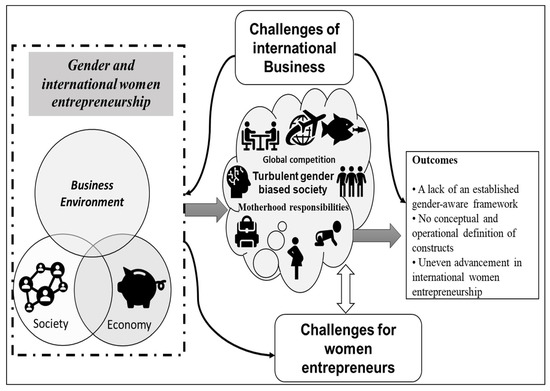
Figure 3.
Summary of SLR findings.
6. Conclusions
This review identifies and examines the existing frameworks and instruments in the women entrepreneurship literature. To address these objectives, a systematic literature review is conducted using the Scopus databases focused on a word search on the Google and Google Scholar on women entrepreneurship, gender, trade and internationalization, specifying social sciences as the research domain and articles published between 1990 and 2020. The findings of this review enhance our knowledge of gender-aware measurement instruments and provide suggestions to both researchers and practitioners for future work on this new research paradigm.
This study contributes to the field by reviewing and assessing the suitability of measurement instruments used in women entrepreneurship literature in the context of international women entrepreneurship. Based on this review, we identify gaps and inconsistencies in the existing frameworks and propose future research directions for developing the international women entrepreneurship as a new research paradigm. Despite the efforts to produce as comprehensive a review as possible, this review has some limitations. For example, some articles may have been omitted inadvertently which may happen because our review was limited to a specific database, in which specific key words were used over a specific time period.
This review highlights that the development of a gender-aware framework is still at the inception stage, especially regarding international women entrepreneurship. Due to the lack of a gender-aware framework, research on female entrepreneurship continues to be conducted using standard research methods (i.e., by explaining differences between male and female entrepreneurs). However, utilising the standard research may be enough to identify differences between male and female entrepreneurs, but not enough for understanding why these differences exist. The lack of an integrative frameworks for understanding the nature and implications of issues related to gender and entrepreneurship is considered as a major obstacle in understanding whether differences between men and women entrepreneurs and their business performances are pervasive, and why they might exist. As such, more research is required for a gender-aware framework in researching women entrepreneurship with articulated operationalizable constructs, specified items, and the domain that each item will intend to measure. This will help researchers to identify and understand why gender differences exist in male and female entrepreneurship and how they should be addressed. More specifically, future research should focus on construct development with conceptual and operational definitions, items specification for measuring the defined constructs and empirical validation by utilising mixed (i.e., qualitative and quantitative) methods and by utilising less methods such as case studies, depth-interviews, ethnography, or discourse analysis. Future scholars should be bold and innovative in developing this research field with a feminist lens to explore the complex nature of a female entrepreneurial endeavour and to overcome unwarranted criticisms of women entrepreneurs as failed or reluctant entrepreneurs.
Author Contributions
Conceptualization, M.A., M.R. and D.R.; Methodology, M.A.; Investigation, M.A. and M.R.; Writing—original draft, M.A., M.R. and D.R. All authors have read and agreed to the published version of the manuscript.
Funding
This research received no external funding.
Institutional Review Board Statement
Not applicable.
Informed Consent Statement
Not applicable.
Conflicts of Interest
The authors declare no conflict of interest.
References
- ITC and SheTrades Commonwealth. SheTrades Commonwealth; ITC: Kolkata, India; Available online: https://shetradescommonwealth.converve.io (accessed on 20 December 2019).
- Çalıyurt, K.T.; Segura, L. Women, Sustainable Entrepreneurship and the Economy: A Global Perspective. In Women and Sustainable Business, 1st ed.; Routledge: London, UK, 2020. [Google Scholar]
- Toma, C.; Vasiljevic, D.; Oberlé, D.; Butera, F. Assigned experts with competitive goals withhold information in group decision making. Br. J. Soc. Psychol. 2013, 52, 161–172. [Google Scholar] [CrossRef] [PubMed]
- Bastian, B.L.; Sidani, Y.M.; El Amine, Y. Women entrepreneurship in the Middle East and North Africa: A review of knowledge areas and research gaps. Gend. Manag. Int. J. 2018, 33, 14–29. [Google Scholar] [CrossRef]
- Yousafzai, S.; Fayolle, A.; Saeed, S.; Henry, C.; Lindgreen, A. The contextual embeddedness of women’s entrepreneurship: Towards a more informed research agenda. Entrep. Reg. Dev. 2019, 31, 167–177. [Google Scholar] [CrossRef]
- Lindgren, N.; Packendorff, J. A Framework for the Integration of a Gender Perspective in Cross-Border Entrepreneurship and Cluster Promotion Programmes. Sweden: Quadruple Helix Reports. 2010. Available online: https://www.diva-portal.org/smash/get/diva2:459305/FULLTEXT01.pdf (accessed on 12 October 2022).
- International Trade Centre (ITC). Unlocking Markets for Women to Trade; International Trade Centre: Geneva, Switzerland, 2015; P356.E/DBIS/TS/15-XII. [Google Scholar]
- Ratten, V. Gender entrepreneurship and global marketing. J. Glob. Mark. 2017, 30, 114–121. [Google Scholar] [CrossRef]
- Çağatay, N. Gender Inequalities and International Trade: A Theoretical Reconsideration. In Latin American Chapter of the Gender and Trade International Network; Department of Economics, University of Utah: Salt Lake City, UT, USA, 2005; Available online: https://www.ciedur.org.uy/adm/archivos/publicacion_101.pdf (accessed on 12 October 2022).
- ITC and SheTrades. Women Entrepreneurship & Trade: Addressing the Barriers for Increasing Participation; ITC|SheTrades: Kolkata, India; Available online: https://www.shetrades.com/application/files/2015/5430/6487/She_Trades_Workshop_1_April_2019_Bangladesh.pdf (accessed on 1 April 2019).
- Ratten, V.; Tajeddini, K. Women’s entrepreneurship and internationalization: Patterns and trends. Int. J. Sociol. Soc. Policy 2018, 38, 780–793. [Google Scholar] [CrossRef]
- Link, A.N.; Strong, D.R. Gender and entrepreneurship: An annotated bibliography. Found. Trends Entrep. 2016, 12, 287–441. [Google Scholar] [CrossRef]
- Siba, E. Empowering Women Entrepreneurs in Developing Countries: Why Current Programs Fall Short; Policy Brief, Africa Growth Initiative at Brookings. 2019. Available online: https://www.brookings.edu/about-us/annual-report/ (accessed on 12 October 2022).
- Junaid, M.; Shah, S.; Shah, S.M. Socio-cultural impediments to Pashtun women entrepreneurs in Peshawar, Pakistan: A narrative approach. Glob. Manag. J. Acad. Corp. Stud. 2015, 5, 155–161. [Google Scholar]
- Orser, B.; Riding, A.; Townsend, J. Exporting as a means of growth for women-owned Canadian SMEs. J. Small Bus. Entrep. 2004, 17, 153–174. [Google Scholar] [CrossRef]
- Faisal, M.N.; Jabeen, F.; Katsioloudes, M.I. Strategic interventions to improve women entrepreneurship in GCC countries: A relationship modeling approach. J. Entrep. Emerg. Econ. 2017, 9, 161–180. [Google Scholar] [CrossRef]
- Maden, C. A gendered lens on entrepreneurship: Women entrepreneurship in Turkey. Gend. Manag. Int. J. 2015, 30, 312–331. [Google Scholar] [CrossRef]
- Zhu, H.; Kuriyama, C. Gender-Related Constraints Faced by Women-OwnedSMES. Creative Commons Attribution-NonCommercial–ShareAlike 3.0 Singapore License. 2016. Available online: www.apec.org/About-Us/Policy-Support-Unit (accessed on 17 June 2018).
- Bosama, N.; Kelley, D. Global Entrepreneurship Monitor 2018/2019 Global Report. Global Entrepreneurship Monitor. 2019. Available online: https://www.gemconsortium.org/report/50213 (accessed on 12 October 2022).
- Terjesen, S.A.; Lloyd, A. The 2015 Female Entrepreneurship Index. Kelley School of Business Research Paper 15–51. Social Science Research Network (SSRN). 2015. Available online: https://doi.org/10.2139/ssrn.2625254 (accessed on 25 May 2018).
- Sammartino, A.; Gundlach, S. Women, Global Trade and What It Takes to Succeed. 2015. Available online: https://doi.org/10.13140/RG.2.1.1192.0806 (accessed on 19 May 2018).
- McCracken, K.; Marquez, S.; Kwong, C.; Stephan, U.; Castagnoli, A.; Dlouhá, M. Women’s Entrepreneurship: Closing the Gender Gap in Access to Financial and Other Services and in Social Entrepreneurship. 2015. Available online: http://repository.essex.ac.uk/id/eprint/18037 (accessed on 12 May 2018).
- Jamali, D. Constraints and opportunities facing women entrepreneurs in developing countries: A relational perspective. Gend. Manag. Int. J. 2009, 24, 232–252. [Google Scholar] [CrossRef]
- OECD. Empowering Women-led SMEs: Economic Development and the New Arab World. In Proceedings of the Conference on Emerging Economies, Emerging Leaderships: Arab Women and Youth as Drivers of Change, Sharjah, United Arab Emirates, 15–17 May 2012; Arab International Women’s Forum in Partnership with the MENA-OECD Investment Programme, The World Bank, Eds.; OECD Publications: Paris, France, 2012. [Google Scholar]
- Higgins, K. Gender and Free Trade Agreements: Best Practices and Policy Guidance; The North-South Institute Research Report; The North-South Institute: Ottawa, ON, Canada, 2013. [Google Scholar]
- Buttner, E.H.; Moore, D.P. Women Entrepreneurs: Moving Beyond the Glass Ceiling, 1st ed.; SAGE Publications, Inc.: Thousand Oaks, CA, USA, 1997. [Google Scholar]
- Bendl, R. Gender Subtexts––Reproduction of exclusion in organizational discourse. Br. J. Manag. 2010, 19, 50–64. [Google Scholar] [CrossRef]
- Akter, M.; Rahman, M.; Radicic, D. Women Entrepreneurship in International Trade: Bridging the Gap by Bringing Feminist Theories into Entrepreneurship and Internationalization Theories. Sustainability 2019, 11, 6230. [Google Scholar] [CrossRef]
- Brush, C.G.; de Bruin, A.; Welter, F. A gender-aware framework for women’s entrepreneurship. Int. J. Gend. Entrep. 2009, 1, 8–24. [Google Scholar] [CrossRef]
- Welter, F.; Brush, C.; de Bruin, A. The Gendering of Entrepreneurship Context; Working Paper 01/14; Institut für Mittelstandsforschung (Hrsg.): Bonn, Germany, 2014. [Google Scholar] [CrossRef]
- Ahl, H.; Marlow, S. Exploring the dynamics of gender, feminism and entrepreneurship: Advancing debate to escape a dead end? Organization 2012, 19, 543–562. [Google Scholar] [CrossRef]
- González, A. How Gender Affects SMEs’ Participation in International Trade; Institute for Research on Public Policy: Montreal, QC, Canada, 2016; Available online: http://irpp.org/research-studies/how-gender-affects-smes-participation-in-international-trade/ (accessed on 12 October 2022).
- Martineau, C.; Pastoriza, D. International involvement of established SMEs: A systematic review of antecedents, outcomes and moderators. Int. Bus. Rev. 2016, 25, 458–470. [Google Scholar] [CrossRef]
- Moreira, J.; Marques, C.; Braga, A.; Ratten, V. A systematic review of women’s entrepreneurship and internationalization literature. Thunderbird Int. Bus. Rev. 2018, 61, 635–648. [Google Scholar] [CrossRef]
- Dabić, M.; Maley, J.; Dana, L.-P.; Novak, I.; Pellegrini, M.M.; Caputo, A. Pathways of SME internationalization: A bibliometric and systematic review. Small Bus. Econ. 2019, 55, 705–725. [Google Scholar] [CrossRef]
- Ahl, H.J. Why research on women entrepreneurs needs new directions. Entrep. Theory Pract. 2006, 30, 595–621. [Google Scholar] [CrossRef]
- Rice, J.S. Free trade, fair trade and gender inequality in less developed countries. Sustain. Dev. 2009, 18, 42–50. [Google Scholar] [CrossRef]
- Marlow, S.; Hart, M.; Levie, J.; Shamsul, M.K. Women in Enterprise: A Different Perspective; RBS Group: Edinburgh, Scotland, 2012; Available online: https://financialallianceforwomen.org/download/women-in-enterprise-a-different-perspective/ (accessed on 12 October 2022).
- Lerner, D.A.; Hunt, R.A.; Dimov, D. Action! Moving beyond the intendedly-rational logics of entrepreneurship. J. Bus. Ventur. 2018, 33, 52–69. [Google Scholar] [CrossRef]
- Vossenberg, S. Beyond the Critique: How Feminist Perspectives Can Feed Entrepreneurship Promotion in Developing Countries; Working Paper Series No. 2014/14; Maastricht School of Management: Maastricht, The Netherlands, 2014; Available online: https://ideas.repec.org/p/msm/wpaper/2014-14.html (accessed on 12 October 2022).
- Hughes, K.D.; Jennings, J.E.; Brush, C.; Carter, S.; Welter, F. Extending Women’s Entrepreneurship Research in New Directions. Entrep. Theory Pr. 2012, 36, 429–442. [Google Scholar] [CrossRef]
- Joshi, A.; Neely, B.; Emrich, C.; Griffiths, D.; George, G. Gender Research in AMJ: AN Overview of Five Decades of Empirical Research and Calls to Action. Acad. Manag. J. 2015, 58, 1459–1475. [Google Scholar] [CrossRef]
- International Trade Centre. Gender and Trade. Inter-Agency Task Force on Financing for Development Issue Brief. 2016. Available online: http://www.un.org/esa/ffd/ffd-follow-up/inter-agency-task-force.html (accessed on 12 October 2022).
- Alves, M.F.R.; Galina, S.V.R.; Macini, N.; Carvalho, L.C.; Costa, T. Internationalization and innovation in nascent companies: Does gender matter? J. Small Bus. Enterp. Dev. 2017, 24, 887–905. [Google Scholar] [CrossRef]
- Farashah, A.D. The effects of demographic, cognitive and institutional factors on development of entrepreneurial intention: Toward a socio-cognitive model of entrepreneurial career. J. Int. Entrep. 2015, 13, 452–476. [Google Scholar] [CrossRef]
- Linán, F.; Fayolle, A. A systematic literature review on entrepreneurial intentions: Citation, thematic analyses, and research agenda. Int. Entrep. Manag. J. 2015, 11, 907–933. [Google Scholar] [CrossRef]
- Fischer, E.M.; Reuber, A.R.; Dyke, L.S. A theoretical overview and extension of research on sex, gender and entrepreneurship. J. Bus. Ventur. 1993, 8, 151–168. [Google Scholar] [CrossRef]
- Hurley, A.E. Incorporating feminist theories into sociological theories of entrepreneurship. Women Manag. Rev. 1999, 14, 54–62. [Google Scholar] [CrossRef]
- Mirchandani, K. Feminist insight on gendered work: New directions in research on women and entrepreneurship. Gend. Work. Organ. 1999, 6, 224–235. [Google Scholar] [CrossRef]
- Ely, R.J.; Meyerson, D.E. Advancing gender equity in organizations: The challenge and importance of maintaining a gender narrative. Organization 2000, 7, 589–608. [Google Scholar] [CrossRef]
- Calás, M.B.; Smircich, L.; Bourne, K.A. Extending the boundaries: Reframing “entrepreneurship as social change” through feminist perspectives. Acad. Manag. Rev. 2009, 34, 552–569. [Google Scholar] [CrossRef]
- Foss, L. Research on entrepreneur networks the case for a constructionist feminist theory perspective. Int. J. Gend. Entrep. 2010, 2, 83–102. [Google Scholar] [CrossRef]
- Emile, L. Female entrepreneurship theory: A multidisciplinary review of resources. J. Women’s Entrep. Educ. 2011, 1, 26–64. [Google Scholar]
- Muntean, S.C.; Ozkazanc-Pan, B. A gender integrative conceptualization of entrepreneurship. New Engl. J. Entrep. 2015, 18, 27–40. [Google Scholar] [CrossRef]
- Henry, C.; Foss, L.; Ahl, H. Gender and entrepreneurship research: A review of methodological approaches. Int. Small Bus. J. Res. Entrep. 2016, 34, 217–241. [Google Scholar] [CrossRef]
- Brush, C.G.; de Bruin, A.; Welter, F. A gender-aware framework for women’s entrepreneurship. In Entrepreneurship and Context; Monograph Book ed.; Welter, F., Ed.; Routledge: London, UK, 2019; pp. 92–108. [Google Scholar]
- Meyerson, D.E.; Kolb, D.M. Moving out of the ‘Armchair’: Developing a f ramework to bridge the gap between feminist theory and practice. Organization 2000, 7, 553–571. [Google Scholar] [CrossRef]
- Cardon, M.S.; Foo, M.D.; Shepherd, D.A.; Wiklund, J. Exploring the heart: Entrepreneurial emotion is a hot topic. Entrep. Theory Pract. 2012, 36, 1–10. [Google Scholar] [CrossRef]
- Nabi, G.; Liñán, F.; Fayolle, A.; Krueger, N.; Walmsley, A. The impact of entrepreneurship education in higher education: A systematic review and research agenda. Acad. Manag. Learn. Educ. 2017, 16, 277–299. [Google Scholar] [CrossRef]
- Martinelli, A. The social and institutional context of entrepreneurship. In Crossroads of Entrepreneurship; Kluwer ed.; Corbetta, G., Huse, M., Ravasi, D., Eds.; Springer: Dordrecht, The Netherlands, 2004; pp. 53–73. [Google Scholar]
- World Trade Organization. Leveling the Trading Field for SMEs; WTO Publications: Geneva, Switzerland, 2016; Available online: https://www.wto.org/english/res_e/booksp_e/world_trade_report16_e.pdf (accessed on 12 October 2022).
- International Trade Centre. SME Competitiveness Outlook 2017—The Region: A Door to Global Trade; International Trade Centre (ITC): Geneva, Switzerland, 2017; Available online: http://www.intracen.org/SMEOutlook/ (accessed on 12 October 2022).
- de Bruin, A.; Brush, C.G.; Welter, F. Advancing a framework for coherent research on Women’s entrepreneurship. Entrep. Theory Pract. 2007, 31, 323–339. [Google Scholar] [CrossRef]
- Adema, W.; Ali, N.; Frey, V.; Kim, H.; Lunati, M.; Piacentini, M.; Queisser, M. Enhancing Women’s Economic Empowerment through Entrepreneurship and Business Leadership in OECD Countries; OECD Publications: Paris, France, 2014; Available online: https://www.oecd.org/gender/Enhancing%20Women%20Economic%20Empowerment_Fin_1_Oct_2014.pdf (accessed on 12 October 2022).
- Hechavarria, D.M.; Ingram, A.E. Entrepreneurial ecosystem conditions and gendered national-level entrepreneurial activity: A fourteen-year panel study of GEM. Small Bus. Econ. 2019, 53, 431–458. [Google Scholar] [CrossRef]
- Butler, J.E.; Doktor, R.; Lins, F.A. Linking international entrepreneurship to uncertainty, opportunity discovery, and cognition. J. Int. Entrep. 2010, 8, 121–134. [Google Scholar] [CrossRef]
Publisher’s Note: MDPI stays neutral with regard to jurisdictional claims in published maps and institutional affiliations. |
© 2022 by the authors. Licensee MDPI, Basel, Switzerland. This article is an open access article distributed under the terms and conditions of the Creative Commons Attribution (CC BY) license (https://creativecommons.org/licenses/by/4.0/).