


Abstract
Research on the relationship between Foreign Direct Investment (FDI) and environmental concerns has been drastically growing, providing opportunities to conduct systematic and bibliometric overviews. Surprisingly, to date, there has been no bibliometric study on the relationship to analyze the large volume of data. To fill the gap, we conducted a bibliometric study to address the statistical evaluation of the published studies and measure the role of the publications in the scientific community. We utilized the Scopus data from 2000–2021 and applied VOSviewer for co-citation and bibliographic coupling and SciMAT for conceptual structure and evaluation. In addition to the most influential authors, journals, and countries, we have discussed theoretical foundations and current research streams in the field of FDI and environmental concerns. We have discussed how research streams in the fields of FDI and environment transformed during 2000–2005, 2006–2010, 2011–2015, and 2016–2021. Concerning future research directions, we strongly recommend studying public policies and government incentives for environmental concerns. Consequently, we have also discussed several future research directions that can further strengthen the field.
Keywords:
FDI; international investment; MNCs; environment; sustainability; SDGs; bibliometric study 1. Introduction
1.1. Background
Finance is considered as the “liver” of environmental practices [1]. Because of this merit, many countries across the globe have reserved some portion of their finances for environmental activities [2,3] while some of the countries (especially underdeveloped and emerging ones) encourage international investors and multi-national companies to help reduce environmental issues [4,5,6]. As a result, the number of studies on the nexus between Foreign Direct Investment (FDI) and environmental practices dramatically increased [7,8,9]. For instance, a recent study conducted by Santos and Forte [4] reveals that the number of studies on FDI and environmental concerns has significantly increased over the last two decades. These studies provided opportunities to conduct bibliometric studies and unleash what is the theoretical foundation, current research, and missing areas in the field of FDI and environmental concerns.
To the best of our knowledge, no relevant bibliometric study in the field could be found. Santos and Forte [4] used 353 papers from Scopus and the Web of Science until January 2019. However, this study is limited to the impact of documents and journals, while co-citations, bibliographic coupling and co-occurrence have not been analyzed. To fill this gap, our research analyzes more updated data from 2000–2021 as the number of studies is significantly higher in this range. Moreover, our research uses co-citations, bibliometric analysis, and conceptual structural and evaluation in the field of FDI and environmental concerns. Our research is not limited to the relationship between FDI and environmental degradation but also encompasses wider environmental concerns namely sustainability practices, environmental pollution, carbon emissions, and environmental issues.
Our research contributes to the existing body of knowledge in three ways. First, the co-citations analysis of this research advances our understanding related to the theoretical foundation in the field that has remained unexplored in the literature. Second, while performing bibliographic coupling, our research sheds light on the current issues in the field of FDI and environmental concerns and gives signals for future research directions. Third, our study employs conceptual structure and evaluation to identify the most and least important themes and research areas, as well as to identify missing nexuses in the field.
The further structure of the paper is below. First, we briefly discussed the relationship between FDI and environmental concerns. Second, we discussed methodological approaches and data collection. Third, we carried out a performance analysis of the data. Fourth, we analyzed co-citations and bibliographic coupling. Fifth, we analyzed the conceptual structure and evaluation of the field. Finally, we discussed future research directions, limitations, and conclusions.
1.2. FDI and Environmental Concern and Overview
Since the 1980s, the literature indicates that the inflow of FDI has globally increased in almost every region, pertaining to its benefits for both the host countries and the investors. Indeed, FDI is regarded as a critical component of economic growth, particularly in developing countries [10]. Among the benefits for the host countries, transfer of foreign capital, technology, skills, and access to new markets for export enhancement are the most crucial elements that are being emphasized [11]. Even though FDI boosts economies in multiple ways. On this issue, the literature is divided into two schools of thought: one indicating its negative impact on the environment (Pollution Haven Hypothesis), while the other emphasizes its constructive role in environment protection (Pollution Halo Hypothesis) [12].
Scholars working on the “pollution heaven hypothesis” contend that underdeveloped economies are more appealing to developed countries due to lax environmental policies that are less stringent than in developed countries. As a result of the transfer of dirty industries from developed economies, developing countries have become pollution hot spots [13,14,15]. Moreover, the developing economies intentionally relax their environmental standards to attract foreign investments to support their economic growth and create new employment opportunities, yet at considerable environmental costs [16]. A substantial portion of the body of literature has indicated the positive relationship between industrial production and CO2 emission that becomes the major cause of environmental degradation. For instance, Alam, et al. [17] employing panel data found a significant positive relationship between energy usage and pollution emissions. Fei, et al. [18] argue that only in China, a 1 percent surge in per capita increases the energy consumption up to 50% which eventually increases the CO2 emission to about 43% in China. Opoku, et al. [19] used a dataset of 103 countries from 1970 to 2019 and stated that environmental degradation boosts the inflow of FDI to under developed and developing countries while it attenuates the inflow to developed economies. Gao, et al. [20] recognized that when there are stringent regulations, FDI improves total green energy facts and environmental performance. Phung, et al. [21] used 2000–2018 data and revealed that FDI has a significant and positive role in the green growth of South Asian economies.
Although there is a substantive part of literature that suggests that the FDI significantly contributes to the CO2 emission that is hazardous for the environment, several studies support a positive nexus between FDI and environmental quality. For instance, Zhang and Zhou [22] while utilizing panel data investigated the effect of FDI on the release of CO2 at the provincial level of China. In fact, the pollution hypothesis are based on the Environmental Kuznets Curve (EKC) hypothesis which suggests that environmental quality is attained after a period where the national income reaches a desired level [23]. Henceforth, the Advocates of pollution hallo hypothesis argues that the FDI initially provides adequate fiscal funds which increase the economic growth of a country that significantly upsurge the gross national income of the host country, yet, at the cost of environmental degradation. However, as Panayotou [24] suggests, the relationship between environmental degradation and economic development follows a U-shaped pattern, i.e., with economic development, environmental quality returns to normal because, with sufficient funds, governmental institutions prioritize environmental protection once the desired national income is achieved. Following FDI absorption, environmental protection will now be the point of competition rather than economic competition [25]. This encourages investors for imitating pollution control methods.
Keeping in view the importance of environmental quality, the developed countries export advanced technological FDIs which are more environmentally friendly in nature that encompasses international environmental standards to the underdeveloped and developing countries [26]. Therefore, FDI that originates from developed countries aids the developing economies in enhancing the environmental quality while contributing to the economic development of developing countries [27,28,29]. The concept of environmental protection largely depends on the Sustainable Development Goals (i.e., SDGs). Whereas the SDGs necessitate support from all countries in order to enhance economic development, halt the drastic climate change, and ensure sustainable utilization of natural resources to attain sustainable development [12]. As most of the SDGs are directly related to the natural environment, all countries need to grow and conserve environmental capital to meet the SDGs. With a global corporation, the developing countries can enhance their investments in SDGs-related projects by importing green and energy-efficient technologies from developed economies in form of FDI, as it is a vital common resource where all the nations can support each other to encourage the sustainability of the earth’s environment. The concept was validated by UNCTAD in 2018, which defined FDI as a supplement to public investment, which is critical for SDGs, particularly in developing countries.
Several studies have investigated the positive role of FDI and financial resources in environmental protection through different channels [30,31]. One of the most prominent factors that enhances the role of FDI is the transfer of cleaner technologies that are utilized for production while keeping in mind the pollution control in host countries, thus leading to green spillover, that positively affects the environmental quality of the host country [32]. For instance, [33] revealed that the CO2 emissions increase due to GDP growth and energy consumption, rather than FDI [28], in fact, FDI reduces the usage of pollutive technology by replacing it with green technology [34]. FDI not only brings new greener technology, but also advanced management concepts, techniques, and procedures are brought in which eventually improve the ecological environment. Zeng and Eastin [35] validate the positive relationship between FDI and environmental protection in Chinese markets. Moreover, Hassaballa (2013) revealed a negative correlation between FDI and environmental pollution, in fact, they concluded that the FDI improves productivity along with energy efficiency through greener technology with low CO2 emitters.
FDI improves the environment through technological structure, industrial structure, economic scale, and a number of other channels in the host country [36,37]. Although the technological spillover impact of FDI is still not properly defined, a number of scholars provide ample evidence that shows that FDI improves productivity with more mature management experience [25,38]. Foreign-funded firms are more often technologically advanced compared to local firms. Due to cutting-edge technology, FDI has substantial potential through the competition effect, personnel flow, demonstration effect, and industrial linkage effect, henceforth, the technological spillover effect enhances the technological innovation efficiency [39,40]. Furthermore, the foreign-invested companies possess strong innovative technological capabilities [41] that are essential for the host countries to determine or adopt environmentally friendly technologies. With the expansion of FDI, import of advanced production technologies along with foreign management experiences, the host countries are enabled to accumulate the innovation capabilities and key knowledge that are essential for pollution control [42]. Whereas FDI comes with multinational companies, firms that utilize overseas mergers and acquisitions have vast R&D institutions that directly transfer technology and knowledge to the parent company [43]. Moreover, several studies prove the positive nexus between FDI and environmental protection in some countries through the transformation of manufacturing industries into service industries, whereas it is empirically proven that the services tend to be less polluting in comparison to the industrial activities [44]. From the empirical evidence, it is evident that FDI can significantly improve the environmental quality of host countries. Although initially, it may negatively affect the environmental quality and improves the pollution abatement capacity of the government expenditure for the betterment of the environment. From the policy maker’s perspective, FDI is crucial for technology-intensive industries [45]. Furthermore, FDI positively influences spatial agglomeration and spillover effects [46]. Whereas the new economic geography utilizes spatial clustering of economic developments into account. Considering the extensive number of studies on the relationship between FDI and environmental concerns, we conducted a bibliometric overview to uncover the theoretical foundations and the current status of the research in the field.
2. Methodology
2.1. Database
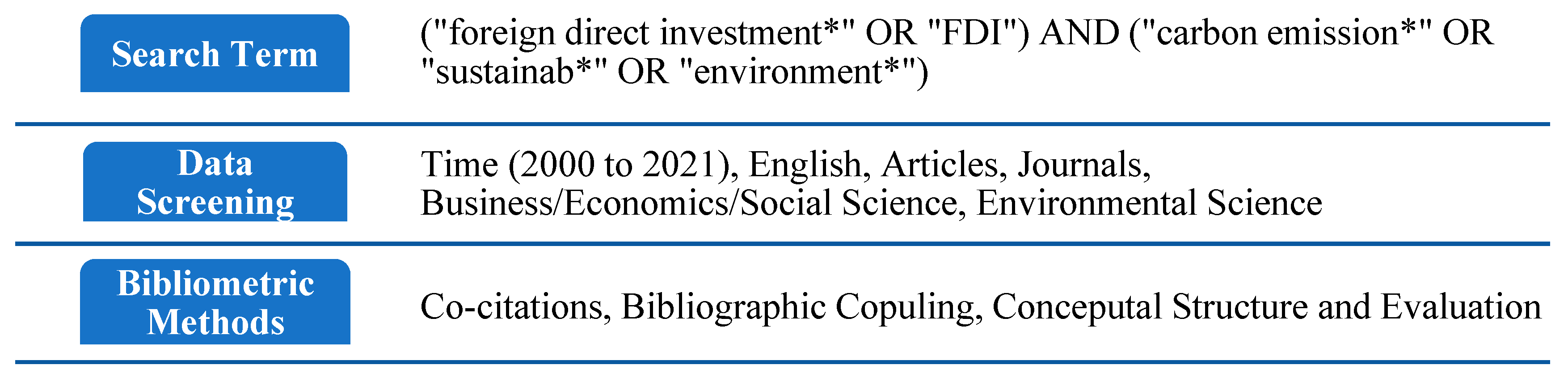
We extracted data from Scopus which is considered the most important data source for bibliometric studies [47,48]. It contains a wide range of data as compared to the web of science and other databases [48]. The time period for this study is 2000 to 2021 as research studies in the field of FDI and environmental concerns significantly increased in this period [4]. Moreover, we further limited our data search to avoid extra literature by selecting only articles in English language and journals. Structure of the bibliometric is given in Figure 1.
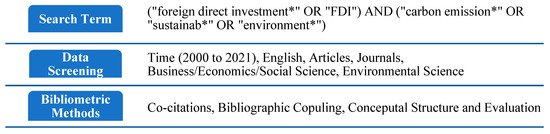
Figure 1.
Structure of the bibliometric study.
2.2. Search Term
The search for this study was “(“foreign direct investment*” OR “FDI”) AND (“carbon emission*” OR “sustainab*” OR “environment*”)” as it could give the most relevant and comprehensive literature in the field of FDI and environmental concerns. We extracted 2810 published papers from Scopus on 21 October 2021.
2.3. Co-Citations
Co-citation is when two documents have been cited independently by the next one or more articles. In simple words, we study the association between those articles that are cited together by another article. It helps us understand the theoretical foundation in a particular field. It gives us information about the past on the field.
2.4. Bibliographic Coupling
When one or more articles cites/cite the next two or third articles in the bibliographies. In other words, here we study the association between those articles that cite similar papers in their references.
2.5. Conceptual Structure and Evaluation
This method uses the co-occurrence approach in SciMat to understand the importance and evaluate each theme during each period (that has been categorized). It explores which theme is the most or least important and which theme is used repeatedly during the sampled period in the particular field. In other words, it shows how the field of research is changing in certain areas.
3. Data Analysis
We first used performance analysis of the data to understand the most productive authors, journals, and countries in the field. To analyze co-citations and bibliographic coupling, we used VOSviewer as it is the most recommended software in recent studies. It analyzes the data from WOS and Scopus directly and gives networking and tabulations (e.g., [49]). For conceptual structure and evaluation, we used SciMAT as it structures the themes into different periods. Moreover, SciMAT also enables us to understand the most and least important research areas in the specified period.
3.1. Performance Analysis
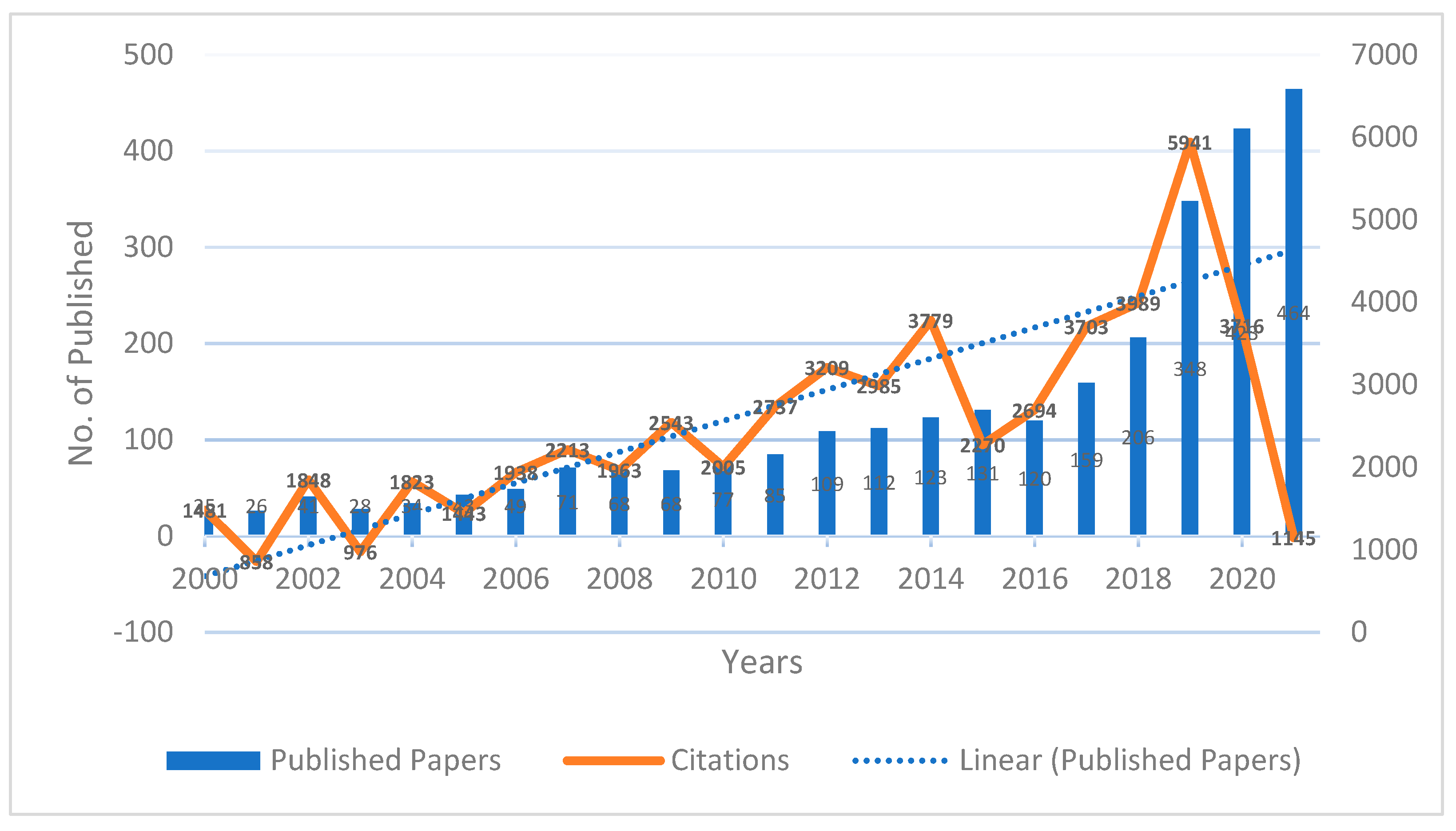
Figure 2 and Table 1 show the number of published papers each year with their citations. It is clear from the figure that the number of published papers increased from 2000 to 2021 except for some ups and downs during 2003, 2008, 2009, and 2016. Similarly, there is strong variation in the citations over the years. For instance, as compared to other periods in the sample, 2001, 2003, 2010, 2015, and 2021 have a low number of citations.
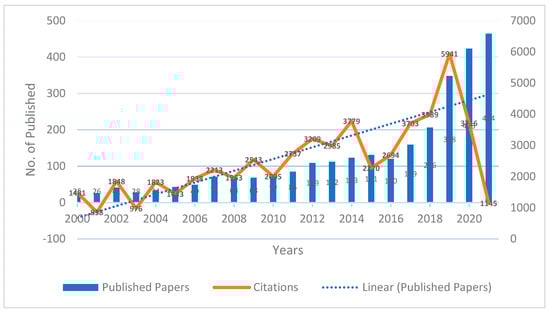
Figure 2.
Published papers and citations (Scopus).

Table 1.
Published papers with citations.
Table 2 shows the most productive authors, journals, and countries in the field of FDI and environmental concerns. Zaman, K is the most productive author with 32 publications, followed by Shahbaz, M and Nassani, A.A. with 19 and 18 articles respectively. With 203 articles, Environmental Science and Pollution Research is the most productive journal, followed by Sustainability and Journal of Cleaner Production, which have 149 and 81 articles, respectively. ChinaOther authors and journals with their publications are shown in the below table. Moreover, Table 3 shows the papers that have been cited the most. Dowell, Hart, and Yeung (2000) and Globerman, Shapiro, and Caballero (2008) stand out.
Table 2.
The most productive authors, journals, and countries.
Table 3.
The Most Cited Papers.
3.2. Bibliometric Analyses
In this study, we conducted a co-citation analysis; bibliographic coupling and co-occurrence (hereby referred to as conceptual structure and evaluation). For both co-citation and coupling analyses, the colors in the networking figures show clusters. The rounded dots (hereby referred nodes) and their size depend on the total link strength (the more the total link strength, the bigger will be the size of the nodes).
3.2.1. Co-Citations for References
In this part, a researcher studies the association between those two references that are cited independently in one or more articles. In the present study, we used a minimum of 20 cited references and found 65 references out of 138,225 total references. We discovered four clusters: cluster 1 (red) had 18 articles, cluster 2 (green) had 18 articles, cluster 3 (blue) had 17 articles, and cluster 4 (yellow) had four articles. Based on the results (shown in Table 4), Tang and Tang (2015) have the most links between them than any other co-cited reference. This article focused on the relationship between energy consumption, income, FDI and CO2 emissions in an emerging market in Vietnam. Indeed, studies in emerging economies on the association between FDI and environmental concerns are rapidly increasing as compared to Europe [30]. Figure 3 shows a network of the co-cited references where four major clusters are shown.
Table 4.
The highest total link strength of co-cited references.
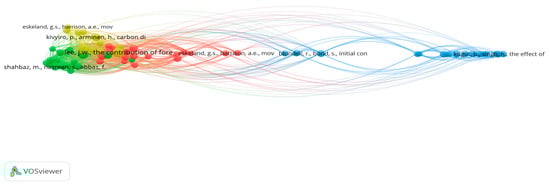
Figure 3.
Co-cited references.
3.2.2. Co-Citations for Journals/Sources
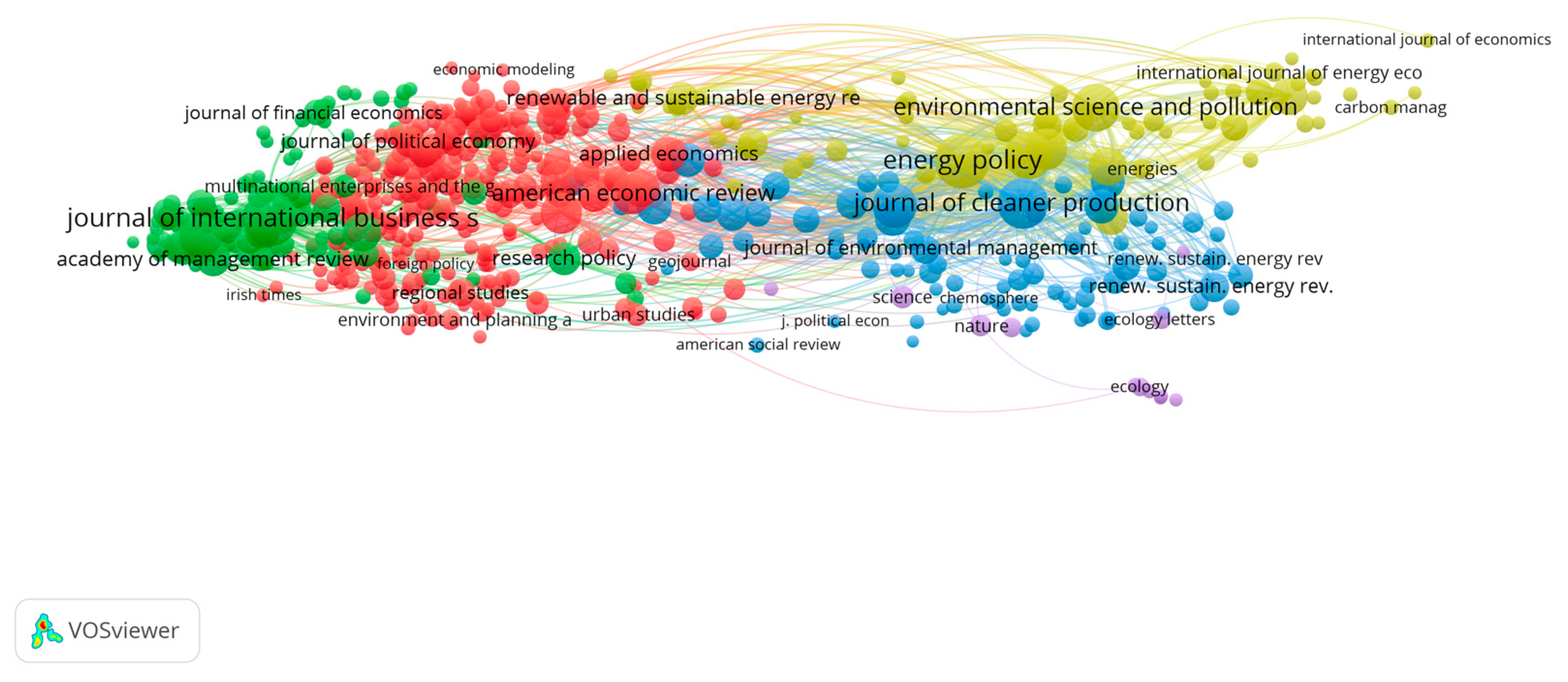
Co-citations for journals show the association between two journals that have appeared independently in one or more articles. We used a minimum criterion of 20 articles per journal and found 585 journals out of a total of 44,226 journals. Figure 4 illustrates five clusters namely cluster 1 (red) with 306 journals, cluster 2 (green) with 117 journals, cluster 3 (blue) with 85 journals, cluster 4 (yellow) with 64 journals, cluster 5 (purple) with 13 journals. Energy Policy has the highest number of total link strengths (see Table 5) followed by the International Journal of Business Studies and Journal of Cleaner Production etc.
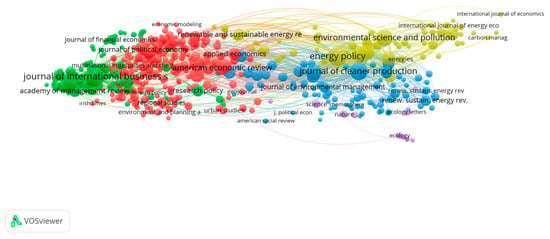
Figure 4.
Network for co-cited journals.
Table 5.
The highest total link strength of co-cited journals.
3.2.3. Co-Citations for Authors
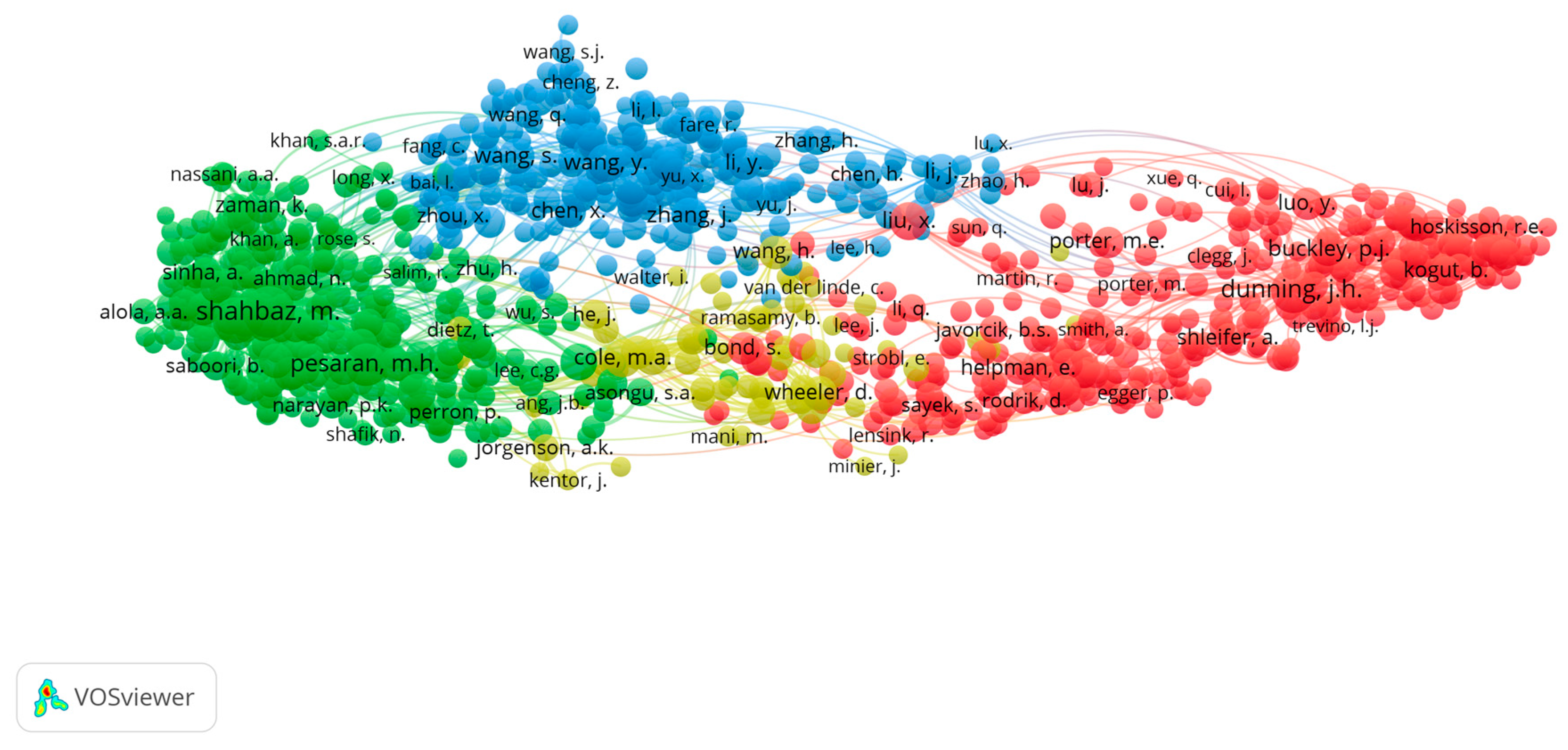
Here we study the relationship between two authors that are cited together by one or more studies. We used the threshold of a minimum of 20 articles by each author and found 2249 authors out of a total of 86,478. Our analysis shows (see Figure 5) four clusters: cluster 1 (red) with 353 authors, cluster 2 (green) with 334 authors, cluster 3 (blue) with 243 authors, and cluster 4 (yellow) with 70 authors. Shahbaz M is the top author (see Table 6) in terms of total link strength followed by Ozturk I and Dunning JH.
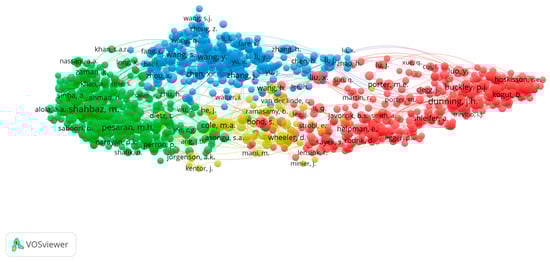
Figure 5.
Network for co-cited authors.
Table 6.
The highest total link strength of co-cited authors.
3.2.4. Bibliographic Coupling for Documents
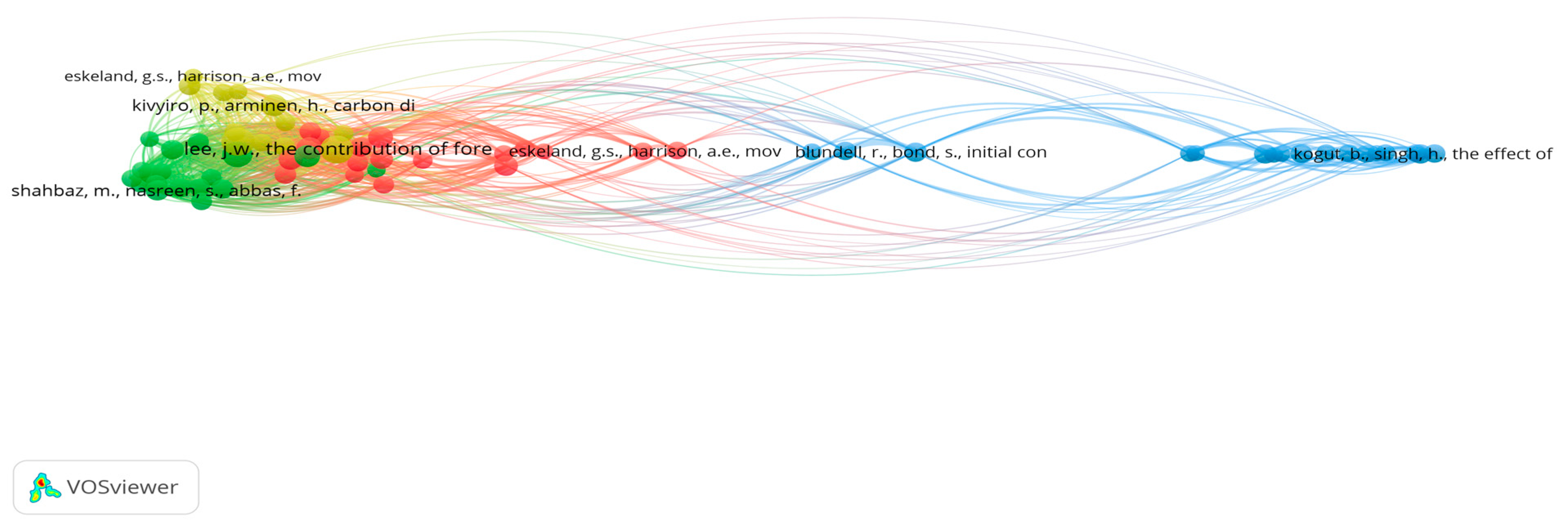
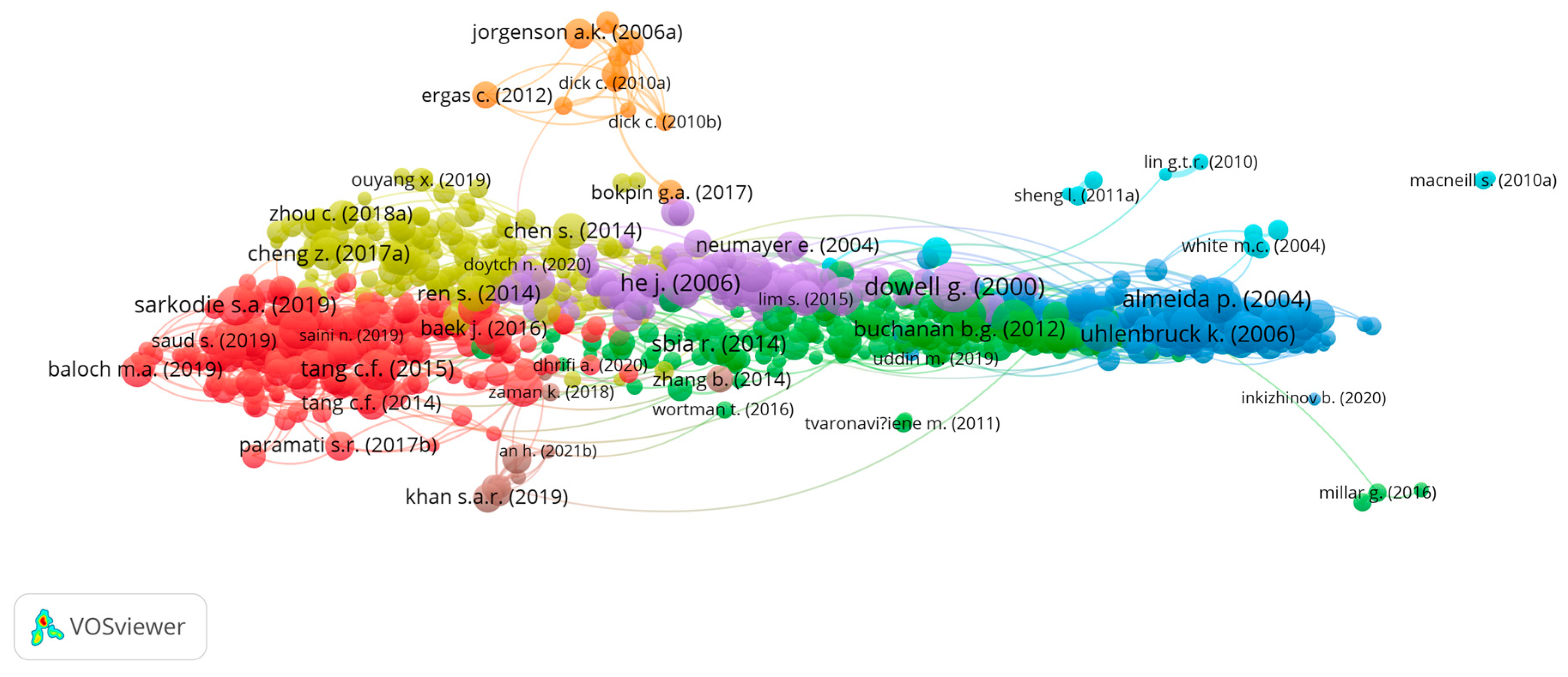
Using the criterion of a minimum of 5 citations per document, we extracted 1467 documents out of 2827 documents. There are eight clusters (see Figure 6) that are cluster 1 (red) with 227 articles, cluster 2 (green) with 217 articles, cluster 3 (blue) with 178 articles, cluster 4 (yellow) with 152 articles, cluster 5 (purple) has 134 articles, cluster 6 (sky-blue) with 14 articles, cluster 7 (orange) with 11 articles, and cluster 8 (bronze) with 10 articles. Villanthenkodath M.A. (2020) has the highest number of total link strengths (see Table 7) followed by Balsalobre-Lorente D. (2019) and Hitt M.A. (2016). The graph depicts the networking for the top 1000 coupled documents.
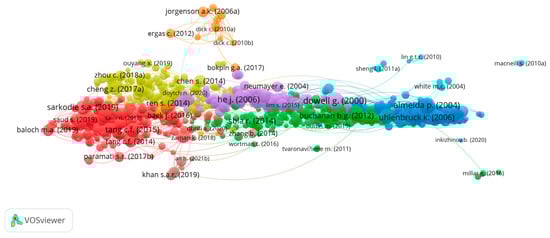
Figure 6.
Network for coupled documents.
Table 7.
The highest total link strength of coupled documents.
3.2.5. Bibliographic Coupling for Source
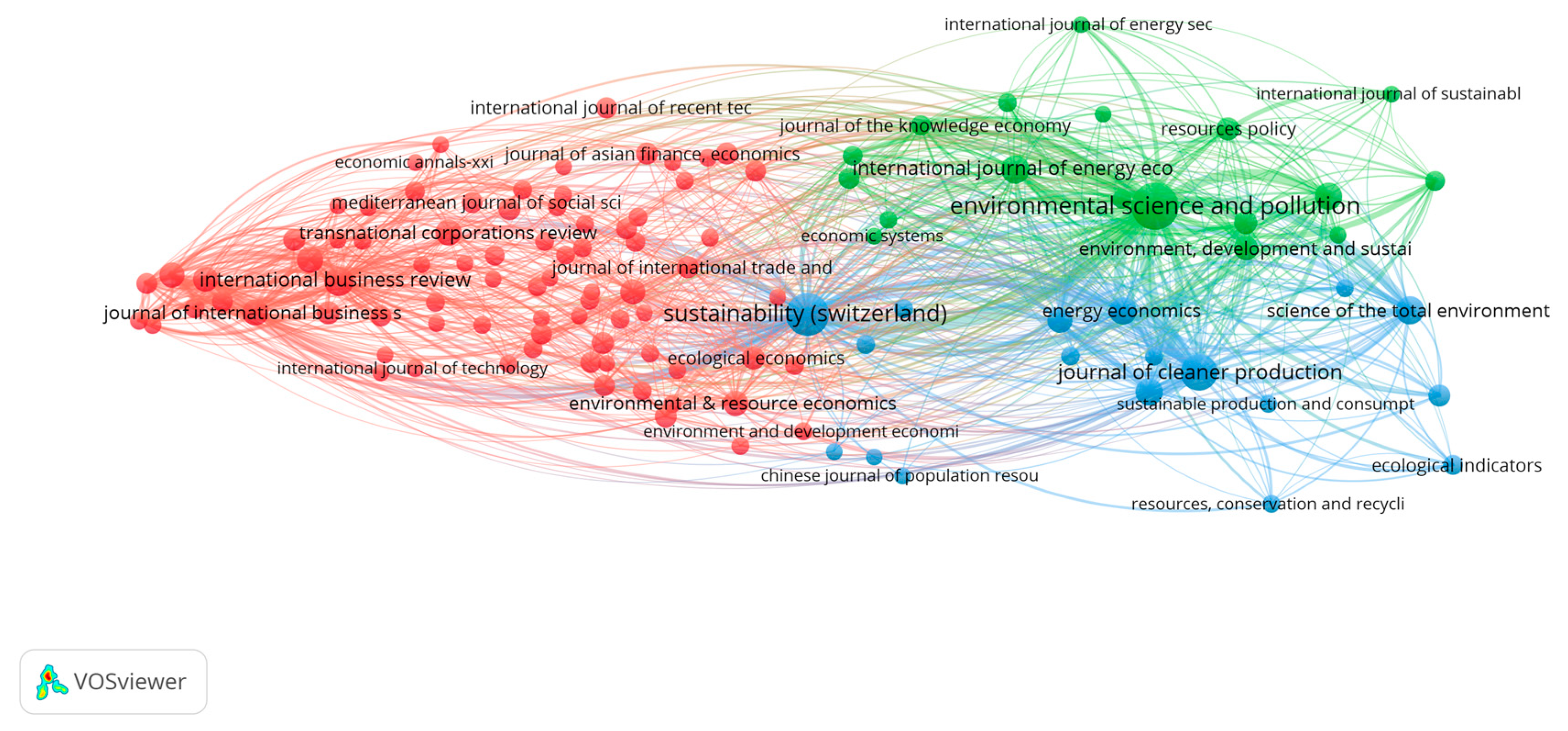
To analyze bibliographic coupling for the journals, we used the minimum threshold of 5 articles per journal and found 116 journals out of 890. Figure 7 displays that there are three clusters namely cluster 1 (red) with 80 journals, cluster 2 (green) with 18 journals and cluster 3 (blue) also with 18 journals. Environmental Science and Pollution Research followed by Sustainability and Journal of Cleaner Production have the highest total link strength (see Table 8). It is rational to state that these journals are the most productive journals in the field of FDI and environmental concern.
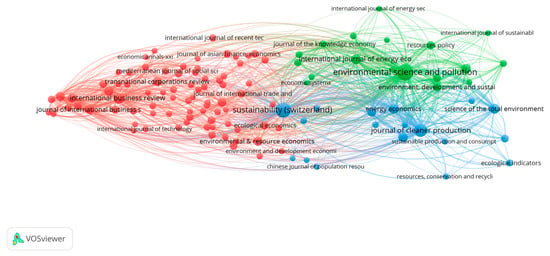
Figure 7.
Network for coupled journals.
Table 8.
The highest total link strength of coupled journals.
3.2.6. Bibliographic Coupling for Authors
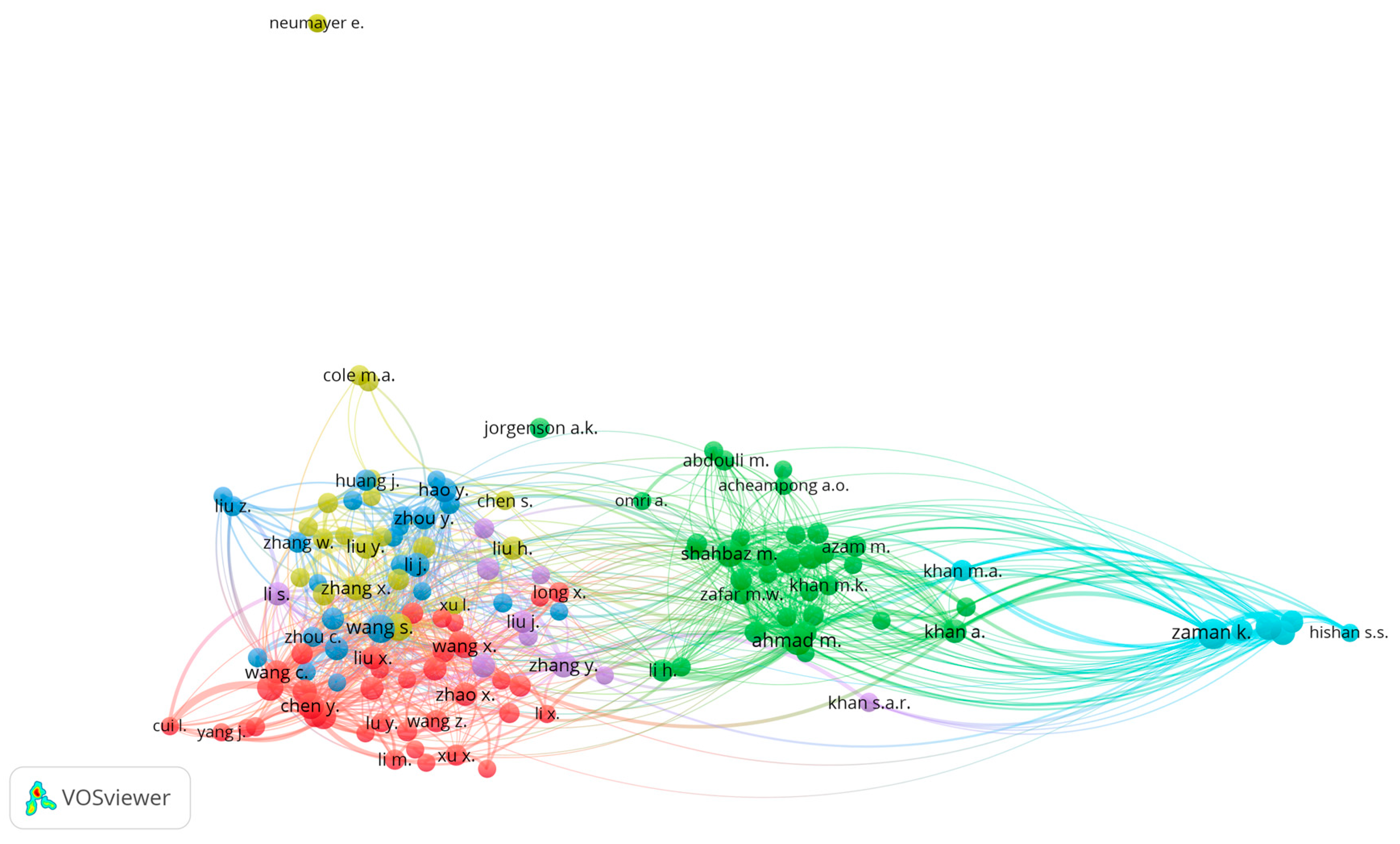
To understand the bibliographic coupling among the authors, we used six documents per author as the minimum threshold and found 136 authors out of a total of 5176. As shown in Figure 8, there are six clusters; cluster 1 (red) with 38 authors, cluster 2 (green) with 35 authors, cluster 3 (blue) with 25 authors, cluster 4 (yellow) with 21 authors, cluster 5 (purple) with 10 authors, cluster 6 (sky-blue) with 7 authors. Table 9 illustrates the total link strength of which Zaman K has the highest total link strength followed by Nassani A. A and Ahmad M. It stands to reason, given that Zaman K is the most prolific author in the field of FDI and environmental concerns.
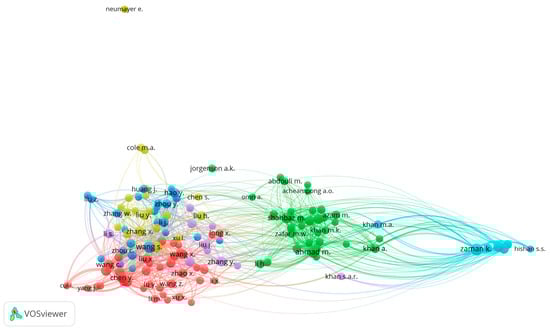
Figure 8.
Network for coupled authors.
Table 9.
The highest total link strength of coupled authors.
3.2.7. Bibliographic Coupling for Countries
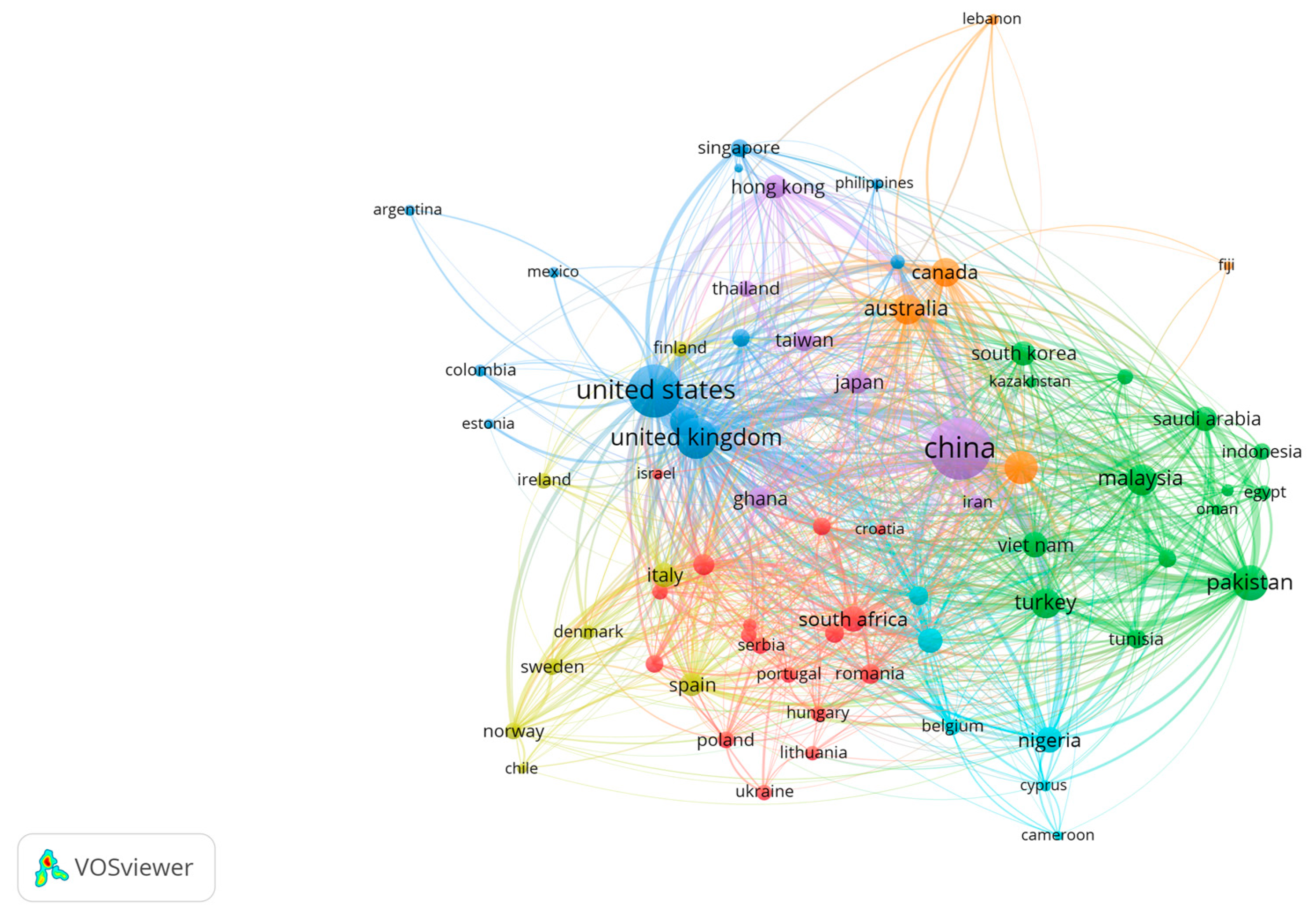
To analyze the bibliographic coupling for coupling countries, we used five thresholds and found 69 countries out of 145. China has the highest total link strength followed by the USA and UK. Figure 9 shows seven clusters; cluster 1 (red) with 17 articles, cluster 2 (green) with 14 articles, cluster 3 (blue) with 12 articles, cluster 4 (yellow) with 8 articles, cluster 5 (purple) with 7 articles, cluster 6 (sky-blue) with 6 while cluster 7 (orange) with 5 articles. Table 10 reveals China has the highest total link strength followed by the USA and UK.
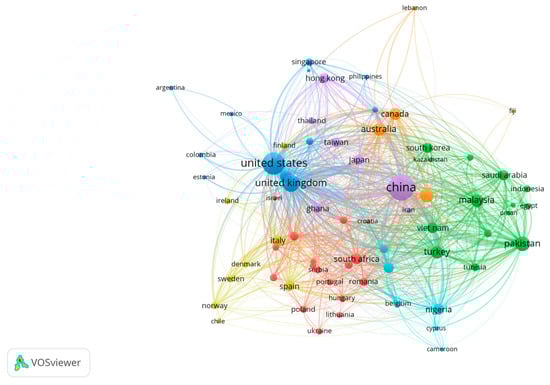
Figure 9.
Network for coupled countries.
Table 10.
The highest total link strength of coupled countries.
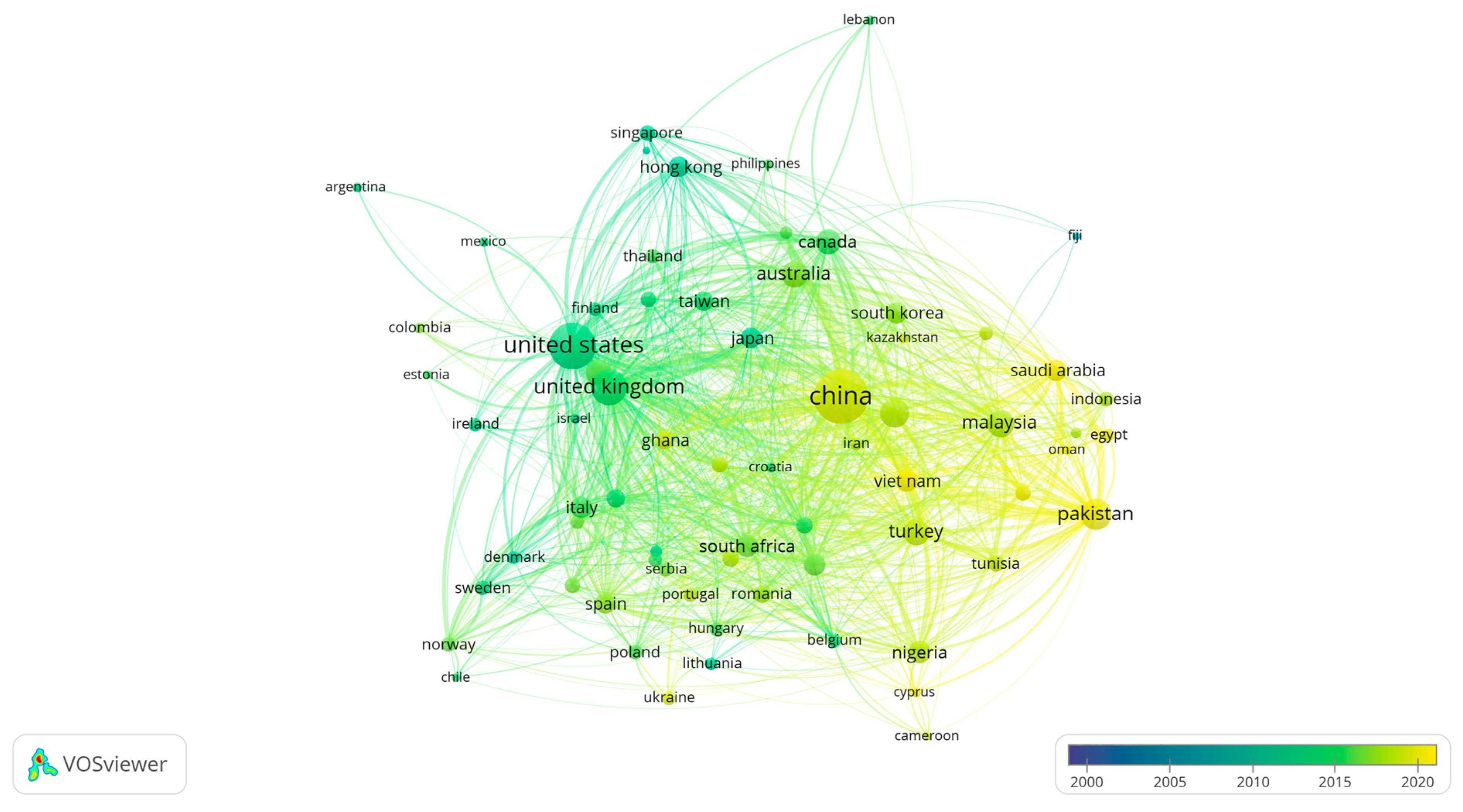
We have also shown coupling for countries over time (see Figure 10). It can be learned from the figure that countries such as China, Pakistan, Vietnam, Saudi Arabia, Egypt, Oman, and Ghana have recently published in the field of FDI and environmental concerns. However, Hong, the USA, Japan, Ireland, Singapore, Sweden, and Denmark have published in the past.
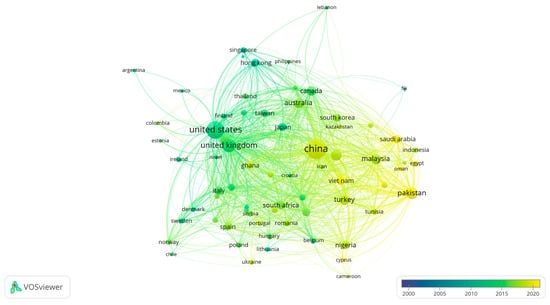
Figure 10.
Time spam network for coupled countries.
3.3. Conceptual Structure and Evaluations
We used SciMAT by categorizing the data into four periods: 2000–2005, 2006–2010, 2011–2015, and 2016 to 2021. The aim of categorizing the data is to find out how research areas are evolving over the time in the field of FDI and environmental concerns. It also enables researchers to understand the most and least important research areas during each period.
3.3.1. Evaluation Map
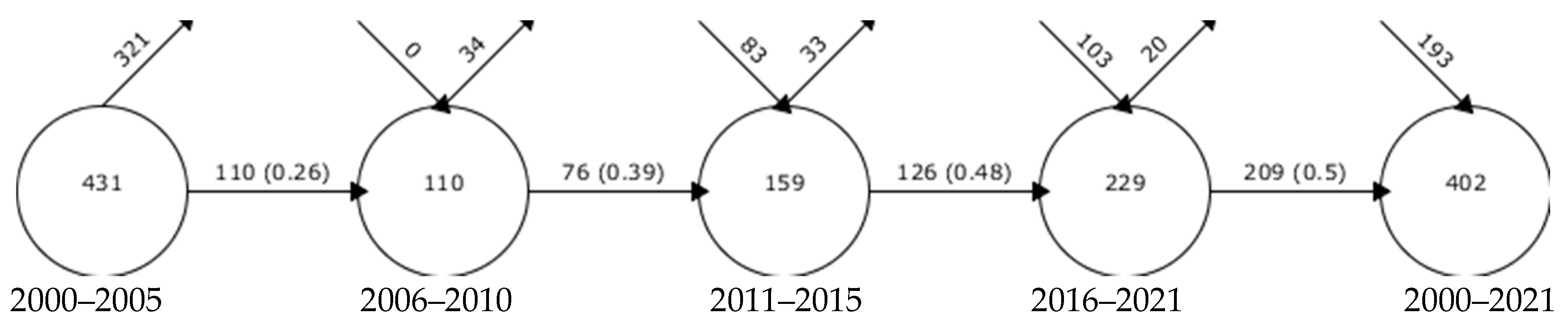
The overlay diagram (see Figure 11) indicates the number of the most frequent words during each period and how some or all of these words are used in different periods. In the first period (2000–2005), 431 words mostly occurred. The arrows going outside indicate the number of words that are left or disappeared in the next period while the arrows coming inside show the entry of new words in the specified period. However, the horizontal arrow shows the number of words used in the next period with a similarity index. For instance, out of 431 words during 2000–2005, 321 words disappeared and 110 words with 26% similarity were used in the period 2006–2010. However, during 2006–2010, only 110 words were used of which 34 disappeared and 76 words with 39% similarity were used in 2011–2015. During the period 2011–2015, 159 words were used of which 83 words were new while 33 words disappeared and only 126 with a similarity index of 48% were used during 2016–2021. Consequently, 229 words were used during 2016–2021 of which 103 were new and 20 words disappeared while 209 words with 50% similarity were used during 2000–2021. Finally, there were 402 words used mostly during 2000–2021.
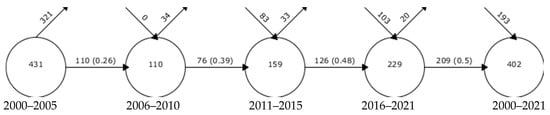
Figure 11.
Overlay diagram.
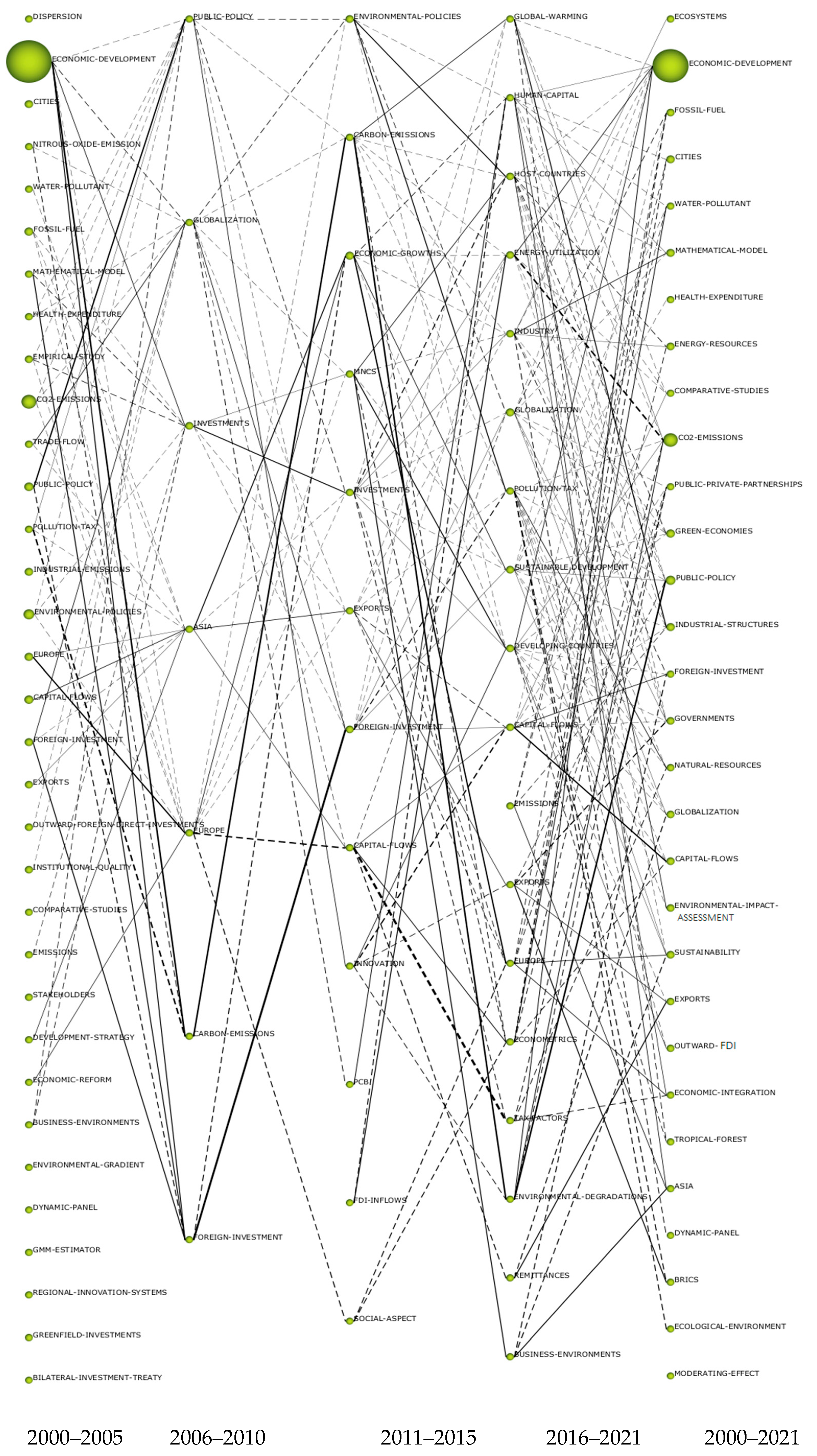
These themes of each period are presented in the evaluation map (see Figure 12). The solid lines indicate a strong relationship/relatedness between the specific themes. In other words, it means that the themes appeared or are used in these two periods. However, sold lines indicate a weak relationship or poor relatedness between the themes. Looking at the period 2000–2005, we can understand that the themes, dispersion, environmental gradient, dynamic panel, GMM estimator, regional innovation system, greenfield investment and bilateral investment treaty, have disappeared and are not used in the period 2006–2010. The theme of FDI inflow started during 2006–2010 and the moderating effect also started its journey during 2000–2021 in the fields of FDI and environmental concerns. However, the relationship/relatedness between the other themes can be understood from the lines (solid and dotted).
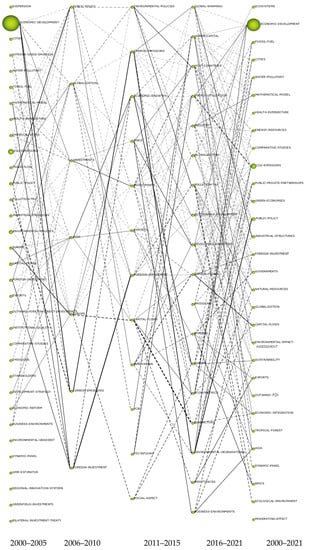
Figure 12.
Thematic evaluation of the main themes.
3.3.2. Strategic Diagram
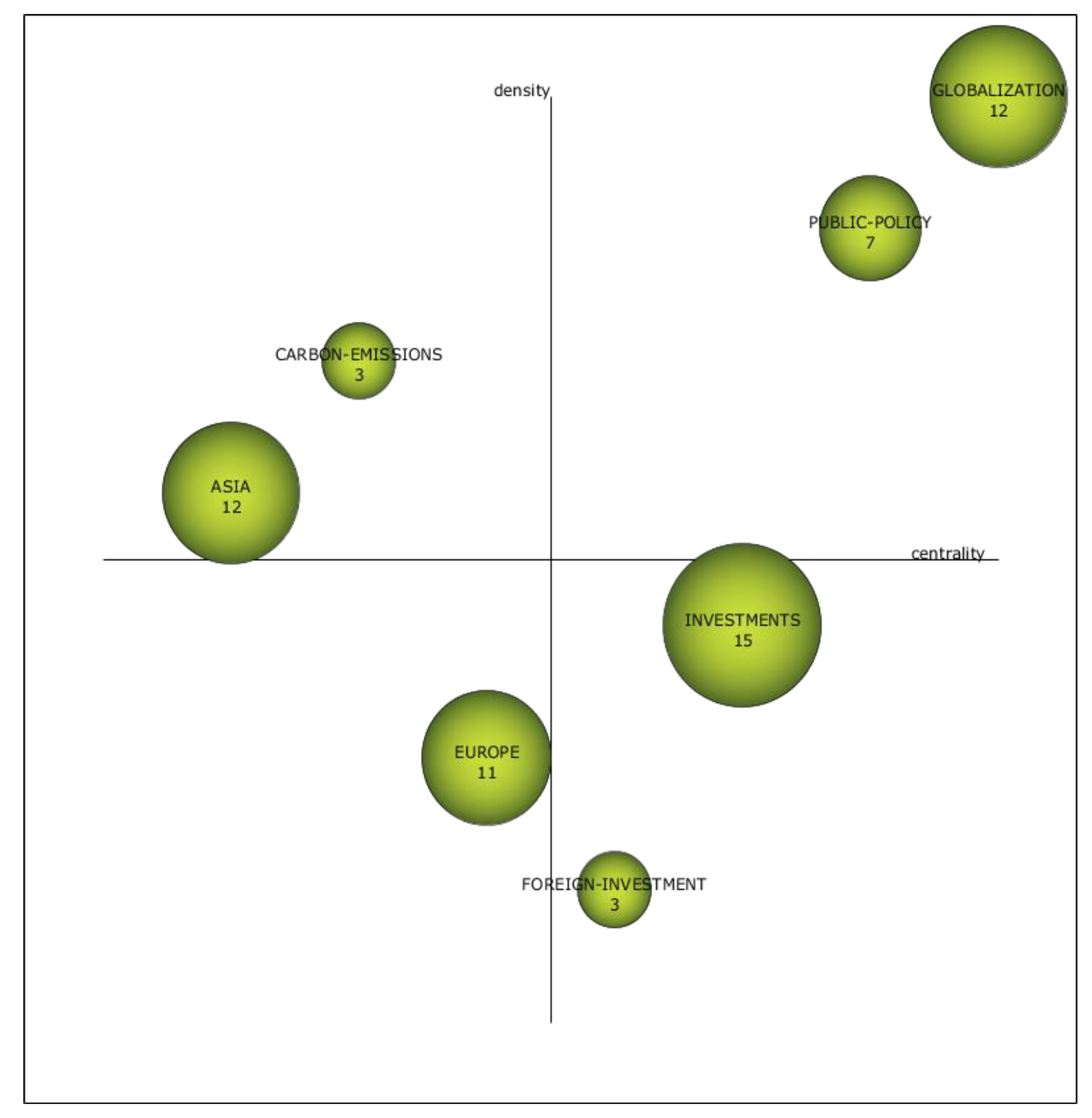
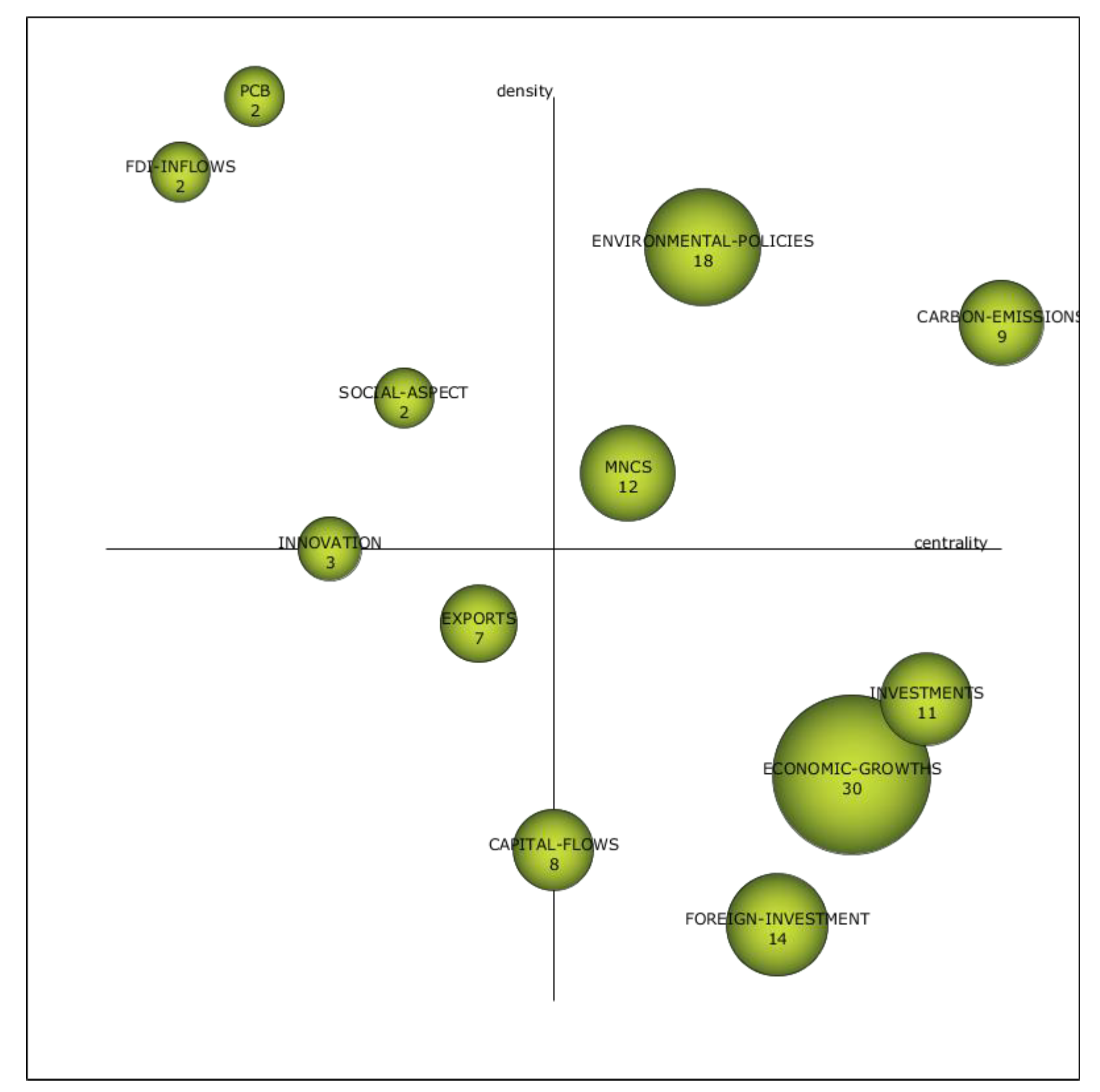
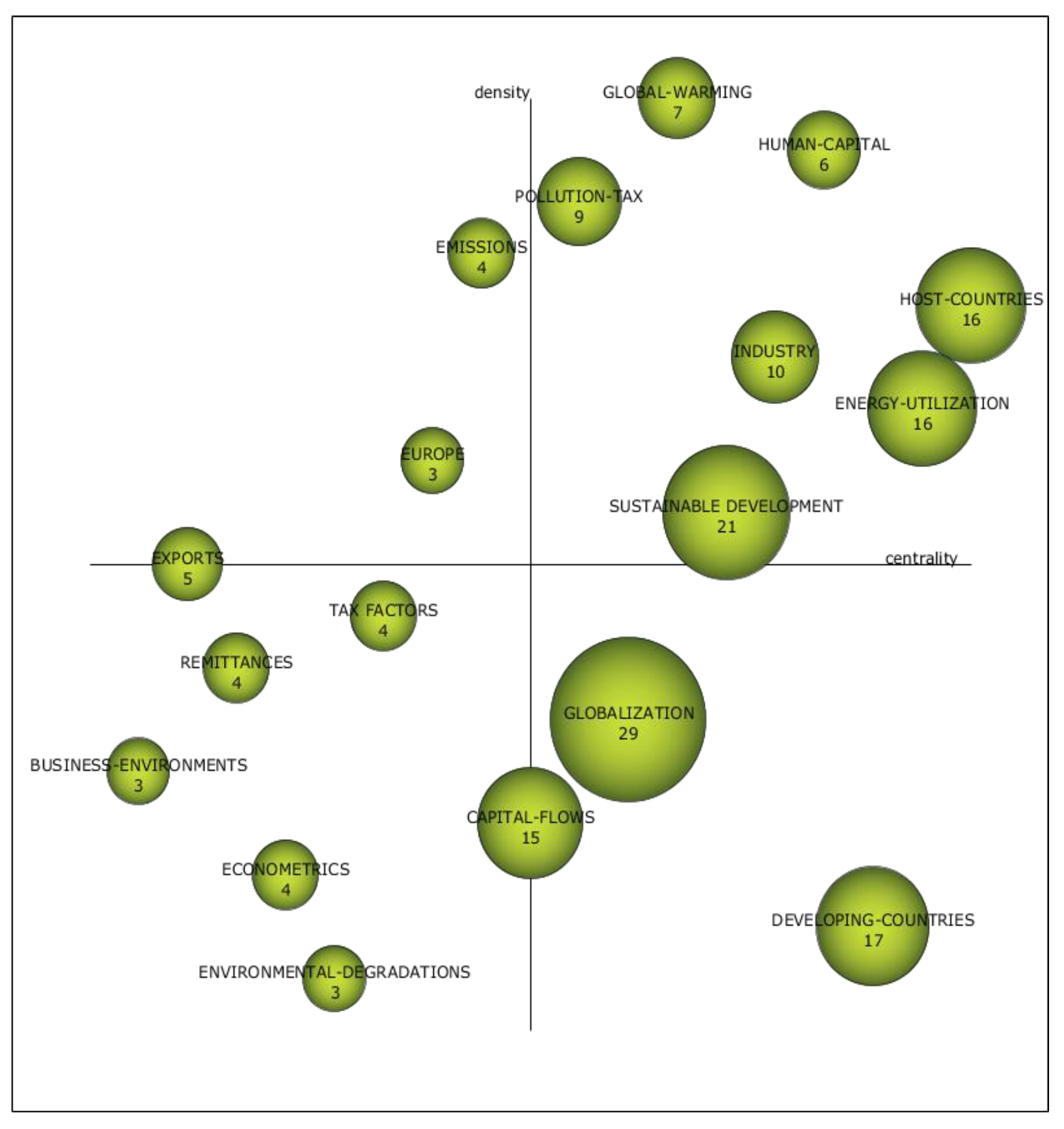
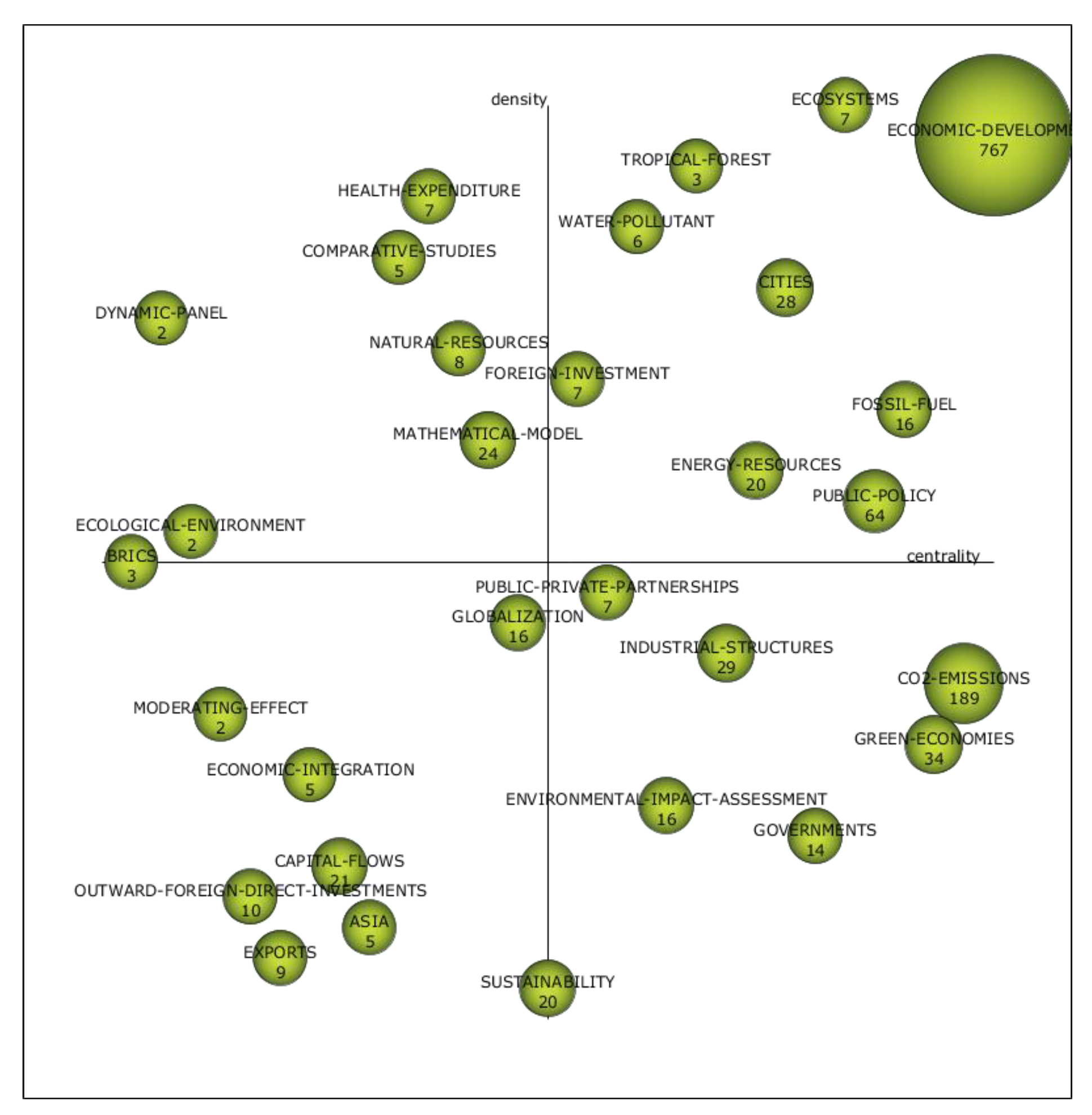
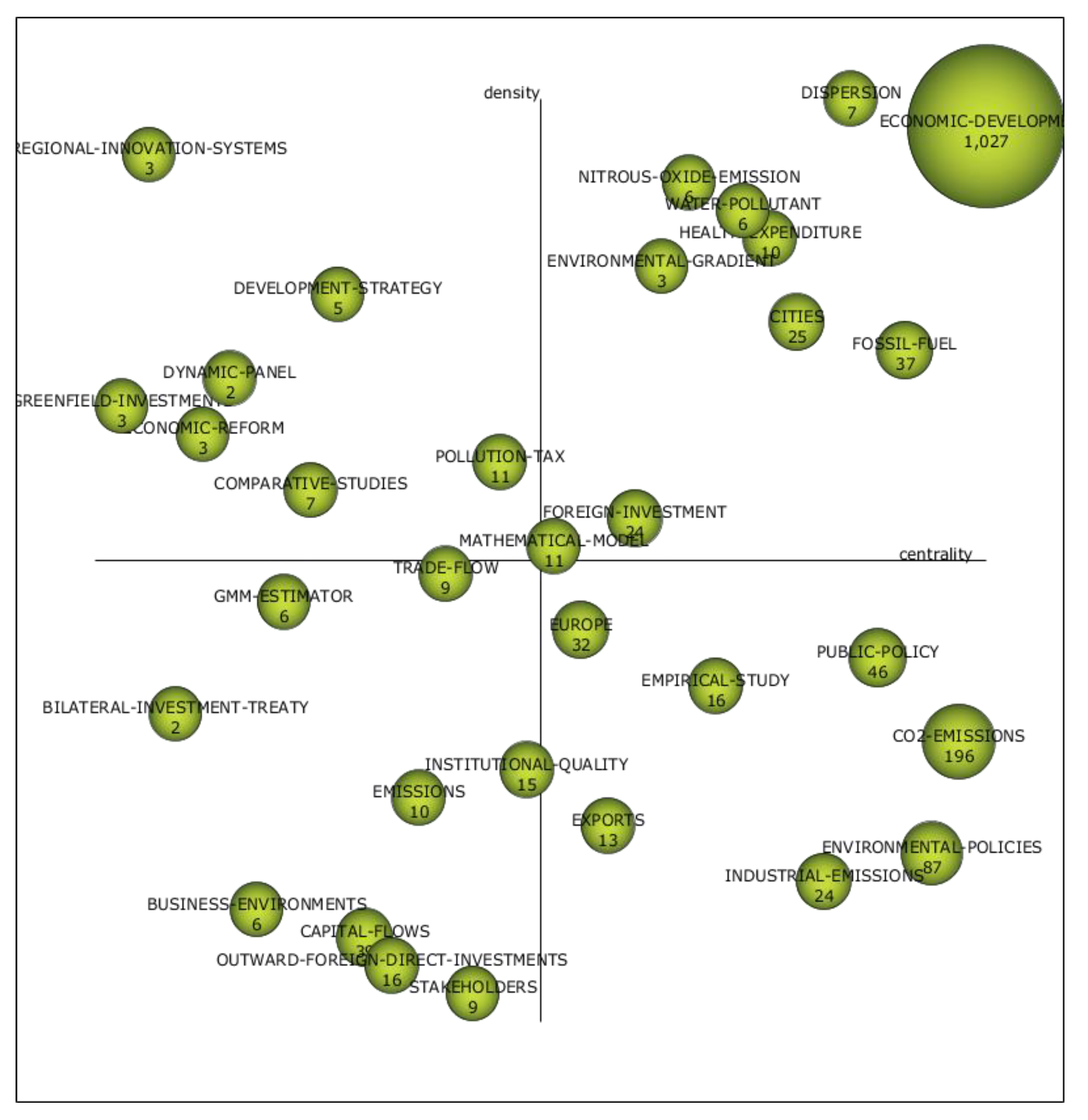
Strategic diagram categorized the most occurrence words into four quartiles namely (Q1) motor themes, (Q2) Basic and Transversal themes, (Q3) Emerging or Declining themes, and (Q4) Highly developed and Isolated themes. The characteristics of each quartile during each period have been discussed below. Motor Themes are the most developed and are very important themes with strong external ties with other themes during each period. Basic and Transversal themes are very important but less developed. Emerging or Declining themes are less important and less developed. Highly Developed and Isolated themes are less important but highly developed. Themes that appeared in each period are shown in the strategic diagrams; Figure 13 (2000–2005), Figure 14 (2006–2010), Figure 15 (2011–2015), Figure 16 (2016–2021) and Figure 17 (2000–2021). Moreover, all the themes with their status are discussed in Table 11. The centrality (degree of interaction of a research theme with other research themes) and density (internal strength value of the research theme) are shown in Table 12.
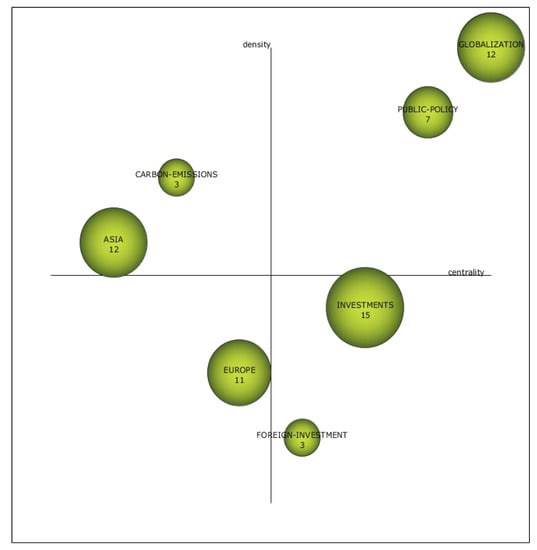
Figure 13.
Strategic diagram (2000–2005).
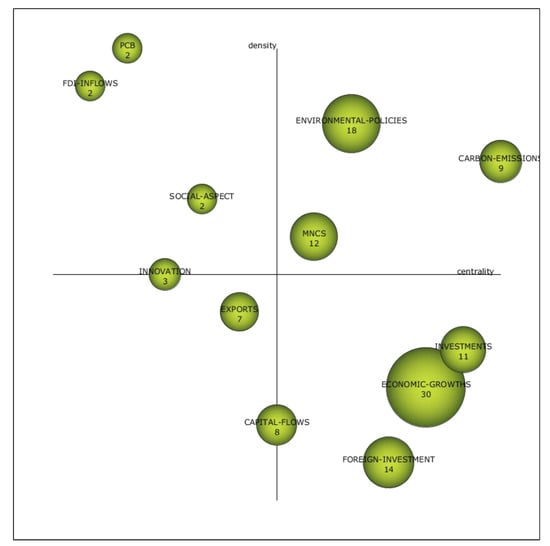
Figure 14.
Strategic diagram (2006–2010).
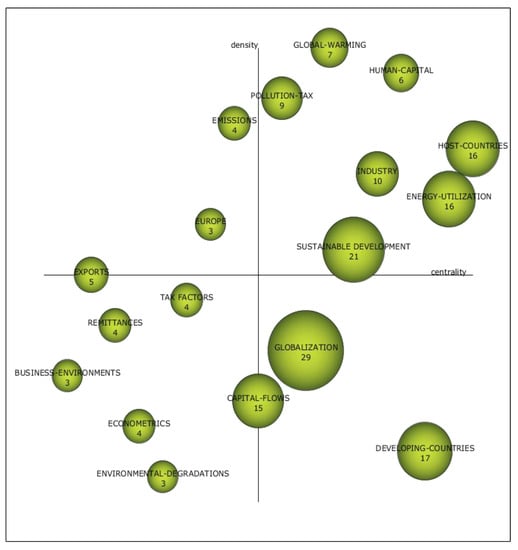
Figure 15.
Strategic diagram (2011–2015).
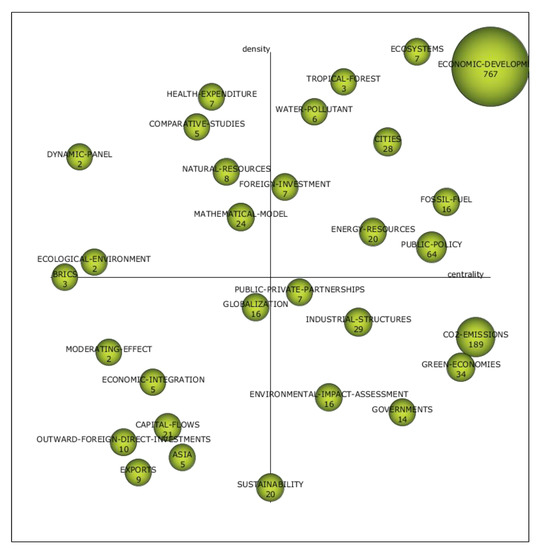
Figure 16.
Strategic diagram (2016–2021).
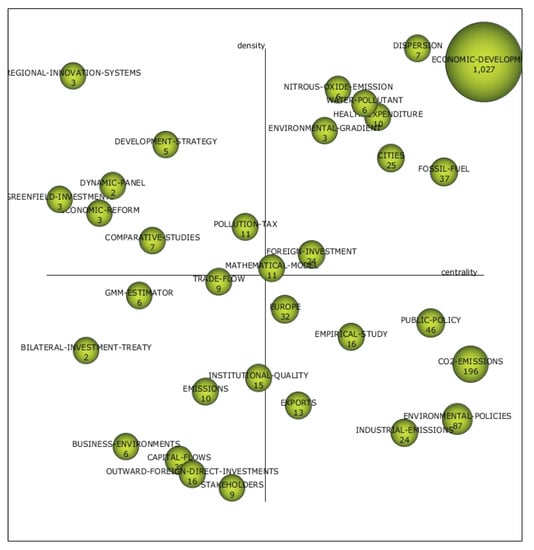
Figure 17.
Strategic diagram (2000–2021).
Table 11.
Major themes during each period.
Table 12.
Centrality and density of major themes (2000–2021).
4. Discussion and Conclusions
There has been an increase in the number of studies on the influence of FDI on environmental concerns worldwide. Several determinants, positive, negative, and insignificant, are discussed in the literature (e.g., [7,8,9]). These studies provided opportunities to map the research streams in the field through meta-analyses, systematic analyses, and bibliometrics. Even though, previous studies have been conducted in the field, we could not detect any bibliometric study in this particular field. Therefore, we conducted this bibliometric study to understand the theoretical foundations and current streams of research in the field of FDI and environmental concerns. Our co-citations analysis revealed four clusters as theoretical foundations, while coupling analysis displayed eight clusters as the current research streams in the field. Moreover, conceptual structure and visualization also displayed a wide range of current research streams. It acknowledges that research areas in the field of foreign direct investment (FDI) and environmental concerns are growing and taking into account new environmental factors.
4.1. Contributions to the Literature
This research has three major contributions to the existing body of literature. First, we shed light on the theoretical foundations in the field of FDI and environmental concerns. Our research extracted highly co-cited references, authors, and journals that have remained untouched in the literature. Our research advances the existing body of knowledge by adding new information in the field. Second, we performed a bibliographic analysis to understand the current structure of the research through the lens of documents, authors, journals, and countries. We discussed which journals, authors, and countries are currently performing in the specified field. For instance, several studies in the literature have claimed that research on the relationship between finance and environmental concerns is significantly increasing in emerging and Asian economies [30,31]. It can be understood from our research that China is the most productive country in the field. In addition, several other Asian economies such as Pakistan, India, Malaysia, and Saudi Arabia are also listed in the top 10 productive countries. In general, our results significantly favor Santos and Forte [4] who revealed China and the USA as the most productive countries in the field. Third, we utilized conceptual structure and evaluation of co-occurrence through SciMat that is the first attempt in the field. We extracted different themes and research areas over time (2000–2005, 2006–2010, 2011–2015, and 2016–2021) and discussed their relative importance. In other words, we discussed the most and least important areas in the field of FDI and environmental concerns. These findings enable current researchers in understanding the most important research area. Forth, we have suggested several future research directions in the field of FDI and environmental concerns. It will enable future researchers to enrich the existing literature in a better way. Consequently, the insights help future researchers recognize the most underdeveloped and needed areas of research.
4.2. Limitations and Future Research Directions
This research has several strengths but also suffers from a few limitations. For instance, we used data from 2000–2021 which has merit but still using earlier data can give a complete message from the theoretical foundation to the current stage. We extracted the data only from Scopus while other databases such as WOS, EBSCO, and Google scholars are not considered. Future researchers are recommended to do a comprehensive search in other data to articulate the results in a better way. Our bibliometric analyses are limited to co-citation, bibliographic coupling, and conceptual structure and evaluation. However, we recommend future researchers to carry out co-occurrence, co-authorship, and citations analysis in VOSviewer to extract detailed information. Consequently, future researchers can compare the theoretical foundation with the current structure of the research based on clusters in co-citations and bibliographic coupling. Moreover, a few other research topics based on conceptual structure and evaluation (basic and transversal themes) are given in Table 13.
Table 13.
Future research directions.
Public policies for environmental and carbon emissions across the globe: Our strategic diagrams displayed that researchers in the field of FDI and environmental concerns have paid poor attention to discuss public policies for environmental issues around the world. Therefore, we give two recommendations: First, researchers should give an overview of public policies for environmental issues around the world by focusing on bibliometric studies or systemic literature review. Second, scholars can empirically test the importance of various public policies for SDGs and environmental activities. It will articulate the insights concerning SDGs in the better way.
The Role of exports In environmental structure, industrial emissions, and carbon structure: Based on the strategic network, we found poor evidence on the relationship between exports, environmental structure, industrial emissions, and carbon structure. Researchers should empirically examine causal relationships between the parameters to unleash how each factor is important or complement for another. Moreover, moderating and mediating mechanisms can be checked in the relationships.
Government incentives and public relations for FDI and environmental degradation: In this gap, we recommend scholars discussing the role of governments (incentives and relationship) in improving FDI and reducing environmental pollution. This is to say how local and the domestic governments assist companies and industrial sectors in creating a clean environment. For instance, Anwar, et al. [1] revealed that government incentives significantly motivate organizations toward SDGs. Hence industries should be supported with local finance. Moreover, some countries have strong while others have poor international relationships that give scholars opportunities to study the strength of networks in FDI and environmental issues.
FDI in green economies: Many countries are moving to a green economy by focusing environmental issues as a priority such as Germany. However, how does FDI influence greening of developing and developed economies. However, research can compare the potential advantages of FDI in Asian, European, and Arabian economies in terms of going green.
4.3. Conclusions
Steered by the significant number of studies on the relationship between FDI and environmental concerns, we conducted a bibliometric overview of the association between FDI and environmental concerns. We used the data from Scopus from 2000–2021 and utilized co-citations analysis, bibliographic coupling, and conceptual structure and evaluation. Considering the descriptive analysis, our results showed Zaman, K, Shahbaz, M and Nassani, A.A as the most productive authors, Environmental Science and Pollution Research, Sustainability, and Journal of Cleaner Production as the most productive journals, and China, the USA, and UK as the most productive countries in the field of FDI and environmental concerns. While utilizing co-citations analysis, we found Tang and Tan (2015), Lee (2013), and Solarin et al., (2017) as the highest co-cited references, Energy Policy, Journal of International Business Studies, and Journal of Cleaner Production as the highest co-cited journals, and Shahbaz, M. Ozturk, I., and Dunning, J.H. as the highest co-cited authors. In the bibliographic analysis, we found Villanthenkodath M.A. (2020), Balsalobre-Lorente D. (2019), and Hitt M.A. (2016) as the highest coupled documents, Environmental Science and Pollution Research, Sustainability, and Journal of Cleaner Production as the highest coupled journals, Zaman K., Nassani A.A., and Ahmad M., as the highest coupled authors, and China, the USA, and UK as the highest coupled countries. The conceptual structure and evaluation indicated 33 research areas that were evolved over the different periods in the field of FDI and environmental concerns. Overall, it illustrates the research areas in the particular field which spread from four theoretical foundations to a wide range of research streams. It signals the importance of the topic in the field and encourages future researchers to articulate the research streams in a better way. In particular, research areas such as globalization, developing countries, capital flow, public private partnerships, industrial structure, environmental impact assessment, CO2-emissions, green economies, governments, industrial structure, sustainability, Europe, public policy, empirical study, industrial emissions, and environmental policies should be emphasized in the future to enrich the current research streams in the field. In addition, we suggested several research topics for future researchers in the fields of public policies, environmental and carbon emissions, industrial structure, industrial emissions, green economies, and government incentives.
Author Contributions
Conceptualization, R.U.; methodology, M.S.K.; software, M.S.K.; validation, S.K.; formal analysis, M.S.K.; investigation, M.A-N.; resources, M.A-N.; data curation, N.U.K.; writing—original draft preparation, R.U.; writing—review and editing, R.U.; visualization, N.U.K.; supervision, M.A.-N.; project administration, S.K.; funding acquisition, M.A.-N. All authors have read and agreed to the published version of the manuscript.
Funding
This paper is supported by the Department of Accounting, Faculty of Economic and Administrative Sciences, The Hashemite University, P.O. Box 330127, Zarqa 13133, Jordan.
Data Availability Statement
The data used in results including tables and figures are freely available on the Scopus.
Conflicts of Interest
The authors have no conflict of interest.
Ethical Statement
The ethics committee of Nankai University China approved the research.
References
- Anwar, M.; Khattak, M.S.; Popp, J.; Meyer, D.F.; Máté, D. The nexus of government incentives and sustainable development goals: Is the management of resources the solution to non-profit organisations? Technol. Econ. Dev. Econ. 2020, 26, 1284–1310. [Google Scholar] [CrossRef]
- Ribaudo, M.O.; Hoag, D.L.; Smith, M.E.; Heimlich, R. Environmental indices and the politics of the Conservation Reserve Program. Ecol. Indic. 2001, 1, 11–20. [Google Scholar] [CrossRef]
- Nguyen, T.T.T.; Pham, B.T.; Sala, H. Being an emerging economy: To what extent do geopo-litical risks hamper technology and FDI inflows? Econ. Anal. Policy 2022, 74, 728–746. [Google Scholar] [CrossRef]
- Santos, A.; Forte, R. Environmental regulation and FDI attraction: A bibliometric analysis of the literature. Environ. Sci. Pollut. Res. 2020, 28, 8873–8888. [Google Scholar] [CrossRef] [PubMed]
- Moser, P. Glorification, Disillusionment or the Way into the Future? The significance of Local Agenda 21 processes for the needs of local sustainability. Local Environ. 2001, 6, 453–467. [Google Scholar] [CrossRef]
- Khattak, M.S.; Anwar, M.; Clauß, T. The Role of Entrepreneurial Finance in Corporate Social Responsibility and New Venture Performance in an Emerging Market. J. Entrep. 2021, 30, 336–366. [Google Scholar] [CrossRef]
- Tripathy, P.; Khatua, M.; Behera, P.; Satpathyy, L.D.; Jena, P.K.; Mishra, B.R. Dynamic link between bilateral FDI, the quality of environment and institutions: Evidence from G20 coun-tries. Environ. Sci. Pollut. Res. 2022, 29, 27150–27171. [Google Scholar] [CrossRef]
- Arif, U.; Arif, A.; Khan, F.N. Environmental impacts of FDI: Evidence from heterogeneous panel methods. Environ. Sci. Pollut. Res. 2021, 29, 23639–23649. [Google Scholar] [CrossRef]
- An, T.; Xu, C.; Liao, X. The impact of FDI on environmental pollution in China: Evidence from spatial panel data. Environ. Sci. Pollut. Res. 2021, 28, 44085–44097. [Google Scholar] [CrossRef]
- Azam, M.; Feng, Y. Does foreign aid stimulate economic growth in developing countries? Further evidence in both aggregate and disaggregated samples. Qual. Quant. 2021, 56, 533–556. [Google Scholar] [CrossRef]
- Jahanger, A. Influence of FDI characteristics on high-quality development of China’s economy. Environ. Sci. Pollut. Res. 2020, 28, 18977–18988. [Google Scholar] [CrossRef] [PubMed]
- Adeel-Farooq, R.M.; Riaz, M.F.; Ali, T. Improving the environment begins at home: Revisiting the links between FDI and environment. Energy 2020, 215, 119150. [Google Scholar] [CrossRef]
- Cole, M.A.; Elliott, R.J.; Fredriksson, P.G. Endogenous pollution havens: Does FDI influence environmental regulations? Scand. J. Econ. 2006, 108, 157–178. [Google Scholar] [CrossRef]
- Xiao, Z. An empirical test of the pollution haven hypothesis for China: Intra-host country analysis. Nankai Bus. Rev. Int. 2015, 6, 177–198. [Google Scholar] [CrossRef]
- Su, T.D.; Nguyen, C.P. Foreign financial flows, human capital and economic growth in African developing countries. Int. J. Financ. Econ. 2020, 27, 3010–3031. [Google Scholar]
- Millimet, D.L.; Roy, J. Multilateral environmental agreements and the WTO. Econ. Lett. 2015, 134, 20–23. [Google Scholar] [CrossRef][Green Version]
- Alam, M.M.; Murad, M.W.; Noman, A.H.; Ozturk, I. Relationships among carbon emissions, economic growth, energy consumption and population growth: Testing Environmental Kuznets Curve hypothesis for Brazil, China, India and Indonesia. Ecol. Indic. 2016, 70, 466–479. [Google Scholar] [CrossRef]
- Fei, L.; Dong, S.; Xue, L.; Liang, Q.; Yang, W. Energy consumption-economic growth rela-tionship and carbon dioxide emissions in China. Energy Policy 2011, 39, 568–574. [Google Scholar] [CrossRef]
- Opoku, E.E.O.; Acheampong, A.O.; Dzator, J.; Kufuor, N.K. Does environmental sustainability attract foreign investment? Evidence from developing countries. Bus. Strat. Environ. 2022, 31, 3542–3573. [Google Scholar] [CrossRef]
- Gao, D.; Li, G.; Li, Y.; Gao, K. Does FDI improve green total factor energy efficiency under heterogeneous environmental regulation? Evidence from China. Environ. Sci. Pollut. Res. 2021, 29, 25665–25678. [Google Scholar] [CrossRef]
- Phung, T.Q.; Rasoulinezhad, E.; Luong Thi Thu, H. How are FDI and green recovery related in Southeast Asian economies? Econ. Chang. Restruct. 2022, 1–21. [Google Scholar] [CrossRef]
- Zhang, C.; Zhou, X. Does foreign direct investment lead to lower CO2 emissions? Evidence from a regional analysis in China. Renew. Sustain. Energy Rev. 2016, 58, 943–951. [Google Scholar] [CrossRef]
- Grossman, G.M.; Krueger, A.B. Economic growth and the environment. Q. J. Econ. 1995, 110, 353–377. [Google Scholar] [CrossRef]
- Panayotou, T. Demystifying the environmental Kuznets curve: Turning a black box into a policy tool. Environ. Dev. Econ. 1997, 2, 464–465. [Google Scholar] [CrossRef]
- Lin, M.; Kwan, Y.K. FDI technology spillovers, geography, and spatial diffusion. Int. Rev. Econ. Financ. 2016, 43, 257–274. [Google Scholar] [CrossRef]
- Emako, E.; Nuru, S.; Menza, M. Determinants of foreign direct investments inflows into de-veloping countries. Transnatl. Corp. Rev. 2022, 1–14. [Google Scholar] [CrossRef]
- Albornoz, F.; Cole, M.A.; Elliott, R.J.R.; Ercolani, M. In Search of Environmental Spillovers. World Econ. 2009, 32, 136–163. [Google Scholar] [CrossRef]
- Al-Mulali, U.; Tang, C.F. Investigating the validity of pollution haven hypothesis in the gulf cooperation council (GCC) countries. Energy Policy 2013, 60, 813–819. [Google Scholar] [CrossRef]
- Mert, M.; Bölük, G. Do foreign direct investment and renewable energy consumption affect the CO2 emissions? New evidence from a panel ARDL approach to Kyoto Annex countries. Environ. Sci. Pollut. Res. 2016, 23, 21669–21681. [Google Scholar] [CrossRef]
- Khan, N.U.; Anwar, M.; Li, S.; Khattak, M.S. Intellectual capital, financial resources, and green supply chain management as predictors of financial and environmental performance. Environ. Sci. Pollut. Res. 2021, 28, 19755–19767. [Google Scholar] [CrossRef]
- Anwar, M.; Li, S. Spurring competitiveness, financial and environmental performance of SMEs through government financial and non-financial support. Environ. Dev. Sustain. 2020, 23, 7860–7882. [Google Scholar] [CrossRef]
- Liu, F.; Zhao, A. Test for the effect of foreign direct investment on environmental pollution in cities: Empirical analysis of panel data from 285 cities. J. Int. Trade 2016, 401, 130–141. [Google Scholar]
- Kim, M.H.; Adilov, N. The lesser of two evils: An empirical investigation of foreign direct investment-pollution tradeoff. Appl. Econ. 2011, 44, 2597–2606. [Google Scholar] [CrossRef]
- Merican, Y.; Yusop, Z.; Noor, Z.M.; Hook, L.S. Foreign direct investment and the pollution in five ASEAN nations. Int. J. Econ. Manag. 2007, 1, 245–261. [Google Scholar]
- Zeng, K.; Eastin, J. International Economic Integration and Environmental Protection: The Case of China. Int. Stud. Q. 2007, 51, 971–995. [Google Scholar] [CrossRef]
- Zhang, Y.-J.; Liu, Z.; Zhang, H.; Tan, T.-D. The impact of economic growth, industrial struc-ture and urbanization on carbon emission intensity in China. Nat. Hazards 2014, 73, 579–595. [Google Scholar] [CrossRef]
- Hunjra, A.I.; Azam, M.; Bruna, M.G.; Taskin, D. Role of financial development for sustainable economic development in low middle income countries. Financ. Res. Lett. 2022, 47, 102793. [Google Scholar] [CrossRef]
- Zhu, L.; Hao, Y.; Lu, Z.-N.; Wu, H.; Ran, Q. Do economic activities cause air pollution? Evi-dence from China’s major cities. Sustain. Cities Soc. 2019, 49, 101593. [Google Scholar] [CrossRef]
- Xiao, S.S.; Park, B.I. Bring institutions into FDI spillover research: Exploring the impact of ownership restructuring and institutional development in emerging economies. Int. Bus. Rev. 2018, 27, 289–308. [Google Scholar] [CrossRef]
- Khachoo, Q.; Sharma, R.; Dhanora, M. Does proximity to the frontier facilitate FDI-spawned spillovers on innovation and productivity? J. Econ. Bus. 2018, 97, 39–49. [Google Scholar] [CrossRef]
- Xu, S.-C.; Li, Y.-F.; Zhang, J.-N.; Wang, Y.; Ma, X.-X.; Liu, H.-Y.; Wang, H.-N.; Tao, Y. Do foreign direct investment and environmental regulation improve green technology innovation? An empirical analysis based on panel data from the Chinese manufacturing industry. Environ. Sci. Pollut. Res. 2021, 28, 55302–55314. [Google Scholar] [CrossRef] [PubMed]
- Ren, S.; Hao, Y.; Xu, L.; Wu, H.; Ba, N. Digitalization and energy: How does internet devel-opment affect China’s energy consumption? Energy Econ. 2021, 98, 105220. [Google Scholar] [CrossRef]
- Hao, Y.; Liu, Y.-M. Has the development of FDI and foreign trade contributed to China’s CO2 emissions? An empirical study with provincial panel data. Nat. Hazards 2014, 76, 1079–1091. [Google Scholar] [CrossRef]
- Wang, D.T.; Chen, W.Y. Foreign direct investment, institutional development, and environ-mental externalities: Evidence from China. J. Environ. Manag. 2014, 135, 81–90. [Google Scholar] [CrossRef] [PubMed]
- Liu, W.; Liu, D. The influence of foreign investment industrial policies on foreign investment spillover effect: A test based on Chinese manufacturing industry’s panel data. Int. Econ. Trade Res. 2017, 33, 97–113. [Google Scholar]
- Wang, J.; Wei, W.; Deng, H.; Yu, Y. Will Fiscal Decentralization Influence FDI Inflows? A Spatial Study of Chinese Cities. Emerg. Mark. Financ. Trade 2017, 53, 1988–2000. [Google Scholar] [CrossRef]
- Durán-Sánchez, A.; Peris-Ortiz, M.; Álvarez-García, J.; Cruz del Río-Rama, M.D.L. Entrepre-neurship and Social Innovation for Sustainability. Bibliometric Analysis. In Strategies and Best Practices in Social Innovation; Springer: Berlin/Heidelberg, Germany, 2018; pp. 11–29. [Google Scholar]
- Ferreira, J.J.; Fernandes, C.I.; Schiavone, F.; Mahto, R.V. Sustainability in family business—A bibliometric study and a research agenda. Technol. Forecast. Soc. Chang. 2021, 173, 121077. [Google Scholar] [CrossRef]
- Muñoz-Villamizar, A.; Santos, J.; Montoya-Torres, J.R.; Velázquez-Martínez, J.C. Measuring environmental performance of urban freight transport systems: A case study. Sustain. Cities Soc. 2019, 52, 101844. [Google Scholar] [CrossRef]
- Dowell, G.; Hart, S.; Yeung, B. Do corporate global environmental standards create or destroy market value? Manag. Sci. 2000, 46, 1059–1074. [Google Scholar] [CrossRef]
- Globerman, S.; Shapiro, D. Governance infrastructure and US foreign direct invest-ment. J. Int. Bus. Stud. 2003, 34, 19–39. [Google Scholar] [CrossRef]
- Caballero, R.J.; Farhi, E.; Gourinchas, P.O. An equilibrium model of” global imbal-ances” and low interest rates. Am. Econ. Rev. 2008, 98, 358–393. [Google Scholar] [CrossRef]
- Ramasamy, B.; Yeung, M.; Laforet, S. China’s outward foreign direct investment: Location choice and firm ownership. J. World Bus. 2012, 47, 17–25. [Google Scholar] [CrossRef]
- He, J. Pollution haven hypothesis and environmental impacts of foreign direct in-vestment: The case of industrial emission of sulfur dioxide (SO2) in Chinese prov-inces. Ecol. Econ. 2006, 60, 228–245. [Google Scholar] [CrossRef]
- Ahearne, A.G.; Griever, W.L.; Warnock, F.E. Information costs and home bias: An analysis of US holdings of foreign equities. J. Int. Econ. 2004, 62, 313–336. [Google Scholar] [CrossRef]
- Tang, C.F.; Tan, B.W. The impact of energy consumption, income and foreign direct investment on carbon dioxide emissions in Vietnam. Energy 2015, 79, 447–454. [Google Scholar] [CrossRef]
- Dean, J.M.; Lovely, M.E.; Wang, H. Are foreign investors attracted to weak envi-ronmental regulations? Evaluating the evidence from China. J. Dev. Econ. 2009, 90, 1–13. [Google Scholar] [CrossRef]
- Zhu, H.; Duan, L.; Guo, Y.; Yu, K. The effects of FDI, economic growth and energy consumption on carbon emissions in ASEAN-5: Evidence from panel quantile re-gression. Econ. Model. 2016, 58, 237–248. [Google Scholar] [CrossRef]
- Xing, Y.; Kolstad, C.D. Do lax environmental regulations attract foreign invest-ment? Environ. Resour. Econ. 2002, 21, 1–22. [Google Scholar] [CrossRef]
- Lee, J.W. The contribution of foreign direct investment to clean energy use, carbon emissions and economic growth. Energy Policy 2013, 55, 483–489. [Google Scholar] [CrossRef]
- Solarin, S.A.; Al-Mulali, U.; Musah, I.; Ozturk, I. Investigating the pollution ha-ven hypothesis in Ghana: An empirical investigation. Energy 2017, 124, 706–719. [Google Scholar] [CrossRef]
- Lau, L.S.; Choong, C.K.; Eng, Y.K. Investigation of the environmental Kuznets curve for carbon emissions in Malaysia: Do foreign direct investment and trade matter? Energy Policy 2014, 68, 490–497. [Google Scholar] [CrossRef]
- Kivyiro, P.; Arminen, H. Carbon dioxide emissions, energy consumption, economic growth, and foreign direct investment: Causality analysis for Sub-Saharan Africa. Energy 2014, 74, 595–606. [Google Scholar] [CrossRef]
- Pao, H.T.; Tsai, C.M. Multivariate Granger causality between CO2 emissions, en-ergy consumption, FDI (foreign direct investment) and GDP (gross domestic prod-uct): Evidence from a panel of BRIC (Brazil, Russian Federation, India, and China) countries. Energy 2011, 36, 685–693. [Google Scholar] [CrossRef]
- Shahbaz, M.; Nasreen, S.; Abbas, F.; Anis, O. Does foreign direct investment impede environmental quality in high-, middle-, and low-income countries? Energy Eco-Nomics 2015, 51, 275–287. [Google Scholar] [CrossRef]
- Tamazian, A.; Chousa, J.P.; Vadlamannati, K.C. Does higher economic and finan-cial development lead to environmental degradation: Evidence from BRIC countries. Energy Policy 2009, 37, 246–253. [Google Scholar] [CrossRef]
- Baek, J. A new look at the FDI–income–energy–environment nexus: Dynamic panel data analysis of ASEAN. Energy Policy 2016, 91, 22–27. [Google Scholar] [CrossRef]
- Saboori, B.; Sulaiman, J.; Mohd, S. Economic growth and CO2 emissions in Malaysia: A cointegration analysis of the environmental Kuznets curve. Energy Policy 2012, 51, 184–191. [Google Scholar] [CrossRef]
- Villanthenkodath, M.A.; Arakkal, M.F. Exploring the existence of environmental Kuznets curve in the midst of financial development, openness, and foreign direct investment in New Zealand: Insights from ARDL bound test. Environ. Sci. Pollut. Res. 2020, 27, 36511–36527. [Google Scholar] [CrossRef]
- Balsalobre-Lorente, D.; Gokmenoglu, K.K.; Taspinar, N.; Cantos-Cantos, J.M. An approach to the pollution haven and pollution halo hypotheses in MINT countries. Environ. Sci. Pollut. Res. 2019, 26, 23010–23026. [Google Scholar] [CrossRef]
- Hitt, M.A.; Li, D.; Xu, K. International strategy: From local to global and beyond. J. World Bus. 2016, 51, 58–73. [Google Scholar] [CrossRef]
- Islam, M.; Khan, M.K.; Tareque, M.; Jehan, N.; Dagar, V. Impact of globalization, foreign direct investment, and energy consumption on CO2 emissions in Bangladesh: Does institutional quality matter? Environ. Sci. Pollut. Res. 2021, 28, 48851–48871. [Google Scholar] [CrossRef] [PubMed]
- Shahbaz, M.; Nasir, M.A.; Roubaud, D. Environmental degradation in France: The effects of FDI, financial development, and energy innovations. Energy Econ. 2018, 74, 843–857. [Google Scholar] [CrossRef]
- Yilanci, V.; Bozoklu, S.; Gorus, M.S. Are BRICS countries pollution havens? Evidence from a bootstrap ARDL bounds testing approach with a Fourier function. Sustain. Cities Soc. 2020, 55, 102035. [Google Scholar] [CrossRef]
- Malik, M.Y.; Latif, K.; Khan, Z.; Butt, H.D.; Hussain, M.; Nadeem, M.A. Symmetric and asymmetric impact of oil price, FDI and economic growth on carbon emission in Pakistan: Evidence from ARDL and non-linear ARDL approach. Sci. Total. Environ. 2020, 726, 138421. [Google Scholar] [CrossRef] [PubMed]
- Chan, C.M.; Makino, S.; Isobe, T. Interdependent behavior in foreign direct investment: The multi-level effects of prior entry and prior exit on foreign market entry. J. Int. Bus. Stud. 2006, 37, 642–665. [Google Scholar] [CrossRef]
- Ahmad, M.; Khattak, S.I.; Khan, A.; Rahman, Z.U. Innovation, foreign direct investment (FDI), and the energy–pollution–growth nexus in OECD region: A simultaneous equation modeling approach. Environ. Ecol. Stat. 2020, 27, 203–232. [Google Scholar] [CrossRef]
- Mert, M.; Bölük, G.; Çağlar, A.E. Interrelationships among foreign direct investments, re-newable energy, and CO2 emissions for different European country groups: A panel ARDL approach. Environ. Sci. Pollut. Res. 2019, 26, 21495–21510. [Google Scholar] [CrossRef]
- Demirbag, M.; McGuinness, M.; Altay, H. Perceptions of Institutional Environment and Entry Mode. Manag. Int. Rev. 2010, 50, 207–240. [Google Scholar] [CrossRef]
- White, G.O., III; Chizema, A.; Canabal, A.; Perry, M.J. Legal system uncertainty and FDI at-traction in Southeast Asia. Int. J. Emerg. Mark. 2015, 10, 572–597. [Google Scholar] [CrossRef]
- Shahbaz, M.; Balsalobre, D.; Shahzad, S.J.H. The Influencing Factors of CO2 Emissions and the Role of Biomass Energy Consumption: Statistical Experience from G-7 Countries. Environ. Model. Assess. 2018, 24, 143–161. [Google Scholar] [CrossRef]
- Nasir, M.A.; Huynh, T.L.D.; Tram, H.T.X. Role of financial development, economic growth & foreign direct investment in driving climate change: A case of emerging ASEAN. J. Environ. Manag. 2019, 242, 131–141. [Google Scholar]
- Koçak, E.; Şarkgüneşi, A. The impact of foreign direct investment on CO2 emissions in Turkey: New evidence from cointegration and bootstrap causality analysis. Environ. Sci. Pollut. Res. 2017, 25, 790–804. [Google Scholar] [CrossRef] [PubMed]
- Abdouli, M.; Hammami, S. Economic Growth, Environment, FDI Inflows, and Financial De-velopment in Middle East Countries: Fresh Evidence from Simultaneous Equation Models. J. Knowl. Econ. 2018, 11, 479–511. [Google Scholar] [CrossRef]
- Bailey, N. Exploring the relationship between institutional factors and FDI attractiveness: A meta-analytic review. Int. Bus. Rev. 2018, 27, 139–148. [Google Scholar] [CrossRef]
- Nguyen, C.P.; Schinckus, C.; Su, T.D. Economic integration and CO2 emissions: Evidence from emerging economies. Clim. Dev. 2019, 12, 369–384. [Google Scholar] [CrossRef]
- Buckley, P.J.; Munjal, S.; Enderwick, P.; Forsans, N. Cross-border acquisitions by Indian mul-tinationals: Asset exploitation or asset augmentation? Int. Bus. Rev. 2016, 25, 986–996. [Google Scholar] [CrossRef]
- Murshed, M.; Rahman, A.; Alam, S.; Ahmad, P.; Dagar, V. The nexus between environmental regulations, economic growth, and environmental sustainability: Linking environmental pa-tents to ecological footprint reduction in South Asia. Environ. Sci. Pollut. Res. 2021, 28, 49967–49988. [Google Scholar] [CrossRef]
Publisher’s Note: MDPI stays neutral with regard to jurisdictional claims in published maps and institutional affiliations. |
© 2022 by the authors. Licensee MDPI, Basel, Switzerland. This article is an open access article distributed under the terms and conditions of the Creative Commons Attribution (CC BY) license (https://creativecommons.org/licenses/by/4.0/).