


Abstract
In the current complicated and volatile international situation, maintaining the sustainable development of OFDI is critical to the economic recovery and growth of all countries. This study aims to examine the influence of foreign direct investment (FDI) and migration on the sustainable development of outward foreign direct investment (OFDI), the moderating effects of intellectual property rights (IPR) protection on the relationship between FDI and OFDI, and the relationship between migration and OFDI. Using the panel data of 85 countries from 2006 to 2018, we find that, globally, FDI positively affects OFDI and that the positive effect of FDI on OFDI is strengthened by the improvement of IPR protection. Migration negatively affects OFDI, and the influence of IPR protection on the relationship between migration and OFDI is not statistically significant. The study shows that in high-income countries, FDI positively affects OFDI, and IPR protection positively moderates the relationship between FDI and OFDI. For upper-middle-income countries, FDI positively affects OFDI, and IPR protection negatively moderates the relationship between FDI and OFDI. For lower-middle and low-income countries, the influence of FDI on OFDI is not statistically significant. Moreover, the influence of migration on OFDI is not significant in high- or upper-middle-income countries. For lower-middle and low-income countries, migration negatively affects OFDI, and IPR protection positively moderates the relationship between migration and OFDI.
1. Introduction
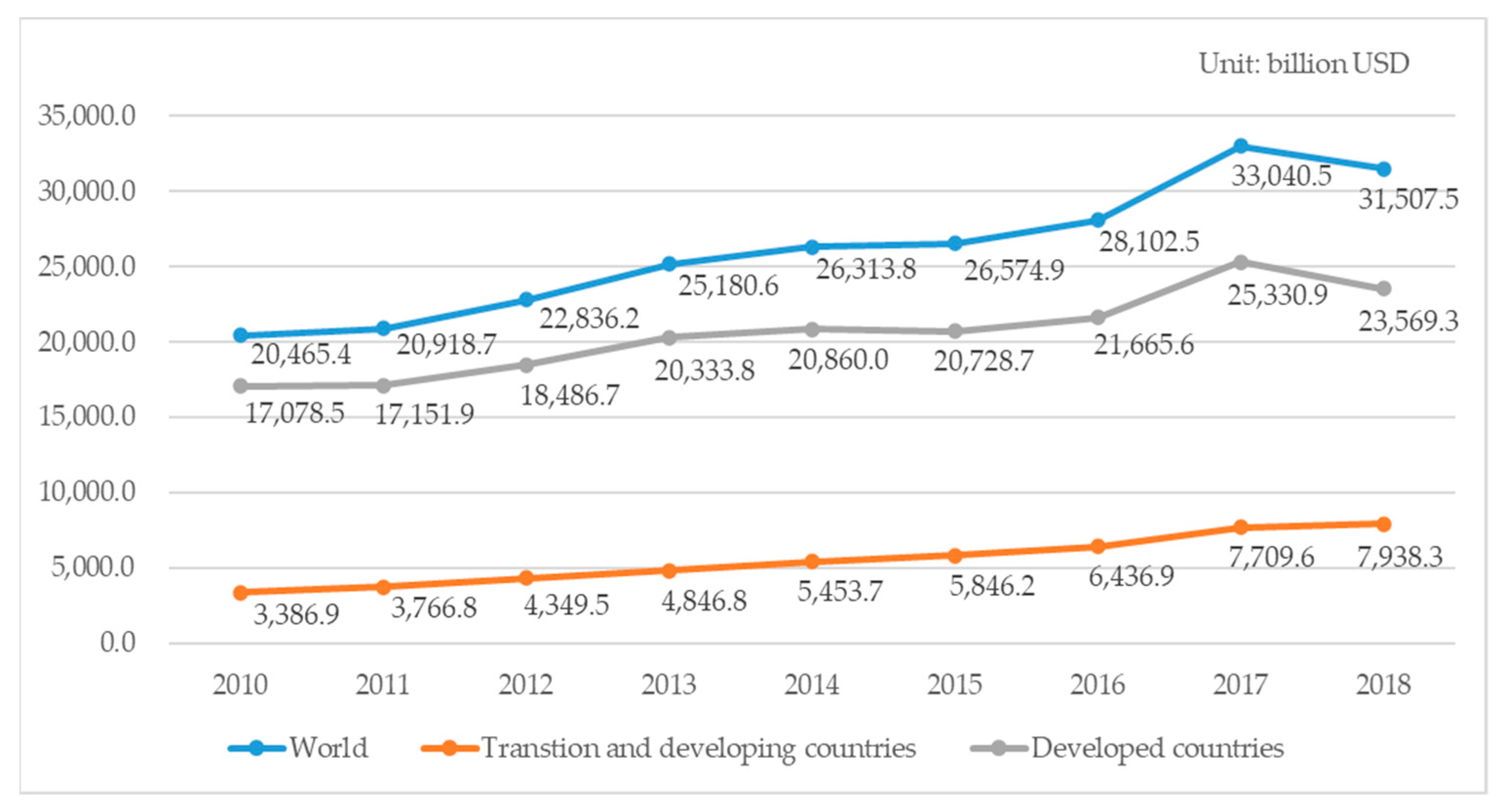
Outward foreign direct investment (OFDI), driven by economic globalisation, has grown significantly since the 1980s. The United Nations Conference on Trade and Development (UNCTAD) data show that the global OFDI stock in 2018 reached USD 31.51 trillion [1], an increase of 53.96% from 2010. The OFDI of developed countries in 2018 increased by 38.01% compared with 2010, reaching USD 23.57 trillion [1]. In transition and developing countries, OFDI grew more rapidly than in developed countries, with an increase of 134.38% between 2010 and 2018, reaching USD 7.94 trillion [1]. However, in recent years, the rise of anti-globalisation and protectionism has challenged the sustainable development of OFDI. From 2017 to 2018, global OFDI stock decreased by 4.64%. OFDI plays a role in transnational resource allocation, and it is beneficial to utilise comparative advantages of host countries [2,3]. In the current complex and volatile international environment, maintaining the sustainable development of OFDI is very important to the economic recovery and growth of all countries. The detailed amount of OFDI stock in the world and in countries at different levels of development from 2010 to 2018 are shown in Figure 1.
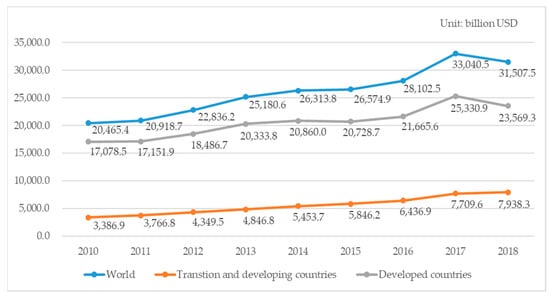
Figure 1.
OFDI stock in the world and in countries at different levels of development (2010–2018).
The investment development path (IDP) describes a country’s development process from foreign direct investment (FDI) inflow to investment abroad [4,5,6]. Nevertheless, the deep influence mechanism of FDI on OFDI has not been clarified. The FDI spillover theory assumes that FDI provides channels for local firms to acquire technology and knowledge [7,8]. FDI can generate these spillover effects on local firms through four spillover mechanisms: the demonstration effect, industry linkages, employee training, and the competition effect [7,9]. The spillover effects of FDI enhance the competitive advantages of local firms, thus improving their ability to invest abroad. The influence of FDI on OFDI has attracted the attention of many scholars, and most studies use a country’s time-series data or provincial panel data [8,10,11]. However, few studies have explored the influence of FDI on OFDI using multi-country panel data.
The IDP mainly focuses on the relationship between FDI and OFDI, neglecting the influence of labour mobility. Globalisation has significantly increased labour mobility while accelerating international capital flow [12]. The assumption in traditional international trade theory that labour is immobile across national borders is no longer applicable in today’s world economy [13]. A significant increase in international migrants has been one of the main manifestations of globalisation [14]. According to the United Nations’ data, the number of international migrants increased from 221 million in 2010 to 272 million in 2019, a 23.04% increase. Emigration may directly cause a brain drain and reduce the capacity of emigrants’ home countries to generate OFDI. Even so, emigrants can gain advanced skills and learn up-to-date technologies in more advanced countries. Moreover, in the right environment, the knowledge acquired by emigrants abroad can flow back to and be utilised within their home countries [15,16]. However, existing research on the relationship between migration and OFDI has mainly focused on the influence of diaspora networks on the latter [17,18,19] and on how migration affects OFDI in host countries [20,21,22]. In contrast, few studies have considered the influence of migration on the OFDI of migrants’ countries of origin.
Intellectual property rights (IPR) protection creates a good investment and innovation environment, which not only enhances the spillover effects of FDI and the absorptive capacity of local firms [23] but also facilitates the flow of knowledge acquired by emigrants back to their home countries [15,16]. However, most prior studies have focused on the relationship between host country IPR protection and OFDI and the factors that influence the relationship between the two [24,25,26,27]. Moreover, only a few studies have focused on the influence of home-country IPR protection on OFDI [28]. However, these studies have not explored the influence of home-country IPR protection on the relationship between FDI and OFDI or the influence of home-country IPR protection on the relationship between migration and OFDI.
We use the panel data of 85 countries from 2006 to 2018 to address the following research questions: Do FDI and migration influence OFDI? Does IPR protection influence the relationship between FDI and OFDI? Does IPR protection influence the relationship between migration and OFDI? The answers to these questions are critical to the sustainable development of OFDI.
This study makes three contributions to the existing literature. First, we examine the moderating effect of IPR protection on the relationship between FDI and OFDI, extending the literature on the FDI—OFDI connection. Most of the existing literature focuses only on the influence of FDI on OFDI and does not consider the influence of other variables on that relationship [8,10]. Although Chen et al. [11] studied the influence of economic development level, corruption degree, and trade openness on the relationship between FDI and OFDI, they neglected the influence of IPR protection. Second, we examine the moderating effect of IPR protection on the relationship between migration and OFDI, enriching the literature on the influence of human mobility on OFDI. The existing literature mainly focuses on analysing the influence of overseas students and migration on OFDI [13,22,29], ignoring the influence of IPR protection on the relationship between migration and OFDI. Third, we contribute to the literature by using multi-country panel data at the global level, making our conclusions more widely applicable. Prior research mainly focuses on specific countries [8,10,11,13] or industries [30].
The rest of this paper is organised as follows. Section 2 reviews the relevant literature. In Section 3, four hypotheses are developed for empirical testing. In Section 4, the regression model specification is described, key variables are defined, and the measurement methods and data sources of the main variables are explained. Section 5 reports the empirical results and conducts robustness checks. Finally, in Section 6, the findings are summarised, theoretical and practical implications are outlined, and the limitations are presented.
2. Literature Review
Dunning constructed the IDP by extending the eclectic paradigm from the firm level to the country level [4,5,6]. The IDP studies the relationship between economic development and net investment position. This theory postulates that, with the improvement of a country’s economic development level, its net investment position will gradually change from a negative to a positive value, eventually fluctuating around zero. Although the IDP simultaneously incorporates FDI and OFDI into its framework, that framework only describes the development process of a country from FDI inflow to investment abroad without paying attention to the influence of FDI on OFDI. Most extant studies have found that FDI positively affects OFDI [8,31,32,33]. However, Liu et al. [10], using China’s time-series data, found that the influence of FDI on OFDI is not statistically significant, suggesting that the decision by Chinese firms to invest abroad derives from the need for international expansion rather than ownership advantages. Research on China’s 10 major industries shows that FDI negatively affects OFDI [34]. Other studies have found that the influence of FDI on OFDI is associated with its entry mode. The FDI that enters as a joint venture positively affects OFDI, whereas the FDI that enters as a standalone investment affects it negatively [30]. Chen et al. [11] argued that the relationship between FDI and OFDI is influenced by factors such as the economic development level, degree of corruption, and trade openness.
With the development of globalisation, the influence of human mobility on OFDI has also attracted the attention of scholars. Gao et al. [13] incorporated human mobility into the IDP framework, using China’s time-series data to find that the two-way mobility of highly skilled Chinese students and scholars promotes Chinese OFDI. Chen et al. [29] also found that international students positively affect Chinese OFDI. In addition, studies of migration show that it has a positive effect on the OFDI from migrants’ host countries to their countries of origin [20,21,22]. Other studies have considered whether the relationship between migration and OFDI might depend on migrants’ education levels, their skill levels or their occupations [35,36,37].
The institutional environment of the home country is crucial for OFDI. Extant studies have found that the institutional development level [38,39], institutional reform [31], and IPR protection [28] have a positive effect on OFDI. However, institutional escapism argues that the institutional fragility of the home country may prompt enterprises to escape from their home countries as a strategic countermeasure [40], and thus promote OFDI. Therefore, some studies have found that the home country’s poor business environment [41], protectionism, and prevailing corruption [32] positively affect OFDI.
Prior literature has conducted extensive studies on the determinants of OFDI. Among these, the influences of FDI, migration, and IPR protection have all received attention. However, few studies have incorporated FDI, migration, and IPR protection into a framework that focuses on the influence of IPR protection on the relationship between FDI and OFDI and on the influence of IPR protection on the relationship between migration and OFDI. Therefore, this study examines the influences of FDI and migration on OFDI from the perspective of IPR protection. This study also provides theoretical support and policy implications that can assist policymakers in formulating IPR protection policies and ensuring that FDI and migration play positive roles in the sustainable development of OFDI.
3. Hypotheses Development
3.1. The Influence of FDI on OFDI
Dunning’s IDP theory describes a country’s development path from FDI to OFDI but fails to clarify the mechanism of the formation of this path. Existing literature holds that enterprises engaged in OFDI usually have competitive advantages [31,32,42], which include higher technological levels, high productivity, and specialised know-how [31,43,44]. In addition, the spillover effects of FDI enhance the competitive advantages of local firms and increase OFDI [8,31,32].
Specifically, FDI spillover effects on local firms occur mainly through three channels: horizontal spillovers within the industry, vertical spillovers between industries, and spillovers caused by employee training [7,9,45]. Local firms can accumulate competitive advantages and exploit these advantages through OFDI. First, the introduction of foreign firms increases the competition pressure on local firms within the industry and forces them to improve their technological levels; additionally, foreign firms introduce advanced technologies, which provide opportunities for local firms to imitate and learn [7,46]. Second, local firms enter the supply chain of foreign firms as suppliers, but the intermediate products produced by foreign firms enter the supply chain of local firms, forming forward and backward linkages between local firms and foreign firms.
Consequently, to meet the needs of foreign firms and acquire the ability to further process the products produced by those firms into new products, local firms need to continue learning and improving their technology [47,48]. Third, after local employees employed by foreign firms leave those firms and enter local firms, they can bring with them the advanced technologies they acquired while working in the foreign firms, thereby improving the technological levels of local firms [49,50]. In conclusion, the spillover effects of FDI increase the competitiveness of local firms and their ability to invest abroad. Therefore, we propose the following hypothesis:
Hypothesis 1.
FDI has a positive effect on OFDI.
3.2. The Moderating Effect of IPR Protection on the Influence of FDI on OFDI
The realisation of FDI spillover effects is affected by IPR protection. If the host countries of FDI cannot effectively protect IPR, foreign firms will face more significant uncertainty and unpredictability [23]. Consequently, to protect core technological knowledge, foreign firms will be less forthcoming about sharing information and guiding their local partners, which will reduce learning opportunities for local firms [9,11]. Moreover, domestic companies that share suppliers or distributors with foreign firms will benefit less from the spillover of knowledge due to the lack of IPR protection. Finally, to protect technological knowledge, foreign firms offer high wages and job opportunities to attract more talented employees, and fewer employees move from foreign firms to local ones [11]. However, local firms have little incentive to invest in R&D and innovation in an environment that lacks IPR protection [51,52], which will reduce the absorptive capacity of local firms.
A high IPR protection level creates a good investment environment and effectively protects the innovation activities of foreign firms, which is conducive to attracting higher-quality FDI [53]. This will promote competition in the industry and provide better learning opportunities for local firms. Furthermore, the parent companies of multinational enterprises will also enhance the transfer of knowledge and technology to subsidiaries in host countries and increase knowledge sharing with local firms [23,54]; thus, the FDI spillover effects will be enhanced, and the positive effect of FDI on OFDI will be strengthened. Meanwhile, strong IPR protection encourages local firms to develop innovation ability, which enhances the absorptive capacity of local firms and facilitates the absorption of spillovers [23]. Accordingly, we formulate the following hypothesis:
Hypothesis 2.
The stronger the country’s IPR protection, the greater the positive effect of FDI on OFDI.
3.3. The Influence of Migration on OFDI
The direct result of emigration is a brain drain of the emigrants’ home country [15,16,55,56]. This brain drain weakens local knowledge networks [57] and leads to the loss of available domestic technologies [15]. The knowledge-based view holds that knowledge is the most valuable source of enterprises’ competitive advantage [44]. Therefore, a shortage of talent is detrimental to the accumulation of ownership advantages and to the acquisition and maintenance of the international competitiveness of firms in emigrants’ home countries [58], thus reducing the capacity to invest abroad. Thus, we formulate the following hypothesis:
Hypothesis 3.
Migration has a negative effect on OFDI.
3.4. The Moderating Effect of IPR Protection on the Influence of Migration on OFDI
Although emigration may directly cause the brain drain of emigrants’ home countries, emigrants can acquire better skills and advanced technologies in more developed countries [15,16,55]. Moreover, emigrants can bring knowledge acquired abroad back to their home countries by returning or by transferring knowledge through social ties, multinational enterprises, or other indirect means [59]. Therefore, migration may act as a channel for the transfer of knowledge and technology and is conducive to the acquisition of knowledge by local firms in migrants’ home countries [14].
IPR protection is an important factor that influences location selection by scientists and engineers. A higher level of IPR protection can attract the inflow of innovative talents [55]. This means that the enhancement of IPR protection by emigrants’ home countries helps attract those who have acquired better skills or advanced knowledge abroad back to their home countries [56], turning the brain drain caused by emigration into brain gain. Whether the knowledge acquired by emigrants abroad can be exploited in their home countries depends on the IPR protection of those countries [16]. This is because a high level of IPR protection in home countries increases returns from skills, thus encouraging labourers to shift from the production sector to the innovation sector, and expansion of the innovation sector enhances the absorptive capacity of a country. In this way, knowledge brought back by emigrants or via diaspora networks or other means can be better absorbed and utilised [15,16]. In conclusion, strong IPR protection in home countries facilitates the utilisation of knowledge acquired abroad and brought back by emigrants, strengthening the competitive advantage of home countries and offsetting the negative effect on OFDI caused by migration-based brain drain. We thus propose:
Hypothesis 4.
The stronger the country’s IPR protection, the weaker the negative effect of migration on OFDI.
4. Methodology and Data
4.1. Model Specification
This paper, which is based on the original model of IDP theory, decomposes the net investment position into OFDI and FDI and then takes OFDI as the dependent variable and FDI as the independent variable to study the influence of FDI and migration on OFDI. Migration is also included in the model as an independent variable. Concerning control variables, GNP per capita, an indicator of economic development level in the IDP model, is replaced with GDP per capita. Meanwhile, following prior studies [10,13], export, R&D, exchange rate, and population are included in the model as control variables. To control the relative fluctuation between variables in the model and eliminate heteroscedasticity, the natural logarithm for each variable is taken. The baseline model is formulated as follows:
where i represents the country, t denotes the year, Ui is the individual effects, Vt is the time effects, and εit is the random disturbance term. OFDIit represents outward foreign direct investment, FDIit denotes foreign direct investment, and EMIGRit represents emigration. CONTROLit represents control variables, including GDP per capita (GDPP), export (EX), R&D (RD), exchange rate (EXDOL), and population (POP).
Furthermore, to study the influence of IPR protection on the relationship between FDI and OFDI and on the relationship between migration and OFDI, we expand model (1) by adding IPR protection and the interaction terms of IPR protection with FDI and with migration. The final model can be written as follows:
where IPRit represents intellectual property rights protection, and FDI × IPR and EMIGR × IPR represent the interaction terms of FDI and IPR protection and of migration and IPR protection, respectively.
4.2. Measures
4.2.1. Dependent Variable
Outward foreign direct investment (OFDI): OFDI refers to the outflow of a country’s international direct investment, namely, the investment made by investors to directly establish and operate firms overseas. Drawing on the methods of Yao et al. [8] and Nayyar and Mukherjee [33], the dependent variable of OFDI is measured by the OFDI stock of each country in that year. Considering the effect of inflation, the OFDI stock is deflated using a GDP deflator (2010 = 100).
4.2.2. Independent Variables
Foreign direct investment (FDI): FDI refers to the inflow of international direct investment into a country. Using the methods of Yao et al. [8] and Chen et al. [11], the independent variable of FDI is measured by the FDI stock of each country in that year; the FDI stock is deflated using a GDP deflator (2010 = 100).
Migration (Emigr): Migration is the movement of people between countries. Drawing on Naghavi and Strozzi [15] and Yang and Zhang [56], migration is measured by emigration stock. Emigration stock is derived from the stock of migrants flowing into OECD countries from each country.
4.2.3. Moderating Variable
Intellectual property rights protection (IPR): IPR means the ownership of the fruits of human intellectual labour. Using the method of Smeets and De Vaal [54], the moderating variable of IPR protection is measured by the IPR index published by the Property Rights Alliance (PRA). This index ranges from 0 to 10, where 0 indicates very weak protection and 10 denotes very strong protection.
4.2.4. Control Variables
Among the control variables, the level of economic development (GDPP) is measured by GDP per capita (at 2010 constant prices). Export (EX) is measured by the proportion of exports in GDP. Population is measured by the size of the population. R&D investment is measured as the ratio of R&D expenditure to GDP. The exchange rate (EXDOL) is measured by the direct quotation method of the US dollar.
4.3. Data Sources
The total sample, which consists of the panel data of 85 countries from 2006 to 2018, considers the position of each country’s OFDI in the world investment pattern and the data availability, and it includes all major countries and regions in the world. These countries are listed in Table A1 in Appendix A. The OFDI stock of these countries in 2018 accounts for more than 90% of the global OFDI stock. Moreover, the total sample covers countries at different income levels. According to the World Bank’s standards, 42 of the 85 countries are high-income, 25 countries are upper-middle-income, and 16 countries are lower-middle- and low-income. Data on OFDI stock and FDI stock are from the UNCTAD database. Emigration stock is from the OECD database. The IPR protection index is from the International Property Rights Index Report published by the PRA. The GDP deflator, the GDP per capita, the proportion of exports in GDP, and population data are from the World Development Indicator (WDI) database of the World Bank. The proportion of R&D expenditure in GDP is from the United Nations Educational Scientific and Cultural Organisation (UNESCO), and the exchange rate is from the International Monetary Fund (IMF). Table 1 reports the description of variables, measures, and data sources.

Table 1.
Description of variables, measures, and data sources.
Table 2 provides the descriptive statistics and correlation matrix. Correlations for most explanatory variables are relatively low, except for the five correlations between IPR protection and FDI, GDP per capita and FDI, IPR protection and GDP per capita, IPR protection and R&D investment, and GDP per capita and R&D investment, all of which have coefficients above 0.6. In addition, multivariate regression analysis was performed to evaluate the variance inflation factor (VIF) to detect potential multicollinearity. The VIF values for explanatory variables ranged from 1.51 to 6.30, below the critical value of 10, indicating that multicollinearity is not a concern for the data.
Table 2.
Descriptive statistics and correlation matrix.
5. Empirical Results
5.1. Estimation Results of the Full Sample
Table 3 reports the results of the regression models, all six of which were estimated using a two-way fixed-effects regression method. Model 1 is the baseline model, which includes only the control variables. Model 2 adds the main effects of FDI and migration. Model 3 adds the moderating variable of IPR protection, and Model 4 adds the interaction effect of IPR protection and FDI. Model 5 adds the interaction effect of IPR protection and migration, whereas Model 6 is the full model, which includes the interactions of IPR protection with FDI and migration. To increase the interpretability of interactions and reduce the potential for multicollinearity, the independent and moderating variables were all mean-centred before creating the interaction terms [60].
Table 3.
Estimation results of the full sample.
Hypothesis 1 predicts that FDI has a positive effect on OFDI. The estimated coefficients of FDI in Model 2 and Model 6 are consistently positive and significant (β = 0.568, p < 0.01; β = 0.602, p < 0.01, respectively), indicating that the spillover effects of FDI help local firms accumulate competitive advantages and exploit these advantages through OFDI. Therefore, Hypothesis 1 is supported. This result is consistent with what prior studies found [8,31,32,33].
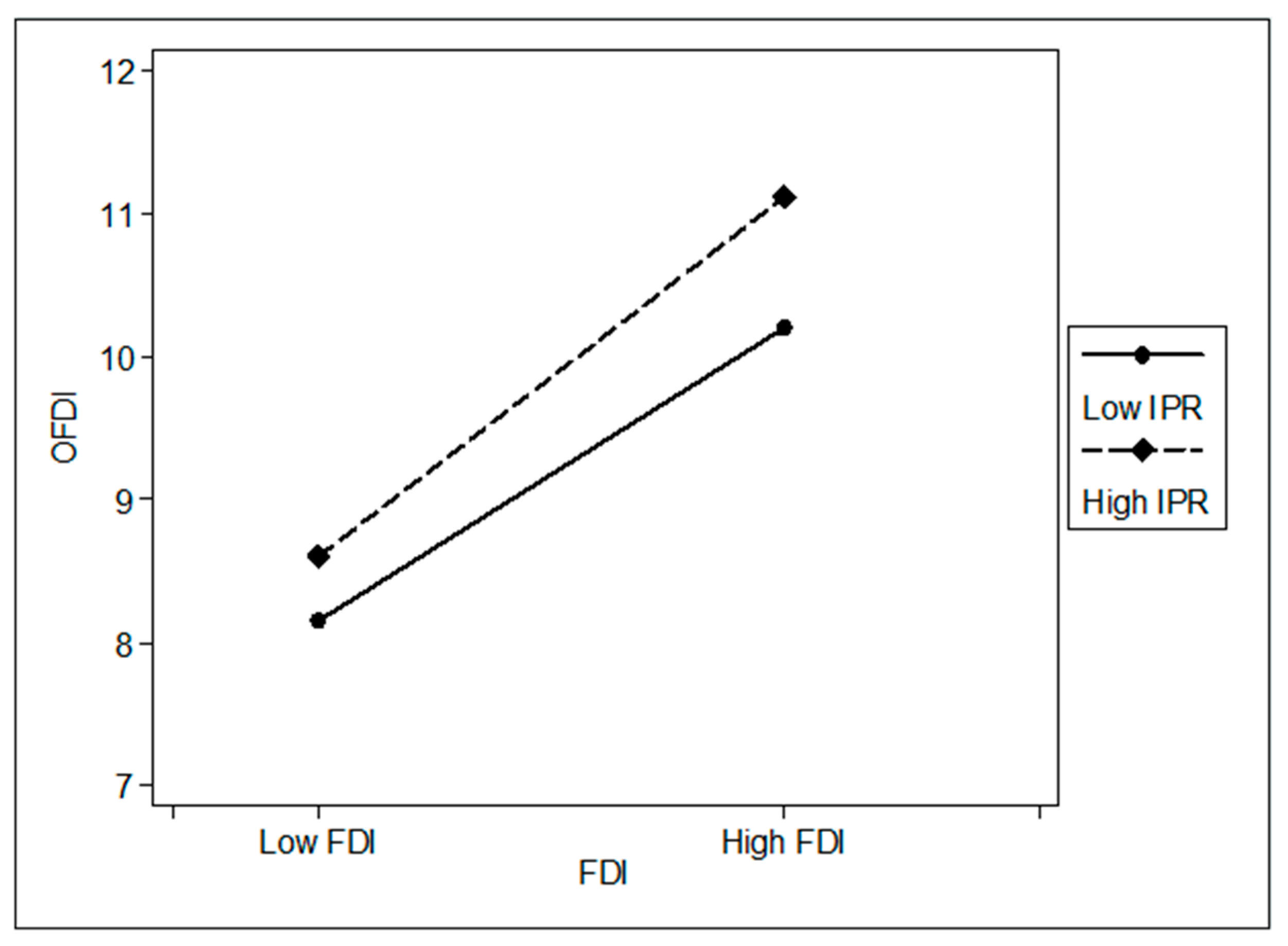
Hypothesis 2 predicts a positive moderating effect of IPR protection on the relationship between FDI and OFDI. In Models 4 and 6, the estimated coefficients of the interaction term of IPR protection and FDI are consistently positive and significant (β = 0.190, p < 0.01; β = 0.174, p < 0.01, respectively), indicating that IPR protection enhances the spillover effects of FDI and the absorptive capacity of local firms, making the effect of FDI on the capacity of local firms to invest abroad more obvious. In other words, the stronger the country’s IPR protection, the greater the positive effect of FDI on OFDI. Thus, Hypothesis 2 is supported. The interaction effect is plotted in Figure 2. The horizontal axis represents the FDI stock, and the vertical axis represents the OFDI stock. The countries were divided into two groups according to the level of IPR protection (high and low). As seen in Figure 2, OFDI increases with an increase in FDI. Moreover, the upward slope of the line is much steeper for countries with high levels of IPR protection than for countries with low levels.
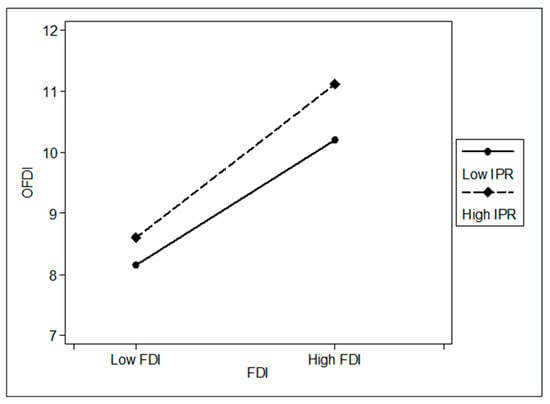
Figure 2.
The moderating effect of IPR protection on the relationship between FDI and OFDI.
Hypothesis 3 proposes that migration has a negative effect on OFDI. The estimated coefficients of migration in Models 2 and 6 are negative and significant (β = −0.078, p < 0.1; β = −0.091, p < 0.05, respectively), suggesting that emigration directly causes brain drain in home countries, which is not conducive to the accumulation of ownership advantages and international competitiveness of firms in such countries and negatively affects OFDI. Therefore, Hypothesis 3 is supported.
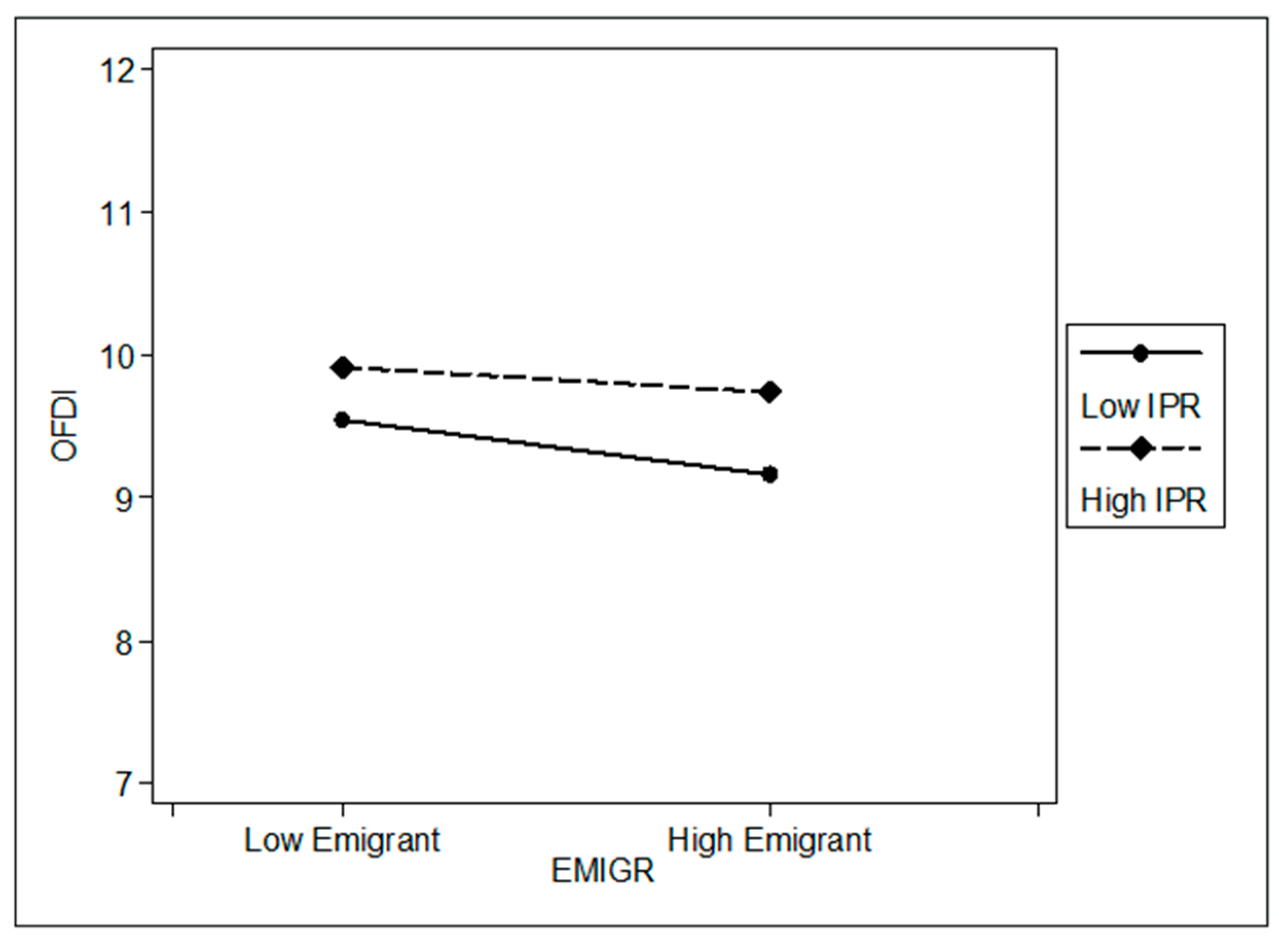
Hypothesis 4 predicts a positive moderating effect of IPR protection on the relationship between migration and OFDI. The estimated coefficients of the interaction term of IPR protection and migration in Models 5 and 6 are insignificant, suggesting that the influence of IPR protection on the relationship between migration and OFDI is not statistically significant. This may be because migration is affected by real wages, job opportunities, and tax levels [61], and IPR protection is just one of many factors. The negative effect of brain drain on OFDI cannot be significantly reduced by the brain gain created by strengthening IPR protection. Therefore, Hypothesis 4 is not supported. The interaction effect is plotted in Figure 3 to facilitate interpretation; the horizontal axis represents the emigration stock, whereas the vertical axis represents the OFDI stock. The countries were divided into two groups according to the level of IPR protection. According to Figure 3, OFDI decreases with an increase in migration. However, the two downward lines have roughly similar slopes for countries with high IPR protection levels and for countries with low levels.
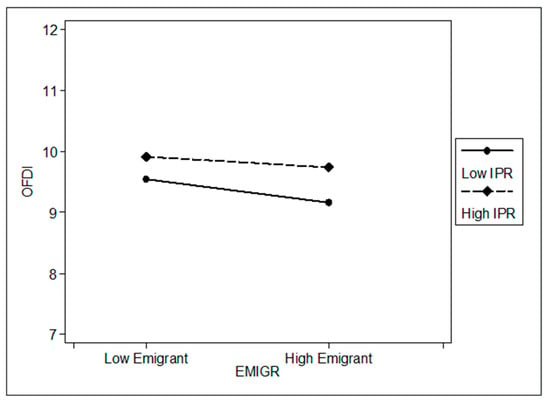
Figure 3.
The moderating effect of IPR protection on the relationship between migration and OFDI.
The estimated coefficients of GDP per capita, export, R&D, exchange rate, and population in Model 1 are positive and significant for the control variables. These results are broadly in line with earlier findings [8,31]. With economic development comes ownership advantages that domestic firms can exploit when investing abroad [31]. Increasing R&D investment enables local firms to obtain more advanced technologies, which can be used as a competitive advantage in internationalisation [31]. An increase in the exchange rate makes it more profitable to invest than to export, thus stimulating the activity of OFDI. A large national population means a large domestic market and an ownership advantage from economies of scale. Export allows a country to accumulate international experience and promote its OFDI [10].
5.2. Robustness Checks
We adopted several additional analyses to check the robustness of our results. First, we used the IPR protection index published by the World Economic Forum (WEF) as another proxy for IPR protection. The index is based on survey responses from business executives; hence, it is primarily a measure of de facto protection. Specifically, more than 13,000 business executives worldwide were asked, “How would you rate intellectual property right protection, including anti-counterfeiting measures, in your country?” The index runs from 1 to 7, with 1 being very weak and 7 very strong. The estimated results after replacing the measure of IPR protection are shown in Table 4. We found that the main results remained similar, indicating that the results are robust.
Table 4.
Robustness check (replacement measure of IPR protection).
Second, we added control variables for robustness testing. Drawing on Yao et al. [8], import was added and was measured by the proportion of a country’s imports to GDP. Import can motivate OFDI by increasing the competitive forces in the domestic economy [33]. This robustness test is shown in Table 5. The results remain similar, indicating that our results were not affected by changing the control variables.
Table 5.
Robustness check (adding import as a control variable).
Finally, we followed the practise of Chen et al. [11] by lagging the independent variables by one year to further reduce concerns about endogeneity between FDI and OFDI and between migration and OFDI. The rationale for lagging the independent variables is that the influences of FDI and migration on OFDI both take time. Table 6 shows the estimated results of lagging the independent variables by one year. We found that the results are largely consistent with previous results, further enhancing the robustness of our findings.
Table 6.
Robustness check (independent variables lagged one year).
5.3. Estimation Results for Countries with Different Income Levels
Considering the heterogeneity of national economic development levels, we further examined the possible influences of FDI and migration on OFDI in countries with different income levels, as well as the moderating effect of IPR protection in the same. According to the standards of the World Bank, we divided the countries in the sample into three groups: high-income countries, upper-middle-income countries, and lower-middle- and low-income countries. The regression results for high-income countries are shown in Table 7. In Models 26 and 30, the estimated coefficients of FDI are positive and significant, and the estimated coefficients of migration are positive but statistically insignificant. This indicates that FDI in high-income countries positively affects OFDI, but the influence of migration is not significant. This is possibly because high-income countries have intensive human capital and can provide more job opportunities and better wages, thus attracting many migrants from other countries [61]. Therefore, the influence of the brain drain on the home country is minimal. The coefficients of the interaction term of FDI and IPR protection in Models 28 and 30 are positive and significant. However, the coefficients of the interaction term of migration and IPR protection in Models 29 and 30 are insignificant. This indicates that IPR protection in high-income countries has a positive moderating effect on the relationship between FDI and OFDI, and the influence of IPR protection on the relationship between migration and OFDI is not statistically significant.
Table 7.
Estimated results for high-income countries.
The estimated results for upper-middle-income countries are shown in Table 8. The coefficients of FDI in Models 32 and 36 are positive and significant, indicating that FDI in upper-middle-income countries has a positive effect on OFDI. In contrast, the coefficients of the interaction term of FDI and IPR protection in Models 34 and 36 are negative and significant, suggesting that IPR protection in upper-middle-income countries negatively moderates the relationship between FDI and OFDI. This may be due to the low levels of technology and productivity of local firms in upper-middle-income countries compared with those of high-income countries, which usually improve their technological levels through imitation and reverse engineering to maintain competitiveness with foreign firms [62]. In addition, the strengthening of IPR protection in these countries restricts the use of proprietary knowledge by non-rights holders and increases the monopolies of foreign firms as IPR owners [23,54], reducing the possibility of imitation and reverse engineering by local firms [23]. Therefore, stricter IPR protection in upper-middle-income countries reduces the spillover effects of FDI, thus reducing the positive effect of FDI on OFDI. The estimated coefficients of migration in Models 32 and 36 are insignificant. This may be due to the relatively abundant human capital in upper-middle-income countries, and the emigration of these countries to OECD countries has no significant impact on their OFDI capacity. In Model 36, the coefficient of the interaction term of IPR protection and migration is insignificant. This shows that the influence of IPR protection in upper-middle-income countries on the relationship between migration and OFDI is not statistically significant.
Table 8.
Estimated results for upper-middle-income countries.
The estimated results for lower-middle- and low-income countries are shown in Table 9. The coefficients of FDI in Model 38 and Model 42 are positive but statistically insignificant, indicating that the influence of FDI in lower-middle- and low-income countries on OFDI is not statistically significant. This may be due to the lack of a favourable market and legal environment in those countries with which to attract high-quality FDI; also, the absorptive capacity of these countries is weak. Therefore, the influence of FDI on OFDI in lower-middle- and low-income countries is minimal. The coefficients of migration in Models 38 and 42 are negative and significant, suggesting that migration negatively affects OFDI in lower-middle- and low-income countries. The coefficient of the interaction term of FDI and IPR protection in Model 42 is not significant, indicating that the influence of IPR protection in these countries on the relationship between FDI and OFDI is not significant. The coefficients of the interaction term of migration and IPR protection in Models 41 and 42 are positive and significant, indicating that IPR protection in lower-middle- and low-income countries positively moderates the relationship between migration and OFDI.
Table 9.
Estimated results of lower-middle- and low-income countries.
6. Conclusions and Implications
6.1. Conclusions
In the context of globalisation, a country can utilise international resources to serve its own economic interests through OFDI. At the same time, OFDI is also an important manifestation of a country’s international competitiveness. Building on the IDP framework, this paper uses a panel dataset of 85 countries between 2006 and 2018 to examine the influence of FDI and migration on the sustainable development of OFDI, the moderating effect of IPR protection on the relationship between FDI and OFDI, and the relationship between migration and OFDI. Countries were divided into three groups: high-income countries, upper-middle-income countries, and lower-middle- and low-income countries, and the influence of heterogeneous economic development levels on the empirical results was explored. The key findings of this paper are as follows:
First, from a worldwide perspective, there is a development path through which a country can strengthen its capacity to invest abroad by attracting FDI. Moreover, strengthening IPR protection enhances the spillover effects of FDI and the absorptive capacity of local firms, thus enhancing the positive effect of FDI on OFDI. In addition, emigration directly causes brain drain in migrants’ home countries and has a negative effect on OFDI, and strengthening IPR protection cannot significantly reduce the negative effect of that brain drain.
Second, the study on countries with different income levels shows that in high-income countries, FDI has a positive effect on OFDI, and the stronger the IPR protection, the greater the positive effect of FDI on OFDI. For upper-middle-income countries, FDI has a positive effect on OFDI, but the stronger the IPR protection, the weaker the positive effect of FDI on OFDI. For lower-middle- and low-income countries, the influence of FDI on OFDI is insignificant. Moreover, the influence of migration on OFDI is not significant in high- and upper-middle-income countries. For lower-middle- and low-income countries, migration has a negative effect on OFDI, and the stronger the IPR protection, the weaker the negative effect of migration on OFDI.
Third, factors such as the level of economic development, investment in R&D, exchange rate, market size, and trade openness of a country have a positive effect on its OFDI.
6.2. Implications
This study provides some important implications for policymakers. First, they should create a good market and legal environment for foreign enterprises to attract more and higher-quality FDI. Through the introduction of FDI to utilize international resources, a situation of coordinated development of FDI and OFDI is gradually formed. Specifically, policymakers can take measures to enable government departments to simplify procedures, enhance efficiency and improve services to facilitate foreign investment. Policymakers should also improve the foreign investment law to attract investment from foreign firms with advanced technology and management capabilities. Moreover, policymakers should not only ensure equal protection of IPR of foreign firms, but also strengthen IPR protection by improving laws and regulations on IPR and increasing the crackdown on IPR infringements to enhance the spillover effects of FDI and the absorptive capacity of local firms. This is critical to the accumulation of competitive advantages by local firms and the enhancement of OFDI.
Second, although migration has a negative effect on OFDI, emigrants can gain advanced knowledge and obtain international experience overseas. Therefore, policymakers should take measures to attract emigrants back to their home country. Specifically, policymakers can transform the brain drain into a brain gain and improve the ability of OFDI by introducing preferential tax policies for talents, providing salary subsidies, creating suitable job opportunities, increasing investment in education and R&D, building efficient and transparent service-oriented government, and creating a good environment for innovation activities.
Third, policymakers should formulate differentiated IPR protection policies according to their country’s stage of economic development. High-income countries can implement stricter IPR protection, strengthening the positive effect of FDI on OFDI. However, strict IPR protection in upper-middle-income countries weakens the positive effect of FDI on OFDI. Therefore, these countries should adopt IPR protection policies that are in line with their actual conditions. The strength of IPR protection should be appropriate, and IPR protection should gradually be strengthened with the development of economic and technological capabilities. Lower-middle- and low-income countries should strengthen IPR protection by perfecting laws on IPR and enhancing law enforcement so that the knowledge acquired by emigrants abroad can flow back to their home countries and be utilised therein, which improves the competitive advantage of local firms and enhances their ability to invest abroad.
7. Limitations and Future Research
Although this research makes many contributions, as mentioned above, there are still some limitations. Apart from IPR protection, other economic and institutional factors may also play a moderating role. Moreover, this research discusses the determinants of the sustainable development of OFDI from the perspective of the OFDI home country but does not consider the determinants of the OFDI host country. Therefore, future research can focus on the influence of the infrastructure, R&D investment, and legal environment of the home country on the relationship between FDI and OFDI, and the relationship between migration and OFDI. In addition, future research can also explore the influence of the economic development level, business environment, and institutional risk of the OFDI host country on the sustainable development of OFDI.
Author Contributions
Conceptualization, H.Z.; methodology, Y.L.; software, Y.L.; validation, H.Z. and Y.L.; formal analysis, Y.L.; investigation, Y.L.; resources, Y.L.; data curation, Y.L.; writing—original draft preparation, H.Z. and Y.L.; writing—review and editing, H.Z. and Y.L.; visualization, Y.L.; supervision, H.Z.; project administration, H.Z.; funding acquisition, H.Z. All authors have read and agreed to the published version of the manuscript.
Funding
This research was funded by the National Natural Science Foundation of China, grant number 72091214, and the National Natural Science Foundation of China, grant number 72062011.
Institutional Review Board Statement
Not applicable.
Informed Consent Statement
Not applicable.
Data Availability Statement
The data presented in this study are available on request from the corresponding author.
Acknowledgments
We thank the seminar participants at Tianjin University.
Conflicts of Interest
The authors declare no conflict of interest.
Appendix A
Table A1.
List of sample countries.
Table A1.
List of sample countries.
| High-Income Countries | Upper-Middle-Income Countries | Lower-Middle- and Low-Income Countries | |||
|---|---|---|---|---|---|
| Australia | Ireland | Qatar | Albania | Mexico | Burundi |
| Austria | Israel | Romania | Argentina | Montenegro | Egypt |
| Belgium | Italy | Saudi Arabia | Armenia | Peru | El Salvador |
| Canada | Japan | Singapore | Azerbaijan | Russia | Ghana |
| Chile | Korea | Slovakia | Bosnia and Herzegovina | Serbia | India |
| Croatia | Kuwait | Slovenia | Brazil | South Africa | Kenya |
| Cyprus | Latvia | Spain | Bulgaria | Thailand | Madagascar |
| Czech Republic | Lithuania | Sweden | China | Turkey | Mali |
| Denmark | Luxembourg | Switzerland | Colombia | Morocco | |
| Estonia | Malta | United Arab Emirates | Costa Rica | Mozambique | |
| Finland | Netherlands | United Kingdom | Guatemala | Pakistan | |
| France | New Zealand | United States | Indonesia | Philippines | |
| Germany | Norway | Uruguay | Iran | Senegal | |
| Greece | Panama | Jordan | Sri Lanka | ||
| Hungary | Poland | Kazakhstan | Tunisia | ||
| Iceland | Portugal | Malaysia | Ukraine | ||
References
- UNCTAD. Balance of Payments. 2022. Available online: https://unctadstat.unctad.org/wds/ReportFolders/reportFolders.aspx (accessed on 5 March 2022).
- Dunning, J.H. Trade, location of economic activity and the MNE: A search for an eclectic approach. In The International Allocation of Economic Activity; Ohlin, B., Hesselborn, P.O., Wijkman, P.M., Eds.; Palgrave Macmillan: London, UK, 1977; pp. 395–418. [Google Scholar]
- Dunning, J.H. Multinational Enterprises and the Global Economy; Addison-Wesley: Wokingham, UK, 1993. [Google Scholar]
- Dunning, J.H. Explaining the international direct investment position of countries: Towards a dynamic or developmental approach. Weltwirtschaftliches Arch. 1981, 117, 30–64. [Google Scholar] [CrossRef]
- Dunning, J.H. The investment development cycle revisited. Weltwirtschaftliches Arch. 1986, 122, 667–676. [Google Scholar] [CrossRef]
- Dunning, J.H.; Narula, R. The investment development path revisited: Some emerging issues. In Foreign Direct Investment and Governments: Catalysts for Economic Restructuring; Dunning, J.H., Narula, R., Eds.; Routledge: London, UK, 1996; pp. 1–41. [Google Scholar]
- Li, J.; Li, Y.; Shapiro, D. Knowledge Seeking and Outward FDI of Emerging Market Firms: The Moderating Effect of inward FDI. Glob. Strateg. J. 2012, 2, 277–295. [Google Scholar] [CrossRef]
- Yao, S.; Wang, P.; Zhang, J.; Ou, J. Dynamic relationship between China’s inward and outward foreign direct investments. China. Econ. Rev. 2016, 40, 54–70. [Google Scholar] [CrossRef]
- Hatani, F. The logic of spillover interception: The impact of global supply chains in China. J. World. Bus. 2009, 44, 158–166. [Google Scholar] [CrossRef]
- Liu, X.; Buck, T.; Shu, C. Chinese economic development, the next stage: Outward FDI? Int. Bus. Rev. 2005, 14, 97–115. [Google Scholar] [CrossRef]
- Chen, J.; Zhan, W.; Tong, Z.; Kumar, V. The effect of inward FDI on outward FDI over time in China: A contingent and dynamic perspective. Int. Bus. Rev. 2020, 29, 101734. [Google Scholar] [CrossRef]
- De Pascale, G.; Sardaro, R.; Faccilongo, N.; Contò, F. What is the influence of FDI and international people flows on environment and growth in OECD countries? A panel study. Environ. Impact. Asses. 2020, 84, 106434. [Google Scholar] [CrossRef]
- Gao, L.; Liu, X.; Zou, H. The role of human mobility in promoting Chinese outward FDI: A neglected factor? Int. Bus. Rev. 2013, 22, 437–449. [Google Scholar] [CrossRef] [Green Version]
- Liu, X.; Giroud, A. International knowledge flows in the context of emerging-economy MNEs and increasing global mobility. Int. Bus. Rev. 2016, 25, 125–129. [Google Scholar] [CrossRef] [Green Version]
- Naghavi, A.; Strozzi, C. Intellectual property rights, diasporas, and domestic innovation. J. Int. Econ. 2015, 96, 150–161. [Google Scholar] [CrossRef] [Green Version]
- Naghavi, A.; Strozzi, C. Intellectual property rights and diaspora knowledge networks: Can patent protection generate brain gain from skilled migration? Can. J. Econ. 2017, 50, 995–1022. [Google Scholar] [CrossRef] [Green Version]
- Tong, S.Y. Ethnic Networks in FDI and the Impact of Institutional Development. Rev. Dev. Econ. 2005, 9, 563–580. [Google Scholar] [CrossRef]
- Buckley, P.J.; Clegg, L.J.; Cross, A.R.; Liu, X.; Voss, H.; Zheng, P. The determinants of Chinese outward foreign direct investment. J. Int. Bus. Stud. 2007, 38, 499–518. [Google Scholar] [CrossRef]
- Anwar, A.; Mughal, M. The role of diaspora in attracting Indian outward FDI. Int. J. Soc. Econ. 2013, 40, 944–955. [Google Scholar] [CrossRef]
- Kugler, M.; Rapoport, H. International labor and capital flows: Complements or substitutes? Econ. Lett. 2007, 94, 155–162. [Google Scholar] [CrossRef]
- Javorcik, B.S.; Özden, Ç.; Spatareanu, M.; Neagu, C. Migrant networks and foreign direct investment. J. Dev. Econ. 2011, 94, 231–241. [Google Scholar] [CrossRef] [Green Version]
- Gheasi, M.; Nijkamp, P.; Rietveld, P. Migration and foreign direct investment: Education matters. Ann. Regional. Sci. 2013, 51, 73–87. [Google Scholar] [CrossRef] [Green Version]
- Yi, J.; Chen, Y.; Wang, C.; Kafouros, M. Spillover Effects of Foreign Direct Investment: How do Region-Specific Institutions Matter? Manag. Int. Rev. 2015, 55, 539–561. [Google Scholar] [CrossRef]
- Awokuse, T.O.; Yin, H. Intellectual property rights protection and the surge in FDI in China. J. Comp. Econ. 2010, 38, 217–224. [Google Scholar] [CrossRef]
- Fang, H.; Peng, B.; Wang, X.; Fang, S.R. The Effect of Intellectual Property Rights Protection in Host Economies on The Sustainable Development of China’s Outward Foreign Direct Investment Evidence from a Cross-Country Sample. Sustainability 2019, 11, 2100. [Google Scholar] [CrossRef] [Green Version]
- Papageorgiadis, N.; Xu, Y.; Alexiou, C. The Effect of European Intellectual Property Institutions on Chinese outward Foreign Direct Investment. Manag. Organ. Rev. 2019, 15, 81–110. [Google Scholar] [CrossRef] [Green Version]
- Papageorgiadis, N.; McDonald, F.; Wang, C.; Konara, P. The characteristics of intellectual property rights regimes: How formal and informal institutions affect outward FDI location. Int. Bus. Rev. 2020, 29, 101620. [Google Scholar] [CrossRef]
- Wei, Y.; Zheng, N.; Liu, X.; Lu, J. Expanding to outward foreign direct investment or not? A multi-dimensional analysis of entry mode transformation of Chinese private exporting firms. Int. Bus. Rev. 2014, 23, 356–370. [Google Scholar] [CrossRef] [Green Version]
- Chen, S.; Lin, Y.; Zhu, X.; Akbar, A. Can International Students in China Affect Chinese OFDI—Empirical Analysis Based on Provincial Panel Data. Economies 2019, 7, 87. [Google Scholar] [CrossRef] [Green Version]
- Gu, Q.; Lu, J.W. Effects of inward investment on outward investment: The venture capital industry worldwide 1985–2007. J. Int. Bus. Stud. 2011, 42, 263–284. [Google Scholar] [CrossRef]
- Stoian, C. Extending Dunning’s Investment Development Path: The role of home country institutional determinants in explaining outward foreign direct investment. Int. Bus. Rev. 2013, 22, 615–637. [Google Scholar] [CrossRef]
- Stoian, C.; Mohr, A. Outward foreign direct investment from emerging economies: Escaping home country regulative voids. Int. Bus. Rev. 2016, 25, 1124–1135. [Google Scholar] [CrossRef]
- Nayyar, R.; Mukherjee, J. Home country impact on Outward FDI from India. J. Policy. Model. 2020, 42, 385–400. [Google Scholar] [CrossRef]
- Mo, Z. Inward Foreign Direct Investment, Entrepreneurial Behavior, and Outward Foreign Direct Investment: Evidence from China. Int. J. Bus. Manag. 2014, 9, 108–117. [Google Scholar]
- Nijkamp, P.; Gheasi, M.; Rietveld, P. Migrants and International Economic Linkages: A Meta-Overview. Spat. Econ. Anal. 2011, 6, 359–376. [Google Scholar] [CrossRef]
- Jayet, H.; Marchal, L. Migration and FDI: Reconciling the standard trade theory with empirical evidence. Econ. Model. 2016, 59, 46–66. [Google Scholar] [CrossRef] [Green Version]
- Cuadros, A.; Martín-Montaner, J.; Paniagua, J. Migration and FDI: The role of job skills. Int. Rev. Econ. Financ. 2019, 59, 318–332. [Google Scholar] [CrossRef]
- Wu, J.; Chen, X. Home country institutional environments and foreign expansion of emerging market firms. Int. Bus. Rev. 2014, 23, 862–872. [Google Scholar] [CrossRef]
- Liu, X.; Lu, J.; Chizema, A. Top executive compensation, regional institutions and Chinese OFDI. J. World. Bus. 2014, 49, 143–155. [Google Scholar] [CrossRef] [Green Version]
- Shi, W.; Sun, S.L.; Yan, D.; Zhu, Z. Institutional fragility and outward foreign direct investment from China. J. Int. Bus. Stud. 2017, 48, 452–476. [Google Scholar] [CrossRef]
- Kong, Q.; Guo, R.; Wang, Y.; Sui, X.; Zhou, S. Home-country environment and firms’ outward foreign direct investment decision: Evidence from Chinese firms. Econ. Model. 2020, 85, 390–399. [Google Scholar] [CrossRef]
- Driffield, N.; Taylor, K.; Love, J. Productivity and Labour Demand Effects of inward and outward FDI on UK Industry. Manch. Sch. 2009, 77, 171–203. [Google Scholar] [CrossRef]
- Narayanan, K.; Bhat, S. Technology sourcing and outward FDI: A study of IT industry in India. Technovation 2011, 31, 177–184. [Google Scholar] [CrossRef]
- Fu, X.; Hou, J.; Sanfilippo, M. Highly skilled returnees and the internationalization of EMNEs: Firm level evidence from China. Int. Bus. Rev. 2017, 26, 579–591. [Google Scholar] [CrossRef]
- Blomstrom, M.; Kokko, A. Foreign direct investment and spillovers of technology. Int. J. Technol. Manag. 2001, 22, 435–454. [Google Scholar] [CrossRef]
- Tang, Y.; Zhang, K.H. Absorptive capacity and benefits from FDI: Evidence from Chinese manufactured exports. Int. Rev. Econ. Financ. 2016, 42, 423–429. [Google Scholar] [CrossRef] [Green Version]
- Krammer, S.M.S. Assessing the relative importance of multiple channels for embodied and disembodied technological spillovers. Technol. Forecast. Soc. 2014, 81, 272–286. [Google Scholar] [CrossRef] [Green Version]
- Liang, F.H. Does foreign direct investment improve the productivity of domestic firms? Technology spillovers, industry linkages, and firm capabilities. Res. Policy. 2017, 46, 138–159. [Google Scholar] [CrossRef]
- Seyoum, M.; Wu, R.; Yang, L. Technology spillovers from Chinese outward direct investment: The case of Ethiopia. China. Econ. Rev. 2015, 33, 35–49. [Google Scholar] [CrossRef]
- Huang, Y.; Zhang, Y. Wage, foreign-owned firms, and productivity spillovers via labour turnover: A non-linear analysis based on Chinese firm-level data. Appl. Econ. 2017, 49, 1994–2010. [Google Scholar] [CrossRef]
- Wei, Z. The Literature on Chinese Outward FDI. Multinatl. Bus. Rev. 2010, 18, 73–112. [Google Scholar] [CrossRef]
- Fu, X.; Pietrobelli, C.; Soete, L. The Role of Foreign Technology and Indigenous Innovation in the Emerging Economies: Technological Change and Catching-up. World. Dev. 2011, 39, 1204–1212. [Google Scholar] [CrossRef] [Green Version]
- Yi, X.; Naghavi, A. Intellectual property rights, FDI, and technological development. J. Int. Trade. Econ. Dev. 2017, 26, 410–424. [Google Scholar] [CrossRef]
- Smeets, R.; de Vaal, A. Intellectual Property Rights and the productivity effects of MNE affiliates on host-country firms. Int. Bus. Rev. 2016, 25, 419–434. [Google Scholar] [CrossRef]
- McAusland, C.; Kuhn, P. Bidding for brains: Intellectual property rights and the international migration of knowledge workers. J. Dev. Econ. 2011, 95, 77–87. [Google Scholar] [CrossRef] [Green Version]
- Yang, X.; Zhang, H. Intellectual property rights, migrants and competitiveness. Int. J. Dev. Issues 2017, 16, 43–53. [Google Scholar] [CrossRef]
- Agrawal, A.; Kapur, D.; McHale, J.; Oettl, A. Brain drain or brain bank? The impact of skilled emigration on poor-country innovation. J. Urban. Econ. 2011, 69, 43–55. [Google Scholar] [CrossRef] [Green Version]
- Tung, R.L. Brain circulation, diaspora, and international competitiveness. Eur. Manag. J. 2008, 26, 298–304. [Google Scholar] [CrossRef]
- Breschi, S.; Lissoni, F.; Miguelez, E. Foreign-origin inventors in the USA: Testing for diaspora and brain gain effects. J. Econ. Geogr. 2017, 17, 1009–1038. [Google Scholar] [CrossRef]
- Aiken, L.S.; West, S.G. Multiple Regression: Testing and Interpreting Interactions; Sage Publications: Newbury Park, CA, USA, 1991. [Google Scholar]
- Pedersen, P.J.; Pytlikova, M.; Smith, N. Selection and network effects—Migration flows into OECD countries 1990–2000. Eur. Econ. Rev. 2008, 52, 1160–1186. [Google Scholar] [CrossRef]
- Kemeny, T. Does Foreign Direct Investment Drive Technological Upgrading? World. Dev. 2010, 38, 1543–1554. [Google Scholar] [CrossRef]
Publisher’s Note: MDPI stays neutral with regard to jurisdictional claims in published maps and institutional affiliations. |
© 2022 by the authors. Licensee MDPI, Basel, Switzerland. This article is an open access article distributed under the terms and conditions of the Creative Commons Attribution (CC BY) license (https://creativecommons.org/licenses/by/4.0/).