


Abstract
With the development of high-speed wireless LAN, the use of multimedia-type digital contents is increasing significantly even in the smart home environment. Therefore, it is very important to efficiently process and manage the use of digital content in the form of multimedia. In order to effectively process multimedia digital contents in the wireless LAN environment of a smart home, a server higher than the PC level is required. There is also a need for a support system that can exchange multimedia digital contents between clients of home appliances. Therefore, in this paper, we propose a Smart Home Digital Contents Management and Operation System (SDCMOS) that effectively processes and supports multimedia digital contents. This system is designed to effectively process real-time multimedia processing in home service in a wireless LAN environment. In addition, it was made possible to efficiently search multimedia information directly from the home server. SDCMOS is designed to be usable in fields such as biomedical image search, history museums, art exhibition halls, tourism information, geographic information, and e-commerce.
1. Introduction
The growth and development of wired and wireless internet greatly affected the use of multimedia type digital contents and also had a great influence on the home service environment. In particular, as the use of multimedia-type digital contents has increased significantly, technology that effectively processes and manages them has become very important. However, although a lot of research to operate multimedia digital contents is being conducted all over the world, there are few research results on embedded digital contents operation technology that effectively operates digital contents in small home clients such as home appliances [1].
A smart home provides a wired/wireless network environment to connect various network furniture such as home computers, portable computers, PDAs, set-up boxes, and network multimedia content players. In a smart home, a user can enjoy various entertainment at home, such as watching TV or listening to music. In a smart home based on the Internet of Things (IoT), a virtual interaction between the user and objects takes place. Collaborative research on the interaction of multimedia contents in a smart computing environment is carried out by Berkeley’s ICSI project, CMU’s Smart Meeting Room Task at ISL at CMU (SMaRT) project, UCSB University’s AVIARY project, University of Colorado’s Neem project, and TeCo Lab. It is being implemented in the Aware Office project. In particular, CMU’s SMaRT project is also conducting research to support collaboration activities implicitly without an explicit request from the user by analyzing the activities of the meeting room through voice and video [1,2,3]. It is necessary to research and develop multimedia services that respond to various situational changes by themselves rather than at the level of content search.
Existing home networking causes extreme inconvenience when selecting a wired option because it requires new wiring and limits flexibility to devices. To correct these limitations, the wireless home networking system (802.11b/g, UWB, ZigBee, Bluetooth, home RF, wireless 1394) and other technologies are used to build a home network. XBee wireless communication technology, an extended version of Zgbee, is applied to wirelessly communicate home environment information.
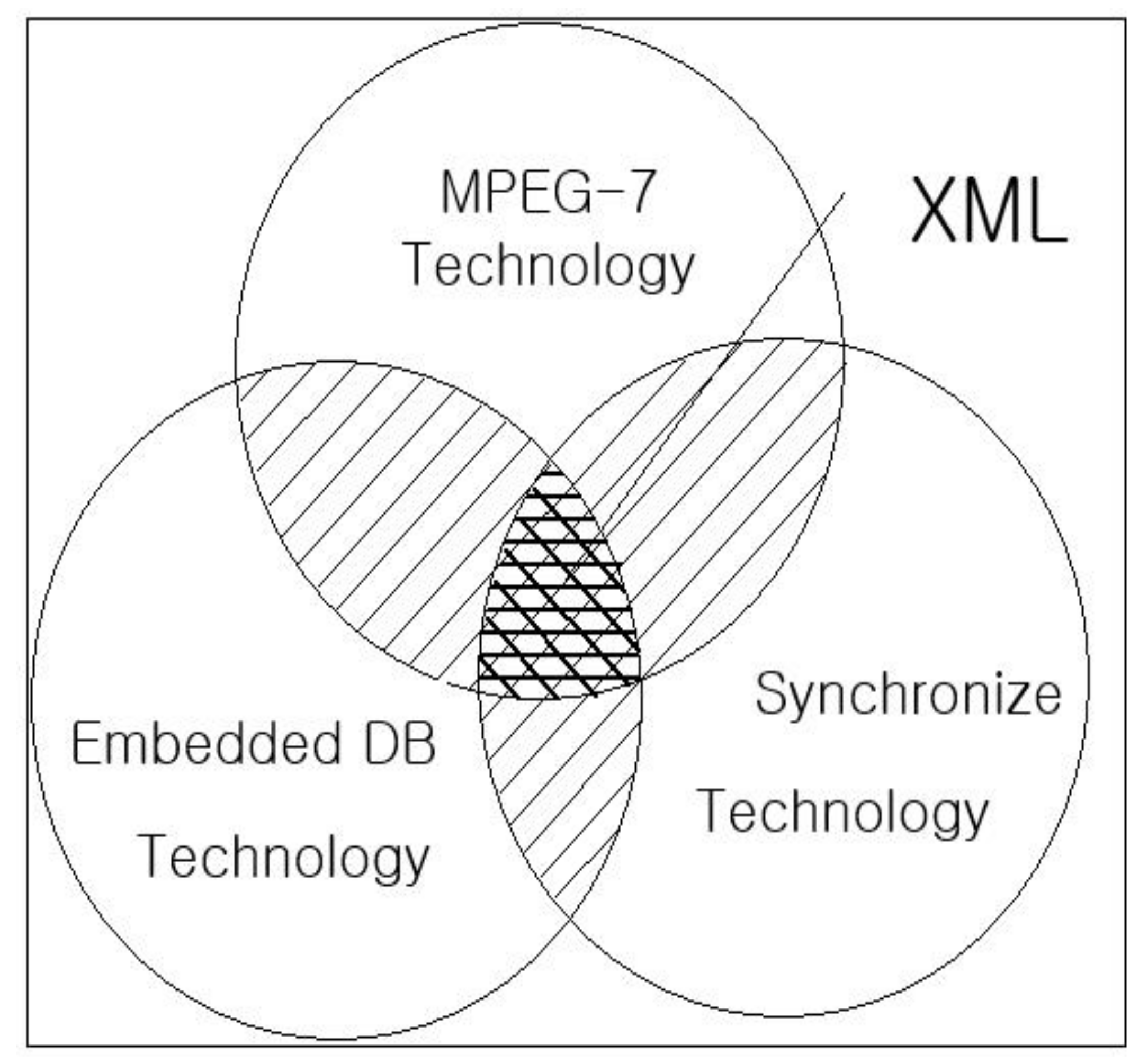
In order to effectively process digital multimedia contents in the wireless LAN environment of Smart Home, a support system capable of exchanging digital multimedia contents between a desktop level server or higher and a client of home appliances is required [2]. In order to effectively manage and operate digital multimedia contents based on the MPEG-7 schema in the home client–home-server environment, the three parts of technology must be well related to each other. These three-part technology components are MPEG-7 process technology, embedded DB technology, and data synchronization technology. These three technologies can be effectively combined based on XML (eXtensible Markup Language) [3].
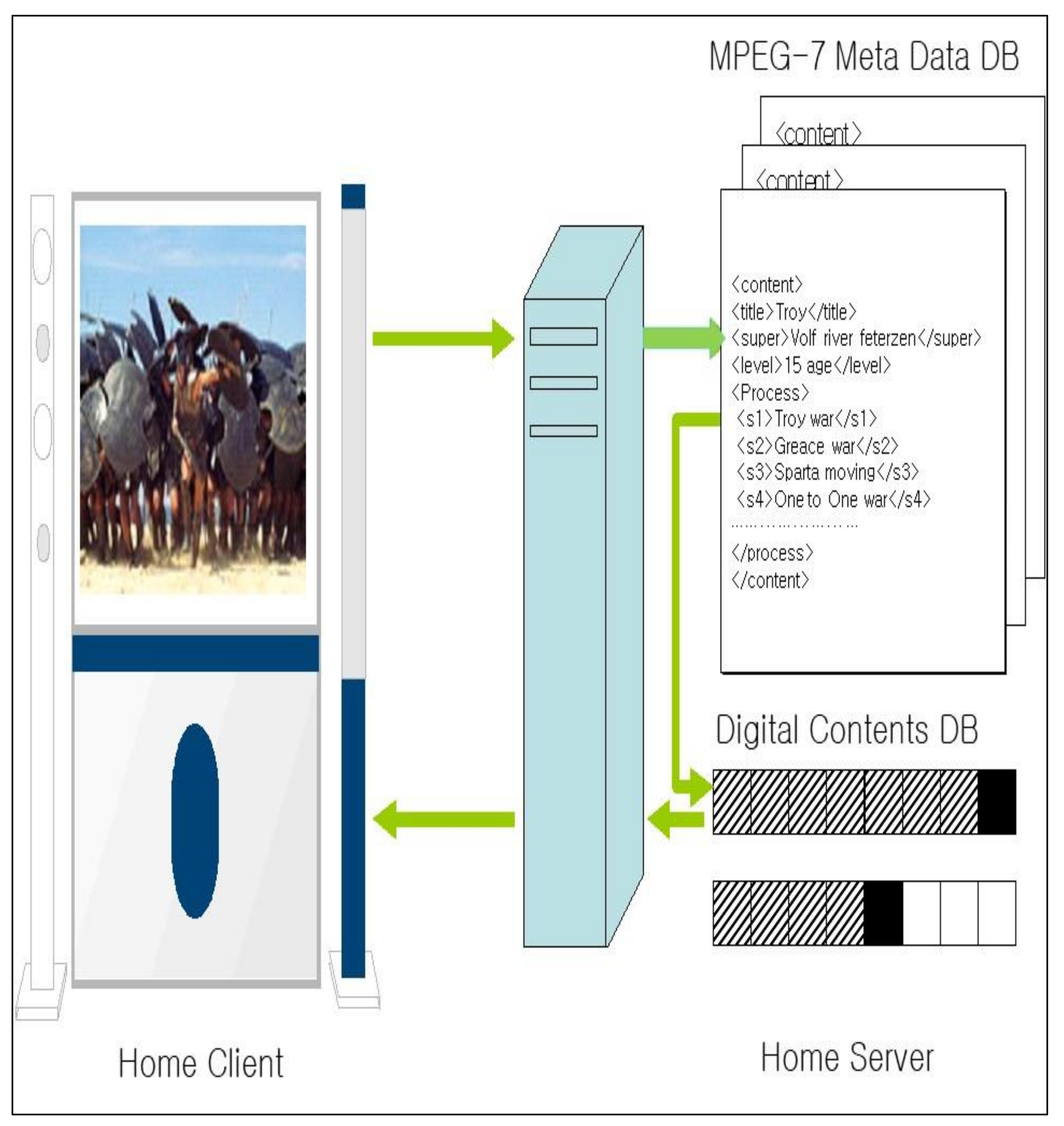
Figure 1 is for effectively managing and operating digital multimedia contents configured based on the MPEG-7 schema in the home-client–home-server environment. MPEG-7 technology, embedded DB technology, and synchronization technology can be effectively combined based on XML. Three specific core technologies based on XML are embedded in MPEG-7 database management technology, XML-based MPEG-7 document validation check technology, and MPEG-7 data synchronization technology [4].
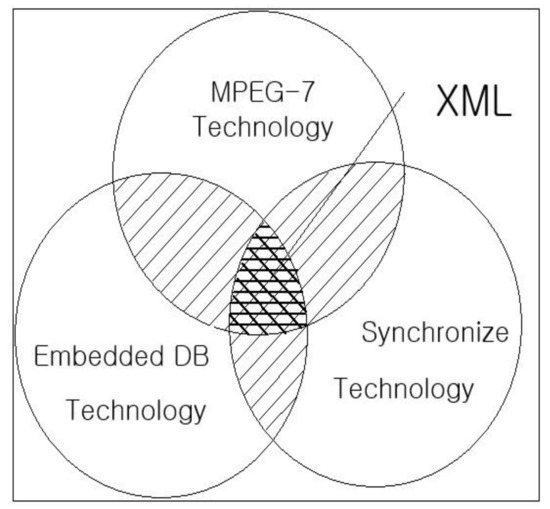
Figure 1.
MPEG-7-based digital multimedia contents technology.
In this paper, we develop and use MPEG-7 schema-based Smart Home digital contents management and operation system (SDCMOS: Smart Home Digital Contents Management and Operation System) to effectively process multimedia in a Smart Home environment by mixing these technologies [5]. A home service application was built. SDCMOS consists of Smart Home digital contents management system (SDCMS: Smart Home Digital Contents Management System), Smart Home digital contents operation system (SDCOS: Smart Home Digital Contents Operation System), and Smart Home application service (SAS: Smart Home Application Service) [6].
SDCMS was developed by integrating embedded MPEG-7 data management technology, MPEG-7 validation check technology, and MPEG-7 SyncML process technology [7]. MPEG-7 data management technology manages MPEG-7 data under limited hardware resources. MPEG-7 validation check technology is a technology that checks the validation of MPEG-7 schema and document. MPEG-7 SyncML process technology supports synchronization of MPEG-7 data between home client and home server [8].
SDCOS was developed by interworking multimedia contents edit technology, multimedia contents control technology, and application service support technologies. The multimedia contents edit technology considers the characteristics of various media [9]. The multimedia contents control technology is a combination of control technology to suit the operating characteristics of various media. Application service support technology supports the operation of Smart Home service effectively [10].
Smart Home application service (SAS: Smart Home Application Service) builds a typical application service of Smart Home that utilizes digital contents in connection with the development of SDCMOS [11].
2. Related Studies
An XML database can be largely divided into a pure XML database and an XML-enabled database according to a model that handles XML documents internally. Among them, the pure XML database stores XML documents as objects in the form of parsed XML [12]. Therefore, there is no need to re-parse when extracting data, so the search is fast and only the desired part can be extracted regardless of the size of the XML document. In contrast, XML-enabled databases manage XML documents by extending existing database technologies based on relational or object-oriented data models [13]. Therefore, the XML document can be mapped to the corresponding data model internally and handled using the operation of the data model.
In this paper, a pure XML database technology with fast search was used. Berkeley DBXML is an XML version of Berkeley DB that stores XML documents in a container in a native format [14,15,16,17]. Currently, version 2.0.9 is used, and the speed is improved compared to the previous 1.2. This was made possible because the indexing technique using XPath, a stable thread base, data size, disk I/O, and the query processor effectively manage the data of the nodes selected by XPath. In this paper, considering the memory performance of small mobile devices such as PDA and Pocket PC, native XML storage method, and Java library based on C and C++, XML was based in a client–server environment to effectively utilize multimedia data in a mobile environment [18,19,20,21]. Berkeley DBXML and the built-in DBMS of existing studies for clustering XML documents are largely divided into a document-targeted method and a schema-targeted method [22]. The former determines the clustering policy using only the XML document, while the latter analyzes the XML schema and uses it for clustering. Document-based clustering uses a method to determine an effective clustering policy by receiving only XML documents as input without information on an XML schema [23]. This method mainly treats XML documents as trees. Schema-based clustering is a method used when the schema representing the frame of an XML document is known [24]. In general, many well-defined applications have schemas for most of the XML documents they deal with. This schema determines the structure of XML documents in advance. Therefore, a more effective clustering policy can be devised by using this. In addition, the MPEG-7 document storage method is classified into a pure XML database storage method and an XML-enabled database storage method [25]. The big difference between them lies in the format of the data model they use. The former is based on XML data models such as Document Object Model (DOM) and Object Exchange Model (OEM), and the latter is based on traditional relational data models or object-oriented data models, each with its own strengths and weaknesses. In order to express complex types of MPEG-7 schemas using XML-enabled database, it is inevitable to modify the database structure [26]. This structural modification makes programming difficult and incurs significant system overhead. Therefore, recently, many studies have been conducted to manage MPEG-7 documents using a pure XML database storage method. The pure XML database storage method is again divided into types according to the size of the record, which is the smallest unit to be stored in an XML document. Lore Systems and TIMBER follow the element-based policy where each element is used as a storage unit, and the element is numbered and stored in advance [27]. Natix uses a subtree-based policy and stores the entire XML document in the form of a subtree according to the size of the physical storage page [28]. Apache Xindice uses a DB policy that stores the entire XML document as a single record. However, since these systems do not consider schemas, it is difficult to efficiently utilize schema information when searching or managing. On the other hand, if XML data are stored and managed using schema information, various storage policies can be utilized. In addition, schema-based path indexes can be used when configuring indexes, and validity can be verified in advance for query processing and update. OrientX is a representative system. This system uses various storage policies based on schema information. In particular, we propose each clustering method focusing on element-based and sub-tree-based. These clustering methods can reduce storage space and reduce I/O time. However, since this method was developed for general XML document management, it has many shortcomings to support a schema with a complex structure like MPEG-7. MPEG-7 is a structure that can derive various types from abstract types and has an organic relationship between each element, so it should be stored in consideration of this. This is because, as in OrientX, if the clustering policy of the MPEG-7 document is used based on the cardinality of the XML schema, the system performance can be degraded by increasing the number of disk block accesses.
3. Design of SDCMOS (Smart Home Digital Contents Management and Operation System)
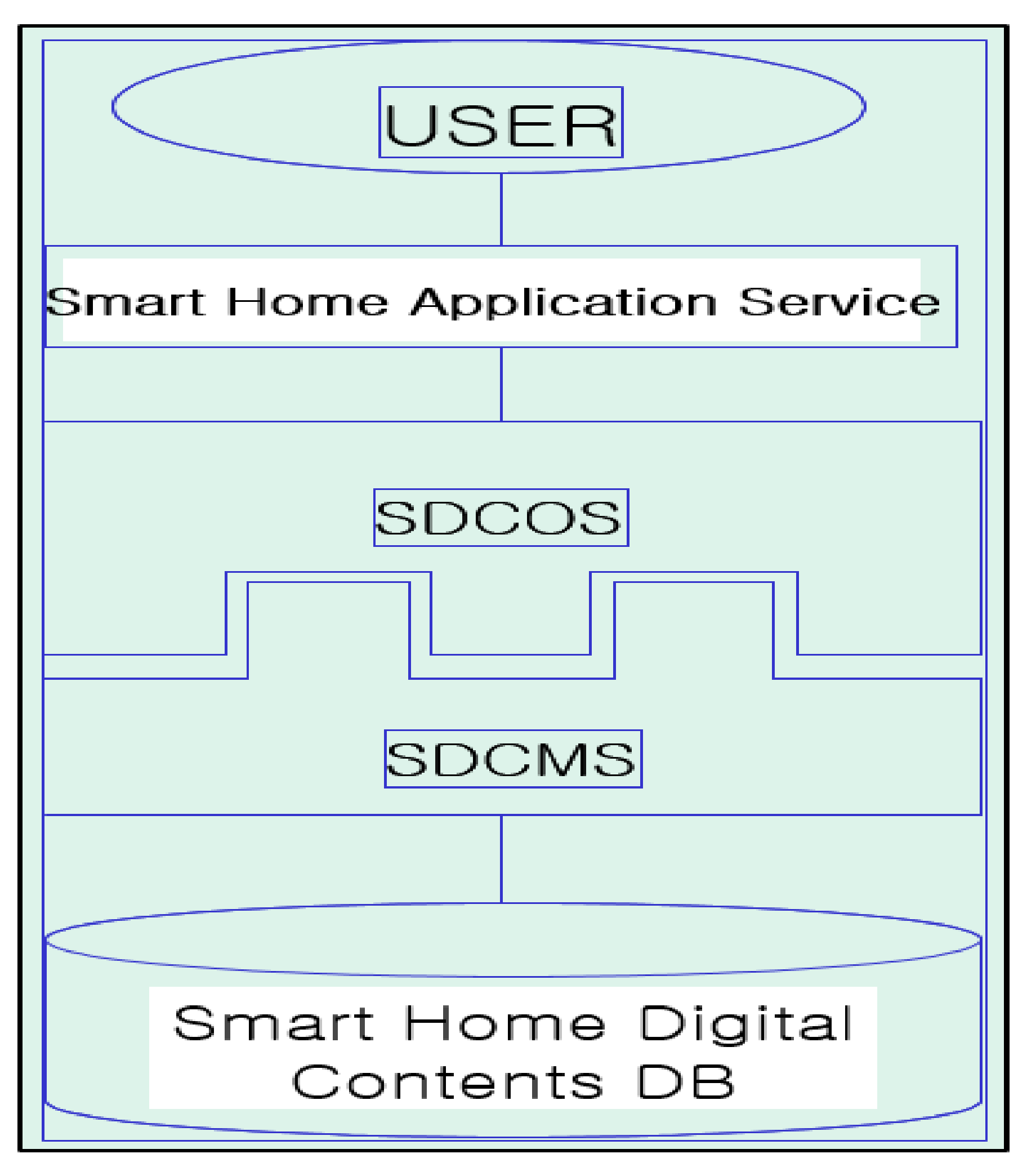
SDCMOS consists of three layers: application service, Smart Home digital contents management and operation system (SDCOS), and Smart Home digital contents management system (SDCMS) [29].
Figure 2 shows the architecture diagram of SDCMOS. When a user requests information using the Smart Home application service module, SDCOS supports the operation of the Smart Home service effectively through the search, contents edit, and control of the requested information. SDCMS connects the request information received from SDCOS to the database, finds the corresponding contents result, and transmits it to SDCOS [30].
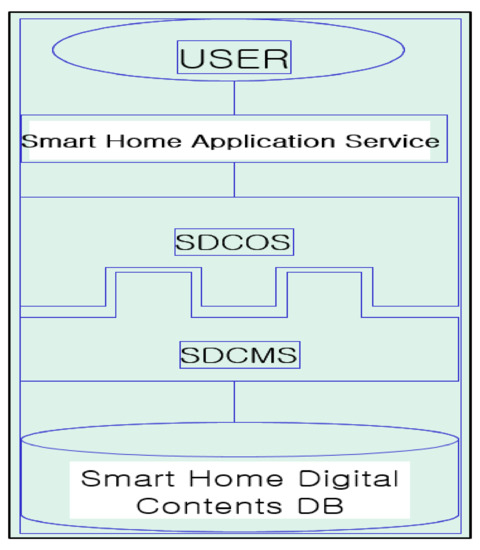
Figure 2.
3-layer conceptual diagram of SDCMOS.
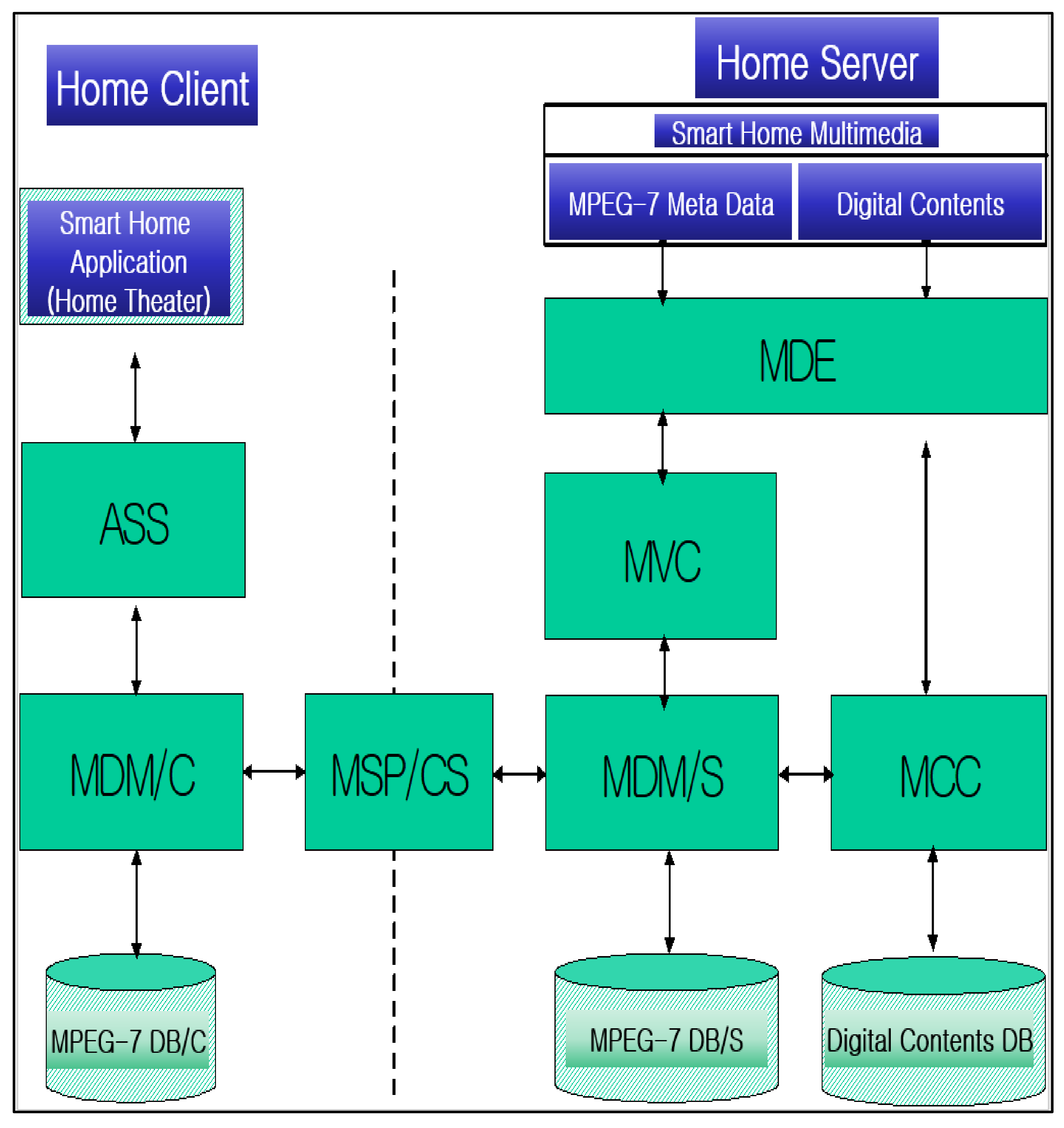
Figure 3 shows the overall system architecture diagram of the Smart Home digital contents management and operation system (SDCMOS: Smart Home Digital Contents Management and Operation System) that SDCMS and SDCOS are interworking to develop. MDM/C, MDM/S, MSP/CS, and MVC are SDCMS components, and MDE, MCC, and ASS are SDCOS components [31].
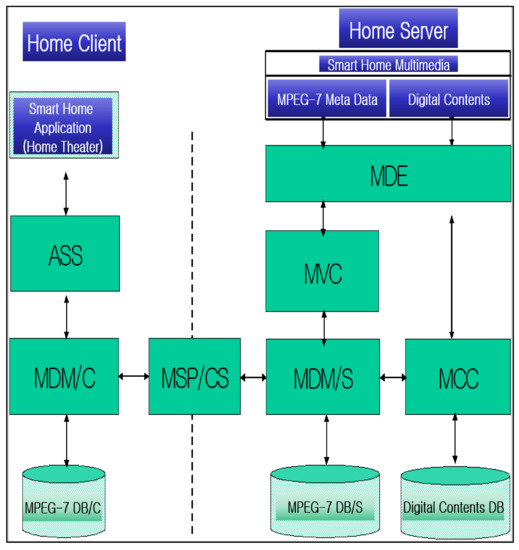
Figure 3.
Architecture diagram of Smart Home digital contents management and operation system (SDCMOS).
3.1. SDCOS (Smart Home Digital Contents Operation System)
SDCOS consists of three functions:
- *
- A function responsible for editing multimedia contents;
- *
- A function to control contents according to the operating characteristics of various media;
- *
- A function that supports the effective operation of Smart Home service.
These functions are developed into three subsystems.
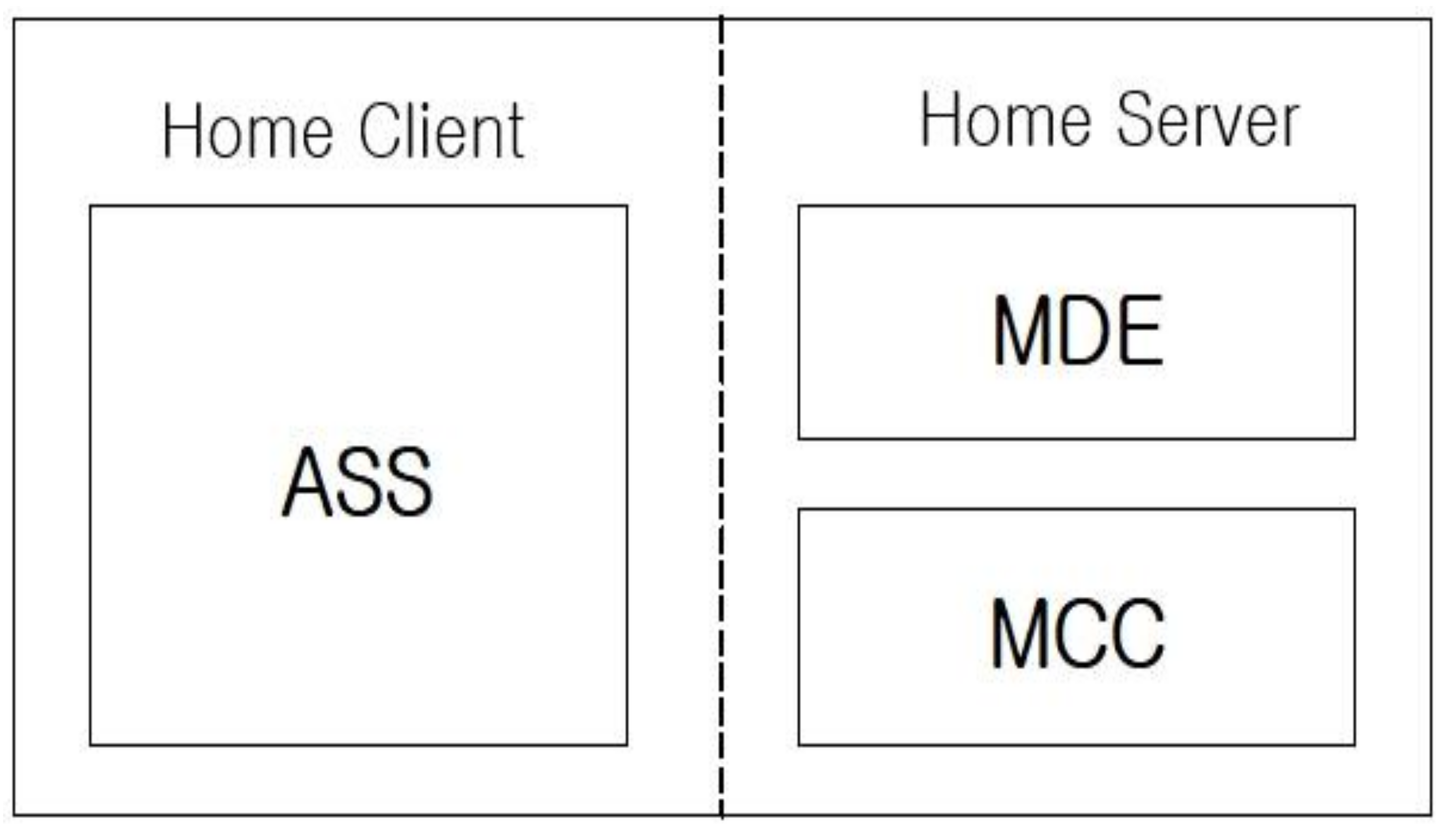
Figure 4 shows the architecture diagram for three subsystems.
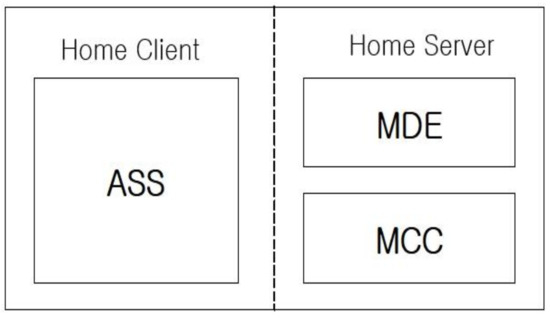
Figure 4.
Architecture diagram of SDCOS layer.
The Multimedia Data Editing Subsystem (MDE) is a multimedia data edit subsystem in charge of editing multimedia contents. The Multimedia Contents Control Subsystem (MCC) is a multimedia contents control subsystem that controls contents suitable for the operation characteristics of various media. ASS (Application Service Support Subsystem) is an application service support subsystem that supports the operation of the Smart Home service effectively [32]. The application service layer is a test bed that checks and improves the functions of the upper layers, the SDCMS and SDCOS layers. It is built on top of SDCMOS to develop various new types of home service. These MDE, MCC, and ASS subsystems are developed and then interlocked with SDCMS [33].
3.2. SDCMS (Smart Home Digital Contents Management System)
SDCMS consists of three functions:
- *
- A function to manage MPEG-7 database in home-server–home-client environment;
- *
- A function to check XML Schema supporting MPEG-7 and validation of XML document;
- *
- A function that processes the synchronization of MPEG-7 data between the client and the server.
These functions are developed into three subsystems.
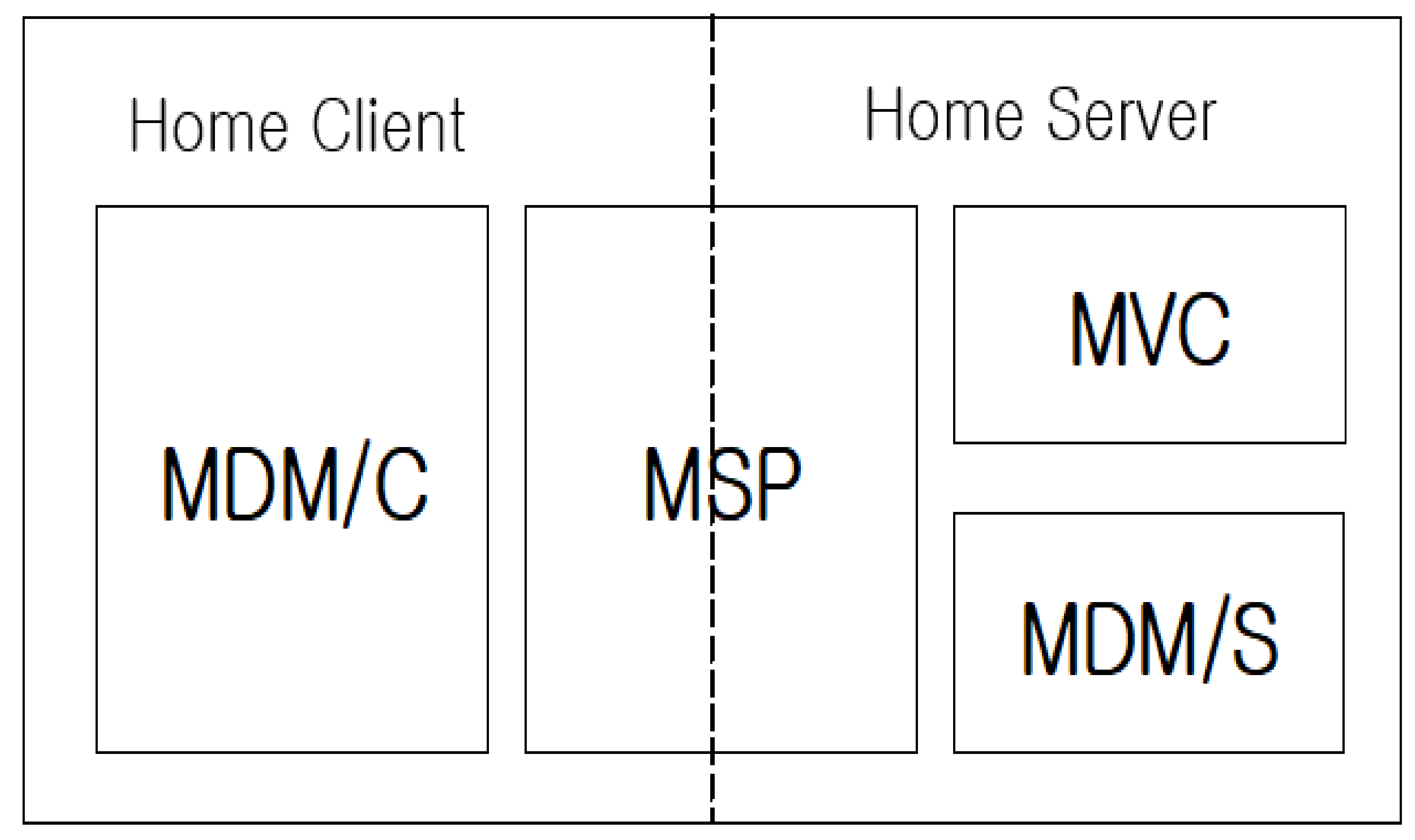
Figure 5 shows the architecture diagram for the three subsystems. MDM (MPEG-7 Data Management Subsystem) is an MPEG-7 data management subsystem and is client-based and server-based. The client receives the data provided by the server and provides them to the user. On the server basis, MPEG-7 data provided by Smart Home digital contents DB are transmitted and provided to the client [34]. MVC (MPEG-7 Validation Checking Subsystem) performs validation checks for XML documents based on the MPEG-7 schema. Checked validation data are stored in DB through server-side MDM. MSP (MPEG-7 Data Synchronize Processing Subsystem) is a subsystem that processes MPEG-7 data synchronization between home client and home server. MDM and MSP operate as a cooperative work type between home server and home client [35]. In the case of MDM, the home server has the full functions of a general database management system, but the home client has only essential functions for the embedded system environment. That is, MDM/C is run on the home client and MDM/S runs on the home server. In this case, MDM/C is basically a subset of MDM/S. MSP functions appear as the same type on both sides. That is, MSP/C and MSP/S have the same function and work cooperatively at the same level [36].
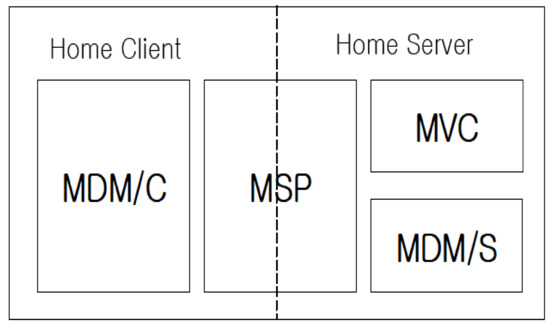
Figure 5.
Architecture diagram of SDCMS layer.
4. Implementation of SDCMOS
Implementation of SDCMOS used the method of integrating and extending existing research results. MDM implementation extended Sleepycat’s Berkeley DB XML, an existing embedded XML DBMS, to enable MPEG-7 MDS management, and MVC implementation extended Apache’s Xerces, an existing XML parser, to handle MPEG-7 MDS. MSP improved ETRI’s SyncML framework, which is the existing SyncML process device, to enable MPEG-7 data synchronization process, and MDE, MCC, and ASS were also implemented to extend existing technology to link with MPEG-7 [37].
4.1. Implementation of SDCMS
SDCMS consists of four types: MPEG-7 Data Management Subsystem (MDM), MPEG-7 Validation Checking Subsystem (MVC), MPEG-7 Data Synchronize Processing Subsystem (MSP), and MPEG-7 Data Management Subsystem/Client (MDM/C). It is composed of subsystems [38].
4.1.1. MDM
MDM stores and manages MPEG-7 data in the home-client–home-server type and consists of four modules.
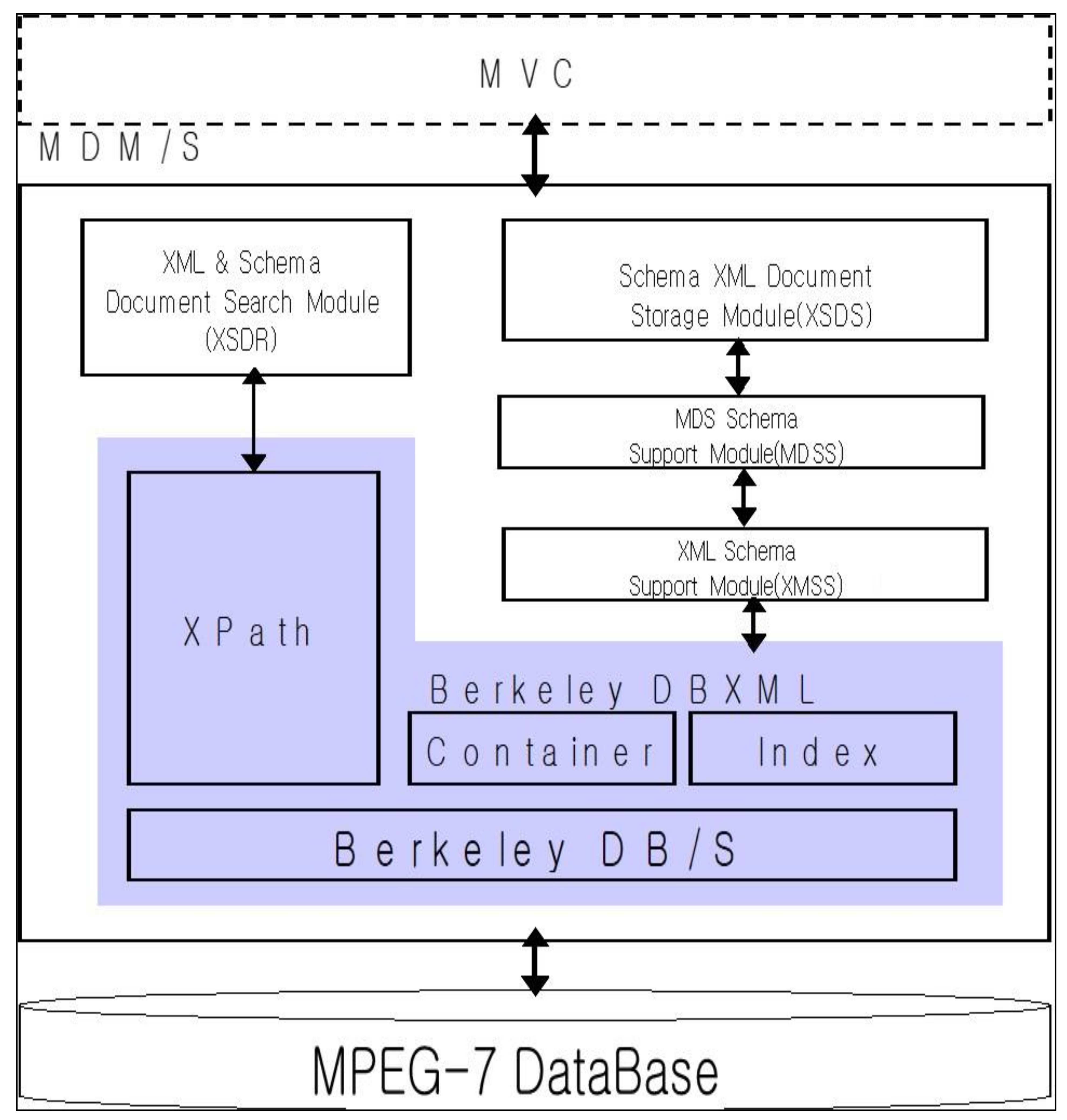
Figure 6 shows the component modules of the MDM subsystem.
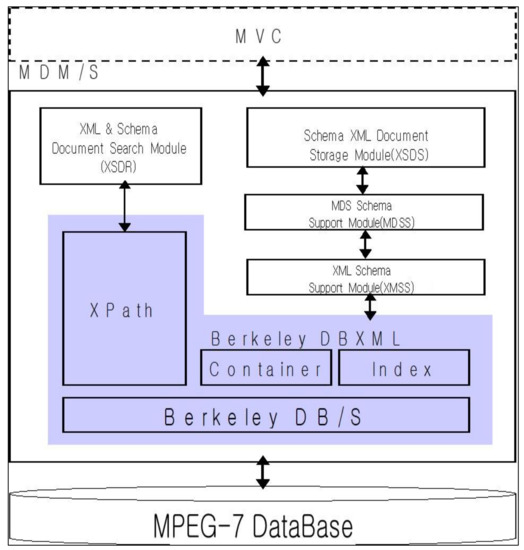
Figure 6.
MDM subsystem configuration module.
XSDS (XML Schema Document Storage Module) stores and manages various multimedia data types and MPEG-7 schema as XML document types in Berkeley DB XML. XSDR (XML Schema Document Retrieve Module) supports the function to search XML documents suitable for each MPEG-7 schema. MDSS (Media Description Schema Supporting Module) manages storage for the MDS Schema among MPEG-7 schema documents to be stored. XMSS (XML MPEG-7 Schema Supporting Module) manages storage for the MPEG-7 schema [39].
4.1.2. MVC
MVC checks the validation of the XML schema and XML document supporting MPEG-7. We devised a method to check the validation of MPEG-7 Schema and MPEG-7 document with various datatypes. MVC consists of 4 modules.
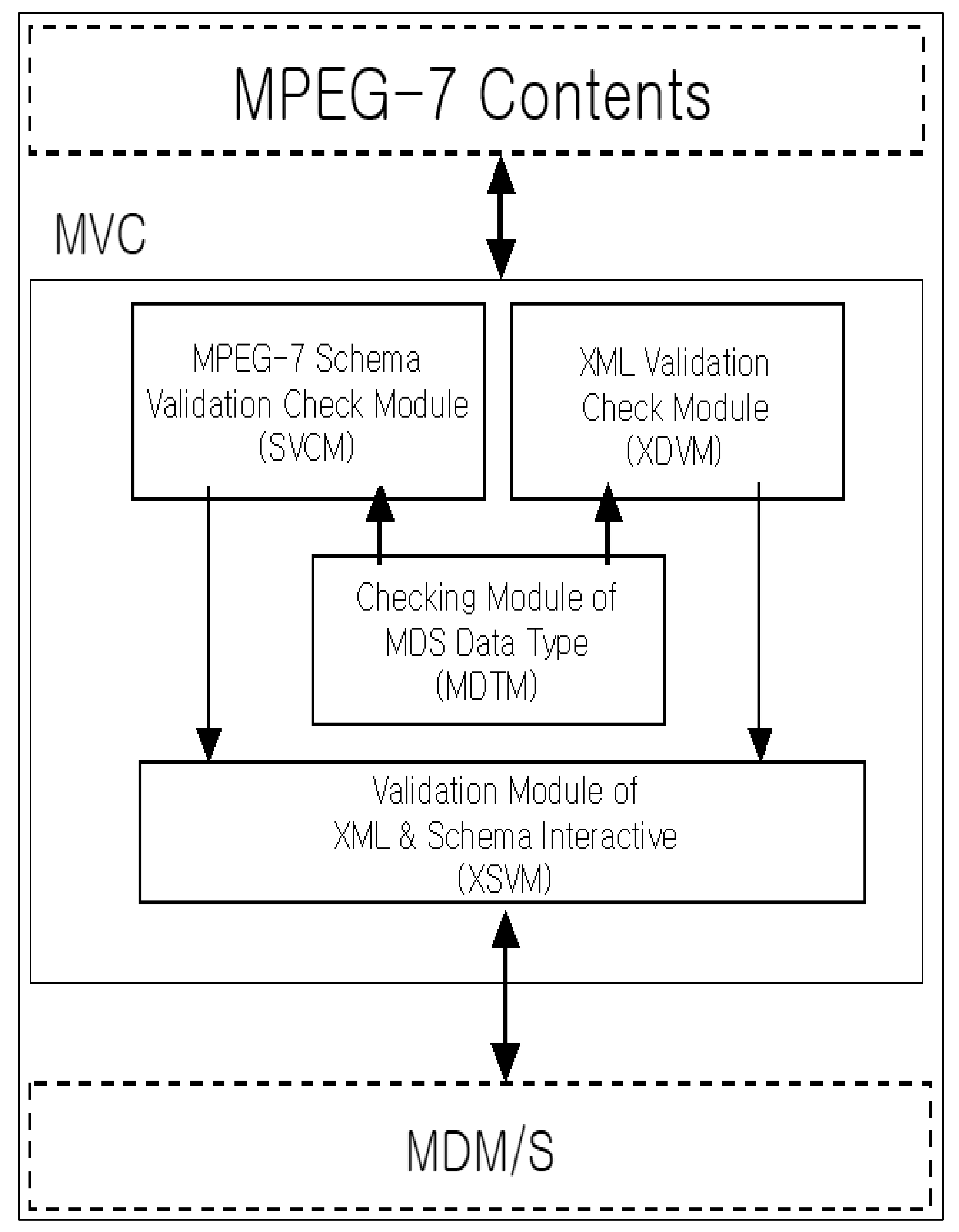
Figure 7 shows the constituent modules and relationships of MVC.
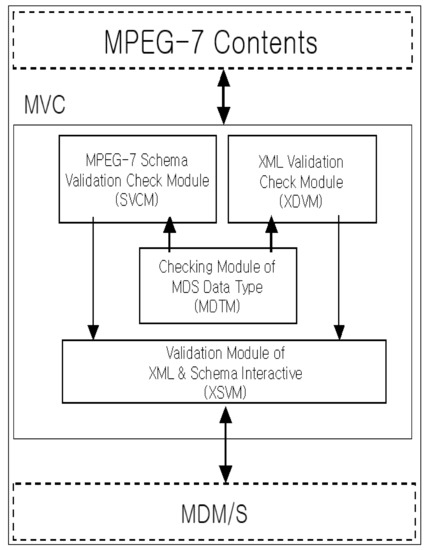
Figure 7.
MVC subsystem construction module.
MDTM checks the datatype of multimedia metadata provided by MPEG-7 MDS. SVCM checks validation for XML Schema of MPEG-7 data. XDVM checks validation for the XML document of MPEG-7 data. XSVM checks the validation between the XML document and XML Schema of MPEG-7 data [40].
4.1.3. MSP
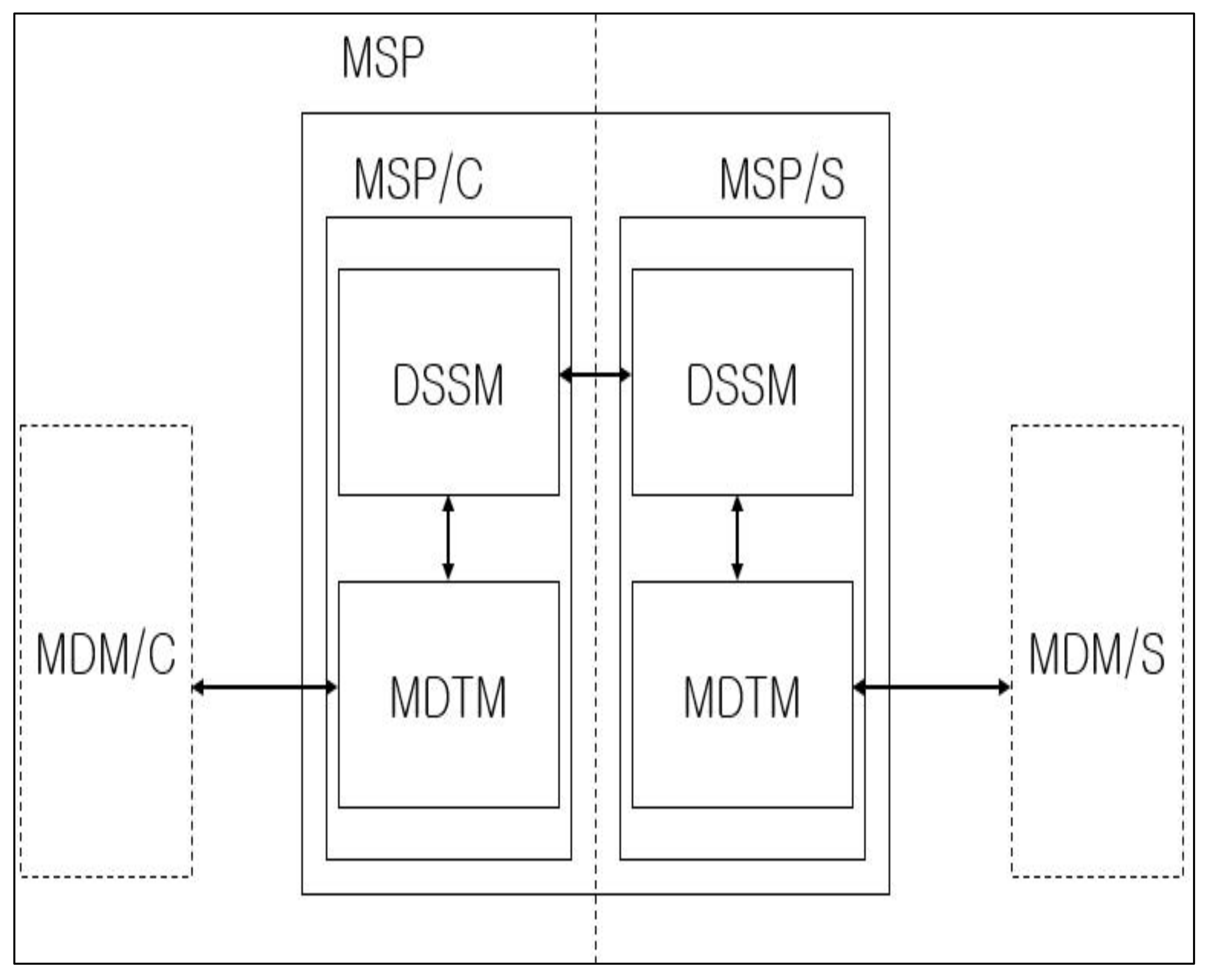
MSP supports the synchronization of MPEG-7 data by extending the SyncML function in consideration of the MDS datatype. MSP consists of two modules: MDTM and DSSM.
Figure 8 shows the constituent modules of MSP and their interrelationships. MDTM plays a role in transmitting MPEG-7 data searched according to the request of the home client. DSSM plays a role in supporting data synchronization between home client and home server.
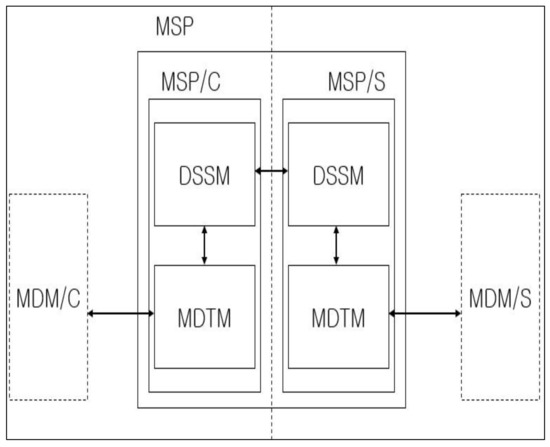
Figure 8.
Construction module of MSP subsystem.
4.1.4. MDM/C
MDM/C was developed to systematically self-manage MPEG-7 data provided by the home server. MDM/C consists of four modules: XSDS/C, XSDR/C, MDSS/C, and XMSS/C. XSDS/C is for storing MPEG-7 data provided from the home server. XSDR/C is for searching the stored MPEG-7 data [41]. MDSS/C supports the MDS schema. XMSS/C supports the XML schema. Each of these modules basically has a function similar to the home server side, but it was implemented to only consist of the basic functions of the DBMS by considering the resource limitations in the functions of the underlying database as much as possible.
4.2. Implementation of SDCMS
SDCOS consists of three subsystems: a Multimedia Data Editing Subsystem (MDE), a Multimedia Contents Control Subsystem (MCC), and an Application Service Support Subsystem (ASS).
4.2.1. MDE
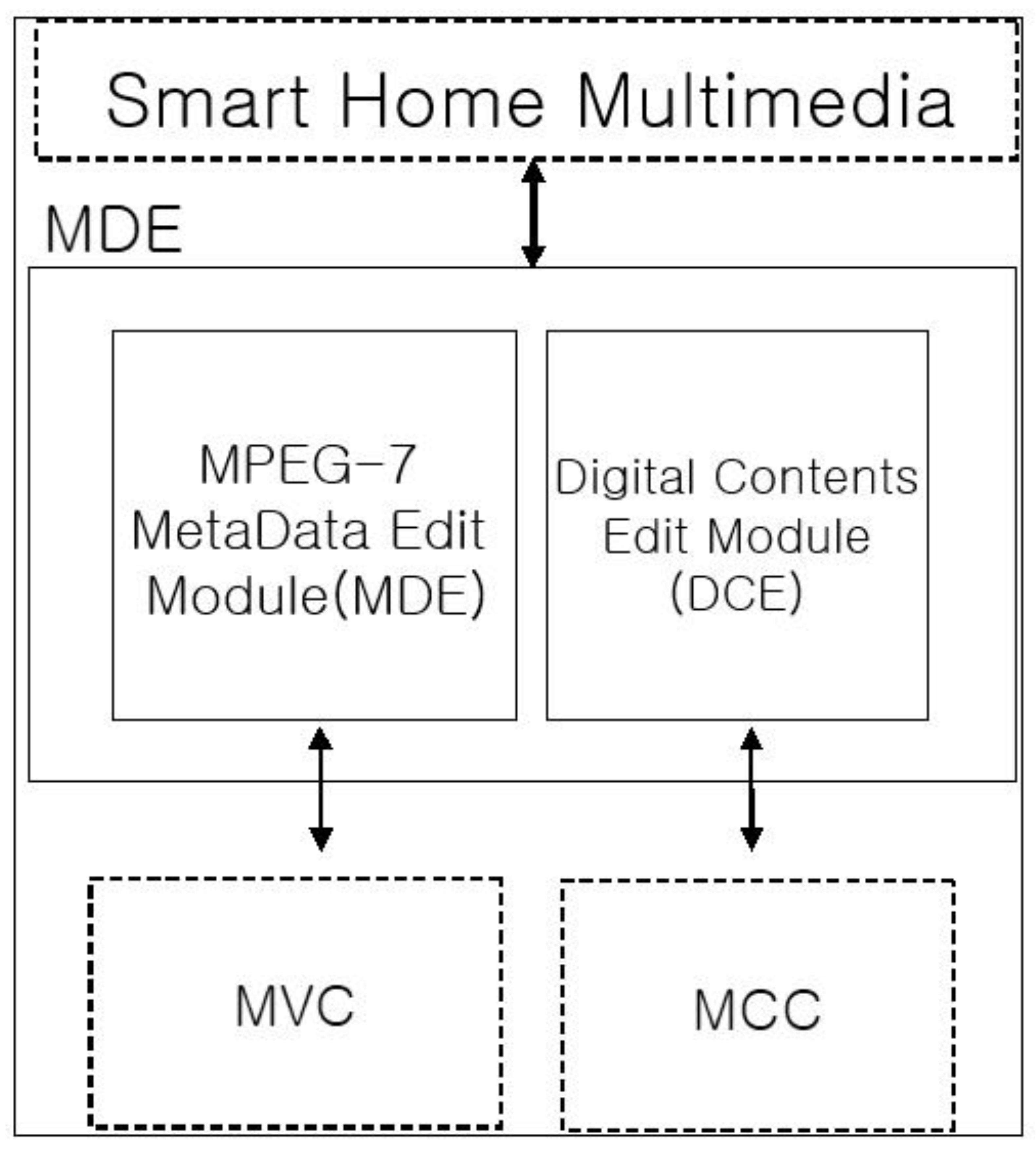
MDE has an edit function of Smart Home digital data. MDE consists of two modules: MDE (MPEG-7 MetaData Edit Module) and DCE (Digital Contents Edit Module).
Figure 9 shows the constituent modules and relationships of MDE.
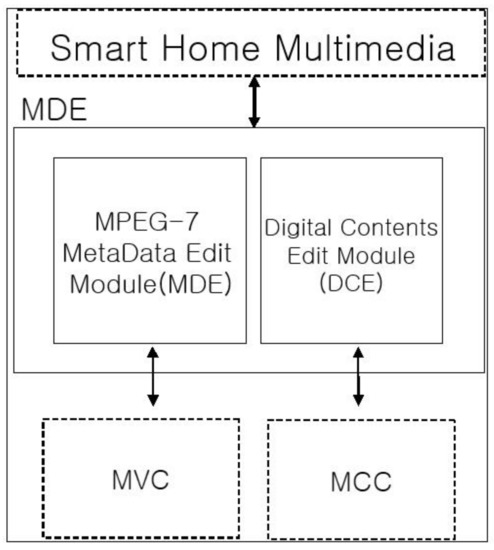
Figure 9.
Construction module of MDE subsystem.
MDE is for editing MPEG-7 metadata and DCE is for editing Smart Home digital contents. MDE interacts with MVC and DCE interacts with MCC.
4.2.2. MCC
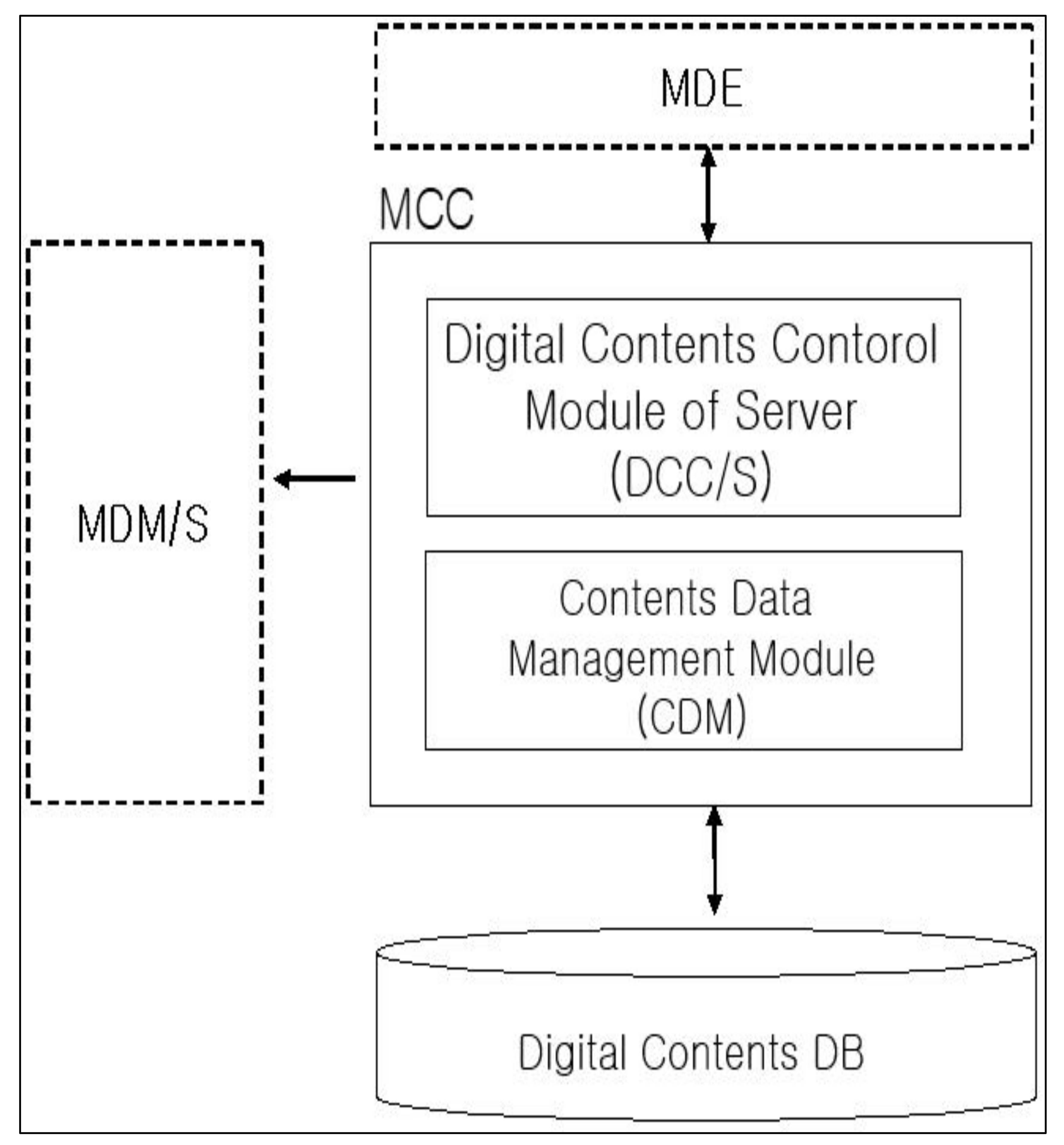
MCC is responsible for the control function of Smart Home digital data. MCC consists of two modules: DCC/S (Digital Contents Control/Server) and CDM (Contents Data Management).
Figure 10 shows the constituent modules and relationships of MCC. DCC/S is a module for managing digital contents in home server, and CDM is a module for managing contents data. DCC/S receives and controls contents from MDE, and CDM stores and manages contents data in database [42].
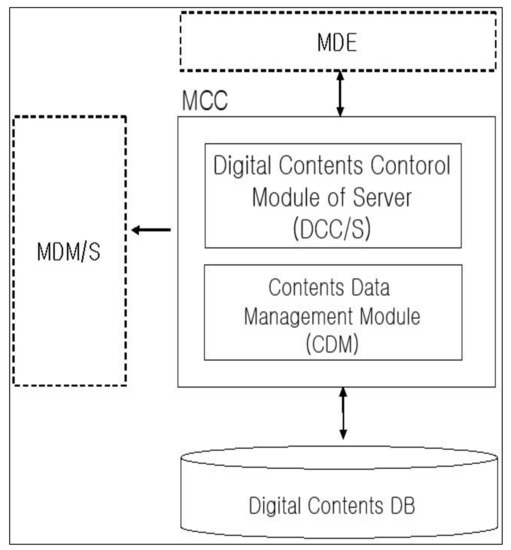
Figure 10.
Construction module of MCC subsystem.
4.2.3. ASS
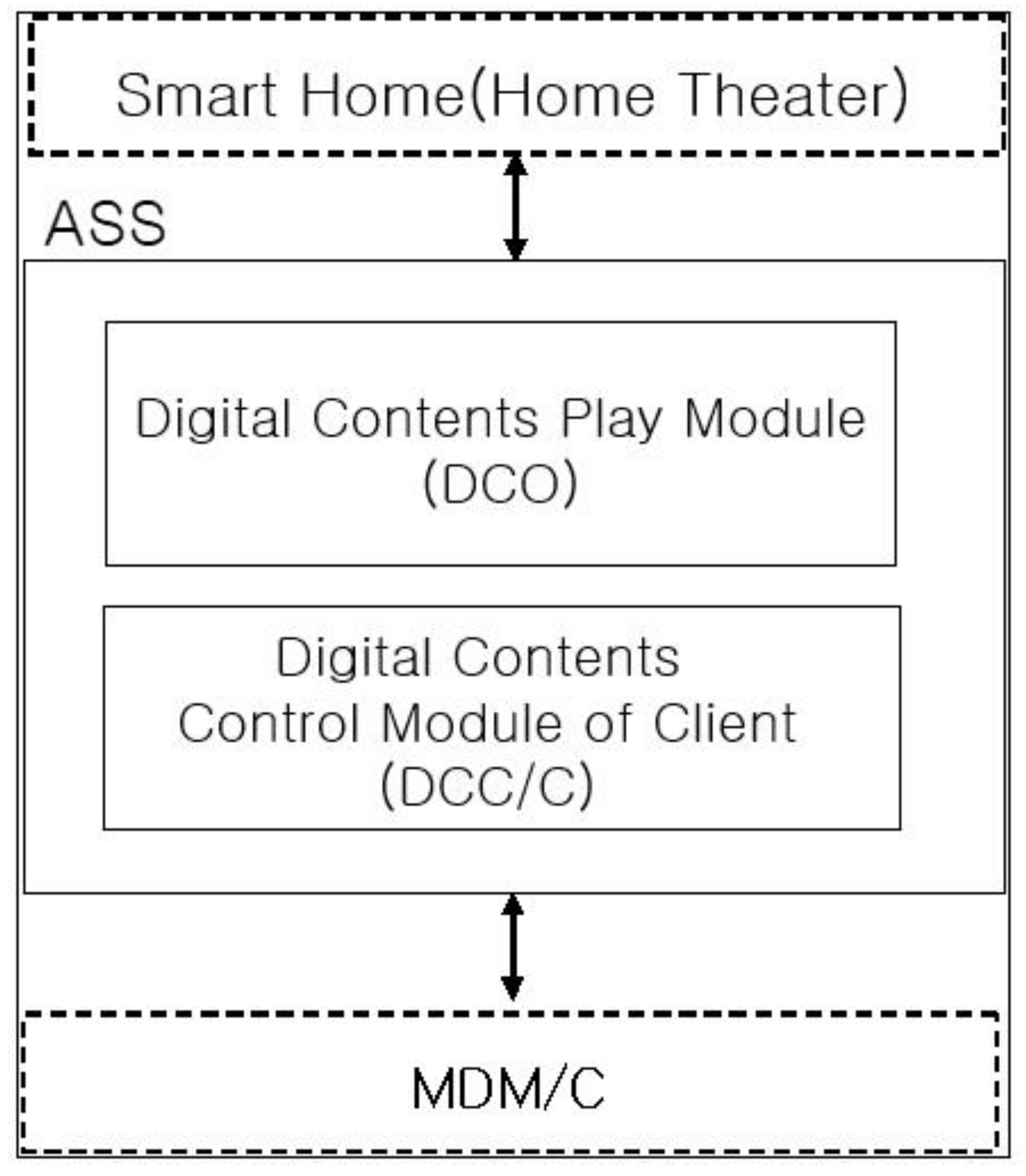
ASS supports the effective development of Smart Home applications. ASS consists of two modules: DCO (Digital Contents Operation) and DCC/C (Digital Contents Control/Client).
Figure 11 shows the constituent modules and relationships of ASS. DCO is to drive digital contents in home client, and DCC/C is to manage digital contents in home client.
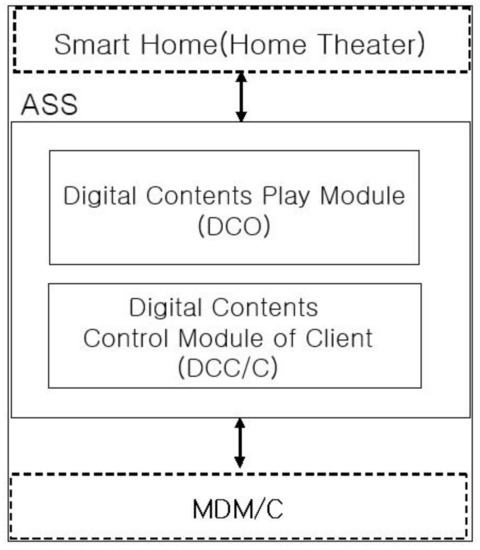
Figure 11.
Construction module of ASS subsystem.
4.3. Implementation of SAS (Smart Home Application Service)
SAS consists of two or more applications such as Home Theater and Home Classroom. SAS is linked to function check of SDCMOS and deriving new home service application. Through this application system construction, SDCMOS leads the new home service direction [43].
4.4. SDCMOS Case
When a user requests information through the smart home application service, SDCOS accesses the SDCMS DB and searches for the relevant information. If there is no relevant information, the relevant contents are found through search and are stored in the DB.
Figure 12 shows a part of a typical multimedia contents segment. It shows the process of classifying the searched contents and storing them in the DB.
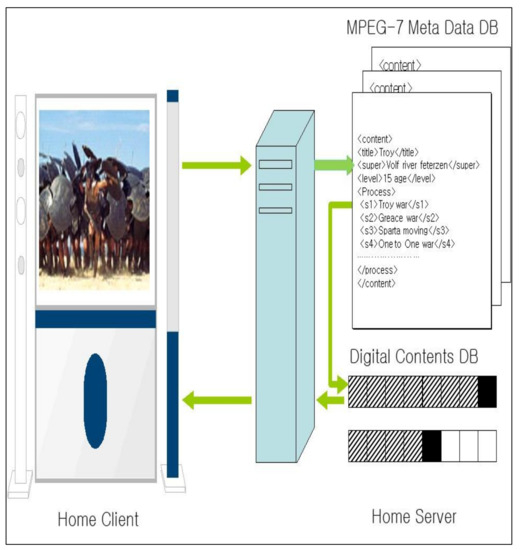
Figure 12.
Establishment of Smart Home service (Home Theater).
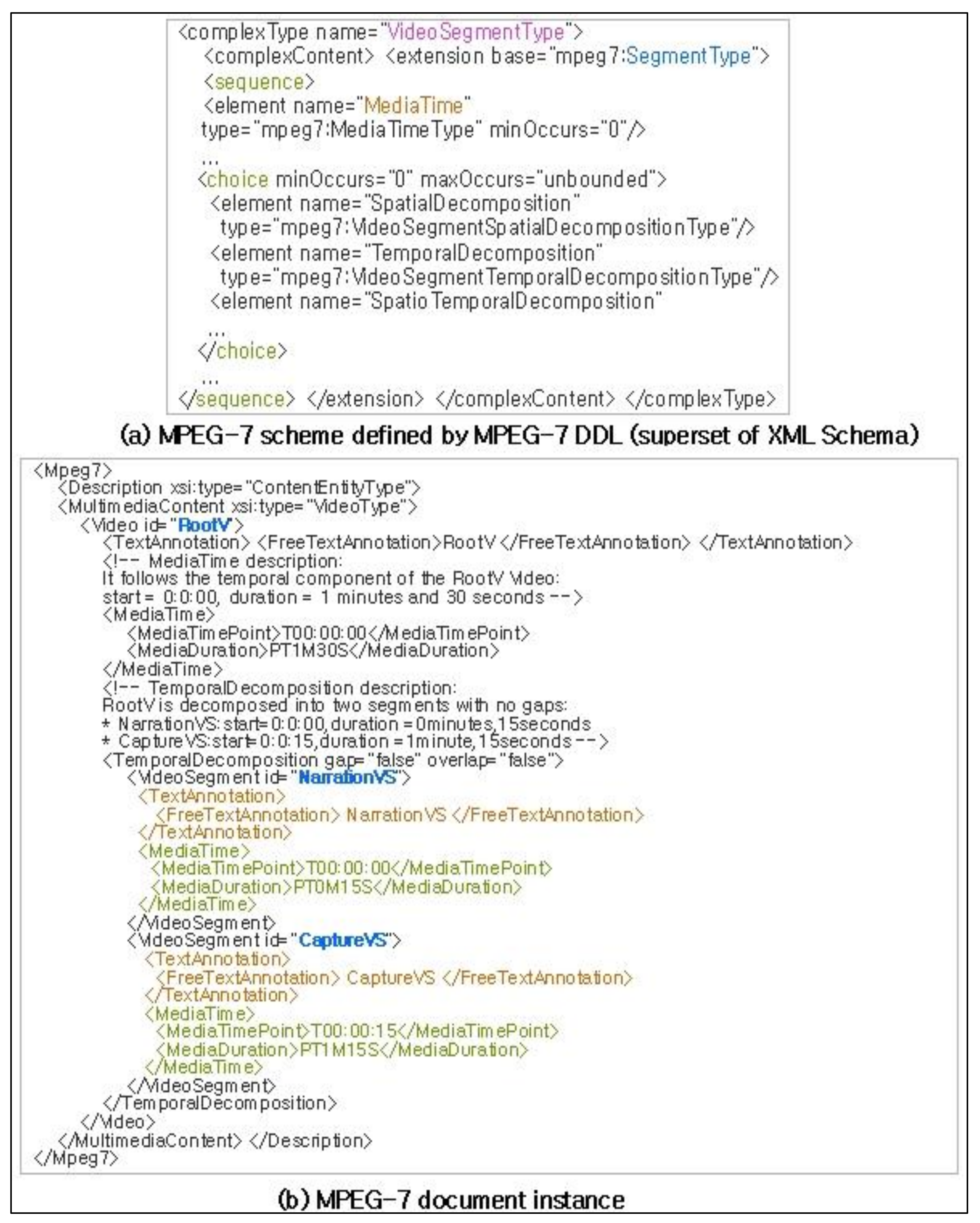
Figure 13 shows multimedia contents segment information as an MPEG-7 document. It is a process of bringing desired multimedia contents to home client and managing it by using MPEG-7 data based on XML Schema.
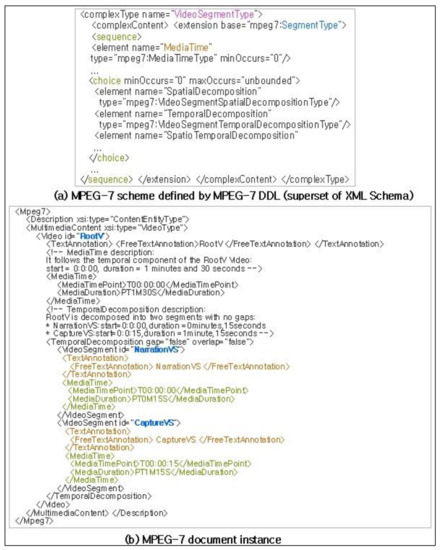
Figure 13.
Example of MPEG-7 metadata.
Figure 13a defines the MPEG-7 schema using MPEG-7 DDL, which is a super set of XML schema language, and creates an MPEG-7 document instance according to this schema. The MPEG-7 schema utilizes a predetermined datatype for various media reflecting the characteristics of multimedia. Figure 13b shows the conversion of MPEG-7 schema to MPEG-7 document instance [44,45,46,47].
5. Conclusions and Future Challenges
In this paper, a real-time multimedia process can be effectively supported in home service of wireless LAN environment. In addition, efficient search for necessary multimedia information is possible even in home appliances away from the home server. In addition, digital library and remote education were made possible in the Smart Home environment of wireless LAN. SDCMOS was developed to be usable in parts such as biomedical image search, history museums, art exhibition halls, tourism information, geographic information, and e-commerce.
The multimedia service market using MPEG-7 is increasing exponentially. Therefore, as a future task of this paper, it should be able install MPEG-7 in all kinds of embedded systems that want to service multimedia in a wireless LAN environment. This should be developed as an independent embedded MPEG-7 data process system.
Funding
This research received no external funding.
Institutional Review Board Statement
Not applicable.
Informed Consent Statement
Not applicable.
Data Availability Statement
The study did not report any data.
Conflicts of Interest
The authors declare no conflict of interest.
References
- Yilmaz, S.; Rinaldi, A.; Patel, M.H. DSM interactions: What is the impact of appliance energy efficiency measures on the demand response (peak load management)? Energy Policy 2020, 139, 301–315. [Google Scholar] [CrossRef]
- Lisa, C.; Mattia, M.; Charalampos, Z. A review of data sources for electric vehicle integration studies. Renew. Sustain. Energy Rev. 2021, 151, 111518. [Google Scholar]
- Uyi, E.K.; Hooi, L.H.; Russell, S. The moderating role of energy consumption in the carbon emissions-income nexus in middle-income countries. Appl. Energy 2020, 261, 114215. [Google Scholar]
- Andrew, H.; Danielle, S.; Beatrice, M.S.; Robert, B. A probabilistic fleet analysis for energy consumption, life cycle cost and greenhouse gas emissions modelling of bus technologies. Appl. Energy 2020, 261, 114422. [Google Scholar]
- Henrich, C.P.; Angelakis, V.; Suppan, S.; Fischer, K.; Oikonomou, G.; Tragos, E.Z.; Rodriguez, R.D.; Mouroutis, T. RERUM: Building a Reliable IoT upon Privacy- and Security- enabled Smart Objects. In Proceedings of the 2014 IEEE Wireless Communications and Networking Conference Workshops (WCNCW), Istanbul, Turkey, 6–9 April 2014. [Google Scholar]
- Hwang, Y.H. IoT Security & Privacy: Threats and Challenges. IST-Africa Week Conference (IST-Africa). In Proceedings of the 1st ACM Workshop on IoT Privacy, Trust, and Security, Singapore, 14 April 2015. [Google Scholar]
- Jiang, D.; Shiwei, C. A study of information security for M2M of IOT. In Proceedings of the 2010 3rd International Conference on Advanced Computer Theory and Engineering(ICACTE), Chengdu, China, 20–22 August 2010. [Google Scholar]
- Li, G. Android Handout; Electronic Industry Press: Beijing, China, 2013. [Google Scholar]
- Lu, X.; Liu, Y.; Wang, X. Design of Intelligent Home System Based on Internet of Things. Telev. Technol. 2013, 24, 43–48. [Google Scholar]
- Liu, C.; Zhang, Y.; Zhang, H. A Novel Approach to IoT Security Based on Immunology. In Proceedings of the 2013 Ninth International Conference on Computational Intelligence and Security, Emeishan, China, 14–15 December 2013. [Google Scholar]
- Pohls, H.C.; Angelakis, V.; Suppan, S.; Fischer, K.; Oikonomou, G.; Tragos, E.Z.; Rodriguez, Z.D.; Mouroutis, T. RERUM: Building a Reliable IoT upon Privacy- and Security- enabled Smart Objects. In Proceedings of the Wireless Communications & Networking Conference Workshops, Istanbul, Turkey, 6–9 April 2014; IEEE: Piscataway, NJ, USA, 2014. [Google Scholar]
- Yukitake, T. Innovative Solutions toward Future Society with AI, Robotics, and IoT. 2017. Available online: https://doi.org/10.23919/vlsic.2017.8008499 (accessed on 4 March 2022).
- Miettinen, M.; Marchal, S.; Hafeez, I.; Frassetto, T.; Asokan, N.; Sadeghi, A.-R.; Tarkoma, S. IoT Sentinel: Automated Device-Type Identification for Security Enforcement in IoT. In Proceedings of the 2017 IEEE 37th International Conference on Distributed Computing Systems (ICDCS), Atlanta, GA, USA, 5–8 June 2017; pp. 2511–2514. [Google Scholar]
- Mahmoud, R.; Yousuf, T.; Aloul, F.; Zualkernan, I. Internet of things (IoT) security: Current status, challenges and prospective measures. In Proceedings of the 2015 10th International Conference for Internet Technology and Secured Transactions (ICITST), London, UK, 14–16 December 2015. [Google Scholar]
- Pacheco, J.; Hariri, S. IoT Security Framework for Smart Cyber Infrastructures. In Proceedings of the 2016 IEEE 1st International Workshops on Foundations and Applications of Self* Systems (FAS*W), Augsburg, Germany, 12–16 September 2016; pp. 242–247. [Google Scholar]
- Ren, Z.; Wang, M.; Wang, P. Principle and Application of Embedded Real-time Operating System μCOS-I; Beijing Aerospace University Press: Beijing, China, 2009. [Google Scholar]
- Riahi, A.; Challal, Y.; Natalizio, E.; Chtourou, Z.; Bouabdallah, A. A Systemic Approach for IoT Security. In Proceedings of the 2013 IEEE International Conference on Distributed Computing in Sensor Systems, Cambridge, MA, USA, 20–23 May 2013. [Google Scholar]
- Stergiou, C.; Psannis, K.E.; Kim, B.G.; Gupta, B. Secure integration of IoT and Cloud Computing. Future Gener. Comput. Syst. 2016. [Google Scholar] [CrossRef]
- Wang, J. Design and Implementation of Smart Home System Based on NB-Iot Wireless Sensor Network; Donghua University of Technology: Shanghai, China, 2013. [Google Scholar]
- Wurm, J.; Hoang, K.; Arias, O.; Sadeghi, A.-R.; Jin, Y. Security analysis on consumer and industrial IoT devices. In Proceedings of the 2016 21st Asia and South Pacific Design Automation Conference (ASP-DAC), Macao, China, 25–28 January 2016; pp. 519–524. [Google Scholar]
- Lu, Y.; Xu, L.D. Internet of Things (IoT) cybersecurity research: A review of current research topics. IEEE Internet Things J. 2019, 6, 2103–2115. [Google Scholar] [CrossRef]
- Xu, T.; Wendt, J.B.; Potkonjak, M. Security of IoT systems: Design challenges and opportunities. In Proceedings of the 2014 IEEE/ACM International Conference on Computer-Aided Design (ICCAD), San Jose, CA, USA, 2–6 November 2014. [Google Scholar]
- Yang, D. Design and implementation of intelligent home control system based on Internet of Things. Electron. World 2012, 21, 16–17. [Google Scholar]
- Zhang, Y.; Shen, Z.; Chen, Y. Principle and Application of ARM Cortex-M3 Microntroller; Electronic Industry Press: Beijing, China, 2013. [Google Scholar]
- Zhou, L. lpc1700 Series Microcontroller; Guangzhou Zhou Ligong Microcontroller Development Co., Ltd: Guangzhou, China, 2012. [Google Scholar]
- Zhang, Z.-K.; Cho, M.C.Y.; Wang, C.-W.; Hsu, C.-W.; Chen, C.-K.; Shieh, S. IoT Security: Ongoing Challenges and Research Opportunities. In Proceedings of the 2014 IEEE 7th International Conference on Service-Oriented Computing and Applications, Matsue, Japan, 17–19 November 2014. [Google Scholar]
- Qureshi, K.N.; Din, S.; Jeon, G.; Piccialli, F. Internet of vehicles: Key technologies, network model, solutions and challenges with future aspects. IEEE Trans. Intell. Transp. Syst. 2020, 22, 1777–1786. [Google Scholar] [CrossRef]
- Qureshi, K.N.; Bashir, F.; Iqbal, S. Cloud computing model for vehicular ad hoc networks. In Proceedings of the 2018 IEEE 7th International Conference on Cloud Networking (CloudNet), Tokyo, Japan, 22–24 October 2018; pp. 1–3. [Google Scholar]
- Idrus, S.M.; Butt, R.A.; Qureshi, K.N.; Ali Shah, P.M.; Zul, N. An energy efficient cyclic sleep control framework for ITU PONs. Opt. Switch Netw. 2017, 27, 7–17. [Google Scholar]
- Ahmed, M.S.; Mohamed, A.; Homod, R.Z.; Shareef, H.; Sabry, A.H.; Khalid, K.B. Smart plug prototype for monitoring electrical appliances in home energy management system. In Proceedings of the 2015 IEEE Student Conference on Research and Development (SCOReD), Kuala Lumpur, Malaysia, 13–14 December 2015; pp. 32–36. [Google Scholar]
- Bouakkaz, A.; Mena, A.J.G.; Haddad, S.; Ferrari, M.L. Efficient energy scheduling considering cost reduction and energy saving in hybrid energy system with energy storage. J. Energy Storage 2021, 33, 101887. [Google Scholar] [CrossRef]
- Ahmed, M.S.; Mohamed, A.; Shareef, H.; Homod, R.Z.; Ali, J.A. Artificial neural network based controller for home energy management considering demand response events. In Proceedings of the 2016 International Conference on Advances in Electrical, Electronic and Systems Engineering (ICAEES), Putrajaya, Malaysia, 14–16 November 2016; pp. 506–509. [Google Scholar]
- Chellamani, G.K.; Chandramani, P.V. An optimized methodical energy management system for residential consumers considering price-driven demand response using satin bowerbird optimization. J. Electr. Eng. Technol. 2020, 15, 955–967. [Google Scholar] [CrossRef]
- Uribe, O.H.; Martin, J.P.; Garcia-Alegre, M.C.; Santos, M.; Guinea, D. Smart building: Decision making architecture for thermal energy management. Sensors 2015, 15, 27543–27568. [Google Scholar] [CrossRef] [Green Version]
- Gandsas, A.; McIntire, K.; Palli, G.; Park, A. Live Streaming Video for Medical Education: A Laboratory Model. J. Laparoendosc. Adv. Surg. Tech. 2002, 12, 377–382. [Google Scholar] [CrossRef] [PubMed]
- Qureshi, K.N.; Iftikhar, A.; Bhatti, S.N.; Piccialli, F.; Giampaolo, F.; Jeon, G. Trust management and evaluation for edge intelligence in the Internet of Things. Eng. Appl. Artif. Intell. 2020, 94, 103756. [Google Scholar] [CrossRef]
- Qureshi, K.N.; Bashir, F.; Abdullah, A.H. Provision of security in vehicular ad hoc networks through an intelligent secure routing scheme. In Proceedings of the 2017 International Conference on Frontiers of Information Technology (FIT), Islamabad, Pakistan, 18–20 December 2017; pp. 200–205. [Google Scholar]
- AlFaris, F.; Juaidi, A.; Manzano-Agugliaro, F. Intelligent homes’ technologies to optimize the energy performance for the net zero energy home. Energy Build 2017, 153, 262–274. [Google Scholar] [CrossRef]
- Meana-Llorián, D.; García, C.G.; Garcia-Bustelo, B.C.P.; Lovelle, J.M.C.; Garcia-Fernandez, N. IoFClime: The fuzzy logic and the Internet of Things to control indoor temperature regarding the outdoor ambient conditions. Future Gener. Comput. Syst. 2017, 76, 275–284. [Google Scholar] [CrossRef] [Green Version]
- Al-Ali, A.R.; Zualkernan, I.A.; Rashid, M.; Gupta, R.; Alikarar, M. A smart home energy management system using IoT and big data analytics approach. IEEE Trans. Consum. Electron. 2017, 63, 426–434. [Google Scholar] [CrossRef]
- Asif, S.; Ambreen, K.; Iftikhar, H.; Khan, H.N.; Maroof, R.; Javaid, N. Energy management in residential area using genetic and strawberry algorithm. In Lecture Notes on Data Engineering and Communications Technologies, Proceedings of the 21st International Conference on Network-Based Information Systems (NBiS-2018), Bratislava, Slovakia, 5–7 September 2018; Springer: Berlin/Heidelberg, Germany; pp. 165–176.
- Becker, V.; Kleiminger, W.; Coroama, V.C.; Mattern, F. Estimating the savings potential of occupancy-based heating strategies. Energy Inform. 2018, 1, 35–54. [Google Scholar] [CrossRef]
- Rathore, P.; Rao, A.S.; Rajasegarar, S.; Vanz, E.; Gubbi, J.; Palaniswami, M. Real-time urban microclimate analysis using Internet of Things. IEEE Internet Things J. 2018, 5, 500–511. [Google Scholar] [CrossRef]
- Arya, A. Energy saving in distribution system using Internet of Things in Smart Grid environment. Int. J. Comput. Digit. Syst. 2019, 8, 158–165. [Google Scholar] [CrossRef]
- Filho, G.P.R.; Villas, L.A.; Gonçalves, V.P.; Pessin, G.; Loureiro, A.A.F.; Ueyama, J. Energy-efficient smart home systems: Infrastructure and decision-making process. Internet Things 2019, 5, 153–167. [Google Scholar] [CrossRef]
- Liu, Y.; Yang, C.; Jiang, L.; Xie, S.; Zhang, Y. Intelligent edge computing for IoT-based energy management in smart cities. IEEE Netw. 2019, 33, 111–117. [Google Scholar] [CrossRef]
- Chekired, D.A.; Khoukhi, L.; Mouftah, H.T. Decentralized cloud-SDN architecture in smart grid: A dynamic pricing model. IEEE Trans. Ind. Inform. 2017, 14, 1220–1231. [Google Scholar] [CrossRef]
Publisher’s Note: MDPI stays neutral with regard to jurisdictional claims in published maps and institutional affiliations. |
© 2022 by the author. Licensee MDPI, Basel, Switzerland. This article is an open access article distributed under the terms and conditions of the Creative Commons Attribution (CC BY) license (https://creativecommons.org/licenses/by/4.0/).