


Abstract
Stakeholder perspectives on supply chain risks (SCRs) play a crucial role in managing risks, achieving goals, and determining performance of an organization. Herein, the role of stakeholders and the complex interrelationships between stakeholders are important factors influencing the supply chain, and, besides, failure to manage SCRs can result in significant losses for the organization. In West Papua, study related to stakeholder perspectives on the risks in palm oil SCs is still limited. Accordingly, to fill this gap, this paper aims to identify SCRs from the perspectives of key stakeholder of the Indonesian palm oil industry in West Papua. This study employs qualitative research methods. Key risks in the palm oil supply chain (SC) were identified from semi-structured interviews with 64 key stakeholders across 25 different stakeholder groups, using NVIVO software for thematic analysis. The results show that the palm oil SC in West Papua has five tiers and five distribution channels of material, information, and financial flows. Public and private stakeholders identified in palm oil SCs play crucial roles in determining palm oil operations in West Papua. Herein, there are seven identified groups as key stakeholders with thirty-two major risks in the SC. Smallholder farmers are exposed to most of the risks, followed by plantation companies, local cooperatives, and government agencies. Interestingly, risks in palm oil SCs in West Papua are predominantly caused by conflicts of interest among multiple stakeholders.
1. Introduction
Stakeholders play a crucial role in determining the performance of an organization [1,2]. Therefore, organizations that manage their stakeholders effectively have an advantage in achieving organizational goals [3,4]. Each organization, private, public, and non-profit, differs in the objectives pursued when running their business, but their respective activities require taking and reducing risks [5,6]. In this sense, risks can pose a threat that objectives will not achieve, so managing an organization means managing risks in such a way as to maximize the possibility of achieving goals [5].
In managing risks, stakeholder perspectives are essential to determine strategic steps that must be taken. At this point, Rivera-Camino (2007) [7] emphasize that stakeholder perspectives are critical in risk management because they can be used as a self-diagnostic tool to determine if a stakeholder’s attitude to risks is reactive or proactive. In line with that, Scolobig and Lilliestam (2016) [8] state that incorporating stakeholder perspectives into environmental decision-making in many countries is a legal requirement and is widely considered helpful because it can help increase decision legitimacy, likelihood of implementation and quality of outcomes, such as in disaster risk management, urban planning, waste management, and infrastructural projects. An example of research on stakeholder perspectives is a social network analysis (SNA) based stakeholder-associated risk analysis method used to assess and analyze the risks and their interactions in complex green building projects [9,10].
With the boom in stakeholder analysis and engagement research in the last decades [9], stakeholder engagement is critical to bridge the gap between academic knowledge production and application for environmental resources [11]. In this vein, Seghezzo et al. (2023) [11] state that a qualitative and quantitative protocol called the Q methodology is particularly suitable for addressing environmental planning and management issues by careful analysis of stakeholder perspectives.
In the context of the agribusiness supply chain (ASC), studies related to ASC risk are relatively new and still need further investigation [12]. In this sense, risks in the ASC are currently a significant business problem worldwide as globalization has affected every business, and SCRs have become a concern in logistics and other business processes [12]. Herein, supply chain risk (SCR) defines any risks for the information, material, and product flows from the original supplier to the end user’s delivery of the final product [13]. Further, risk in the ASC is one of the research areas related to supply chain risk management (SCRM) [12], whereas SCRM has been an essential research topic in the past two decades [14], transitioning from an emerging issue to a growing and broad research area [15,16,17,18]. Therefore, there is a need to conduct research related to ASC risk in the future, including research on SCRs from the perspectives of key stakeholders.
Research related to SCRs from the perspective of key stakeholders in the Indonesian palm oil industry in West Papua is based on previously conducted systematic literature studies [12]. According to Imbiri et al. (2021) [12], there are 60 risks in the ASC, which fall into three main categories: internal, external, and network. Based on the 60 risks identified in the ASC, studies were conducted to investigate this research topic, particularly in the context of the Indonesian palm oil industry in West Papua. The main reason for conducting this research is that palm oil SCs deal with various risks involving various supply chain stakeholders [12]. Moreover, although palm oil development in West Papua is aiming to regional economic growth and improve people’s welfare, its activities lead to a variety of risks that affect at least three main aspects, namely, economic, sociocultural, and environmental [19,20], such as ecological damage both ecologically and socially due to the conversion of forest areas into palm oil plantations resulting in loss of food sources and other raw materials of indigenous people [19,21,22]. Accordingly, it is crucial to understand these risks from key stakeholders’ perspectives in order to manage them.
Previous studies have been conducted and have primarily focused on the policy and development that must be carried out in Papua and West Papua [23], such as palm oil estate development in West Papua [24,25] and Papua [26]. However, the results of past studies do not specifically focus on stakeholders associated with the risks in palm oil SCs. Therefore, this shows that research related to stakeholders and risks in palm oil SCs in West Papua still needs to be completed. In this overview, research on the risks in palm oil SCs from stakeholder perspectives becomes essential for the West Papuan context because the entire region relies heavily on agribusiness as their livelihood. Accordingly, it is vital to research stakeholders and their risks in palm oil SCs in West Papua to fill this gap.
The result of this study is expected to contribute significantly to the development of palm oil SCs in West Papua in order to improve the welfare of the community and the regional economy and to be adopted and used in other regions in Indonesia and other developing countries that have similar socioeconomic and geographical characteristics. In doing so, this study aims to address the following fundamental questions: How are the distribution channels of palm oil supply chains in West Papua organized? Who are the key stakeholders in palm oil supply chains in West Papua? And what are the risks they faced in the supply chain?
The remainder of this paper is organized as follows. The next section describes the review of literature in the research areas related to supply chain stakeholders and supply chain risks, including risks in palm oil SC. Section 3 discusses the methodology adopted in this study and then leads to the justification for the research. Section 4 presents the results and findings. Then, Section 5 and Section 6 discuss stakeholders and their risks in palm oil supply chains, and conclusions.
2. Literature Review
2.1. Supply Chain Stakeholders
Since Freeman (1984) [27] published his book Strategic Management: A Stakeholder Approach, the stakeholder theory has become necessary as it is widely used in public policy analysis, scientific studies, and publications [28,29,30]. Stakeholder theory perceives the relationship between management and stakeholder groups as one of the most vital functions of the organization [27]. Likewise, Rowley (1997) [28] state that stakeholder theory development has centered around two related streams, such as defining the stakeholder concept and classifying stakeholders that provide an understanding of individual stakeholder relationships. In this point, stakeholder concepts have been described, for instance, by Freeman (1984) [27] and PMI (2017) [31], emphasizing several essential aspects, such as that stakeholders can be individuals, groups, or organizations. Then, stakeholders can influence, be influenced by, or perceive themselves to be influenced by decisions, activities, or outcomes of a project, program, or portfolio.
However, Miles (2017) [32] states that stakeholder theory has reached maturity so that attention should logically shift from the ongoing debate around the definition of stakeholder to focus more on delineating the boundaries of stakeholder identification, which are aligned to context.
2.1.1. Stakeholders Classification
Identification and classification of stakeholders are two critical facets of stakeholder management [33]. In this overview, there are several terms used by scholars to classify stakeholders (see Table 1), such as primary and secondary stakeholders [34,35,36], ultimate and secondary stakeholders [37,38], and internal and external stakeholders [3,6,27,39,40,41,42].

Table 1.
Classifications of stakeholders.
According to Clarkson (1995) [34], primary stakeholder groups typically comprise shareholders and investors, employees, customers, and suppliers, together with what is defined as the public stakeholder group, such as the governments and communities that provide infrastructures and markets whose laws and regulations must be followed, and to whom taxes and other obligations may be due. Meanwhile, secondary stakeholder groups are defined as those who influence or affect or are influenced or affected by the corporation, but they are not engaged in transactions with the corporation and are not essential for its survival [34]. The author [34] explains that the media and various special interest groups are considered secondary stakeholders. They have the capacity to mobilize public opinion in favor of, or in opposition to, a corporation’s performance.
Furthermore, Cook (2017) [40] defines internal stakeholders as the internal parties that have a stake in an enterprise’s success, including the shareholders, the board of directors, the executive management, and the employees. Meanwhile, external stakeholders, such as the external parties that have a stake in an enterprise’s success, include customers and consumers, suppliers and service providers, civil society organizations, non-governmental organizations, government agencies, local community representatives, the media, and the environment [40]. Moreover, the author [40] states that external stakeholders share the objective of having businesses succeed in a manner that strengthens both the economy and civil society. These stakeholders can provide feedback on values and political, economic, and social considerations that an enterprise should integrate into its ethical identity [40].
In short, stakeholders can be divided into two, primary/ultimate/internal stakeholders and secondary/external stakeholders. The classification of stakeholders can be seen in Table 1.
2.1.2. Stakeholders in Palm Oil Supply Chains
According to various concepts and classifications of stakeholders, as provided in Section 2.1, stakeholders in palm oil supply chains can be understood in general as an individual, a group, an organization, an institution, an association, or an entity, that become involved in all businesses related to palm oil supply chains. They integrate into a network system that is connected directly (tangible) or indirectly (intangible) from upstream to downstream in order to distribute materials, goods, and information (including money) into the hands of customers. Moreover, they have influence in the decision-making process from planning and implementation to evaluation and control of the policy and the decision that influences them.
A summary of the existing literature about stakeholders in palm oil SCs is provided in Table 2.
Table 2.
Stakeholders in palm oil supply chains.
Table 2 shows that terms used to classify stakeholders in palm oil supply chains vary mainly depending on the research context. For instance, according to Nupueng, Oosterveer, and Mol (2022) [46], palm oil SC’s stakeholders are categorized as private and public stakeholders. Herein, the authors state that the private actors include non-governmental organizations (NGOs) and companies such as millers, refinery facilities, biodiesel plants, collectors, certification bodies, and local cooperatives. Meanwhile, Donofrio, Rothrock, and Leonard (2017) [47] explain that stakeholders in palm oil SCs are producers, processors, traders, manufacturers, and retailers. This classification is almost the same as Sukati et al. (2012) [43], who categorize stakeholders in palm oil SCs as producers, suppliers, transporters, warehouses, retailers, and customers. Therefore, to understand the supply chain, it is essential to be familiar with the supply chain context.
In summary, stakeholders in palm oil SCs can be divided into public and private. Herein, public stakeholders may include external/secondary stakeholders, such as government agencies, while private stakeholders may include both internal/primary and external/secondary stakeholders such as producers (e.g., smallholder farmers), suppliers (e.g., local cooperatives), transporters (e.g., collectors), warehouses, retailers, customers, NGOs, civil society organizations, local community representatives, and mass media.
2.2. Supply Chain Risks
Risk has always existed in supply chains and affects operations at different levels, such as business, supply chain, and network. Accordingly, supply chain risk management has been challenging, particularly during the last two decades [18]. In terms of defining the concept, there is no consensus on the definition of SCR and SCRM [51,52,53]. However, the construct SCR is based on Jüttner, Peck and Christopher (2003) [13] who explain in simpler terms that SCR refers to the possibility and effect of a mismatch between supply and demand. In this sense, the construct SCR points out the effect of uncertainty that causes disruptions and potential occurrence of an incident or failure in the entire flow of information, materials, services, and finances through a network of organizations (e.g., suppliers, manufacturers, logistics providers, wholesalers/distributors, and retailers) that aims to produce and deliver products or services for the consumers [12].
Shahbaz, Rm Rasi and Bin Ahmad (2019) [54] have extended the classification of SCR into seven categories: supply-side, process-side, demand-side, logistic-side, collaboration-side, financial-side, and environment-side risks. Moreover, SCR types can be divided into three categories: organizational risk or internal risk (e.g., process and control risks), network-related risk or risk within the supply chain (e.g., demand and supply risks), and environmental risk or risk in the external environment (e.g., natural disasters, war and terrorism, and political instability) [13,16,55,56].
Risks in Palm Oil Supply Chains
As the supply chain is a higher-level well-researched theoretical construct, agribusiness supply chains (ASCs), including the palm oil SC, presents a context or a particular instance of a supply chain. Therefore, risks in the palm oil SC can be understood from the constructs of risk in the ASCs. In this overview, understanding risks in the palm oil SC can refer to internal, external, and network risks in the ASC [12].
According to Andersen and Schrøder (2010) [57], internal risks are related to operational risks from the business’s internal organization, and their handling varies significantly according to the type of operation. Herein, internal risks that encompass organizational risk factors are divided into five sources of risk: supply, demand, process and control, logistical/infrastructural, and financial-side risks [12,15,17,58,59].
Meanwhile, the external risks are the risks derived from sources outside the supply chain over which an organization has little or no control, such as natural disasters (e.g., earthquakes and tsunamis), war, oil crises, terrorist attacks, outbreaks of disease, financial irregularities, crime, and rising custom duty [60]. In the agribusiness context, external risks that signify environmental risk factors can be divided into two types: man-made risks and natural disruptions [12,13,54,61,62].
Furthermore, network risks indicate network-related risk factors, including collaboration-related risks such as information flow and coordinating supply and demand [12,54,60,63]. In relation to the internal, external, and network risks, several scholars have stated several crucial risks in the palm oil SC. For instance, Anugerah et al. (2021) [64] state that the most dangerous risks in the palm oil plantation supply chain are unsafe and dangerous working environments, natural disasters, and unreliable transportation systems. Meanwhile, Hadiguna and Tjahjono (2017) [65] point out that the challenge faced by the palm oil industry is the integration of decision-making at the operational level. In this vein, the authors explain further that industry continues to face pressures because of the strict conditions imposed by predominantly international trading communities, and in some cases by environmental issues, both domestic and overseas. In line with this point, Marimin and Safriyana (2018) [66] state that when the productivity and export market are being increased, usually the negative impacts to sustainability issues (economic, social, and environmental aspects) will arise. A summary of the extant literature related to risks in palm oil SCs is provided in Table 3.
Table 3.
Risks in palm oil supply chains.
In summary, risks in palm oil SC can be divided into three categories, namely, internal, external, and network risks. Furthermore, as explained in Section 1, the study related to stakeholder perspectives on the risks in palm oil SCs in West Papua still needs to be completed. Based on the research gap and interest in identifying SCRs from the perspectives of key stakeholder of the Indonesian palm oil industry in West Papua, a literature review comprises several groups and themes to understand the current state of knowledge and research gaps. To address the research gap, the case study as the primary qualitative research method is employed and discussed in detail in the methodology.
3. Methodology
According to Creswell and Creswell (2018) [70], qualitative research is an approach to exploring and understanding the meaning individuals or groups ascribe to a social or human problem. The authors [70] also state that the research process involves eliciting questions and procedures, data are usually collected in participant settings, data analysis inductively builds from specific themes to general themes, and the researcher makes interpretations of the meaning of the data. Likewise, Yin (2016) [71] states that qualitative research studies the meaning of people’s lives in their roles in the real world, representing the views and perspectives of the participants in a study, explicitly paying attention to and taking into account real-world contextual conditions; contributing insights from existing or new concepts that can help explain social behavior and thinking; and recognizing the potential relevance of multiple sources of evidence rather than relying on a single source.
At this point, qualitative research involves the studied use and collection of a variety of empirical materials, which can include case studies, personal experiences, introspection, life stories, interviews, artifacts, and cultural texts and productions, along with observational, historical, interactional, and visual texts that describe routine and problematic moments and meanings in individuals’ lives [72]. Since this study aims to identify key stakeholder perspectives on the supply chain risks (SCRs) in the case of the Indonesian palm oil industry in West Papua, qualitative research using appropriate techniques is a valid and preferred approach to the research problem. Herein, the case study was adopted in this study as the primary qualitative method.
According to Eisenhardt (1989) [73], the case study is a research strategy that focuses on understanding the dynamics present within single settings. Case study research can involve either single or multiple cases and numerous levels of analysis [74,75]. At this point, case studies typically combine data collection methods such as archives, interviews, questionnaires, and observations, and then the evidence may be qualitative, quantitative, or both [73]. In this sense, multiple-case studies often contain both individual case studies and some cross-case chapters, so its goal is to build a general explanation that fits each individual case, even though the cases will vary in their details [74].
Furthermore, Yin [74] states that a case study is an empirical inquiry that investigates a contemporary phenomenon (the “case”) in depth and within its real-world context, especially when the boundaries between phenomenon and context may not be evident. Further, the author [74] states that a case study inquiry copes with the technically distinctive situation in which there will be many more variables of interest than data points and, as one result, relies on multiple sources of evidence, with data needing to converge in a triangulating fashion, and as another result benefits from the prior development of theoretical propositions to guide data collection and analysis. In this overview, doing case study research would be the preferred method, compared to the others, in situations when the main research questions are “how” or “why” questions; a researcher has little or no control over behavioral events, and the focus of the study is a contemporary (as opposed to entirely historical) phenomenon [74].
Moreover, Handfield and Melnyk (1998) [76] emphasize the nature of scientific knowledge and proceed through the stages of the theory-building process, such as techniques for transforming observations (discovery and description) into empirical generalizations. The authors also explain further that there are two major types of descriptions: taxonomies and typologies. Taxonomies deal with a categorical analysis of the data, such as what the phenomena are, while typologies describe what is the most important aspect of the phenomena or activity under consideration. The goal of each case is to provide a thorough and useful description of the event being studied. With the description completed, the map can be completed in order to identify key variables and issues involved without specifying the actual structure of the problem [76,77].
Based on the explanations above, this research uses a case study approach to study the key stakeholder perspectives on the supply SC in West Papua. This research was conducted in three representative regencies in West Papua, namely, Manokwari, Sorong, and Teluk Bintuni regencies. The reasons for choosing these regencies as representative areas is to study risks in palm oil SC in West Papua from stakeholder perspectives. First, these regencies have become target areas for the development of palm oil plantations and other superior commodities in West Papua since 1980 until now. Second, each regency has specific characteristics in terms of socioeconomic and geographical characteristics. Third, these regencies represent urban and rural areas that can be reached by using cars and boats. Fourth, there are local communities and migrants who are involved as smallholder plasma farmers and independent plasma farmers. Fifth, there are various crucial issues in these regencies that affect the development of palm oil plantations in West Papua. Moreover, the selection of these three regencies was considered appropriate according to the results of consultations and recommendations from the head of the plantation division, the Department of Food Plants, Horticulture, and Plantation, West Papua Province.
In addition to the reasons stated above, Indonesia and Malaysia are the two largest palm oil-producing countries globally [78] and the leading exporters of palm oil in the world [79]. As Indonesia is striving to maintain its position as the world’s largest palm oil producer [80], investment in palm oil plantations continues throughout Indonesia [24,81]. West Papua is one of the 34 provinces in Indonesia that contains globally significant reserves of biodiversity and supports unique traditional cultures [82]. Nevertheless, West Papua has become one of the targeted areas for palm oil development in Indonesia. Kesaulija et al. (2014) [24] state that the land of Papua is available for oil palm development compared to other provinces, such as Kalimantan and Sumatera, which are already too densely populated to accommodate new palm oil plantations. In this overview, the authors [24] state that palm oil companies wishing to expand their plantations immediately turned their attention to the remaining forests in the land of Papua.
The development of palm oil plantations in West Papua has been more than 40 years [21,23,24,25]. However, its activities lead to several major issues in economic, socio-cultural, and environmental aspects. Moreover, according to West Papua province’s mid-term development plan for 2017–2022, the province has the second highest poverty rate in Indonesia [27].
Furthermore, primary and secondary data for the research were collected. Types of primary data collected in this study are as follows: (1) profile of interviewees such as name, occupation, position in an organization, years of experience in palm oil SC, and profile of organization; (2) verifying and validating palm oil SC networks, such as the main actors in palm oil SC in West Papua, the institutions and supporting parties to palm oil SC in West Papua, and the main roles of each actor in the palm oil SC networks; and (3) risks associated with the palm oil SC in West Papua. Meanwhile, secondary data was obtained from participants in the form of reports and social media. These data and information were up-to-date and related to participants and palm oil SC in West Papua.
Primary data were collected by semi-structured interviews with 64 key stakeholders (see Table 4) from 25 different stakeholder groups (see Table 5), namely, smallholder farmers, including farmer associations and cooperatives (38 participants, 8 organizations), plantation companies (6 participants, 4 companies), NGOs (6 participants, 6 organizations), government agencies (10 participants, 6 divisions), and universities (4 participants, 1 institution). Herein, these stakeholders are categorized into five different groups. Group 1, smallholder farmers, which includes farmers, contract farmers (harvesting farmers, plant care farmers), the group leader of farmer, the leader of cooperative, chairman, and the secretary of Indonesian palm oil farmers association branch, West Papua, Manokwari, and the Sorong and Teluk Bintuni regencies. Group 2, plantation companies, includes the manager of environment and safety, the manager of compliance and sustainability, the plantation controller, the manager of operation and admin, and HRD. Group 3, NGOs, includes the chief, the team leader of the forest campaign, the coordinator of Papua and West Papua, and the manager of landscape West Papua. Group 4 is the government agencies, namely, the head of the plantation division, the head of the promotion division, the head of the environmental impact, the head of the one-stop integrated service, and the special economic zones. Group 5 is from the universities, such as experts in palm oil plantation, social, economics of agriculture, agricultural product marketing, and environmental studies of palm oil plantations. Further, the profiles of the interviewees can be seen in Table 4.
Table 4.
Profile of Interviewees.
Table 5.
Stakeholder groups.
Table 4 shows that most of the interviewees were from the private sector (78%), while 22% were from the public sector. Then, 17 interviewees (S1–S17) from West Papua Province, comprising representatives of farmers, farmer associations, farm workers, academics, NGOs, and government agencies at the provincial level. Herein, data and information gathered from these interviewees cover West Papua and three representative case study areas, the Manokwari, Sorong, and Teluk Bintuni regencies. The interviewees live in Manokwari regency, as Manokwari is the capital city of West Papua province. Meanwhile, from Manokwari regency, there are 13 interviewees (S18–S30) who represent farmers, cooperatives, farm workers, palm oil companies, and government agencies at the district level. Then, 15 interviewees (S31–S45) from Sorong regency represent farmers, farm workers, palm oil companies, and government agencies at the district level. Lastly, 19 interviewees (S46–S64) from Teluk Bintuni regency represent farmers, cooperatives, palm oil companies, and government agencies at the district level.
Furthermore, the experience possessed by the interviewees varied. Most of the interviewees have experience ranging from 20 to 40 years, mainly in palm oil SC and other aspects, such as agribusiness, agriculture, social economics of agriculture, and the environment. They have experience in the palm oil SC since the palm oil plantation was first developed in West Papua around the 1980s. Meanwhile, only a small number of farm workers have experience below five years because they are palm oil company contract workers to harvest and maintain the farm.
Furthermore, the 64 interviewees can be classified into groups of stakeholders (see Table 5).
Table 5 shows most of the interviewees from the private sector, namely, smallholder farmers, plantation companies, and NGOs, compared to the public sector, government agencies, and universities. However, only smallholder farmers and plantation companies are categorized as internal stakeholders. Meanwhile, NGOs, government agencies, and universities are classified as external stakeholders.
According to Saunders, Lewis, and Thornhill (2012) [83], semi-structured interviews can be used to collect qualitative data, where data collection is guided by predetermined themes, existing literature, or preliminary data. As this study adopted a qualitative research approach and data collection was informed by the initial literature review, semi-structured interviews were considered appropriate for this study. The use of semi-structured interviews allows researchers to collect specific information that can be compared while exploring other insights that emerge during the data collection process.
The interviews with key actors were conducted in three ways: by telephone, Zoom meetings, and face-to-face, based on the accessibility and preference of the interviewee. The mean interview duration was 45:56 min. The steps taken are through initial contact made by email and by telephone, and then followed up by sending documents (cover letters, consent forms, and question guides) via email directly to participants. Phone calls and face-to-face interviews were used mainly to reach respondents who did not have an email and were difficult to reach as they lived in remote areas. Interviews were conducted under the condition of anonymity and confidentiality. Interviews with participants were recorded, transcribed, and summarized to obtain details and accurate primary data records. At this point, the interview transcripts were carried out in three stages. First, the transcripts were created based on recorded interviews with the participants. At this stage, the transcript results were still rough because they contained Papuan dialects and used several analogies so that they needed refinement. The second stage was refining the transcripts by using the standard Indonesian language without changing its meaning so that it was easier to understand and translate. At this point, the transcripts were read several times thoroughly to ensure there was no change in their meaning. In the third stage, the refined transcripts in standard Indonesian were then translated into English.
Furthermore, all transcripts in English and data collected from secondary sources were coded using NVivo software (release 1.6.1. January 2022) developed by QSR International to organize the data and undertake the thematic analysis. According to Braun and Clarke (2020) [84], thematic analysis approaches typically acknowledge the potential for inductive (data-driven) and deductive (theory-driven) orientations to coding, capturing semantic and latent meanings, processes of coding and theme development, and the potential for some flexibility around the theory that frames the research. At this point, the authors have categorized the thematic analysis into three broad types, such as coding reliability approaches, reflexive approaches, and codebook approaches.
As the thematic analysis of this study was built based on data coding and potential themes from systematic literature review papers [12], five initial codes were created based on the literature and aligned with the research objectives such as key actors in palm oil SC, institutions and supporting parties in palm oil SC, main roles of each actor, supply chain of palm oil SC, and type and source of risks in palm oil SC.
4. Results and Findings
4.1. Stakeholder Perspectives on Key Stakeholders in Palm Oil SCs in West Papua
According to the constructs of stakeholders in palm oil SCs in Section 2.1.2, there are seven identified groups as key stakeholders in palm oil SCs in West Papua, and they can be divided into two: public and private stakeholders. Public stakeholders include government agencies and universities, while private stakeholders include smallholder farmers, local cooperatives, farmer associations, plantation companies, and NGOs. Moreover, based on the data provided in Table 5, most of key stakeholders are private stakeholders. Furthermore, the role of identified key stakeholders in palm oil SCs in West Papua based on interview findings can be seen in Table 6.
Table 6.
The role of key stakeholders in palm oil supply chains in West Papua.
Table 6 shows that each of the stakeholder groups has essential roles in palm oil SCs in West Papua. For instance, the role of smallholder farmers in managing oil palm plantations and selling fresh fruit bunches (FFB) production to plantation companies to ensure the continuity of the operation of FFB production processing mills. On the other hand, the role of the government is to monitor and supervise the company’s activities and to set FFB prices with plantation companies and farmer associations.
4.2. Stakeholder Perspectives on Palm Oil Supply Chains in West Papua
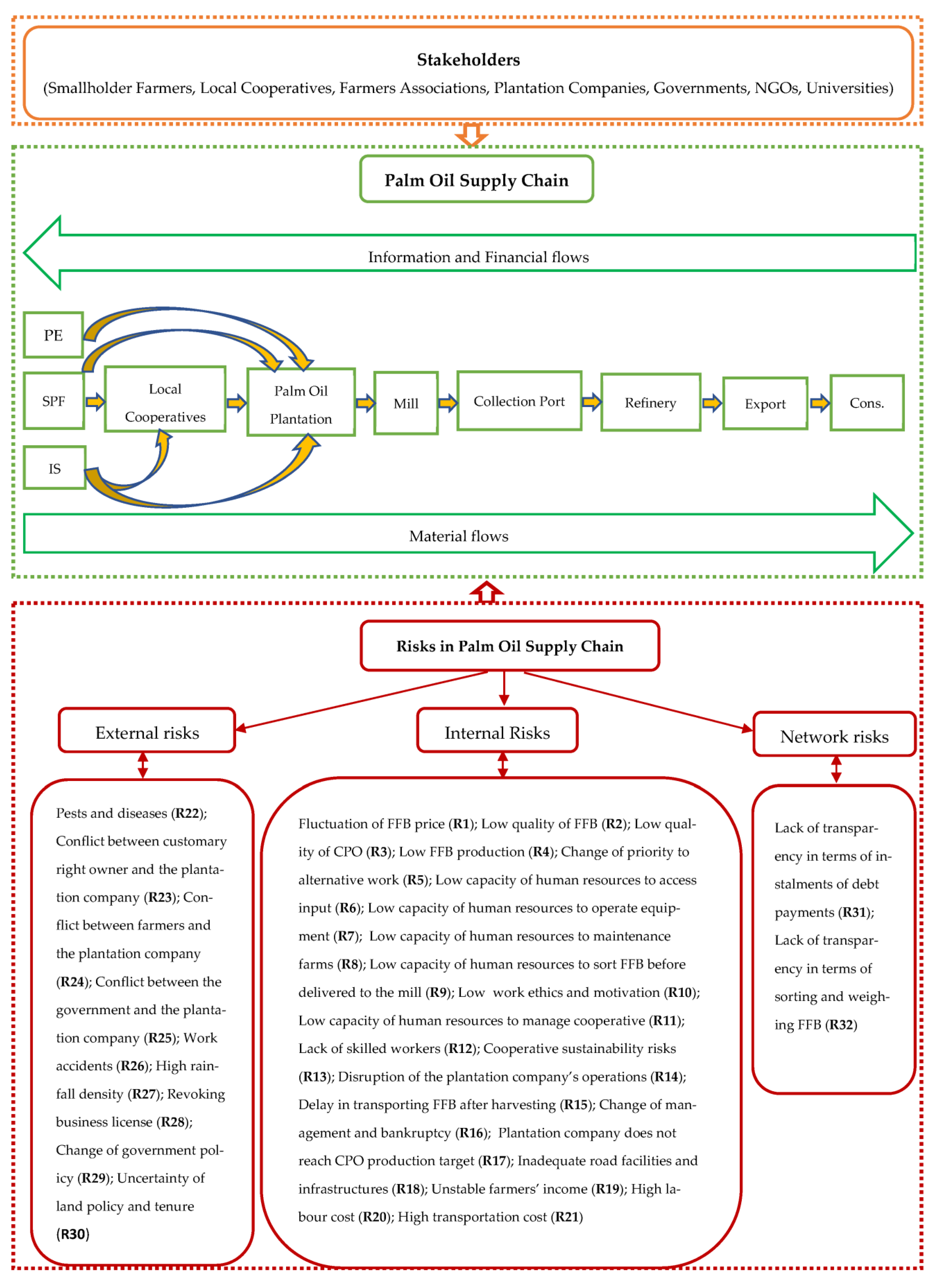
Interview findings showed that the palm oil supply chain in West Papua, in general, has five tiers, namely, private estate, smallholder plasma farmers, and independent smallholders (first tier), local cooperatives (second tier), palm oil plantations (third tier), mill (fourth tier), and collection port (fifth tier). Meanwhile, the next tiers, such as refinery, export, and consumers, are not included as these processes are carried out outside West Papua (see Figure 1).
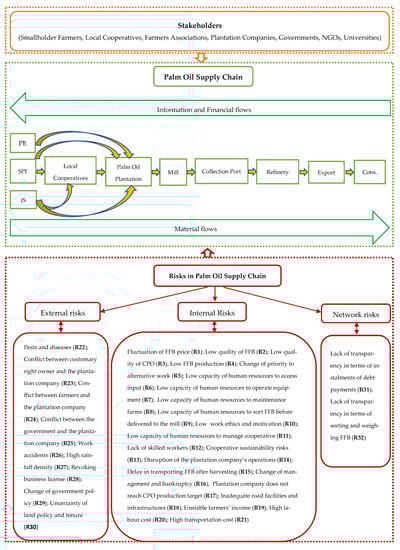
Figure 1.
Stakeholders and risks in the palm oil supply chain in West Papua (Reprinted/adapted with permission from Imbiri et al. (2021) [12]) Note: PE = Private estate; SPF = Smallholder plasma farmers, IS = Independent smallholders, Cons = Consumers.
Figure 1 shows that there are five distribution channels in the palm oil supply chain in West Papua, and they can be classified into direct and indirect. The direct distribution comprises the following channels: palm oil plantation gets the supply of products in the form of fresh fruit bunches (FFB) directly from the private estate (PE), smallholder plasma farmers (SPF), and independent smallholders (IS). The indirect distribution channel involves the collection of the FFB from smallholder plasma farmers (SPF) and independent smallholders (IS) through local cooperatives (LC). After collecting the FFB, the mill will further process the FFB into crude palm oil (CPO). Then, the CPO will be transported from the mill to storage tanks in the collection ports. After that, the CPO is shipped from the ports in West Papua to other provinces in Indonesia, such as Surabaya and Sumatera, for further processing of CPO either to be exported or to be the final and other derivative products to the hands of consumers.
In short, the main process in the palm oil supply chain is the distribution of FFB and CPO raw materials from palm oil plantations and mills until they are further processed into final products that are beneficial to consumers. Herein, there is a distribution of materials, information, and financials into the hands of consumers.
4.3. Stakeholder Perspectives on Risks in Palm Oil Supply Chains in West Papua
Categorization of risks in the palm oil SCs in West Papua based on the risk categories and risk sources in the ASC [12,85]. According to the authors [12], there are 60 risks in the ASC, which fall into three main categories: internal, external, and network risks. Then, internal risks are divided into five risk sources (supply, demand, process and control, logistical/infrastructural, and financial-side risks), external risks with two risk sources (man-made risks and natural disruptions), and network risks with one risk source (collaboration-related risks). Based on the 60 risks identified in the ASC, interviews were then conducted to obtain risks that could be applied to the palm oil supply chain in West Papua. Therefore, risks in the palm oil SCs can be divided into three categories: internal, external, and network risks.
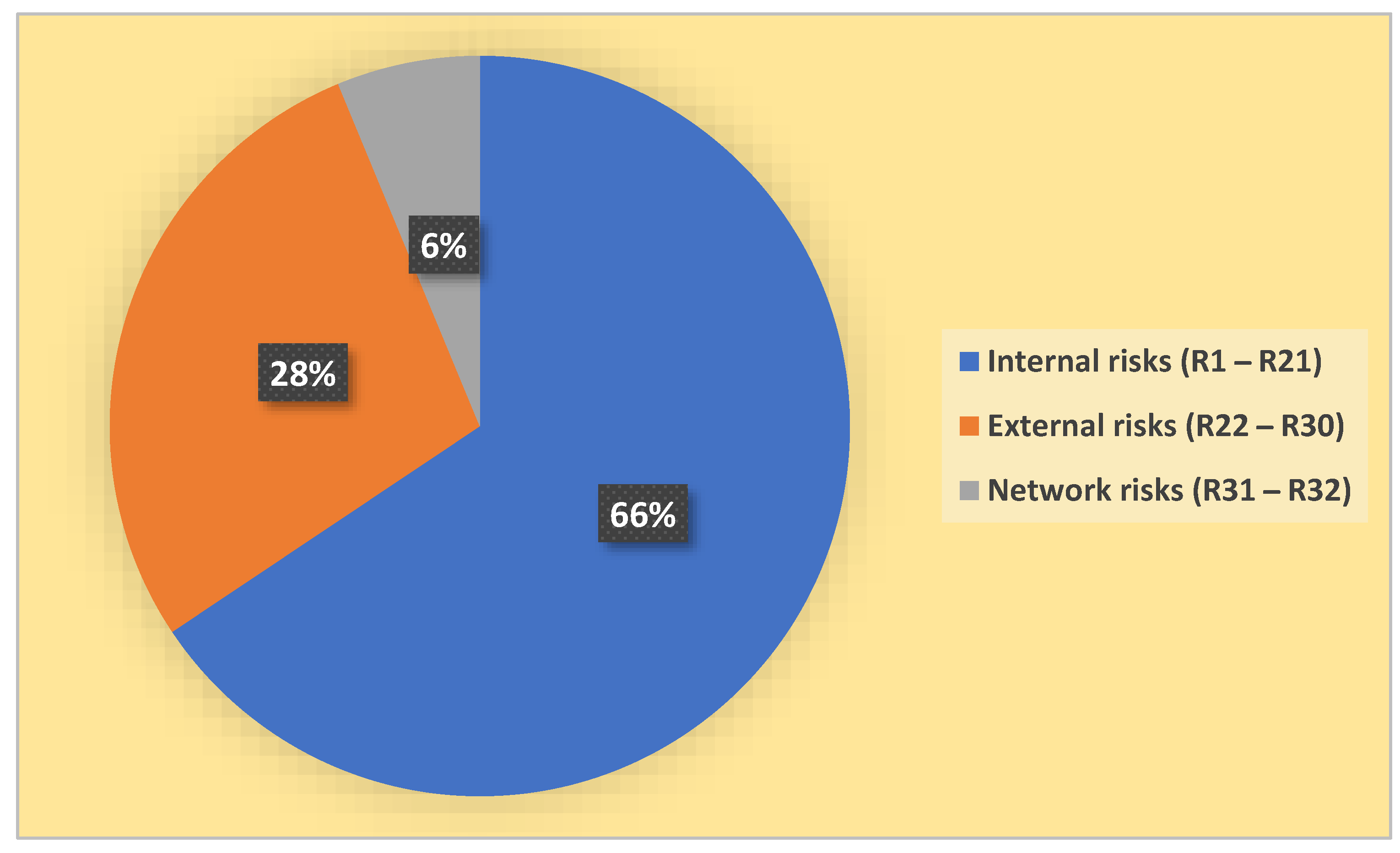
Interview findings showed that there are 32 different risks in the palm oil SCs in West Papua, comprising 21 internal, 9 external, and 2 network related (see Figure 2 and Table 7).
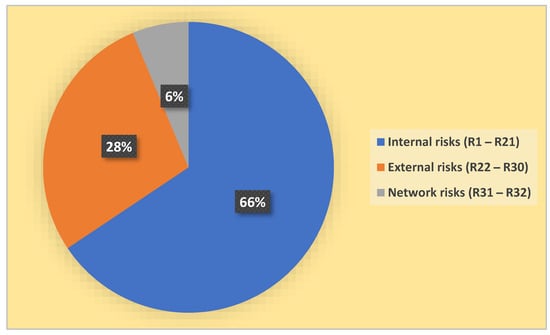
Figure 2.
Proportion of risks in the palm oil supply chains in West Papua.
Table 7.
Risks exposure to palm oil SCs in West Papua.
A summary of risks exposure to palm oil SCs in West Papua based on interview findings is provided in Table 7.
5. Discussion
5.1. Stakeholder Perspectives on the Palm Oil Supply Chain Risks in West Papua
As mentioned in Section 4.3, stakeholder perspectives on the palm oil supply chain risks (SCRs) in West Papua can be divided into three categories: internal, external, and network risks (see Table 7, Figure 1 and Figure 2).
5.1.1. Internal Risks
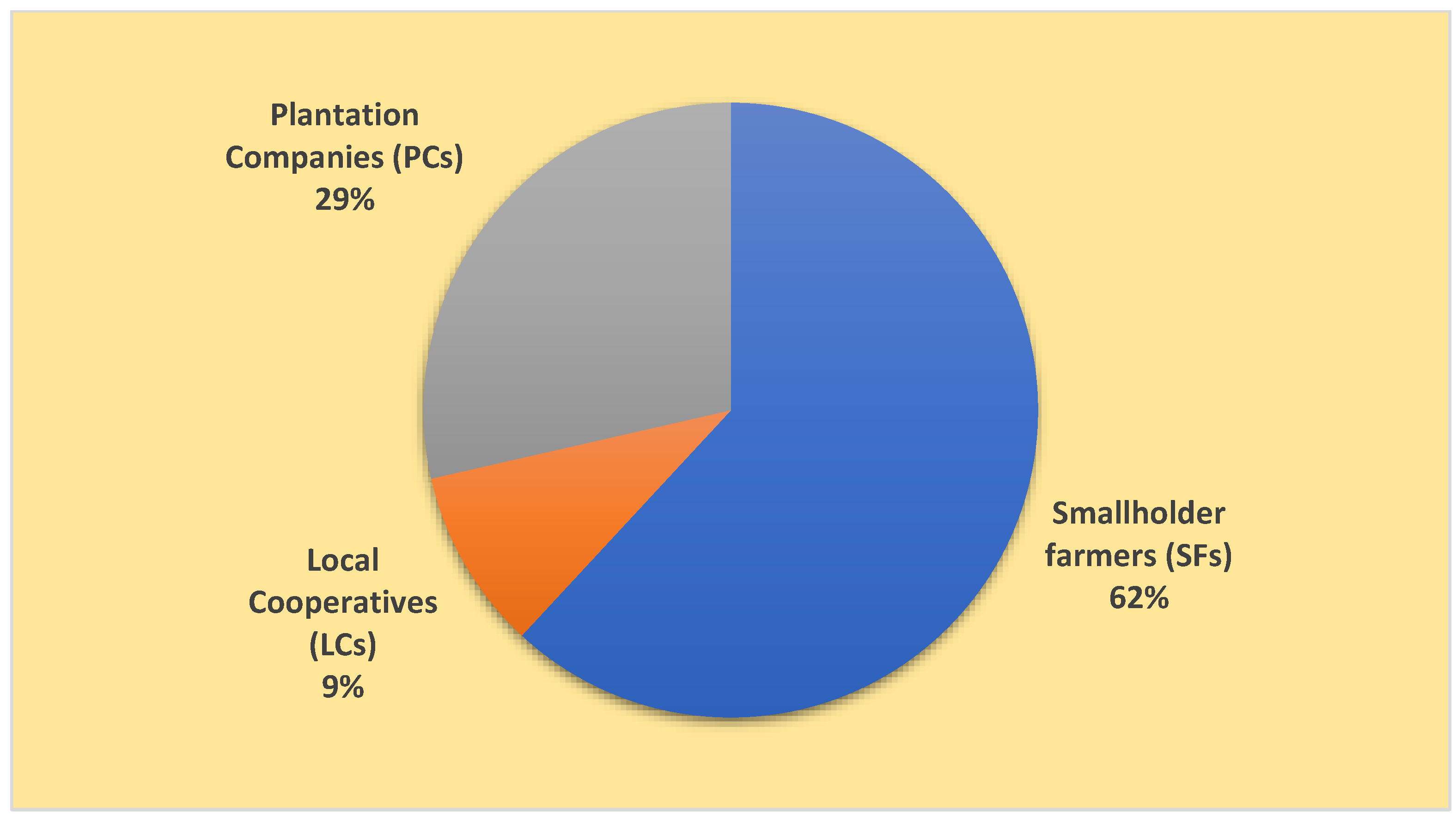
Based on the interview findings in Section 4.3, there are 21 internal risks (R1 to R21) of 32 risks in palm oil SCs in West Papua (see Table 7 and Figure 2). Herein, most of the risk (66%) comes from internal risks, and those affected by these risks are smallholder farmers (SFs), plantation companies (PCs), and local cooperatives (LCs).
The risks experienced by SF include fluctuation of FFB price (R1), low quality of FFB (R2), low FFB production (R4), change of priority to alternative work (R5), low capacity of human resources to access input (R6), low capacity of human resources to operate equipment (R7), low capacity of human resources to maintenance farms (R8), low capacity of human resources to sort FFB before delivered to the mill (R9), low work ethic and motivation (R10), delay in transporting FFB after harvesting (R15), unstable farmers’ income (R19), high labor cost (R20), and high transportation cost (R21). In short, there are 13 internal (62%) risks affecting SFs in palm oil SCs in West Papua.
Furthermore, there are two internal risks (29%) faced by LCs, namely, the low capacity of human resources to manage cooperatives (R11) and cooperative sustainability risks (R13). Meanwhile, PCs were affected by six internal risks (29%) such as low quality of CPO (R3), lack of skilled workers (R12), disruption of the plantation company’s operations (R14), change of management, and bankruptcy (R16), plantation company not reaching CPO production target (R17), and inadequate road facilities and infrastructures (R18).
The proportion of internal risks in palm oil SCs in West Papua can be seen in Figure 3.
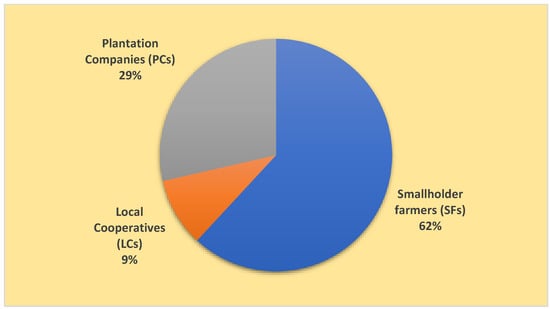
Figure 3.
The proportion of internal risks in palm oil SCs in West Papua.
The risks encountered by SFs, LCs, and PCs do not stand alone but affect one another. For instance, the SFs and LCs in West Papua have crucial issues related to low human resource capacity in terms of accessing input (R6), operating equipment (R7), maintaining farms (R8), and managing cooperatives (R11). These risks, then, result in low FFB production (R4), low quality of CPO (R3), fluctuation of FFB price (R1), and unstable farmers’ income (R19). Moreover, inconsistent smallholder farmers’ income (R19) is also caused by changes in the company’s management and bankruptcy (R16).
5.1.2. External Risks
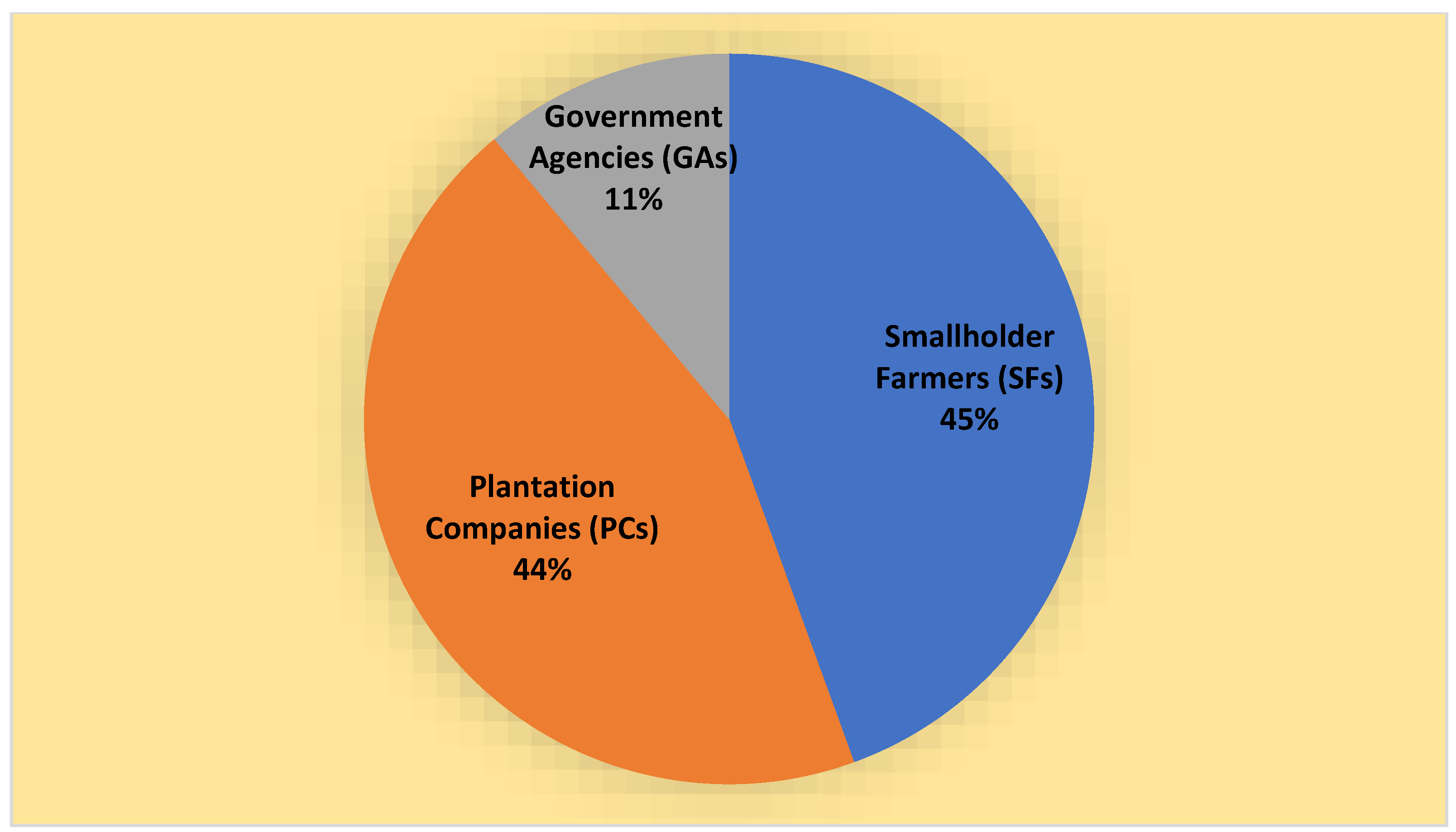
Unlike internal risks, there are only nine external risks (R22 to R30) of 32 risks in palm oil SCs in West Papua (see Table 7 and Figure 2). This shows that around 28% of the external risks affect smallholder farmers (SFs), plantation companies (PCs), and government agencies (GAs). Herein, four external risks are affecting SF, such as pests and diseases (R22), a conflict between farmers and the plantation company (R24), work accidents (R26), and uncertainty of land policies and tenure (R30). Meanwhile, PC is also influenced by four external risks, namely, the conflict between the customary right owner and the plantation company (R23), the conflict between the government and the plantation company (R25), high rainfall density (R27), and revoking business license (R28). Interestingly, the only external risk from GAs that has a major impact on the other risks is changing the government policy (R29). For instance, the revocation of the plantation company’s business license (R28) causes disruption of the plantation company’s operations (R14) and further creates conflict between the government and the plantation company (R25). These interview findings are in line with Jong (2021) [86] who state that twelve palm oil concession permits in West Papua were revoked from the licensing evaluation of 24 palm oil companies, and the West Papua government is also planning to terminate four palm oil companies in the conservation province. Moreover, Jong (2021) [86] 86 point out that 267,856.86 hectares have been revoked and 43,689.93 hectares are still in the process of being revoked. This decision follows the process of evaluating permits for oil palm plantations in West Papua, which has been going on since July 2018 under the coordination of the West Papua Food Crops, Horticulture, and Plantation Service, and involves various related parties including the district government in West Papua.
The proportion of external risks in palm oil SCs in West Papua can be seen in Figure 4.
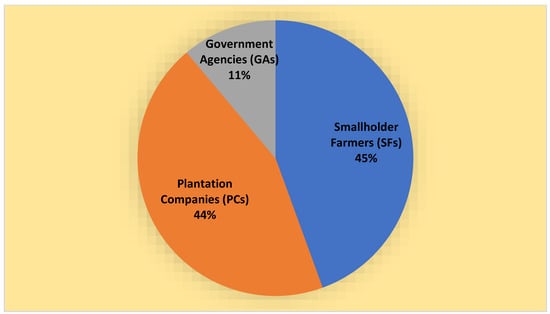
Figure 4.
The proportion of external risks in palm oil SCs in West Papua.
5.1.3. Network Risks
Regarding network risks, only two risks (R31 to R32) or around 6% of these risks, affect the PCs in palm oil SCs in West Papua, namely, lack of transparency in terms of instalments of debt payments (R31) and lack of transparency in terms of the process of sorting and weighing FFB (R32) (see Table 7 and Figure 2). For instance, smallholder farmers in one of case study areas have been waiting and attempting for years since 2000 to get their certificate of palm oil land from the plantation company but have yet to be successful. To solve this issue, the local government has attempted many times to facilitate meetings between the smallholder farmers, farmer associations, local cooperatives, the House of Representatives, and the company to resolve this problem through deliberation, but the company asked that this problem be resolved in the court. Here is the quote from one of participants (S48) in Teluk Bintuni regency:
“…from 2000 to 2001, I started working as an assistant for Afdeling, until 2005. Then in 2006, I left because I took the employee test and passed. That’s why I left Varita (the palm oil company). Now, as far as I know, Varita has a credit problem, which means how many times have we facilitated it with the council as well or the DPR (house of representative) of Teluk Bintuni Regency. We facilitate them (smallholder farmers) with the company. It also did not meet a single bright spot. From the farmer’s point of view, it has not been resolved. And lastly, in 2019, I and the head of the agriculture office, we went to Jakarta to meet the Director there and we brought the chairman of the cooperative and the head of the cooperative two people. There are two of these cooperatives, we will join them. At the same time, there are 2 farmers from the farmers who we brought to the center. At the same time, there are also members of the council who were brought to the centre. After we met there, we talked about it and submitted the files from the farmers. We are facilitating, so they have all the complete files. They show. We also had a chance to meet with the Director from Malaysia who was there. The manager was the director. The Managing Director is from Malaysia. That too is not finished either. Until the last time, they ask us to go to court. We propose they have such a request. But we were showed by the company that they had the certificates. They are not trusted to store certificates. Do not let this certificate be pledged again to the bank. Because it’s been a long time, right?”
Based on this case study, lack of transparency in terms of installments of debt payments (R31) lead to conflict between smallholder farmers and the plantation company (SFR24) and impacts the low work ethic and motivation of the farmers (SFR10).
6. Conclusions
The authors offered one of the first studies on stakeholder perspectives on the SCRs in the case of the Indonesian palm oil industry in West Papua. The authors found that there are seven identified groups as key stakeholders who have crucial roles in palm oil SCs in West Papua, namely smallholder farmers, local cooperatives, farmer associations, plantation companies, NGOs, government agencies, and universities.
Regarding the tiers and distribution channels in the palm oil SCs in West Papua, there are only five tiers, namely, private estate, smallholder plasma farmers, and independent smallholders (first tier), local cooperatives (second tier), palm oil plantations (third tier), mills (fourth tier), and the collection port (fifth tier). Meanwhile, there are three direct and two indirect distribution channels in the palm oil SC in West Papua. Three direct distribution channels of FFB to palm oil companies come from the private estate (PE), smallholder plasma farmers (SPFs), and independent smallholders (ISs), while two indirect distribution channels of FFB involve smallholder plasma farmers (SPFs) and independent smallholders (ISs) through local cooperatives (LCs). After the FFB is collected, the factory will process the FFB into CPO. Then the CPO will be transported to a storage tank and shipped from ports in West Papua to other provinces in Indonesia until they are further processed into final products that are beneficial to consumers.
Furthermore, there are 32 various risks in the palm oil SCs in West Papua comprising 21 internal, 9 external, and 2 network risks. At this point, most of the risk (67%) comes from internal risks affecting smallholder farmers, plantation companies, and local cooperatives. Then, around 27% of the external risks affect smallholder farmers, plantation companies, and government agencies. Meanwhile, only around 1% of network risks affect plantation companies.
In West Papua, risks in palm oil SCs are predominantly caused by conflicts of interest among multiple stakeholders. Hence, this study will contribute significantly to providing recent data and information in terms of risk-related stakeholder perspectives in palm oil SCs in West Papua. This paper is the first study to examine stakeholders and their risks in palm oil SCs in West Papua.
As the public stakeholders (government agencies and universities) and private stakeholders (smallholder farmers, local cooperatives, farmer associations, plantation companies, and NGOs) identified in palm oil SCs in West Papua play crucial roles in determining palm oil operations in West Papua, it is expected that the results of this study will have a significant impact in assisting the planning, implementation, and evaluation of palm oil SCs, to overcome several crucial issues in West Papua, such as deforestation, poverty, food insecurity, unemployment, and economic growth. However, to achieve the expected results, the development of mitigation strategies for identified risks must still be carried out using quantitative studies.
Despite our important findings, the authors must also note that our research does contain two limitations that should be addressed. First, this study is limited to only three regencies in the West Papua province. Accordingly, future studies replicating this research across multiple regencies and provinces either in Indonesia or other developing countries would increase the understanding of stakeholders and their risks in palm oil SCs worldwide. Second, our investigation of key stakeholder perspectives on SCRs the case of Indonesian palm oil industry in West Papua only based on qualitative methods. Therefore, further research could explore those identified risks based on quantitative methods, such as questionnaire surveys to investigate the probability of occurrence of these risks and their severity of impact and investigate relationships among stakeholders and their risks such as risk propagation and resilience in palm oil SCs.
Author Contributions
Conceptualisation, S.I., R.R., N.C. and L.S.; methodology, S.I., R.R., N.C. and L.S.; validation, R.R., N.C. and L.S.; resources, S.I., R.R., N.C. and L.S.; investigation: S.I.; writing—original draft preparation, S.I.; writing—review and editing, R.R., N.C. and L.S.; visualisation, S.I.; supervision, R.R., N.C. and L.S. All authors have read and agreed to the published version of the manuscript.
Funding
This research received no external funding.
Institutional Review Board Statement
Not applicable.
Informed Consent Statement
Not applicable.
Data Availability Statement
Data generated or analysed during the study are available from the corresponding author by request.
Acknowledgments
The authors would like to acknowledge the Australian government’s financial support through an Australian Award Scholarship for PhD studies and support from the University of South Australia. The authors would like to thank anonymous reviewers for their constructive feedback to improve the quality of the paper.
Conflicts of Interest
The authors declare no conflict of interest with respect to the research, authorship and/or publication of this article.
References
- Quan, Y.; Wu, H.; Li, S.; Ying, S.X. Firm sustainable development and stakeholder engagement: The role of government support. Bus. Strategy Environ. 2018, 27, 1145–1158. [Google Scholar] [CrossRef]
- Welp, M.; de la Vega-Leinert, A.; Stoll-Kleemann, S.; Jaeger, C.C. Science-based stakeholder dialogues: Theories and tools. Glob. Environ. Chang. 2006, 16, 170–181. [Google Scholar] [CrossRef]
- Nguyen, T.H.D.; Chileshe, N.; Rameezdeen, R.; Wood, A. External stakeholder strategic actions in projects: A multi-case study. Int. J. Proj. Manag. 2019, 37, 176–191. [Google Scholar] [CrossRef]
- Verbeke, A.; Tung, V. The future of stakeholder management theory: A temporal perspective. J. Bus. Ethics 2012, 112, 529–543. [Google Scholar] [CrossRef]
- Domańska-Szaruga, B. Maturity of risk management culture. Entrep. Sustain. Issues 2020, 7, 2060–2078. [Google Scholar] [CrossRef] [PubMed]
- Nguyen, T.H.D.; Chileshe, N.; Rameezdeen, R.; Wood, A. Stakeholder influence pathways in construction projects: Multicase study. J. Constr. Eng. Manag. 2019, 145, 05019011. [Google Scholar] [CrossRef]
- Rivera-Camino, J. Re-evaluating green marketing strategy: A stakeholder perspective. Eur. J. Mar. 2007, 41, 1328–1358. [Google Scholar] [CrossRef]
- Scolobig, A.; Lilliestam, J. Comparing approaches for the integration of stakeholder perspectives in environmental decision making. Resources 2016, 5, 37. [Google Scholar] [CrossRef]
- Yang, R.J.; Zou, P.X.W. Stakeholder-associated risks and their interactions in complex green building projects: A social network model. Build. Environ. 2014, 73, 208–222. [Google Scholar] [CrossRef]
- Yang, R.J.; Zou, P.X.W.; Wang, J. Modelling stakeholder-associated risk networks in green building projects. Int.J. Proj. Manag. 2016, 34, 66–81. [Google Scholar] [CrossRef]
- Seghezzo, L.; Sneegas, G.; Jepson, W.; Brannstrom, C.; Beckner, S.; Lee, K. The use and potential of Q method in environmental planning and management. J. Environ. Plan. Manag. 2023, 1–27. [Google Scholar] [CrossRef]
- Imbiri, S.; Rameezdeen, R.; Chileshe, N.; Statsenko, L. A novel taxonomy for risks in agribusiness supply chains: A systematic literature review. Sustainability 2021, 13, 9217. [Google Scholar] [CrossRef]
- Jüttner, U.; Peck, H.; Christopher, M. Supply chain risk management: Outlining an agenda for future research. Int. J. Logist. Res. App. 2003, 6, 197–210. [Google Scholar] [CrossRef]
- Fahimnia, B.; Tang, C.S.; Davarzani, H.; Sarkis, J. Quantitative models for managing supply chain risks: A review. Eur. J. Oper. Res. 2015, 247, 1–15. [Google Scholar] [CrossRef]
- Behzadi, G.; O’Sullivan, M.J.; Olsen, T.L.; Zhang, A. Allocation flexibility for agribusiness supply chains under market demand disruption. Int. J. Prod. Res. 2018, 56, 3524–3546. [Google Scholar] [CrossRef]
- Ghadge, A.; Dani, S.; Kalawsky, R. Supply chain risk management: Present and future scope. Int. J. Logist. Manag. 2012, 23, 313–339. [Google Scholar] [CrossRef]
- Prakash, S.; Soni, G.; Rathore, A.P.S. A critical analysis of supply chain risk management content: A structured literature review. J. Adv. Manag. Res. 2017, 14, 69–90. [Google Scholar] [CrossRef]
- Zsidisin, G.A.; Henke, M. (Eds.) Revisiting Supply Chain Risk; Springer: Cham, Switzerland, 2019. [Google Scholar]
- Universitas Papua; Conservation International. Sustainable Investment Action Plan: Rencana Aksi Investasi Berkelanjutan di Papua Barat 2017; Universitas Papua: Manokwari, Indonesia; Conservation International: Arlington, VA, USA, 2017; pp. 1–140. [Google Scholar]
- Wambrauw, L.T. Indigenous Entrepreneurship by Papuan Women in the Informal Agricultural Sector in Manokwari West Papua. Ph.D. Thesis, Lincoln University, Christchurch, New Zealand, 2013; pp. 1–230. [Google Scholar]
- Universitas Papua; Conservation International. Keadaan Sosial Ekonomi dan Implikasinya Dalam Pelaksanaan Provinsi Konservasi di Provinsi Papua Barat 2017; Universitas Papua: Manokwari, Indonesia; Conservation International: Arlington, VA, USA, 2017; pp. 1–88. [Google Scholar]
- FWI. Lembar Fakta Deforestasi Dari Masa ke Masa di Tanah Papua: Papua, Papua Barat, dan Kepulauan aru; Forest Watch Indonesia: Bogor, Indonesia; Rainforest Foundation Norway: Oslo, Norway, 2019; pp. 1–8. [Google Scholar]
- Sumule, A. Chapter Four: Selected Aspects of Irian Jaya Province and the Arfak Land; University of Queensland: Brisbane, Australia, 1994; pp. 1–54. [Google Scholar]
- Kesaulija, F.F.; Sadsoeitoebeon, B.M.G.; Peday, H.F.Z.; Tokede, M.J.; Komarudin, H.; Andriani, R.; Obidzinski, K. Oil Palm Estate Development and Its Impact on Forests and Local Communities in West Papua: A Case Study on the Prafi Plain; Working Paper 156; CIFOR: Bogor, Indonesia, 2014; pp. 1–30. [Google Scholar]
- Matualage, A.; Hariadi, S.S.; Wiryono, P. Management of plam oil in the core plasma PTPN II Prafi partnership pattern with Arfak Farmers in Manokwari, Papua Barat. J. Sos. Ekon. Pertan. 2019, 12 (Suppl. S1), 19–28. [Google Scholar]
- Acosta, P.; Curt, M.D. Understanding the expansion of oil palm cultivation: A case-study in Papua. J. Clean. Prod. 2019, 219, 199–216. [Google Scholar] [CrossRef]
- West Papua Provincial Government. West Papua Provincial Mid-Term Development Plan for 2017–2022; West Papua Provincial Government: Manokwari, Indonesia, 2017; pp. 1–938. [Google Scholar]
- Bonnafous-Boucher, M.; Rendtorff, J.D. Stakeholder Theory: A Model for Strategic Management; Springer International Publishing: Cham, Switzerland, 2016; pp. 1–102. [Google Scholar]
- Rowley, T.J. Moving beyond dyadic ties: A network theory of stakeholder influences. Acad. Manag. Rev. 1997, 22, 887–910. [Google Scholar] [CrossRef]
- Takeuchi, K.; Shiroyama, H.; Saito, O.; Matsuura, M. (Eds.) Biofuels and Sustainability: Holistic Perspectives for Policy-Making; Springer Open: Tokyo, Japan, 2018; pp. 1–261. [Google Scholar]
- PMI. A Guide to the Project Management Body of Knowledge (PMBOK Guide), 6th ed.; Project Management Institute, Inc.: Pennsylvania, PA, USA, 2017; pp. 1–976. [Google Scholar]
- Miles, S. Stakeholder theory classification: A theoretical and empirical evaluation of definitions. J. Bus. Ethics 2017, 142, 437–459. [Google Scholar] [CrossRef]
- Chinyio, E.; Olomolaiye, P. (Eds.) Introducing Stakeholder management. In Construction Stakeholder Management; Blackwell Publishing Ltd.: Hoboken, NJ, USA, 2010; pp. 1–12. [Google Scholar]
- Clarkson, M.E. A stakeholder framework for analyzing and evaluating corporate social performance. Acad. Manag. Rev. 1995, 20, 92–117. [Google Scholar] [CrossRef]
- Safapour, E.; Kermanshachi, S.; Kamalirad, S.; Tran, D. Identifying effective project-based communication indicators within primary and secondary stakeholders in construction projects. J. Leg. Aff. Disput. Resolut. Eng. Constr. 2019, 11, 04519028. [Google Scholar] [CrossRef]
- Savage, G.T.; Nix, T.W.; Whitehead, C.J.; Blair, J.D. Strategies for assessing and managing organisational stakeholders. Acad. Manag. Exec. 1991, 5, 61–75. [Google Scholar]
- Johnsen, H.C.G.; Normann, R. When research and practice collide: The role of action research when there is a conflict of interest with stakeholders. Syst. Pract. Action Res. 2004, 17, 207–235. [Google Scholar] [CrossRef]
- Susilo, L.J.; Kaho, V.R. Manajemen Risiko Berbasis ISO 31000:2018: Panduan Untuk Risk Leaders Dan Risk Practitioners; PT. Grasindo: Jakarta, Indonesia, 2019. [Google Scholar]
- Bradley-Swanson, O.T. Stakeholder Engagement Strategies for Nonprofit Organization Financial Sustainability. Ph.D. Thesis, College of Management and Technology, Walden University, Minneapolis, MN, USA, 2019; pp. 1–159. [Google Scholar]
- Cook, T.A. Entreprise Risk Management in the Global Supply Chain; CRC Press: Boca Raton, FL, USA; Taylor & Francis Group: New York, NY, USA, 2017; pp. 1–355. [Google Scholar]
- Huml, M.R.; Hambrick, M.E.; Hums, M.A.; Nite, C. It’s powerful, legitimate, and urgent, but is it equitable? Stakeholder claims within the attributes of stakeholder salience in sport. J. Sport Manag. 2018, 32, 243–256. [Google Scholar] [CrossRef]
- Van Puyvelde, S.; Brown, W.A. Determinants of nonprofit sector density: A stakeholder approach. VOLUNTAS Int. J. Volunt. Nonprofit Organ. 2015, 27, 1045–1063. [Google Scholar] [CrossRef]
- Sukati, I.; Hamid, A.B.; Baharun, R.; Yusoff, R.M. The study of supply chain management strategy and practices on supply chain performance. Procedia Soc. Behav. Sci. 2012, 40, 225–233. [Google Scholar] [CrossRef]
- Agustina, F.; Vanany, I.; Siswanto, N. Determining sources of uncertainty, performance, and strategy in biodiesel supply chain. In Proceedings of the 2020 2nd International Conference on Management Science and Industrial Engineering, Osaka, Japan, 7–9 April 2020; pp. 18–24. [Google Scholar]
- Matondang, N.; Hidayati, J.; Buchari; Arifin, E.P.; Panama, J. Analysis of crude palm oil supply chain using food supply chain network (fscn): A case study. IOP Conf. Ser. Mater.Sci. Eng. 2020, 1003, 012036. [Google Scholar] [CrossRef]
- Nupueng, S.; Oosterveer, P.; Mol, A.P.J. Governing sustainability in the Thai palm oil-supply chain: The role of private actors. Sustain. Sci. Pract. Policy 2022, 18, 37–54. [Google Scholar] [CrossRef]
- Donofrio, S.; Rothrock, P.; Leonard, J. Supply Change: Tracking Corporate Commitments to Deforestation-Free Supply Chains; Forest Trends—Supply Change Initiative: Washington, DC, USA, 2017; pp. 1–32. [Google Scholar]
- Lyons-White, J.; Knight, A.T. Palm oil supply chain complexity impedes implementation of corporate no-deforestation commitments. Glob. Environ. Chang. 2018, 50, 303–313. [Google Scholar] [CrossRef]
- Wilmar International Limited. Driving Positive Impact for a Better Tomorrow; Sustainability Report; Wilmar International Limited: Singapore, 2021; pp. 1–123. [Google Scholar]
- Jamil, A. Statistical of National Leading Estate Crops Commodity 2020-2022. Directorate General of Estates Ministry of Agriculture. Jakarta. Available online: https://ditjenbun.pertanian.go.id/?publikasi=buku-statistik-perkebunan-2020-2022 (accessed on 5 April 2023).
- Ho, W.; Zheng, T.; Yildiz, H.; Talluri, S. Supply chain risk management: A literature review. Int. J. Prod. Res. 2015, 53, 5031–5069. [Google Scholar] [CrossRef]
- Sodhi, M.S.; Son, B.-G.; Tang, C.S. Researchers’ Perspectives on Supply Chain Risk Management. Prod. Oper. Manag. 2011, 21, 1–13. [Google Scholar] [CrossRef]
- Vilko, J. Approaches to Supply Chain Risk Management: Identification, Analysis and Control. Ph.D. Thesis, School of Business, Lappeenranta University of Technology, Lappeenranta, Finland, 2012. [Google Scholar]
- Shahbaz, M.S.; Rasi, R.Z.R.; Ahmad, F. A novel classification of supply chain risks: Scale development and validation. J. Ind. Eng. Manag. 2019, 12, 201–218. [Google Scholar] [CrossRef]
- Lin, Y.; Zhou, L. The impacts of product design changes on supply chain risk: A case study. Int. J. Phys. Distrib. Logist. Manag. 2011, 41, 162–186. [Google Scholar] [CrossRef]
- Enyinda, C.I.; Mbah, C.H. Quantifying Sources of Risk in Global Food Operations and Supply Chain. Thunderbird Int. Bus. Rev. 2016, 59, 653–661. [Google Scholar] [CrossRef]
- Andersen, T.J.; Schrøder, P.W. Strategic Risk Management Practice: How to Deal Effectively with Major Corporate Exposures; Cambridge University Press: New York, NY, USA, 2010. [Google Scholar]
- Chandrasekaran, N.; Raghuram, G. Agribusiness Supply Chain Management; CRC Press: Boca Raton, FL, USA; Taylor & Francis Group: London, UK, 2014. [Google Scholar]
- Waqas, U.; Rahman, A.B.A.; Ismail, N.W.; Basha, N.K.; Umair, S. Conceptualising the moderating role of knowledge management within supply chain risks and supply chain risk management. For. Soc. 2019, 3, 209–226. [Google Scholar] [CrossRef]
- Khojasteh, Y. Developing Supply Chain Risk Mitigation Strategies; Springer Nature Singapore Pte Ltd.: Singapore, 2018. [Google Scholar]
- Bode, C.; Wagner, S.M. Structural drivers of upstream supply chain complexity and the frequency of supply chain disruptions. J. Oper. Manag. 2015, 36, 215–228. [Google Scholar] [CrossRef]
- Leppälä, J.; Murtonen, M.; Kauranen, I. Farm risk map: A contextual tool for risk identification and sustainable management on farms. Risk Manag. 2012, 14, 42–59. [Google Scholar] [CrossRef]
- Statsenko, L.; Gorod, A.; Ireland, V. A supply network governance framework: A case study of the South Australian mining industry. J. Glob. Oper. Strateg. Sourc. 2018, 11, 55–78. [Google Scholar] [CrossRef]
- Anugerah, A.R.; Ahmad, S.A.; Samin, R.; Samdin, Z.; Kamaruddin, N. Modified failure mode and effect analysis to mitigate sustainable related risk in the palm oil supply chain. Adv. Mater. Process. Technol. 2021, 8, 2229–2243. [Google Scholar] [CrossRef]
- Hadiguna, R.A.; Tjahjono, B. A framework for managing sustainable palm oil supply chain operations: A case of Indonesia. Prod. Plan. Control 2017, 28, 1093–1106. [Google Scholar] [CrossRef]
- Marimin, M.; Safriyana, S. Evaluation of palm oil supply chain’s performance, added value, and performance improvement: A case study at X Co. IOP Conf. Ser. Earth Environ. Sci. 2018, 196, 012001. [Google Scholar] [CrossRef]
- Busch, J.; Amarjargal, O.; Taheripour, F.; Austin, K.G.; Siregar, R.N.; Koenig, K.; Hertel, T.W. Effects of demand-side restrictions on high-deforestation palm oil in Europe on deforestation and emissions in Indonesia. Environ. Res. Lett. 2022, 17, 014035. [Google Scholar] [CrossRef]
- Phochanikorn, P.; Tan, C. An integrated multi-criteria decision-making model based on prospect theory for green supplier selection under uncertain environment: A case study of the Thailand palm oil products industry. Sustainability 2019, 11, 1872. [Google Scholar] [CrossRef]
- Gallemore, C.; Jespersen, K. Offsetting, Insetting, or Both? Current Trends in Sustainable Palm Oil Certification. Sustainability 2019, 11, 5393. [Google Scholar] [CrossRef]
- Creswell, J.W.; Creswell, J.D. Research Design: Qualitative, quantitative, and Mixed Methods Approaches, 5th ed.; SAGE Publications, Inc.: Los Angeles, CA, USA, 2018; pp. 1–540. [Google Scholar]
- Yin, R.K. Qualitative Research from Start to Finish, 2nd ed.; The Guilford Press: New York, NY, USA, 2016; pp. 1–417. [Google Scholar]
- Denzin, N.K.; Lincoln, Y.S. The SAGE Handbook of Qualitative Research, 5th ed.; SAGE Publications, Inc.: Thousand Oaks, CA, USA, 2017; pp. 1–1694. [Google Scholar]
- Eisenhardt, K.M. Building theories from case study research. Acad. Manag. Rev. 1989, 14, 532–555. [Google Scholar] [CrossRef]
- Yin, R.K. Case Study Research: Design and Methods, 5th ed.; SAGE Publications, Inc.: Thousand Oaks, CA, USA, 2014; pp. 1–377. [Google Scholar]
- Gorod, A.; Hallo, L.; Statsenko, L.; Nguyen, T.; Chileshe, N. Integrating hierarchical and network centric management approaches in construction megaprojects using a holonic methodology. Eng. Constr. Archit. Manag. 2020, 28, 627–661. [Google Scholar] [CrossRef]
- Handfield, R.B.; Melnyk, S.A. The scientific theory-building process: A primer using the case of TQM. J. Oper. Manag. 1998, 16, 321–339. [Google Scholar] [CrossRef]
- Stuart, I.; McCutcheon, D.; Handfield, R.; McLachlin, R.; Samson, D. Effective case research in operations management: A process perspective. J. Oper. Manag. 2002, 20, 419–433. [Google Scholar] [CrossRef]
- Lai, J.Y.; Mardiyaningsih, D.I.; Rahmadian, F.; Hamzah, N. What evidence exists on the impact of sustainability initiatives on smallholder engagement in sustainable palm oil practices in Southeast Asia: A systematic map protocol. Environ. Evid. 2022, 11, 28. [Google Scholar] [CrossRef]
- Sylvia, N.; Rinaldi, W.; Muslim, A.; Husin, H.; Yunardi. Challenges and possibilities of implementing sustainable palm oil industry in Indonesia. IOP Conf. Ser. Earth Environ. Sci. 2022, 969, 012011. [Google Scholar] [CrossRef]
- Khair, F.; Wijaya, D.I.; Yulianto, H.D.; Soebandrija, K.E.N. Designing the performance measurement for sustainable supply chain of the crude palm oil (CPO) companies using lean & green supply chain management (LGSCM) approach (Case Study: Indonesia’s palm oil company. In Proceedings of the 3rd International Conference on Eco Engineering Development, Solo City, Indonesia, 13–14 November 2019; IOP Publishing: Bristol, UK, 2020; pp. 1–10. [Google Scholar]
- Wardhani, R.; Rahadian, Y. Sustainability strategy of Indonesian and Malaysian palm oil industry: A qualitative analysis. Sustain. Account. Manag. Policy J. 2021, 12, 1077–1107. [Google Scholar] [CrossRef]
- CI Indonesia. West Papua as Conservation Province; Conservation International Indonesia: Jakarta, Indonesia, 2019; pp. 1–2. [Google Scholar]
- Saunders, M.; Lewis, P.; Thornhill, A. Research Methods for Business Students, 6th ed.; Pearson Education Limited: London, UK, 2012; pp. 1–729. [Google Scholar]
- Braun, V.; Clarke, V. Can I use TA? should I use TA? should I not use TA? Comparing reflexive thematic analysis and other pattern-based qualitative analytic approaches. Couns. Psychother. Res. 2020, 21, 37–47. [Google Scholar] [CrossRef]
- Imbiri, S.; Rameezdeen, R.; Chileshe, N.; Statsenko, L. Risk propagation and resilience in the agribusiness supply chain: A systematic literature review. J. Agribus. Dev. Emerg. Econ. 2023. ahead of print. [Google Scholar] [CrossRef]
- Jong, H.N. West Papua Revokes Quarter of a Million Hectares of Land from Palm Oil. 2021. Mongabay: News & Inspiration from Nature’s Frontline, USA. Available online: https://news.mongabay.com/2021/06/west-papua-revokes-quarter-of-a-million-hectares-of-land-from-palm-oil/ (accessed on 27 February 2023).
Disclaimer/Publisher’s Note: The statements, opinions and data contained in all publications are solely those of the individual author(s) and contributor(s) and not of MDPI and/or the editor(s). MDPI and/or the editor(s) disclaim responsibility for any injury to people or property resulting from any ideas, methods, instructions or products referred to in the content. |
© 2023 by the authors. Licensee MDPI, Basel, Switzerland. This article is an open access article distributed under the terms and conditions of the Creative Commons Attribution (CC BY) license (https://creativecommons.org/licenses/by/4.0/).