


Abstract
Greenhouse gas (GHG) emissions, especially CO2, represent a global concern. Among those responsible for CO2 emissions, buildings stand out due to the consumption of energy from fossil fuels. In this sense, initiatives for the decarbonization of buildings and construction tends to contribute to the achievement of the target defined in the Paris Agreement of limiting the increase in global temperature to 1.5 degrees Celsius above pre-industrial levels, as well as in achieving the Sustainable Development Goals (SDG) and of the Triple Bottom Line (TBL). This article aimed to identify renewable energy generation technologies that can be applied in urban vertical constructions, contributing to the reduction of carbon emissions in the atmosphere. To this end, the following methodology was adopted: a survey of the Conferences of the Parties on climate change; identification of European Union Legislative Directives for the decarbonization of buildings; and a literature review to identify research that deals with renewable energy generation technologies that can be adopted in buildings. The results indicated that there seems to be a correlation between the growth in the number of articles that deal with the topic of decarbonizing buildings and the increase in world concerns about global warming. A hybrid microgrid proposal, combining different sources of renewable energy such as solar photovoltaic, wind, biomass, micro-hydroelectric, and others for vertical buildings with more than five floors, is presented as viable to achieve zero emissions in these buildings, contributing to future research, that can carry out quantitative analyses and feasibility studies, as well as for experiments and applications in existing buildings and the projects of new vertical constructions.
1. Introduction
The speed and impact of climate change are a global concern, as they pose serious risks to life on planet Earth. Among the causes of such changes, the emission of greenhouse gases (GHG) stands out, such as CO2, responsible for global warming. Thus, the topic has been addressed over the years in national and international forums, the most representative being the United Nations Conference on Climate Change, which has resulted in agreements to try and limit global warming. In this sense, the Paris Agreement brought the need to seek efforts to limit the increase in temperature to 1.5 degrees Celsius above pre-industrial levels [1].
In this context, the growth of cities brings with it an increase in the demand for buildings and, consequently, a greater consumption of energy, which if it comes from non-renewable sources, contributes to the generation of CO2. According to Zarco-Soto et al. (2021) [2], more than half of the world’s population lives in cities, and in some places, this number is even higher, such as in Europe. In 2021, buildings and the construction industry accounted for about 37 percent of global [3] CO2 emissions.
Thus, the challenges for achieving decarbonization and net zero carbon emissions in urban areas are great. This emphasizes the need for an integrated approach to implementing renewable energy projects that consider not only technical aspects but also social, economic, and environmental aspects [4].
Among the possible solutions, the use of Nature-based Solutions (NBS) stands out, which involves multiple measures based on land use management options that consider the restoration, protection, and sustainable management of ecosystems [5]. As indicated by Makvandi et al. (2023) [6], the growth of urban areas generates changes in land use and land cover, as well as heat islands, due to reduced natural ventilation, increased urban heat, and air pollution problems. To mitigate these impacts, strategies have been proposed, such as the growth of urban green space with shading and blue spaces (ponds, rivers, swamps) which have the potential to absorb heat. Anderson et al. (2022) [7], in turn, study the use of green infrastructure based on nature in urban areas, from four areas of application: green roofs, green walls, urban vegetation and forestry, and systems of urban agriculture, to reduce the impact of atmospheric warming, among other benefits. It should be noted that the NBS represents one of the possible initiatives in pursuit of decarbonization and can work in parallel with other measures, such as encouraging the use of renewable technologies.
In addition, recent research shows the use of Artificial Intelligence (AI) applied in Intelligent Systems to forecast renewable energy production to optimize proposed projects, in which Elsheikh et al. [8] and Al-qaness et al. [9] use, respectively, the Artificial Neural Network (ANN) applied to solar energy and wind energy.
Furthermore, Alhawsawi et al. [10] presents a comprehensive theoretical modeling and performance analysis of a solar dish/Stirling-powered single effect distillation system (SDSPSEDS) for the combined tri-production of electricity, heat, and freshwater, thus proving that the hybrid SDSPSEDS is an efficient system to produce energy and water in rural areas without running water or electricity. There is also a review article, presented by Elsheikh [11], which discussed the applications of bistable morphing composites in addition to dealing with applications of artificial intelligence techniques to optimize the design of bitable structures and predict their response under different actuation schemes.
As noted in the 2022 Global Status Report for Buildings and Construction [3], the COVID-2019 pandemic has resulted in a drop in demand for buildings as well as workplace closures due to lockdowns to contain the spread of the virus, resulting in a drop in CO2 emissions. In 2021, activities in the civil construction sector returned to pre-pandemic levels, energy consumption in buildings grew with the return to face-to-face activities, and in emerging economies, there was an increase in the use of fossil fuels in buildings. As a result, CO2 emissions from building operations reached an all-time high of around 10 GtCO2 (billion tons of CO2) [3].
In this way, the implementation of actions with the objective of making buildings capable of producing and consuming renewable energy, becoming a prosumer, can contribute to their decarbonization, as well as show adherence to the Sustainable Development Goals (SDG), in particular, objectives 7, 9, 11, 12, and 13 and their targets, as summarized in the Table 1.

Table 1.
Adherence to the Sustainable Development Goals (SDG).
This work aims to identify renewable energy generation technologies that can be applied in vertical constructions (e.g., buildings with more than five floors), contributing to the reduction of carbon emissions in the atmosphere. With this, it is intended to answer the following research question: how to contribute to the reduction of carbon emissions in the atmosphere with the production of renewable energy generated from different sources in vertical urban constructions.
Therefore, in addition to this introduction, the article is organized as follows: Section 2 presents the proposed methodology adopted to achieve the proposed objective; Section 3 discusses the results obtained with the application of the methodology; Section 4 brings the discussion; and Section 5 presents the conclusions about the obtained findings.
2. Materials and Methods
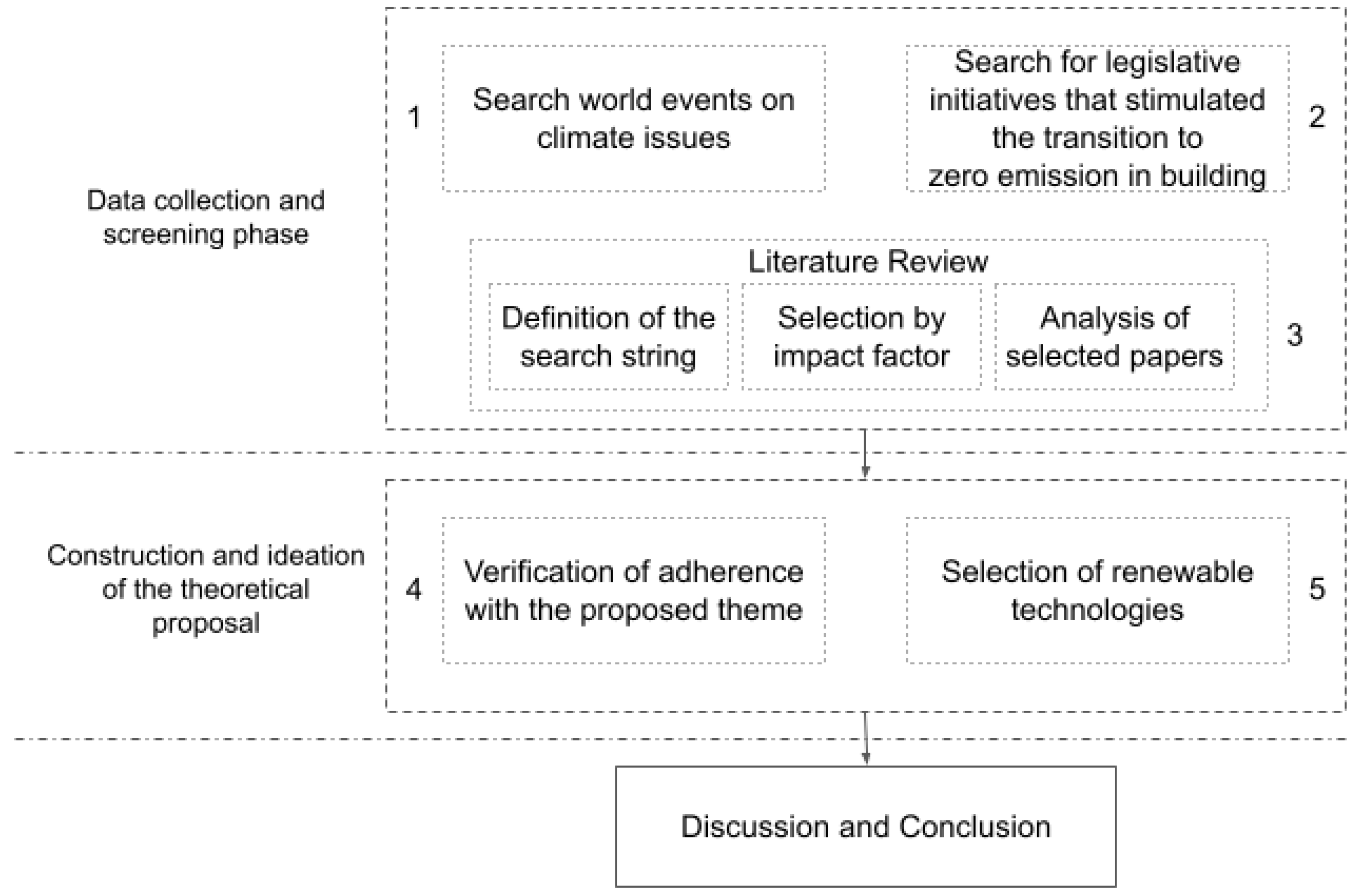
Society has been concerned about climate issues and how humanity can contribute to reducing the emission of greenhouse gases (GHG). Thus, to answer the research question, three steps were adopted, according to the methodological scheme shown in Figure 1. Initially, a survey was carried out of world events promoted by the United Nations, whose main topic under discussion was climate change in the world. Such events resulted in agreements between the countries involved for carrying out short and medium-term actions to reduce the environmental impacts caused by the world’s population. Then, specific European Union (EU) legislative initiatives were identified to encourage the transition to zero emissions in buildings.
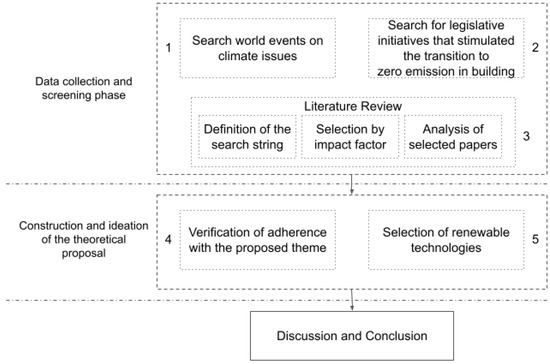
Figure 1.
Research methodology flow chart. Source: Authors, 2023.
Following this, a literature review was carried out in order to locate research that deals with renewable energy generation technologies applicable to urban buildings. Finally, to assist in the ideation and construction of a theoretical proposal, it was verified which of these selected studies had technologies that adhered to the theme proposed by this work. This way, this paper was supported by critical reviews [13] to provide an interpretive analysis of the key features of renewable energy, prosumers, and microgeneration technologies.
Bibliographic Search
In order to identify renewable energy generation technologies that allow their use in urban vertical buildings, this was searched for in March 2023, through a Brazilian government tool, the CAPES portal (https://www.periodicos.capes.gov.br/, accessed on 15 February 2023), which covers approximately 122 databases (such as Web of Science, Cinahl, Scopus, and Pubmed), with the search string building AND (prosumer OR (“renewable energy” AND (solar OR hydro OR wind OR sewage))) AND (“carbon credit” OR decarbonization) for the period 2013 to 2023, for peer-reviewed articles. An amount of 115 (one hundred and fifteen) publications were located, from which those whose impact factor of the journal was greater than zero were selected, thus totaling 49 (forty-nine) publications, which were distributed in the timeline according to Table 2.
Table 2.
Distribution of publications by year.
Then, the selected articles [14,15,16,17,18,19,20,21,22,23,24,25,26,27,28,29,30,31,32,33,34,35,36,37,38,39,40,41,42,43,44,45,46,47,48,49,50,51,52,53,54,55,56,57,58,59,60,61,62] were analyzed to obtain information on the technologies used in the research that are applicable in urban vertical buildings, and that can, in a combined way, be used to make this type of building self-sufficient in energy, making it a prosumer, that is, a consumer of renewable energy that produces the energy needed for its use [63].
3. Results
In 1995, the first Conference of the Parties—United Nations on Climate Change (COP’s) [64]—was held in Berlin/Germany, and since then, participating countries have tried to annually establish more energetic actions in relation to the reduction of greenhouse gas emissions. Below, in Table 3, some milestones and definitions that occurred over the years are presented.
Table 3.
Milestones of the United Nations Climate Change Conferences (COP’s).
As indicated in Table 3 at COP 26, the Paris Agreement became operational, as well as the 1.5-degree average temperature increase limit that had been agreed upon in 2015, set as a goal for the decade, which has led the signatory nations to adopt more energetic measures to reduce CO2 emissions, including those aimed at zero emissions in buildings.
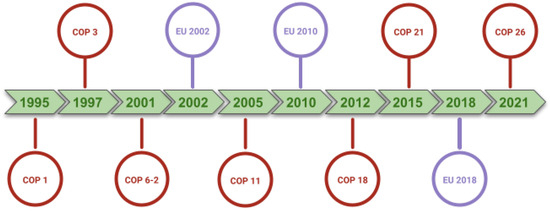
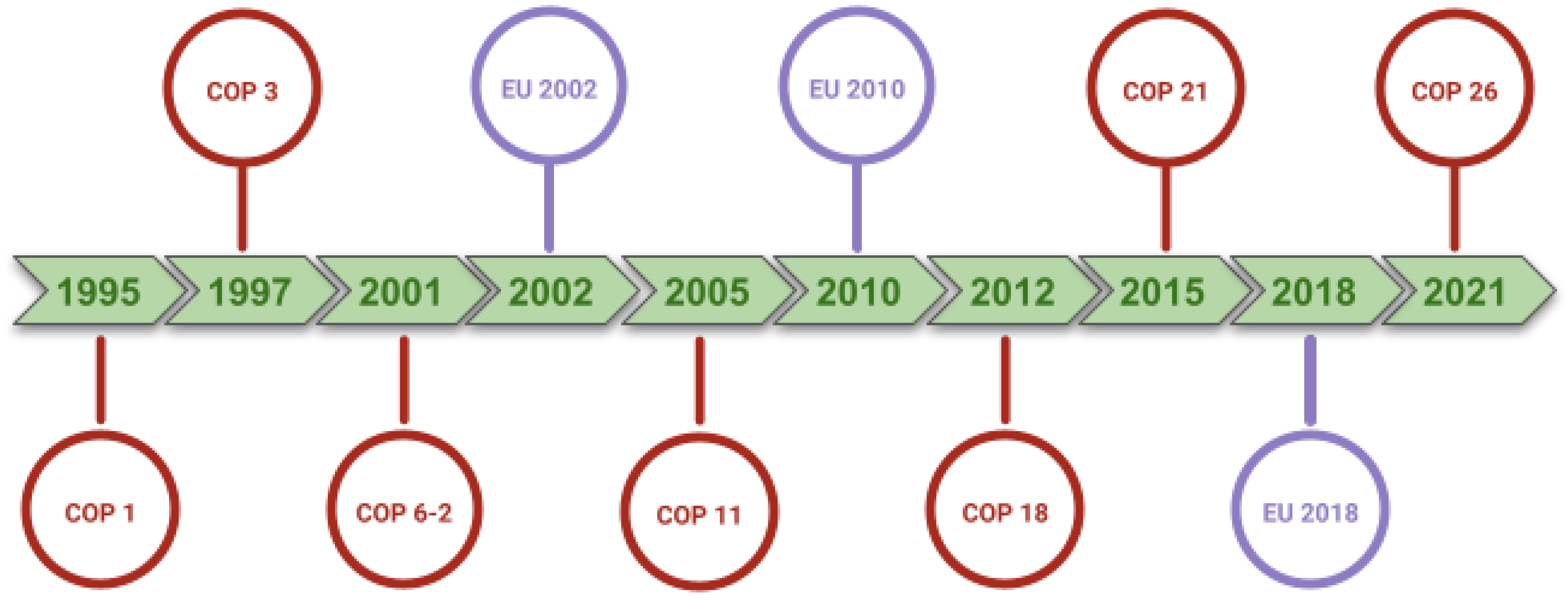
In addition, the European Union has defined, through legislative directives, changes in legislation to increase the use of renewable energies in buildings. Some of these directives, which were extracted from the European Union law portal [65], are highlighted in Table 4 and together with the agreements listed in Table 3, a timeline is consolidated as is shown in Figure 2.
Table 4.
Directive of the European Parliament and of the Council on the use of renewable energies in buildings.
According to Uche et al. (2022) [69], it is intended that from 2020, new buildings (residential and commercial) in Europe will have almost zero energy, and new rules will try to promote the decarbonization of the construction sector by 2050, which requires the implementation of energy transition strategies. A new Directive is being prepared with the aim of limiting the use of fossil fuels for heating and a new energy classification for buildings must be updated according to the age of the building.
Corti et al. (2020) [70], in turn, points out that the review carried out in 2018 (Directive 2018/844) introduced changes with the aim of accelerating the profitable renovation of existing buildings, with the vision of a decarbonized building stock by 2050 and the mobilization of investments.
Figure 2 illustrates, in a timeline, the main milestones of the Conference of the Parties—United Nations on Climate Change (COP’s) and the evolution of legislative directives of the European Union (EU) to date.
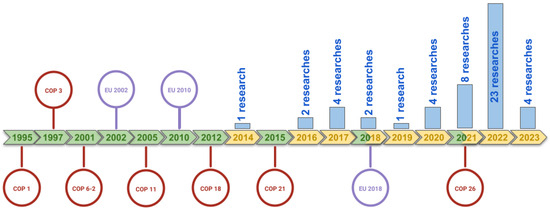
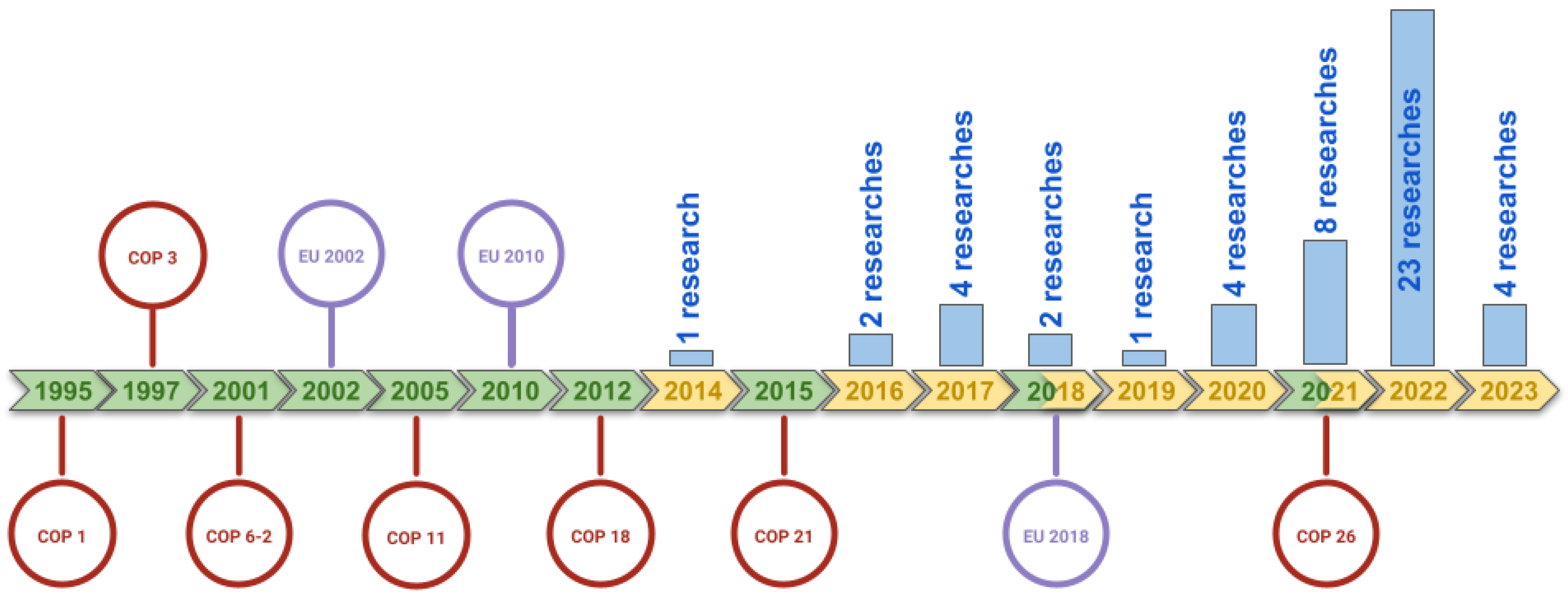
This way, following the methodology described in Section 2, it was verified that, as shown in Table 2, there was an increase in the number of publications on the subject from the year 2020 onwards. Consonance with the advance of global concerns about climate change, evidenced in Table 3, and initiatives seeking to decarbonize buildings, such as the European Union directives, are detailed in Table 4. Such findings were consolidated in the timeline shown in Figure 3.
In order to adhere to the scope of analysis of the theme proposed in this work, of the 49 (forty-nine) articles consulted (Table 5), 37 (thirty-seven) were discarded for not dealing with technologies for renewable energy generation with potential application in vertical buildings. In this way, it was verified that 12 (twelve) articles adhere to the proposal of the present work and are detailed in Table 6.
Table 5.
Information extracted from selected publications. Legend: Biomass; Green Hydrogen; Hydro; Solar; Wind.
Based on these results, in the next section, we discuss the theoretical possibilities of the combined use of existing technologies.
4. Discussion
The analysis of the results obtained in this work indicates that concerns about climate change resulted in agreements between signatory countries of the Convention of the Parties (COP’s) to act on an emergency basis in view of the need to limit global warming to the levels defined in the Paris Agreement. This can be illustrated at COP 26 when the Paris Agreement became operational and adopted the target of limiting the average temperature increase to 1.5 degrees Celsius, a major challenge.
Faced with the representativeness of buildings and the construction industry in global CO2 emissions, which represent about 37% of these emissions, the European Union promoted legislative directives with the aim of achieving zero emissions in buildings and decarbonizing the housing stock in a few decades. As already mentioned, such initiatives tend to contribute to the Sustainable Development Goals, as can be seen in Table 1.
In this scenario, the bibliographic survey carried out in this article indicated that there seems to be a correlation between the number of publications that deal with the decarbonization of buildings, the urgency of limiting global warming as agreed in the COP’s on climate change and the evolution of the European Union Directives for zero-emission in buildings. Figure 3 illustrates that in 2022, there was an increase in the number of publications with this theme compared to previous years. Table 6, in turn, indicates that of the 12 selected articles, 75% were published from the year 2020 onwards, and in 2018, there was a review of the European Union Directives and in 2021, the Paris Agreement became operational.
In this way, each technology highlighted in the previous section has characteristics, as detailed below, that can be theoretically used to jointly make vertical urban buildings producers/consumers (prosumers) of renewable energy.
- Biomass: Energy from biomass is usually obtained by burning biogas or solid biomass, which is a biological material derived from living organisms such as wood, agricultural waste, and dried manure [71];
- Green Hydrogen: Green Hydrogen is hydrogen produced from low-carbon or carbon-free energy sources [72];
- Hydro: Energy produced through the movement of a turbine caused by the passage of water [62];
- Solar: Energy produced by capturing solar radiation [36];
- Wind: Energy produced through the movement caused by the force of the wind, being recognized as one of the most abundant natural resources of electricity [73].
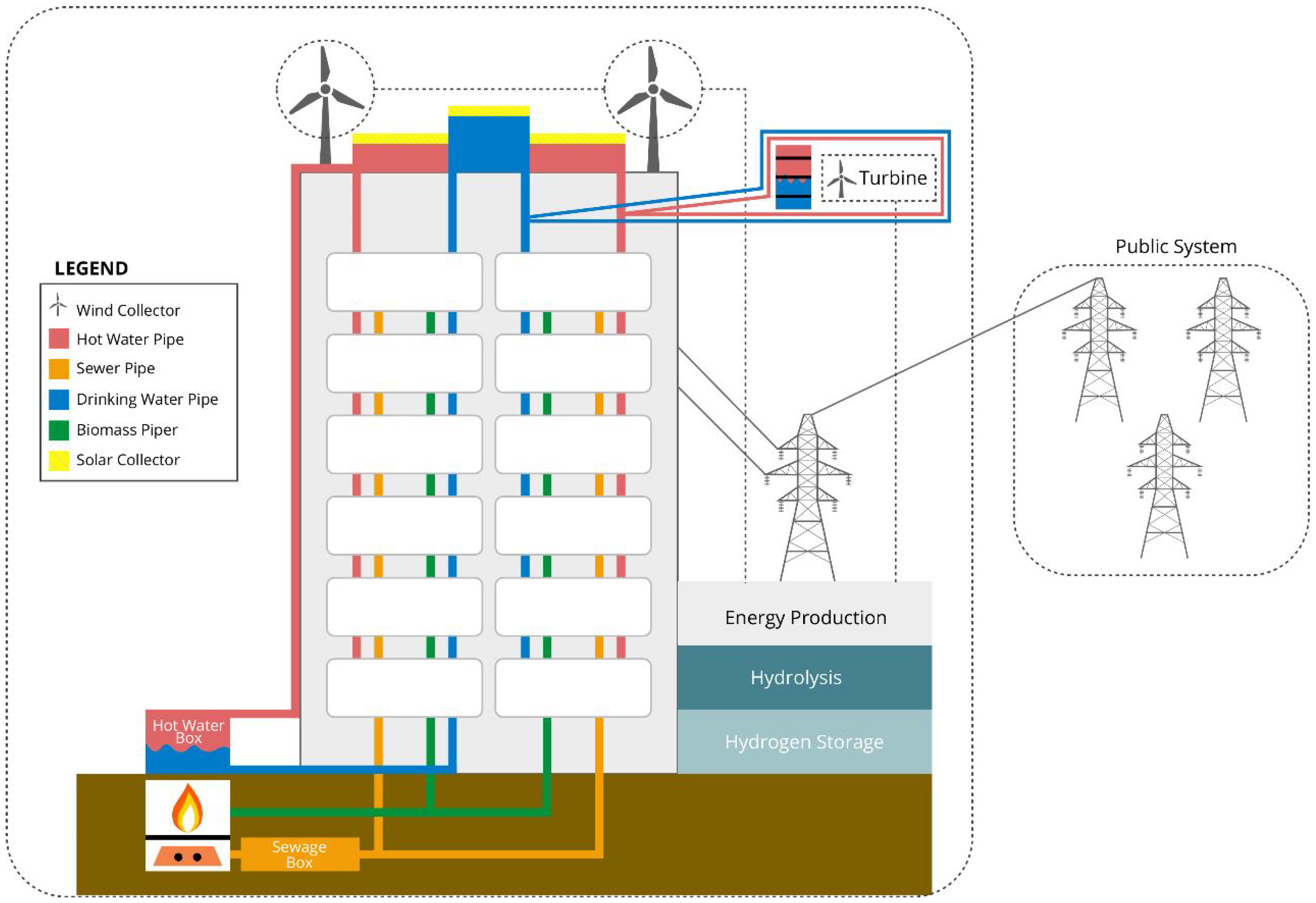
Due to their physical characteristics, vertical urban buildings have limited space to accommodate certain types of technology in isolation, such as a possible installation of solar panels on top of these buildings. In this way, building a hybrid microgrid combining such renewable technologies can prove to be viable and help society to reduce carbonization levels, in addition to achieving some sustainable development goals, as seen in the introduction. The theoretical proposal for the association of these technologies is diagrammed in Figure 4, whose strategies are detailed below:
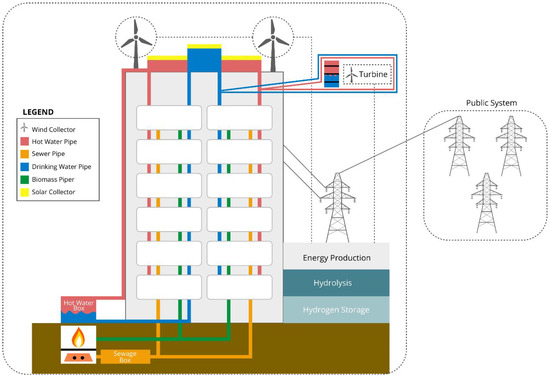
Figure 4.
Theoretical design of the proposed prosumer hybrid microgrid based on the technologies described in Table 6. Source: Authors, 2023.
- Solar panels installed on the roof of the building to capture existing solar radiation;
- Adapted mini wind turbines that can capture the force of the wind on top of buildings, as suggested by Liew et al. [73], to capture the wind generated by passing cars on a highway and discussed by Kumar and Prakash [74] that proposed a review paper to analyze micro wind turbines on high-rise buildings;
- Mini hydro turbines adapted to capture the force of the displacement of water (hot or cold) from the upper tank to the housing units;
- Bio digestion process with Biomass composed of food waste from housing units and the use of sewage treatment produced by the units;
- Water heating from the biodigester combustion process;
- Carrying out hydrolysis to generate green hydrogen from energy generated by the private power generation microgrid;
- Distribution of surplus energy produced for the Public Energy System.
Therefore, the practical use of these combined technologies can be feasible for existing buildings and planned for new constructions. As indicated in the EU Directives, the improvement of the energy performance of buildings depends on external climatic conditions and local conditions, as well as requirements in terms of indoor climate and profitability. In addition to these conditions, in existing buildings, decarbonization through the combined use of renewable sources will depend on the pre-existing structure, which may require greater or lesser investments. This difficulty can be eliminated in the case of new buildings, due to the possibility of including in their projects the requirements for the implementation of a hybrid microgrid. This path towards decarbonization will help achieve the SDG targets, create a broad network of prosumers, reduce energy costs, and improve the environment.
Through the mapping of actions, norms, and studies (Table 3, Table 4 and Table 5, respectively), the qualitative analysis of the theoretical proposal discussed by this research could contribute as a basis to help society in the construction and modernization of vertical urban buildings. In addition, they bring light to governments to think about tax incentives that allow society to improve business models, focusing on low carbon emissions and the use of clean energy, as suggested by recent research [37,58].
5. Conclusions
We believe that improving air quality and achieving energetic efficiency in vertical buildings are essential for reaching the Triple Bottom Line (TBL, which may be described as financial, social, and environmental initiatives for working together) and contributing to the 9th Sustainable Development Goal (e.g., SDG 9). Thus, one way to achieve this is by investing in sustainable infrastructure and innovative technologies.
In this way, initiatives to decarbonize buildings and constructions that were responsible in 2021 for approximately 37% of global CO2 emissions may contribute to the development of resilient and sustainable infrastructures, as determined in target 9.1 of SDG 9. In addition, the production of renewable energy in vertical buildings, with the installation of infrastructure for photovoltaic solar energy generation, such as the canopy top, generating solar energy on top of buildings; wind energy; biomass energy; geothermal energy; mini hydroelectric; and others, makes it possible to act as a prosumer and reduce the amount spent on energy consumption for heating, cooling, lighting, and other applications.
Thus, to achieve the objective of identifying renewable energy generation technologies that can be applied in vertical constructions, this study mapped the state of the art in terms of innovative renewable energy generation technologies, performing an analysis of the potential application of these technologies in urban vertical buildings. For instance, modern microgrid technologies can help reduce consumption and carbon emissions, while vertical building designs can promote the efficient use of resources. In addition to the environmental benefits, implementing sustainable practices can also improve social equity and economic prosperity, which are crucial components of the TBL framework.
Furthermore, renewable energy-based microgrids can enable buildings in large urban centers to function as weather stations, allowing that the temperature, atmospheric pressure, humidity sensors, and other climate variables can be integrated into the microgrid control system, allowing weather data to be collected and used to predict and manage the building’s energy demand. By considering the specific weather conditions of the area where the building is located, it is possible to develop more efficient and resilient energy systems, as well as contribute to monitoring and predicting the weather in the city. This process could include computer modeling to understand the microclimate during extreme weather events [75,76,77].
The high concentration of individuals in large cities seems to be inevitable. Nevertheless, reducing carbon emissions in the atmosphere is mandatory by applying the production of renewable energy generated from different sources. By investing in sustainable infrastructure and adopting energy-efficient practices, businesses can contribute to the achievement of SDGs 9 and 11 while improving their TBL performance. Furthermore, prioritizing the social and environmental impacts of business operations can help create long-term value and foster positive relationships with stakeholders. Ultimately, achieving TBL and promoting sustainability requires a holistic approach that considers social, environmental, and financial considerations.
However, it is necessary to advance the studies and technical feasibility of technologies in buildings, aiming to effectively contribute to environmental sustainability, with the use of quantitative data to develop mathematical models applied to renewable energy systems, which was not achieved by this study, in view of scope limitations. In future perspectives, the creation of a laboratory for simulation and experimentation of micro production of renewable energies in vertical buildings is suggested, evaluating which technologies present the viability of joint application, including the study of other technologies not presented in this work, which can replace technologies from non-renewable sources and contribute to the reduction of carbon emissions into the atmosphere.
Author Contributions
A.S.N.F. and H.S.: supervision, conceptualization, methodology, validation, formal analysis, writing—review and editing. R.S.d.O.: conceptualization, methodology, writing—original draft, validation, formal analysis. M.J.L.d.O.: conceptualization, methodology, writing—original draft, validation, formal analysis. E.G.S.N.: methodology, validation, formal analysis, writing—review and editing. R.S.: methodology, validation, formal analysis, writing—review and editing. All authors have read and agreed to the published version of the manuscript.
Funding
This research was funded by Regional Labor Court of the 5th Region—Bahia—Brazil.
Institutional Review Board Statement
Not applicable.
Informed Consent Statement
Not applicable.
Data Availability Statement
Not applicable.
Conflicts of Interest
The authors declare no conflict of interest.
Abbreviations
| ANN | Artificial Neural Network |
| AI | Artificial Intelligence |
| COP’s | Conferences of the Parties—United Nations Climate Change |
| EU | European Union |
| GHG | Greenhouse gases |
| NBS | Nature-based Solutions |
| SDG | Sustainable Development Goals |
| SDSPSEDS | Stirling-powered single effect distillation system |
| TBL | Triple Bottom Line |
References
- UNFCCC. Conference of the Parties (COP). Paris Climate Change Conference—November 2015. Available online: https://unfccc.int/documents/9064 (accessed on 1 April 2023).
- Zarco-Soto, F.J.; Zarco-Soto, I.M.; Zarco-Periñán, P.J. Influence of Population Income and Climate on Air Pollution in Cities Due to Buildings: The Case of Spain. Atmosphere 2021, 12, 1051. [Google Scholar] [CrossRef]
- United Nations Environment Programme. 2022 Global Status Report for Buildings and Construction. Available online: https://www.unep.org/resources/publication/2022-global-status-report-buildings-and-construction (accessed on 1 April 2023).
- Borges, T.; Salvador, H.; Ferreira, P.; Saba, H. Renewable sources to promote well-being in poor regions of Brazil. Front. Phys. 2022, 10, 1192. [Google Scholar]
- Yin, C.; Pereira, P.; Zhao, W.; Barcelo, D. Natural climate solutions. The way forward. Geogr. Sustain. 2023, 4, 179–182. [Google Scholar] [CrossRef]
- Makvandi, M.; Li, W.; Ou, X.; Chai, H.; Khodabakhshi, Z.; Fu, J.; Yuan, P.F.; Horimbere, E.d.L.J. Urban Heat Mitigation towards Climate Change Adaptation: An Eco-Sustainable Design Strategy to Improve Environmental Performance under Rapid Urbanization. Atmosphere 2023, 14, 638. [Google Scholar] [CrossRef]
- Anderson, V.; Gough, W.A.; Zgela, M.; Milosevic, D.; Dunjic, J. Lowering the Temperature to Increase Heat Equity: A Multi-Scale Evaluation of Nature-Based Solutions in Toronto, Ontario, Canada. Atmosphere 2022, 13, 1027. [Google Scholar] [CrossRef]
- Elsheikh, A.H.; Sharshir, S.W.; Abd Elaziz, M.; Kabeel, A.; Guilan, W.; Haiou, Z. Modeling of solar energy systems using artificial neural network: A comprehensive review. Sol. Energy 2019, 180, 622–639. [Google Scholar] [CrossRef]
- Al-qaness, M.A.; Ewees, A.A.; Fan, H.; Abualigah, L.; Elsheikh, A.H.; Abd Elaziz, M. Wind power prediction using random vector functional link network with capuchin search algorithm. Ain Shams Eng. J. 2023, 14, 102095. [Google Scholar] [CrossRef]
- Alhawsawi, A.; Zayed, M.E.; Moustafa, E.; Banoqitah, E.; Elsheikh, A.H. Hybridizing solar dish Stirling power system with single-effect desalination for sustainable electricity and freshwater co-generation: Mathematical modeling and performance evaluation. Case Stud. Therm. Eng. 2023, 45, 102997. [Google Scholar] [CrossRef]
- Elsheikh, A. Bistable Morphing Composites for Energy-Harvesting Applications. Polymers 2022, 14, 1893. [Google Scholar] [CrossRef]
- United Nations—Department of Economic and Social affairs Sustainable Development. Sustainable Development Goals (SDG). Available online: https:///sdgs.un.org/goals (accessed on 1 April 2023).
- Paré, G.; Kitsiou, S. Methods for literature reviews. In Handbook of eHealth Evaluation: An Evidence-Based Approach [Internet]; University of Victoria: Singapore, 2017. [Google Scholar]
- Sovacool, B.K.; Martiskainen, M.; Hook, A.; Baker, L. Decarbonization and its discontents: A critical energy justice perspective on four low-carbon transitions. Clim. Chang. 2019, 155, 581–619. [Google Scholar] [CrossRef]
- Kobashi, T.; Choi, Y.; Hirano, Y.; Yamagata, Y.; Say, K. Rapid rise of decarbonization potentials of photovoltaics plus electric vehicles in residential houses over commercial districts. Appl. Energy 2022, 306, 118142. [Google Scholar] [CrossRef]
- Pfeifer, A.; Herc, L.; Batas Bjelić, I.; Duić, N. Flexibility index and decreasing the costs in energy systems with high share of renewable energy. Energy Convers. Manag. 2021, 240, 114258. [Google Scholar] [CrossRef]
- Sovacool, B.K. Contestation, contingency, and justice in the Nordic low-carbon energy transition. Energy Policy 2017, 102, 569–582. [Google Scholar] [CrossRef]
- Calise, F.; Duic, N.; Pfeifer, A.; Vicidomini, M.; Orlando, A. Moving the system boundaries in decarbonization of large islands. Energy Convers. Manag. 2021, 234, 113956. [Google Scholar] [CrossRef]
- Madurai Elavarasan, R.; Pugazhendhi, R.; Irfan, M.; Mihet-Popa, L.; Khan, I.A.; Campana, P.E. State-of-the-art sustainable approaches for deeper decarbonization in Europe—An endowment to climate neutral vision. Renew. Sustain. Energy Rev. 2022, 159, 112204. [Google Scholar] [CrossRef]
- Bloess, A.; Schill, W.P.; Zerrahn, A. Power-to-heat for renewable energy integration: A review of technologies, modeling approaches, and flexibility potentials. Appl. Energy 2018, 212, 1611–1626. [Google Scholar] [CrossRef]
- Susskind, L.; Chun, J.; Gant, A.; Hodgkins, C.; Cohen, J.; Lohmar, S. Sources of opposition to renewable energy projects in the United States. Energy Policy 2022, 165, 112922. [Google Scholar] [CrossRef]
- Ümitcan Yilmaz, H.; Kimbrough, S.O.; van Dinther, C.; Keles, D. Power-to-gas: Decarbonization of the European electricity system with synthetic methane. Appl. Energy 2022, 323, 119538. [Google Scholar] [CrossRef]
- Jafari, M.; Botterud, A.; Sakti, A. Decarbonizing power systems: A critical review of the role of energy storage. Renew. Sustain. Energy Rev. 2022, 158, 112077. [Google Scholar] [CrossRef]
- Chang, S.; Cho, J.; Heo, J.; Kang, J.; Kobashi, T. Energy infrastructure transitions with PV and EV combined systems using techno-economic analyses for decarbonization in cities. Appl. Energy 2022, 319, 119254. [Google Scholar] [CrossRef]
- Ahmed, A.; Ge, T.; Peng, J.; Yan, W.C.; Tee, B.T.; You, S. Assessment of the renewable energy generation towards net-zero energy buildings: A review. Energy Build. 2022, 256, 111755. [Google Scholar] [CrossRef]
- Padovani, F.; Sommerfeldt, N.; Longobardi, F.; Pearce, J.M. Decarbonizing rural residential buildings in cold climates: A techno-economic analysis of heating electrification. Energy Build. 2021, 250, 111284. [Google Scholar] [CrossRef]
- Hanna, R.; Ghonima, M.; Kleissl, J.; Tynan, G.; Victor, D.G. Evaluating business models for microgrids: Interactions of technology and policy. Energy Policy 2017, 103, 47–61. [Google Scholar] [CrossRef]
- Timmons, D.; Konstantinidis, C.; Shapiro, A.M.; Wilson, A. Decarbonizing residential building energy: A cost-effective approach. Energy Policy 2016, 92, 382–392. [Google Scholar] [CrossRef]
- Jacobson, M.Z.; von Krauland, A.K.; Coughlin, S.J.; Palmer, F.C.; Smith, M.M. Zero air pollution and zero carbon from all energy at low cost and without blackouts in variable weather throughout the U.S. with 100% wind-water-solar and storage. Renew. Energy 2022, 184, 430–442. [Google Scholar] [CrossRef]
- Arent, D.J.; Green, P.; Abdullah, Z.; Barnes, T.; Bauer, S.; Bernstein, A.; Berry, D.; Berry, J.; Burrell, T.; Carpenter, B.; et al. Challenges and opportunities in decarbonizing the U.S. energy system. Renew. Sustain. Energy Rev. 2022, 169, 112939. [Google Scholar] [CrossRef]
- Majidi Nezhad, M.; Neshat, M.; Piras, G.; Astiaso Garcia, D. Sites exploring prioritisation of offshore wind energy potential and mapping for wind farms installation: Iranian islands case studies. Renew. Sustain. Energy Rev. 2022, 168, 112791. [Google Scholar] [CrossRef]
- Lugovoy, O.; Gao, S.; Gao, J.; Jiang, K. Feasibility study of China’s electric power sector transition to zero emissions by 2050. Energy Econ. 2021, 96, 105176. [Google Scholar] [CrossRef]
- Buonocore, J.J.; Salimifard, P.; Magavi, Z.; Allen, J.G. Inefficient Building Electrification Will Require Massive Buildout of Renewable Energy and Seasonal Energy Storage. Sci. Rep. 2022, 12, 11931. [Google Scholar] [CrossRef]
- Ren, K.; Tang, X.; Höök, M. Evaluating metal constraints for photovoltaics: Perspectives from China’s PV development. Appl. Energy 2021, 282, 116148. [Google Scholar] [CrossRef]
- Chong, W.T.; Yip, S.Y.; Fazlizan, A.; Poh, S.C.; Hew, W.P.; Tan, E.P.; Lim, T.S. Design of an exhaust air energy recovery wind turbine generator for energy conservation in commercial buildings. Renew. Energy 2014, 67, 252–256. [Google Scholar] [CrossRef]
- Palomba, V.; Borri, E.; Charalampidis, A.; Frazzica, A.; Cabeza, L.F.; Karellas, S. Implementation of a solar-biomass system for multi-family houses: Towards 100% renewable energy utilization. Renew. Energy 2020, 166, 190–209. [Google Scholar] [CrossRef]
- Yin, G.; Duan, M. Pricing the deep peak regulation service of coal-fired power plants to promote renewable energy integration. Appl. Energy 2022, 321, 119391. [Google Scholar] [CrossRef]
- Wang, Y.; Mauree, D.; Sun, Q.; Lin, H.; Scartezzini, J.; Wennersten, R. A review of approaches to low-carbon transition of high-rise residential buildings in China. Renew. Sustain. Energy Rev. 2020, 131, 109990. [Google Scholar] [CrossRef]
- Xiao, K.; Yu, B.; Cheng, L.; Li, F.; Fang, D. The effects of CCUS combined with renewable energy penetration under the carbon peak by an SD-CGE model: Evidence from China. Appl. Energy 2022, 321, 119396. [Google Scholar] [CrossRef]
- Wendeker, M.; Gęca, M.J.; Grabowski, Ł.; Pietrykowski, K.; Kasianantham, N. Measurements and analysis of a solar-assisted city bus with a diesel engine. Appl. Energy 2022, 309, 118439. [Google Scholar] [CrossRef]
- Erten, D.; Kılkış, B. How can green building certification systems cope with the era of climate emergency and pandemics? Energy Build. 2022, 256, 111750. [Google Scholar] [CrossRef]
- Farid, A.M.; Jiang, B.; Muzhikyan, A.; Youcef-Toumi, K. The need for holistic enterprise control assessment methods for the future electricity grid. Renew. Sustain. Energy Rev. 2016, 56, 669–685. [Google Scholar] [CrossRef]
- Beuse, M.; Dirksmeier, M.; Steffen, B.; Schmidt, T.S. Profitability of commercial and industrial photovoltaics and battery projects in South-East-Asia. Appl. Energy 2020, 271, 115218. [Google Scholar] [CrossRef]
- Seljom, P.; Tomasgard, A. The impact of policy actions and future energy prices on the cost-optimal development of the energy system in Norway and Sweden. Energy Policy 2017, 106, 85–102. [Google Scholar] [CrossRef]
- Zhou, Y. Climate change adaptation with energy resilience in energy districts—A state-of-the-art review. Energy Build. 2023, 279, 112649. [Google Scholar] [CrossRef]
- Bernath, C.; Deac, G.; Sensfuß, F. Impact of sector coupling on the market value of renewable energies—A model-based scenario analysis. Appl. Energy 2021, 281, 115985. [Google Scholar] [CrossRef]
- Lucas, T.R.; Ferreira, A.F.; Santos Pereira, R.; Alves, M. Hydrogen production from the WindFloat Atlantic offshore wind farm: A techno-economic analysis. Appl. Energy 2022, 310, 118481. [Google Scholar] [CrossRef]
- Gkeka-Serpetsidaki, P.; Papadopoulos, S.; Tsoutsos, T. Assessment of the visual impact of offshore wind farms. Renew. Energy 2022, 190, 358–370. [Google Scholar] [CrossRef]
- Hearn, A.X. Positive energy district stakeholder perceptions and measures for energy vulnerability mitigation. Appl. Energy 2022, 322, 119477. [Google Scholar] [CrossRef]
- Chen, H.; Chen, J.; Han, G.; Cui, Q. Winding down the wind power curtailment in China: What made the difference? Renew. Sustain. Energy Rev. 2022, 167, 112725. [Google Scholar] [CrossRef]
- Gao, D.; Wu, L.; Hao, Y.; Pei, G. Ultrahigh-efficiency solar energy harvesting via a non-concentrating evacuated aerogel flat-plate solar collector. Renew. Energy 2022, 196, 1455–1468. [Google Scholar] [CrossRef]
- Wang, Y.; Qin, Y.; Wang, K.; Liu, J.; Fu, S.; Zou, J.; Ding, L. Where is the most feasible, economical, and green wind energy? Evidence from high-resolution potential mapping in China. J. Clean. Prod. 2022, 376, 134287. [Google Scholar] [CrossRef]
- Rogge, K.S.; Dütschke, E. What makes them believe in the low-carbon energy transition? Exploring corporate perceptions of the credibility of climate policy mixes. Environ. Sci. Policy 2018, 87, 74–84. [Google Scholar] [CrossRef]
- Backe, S.; Korpås, M.; Tomasgard, A. Heat and electric vehicle flexibility in the European power system: A case study of Norwegian energy communities. Int. J. Electr. Power Energy Syst. 2021, 125, 106479. [Google Scholar] [CrossRef]
- Chen, E.; Xie, M.; Jia, T.; Zhao, Y.; Dai, Y. Performance assessment of a solar-assisted absorption-compression system for both heating and cooling. Appl. Energy 2022, 328, 120238. [Google Scholar] [CrossRef]
- Ma, Q.; Fan, J.; Liu, H. Energy pile-based ground source heat pump system with seasonal solar energy storage. Renew. Energy 2023, 206, 1132–1146. [Google Scholar] [CrossRef]
- Babaei, R.; Ting, D.S.K.; Carriveau, R. Optimization of hydrogen-producing sustainable island microgrids. Int. J. Hydrog. Energy 2022, 47, 14375–14392. [Google Scholar] [CrossRef]
- Backe, S.; Pinel, D.; Askeland, M.; Lindberg, K.B.; Korpås, M.; Tomasgard, A. Exploring the link between the EU emissions trading system and net-zero emission neighbourhoods. Energy Build. 2023, 281, 112731. [Google Scholar] [CrossRef]
- Wang, S.; Tarroja, B.; Schell, L.S.; Samuelsen, S. Determining cost-optimal approaches for managing excess renewable electricity in decarbonized electricity systems. Renew. Energy 2021, 178, 1187–1197. [Google Scholar] [CrossRef]
- Tafone, A.; Raj Thangavelu, S.; Morita, S.; Romagnoli, A. Design optimization of a novel cryo-polygeneration demonstrator developed in Singapore—Techno-economic feasibility study for a cooling dominated tropical climate. Appl. Energy 2023, 330, 119916. [Google Scholar] [CrossRef]
- Suman, R.; Javaid, M.; Nandan, D.; Bahl, S.; Haleem, A. Electricity Generation Through Water Supply Pipes in High Rise Buildings. J. Ind. Integr. Manag. 2021, 06, 449–468. [Google Scholar] [CrossRef]
- Du, J.; Yang, H.; Shen, Z.; Chen, J. Micro hydro power generation from water supply system in high rise buildings using pump as turbines. Energy 2017, 137, 431–440. [Google Scholar] [CrossRef]
- Rathnayaka, A.D.; Potdar, V.M.; Kuruppu, S.J. An innovative approach to manage prosumers in Smart Grid. In Proceedings of the 2011 World Congress on Sustainable Technologies (WCST), London, UK, 7–10 November 2011; pp. 141–146. [Google Scholar] [CrossRef]
- United Nations Climate Change. Conference of the Parties (COP). Available online: https://unfccc.int/process/bodies/supreme-bodies/conference-of-the-parties-cop#sessions (accessed on 1 April 2023).
- EUR-Lex. Access to European Union law. Available online: https://eur-lex.europa.eu/ (accessed on 1 April 2023).
- EUR-Lex. Directive 2002/91/EC of the European Parliament and of the Council. Available online: https://eur-lex.europa.eu/legal-content/PT/TXT/?uri=celex%3A32002L0091 (accessed on 1 April 2023).
- EUR-Lex. Directive 2010/31/EU of the European Parliament and of the Council. Available online: https://eur-lex.europa.eu/LexUriServ/LexUriServ.do?uri=OJ:L:2010:153:0013:0035:en:PDF (accessed on 1 April 2023).
- EUR-Lex. Directive (EU) 2018/844 of the European Parliament and of the Council. Available online: https://eur-lex.europa.eu/legal-content/PT/TXT/PDF/?uri=CELEX:32018L0844&from=EN (accessed on 1 April 2023).
- Uche, J.; Zabalza, I.; Gesteira, L.G.; Martínez-Gracia, A.; Usón, S. A Sustainable Polygeneration System for a Residential Building. Appl. Sci. 2022, 12, 12992. [Google Scholar] [CrossRef]
- Corti, P.; Capannolo, L.; Bonomo, P.; De Berardinis, P.; Frontini, F. Comparative Analysis of BIPV Solutions to Define Energy and Cost-Effectiveness in a Case Study. Energies 2020, 13, 3827. [Google Scholar] [CrossRef]
- European Parliament. Biomass for Electricity and Heating—Opportunities and Challenges. Available online: https://www.europarl.europa.eu/RegData/etudes/BRIE/2015/568329/EPRS_BRI(2015)568329_EN.pdf (accessed on 1 April 2023).
- Shi, J.; Zhu, Y.; Feng, Y.; Yang, J.; Xia, C. A Prompt Decarbonization Pathway for Shipping: Green Hydrogen, Ammonia, and Methanol Production and Utilization in Marine Engines. Atmosphere 2023, 14, 584. [Google Scholar] [CrossRef]
- Liew, H.F.; Baharuddin, I.; Rosemizi, A.R.; Muzamir, I.; Hassan, S.I.S. Review of feasibility wind turbine technologies for highways energy harvesting. J. Phys. Conf. Ser. 2020, 1432, 012059. [Google Scholar] [CrossRef]
- Kumar, N.; Prakash, O. Analysis of wind energy resources from high rise building for micro wind turbine: A review. Wind Eng. 2023, 47, 190–219. [Google Scholar] [CrossRef]
- Murari, T.B.; Filho, A.S.N.; Moret, M.A.; Pitombo, S.; Santos, A.A. Self-affine analysis of ENSO in solar radiation. Energies 2020, 13, 4816. [Google Scholar] [CrossRef]
- Schaefer, M.; Salari, H.E.; Köckler, H.; Thinh, N.X. Assessing local heat stress and air quality with the use of remote sensing and pedestrian perception in urban microclimate simulations. Sci. Total Environ. 2021, 794, 148709. [Google Scholar] [CrossRef] [PubMed]
- Ampatzidis, P.; Kershaw, T. A review of the impact of blue space on the urban microclimate. Sci. Total Environ. 2020, 730, 139068. [Google Scholar] [CrossRef]
Disclaimer/Publisher’s Note: The statements, opinions and data contained in all publications are solely those of the individual author(s) and contributor(s) and not of MDPI and/or the editor(s). MDPI and/or the editor(s) disclaim responsibility for any injury to people or property resulting from any ideas, methods, instructions or products referred to in the content. |
© 2023 by the authors. Licensee MDPI, Basel, Switzerland. This article is an open access article distributed under the terms and conditions of the Creative Commons Attribution (CC BY) license (https://creativecommons.org/licenses/by/4.0/).