


Abstract
Today, the European Union and the governments of its constituent countries are focused on the development of the Sustainable Development Goals (SDGs) and the 2030 agenda—something that has been translated into education itself. Video games, gamification, and game-based learning have become different strategies and tools to enhance the learning process and some of the growing approaches used by teachers to develop sustainable education in classrooms. This research aims to analyze the characteristics to promote sustainability in education using games and technology, specifically in terms of learning benefits for higher education. A systematic review of the literature was conducted following the PRISMA methodology. At first, 2025 documents were found; after the filtering phases, the number of articles was reduced to 9, which were subsequently analyzed in depth. The results indicated that the benefits of the use of games mediated by technologies include the following: it favors education for sustainability, and it promotes the educational inclusion and the work of various social skills, such as collaborative and cooperative work. Also, there was an increase in the number of publications between 2019 and 2023, reflecting the growing interest in the topic. However, there are some research gaps in this field.
1. Introduction
The current reality presents a series of challenges that will be difficult to overcome without global collaboration to promote sustainable development from a future-oriented perspective [1]. The United Nations (UN), through the implementation of the Sustainable Development Goals (SDGs) and the 2030 Agenda for Sustainable Development, seeks to create a more equitable environment that can alleviate the existing difficulties in the world today [1]. This is where education plays a fundamental role and, with the help of available technological resources and appropriate pedagogical strategies, the aim is to build an education oriented towards achieving the SDGs to achieve a fairer and more equitable world.
As the UN explicitly states in the theoretical development of the SDGs [1], number four shows the greatest linkage with the educational field, as it advocates “ensuring inclusive and equitable quality education and promoting lifelong learning opportunities for all”. Among the goals set for this objective, some aim to ensure free primary and secondary education for all, so as to ensure quality education that promotes equity for men and women at all stages, providing equal opportunities. Similarly, the goal is to eliminate disparities in education between men and women, promote literacy for the entire population, and promote the inculcation of sustainability, peace and non-violence, global citizenship, and positive valuing of differences, with a deadline of 2030 for achieving all of these goals.
In relation to the SDGs, higher education plays a fundamental role since, as stated in the guide developed by the SDNS [2], universities will fundamentally be responsible for providing the knowledge and solutions that support the implementation of these Sustainable Development Goals and will enable the creation of new goals; they will facilitate inclusion at the social level, along with the creation of intersectional leadership in the active implementation of these SDGs. Society, therefore, is in constant change, and due to this undeniable fact, education is one of the areas facing the greatest challenges, as it is responsible for responding to the needs of learners and has the capacity to adapt to new realities arising from society’s advancement at all levels [3].
Along the same lines, and as we have seen that society is exposed to numerous and constant changes, it would be favorable to make use of different tools to achieve the modification and improvement of the teaching–learning processes.
As has been seen throughout the introductory development of this article, the main objective here is to establish a clear conceptualization of the relationship between gamification, game-based learning, and video games and their benefits to expand sustainability education and the Sustainable Development Goals in higher education in the European context.
Literature Review
Gamification and game-based learning have emerged as some of the most current approaches to promoting the development of the population in the proposed values. In particular, video games have emerged as one of the main entertainment options in our society via the appearance of new platforms created around video games, such as Twitch, which brings together a plethora of people [4]. For all of these reasons, implementing didactic strategies based on gamification or games in education promotes student motivation, making the proposed exercises more attractive to them, as some of the works reviewed indicate [5]. This fact is evidenced in other proposals [6] that argue that gamified approaches could increase student motivation and, therefore, improve their participation and involvement in the proposed activities. Such proposals represent an interesting approach for teachers to improve their teaching–learning process and promote active participation and involvement of their students in the classroom.
Despite the similarity of the concepts of gamification and game-based learning, and the interchangeable use of the two terms in the literature, game-based learning involves using games and video games to improve learning. However, gamification uses tools and dynamics specific to games in non-playful contexts, although the game itself is not played [7].
The literature review highlights the research on video games, gamification, and game-based learning in terms of the benefits of using these methods to facilitate the understanding of the contents [8], the involvement of students in the subjects [9], creativity and innovation [10], or social competence [11]. Although GBL and gamification have been applied at several educational stages, including higher education, with some success stories and other failed experiences [12], in the systematic review carried out, only nine articles were found related to the use of GBL and educational sustainability in higher education. This led to the identification of the lack of an updated study of the scientific production in this field, which is not restricted to a specific type of research but encompasses different assessment methods as well as learning-related outcomes. Therefore, the aim of this research was to fill this gap. Although priority was given to a concrete coverage of the study problem, this work is both a continuation and an extension of previous work.
More empirical evidence is needed to reveal the added value of game-based learning situations related to the development of the SDGs compared to other types of learning. There is a need to review such approaches, as well as the underlying learning benefits of game design related to sustainability education at the university level. This will serve to expand the ways in which it can be applied in the classroom and provide guidelines for educators. The actual learning benefits still need to be known before such strategies can be generalized. Therefore, the systematic review of this topic is considered necessary to address the research gaps identified in the analysis of the scientific literature.
It is necessary to explore the educational potential of the different possibilities of use in different disciplines, how to practice and integrate what has been learned in GBL programs, or how to assess knowledge, facilitate didactic design for teachers, and pay attention to diversity [13] concerning which methods and instruments of educational programs are evaluated or contribute to making the acquired learning transferable to different contexts, and specifically in the field of education for sustainability. These challenges will help to find out what directions LWM can take, based on case studies and good practices in the use of LWM and/or evidence on learning processes based on the experiments carried out.
In contrast to other studies, this review highlights the benefits of using these methodological approaches for sustainable education in higher education [4,12].
There is a need to review the approaches developed in game-based programs for the development of sustainable education, as well as the underlying learning benefits of game design related to sustainability education. This will serve to expand the ways in which it can be applied in the classroom and provide guidelines for educators.
2. Materials and Methods
Given the growth of works interested in this theme, and to find the main findings and research gaps related to it, a systematic review was conducted using a systematic mapping approach based on the PRISMA (Preferred Reporting Items for Systematic Reviews and Meta-Analyses) methodology, which transparently documents why the review was conducted, the process of searching and compiling the sample papers, and what findings were found [14]. This allows for a description, critical review, and synthesis of the findings in a reproducible manner for future research [15,16]. For this review, four mapping questions were proposed to help contextualize the research topic (Box 1), along with eight research questions to critically analyze the phenomenon under study (Box 2).
Box 1. Mapping questions.
MQ1: Who are the most prominent authors in this field?
MQ2: What has been the evolution of scientific production over the years?
MQ3: In which countries has research on sustainable
education related to gamification, video games, or game-based learning been predominantly published?
MQ4: What are the most frequently used channels for
publishing research in the field of sustainable education related to gamification, video games, or game-based learning?
Box 2. Research questions.
RQ1: What are the most
used research methods in this field?
RQ2: What types of practices are most used depending on the educational stage?
RQ3: What SDGs are most developed using these approaches?
RQ4: What benefits do they have in learning?
RQ5: What impact do these practices have on SDG 4: Ensure inclusive and equitable quality education?
RQ6: What evaluation methods are used to assess the
impacts of these practices?
RQ7: What limitations do current studies in this field have?
RQ8: What research gaps exist?
The sample collection was based on the search for keywords extracted from the UNESCO and ERIC thesauri, combined with the Boolean operators shown in Box 3.
Those research studies related to sustainable education, Sustainable Development Goals (SDGs), gamification, video games, and game-based learning were selected.
Box 3. Keywords used in the search, and combinations of Boolean operators used.
(Sustainability education or Sustainable Development
Goals) AND (gamification OR video games OR game-based learning)
(Sustainability education or Sustainable Development
Goals) AND (gamification OR video games OR game-based learning) AND (higher education OR college OR undergrad OR graduate OR postgrad)
Six of the most used scientific–educational databases were consulted: Web of Science (WOS), SCOPUS, EBSCO, PubMed, Dialnet, and Taylor & Francis. These international databases were considered because of their indexing of educational technology research and works in English and Spanish. The search was filtered to cover the years 2019–2023, narrowing the search to the last five years to obtain up-to-date reports, in order to ensure that the findings corresponded to current samples.
In the process of searching for articles, the search fields used for the queries were topic, title, abstract, keywords, year published, language and research areas, countries, and type of work.
The references found in the bibliographic search were downloaded in RIS format and stored in the intelligent virtual systematic review system Rayyan [17] for subsequent filtering according to the PRISMA method. Inclusion and exclusion criteria were established to identify relevant studies (Table 1), and based on these criteria, the most relevant articles on the topic were selected. From here, the process followed three phases: identification, screening, and inclusion [18].

Table 1.
Inclusion and exclusion criteria for the studies.
It is important to clarify that the CI3 inclusion criterion was identified from the data collected regarding relevance, impact, and international scope in the context of the research and the topic covered in the published journals (JCI and JCR). For its part, the CI4 inclusion criterion (Publication between 2019 and 2023) was chosen to select recent publications to guarantee their relevance and current suitability.
The CI7 inclusion criterion was based on the ability of the researcher to access the open-access publication with the institutional account of the university to which they belong, extrapolating to other possible universities.
In accordance with the CI8 (contextualized in Europe) inclusion criterion, it was decided to exclusively include articles and journals whose study samples belonged to European universities. It was chosen to include institutions that act under the European Union treaty and the United Nations 2030 Agenda, which includes the 17 Sustainable Development Goals (SDGs).
The different phases of development are explained below:
Identification phase:
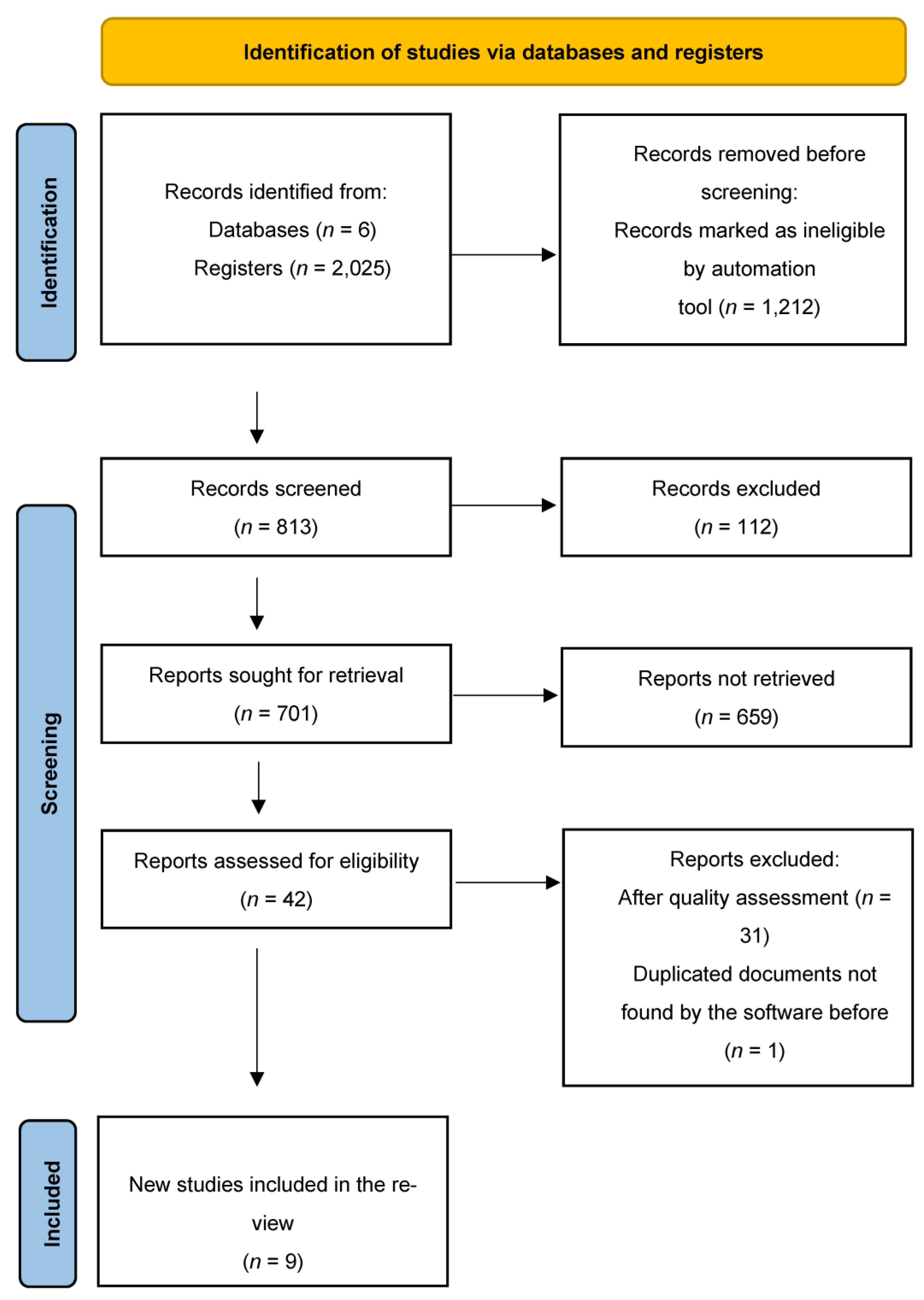
In the first phase, 2025 articles related to the subject were identified. The aim of this initial search was to determine the scope of resources published on the topic, where 128 papers were found in WOS, 91 in SCOPUS, 157 in PubMed, 56 in Dialnet, 1775 in Taylor & Francis, and 39 in EBSCO. Of these, 1212 were automatically eliminated by the Rayyan software (2022) because they had metadata with low readability for the program, leaving 813 articles for review.
Screening phase:
In a second phase, after eliminating duplicate articles (n = 112), 701 articles were identified. A screening was performed by reviewing the title, keywords, and abstract and applying the inclusion and exclusion criteria. After this screening, 659 documents were discarded, leaving a group of 42 selected papers for the next phase.
Inclusion phase:
In the third phase, a second screening was carried out using a quality checklist (Table 2). This was based on a checklist of 6 questions with predefined answers and a score associated with each answer (yes = 1/partially = 0.5/no = 0). A cutoff score of 3 points was established, and studies evaluated with a score below this were discarded from the final review.
Table 2.
Quality criteria used in the second screening [16].
After the quality evaluation, 31 articles were excluded; in addition, one of them was removed for being a duplicate (previously not detected by the Rayyan tool), and another was also eliminated due to lack of access to the full document. This resulted in a final sample of n = 9 articles for in-depth review.
Figure 1 shows the screening process carried out in the three phases using the PRISMA method.
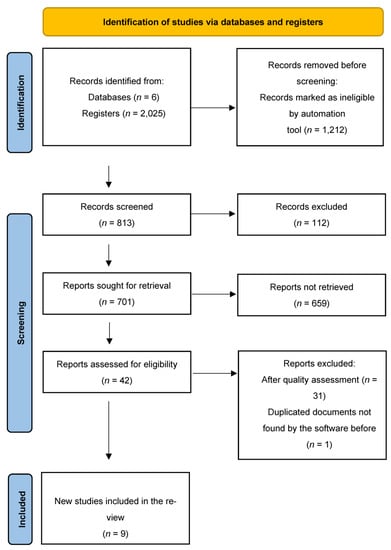
Figure 1.
Process carried out based on the PRISMA method [14].
Finally, with the final corpus of articles, a manual review was carried out based on an Excel table systematically organized by columns to extract information from each work, considering the mapping and research questions. Regarding data processing, the information was synthesized to obtain an updated study of the current state of the field of study and the research gaps detected.
3. Results
The data obtained after reviewing the final sample of primary studies yielded the following results.
Description of the final sample:
Regarding the critical appraisal, Table 3 shows the scores obtained by each study to be included in the final sample. The cutoff score was set at three points; therefore, all nine evaluated articles were included. Question number six stands out, showing that all studies were extracted from peer-reviewed resources. As for the rest of the questions, all obtained scores equal to or above the cutoff score; it is only worth noting that question number three generated the lowest score, corresponding to the measurement techniques used in the analyzed studies and their transparent, replicable, and justified descriptions.
Table 3.
Process of quality assessment of the selected research documents [14].
Answers to mapping questions:
Table 4 shows the final corpus of selected works, as well as the answers to the mapping questions: the most representative authors, the evolution of scientific production over the years, the country of publication, and the most frequently used resources. The year was 2022, and Spain was the country where the most research had been developed. As for the authors, it was not possible to draw a consensus on a particular outstanding one, since several academics were found with equal frequency.
Table 4.
Research documents were selected according to the evaluation criteria established for their final study.
In reference to the years of publication, there was a notable increase in production from the year 2021 onwards, with the year 2022 being the year with the highest presence in this study. Spain was the country with the most publications found, and in the case of magazines, there was none that stood out more than the others in our sample.
Regarding the impact of the journals where the articles were published, it should be mentioned that the Journal Citation Indicator (JCI), Journal Impact Factor (JIF), and Journal Citation Report (JCR) were used to verify the scientific impact of the articles, and their values are shown in Table 5.
Table 5.
Compilation of journals of the selected articles in the study, their category and/or topic, and their impact values (JCI, JIF, and JCR).
According to the data collected regarding the category and topic of the journals where the works were published, it can be stated that five articles (55.5%) belong to the category of “Education and Educational Research”, two articles belong to the category of “Environmental Sciences” (22.2%), one article belongs to “Education and Scientific Disciplines” (11.1%), and one article belongs to the topic of “Business” (11.1%).
Responses to research questions:
Below are the main findings regarding the responses to the research questions posed. Based on the data collected from the sample of articles, the selected documents specifically focus on the university stage contextualized within the European framework.
According to the most used research methods in the selected works (RQ1), Table 6 shows that four studies used mixed methods and five were developed using quantitative methods. From a quantitative perspective, the Likert-type questionnaire was the most commonly used tool [20,21,22,23,24], but complementary evaluations can also be observed, such as semi-open questions [9,10,11,19] and the analytical scoring of game levels developed in the methodological essay of the research study [11] or records [24].
Table 6.
Typology of research methods (RQ1) and educational practices considered (RQ2) in the selected articles.
At the qualitative level, group oral exams, discussions, and debates were preferentially used as the optimal methodologies for data collection [19].
Regarding the educational practices used (RQ2), game-based learning was present in eight of the nine selected articles, and learning based on video games and games based on virtual reality were used in three articles, as can be seen in Table 6. It should be noted that other teaching methodologies, such as problem-based learning (PBL), cooperative learning, and learning based on A + A (learning + action), were also present in several of the selected articles.
According to the analysis of the selected articles (RQ3), two articles (5 and 8) address the SDGs in a generalized manner (20%), while the remaining seven (80%) specifically mention at least one of them.
Among them, the SDGs most developed in the articles are SDG 4 (quality education), SDG 7 (affordable and clean energy), SDG 8 (decent work and economic growth), SDG 10 (reduced inequalities), SDG 13 (climate action), and SDG 15 (life on land). These objectives are considered in the teaching and learning methodologies of at least 3 of the 10 selected articles (30%). Table 7 shows the different SDGs addressed in the selected articles.
Table 7.
Relationships of SDGs addressed in the selected articles.
According to the benefits of the SDGs for student learning collected in Table 8 (RQ4) from the selected articles, the importance of active learning through cooperative games and their benefits in raising students’ awareness can be seen, as can their creativity and innovation in addressing various relevant issues and problems related to the Sustainable Development Goals.
Table 8.
Relationships of learning benefits observed in the selected articles with respect to the Sustainable Development Goals (SDGs).
In addition, this highlights the cognitive, emotional, and behavioral commitment of the participating students, developing key competencies and relevant skills to act critically and responsibly regarding the proposed SDGs.
The impact of gamification, video games, and game-based learning on SDG 4—quality education and SDG 10—reduced inequalities (RQ5) is evident in the sample articles. The results allow us to discern the importance of these SDGs during the teaching and learning process in the European educational context.
Table 9 shows that, according to the report results (RQ5), active student participation through multidisciplinary cooperative games, along with the development of equality and competitiveness, allows for better assimilation and internalization of knowledge. It also develops the acquisition of practical and creative skills, promoting performance, critical thinking, and innovation in the educational context.
Table 9.
Impact of gamification, video games, and game-based learning on SDG 4 in terms of inclusive, equitable, and quality education according to the selected articles (RQ5).
The evaluation methods used to assess the results of the selected articles (RQ6) are presented in Table 10. The most used are questionnaires of various types, pre-test and post-test applications, self-assessment or group controls and experiments. Other types of evaluations were also seen, depending on the nature of the study, such as oral tests, analysis of game experience results, or observation, although the latter was seen to a lesser extent.
Table 10.
The evaluation methods employed in the selected articles (RQ6).
Finally, the limitations of each study (RQ7) and the research gaps (RQ8) are presented in Table 11. Regarding limitations, it should be noted that in some of the analyzed programs, game-based learning activities were complex for students, and this may have affected the learning outcomes.
Table 11.
Limitations and research gaps of the studies.
Additionally, in most cases, a single data collection method was used, either at a single timepoint or with a small sample size. On the other hand, regarding research gaps, there is a need to expand the research methods and data collection. It is also important to detail studies in a comprehensive manner so that they can be replicated by the scientific community. Finally, the nature or complexity of some game-based learning activities may cause students’ perceptions of their learning outcomes to differ from those of the same didactic approach without using games. In this regard, it would be necessary to expand studies from a pedagogical perspective.
4. Discussion
This section summarizes the research and identifies gaps in the field. The purpose of this study was to review the implications that game-based and technology-mediated learning can have for sustainable education. Scientific evidence from the last five years was analyzed to understand the current situation and future trends of this phenomenon. Next, the results are discussed, considering previous studies and the research questions.
Firstly, the first research question aims to answer what methods were implemented for data collection. It should be noted that the quasi-experimental design followed by time-series studies and randomized experimental design have been the most frequent methods in the literature review. In certain studies, single-group experiments were used and applied to subsequent time-series designs to measure the learning gains of a group of students after the game and technology intervention.
Regarding the second research question, on what types of practices are used for using game-based learning for sustainable education in university students, two pieces of evidence described programs that used gamification strategies. Findings on the benefits of using video games were also found in two documents, and the use of serious games was found in three pieces of evidence. The rest described didactic situations related to the use of games in a generalized way.
As for the third research question, on the development of sustainable education, it is worth noting that previous studies show the benefits of using game-based and technology-mediated methodologies. These include students’ awareness of the consequences of economic decisions on society and the environment [25], or their understanding of the importance of protecting ecosystems. In addition, students’ perceptions of game-based strategies were positive, seeing them as a useful component for learning. Other studies [26] showed that students were cognitively engaged in game-based learning.
In line with the fourth research question of this study, regarding the benefits obtained by university students using game-based learning mediated by technology, it was found that the purpose and benefits of using these strategies covered various areas:
- Helpful in understanding the contents: One aspect that is worth noting in the use of game-based and technology-mediated methodology is the promotion of understanding of subjects. Several studies show how the use of technology-mediated games in the context of higher education has the main benefit of helping students to better understand the contents of the subjects [9].
- On the other hand, others argue that it also helps to develop extrinsic motivation towards the discipline [19].
- Promoting inclusive education: Another study [27] showed that one of the benefits of using game-based methodologies along with technology is the facilitation of identifying at-risk students and their individual learning needs. However, it is important to note that this research was focused on areas other than inclusion, so there may be disparities in results among the studies consulted.
- Development of social skills: Regarding the impact of game-based learning, this educational approach has great usefulness in the development of key competencies such as teamwork, and in other areas such as creativity and innovation [14].
- It was also found that it improves the interaction between the academic and work worlds [10]. Other studies affirmed that its use fostered cognitive, emotional, and behavioral engagement of the players [8]. In this sense, they also highlighted the importance of student engagement in providing positive experiences [26], as well as spaces for participating in informal conversations that also help to develop digital literacy skills [28].
Continuing with the order of questions, the fifth question to be addressed was the impact that these educational practices have on SDG4—ensuring inclusive and equitable quality education. The reviewed scientific literature does not make explicit reference to the development of this goal, although some of the objectives of various studies [25] indicate that it allows for improving learning from a multidisciplinary perspective.
According to the sixth research question, with respect to the evaluation methods used to assess the impacts of the reviewed programs, the predominant instruments were questionnaires—both pre-test and post-test—as well as control and experimental group questionnaires. Observation and documentary review were also used in two of the reviewed articles. It is important to note that many studies involving questionnaires on educational innovation activities focus on satisfaction levels, often ignoring the impact on learning.
In contrast to other studies, this review highlights the benefits of using these methodological approaches for sustainable education in higher education, highlighting increased awareness of environmental respect, the development of social competencies, and support for the understanding of new content in university classrooms.
The limitations of this study are addressed in response to the seventh research question. After several tests, the search strategy was considered adequate, using terms based on education thesauri. However, the topic does not seem to be widely addressed in the literature to date, and the scant results regarding SDG4 or the benefits for learning in higher education stand out.
Finally, several future research lines were identified in response to the eighth research question. It would be necessary to apply the search to other educational stages to compare the results of the studied phenomenon and its benefits in learning at different ages. In addition, other lines of research could broaden their intervention from a pedagogical perspective to educational inclusion, including different groups and people with diverse abilities in didactic programs and scientific evaluations. On the other hand, more randomized experiments with a reasonable sample size of participants, along with transparent and replicable methods, would be needed to make more reliable statements in this regard.
5. Conclusions
The results of over 800 documents found related to video games, gamification, and game-based learning confirmed the growing interest in this topic in educational technology research. Many of these studies described experiences that integrate games in didactic contexts mediated by technology. However, only nine documents were found that addressed these methodologies in conjunction with education for sustainability in higher education. This highlights the research gap that currently exists in this field.
The distribution of articles by year of publication showed an increase in the number of publications between 2019 and 2023, reflecting the growing interest in this topic. The results show that the benefits of using game-based technologies in education include promoting education for sustainability, including the work of SDG 4—quality education, fostering educational inclusion, and promoting various social skills, such as collaborative and cooperative work.
Most of the analyzed documents described and evaluated a game or educational experience, and some conducted empirical studies to assess their effectiveness for learning.
To conclude this work, it should be noted that, to maintain progress in the use of digital game-based learning for teaching sustainable education in the university context, more studies should be conducted on its effectiveness at different stages and with different groups. Implementing these methodological strategies in the classroom requires knowledge of game design and creation—a set of skills that many educators may not necessarily have. Therefore, more reviews focused on pedagogical approaches, underlying learning theories, and game design principles and themes related to education for sustainability would be needed. This would help to expand different ways of implementing it in the classroom, and to provide pedagogical training to teachers.
6. Limitations of the Study and Future Research
Despite the results and conclusions obtained, this study is not exempt from some presumably obvious limitations.
First, the sample of articles could be larger, so as to capture a greater range of works related to the subject of study. This may be conditional on scientific publications, which, as we have seen, are increasing in number. It could also be complemented by a systematic search that also includes papers from journals and conferences that have not been included in this review.
Secondly, and in this case, due to factors in the selection of articles through the Rayyan bibliographic manager and incompatibilities with some databases, it was not possible to extrapolate the information from part of the initially selected sample of articles.
Thirdly, this research is based on a study of the perception of video games, gamification, and game-based learning in education for sustainability in higher education. For future research, it could be interesting to extend the sample to other stages, such as primary and secondary education.
Likewise, it should be noted that the samples of students referred to in the articles of the selected journals were located exclusively in the European educational geographic framework. For future research, one factor to consider would be to extend the study to the whole world.
Author Contributions
Conceptualization, M.P.-M., D.L.-R., P.P.-T. and M.Á.G.-D.; methodology, M.P.-M., D.L.-R., P.P.-T. and M.Á.G.-D.; software, M.P.-M., D.L.-R., P.P.-T. and M.Á.G.-D.; validation, M.P.-M., D.L.-R., P.P.-T. and M.Á.G.-D.; formal analysis, M.P.-M., D.L.-R., P.P.-T. and M.Á.G.-D.; investigation, M.P.-M., D.L.-R., P.P.-T. and M.Á.G.-D.; resources, M.P.-M., D.L.-R., P.P.-T. and M.Á.G.-D.; data curation, M.P.-M., D.L.-R., P.P.-T. and M.Á.G.-D.; writing—original draft preparation, M.P.-M., D.L.-R.; writing—review and editing, M.P.-M., D.L.-R.; visualization, M.P.-M., D.L.-R.; supervision, M.P.-M., D.L.-R.; project administration, M.P.-M., D.L.-R.; funding acquisition, M.P.-M., D.L.-R., P.P.-T. and M.Á.G.-D. All authors have read and agreed to the published version of the manuscript.
Funding
This research received no external funding.
Institutional Review Board Statement
Not applicable.
Informed Consent Statement
Not applicable.
Data Availability Statement
Not applicable.
Conflicts of Interest
The authors declare no conflict of interest.
References
- ONU. La Agenda 2030 y los Objetivos de Desarrollo Sostenible Una Oportunidad Para América Latina y el Caribe; Publicación de las Naciones Unidas: New York, NY, USA, 2018; Available online: https://repositorio.cepal.org/bitstream/handle/11362/40155/24/S1801141_es.pdf (accessed on 22 April 2023).
- SDSN. Australia/Pacific. In Getting Started with the SDGs in Universities: A Guide for Universities, Higher Education Institutions, and the Academic Sector; Australia, New Zealand and Pacific Edition; Sustainable Development Solutions Network: New York, NY, USA, 2017. [Google Scholar]
- Severin, E. Un nuevo paradigma educativo. Educ. Ciudad 2017, 32, 75–82. [Google Scholar] [CrossRef]
- Carvalho, C.V.; Coelho, A. Game-Based Learning, Gamification in Education and Serious Games. Computers 2022, 11, 36. [Google Scholar] [CrossRef]
- González, C.S.G.; del Río, N.G.; Adelantado, V.N. Exploring the Benefits of Using Gamification and Videogames for Physical Exercise: A Review of State of Art. IJIMAI 2018, 5, 46–52. [Google Scholar] [CrossRef]
- Cornella, P.; Estebanell, M.; Brusi, D. Gamificación y Aprendizaje Basado en Juegos. Consideraciones Generales y Algunos Ejemplos para la Enseñanza de la Geología. Enseñanza Cienc. Tierra 2020, 28, 5–19. [Google Scholar]
- Parra-González, M.E.; Segura-Robles, A.; Romero-García, C. Analysis of creative thinking and levels of student activation after a gamification experience. Educar 2020, 56, 475–489. [Google Scholar] [CrossRef]
- Marín Santiago, I. ¿Jugamos? Como el Aprendizaje Lúdico Puede Transformar la Educación; Paidos Educ: Barcelona, Spain, 2018; pp. 1–27. [Google Scholar]
- Sierra, J.; Suárez-Collado, A. The Transforming Generation: Increasing Student Awareness about the Effects of Economic Decisions on Sustainability. Int. J. Sustain. High. Educ. 2021, 22, 1087–1107. [Google Scholar] [CrossRef]
- Gawel, A.; Strykowski, S.; Madias, K. Implementing Sustainability into Virtual Simulation Games in Business Higher Education. Educ. Sci. 2022, 12, 599. [Google Scholar] [CrossRef]
- Fornós, S.; Udeozor, C.; Glassey, J.; Cermak-Sassenrath, D. The CHEM Jam-How to Integrate a Game Creation Event in Curriculum-Based Engineering Education. Educ. Chem. Eng. 2022, 40, 8–16. [Google Scholar] [CrossRef]
- Hanus, M.D.; Fox, J. Assessing the effects of gamification in the classroom: A longitudinal study on intrinsic motivation, social comparison, satisfaction, effort, and academic performance. Comput. Educ. 2015, 80, 152–161. [Google Scholar]
- Estévez, D.; Terrón-López, M.J.; Velasco-Quintana, P.J.; Rodríguez-Jiménez, R.M.; Álvarez-Manzano, V.A. Case Study of a Robot-Assisted Speech Therapy for Children with Language Disorders. Sustainability 2021, 13, 2771. [Google Scholar] [CrossRef]
- Haddaway, N.R.; Page, M.J.; Pritchard, C.C.; McGuinness, L.A. PRISMA 2020: An R Package and Shiny App for Producing PRISMA 2020-Compliant Flow Diagrams, with Interactivity for Optimised Digital Transparency and Open Synthesis. Campbell Syst. Rev. 2022, 18, e1230. [Google Scholar] [CrossRef] [PubMed]
- Gough, D.; Oliver, S.; Thomas, J. An Introduction to Systematic Reviews, 2nd ed.; Sage Publications Ltd.: London, UK, 2017. [Google Scholar]
- Kitchenham, B. Guidelines for Performing Systematic Literature Reviews in Software Engineering, Version 2.3. EBSE Technical Report. 2007. Available online: https://www.elsevier.com/__data/promis_misc/525444systematicreviewsguide.pdf (accessed on 15 April 2023).
- Ouzzani, M.; Hammady, H.; Fedorowicz, Z.; Elmagarmid, A. Rayyan—A web and mobile app for systematic reviews. Syst. Rev. 2016, 5, 210. [Google Scholar] [CrossRef]
- Moher, D.; Altman, D.G.; Liberati, A.; Tetzlaff, J. PRISMA Statement. Epidemiology 2011, 22, 128. [Google Scholar] [CrossRef] [PubMed]
- Vazquez-Vilchez, M.; Garrido-Rosales, D.; Pérez-Fernández, B.; Fernández-Oliveras, A. Using a Cooperative Educational Game to Promote Pro-Environmental Engagement in Future Teachers. Educ. Sci. 2021, 11, 691. [Google Scholar] [CrossRef]
- Martín-Hernández, P.; Gil-Lacruz, M.; Tesán-Tesán, A.C.; Pérez-Nebra, A.R.; Azkue-Beteta, J.L.; Rodrigo-Estevan, M.L. The Moderating Role of Teamwork Engagement and Teambuilding on the Effect of Teamwork Competence as a Predictor of Innovation Behaviors among University Students. Int. J. Environ. Res. Public Health 2022, 19, 12047. [Google Scholar] [CrossRef]
- Nóbile, C.I.; del Valle Gauna Domínguez, C.; Aude Berozonce, M.P.; Pérez, J. Metodologías Activas y Gestión del Conocimiento para Promover la Creatividad y la Innovación en el Aula. Innoeduca Int. J. Technol. Educ. Innov. 2021, 7, 61–74. [Google Scholar] [CrossRef]
- Sierra, J.; Rodríguez-Conde, M.J. The Microfinance Game: Experiencing the Dynamics of Financial Inclusion in Developing Contexts. Int. J. Manag. Educ. 2021, 19, 100540. [Google Scholar] [CrossRef]
- Udeozor, C.; Russo Abegao, F.; Glassey, J. An Evaluation of the Relationship Between Perceptions and Performance of Students in Serious Game. J. Educ. Comput. Res. 2022, 60, 322–355. [Google Scholar] [CrossRef]
- Sáiz Manzanares, M.C.; Rodríguez Diez, J.J.; Marticorena Sánchez, R.; Zaparaín Yáñez, M.J.; Cerezo Menéndez, R. Lifelong Learning from Sustainable Education: An Analysis with Eye Tracking and Data Mining Techniques. Sustainability 2020, 12, 1970. [Google Scholar] [CrossRef]
- Lindsay, S.; Hounsell, K.G. Adapting a Robotics Program to Enhance Participation and Interest in STEM among Children with Disabilities: A Pilot Study. Disabil. Rehabil. Assist. Technol. 2016, 12, 694–704. [Google Scholar] [CrossRef] [PubMed]
- Bovermann, K.; Bastiaens, T. How Gamification Can Foster Motivation and Collaboration in Blended Learning: A Mixed Methods Case Study. J. Interact. Learn. Res 2019, 30, 275–300. Available online: https://www.learntechlib.org/primary/p/184766/ (accessed on 22 April 2023).
- Rodrigo Parra, J. Robótica para la Inclusión Educativa: Una Revisión Sistemática. Rev. Interuniv. Investig. Tecnol. Educ. 2021, 11, 150–171. [Google Scholar] [CrossRef]
- Abella-García, V.; Delgado-Benito, V.; Ausín-Villaverde, V.; Hortigüela-Alcalá, D. To Tweet or Not to Tweet: Student Perceptions of the Use of Twitter on an Undergraduate Degree Course. Innov. Educ. Teach. Int. 2018, 56, 402–411. [Google Scholar] [CrossRef]
Disclaimer/Publisher’s Note: The statements, opinions and data contained in all publications are solely those of the individual author(s) and contributor(s) and not of MDPI and/or the editor(s). MDPI and/or the editor(s) disclaim responsibility for any injury to people or property resulting from any ideas, methods, instructions or products referred to in the content. |
© 2023 by the authors. Licensee MDPI, Basel, Switzerland. This article is an open access article distributed under the terms and conditions of the Creative Commons Attribution (CC BY) license (https://creativecommons.org/licenses/by/4.0/).