


Abstract
Advancements in renewable energy technology have significantly reduced the consumer dependence on conventional energy sources for power generation. Solar energy has proven to be a sustainable source of power generation compared to other renewable energy sources. The performance of a photovoltaic (PV) system is highly dependent on the amount of solar penetration to the solar cell, the type of climatic season, the temperature of the surroundings, and the environmental humidity. Unfortunately, every renewable’s technology has its limitation. Consequently, this prevents the system from operating to a maximum or optimally. Achieving a precise PV system output power is crucial to overcoming solar power output instability and intermittency performance. This paper discusses an intensive review of machine learning, followed by the types of neural network models under supervised machine learning implemented in photovoltaic power forecasting. The literature of past researchers is collected, mainly focusing on the duration of forecasts for very short-, short-, and long-term forecasts in a photovoltaic system. The performance of forecasting is also evaluated according to a different type of input parameter and time-step resolution. Lastly, the crucial aspects of a conventional and hybrid model of machine learning and neural networks are reviewed comprehensively.
1. Introduction
The rapid development of renewable energy technologies (RET) as new energy sources has made it possible to mitigate our dependency on using conventional resources (fossil fuels, coal, natural gas, etc.) for electricity generation. Electricity is essential for technological advancement and economic development in order for one country to achieve rapid urbanization and industrialization. As the demand for energy grows, so does the demand for power generation and distribution. Governmental and intergovernmental organizations’ policies help to prepare and strengthen the way for renewables to be employed on a larger scale [1,2]. In the upcoming years, the European Union is targeting to reduce greenhouse gas emissions by up to 80% by 2050 and to generate 100% of electricity from renewable energy sources. Based on the statistics in [3], it is estimated that the total power generated would suffice to support the electricity demands of all continents. The earth’s geological surface receives approximately 1367 Wm−2 of solar irradiation per day, and the total global absorption is approximately 1.8 × 10¹¹ MW.
Renewable energy resources (RES) are expected to expand at a consistent rate in the upcoming decades, becoming extremely prevalent in our day-to-day energy needs and proceeding toward a green era. Solar energy (SE) has shown tremendous potential in replacing conventional energy resources. The Sun-radiated sunlight is non-stop every single day. Thus, this will ensure that Earth receives a significant amount of sunlight to generate a sufficient amount of power to support a high population for both on-grid and off-grid connectivity [4,5]. Wind is the second-largest renewable energy source. Currently, there is an ongoing project for installing more plants/farms [6], followed by hydro (large or mini-plant), tidal, geothermal, and biomass [7]. Solar energy is considered to be among the most promising alternative sources of energy for generating electricity, with the advantages of continuous resources, no pollution, and it being by far the most significant and dominant renewable energy source [8,9].
Photovoltaic systems have emerged as a key component of sustainable development and as the fastest-growing renewable technology over the previous decade. The rapid advancement of photovoltaic power generation has generated significant interest, but it has also posed a conundrum [10,11,12]. Parameters such as the solar irradiance intensity, the temperature of the module and ambient, the velocity of wind, and other factors dependent on meteorological factors are the primary components of photovoltaic power generation [13,14,15,16,17,18,19,20]. Any subtle changes that occur, such as the instability or inconstancy of the following dependence, will cause photovoltaic power generation to be intermittent and fluctuating. The consequences of sudden disruptive events would be difficult to control and measure, leading to severe issues for the grid-connected and stand-alone photovoltaic generation system [21].
The ability to precisely forecast the power produced by a PV system is important. It has been identified as one of the key challenges toward massive PV integration [22]. Essentially, solar forecasting provides a way for the party of interest, such as grid operators. They would be required to make sure to balance the energy production and consumption to minimize cost and achieve economic viability and competitiveness. Assuming the grid operator has a mix of generating assets at their disposal, reliable solar forecasting lets the operator best optimize the way in which they dispatch their controllable units.
Several studies have discovered that a variety of machine learning algorithms have been employed to estimate the output of renewable energy resources, especially in PV production. With the help of modern technology, such as machine learning models, it is possible to make more accurate predictions about the amount of power generated by the system in the very short term to the long term. About 70–80% of the total data are used for training, and the remaining 20–30% are used for testing the generalized model. The current research found that a model with hybrid machine learning algorithms and projections for forecasting has also been enhanced and generated better forecasting accuracy compared to a single model [23].
Unfortunately, to effectively predict the availability, it was required to use a large number of time intervals, depending on whether the model proposed can synchronize with two or more models in the system. Thus, these criteria have been widely used to evaluate the accuracy and efficiency of machine learning algorithms [24]. The details and classification of single and hybrid methods of machine learning are further discussed in Section 3.
1.1. Forecasting Horizon
The forecast horizon is the duration of the time ahead in which the forecast looks, whereas the forecast resolution is the size of the frame at the forecast horizon. Experts divide photovoltaic power generation forecasts into four categories based on the scale of time. The ultra-short-term prediction, also known as forecasts of solar power generation, uses one or several minutes of data. It is commonly used in real-time grid dispatching and to alleviate system congestion [25,26]. In compliance with [27], the forecast cycle of short-term photovoltaic generation forecasting generally ranges from a second to one hour ahead. The primary function is to increase the power dispatch and unit composition. The forecast cycles of medium- and long-term forecasts are classified as days and weeks ahead. These kinds of approaches are primarily employed for photovoltaic power plant operation in maintenance and management control [28,29,30]. Table 1 shows the type of horizon widely used for forecasting.

Table 1.
Type of forecast horizon with the duration of forecasting.
A successful outcome of photovoltaic generation for very short-term forecasting horizons of 5 min to 60 min may be possible using only historical photovoltaic power data, without meteorological data. The findings indicate that univariate models significantly outperformed multivariate models, with a mean relative error range from 4.15 to 9.34%. Meanwhile, Eseye et al. [31] presented a model of hybrid forecasting (WT-PSO-SVM) with a combination of multiple models. The models are wavelet transform, particle swarm optimization, and support vector machine. The power generation forecasting was conducted 24 h ahead (one day), based on a real micro-grid PV system. The model is built by combining the interactions of the PV system’s Supervisory Control and Data Acquisition (SCADA) actual recorded power with meteorological data using Numerical Weather Prediction (NWP). The meteorological data used for training are over a more-than-one-year timeframe, with a time step of one hour. The results from the proposed method were able to obtain averaged values for the mean absolute percentage error (MAPE) and the normalized mean absolute error (NMAE) of 4.22% and 0.4%, respectively.
A new prediction model was proposed by Jun Li et al. [32]. The proposed method consists of integrating the interval type-2 Takagi–Sugeno–Kang (TSK) fuzzy neural network (type-2 TSKFNN) model. The models later become optimized by an extended Kalman filter (EKF) and self-organizing map (SOM). The main purpose of the proposed method is to define a feasible interval clustering. SOM is used to determine the level of meteorological clustering data. In the end, the application for determining the optimal size of categories of the Davies–Bouldin index (DBI) is applied. The validation of the actual prediction study was obtained from Australia’s Yulara Solar System. According to the results, the proposed SOM-EKTSK model provided a significantly higher prediction accuracy. Overall, the proposed forecasts’ root means square error (RMSE) is the lowest in spring (16.47%) and the highest in winter (44.36%).
1.2. Type of Forecasting Method
Various forecasting types have been introduced, researched for further improvement, and implemented depending on the model and forecasting method. The prime examples of forecasting methods are statistical and physical models.
1.2.1. Statistics Models
A statistical method is a data-driven approach that is able to extract relations between historical time-series data and real-time data to predict future behaviors. Thus, the quality of historical data is essential for an accurate forecast. They have been proven superior to PV performance models in the modeling of a PV plant [33]. This method benefits from the ability to correct systematic errors associated with the measurement of inputs. Contrary to the parametric approach, this approach typically requires a larger historical dataset for which the plant must have been working already for some time.
Typically, statistic models are classified as time-series-based forecasting techniques, machine learning, and artificial intelligence. Machine leaning and artificial intelligence techniques focus on estimating the relationship between a dependent variable and independent variable. Both techniques also include neural network models. The technique has the capability to generate a better accuracy in forecasting and the ability to capture any sudden changes in the output with the guidance of the intelligence training process of the network. Other than neural networks, there are also different kinds of models that are widely used, such as k-Nearest Neighbors. The k-Nearest Neighbors model is based on an algorithm which compares the current states with training samples in a future space [34,35,36,37]. Other methods such as support vector machine (SVM) and support vector regression machines (SVR) are commonly known for their ability to be employed when dealing with non-linear problems.
In general, they have less input data than physical methods. Statistical methods are easier to model and are cheaper. This method proves to be reliable in short-term forecasts [38]. By applying statistical methods, this approach is capable of extracting correlations and determining the changes in the pattern from historical data. Unfortunately, the photovoltaic power generation time-series remains a complex time-series with dynamic and non-periodic models, which can weaken the precondition of a large amount of definite historical data for this model’s application. Therefore, the collection and computation of accurate data during the process of an actual implementation remain challenging [39].
1.2.2. Physical Models
Physical forecasting does not require historical data but instead relies on exclusive geographic information and precise meteorological data. In the photovoltaic forecasting scenario, there are two types of approaches to generating power: the physical approach and the data-driven approach. The photovoltaic power is calculated from the meteorological parameters of the prediction time. The following parameters are sky images, satellite images of clouds, and the numerical weather prediction (NWP) method. By contrast, physical methods rely primarily on numerical weather prediction, which takes a relatively long time to compute and only yields meteorological data after 6 h, which restricts their use for ultra-short-term targets [40,41,42,43].
Parameters such as the velocity of the wind, the solar irradiance intensity, the temperature of the module and ambient, the humidity of the environment, the pressure of the air, and the friction are values obtained from geographic and climatic data. However, the physical approach shows the significant advantage of not requiring previous solar data. Instead, it relies on accurate climatic data, the specific location of the monitoring station, and extensive photovoltaic generator information [44,45]. Furthermore, due to the limitation of ground–sky coverage and the low resolution of geographic data, their performance in forecasting accuracy requires further improvements. Additionally, the characteristics offered by solar module manufacturers deviate from the actual operation, with varying degrees based on geographical location. As a result, discrepancies in the physical models will occur, resulting in a low precision [46,47,48,49]. By selecting a proper model, accurate forecasts will be made possible, enabling a significant increase in the stability and integration of solar power generation.
In this respect, it is evident from the literature that comprehensive analyses for different types of forecast horizons in different neural networks have not yet been explored much. This paper has the aim of further enriching the existing literature and providing useful information about forecasting between three types of neural networks: the artificial neural network (ANN), recurrent neural network (RNN), and convolutional neural network (CNN). This paper discusses an intensive review of machine learning, followed by the types of neural network models under supervised machine learning implemented in photovoltaic power forecasting. The literature of past researchers is collected, mainly focusing on the duration of the forecasts horizon for very short- to long-term forecasts in a photovoltaic system. The performance metric of forecasting is also evaluated according to different types and numbers of input parameters, the time-step resolution, and the duration of data training and testing.
This paper reviews the crucial aspects of a conventional and hybrid model of machine learning and neural networks. Section 2 illustrates the architecture and classification of machine models. The performance of forecasting will also be evaluated according to a different type of the parameter of the input, the time-step resolution, and the duration of the forecast horizon. Section 3 comprises a discussion and literature assessment of existing methodologies for forecasting for very-short to long-term durations utilizing artificial neural networks (ANN), recurrent neural networks (RNN), and convolutional neural networks (CNN). Section 4 summarizes the paper’s conclusion.
2. Machine Learning Method
As presented in the introduction, machine learning (ML) is an artificial intelligence (AI) discipline that allows machines to automatically identify the pattern of both historical and current data to produce predictions with a low loss function [50]. Machine learning forecasting algorithms often provide more sophisticated patterns and forecasting approaches. However, their primary goal is to enhance the forecast accuracy while minimizing the loss function. The loss function is generally described as the sum of squares owing to the prediction or forecasting errors. While most conventional methods employ explainable linear processes, most machine learning methods use nonlinear approaches to minimizing loss functions.
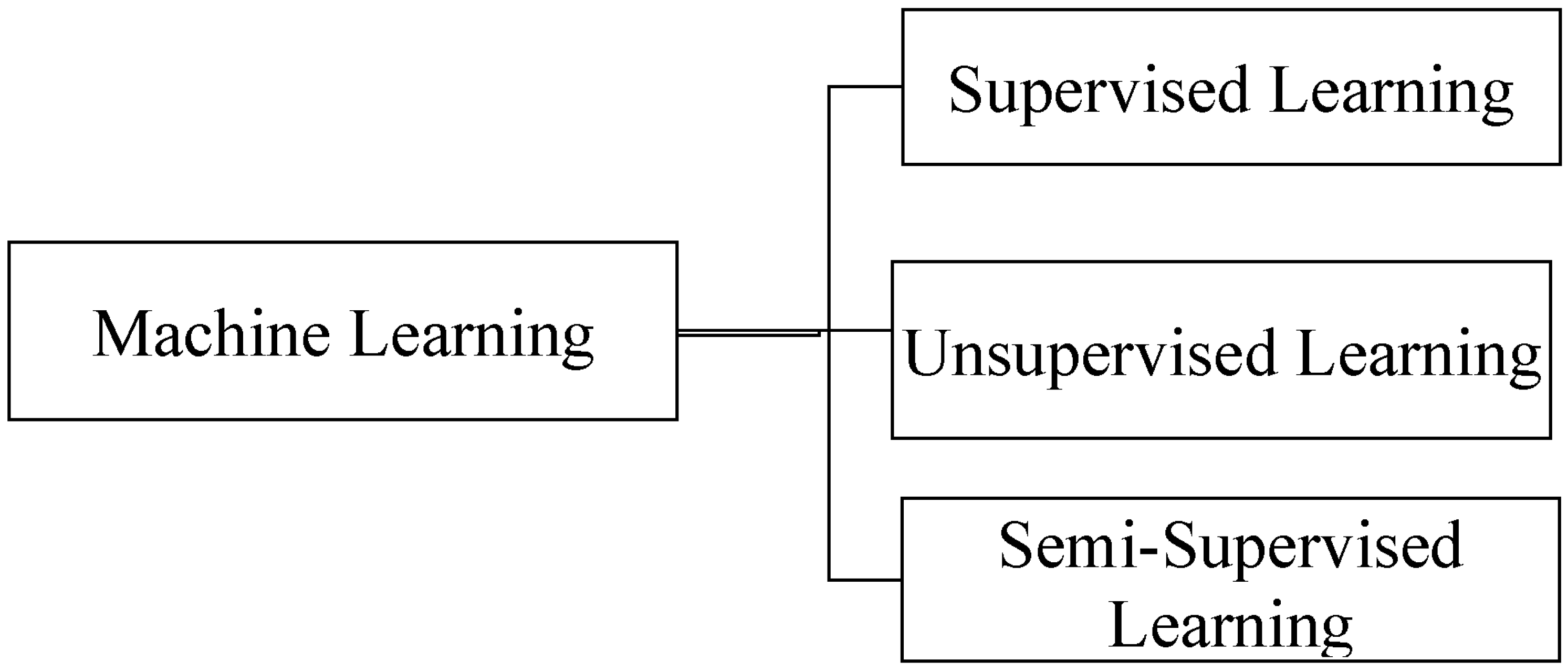
Recent forecasting competitions have satisfactorily used two types of ML forecasting approaches: regression-based machine learning and neural forecasting methods. The time series regression of ML converts the time series prediction problem into a regression problem, while neural forecasting approaches employ a methodology that allows for the direct processing of the time series and the generation [51]. Figure 1 illustrates the different types of machine learning approaches.
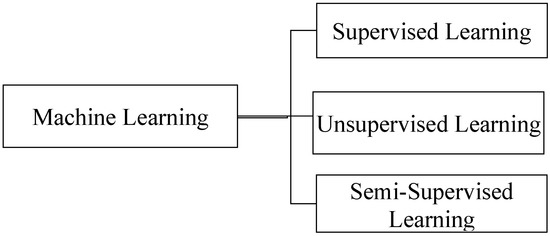
Figure 1.
Classification of Machine Learning.
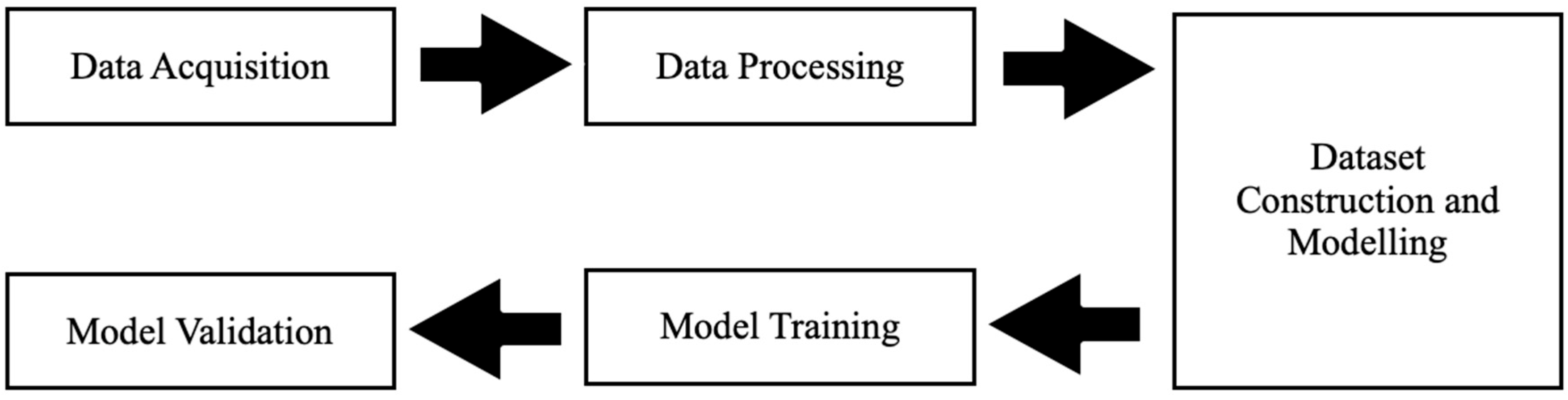
Given that each of the proposed methods has numerous weaknesses, researchers started to investigate the implications of machine learning regarding predictions. Machine learning does have the advantage of efficiently extracting the interlaced nonlinear properties and feeding them symmetrically to outputs. Figure 2 illustrates the general operation of machine learning. This concept has already become one of the most widely used approaches for forecasting time sequences.
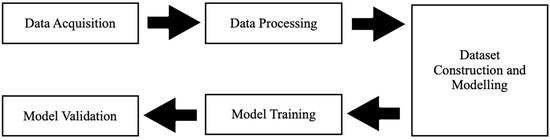
Figure 2.
The architecture of the Machine Learning Process.
The initial step of the machine learning’s architecture is known as data acquisition. This step is solely responsible for collecting, preparing, filtering, and segregating the data according to the user’s desire [36,37,52]. This step also involves the decision maker cycle. Once it is complete, the data will progress to the next layer for categorization. The following layer is known as the processing stage.
The data processing is dependent on the type of learning being used and responsible for choosing a range from the action to the continuous data [53]. The process of choosing a range will involve using specific function-based architecture. The prime example of function-based architecture is lambda architecture. The data in the data acquisition are to be subjected to advanced integration, normalization, cleansing, transformation, and encoding.
Approaching the next step, dataset construction and modeling is a section of the architecture that involves the selection of different algorithms that are feasible in the system for addressing the problem for which learning should be devised. These algorithms evolve from or are inherited from a set of libraries in the system [49]. The algorithm is used to model the data accordingly. Thus, the system is ready to proceed to the model training step for validation.
In the final layer in machine learning, the validation of the model will be conducted. The general goal behind the optimization of the algorithm is to extract the required machine outcome and maximize the system performance. The output of the step is a refined solution capable of providing the required data for the machine to make decisions. The machine learning architectures define the various steps involved in the machine learning cycle. The major steps are carried out in the transformation of raw data into training datasets capable of enabling the decision making of a system.
The author [36] investigated a photovoltaic power plant’s forecast accuracy by proposing the k-Nearest Neighbors method by applying data filtration on the initial data. The investigation was conducted to overcome the inconsistent power generation under bad weather conditions in different seasons. The filtration was applied to improve the accuracy in calculating the transparency index, which is used to calculate the efficiency of regression models. The author compared the proposed method with different models such as the persistence model, the autoregressive model, the autoregressive moving average model, and the autoregressive model with exogenous inputs. The result proved that the method proposed by the author is more effective and obtains the lowest error of forecasting accuracy. The mean absolute percentage error obtained is 18.66%.
The author in [54] presented the experiment by investigating the relationship between Gaussian process regression (GPR) and support vector machine (SVM). Both methods were taken into account, and comparisons between the models were made using the obtained root mean squared error (RMSE) and mean absolute error (MAE). The findings indicate that the approach adopted by the author delivered the highest performances of 7.967 (RMSE) and 5.302 (MAE).
The author’s proposed machine learning algorithm, Matern 5/2 GPR, significantly outperformed the others, whereas cubic SVM performed the worst. The TPV module temperature, ambient temperature, solar flux, solar hour, and relative humidity are the parameters that were reconsidered. [55] demonstrated a hybrid system that employs the Pearson correlation coefficient (PCC), ensemble sample entropy (SE), empirical modal decomposition (EEMC), long short-term memory (LSTM), and sparrow search algorithm (SSA). The hybrid model forecasted for a short time, and the results suggested that the proposed forecasting performance of the multiple-mixed model is superior and that the percentage of the error is minor.
3. Machine Learning-Based Neural Networks for Forecasting
3.1. Artificial Neural Network
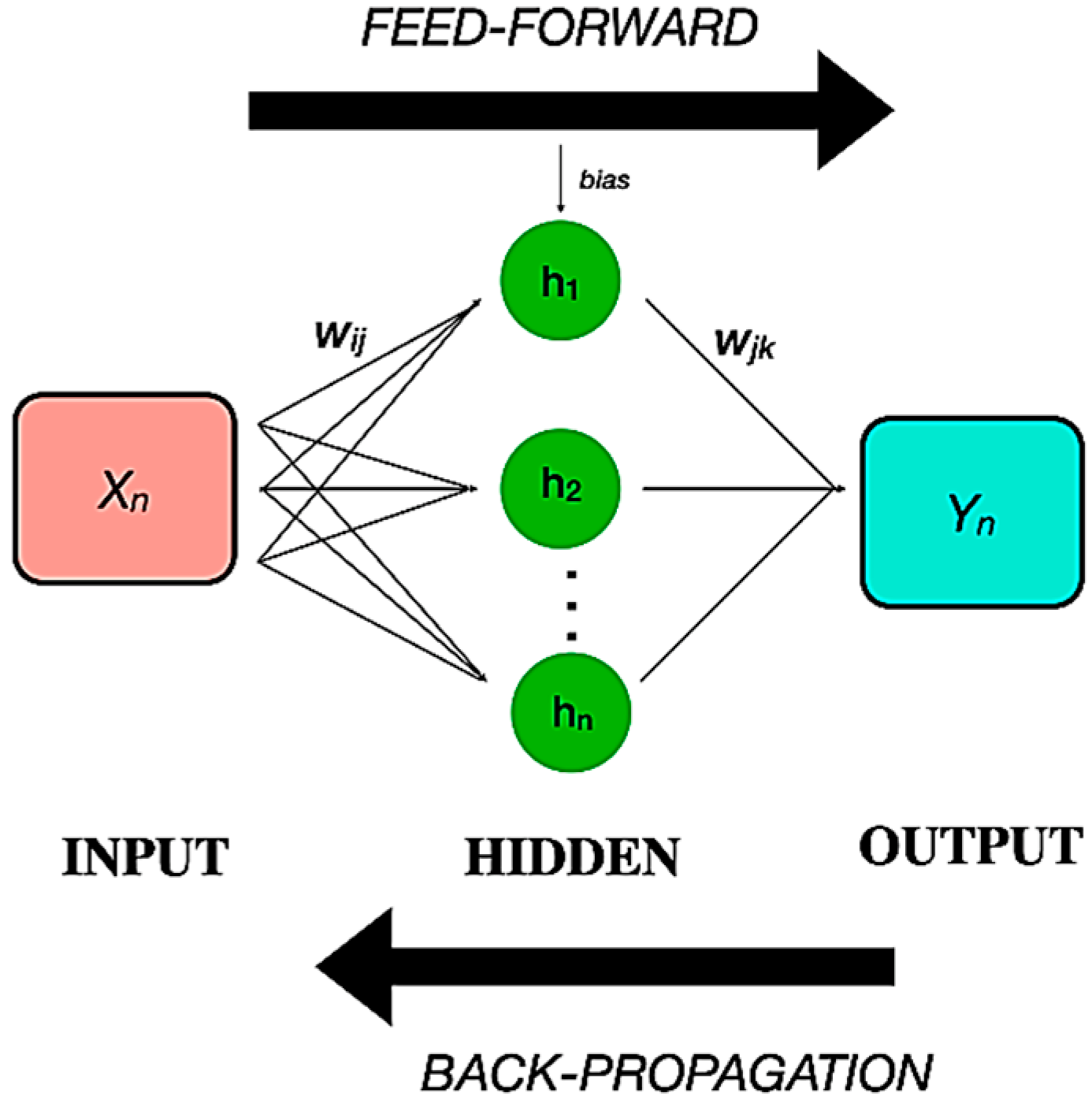
The artificial neural network is a computing algorithm that consists of small processing units identified as neurons that are interconnected in parallel [56]. The ANN’s architecture was initially motivated by biological neural networks. The motivation is illustrated in Figure 3. The ANN is composed of three layers: input, hidden, and output. Each layer is accountable for forecasting since it operates based on user settings [57,58,59]. The ANN has the capability to process information at incredibly fast speeds, with little error tolerance, and it can easily adapt and generalize. The characteristics of the ANN have resulted in a computer system with a powerful smart tool for optimization, modeling, and prediction [60].
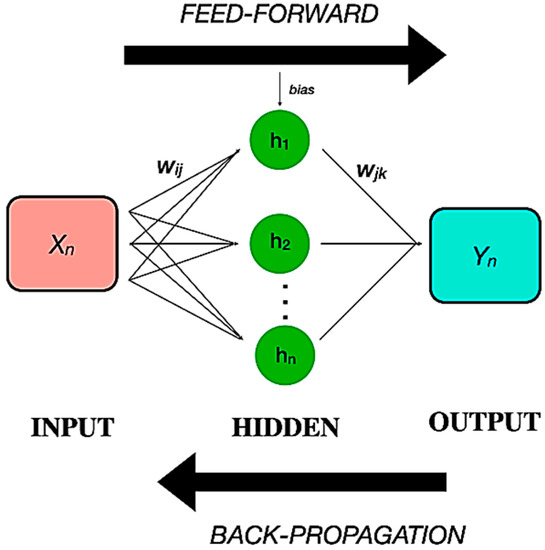
Figure 3.
Conventional ANN’s architecture.
The ANN was implemented by authors such as Bouzerdoum et al. [61] to forecast solar irradiation intensity and PV output power. The forecasting horizon is 24 h ahead, with a time-step of 1 h. Meanwhile, Chen et al. [62] utilized the ANN to forecast the PV output power based on past meteorological data such as the solar irradiance, module temperature, wind velocity, and environment humidity. The model also includes a day prediction horizon and a 24 h time interval. Both authors proposed a hybrid method based on ANN model forecasting for a 24 h forecast horizon. The research indicated that a hybrid model’s forecasting showed a better performance than a conventional or single model.
Behera et al. [63] suggested a three-stage approach for short-term forecasting which combines the extreme learning machine (ELM) technique, the sine-cosine algorithm (SCA), and the empirical mode decomposition (EMD). The data intervals used are 15 min, 30 min, and one hour ahead. The simulation results indicate that the proposed hybrid method surpasses the conventional ones, with an MAPE of 1.885%. Moreira et al. [59] employed a new approach by using an artificial neural network (ANN) as the main ensemble model to reconstruct a methodology for photovoltaic generation forecasting for a week horizon.
Louzazni et al. [64] proposed a forecasting prediction model that is a month ahead using an exogenous non-linear auto-regressive exogenous (NARX) technique. The NARX method’s forecast of the output power is compared to the neural network and the empirically measured data. The neural network times series has a Levenberg–Marquardt set of the training algorithm. The results indicated that the proposed method was proven to perform forecasting more accurately compared to the conventional method, with a percentage of 1.135% for the mean square error (MSE) average value.
The flexibility of the proposed method allowed for modifications and improvements of each parameter employed in the experimental design, the forecasting model, and the desired value of the forecast horizon. Therefore, it gives an opportunity for researchers to improve the outcome and result performance of forecasting accuracy. Table 2 summarizes all other research works related to forecasting PV systems using the ANN for very-short- to long-term forecast horizons.
Table 2.
Summary of past research on the ANN for forecasting.
3.2. Recurrent Neural Network
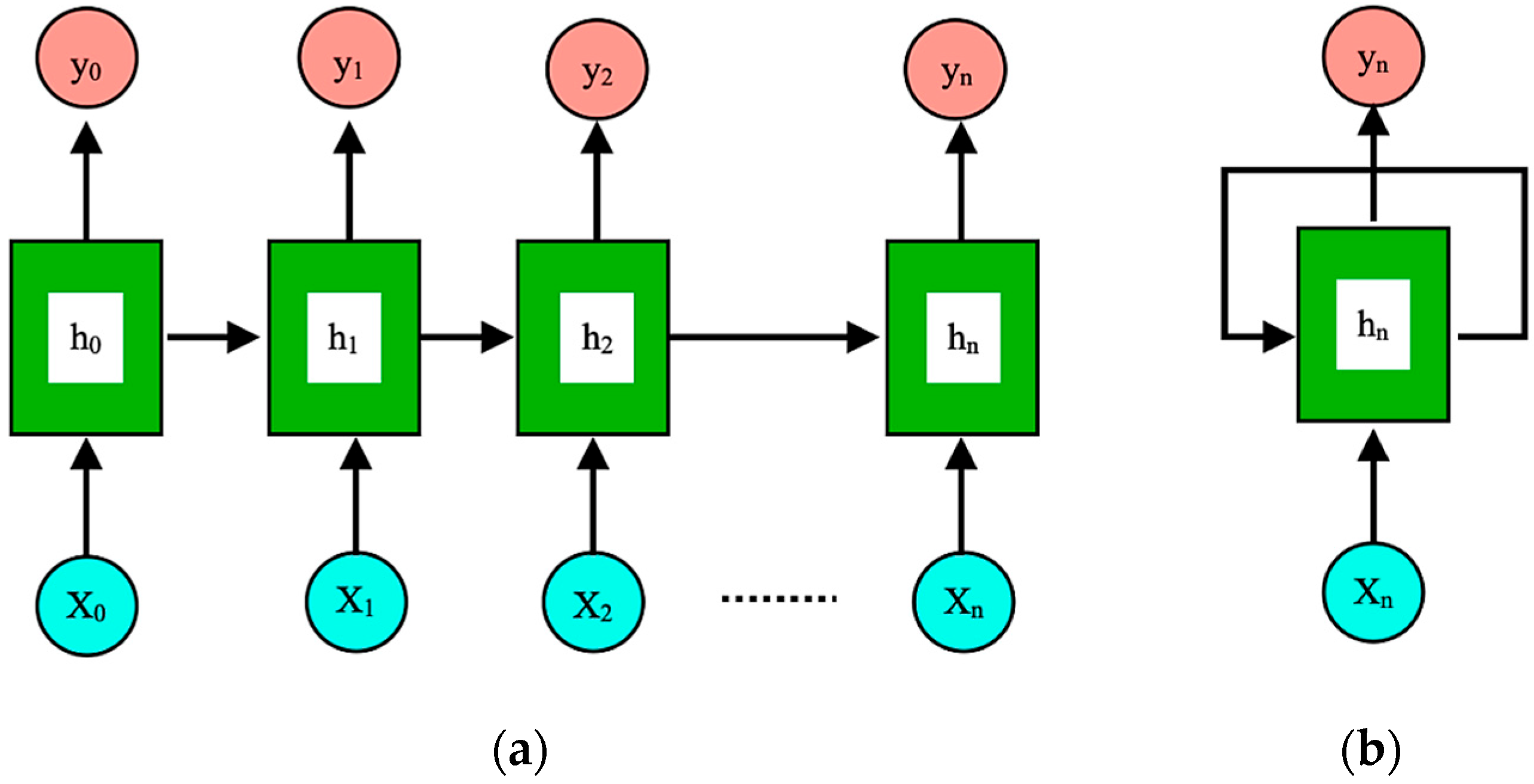
A recurrent neural network (RNN) is another type of neural network with a unique looped architecture, enabling previous knowledge to be used as an input for the next layer. They are used in various domains where data containing sequences are involved, such as predicting the next word of a sentence or the time. These looped networks are referred to as recurrent because they execute the same operations and computations on every element of an input data sequence. RNNs possess memory, which aids in retrieving information from previous sequences [71]. An RNN is distinguished from standard feedforward neural networks in that it has a feedback connection. Figure 4a shows the conventional architecture of an RNN in an unfolded state, while Figure 4b shows an RNN’s architecture in a folded state.
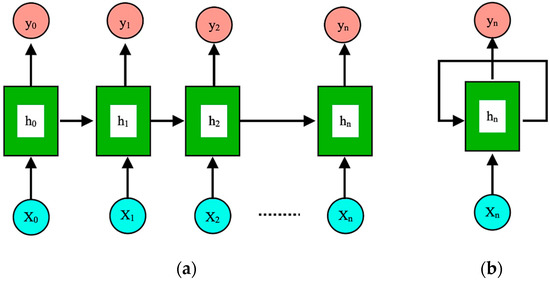
Figure 4.
(a) RNN’s architecture; (b) RNN’s achitecture in a folded state.
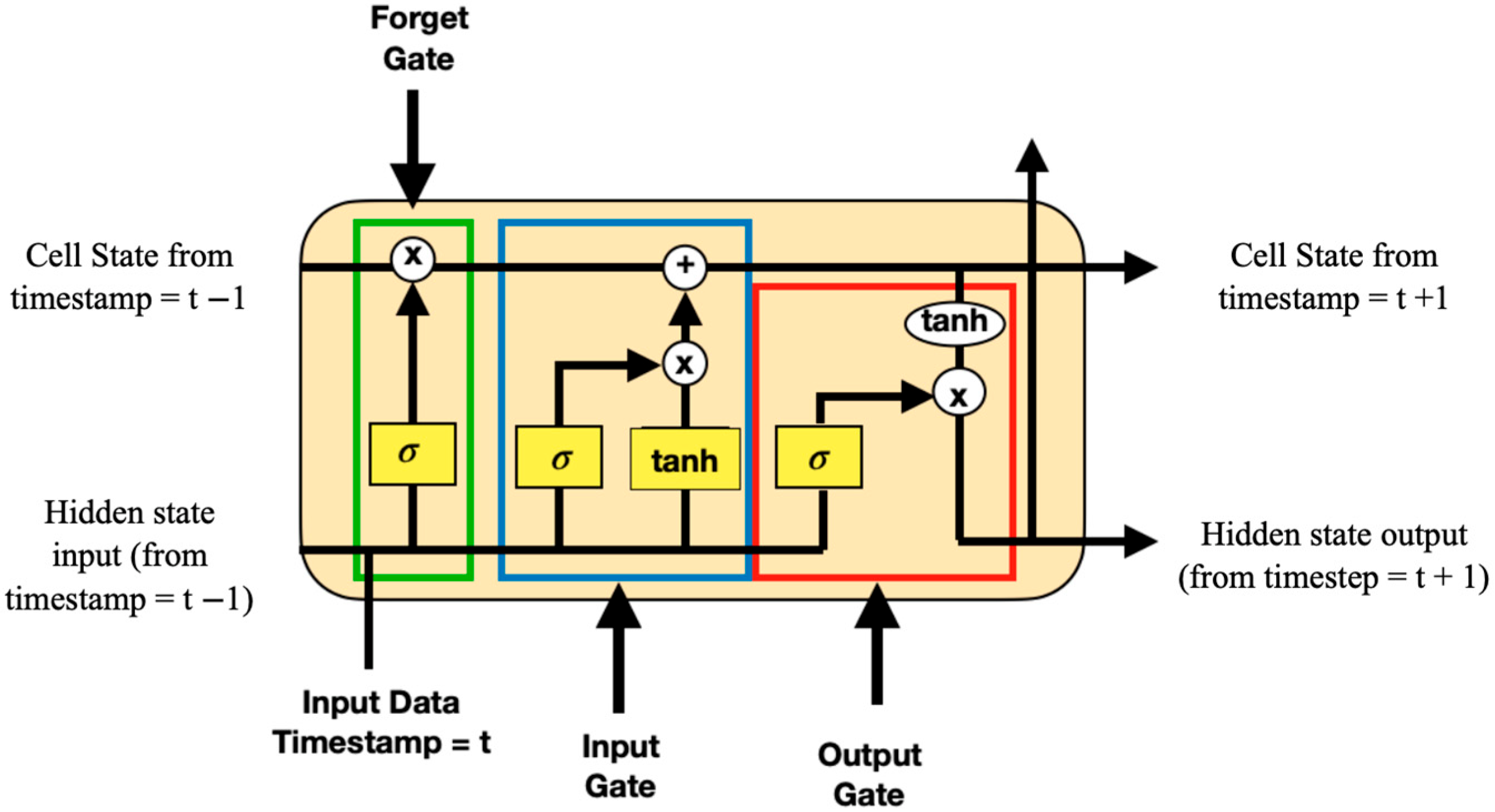
Another type of neural network under an RNN is called long short-term memory (LSTM). LSTM has the ability to handle complex areas of deep learning, where the algorithms will try to mimic the human brain by analyzing the relationship of sequential data patterns, memorizing the data pattern, learning long-term sequences for prediction problems, and processing the sequential data apart from an image and single data [35,72,73,74,75]. LSTM is controlled by a memory cell known as a “Cell State” that works by maintaining its state over time. The Cell State is a horizontal line that runs through the top of Figure 5 and appears as a conveyor belt carrying an information flow. The “Hidden State” is the opposite side of the Cell State. LSTM comprises three gates: the forget gate, input gate, and output gate. Table 3 describes, in detail, the function of each gate operated in LSTM.
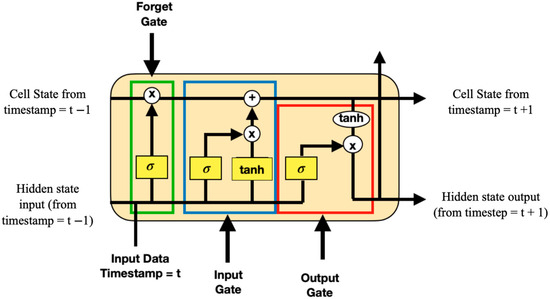
Figure 5.
LSTM’s architecture.
Table 3.
Description of each gate of LSTM’s circuit.
Li et al. [72] were inspired to design a combination of two types of training models known as wavelet packet decomposition (WPD) and long short-term memory (LSTM) networks, known as a hybrid deep learning model. Based on the actual data collected in Alice Springs, Australia, the forecast horizon is 60 min ahead, with a 5 min time-step. The performance of the newly proposed hybrid model was compared with conventional LSTM, recurrent neural networks (RNN), gated recurrent (GRU), and multi-layer perception (MLP) to determine whether the model operation was better in hybrid form or individual form. The research findings showed that the proposed method had the ability to enhance the performance of distributed energy systems, which could boost the environmental and economical advantages of the PV system. [35] proposed combining long short-term memory (LSTM) and convolutional neural networks (CNN) to a hybrid deep learning model for 24 h global horizontal irradiance forecasting. The LSTM-CNN model was specifically trained based on meteorological data collected from twenty-three locations throughout California, USA. The proposed models were discovered to be genuine, with alternative solutions for short-term GHI forecasting, having forecast estimates ranging from 37% to 45%.
As noted in Section 3.1, regardless of having a substantial amount of historical/old weather data and updated meteorological data, which can be obtained from a photovoltaic system, the amount of the prediction error for ANNs is relatively higher than that for RNNs. One of many possible reasons is the inconsistent distribution of the solar irradiation and module and ambient temperature. Photovoltaic generation includes abrupt changes, leading to a non-linear trend. RNN, on the other hand, is a stochastic model with multiple parameters. Table 4 summarizes other PV system forecasting research using RNN.
Table 4.
Summary of past research on RNN for forecasting.
3.3. Convolutional Neural Network
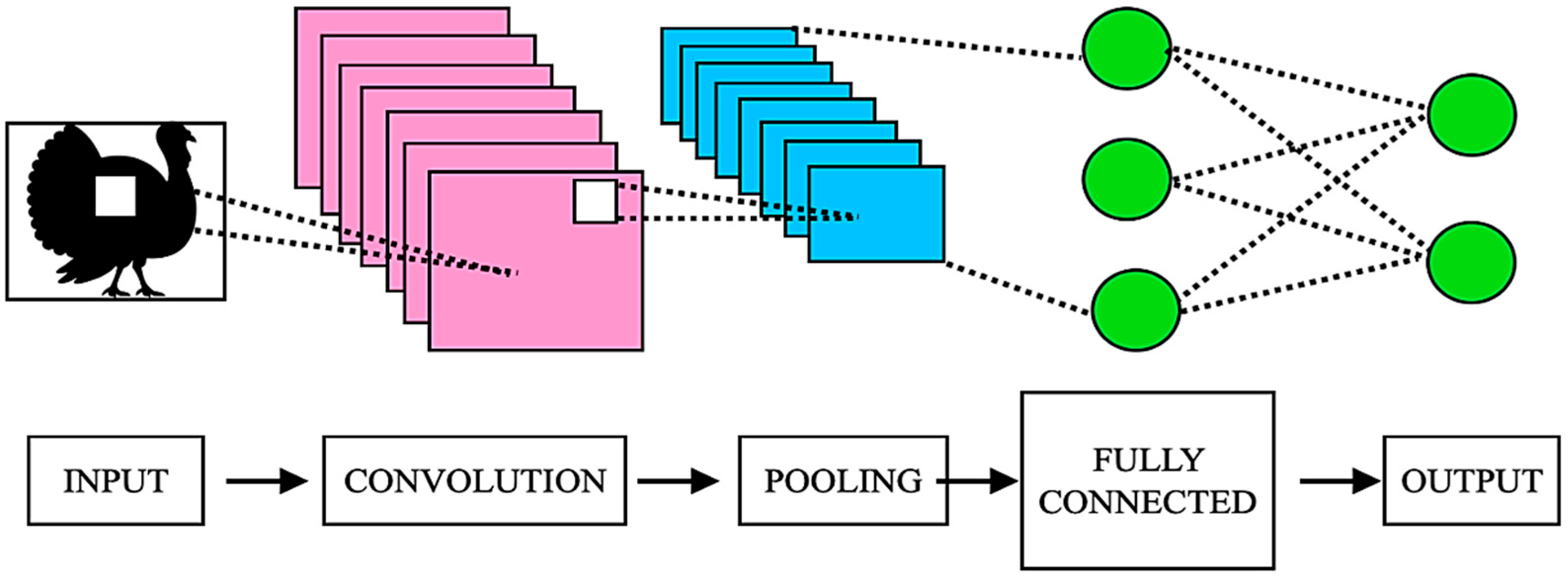
Convolutional Neural Networks (CNNs) are among the mathematical construction models that specialize in processing data with a distinct, grid-like structure. The way CNNs are applied in PV forecasting is the same as for ANNs and RNNs, but what differs from both types of neural networks is the data processing; the input data are moved by the filters (neurons) from one layer to another layer, which is known as a sliding window-like manner [83,84]. The layer is made up of many filters (neurons). These filters carry out a convolutional function, which is, by definition, a function that is applied to the input data to obtain specific information from them [85]. Figure 6 shows the architecture of the CNN for a further understanding of how the process of transferring the input to the output is carried out.
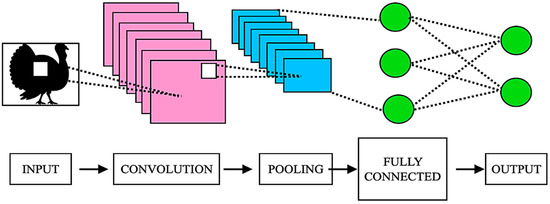
Figure 6.
The architecture of a CNN.
Typically, a CNN is also composed of three types of layers, which are also reconsidered as building blocks: the convolution, pooling, and fully connected layers. For reference, the time-series data are 1D (one-dimensional) for the grid topology. Meanwhile, the imaging data have a 2D (two-dimensional) grid of pixels. As one layer feeds its output into the next layer, extracted features can hierarchically and progressively become more complex. The second step involves rescaling the value distribution, which focuses on ensuring that the observation data’s mean is zero and that the standard deviation is one. CNN models typically handle a variety of input data formats, notably in one-dimensional data or more than one-dimensional data, which typically comprise 1 to n channels [86].
Usually, pre-processing techniques, such as normalization and standardization, are techniques that are often employed during convolution. The first is tasked with converting the original values to a range of 0 and 1 [87]. The output layer of filters is called feature maps, where it holds the relationship and pattern from the input data. These features are mapped from each filter and put together to complete the convolutional layers. This is followed by a pooling layer which operates to prevent the feature maps of the convolutional layer from overfitting. Table 5 summarizes the CNN and hybrid-CNN models for photovoltaic system forecasting.
Table 5.
Summary of past research on CNN for forecasting.
Two types of hybrid models were proposed by Qu et al. [88]. The research focuses on merging the new deep-learning network and time series forecasting patterns to address the difficulty encountered by conventional forecasting models that cannot accommodate the composition relationship of the time-step and multi-variables. An attention-based CNN-LSTM neural network embedded with a multiple relevant and target variables prediction pattern (MRTPP) methodology can capture short-term and long-term temporal changes in a time series and achieve day-ahead hourly solar power forecasting. Agga et al. [89] proposed a hybrid model consisting of two types of deep learning architectures: the convolutional neural network and long short-term memory. The topology is based on real meteorological data from Rabat, Morocco. Based on the error metrics from the experiment, it was found that the proposed architecture for CNN-LSTM performance exceeded the prediction, precision, and stability compared to conventional machine learning and single deep-learning (DL) models. Furthermore, during the comparison of the forecasting of time windows one-dimensionally, three-dimensionally, and seven-dimensionally, the MAPE value of the hybrid model subsequently increased by 5.55% (1D), 6.86% (3D), and 6.49% (7D), respectively.
3.4. Summary of Supervised Neural Network Models
The forecasting of photovoltaic systems has evolved and is currently still ongoing to obtain a lower percentage of errors and increase the accuracy of the system performance. A variety of methods proposed by researchers are still unable to break the limitations of machine learning and neural networks. Both approaches effectively learn sophisticated non-linear connections from sets of training samples, making them perfectly adapted for pattern recognition tasks that involve detecting complex trends in high-dimensional datasets. Although the models are robust, the reliability of the system is still affected by random initial data and over-fitting [94].
In summary, the ANN was known for its ability to work with incomplete knowledge and for having a high fault tolerance, but the network is hardware-dependent, which means it requires a processor with parallel power in accordance with the ANN’s structure. Another complexity for the ANN is the difficulty showing to the network. Even though the ANN can work with numerical information, the value must first be converted into numerical form before being introduced to the ANN. As for the RNN and CNN, both networks were proven to perform better than the ANN. However, both the RNN and CNN encounter the same complexity as the ANN; both lack the ability to be spatially invariant to the input data, both have difficulty in solving gradient vanishing and exploding problems for RNN, both are unable to perform very long sequences if they are using tanh as an activation function, and both have difficulty in training the data in small quantities.
The collection of machine learning algorithms for different forecasting horizons in Section 3.1, Section 3.2 and Section 3.3 suggests that the forecasting accuracy drops as the forecasting horizon increases. Instead of long-term forecasting horizons, these methodologies provide a better forecasting accuracy for short-term and medium-term forecasting horizons. In Table 2, Table 4 and Table 5, a summary of all the past studies linked to photovoltaic forecasting is presented according to the type of neural network.
4. Conclusions
The application of machine learning has grown and will likely progress to become one of the most reliable techniques for forecasting. In this paper, a comprehensive review of supervised machine learning was carried out. The previous research papers are compiled and grouped according to the type of neural network. The main objective of this paper is to study the accuracy performance of the output power generated by the PV system when applying different types of neural networks. The majority of the forecasted methods are hybrid compared to conventional methods. This proved that hybrid models perform better in forecasting. They are able to achieve lower and better performance metrics. Thus, they are capable of achieving a much better accuracy.
An accurate solar forecast is considered vital to accomplishing the enhanced degree of operational photovoltaic coverage while maintaining a minimal cost and achieving sustainable growth and competitiveness at the same time. The forecasting horizon substantially impacts the precision of a model’s prediction outcomes. The performance of a forecasting model typically degrades as the forecasting horizon rises. The quality of forecasting decreases with an increase in the forecasting duration and depends on the location of the PV installation. It is pivotal to properly choose the forecasting models that are in accordance with the horizon and location of the PV installed.
Furthermore, the performance of a forecasting model fluctuates as the climate changes. Each country has different seasons, and the climatic weather and input parameter are also crucial to be reconsidered. As a result, one of the most influential variables in improving the predictive accuracy of forecasting models is weather classification. This necessitates the addition of weather classifications during forecasting. For instance, certain forecasting models exhibit lower error rates in partially cloudy or cloudy weather and during an increase in the module and ambient temperature, while others may perform better.
In conclusion, the outcomes of this study imply that the number and type of input parameters, the duration of the forecast horizon, and the hybrid models/methods have proven their credibility in enhancing the system performance. The accuracy ought to be preferred over simple and conventional machine learning models. The most recent information and the comparative analysis of machine learning models offered in this study can improve the future of photovoltaics researchers, planners, and specialists by assisting them in boosting the performance of forecasting models. By using the proper tools and methods for PV power forecasting, it could be possible to overcome the dependency on conventional energy resources as the main source in power generation and improve the PV’s system performance. Because of their tremendous capacities for huge data analysis and nonlinear representation, supervised neural networks have been applied to the field of forecasting and contributed to the exponential rise of new machine learning theory.
Author Contributions
Conceptualization, P.N.L.M.R., S.M., N.M.S. and M.N.A.; methodology, P.N.L.M.R.; validation, S.M., N.M.S. and M.N.A.; formal analysis, P.N.L.M.R., S.M., N.M.S. and M.N.A.; investigation, P.N.L.M.R.; resources, P.N.L.M.R.; writing—original draft preparation, P.N.L.M.R.; writing—review and editing, P.N.L.M.R., S.M., N.M.S. and M.N.A.; visualization, P.N.L.M.R., S.M., N.M.S. and M.N.A.; supervision, S.M., N.M.S. and M.N.A. All authors have read and agreed to the published version of the manuscript.
Funding
The authors would like to thank the Ministry of Higher Education, Malaysia, for providing financial support under the Large Research Grant Scheme (LRGS): LRGS/1/2019/UKM/01/6/3 and UM International Collaboration Grant ST085-2022.
Institutional Review Board Statement
Not applicable.
Informed Consent Statement
Not applicable.
Data Availability Statement
Data are available from the authors upon reasonable request.
Conflicts of Interest
The authors declare no conflict of interest.
Abbreviation
| AD | Adaptive deep |
| AI | Artificial Intelligent |
| ANN | Artificial Neural Network |
| APB | Absolute Percentage Bias |
| CNN | Convolutional Neural network |
| D | Dimension |
| DLNN | Deep learning neural network |
| DRWNN | Diagonal recurrent wavelet neural network |
| DWT | Discrete wavelet transform |
| EEMC | Empirical model decomposition |
| EKF | Extended Kalman filter |
| ELM | Extreme learning machine |
| EMD | Empirical mode decomposition |
| FCW | Forward collision warning |
| FFNN | Feed-forward neural network |
| FFNNST | Feed-forward neural network-spatiotemporal |
| GHI | Global hour irradiance |
| GRU | Gated recurrent unit |
| GRUP | Gated recurrent unit pool |
| LSSVM | Least square support vector machine |
| MAE | Mean Absolute Error |
| MAPE | Mean Absolute Percentage Error |
| MBE | Mean Bias Error |
| MPE | Main Percentage Error |
| MRE | Mean Relative Error |
| MSE | Mean Squared Error |
| NMAE | Normalized Mean Absolute Error |
| NRMSE | Normalized Root Mean Square Error |
| MFA | Modified firefly algorithm |
| MLP | Multi-layer perception |
| MODWT-LSTM | Maximal overlap discrete wavelet transform |
| MRTPP | Multiple relevant and target variables prediction pattern |
| MW | MegaWatt |
| NARX | Nonlinear autoregressive exogenous model |
| NMAE | Normalized mean absolute error |
| NPKDE | Non-parametric kernel density estimation |
| NWP | Numerical weather prediction |
| PSO | Particle swarm optimization |
| PVPF | Photovoltaic Power Forecasting tool |
| R2 | Coefficient of regression |
| R | Regression |
| RES | Renewable energy sources |
| RET | Renewable energy technologies |
| RMSE | Root Mean Square Error |
| SARIMA | Seasonal Auto-Regressive Integrated Moving Average |
| SCA | Sine-cosine algorithm |
| SE | Sample entropy |
| SOM | Self-organizing map |
| SSA | Sparrow search algorithm |
| SVM | Support vector machine |
| TSK | Takagi–Sugeno–Kang |
| TSKFNN | Takagi–Sugeno–Kang Neural Network |
| WMIM | Wrapper mutual information methodology |
| WOA | Whale optimization algorithm |
| WRP | Wavelet packet decomposition |
References
- Miller, I.; Gençer, E.; O’Sullivan, F.M. A General Model for Estimating Emissions from Integrated Power Generation and Energy Storage. Case Study: Integration of Solar Photovoltaic Power and Wind Power with Batteries. Processes 2018, 6, 267. [Google Scholar] [CrossRef]
- Yin, W.; Han, Y.; Zhou, H.; Ma, M.; Li, L.; Zhu, H. A novel non-iterative correction method for short-term photovoltaic power forecasting. Renew. Energy 2020, 159, 23–32. [Google Scholar] [CrossRef]
- Konstantinou, M.; Peratikou, S.; Charalambides, A.G. Solar Photovoltaic Forecasting of Power Output Using LSTM Networks. Atmosphere 2021, 12, 124. [Google Scholar] [CrossRef]
- Forstinger, A.; Wilbert, S.; Driesse, A.; Hanrieder, N.; Affolter, R.; Kumar, S.; Goswami, N.; Geuder, N.; Vignola, F.; Zarzalejo, L.F.; et al. Physically based correction of systematic errors of Rotating Shadow band Irradiometers. Meteorol. Z. 2020, 29, 19–39. [Google Scholar] [CrossRef]
- Lu, Y.; Khan, Z.; Alvarez-Alvarado, M.; Zhang, Y.; Huang, Z.; Imran, M. A Critical Review of Sustainable Energy Policies for the Promotion of Renewable Energy Sources. Sustainability 2020, 12, 5078. [Google Scholar] [CrossRef]
- Ahmed, R.; Sreeram, V.; Mishra, Y.; Arif, M.D. A review and evaluation of the state-of-the-art in PV solar power forecasting: Techniques and optimization. Renew. Sustain. Energy Rev. 2020, 124, 109792. [Google Scholar] [CrossRef]
- Al-Dahidi, S.; Louzazni, M.; Omran, N. A Local Training Strategy-Based Artificial Neural Network for Predicting the Power Production of Solar Photovoltaic Systems. IEEE Access 2020, 8, 150262–150281. [Google Scholar] [CrossRef]
- Ma, M.; He, B.; Shen, R.; Wang, Y.; Wang, N. An adaptive interval power forecasting method for photovoltaic plant and its 396 optimization. Sustain. Energy Technol. Assess. 2022, 52, 102360. [Google Scholar] [CrossRef]
- Zhang, M.; Yan, Q.; Li, W.; Tang, G.; Lin, H. Sustainability performance assessment of photovoltaic coupling storage charging 398 stations with novel multi-criteria decision-making technique. Int. J. Electr. Power Energy Syst. 2022, 142, 108301. [Google Scholar] [CrossRef]
- Saglam, S. Meteorological parameters effects on solar energy power generation. WSEAS Trans. Circuits Syst. 2010, 9, 637–649. [Google Scholar]
- Jerez, S.; Tobin, I.; Vautard, R.; Montávez, J.P.; López-Romero, J.M.; Thais, F.; Bartok, B.; Christensen, O.B.; Colette, A.; Déqué, M.; et al. The impact of climate change on photovoltaic power generation in Europe. Nat. Commun. 2015, 6, 10014. [Google Scholar] [CrossRef]
- Rao, R.R.; Mani, M.; Ramamurthy, P.C. An updated review on factors and their inter-linked influences on photovoltaic system 406 performance. Heliyon 2018, 4, e00815. [Google Scholar] [CrossRef]
- Vaka, M.; Walvekar, R.; Rasheed, A.K.; Khalid, M. A review on Malaysia’s solar energy pathway towards carbon-neutral Malaysia beyond COVID-19 pandemic. J. Clean. Prod. 2020, 273, 122834. [Google Scholar] [CrossRef]
- Zhao, J.; Guo, Z.-H.; Su, Z.; Zhao, Z.-Y.; Xiao, X.; Liu, F. An improved multi-step forecasting model based on WRF ensembles 410 and creative fuzzy systems for wind speed. Appl. Energy 2015, 162, 808–826. [Google Scholar] [CrossRef]
- Son, J.; Jeong, S.; Park, H.; Park, C.-E. The effect of particulate matter on solar photovoltaic power generation over the Republic of Korea. Environ. Res. Lett. 2020, 15, 9. [Google Scholar] [CrossRef]
- Lee, C.-H.; Yang, H.-C.; Ye, G.-B. Predicting the Performance of Solar Power Generation Using Deep Learning Methods. Appl. Sci. 2021, 11, 6887. [Google Scholar] [CrossRef]
- Dajuma, A.; Yahaya, S.; Touré, S.; Diedhiou, A.; Adamou, R.; Konaré, A.; Sido, M.; Golba, M. Sensitivity of Solar Photovoltaic 416 Panel Efficiency to Weather and Dust over West Africa: Comparative Experimental Study between Niamey (Niger) and Abidjan (Côte d’Ivoire). Comput. Water Energy Environ. Eng. 2016, 5, 123–147. [Google Scholar] [CrossRef]
- Li, S.; Wang, J.; Liu, Q.; Li, L.; Hua, Y.; Liu, W. Analysis of Status of Photovoltaic and Wind Power Abandoned in China. J. Power Energy Eng. 2017, 5, 91–100. [Google Scholar] [CrossRef]
- Gandoman, F.H.; Abdel Aleem, S.H.E.; Omar, N.; Ahmadi, A.; Alenezi, F.Q. Short-term solar power forecasting considering cloud coverage and ambient temperature variation effects. Renew. Energy 2018, 123, 793–805. [Google Scholar] [CrossRef]
- Rawa, M.; Abusorrah, A.; Bassi, H.; Mekhilef, S.; Ali, Z.M.; Abdel Aleem, S.H.E.; Hasanien, H.M.; Omar, A.I. Economical-technical-environmental operation of power networks with wind-solar-hydropower generation using analytic hierarchy process and improved grey wolf algorithm. Ain Shams Eng. J. 2021, 12, 2717–2734. [Google Scholar] [CrossRef]
- Padmanathan, K.; Govindarajan, U.; Ramachandaramurthy, V.K.; Sudar Oli Selvi, T.; Jeevarathinam, B. Integrating solar photovoltaic energy conversion systems into industrial and commercial electrical energy utilization—A survey. J. Ind. Inf. Integr. 2018, 10, 39–54. [Google Scholar] [CrossRef]
- Zhong, J.; Liu, L.; Sun, Q.; Wang, X. Prediction of Photovoltaic Power Generation Based on General Regression and Back Propagation Neural Network. Energy Procedia 2018, 152, 1224–1229. [Google Scholar] [CrossRef]
- Cannizzaro, D.; Aliberti, A.; Bottaccioli, L.; Macii, E.; Acquaviva, A.; Patti, E. Solar radiation forecasting based on convolutional neural network and ensemble learning. Expert Syst. Appl. 2021, 181, 115167. [Google Scholar] [CrossRef]
- Jebli, I.; Belouadha, F.-Z.; Kabbaj, M.I.; Tilioua, A. Prediction of solar energy guided by pearson correlation using machine learning. Energy 2021, 224, 120109. [Google Scholar] [CrossRef]
- Yagli, G.M.; Yang, D.; Srinivasan, D. Automatic hourly solar forecasting using machine learning models. Renew. Sustain. Energy Rev. 2019, 105, 487–498. [Google Scholar] [CrossRef]
- Rodríguez, F.; Galarza, A.; Vasquez, J.C.; Guerrero, J.M. Using deep learning and meteorological parameters to forecast the photovoltaic generators intra-hour output power interval for smart grid control. Energy 2022, 239, 122116. [Google Scholar] [CrossRef]
- Mughal, S.N.; Sood, Y.R.; Jarial, R.K. Design and optimization of photovoltaic system with a week ahead power forecast using autoregressive artificial neural networks. Mater. Today: Proc. 2022, 52, 834–841. [Google Scholar] [CrossRef]
- Haider, S.A.; Sajid, M.; Sajid, H.; Uddin, E.; Ayaz, Y. Deep learning and statistical methods for short- and long-term solar irradiance forecasting for Islamabad. Renew. Energy 2022, 198, 51–60. [Google Scholar] [CrossRef]
- Pedregal, D.J.; Trapero, J.R. Adjusted combination of moving averages: A forecasting system for medium-term solar irradiance. Appl. Energy 2021, 298, 117155. [Google Scholar] [CrossRef]
- Eseye, A.T.; Zhang, J.; Zheng, D. Short-term photovoltaic solar power forecasting using a hybrid Wavelet-PSO-SVM model based on SCADA and Meteorological information. Renew. Energy 2018, 118, 357–367. [Google Scholar] [CrossRef]
- Li, J.; Liu, Q. Forecasting of short-term photovoltaic power generation using combined interval type-2 Takagi-Sugeno-Kang fuzzy systems. Int. J. Electr. Power Energy Syst. 2022, 140, 108002. [Google Scholar] [CrossRef]
- Sarker, I.H. Machine Learning: Algorithms, Real-World Applications and Research Directions. SN Comput. Sci. 2021, 2, 160. [Google Scholar] [CrossRef]
- Graditi, G.; Ferlito, S.; Adinolfi, G. Comparison of Photovoltaic plant power production prediction methods using a large measured dataset. Renew. Energy 2016, 90, 513–519. [Google Scholar] [CrossRef]
- Rodríguez, F.; Azcárate, I.; Vadillo, J.; Galarza, A. Forecasting intra-hour solar photovoltaic energy by assembling wavelet based 521 time-frequency analysis with deep learning neural networks. Int. J. Electr. Power Energy Syst. 2022, 137, 107777. [Google Scholar] [CrossRef]
- Kumari, P.; Toshniwal, D. Long short term memory–convolutional neural network based deep hybrid approach for solar irradiance forecasting. Appl. Energy 2021, 295, 117061. [Google Scholar] [CrossRef]
- Eroshenko, S.A.; Khalyasmaa, A.I.; Snegirev, D.A.; Dubailova, V.V.; Romanov, A.M.; Butusov, D.N. The Impact of Data Filtration on the Accuracy of Multiple Time-Domain Forecasting for Photovoltaic Power Plants Generation. Appl. Sci. 2020, 10, 8265. [Google Scholar] [CrossRef]
- Malvoni, M.; De Giorgi, M.G.; Congedo, P.M. Forecasting of PV Power Generation using weather input data-preprocessing techniques. Energy Procedia 2017, 126, 651–658. [Google Scholar] [CrossRef]
- Antonanzas, J.; Osorio, N.; Escobar, R.; Urraca, R.; Martinez-de-Pison, F.J.; Antonanzas-Torres, F. Review of photovoltaic power forecasting. Sol. Energy 2016, 136, 78–111. [Google Scholar] [CrossRef]
- Luo, X.; Zhang, D. An adaptive deep learning framework for day-ahead forecasting of photovoltaic power generation. Sustain. Energy Technol. Assess. 2022, 52, 102326. [Google Scholar] [CrossRef]
- Zang, H.; Cheng, L.; Ding, T.; Cheung, K.W.; Wei, Z.; Sun, G. Day-ahead photovoltaic power forecasting approach based on 424 deep convolutional neural networks and meta learning. Int. J. Electr. Power Energy Syst. 2020, 118, 105790. [Google Scholar] [CrossRef]
- Diagne, M.; David, M.; Lauret, P.; Boland, J.; Schmutz, N. Review of solar irradiance forecasting methods and a proposition for 427 small-scale insular grids. Renew. Sustain. Energy Rev. 2013, 27, 65–76. [Google Scholar] [CrossRef]
- Terrén-Serrano, G.; Martínez-Ramón, M. Multi-layer wind velocity field visualization in infrared images of clouds for solar irradiance forecasting. Appl. Energy 2021, 288, 116656. [Google Scholar] [CrossRef]
- Chapman, L.; Thornes, J. The use of geographical information systems in climatology and meteorology. Prog. Phys. Geogr. 2003, 27, 313–330. [Google Scholar] [CrossRef]
- Yadir, S.; Bendaoud, R.; El-Abidi, A.; Amiry, H.; Benhmida, M.; Bounouar, S.; Zohal, B.; Bousseta, H.; Zrhaiba, A.; Elhassnaoui, A. Evolution of the physical parameters of photovoltaic generators as a function of temperature and irradiance: New method of prediction based on the manufacturer’s datasheet. Energy Convers. Manag. 2020, 203, 112141. [Google Scholar] [CrossRef]
- Lauria, D.; Mottola, F.; Proto, D. Caputo derivative applied to very short time photovoltaic power forecasting. Appl. Energy 2022, 309, 118452. [Google Scholar] [CrossRef]
- Aghaei, M.; Fairbrother, A.; Gok, A.; Ahmad, S.; Kazim, S.; Lobato, K.; Oreski, G.; Reinders, A.; Schmitz, J.; Theelen, M.; et al. Review of degradation and failure phenomena in photovoltaic modules. Renew. Sustain. Energy Rev. 2022, 159, 112160. [Google Scholar] [CrossRef]
- Elbaset, A.A.; Ali, H.; Abd-El Sattar, M. Novel seven-parameter model for photovoltaic modules. Sol. Energy Mater. Sol. Cells 2014, 130, 442–455. [Google Scholar] [CrossRef]
- Hacke, P.; Lokanath, S.; Williams, P.; Vasan, A.; Sochor, P.; TamizhMani, G.; Shinohara, H.; Kurtz, S. A status review of photovoltaic power conversion equipment reliability, safety, and quality assurance protocols. Renew. Sustain. Energy Rev. 2018, 82, 1097–1112. [Google Scholar] [CrossRef]
- Etxegarai, G.; López, A.; Aginako, N.; Rodríguez, F. An analysis of different deep learning neural networks for intra-hour solar irradiation forecasting to compute solar photovoltaic generators’ energy production. Energy Sustain. Dev. 2022, 68, 1–17. [Google Scholar] [CrossRef]
- Ezugwu, A.E.; Ikotun, A.M.; Oyelade, O.O.; Abualigah, L.; Agushaka, J.O.; Eke, C.I.; Akinyelu, A.A. A comprehensive survey 470 of clustering algorithms: State-of-the-art machine learning applications, taxonomy, challenges, and future research prospects. Eng. Appl. Artif. Intell. 2022, 110, 104743. [Google Scholar] [CrossRef]
- Zazoum, B. Solar photovoltaic power prediction using different machine learning methods. Energy Rep. 2022, 8, 19–25. [Google Scholar] [CrossRef]
- Phan, Q.T.; Wu, Y.K.; Phan, Q.D.; Lo, H.Y. A Novel Forecasting Model for Solar Power Generation by a Deep Learning Framework with Data Preprocessing and Postprocessing. In Proceedings of the 2022 IEEE/IAS 58th Industrial and Commercial Power Systems Technical Conference (I&CPS), Las Vegas, NV, USA, 2–5 May 2022; pp. 1–11. [Google Scholar]
- El Alani, O.; Abraim, M.; Ghennioui, H.; Ghennioui, A.; Ikenbi, I.; Dahr, F.-E. Short term solar irradiance forecasting using sky images based on a hybrid CNN–MLP model. Energy Rep. 2021, 7, 888–900. [Google Scholar] [CrossRef]
- Li, Z.; Xu, R.; Luo, X.; Cao, X.; Du, S.; Sun, H. Short-term photovoltaic power prediction based on modal reconstruction and hybrid deep learning model. Energy Rep. 2022, 8, 9919–9932. [Google Scholar] [CrossRef]
- Pazikadin, A.R.; Rifai, D.; Ali, K.; Malik, M.Z.; Abdalla, A.N.; Faraj, M.A. Solar irradiance measurement instrumentation and 477 power solar generation forecasting based on Artificial Neural Networks (ANN): A review of five years research trend. Sci. Total Environ. 2020, 715, 136848. [Google Scholar] [CrossRef]
- Alzahrani, A.; Shamsi, P.; Dagli, C.; Ferdowsi, M. Solar Irradiance Forecasting Using Deep Neural Networks. Procedia Comput. Sci. 2017, 114, 304–313. [Google Scholar] [CrossRef]
- Fuselero, A.D.P.; Portus, H.M.S.A.; Doma, B.T. Daily Solar Radiation Forecasting based on a Hybrid NARX-GRU Network in Dumaguete, Philippines. Int. J. Renew. Energy Dev. 2022, 11, 839–850. [Google Scholar] [CrossRef]
- Bouchouicha, K.; Bailek, N.; Razagui, A.; El-Shimy, M.; Bellaoui, M.; Bachari, N.E.I. Comparison of artificial intelligence and empirical models for energy production estimation of 20 MWp solar photovoltaic plant at the Saharan Medium of Algeria. Int. J. Energy Sect. Manag. 2021, 15, 119–138. [Google Scholar] [CrossRef]
- Gutierrez-Corea, F.-V.; Manso-Callejo, M.-A.; Moreno-Regidor, M.-P.; Manrique-Sancho, M.-T. Forecasting short-term solar irradiance based on artificial neural networks and data from neighboring meteorological stations. Sol. Energy 2016, 134, 119–131. [Google Scholar] [CrossRef]
- Bouzerdoum, M.; Mellit, A.; Massi Pavan, A. A hybrid model (SARIMA–SVM) for short-term power forecasting of a small-scale grid-connected photovoltaic plant. Sol. Energy 2013, 98, 226–235. [Google Scholar] [CrossRef]
- Chen, C.; Duan, S.; Cai, T.; Liu, B. Online 24-h solar power forecasting based on weather type classification using artificial neural network. Sol. Energy 2011, 85, 2856–2870. [Google Scholar] [CrossRef]
- Behera, M.K.; Nayak, N. A comparative study on short-term PV power forecasting using decomposition based optimized extreme learning machine algorithm. Eng. Sci. Technol. Int. J. 2020, 23, 156–167. [Google Scholar] [CrossRef]
- Moreira, M.O.; Balestrassi, P.P.; Paiva, A.P.; Ribeiro, P.F.; Bonatto, B.D. Design of experiments using artificial neural network 499 ensemble for photovoltaic generation forecasting. Renew. Sustain. Energy Rev. 2021, 135, 110450. [Google Scholar] [CrossRef]
- Louzazni, M.; Mosalam, H.; Khouya, A.; Amechnoue, K. A non-linear auto-regressive exogenous method to forecast the photovoltaic power output. Sustain. Energy Technol. Assess. 2020, 38, 100670. [Google Scholar] [CrossRef]
- Fernandez-Jimenez, L.A.; Muñoz-Jimenez, A.; Falces, A.; Mendoza-Villena, M.; Garcia-Garrido, E.; Lara-Santillan, P.M.; Zorzano-Alba, E.; Zorzano-Santamaria, P.J. Short-term power forecasting system for photovoltaic plants. Renew. Energy 2012, 44, 311–317. [Google Scholar] [CrossRef]
- Rana, M.; Koprinska, I.; Agelidis, V.G. Univariate and multivariate methods for very short-term solar photovoltaic power forecasting. Energy Convers. Manag. 2016, 121, 380–390. [Google Scholar] [CrossRef]
- Bouzgou, H.; Gueymard, C.A. Fast short-term global solar irradiance forecasting with wrapper mutual information. Renew. Energy 2019, 133, 1055–1065. [Google Scholar] [CrossRef]
- Rodríguez, F.; Martín, F.; Fontán, L.; Galarza, A. Ensemble of machine learning and spatiotemporal parameters to forecast very short-term solar irradiation to compute photovoltaic generators’ output power. Energy 2021, 229, 120647. [Google Scholar] [CrossRef]
- Gu, B.; Shen, H.; Lei, X.; Hu, H.; Liu, X. Forecasting and uncertainty analysis of day-ahead photovoltaic power using a novel orecasting method. Appl. Energy 2021, 299, 117291. [Google Scholar] [CrossRef]
- Ma, X.; Zhang, X. A short-term prediction model to forecast power of photovoltaic based on MFA-Elman. Energy Rep. 2022, 8, 495–507. [Google Scholar] [CrossRef]
- Dang, N.C.; Moreno-García, M.N.; De la Prieta, F. Sentiment Analysis Based on Deep Learning: A Comparative Study. Electronics 2020, 9, 483. [Google Scholar] [CrossRef]
- Li, P.; Zhou, K.; Lu, X.; Yang, S. A hybrid deep learning model for short-term PV power forecasting. Appl. Energy 2020, 259, 114216. [Google Scholar] [CrossRef]
- Lee, D.; Kim, K. Recurrent Neural Network-Based Hourly Prediction of Photovoltaic Power Output Using Meteorological Information. Energies 2019, 12, 215. [Google Scholar] [CrossRef]
- Ahmed, R.; Sreeram, V.; Togneri, R.; Datta, A.; Arif, M.D. Computationally expedient Photovoltaic power Forecasting: A LSTM ensemble method augmented with adaptive weighting and data segmentation technique. Energy Convers. Manag. 2022, 258, 115563. [Google Scholar] [CrossRef]
- Akhter, M.N.; Mekhilef, S.; Mokhlis, H.; Ali, R.; Usama, M.; Muhammad, M.A.; Khairuddin, A.S.M. A hybrid deep learning method for an hour ahead power output forecasting of three different photovoltaic systems. Appl. Energy 2022, 307, 118185. [Google Scholar] [CrossRef]
- Yona, A.; Senjyu, T.; Funabashi, T. Application of Recurrent Neural Network to Short-Term-Ahead Generating Power Forecasting for Photovoltaic System. In Proceedings of the 2007 IEEE Power Engineering Society General Meeting, Tampa, FL, USA, 24–28 June 2007; Volume 532, pp. 1–6. [Google Scholar] [CrossRef]
- Cao, J.; Lin, X. Study of hourly and daily solar irradiation forecast using diagonal recurrent wavelet neural networks. Energy Convers. Manag. 2008, 49, 1396–1406. [Google Scholar] [CrossRef]
- Gao, M.; Li, J.; Hong, F.; Long, D. Day-ahead power forecasting in a large-scale photovoltaic plant based on weather classification using LSTM. Energy 2019, 187, 115838. [Google Scholar] [CrossRef]
- Pang, Z.; Niu, F.; O’Neill, Z. Solar radiation prediction using recurrent neural network and artificial neural network: A case study with comparisons. Renew. Energy 2020, 156, 279–289. [Google Scholar] [CrossRef]
- Sharma, N.; Mangla, M.; Yadav, S.; Goyal, N.; Singh, A.; Verma, S.; Saber, T. A sequential ensemble model for photovoltaic power forecasting. Comput. Electr. Eng. 2021, 96, 107484. [Google Scholar] [CrossRef]
- Qu, Y.; Xu, J.; Sun, Y.; Liu, D. A temporal distributed hybrid deep learning model for day-ahead distributed PV power forecasting. Appl. Energy 2021, 304, 117704. [Google Scholar] [CrossRef]
- Özcanlı, A.K.; Baysal, M. A novel Multi-LSTM based deep learning method for islanding detection in the microgrid. Electr. Power Syst. Res. 2022, 202, 107574. [Google Scholar] [CrossRef]
- Suresh, V.; Janik, P.; Rezmer, J.; Leonowicz, Z. Forecasting Solar PV Output Using Convolutional Neural Networks with a Sliding Window Algorithm. Energies 2020, 13, 723. [Google Scholar] [CrossRef]
- Lin, K.-M.; Lin, H.-H.; Lin, Y.-T. Development of a CNN-based hierarchical inspection system for detecting defects on electroluminescence images of single-crystal silicon photovoltaic modules. Mater. Today Commun. 2022, 31, 103796. [Google Scholar] [CrossRef]
- Bisong, E. Convolutional Neural Networks (CNN). In Building Machine Learning Deep Learning Models Google on Cloud Platform; Apress: Berkeley, CA, USA, 2019; pp. 423–441. [Google Scholar]
- Yamashita, R.; Nishio, M.; Do, R.K.G.; Togashi, K. Convolutional neural networks: An overview and application in radiology. Insights Into Imaging 2018, 9, 611–629. [Google Scholar] [CrossRef] [PubMed]
- Schmidt, J.; Marques, M.R.G.; Botti, S.; Marques, M.A.L. Recent advances and applications of machine learning in solid-state materials science. Npj Comput. Mater. 2019, 5, 83. [Google Scholar] [CrossRef]
- Qu, J.; Qian, Z.; Pei, Y. Day-ahead hourly photovoltaic power forecasting using attention-based CNN-LSTM neural network embedded with multiple relevant and target variables prediction pattern. Energy 2021, 232, 120996. [Google Scholar] [CrossRef]
- Agga, A.; Abbou, A.; Labbadi, M.; Houm, Y.E.; Ou Ali, I.H. CNN-LSTM: An efficient hybrid deep learning architecture for predicting short-term photovoltaic power production. Electr. Power Syst. Res. 2022, 208, 107908. [Google Scholar] [CrossRef]
- Zhang, W.; Chen, X.; He, K.; Chen, L.; Xu, L.; Wang, X.; Yang, S. Semi-asynchronous personalized federated learning for short-term photovoltaic power forecasting. Digit. Commun. Netw. 2022. [Google Scholar] [CrossRef]
- Ghimire, S.; Deo, R.C.; Raj, N.; Mi, J. Deep solar radiation forecasting with convolutional neural network and long short-term memory network algorithms. Appl. Energy 2019, 253, 113541. [Google Scholar] [CrossRef]
- Mellit, A.; Pavan, A.M.; Lughi, V. Deep learning neural networks for short-term photovoltaic power forecasting. Renew. Energy 2021, 172, 276–288. [Google Scholar] [CrossRef]
- Mustaqeem; Ishaq, M.; Kwon, S. A CNN-Assisted deep echo state network using multiple Time-Scale dynamic learning reservoirs for generating Short-Term solar energy forecasting. Sustain. Energy Technol. Assess. 2022, 52, 102275. [Google Scholar] [CrossRef]
- Omran, A.H.; Said, D.M.; Hussin, S.M.; Abdulhussain, S.H.; Samet, H. Utilizing different types of deep learning models for classification of series arc in photovoltaics systems. Comput. Electr. Eng. 2021, 96, 107478. [Google Scholar] [CrossRef]
Disclaimer/Publisher’s Note: The statements, opinions and data contained in all publications are solely those of the individual author(s) and contributor(s) and not of MDPI and/or the editor(s). MDPI and/or the editor(s) disclaim responsibility for any injury to people or property resulting from any ideas, methods, instructions or products referred to in the content. |
© 2023 by the authors. Licensee MDPI, Basel, Switzerland. This article is an open access article distributed under the terms and conditions of the Creative Commons Attribution (CC BY) license (https://creativecommons.org/licenses/by/4.0/).