


Abstract
The research on high-quality development of the manufacturing industry (HQDMI) in the Yellow River Basin is in the exploratory stage, and little literature has systematically analyzed its influencing factors. Based on the grounded theory, this paper makes an exploratory analysis of the influencing factors of the HQDMI in the Yellow River Basin. This study finds that the influencing factors of the HQDMI mainly include six aspects: innovation capability, organization construction, industry resources, institutional environment, industry collaboration, and market demand. By using the HQDMI’s endogenous and exogenous factors as the core, the realization mode of the HQDMI in the Yellow River basin is put forward, and the influencing factors and action model of the HQDMI in the Yellow River Basin are constructed. The findings have significant reference value for promoting the HQDMI in the Yellow River Basin and are helpful for improving the HQDMI research.
1. Introduction
The Yellow River Basin is the cradle of Chinese civilization and is currently an important area for population activities and social development. It has an important strategic position in national economic development and modernization. The Yellow River Basin is rich in resources; this provides favorable conditions for the development of the manufacturing industry. At present, a situation of complete categories and a complete industrial system has been formed. However, due to the influence of regional conditions, the natural environment, economic policies, and other factors, the unitary industrial system dominated by energy and heavy chemical industry in the Yellow River Basin has had an irreversible and serious impact on the ecological environment of the basin. At the same time, the marginal benefit of the traditional manufacturing industry is gradually declining and water resources are extremely limited, which is the main source of frequent ecological environmental problems. Continuing to promote the upgrade of energy structures and industries along the Yellow River and establishing a green and low-carbon economic system are the top priorities for ecological protection and for high-quality development in the Yellow River Basin. Promoting the adjustment and optimization of the industrial structure and promoting high-quality development are fundamental requirements for determining the current and future development ideas and implementing macro-control in the Yellow River Basin [1]. The manufacturing industry is an important support for the economic stability and long-term improvement of China and is the main body of innovation in the modern economy [2]. Manufacturing plays a strategic role in the process of economic development, and R&D activities of manufacturing enterprises have always been an important source of technological development in the world economy. Therefore, manufacturing is the key to innovation and technology diffusion. At the same time, the manufacturing industry also provides the strong advantage of a spillover effect for other economic sectors. In particular, manufacturing enterprises are important consumers of banking, transportation, insurance, and communication services, all of which provide more opportunities for job creation [3].
At present, the global manufacturing pattern is undergoing profound changes. China needs to maintain its strategic focus, look for opportunities in times of crisis, and put the high-quality development of the manufacturing industry (HQDMI) in a more prominent position [4]. Since the 18th National Congress of the Communist Party of China, Chinese state leader President Xi Jinping has conducted many field visits to the Yellow River Basin and has delivered a series of speeches, which have pointed out the direction for the high-quality development of the Yellow River Basin. The HQDMI in the Yellow River Basin is an important part of the high-quality development of China’s manufacturing industry, as well as being an organic part of ecological protection and high-quality development in the Yellow River Basin. However, due to the over-reliance on energy in the provinces along the Yellow River the problems of poor quality and efficiency are prominent. The leading industries with obvious characteristics are as follows: energy and chemical, metal manufacturing, raw materials, agriculture, and animal husbandry; emerging industry clusters are relatively lacking. The outflow of human resources supporting high-quality development is serious, and the element resources are also relatively short. Moreover, due to geographical conditions and other constraints, the economic ties between the regions along the Yellow River have not been high and the awareness of regional division of labor and cooperation is weak. In addition, there is a lack of efficient and coordinated development mechanisms. Therefore, accelerating the promotion of the HQDMI in the Yellow River Basin has become a major practical issue that needs to be solved urgently.
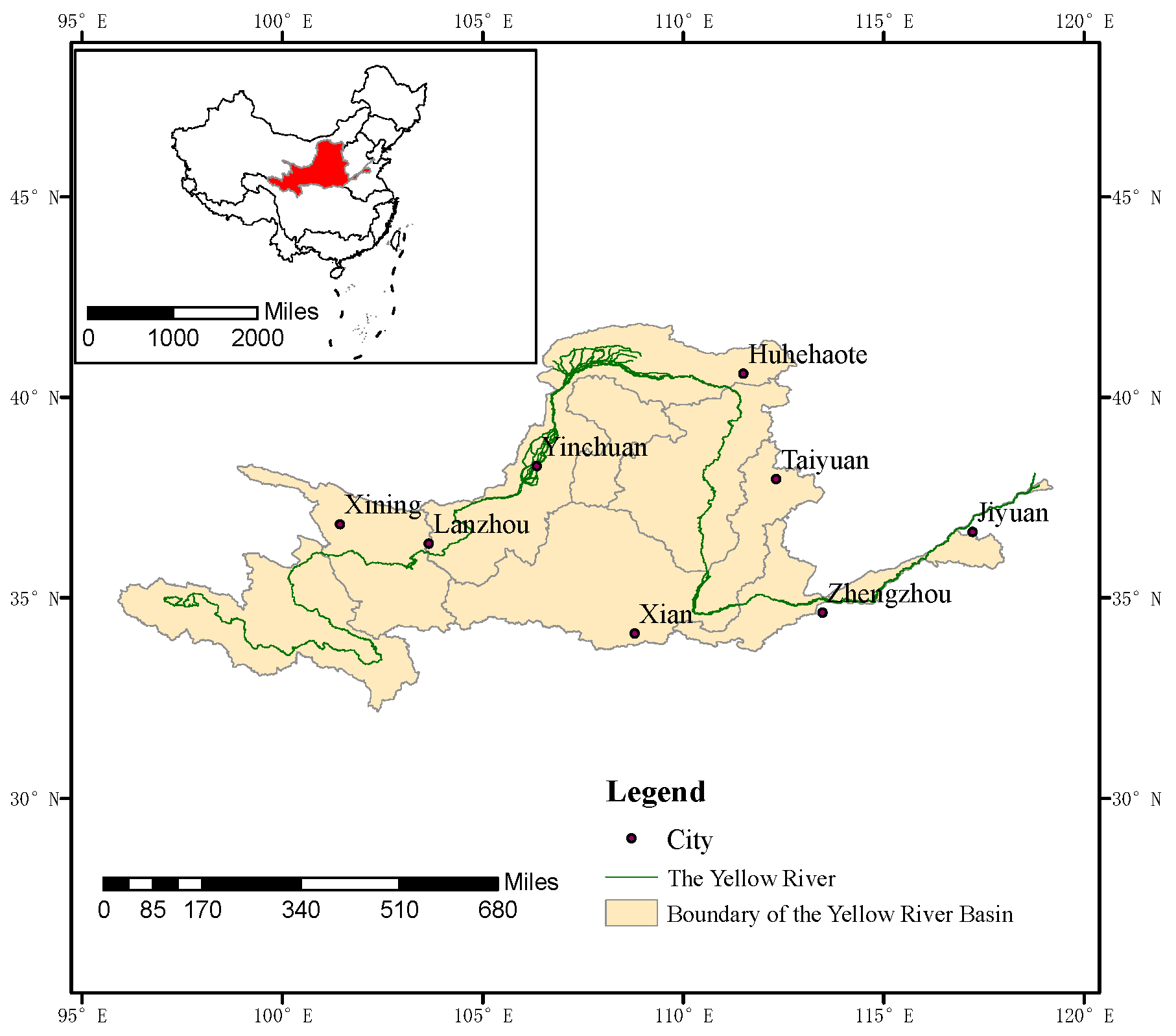
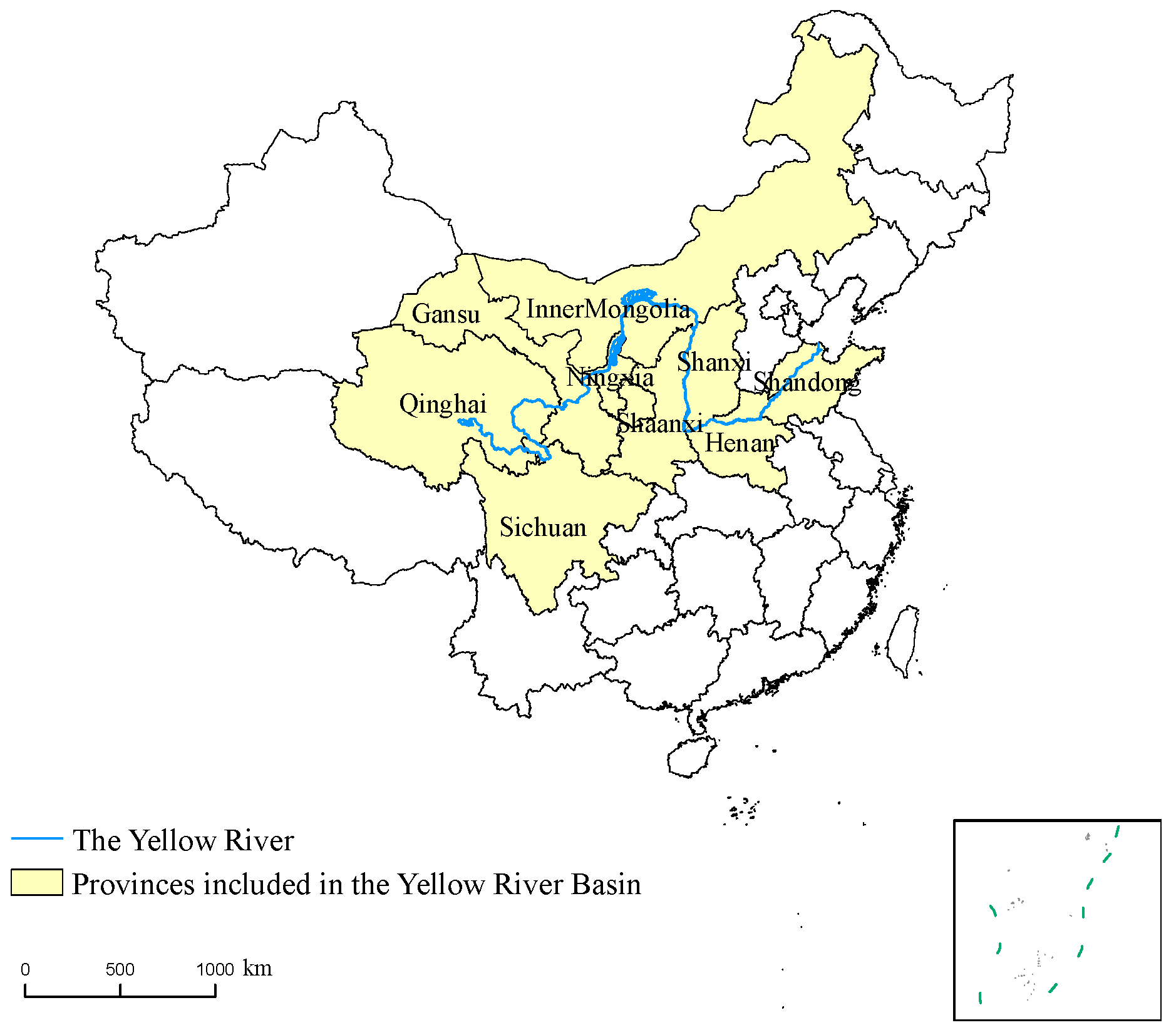
The Yellow River Basin refers to the geographical and ecological area affected by the Yellow River system from its source to the sea. Traditionally, people often refer to the relevant area of the Yellow River flowing through provinces as the Yellow River Basin, as shown in Figure 1. Based on the extent of the natural Yellow River basin, this paper takes the provincial administrative regions that the Yellow River basin passes through as its research scope; these areas are shown in Figure 2. Although some areas of these provincial administrative regions are not involved in the natural Yellow River basin, their social and economic development is deeply influenced by the Yellow River. Therefore, considering the correlation between regional socio-economic development and the Yellow River, the Yellow River Basin defined in this paper involves nine provincial administrative regions, namely: Qinghai, Sichuan, Gansu, Ningxia, Inner Mongolia, Shanxi, Shaanxi, Henan, and Shandong.
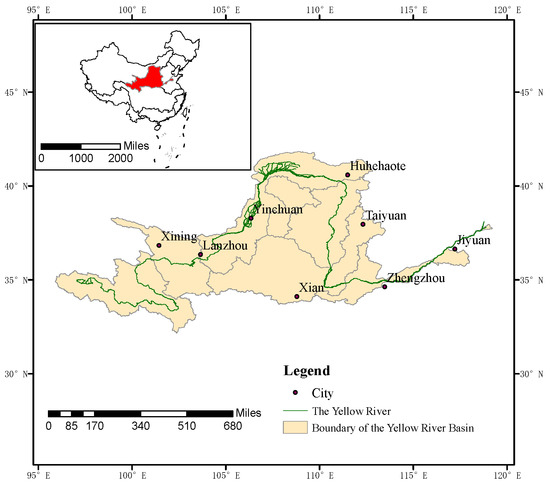
Figure 1.
Location of the Yellow River Basin.
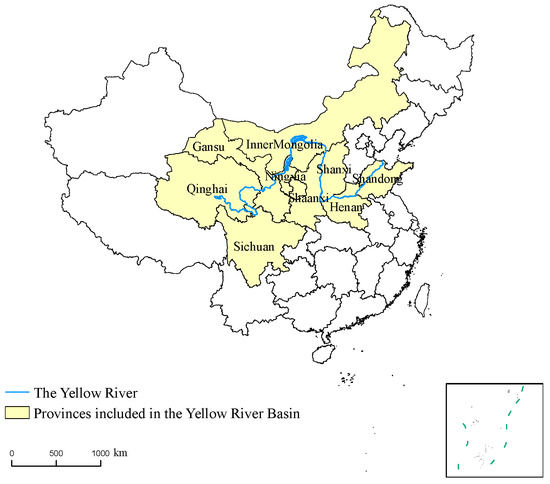
Figure 2.
Provinces included in the Yellow River Basin.
In this paper, the HQDMI in the Yellow River Basin refers to, under the guidance of the new development concept, focusing on the top-level design of the Yellow River Basin and building a new development pattern by strengthening the coordination and cooperation of the whole basin. The whole life cycle of design, production, manufacturing, and sales services of the manufacturing industry can achieve sustainable development with a low input of production factors, high resource allocation efficiency, excellent ecological environment quality, strong innovation capability, excellent product quality, and good economic benefits. From the perspective of connotation, the HQDMI in the Yellow River Basin refers to improving efficiency, optimizing industrial structure, improving product quality, and improving environmental quality based on the carrying capacity of water resources and the ecological environment. From the perspective of extension, it is necessary to strengthen characteristic industries, speed up the transformation of old and new kinetic energy, improve the quality of economic development, promote the transformation and upgrading of resource industries, and build a modern industrial system with characteristics and advantages, to achieve the HQDMI in the Yellow River Basin. However, what are the influencing factors and paths for the HQDMI in the Yellow River Basin? The academic circles have not solved these problems well. From a practical point of view, both enterprises and government management departments attach great importance to promoting the HQDMI in the Yellow River Basin, and relevant government departments have also formulated some industrial policies. However, these industrial policies have not yet achieved the desired effect.
The main research question of this article is as follows: What are the key influencing factors and their impact paths for the high-quality development of manufacturing in the Yellow River Basin? This problem has not yet been adequately addressed by the academic community.
The following are this study’s contributions: Firstly, the original data are obtained through in-depth interviews with manufacturers in the Yellow River basin. The data at three levels are coded using the grounded theory, the factors that influenced the high-quality development of the manufacturing sector are identified, and the influencing factors model of high-quality development of the manufacturing industry rooted in the Yellow River basin is proposed. Compared with the general qualitative description and analysis of high-quality development in the manufacturing industry, this study adopts a more standardized research logic and reasonable research steps, combined with the research context, to enhance the rigor and persuasiveness of relevant theories. Secondly, taking cues from dialectical materialism, the manufacturing industry has developed to a high standard through the interaction of endogenous and external variables. The manufacturing sector’s high-quality development is based on endogenous forces, which are also the first to identify the fundamental pattern of high-quality development. External elements, which are secondary and can speed up or slow down high-quality development, are the external conditions for the manufacturing industry’s high-quality development. This article categorizes the influencing elements into two groups: endogenous factors and exogenous ones, based on the historical context of the high-quality development of the manufacturing industry in the Yellow River Basin and the production practices of firms. Among them, endogenous factors include three levels: innovation ability, organizational construction, and industry resources. Exogenous factors include three levels: institutional environment, industrial collaboration, and market demand. Thirdly, this study breaks through the limitations of previous one-sided and micro-studies on the impact of high-quality development in the manufacturing industry, and deeply analyzes the causal relationships between the influencing factors. The theoretical research has been somewhat enriched by this study, which offers theoretical support for the promotion of the high-quality development of the manufacturing industry in the Yellow River Basin.
The structure of this paper is as follows: The second part reviews the literature related to the HQDMI. The third part designs the identification method of the factors influencing the HQDMI in the Yellow River Basin. The fourth part provides the identification process of the influencing factors of the HQDMI in the Yellow River Basin. The fifth part outlines the influencing factors and their mechanisms of action for the HQDMI in the Yellow River Basin. The sixth part is a discussion of the study and the seventh part is the conclusion, theoretical contributions, and future research directions.
2. Literature Review and Theoretical Basis
2.1. The High-Quality Development of the Manufacturing Industry
The research on the HQDMI can be traced back to the end of the 20th century. Human beings have reflected on the mode of development that traditionally only pursues economic growth [5]. People have realized that the traditional industrial development model has made mistakes in resource consumption and ecological damage. Progressives agree that manufacturing technology must be in harmony with the environment and that it should be a technology that follows the principle of “sustainable development” [6]. Early theoretical and empirical studies have pushed scholars to deepen their cognition of industry resources, however, most of these studies focus on economic factors and ignore social and ecological factors. Since then, scholars have begun to explore the relationship between manufacturing development and the ecological environment from the perspective of cross-integration of different disciplines [7,8,9]. The theoretical achievements of the sustainable development of the manufacturing industry have laid a solid foundation for exploring the HQDMI in the Yellow River Basin. With the rapid development of China’s manufacturing industry, the developing mode and background of the manufacturing industry have produced some new features, such as innovation as the primary driving force, green development as the internal requirement, and open development as the only way [10]. Innovation capability is an important source and key element for enterprises to build competitiveness [11]. Climate change and poverty eradication are urgent challenges facing the world and society today [12,13]. These new features have brought great challenges to the HQDMI.
As a concept of state, high-quality development in manufacturing can be considered to be a new state of development, meaning the state in which manufacturing enterprises achieve or are in a high-level and excellent state of enterprise development quality. In this sense, high-quality development of the manufacturing industry is a goal or ideal state pursued by enterprises compared to the development of low-level and low-quality enterprises. As a procedural concept, high-quality development in manufacturing can also be seen as a new paradigm of manufacturing development, where the manufacturing industry aims to achieve a high-level and excellent quality of enterprise development. In this way, enterprises will move away from their previous extensive development strategies, which only prioritized enterprise scale expansion and increased factor investment and will instead focus on delivering high-quality goods and services, while highlighting the effectiveness and degree of value creation for both the economy and for society. This places emphasis on the process of influencing an enterprise’s quality and capacity for sustainable growth. Based on the above two concepts, this article defines the high-quality development of the manufacturing industry as the goal state or development paradigm for the manufacturing industry to pursue high-level and efficient economic and social value creation, as well as to shape excellent sustained growth and sustained value-creation capabilities.
2.2. Research on Influencing Factors of the HQDMI
Systematic research on the HQDMI in academia has gradually emerged. At present, the research on the HQDMI in domestic and foreign literature is mainly based on the following aspects:
Firstly, the existing literature focuses on the HQDMI model, and studies the influencing factors of development from the perspective of the industry. Cai et al. [14] used exploratory case studies and qualitative research methods to analyze the influencing factors of the entrepreneurial behavior of new state-owned enterprises in the new-energy vehicle industry. Usama et al. [15] used the explanatory structure model to conclude that the lack of personnel participation in planning and the lack of supportive institutional policies were the main obstacles. Xu [16] discussed the response process of the high-quality development of China’s manufacturing industry based on the logic of “society symbiosis technology” and analyzed the change trend from the perspective of value chain upgrading. Mou et al. [17] studied the dynamic characteristics and causes of the development of China’s manufacturing industry based on the general laws of the development of the manufacturing industry in the world, by analyzing the dynamic change characteristics of the scale of the manufacturing industry in the world. Secondly, the existing literature focuses on the evaluation and measurement of the HQDMI. Yang et al. [18] established an evaluation index system for the high-quality development level of the manufacturing industry using the four aspects of economic creation, scientific and technological innovation, opening to the outside world, and green environmental protection, and conducted an overall and provincial dynamic evaluation and comparative analysis on the high-quality development level of the manufacturing industry. Fu and Chu [19], based on the provincial panel data of the manufacturing industry in the Yangtze River Delta from 2011 to 2018, used the TOPSIS Model with combined weights to analyze the HQDMI in the Yangtze River Delta. Jiang et al. [20] analyzed the HQDMI level and its spatial-temporal distribution characteristics by using the panel data of 31 provinces in China by constructing an evaluation index system for the HQDMI. Ma and Cao [21] constructed an evaluation index system from the five dimensions of benefit growth, social sharing, green development, open cooperation, and innovation development, and conducted an empirical analysis based on enterprise data using the combined weighting TOPSIS model. Thirdly, the existing literature focuses on the factors affecting the HQDMI from a single perspective. Dou et al. [22] used a panel regression model based on diamond theory to analyze the impact of factors such as financial services, transportation services, information technology, and intellectual property on the high-quality development of the manufacturing industry. Feng [23] addressed the problems of structural imbalance and low overall levels in the development of manufacturing system in Zhengzhou, analyzed the current situation of the HQDMI, and discussed the influencing factors of the HQDMI. Na et al. [24] used the grey correlation analysis model to make an empirical analysis of the transformation and upgrading of China’s manufacturing industry. The research results show that technological innovation and structural optimization are the main factors. Li [25] explored the influencing factors of manufacturing intelligence from internal and external perspectives. Zhang et al. [26] comprehensively investigated the direct and indirect effects of multi-dimensional factor mismatch, such as capital mismatch, labor mismatch, and land mismatch on the HQDMI by introducing factor mismatch and independent innovation into the monopoly-competition model of heterogeneous enterprises. Based on the perspective of the whole industry chain of the manufacturing industry, Chao et al. [27] explained the impact mechanism of digital infrastructure on the HQDMI from the three dimensions of design, production, and market matching, and conducted an empirical test. Tang et al. [28] empirically tested the impact of industrial intelligence on the HQDMI by using provincial panel data. Based on the complex manufacturing demand environment, Dou et al. [29] proposed a deep learning method to analyze the impact of market demand on the development of the manufacturing industry.
2.3. Theoretical Basis for the HQDMI
By reviewing the existing literature from China and elsewhere, we have found a theoretical basis for explaining the high-quality development of the manufacturing industry, which provides a theoretical basis for this study. These theories include SWOT, new industrialization theory, and PPM theory. SWOT is a comprehensive, systematic, and accurate study based on a situational analysis of internal and external competitive environments and conditions; it involves various main internal strengths, weaknesses, and external opportunities and threats closely related to the research object. Corresponding development strategies, plans, and countermeasures are formulated based on the research results. Zima et al. [30] used the SWOT analysis method to evaluate the construction industry in Poland. The theory of new industrialization emphasizes ecological environment construction and environmental protection under the guidance of sustainable development, improves total factor productivity through informatization and digitization, and realizes a fundamental transformation of economic growth mode [31]. Hong [32] believes that this industrialization path is new when compared to China’s original industrialization path and to the industrialization path that Western developed countries have taken, and that its essence is to transform the economic development model. The push-pull-anchoring (PPM) theory explains the process of an industry moving from a harsh environment to a better and more sustainable environment. Based on PPM theory, Dou et al. [33] defined the concept of a regional advanced manufacturing industry and established an impact factor evaluation system to analyze the potential factors that affect regional advanced manufacturing industries.
The above results provide a rich and useful reference for exploring the influencing factors of the HQDMI in the Yellow River Basin. However, after further summarizing the existing literature, it is found that there is relatively little literature that directly studies the relationship between the HQDMI in the Yellow River Basin and its influencing factors. Therefore, based on the research results of domestic and foreign scholars, this paper will study the influencing factors of the HQDMI in the Yellow River Basin, and explore its key influencing factors, in order to provide a reference for manufacturing enterprises and governments to formulate effective policies to promote the HQDMI.
3. Research Methods and Data Sources
3.1. Research Methods
In China, the research on the factors influencing the HQDMI in the Yellow River Basin is still being explored, and the research is exploratory and interpretive, so it is appropriate to use exploratory research methods. Moreover, according to field research, we found that the industry’s understanding of the HQDMI is also inconsistent. Therefore, the direct design of structured questionnaires without differences for large sample data collection to quantify research may not achieve the desired results. In view of this, data were collected through semi-structured interviews with representative manufacturing enterprises in the Yellow River Basin. Using qualitative research can more effectively explore the key factors influencing the HQDMI. Grounded theory, proposed by Barney Glaser and Anselm Strauss, is a relatively rigorous qualitative research method [34]. Grounded theory is the use of collected interviews and second-hand data to build a substantive theory from the bottom up [35]. That is, to scientifically extract, analyze, compare and summarize the original materials, gradually improve the abstraction of concepts and their relationships, and finally develop into a theoretical qualitative research method [36]. The specific research process is shown in Figure 3.

Figure 3.
Research steps of grounded theory.
Grounded theory has been widely used in qualitative research [37]. There are four main reasons for choosing the theory of taking root in this study: (1) There are many factors affecting the HQDMI in the Yellow River Basin that are difficult to study using traditional hypothesis testing; (2) Grounded theory can be used to extract and summarize real-life empirical data from the bottom-up, and then to construct and improve the theory; (3) The influencing factors of the HQDMI have yet to be fully tested; (4) The factors affecting the HQDMI are complex and involve several interrelated factors. Therefore, grounded theory is appropriate for this study to systematically collect and analyze empirical data to generate conceptual categories, that is, factors influencing the HQDMI in the Yellow River Basin.
In this paper, following the general process of programmed grounded theory [38,39], after open coding, axial coding, and selective coding of the obtained data, the properties of categories and the essential relationship between categories were identified. In the process of data analysis, the continuous comparative analysis idea was adopted, the theory was continuously refined and revised, and a model of factors influencing the HQDMI in the Yellow River Basin was finally constructed. Deep and insightful analysis of data is a prerequisite for qualitative research. The specific operation process is based on the research of Carmel Maher et al. [40] using traditional tools that support data analysis (such as colored pens and sticky notes), combined with software that supports data management (such as NVivo) for coding to ensure that the analysis process is strict and valid. At present, manufacturing enterprises with high-quality development have provided a large number of rich original materials for this study. This study abstracts and summarizes the laws that reflect the nature of things from the actual situation of many enterprise cases, which rise to theory and finally form a theoretical model. Therefore, this study will collect data through multiple cases and then conduct data coding analysis to deeply explore the influencing factors and internal mechanisms of the HQDMI in the Yellow River Basin, to provide relevant theoretical guidance and reference for the HQDMI in the Yellow River Basin.
3.2. Interview Outline
First, the pre-interviews were conducted. Then, combined with the actual development of the manufacturing industry in relevant provinces in the Yellow River Basin, the opinions of relevant experts and enterprise managers were consulted and the content of the pre-interview was modified so that it could be summarized to the problems studied, and finally an interview outline was formed. The interview outline is as follows: (1) How do you understand the HQDMI?; (2) How did the idea of high-quality development of your enterprise come about? How is it implemented? Can it be exemplified?; (3) What do you think are the internal factors that affect the high-quality development of your enterprise? What are the external factors?; (4) What suggestions would you put forward to promote the HQDMI in the Yellow River Basin?; (5) What else do you need to add to the discussion just now? It is worth noting that the interview outline is used to guide the interview process, but the content of the interview is not limited to this outline. The detailed interview outline can be found in Appendix A.
3.3. Collection of Data
In this study, the HQDMI in the Yellow River Basin is studied in multiple cases, and a variety of methods are used to collect the data. There are two sources of data for grounded theory: (i) Interview data. Select specific interviewees according to the research purpose and criteria of relevance. Since qualitative research requires respondents to have a certain understanding and understanding of the research issues [41], the interviewees were middle and senior managers and scientific and technological personnel who had more than two years of work experience in the enterprise and had a bachelor’s degree or above. The interviewees were mainly project leaders and scientific research backbones of their enterprises. Due to the impact of the COVID-19 pandemic, this study was carried out through a combination of interviews and telephone. Among them, the duration of each one-on-one in-depth interview was about 1 h, and the duration of each telephone interview was about 30 min. The one-on-one in-depth interview can leave relatively sufficient room for the respondents to think and express themselves. The time and situation of the interview are sorted out through the interview records and memos, the data is saved, and the interview text is finally formed. This paper selects the demonstration enterprises in the Yellow River Basin as the case selection base, because these demonstration enterprises have achieved high-quality development to a certain extent and can extract the real and effective influencing factors. In this study, semi-structured in-depth interviews were used to let the respondents talk about the influencing factors of the HQDMI in the Yellow River Basin from their own perspectives; (ii) Second-hand data. We collect second-hand data as supporting data. The second-hand data is mainly used to find the relevant materials and documents of the HQDMI through the enterprise website and search the relevant media reports of the high-quality development of the enterprise through the web page, so as to try to obtain the written documents or relevant materials of each manufacturing enterprise related to the high-quality development. According to the mature research experience of previous grounded theoretical research [42,43,44], the sample size should be 25–35. Through the above two data collection methods, a total of 33 interview records were formed. On the premise of ensuring the theoretical saturation of the sample, we randomly selected 25 interview records for coding analysis and model construction. Another eight interview records were used for the theoretical saturation test.
4. Identification Process of the HQDMI in the Yellow River Basin
4.1. Open Coding
In this paper, the coding is carried out according to the method and steps of the program grounded theory. Open coding is to encode and label the original data word by word and sentence by sentence. That is, to discover the initial concept and extract the category from the original data. In order to reduce the subjective influence of researchers, this study tries to use the original words in the data as labels to explore initial concepts. Since the number of initial concepts is very large and complex and there is a certain degree of overlap, categories are reclassified combinations of concepts. Therefore, it is necessary to categorize the obtained initial concepts. The original data were sorted and summarized to form 772 codes. After further refining the code, the code forms 84 formal concepts, and finds out the potential internal connection between each concept. Table 1 shows the obtained concepts and some categories.

Table 1.
Open coding results.
4.2. Axial Coding
Through axial coding, we can find the potential logical connection between categories, and develop the main category and its sub-categories. According to this model, this study deeply analyzes the interrelationship and logic of different categories. We classify the 21 categories formed by open coding into six main categories. The details are shown in Table 2.
Table 2.
Axial coding results.
4.3. Selective Coding
The main work of selective coding is to extract the core categories from the main categories through integration and condensation, and to analyze the connection between the core categories and the main categories. Through the categories and relationships developed at the previous two levels of coding, selective coding distills a core that summarizes the entire phenomenon, namely, a “story line” that describes the behavioral phenomenon and contextual conditions, and ultimately a new theoretical framework. The “story line” around the core of “the HQDMI in the Yellow River basin” can be summarized as follows: innovation capability, organization construction, industry resources, institutional environment, industry collaboration, and market demand have a significant influence on the HQDMI in the Yellow River basin. The linkage of the core categories to the main categories and their categories is shown in Table 3.
Table 3.
Relation structure of the main category.
For a company, innovation is the lifeblood of its survival and development. Innovation is widely regarded as an important component of competitiveness, embedded in the organizational structure, processes, products, and services within a company [45]. Enterprises apply innovative knowledge and new technologies, new processes, new production methods, and business management models to improve product quality, develop new products, improve new services, occupy the market, and realize market value. Organizational construction is a fundamental belief, value standard, and behavioral norm that all members of an organization continuously cultivate and adhere to in the development process of the enterprise. The organizational construction of an enterprise is an intangible asset with a brand effect, which has strong vitality and expandability. Although it cannot directly create economic benefits, it can affect production, sales, market, and consumption through human management, thereby affecting the interests of enterprises. It is a cultural productivity with enormous influence and infinite potential [46]. Industrial resources include industrial foundation, industrial structure, and resource integration. As the core task of manufacturing development, industrial foundation is not only an inevitable demand for the construction of a strong manufacturing country, but also a key link in the construction of a modern industrial system [47]. The rationalization of manufacturing structure has a positive effect on economic growth efficiency [48]. Cross-border resource integration can not only combine international and domestic resources with the market, learn advanced production technologies and operational management systems from abroad, and improve the brand image of enterprises, but can also improve company systems, optimize industrial structures, improve operational efficiency, and achieve the goal of high-quality development of enterprises [49]. A good external institutional environment helps to improve the company’s internal control [50]. Strengthening the mechanism of regional industrial cooperation and complementary and misaligned development among industries can reduce redundant construction and vicious competition among regions [51]. Expanding market demand can bring about economies of scale and competitive effects, which in turn drive enterprises to seek innovation [52].
4.4. Theoretical Saturation Test
In this study, 25% of the data were tested for theoretical saturation, and the results showed that no new important categories or relationships were found. No new influencing factors were found in the six main categories affecting the HQDMI in the Yellow River Basin. Therefore, it can be considered that in theory, “the influencing factors and function model for the HQDMI in the Yellow River Basin” is saturated. The verification codes are shown in Table 4.
Table 4.
Coding results of theoretical saturation test.
5. Identification Results of Influencing Factors and Model Interpretation
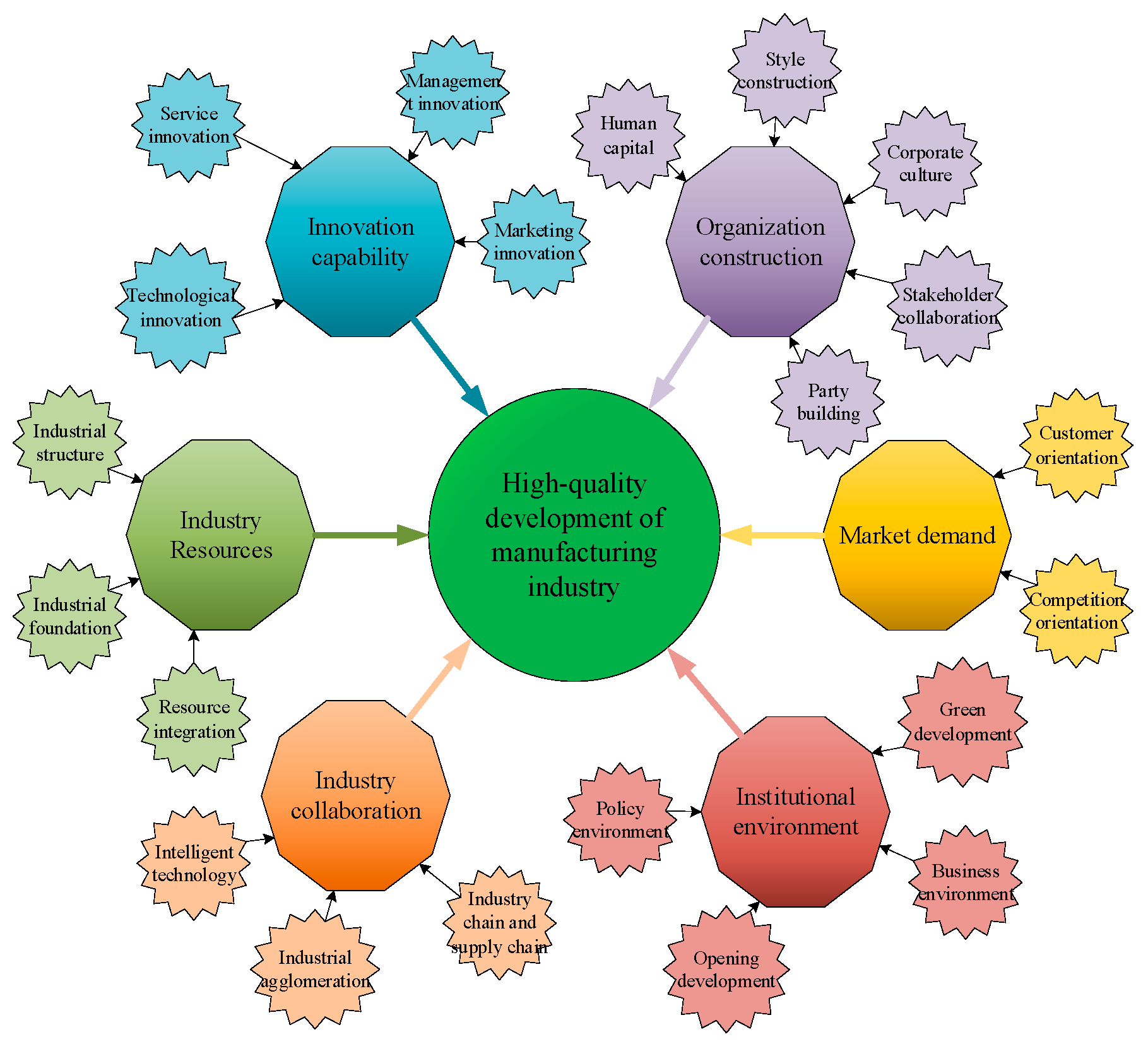
Through open coding, axial coding, selective coding, and theoretical saturation testing on the interview data, we constructed a relational model of the factors influencing the high-quality development of the manufacturing industry in the Yellow River Basin, as shown in Figure 4. Innovation capability, organization construction, and industry resources constitute endogenous factors, and the endogenous factors of the HQDMI are those which directly determine the mode of the HQDMI. Institutional environment, industry collaboration, and market demand constitute exogenous factors. The exogenous factors of the HQDMI are the influencing variables for the survival and development of manufacturing industry. From Figure 4, we can find that the key factors for the HQDMI in the Yellow River Basin lie in “endogenous factors” and “exogenous factors”. Exogenous factors are mediated by endogenous factors and act on the HQDMI. The model constructed based on the grounded theory gives the influencing factors for the HQDMI in the Yellow River Basin, and this study will elaborate on the relational model of influencing factors for the HQDMI in the Yellow River Basin.
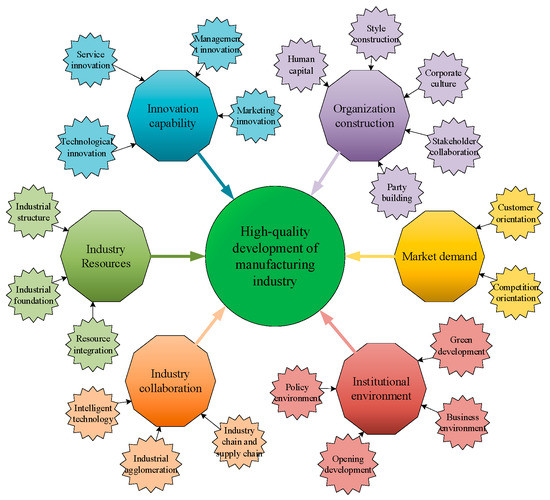
Figure 4.
Relationship model of influencing factors for the HQDMI in the Yellow River basin.
5.1. Endogenous Factors for the HQDMI
Endogenous factors include three main categories: innovation capability, organization construction, and industry resources.
(1) Analysis of sub-factors related to innovation capability: (i) Technological innovation. With the continuous deepening of scientific and technological revolution and industrial transformation, it is profoundly changing the production mode of the manufacturing industry and has an impact on the industrial competition pattern around the world. Emerging industries supported by new technologies are developing rapidly. Digital enterprises have gradually penetrated and extended to traditional product research and development, production, logistics, services, and other fields. Information and communication, software, and other service enterprises have accelerated their cooperation and interaction with manufacturing enterprises. The production organization of the manufacturing industry will be fundamentally changed, and the allocation of industrial factor resources will be more optimized. Therefore, the scientific and technological revolution not only promotes the interaction between technology and industry, but also promotes cross-industry integration, catalyzes the amplification multiplier effect, and greatly improves the quality and efficiency of manufacturing development; (ii) Management innovation. Management innovation includes a series of activities for overall or partial improvement of management concepts, systems, theories, processes, methods, and tools. It conforms to the current trend of the big data era and finds an advanced management model suitable for its own development in combination with the international market, in order to continue to develop in the fierce market competition; (iii) Service innovation. The service innovation of manufacturing enterprises is the research, development, and realization of new services or product service systems through in-depth understanding of service objects and relying on internal and external resources of enterprises under the service orientation [53]. The rapid development of information technology has also intensified the homogenization of product technology and product functions, which results in a decrease in the space for competition by improving product quality and reducing product costs. Service innovation can improve the market reputation and the economic benefits of enterprises. Therefore, service innovation has become an important measure for enterprises to compete in the market; (iv) Marketing innovation. Marketing innovation is the process of optimizing and improving marketing concepts, means, and strategies in order to develop and occupy the market and adapt to the new market environment. It is an effective method for enterprises to expand the market. Therefore, with the development of economic globalization, enterprises must carry out marketing innovation to adapt to the new market environment and break through the bottleneck problem of enterprises.
(2) Analysis of sub-factors related to organization construction: (i) Human capital, especially innovative talents, is the basis for the HQDMI. It is related to the technological update and iteration of the development of manufacturing enterprises and provides innovative support for the HQDMI. Specifically, human capital is the knowledge and ability of employees, which has strong path dependence. Because human capital is difficult to imitate, it has become the core of the competitiveness of enterprises. Enterprises can gain sustainable competitive advantages through a variety of methods to fully stimulate the potential of human capital and adapt to changes in the external environment. Therefore, human capital plays a vital role in the HQDMI; (ii) Style construction. Enterprise style is a relatively stable atmosphere or behavior mode formed in various practical activities of the enterprise, which reflects the spiritual outlook of the employees of the enterprise and is also the manifestation of the essence of the enterprise. The traditional style of the enterprise, especially the leadership style, plays a vital role in the growth and development of the enterprise; (iii) Corporate culture. Corporate culture is a unique cultural image composed of values, beliefs, and ways of doing things. It is the spiritual wealth and material form with corporate characteristics created by enterprises in production activities. Corporate culture has the functions of guidance, cohesion, restriction, promotion, incentive, and radiation. Corporate culture covers the material culture, behavioral culture, institutional culture, and spiritual culture of an enterprise. Therefore, an excellent corporate culture plays a huge role in the high-quality development of an enterprise; (iv) Stakeholder collaboration. Stakeholders mainly include shareholders, investors, governments, customers, suppliers, distributors, and employees. The belief of “shareholders’ interests first” that enterprises have been upholding for decades is changing, and the social value of enterprises and the role they will play in the future world will be reinterpreted. Therefore, it is necessary to build a new pattern in which multiple stakeholders such as shareholders, investors, governments, consumers, suppliers, distributors, and employees participate in the HQDMI; (v) Party building. Enterprise party organization is a unique institutional arrangement in Chinese corporate governance [54]. Party building is a unique corporate political resource in China and plays an important leading role in deepening the reform of corporate systems and mechanisms. Taking party building as the political core to promote the development of enterprises will help to create a clean and upright corporate cultural atmosphere, improve the overall moral quality of employees, and then promote the high-quality development of enterprises.
(3) Analysis of sub-factors related to industry resources: (i) industrial structure. For a long time, the industrial economy of the Yellow River Basin has focused on traditional industries such as non-ferrous metallurgy, coal chemical industry, and equipment manufacturing. The manufacturing industry is comprised mainly of resource-intensive and labor-intensive industries, while the development level of high-tech manufacturing industry with high-added value and high-tech content is relatively backward. Finally, the problems of short industrial chains, low product-level, late start of emerging industries, small scale, scattered enterprise layout, and low efficiency of resource allocation affect the HQDMI in the Yellow River Basin. The impact of industrial structure on the HQDMI is mainly reflected in: By optimizing the industrial structure, we will accelerate the restructuring of the competitive advantages of traditional industries, continuously improve the growth rate and contribution rate of emerging technology industries, continuously enhance the supply capacity of high-end products, and continuously improve the green development level of industry; (ii) Industrial foundation. Industrial foundation mainly includes key technologies, manufacturing processes, core components, and basic materials for industrial development. It is the basic support for industrial development and the necessary condition for supporting the HQDMI in the Yellow River Basin. Compared with the Yangtze River Basin, the basic categories of industries in the Yellow River Basin are relatively simple, and the overall scale advantage is not yet prominent. At the same time, the reliability and stability of some technologies and product quality are not high, and there is a big gap with the world’s advanced level. Therefore, it is necessary to build a high-standard industrial infrastructure system, target the shortcomings of the industrial infrastructure capabilities in the Yellow River Basin, improve quality and efficiency, optimize the ecology, improve the level of industrial infrastructure, and provide a solid support for the HQDMI; (iii) Resource integration. Resource integration is the strategy of enterprise strategic development adjustment. It is a complex dynamic process of identifying, selecting, absorbing, configuring, activating, and integrating different types of resources, forming strong toughness, systematicness and value, and creating new resources. Enterprise development requires resources, especially compared with the company’s own scarce resources, it is even more necessary to optimize the global resource allocation. Through the global integration of innovation resources and mergers and acquisitions, enterprises spill over to local industry knowledge, especially overseas mergers and acquisitions to obtain reverse technology spillover, which is an important growth mechanism to accelerate the competitive advantage of manufacturing enterprises in the Yellow River Basin. Therefore, resource integration is an important means to promote the HQDMI.
5.2. Exogenous Factors for the HQDMI
Exogenous factors include three main categories: institutional environment, industry collaboration, and market demand.
(1) Analysis of sub-factors related to the institutional environment: (i) Open development. Open development can promote the circulation of commodities and factors, deepen the division of labor and cooperation, and improve production efficiency. On the one hand, the government actively expands the degree of opening to the outside world, which can bring more resources and opportunities to enterprises and give enterprises the opportunity to step on the stage of globalization. On the other hand, openness means competition and cooperation. The pressure of competition will help enterprises to invest more funds in technology research and development and innovation and enhance their competitiveness and innovation. Therefore, open development is the fundamental principle to adhere to in the process of the HQDMI; (ii) Green development. Manufacturing is a key and difficult area to promote green development. For a long time, the development of the manufacturing industry has been accompanied by a large number of resource and energy consumption and emission problems, resulting in an inconsistency between industrial economic development, resources, and environment. This requires the development of the manufacturing industry to form a green development mode, in order to fundamentally solve the contradiction between economic development and ecological environmental protection. Building an industrial system for green, circular, and low-carbon development is the technical support and industrial foundation for building a resource-saving and environment-friendly green development system. Adhering to green development, green transformation of traditional industries, and establishment of a green industrial system are inevitable requirements for the HQDMI; (iii) Business environment. A business environment is a systemic environment. A good business environment can stimulate market vitality and enhance the endogenous driving force for development, which is an important manifestation of a country or region’s economy and competitiveness. The government should deepen the reform of government functions, accelerate the construction of a modern economic system, strive to create a market-oriented, legalized, and internationalized business environment, continuously liberate and develop social productive forces, and continuously cultivate and stimulate the vitality of market players. Therefore, the government needs to optimize the top-level design of the business environment, clarify the main responsibilities and work objectives of each department, earnestly implement various measures to optimize the business environment, and strive to improve the government service capacity and level. Effectively reducing institutional transaction costs and comprehensively stimulating social creativity will greatly promote the HQDMI; (iv) Policy environment. The policy environment can regulate and regulate the production activities of enterprises. The national guidelines at different stages of development provide good conditions and foundations for the political environment for high-quality development of enterprises. Correctly and fully fit the policy environment of the enterprise will have a positive impact on the development planning, production activities, and management of the enterprise. Therefore, the establishment of a policy environment suitable for the HQDMI in the Yellow River Basin is an important prerequisite for achieving high-quality development and a guide for enterprises to move towards high-quality development.
(2) Analysis of sub-factors related to industry collaboration: (i) Intelligent technology. With the in-depth development of a new round of technological revolution and industrial transformation, intelligent technology is promoting the remodeling of global industrial chain and supply chain. Therefore, the key to achieving the HQDMI is for manufacturing enterprises to accelerate the digital, networked, and intelligent upgrading of the manufacturing industry, vigorously cultivate new driving forces for development, strengthen the R&D and innovation of key intelligent manufacturing technologies, accelerate the construction of intelligent factories and digital workshops, improve the intelligent manufacturing standard system and sharing platform, build a collaborative innovation network for intelligent manufacturing, and actively cultivate and develop an intelligent manufacturing ecosystem; (ii) Industrial agglomeration. Industrial agglomeration has comprehensive competitive advantages in terms of enterprise development, production technology, professional talents, resource elements and brand effects. Distinctive industrial characteristics, reasonable spatial layout, rich innovation elements, and efficient division of labor and collaboration are important manifestations of industrial agglomeration development. Continuously improve the supporting functions and carrying capacity of industrial agglomeration, continue to deepen the division of labor network system and industrial organization form of enterprise cooperation, symbiosis and integration, gradually improve the system and policy system that adapt to the development of industrial agglomeration, constantly optimize the cluster innovation and development ecosystem, cultivate and develop a number of world-class industrial clusters according to local conditions, and become the leading force for the HQDMI in the Yellow River Basin; (iii) Industrial chain and supply chain. Both industrial chain and supply chain are value-added chains and transmission chains of user value. Both are driven by market demand and develop dynamically with market changes. Both are closely related to the development of enterprises and specific enterprises and businesses, such as information flow, logistics, capital flow, etc. The impact of COVID-19 has had a serious effect on the economy of China and even the world. COVID-19 has affected the free flow of production factors, blocked the supply chain circulation of the enterprise industrial chain, and caused the collapse of the supply side due to the shutdown and closure of enterprises. Therefore, it is of great practical significance for the HQDMI to enhance the resilience of the enterprise’s industrial chain and supply chain.
(3) Analysis of sub-factors related to market demand: (i)Customer orientation. Customer orientation is to obtain customer satisfaction as the goal, to improve the quality of its own services, to obtain maximum profits. That is to say, because the enterprises in the market must constantly collect information on the needs of target customers, strive to follow the development of the market or even lead the development of the market, and continue to create excellent value for customers. Therefore, the enterprise’s ability to control the market determines the production and operation efficiency and even the survival fate of the enterprise; (ii) Competition orientation. Competitive orientation starts from its competitors, evaluates its own competitive environment, selects its own competitive market area, and creates more competitive and cost-effective services than competitors, so it can win market and consumer recognition.
6. Discussion
This study selects the demonstration manufacturing enterprises in the Yellow River basin as the research samples and adopts the grounded theory to carry out the research. The industries interviewed include: manufacture of automobiles, smelting and pressing of non-ferrous metals, manufacture of foods, manufacture of paper and paper products, manufacture of raw chemical material and chemical products, processing of food from agricultural products, smelting and pressing of ferrous metals, manufacture of metal products, manufacture of general purpose machinery, manufacture of special purpose machinery, manufacture of electrical machinery and apparatus, processing of petroleum, coal and other fuels, manufacture of railway, ship, aerospace, and other transport equipment, and manufacture of computer, communication, and other electronic equipment, etc. According to the research steps of the grounded theory method, the original data is analyzed through the three-level coding process, and the various levels of categories and storylines of the factors affecting the high-quality development of the manufacturing industry in the Yellow River basin are determined. The identified factors affecting the high-quality development of the manufacturing industry include innovation capability, organizational construction, industrial resources, institutional environment, industrial cooperation, and market demand.
By studying the existing research results, we found the following results: Innovation capability [55] can effectively drive the high-quality development of the manufacturing industry; Enterprise organization [56,57] has a significant impact on the development of manufacturing enterprises; Rationalization of industrial structure can promote industrial economic growth [58]; If the government continues to optimize the institutional environment and eliminate institutional barriers to enterprise development, it will have a positive promoting effect on the high-quality development of the manufacturing industry [59]; There is a significant positive spatial spillover effect of industrial collaboration agglomeration on technological innovation [60]; Positive external demand can accelerate the technological catch up of enterprises and promote their development [61]. The previous research results mentioned above have all verified the effectiveness and rationality of the results of this study.
7. Conclusions and Recommendations
7.1. Conclusions
In order to reveal the key factors influencing the HQDMI in the Yellow River Basin, a theoretical model is established. First, based on the analysis of domestic and foreign high-quality development research literature, this paper takes 32 representative manufacturing enterprises in nine provinces (regions) of the Yellow River Basin as the research object, and obtains the original data through in-depth interviews with employees of manufacturing enterprises. Second, based on the grounded theory, this paper constructs the key factors and function models of the HQDMI in the Yellow River Basin.
The study reached the following three conclusions:
(1) The key factors influencing the HQDMI in the Yellow River Basin are mainly reflected in two levels: endogenous factors and exogenous factors;
(2) The impact of endogenous factors is mainly reflected in three main categories including the innovation capability, the organization construction and the industry resources;
(3) The impact of exogenous factors is mainly reflected in the institutional environment, the industry collaboration, and the market demand.
7.2. Theoretical Contributions
The research conclusions of this paper provide theoretical ideas for the HQDMI in the Yellow River Basin. First, this paper has enriched the research scope of high-quality development of the Yellow River Basin, extending from a single water resources ecological field to the whole process of activities in the Yellow River Basin. This paper provides certain materials and accumulations for improving the HQDMI and makes up for the vacancy in the research on the HQDMI in the Yellow River Basin. The research from the perspective of the HQDMI in the Yellow River Basin has certain reference significance for promoting the strategic development of the Yellow River Basin and the sustainable development of manufacturing enterprises. Second, this paper systematically summarizes the influencing factors of the HQDMI in the Yellow River Basin and clarifies the correlation and interaction mechanism between different influencing factors. It has certain reference values for optimizing the industrial structure of the Yellow River Basin from multiple angles, especially for promoting the green and low-carbon circular development of enterprises. Third, this study enriches the research field of green development theory, new industrialization theory, and high-quality development concept. The model of key influencing factors for the HQDMI in the Yellow River Basin constructed in this study provides a reference for subsequent research.
7.3. Managerial Implications
On the one hand, from the perspective of enterprises themselves, manufacturing enterprises should give full play to their subjective initiative, combine their own reality, accurately grasp the consumer market, and grasp the major strategy of high-quality development in the Yellow River Basin. Manufacturing enterprises should actively strive for the support and cooperation of the government, universities, scientific research institutes, and other aspects, take the initiative to change the industrial structure, optimize the allocation of enterprise resources, and improve the core competitiveness of enterprises. On the other hand, from the perspective of the government, the government needs to strive to improve policies and systems, establish an external development environment for enterprises, stimulate the vitality and creativity of market players, actively guide the sustainable development of enterprises, layout and build a number of scientific and technological innovation platforms such as national key laboratories, industrial innovation centers and engineering research centers, and comprehensively promote the comprehensive treatment of industrial pollution and ecological environment. The government should strengthen the risk management and control of industrial wastes in the areas along the Yellow River and the regional treatment of heavy metal pollution left over from history, provide a path for the transformation of old and new kinetic energy in the basin economy and underdeveloped areas, and turn the grand blueprint of ecological protection and high-quality development in the Yellow River basin into reality.
7.4. Limitations and Future Research
As an exploratory study, this study has limitations in the following aspects. First, during the interview, the researchers found that it was difficult for the respondents to clearly describe the concept of the HQDMI, which was probably because the phrase “high-quality development” is highly abstract. Therefore, the relationship between the HQDMI and its influencing factors is still somewhat vague. In future research, indirect methods such as projection technology could be used to collect the respondents’ attitudes and ideas about the HQDMI, so as to abstract and summarize the HQDMI. In the future, the case study method could be used to verify and analyze the HQDMI, and to enrich and improve the theoretical model of the HQDMI in the Yellow River Basin. Second, qualitative research methods inevitably have strong subjectivity. In the future, we can quantitatively analyze the theoretical model of the HQDMI in the Yellow River Basin and test the research conclusions of this paper. In addition, it is difficult for researchers to determine the weight of each component category in the model and the influence of different factors, so it is necessary to further study the weight of each factor. Therefore, it is necessary to perform factor analysis and structural equation modeling on large sample data through quantitative research to test the model.
Author Contributions
Conceptualization, Y.S. and J.S.; methodology, Y.S.; software, M.Z.; validation, Y.S., J.S. and M.Z.; formal analysis, Y.S.; investigation, Y.S.; resources, Y.S.; data curation, Y.S.; writing—original draft preparation, Y.S.; writing—review and editing, Y.S.; visualization, Y.S.; supervision, Y.S.; project administration, Y.S.; funding acquisition, J.S. All authors have read and agreed to the published version of the manuscript.
Funding
This research was funded by the National Natural Science Foundation of China, grant number 71371172.
Institutional Review Board Statement
Not applicable.
Informed Consent Statement
Not applicable.
Data Availability Statement
Not applicable.
Conflicts of Interest
The authors declare no conflict of interest.
Appendix A
Interview Outline for Manufacturing Enterprises in the Yellow River Basin:
1. Under the national strategy of ecological protection and high-quality development in the Yellow River Basin, what factors do you think will affect the high-quality development of manufacturing enterprises in the development process?
2. Besides the factors of the enterprise itself, what other factors will affect the high-quality development of the enterprise?
3. What suggestions would you put forward to promote the high-quality development of manufacturing in the Yellow River Basin?
4. What other aspects do you need to add to the previous discussion?
Appendix B
Table A1.
Interview the industry and locations of the Chinese enterprises.
Table A1.
Interview the industry and locations of the Chinese enterprises.
| Industry | Enterprise Name | Location |
|---|---|---|
| Manufacture of Automobile | Shaanxi Automobile Holding Group Co., Ltd. | Xi’an, Shaanxi |
| Yutong Group Co., Ltd. | Zhengzhou, Henan | |
| Weichai Holding Group Co., Ltd. | Weifang, Shandong | |
| Smelting and Pressing of Non-ferrous Metals | Western Mining Group Co., Ltd. | Xining, Qinghai |
| Henan Sunho Group Co., Ltd. | Shangqiu, Henan | |
| Jinchuan Group Co., Ltd. | Jinchang, Gansu | |
| Tianyuan Manganese Industry Group Co., Ltd. | Zhongwei, Ningxia | |
| Shaanxi Nonferrous Metals Holding Group Co., Ltd. | Xi’an, Shaanxi | |
| Manufacture of Railway, Ship, Aerospace, and other Transport Equipment | AVIC Chengdu Aircraft Industrial (Group) Co., Ltd. | Chengdu, Sichuan |
| CRRC Datong Co., Ltd. | Datong, Shanxi | |
| Manufacture of Foods | New Hope Group | Chengdu, Sichuan |
| Mengniu Dairy Industry (Group) Co., Ltd. | Hohhot, Inner Mongolia | |
| Yili Industrial Group Limited by Share Ltd. | Hohhot, Inner Mongolia | |
| Manufacture of Paper and Paper Products | MCC Meili Cloud Computing Industry Investment Co., Ltd. | Yinchuan, Ningxia |
| Manufacture of Raw Chemical Material and Chemical Products | Qinghai Salt Lake Industry Co., Ltd. | Geermu, Qinghai |
| Henan Energy Chemical Group Co., Ltd. | Zhengzhou, Henan | |
| Processing of Food from Agricultural Products | Tongwei Group | Chengdu, Sichuan |
| Manufacture of Metal Products | Sichuan Kexin Co., Ltd. | Deyang, Sichuan |
| Smelting and Pressing of Ferrous Metals | Xining Special Steel Co., Ltd. | Xining, Qinghai |
| Jiuquan Iron & Steel (Group) Co., Ltd. | Jiayuguan, Gansu | |
| Taiyuan Iron & Steel (Group) Co., Ltd. | Taiyuan, Shanxi | |
| Manufacture of General-Purpose Machinery | Luoyang LYC Bearing Co., Ltd. | Luoyang, Henan |
| Weihua Group Co., Ltd. | Xinxiang, Henan | |
| Henan Kuangshan Crane Co., Ltd. | Xinxiang, Henan | |
| Processing of Petroleum, Coal, and Other Fuels | Shandong Energy Group Co., Ltd. | Jinan, Shandong |
| Shaanxi Yanchang Petroleum (Group) Co., Ltd. | Yan’an, Shaanxi | |
| Manufacture of Special Purpose Machinery | YTO Group Corporation | Luoyang, Henan |
| China Railway Engineering Equipment Group Co., Ltd. | Zhengzhou, Henan | |
| CITIC Heavy Industries Co., Ltd. | Luoyang, Henan | |
| Manufacture of Electrical Machinery and Apparatus | Qinghai Energy Development Group Co., Ltd. | Xining, Qinghai |
| Manufacture of Computer, Communication, and Other Electronic Equipment | AVIC JONHON Optronic Technology Co., Ltd. | Luoyang, Henan |
| Haier Group | Tsingtao, Shandong |
References
- Xin, G. Promote the high-quality development of the manufacturing sector. Macroecon. Manag. 2019, 2, 5–7. [Google Scholar]
- Li, X.; Yi, S.; Huang, J. Constructing the development pattern of “Dual circulation”: China’s new strategy for economic development. Bus. Manag. J. 2021, 43, 5–24. [Google Scholar]
- Mijiyawa, A.G. Drivers of structural transformation: The case of the manufacturing sector in Africa. World Dev. 2017, 99, 141–159. [Google Scholar] [CrossRef]
- Li, L.; Shi, X.; Liu, J. 40 years of manufacturing in China: Intelligentization process and outlook. China Soft Sci. 2019, 1, 1–9+30. [Google Scholar]
- Kong, A. Research on the industrial structure of sustainable development. J. Quant. Tech. Econ. 1997, 2, 15–21. [Google Scholar]
- Hai, J.; Han, X. Thinking on sustainable development of manufacturing industry in China. China Mech. Eng. 2001, 3, 13–16+3. [Google Scholar]
- Gavin, H. Sustainable development policies in Canada’s mining sector: An overview of government and industry efforts. Environ. Sci. Policy 2000, 3, 201–211. [Google Scholar]
- Moffatt, I.; Hanley, N. Modelling sustainable development: Systems dynamic and input–output approaches. Environ. Model. Softw. 2001, 16, 545–557. [Google Scholar] [CrossRef]
- Zhang, H.; Wu, N.; Tang, W. Significations and strategies of developing manufacturing by advancing green supply chain management. Ecol. Econ. 2006, 5, 241–244. [Google Scholar]
- Jin, B. Study on the “High-quality development” economics. China Ind. Econ. 2018, 4, 5–18. [Google Scholar]
- Robert, F.; Hurley, G.; Tomas, M. Innovation, market orientation, and organizational learning: An integration and empirical examination. J. Mark. 1998, 62, 42–54. [Google Scholar]
- Fankhauser, S.; Jotzo, F. Economic growth and development with low-carbon energy. Wiley Interdiscip. Rev. Clim. Chang. 2018, 9, e495. [Google Scholar] [CrossRef]
- Liu, Z.; Patricia, E. Tackling climate change to accelerate sustainable development. Nat. Clim. Chang. 2019, 9, 494–496. [Google Scholar]
- Cai, L.; Peng, X.; Wang, L. The characteristics and influencing factors of entrepreneurial behavior: The case of new state-owned firms in the new energy automobile industry in an emerging economy. Technol. Forecast. Soc. Chang. 2018, 135, 112–120. [Google Scholar] [CrossRef]
- Usama, A.; Andrzej, K.; Janne, H. Understanding influential factors on implementing social sustainability practices in Manufacturing Firms: An interpretive structural modelling (ISM) analysis. Procedia Manuf. 2018, 17, 1039–1048. [Google Scholar]
- Xu, H. Research on the high quality development of China’s manufacturing industry: Theoretical logic, change trend, policy orientation—Based on the perspective of value chain upgrade. Economist 2021, 11, 52–61. [Google Scholar]
- Mu, J.; Yan, L.; Qi, X. Research on the stand of Chinese manufacturing in the world and the influencing factors: A method that blend stochastic kernel dynamic distribution and growth regression. China Soft Sci. 2021, 2, 1–10. [Google Scholar]
- Yang, H.; Ding, Y.; Li, L.; He, Y. Dynamic evaluation and comparison of high-quality development level of manufacturing industry. Stat. Decis. 2021, 37, 78–81. [Google Scholar]
- Fu, W.; Chu, L. Research on the evaluation of high quality development of manufacturing industry from the perspective of integration of the Yangtze River Delta—TOPSIS evaluation model based on improved CRITICAL—Entropy weight method. J. Ind. Technol. Econ. 2020, 39, 145–152. [Google Scholar]
- Jiang, X.; He, J.; Fang, L. Measure, Regional difference and promotion path of high quality development level of manufacturing. Shanghai J. Econ. 2019, 7, 70–78. [Google Scholar]
- Ma, Z.; Cao, L. Construction and measurement of manufacturing enterprises high quality development evaluation system based on the data of 1881 listed companies from 2015 to 2018. Sci. Technol. Prog. Policy 2020, 37, 126–133. [Google Scholar]
- Dou, Z.; Wu, B.; Sun, Y.; Wang, T. The Competitiveness of Manufacturing and Its Driving Factors: A Case Study of G20 Participating Countries. Sustainability 2021, 13, 1143. [Google Scholar] [CrossRef]
- Feng, Y. Research on the measurement of high quality development level of manufacturing industry in Zhengzhou. Co-Oper. Econ. Sci. 2021, 11, 24–26. [Google Scholar]
- Na, D.; Li, Y. Research on the influencing factors of manufacturing transformation and upgrading. Study Explor. 2020, 12, 130–135. [Google Scholar]
- Li, J. Research on evaluation benchmark and influencing factors for China’s manufacturing intelligentization. China Soft Sci. 2020, 1, 154–163. [Google Scholar]
- Zhang, X.; Zhang, M. Factor misallocation, independent innovation and high—Quality development of manufacturing industry. Stud. Sci. Sci. 2022, 40, 1117–1127. [Google Scholar]
- Chao, X.; Lian, Y.; Luo, L. Impact of new digital infrastructure on high—Quality development of manufacturing. Financ. Trade Res. 2021, 32, 1–13. [Google Scholar]
- Tang, X.; Chi, Z. The impact of industrial intelligence on the high-quality development of manufacturing industry. Contemp. Financ. Econ. 2021, 5, 102–114. [Google Scholar]
- Dou, Z.; Sun, Y.; Zhang, Y.; Wang, T.; Wu, C.; Fan, S. Regional Manufacturing Industry Demand Forecasting: A Deep Learning Approach. Appl. Sci. 2021, 11, 6199. [Google Scholar] [CrossRef]
- Zima, K.; Plebankiewicz, E.; Wieczorek, D. A SWOT analysis of the use of BIM technology in the polish construction industry. Buildings 2020, 10, 16. [Google Scholar] [CrossRef]
- Guo, X. A doctrinal analysis on industrialization path theories of the Communist Party of China. China Ind. Econ. 2022, 406, 19–33. [Google Scholar]
- Hong, Y. The economic analysis of new—Type industrialization path. J. Guizhou Univ. Financ. Econ. 2003, 1, 1–6. [Google Scholar]
- Dou, Z.; Sun, Y.; Wang, T.; Wan, H.; Fan, S. Exploring regional advanced manufacturing and its driving factors: A case study of the Guangdong–Hong Kong–Macao greater bay. Int. J. Environ. Res. Public Health 2021, 18, 5800. [Google Scholar] [CrossRef] [PubMed]
- Virpi, T.; Geraldine, F.; Catherine, C. Challenges When Using Grounded Theory: A Pragmatic Introduction to Doing GT Research. Int. J. Qual. Methods 2018, 17, 1–10. [Google Scholar]
- Hou, E.; Qin, R.; Yong, H. Research to the influential factors of scientific research team innovation performance based on grounded theory. Chin. J. Manag. Sci. 2016, 24 (Suppl. S1), 868–874. [Google Scholar]
- Glaser, B.G. Theoretical sensitivity: Advances in the methodology of grounded theory. J. Investig. Dermatol. 1978, 2, 368–377. [Google Scholar]
- Tian, Q.F.; Zhang, S.; Yu, H.M.; Cao, G.M. Exploring the Factors Influencing Business Model Innovation Using Grounded Theory: The Case of a Chinese High-End Equipment Manufacturer. Sustainability 2019, 11, 1455. [Google Scholar] [CrossRef]
- Zhang, Z.; Xiong, J.; Wu, S. The violation and repair of doctor-patient trust from the perspective of medical—Exploratory analysis based on grounded theory. Syst. Eng. Theory Pract. 2019, 39, 1256–1265. [Google Scholar]
- Sun, Y.Y.; Wu, L.; Yin, S. Green Innovation Risk Identification of the Manufacturing Industry under Global Value Chain Based on Grounded Theory. Sustainability 2020, 12, 10270. [Google Scholar] [CrossRef]
- Carmel, M.; Mark, H.; Maggie, H.; Hutchings, M.; De Eyto, A. Ensuring rigor in qualitative data analysis: A design research approach to coding combining NVivo with traditional material methods. Int. J. Qual. Methods 2018, 17, 1609406918786362. [Google Scholar]
- Wang, J.; Wang, J. Influencing factor model of public low carbon consumption pattern and government regulation policy—An exploratory study based on grounded theory. J. Manag. World 2011, 4, 58–68. [Google Scholar]
- Meng, F.; Wang, H.; Chen, Z. Influence factors of atmospheric governance policies based on grounded theory research. Soft Sci. 2017, 31, 34–37. [Google Scholar]
- Guo, P.; Zhou, Y. A grounded-theory-based study on the evaluation index extraction and construction of China’s city green transition policy. Manag. Rev. 2018, 30, 257–267. [Google Scholar]
- Jiang, L.; Yang, P.; Zhang, Q. Research on the influence mechanism of civil—Military fusion innovation for UAV. Sci. Sci. Manag. S. T 2018, 39, 96–111. [Google Scholar]
- Gurhan, G.; Gunduz, U.; Kemal, K.; Alpkan, L. Effects of innovation types on firm performance. Int. J. Prod. Econ. 2011, 133, 662–676. [Google Scholar]
- Lu, M.; Zhang, Z. A Study on the relationship between corporate culture and organizational performance. Nankai Bus. Rev. 2006, 6, 26–30+67. [Google Scholar]
- Zhu, M.; Zhang, Z.; Yang, X.; Gao, B.; Zang, J.; Qu, X. Strategy and countermeasure research on industrial foundation upgrading. Strateg. Study CAE 2021, 23, 122–128. [Google Scholar] [CrossRef]
- Fu, Y.; Ye, X.; Wang, Z. Structure changes in manufacturing industry and efficiency improvement in economic growth. Econ. Res. J. 2016, 51, 86–100. [Google Scholar]
- Li, S.; Liu, Y. How does the post merger and acquisition integration affect firms’ performance? Based on the study of China LPG industry. Nankai Bus. Rev. 2010, 13, 154–160. [Google Scholar]
- Liu, Q.; Luo, L.; He, W.; Chen, H.W. State ownership, the institutional environment, and internal control quality: Evidence from Chinese listed firms. Account. Res. 2012, 293, 52–61+95. [Google Scholar]
- Wang, L.; Duang, X.; Yang, Q. The development pattern and its evolution of regional cooperation in the Yangtze River Economic Belt. Scientia Geographica Sinica. 2017, 37, 1841–1849. [Google Scholar]
- Chen, F.; Xu, K. Home market size and TFP of China’s manufacturing sector. China Ind. Econ. 2012, 290, 44–56. [Google Scholar]
- Zhao, Y.; Luo, J.; Feng, Q. An empirical research on the driving force of service innovation of manufacturing enterprises. Sci. Res. Manag. 2020, 41, 164–173. [Google Scholar]
- Liu, C.; Wang, Y.; Jiang, J. Can the party organization increase the labor income share of enterprises? Evidence from CPES data. J. Shanghai Univ. Financ. Econ. 2022, 24, 16–31. [Google Scholar]
- Hu, C. Drive by innovation to build high quality growth of China’s manufacturing industry—Based on the review of the development of the manufacturing industry in the past 70 years. Econ. Rev. J. 2019, 407, 53–63. [Google Scholar]
- Zhang, M.; Shi, C.; Zhang, D.; Jia, Y. Empirical research on construction of four—Dimensional model of organizational innovation—Take manufacturing enterprises as an example. Sci. Res. Manag. 2013, 34 (Suppl. S1), 243–251. [Google Scholar]
- Zhao, X.; Gao, Y.; Sun, M. Organizational flexibility of manufacturing enterprises, dynamic service innovation capability and service invitation performance. Sci. Technol. Prog. Policy 2020, 37, 62–69. [Google Scholar]
- Gan, C.; Zheng, R.; Yu, D. An empirical study on the effects of industrial structure on economic growth and fluctuations in China. Econ. Res. J. 2011, 46, 4–16+31. [Google Scholar]
- Li, Z.; Bai, X. Does business environment break the political resource curse?—An analysis based on the political affiliation and firm productivity. Chin. J. Manag. Sci. 2023, pre-press. [Google Scholar] [CrossRef]
- Tang, C.; Zhang, L. A research on the regional technological innovation effect of industrial co-agglomeration: A case study of manufacturing and productive service industries. J. Soc. Sci. Hunan Norm. Univ. 2020, 49, 140–148. [Google Scholar]
- Xie, J.; Wang, Q.; Yang, Y. Does the positive external demand promote the technological catch—Up of manufacturing enterprises: Theoretical and empirical study on the export of China’s multi—Product enterprises. Int. Econ. Trade Res. 2021, 37, 38–53. [Google Scholar]

Disclaimer/Publisher’s Note: The statements, opinions and data contained in all publications are solely those of the individual author(s) and contributor(s) and not of MDPI and/or the editor(s). MDPI and/or the editor(s) disclaim responsibility for any injury to people or property resulting from any ideas, methods, instructions or products referred to in the content. |
© 2023 by the authors. Licensee MDPI, Basel, Switzerland. This article is an open access article distributed under the terms and conditions of the Creative Commons Attribution (CC BY) license (https://creativecommons.org/licenses/by/4.0/).