Landscape Indicators—An Inventive Approach for the Sustainability of Landscapes




Abstract
1. Introduction
1.1. Conceptual Framework
1.2. Predecessors
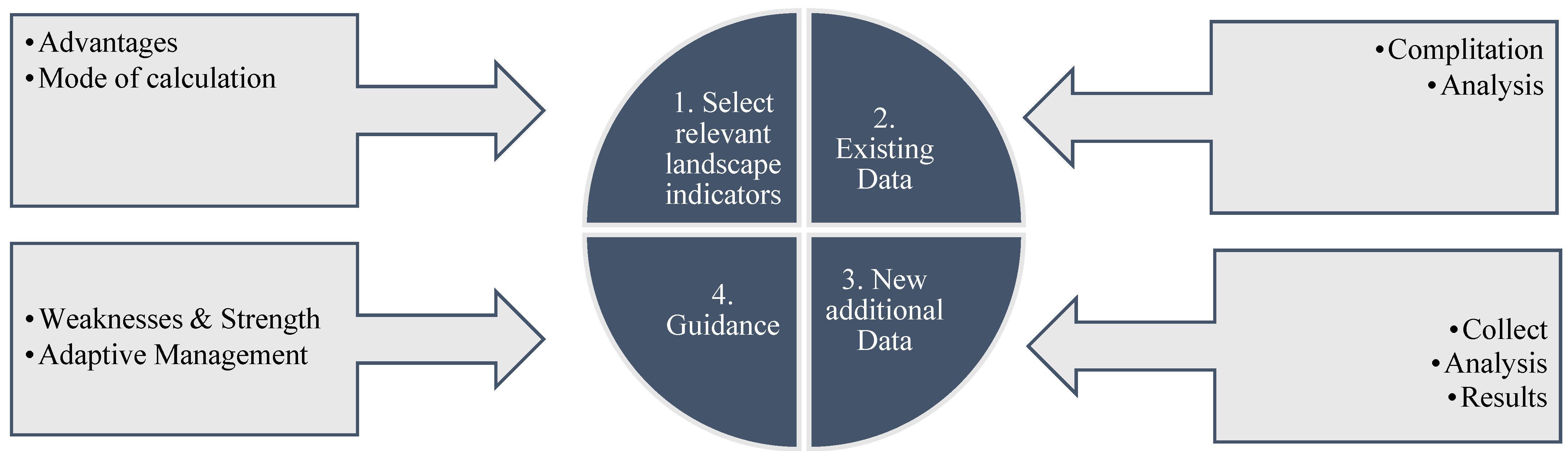
- Strategic Environmental Assessment SEA consists of a range of analytical and participatory approaches [8]. We selected SEA since it adopts indicators to prevent territorial trespassing and impacts the landscape [1,9,13]. It also focuses on territorial and landscape programs with an effect on the environment [1,14], but unfortunately, it is mostly voluntary for the landscape approach [1,15] and qualitative. Most importantly, SEA takes the visual dimension into account.
- Sustainability Assessment at Farms (known in French by Indicateurs de Durabilité des Exploitations Agricoles) is a quantitative method [1,10], based on agro-ecological indicators [16], but not specific to the landscape [17]. Covering the three dimensions of sustainability, SAF is a 41 indicator-based method used by farmers in a self-assessment process. Also recommended in pedagogic situations [1,18,19], SAF is a decision-making tool for possible progress in sustainability [18].
1.3. The Expansion Need for Landscape Indicators
1.4. Role and Types of Landscape Indicators
- recognition function (monitoring and measuring conditions and processes);
- evaluation function (judgement of the value of the condition, the process, and the human action in relation to these);
- orientation function (supplying indications on the ways in which human action should be implemented) [34].
1.5. Quantifying Landscape Indicators
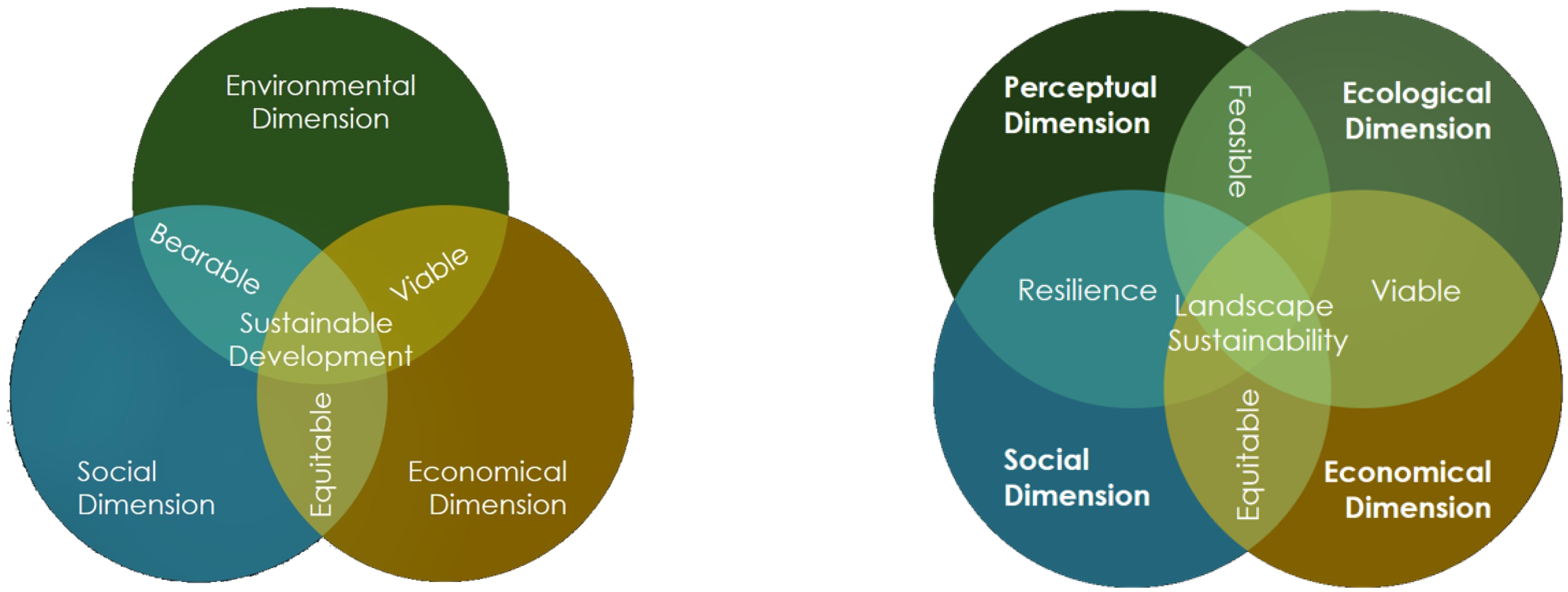
- a fourth dimension, the perceptual dimension, not previously mentioned in the context of the current study.
- quantitatively assess the sustainability of landscapes, unlike any predecessor.
2. Materials and Methods
2.1. Developing a System of Sustainable Landscape Indicators
2.2. Adopting a Mixed Methodology
2.3. Identifying Relevant Stakeholder Involvement and Engagement
- Government and regulatory bodies that are responsible for land use planning, environmental protection, regulatory compliance, and policymakers. They can be local, regional, or national government agencies.
- International and non-governmental organizations that have an interest in landscape sustainability, landscape conservation, and advocacy for sustainable practices, biodiversity conservation, and protection of natural resources.
- Local communities are defined as residents, community organizations, local businesses, and private landowners (individuals, corporations, or entities) with a direct interest in the quality of life, cultural heritage, and economic well-being of the landscape site.
- Cultural and touristic groups that often support unique perspectives on conservation and land management.
- Research, Planning, and Development groups include (i) academic and research institutions such as universities, research organizations, and scholars conducting studies related to landscape ecology, and sustainable development; (ii) environmental consultants and planners, i.e., professionals providing expertise in impact assessments, landscape architecture, and sustainable land management practices and (iii) infrastructure and development agencies, i.e., organizations involved in infrastructure development, urban planning, and transportation that may impact the landscape.
2.4. Establishing Key Landscape Indicators
2.5. Scoring and Weighting
3. Results
3.1. Sustainable Landscape Ecological Indicators SLEI
3.2. Sustainable Landscape Economic Indicators SLEcI
3.3. Sustainable Landscape Social Indicators SLSI
3.4. Sustainable Landscape Visual Indicators SLVI
3.5. Implementing Sustainable Landscape Indicators at Tannourine Cedar Forest Nature Reserve
4. Discussion
4.1. Assessment of the General Situation: The Four Dimensions
4.2. Zoom-in to Landscape Components
4.3. Zoom-in to Landscape Indicators
5. Conclusions
Author Contributions
Funding
Institutional Review Board Statement
Informed Consent Statement
Data Availability Statement
Acknowledgments
Conflicts of Interest
References
- Aad, R.; Nemer, N. Developing a Tool for Landscape Sustainability Assessment—Using a New Conceptual Approach in Lebanon. Sustainability 2023, 15, 15092. [Google Scholar] [CrossRef] [Scilit]
- The Millennium Development Goals Report 2012; United Nations Development Programme: New York, NY, USA, 2012.
- Sowińska-Świerkosz, B.; Michalik-Śnieżek, M. Landscape indicators as a tool of assessing landscape quality. E3S Web Conf. 2020, 171, 02011. [Google Scholar] [CrossRef] [Scilit]
- Wu, C.; Isaksson, K.; Antonson, H. The struggle to achieve holistic landscape planning, Sweden. Land Use Policy 2017, 67, 167–177. [Google Scholar] [CrossRef] [Scilit]
- Palang, H.; Alumäe, H.; Mander, U. Holistic aspects in landscape development: A scenario approach. Landsc. Urban Plan. 2000, 50, 85–94. [Google Scholar] [CrossRef] [Scilit]
- Council of Europe Landscape Convention/Official Website—Council of Europe Landscape Convention. Available online: https://www.coe.int/en/web/landscape (accessed on 26 January 2024).
- Jones, A.; Wolosin, M. Branching Up and Out: Options for Integrating Forests into the Post-2015 Development Framework; Climate Advisors: Washington, DC, USA, 2014. [Google Scholar]
- Mayers, J. Forests in the sustainable development goals. Biores 2014, 8, 16–19. [Google Scholar]
- Sayer, J.; Sunderland, T.; Ghazoul, J.; Pfund, J.L.; Sheil, D.; Meijaard, E.; Venter, M.; Boedhihartono, A.K.; Day, M.; Garcia, C.; et al. Ten principles for a landscape approach to reconciling agriculture, conservation, and other competing land uses. Proc. Natl. Acad. Sci. USA 2013, 110, 8349–8356. [Google Scholar] [CrossRef] [Scilit]
- Nautiyal, H.; Goel, V. Chapter 3, Sustainability assessment: Metrics and methods. In Methods in Sustainability Science; Ren, J., Ed.; Elsevier: Amsterdam, The Netherlands, 2021; pp. 27–46. ISBN 9780128239872. [Google Scholar] [CrossRef] [Scilit]
- Leverington, F.; Hockings, M.; Pavese, H.; Lemos Costa, K.; Courrau, J. Management Effectiveness Evaluation in Protected Areas—A Global Study; Supplementary Report No.1: Overview of Approaches and Methodologies; The University of Queensland: Gatton, Australia, 2008. [Google Scholar]
- Environmental Indicators for Agriculture. Available online: https://www.oecd.org/greengrowth/sustainable-agriculture/40680795.pdf (accessed on 26 June 2023).
- Baral, H.; Holmgren, P. A Framework for Measuring Sustainability Outcomes for Landscape Investments; Center for International Forestry Research: Bogor, Indonesia, 2015. [Google Scholar] [CrossRef] [Scilit]
- Fischer, T. The Theory and Practice of Strategic Environmental Assessment: Towards a More Systematic Approach; Earthscan Publications Ltd.: London, UK, 2007. [Google Scholar]
- Chaker, A.; El-Fadl, K.; Chamas, L.; Hatjian, B. A review of strategic environmental assessment in 12 selected countries. Environ. Impact Assess. Rev. 2006, 26, 15–56. [Google Scholar] [CrossRef] [Scilit]
- Bockstaller, C.; Girardin, P.; Van der Werf, H. Use of Agro-ecological Indicators for the Evaluation of Farming Systems. Eur. J. Agron. 1997, 7, 329–338. [Google Scholar] [CrossRef] [Scilit]
- Netherlands Commission for Environmental Assessment—Annual Report 2020. Available online: https://www.eia.nl/annualreport2020/ (accessed on 3 April 2024).
- Briquel, V.; Vilain, L.; Bourdais, J.L.; Girardin, P.; Mouchet, C.; Viaux, P. La méthode IDEA (indicateurs de durabilité des exploitations agricoles): Une démarche pédagogique. Ing. Eau-Agric.-Territ. 2001, 25, 29–39. [Google Scholar]
- Cohen, S.; Peltier, C.; Viel, J.-A.; Carayon, C.; Cousinié, P.; Gafsi, M.; Gay, N.; Ghibaudo, S.; Girard, S.; Méchaussie, V.; et al. IDEA4 dans L’enseignement Technique Agricole. Retours D’expériences et Recommandations en Situation Pédagogique. 2023, Volume 36, p. hal-04379842. Available online: https://hal.science/hal-04379842 (accessed on 2 April 2024).
- Guide to Evaluate Performance|Landscape Performance Series. Available online: https://www.landscapeperformance.org/guide-to-evaluate-performance (accessed on 14 June 2023).
- Stolton, S.; Dudley, N.; Hockings, M. METT Handbook: A Guide to Using the Management Effectiveness Tracking Tool (METT); Second Edition Guidance for Using METT-4; WWF: Gland, Switzerland, 2021. [Google Scholar]
- Sala, P. Els indicadors de paisatge de Catalunya. In Indicadors de Paisatge. Reptes i Perspectives; Nogué, J., Puigbert, L., Bretcha, G., Eds.; Landscape Observatory of Catalonia: Barcelona, Spain, 2009; pp. 110–131. ISBN 978-84-613-1327-3. [Google Scholar]
- Wascher, D. Landscape-indicator development: Steps towards a European approach. New Dimens. Eur. Landsc. 2004, 4, 237–252. [Google Scholar]
- Phondani, P.; Bhatt, A.; Elsarrag, E.; Alhorr, Y.; El-Keblawy, A. Criteria and indicator approach of global sustainability assessment system for sustainable landscaping using native plants in Qatar. Ecol. Indic. 2016, 69, 381–389. [Google Scholar] [CrossRef] [Scilit]
- Braz, A.; de Oliveira, I.; Cavalcanti, L.; Almeida, A.; Chávez, E. Cluster analysis for Landscape typology. Mercator 2020, 19, e19011. [Google Scholar] [CrossRef] [Scilit]
- Cassatella, C.; Peano, A. (Eds.) Landscape Indicators: Assessing and Monitoring Landscape Quality; Springer: Dordrecht, The Netherlands; Berlin/Heidelberg, Germany; London, UK; New York, NY, USA, 2011; ISBN 978-94-007-0365-0. [Google Scholar] [CrossRef] [Scilit]
- Swanwick, C. Society’s attitudes to and preferences for land and landscape. Land Use Policy 2009, 26, 62–75. [Google Scholar] [CrossRef] [Scilit]
- Butler, A.; Åkerskog, A. Awareness-raising of landscape in practice. An analysis of Landscape Character Assessments in England. Land Use Policy 2014, 36, 441–449. [Google Scholar] [CrossRef] [Scilit]
- Firmansyah; Soeriaatmadja, A.R.; Wulanningsih, R. A set of sustainable urban landscape indicators and parameters to evaluate urban green open space in Bandung City. IOP Conf. Ser. Earth Environ. Sci. 2018, 179, 012016. [Google Scholar] [CrossRef] [Scilit]
- Sowinska-Swierkosz, B.; Michalik-Sniezek, M. The Methodology of Landscape Quality (LQ) Indicators Analysis Based on Remote Sensing Data: Polish National Parks Case Study. Sustainability 2020, 12, 2810. [Google Scholar] [CrossRef] [Scilit]
- Ode, A.; Tveit, M.; Fry, G. Capturing Landscape Visual Character Using Indicators: Touching Base with Landscape Aesthetic Theory. Landsc. Res. 2008, 33, 89–117. [Google Scholar] [CrossRef] [Scilit]
- Medeiros, A.; Fernandes, C.; Gonçalves, J.; Farinha-Marques, P. Research trends on integrative landscape assessment using indicators—A systematic review. Ecol. Indic. 2021, 129, 107815. [Google Scholar] [CrossRef] [Scilit]
- Nogué, S.; Rull, V.; Vegas-Vilarrúbia, T. Modeling Biodiversity Loss by Global Warming on Pantepui, Northern South America: Projected Upward Migration and Potential Habitat Loss. Clim. Chang. 2009, 94, 77–85. [Google Scholar] [CrossRef] [Scilit]
- Cassatella, C.; Voghera, A. Indicators used for landscape. In Landscape Indicators—Assessing and Monitoring Landscape Quality; Cassatella, C., Peano, A., Eds.; Springer: Dordrecht, The Netherlands, 2011; pp. 31–46. [Google Scholar]
- Ilic-Krstic, I.; Ilic, A.; Avramović, D. The Three Dimensions of Sustainable Development: Environment, Economy and Society. In Proceedings of the 18th Conference of the Series Man and Working Environment, Nis, Serbia, 6–7 December 2018. [Google Scholar]
- Economiesuisse. Sustainable Development Includes Several Dimensions. Available online: https://www.economiesuisse.ch/en/dossier-politics/sustainable-development-includes-several-dimensions (accessed on 6 July 2023).
- Kang, N.; Liu, C. Towards landscape visual quality evaluation: Methodologies, technologies, and recommendations. Ecol. Indic. 2022, 142, 109174. [Google Scholar] [CrossRef] [Scilit]
- Equity|Sustainable Environment Online. Available online: https://sustainable-environment.org.uk/Principles/Equity.php (accessed on 6 July 2023).
- Gkoltsiou, K.; Terkenli, T.S. Landscape Indicators: S Promising Tool for the Analysis of Tourist Landscape Structure. In Proceedings of the International Conference Studying, Modelling and Sense Making of Planet Earth, Myytilene, Greece, 1–6 June 2008. [Google Scholar]
- Dale, V.H.; Kline, K.L.; Parish, E.S.; Eichler, S.E. Engaging stakeholders to assess landscape sustainability. Landsc. Ecol. 2019, 34, 1199–1218. [Google Scholar] [CrossRef] [Scilit]
- Valánszki, I.; Ágnes, S. A landscape indicator-system for sustainable landscape management. J. Landsc. Archit. Gard. Art 2017, 46, 44–50. [Google Scholar]
- Lee, H.-S.; Park, E.-Y. Developing a Landscape Sustainability Assessment Model Using an Analytic Hierarchy Process in Korea. Sustainability 2020, 12, 301. [Google Scholar] [CrossRef] [Scilit]
- Alphan, H. Analysis of landscape changes as an indicator for environmental monitoring. Environ. Monit. Assess. 2017, 189, 24. [Google Scholar] [CrossRef] [Scilit] [PubMed]
- Aziz, A.; Anwar, M. Landscape Change and Human Environment. Environ. Earth Ecol. 2019, 3, 7–12. [Google Scholar] [CrossRef] [Scilit]
- Botequilha-Leitão, A.; Miller, J.; Ahern, J.; McGarigal, K. Measuring Landscapes: A Planner’s Handbook; Island Press: Washington, DC, USA, 2006. [Google Scholar]
- Mori, K.; Christodoulou, A. Review of Sustainability Indices and Indicators: Towards a New City Sustainability Index (CSI). Environ. Impact Assess. Rev. 2012, 32, 94–106. [Google Scholar] [CrossRef] [Scilit]
- Moldan, B.; Janoušková, S.; Hák, T. How to Understand and Measure Environmental Sustainability: Indicators and Targets. Ecol. Indic. 2012, 17, 4–13. [Google Scholar] [CrossRef] [Scilit]
- Bruni, D. Landscape Quality and Sustainability Indicators. Agric. Agric. Sci. Procedia 2016, 8, 698–705. [Google Scholar] [CrossRef] [Scilit]





| Tools of Assessment Selected | Tool Characteristics and Scale | Reasons for Adopting This Research | |||||
|---|---|---|---|---|---|---|---|
| Landscape Relevance | Indicator Type | Indicator Dimension | |||||
| Qualitative | Quantitative | Agro-Ecological | Landscape Specificity | ||||
| SEA | Strategic Environmental Assessment |
| ☑ | ☑ | ☑ | ☑ | |
| SAF | Sustainability at Farms |
| ☑ | ☑ | ☑ | ||
| LPS | Landscape Performance Series |
| ☑ | ☑ | ☑ | ||
| METT | Management Effectiveness Tracking Tool |
| ☑ | ☑ | |||
| Technics | Data Type | Indicator Type | Outcomes | ||
|---|---|---|---|---|---|
| New Indicators | Relevant Indicators | Existing Indicators | |||
| GIS techniques and Google mapping | Spatial | ☑ | Selecting LIs, Scoring, and Maxima | ||
| Landscape visual studies | Landscape scenes, Photographs, drawings | ☑ | Selecting LIs, categorization, Scoring, and Maxima | ||
| Citations and readings | Descriptive | ☑ | ☑ | Selecting LIs, categorization | |
| Social perception and surveys | Descriptive and statistical | ☑ | Selecting LIs, categorization | ||
| Documents analysis | ☑ | ☑ | ☑ | Selecting LIs, categorization, Scoring, and Maxima | |
| Interviews and questionnaires | ☑ | Selecting Lis | |||
| Interviewees | Total Number of Interviewees | Type of Reserve | Types of Expertise | ||||
|---|---|---|---|---|---|---|---|
| Cedar Reserve | Cedar and Pine Reserve | Others | Landscape Design and/or Management | Tools and/or Value Chain | |||
| Reserve managers | 8 | 4 | ☑ | ☑ | ☑ | ||
| 1 | ☑ | ☑ | |||||
| 3 | ☑ | ☑ | |||||
| Experts | 15 | 5 | ☑ | ||||
| 5 | ☑ | ||||||
| 5 | ☑ | ||||||
| Country of Origin | Methodology | Relevant Landscape Indicators | Uses |
|---|---|---|---|
| Europe | Policies establishment | Landscape diversity Landscape quality Landscape character | Landscape-related concepts |
| Asia | Four sets of indicators of performance | Improved landscape livelihoods Improved ecosystem services Improved resource efficiency in land use Supply of food and other products | Landscape at different scales; landscape sustainability management |
| Catalonia | Ten indicators | Transformation of the landscape Landscape diversity Landscape fragmentation Economic value of the landscape Knowledge of the landscape Landscape satisfaction Landscape sociability Landscape and communication Public and private action in the field of conservation Application of instruments of the landscape legislation | Landscape quality |
| Netherland | Landscape perception and assessment | Unity Functional organization Possibility of using the landscape for your own activities Historical character Natural character Spatial dimensions Sense impressions | Landscape appreciation Landscape perception |
| Italy | European landscape character | Coherence Openness Diversity | Landscape character landscape policy |
| United Kingdom | Emerging indicators | Land cover Cultural pattern | Future monitoring at landscape scale |
| An Example of Antecedent Research-Based Indicators | Indicators Mentioned in the New Lebanese Law | Some Inventive Indicators to Be Taken into Consideration |
|---|---|---|
| Ecological diversity | Types of protected areas | Accessibility and dimension of the site |
| Space organization | Buffer zone | Number and age of visitors |
| Specificity | Limitation | Entrance fees and paid services |
| Dependencies | Presence inside a private area | Neighboring urban agglomerations |
| Revenues | Endemism | Territorial and landscape diversity |
| Dynamism | Rare species | Built heritage and cultural landscape |
| Well-being | Biodiversity | Landscape resources management |
| Social diversity | Urban pressure | Social contribution and event hosting |
| Agroforestry and agricultural activities |
 |
| 3 Components | 15 Indicators | Maxima Value | Total Score | |
|---|---|---|---|---|
| Ecological Diversity |
| 13 | 33 units | 100 |
| 13 | |||
| 5 | |||
| 5 | |||
| 13 | |||
| Space organization |
| 10 | 33 units | |
| 6 | |||
| 6 | |||
| 6 | |||
| 12 | |||
| Practices effectiveness |
| 6 | 34 units | |
| 6 | |||
| 10 | |||
| 10 | |||
| 3 | |||
| 3 Components | 11 Indicators | Maxima Value | Total Score | |
|---|---|---|---|---|
| Viability |
| 15 | 33 units | 100 |
| 5 | |||
| 15 | |||
| 10 | |||
| Independency |
| 15 | 33 units | |
| 10 | |||
| 10 | |||
| 10 | |||
| Efficiency |
| 15 | 34 units | |
| 10 | |||
| 15 | |||
| 3 Components | 12 Indicators | Maxima Value | Total Score | |
|---|---|---|---|---|
| Living environment |
| 12 | 33 units | 100 |
| 7 | |||
| 6 | |||
| 4 | |||
| Esthetic value |
| 5 | 33 units | |
| 5 | |||
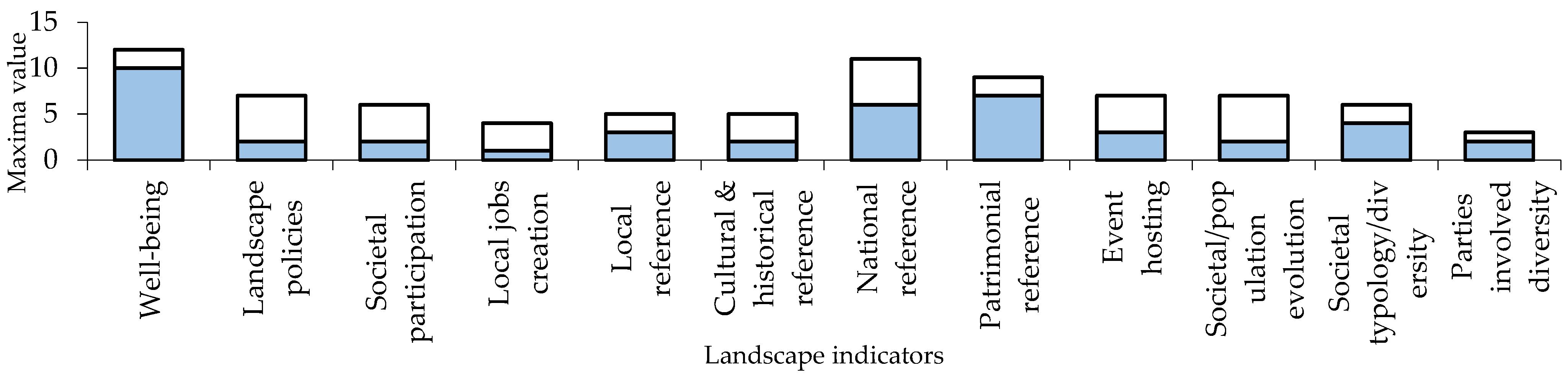
| 11 | |||
| 9 | |||
| Dynamism |
| 7 | 34 units | |
| 7 | |||
| 6 | |||
| 3 | |||
| 3 Components | 13 Indicators | Maxima Value | Total Score | |
|---|---|---|---|---|
| Perceptual Diversity |
| 7 | 33 units | 100 |
| 13 | |||
| 13 | |||
| 13 | |||
| Perceptual features |
| 10 | 33 units | |
| 6 | |||
| 10 | |||
| 6 | |||
| Perceptual components |
| 12 | 34 units | |
| 10 | |||
| 10 | |||
| 10 | |||
| 3 | |||
Disclaimer/Publisher’s Note: The statements, opinions and data contained in all publications are solely those of the individual author(s) and contributor(s) and not of MDPI and/or the editor(s). MDPI and/or the editor(s) disclaim responsibility for any injury to people or property resulting from any ideas, methods, instructions or products referred to in the content. |
© 2024 by the authors. Licensee MDPI, Basel, Switzerland. This article is an open access article distributed under the terms and conditions of the Creative Commons Attribution (CC BY) license (https://creativecommons.org/licenses/by/4.0/).
Share and Cite
Aad, R.; el Balaa, R.; Tanios, C.; Nemer, N. Landscape Indicators—An Inventive Approach for the Sustainability of Landscapes. Sustainability 2024, 16, 4887. https://doi.org/10.3390/su16124887
Aad R, el Balaa R, Tanios C, Nemer N. Landscape Indicators—An Inventive Approach for the Sustainability of Landscapes. Sustainability. 2024; 16(12):4887. https://doi.org/10.3390/su16124887
Chicago/Turabian StyleAad, Roula, Rodrigue el Balaa, Challita Tanios, and Nabil Nemer. 2024. "Landscape Indicators—An Inventive Approach for the Sustainability of Landscapes" Sustainability 16, no. 12: 4887. https://doi.org/10.3390/su16124887
APA StyleAad, R., el Balaa, R., Tanios, C., & Nemer, N. (2024). Landscape Indicators—An Inventive Approach for the Sustainability of Landscapes. Sustainability, 16(12), 4887. https://doi.org/10.3390/su16124887