


Abstract
This study utilizes a Cobb–Douglas production function and an instrumental variables regression approach to analyze the impact of quality certification and product diversification on asset productivity at the firm level. Analyzing a panel dataset of approximately 2500 firms from 2011, 2013, and 2015 showed that regional norms significantly influence adoption behaviors, which vary across industries and business types. The study reveals that firms employing computers and those with a larger scale are more inclined to adopt these strategies. The results showed that quality certification enhances asset productivity by approximately 26%, highlighting its positive role. In contrast, firms with diversified products exhibit about 18% lower asset productivity than mono-product firms, suggesting a trade-off inherent in diversification. The study concludes with policy recommendations emphasizing the promotion of quality certification while carefully considering the complexities and potential inefficiencies arising from product diversification strategies.
1. Introduction
The role of small and medium-sized enterprises (SMEs) in driving economic growth, and innovation has been increasingly recognized. These entities, often characterized by their agility and adaptability, have become critical players in the global economy, especially in developing countries [1,2]. For SMEs, maintaining competitiveness and improving performance, such as asset turnover or asset productivity [3] and profit, are their ultimate goals. Various strategies have been explored in this context, for instance quality-certification [4,5,6] and product-diversification [7,8] schemes. According to some prior studies, certification and diversification are crucial for enhancing the performance of SMEs [9,10,11,12]. However, the implementation expenses and administrative constraints associated with certifications such as ISO 9001 (for quality management) may be prohibitive for SMEs. The effectiveness of these strategies is mixed, or the effect of being certified or diversified on firm performance is nonlinear [13,14].
Despite the importance of SMEs and their performance, challenges exist for SMEs in adopting new measures due to high levels of competition and limited resources. Unlike large firms, SMEs are more resource-constrained and vulnerable to market competition, impacting their ability to compete effectively, especially in international markets [15,16]. In addition, SMEs often lack a detailed understanding of market and policy framework changes and find it challenging to plan effective strategies due to resource limitations [1].
In this study, we first explored the factors influencing the adoption of quality certification (mainly certification of quality management systems such as ISO 9001 or HACCP) and diversification strategies by SMEs. We, in particular, focused on how firms located in close proximity or sharing similar environmental characteristics may influence each other in adopting new practices, such as quality certification or product diversification. This phenomenon can be understood through the lens of social norms and policy frameworks, commonly referred to as production technology, as outlined in the works of [17,18]. Second, we evaluated the impact of these strategies on the firm performance, measured as asset productivity [3].
Our study adds to the existing literature in several dimensions. A frequent econometric challenge in studies examining the adoption of new strategies by firms or individuals is endogeneity, as demonstrated in previous studies, i.e., [19,20]. This issue is particularly pertinent in cases of certification schemes or product diversification, where the adoption of such strategies is contingent on pre-existing conditions or criteria, such as production scale or financial capacity. To address this, we used an instrumental variable approach, employing the percentage of firms adopting similar strategies in the same district, which significantly and positively influence a firm’s adoption behavior. Moreover, quality certification not only beneficially impacts labor productivity [21], but also improves the asset productivity of SMEs. Additionally, while diversification might mitigate risks [22], diversifying to several different product types could present a trade-off, potentially challenging rather than enhancing economies of scope.
This paper is structured as follows. Section 2 reviews the relationship between certification, diversification, and firm asset productivity. Data and empirical models are presented in Section 3. In Section 4, we discuss the determinants of the adoption of certification and diversification and evaluate the impact of these measures on asset productivity. Section 5 summarizes the key findings and policy options and suggests future research directions.
2. Literature Review
Extensive knowledge and discourse have surrounded the performance of SMEs. An abundance of research, including empirical studies and various points of view, has been devoted to examining the effect of certification and diversification on the performance of SMEs. While several previous studies indicated that certification of quality systems would not significantly affect SMEs, others highlight potential benefits such as the ability to satisfy consumer demands or acquire a competitive edge in the market [23]. Similarly, the relationship between geographical diversification and corporate performance has been explored, revealing varying outcomes for SMEs. Additionally, the role of managerial characteristics, internationalization, and the development of SMEs in diversifying economies have all been found to be interconnected and impactful factors [23,24,25].
The expansion of a business’s operations into new product lines or markets is referred to as diversification. The empirical research findings demonstrate that diversification is an essential factor influencing the performance of SMEs. Additionally, SMEs can mitigate the risks associated with over-reliance on a single product or market sector by diversifying their operations to explore new market opportunities [23,26]. Another empirical study found that, while product diversification did not directly correlate with overall performance, investment levels in rent-generating, proprietary assets were linked to the extent of product diversification [27]. This suggests that diversification, when coupled with strategic investment, can potentially impact the performance of SMEs positively [26,28].
On the other hand, Ref. [29] conducted a study on Japanese SMEs, which showed a U-shaped relationship between geographical diversification and corporate performance. They found that most SMEs faced higher learning costs at the initial stages of expansion due to a lack of relevant experience. Nevertheless, the research conducted by [30] suggests that financial performance can lead to internationalization for SMEs. They observed a material relationship between managerial characteristics and geographical diversification strategies. Specifically, they found that specific organizational attributes were correlated with profitability according to the level of international diversification. Overall, the research indicates that diversification strategies, whether through product or geographical expansion, can have both positive and negative effects on the performance of SMEs. These findings highlight the need for SMEs to carefully consider their diversification strategies and align them with their specific resources, market conditions, and managerial capabilities [26,31,32,33].
An analysis of how companies execute certification reveals a complex interplay of components. The certification procedures businesses adopt are determined by their organizational routines, absorptive ability, and discussions with certifying authorities [34,35]. The rationales behind quality certification encompass market competitiveness and strategic positioning [36]. Conversely, the acceptance of sustainability certifications is propelled by ethical, environmental, and economic motivations [36,37]. Businesses respond to environmental certification with strategic measures, including product bunching and pricing surcharges. Implementing ethical standards for international suppliers is subject to the influence of intricate interconnections with pre-existing circumstances. Environmental certification safeguards against the potential hazards linked to novelty and insignificance, augmenting operational effectiveness and financial profits [38,39,40]. Some previous works found that certification can significantly improve the performance of SMEs. It can function as a tool to exhibit the quality and standards of the SMEs’ products and services, thereby fostering customer trust and confidence. In addition, the accreditation of quality systems can confer a competitive advantage and grant access to untapped market sectors where strict adherence to criteria is essential. For instance, the acquisition of ISO certification for quality management systems can bolster the reputation of SMEs and facilitate opportunities for entry into more-extensive markets and prospective alliances with international firms [23].
In conclusion, extensive research has been conducted on the performance of SMEs, particularly regarding the impact of certification and diversification. The findings suggest that certification and diversification strategies can significantly affect SMEs’ performance, with potential benefits such as meeting consumer demands and gaining a competitive edge. However, the outcomes can vary depending on managerial characteristics, internationalization, and market conditions. Therefore, SMEs should carefully consider their certification and diversification strategies in alignment with their available resources and capabilities. This practice will enable them to navigate the market complexities effectively and enhance their overall performance.
This analysis commences with an examination of the factors that influence the acceptance of quality certification and diversification programs by SMEs in Vietnam. Additionally, we assessed the effects of various strategies on asset productivity, a metric that functions as a gauge of the firms’ overall performance.
3. Data and Empirical Models
3.1. Data and Variables
Our study utilizes an unbalanced panel dataset of small and medium enterprises (SMEs) in Vietnam, collected in the years 2011, 2013, and 2015. The dataset consists of surveys from approximately 2500 enterprises across 10 provinces in Vietnam, each employing fewer than 300 employees. The context of the surveyed population, sampling methodology, and key characteristics of this dataset have been extensively detailed in previous studies (see, for example, [1,21]). The variables of interest are defined in Table 1 and descriptively summarized in Table 2.

Table 1.
Variable definitions and measurements.
Table 2.
Summary statistics by year and aggregate.
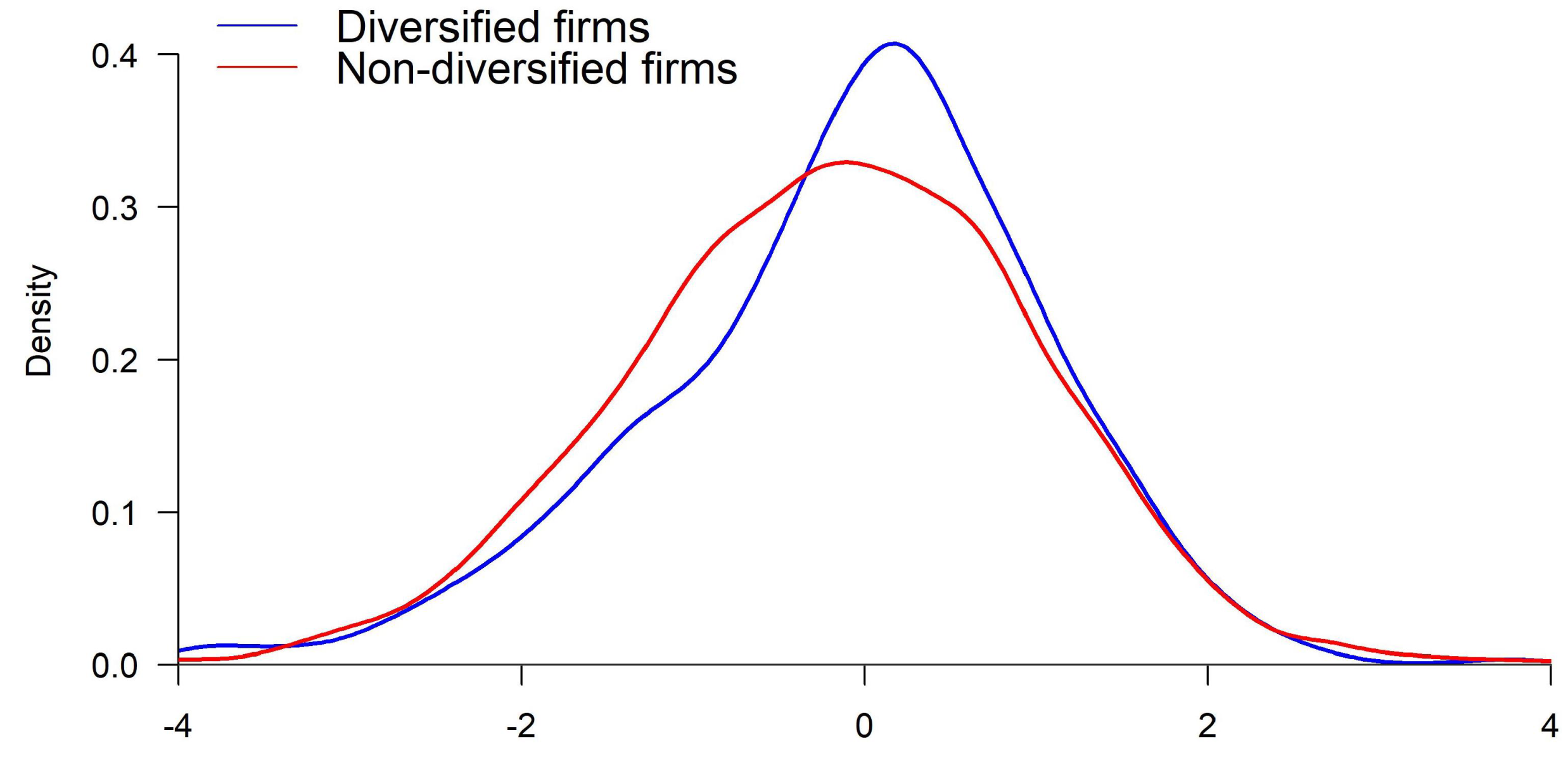
The outcome variable in our study is asset productivity, defined as the ratio of revenues to total asset value, indicating the efficiency of investment in assets [3]. The mean asset productivity (AP) of the firms over the three years was 1.865, implying that, for every dollar of asset, the firms could generate USD 1.865 in revenue. In our estimation models, this dependent variable is transformed into its natural logarithms form, and the Kernel density of this variable is detailed in the Appendix A. The following variables, Lk and Mk, represent the ratios of labor hours and other production costs to the asset value, respectively. They function as primary production inputs and are expressed in their natural logarithmic forms used in the Cobb–Douglas production function.
The quality certification variable, cert, takes a value of 1 if the firm has adopted either national or international standards (i.e., [21]). Table 2 shows that about 9% of SMEs adopted at least one quality certification scheme in 2011 and 2013, and this figure jumped to 15% in 2015. One of the key determinants of the certification adoption behavior is the percentage of certified firms in the district in the surveyed year. We noted that the sample mean value of this variable was very close to the mean value of the certification variable by definition. However, the standard deviation of the percentage of certified firms in a district was much lower than that of the certification variable, 10.4% compared with 31.3%. We also observed a similar pattern for product diversification and the percentage of diversified firms. We were also interested in other control variables, as summarized in Table 2.
3.2. Empirical Model
We depart from a standard Cobb–Douglas production function as specified in Equation (1) below:
where Y denotes the production output measured in asset productivity and A refers to the technology level or total factor productivity. K and L represent the production inputs, with K being the ratio of the costs to the total asset value and L being the ratio of labor hours to the total asset value. T refers to the adoption behavior, and is a vector of control variables. , , , and are parameters to be estimated. is known as the error term, and the prefixes it indicate firm and year identifications. Taking the natural logarithms of Equation (1), we obtain the following equation:
Apart from the production function, we are interested in the effect of the quality certification and diversification strategies, denoted as variable T controlling for a set of variables, , such as a sector, market power measured by the ability to change the price, business types, the network, the use of computers, and firm age. However, when assessing the adoption behavior and the impact of the adopted strategies on asset productivity, the adoption behavior is endogenous [17,19]. In such cases, the availability of valid instruments is crucial. Those firms, within the adjunct distance or located in the same district, may learn from each other, which can be interpreted as a spillover effect or the effect of social norms or pressures [41,42]. Moreover, firms located in the same district are under similar institutions. That is, to construct the instrument, we calculated the percentage of adopted firms in the same district. This allowed us to employ instrumental variable (IV) models, which could mitigate the bias due to unobserved features affecting the adoption behavior. The IV approach requires the following assumptions. First, the percentage of adopted firms located in the same district is correlated with the adoption behavior of the firms. Second, there is no significant correlation between the percentage of adopted firms in the same districts and the error term estimated from the asset productivity model (see, for example, [43]). Given that the first stage regression model is a logit model predicting adoption behavior, in which the percentage of adopted firms located in the same district is the instrument, the first-stage regression model is specified as follows:
The second-stage model reads as:
4. Results and Discussion
Prior to discussing the primary results displayed in Table 3 and Table 4, it is essential to evaluate the validity of the instruments to ensure the enhanced consistency of the instrumental variable estimation. First, the random effects logit regression models presented in Table 3 suggest that the proportion of certified firms within the same district has a statistically significant impact on a firm’s likelihood of adopting certification. Similarly, the proportion of diversified firms within the same district significantly affects a firm’s propensity to adopt diversification strategies. Second, we also performed the correlation test between the instrument and the residual of the corresponding main equation, , in Equation (2). The correlation between the percentage of certified firms in a district and was relatively weak, with a correlation coefficient of 0.082, and this figure for the correlation relationship between the percentage of diversified firms in a district and was −0.062. This indicates the validity of the instruments for the IV regressions.
Table 3.
Random effects logit regression results.
Table 4.
IV regression results.
4.1. Certification and Diversification Adoption
Table 3 reports the random effects logit regression results of factors influencing the likelihood of adopting the quality certification (‘cert’) and product diversification (‘diver’) behavior by firms. The analysis is presented in four models, each corresponding to different combinations of dependent variables and control inclusions. The findings reveal intricate dynamics between firm characteristics and their strategic outcomes, providing nuanced insights into the factors driving certification attainment and diversification within firms.
The positive relationship between ‘cert’ and ‘cert_percent’ suggests a mimicry effect, where firms are likely to adopt certifications if they operate in areas with a higher prevalence of certified firms. This finding aligns with institutional theory, which posits that firms often conform to prevailing norms and practices in their institutional environment to gain legitimacy [44]. The significant and positive impact of ‘FB_sector’ on ‘cert’ may be explained through the lens of food safety concerns in Vietnam [45,46]. This suggests that food and beverage firms are more likely to seek certifications to signal quality and gain competitive advantage [47]. In contrast, household businesses (‘business_type’) are less likely to seek certifications, possibly due to resource constraints or a lack of institutional pressure, highlighting the importance of organizational capacity in adopting complex practices [48]. The role of technology (‘computer’) and firm age (‘firm_age’) in positively influencing certification adoption further supports the notion that resource availability and firm maturity are crucial in meeting the demands of the certification processes.
The observed positive correlation between ‘diver’ and ‘diver_percent’ indicates that firms are more inclined to diversify in regions with diverse product types. This could be attributed to competitive isomorphism or organization–environment relations, where firms mimic the successful strategies of their peers to remain competitive [49]. The negative association of the ‘FB_sector’ with ‘diver’ might reflect the specialized nature of the food and beverage industry, where diversification could dilute brand identity or clash with regulatory constraints. The negative effect of ‘business_type’ suggests that smaller, resource-constrained firms may face higher barriers to diversification. The positive influence of ‘computer’ underscores the role of technology in enabling firms to explore and enhance a firm’s adaptive capacity [50].
In summary, the study sheds light on the various factors influencing firms’ strategic outcomes in certification attainment and diversification. The significant predictors, such as the percentage of certification or diversification, sectoral affiliation, business type, technological resources, and firm age, provide a different angle of the driving forces behind firm strategies. However, the relatively modest R² values suggest that other unobserved factors may also play a significant role.
4.2. The Impact of Certification and Diversification on Productivity
The IV regression results, presented in Table 4, provide insights into the sizable effects of quality certification (‘cert’) and product diversification (‘diver’) on asset productivity (‘lnAP’), accounting for potential endogeneity issues. Endogeneity in this context might arise from omitted variable bias, measurement error, or reverse causality, where the level of asset productivity could influence a firm’s decision to obtain certifications or diversify its products. By using the IV approach, the model aims to offer a more-accurate estimation of the causal impact of quality certification and product diversification on asset productivity.
The coefficient for ‘cert’ is positive and significant across the models where it is included, indicating that obtaining quality certifications is associated with an increase in asset productivity. Specifically, the coefficients range from 0.255 to 0.273, implying a substantial and positive effect on the asset productivity. This means that, all else being equal, obtaining quality certification is associated with an approximately 25.5% to 27.3% increase in the sales generated per unit of asset.
This significant positive effect can be attributed to several mechanisms. First, certifications often require firms to adhere to standardized processes that enhance operational efficiency and reduce waste [51]. Second, by streamlining operations, firms can generate more output from the same level of assets. Quality certifications can also enhance a firm’s reputation and provide access to new markets, particularly where certifications are a prerequisite for entry [52]. This can lead to increased sales without a corresponding increase in asset base, thereby improving the sales-to-asset ratio. Third, the process of obtaining and maintaining certification may foster a culture of continuous improvement and innovation within the firm, leading to better use of assets and improved productivity over time [53].
Conversely, the coefficient for ‘diver’ is negative and significant in the models where it is included, indicating that diversification is associated with a decrease in asset productivity. The coefficients are −0.196 and −0.176, suggesting that diversifying product lines is associated with an approximately 17.6% to 19.6% decrease in the sales generated per unit of asset.
This negative impact may be due to several factors. First, diversification can increase the complexity of operations, leading to inefficiencies and a dilution of focus. Managing a wider array of products or services may require more-diverse assets, not all of which are utilized efficiently [54,55]. Second, diversifying into areas outside of a firm’s core competencies can lead to a misallocation of resources, where assets are not used in the most-productive manner [53].
The IV regression models indicate that, while quality certification significantly enhances asset productivity, product diversification appears to diminish it. These findings underscore the importance of strategic alignment and careful consideration of the broader market and operational context when pursuing quality certification and diversification strategies. Firms must weigh the potential efficiency gains from certification against the possible complexity and resource misallocation associated with diversification.
5. Conclusions, Policy Options, and Limitations
This study primarily utilizes a Cobb–Douglas production function framework through instrumental variables regression to elucidate the impacts of quality certification and product diversification on firm-level asset productivity. Quality certification was found to significantly enhance asset productivity, with certified firms showing an increase in sales per unit of asset. This suggests that certifications improve operational efficiency, enhance reputation, and facilitate market access. In contrast, product diversification is associated with a decrease in asset productivity, indicating the potential complexities and inefficiencies that can arise from managing a broader range of products or services.
The implications for policymakers and industry stakeholders are profound. Encouraging quality certifications through supportive policies can elevate industry standards and competitiveness, while a strategic approach to diversification is necessary to ensure that expansion does not compromise asset productivity. Additionally, fostering technological advancement and providing targeted support to small and household businesses can further enhance productivity and operational efficiency.
However, the study has limitations that call on further research. The use of asset productivity as the sole measure may not capture the full spectrum of firm performance. Future studies could incorporate additional productivity metrics or explore industry-specific effects to provide a more-nuanced understanding. Moreover, the nature of the data limits the ability to fully account for all factors influencing certification and diversification decisions. Understanding these aspects is vital for developing more-targeted and -effective policies and strategies for enhancing firm productivity and competitiveness.
Author Contributions
Conceptualization, D.-N.L. and V.-H.N.; methodology, D.-N.L. and V.-H.N.; data cleaning, D.-N.L. and V.-H.N.; formal analysis, D.-N.L. and V.-H.N.; writing—original draft preparation, D.-N.L. and V.-H.N.; writing—review and editing, D.-N.L. and V.-H.N.; supervision, D.-N.L.; funding acquisition, D.-N.L. All authors have read and agreed to the published version of the manuscript.
Funding
This research is funded by the Vietnam National Foundation for Science and Technology Development (NAFOSTED) under grant number 502.01-2019.330.
Institutional Review Board Statement
Not applicable.
Informed Consent Statement
Not applicable.
Data Availability Statement
The data used in this study will be available upon request to the corresponding author.
Acknowledgments
The authors are grateful to Ho Quoc Thong of University of Economics Ho Chi Minh for his assistance in determining the direction of this study and improving our technique.
Conflicts of Interest
The authors declare no conflicts of interest.
Appendix A
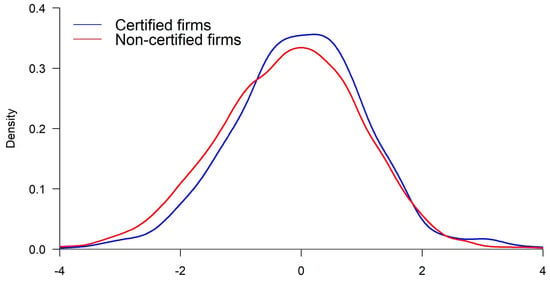
Figure A1.
Density of log of asset productivity: certified vs. non-certified firms.
Figure A1.
Density of log of asset productivity: certified vs. non-certified firms.
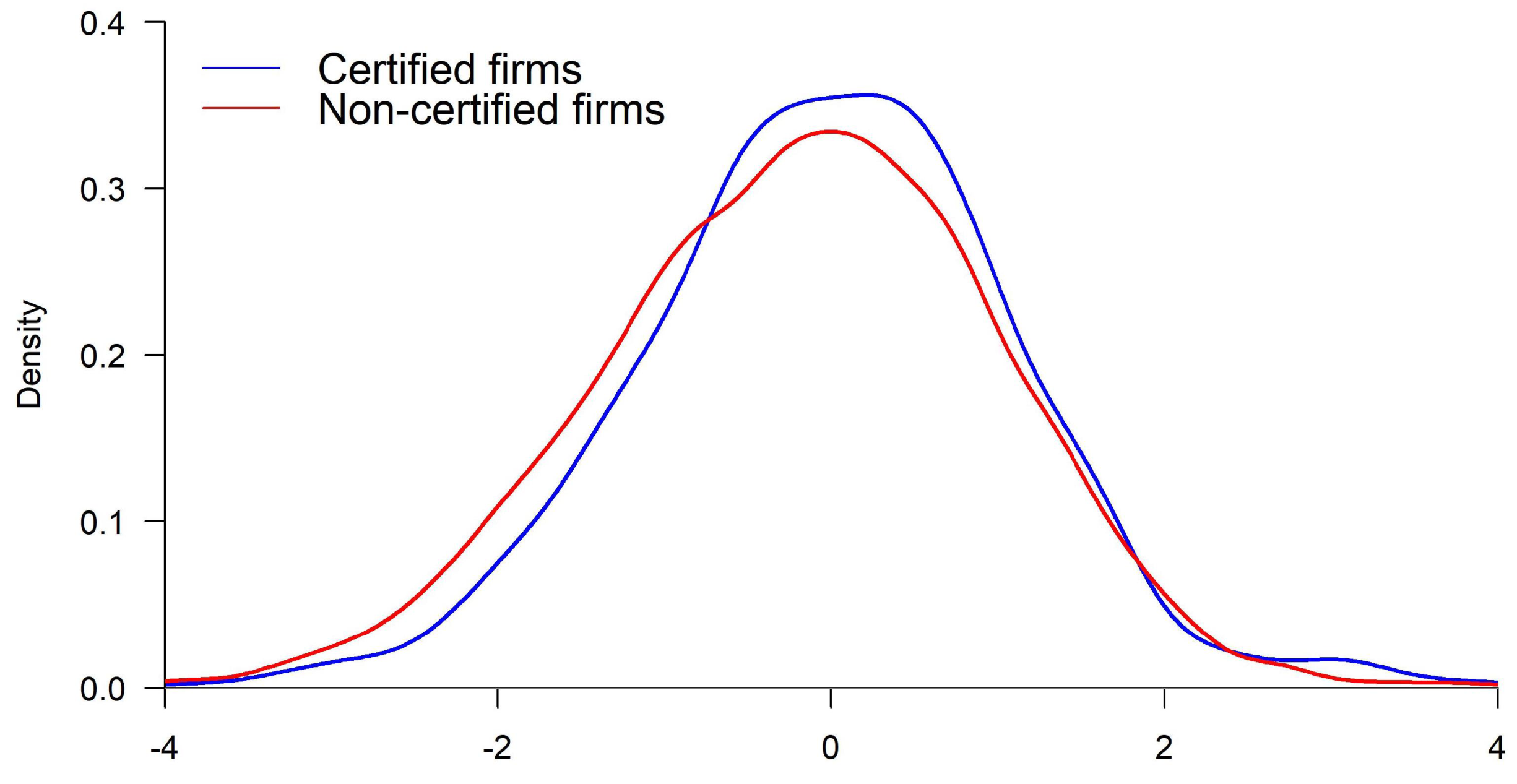
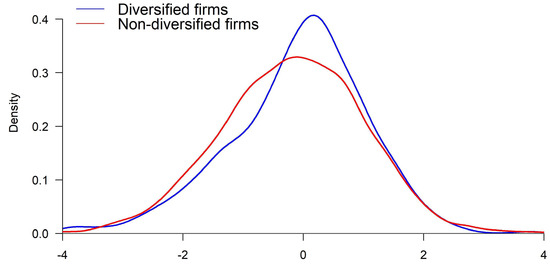
Figure A2.
Density of log of asset productivity: diversified vs. non-diversified firms.
Figure A2.
Density of log of asset productivity: diversified vs. non-diversified firms.
References
- Kim, S.Y.; Tran, D.B. Intellectual capital and performance: Evidence from SMEs in Vietnam. Asia-Pac. J. Bus. Adm. 2023. ahead of print. [Google Scholar] [CrossRef]
- Palia, D.; Lichtenberg, F. Managerial ownership and firm performance: A re-examination using productivity measurement. J. Corp. Financ. 1999, 5, 323–339. [Google Scholar] [CrossRef]
- Nahata, R. Venture capital reputation and investment performance. J. Financ. Econ. 2008, 90, 127–151. [Google Scholar] [CrossRef]
- Ullah, B.; Wei, Z.; Xie, F. ISO certification, financial constraints, and firm performance in Latin American and Caribbean countries. Glob. Financ. J. 2014, 25, 203–228. [Google Scholar] [CrossRef]
- Wang, J.; Liu, F. Examining the link between integrated management systems and firm performance: Do the integration strategies matter? Int. J. Oper. Prod. Manag. 2023, 43, 332–372. [Google Scholar] [CrossRef]
- Starke, F.; Eunni, R.V.; Manoel, M.; Dias, F.N.; de Angelo, C.F. Impact of ISO 9000 certification on firm performance: Evidence from Brazil. Manag. Res. Rev. 2012, 35, 974–997. [Google Scholar] [CrossRef]
- Schommer, M.; Richter, A.; Karna, A. Does the Diversification–Firm Performance Relationship Change Over Time? A Meta-Analytical Review. J. Manag. Stud. 2019, 56, 270–298. [Google Scholar] [CrossRef]
- Shira, R.K. Connection between corporate diversification, CSR and firm performance in South Asia. J. Econ. Adm. Sci. 2023. ahead of print. [Google Scholar] [CrossRef]
- Rizos, V.; Behrens, A.; Van der Gaast, W.; Hofman, E.; Ioannou, A.; Kafyeke, T.; Flamos, A.; Rinaldi, R.; Papadelis, S.; Hirschnitz-Garbers, M.; et al. Implementation of Circular Economy Business Models by Small and Medium-Sized Enterprises (SMEs): Barriers and Enablers. Sustainability 2016, 8, 1212. [Google Scholar] [CrossRef]
- Almodóvar, P.; Nguyen, Q.T.K. Product innovation of domestic firms versus foreign MNE subsidiaries: The role of external knowledge sources. Technol. Forecast. Soc. Chang. 2022, 184, 122000. [Google Scholar] [CrossRef]
- Qalati, S.A.; Ostic, D.; Sulaiman, M.A.B.A.; Gopang, A.A.; Khan, A. Social media and SMEs’ performance in developing countries: Effects of technological-organizational-environmental factors on the adoption of social media. SAGE Open 2022, 12, 1–13. [Google Scholar] [CrossRef]
- Majali, T.; Alkaraki, M.; Asad, M.; Aladwan, N.; Aledeinat, M. Green Transformational Leadership, Green Entrepreneurial Orientation and Performance of SMEs: The Mediating Role of Green Product. J. Open Innov. Technol. Mark. Complex. 2022, 8, 191. [Google Scholar] [CrossRef]
- Chow-Chua, C.; Goh, M.; Wan, T.B. Does ISO 9000 certification improve business performance? Int. J. Qual. Reliab. Manag. 2003, 20, 936–953. [Google Scholar] [CrossRef]
- Volkov, N.I.; Smith, G.C. Corporate diversification and firm value during economic downturns. Q. Rev. Econ. Financ. 2015, 55, 160–175. [Google Scholar] [CrossRef]
- Doukas, J.A.; Lang, L.H.P. Foreign direct investment, diversification and firm performance. J. Int. Bus. Stud. 2023, 34, 153–172. [Google Scholar] [CrossRef]
- Li, S.X.; Greenwood, R. The effect of within-industry diversification on firm performance: Synergy creation, multi-market contact and market structuration. Strateg. Manag. J. 2004, 25, 1131–1153. [Google Scholar] [CrossRef]
- Di Falco, S.; Bulte, E. The Impact of Kinship Networks on the Adoption of Risk-Mitigating Strategies in Ethiopia. World Dev. 2013, 43, 100–110. [Google Scholar] [CrossRef]
- Kuhfuss, L.; Préget, R.; Thoyer, S.; Hanley, N.; Le Coent, P.; Désolé, M. Nudges, Social Norms, and Permanence in Agri-environmental Schemes. Strateg. Manag. J. 2016, 92, 641–655. [Google Scholar] [CrossRef]
- Shikuku, K.M.; Melesse, M.B. Networks, incentives and technology adoption: Evidence from a randomised experiment in Uganda. Eur. Rev. Agric. Econ. 2020, 47, 1740–1775. [Google Scholar] [CrossRef]
- Vu, H.T.; Tran, D.; Goto, D.; Kawata, K. Does experience sharing affect farmers’ pro-environmental behavior? A randomized controlled trial in Vietnam. World Dev. 2020, 136, 105062. [Google Scholar] [CrossRef]
- Calza, E.; Goedhuys, M.; Trifković, N. Drivers of productivity in Vietnamese SMEs: The role of management standards and innovation. Econ. Innov. New Technol. 2019, 28, 23–44. [Google Scholar] [CrossRef]
- Chavas, J.P.; Di Falco, S. On the Role of Risk Versus Economies of Scope in Farm Diversification With an Application to Ethiopian Farms. J. Agric. Econ. 2012, 63, 25–55. [Google Scholar] [CrossRef]
- Husband, S.; Mandal, P. A conceptual model for quality integrated management in small and medium-size enterprises. Econ. Innov. New Technol. 1999, 16, 699–713. [Google Scholar] [CrossRef]
- Morck, R.; Yeung, B. Why Firms Diversify: Internalization vs. Agency Behavior; Working Paper; University of Michigan Business School: Ann Arbor, MI, USA, 1998. [Google Scholar]
- Singh, M.; Mathur, I.; Gleason, K.C. Governance and Performance Implications of Diversification Strategies: Evidence from Large U.S. Firms. Financ. Rev. 2004, 39, 489–526. [Google Scholar] [CrossRef]
- Lin, Y.; Zhang, S.; Shi, Y. The impact of operational stickiness on product quality: Product diversification moderation. J. Manuf. Technol. Manag. 2020, 32, 423–447. [Google Scholar] [CrossRef]
- Delios, A.; Beamish, P.W. Geographic scope, product diversification, and the corporate performance of Japanese firms. Strateg. Manag. J. 1999, 20, 711–727. [Google Scholar] [CrossRef]
- Miller, D.J. Firms’ technological resources and the performance effects of diversification: A longitudinal study. Strateg. Manag. J. 2004, 25, 1097–1119. [Google Scholar] [CrossRef]
- Lu, J.W.; Beamish, P.W. International Diversification and Firm Performance: The S-Curve Hypothesis. Acad. Manag. J. 2004, 47, 598–609. [Google Scholar] [CrossRef]
- Fernández-Ortiz, R.; Lombardo, G.F. Influence of the capacities of top management on the internationalization of SMEs. Acad. Manag. J. 2009, 21, 131–154. [Google Scholar] [CrossRef]
- Muñoz-Bullón, F.; Sánchez-Bueno, M. Is there new evidence to show that product and international diversification influence SMEs’ performance? EuroMed J. Bus. 2011, 6, 63–76. [Google Scholar] [CrossRef]
- Narteh, B.; Acheampong, G. Foreign participation and internationalization intensity of African enterprises. Int. Mark. Rev. 2018, 35, 560–579. [Google Scholar] [CrossRef]
- Robson, G.; Gallagher, C.; Daly, M. Diversification Strategy and Practice in Small Firms. Int. Small Bus. J. Res. Entrep. 1993, 11, 37–53. [Google Scholar] [CrossRef]
- Bowler, K.; Castka, P.; Balzarova, M. Understanding Firms Approaches to Voluntary Certification: Evidence from Multiple Case Studies in FSC Certification. J. Bus. Ethics 2015, 145, 441–456. [Google Scholar] [CrossRef]
- Castka, P.; Prajogo, D.; Sohal, A.; Yeung, A.C.L. Understanding firms’ selection of their ISO 9000 third-party certifiers. Int. J. Prod. Econ. 2015, 162, 125–133. [Google Scholar] [CrossRef]
- Rubio-Andrada, L.; Del Mar Alonso-Almeida, M.; Rodríguez-Antón, J.M. Motivations and impacts in the firm and stakeholders of quality certification: Evidence from small- and medium-sized service enterprises. Total. Qual. Manag. Bus. Excell. 2011, 22, 833–852. [Google Scholar] [CrossRef]
- Valenciano-Salazar, J.A.; André, F.J.; Martín-De Castro, G. Sustainability and firms’ mission in a developing country: The case of voluntary certifications and programs in Costa Rica. J. Environ. Plan. Manag. 2021, 65, 2029–2053. [Google Scholar] [CrossRef]
- Djupdal, K.; Westhead, P. Environmental certification as a buffer against the liabilities of newness and smallness: Firm performance benefits. Int. Small Bus. J. Res. Entrep. 2013, 33, 148–168. [Google Scholar] [CrossRef]
- Houde, S. Bunching with the Stars: How Firms Respond to Environmental Certification. SSRN Electron. J. 2018, 18, 292. [Google Scholar] [CrossRef]
- Prado, A.M.; Woodside, A.G. Deepening Understanding of Certification Adoption and Non-Adoption of International-Supplier Ethical Standards. J. Bus. Ethics 2014, 132, 105–125. [Google Scholar] [CrossRef]
- Dholakia, R.R.; Kshetri, N. Factors Impacting the Adoption of the Internet among SMEs. Small Bus. Econ. 2004, 23, 311–322. [Google Scholar] [CrossRef]
- Dey, P.K.; Petridis, N.E.; Petridis, K.; Malesios, C.; Nixon, J.D.; Ghosh, S.K. Environmental management and corporate social responsibility practices of small and medium-sized enterprises. J. Clean. Prod. 2018, 195, 687–702. [Google Scholar] [CrossRef]
- Akotey, J.O.; Adjasi, C.K. Does Microcredit Increase Household Welfare in the Absence of Microinsurance? World Dev. 2016, 77, 380–394. [Google Scholar] [CrossRef]
- DiMaggio, P.J.; Powell, W.W. The iron cage revisited: Institutional isomorphism and collective rationality in organizational fields. Am. Sociol. Rev. 1983, 48, 147–160. [Google Scholar] [CrossRef]
- Ha, T.M.; Shakur, S.; Do, K.H.P. Consumer concern about food safety in Hanoi, Vietnam. Food Control 2019, 98, 238–244. [Google Scholar] [CrossRef]
- Luu, H.P.; Tran, T.T.H.; Truong, T.X. Factors affecting consumers’ food safety behavior in Vietnam. Food Control 2023, 143, 109294. [Google Scholar] [CrossRef]
- Barney, J. Firm resources and sustained competitive advantage. J. Manag. 1991, 17, 99–120. [Google Scholar] [CrossRef]
- North, D.C. Institutions, Institutional Change and Economic Performance, 1st ed.; Cambridge University Press: New York, NY, USA, 1990. [Google Scholar]
- Hannan, M.T.; Freeman, J. The population ecology of organizations. Am. J. Sociol. 1977, 82, 929–964. [Google Scholar] [CrossRef]
- Teece, D.J. Explicating dynamic capabilities: The nature and microfoundations of (sustainable) enterprise performance. Strateg. Manag. J. 2007, 28, 1319–1350. [Google Scholar] [CrossRef]
- Corbett, C.J.; Montes-Sancho, M.J.; Kirsch, D.A. The financial impact of ISO 9000 certification in the United States: An empirical analysis. Manag. Sci. 2005, 51, 1046–1059. [Google Scholar] [CrossRef]
- Terlaak, A.; King, A.A. The effect of certification with the ISO 9000 Quality Management Standard: A signaling approach. Manag. Sci. 2006, 60, 579–602. [Google Scholar] [CrossRef]
- Palich, L.E.; Cardinal, L.B.; Miller, C.C. Curvilinearity in the diversification–performance linkage: An examination of over three decades of research. Strateg. Manag. J. 2000, 21, 155–174. [Google Scholar] [CrossRef]
- Markides, C.C. Diversification, restructuring and economic performance. Strateg. Manag. J. 1995, 16, 101–118. [Google Scholar] [CrossRef]
- Hoang, V.N.; Nguyen, T.T.; Wilson, C.; Ho, T.Q.; Khanal, U. Scale and scope economies in small household rice farming in Vietnam. J. Integr. Agric. 2021, 20, 3339–3351. [Google Scholar] [CrossRef]
Disclaimer/Publisher’s Note: The statements, opinions and data contained in all publications are solely those of the individual author(s) and contributor(s) and not of MDPI and/or the editor(s). MDPI and/or the editor(s) disclaim responsibility for any injury to people or property resulting from any ideas, methods, instructions or products referred to in the content. |
© 2024 by the authors. Licensee MDPI, Basel, Switzerland. This article is an open access article distributed under the terms and conditions of the Creative Commons Attribution (CC BY) license (https://creativecommons.org/licenses/by/4.0/).