Energy Poverty and Territorial Resilience: An Integrative Review and an Inclusive Governance Model




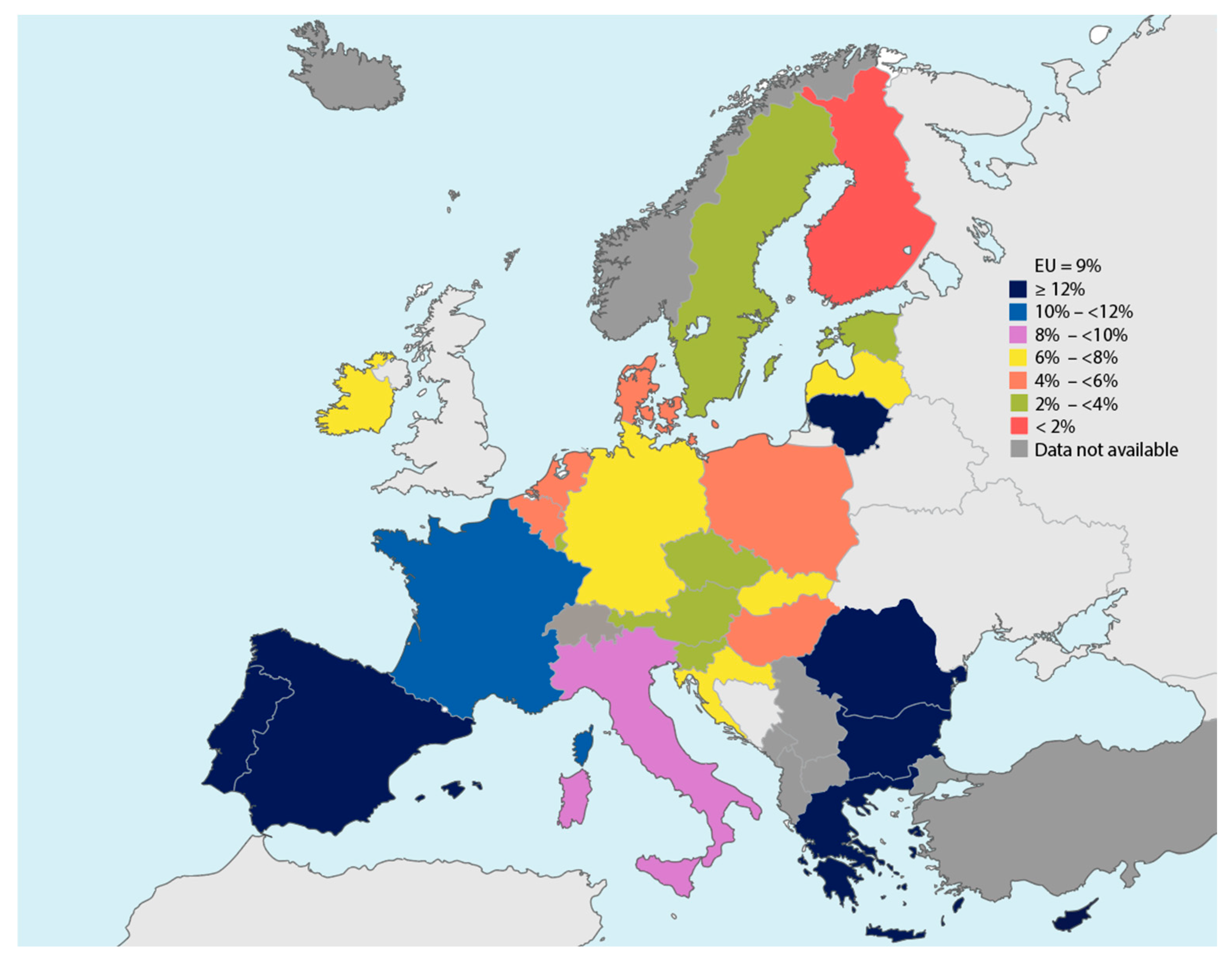
Abstract
1. Introduction
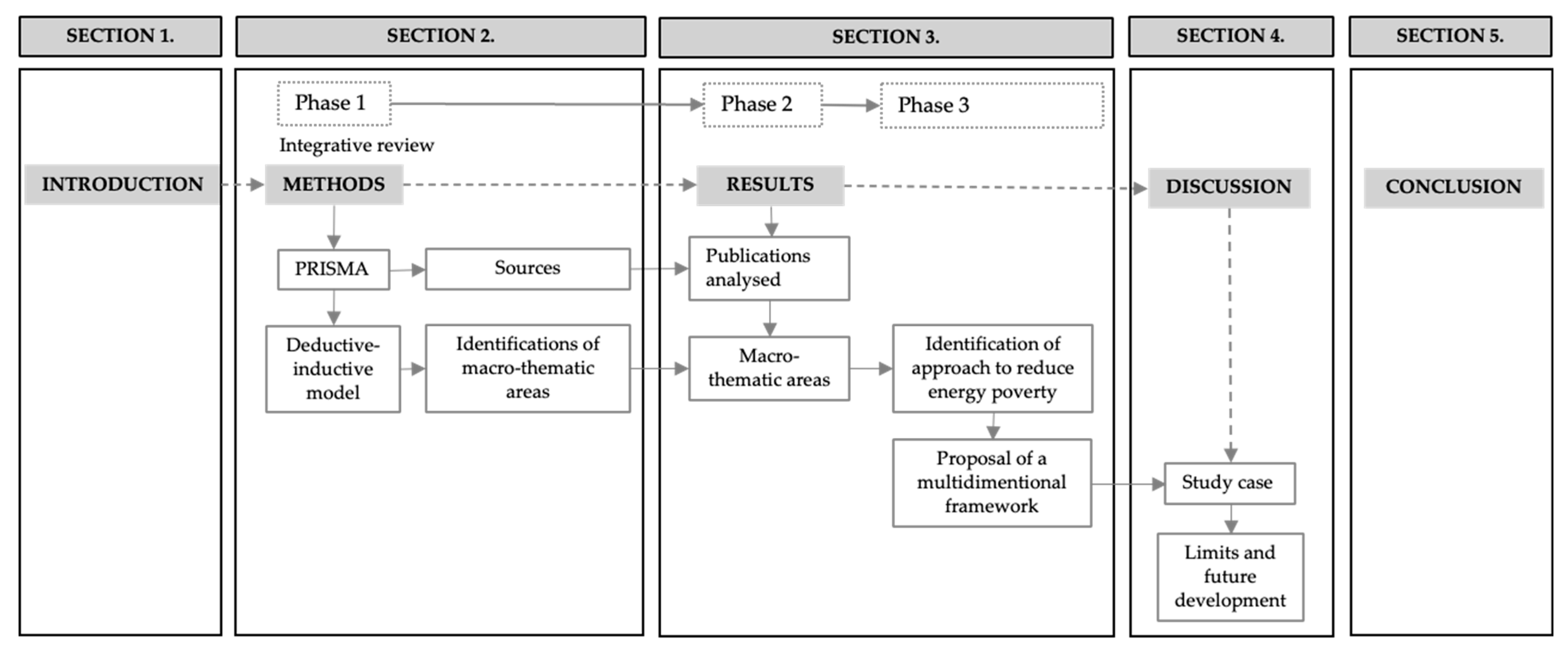
- Section 2 introduces the methodological approach;
- Section 3 reports the results;
- Section 4 proposes some reflections on the results, introduces a novel governance model designed to bridge existing gaps and introduces territorially embedded solutions using IERIN; it also identifies the limits and the lines of future development of this research;
- Section 5 summarises and highlights the main issues and findings of this study.
2. Methods
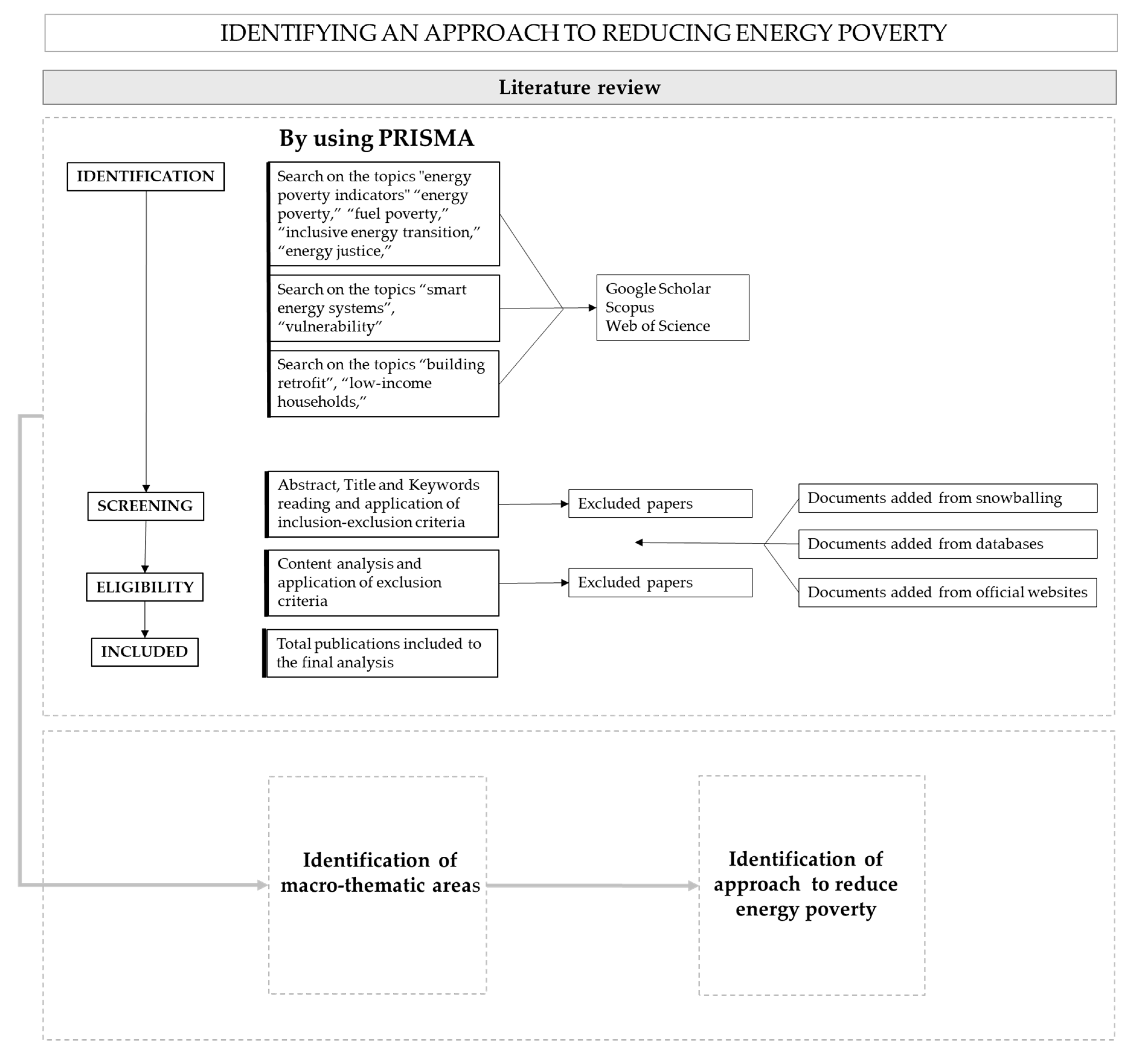
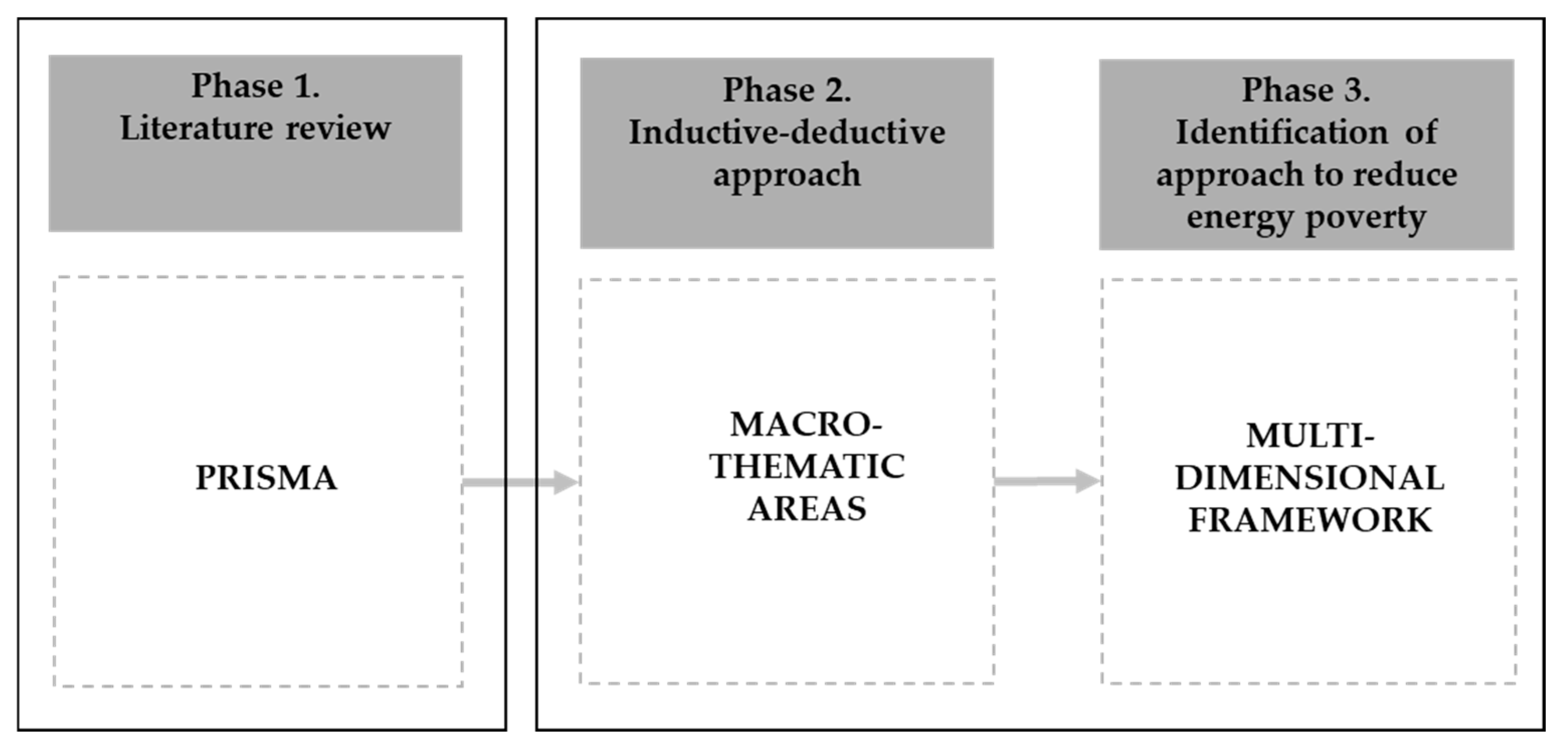
- Phase 1. An integrated review of scientific literature, institutional documents and European pilot projects, aimed at identifying critical issues and systemic gaps.
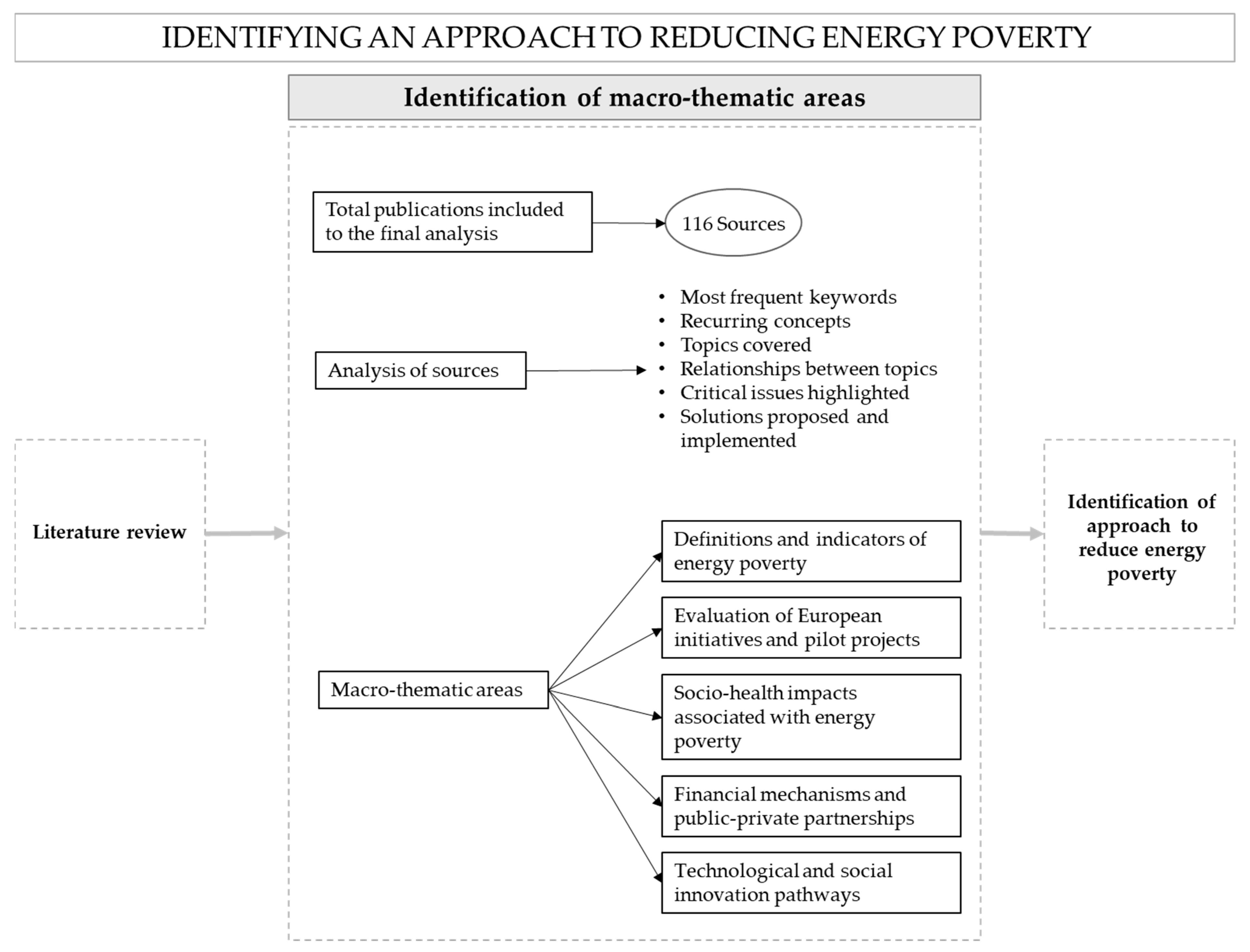
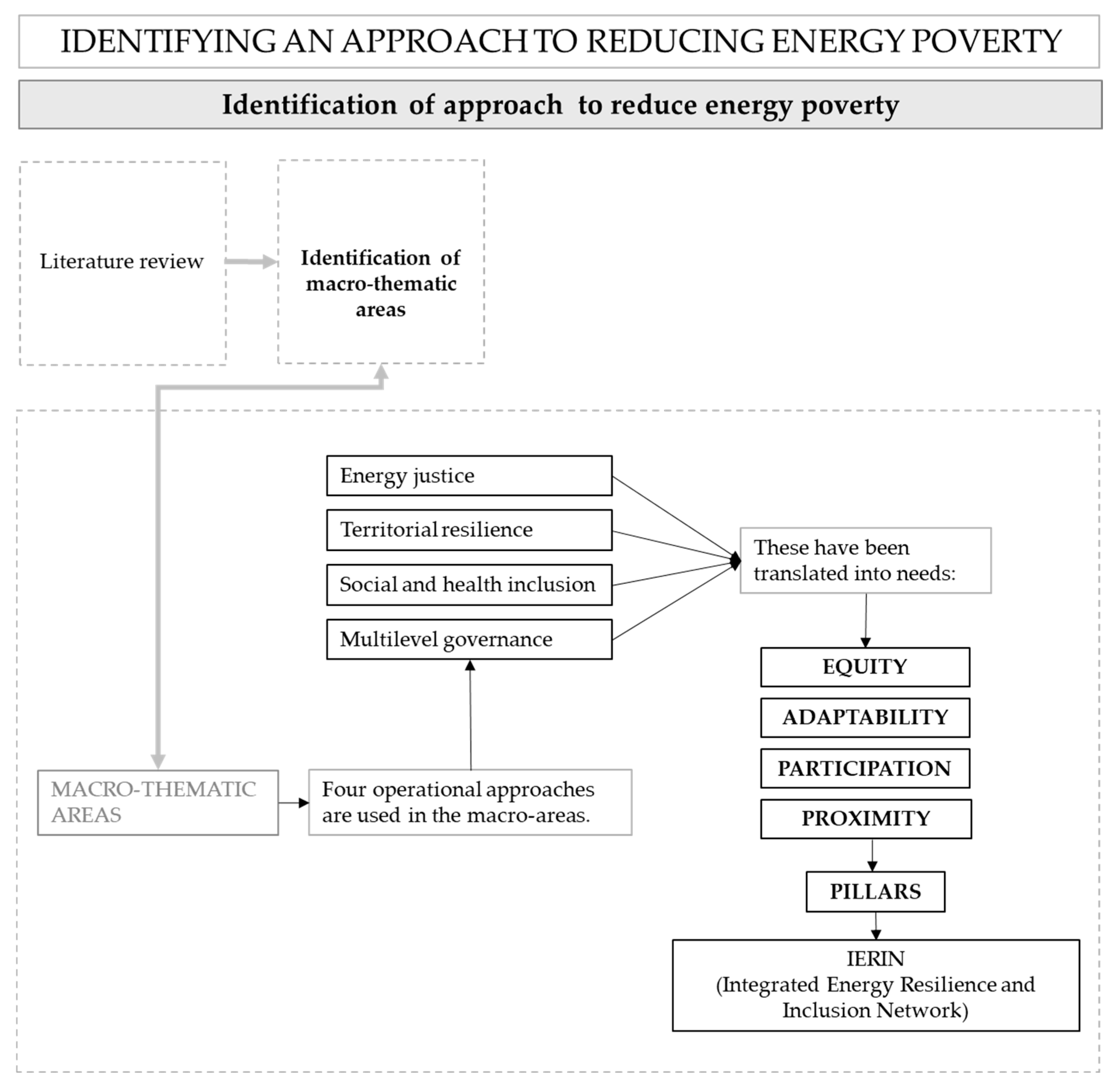
- Phase 2. Inductive thematic analysis of the selected sources, leading to the identification of five macro-domains and four recurring strategic logics.
- Phase 3. Deductive synthesis of the findings, resulting in the formulation of a strategic proposal to address energy poverty through integrated and territorially adaptable interventions.
2.1. Phase 1
2.1.1. Inclusion Criteria
2.1.2. Exclusion Criteria
3. Results
3.1. Phase 1
3.2. Phase 2
- Financial mechanisms and public–private partnerships [31]
3.2.1. Definitions and Indicators of Energy Poverty
3.2.2. Policy Initiatives and Project-Based Interventions

| Policy/Initiative | Description | Geographic Scope | Target Groups | Strengths | Limitations | Years of Implementation | Sources |
|---|---|---|---|---|---|---|---|
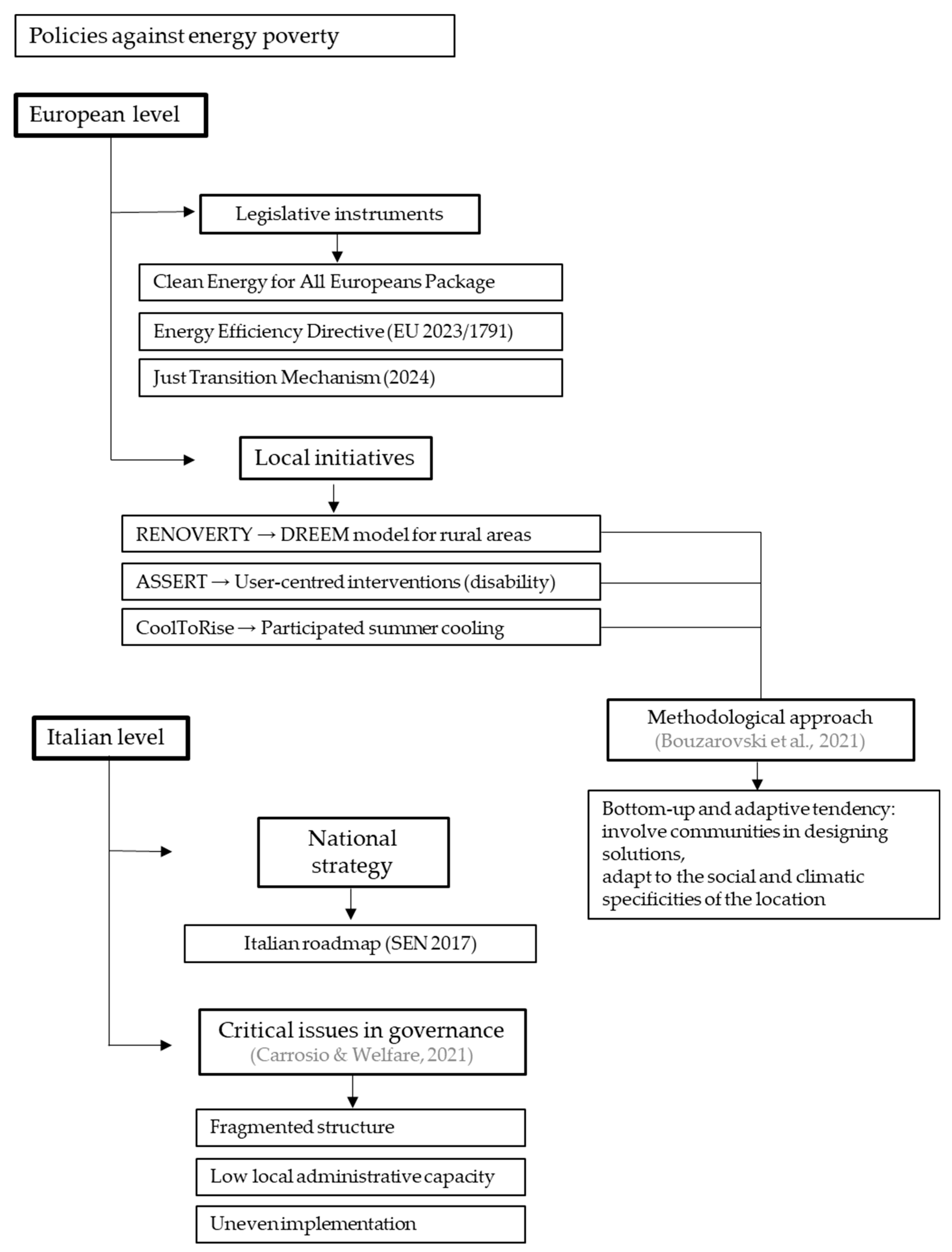
| Clean Energy for All Europeans Package | EU-level legislative framework recognizing energy poverty and mandating national action plans | European Union | Vulnerable consumers, low-income households | Institutionalizes energy poverty at EU level | Implementation varies by Member State | Adopted in 2019 | [63] |
| Energy Efficiency Directive (EU 2023/1791) | Obligates Member States to monitor and reduce energy poverty, with binding energy savings targets | European Union | Low-income and vulnerable energy users | Legally binding targets; forces national engagement | Monitoring tools still under development | Entry into force 10 October 2023; (Member States have until 11 October 2025 to transpose the provisions of the directive into their national legislation) | [64] |
| Just Transition Mechanism (EU Green Deal) | Funds vulnerable regions during energy transition; includes the Climate Social Fund | European Union (focus on fossil fuel regions) | Vulnerable regions and social groups | Large budget and redistributive focus | Disparities in allocation; complex bureaucracy | Launched in January 2020 | [65] |
| National Strategy on Energy Poverty (Italy, 2017) | Defines poverty thresholds and suggests metrics, yet lacks legal enforcement | Italy | Italian low-income households | Pioneering national definition and awareness | No legal binding or monitoring | Adopted in 2017 | [66] |
| RENOVERTY Project | Deep retrofitting in rural and vulnerable communities using the DREEM model | Italy, Spain, Portugal, others | Rural families in energy-inefficient housing | Customized solutions and community involvement | Requires strong local coordination | Project duration 2024–2027 | [19] |
| ASSERT Project | Inclusive design and retrofits for people with disabilities | EU-wide | People with physical disabilities | User-centered retrofits, inclusive design | Dependent on continued EU funding | Project duration 2024–2027 | [20] |
| CoolToRise Project | Behavioral and passive cooling strategies in Mediterranean countries | Southern Europe | Low-income households facing summer overheating | Climate-specific innovation | Effectiveness limited in poorly insulated buildings | Project duration 2021–2024 | [21] |
| PNIEC (Italy) | Sets national targets for climate and energy; integrates poverty indicators | Italy | General population, with focus on energy-poor | Integrates poverty and sustainability | Slow implementation; mixed local capacities | Implementation period 2021–2030 | [67] |
| EPBD—Energy Performance of Buildings Directive | Mandates renovation strategies, prioritizing buildings with vulnerable occupants | European Union | Tenants in low-performance housing | Links energy and social policy | Implementation differs across Member States | Entered into force on 28 May 2024. Member States are required to transpose the directive into national law by 29 May 2026 | [68] |
3.2.3. Social and Health Impacts
3.2.4. Financial Instruments and Public–Private Partnerships
3.2.5. Technological and Social Innovations
3.3. Phase 3
3.4. The IERIN Proposal
3.4.1. Operational Components
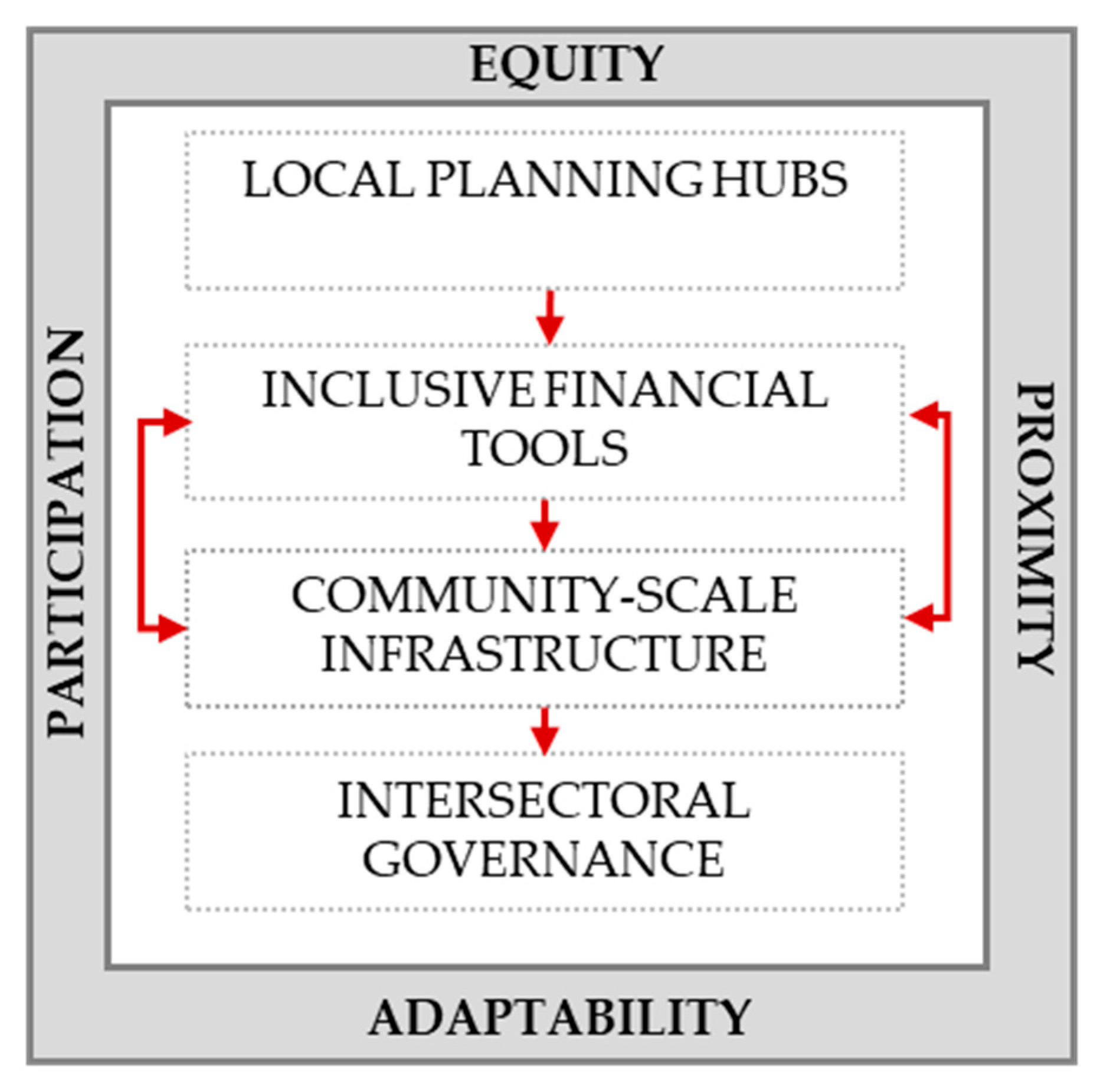
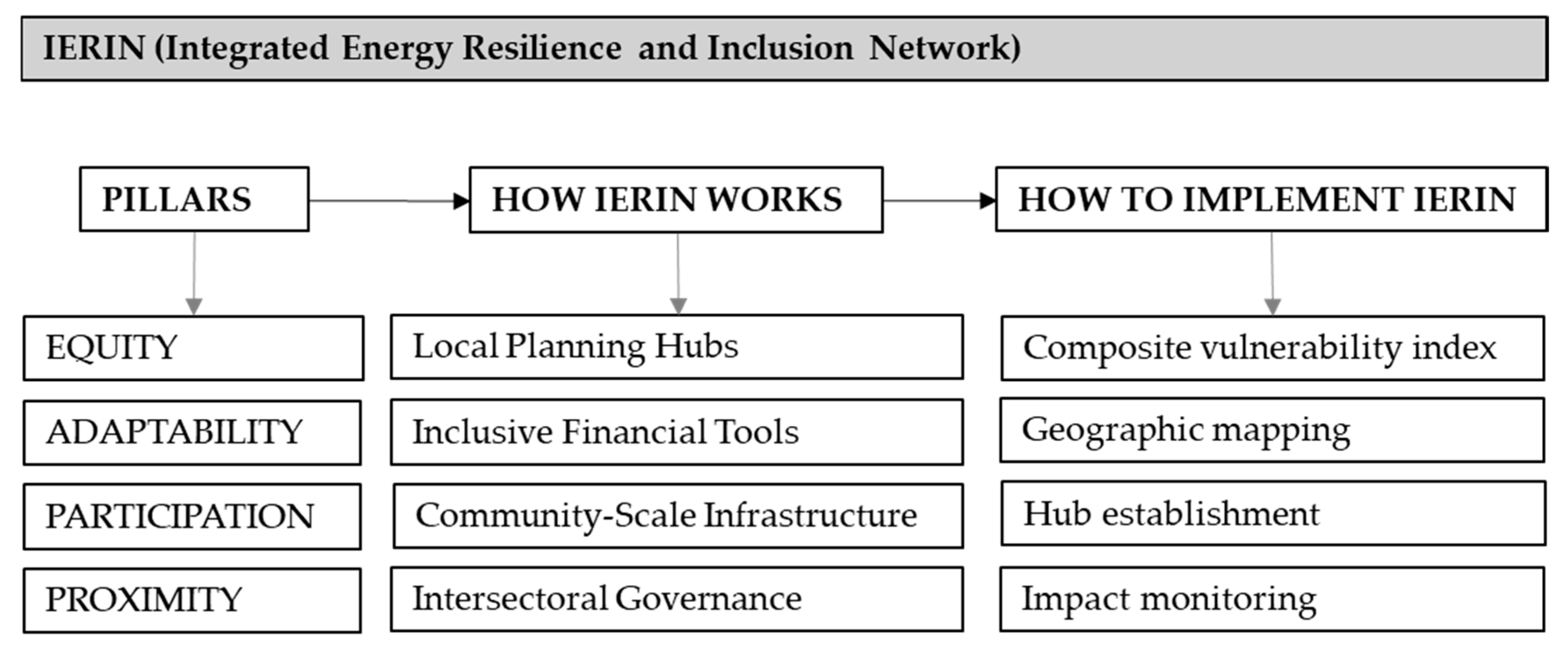
- Local Planning Hubs: local centres that coordinate energy, construction and social initiatives.
- Inclusive Financial Tools: accessible financial instruments for vulnerable families.
- Community-Scale Infrastructure: shared energy solutions at neighbourhood level.
- Intersectoral Governance: Models of coordination between public bodies, technical experts, social organisations, and citizens.
3.4.2. Implementation of the IERIN
- Composite vulnerability index: aggregates variables such as income deprivation, building inefficiency, climate stress (HDD/CDD), and socio-health indicators
- Geographic mapping: applies the index to identify neighborhoods most in need of intervention
- Hub establishment: sets up IERIN hubs in high-need areas to enable participatory planning
- Impact monitoring: tracks outcomes through metrics such as energy cost reduction, improved indoor comfort, and reduced hospitalization rates
4. Discussion
4.1. Case Study
4.2. Limits and Future Development
5. Conclusions
Author Contributions
Funding
Institutional Review Board Statement
Informed Consent Statement
Data Availability Statement
Conflicts of Interest
Abbreviations
| IERIN | Integrated Energy Resilience and Inclusion Network |
| CER | Renewable Energy Community |
| PNRR | National Recovery and Resilience Plan |
| PAYS | Pay-As-You-Save |
| LIHC | Low-Income High Cost |
| CDDs | Cooling Degree Days |
| HDDs | Heating Degree Days |
| HCI | Housing Conditions Indicator |
| PPPs | Public–Private Partnerships |
| UBEM | Urban Building Energy Modelling |
| IKHW | Inability to Keep Home Warm |
| AUB | Arrears on Utility Bills |
| EU-SILC | European Union Statistics on Income and Living Conditions |
| PNIEC | National Integrated Energy and Climate Plan |
| EPAH | Energy Poverty Advisory Hub |
| IoT | Internet of Things |
| EPBD | Energy Performance of Buildings Directive |
| SEN | National Energy Strategy |
| UMI | Urban Modeling Interface |
References
- Widuto, A. Energy Poverty in the EU. European Parliamentary Research Service (EPRS), PE 733.583, September 2023. Available online: https://www.europarl.europa.eu/thinktank/en/document/EPRS_BRI(2022)733583 (accessed on 2 September 2025).
- Eurostat. 9% of EU Population Unable to Keep Home Warm in 2022. Available online: https://ec.europa.eu/eurostat/web/products-eurostat-news/w/ddn-20230911-1 (accessed on 2 September 2025).
- Cura Di, A.; Faiella, I.; Lavecchia, L.; Miniaci, R.; Contributi Di, P.V.; Bardazzi, R.; Filippini, M.; Pontoni, F.; Vona, F.; Becchetti, L.; et al. La Povertà Energetica in Italia. 2020. Available online: https://oipeosservatorio.it/wp-content/uploads/2020/12/rapporto2020_v2.pdf (accessed on 2 September 2025).
- International Energy Agency (IEA). Access to Electricity—SDG7: Data and Projections. Available online: https://www.iea.org/reports/sdg7-data-and-projections/access-to-electricity (accessed on 2 September 2025).
- Leal Filho, W.; Begum, H.; Anholon, R.; Quelhas, O.; Rampasso, I.; Sharifi, A.; Guerra, J.; Gatto, A.; Lovett, M.; Velazquez, L.; et al. Addressing the challenges posed by energy poverty in Latin American countries. Discov. Sustain. 2024, 5, 262. [Google Scholar] [CrossRef]
- Menyhert, B. Energy Poverty—New Insights for Measurement and Policy Introduction and Policy Context; European Commisison: Brussels, Belgium, 2023. [Google Scholar]
- Lu, S.; Ren, J. A comprehensive review on energy poverty: Definition, measurement, socioeconomic impact and its alleviation for carbon neutrality. Environ. Dev. Sustain. 2023, 25, 8773–8807. [Google Scholar] [CrossRef]
- European Union. Energy Justice Insights from Energy Poverty Research and Innovation Experiences. 2024. Available online: https://data.europa.eu/doi/10.2760/96871 (accessed on 2 September 2025).
- Halkos, G.E.; Aslanidis, P.S.C. Addressing Multidimensional Energy Poverty Implications on Achieving Sustainable Development. Energies 2023, 16, 3805. [Google Scholar] [CrossRef]
- Gouveia, J.P.; Bessa, S.; Palma, P.; Mahoney, K.; Sequeira, M. Energy Poverty National Indicators Uncovering New Possibilities for Expanded Knowledge; European Commisison: Brussels, Belgium, 2023. [Google Scholar]
- Bank, W. Tracking SDG7: The Energy Progress Report 2024. 2024. Available online: https://trackingsdg7.esmap.org/downloads (accessed on 2 September 2025).
- Fabbri, K. Energy Poverty and Poor Buildings: A Brief Literature Review to Promote New Topics for Future Studies. Sustainability 2024, 16, 9638. [Google Scholar] [CrossRef]
- Mandelli, M.; Paris, S.; Lee, J. LIEPP Working Paper Mapping Energy Poverty Policies Across the EU: Pathways Towards Eco-Social Integration? Mapping Energy Poverty Policies Across the EU: Pathways Towards Eco-Social Integration? 2025. Available online: www.sciencespo.fr/liepp (accessed on 2 September 2025).
- Hills, J. Getting the Measure of Fuel Poverty: Final Report of the Fuel Poverty; Centre for Analysis of Social Exclusion: London, UK, 2012. [Google Scholar]
- Bouzarovski, S.; Petrova, S.; Sarlamanov, R. Energy poverty policies in the EU: A critical perspective. Energy Policy 2012, 49, 76–82. [Google Scholar] [CrossRef]
- Campagna, L.; Radaelli, L.; Ricci, M.; Rancilio, G. Exploring the Complexity of Energy Poverty in the EU: Measure It, Map It, Take Actions. In Current Sustainable/Renewable Energy Reports; Springer Nature: Berlin/Heidelberg, Germany, 2024. [Google Scholar]
- Directive (EU) 2023/2413 on the Promotion of Energy from Renewable Sources. Available online: https://eur-lex.europa.eu/legal-content/EN/TXT/?uri=CELEX:32023L2413 (accessed on 2 July 2025).
- Proposal for Guidelines Energy Justice in EU Impact Assessment. Available online: https://data.europa.eu/doi/10.2760/0414062 (accessed on 2 September 2025).
- LIFE RENOVERTY—Home Renovation Roadmaps to Address Energy Poverty in Vulnerable Rural Districts. Available online: https://webgate.ec.europa.eu/life/publicWebsite/project/LIFE21-CET-ENERPOV-RENOVERTY-101077272/home-renovation-roadmaps-to-address-energy-poverty-in-vulnerable-rural-districts (accessed on 2 July 2025).
- LIFE ASSERT—Multiactor Mentorship Programme on Energy Poverty. Available online: https://webgate.ec.europa.eu/life/publicWebsite/project/LIFE23-CET-ASSERT-101167584/large-scale-multiactor-training-and-mentoriship-programme-to-assist-people-with-physical-impairments-in-energy-poverty (accessed on 2 July 2025).
- CoolToRise Project. Available online: https://cooltorise.eu/ (accessed on 2 July 2025).
- Delle Pubblicazioni dell Unione Europea, U. P9_TA(2024)0048—Aspetti di Genere dell’Aumento del Costo della Vita e dell’Impatto della Crisi Energetica—Risoluzione del Parlamento Europeo del 18 Gennaio 2024 sugli Aspetti di Genere dell’Aumento del Costo della Vita e dell’Impatto della Crisi Energetica (2023/2115(INI)). Available online: http://data.europa.eu/eli/C/2024/5737/oj (accessed on 2 September 2025).
- Senato della Repubblica—Servizio Studi. Povertà Energetica e Impatto di Genere. Dossier AP0151. 2023. Available online: https://documenti.camera.it/leg19/dossier/pdf/AP0151.pdf (accessed on 2 September 2025).
- Shejale, S.; Zhan, M.X.; Sahakian, M.; Aleksieva, R.; Biresselioglu, M.E.; Bogdanova, V.; Cardone, B.; Epp, J.; Kirchler, B.; Kollmann, A.; et al. Participation as a pathway to procedural justice: A review of energy initiatives across eight European countries. Energy Res. Soc. Sci. 2025, 122, 103982. [Google Scholar] [CrossRef]
- Boute, A. Energy justice in times of crisis: Protection of consumers and market-based renewable energy investments. J. Int. Econ. Law 2023, 26, 770–785. [Google Scholar] [CrossRef]
- García-León, D.; Masselot, P.; Mistry, M.N.; Gasparrini, A.; Motta, C.; Feyen, L.; Ciscar, J.-C. Temperature-related mortality burden and projected change in 1368 European regions: A modelling study. Lancet Public Health 2024, 9, e644–e653. [Google Scholar] [CrossRef] [PubMed]
- Sovacool, B.K. Fuel poverty, affordability, and energy justice in England: Policy insights from the Warm Front Program. Energy 2015, 93, 361–371. [Google Scholar] [CrossRef]
- Sovacool, B.K.; Dworkin, M.H. Energy justice: Conceptual insights and practical applications. Appl. Energy 2015, 142, 435–444. [Google Scholar] [CrossRef]
- Shen, Y.; Shi, X.; Zhao, Z.; Grafton, R.Q.; Yu, J.; Shan, Y. Quantifying energy transition vulnerability helps more just and inclusive decarbonization. PNAS Nexus 2024, 3, pgae427. [Google Scholar] [CrossRef]
- Umar, A.A.; Goje, K.; Ahmad, M. Combating Rising Energy Poverty with Sunnah-Compliant Orthodox Sukuk Finance. J. Risk Financ. Manag. 2023, 16, 438. [Google Scholar] [CrossRef]
- Deason, J.; Murphy, S.; Leventis, G. Customer Outcomes in Pay-As-You-Save Programs. 2022. Available online: http://eeivt.com/wordpress/PAYS (accessed on 2 September 2025).
- Umair, M.; Cheema, M.A.; Afzal, B.; Shah, G. Energy management of smart homes over fog-based IoT architecture. Sustain. Comput. Inform. Syst. 2023, 39, 100898. [Google Scholar] [CrossRef]
- Alsuwian, T.; Shahid Butt, A.; Amin, A.A. Smart Grid Cyber Security Enhancement: Challenges and Solutions—A Review. Sustainability 2022, 14, 14226. [Google Scholar] [CrossRef]
- George, T.; Selvakumar, A.I. Smart home energy management systems in India: A socio-economic commitment towards a green future. In Discover Sustainability; Springer Nature: Berlin/Heidelberg, Germany, 2024. [Google Scholar]
- Buckley, N.; Mills, G.; Reinhart, C.; Berzolla, Z.M. Using urban building energy modelling (UBEM) to support the new European Union’s Green Deal: Case study of Dublin Ireland. Energy Build. 2021, 247, 111115. [Google Scholar] [CrossRef]
- Tozer, L.; Macrae, H.; Smit, E. Achieving deep-energy retrofits for households in energy poverty. Build. Cities 2023, 4, 258–273. [Google Scholar] [CrossRef]
- Ghorbany, S.; Hu, M.; Yao, S.; Wang, C.; Nguyen, Q.C.; Yue, X.; Alirezaei, M.; Tasdizen, T.; Sisk, M. Examining the role of passive design indicators in energy burden reduction: Insights from a machine learning and deep learning approach. Build. Environ. 2024, 250, 111126. [Google Scholar] [CrossRef]
- Seo, J.; Kim, S.; Lee, S.; Jeong, H.; Kim, T.; Kim, J. Data-driven approach to predicting the energy performance of residential buildings using minimal input data. Build. Environ. 2022, 214, 108911. [Google Scholar] [CrossRef]
- Bonetti, M.; Villa, M. Innovazione Sociale e Transizione Ecologica: Il Caso delle Comunità Energetiche. 2024. Available online: www.francoangeli.it (accessed on 2 September 2025).
- Awolesi, O.; Salter, C.A.; Reams, M. A Systematic Review on the Path to Inclusive and Sustainable Energy Transitions. Energies 2024, 17, 3512. [Google Scholar] [CrossRef]
- Varo, A.; Jiglau, G.; Grossmann, K.; Guyet, R. Addressing energy poverty through technological and governance innovation. Energy Sustain. Soc. 2022, 12, 49. [Google Scholar] [CrossRef]
- Bessa, S.; Gouveia, J.P. A framework for policy mix analysis: Assessing energy poverty policies. J. Environ. Econ. Policy 2023, 12, 438–454. [Google Scholar] [CrossRef]
- Trevisan, R.; Ghiani, E.; Pilo, F. Renewable Energy Communities in Positive Energy Districts: A Governance and Realisation Framework in Compliance with the Italian Regulation. Smart Cities 2023, 6, 563–585. [Google Scholar] [CrossRef]
- Page, M.J.; McKenzie, J.E.; Bossuyt, P.M.; Boutron, I.; Hoffmann, T.C.; Mulrow, C.D.; Shamseer, L.; Tetzlaff, J.M.; Akl, E.A.; Brennan, S.E.; et al. The PRISMA 2020 statement: An updated guideline for reporting systematic reviews. BMJ 2021, 372, n71. [Google Scholar] [CrossRef]
- Bouzarovski, S.; Thomson, H.; Cornelis, M. Confronting energy poverty in europe: A research and policy agenda. Energies 2021, 14, 858. [Google Scholar] [CrossRef]
- Al Kez, D.; Foley, A.; Lowans, C.; Del Rio, D.F. Energy poverty assessment: Indicators and implications for developing and developed countries. Energy Convers. Manag. 2024, 307, 118324. [Google Scholar] [CrossRef]
- Boardman, B. Fuel Poverty is Different. Policy Stud. 1991, 12, 30–41. [Google Scholar] [CrossRef]
- Healy, J.D.; Clinch, J.P. Quantifying the severity of fuel poverty, its relationship with poor housing and reasons for non-investment in energy-saving measures in Ireland. Energy Policy 2004, 32, 207–220. [Google Scholar] [CrossRef]
- Opatrny, M.; Scasny, M. Bridging the Gap: A Novel M2/LIHC Hybrid Indicator Unveils Energy Poverty Dynamics-Case Study of the Czech Republic. Available online: http://ies.fsv.cuni.cz (accessed on 2 September 2025).
- Rakotomena, M.; Ricci, O. Measuring Energy Poverty: A Climate-Aware Multidimensional Approach. In Social Indicators Research; Springer: Berlin/Heidelberg, Germany, 2025; Available online: https://link.springer.com/10.1007/s11205-025-03703-w (accessed on 2 September 2025).
- Raimundo, A.M.; Oliveira, A.V.M. Analyzing thermal comfort and related costs in buildings under Portuguese temperate climate. Build Environ. 2022, 219, 109238. [Google Scholar] [CrossRef]
- Ministero Dello Sviluppo Economico (MISE); Ministero dell’Ambiente e Della Tutela Del Territorio e Del Mare (MATTM); Ministero Delle Infrastrutture e dei Trasporti (MIT). Piano Nazionale Integrato per l’Energia e il Clima (PNIEC). 2020. Available online: https://www.mimit.gov.it/images/stories/documenti/PNIEC_finale_17012020.pdf (accessed on 2 September 2025).
- Gouveia, J.P.; Palma, P.; Simoes, S.G. Energy poverty vulnerability index: A multidimensional tool to identify hotspots for local action. Energy Rep. 2019, 5, 187–201. [Google Scholar] [CrossRef]
- Ceglia, F.; Marrasso, E.; Samanta, S.; Sasso, M. Addressing Energy Poverty in the Energy Community: Assessment of Energy, Environmental, Economic, and Social Benefits for an Italian Residential Case Study. Sustainability 2022, 14, 15077. [Google Scholar] [CrossRef]
- Jiménez Torres, M.; Pérez-Fargallo, A.; May Tzuc, O.; Ricalde Castellanos, L.; Bassam, A.; Flota-Bañuelos, M.; Rubio-Bellido, C. Energy poverty under 2M indicator: Feasibility of decrease by using passive techniques in residential buildings of Southeast Mexico. Energy Build. 2024, 323, 114761. [Google Scholar] [CrossRef]
- Streimikiene, D.; Kyriakopoulos, G.L.; Lekavicius, V.; Siksnelyte-Butkiene, I. Energy Poverty and Low Carbon Just Energy Transition: Comparative Study in Lithuania and Greece. Soc. Indic. Res. 2021, 158, 319–371. [Google Scholar] [CrossRef]
- Teixeira, I.; Ferreira, A.C.; Rodrigues, N.; Teixeira, S. Energy Poverty and Its Indicators: A Multidimensional Framework from Literature. Energies 2024, 17, 3445. [Google Scholar] [CrossRef]
- Taušová, M.; Domaracká, L.; Čulková, K.; Tauš, P.; Kaňuch, P. Development of Energy Poverty and Its Solutions through the Use of Renewables: The EU Case with a Focus on Slovakia. Energies 2024, 17, 3762. [Google Scholar] [CrossRef]
- Trovato, M.R.; Cappello, C. Climate Adaptation Heuristic Planning Support System (HPSS): Green-Blue Strategies to Support the Ecological Transition of Historic Centres. Land 2022, 11, 773. [Google Scholar] [CrossRef]
- Ministero dello Sviluppo Economico (MISE); Ministero dell’Ambiente e della Tutela del Territorio e del Mare (MATTM). Strategia Energetica Nazionale (SEN). 2017. Available online: https://www.mimit.gov.it/images/stories/documenti/Testo-integrale-SEN-2017.pdf (accessed on 2 September 2025).
- European Commission. State of the Energy Union Report 2024. Brussels, 2024. Available online: https://energy.ec.europa.eu/publications/state-energy-union-report-2024_en (accessed on 2 September 2025).
- Carrosio, G.; De Vidovich, L. Povertà Energetica Tra Welfare e Ambiente: Esiti di Una Ricerca in Quattro Quartieri ATER di Trieste, 2023. Available online: https://www.researchgate.net/publication/387894406_Poverta_energetica_tra_welfare_e_ambiente_Esiti_di_una_ricerca_in_quattro_quartieri_ATER_di_Trieste (accessed on 2 September 2025).
- Clean Energy for All Europeans Package. Available online: https://wayback.archive-it.org/12090/20241209144917/https://energy.ec.europa.eu/topics/energy-strategy/clean-energy-all-europeans-package_en (accessed on 2 July 2025).
- Directive (EU) 2023/1791 on Energy Efficiency. Available online: https://eur-lex.europa.eu/eli/dir/2023/1791/oj (accessed on 2 July 2025).
- European Green Deal. Just Transition Funding Sources. Available online: https://commission.europa.eu/strategy-and-policy/priorities-2019-2024/european-green-deal/finance-and-green-deal/just-transition-mechanism/just-transition-funding-sources_en (accessed on 2 July 2025).
- Certifico. Osservatorio Nazionale della Povertà Energetica. Available online: https://www.certifico.com/component/attachments/download/6884 (accessed on 2 July 2025).
- Ministero dell’Ambiente e della Sicurezza Energetica (MASE). Energia e Clima 2030. Available online: https://www.mase.gov.it/energia/energia-e-clima-2030 (accessed on 2 July 2025).
- Energy Performance of Buildings Directive. Available online: https://energy.ec.europa.eu/topics/energy-efficiency/energy-efficient-buildings/energy-performance-buildings-directive_en (accessed on 2 July 2025).
- Pradhan Shrestha, R.; Mainali, B.; Mokhtara, C.; Lohani, S.P. Bearing the Burden: Understanding the Multifaceted Impact of Energy Poverty on Women. Sustainability 2025, 17, 2143. [Google Scholar] [CrossRef]
- Taghizadeh-Hesary, F.; Yousef Yang, X.; Simcock, N.; Yi, H. Is there gender inequality in the impacts of energy poverty on health? Front. Public Health 2022, 10, 986548. [Google Scholar]
- European Commission. Energy Poverty Advisory Hub (EPAH). EPAH Handbook: A Guide to Energy Poverty Diagnosis. Brussels, 2023. Available online: https://energy-poverty.ec.europa.eu/our-work/epah-publications (accessed on 2 September 2025).
- Dabush, I.; Cohen, C.; Pearlmutter, D.; Schwartz, M.; Halfon, E. Economic and social utility of installing photovoltaic systems on affordable-housing rooftops: A model based on the game-theory approach. Build. Environ. 2023, 228, 109835. [Google Scholar] [CrossRef]
- Alonso, C.; de Frutos, F.; Martín-Consuegra, F.; Oteiza, I.; Frutos, B. Energy consumption and environmental parameters in Madrid social housing. Performance in the face of extreme weather events. Build. Environ. 2024, 254, 111354. [Google Scholar] [CrossRef]
- Comunità Energetiche in Toscana: Un Caso di Studio—La CER Isola d’Elba. Webinar “Il Novembre delle CER” (7 November 2024), Camera di Commercio di Pistoia-Prato. Available online: https://www.ptpo.camcom.it/doc/news/eventi/2024/20241128-webinar-novembre-cer-slide-7-novembre.pdf (accessed on 2 July 2025).
- Lakatos, E.; Arsenopoulos, A. Investigating EU financial instruments to tackle energy poverty in households: A SWOT analysis. Energy Sources Part B Econ. Plan. Policy 2019, 14, 235–253. [Google Scholar] [CrossRef]
- Galvin, R.; Sunikka-Blank, M. Ten questions concerning sustainable domestic thermal retrofit policy research. Build. Environ. 2017, 118, 377–388. [Google Scholar] [CrossRef]
- SunEnergy. Pay As You Save Solar. Available online: https://sunenergy.com.au/sunenergy-solar-pays-pay-as-you-save/ (accessed on 2 July 2025).
- UK Green Building Council. Pay As You Save. Available online: https://ukgbc.org/resources/pay-as-you-save/ (accessed on 2 July 2025).
- Energy Efficiency Institute. How Pay-As-You-Save Works. Available online: https://eeivt.com/wordpress/how-pays-works/ (accessed on 2 July 2025).
- SELCO India. Sustainable Energy Solutions. Available online: https://selco-india.com/ (accessed on 2 July 2025).
- Grameen Shakti. Solar Energy Loan. Available online: http://grameenshakti.co.in/solar-energy-loan/ (accessed on 2 July 2025).
- Enercoop. Cooperative Energy Supplier. Available online: https://www.enercoop.fr/ (accessed on 2 July 2025).
- SonnenCommunity. Press Release. Available online: https://sonnengroup.com/press-release-sonnencommunity/ (accessed on 2 July 2025).
- Comunità Energetica Rinnovabile e Solidale di Lecco (CERS). Available online: https://www.comune.lecco.it/Amministrazione/Enti-e-fondazioni/Comunita-Energetica-Rinnovabile-e-Solidale-di-Lecco-CERS (accessed on 2 July 2025).
- European Regional Development Fund (ERDF). Available online: https://ec.europa.eu/regional_policy/funding/erdf_en (accessed on 2 July 2025).
- European Commission. LIFE Programme. Available online: https://cinea.ec.europa.eu/programmes/life_en (accessed on 2 July 2025).
- Horizon Europe. Funding Opportunities. Available online: https://research-and-innovation.ec.europa.eu/funding/funding-opportunities/funding-programmes-and-open-calls/horizon-europe_en (accessed on 2 July 2025).
- Italia Domani. PNRR Portal. Available online: https://www.italiadomani.gov.it/it/home.html (accessed on 2 July 2025).
- Llewellyn, J.; Venverloo, T.; Duarte, F.; Ratti, C.; Katzeff, C.; Johansson, F.; Pargman, D. Assessing the impact of energy coaching with smart technology interventions to alleviate energy poverty. Sci. Rep. 2025, 15, 969. [Google Scholar] [CrossRef] [PubMed]
- Mengelkamp, E.; Gärttner, J.; Rock, K.; Kessler, S.; Orsini, L.; Weinhardt, C. Designing microgrid energy markets: A case study: The Brooklyn Microgrid. Appl. Energy 2018, 210, 870–880. [Google Scholar] [CrossRef]
- Tamasiga, P.; Onyeaka, H.; Altaghlibi, M.; Bakwena, M.; Houssin Ouassou, E. Empowering communities beyond wires: Renewable energy microgrids and the impacts on energy poverty and socio-economic outcomes. Energy Rep. 2024, 12, 4475–4488. [Google Scholar] [CrossRef]
- Tianyi, Z.; Zhou, Q.; Ali, S.; Nazar, R.; Anser, M.K. The digital solution: How artificial intelligence is revolutionizing energy poverty alleviation. In Environment, Development and Sustainability; Springer: Berlin/Heidelberg, Germany, 2025. [Google Scholar]
- Boekelo, M.; Kloppenburg, S. Energy platforms and the future of energy citizenship. Energy Res. Soc. Sci. 2023, 102, 103165. [Google Scholar] [CrossRef]
- Baard, P. Knowledge, participation, and the future: Epistemic quality in energy scenario construction. Energy Res. Soc. Sci. 2021, 75, 102019. [Google Scholar] [CrossRef]
- SENDER Project. Horizon 2020. Available online: https://www.sender-h2020.eu/ (accessed on 2 July 2025).
- AMS Institute. Energy Coaching and Smart Technology. Available online: https://www.ams-institute.org/news/energy-coaching-and-smart-technology-halve-energy-bills-for-dutch-households/ (accessed on 2 July 2025).
- CER Elba. Comunità Energetica Rinnovabile dell’Isola d’Elba. Available online: https://cer-elba.it/ (accessed on 2 July 2025).
- Brooklyn Microgrid—Community Powered Energy. Available online: https://www.brooklyn.energy/ (accessed on 2 July 2025).
- Iluméxico. Solar Access for Rural Mexico. Available online: https://ilumexico.mx/ (accessed on 2 July 2025).
- Mera Gao Power. EDFI ElectriFI. Available online: https://edfimc.eu/project/mera-gao/ (accessed on 2 July 2025).
- REACT Project. Horizon 2020. Available online: https://react2020.eu/it/isole-pilota/ (accessed on 2 July 2025).
- Energiesprong. Net-Zero Retrofit Initiative. Available online: https://energiesprong.org/ (accessed on 2 July 2025).
- Sharing Cities. EU Smart Cities Initiative. Available online: https://sharingcities.eu/ (accessed on 2 July 2025).
- LIFE ReHABITA Project. Available online: https://webgate.ec.europa.eu/life/publicWebsite/project/LIFE22-CET-LIFE-ReHABITA-101120713/ (accessed on 2 July 2025).
- Siksnelyte-Butkiene, I.; Streimikiene, D.; Lekavicius, V.; Balezentis, T. Energy poverty indicators: A systematic literature review and comprehensive analysis of integrity. Sustain. Cities Soc. 2021, 67, 102756. [Google Scholar] [CrossRef]
- Siksnelyte-Butkiene, I. A systematic literature review of indices for energy poverty assessment: A household perspective. Sustainability 2021, 13, 10900. [Google Scholar] [CrossRef]
- Nussbaumer, P.; Nerini, F.F.; Onyeji, I.; Howells, M. Global insights based on the multidimensional energy poverty index (MEPI). Sustainability 2013, 5, 2060–2076. [Google Scholar] [CrossRef]
- Bouzarovski, S.; Petrova, S. A global perspective on domestic energy deprivation: Overcoming the energy poverty-fuel poverty binary. Energy Res. Soc. Sci. 2015, 10, 31–40. [Google Scholar] [CrossRef]
- Thomson, H.; Simcock, N.; Bouzarovski, S.; Petrova, S. Energy poverty and indoor cooling: An overlooked issue in Europe. Energy Build. 2019, 196, 21–29. [Google Scholar] [CrossRef]
- Kyprianou, I.; Serghides, D.K.; Varo, A.; Gouveia, J.P.; Kopeva, D.; Murauskaite, L. Energy poverty policies and measures in 5 EU countries: A comparative study. Energy Build. 2019, 196, 46–60. [Google Scholar] [CrossRef]
- Dear, K.B.; McMichael, A.J. The health impacts of cold homes and fuel poverty. Bmj 2011, 342, d2807. [Google Scholar] [CrossRef]
- Liddell, C.; Morris, C. Fuel poverty and human health: A review of recent evidence. Energy Policy 2010, 38, 2987–2997. [Google Scholar] [CrossRef]
- Nyame-Baafi, K.; Darmoe, J.K.A.; Ohemeng, W.; Amenah, M.A. Assessing the effect of energy poverty on health outcomes: Insights from Ghana. BMC Public Health 2025, 25, 2419. [Google Scholar] [CrossRef]
- González-Eguino, M. Energy poverty: An overview. Renew. Sustain. Energy Rev. 2015, 47, 377–385. [Google Scholar] [CrossRef]
- Thema, J.; Suerkemper, F.; Couder, J.; Mzavanadze, N.; Chatterjee, S.; Teubler, J.; Thomas, S.; Ürge-Vorsatz, D.; Hansen, M.B.; Bouzarovski, S.; et al. The multiple benefits of the 2030 EU energy efficiency potential. Energies 2019, 12, 2798. [Google Scholar] [CrossRef]
- Cheng, Q.; Zhang, Z.; Wang, Y.; Zhang, L. A Review of Distributed Energy Systems: Technologies, Classification, and Applications. Sustainability 2025, 17, 1346. [Google Scholar] [CrossRef]




| Indicator/Approach | Description | Strengths | Limitations | Used In | References |
|---|---|---|---|---|---|
| 10% Rule | Household spends more than 10% of income on energy bills | Simple, widely used historically | Insensitive to regional energy needs and income variation | UK, early EU studies | [54] |
| LIHC (Low Income High Cost) | Household has high energy costs and residual income below poverty line | More nuanced; includes both cost and income | Requires detailed income and expenditure data | UK (Hills Report, 2012) | [54] |
| 2M Indicator | Data | Highlights extreme energy burden | Overly broad; may capture non-poor | Italy (PNIEC), EU comparative metrics | [55,56] |
| M/2 Indicator | Abnormally low energy spending potentially indicating forced deprivation | Flags hidden energy poverty | May misidentify households with low energy use by choice | Italy (PNIEC), EU studies | [56] |
| IKHW (Inability to Keep Home Warm) | Households self-report inability to keep home adequately warm | Captures subjective thermal comfort | Subjective; relies on self-reporting | EU-SILC surveys | [57] |
| AUB (Arrears on Utility Bills) | Households behind on energy bill payments | Reflects economic stress related to energy costs | Affected by household attitudes and payment practices | EU-SILC surveys | [57] |
| Heating Degree Days (HDD) | Metric for cold-related heating needs based on temperature thresholds | Climate-sensitive; useful for targeting winter energy poverty | Needs accurate local climate data | All EU climate zones | [58] |
| Cooling Degree Days (CDD) | Metric for cooling needs in warm climates based on temperature thresholds | Addresses summer energy poverty | Less commonly integrated in EU definitions | Southern Europe, Mediterranean countries | [58] |
| Housing Conditions Indicator (HCI) | Composite indicator measuring housing quality, dampness, access to basic energy services | Integrates multiple aspects of housing-energy interaction | Data-intensive; methodology may vary by country | Eurostat, EPAH, some national strategies | [57] |
| Impact Area | Description | Affected Groups | Mitigation Measures | Sources |
|---|---|---|---|---|
| Respiratory Illnesses | Cold and damp housing conditions increase incidence of bronchitis, asthma, and infections | Children, low-income families in cold homes | Improved insulation, ventilation | [26,27] |
| Cardiovascular Diseases | Inadequate indoor temperatures contribute to heart stress and increased mortality risk | Elderly, cardiovascular patients | Stable indoor temperature, monitoring | [15] |
| Mental Health (Anxiety, Depression) | Inability to pay bills or heat home increases stress, depression, and anxiety | Adults in fuel-deprived households | Energy coaching, psychosocial support | [23,28] |
| Social Isolation | Energy-poor households tend to withdraw from social interactions | All vulnerable households | Community energy programs | [26,45] |
| Gendered Vulnerability | Women-headed households, especially single mothers, face higher energy cost burdens | Female-headed and single-parent households | Gender-sensitive subsidies | [22,23,69,70] |
| Elderly Susceptibility | Older adults are at higher risk due to lower mobility and temperature sensitivity | Elderly in inadequately heated homes | Priority retrofit programs for elderly homes | [26] |
| Disability-related Risks | People with disabilities need stable indoor temperatures and powered medical devices | Disabled individuals | Tailored design and energy supply stability | [20,71] |
| Household Financial Stress | High energy bills lead to arrears, debt, and rationing of other essentials | Low-income families | Bill subsidies, payment plans | [52] |
| Educational Disruption (Children) | Lack of heating or lighting impairs children’s study and sleep quality | Children in underheated homes | Targeted school and housing support | [26,45] |
| Model/Instrument | Description | Case Studies | Target Beneficiaries | Strengths | Limitations | Years of Implementation | Sources |
|---|---|---|---|---|---|---|---|
| Pay-As-You-Save (PAYS) | No upfront cost: energy efficiency upgrades repaid via savings on bills | 1. Kansas (USA) 2. UK 3. Australia | Low-income renters and homeowners | Removes upfront investment barrier | Requires reliable utility/program administration | 1. from 2000 2. from 2010 3. from 2022 | [77,78,79] |
| Energy Microcredit | Micro-loans for installing renewable technologies or efficient systems | Grameen Shakti (Bangladesh), SELCO (India) | Rural households, developing country communities | Enhances financial inclusion, builds resilience | Risk of insolvency; needs microfinance infrastructure | 1. founded 1996 2. founded in 1995 | [80,81] |
| Energy Leasing | Households rent renewable installations (e.g., solar panels) with monthly fees | SonnenCommunity (Germany), Enercoop (France) | Families with low capital liquidity | Enables immediate access to energy savings | Contract duration and ownership issues | 1. 2015 2. Founded in 2005 | [82,83] |
| Public–Private Partnerships (PPPs) | Joint ventures between public entities and private sector to deliver energy services | CER Lecco (Italy), local microgrids | Citizens, municipalities, SMEs | Shares risk and cost, leverages expertise | Complex governance, bureaucratic delays | Constituted on 18 June 2024 | [84] |
| Just Transition Fund | Supports vulnerable regions in transitioning away from fossil fuels | Poland, Eastern Europe coal regions | Communities in carbon-intensive regions | Redistributes climate transition funds | Uneven access and fund allocation | 2021–2027 | [65] |
| FESR (EU Regional Funds) | Funds energy efficiency in disadvantaged EU regions | Greece, Portugal energy upgrades | Low-income regions in EU | Large-scale support for structural projects | High bureaucracy, limited absorption capacity | 2021–2027 | [85] |
| LIFE Programme | Pilots and replicates innovative and inclusive energy projects | LIFE ReHABITA (Spain) | Vulnerable populations, local authorities | Supports innovation, good replicability | Competitive funding, fragmented impact | 2021–2027 | [86] |
| Horizon Europe (Tech Innovation) | Finances cutting-edge energy poverty solutions and research | SENDER, REACT, Sharing Cities | Universities, startups, public agencies | Drives technological and systemic change | High administrative burden | 2021–2027 | [87] |
| PNRR Incentives (Italy) | Grants and tax credits for retrofits and renewables, often linked to local planning | Superbonus 110%, CER support schemes | Italian families and small enterprises | Boosts local green economy and equity | Discontinuity and bureaucratic complexity | 2021–2026 | [88] |
| Innovation/Tool | Description | Case Studies | Impact | Limitations | Years of Implementation | Sources |
|---|---|---|---|---|---|---|
| Internet of Things (IoT) Systems | Sensors and digital tools monitor and optimize household energy use | SENDER project; smart homes in Spain/Finland/Austria | Improved energy awareness and reduced consumption | Upfront device cost and privacy concerns | Started in October 2020 and completed in September 2024 | [95] |
| Smart Energy Coaching | Combines real-time feedback with behavioral change interventions | Amsterdam pilot; Llewellyn et al., 2025 | Behavioral savings and user empowerment | Requires long-term support and user trust | Measurements between October 2023 and December 2023 (117 homes); revisited to measure the impact of the intervention from February 2024 to March 2024 (73 homes) | [89,96] |
| Renewable Energy Communities (CERs) | Local cooperatives jointly produce and consume renewable energy | 1. CER Lecco 2. CER Elba, Tuscany | Energy autonomy and social inclusion | Regulatory barriers, bureaucratic setup | 1. Constituted on 18 June 2024 2. Association created in 2023 | [84,97] |
| Microgrids with Blockchain | P2P energy trading using blockchain-enabled microgrids | Brooklyn Microgrid (USA) | Enhanced local resilience and democratization | Legal uncertainty around energy exchange | Initiative started in April 2016 | [98] |
| Decentralized Solar Solutions | Off-grid solar systems for rural or underserved areas | 1. Mera Gao Power (India), 2. Ilumexico | Low-cost access to clean energy | Limited capacity, maintenance needs | 1. Set up in 2011 2. Set up in 2010 | [99,100] |
| AI for Predictive Energy Management | Uses machine learning to optimize consumption and grid interaction | 1. REACT (HORIZON 2020 EU) 2. Energiesprong | Grid stability and efficiency for vulnerable zones | Complex implementation, needs data infrastructure | 1. January 2019– June 2023 2. From 2010 | [101,102] |
| Digital Participatory Platforms | Engages citizens in energy planning via online platforms | Sharing Cities (EU) | Increased civic engagement and transparency | Depends on digital literacy and platform uptake | Started in 2016—completed in 2021 | [103] |
| Energy Retrofit Packages | Pre-packaged interventions for insulation, HVAC, renewables | 1. ASSERT 2. RENOVERTY 3. LIFE ReHABITA | Improved living conditions and cost savings | Funding and integration challenges | 1. From 2022 to 2025 2. From 2024 to 2027 3. From 2023 to 2027 | [19,20,104] |
Disclaimer/Publisher’s Note: The statements, opinions and data contained in all publications are solely those of the individual author(s) and contributor(s) and not of MDPI and/or the editor(s). MDPI and/or the editor(s) disclaim responsibility for any injury to people or property resulting from any ideas, methods, instructions or products referred to in the content. |
© 2025 by the authors. Licensee MDPI, Basel, Switzerland. This article is an open access article distributed under the terms and conditions of the Creative Commons Attribution (CC BY) license (https://creativecommons.org/licenses/by/4.0/).
Share and Cite
Di Rocco, A.R.; Trovato, M.R.; Caponetto, R.G.; Nocera, F. Energy Poverty and Territorial Resilience: An Integrative Review and an Inclusive Governance Model. Sustainability 2025, 17, 8555. https://doi.org/10.3390/su17198555
Di Rocco AR, Trovato MR, Caponetto RG, Nocera F. Energy Poverty and Territorial Resilience: An Integrative Review and an Inclusive Governance Model. Sustainability. 2025; 17(19):8555. https://doi.org/10.3390/su17198555
Chicago/Turabian StyleDi Rocco, Alice Renè, Maria Rosa Trovato, Rosa Giuseppina Caponetto, and Francesco Nocera. 2025. "Energy Poverty and Territorial Resilience: An Integrative Review and an Inclusive Governance Model" Sustainability 17, no. 19: 8555. https://doi.org/10.3390/su17198555
APA StyleDi Rocco, A. R., Trovato, M. R., Caponetto, R. G., & Nocera, F. (2025). Energy Poverty and Territorial Resilience: An Integrative Review and an Inclusive Governance Model. Sustainability, 17(19), 8555. https://doi.org/10.3390/su17198555