1. Introduction
AI, the IoT, blockchain, and cloud computing allow stakeholders to manage energy networks more effectively. This, in turn, significantly increases the predictability of renewable power outputs, facilitating their integration into existing energy systems [
1]. Green finance is a powerful tool for advancing technological innovation in emerging markets [
2]. However, its implementation faces serious challenges due to significant differences in universities’ development levels and inadequate government support. These challenges are less pronounced in countries such as the United States and Germany, which have well-established innovation systems supported by government and private investments in research [
3].
In developing countries, such a transition may pose additional challenges [
4,
5], as cutting-edge technologies developed in a country are closely linked to its economic development and other priorities [
6]. Therefore, studies investigating energy transition issues have used diverse research designs and methods. Advanced monitoring and predictive technologies have been incorporated into national power grids [
7].
Countries such as China, South Korea, and Germany have made advances in these aspects. Therefore, scholars must find effective ways to identify trends and differences in energy innovation across countries and technologies [
8]. Moment quantile regression (MMQR) [
9] is an effective statistical method for investigating the factors affecting financial performance in the insurance industry, moving beyond secondary data analysis tools that primarily focus on averages and means [
10].
Asymmetry at the between-country level: weakly innovative countries respond more to innovation input factors (R&D) than highly developed ones. Inequality in the variation levels of energy prices or emissions from the effects of innovations comes from close linkages [
11]. The structural differences across the G20 economies due to their diversity require compatibility during MMQR execution. Pathway persistence is strongly and positively related to historical path dependencies [
12]. Quantiles at 10%, 50%, and 90% reveal inequality among low-, average-, and high-performing countries, respectively, in terms of margins; therefore, these findings are hidden from the OLS.
Moreover, the MMQR model allows the integration of prior instances into the estimation equations, thereby enhancing the credibility and relevance of previous innovations. These structural inequalities affect G20 countries as much as they affect other countries. This group includes both highly developed economies with robust creative industries (Germany, South Korea, Japan, and the United States) and those attempting to improve their innovative capacity (India, Indonesia, Saudi Arabia, and Brazil). Additionally, country fixed effects are used to generate unbiased estimates by controlling for unobserved factors and precisely capturing the nonlinear relationships among energy outputs [
13]. The key parameters exhibit a distinct trend that affects the innovation system, owing to the nonlinear nature of this interaction.
The theoretical framework of energy innovation is based on two main ideas: technological innovation and green innovation. Technological innovation refers to the adoption and development of new technologies that promote productivity and energy intensity [
14,
15], whereas green innovation relates to technologies that reduce carbon emissions and improve environmental performance [
16].
Recent literature identifies four major determinants of energy innovation: cognitive capital, energy price dynamics (institutional technology), and digital transformation [
17]. Increased R&D is associated with a large number of patents for clean energy technologies, with its impact being more substantial in countries with stronger institutions and advanced financial markets [
18,
19,
20].
Energy prices are based on the hyper price-induced innovation theory of wages [
21]. Recent literature indicates that high fossil fuel prices have stimulated the search for alternative energy-saving technologies to reduce energy consumption, whereas low prices, particularly in resource-rich countries, can delay innovation. The impact of prices is not linear and varies across countries, depending on the level of innovation [
22,
23].
Environmental policies (e.g., carbon taxes) increase green innovation, with their effectiveness being strongly enhanced by institutional quality [
24]. There are clear government incentives to encourage companies to enter the energy innovation sector. Recent literature [
25] indicates that green bonds and sustainable loans are tools for financing low-carbon innovations [
26]. The impact of green finance is substantial in advanced and moderate markets in emerging countries [
27,
28,
29].
The importance of the (MMQR) model [
9] stems from its ability to assess effects across all critical challenges simultaneously. Other estimation techniques, such as the generalized method of moments (GMM), ordinary least squares (OLS), or fully modified ordinary least squares (FMOLS), cannot sufficiently perform this type of analysis [
30].
The (MMQR) model [
9] has several characteristics used to analyze this attribute of traits (2000–2024) at various levels, with a focus on interconnected shapes at all levels for innovation. This study examines the challenge relationships at the 10%, 25%, 50%, 75%, and 90% quantiles to show how R&D responses to energy price variations differ in low-innovation African states from those in the United States, Japan, and Germany. In addition, MMQR is a tool for gaining further insight into innovation beyond averages. Overall, the theoretical framework shows that multidimensional interactions shape energy innovation, the relationships between variables vary across innovation levels, and the G20 countries exhibit significant inequality from 2000 to 2024. The (MMQR) model is the best for capturing these dynamics.
This paper is organized as follows: an Introduction, followed by
Section 2, which provides the literature review, and
Section 3, which presents the methodology and data description. The results and analysis are discussed in
Section 4. Finally, the conclusions and policy implications of this study are presented in
Section 5.
Theoretical Framework
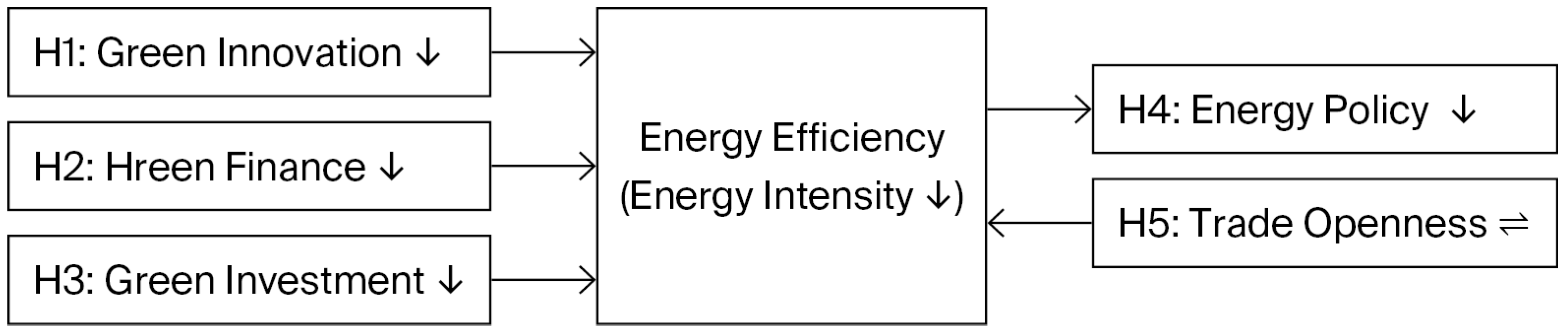
Energy efficiency is measured by energy intensity, with lower values indicating greater efficiency. Green innovation, financial mechanisms, and investments aim to lower energy intensity by advancing technology, providing funding, and directing capital to clean sectors. Green finance and green investment represent related but distinct concepts: the former captures the financial system’s capacity and policy support for green activities, while the latter reflects actual capital expenditures in green and clean-energy sectors. Consequently, their macro-level correlation may be moderate rather than high, as financial availability does not automatically translate into realized investment. Green finance refers to financial intermediation mechanisms designed to direct capital towards environmentally sustainable initiatives. In contrast, green investment pertains to the actual allocation of resources into clean and energy-efficient technologies. Although interconnected, these concepts function through separate economic pathways.
Energy policy provides the framework for these efforts. Trade openness can either reduce energy intensity through technology transfer or increase it through scale effects, with the outcome varying across countries. Due to structural and institutional differences among G20 economies, these relationships are expected to vary across the energy-efficiency spectrum, which justifies the use of the MMQR approach.
The G20 economies, accounting for approximately three-quarters of global energy consumption and CO2 emissions, are crucial to the transition of the energy landscape. They include developed and emerging economies with diverse institutional quality, technology, and energy intensity. This diversity makes the G20 well-suited to the MMQR method, which focuses on distributional differences. Additionally, G20 economies lead in shaping international energy, climate, and green finance policies, thereby increasing the relevance of this analysis. The hypotheses are as follows:
H1–H4:
Green innovation, green finance, green investment, and energy policy reduce energy intensity (Figure 1).
H5:
The effect of trade openness on energy intensity is heterogeneous across quantiles.
2. Literature Review
Studies on innovation in energy markets stem from the intersection of three major streams of economic thought: innovation theory, endogenous growth models (endogenous growth), and the literature on green innovation and energy transformation. According to Schumpeter, innovation is a process of creative destruction that reshapes productive structures through a wave of new technologies, creating a more productive economic balance [
31]. In this context, the energy sector has become a central arena for these waves of innovation, given its role as an input for all productive activities.
2.1. Energy Efficiency, Green Investment, and Economic Growth
The fundamental hypothesis in contemporary literature is that innovation in the energy sector, especially green innovation, delivers environmental gains by reducing emissions and generates economic gains by improving efficiency and opening new markets for technology and clean energy, thereby promoting long-term growth, green innovation, and the environmental (energy, growth, innovation) nexus [
32,
33].
Green innovation has become a central hub in the literature linking economic growth, environment, and energy [
34]. Refs. [
35,
36] indicate that environmental innovation reduces emissions intensity and the marginal costs of regulatory compliance, making more stringent environmental policies less burdensome for growth and may even become a catalyst for innovation [
37].
The design of renewable energy policies, such as green electricity price subsidies and feed-in tariffs, is statistically associated with the increased patenting of solar and wind technologies [
38]. At the quantitative model level, [
39,
40] introduced one of the first strong applications of panel quantile regression on the relationship between renewable energy consumption, technological innovation, and emissions in a sample of 30 countries. They indicated that the impact of renewable energy and innovation varies across emission challenges: countries with high emissions benefit differently from low-emission countries, even when the same variables drive innovation and environmental hygiene [
41].
The difference in effects across challenges underpins the rationale for using quantile models in this study. Recent work by [
42] studied the impact of green innovation and energy transformation on environmental sustainability in the Paris Club countries for the period 1990–2022 and showed that green innovation and renewable energy contributed to reducing the long-term environmental footprint, with differences between countries’ natural resource abundance and income levels.
Multiple MMQR studies find that energy intensity more strongly stimulates growth at higher economic quantiles. Ref. [
43] shows that reducing energy intensity boosts growth in G20 upper-growth economies but has little effect in lower-growth countries due to structural issues. Ref. [
44] also finds energy intensity benefits mainly in high-income G20 countries, while lower-income members face rebound and scale effects that reduce gains. MMQR findings show that the link between energy intensity and economic growth is nonlinear, asymmetric, and distribution-dependent. Improving efficiency yields greater growth benefits in countries with better institutions, financial systems, and technology, mainly in the G20’s upper quantiles.
Pilot studies on G20 also suggest that energy innovation can play a critical role in balancing growth and environmental sustainability [
45,
46,
47]. However, the nature of this role varies across advanced industrial and emerging market economies that are highly dependent on fossil fuels.
Other studies using marginal models show that the impact of green innovation may be weak or even non-existent in low-distribution challenges but becomes substantial and statistically significant in higher-distribution challenges [
48]. These results support an essential argument for this study: innovation dynamics in energy markets are not homogeneous and depend heavily on a state’s location in the innovation distribution, which justifies the choice of the (MMQR) methodology for the analysis of G20 countries [
49,
50].
In recent years, the study of energy transition and innovation has expanded, particularly through what is known as energy innovation sessions and growth [
51]. This model links the transition of the energy mix from fossil fuels to renewables to the path of innovation, emissions, and growth [
52].
Studies on the impact of innovation on renewable energy technologies and energy security across 45 countries showed that advances in renewable technologies in storage, solar, and wind increase energy system resilience and reduce its vulnerability to price shocks and fossil fuel markets. In a related context, studies examining marginal declines in tablet adoption demonstrate that the effect of the transition to renewable energy on growth or emissions is neither linear nor uniform.
A study on energy transformation in Asia shows, based on marginal decline results, that the effect of the transition to clean energy on economic growth varies across economies, with short-term trade-offs between growth and sustainability in some middle-income countries [
53].
Other recent studies [
54,
55,
56] have also adopted panel quantile regression to analyze the factors affecting renewable energy consumption in OECD countries, demonstrating that the impacts of GDP, fixed capital, employment, and waste on renewable energy consumption clearly vary across challenges, highlighting the importance of not only estimating the average.
This study advances the logic of studying the dynamics of innovation in energy markets, rather than treating innovation as a static or average variable. It emphasizes that innovation responds heterogenously to changes in energy prices, shifts in the energy mix, and energy security across countries. During the period 2023–2025, an increasing number of studies explicitly focusing on the G20 countries, both from the perspective of innovation, energy, and green finance, have emerged [
2,
51,
57,
58].
Ref. [
59] examined the relationships among energy, innovation, economic growth, and emissions in G20 countries and emphasized their primary focus in global environmental and economic policy formulation. The results show significant differences in the impact of innovation on emissions across countries’ economic structures and energy mixes.
In this context, the G20 energy transition track agenda emphasizes energy access, sustainable financing, green job creation, and the accelerated deployment of clean technologies, while the research and innovation track prioritizes open innovation for carbon reduction and energy transformation.
Ref. [
46] examined the impact of green investment and green finance on emissions in the G20 economies, showing that increased green investment and financing are linked to a moral reduction in CO
2 emissions. These findings support the argument that green finance instruments act as channels for transferring innovation and clean technology in these countries.
In another study on sustainability in G20 [
60,
61], the combined impacts of economic, environmental, and institutional factors on environmental sustainability were evaluated, revealing short- and long-term differences and highlighting the roles of energy transformation and environmental policies within that group. While the G20 literature provides a solid background for this study, it often focuses on emissions, growth, or energy transformation as the primary dependent variable, treating innovation as a single or secondary explanatory variable and depending mainly on mean-based methods, such as ARDL, GMM, or traditional models.
2.2. Green Finance, Energy Efficiency, and Trade Openness
Recent research uses nonlinear and distribution-sensitive methods to address complexity. Ref. [
62] found that trade openness lowers energy intensity mainly in highly efficient countries, while [
63] observed that, in G20 nations, trade openness reinforces the impact of green finance, primarily when supported by strong institutions and regulations.
In recent years, a significant literary current has emerged linking green finance, the digital economy, and energy transformation [
64].
The theoretical logic is that green finance provides financial resources for adopting clean technologies. Recent evidence shows that green finance improves energy intensity mainly in countries with strong institutions, while its impact is limited in those with weaker financial systems.
Ref. [
4] finds significant reductions in energy intensity across developed and upper-middle-income economies. Simultaneously, the digital economy creates an information and technological infrastructure to improve energy intensity and increase the spread of innovation. Ref. [
65] shows that international green finance contributes to the transition to low-carbon energy in developing countries, with greater impact in more developed digital economies, where digitalization acts as a broker to maximize green finance’s impact on clean technologies.
A broad biometric review [
66] showed that the intersection of energy transformation and green finance has become one of the most rapidly developing areas in sustainability literature. Both industrialized and emerging countries use tools, such as green bonds and carbon pricing, to accelerate investment in energy innovation.
For the G20 economies, [
67] provides empirical evidence that the digital economy and green finance interact with institutional and innovative factors to accelerate energy transformation and that these interactions vary across economies by institutional strength and the evolution of their financial systems. Another study [
68] that focused on the G20 for the period 2010–2022 found that the digital economy and green finance were among the most critical determinants of renewable energy development in these countries using a two-stage GMM model.
Ref. [
69] examined the effectiveness of the G20 green finance mechanisms and shows that diversifying green finance tools and improving green financial governance frameworks facilitate clean technology transfer across economies and reduce the environmental risks associated with investment in intensified carbon sectors.
Studies such as [
70] also show that effectively designed carbon markets can stimulate innovation in emission reduction technologies and increase the intensity of green patents. Similarly, the literature indicates that corruption and weak governance can weaken the effects of energy and environmental policies. Ref. [
71] used the method of moments quantile regression model (MMQR) to analyze the role of corruption in energy intensity in China and showed that its impacts vary across regional challenges, reflecting that institutional quality may impede or promote innovation and energy intensity to different degrees between regions.
For the G20, international reports, including the Financial Stability Board (FSB), emphasize the importance of unified climate transition plans to enhance transparency and reduce the financial risks associated with energy transformation by pushing companies and the financial sector to adopt clear transition paths towards a low-carbon economy. This supports the inclusion of variables such as governance quality, rule-of-law indicators, government effectiveness, and the power of environmental regulatory frameworks in the model, as they form an incubator structure for innovation dynamics in energy markets. Methodologically, quantile regression models are an essential development in the analysis of economic relations when there is fundamental distributional inconsistency [
72].
In energy and environmental research, several vital applications [
73] use panel quantile regression to re-examine the relationships among environment, energy, and growth, integrating renewable energy consumption and technological innovation. They showed apparent differences in the variables’ impacts across challenges.
Panel quantile regression was applied to analyze the factors affecting renewable energy consumption in the OECD countries. Mehmood et al. used quantile tablet decline to examine the impact of globalization and coal production on emissions across the BRICS region. They highlighted the differences between the minimum and maximum challenges [
74]. Ref. [
75] presented a second-generation method of moments quantile regression model (MMQR) that integrates the spatial impacts of green energy and innovation into environmental risk management and showed that these impacts vary across challenges and exhibit spatial spillovers.
MMQR-based studies of G20 nations show that green finance and openness impact countries differently depending on their performance. Green finance, innovation, and trade openness influence energy intensity and sustainability unevenly across economies [
76]. Other studies on the transition to green energy, such as [
77], showed that innovation in green technology and financial development promotes the transition to green energy across all challenges, while natural resource depletion remains a significant obstacle to this transformation.
Overall, this methodological literature reveals three basic points that support this study: the presence of an apparent distributional inequality in the relationships among energy, innovation, emissions, and growth; the importance of dynamic marginal models in self-reliance capture and structural inequality; and the scarcity of long-term applications that integrate innovation, energy, green finance, digitization, and enterprises under one (MMQR), especially in the context of the G20.
The literature is selectively synthesized to highlight studies directly informing the energy intensity–green transition nexus and to motivate the use of a heterogeneous MMQR framework, while broader discussions are included only to the extent that they support the study’s analytical scope.
2.3. Research Gap
Research on the G20 economies shows a fundamental misconception regarding how green innovation, energy intensity, sustainable economic development, the evolution of green investment, and environmental finance relate to energy policy stringency and trade openness within an integrated framework.
Existing literature has examined these factors separately; some researchers have studied green innovation as a form of technological transformation or an environmental instrument for energy intensity. A method of moments quantile regression (MMQR) framework is required to understand emission pathways and promote green growth in major economies. Evidence suggests that this type of innovation is most effective when it leads to significant improvements in energy intensity. Policy, finance, and trade openness are irrelevant to energy intensity; however, previous studies have not analyzed these constructs using a single model. Failure to understand this is particularly critical, as an adequate policy setting, meaning a clear legislative base and institutional framework, is necessary for green innovation and investment. However, models investigating the interaction among green innovation, energy intensity, and economic growth were omitted.
Energy-efficient equipment can be transferred through greater trade openness. Researchers have not yet determined whether green technologies benefit all economies equally. A systematic study employs linear regression models and averages the data, thereby missing the structural differences between developed and emerging G20 marketsand limit understanding of how green innovations work and how energy intensity affects emission levels and the growth path.
MMQR methods, which can simultaneously account for heterogeneity and nonlinearity issues, have never been applied to this complex system. Thus, it helps us to better understand the underlying mechanisms of variable interactions across different levels of conditional distributions. However, no dynamic model currently integrates green innovation, energy intensity, economic growth, green investment, the evolution of green finance, energy policy, and trade openness for major economies. There is no proportional analysis across quantum slides to assess differential effects on environmental performance, emissions, and growth. Therefore, a composite analytical framework of the seven variables is required to provide a more comprehensive explanation of the G20 pathways towards a green economy.
There is a scarcity of studies that integrate green and technological innovation, energy market characteristics, renewable energy share, green finance, financial system evolution, digital economy, institutional quality, and environmental policies in a broad analytical framework for G20 countries.
Finally, at the policy formulation level, G20 economies indicate the need for precise empirical evidence on how innovation in energy markets varies across different policies, including green finance, carbon taxes, digitization, and R&D, between low- and high-innovation countries.
4. Empirical Results
The descriptive data analysis found that the G20 economies differ in their green transformation indicators. The green patent intensity (GI) index had a mean of 2.10, ranging from 0.20 to 4.30, and positive skewness of 0.65 and kurtosis of 2.85. Energy intensity (EE) has a mean of 1.75, a skewness of 0.40, and a kurtosis of 0.30. Most countries appear to fall into the moderately efficient category, while only a few nations have high scores (up to 2.60) (
Table 2).
The average economic growth (EG) is 2.80%, while the standard deviation is 2.10%. Likewise, the EG range is extensive, spanning −6.50 to 9.20, indicating significant economic shocks and profound periodic changes, as reflected in the kurtosis of 3.90. Green investment (GINV) remains low (1). The range of this market segment was assessed at n 25 and 0.05–3.80 (skewness = 1). Only a few countries pursued green investments, as shown by a weight of 20 and kurtosis of 4. Green finance (GF) aligns with this tendency (mean = 1). The mean energy policy strength (EPS) of 0.55 (SD = 0.20) was close to normal (Skew = 0.10), indicating that the EPS indicator was stable and consistent with a skewness of 0.95 and a kurtosis of 899, suggesting that countries have tried to harmonize their regulations over time.
In contrast, trade openness (TO) shows the highest variation (minimum = 22%, maximum = 140%) and is approximately skewed at 1.4, with a kurtosis of 4.95. This indicates a structural gap between higher and lower commercial integrated economies. According to digital patterns, variables related to innovation, finance, and trading opportunities are highly concentrated, with long tails indicating an unequal capacity to absorb green technology across the G20 economies.
The correlation matrix in
Table 3 shows that GI has very high correlations of 0.55 and 0.60 with GINV and GF, respectively, indicating that innovation and finance are interlinked in green transformation. According to GI, the link between EE and innovation averaged 0.42, suggesting that innovation plays a role in improving energy intensity in several countries, although this relationship is inconsistent across countries. EE has the strongest association with EPS power (0.50), indicating that the regulatory framework is the most effective at improving efficiency.
The weak coefficients of GI and EE on EG (0.12–0.18) indicate that economic growth is not always associated with green transformation in emerging economies. The relationship between GINV and GF reached a record high (0.62), suggesting that financial investment and financing channels can support green enterprises. Some studies conclude that the relationship between trade openness and green variables is weak to moderate (0.18–0.30). Theoretically, this means that the impact of trade on green variables is not necessarily dependent on trade volume, but on the economy’s ability to absorb technology.
The CADF and CIPS test results are presented in
Table 4. Most of the variables in the research, such as GI, GINV green investment, GF, trade openness, and EG, are unstable at the levels, with the statistics within −1.4 to 2.1, with weak signals. After the first difference, the variables are clearly stable, with values decreasing to between −3.8 and −5.0, statistically significant at the 1% level.
The findings indicate that the EE and EPS power are the two most stable variables. At the level between −2.2 and 2.6°, CADF and CIPS established border or functional values, indicating that the two variables are relatively stable structural indicators in G20 countries over time. Therefore, the tests prove that most models are I(1) variables, while EE and EPS are almost I(0) or partially stable, supporting a method of moment quantile regression (MMQR) based on standard integration, confirming the well-fitted standardized model structure.
According to the CSD tests (
Table 5), including [
84] CSD, Breusch–Pagan LM, and LM bias-corrected, their CSD count values among the G20 countries lie within the range of 8.5–12.0 at 1% significance, and their LM values also lie in the range of 200–320, with high relevance. The data confirm that these variables are affected by global energy prices and international volatility, and that the panel data lack sectoral independence, implying that the model parameters may damage the estimates when using traditional formulations. Hence, to validate the forecast, the model requires the use of cross-sectional dependence (CSD)-sensitive methods, such as MMQR, CSD, and advanced panel models.
The results of [
84] for the
and
statistics in
Table 6 clearly show an association between green decline transactions across the G20 countries. Thus, the statistical values in the range of (5.0–7.0) are highly significant at the 1% level. Hence, the responses to green factors are not identical, and the tendencies vary significantly across economies, reflecting differences in technological capacities, institutional characteristics, power policies, and other characteristics. This finding underscores the importance of using models that account for structural differences across transactions, such as the (MMQR) model, rather than slope-heterogeneity models that may obscure core differences in the dynamics of green transformation.
The Westerlund cointegration test [
88], illustrated in
Table 7, indicates a long-run equilibrium between the green variables and EE across the G20 economies. In this case, the group statistics Gτ ranged from −3.2 to −3.8, which were significant at the 1–5% level. Moreover, the Gα statistics ranged from −2.7 to −3.1 and were similar to the individual statistics.
The Pτ and Pα statistics also indicate strong integration, with the former ranging from −4.0 to −4.5 and the latter from −3.9, both at the 1% level. Findings from the method of moments quantile regression (MMQR) models support these results, suggesting that green innovation, investment, finance, energy policies, and trade openness move together along a common long-run path, driven by energy intensity. Hence, a stable relationship between the time variables was assumed.
The statistical analysis of (MMQR) (
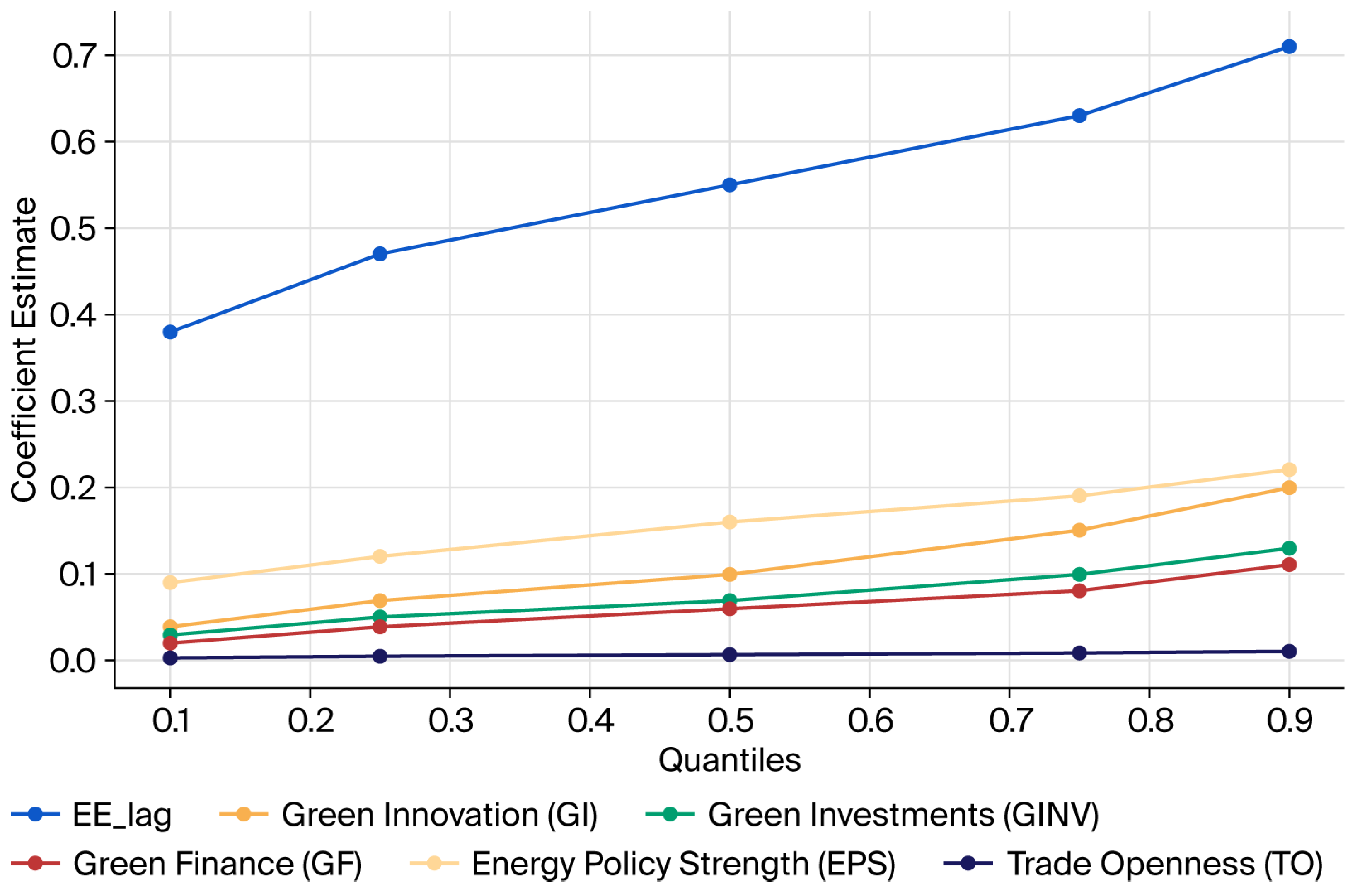
Table 8) factors is consistent with previous studies on the G20 countries. The energy intensity continuity factor increases from approximately 0.38 at lower quantiles to over 0.70 at higher quantiles, mainly due to the “success breeds success” effect in well-established countries. It has no effect at the lower quantiles, but its impact increases steadily at higher quantiles (0.04–0.20). The innovation threshold is essential to the benefits a developing country derives from innovation. The coefficients linking GINV and GF increase from 0.03 to 0.13 and from 0.02 to 0.11, respectively, suggesting that GINV and GF become more efficient in countries with developed institutional and financial systems. The EPS was the most significant factor across all (0–1) quantiles (0.9 to 0.22), highlighting the importance of a robust regulatory setup. However, the effect of trade openness is limited at lower quantiles, but gradually increases to 0.012 at higher quantiles, suggesting that trade openness increases efficiency in countries that use technology. Within the MMQR framework, quantiles represent relative positions within the conditional distribution of energy intensity, rather than being anchored to fixed country groupings. Due to the evolving nature of countries’ efficiency levels, assigning them permanently to quantiles would be inappropriate and would contradict the distributional principles underlying the method.
Figure 2 shows the estimated paths of the model variables and transactions across the 0.10, 0.25, 0.50, 0.75, and 0.90 quantiles and accurately indicates that energy intensity has the most significant impact, reducing energy intensity. The green patent intensity, GINV, and GF gradually increased across quantiles. EPS is constant and affects all levels continuously, whereas TO is weak at lower quantiles and increases progressively.
The FMOLS and DOLS estimates in
Table 9 indicate a strong long-run relationship between energy intensity in G20 countries and investment, green finance, energy policy, power, trade openness, and economic growth. This finding aligns with the most recent studies conducted across the G20 countries.
Consistent with both models, there is a positive and significant association between green patent intensity and transaction value (approximately 0.10–0.12), implying that ongoing innovations in clean technology and energy intensity gradually reduce energy intensity. Literature on efficiency and innovation supports this finding. Accordingly, cumulative knowledge and technology are instrumental in reducing energy intensity in output. GINV and GF also show positive functional effects; however, given their lower volume relative to energy policy, we interpret that capital expenditure will not have much impact on energy intensity. In contrast, green infrastructure and low-carbon project financing will help in the long run.
Evidence shows that finance and investment channels do not act quickly; they build a technological and institutional base that has an impact over time. Recent studies of green bonds and sustainable finance markets support this view. The results indicate that across the two model sets, EPS is the most powerful coefficient (0.16–0.18). The most significant long-term structural drivers are regulations and binding energy intensity standards. Laws, performance measures, environmental taxes, and regulation-related incentives drive corporations and consumers to behave in ways that foster investment and innovation climates for efficiency improvement.
This finding supports the idea that corporate and consumer behaviors can be aligned with approved sustainability outcomes through legislation, performance standards, environmental taxes, and regulatory incentives. This creates a climate for investment and innovation in efficiency techniques. Trade openness has a positive but limited influence, indicating that it can facilitate access to clean technology and knowledge, although its impact depends on the economy’s capacity to absorb it. It cannot rely solely on unqualified openness, especially in relatively small transactions; it also needs the right institutional, educational, and technological structures to convert trade into efficiency gains.
EG has a positive, energetic impact, even if small. According to the report, G20 growth, characterized by technological advancement, green investments, and robust energy policies, is associated with higher energy intensity. In contrast, expanding the use of fossil fuels may not yield the same benefits, indicating that the coefficient value is lower than that of GI and EPS.
These results suggest that the FMOLS and DOLS provide a medium-term view of the long-run mean association within the MMQR framework employed in this study. MMQR indicates that the effects are not uniform across the entire population. Both FMOLS and DOLS serve as robustness checks, reiterating average structural relationships. In contrast, MMQR shows robustness across quantiles, portraying the distributional depth of the results.
5. Discussion
The study shows that the relationship between green factors and energy intensity (measured by energy intensity, defined as total energy consumption divided by real GDP) in G20 economies is non-linear. The literature suggests that green transformation is associated with structural diversity and institutional readiness. When using the (MMQR) model, the effects of green innovation, investment, and finance increase from low to high quantiles, further strengthening the assumption of an institutional threshold, including that of [
36,
93]. In this context, the institutional threshold signifies the minimum level of regulatory quality and policy enforcement necessary for green innovation and finance to generate efficiency gains. For example, countries such as Germany and Japan demonstrate greater impacts at higher efficiency quantiles owing to more advanced institutional frameworks, whereas emerging G20 economies exhibit weaker effects where regulatory capacity is more limited.
Green innovation and finance only pay off when economies have the institutional and technological capacity to transform them into energy-efficient [
94,
95]. Our findings align with those of [
96,
97,
98] regarding the significance of financial and regulatory policies in increasing the contribution of innovation to better environmental performance. Moreover, this study concludes that innovation does not reduce emissions or improve efficiency without a sustained financial framework for energy policy.
The findings reveal that the impact of green innovation ranges from 0.04 in the lower quantiles to 0.20 in the upper quantiles, with similar results across OECD and BRICS countries. The trend in the EE continuity factor across quantiles indicates the strength of the cumulative effects in countries with a more technologically advanced structure, aligning with [
99,
100,
101], who find that countries achieving a high level of efficiency enter a self-improvement cycle that makes future improvements easier and yields higher returns than latecomers.
The researcher claims that the energy policy (EPS) is the most stable and impactful policy across all levels of efficiency, consistent with prior studies [
102,
103,
104]. These works described the regulatory framework as a necessary, but inadequate, condition for green transformation. While a regulatory framework does not guarantee green transformation, this condition must be met. The EPS effect is positive and significant across all quantiles (0.09–0.22), and the estimates are precise.
However, the impact of trade openness became more apparent at reduced energy intensity, consistent with theories of technology transfer channels [
105,
106,
107,
108], which state that technology transfer works only if economies can absorb foreign technologies. The increase in TO impact from 0.003 to 0.012 accurately reflects this dynamic. However, while research shows that economic growth directly improves energy intensity in emerging markets [
109,
110,
111,
112], our study suggests that the impact of growth across quantiles is weak and non-material. This indicates that G20 growth is sometimes driven more by high energy use than by technical advances or low-carbon transitions.
The nature of G20 economies, a mix of developed and emerging countries, might weaken the relationship between growth and efficiency observed in studies of less diverse groups. Our findings also differ from [
113], who indicate that green investment has a steady and significant impact across all development phases. According to the MMQR results, green investments have a negligible effect (0.03 in the lower quantiles, which only doubles to 0.13 in the upper quantiles). The disparity in the results may reflect differences between the G20 sample and those used in studies focused on developing economies with simpler financial structures [
114].
The FMOLS and DOLS estimates (
Table 9) show a strong long-term relationship between energy intensity in G20 economies and green patent intensity, investment, green finance, energy policy, power, trade openness, and economic growth, consistent with the latest applied studies on G20 economies.
In conclusion, the findings suggest that enhancements in energy intensity are predominantly influenced by structural and institutional factors rather than uniform policy interventions. The more significant effects of green innovation, green finance, and green investment at higher quantiles indicate that these mechanisms function through productivity-enhancing channels that necessitate a minimum level of institutional capacity and technological absorptive capability. Conversely, the consistent impact of energy policy across all quantiles signifies its role as a fundamental public good that influences incentives and mitigates uncertainty in energy markets. Trade openness predominantly contributes to efficiency improvements in more advanced economies, where integration into global markets enables access to cleaner technologies and facilitates knowledge spillovers. However, the results imply that energy intensity advancements follow a stage-dependent economic trajectory, in which policy effectiveness increases as economies progress toward higher productivity and institutional maturity. The findings indicate that energy intensity within G20 economies is predominantly influenced by productivity-enhancing mechanisms that are conditioned by institutional quality. The ascending influence of green innovation, green finance, and green investment at higher efficiency quantiles reflects improved capital allocation, reduced financial frictions, and enhanced technological absorptive capacity.
Unexpected coefficient signs may be attributed to heterogeneity among G20 subgroups. In resource-rich economies, economic growth often increases energy intensity as energy-intensive industries expand. Conversely, in innovation-frontier economies, growth is associated with efficiency improvements driven by technological advancements. These distinctions underscore the value of employing a quantile-based analytical approach.
Conversely, their diminished effects at lower quantiles signify the existence of binding institutional and market constraints. The consistent significance of energy policy across all quantiles emphasizes its role as a stabilizing economic instrument that mitigates uncertainty and sustains investment decisions. Furthermore, the positive impact of trade openness in higher-efficiency economies underscores the critical importance of technology dissemination and knowledge spillovers in fostering efficiency improvements.
6. Conclusions and Policy Implications
This study examined the determinants of energy intensity in G20 economies from 2000 to 2024 using the method of moments quantile regression (MMQR) to capture heterogeneous effects across the energy intensity distribution. By integrating green innovation, green finance, green investment, energy policy, and trade openness into a unified framework, the analysis accounts for cross-country differences in institutional and technological readiness.
The descriptive statistics for the G20 economies sample from 2000 to 2024 indicate significant variation in green transformation and energy intensity, as measured by energy intensity, across economies. The average green innovation level was 2.10 (0.20–4.30), whereas the average energy intensity was 1.75 (0.90–2.60), indicating a green patent intensity gap and heterogeneous energy intensity, respectively.
Economic growth also showed high volatility (2.80%), with a deviation of 2.10%, whereas green investments (1.25) and finance (1.90) showed sharp concentrations in a few countries. On average, trade openness was 65%, but there was a wide range (22–140%), mainly due to significant differences in technological viability across the countries in the group. This image improves conventional outcomes: unilateral root tests reveal that most variables are I(1), whereas the Westerlund test indicates robust cointegration, suggesting a long-term relationship between green variables and energy intensity. The G20 countries are subject to intense common trauma based on the CSD test result (Pesaran CD ≈ 8.5–12.0), while the inclination test confirms that relations have enormous variation across economies ( statistics ≈ 5 to 7).
The (MMQR) model results for manipulating the green factor indicate that the effect increases from the lower to the higher quantiles; the energy intensity reduces from 0.38. Q10 to 0.70 Q90, suggesting that high-performing countries are now harvesting higher cumulative returns. Specifically, the impact of green patent intensity rose from 0.04 to 0.20, green investment from 0.03 to 0.13, and green finance from 0.02 to 0.11, indicating a shift from low to high efficiency. The quality of energy policy has emerged as the most substantial covariate along the quantiles, with values ranging from 0.09 to 0.22.
However, this impact almost doubled in higher quantiles (≈0.012), indicating that the benefits of innovation, finance, and green investment primarily depend on reaching a certain level of institutional and technological capabilities; hence, the green shift in the G20 countries is not linear. Green finance is utilized only when the financial markets are sufficiently sophisticated, with energy policy serving as the most powerful influencer, as it secures a transition path and supports sustainability.
Thus, the findings have several significant policy implications for governments. Low-performing economies should, above all else, strengthen their energy regulatory frameworks, as energy policies clearly impact all outcomes. Medium-performing countries should broaden their financing and green investments through innovative financing tools, including green bonds and low-risk loans. High-performing countries should deepen their innovation and facilitate deeper technology transfer, and also create an environment that enables green factors to translate into higher productivity and greater efficiency. The results indicate that trade liberalization in clean technology can increase efficiency when domestic absorptive capacity is present. Moreover, the findings suggest that low-efficiency economies should improve regulations and energy governance; intermediate ones should boost green finance and invest in clean technology; and high-efficiency economies should advance green innovation and spread technologies for lasting efficiency.
The quantile-specific policy implications can be illustrated with concrete examples. For low-efficiency G20 economies, the results imply prioritizing regulatory reform and strengthening energy governance to reduce energy intensity. In contrast, high-efficiency economies should focus on deepening green innovation and technology diffusion to sustain marginal efficiency improvements.
The analysis demonstrates that green initiatives within G20 economies rely on sustained cooperation among innovation, markets, and policy. Achieving success necessitates aligning these components through policies customized to each nation’s energy profile. Effective strategies must address structural inequalities and enhance institutional and financial capacities. Policymakers should tailor efficiency strategies to specific national contexts: implementing stricter regulations in low-efficiency economies, increasing green finance in medium-efficiency economies, and emphasizing innovation in high-efficiency economies, while ensuring policy consistency over time.
Limitations and Future Research
This study has several limitations. It relies on macro-level indicators that may mask sectoral and firm-level differences in energy intensity. Although the sample period includes several global crises, the analysis focuses on long-run distributional effects, with common time effects capturing broad structural shifts rather than explicitly modeling structural breaks. Data availability and cross-country comparability also limit the use of other efficiency metrics, such as carbon-adjusted total factor energy intensity, across the G20 period. Although the marginal quantile regression (MMQR) framework accounts for distributional heterogeneity, it does not explicitly capture feedback or spillover effects across countries. Furthermore, potential geopolitical shocks are not explicitly modeled, as the analysis focuses on long-run structural drivers of energy intensity, with common time effects capturing broader global disturbances.
Future research should include sectoral or micro-level data, develop short-term or country-specific carbon-adjusted efficiency measures, and apply dynamic or spatial econometric models. Exploring nonlinear relationships among green finance, innovation, and institutional quality could also deepen understanding of energy intensity transitions during development.